
Articles | Volume 26, issue 4
https://doi.org/10.5194/acp-26-3091-2026
© Author(s) 2026. This work is distributed under
the Creative Commons Attribution 4.0 License.
the Creative Commons Attribution 4.0 License.
Collection:
https://doi.org/10.5194/acp-26-3091-2026
© Author(s) 2026. This work is distributed under
the Creative Commons Attribution 4.0 License.
the Creative Commons Attribution 4.0 License.
Research article
| 
27 Feb 2026
Research article |
| 27 Feb 2026
| 27 Feb 2026
Unexpected enhancement of new particle formation by lactic acid sulfate resulting from SO3 loss in forested and agricultural regions
Rui Wang
Shaanxi Key Laboratory of Catalysis, School of Chemical & Environment Science, Shaanxi University of Technology, Hanzhong, Shaanxi 723001, China
Shuqin Wei
Shaanxi Key Laboratory of Catalysis, School of Chemical & Environment Science, Shaanxi University of Technology, Hanzhong, Shaanxi 723001, China
Zeyao Li
Shaanxi Key Laboratory of Catalysis, School of Chemical & Environment Science, Shaanxi University of Technology, Hanzhong, Shaanxi 723001, China
Kaiyu Xue
Shaanxi Key Laboratory of Catalysis, School of Chemical & Environment Science, Shaanxi University of Technology, Hanzhong, Shaanxi 723001, China
Rui Bai
Shaanxi Key Laboratory of Catalysis, School of Chemical & Environment Science, Shaanxi University of Technology, Hanzhong, Shaanxi 723001, China
Tianlei Zhang
CORRESPONDING AUTHOR

Shaanxi Key Laboratory of Catalysis, School of Chemical & Environment Science, Shaanxi University of Technology, Hanzhong, Shaanxi 723001, China
Related authors
Chengyan Zhang, Guanhua Wang, Xiaokai Guo, Yaogeng Li, Xueping Feng, Yuan Zuo, and Rui Wang
EGUsphere, https://doi.org/10.5194/egusphere-2026-3682, https://doi.org/10.5194/egusphere-2026-3682, 2026
Short summary
Short summary
In this work, NSA formation from SO3 + HNO3 was studied using quantum chemistry + ACDC. The reaction has a 3.61 kcal·mol-1 barrier and competes with SO3 sinks (HCOOH, C6H5COOH, NH3, H2O). NSA enhances interactions, lowers free energies, stabilizing SA–A clusters. ACDC shows SA–A nucleation up to ~10-3 cm-3 s-1 (278 .15K), ~5 orders above binary. NSA contribution increases with concentration and is stronger than HNO3.
Xiaokai Guo, Yaogeng Li, Rui Su, Yanlong Yang, Xueping Feng, Guane Wang, Yuan Zuo, Rui Wang, and Tianlei Zhang
EGUsphere, https://doi.org/10.5194/egusphere-2026-2831, https://doi.org/10.5194/egusphere-2026-2831, 2026
Short summary
Short summary
Benzoic sulfuric anhydride is a potential precursor to atmospheric new particle formation. We used calculations and kinetic modeling to investigate how it forms and influences sulfuric acid-amine particle formation. It forms readily in the gas phase and is a previously unrecognized sulfur-containing species that stabilizes molecular clusters more effectively than benzoic acid. Thus, it promotes particle formation in polluted cities and helps explain why these events occur so frequently.
Rongrong Li, Zeyao Li, Chengyan Zhang, Rui Wang, Jihuan Yang, Heran Cui, Xuanye Li, Nini Huo, and Tianlei Zhang
Atmos. Chem. Phys., 26, 3867–3880, https://doi.org/10.5194/acp-26-3867-2026, https://doi.org/10.5194/acp-26-3867-2026, 2026
Short summary
Short summary
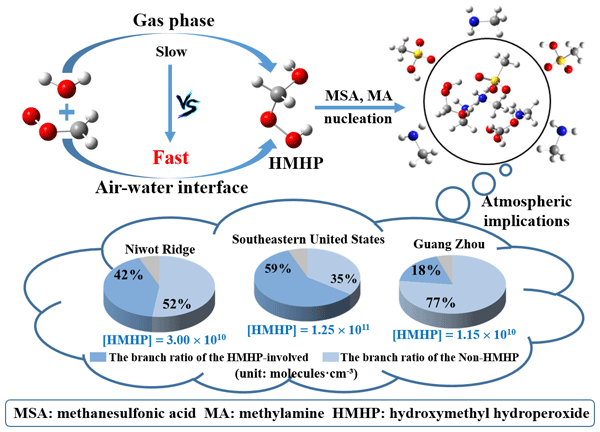
This study investigates the formation of hydroxymethyl hydroperoxide (HMHP) through methanesulfonic acid (MSA)-catalyzed hydrolysis of CH2OO in the gas phase and at the air-water interface. HMHP forms rapidly and stably in both environments. Further analysis shows that HMHP enhances the stability of MSA-methylamine (MA) clusters and highlights HMHP's key role in MSA-MA-HMHP nucleation, especially in urban and forested regions.
Rui Wang, Rongrong Li, Shasha Chen, Ruxue Mu, Changming Zhang, Xiaohui Ma, Majid Khan, and Tianlei Zhang
Atmos. Chem. Phys., 25, 5695–5709, https://doi.org/10.5194/acp-25-5695-2025, https://doi.org/10.5194/acp-25-5695-2025, 2025
Short summary
Short summary
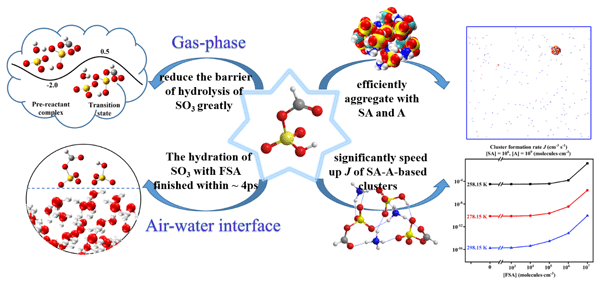
Gaseous results indicated that SO3 hydrolysis with formic sulfuric anhydride (FSA) has a Gibbs free energy barrier as low as 1.5 kcal mol-1 and can effectively compete with other SO3 hydrolysis. Interfacial BOMD (Born–Oppenheimer molecular dynamics) simulations illustrated that FSA-mediated SO3 hydrolysis at the gas–liquid interface occurs through a stepwise mechanism and can be completed within a few picoseconds. ACDC (Atmospheric Clusters Dynamics Code) kinetic simulations indicated that FSA significantly enhances cluster formation rates in the H2SO4–NH3 system.
Hui Wang, Shuqin Wei, Jihuan Yang, Yanlong Yang, Rongrong Li, Rui Wang, Chongqin Zhu, Tianlei Zhang, and Changming Zhang
Atmos. Chem. Phys., 25, 2829–2844, https://doi.org/10.5194/acp-25-2829-2025, https://doi.org/10.5194/acp-25-2829-2025, 2025
Short summary
Short summary
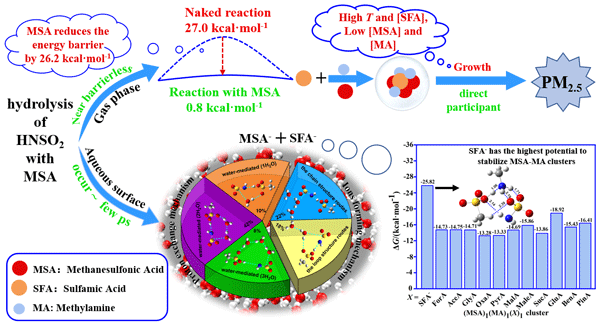
In the gaseous reaction, the activation energy for the hydrolysis of HNSO2 catalyzed by MSA was only 0.8 kcal mol−1. Atmospheric Cluster Dynamic Code kinetic simulations disclosed that sulfamic acid markedly enhances the assembly of a methanesulfonic acid–methylamine-based cluster. At the air–water interface, the NH2SO3− and H3O+ ion formation mechanism and the proton exchange mechanism were observed.
Rui Wang, Yang Cheng, Shasha Chen, Rongrong Li, Yue Hu, Xiaokai Guo, Tianlei Zhang, Fengmin Song, and Hao Li
Atmos. Chem. Phys., 24, 4029–4046, https://doi.org/10.5194/acp-24-4029-2024, https://doi.org/10.5194/acp-24-4029-2024, 2024
Short summary
Short summary
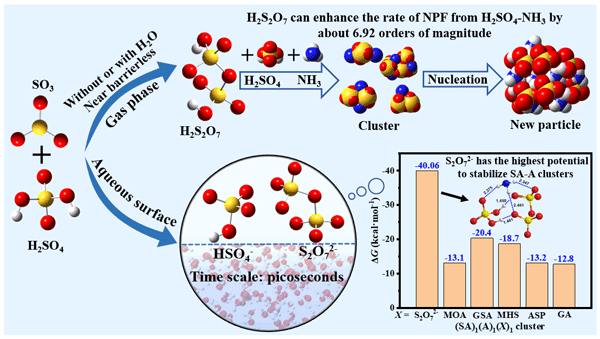
We used quantum chemical calculations, Born–Oppenheimer molecular dynamics simulations, and the ACDC kinetic model to characterize SO3–H2SO4 interaction in the gas phase and at the air–water interface and to study the effect of H2S2O7 on H2SO4–NH3-based clusters. The work expands our understanding of new pathways for the loss of SO3 in acidic polluted areas and helps reveal some missing sources of NPF in metropolitan industrial regions and understand the atmospheric organic–sulfur cycle better.
Guanhua Wang, Chengyan Zhang, Xiaokai Guo, Rui Su, Xintong Cai, Yuan Zuo, and Tianlei Zhang
EGUsphere, https://doi.org/10.5194/egusphere-2026-3408, https://doi.org/10.5194/egusphere-2026-3408, 2026
This preprint is open for discussion and under review for Atmospheric Chemistry and Physics (ACP).
Short summary
Short summary
Nitric acid affects air pollution, acid rain, and climate-related particle formation. Using atmospheric dynamics, we found that water greatly accelerates nitric acid formation, especially at water surfaces. We also found that nitric acid promotes the growth of airborne particles by attracting water and stabilizing small molecular clusters.
Chengyan Zhang, Guanhua Wang, Xiaokai Guo, Yaogeng Li, Xueping Feng, Yuan Zuo, and Rui Wang
EGUsphere, https://doi.org/10.5194/egusphere-2026-3682, https://doi.org/10.5194/egusphere-2026-3682, 2026
Short summary
Short summary
In this work, NSA formation from SO3 + HNO3 was studied using quantum chemistry + ACDC. The reaction has a 3.61 kcal·mol-1 barrier and competes with SO3 sinks (HCOOH, C6H5COOH, NH3, H2O). NSA enhances interactions, lowers free energies, stabilizing SA–A clusters. ACDC shows SA–A nucleation up to ~10-3 cm-3 s-1 (278 .15K), ~5 orders above binary. NSA contribution increases with concentration and is stronger than HNO3.
Xiaokai Guo, Yaogeng Li, Rui Su, Yanlong Yang, Xueping Feng, Guane Wang, Yuan Zuo, Rui Wang, and Tianlei Zhang
EGUsphere, https://doi.org/10.5194/egusphere-2026-2831, https://doi.org/10.5194/egusphere-2026-2831, 2026
Short summary
Short summary
Benzoic sulfuric anhydride is a potential precursor to atmospheric new particle formation. We used calculations and kinetic modeling to investigate how it forms and influences sulfuric acid-amine particle formation. It forms readily in the gas phase and is a previously unrecognized sulfur-containing species that stabilizes molecular clusters more effectively than benzoic acid. Thus, it promotes particle formation in polluted cities and helps explain why these events occur so frequently.
Rongrong Li, Zeyao Li, Chengyan Zhang, Rui Wang, Jihuan Yang, Heran Cui, Xuanye Li, Nini Huo, and Tianlei Zhang
Atmos. Chem. Phys., 26, 3867–3880, https://doi.org/10.5194/acp-26-3867-2026, https://doi.org/10.5194/acp-26-3867-2026, 2026
Short summary
Short summary
This study investigates the formation of hydroxymethyl hydroperoxide (HMHP) through methanesulfonic acid (MSA)-catalyzed hydrolysis of CH2OO in the gas phase and at the air-water interface. HMHP forms rapidly and stably in both environments. Further analysis shows that HMHP enhances the stability of MSA-methylamine (MA) clusters and highlights HMHP's key role in MSA-MA-HMHP nucleation, especially in urban and forested regions.
Rui Wang, Rongrong Li, Shasha Chen, Ruxue Mu, Changming Zhang, Xiaohui Ma, Majid Khan, and Tianlei Zhang
Atmos. Chem. Phys., 25, 5695–5709, https://doi.org/10.5194/acp-25-5695-2025, https://doi.org/10.5194/acp-25-5695-2025, 2025
Short summary
Short summary
Gaseous results indicated that SO3 hydrolysis with formic sulfuric anhydride (FSA) has a Gibbs free energy barrier as low as 1.5 kcal mol-1 and can effectively compete with other SO3 hydrolysis. Interfacial BOMD (Born–Oppenheimer molecular dynamics) simulations illustrated that FSA-mediated SO3 hydrolysis at the gas–liquid interface occurs through a stepwise mechanism and can be completed within a few picoseconds. ACDC (Atmospheric Clusters Dynamics Code) kinetic simulations indicated that FSA significantly enhances cluster formation rates in the H2SO4–NH3 system.
Hui Wang, Shuqin Wei, Jihuan Yang, Yanlong Yang, Rongrong Li, Rui Wang, Chongqin Zhu, Tianlei Zhang, and Changming Zhang
Atmos. Chem. Phys., 25, 2829–2844, https://doi.org/10.5194/acp-25-2829-2025, https://doi.org/10.5194/acp-25-2829-2025, 2025
Short summary
Short summary
In the gaseous reaction, the activation energy for the hydrolysis of HNSO2 catalyzed by MSA was only 0.8 kcal mol−1. Atmospheric Cluster Dynamic Code kinetic simulations disclosed that sulfamic acid markedly enhances the assembly of a methanesulfonic acid–methylamine-based cluster. At the air–water interface, the NH2SO3− and H3O+ ion formation mechanism and the proton exchange mechanism were observed.
Rui Wang, Yang Cheng, Shasha Chen, Rongrong Li, Yue Hu, Xiaokai Guo, Tianlei Zhang, Fengmin Song, and Hao Li
Atmos. Chem. Phys., 24, 4029–4046, https://doi.org/10.5194/acp-24-4029-2024, https://doi.org/10.5194/acp-24-4029-2024, 2024
Short summary
Short summary
We used quantum chemical calculations, Born–Oppenheimer molecular dynamics simulations, and the ACDC kinetic model to characterize SO3–H2SO4 interaction in the gas phase and at the air–water interface and to study the effect of H2S2O7 on H2SO4–NH3-based clusters. The work expands our understanding of new pathways for the loss of SO3 in acidic polluted areas and helps reveal some missing sources of NPF in metropolitan industrial regions and understand the atmospheric organic–sulfur cycle better.
Cited articles
Anderson, J. O., Thundiyil, J. G., and Stolbach, A.: Clearing the air: a review of the effects of particulate matter air pollution on human health, J. Med. Toxicol., 8, 166–175, 2012.
Brean, J., Beddows, D. C. S., Shi, Z., Temime-Roussel, B., Marchand, N., Querol, X., Alastuey, A., Minguillón, M. C., and Harrison, R. M.: Molecular insights into new particle formation in Barcelona, Spain, Atmos. Chem. Phys., 20, 10029–10045, https://doi.org/10.5194/acp-20-10029-2020, 2020.
Brüggemann, M., Poulain, L., Held, A., Stelzer, T., Zuth, C., Richters, S., Mutzel, A., van Pinxteren, D., Iinuma, Y., Katkevica, S., Rabe, R., Herrmann, H., and Hoffmann, T.: Real-time detection of highly oxidized organosulfates and BSOA marker compounds during the F-BEACh 2014 field study, Atmos. Chem. Phys., 17, 1453–1469, https://doi.org/10.5194/acp-17-1453-2017, 2017.
Cai, R., Yan, C., Yang, D., Yin, R., Lu, Y., Deng, C., Fu, Y., Ruan, J., Li, X., Kontkanen, J., Zhang, Q., Kangasluoma, J., Ma, Y., Hao, J., Worsnop, D. R., Bianchi, F., Paasonen, P., Kerminen, V.-M., Liu, Y., Wang, L., Zheng, J., Kulmala, M., and Jiang, J.: Sulfuric acid–amine nucleation in urban Beijing, Atmos. Chem. Phys., 21, 2457–2468, https://doi.org/10.5194/acp-21-2457-2021, 2021.
Chen, S. S., Li, R. R., Zhang, C. Y., Wei, S. Q., Wang, R., Chu, B. W., Zhang, X. M., Li, H., and Zhang, T. L.: The enhanced role of formic acid on sulfuric acid-ammonia-driven nucleation in forest regions and polluted city areas, J. Environ. Sci., 160, 621–628, 2025.
Cheng, Y., Wang, R., Chen, Y., Tian, S., Gao, N., Zhang, Z., and Zhang, T.: Hydrolysis of SO3 in small clusters of sulfuric acid: mechanistic and kinetic study, ACS Earth and Space Chemistry, 6, 3078–3089, 2022.
Dai, L., Zhao, Y., Zhang, L., Chen, D., and Wu, R.: Particle number size distributions and formation and growth rates of different new particle formation types of a megacity in China, J. Environ. Sci., 131, 11–25, 2023.
Darer, A. I., Cole-Filipiak, N. C., O'Connor, A. E., and Elrod, M. J.: Formation and stability of atmospherically relevant isoprene-derived organosulfates and organonitrates, Environ. Sci. Technol., 45, 1895–1902, 2011.
Ding, J., Zhao, P., Su, J., Dong, Q., Du, X., and Zhang, Y.: Aerosol pH and its driving factors in Beijing, Atmos. Chem. Phys., 19, 7939–7954, https://doi.org/10.5194/acp-19-7939-2019, 2019.
Faloona, I., Conley, S. A., Blomquist, B., Clarke, A. D., Kapustin, V., Howell, S., Lenschow, D. H., and Bandy, A. R.: Sulfur dioxide in the tropical marine boundary layer: dry deposition and heterogeneous oxidation observed during the pacific atmospheric sulfur experiment, J. Atmos. Chem., 63, 13–32, 2009.
Froyd, K. D., Murphy, S. M., Murphy, D. M., de Gouw, J. A., Eddingsaas, N. C., and Wennberg, P. O.: Contribution of isoprene-derived organosulfates to free tropospheric aerosol mass, P. Natl. Acad. Sci. USA, 107, 21360–21365, 2010a.
Glasius, M., Hansen, A. M. K., Claeys, M., Henzing, B., Jedyńska, A., Kasper-Giebl, A., Kistler, M., Kristensen, K., Martinsson, J., Maenhaut, W., Nøjgaard, J., Spindler, G., Stenström, K., Swietlicki, E., Szidat, S., Simpson, D., and Yttri, K. E.: Composition and sources of carbonaceous aerosols in Northern Europe during winter, Atmos. Environ., 173, 127–141, 2017.
Glowacki, D. R., Liang, C. H., Morley, C., Pilling, M. J., and Robertson, S. H.: MESMER: an open-source master equation solver for multi-energy well reactions, J. Phys. Chem. A, 116, 9545–9560, 2012.
Hazra, M. K. and Sinha, A.: Formic acid catalyzed hydrolysis of SO3 in the gas phase: a barrierless mechanism for sulfuric acid production of potential atmospheric importance, J. Am. Chem. Soc., 133, 17444–17453, 2011.
Hettiyadura, A. P. S., Jayarathne, T., Baumann, K., Goldstein, A. H., de Gouw, J. A., Koss, A., Keutsch, F. N., Skog, K., and Stone, E. A.: Qualitative and quantitative analysis of atmospheric organosulfates in Centreville, Alabama, Atmos. Chem. Phys., 17, 1343–1359, https://doi.org/10.5194/acp-17-1343-2017, 2017.
Hirsikko, A., Nieminen, T., Gagné, S., Lehtipalo, K., Manninen, H. E., Ehn, M., Hõrrak, U., Kerminen, V.-M., Laakso, L., McMurry, P. H., Mirme, A., Mirme, S., Petäjä, T., Tammet, H., Vakkari, V., Vana, M., and Kulmala, M.: Atmospheric ions and nucleation: a review of observations, Atmos. Chem. Phys., 11, 767–798, https://doi.org/10.5194/acp-11-767-2011, 2011.
Hodshire, A. L., Campuzano-Jost, P., Kodros, J. K., Croft, B., Nault, B. A., Schroder, J. C., Jimenez, J. L., and Pierce, J. R.: The potential role of methanesulfonic acid (MSA) in aerosol formation and growth and the associated radiative forcings, Atmos. Chem. Phys., 19, 3137–3160, https://doi.org/10.5194/acp-19-3137-2019, 2019.
Horváth, G., Horváth, I., Almousa, S. A. D., and Telek, M.: Numerical inverse laplace transformation using concentrated matrix exponential distributions, Performance Evaluation, 137, 102067, https://doi.org/10.1016/j.peva.2019.102067, 2020.
Hratchian, H. P. and Schlegel, H. B.: Using hessian updating to increase the efficiency of a hessian based predictor-corrector reaction path following method, J. Chem. Theory Comput. 1, 61–69, 2005.
Huang, H. L., Chao, W., and Lin, J. J. M.: Kinetics of a Criegee intermediate that would survive high humidity and may oxidize atmospheric SO2, P. Natl. Acad. Sci. USA, 112, 10857–10862, 2015.
Kanellopoulos, P. G., Kotsaki, S. P., Chrysochou, E., Koukoulakis, K., Zacharopoulos, N., Philippopoulos, A., and Bakeas, E.: PM2.5-bound organosulfates in two Eastern Mediterranean cities: The dominance of isoprene organosulfates, Chemosphere, 297, 134103, https://doi.org/10.1016/j.chemosphere.2022.134103, 2022.
Kirkby, J., Curtius, J., Almeida, J., Dunne, E., Duplissy, J., Ehrhart, S., Franchin, A., Gagné, S., Ickes, L., Kürten, A., Kupc, A., Metzger, A., Riccobono, F., Rondo, L., Schobesberger, S., Tsagkogeorgas, G., Wimmer, D., Amorim, A., Bianchi, F., Breitenlechner, M., David, A., Dommen, J., Downard, A., Ehn, M., Flagan, R. C., Haider, S., Hansel, A., Hauser, D., Jud, W., Junninen, H., Kreissl, F., Kvashin, A., Laaksonen, A., Lehtipalo, K., Lima, J., Lovejoy, E. R., Makhmutov, V., Mathot, S., Mikkilä, J., Minginette, P., Mogo, S., Nieminen, T., Onnela, A., Pereira, P., Petäjä, T., Schnitzhofer, R., Seinfeld, J. H., Sipilä, M., Stozhkov, Y., Stratmann, F., Tomé, A., Vanhanen, J., Viisanen, Y., Vrtala, A., Wagner, P. E., Walther, H., Weingartner, E., Wex, H., Winkler, P. M., Carslaw, K. S., Worsnop, D. R., Baltensperger, U., and Kulmala, M.: Role of sulphuric acid, ammonia and galactic cosmic rays in atmospheric aerosol nucleation, Nature, 476, 429–433, 2011.
Klippenstein, S. J. and Marcus, R. A.: Unimolecular reaction rate theory for highly flexible transition states.2.Conventional coordinate formulas for the various possible fragment combinations: miscellaneous topics, J. Phys. Chem. C., 92, 5412–5417, 1988.
Kulmala, M., Vehkamäki, H., Petäjä, T., Dal Maso, M., Lauri, A., Kerminen, V. M., Birmili, W., and McMurry, P. H.: Formation and growth rates of ultrafine atmospheric particles: a review of observations, Aerosol Sci., 35, 143–176, 2004.
Kundu, S., Quraishi, T. A., Yu, G., Suarez, C., Keutsch, F. N., and Stone, E. A.: Evidence and quantitation of aromatic organosulfates in ambient aerosols in Lahore, Pakistan, Atmos. Chem. Phys., 13, 4865–4875, https://doi.org/10.5194/acp-13-4865-2013, 2013.
Kurtén, T., Loukonen, V., Vehkamäki, H., and Kulmala, M.: Amines are likely to enhance neutral and ion-induced sulfuric acid-water nucleation in the atmosphere more effectively than ammonia, Atmos. Chem. Phys., 8, 4095–4103, https://doi.org/10.5194/acp-8-4095-2008, 2008.
Lee, S. H., Gordon, H., Yu, H., Lehtipalo, K., Haley, R., Li, Y., and Zhang, R.: New particle formation in the atmosphere: from molecular clusters to global climate, J. Geophys. Res.-Atmos., 124, 7098–7146, 2019.
Li, D., Chen, D., Liu, F., and Wang, W.: Role of glycine on sulfuric acid-ammonia clusters formation: Transporter or participator, J. Environ. Sci., 89, 125–135, 2020.
Li, H., Kupiainen-Määttä, O., Zhang, H., Zhang, X., and Ge, M.: A molecular-scale study on the role of lactic acid in new particle formation: Influence of relative humidity and temperature, Atmos. Environ., 166, 479–487, 2017.
Li, H., Zhong, J., Vehkamäki, H., Kurtén, T., Wang, W., Ge, M., Zhang, S., Li, Z., Zhang, X., Francisco, J. S., and Zeng, X. C.: Self-catalytic reaction of SO3 and NH3 to produce sulfamic acid and its implication to atmospheric particle formation, J. Am. Chem. Soc., 140, 11020–11028, 2018a.
Li, J., Tsona, N. T., and Du, L.: Effect of a single water molecule on the HO2+ ClO reaction, Phys. Chem. Chem. Phys., 20, 10650–10659, 2018b.
Li, J., Ning, A., Liu, L., and Zhang, X.: Atmospheric bases enhanced iodic acid nucleation: altitude-dependent characteristics and molecular mechanisms, Environ. Sci. Technol., 58, 16962–16973, 2024.
Liu, L., Zhong, J., Vehkamäki, H., Kurtén, T., Du, L., Zhang, X., Francisco, J. S., and Zeng, X. C.: Unexpected quenching effect on new particle formation from the atmospheric reaction of methanol with SO3, P. Natl. Acad. Sci. USA, 116, 24966–24971, 2019.
Liu, L., Yu, F., Du, L., Yang, Z., Francisco, J. S., and Zhang, X.: Rapid sulfuric acid-dimethylamine nucleation enhanced by nitric acid in polluted regions, P. Natl. Acad. Sci. USA, 118, e2108384118, https://doi.org/10.1073/pnas.2108384118, 2021.
Long, B., Chang, C. R., Long, Z. W., Wang, Y. B., Tan, X. F., and Zhang, W. J.: Nitric acid catalyzed hydrolysis of SO3 in the formation of sulfuric acid: a theoretical study, Chem. Phys. Lett., 581, 26–29, 2013.
Lu, T. and Chen, F.: Multiwfn: a multifunctional wavefunction analyzer, J. Comput. Chem, 33, 580–592, 2012.
Lu, Y., Liu, L., Ning, A., Gan, Y., Liu, Y., Kurtén, T., Vehkamäki, H., and Wang, L.: Atmospheric sulfuric acid-dimethylamine nucleation enhanced by trifluoroacetic acid, Geophys. Res. Lett., 47, https://doi.org/10.1029/2019GL085627, 2020.
Lund, M. T., Myhre, G., and Samset, B. H.: Anthropogenic aerosol forcing under the Shared Socioeconomic Pathways, Atmos. Chem. Phys., 19, 13827–13839, https://doi.org/10.5194/acp-19-13827-2019, 2019.
Luo, X. S., Tang, A. H., Shi, K., Wu, L. H., Li, W. Q., Shi, W. Q., Shi, X. K., Erisman, J. W., Zhang, F. S., and Liu, X. J.: Chinese coastal seas are facing heavy atmospheric nitrogen deposition, Environ. Res. Lett., 9, https://doi.org/10.1088/1748-9326/9/9/095007, 2014.
Lv, G., Sun, X., Zhang, C., and Li, M.: Understanding the catalytic role of oxalic acid in SO3 hydration to form H2SO4 in the atmosphere, Atmos. Chem. Phys., 19, 2833–2844, https://doi.org/10.5194/acp-19-2833-2019, 2019.
Ma, F., Xie, H. B., Elm, J., Shen, J., Chen, J., and Vehkamäki, H.: Piperazine enhancing sulfuric acid-based new particle formation: implications for the atmospheric fate of piperazine, Environ. Sci. Technol., 53, 8785–8795, 2019.
Mai, T. V., Duong, M. V., Nguyen, H. T., and Huynh, L. K.: Ab initio kinetics of the HOSO2+3O2→ SO3+ HO2 reaction, Phys. Chem. Chem. Phys., 20, 6677–6687, 2018.
Mochizuki, T., Kawamura, K., Nakamura, S., Kanaya, Y., and Wang, Z.: Enhanced levels of atmospheric low-molecular weight monocarboxylic acids in gas and particulates over Mt. Tai, North China, during field burning of agricultural wastes, Atmos. Environ., 171, 237–247, 2017.
Mochizuki, T., Kawamura, K., Miyazaki, Y., Kunwar, B., and Boreddy, S. K. R.: Distributions and sources of low-molecular-weight monocarboxylic acids in gas and particles from a deciduous broadleaf forest in northern Japan, Atmos. Chem. Phys., 19, 2421–2432, https://doi.org/10.5194/acp-19-2421-2019, 2019.
Mutzel, A., Poulain, L., Berndt, T., Iinuma, Y., Rodigast, M., Böge, O., Richters, S., Spindler, G., Sipilä, M., Jokinen, T., Kulmala, M., and Herrmann, H.: Highly oxidized multifunctional organic compounds observed in tropospheric particles: a field and laboratory study, Environ. Sci. Technol., 49, 7754–7761, 2015.
Neese, F.: The ORCA program system, WIREs Computational Molecular Science, 2, 73–78, 2012.
O'Dowd, C. D., Hämeri, K., Mäkelä, J. M., Pirjola, L., Kulmala, M., Jennings, S. G., Berresheim, H., Hansson, H. C., de Leeuw, G., Kunz, G. J., Allen, A. G., Hewitt, C. N., Jackson, A., Viisanen, Y., and Hoffmann, T.: A dedicated study of New Particle Formation and Fate in the Coastal Environment (PARFORCE): Overview of objectives and achievements, J. Geophys. Res.-Atmos., 107, https://doi.org/10.1029/2001JD000555, 2002.
Olson, C. N., Galloway, M. M., Yu, G., Hedman, C. J., Lockett, M. R., Yoon, T., Stone, E. A., Smith, L. M., and Keutsch, F. N.: Hydroxycarboxylic acid-derived organosulfates: synthesis, stability, and quantification in ambient aerosol, Environ. Sci. Technol., 45, 6468–6474, 2011.
Partanen, L., Vehkamäki, H., Hansen, K., Elm, J., Henschel, H., Kurtén, T., Halonen, R., and Zapadinsky, E.: Effect of conformers on free energies of atmospheric complexes, J. Phys. Chem. A, 120, 8613–8624, 2016.
Ristovski, Z. D., Suni, T., Kulmala, M., Boy, M., Meyer, N. K., Duplissy, J., Turnipseed, A., Morawska, L., and Baltensperger, U.: The role of sulphates and organic vapours in growth of newly formed particles in a eucalypt forest, Atmos. Chem. Phys., 10, 2919–2926, https://doi.org/10.5194/acp-10-2919-2010, 2010.
Riva, M., Tomaz, S., Cui, T., Lin, Y.-H., Perraudin, E., Gold, A., Stone, E. A., Villenave, E., and Surratt, J. D.: Evidence for an unrecognized secondary anthropogenic source of organosulfates and sulfonates: gas-phase oxidation of polycyclic aromatic hydrocarbons in the presence of sulfate aerosol, Environ. Sci. Technol., 49, 6654–6664, 2015.
Rong, H., Liu, J. R., Zhang, Y. J., Du, L., Zhang, X., and Li, Z.: Nucleation mechanisms of iodic acid in clean and polluted coastal regions, Chemosphere, 253, 126743–126752, 2020a.
Rong, H., Liu, L., Liu, J., and Zhang, X.: Glyoxylic sulfuric anhydride from the gas-phase reaction between Glyoxylic Acid and SO3: A potential nucleation precursor, J. Phys. Chem. A, 124, 3261–3268, 2020b.
Shampine, L. F. and Reichelt, M. W.: The MATLAB ode suite, SIAM Journal on Scientific Computing, 18, 1–22, 1997.
Shen, J., Xie, H.-B., Elm, J., Ma, F., Chen, J., and Vehkamäki, H.: Methanesulfonic Acid-driven new particle formation enhanced by monoethanolamine: A computational study, Environ. Sci. Technol., 53, 14387–14397, 2019.
Shen, J., Elm, J., Xie, H. B., Chen, J., Niu, J., and Vehkamäki, H.: Structural effects of amines in enhancing methanesulfonic acid-driven new particle formation, Environ. Sci. Technol., 54, 13498–13508, 2020.
Sipilä, M., Sarnela, N., Jokinen, T., Henschel, H., Junninen, H., Kontkanen, J., Richters, S., Kangasluoma, J., Franchin, A., Peräkylä, O., Rissanen, M. P., Ehn, M., Vehkamäki, H., Kurten, T., Berndt, T., Petäjä, T., Worsnop, D., Ceburnis, D., Kerminen, V.-M., Kulmala, M., and O'Dowd, C.: Molecular-scale evidence of aerosol particle formation via sequential addition of HIO3, Nature, 537, 532–534, 2016.
Smith, C. J., Huff, A. K., Ward, R. M., and Leopold, K. R.: Carboxylic sulfuric anhydrides, J. Phys. Chem. A, 124, 601–612, 2020.
Stewart, J. J.: Optimization of parameters for semiempirical methods V: modification of NDDO approximations and application to 70 elements, J. Mol. Model., 13, 1173–1213, 2007.
Sun, H., Liu, Y., Nie, W., Li, Y., Ge, D., Xu, T., Yin, J., Liu, C., Fu, Z., Qi, X., Liu, T., Zha, Q., Yan, C., Wang, Z., Chi, X., and Ding, A.: Unexpected gas-Phase formation of Glycolic Acid Sulfate in the atmosphere, Environ. Sci. Technol., 59, 16556–16566, 2025.
Tan, S., Zhang, X., Lian, Y., Chen, X., Yin, S., Du, L., and Ge, M.: OH group orientation leads to organosulfate formation at the liquid aerosol surface, J. Am. Chem. Soc., 144, 16953–16964, 2022.
Tan, X. F., Long, B., Ren, D. S., Zhang, W. J., Long, Z. W., and Mitchell, E.: Atmospheric chemistry of CH3CHO: the hydrolysis of CH3CHO catalyzed by H2SO4, Phys. Chem. Chem. Phys., 20, 7701–7709, 2018.
Tan, X. F., Zhang, L., and Long, B.: New mechanistic pathways for the formation of organosulfates catalyzed by ammonia and carbinolamine formation catalyzed by sulfuric acid in the atmosphere, Phys. Chem. Chem. Phys., 22, 8800–8807, 2020.
Tsona Tchinda, N., Du, L., Liu, L., and Zhang, X.: Pyruvic acid, an efficient catalyst in SO3 hydrolysis and effective clustering agent in sulfuric-acid-based new particle formation, Atmos. Chem. Phys., 22, 1951–1963, https://doi.org/10.5194/acp-22-1951-2022, 2022.
Walker, M., Harvey, A. J. A., Sen, A., and Dessent, C. E. H.: Performance of M06, M06-2X, and M06-HF density functionals for conformationally flexible anionic clusters: M06 functionals perform better than B3LYP for a model system with dispersion and ionic hydrogen-bonding interactions, J. Phys. Chem. A., 117, 12590–12600, 2013.
Wang, R., Li, R., Chen, S., Mu, R., Zhang, C., Ma, X., Khan, M., and Zhang, T.: Enhancing SO3 hydrolysis and nucleation: the role of formic sulfuric anhydride, Atmos. Chem. Phys., 25, 5695–5709, https://doi.org/10.5194/acp-25-5695-2025, 2025.
Wang, Y., Hu, M., Guo, S., Wang, Y., Zheng, J., Yang, Y., Zhu, W., Tang, R., Li, X., Liu, Y., Le Breton, M., Du, Z., Shang, D., Wu, Y., Wu, Z., Song, Y., Lou, S., Hallquist, M., and Yu, J.: The secondary formation of organosulfates under interactions between biogenic emissions and anthropogenic pollutants in summer in Beijing, Atmos. Chem. Phys., 18, 10693–10713, https://doi.org/10.5194/acp-18-10693-2018, 2018.
Wang, Z. B., Hu, M., Yue, D. L., Zheng, J., Zhang, R. Y., Wiedensohler, A., Wu, Z. J., Nieminen, T., and Boy, M.: Evaluation on the role of sulfuric acid in the mechanisms of new particle formation for Beijing case, Atmos. Chem. Phys., 11, 12663–12671, https://doi.org/10.5194/acp-11-12663-2011, 2011.
Wardlaw, D. M. and Marcus, R. A.: RRKM reaction rate theory for transition states of any looseness, Chem. Phys. Lett., 110, 230–234, 1984.
Wu, S., Dai, L. H., Wei, Y., Zhu, H., Zhang, Y. J., Schwab, J., and Yuan, C. S.: Atmospheric ammonia measurements along the coastal lines of Southeastern China: Implications for inorganic nitrogen deposition to coastal waters, Atmos. Environ., 177, 1–11, 2017.
Xing, Y. F., Xu, Y. H., Shi, M. H., and Lian, Y. X.: The impact of PM2.5 on the human respiratory system, J. Thorac. Dis., 8, 69–74, 2016.
Yang, Y., Liu, L., Wang, H., and Zhang, X.: Molecular-scale mechanism of sequential reaction of oxalic acid with SO3: potential participator in atmospheric aerosol nucleation, J. Phys. Chem. A, 125, 4200–4208, 2021.
Yao, L., Garmash, O., Bianchi, F., Zheng, J., Yan, C., Kontkanen, J., Junninen, H., Mazon, S. B., Ehn, M., Paasonen, P., Sipilä, M., Wang, M., Wang, X., Xiao, S., Chen, H., Lu, Y., Zhang, B., Wang, D., Fu, Q., Geng, F., Li, L., Wang, H., Qiao, L., Yang, X., Chen, J., Kerminen, V. M., Petäjä, T., Worsnop, D. R., Kulmala, M., and Wang, L.: Atmospheric new particle formation from sulfuric acid and amines in a Chinese megacity, Science, 361, 278–281, 2018.
Yao, L., Fan, X., Yan, C., Kurtén, T., Daellenbach, K. R., Li, C., Wang, Y., Guo, Y., Dada, L., Rissanen, M. P., Cai, J., Tham, Y. J., Zha, Q., Zhang, S., Du, W., Yu, M., Zheng, F., Zhou, Y., Kontkanen, J., Chan, T., Shen, J., Kujansuu, J. T., Kangasluoma, J., Jiang, J., Wang, L., Worsnop, D. R., Petäjä, T., Kerminen, V. M., Liu, Y., Chu, B., He, H., Kulmala, M., and Bianchi, F.: Unprecedented ambient sulfur trioxide (SO3) detection: possible formation mechanism and atmospheric implications, Environ. Sci. Technol., 7, 809–818, 2020.
Yin, R., Yan, C., Cai, R., Li, X., Shen, J., Lu, Y., Schobesberger, S., Fu, Y., Deng, C., Wang, L., Liu, Y., Zheng, J., Xie, H., Bianchi, F., Worsnop, D. R., Kulmala, M., and Jiang, J.: Acid-base clusters during atmospheric new particle formation in urban Beijing, Environ. Sci. Technol., 55, 10994–11005, 2021.
Zhang, H., Worton, D. R., Lewandowski, M., Ortega, J., Rubitschun, C. L., Park, J.-H., Kristensen, K., Campuzano-Jost, P., Day, D. A., Jimenez, J. L., Jaoui, M., Offenberg, J. H., Kleindienst, T. E., Gilman, J., Kuster, W. C., de Gouw, J., Park, C., Schade, G. W., Frossard, A. A., Russell, L., Kaser, L., Jud, W., Hansel, A., Cappellin, L., Karl, T., Glasius, M., Guenther, A., Goldstein, A. H., Seinfeld, J. H., Gold, A., Kamens, R. M., and Surratt, J. D.: Organosulfates as tracers for secondary organic aerosol (SOA) formation from 2-Methyl-3-Buten-2-ol (MBO) in the atmosphere, Environ. Sci. Technol., 46, 9437–9446, 2012a.
Zhang, H., Kupiainen-Määttä, O., Molinero, V., Zhang, Y., and Li, Z.: The enhancement mechanism of glycolic acid on the formation of atmospheric sulfuric acid-ammonia molecular clusters, J. Chem. Phys., 146, 184308, https://doi.org/10.1063/1.4982929, 2017.
Zhang, H., Li, H., Liu, L., Zhang, Y., Zhang, X., and Li, Z.: The potential role of malonic acid in the atmospheric sulfuric acid-ammonia clusters formation, Chemosphere, 203, 26–33, 2018.
Zhang, H., Gao, R., Li, H., Li, Y., Xu, Y., and Chai, F.: Formation mechanism of typical aromatic sulfuric anhydrides and their potential role in atmospheric nucleation process, J. Environ. Sci., 123, 54–64, 2023a.
Zhang, H., Wang, W., Fan, L., Li, J., Ren, Y., Li, H., Gao, R., and Xu, Y.: The role of sulfur cycle in new particle formation: Cycloaddition reaction of SO3 to H2S, J. Environ. Sci., 148, 489–501, 2025.
Zhang, J. and Dolg, M.: Global optimization of clusters of rigid molecules using the artificial bee colony algorithm, Phys. Chem. Chem. Phys., 18, 3003–3010, 2016.
Zhang, Q., Wang, Y., Liu, M., Zheng, M., Yuan, L., Liu, J., Tao, S., and Wang, X.: Wintertime formation of large sulfate particles in China and implications for human health, Environ. Sci. Technol., 57, 20010–20023, 2023b.
Zhang, R., Khalizov, A., Wang, L., Hu, M., and Xu, W.: Nucleation and growth of nanoparticles in the atmosphere, Chem. Rev., 112, 1957–2011, 2012b.
Zhang, R., Wang, G., Guo, S., Zamora, M. L., Ying, Q., Lin, Y., Wang, W., Hu, M., and Wang, Y.: Formation of urban fine particulate matter, Chem. Rev., 115, 3803–3855, 2015.
Zhang, X., Lian, Y., Tan, S., and Yin, S.: Organosulfate produced from consumption of SO3 speeds up sulfuric acid–dimethylamine atmospheric nucleation, Atmos. Chem. Phys., 24, 3593–3612, https://doi.org/10.5194/acp-24-3593-2024, 2024.
Zhao, B., Donahue, N. M., Zhang, K., Mao, L., Shrivastava, M., Ma, P.-L., Shen, J., Wang, S., Sun, J., Gordon, H., Tang, S., Fast, J., Wang, M., Gao, Y., Yan, C., Singh, B., Li, Z., Huang, L., Lou, S., Lin, G., Wang, H., Jiang, J., Ding, A., Nie, W., Qi, X., Chi, X., and Wang, L.: Global variability in atmospheric new particle formation mechanisms, Nature, 631, 98–105, 2024.
Zheng, B., Tong, D., Li, M., Liu, F., Hong, C., Geng, G., Li, H., Li, X., Peng, L., Qi, J., Yan, L., Zhang, Y., Zhao, H., Zheng, Y., He, K., and Zhang, Q.: Trends in China's anthropogenic emissions since 2010 as the consequence of clean air actions, Atmos. Chem. Phys., 18, 14095–14111, https://doi.org/10.5194/acp-18-14095-2018, 2018.
Zu, H., Zhang, S., Li, S., Liu, L., and Zhang, X.: The synergistic nucleation of iodous acid and sulfuric acid: A vital mechanism in polluted marine regions, Atmos. Environ., 318, 120266, https://doi.org/10.1016/j.atmosenv.2023.120266, 2024a.
Zu, H., Zhang, S., and Liu, L.: The vital role of sulfuric acid in iodine oxoacids nucleation: impacts of urban pollutants on marine atmosphere, Environ. Res. Lett., 19, https://doi.org/10.1088/1748-9326/ad193f, 2024b.
Short summary
This study investigates the atmospheric formation of lactic acid sulfate and its role in new particle formation, with implications for air quality and climate. The results show that lactic acid sulfate enhances particle cluster stability and promotes new particle formation, particularly in forested and agricultural regions. These findings highlight the important role of organic compounds like lactic acid sulfate in particle formation, offering insights for mitigating haze and health risks.
This study investigates the atmospheric formation of lactic acid sulfate and its role in new...


Altmetrics
Final-revised paper
Preprint