
Articles | Volume 26, issue 22
https://doi.org/10.5194/acp-26-16821-2026
© Author(s) 2026. This work is distributed under
the Creative Commons Attribution 4.0 License.
https://doi.org/10.5194/acp-26-16821-2026
© Author(s) 2026. This work is distributed under
the Creative Commons Attribution 4.0 License.
Research article
| 
24 Nov 2026
Research article |
| 24 Nov 2026
Southern Hemisphere sudden stratospheric warmings continue to be relevant under global warming

Research Division 1, Marine Meteorology, GEOMAR – Helmholtz Center for Ocean Research Kiel, Kiel, Germany
Pia Undine Rethmeier
Research Division 1, Marine Meteorology, GEOMAR – Helmholtz Center for Ocean Research Kiel, Kiel, Germany
Faculty of Mathematics and Natural Sciences, Christian-Albrechts Universität Kiel, Kiel, Germany
Wenjuan Huo
Research Division 1, Marine Meteorology, GEOMAR – Helmholtz Center for Ocean Research Kiel, Kiel, Germany
Sebastian Wahl
Research Division 1, Marine Meteorology, GEOMAR – Helmholtz Center for Ocean Research Kiel, Kiel, Germany
Robin Pilch Kedzierski
Department of Meteorology and Geophysics, Universität Wien, Vienna, Austria
Related authors
Flossie Brown, Sabine Bischof, Brodie Pearson, Aditya Sengupta, Pauline Bonnet, Swen Brands, Jayasankar C.B., James Carruthers, Marion Devilliers, F. Feba, Mehmet Sedat Gözlet, Saurabh Kelkar, Sifan A. Koriche, Michael Lai, Andre Lanfer Marquez, Xiaohan Sally Li, Yiwen Li, Abhnil Prasad, Angelica R. Rodriguez, Serena Schroeter, Gopika Suresh, and Rebecca Varney
EGUsphere, https://doi.org/10.5194/egusphere-2026-3510, https://doi.org/10.5194/egusphere-2026-3510, 2026
Short summary
Short summary
The Coupled Model Intercomparison Project (CMIP) creates simulations of the Earth and climate, but its representation of many features are imperfect. In this review, we show how these biases are connected across the atmosphere, land and ocean and discuss current understanding of their causes and effects. In addition, we provide a perspective on the modelling advances expected in CMIP7 aimed at end users, those new to CMIP data and those looking to connect different aspects of the Earth system.

Tobias Spiegl, Ulrike Langematz, Wenjuan Huo, Jürgen Kröger, Thomas Reddmann, Franziska Kappenberger, Sebastian Wahl, Maryam Ramezani Ziarani, Holger Pohlmann, and Miriam Sinnhuber
Earth Syst. Dynam., 17, 1703–1718, https://doi.org/10.5194/esd-17-1703-2026, https://doi.org/10.5194/esd-17-1703-2026, 2026
Short summary
Short summary
The SOLCHECK (Solar Contribution to Climate Change on Decadal to Centennial Timescales) project studied how fluctuations in Sun’s energy output affect weather and climate. Key results are: Strong solar storms can deplete ozone thus raising surface irradiance. Impacts of the 11-year solar cycle depend on stratospheric dynamics. Long-term Grand Solar Minima leave fingerprints in past and future climate states. The large model ensemble explored in SOLCHECK helped to separate various solar effects from human-driven change and advanced our knowledge of climate feedbacks.
Andebo Waza, Konrad Kandler, Franz Kanngießer, Julia Gottschall, Arne Leuzinger, Simon Speith, Natalia Sudarchikova, Sebastian Wahl, Wirginia Hepert, and Stephanie Fiedler
Earth Syst. Sci. Data Discuss., https://doi.org/10.5194/essd-2026-733, https://doi.org/10.5194/essd-2026-733, 2026
Manuscript not accepted for further review
Short summary
Short summary
Originating from North Africa, mineral dust, which is one of the most abundant aerosol types in the Earth’s atmosphere, is frequently transported across the Atlantic Ocean. To observe these dust transport different instruments, which provide information on both near-surface dust and lofted dust plumes, were deployed during two research cruises between January and March 2025 in the Atlantic Ocean. The presented data allows us to address existing knowledge gaps in trans-Atlantic dust transport.
Norman Julius Steinert, Kirsten Zickfeld, Benjamin Mark Sanderson, Charles D. Koven, Nadine Mengis, Pia Rethmeier, and Jörg Schwinger
EGUsphere, https://doi.org/10.5194/egusphere-2026-5338, https://doi.org/10.5194/egusphere-2026-5338, 2026
Short summary
Short summary
As 1.5°C pathways increasingly rely on temperature overshoot, this Perspective examines whether climate overshoot-induced effects can be reversed. We synthesize what drives climate reversibility in positive and negative emission pathways, proposing a typology of temperature responses beyond simple (ir)reversible categories. Current climate models suggest irreversible responses cannot be ruled out, underscoring the need for more nuanced assessment of overshoot-based mitigation risks.
Chaim I. Garfinkel, David Avisar, Wenjuan Huo, Ales Kuchar, Shoshiro Minobe, Scott Osprey, Katharina Perny, and Jonathon S. Wright
EGUsphere, https://doi.org/10.5194/egusphere-2026-3738, https://doi.org/10.5194/egusphere-2026-3738, 2026
Short summary
Short summary
Whether tropical volcanic eruptions lead to a circulation response in winter is still unclear. We re-evaluate this effect using large ensembles from eight separate models with only one time-varying external forcing: volcanic aerosols. We find that 75 % of models simulate the previously proposed effect, but that the signal requires at least 30 eruptions before it emerges robustly from the noise. Furthermore, we demonstrate that the El Niño signal differs from natural El Niño events.
Flossie Brown, Sabine Bischof, Brodie Pearson, Aditya Sengupta, Pauline Bonnet, Swen Brands, Jayasankar C.B., James Carruthers, Marion Devilliers, F. Feba, Mehmet Sedat Gözlet, Saurabh Kelkar, Sifan A. Koriche, Michael Lai, Andre Lanfer Marquez, Xiaohan Sally Li, Yiwen Li, Abhnil Prasad, Angelica R. Rodriguez, Serena Schroeter, Gopika Suresh, and Rebecca Varney
EGUsphere, https://doi.org/10.5194/egusphere-2026-3510, https://doi.org/10.5194/egusphere-2026-3510, 2026
Short summary
Short summary
The Coupled Model Intercomparison Project (CMIP) creates simulations of the Earth and climate, but its representation of many features are imperfect. In this review, we show how these biases are connected across the atmosphere, land and ocean and discuss current understanding of their causes and effects. In addition, we provide a perspective on the modelling advances expected in CMIP7 aimed at end users, those new to CMIP data and those looking to connect different aspects of the Earth system.
Tobias Spiegl, Norel Rimbu, Franziska Kappenberger, Xiaojie Hao, Wenjuan Huo, Stephan Thober, Ulrike Langematz, and Gerrit Lohmann
EGUsphere, https://doi.org/10.5194/egusphere-2026-3630, https://doi.org/10.5194/egusphere-2026-3630, 2026
Short summary
Short summary
Natural solar signals are not fixed in time. During past centennial-scale solar minima, reduced solar activity promoted summer heavy precipitation through coupled changes in ozone, sea ice and storm tracks. In a warmer future climate, this pathway weakens, showing that anthropogenic warming can reshape how natural forcings translate into regional weather extremes.
Mona Zolghadrshojaee, Susann Tegtmeier, Sean M. Davis, Robin Pilch Kedzierski, and Leopold Haimberger
Atmos. Chem. Phys., 25, 12213–12232, https://doi.org/10.5194/acp-25-12213-2025, https://doi.org/10.5194/acp-25-12213-2025, 2025
Short summary
Short summary
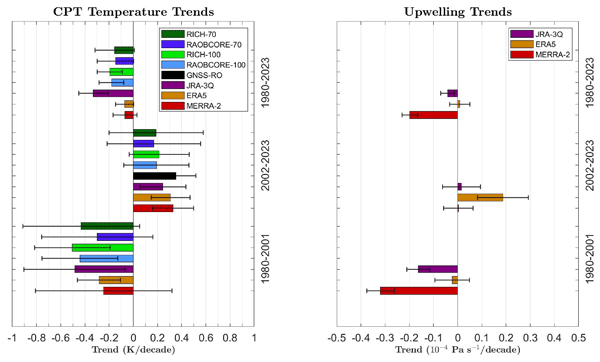
The tropical tropopause layer (TTL) is a crucial region where the troposphere transitions into the stratosphere, influencing air mass transport. This study examines temperature trends in the TTL and lower stratosphere using data from weather balloons, satellites and reanalysis datasets. We found cooling trends in the TTL from 1980 to 2001, followed by warming from 2002 to 2023. These shifts are linked to changes in atmospheric circulation and impact water vapour transport into the stratosphere.
Wenjuan Huo, Tobias Spiegl, Sebastian Wahl, Katja Matthes, Ulrike Langematz, Holger Pohlmann, and Jürgen Kröger
Atmos. Chem. Phys., 25, 2589–2612, https://doi.org/10.5194/acp-25-2589-2025, https://doi.org/10.5194/acp-25-2589-2025, 2025
Short summary
Short summary
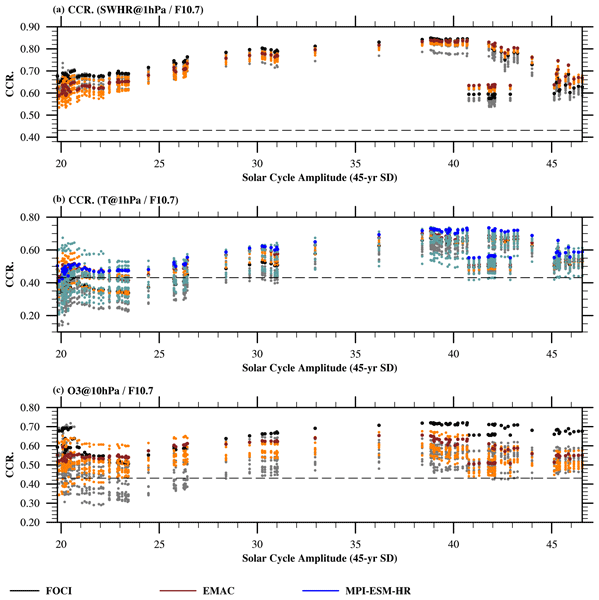
Uncertainties of the solar signals in the middle atmosphere are assessed based on large ensemble simulations with multiple climate models. Our results demonstrate that the 11-year solar signals in the shortwave heating rate, temperature, and ozone anomalies are significant and robust. The simulated dynamical responses are model-dependent, and solar imprints in the polar night jet are influenced by biases in the model used.
Mona Zolghadrshojaee, Susann Tegtmeier, Sean M. Davis, and Robin Pilch Kedzierski
Atmos. Chem. Phys., 24, 7405–7419, https://doi.org/10.5194/acp-24-7405-2024, https://doi.org/10.5194/acp-24-7405-2024, 2024
Short summary
Short summary
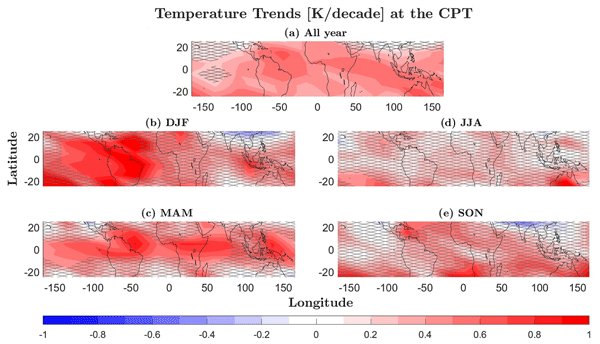
Satellite data challenge the idea of an overall cooling trend in the tropical tropopause layer. From 2002 to 2022, a warming trend was observed, diverging from earlier findings. Tropopause height changes indicate dynamic processes alongside radiative effects. Upper-tropospheric warming contrasts with lower-stratosphere temperatures. The study highlights the complex interplay of factors shaping temperature trends.
Tabea Rahm, Robin Pilch Kedzierski, Martje Hänsch, and Katja Matthes
EGUsphere, https://doi.org/10.5194/egusphere-2024-667, https://doi.org/10.5194/egusphere-2024-667, 2024
Preprint archived
Short summary
Short summary
Sudden Stratospheric Warmings (SSWs) are extreme wintertime events that can impact surface weather. However, a distinct surface response is not observed for every SSW. Here, we classify SSWs that do and do not impact the troposphere in ERA5 reanalysis data. In addition, we evaluate the effects of two kinds of waves: planetary and synoptic-scale. Our findings emphasize that the lower stratosphere and synoptic-scale waves play crucial roles in coupling the SSW signal to the surface.
Abhishek Savita, Joakim Kjellsson, Robin Pilch Kedzierski, Mojib Latif, Tabea Rahm, Sebastian Wahl, and Wonsun Park
Geosci. Model Dev., 17, 1813–1829, https://doi.org/10.5194/gmd-17-1813-2024, https://doi.org/10.5194/gmd-17-1813-2024, 2024
Short summary
Short summary
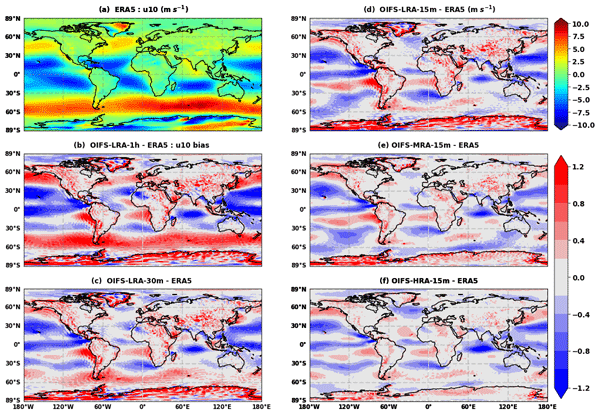
The OpenIFS model is used to examine the impact of horizontal resolutions (HR) and model time steps. We find that the surface wind biases over the oceans, in particular the Southern Ocean, are sensitive to the model time step and HR, with the HR having the smallest biases. When using a coarse-resolution model with a shorter time step, a similar improvement is also found. Climate biases can be reduced in the OpenIFS model at a cheaper cost by reducing the time step rather than increasing the HR.
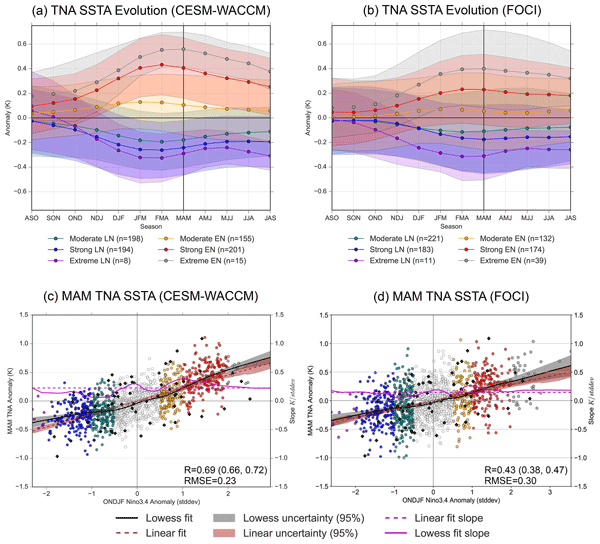
Jake W. Casselman, Joke F. Lübbecke, Tobias Bayr, Wenjuan Huo, Sebastian Wahl, and Daniela I. V. Domeisen
Weather Clim. Dynam., 4, 471–487, https://doi.org/10.5194/wcd-4-471-2023, https://doi.org/10.5194/wcd-4-471-2023, 2023
Short summary
Short summary
El Niño–Southern Oscillation (ENSO) has remote effects on the tropical North Atlantic (TNA), but the connections' nonlinearity (strength of response to an increasing ENSO signal) is not always well represented in models. Using the Community Earth System Model version 1 – Whole Atmosphere Community Climate Mode (CESM-WACCM) and the Flexible Ocean and Climate Infrastructure version 1, we find that the TNA responds linearly to extreme El Niño but nonlinearly to extreme La Niña for CESM-WACCM.
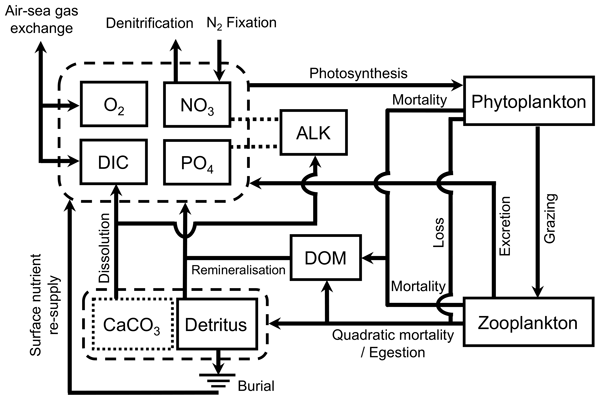
Chia-Te Chien, Jonathan V. Durgadoo, Dana Ehlert, Ivy Frenger, David P. Keller, Wolfgang Koeve, Iris Kriest, Angela Landolfi, Lavinia Patara, Sebastian Wahl, and Andreas Oschlies
Geosci. Model Dev., 15, 5987–6024, https://doi.org/10.5194/gmd-15-5987-2022, https://doi.org/10.5194/gmd-15-5987-2022, 2022
Short summary
Short summary
We present the implementation and evaluation of a marine biogeochemical model, Model of Oceanic Pelagic Stoichiometry (MOPS) in the Flexible Ocean and Climate Infrastructure (FOCI) climate model. FOCI-MOPS enables the simulation of marine biological processes, the marine carbon, nitrogen and oxygen cycles, and air–sea gas exchange of CO2 and O2. As shown by our evaluation, FOCI-MOPS shows an overall adequate performance that makes it an appropriate tool for Earth climate system simulations.

Annika Drews, Wenjuan Huo, Katja Matthes, Kunihiko Kodera, and Tim Kruschke
Atmos. Chem. Phys., 22, 7893–7904, https://doi.org/10.5194/acp-22-7893-2022, https://doi.org/10.5194/acp-22-7893-2022, 2022
Short summary
Short summary
Solar irradiance varies with a period of approximately 11 years. Using a unique large chemistry–climate model dataset, we investigate the solar surface signal in the North Atlantic and European region and find that it changes over time, depending on the strength of the solar cycle. For the first time, we estimate the potential predictability associated with including realistic solar forcing in a model. These results may improve seasonal to decadal predictions of European climate.
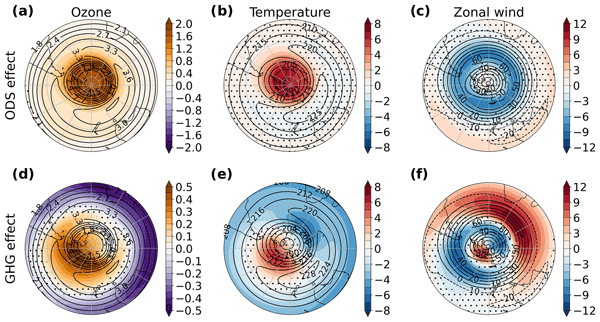
Ioana Ivanciu, Katja Matthes, Arne Biastoch, Sebastian Wahl, and Jan Harlaß
Weather Clim. Dynam., 3, 139–171, https://doi.org/10.5194/wcd-3-139-2022, https://doi.org/10.5194/wcd-3-139-2022, 2022
Short summary
Short summary
Greenhouse gas concentrations continue to increase, while the Antarctic ozone hole is expected to recover during the twenty-first century. We separate the effects of ozone recovery and of greenhouse gases on the Southern Hemisphere atmospheric and oceanic circulation, and we find that ozone recovery is generally reducing the impact of greenhouse gases, with the exception of certain regions of the stratosphere during spring, where the two effects reinforce each other.
Cited articles
Baldwin, M. P. and Dunkerton, T. J.: Stratospheric harbingers of anomalous weather regimes, Science (New York, N. Y.), 294, 581–4, https://doi.org/10.1126/science.1063315, 2001. a
Baldwin, M. P., Ayarzagüena, B., Birner, T., Butchart, N., Butler, A. H., Charlton-Perez, A. J., Domeisen, D. I. V., Garfinkel, C. I., Garny, H., Gerber, E. P., Hegglin, M. I., Langematz, U., and Pedatella, N. M.: Sudden Stratospheric Warmings, Rev. Geophys., 59, 1–37, https://doi.org/10.1029/2020RG000708, 2021. a
Bischof, S., Pilch Kedzierski, R., and Wahl, S.: Bischof et al. 2025 – Southern Hemisphere Sudden Stratospheric Warmings Continue to Be Relevant Under Global Warming, Zenodo [data set], https://doi.org/10.5281/zenodo.16876611, 2025. a
Brovkin, V., Raddatz, T., Reick, C. H., Claussen, M., and Gayler, V.: Global biogeophysical interactions between forest and climate, Geophys. Res. Lett., 36, 1–5, https://doi.org/10.1029/2009GL037543, 2009. a
Butler, A. H., Seidel, D. J., Hardiman, S. C., Butchart, N., Birner, T., and Match, A.: Defining Sudden Stratospheric Warmings, B. Am. Meteorol. Soc., 96, 1913–1928, https://doi.org/10.1175/BAMS-D-13-00173.1, iSBN: 6038621628, 2015. a, b
Butler, A. H., Sjoberg, J. P., Seidel, D. J., and Rosenlof, K. H.: A sudden stratospheric warming compendium, Earth Syst. Sci. Data, 9, 63–76, https://doi.org/10.5194/essd-9-63-2017, 2017. a, b
Charlton, A. J. and Polvani, L. M.: A New Look at Stratospheric Sudden Warmings. Part I: Climatology and Modeling Benchmarks, J. Climate, 20, 449–469, https://doi.org/10.1175/JCLI3996.1, 2007. a, b
Charlton, A. J., O'Neill, A., Lahoz, W. A., Massacand, A. C., and Berrisford, P.: The impact of the stratosphere on the troposphere during the southern hemisphere stratospheric sudden warming, September 2002, Q. J, Roy. Meteor. Soc., 131, 2171–2188, https://doi.org/10.1256/qj.04.43, 2005. a
Charney, J. G. and Drazin, P. G.: Propagation of planetary-scale disturbances from the lower into the upper atmosphere, J. Geophys. Res., 66, 83–109, https://doi.org/10.1029/JZ066i001p00083, 1961. a, b
Chipperfield, M. P., Santee, M. L., Alexander, S. P., de Laat, A. T. J., Kinnison, D. E., Kuttippurath, J., Langematz, U., and Wargan, K.: Polar stratospheric ozone: Past, present, and future, in: Scientific assessment of ozone depletion: 2022, GAW report, , number: 278 Section: 4, p. 509, World Meteorological Organization, Geneva, Switzerland, https://csl.noaa.gov/assessments/ozone/2022/downloads/Chapter4_2022OzoneAssessment.pdf (last access: 20 November 2026), 2022. a
Dennison, F. W., McDonald, A. J., and Morgenstern, O.: The effect of ozone depletion on the Southern Annular Mode and stratosphere-troposphere coupling, J. Geophys. Res.-Atmos., 120, 1–8, https://doi.org/10.1002/2014JD023009, 2015. a
Eyring, V., Cionni, I., Bodeker, G. E., Charlton-Perez, A. J., Kinnison, D. E., Scinocca, J. F., Waugh, D. W., Akiyoshi, H., Bekki, S., Chipperfield, M. P., Dameris, M., Dhomse, S., Frith, S. M., Garny, H., Gettelman, A., Kubin, A., Langematz, U., Mancini, E., Marchand, M., Nakamura, T., Oman, L. D., Pawson, S., Pitari, G., Plummer, D. A., Rozanov, E., Shepherd, T. G., Shibata, K., Tian, W., Braesicke, P., Hardiman, S. C., Lamarque, J. F., Morgenstern, O., Pyle, J. A., Smale, D., and Yamashita, Y.: Multi-model assessment of stratospheric ozone return dates and ozone recovery in CCMVal-2 models, Atmos. Chem. Phys., 10, 9451–9472, https://doi.org/10.5194/acp-10-9451-2010, 2010. a
Feng, K., Rao, J., Garfinkel, C. I., Butler, A. H., Jie, W., Wu, T., Hitchcock, P., Lim, E.-P., Dowdy, A. J., and Seviour, W.: Can stratospheric nudging improve surface predictability? Insights from the 2019 Southern Hemisphere sudden stratospheric warming, npj Clim. Atmos. Sci., 8, 353, https://doi.org/10.1038/s41612-025-01234-2, 2025. a, b
Garden, P. U.: Southern hemisphere sudden stratospheric warmings in the ECHAM6 model, Bachelor Thesis, CAU Kiel, https://oceanrep.geomar.de/id/eprint/56573 (last access: 20 November 2026), 2022. a
Gillett, N. P. and Thompson, D. W. J.: Simulation of Recent Southern Hemisphere Climate Change, Science, 302, 273–275, https://doi.org/10.1126/science.1087440, iSBN: 1094-4281, 2003. a
Gillett, N. P., Kell, T. D., and Jones, P. D.: Regional climate impacts of the Southern Annular Mode, Geophys. Res. Lett., 33, L23704, https://doi.org/10.1029/2006GL027721, 2006. a, b, c
Haase, S., Fricke, J., Kruschke, T., Wahl, S., and Matthes, K.: Sensitivity of the Southern Hemisphere circumpolar jet response to Antarctic ozone depletion: prescribed versus interactive chemistry, Atmos. Chem. Phys., 20, 14043–14061, https://doi.org/10.5194/acp-20-14043-2020, 2020. a
Hawkins, E. and Sutton, R.: The Potential to Narrow Uncertainty in Regional Climate Predictions, B. Am. Meteorol. Soc., 90, 1095–1108, https://doi.org/10.1175/2009BAMS2607.1, 2009. a
Hendon, H. H., Lim, E. P., and Abhik, S.: Impact of Interannual Ozone Variations on the Downward Coupling of the 2002 Southern Hemisphere Stratospheric Warming, J. Geophys. Res.-Atmos., 125, 1–16, https://doi.org/10.1029/2020JD032952, 2020. a
Hersbach, H., Bell, B., Berrisford, P., Hirahara, S., Horányi, A., Muñoz-Sabater, J., Nicolas, J., Peubey, C., Radu, R., Schepers, D., Simmons, A., Soci, C., Abdalla, S., Abellan, X., Balsamo, G., Bechtold, P., Biavati, G., Bidlot, J., Bonavita, M., De Chiara, G., Dahlgren, P., Dee, D., Diamantakis, M., Dragani, R., Flemming, J., Forbes, R., Fuentes, M., Geer, A., Haimberger, L., Healy, S., Hogan, R. J., Hólm, E., Janisková, M., Keeley, S., Laloyaux, P., Lopez, P., Lupu, C., Radnoti, G., de Rosnay, P., Rozum, I., Vamborg, F., Villaume, S., and Thépaut, J. N.: The ERA5 global reanalysis, Q. J, Roy. Meteor. Soc., 146, 1999–2049, https://doi.org/10.1002/qj.3803, 2020. a, b
Hirota, I., Kuroi, K., and Shiotani, M.: Midwinter warmings in the southern hemisphere stratosphere in 1988, Q. J, Roy. Meteor. Soc., 116, 929–941, https://doi.org/10.1002/qj.49711649407, 1990. a
Intergovernmental Panel on Climate Change (IPCC): Climate Change 2021 – The Physical Science Basis: Working Group I Contribution to the Sixth Assessment Report of the Intergovernmental Panel on Climate Change, Cambridge University Press, Cambridge, UK and New York, NY, USA, ISBN 978-1-009-15789-6, https://doi.org/10.1017/9781009157896, 2023. a
Ivanciu, I., Matthes, K., Wahl, S., Harlaß, J., and Biastoch, A.: Effects of prescribed CMIP6 ozone on simulating the Southern Hemisphere atmospheric circulation response to ozone depletion, Atmos. Chem. Phys., 21, 5777–5806, https://doi.org/10.5194/acp-21-5777-2021, 2021. a
Ivanciu, I., Matthes, K., Biastoch, A., Wahl, S., and Harlaß, J.: Twenty-first-century Southern Hemisphere impacts of ozone recovery and climate change from the stratosphere to the ocean, Weather Clim. Dynam., 3, 139–171, https://doi.org/10.5194/wcd-3-139-2022, 2022a. a, b
Ivanciu, I., Ndarana, T., Matthes, K., and Wahl, S.: On the Ridging of the South Atlantic Anticyclone Over South Africa: The Impact of Rossby Wave Breaking and of Climate Change, Geophys. Res. Lett., 49, https://doi.org/10.1029/2022GL099607, 2022b. a, b
Kanzawa, H. and Kawaguchi, S.: Large stratospheric sudden warming in Antarctic late winter and shallow ozone hole in 1988, Geophys. Res. Lett., 17, 77–80, https://doi.org/10.1029/GL017i001p00077, 1990. a
Krüger, K., Naujokat, B., and Labitzke, K.: The Unusual Midwinter Warming in the Southern Hemisphere Stratosphere 2002: A Comparison to Northern Hemisphere Phenomena, J. Atmos. Sci., 62, 603–613, https://doi.org/10.1175/JAS-3316.1, iSBN: 0-408-70652-X, 2005. a
Kwon, H., Choi, H., Kim, B.-M., Kim, S.-W., and Kim, S.-J.: Recent weakening of the southern stratospheric polar vortex and its impact on the surface climate over Antarctica, Environ. Res. Lett., 15, 094072, https://doi.org/10.1088/1748-9326/ab9d3d, 2020. a, b, c
Labitzke, K.: Interannual Variability of the Winter Stratosphere in the Northern Hemisphere, Mon. Weather Rev., 105, 762–770, https://doi.org/10.1175/1520-0493(1977)105<0762:IVOTWS>2.0.CO;2, 1977. a
Labitzke, K.: Stratospheric-mesospheric midwinter disturbances: A summary of observed characteristics, J. Geophys. Res.-Oceans, 86, 9665–9678, https://doi.org/10.1029/JC086iC10p09665, 1981. a
Lim, E.-P., Hendon, H. H., Butler, A. H., Garreaud, R. D., Polichtchouk, I., Shepherd, T. G., Scaife, A., Comer, R., Coy, L., Newman, P. A., Thompson, D. W. J., and Nakamura, H.: The 2019 Antarctic sudden stratospheric warming, SPARC newsletter, WCRP, 10–13, https://aparc-climate.org/wp-content/uploads/2025/10/SPARCnewsletter_Jan2020_WEB.pdf (last access: 20. November 2026), 2020. a
Lim, E. P., Hendon, H. H., Butler, A. H., Thompson, D. W., Lawrence, Z. D., Scaife, A. A., Shepherd, T. G., Polichtchouk, I., Nakamura, H., Kobayashi, C., Comer, R., Coy, L., Dowdy, A., Garreaud, R. D., Newman, P. A., and Wang, G.: The 2019 southern hemisphere stratospheric polar vortex weakening and its impacts, B. Am. Meteorol. Soc., 102, E1150–E1171, https://doi.org/10.1175/BAMS-D-20-0112.1, 2021. a, b, c, d, e
Lim, E.-P. P., Hendon, H. H., and Thompson, D. W. J.: Seasonal Evolution of Stratosphere-Troposphere Coupling in the Southern Hemisphere and Implications for the Predictability of Surface Climate, J. Geophys. Res.-Atmos., 123, 12,002–12,016, https://doi.org/10.1029/2018JD029321, 2018. a, b, c
Matthes, K., Biastoch, A., Wahl, S., Harlaß, J., Martin, T., Brücher, T., Drews, A., Ehlert, D., Getzlaff, K., Krüger, F., Rath, W., Scheinert, M., Schwarzkopf, F. U., Bayr, T., Schmidt, H., and Park, W.: The Flexible Ocean and Climate Infrastructure version 1 (FOCI1): mean state and variability, Geosci. Model Dev., 13, 2533–2568, https://doi.org/10.5194/gmd-13-2533-2020, 2020. a, b, c
McLandress, C., Jonsson, A. I., Plummer, D. A., Reader, M. C., Scinocca, J. F., and Shepherd, T. G.: Separating the Dynamical Effects of Climate Change and Ozone Depletion. Part I: Southern Hemisphere Stratosphere, J. Climate, 23, 5002–5020, https://doi.org/10.1175/2010JCLI3586.1, iSBN: 0894-8755, 2010. a, b
Meinshausen, M., Nicholls, Z. R. J., Lewis, J., Gidden, M. J., Vogel, E., Freund, M., Beyerle, U., Gessner, C., Nauels, A., Bauer, N., Canadell, J. G., Daniel, J. S., John, A., Krummel, P. B., Luderer, G., Meinshausen, N., Montzka, S. A., Rayner, P. J., Reimann, S., Smith, S. J., van den Berg, M., Velders, G. J. M., Vollmer, M. K., and Wang, R. H. J.: The shared socio-economic pathway (SSP) greenhouse gas concentrations and their extensions to 2500, Geosci. Model Dev., 13, 3571–3605, https://doi.org/10.5194/gmd-13-3571-2020, 2020. a
Monge-Sanz, B. M., Bozzo, A., Byrne, N., Chipperfield, M. P., Diamantakis, M., Flemming, J., Gray, L. J., Hogan, R. J., Jones, L., Magnusson, L., Polichtchouk, I., Shepherd, T. G., Wedi, N., and Weisheimer, A.: A stratospheric prognostic ozone for seamless Earth system models: performance, impacts and future, Atmos. Chem. Phys., 22, 4277–4302, https://doi.org/10.5194/acp-22-4277-2022, 2022. a
Morgenstern, O., Zeng, G., Dean, S. M., Joshi, M., Abraham, N. L., and Osprey, A.: Direct and ozone-mediated forcing of the Southern Annular Mode by greenhouse gases, Geophys. Res. Lett., 41, 9050–9057, https://doi.org/10.1002/2014GL062140, 2014. a
Müller, W., Borchert, L., and Ghosh, R.: Observed Sub-Decadal Variations of European Summer Temperatures, Geophys. Res. Lett., 47, 2019GL086043, https://doi.org/10.1029/2019GL086043, 2019. a
Naujokat, B. and Roscoe, H. K.: Evidence against an Antarctic Stratospheric Vortex Split during the Periods of Pre-IGY Temperature Measurements, J. Atmos. Sci., 62, 885–889, https://doi.org/10.1175/JAS-3317.1, 2005. a
Nordström, V. J. and Seppälä, A.: Does the coupling of the semiannual oscillation with the quasi-biennial oscillation provide predictability of Antarctic sudden stratospheric warmings?, Atmos. Chem. Phys., 21, 12835–12853, https://doi.org/10.5194/acp-21-12835-2021, 2021. a
Randel, W. J. and Wu, F.: Cooling of the Arctic and Antarctic polar stratospheres due to ozone depletion, J. Climate, 12, 1467–1479, https://doi.org/10.1175/1520-0442(1999)012<1467:COTAAA>2.0.CO;2, 1999. a
Rao, J., Garfinkel, C. I., White, I. P., and Schwartz, C.: The Southern Hemisphere Minor Sudden Stratospheric Warming in September 2019 and its Predictions in S2S Models, J. Geophys. Res.-Atmos., 125, 1–19, https://doi.org/10.1029/2020JD032723, 2020. a
Rao, J., Garfinkel, C. I., Wu, T., Lu, Y., and Chu, M.: Mean State of the Northern Hemisphere Stratospheric Polar Vortex in Three Generations of CMIP Models, J. Climate, 35, 4603–4625, https://doi.org/10.1175/JCLI-D-21-0694.1, 2022. a, b
Reick, C. H., Raddatz, T., Brovkin, V., and Gayler, V.: Representation of natural and anthropogenic land cover change in MPI-ESM, J. Adv. Model. Earth Sy., 5, 459–482, https://doi.org/10.1002/jame.20022, 2013. a
Revell, L. E., Robertson, F., Douglas, H., Morgenstern, O., and Frame, D.: Influence of Ozone Forcing on 21st Century Southern Hemisphere Surface Westerlies in CMIP6 Models, Geophys. Res. Lett., 49, 1–9, https://doi.org/10.1029/2022GL098252, 2022. a
Rind, D., Suozzo, R., Balachandran, N. K., and Prather, M. J.: Climate Change and the Middle Atmosphere. Part I: The Doubled CO2 Climate, J. Atmos. Sci., 47, 475–494, https://doi.org/10.1175/1520-0469(1990)047<0475:CCATMA>2.0.CO;2, 1990. a
Safieddine, S., Bouillon, M., Paracho, A. C., Jumelet, J., Tencé, F., Pazmino, A., Goutail, F., Wespes, C., Bekki, S., Boynard, A., Hadji-Lazaro, J., Coheur, P. F., Hurtmans, D., and Clerbaux, C.: Antarctic Ozone Enhancement During the 2019 Sudden Stratospheric Warming Event, Geophys. Res. Lett., 47, 1–10, https://doi.org/10.1029/2020GL087810, 2020. a
Scherhag, R.: Die explosionsartige Stratosphären-Erwärmung des Spätwinters 1951/52, Berichte des DWD in der US-Zone, Bad Kissingen, Vol. 6, 51–63, 1952. a
Schoeberl, M. R., Stolarski, R. S., and Krueger, A. J.: The 1988 Antarctic ozone depletion: Comparison with previous year depletions, Geophys. Res. Lett., 16, 377–380, https://doi.org/10.1029/GL016i005p00377, 1989. a
Shiotani, M. and Hirota, I.: Planetary wave-mean flow interaction in the stratosphere: A comparison between northern and southern hemispheres, Q. J, Roy. Meteor. Soc., 111, 309–334, https://doi.org/10.1002/qj.49711146804, 1985. a
Sigmond, M., Scinocca, J. F., Kharin, V. V., and Shepherd, T. G.: Enhanced seasonal forecast skill following stratospheric sudden warmings, Nat. Geosci., 6, 98–102, https://doi.org/10.1038/ngeo1698, 2013. a
Solomon, S., Ivy, D. J., Kinnison, D., Mills, M. J., Neely, R. R., and Schmidt, A.: Emergence of healing in the Antarctic ozone layer, Science, 353, 269–274, https://doi.org/10.1126/science.aae0061, 2016. a
Stolarski, R. S., McPeters, R. D., and Newman, P. A.: The Ozone Hole of 2002 as Measured by TOMS, J. Atmos. Sci., 62, 716–720, https://doi.org/10.1175/JAS-3338.1, 2005. a
Thompson, D. W. J. and Solomon, S.: Interpretation of Recent Southern Hemisphere Climate Change, Science, 296, 895–899, https://doi.org/10.1126/science.1069270, 2002. a, b, c
Thompson, D. W. J., Baldwin, M. P., and Solomon, S.: Stratosphere–Troposphere Coupling in the Southern Hemisphere, J. Atmos. Sci., 62, 708–715, https://doi.org/10.1175/JAS-3321.1, 2005. a
Thompson, D. W. J. and Wallace, J. M.: Annular Modes in the Extratropical Circulation. Part I: Month-to-Month Variability, J. Climate, 13, 1000–1016, https://doi.org/10.1175/1520-0442(2000)013%3C1000:AMITEC%3E2.0.CO;2, 2000. a
Thompson, D. W. J., Baldwin, M. P., and Solomon, S.: Stratosphere–Troposphere Coupling in the Southern Hemisphere, J. Atmos. Sci., 62, 708–715, https://doi.org/10.1175/JAS-3321.1, 2005. a, b, c
Thompson, D. W. J., Solomon, S., Kushner, P. J., England, M. H., Grise, K. M., and Karoly, D. J.: Signatures of the Antarctic ozone hole in Southern Hemisphere surface climate change, Nat. Geosci., 4, 741–749, https://doi.org/10.1038/ngeo1296, 2011. a
Wang, L., Hardiman, S. C., Bett, P. E., Comer, R. E., Kent, C., and Scaife, A. A.: What chance of a sudden stratospheric warming in the southern hemisphere?, Environ. Res. Lett., 15, https://doi.org/10.1088/1748-9326/aba8c1, 2020. a
Wargan, K., Weir, B., Manney, G. L., Cohn, S. E., and Livesey, N. J.: The Anomalous 2019 Antarctic Ozone Hole in the GEOS Constituent Data Assimilation System With MLS Observations, J. Geophys. Res.-Atmos., 125, 1–28, https://doi.org/10.1029/2020JD033335, 2020. a, b
Wu, Z. and Reichler, T.: Variations in the Frequency of Stratospheric Sudden Warmings in CMIP5 and CMIP6 and Possible Causes, J. Climate, 33, 10305–10320, https://doi.org/10.1175/JCLI-D-20-0104.1, 2020. a
Xu, X., Martin, T., Beadling, R. L., Liu, J., Bischof, S., Hattermann, T., Huo, W., Li, Q., Marshall, J. C., Muilwijk, M., Pauling, A. G., Purich, A., Smith, I. J., Swart, N. C., and Thomas, M.: Robustness and Mechanisms of the Atmospheric Response Over the Southern Ocean to Idealized Freshwater Input Around Antarctica, Geophys. Res. Lett., 52, e2024GL113734, https://doi.org/10.1029/2024GL113734, 2025. a
Zheng, F., Li, J., and Liu, T.: Some advances in studies of the climatic impacts of the Southern Hemisphere annular mode, J. Meteorol. Res., 28, 820–835, https://doi.org/10.1007/s13351-014-4079-2, 2014. a
Zi, Y., Long, Z., Sheng, J., Lu, G., Perrie, W., and Xiao, Z.: The Sudden Stratospheric Warming Events in the Antarctic in 2024, Geophys. Res. Lett., 52, https://doi.org/10.1029/2025gl115257, 2025. a
Short summary
In 2019, a stratospheric warming event over Antarctica contributed to extreme heat and drought in Australia, intensifying that year's fire season. The impact of climate change on the occurrence of such events remains uncertain. Our climate model simulations indicate that in the coming decades, stratospheric warming events over Antarctica are likely to continue influencing extreme heat in regions such as Australia and Southern Africa, compounding the direct effects of global warming.
In 2019, a stratospheric warming event over Antarctica contributed to extreme heat and drought...


Altmetrics
Final-revised paper
Preprint