
Articles | Volume 26, issue 22
https://doi.org/10.5194/acp-26-16703-2026
© Author(s) 2026. This work is distributed under
the Creative Commons Attribution 4.0 License.
https://doi.org/10.5194/acp-26-16703-2026
© Author(s) 2026. This work is distributed under
the Creative Commons Attribution 4.0 License.
Research article
| 
23 Nov 2026
Research article |
| 23 Nov 2026
Intense concentric gravity waves from the stratosphere to the thermosphere and a massive red sprite outbreak triggered by severe thunderstorms south of the Himalayas
Qinzeng Li
State Key Laboratory of Solar Activity and Space Weather, National Space Science Center, Chinese Academy of Sciences, Beijing, 100190, China
Jiyao Xu
CORRESPONDING AUTHOR

State Key Laboratory of Solar Activity and Space Weather, National Space Science Center, Chinese Academy of Sciences, Beijing, 100190, China
Wei Yuan
State Key Laboratory of Solar Activity and Space Weather, National Space Science Center, Chinese Academy of Sciences, Beijing, 100190, China
Angel An
Independent photographer, Beijing, 100000, China
Shengyang Gu
School of Earth and Space Science and Technology, Wuhan University, Wuhan, China
Oscar A. van der Velde
Department of Electrical Engineering, Universitat Politécnica de Catalunya, Colom 1, 08222 Terrassa, Spain
Yajun Zhu
State Key Laboratory of Solar Activity and Space Weather, National Space Science Center, Chinese Academy of Sciences, Beijing, 100190, China
National Field Observation and Research Station (Hainan) for Space Weather, Hainan, China
Xiaolong Wei
State Key Laboratory of Solar Activity and Space Weather, National Space Science Center, Chinese Academy of Sciences, Beijing, 100190, China
College of Earth and Planetary Sciences, University of Chinese Academy of Sciences, Beijing, 100049, China
Related authors
Qinzeng Li, Jiyao Xu, Yajun Zhu, Cristiano M. Wrasse, José V. Bageston, Wei Yuan, Xiao Liu, Weijun Liu, Ying Wen, Hui Li, and Zhengkuan Liu
Atmos. Chem. Phys., 25, 9719–9736, https://doi.org/10.5194/acp-25-9719-2025, https://doi.org/10.5194/acp-25-9719-2025, 2025
Short summary
Short summary
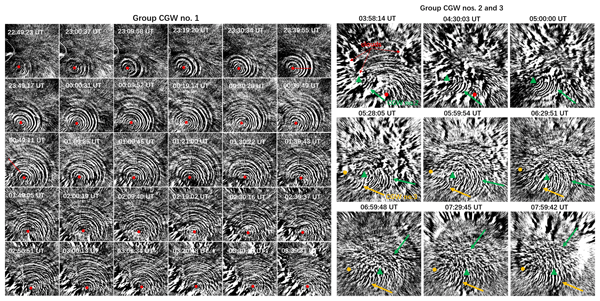
This study explores intense concentric gravity waves (CGWs) based on ground-based and multi-satellite observations over southern Brazil, revealing significant airglow perturbations and strong momentum release. Triggered by deep convection and enabled by weaker wind fields, these CGWs reached the mesopause and thermosphere. Consistent detection via OI and OH airglow emissions confirms their vertical propagation, while asymmetric thermosphere propagation is linked to Doppler-induced wavelength changes.
Qinzeng Li, Jiyao Xu, Aditya Riadi Gusman, Hanli Liu, Wei Yuan, Weijun Liu, Yajun Zhu, and Xiao Liu
Atmos. Chem. Phys., 24, 8343–8361, https://doi.org/10.5194/acp-24-8343-2024, https://doi.org/10.5194/acp-24-8343-2024, 2024
Short summary
Short summary
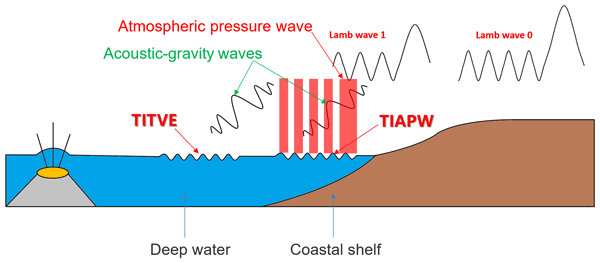
The 2022 Hunga Tonga–Hunga Ha’apai (HTHH) volcanic eruption not only triggered broad-spectrum atmospheric waves but also generated unusual tsunamis which can generate atmospheric gravity waves (AGWs). Multiple strong atmospheric waves were observed in the far-field area of the 2022 HTHH volcano eruption in the upper atmosphere by a ground-based airglow imager network. AGWs caused by tsunamis can propagate to the mesopause region; there is a good match between atmospheric waves and tsunamis.
Qinzeng Li, Jiyao Xu, Hanli Liu, Xiao Liu, and Wei Yuan
Atmos. Chem. Phys., 22, 12077–12091, https://doi.org/10.5194/acp-22-12077-2022, https://doi.org/10.5194/acp-22-12077-2022, 2022
Short summary
Short summary
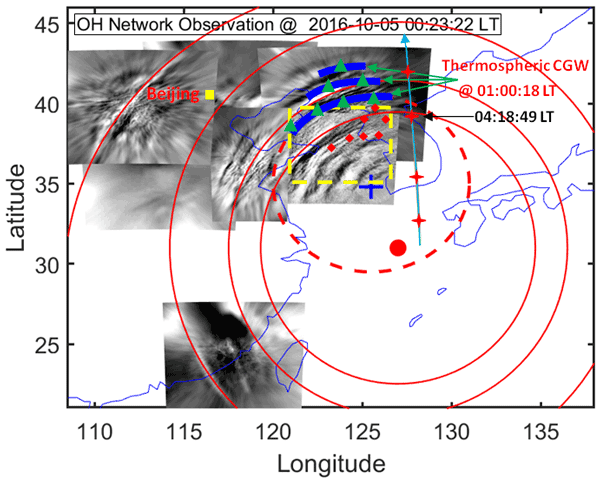
We use ground-based airglow network observations, reanalysis data, and satellite observations to explore the propagation process of concentric gravity waves (CGWs) excited by a typhoon between the troposphere, stratosphere, mesosphere, and thermosphere. We find that CGWs in the mesosphere are generated directly by the typhoon but the CGW observed in the thermosphere may be excited by CGW dissipation in the mesosphere, rather than directly excited by a typhoon and propagated to the thermosphere.
Tiancai Wang, Yajun Zhu, Guangyi Zhu, Wei Yuan, Zhongqi Tan, Weijun Liu, Qiucheng Gong, Hong Gao, and Jiyao Xu
Atmos. Meas. Tech., 19, 7693–7709, https://doi.org/10.5194/amt-19-7693-2026, https://doi.org/10.5194/amt-19-7693-2026, 2026
Short summary
Short summary
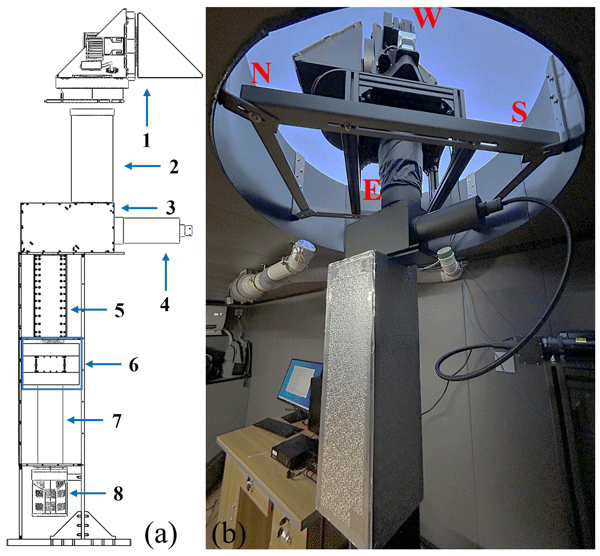
The Fabry-Perot interferometer (FPI) is a vital optical instrument for measuring atmospheric wind and temperature. However, traditional FPIs are often bulky and sensitive to pressure changes of the interference cavity. We have developed a novel FPI that uses an all-solid-state interference cavity to provide an aviable alternative. Laboratory and field tests demonstrated its excellent accuracy and close agreement with established instruments.
Zheng Wang, Quanhan Li, Zehao Wang, Qinzeng Li, Yajun Zhu, Guojun Wang, Yusen Tian, and Xiao Wang
EGUsphere, https://doi.org/10.5194/egusphere-2026-6656, https://doi.org/10.5194/egusphere-2026-6656, 2026
This preprint is open for discussion and under review for Annales Geophysicae (ANGEO).
Short summary
Short summary
At Hainan, replacing the modeled lower ionosphere with an observed profile improves agreement with satellite-based total electron content after midnight but worsens it in the afternoon. The contrast persists when the lower and upper parts meet at the observed peak. The results show why local observations should be used with attention to both parts of the ionosphere: a better lower profile alone need not improve the total column.

Shuqi Niu, Shengyang Gu, Haiyang Gao, Dini Gong, Yafei Wei, and Yusong Qin
Atmos. Meas. Tech., 19, 7113–7129, https://doi.org/10.5194/amt-19-7113-2026, https://doi.org/10.5194/amt-19-7113-2026, 2026
Short summary
Short summary
We present a algorithm for retrieving temperatures near the mesopause from airglow spectra, enabling efficient analysis of long-duration, high-temporal-resolution observations. Comparisons with independent measurements showed similar temporal variations. Applied to six nights of observations, the algorithm revealed nighttime temperature variations and short-period disturbances, supporting studies of atmospheric wave activity.
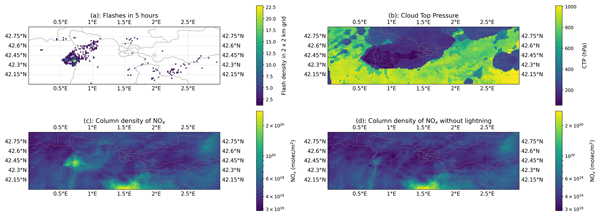
Francisco J. Pérez-Invernón, Francisco J. Gordillo-Vázquez, Oscar van der Velde, Joan Montanyà, Jesús Alberto López Trujillo, Nicolau Pineda, Diego Loyola, Sora Seo, Christoph Knote, Alexandre O. Fierro, and Heidi Huntrieser
Atmos. Chem. Phys., 26, 14277–14301, https://doi.org/10.5194/acp-26-14277-2026, https://doi.org/10.5194/acp-26-14277-2026, 2026
Short summary
Short summary
Lightning is a major source of atmospheric pollutants. This study uses advanced satellite and ground-based data to show how lightning characteristics, such as length, brightness, and duration, affect the production of these pollutants in storms over Spain’s Ebro Valley.
Zheng Wang, Yusen Tian, Guangwei Cao, Guojun Wang, Guangyuan Tan, Kai Ding, Yajun Zhu, and Xiao Wang
EGUsphere, https://doi.org/10.5194/egusphere-2026-5242, https://doi.org/10.5194/egusphere-2026-5242, 2026
Short summary
Short summary
Six years of observations over Hainan show that background plasma and short-timescale ionospheric structure follow different seasonal and daily cycles. Winter disturbances strengthen during the afternoon and evolve over or pass through the region. Summer disturbances intensify near midnight but are concentrated in particular directions or areas, revealing a more uneven horizontal distribution.
Liang Zhang, Zhongfang Liu, and Yajun Zhu
EGUsphere, https://doi.org/10.5194/egusphere-2026-4809, https://doi.org/10.5194/egusphere-2026-4809, 2026
Short summary
Short summary
Using 24 years of SABER and MLS satellite data, we show that the T80 index dominates interannual and daily variability of MLT density. Stronger upwelling (lower T80) generates a vertical density dipole over southern high latitudes (R = 0.98 at 95 km) via column adjustment and local thermal effects, while an anti-phased pattern appears at low latitudes. The robust T80-density linkage enables one-month-ahead statistical forecasts of MLT density (R up to 0.90).
Liang Zhang, Zhongfang Liu, and Yajun Zhu
EGUsphere, https://doi.org/10.5194/egusphere-2026-3749, https://doi.org/10.5194/egusphere-2026-3749, 2026
Preprint archived
Short summary
Short summary
The T80 index, a proxy for summer polar upwelling, provides a near-perfect description (R = 0.98) and a one- to two-month forecast (R = 0.90) of the Southern Hemisphere summer mesopause height. The mechanism involves a vertical dipole temperature response through coupled dynamics, microphysics, and chemistry: stronger upwelling cools below ~90 km via adiabatic ascent and warms above ~90 km via chemical and radiative heating, shifting the temperature minimum downward.
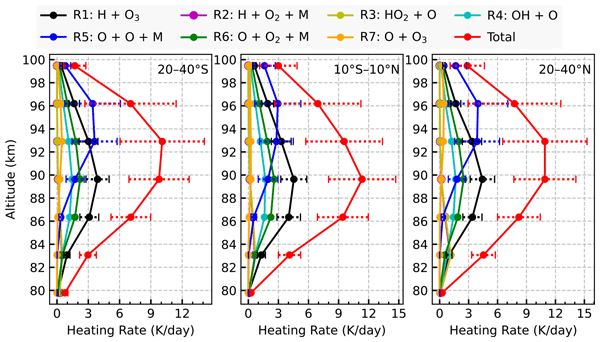
Xiaolin Wu, Yajun Zhu, Anne K. Smith, Martin Kaufmann, Guoying Jiang, Shuai Liu, and Jiyao Xu
Atmos. Chem. Phys., 26, 4669–4683, https://doi.org/10.5194/acp-26-4669-2026, https://doi.org/10.5194/acp-26-4669-2026, 2026
Short summary
Short summary
Chemical reactions are key to the energy budget of the upper mesosphere–lower thermosphere, but this process remains poorly quantified. We derived a new dataset of nighttime chemical heating by combining observations from two different satellite instruments. The main exothermic reactions, hydrogen reacting with ozone and oxygen recombination, dominate at different altitudes and vary seasonally. The new results revise previous estimates and provide constraints on the mesopause energy budget.
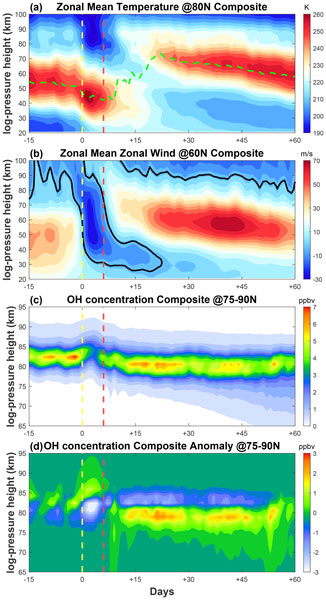
Jin Hu, Sheng-Yang Gu, Yusong Qin, Yuxuan Liu, and Yafei Wei
Atmos. Chem. Phys., 25, 18431–18447, https://doi.org/10.5194/acp-25-18431-2025, https://doi.org/10.5194/acp-25-18431-2025, 2025
Short summary
Short summary
This paper focuses on the response of the polar hydroxyl layer in the mesosphere to Arctic sudden stratospheric warming events with an elevated stratopause, revealing significant phase-dependent variations in hydroxyl distribution driven by gravity wave drag changes. These findings enhance our understanding of vertical and dynamical-photochemical coupling in the middle and upper atmosphere, which also offer valuable implications for the upper atmospheric sounding and modeling.
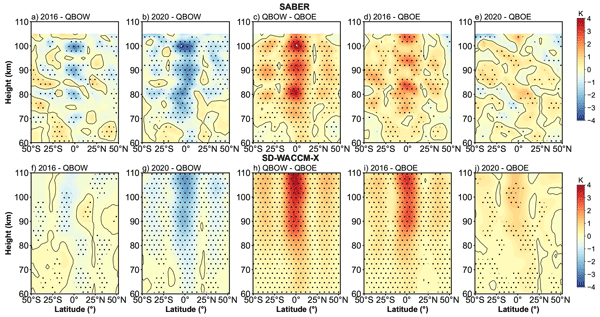
Shuai Liu, Guoying Jiang, Bingxian Luo, Xiao Liu, Jiyao Xu, Yajun Zhu, and Wen Yi
Atmos. Chem. Phys., 25, 17725–17746, https://doi.org/10.5194/acp-25-17725-2025, https://doi.org/10.5194/acp-25-17725-2025, 2025
Short summary
Short summary
Disruptions of the Quasi-Biennial Oscillation modulate the migrating diurnal tide in the mesosphere and lower thermosphere. During the events, wavelengths and phases of the tide remain unchanged, but its amplitude strengthens. The variation of heating sources, dissipation, zonal wind latitude shear and gravity wave drag may contribute to the amplification of the tide amplitude. These features provide insight into the dynamical coupling of troposphere, stratosphere, mesosphere and lower thermosphere.
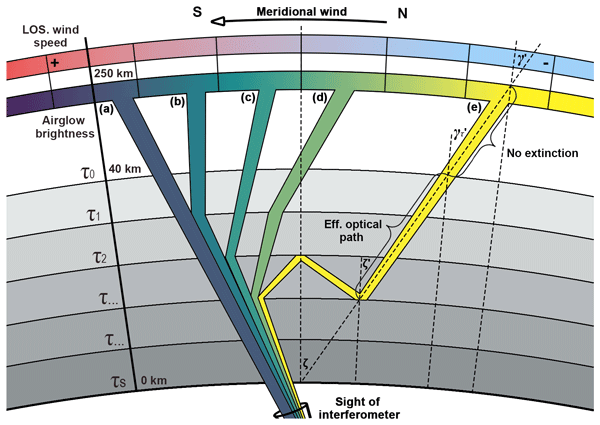
Xiaolong Wei, Guoying Jiang, Yajun Zhu, Jiyao Xu, Weijun Liu, Tiancai Wang, Guangyi Zhu, and Wei Yuan
Atmos. Meas. Tech., 18, 6959–6977, https://doi.org/10.5194/amt-18-6959-2025, https://doi.org/10.5194/amt-18-6959-2025, 2025
Short summary
Short summary
Scattered airglow can bias thermospheric wind observations by ground-based interferometers, especially when brightness is spatially uneven due to auroras. We simulated lower atmospheric scattering during two mid-latitude auroral events and confirmed that scattering can lead to line-of-sight speed biases, thereby increasing the horizontal differences between opposite cardinal directions. This scattering impact needs to be carefully considered in thermospheric dynamics analysis.
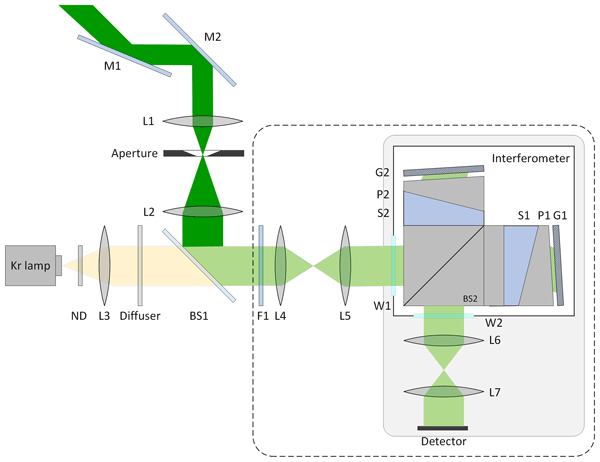
Guangyi Zhu, Yajun Zhu, Martin Kaufmann, Tiancai Wang, Weijun Liu, Wei Yuan, Siyin Liu, Guotao Yang, and Jiyao Xu
Atmos. Meas. Tech., 18, 5985–5997, https://doi.org/10.5194/amt-18-5985-2025, https://doi.org/10.5194/amt-18-5985-2025, 2025
Short summary
Short summary
Winds in the mesopause region (85–100 km altitude) drive upper-atmospheric dynamics and energy transfer. We present the Asymmetric Spatial Heterodyne Spectrometer, a ground-based instrument, to measure winds by observing the green airglow of atomic oxygen. Lab tests demonstrated the instrument achieves better than 2 m/s accuracy. Field measurements at a high-latitude site in China showed strong agreement with independent LiDAR data, confirming that the system delivers reliable wind retrievals.
Qinzeng Li, Jiyao Xu, Yajun Zhu, Cristiano M. Wrasse, José V. Bageston, Wei Yuan, Xiao Liu, Weijun Liu, Ying Wen, Hui Li, and Zhengkuan Liu
Atmos. Chem. Phys., 25, 9719–9736, https://doi.org/10.5194/acp-25-9719-2025, https://doi.org/10.5194/acp-25-9719-2025, 2025
Short summary
Short summary
This study explores intense concentric gravity waves (CGWs) based on ground-based and multi-satellite observations over southern Brazil, revealing significant airglow perturbations and strong momentum release. Triggered by deep convection and enabled by weaker wind fields, these CGWs reached the mesopause and thermosphere. Consistent detection via OI and OH airglow emissions confirms their vertical propagation, while asymmetric thermosphere propagation is linked to Doppler-induced wavelength changes.
Liang Tang, Sheng-Yang Gu, and Xiankang Dou
EGUsphere, https://doi.org/10.5194/egusphere-2024-3121, https://doi.org/10.5194/egusphere-2024-3121, 2024
Preprint withdrawn
Short summary
Short summary
The temperature amplitude and wave periods of each polar planetary wave event were determined using 2-D least-squares fitting. An important result in this work is that the propagation and amplification characteristics of polar planetary waves during austral winter periods are influenced by background zonal winds and atmospheric instability, and that there is significant variability temperature amplitude, wave period, and temporal variations examined for a given zonal wavenumber.
Qinzeng Li, Jiyao Xu, Aditya Riadi Gusman, Hanli Liu, Wei Yuan, Weijun Liu, Yajun Zhu, and Xiao Liu
Atmos. Chem. Phys., 24, 8343–8361, https://doi.org/10.5194/acp-24-8343-2024, https://doi.org/10.5194/acp-24-8343-2024, 2024
Short summary
Short summary
The 2022 Hunga Tonga–Hunga Ha’apai (HTHH) volcanic eruption not only triggered broad-spectrum atmospheric waves but also generated unusual tsunamis which can generate atmospheric gravity waves (AGWs). Multiple strong atmospheric waves were observed in the far-field area of the 2022 HTHH volcano eruption in the upper atmosphere by a ground-based airglow imager network. AGWs caused by tsunamis can propagate to the mesopause region; there is a good match between atmospheric waves and tsunamis.
Sheng-Yang Gu, Dong Wang, Liang Tang, and Yafei Wei
EGUsphere, https://doi.org/10.5194/egusphere-2023-910, https://doi.org/10.5194/egusphere-2023-910, 2023
Preprint archived
Short summary
Short summary
Based on SABER observations, the seasonal and interannual variability of the peak emission rate and height of OH airglow is analyzed. The results show that the latitudinal variations of the semi-annual oscillation (SAO) and annual oscillation (AO) of peak emission rates and heights are similar. In addition, we find that the OH airglow emission is modulated by the quasi-biennial oscillation (QBO) in the equatorial region and solar activity.
Liang Tang, Sheng-Yang Gu, Shu-Yue Zhao, and Dong Wang
Atmos. Chem. Phys. Discuss., https://doi.org/10.5194/acp-2022-778, https://doi.org/10.5194/acp-2022-778, 2022
Revised manuscript not accepted
Short summary
Short summary
We found that the interannual difference of the W3 and W4 Q2DW is significantly correlated with the Quasi-Biennial Oscillation westerly (QBOW) and easterly (QBOE) phase. In addition, planetary waves gain stronger source activity during the QBOW phase to provide sufficient energy for propagation and amplification. Overall, this study reveals a difference between the dynamics of mid-latitude westward planetary waves in the QBOW and QBOE phases.
Qinzeng Li, Jiyao Xu, Hanli Liu, Xiao Liu, and Wei Yuan
Atmos. Chem. Phys., 22, 12077–12091, https://doi.org/10.5194/acp-22-12077-2022, https://doi.org/10.5194/acp-22-12077-2022, 2022
Short summary
Short summary
We use ground-based airglow network observations, reanalysis data, and satellite observations to explore the propagation process of concentric gravity waves (CGWs) excited by a typhoon between the troposphere, stratosphere, mesosphere, and thermosphere. We find that CGWs in the mesosphere are generated directly by the typhoon but the CGW observed in the thermosphere may be excited by CGW dissipation in the mesosphere, rather than directly excited by a typhoon and propagated to the thermosphere.
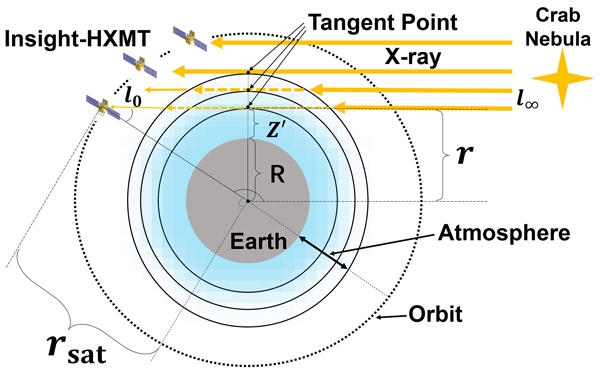
Daochun Yu, Haitao Li, Baoquan Li, Mingyu Ge, Youli Tuo, Xiaobo Li, Wangchen Xue, Yaning Liu, Aoying Wang, Yajun Zhu, and Bingxian Luo
Atmos. Meas. Tech., 15, 3141–3159, https://doi.org/10.5194/amt-15-3141-2022, https://doi.org/10.5194/amt-15-3141-2022, 2022
Short summary
Short summary
In this work, the measurement of vertical atmospheric density profiles using X-ray Earth occultation is investigated. The Earth’s density profile for the lower thermosphere is obtained with Insight-HXMT. It is shown that the Insight-HXMT X-ray satellite of China can be used as an X-ray atmospheric diagnostics instrument for the upper atmosphere. The Insight-HXMT satellite can, with other X-ray astronomical satellites in orbit, form a network for X-ray Earth occultation sounding in the future.
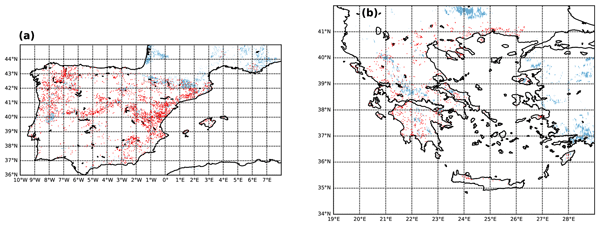
Francisco J. Pérez-Invernón, Heidi Huntrieser, Sergio Soler, Francisco J. Gordillo-Vázquez, Nicolau Pineda, Javier Navarro-González, Víctor Reglero, Joan Montanyà, Oscar van der Velde, and Nikos Koutsias
Atmos. Chem. Phys., 21, 17529–17557, https://doi.org/10.5194/acp-21-17529-2021, https://doi.org/10.5194/acp-21-17529-2021, 2021
Short summary
Short summary
Lightning-ignited fires tend to occur in remote areas and can spread significantly before suppression. Long continuing current (LCC) lightning, preferably taking place in dry thunderstorms, is believed to be the main precursor of lightning-ignited fires. We analyze fire databases of lightning-ignited fires in the Mediterranean basin and report the shared meteorological conditions of fire- and LCC-lightning-producing thunderstorms. These results can be useful to improve fire forecasting methods.
Liang Tang, Sheng-Yang Gu, and Xian-Kang Dou
Atmos. Chem. Phys., 21, 17495–17512, https://doi.org/10.5194/acp-21-17495-2021, https://doi.org/10.5194/acp-21-17495-2021, 2021
Short summary
Short summary
Our study explores the variation in the occurrence date, peak amplitude and wave period for eastward waves and the role of instability, background wind structure and the critical layer in eastward wave propagation and amplification.
Cited articles
AIRS Project: AIRS/Aqua L1B Infrared (IR) geolocated and calibrated radiances V005, Goddard Earth Sciences Data and Information Services Center (GES DISC) [data set], Greenbelt, MD, USA, https://doi.org/10.5067/YZEXEVN4JGGJ, 2007.
Alexander, M. J. and Holton, J. R.: On the spectrum of vertically propagating gravity waves generated by a transient heat source, Atmos. Chem. Phys., 4, 923–932, https://doi.org/10.5194/acp-4-923-2004, 2004.
Aumann, H. H., Chahine, M. T., Gautier, C., Goldberg, M. D., Kalnay, E., McMillin, L. M., Revercomb, H., Rosenkranz, P. W., Smith, W. L., Staelin, D. H., Strow, L. L., and Susskind, J.: AIRS/AMSU/HSB on the aqua mission: Design, science objectives, data products, and processing systems, IEEE T. Geosci. Remote, 41, 253–264, https://doi.org/10.1109/TGRS.2002.808356, 2003.
Chou, C. C., Dai, J., Kuo, C. L., and Huang, T. Y.: Simultaneous observations of storm-generated sprite and gravity wave over Bangladesh, J. Geophys. Res.-Space, 121, 9222–9233, https://doi.org/10.1002/2016JA022554, 2016.
Fovell, R., Durran, D., and Holton, J. R.: Numerical simulations of convectively generated stratospheric gravity waves, J. Atmos. Sci., 49, 1427–1442, https://doi.org/10.1175/1520-0469(1992)049<1427:NSOCGS>2.0.CO;2, 1992.
Fritts, D. C. and Alexander, M. J.: Gravity wave dynamics and effects in the middle atmosphere, Rev. Geophys., 41, 1003, https://doi.org/10.1029/2001RG000106, 2003.
Günzkofer, F., Liu, H., Liu, H., Stober, G., Lu, G., Wu, H., Bartel, N., Heymann, F., and Borries, C.: High-latitude joule heating in tie-gcm 3.0: Evaluation of different plasma convection forcing models, Geophys. Res. Lett., 52, e2025GL117647, https://doi.org/10.1029/2025GL117647, 2025.
Heale, C. J., Snively, J. B., Bhatt, A. N., Hoffmann, L., Stephan, C. C., and Kendall, E. A.: Multilayer observations and modeling of thunderstorm-generated gravity waves over the Midwestern United States, Geophys. Res. Lett., 46, 14164–14174, https://doi.org/10.1029/2019GL085934, 2019.
Heale, C. J., Inchin, P. A., and Snively, J. B.: Primary Versus Secondary Gravity Wave Responses at F-Region Heights Generated by a Convective Source, J. Geophys. Res.-Space, 127, e2021JA029947, https://doi.org/10.1029/2021JA029947, 2022.
Hersbach, H., Bell, B., Berrisford, P., Hirahara, S., Horányi, A., Muñoz-Sabater, J., Nicolas, J., Peubey, C., Radu, R., Schepers, D., Simmons, A., Soci, C., Abdalla, S., Abellan, X., Balsamo, G., Bechtold, P., Biavati, G., Bidlot, J., Bonavita, M., De Chiara, G., Dahlgren, P., Dee, D., Diamantakis, M., Dragani, R., Flemming, J., Forbes, R., Fuentes, M., Geer, A., Haimberger, L., Healy, S., Hogan, R. J., Hólm, E., Janisková, M., Keeley, S., Laloyaux, P., Lopez, P., Lupu, C., Radnoti, G., deRosnay, P., Rozum, I., Vamborg, F., Villaume, S., and Thépaut, J. N.: The ERA5 global reanalysis, Q. J. Roy. Meteor. Soc., 146, 1999–2049, https://doi.org/10.1002/qj.3803, 2020.
Hersbach, H., Bell, B., Berrisford, P., Biavati, G., Horányi, A., Muñoz Sabater, J., Nicolas, J., Peubey, C., Radu, R., Rozum, I., Schepers, D., Simmons, A., Soci, C., Dee, D., and Thépaut, J.-N.: ERA5 hourly data on pressure levels from 1940 to present, Copernicus Climate Change Service (C3S) Climate Data Store (CDS) [data set], https://doi.org/10.24381/cds.bd0915c6, 2023.
Hines, C. O.: Internal atmospheric gravity waves at ionospheric heights, Can. J. Phys., 38, 1441–1481, https://doi.org/10.1139/p60-150, 1960.
Hoffmann, L. and Alexander, M. J.: Occurrence frequency of convective gravity waves during the North American thunderstorm season, J. Geophys. Res., 115, D20111, https://doi.org/10.1029/2010JD014401, 2010.
Hoffmann, L., Alexander, M. J., Clerbaux, C., Grimsdell, A. W., Meyer, C. I., Rößler, T., and Tournier, B.: Intercomparison of stratospheric gravity wave observations with AIRS and IASI, Atmos. Meas. Tech., 7, 4517–4537, https://doi.org/10.5194/amt-7-4517-2014, 2014.
Holton, J. R.: The influence of gravity wave breaking on the general circulation of the middle atmosphere, J. Atmos. Sci., 40, 2497–2507, https://doi.org/10.1175/1520-0469(1983)040<2497:TIOGWB>2.0.CO;2, 1983.
Huang, H. L., Lu, G. P., An, A., Xu, D., Cheng, Z. W., Wang, Y. P., Chen, Y. Z., and Huang, X.: Massive outbreak of red sprites in South Asia observed from the Tibetan Plateau, Adv. Atmos. Sci., 42, 1247–1260, https://doi.org/10.1007/s00376-024-4143-5, 2025.
Hurrell, J. W., Holland, M. M., Gent, P. R., Ghan, S., Kay, J. E., Kushner, P. J., Lamarque, J.-F., Large, W. G., Lawrence, D., Lindsay, K., Lipscomb, W. H., Long, M. C., Mahowald, N., Marsh, D. R., Neale, R. B., Rasch, P., Vavrus, S., Vertenstein, M., Bader, D., Collins, W. D., Hack, J. J., Kiehl, J., and Marshall, S.: The Community Earth System Model: A framework for collaborative research, B. Am. Meteorol. Soc., 94, 1339–1360, https://doi.org/10.1175/BAMS-D-12-00121.1, 2013.
Lai, C., Li, P. W., Xu, J. Y., Yuan, W., Yue, J., Liu, X., Kogure, M., and Qian, L. L.: Joint observation of the concentric gravity wave event on the Tibetan Plateau, Earth Planet. Phys., 6, 219–227, https://doi.org/10.26464/epp2022029, 2022.
Li, Q., Xu, J., Liu, H., Liu, X., and Yuan, W.: How do gravity waves triggered by a typhoon propagate from the troposphere to the upper atmosphere?, Atmos. Chem. Phys., 22, 12077–12091, https://doi.org/10.5194/acp-22-12077-2022, 2022.
Li, Q., Xu, J., Gusman, A. R., Liu, H., Yuan, W., Liu, W., Zhu, Y., and Liu, X.: Upper-atmosphere responses to the 2022 Hunga Tonga–Hunga Ha′apai volcanic eruption via acoustic gravity waves and air–sea interaction, Atmos. Chem. Phys., 24, 8343–8361, https://doi.org/10.5194/acp-24-8343-2024, 2024.
Li, Q., Xu, J., Zhu, Y., Wrasse, C. M., Bageston, J. V., Yuan, W., Liu, X., Liu, W., Wen, Y., Li, H., and Liu, Z.: Extreme concentric gravity waves observed in the mesosphere and thermosphere regions over southern Brazil associated with fast-moving severe thunderstorms, Atmos. Chem. Phys., 25, 9719–9736, https://doi.org/10.5194/acp-25-9719-2025, 2025.
Liu, H.-L., Bardeen, C. G., Foster, B. T., Lauritzen, P., Liu, J., Lu, G., Marsh, D. R., Maute, A., McInerney, J. M., Pedatella, N. M., Qian, L., Richmond, A. D., Roble, R. G., Solomon, S. C., Vitt, F. M., and Wang, W.: Development and validation of the Whole Atmosphere Community Climate Model with thermosphere and ionosphere extension (WACCM-X 2.0), J. Adv. Model. Earth Sy., 10, 381–402, https://doi.org/10.1002/2017MS001232, 2018.
Maurya, A. K., Parihar, N., Dube, A., Singh, R., Kumar, S., Chanrion, O., Tomicic, M., and Neubert, T.: Rare observations of sprites and gravity waves supporting D, E, F-regions ionospheric coupling, Sci. Rep.-UK, 12, 581, https://doi.org/10.1038/s41598-021-03808-5, 2022.
MPDC: Meridian Project data service portal, https://dcstatus.meridianproject.ac.cn/, last access: 12 January 2026.
NSMC, China Meteorological Administration: FENGYUN Satellite Data Service, https://data.nsmc.org.cn/DataPortal/en/home/index.html, last access: 12 August 2026.
Nyassor, P. K., Wrasse, C. M., Paulino, I., São Sabbas, E. F. M. T., Bageston, J. V., Naccarato, K. P., Gobbi, D., Figueiredo, C. A. O. B., Ayorinde, T. T., Takahashi, H., and Barros, D.: Sources of concentric gravity waves generated by a moving mesoscale convective system in southern Brazil, Atmos. Chem. Phys., 22, 15153–15177, https://doi.org/10.5194/acp-22-15153-2022, 2022.
Pasko, V. P., Inan, U. S., and Bell, T. F.: Sprites as evidence of vertical gravity wave structures above mesoscale thunderstorms, Geophys. Res. Lett., 24, 1735–1738, https://doi.org/10.1029/97GL01607, 1997.
Passas-Varo, M., van der Velde, O., Gordillo-Vázquez, F. J., Sánchez-Ramírez, R., García-Comas, M., and Montanyà, J.: Spectroscopy of a mesospheric ghost reveals iron emissions, Nat. Commun., 14, 7810, https://doi.org/10.1038/s41467-023-42892-1, 2023.
Peng, C.-H. and Chen, X.: Monsoonal MCS initiation, rainfall, and diurnal gravity waves over the Bay of Bengal: Observation and a linear model, J. Atmos. Sci., 81, 1401–1418, https://doi.org/10.1175/JAS-D-23-0230.1, 2024.
Picone, J. M., Hedin, A. E., Drob, D. P., and Aikin, A. C.: NRLMSISE-00 empirical model of the atmosphere: Statistical comparisons and scientific issues, J. Geophys. Res., 107, 1468, https://doi.org/10.1029/2002JA009430, 2002.
Plane, J. M. C., Gumbel, J., Kalogerakis, K. S., Marsh, D. R., and von Savigny, C.: Opinion: Recent developments and future directions in studying the mesosphere and lower thermosphere, Atmos. Chem. Phys., 23, 13255–13282, https://doi.org/10.5194/acp-23-13255-2023, 2023.
Richmond, A. D., Ridley, E. C., and Roble, R. G.: A thermosphere/ionosphere general circulation model with coupled electrodynamics, Geophys. Res. Lett., 19, 601–604, https://doi.org/10.1029/92GL00401, 1992.
Russell III, J. M., Mlynczak, M. G., Gordley, L. L., Tansock, J., and Esplin, R.: An overview of the SABER experiment and preliminary calibration results, Proc. SPIE, 3756, 277–288, https://doi.org/10.1117/12.366382, 1999.
Sentman, D., Wescott, E., Picard, R., Winick, J., Stenbaek-Nielsen, H., Dewan, E., and Morrill, J.: Simultaneous observations of mesospheric gravity waves and sprites generated by a midwestern thunderstorm, J. Atmos. Sol.-Terr. Phy., 65, 537–550, https://doi.org/10.1016/S1364-6826(02)00328-0, 2003.
Smith, S. M., Vadas, S. L., Baggaley, W. J., Hernandez, G., and Baumgardner, J.: Gravity wave coupling between the mesosphere and thermosphere over New Zealand, J. Geophys. Res.-Space, 118, 2694–2707, https://doi.org/10.1002/jgra.50263, 2013.
Smith, S. M., Setvák, M., Beletsky, Y., Baumgardner, J., and Mendillo, M.: Mesospheric gravity wave momentum flux associated with a large thunderstorm complex, J. Geophys. Res.-Atmos., 125, e2020JD033381, https://doi.org/10.1029/2020JD033381, 2020.
Snively, J. B., Pasko, V. P., and Taylor, M. J.: OH and OI airglow layer modulation by ducted short-period gravity waves: Effects of trapping altitude, J. Geophys. Res.-Space, 115, A11311, https://doi.org/10.1029/2009JA015236, 2010.
Vadas, S. L.: Horizontal and vertical propagation and dissipation of gravity waves in the thermosphere from lower atmospheric and thermospheric sources, J. Geophys. Res.-Space, 112, A06305, https://doi.org/10.1029/2006JA011845, 2007.
Vadas, S. L. and Azeem, I.: Concentric secondary gravity waves in the thermosphere and ionosphere over the continental United States on March 25–26, 2015 from deep Convection, J. Geophys. Res.-Space, 126, e2020JA028275, https://doi.org/10.1029/2020JA028275, 2021.
Vadas, S. L. and Crowley, G.: Sources of the traveling ionospheric disturbances observed by the ionospheric TIDDBIT sounder near Wallops Island on October 30, 2007, J. Geophys. Res.-Space, 115, A07324, https://doi.org/10.1029/2009JA015053, 2010.
Vadas, S. L., Fritts, D. C., and Alexander, M. J.: Mechanism for the generation of secondary waves in wave breaking regions, J. Atmos. Sci., 60, 194–214, https://doi.org/10.1175/1520-0469(2003)060<0194:MFTGOS>2.0.CO;2, 2003.
Vadas, S. L., Yue, J., She, C. Y., Stamus, P., and Liu, A. Z.: A model study of the effects of winds on concentric rings of gravity waves from a convective plume near Fort Collins on 11 May 2004, J. Geophys. Res., 114, D06103, https://doi.org/10.1029/2008JD010753, 2009.
Vadas, S. L., Xu, S., Yue, J., Bossert, K., Becker, E., and Baumgarten, G.: Characteristics of the quiet-time hotspot gravity waves observed by GOCE over the Southern Andes on 5 July 2010, J. Geophys. Res.-Space, 124, 7034–7061, https://doi.org/10.1029/2019JA026693, 2019.
van der Velde, O. A., Montanyà, J., López, J. A., and Cummer, S. A.: Gigantic jet discharges evolve stepwise through the middle atmosphere, Nat. Commun., 10, 4350, https://doi.org/10.1038/s41467-019-12261-y, 2019.
Wang, Y. P., Lu, G. P., Ma, M., Zhang, H. B., Fan, Y. F., Liu, G. J., Wan, Z. R., Wang, Y., Peng, K. M., Peng, C. Z., Liu, F. F., Zhu, B. Y., Ni, B. B., Gu, X. D., Chen, L., Yi, J., and Zhou, R. X.: Triangulation of red sprites observed above a mesoscale convective system in North China, Earth Planet. Phys., 3, 111–125, 2019.
Yang, J., Zhang, Z., Wei, C., Lu, F., and Guo, Q.: Introducing the new generation of Chinese geostationary weather satellites, Fengyun-4, B. Am. Meteorol. Soc., 98, 1637–1658, https://doi.org/10.1175/BAMS-D-16-0065.1, 2017.
Yue, J. and Lyons, W. A.: Structured elves: Modulation by convectively generated gravity waves, Geophys. Res. Lett., 42, 1004–1011, https://doi.org/10.1002/2014GL062612, 2015.
Short summary
On 19 May 2022, a powerful thunderstorm outbreak south of the Himalayas produced both unusual high-altitude lightning and large atmospheric waves. Using satellite and ground-based observations, we tracked the waves over distances exceeding 3000 km. Some waves observed at the highest altitudes were likely generated by the breakdown of earlier waves. The results show how severe storms can affect atmospheric regions far above the weather systems that create them.
On 19 May 2022, a powerful thunderstorm outbreak south of the Himalayas produced both unusual...


Altmetrics
Final-revised paper
Preprint