
the Creative Commons Attribution 4.0 License.
the Creative Commons Attribution 4.0 License.
 | 11 Nov 2026
The synergy of morphology and mixing state on the absorption of coated black carbon soot
Johannes Heuser

Claudia Di Biagio
Jérôme Yon
Mathieu Cazaunau
Antonin Bergé
Edouard Pangui
Marco Zanatta
Laura Renzi
Angela Marinoni
Chenjie Yu
Servanne Chevaillier
Daniel Ferry
Paolo Laj
Michel Maillé
Paola Formenti
Benedicte Picquet-Varrault
Jean-Francois Doussin
Black carbon (BC) strongly absorbs light and contributes to climate warming. Coating formation on fractal BC-containing soot is a ubiquitous atmospheric process that enhances its absorption, but the extent of this absorption enhancement (Eabs) remains uncertain and difficult to represent in models. In this study, we use large simulation chamber experiments to investigate BC absorption and its modification by coating formation and ageing. Polydisperse fractal BC-containing soot was mixed with non-absorbing atmospherically-relevant secondary aerosols (sulfuric acid and α-pinene secondary organic aerosols). Varying reaction dynamics produced different coating rates and masses, mimicking atmospheric processing. The evolution of soot and coating properties was tracked for up to 20 h. The results of this study suggest a general positive correlation between Eabs and coating amount on soot. However, they also experimentally demonstrate the strong effect of morphological modifications and mixing state heterogeneity on BC absorption, both depending on the reaction dynamics of coating formation and ageing of the coated soot. Combined variations in morphology and mixing state affect the magnitude of Eabs and its further evolution, leading, depending on processing, to either an increase or decrease in absorption. The range of measured Eabs resulting from soot processing cannot be reliably represented using a fixed Eabs value or by a core-shell optical model, two approximations commonly used in climate models. These results support the need for new formalisms that would take into account both morphological and mixing state heterogeneity to improve model predictions of BC absorption and its role on the radiative budget.
- Article
(1944 KB) - Full-text XML
-
Supplement
(4769 KB) - BibTeX
- EndNote


Black carbon (BC) is the major aerosol light-absorber and one of the strongest contributors to modern climate forcing (Bond et al., 2013; IPCC, 2023; Lee et al., 2021). Soot, as the most common BC-containing aerosol, is emitted as a product of incomplete combustion of biomass, biofuels, and fossil fuels, and displays a broad atmospheric distribution ranging from the surface into the stratosphere and from urban environments to remote locations (Bond et al., 2013; Liu et al., 2020; Schwarz et al., 2006). Light absorption by BC in soot is strongly affected by internal mixing with brown carbon (Cheng et al., 2019; Heuser et al., 2025a) and secondary species (Colbeck et al., 1990; Schnaiter et al., 2005; Wang et al., 2017; Zhang et al., 2018), either co-emitted or formed during atmospheric lifetime. In particular, the formation of a non- or weakly-absorbing coating on soot has been established to enhance its absorption due to refracting and reflecting effects (Bond and Bergstrom, 2006; Cappa et al., 2012, 2019; Fuller et al., 1999). This enhancement is commonly expressed via the enhancement factor Eabs, which is the ratio between the absorption of the coated and the uncoated soot.
Currently, the magnitude and dependencies of Eabs on coating and soot properties remain controversial (Cappa et al., 2012; Fierce et al., 2016, 2020; Liu et al., 2017; Peng et al., 2016). Most studies generally describe an increasing Eabs with an increasing coating-to-soot or coating-to-BC mass ratio. Laboratory works retrieved Eabs values as high as 2 for internally mixed soot with varying coating-to-BC mass ratios (Cappa et al., 2012; Lack et al., 2009; Peng et al., 2016; Schnaiter et al., 2005). Field observations led to diverse results, with some studies reporting Eabs up to 3 (Liu et al., 2015, 2017; Zhang et al., 2018), while others calculate small Eabs despite large coating masses (Cappa et al., 2012, 2019; Chan et al., 2010; Healy et al., 2015; Huang et al., 2024). The spread of observations suggests that the mechanisms leading to absorption enhancement do not depend solely on the amount of coating mass deposited on the BC. Key aspects evidenced to affect Eabs magnitude and variability include (i) the single particle properties and mixing state including the morphological organization of the soot and its coating (Chen et al., 2024; Huang et al., 2024; Liu et al., 2017; Sedlacek III et al., 2012), i.e. the way secondary species distributes over the fractal soot including void filling or encapsulating soot with consequent collapse of the aggregate; (ii) the diversity in the particle-to-particle mixing state in the soot population (Cappa et al., 2019; Fierce et al., 2020; Wang et al., 2023; Zeng et al., 2024), and the (iii) rate of coating formation and ageing (Cappa et al., 2019; Peng et al., 2016). Despite advances in identifying the various mechanisms contributing to the variability of soot absorption, including evaluation of instrumental and methodological uncertainties (Asmi et al., 2025), the process-level understanding of the impact of ageing on Eabs remains elusive. As a consequence of this lack of knowledge, and despite the evident variability, most climate models keep an oversimplified estimation of Eabs either via a concentric core-shell optical model (the Mie core-shell for spherical coated particles) or a fixed Eabs factor, often set at the value of 1.5 (Sand et al., 2021). However, both approximations are identified to overestimate Eabs (Cappa et al., 2019; Fierce et al., 2020; Liu et al., 2017; Wang et al., 2023).
In order to advance towards a mechanistic understanding of Eabs, in this work, we investigate the absorption of BC and its modification due to coating formation based on systematic laboratory experiments in a large simulation chamber. We generated polydisperse fractal BC-containing soot and mixed it with non-absorbing atmospherically-relevant secondary aerosol species (sulfuric acid, H2SO4, and α-pinene secondary organic aerosols, SOA). Multiple coating experiments were performed with varying reaction dynamics, leading to slower/faster and lower/higher coating mass formation, mimicking the processing occurring in the atmosphere. The evolution of the soot and coating properties over up to 20 h of chamber lifetime was studied to evaluate the Eabs magnitude and variability, and its link to physico-chemical properties.
This study utilises the 4.2 m3 stainless steel CESAM atmospheric simulation chamber (French acronym for Experimental Multiphasic Atmospheric Simulation Chamber) (Doussin et al., 2023; Wang et al., 2011) (https://cesam.cnrs.fr/, last access: 17 July 2026). CESAM is a temperature-, pressure-, and humidity-controlled chamber designed to allow multiphase atmospheric (photo-) chemistry, widely used to investigate the formation, evolution and climate-relevant properties of primary and secondary sub- and super-micron aerosols (Baldo et al., 2020, 2023; Battaglia et al., 2025; Caponi et al., 2017; De Haan et al., 2023; Di Biagio et al., 2017, 2019, 2023; Heuser et al., 2025a). The gaseous and aerosol content can be varied in CESAM to reproduce atmospherically-relevant mixtures under varying particles and gas-phase concentrations. Realistic solar irradiation is provided by three 6.5 kW Xenon arc lamps. A stainless steel fan placed at the bottom of the reactor ensures the homogeneity within the volume, with a mixing time of around one minute. The aerosol lifetime in the chamber is between 6 to more than 24 h for particles of diameter between 50 and 200 nm (Lamkaddam et al., 2017). CESAM is equipped with 12 circular flanges enabling the deployment of multiple instruments for online and offline measurements of the chamber's thermodynamic state, gas-phase composition, aerosol concentration and their physico-chemical and spectral optical properties.
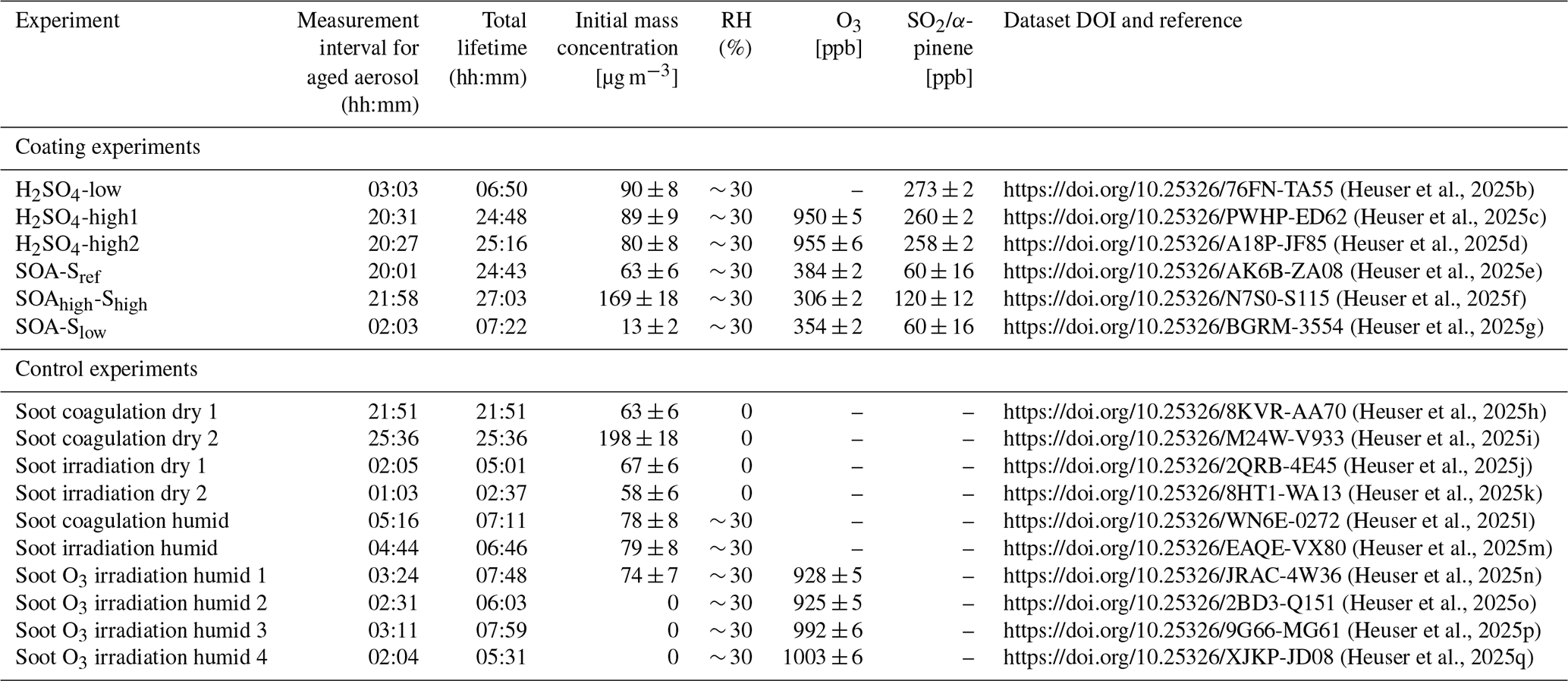
A total of 16 experiments were performed to investigate the evolution of the soot optical properties due to different ageing conditions, as summarized in Table 1. Six of these experiments targeted the formation of a coating on soot under diverse reactions dynamics and its subsequent ageing. In three experiments, H2SO4 coating was generated via the reaction of SO2 and hydroxyl radical (OH). In two of these experiments (H2SO4-high1, H2SO4-high2), O3 (at concentration of about 950 ppb) was used for OH-radical production via photolysis in the presence of water vapour. An additional experiment (H2SO4-low) was performed without active OH-production from O3. In the other three coating experiments, SOA was generated via the ozonolysis of α-pinene. The quantities of α-pinene and soot were changed at similar O3 concentration (306 to 384 ppb) to alter the amount of SOA and soot coating generated. In the SOA-Sref experiment, the initial soot mass (63 ± 6 µg m−3) was comparable to H2SO4 experiments (within 80 and 90 µg m−3). In SOA-Slow smaller quantities of soot (∼13 µg m−3) were injected while α-pinene was kept comparable to SOA-Sref (∼ 60 ppb), and SOAhigh-Shigh was performed at about two to three times the soot and precursor concentration as SOA-Sref (soot ∼ 169 µg m−3, α-pinene ∼ 120 ppb). Ten control experiments were performed to evaluate the impact on the soot properties of each compound, process, and protocol used in the coating experiments. These aimed to quantify the effects of soot lifetime and coagulation under dry and humid conditions, of irradiation under dry and humid conditions, and of the presence of O3 and OH-radicals under humid conditions on particles' physico-chemical and spectral optical properties, with particular emphasis on particle density, size, and light absorption. Further control experiments were performed with non-absorbing submicron ammonium sulphate and sulphuric acid aerosols with well-characterized properties to validate the performance and consistency of the optical and physico-chemical measurements, as presented and discussed by Heuser et al. (2025a).
2.1 Protocol of chamber experiments
For the experiments, the chamber was filled with an -mixture of N2 (evaporated from liquid N2; Messer, purity > 99.995 %) and O2 (Linde 5.0, purity ≥ 99 999 %) at a slight overpressure (ambient conditions +5 hPa) to avoid external contaminations.
Table 1List of soot ageing experiments. These are separated into the coating experiments, in which coating generation was achieved and studied, and the control experiments. Table columns indicate: the experiment name, the measurement interval after coating formation (coating experiments) or for different ageing conditions (control experiments), the total soot lifetime in the chamber, the initial soot mass concentration, the relative humidity (RH), the ozone (O3) concentration at the start of the SOA generation, and the SO2 and α-pinene injected concentrations. The list of digital object identifiers (DOI) for the experimental data are also reported. Those data are available through the Database of Atmospheric Simulation Chamber Studies (DASCS) of the EUROCHAMP Data Centre (https://data.eurochamp.org/data-access/chamber-experiments/, last access: 30 October 2026) also available via the ACTRIS data portal (https://data.actris.eu/, last access: 30 October 2026).
The combustion aerosol was produced with a miniCAST propane-diffusion flame soot generator (Model 6204 Type C, Jing Ltd., Switzerland), which allows for repeatable soot generations (Heuser et al., 2025a; Moore et al., 2014). For all experiments, the propane, mixing N2, quench N2, oxidation, and dilution air flows were kept at 0.03, 0, 2, 0.75, and 5 L min−1, respectively, as corresponding to the first operation point of the miniCAST, producing a fuel-lean combustion with a global equivalence ratio of 0.91. Fuel-lean miniCAST soot is widely regarded as representative of diesel and aircraft (kerosene-type) emissions (Ess et al., 2021; Moore et al., 2014; Saffaripour et al., 2017). The bulk elemental-to-total carbon ratio (EC TC) of the generated cast soot (CS), hereafter referred to as CS1, was measured at 0.79 ± 0.11, indicating a BC-dominated composition (Heuser et al., 2025a). The CS1 was injected into CESAM through an activated carbon denuder for a duration between 30 and 390 s, depending on the targeted mass concentration.
The water vapour was injected about 2 h after the soot to reach a relative humidity of ca. 30 %, as steam from a modified pressure cooker filled with ultra-pure water (18.2 MΩ, 3.2 ppb TOC, Milipak) (Wang et al., 2011). Ozone was injected directly out of an ozone generator (BMT 802N, BMT MESSTECHNIK GMBH), using bottled O2 (Linde 5.0, purity ≥ 99 999 %). About 40 ppb of Butanol-d9 (1-Butanol D9, 98 %, Euroisotop) was volatilized and injected, prior to the O3, using a vacuum line and a glass bulb. The Butanol-d9 was used as a tracer to monitor the OH-exposure. Following O3, about 75 to 90 min later, the precursors for the secondary aerosol and coating formation were introduced in the chamber volume. The SO2 (Merck, 99.95 %) was injected using a calibrated gas-tight syringe and septum inlets. The H2SO4 generation itself was then started by initiating the photochemical hydroxyl radical production by turning on the three Xenon-arc lamps. The light of the lamps is introduced via quartz windows equipped with Pyrex® filters (6.5 mm), generating a spectrum close to solar radiation at ground level (Wang et al., 2011). Temperature fluctuations due to the radiation were limited with a cooling system (LAUDA Integral-T 10 000 W) to about 1 to 2 K, resulting in a temperature range of 294 to 301 K during experiments. The α-pinene (98 %, Sigma-Aldrich) was volatilized using a vacuum line, and a known quantity of the SOA precursor was injected with a glass bubble. Dark conditions and minimal temperature fluctuations between 289 and 291,K required no temperature regulations in the SOA experiments. After 3 h since the start of secondary aerosol formation, the majority of the α-pinene was consumed (< 3 ppb remaining), and the H2SO4 coating production was stopped by turning off the lamps. In experiments H2SO4-high 1 and 2, SOA-Sref, and SOAhigh-Shigh, the coated soot was left in suspension under dark conditions with reduced instrumentation and minimal dilution (about 3 L min−1). After 15 h, the aged soot was again fully characterized.
At the end of each experiment, the CESAM chamber was evacuated to around hPa to avoid carryover contaminations and stays evacuated between subsequent experiments. The chamber was also additionally cleaned manually at the beginning of each campaign and when changing the chemical system. More details on the experimental protocol for the soot and control experiments are provided in Sect. S1 and Table S1 in the Supplement.
2.2 Measurements
A large complementary set of state-of-the-art instrumentation was used to characterize the physico-chemical and spectral optical properties of the soot aerosol, as well as the thermodynamic state of the volume and its gaseous content. The full instrumentation including details for measurement uncertainties calculations are detailed in Tables S2 and S3, and previously described in Heuser et al. (2025a). The majority of online measurements were performed continuously throughout experiments with the exception of short disconnections at soot and water vapour injections. During the 15 h dark ageing, only the number size distribution was measured continuously. Air sampled out of the chamber during experiments (varying between 3 and 22 L min−1) was compensated with a particle-free N2 O2-mixture, leading to a constant dilution of the compounds in the chamber. The main instruments used to characterise the aerosol properties in this work are presented in the following. The aerosol was measured without drying to preserve realistic RH conditions.
The aerosol number size concentration between 19.5 and 881.7 nm over 64 channels (; Dm, mobility diameter) was continuously measured at 3 min resolution with a scanning mobility particle sizer (SMPS, TSI, Kripton85 neutraliser, DMA 3080, CPC 3772, with 2.0/0.2 L min−1 sheath/aerosol flow rates). Measurements were corrected for diffusion losses and multiple charge effects with the instrument software. Total uncertainty on was of the order of 5 %. The number size distributions were fitted with log-normal functions to determine the population count (or number) median diameter (CMD).
The aerosol effective density (ρeff) was derived from measurements with a centrifugal particle mass analyzer (CPMA – Cambustion) and an SMPS (TSI, X-ray neutraliser 3087, DMA 3080, CPC 3775 high). A DMA-CPMA-CPC setup was used to measure the aerosol mass-resolved size distributions as described in Heuser et al. (2025a) and Yon et al. (2015). Multiple measurements between 0.03 to 6 femtograms allowed for the calculation of the effective density over the range of soot diameters ρeff (Dm) (Kasper, 1982; Park et al., 2003). The uncertainty on ρeff (Dm) was estimated to be 10 %. A complete DMA-CPMA-CPC scan to derive a full ρeff (Dm) curve lasted about 35 min. The scans were performed after soot injection in the chamber, after each compound injected in the chamber and for coated soot, before and after long-term ageing. The ρeff (Dm) data were fitted with a power-law relation (Park et al., 2003)
to determine the mass-mobility exponent (Dfm) and the pre-factor a. The Dfm is dependent on the morphology of the aerosols (it equals to 3 for spherical-void free particles, and is around 2.2 for soot (Maricq and Xu, 2004; Sorensen, 2011)) and, together with ρeff, was used as a proxy for morphological and chemical evolution of the soot over the simulated ageing processes (Park et al., 2003; Sorensen, 2011). The ρeff (Dm) was used to determine the total aerosol mass concentration (mtotal) as:
where ρeff (Dm,i) indicates the values extrapolated at the Dm values of the SMPS and is the corresponding measured number size distribution (the subscript i in Eq. 2 indicates the SMPS channel). As discussed in Heuser et al. (2025a), the mtotal compared well with gravimetric measurements from a tapered element oscillating microbalance (TEOM 1400a – Thermo Scientific). Noteworthy, the mass concentration calculated with Eq. (2) lacks sensitivity to ongoing aerosol physico-chemical processing due to the coarse time resolution of ρeff measurements.
Morphological information of the soot particles were also retrieved using transmission electron microscopy (TEM). Soot particles samples were collected over different moments of the experiments using three TEM grids (200-mesh copper grid with a Formvar/carbon film, Agar Scientific) glued onto the Teflon-pore filters (47 mm Nuclepore Whatman, 0.8 µm nominal pore size). Sampling was performed with a custom-made stainless-steel filter holder operated at a flow rate of 2–4 L min−1. The total sampling time was adjusted to ensure similar area loadings between different samples. Nevertheless, the total number of TEM images acquired varied considerably among experiments and particularly for the aged conditions, ranging from a few tens to more than 300 images per sampled grid set. The TEM images were acquired with a JEOL® 100CXII and a JEOL® JEM2010 microscopes and processed using the same protocol as described in Heuser et al. (2025a). A qualitative visual assessment of the TEM images was performed to characterize the aged sampled soot. However, the variation in the number of images across experiments precluded a statistically robust clustering analysis and, by consequence, a more quantitative comparison across the various experimental stages.
A single particle soot-photometer (SP2 – Droplet Measurement Technologies, 1 min resolution, Stephens et al., 2003) was used to measure the refractory mass concentration (mrBC) and its size distribution between 89 and 567 nm (volume equivalent diameter, Dve), assuming a material density of 1.8 g cm−3. The SP2 was calibrated with fullerene-soot material, mass-selected with the CPMA. The calibration curve of fullerene showed comparable coefficients to the most elemental CS1 particles produced at fuel-lean conditions (Heuser et al., 2025a). The measured size distributions from the SP2 were extrapolated based on a lognormal fit to approximate mrBC over the full soot size range (Liu et al., 2014). The uncertainty on mrBC was estimated to be 17 %. The ratio of the mtotal to the SP2 fullerene-calibrated mrBC () was determined for each experiment prior to coating formation and ranged from 1.2 to 1.8. This ratio was used to convert mrBC into the total soot mass (msoot) representing the total carbonaceous mass of soot, including both elemental and organic carbon fractions, according to . This approach enabled continuous tracking of the soot mass concentration throughout the experiments. Due to instrumental limits of the SP2 scattering detector, a detailed quantification of the coating thickness (leading-edge-only, LEO-fit) or frequency of thinly and thickly coated rBC cores (delay-time) was not possible, as reported for the same SP2 instrument in a recent experiment in the AIDA (Atmospheric Interactions and Dynamics in the Atmosphere) chamber (Zanatta et al., 2025).
Spectral optical properties were monitored with a nephelometer (TSI Model 3563 Integrating Nephelometer, 1 s resolution, sampling flow rate 2 L min−1, Anderson et al., 1996), providing the scattering coefficient (bscat) at 450, 550, and 700 nm, and two Cavity Attenuated Phase Shift monitors (CAPS PMex, Aerodyne Research, both operated at 1 s resolution, sampling flow rate 0.85 L min−1, Kebabian et al., 2007; Massoli et al., 2010) measuring the extinction coefficient (bext) at 450 and 630 nm. Two additional CAPS single scattering albedo monitors (CAPS PMSSA, 1 s resolution, sampling flow rate 0.85 L min−1, Onasch et al., 2015; Yu et al., 2024) were additionally deployed in some experiments to provide bext at 450 and 630 nm to compare against CAPS PMex data (the scattering signal from the CAPS PMSSA was not considered in this analysis). The bext by the CAPS PMex and PMSSA agreed within their uncertainty (<6 %). The aerosol scattering coefficient measured at angles between 7 and 170° from the nepheleometer was corrected based on Massoli et al. (2009) to obtain the fully integrated 0–180° bscat by using a real refractive index of 1.95 (Bond and Bergstrom, 2006). Total uncertainty on bsca was estimated at about 8 %. The scattering Ångström exponent was calculated via the power-law fit of the spectral bscat and used to interpolate the scattering coefficient at 630 nm.
The aerosol absorption coefficient (babs) at 450 and 630 nm was calculated from online measurements throughout each experiment as bext from the CAPS PMex minus bscat from the nephelometer. The uncertainty on the derived babs was estimated to range within 10 %–30 %. As fully described in Heuser et al. (2025a), the babs derived with extinction-minus-scattering was compared against three filter-based measurements operating between 375 and 850 nm: the Multi Angle Absorption Photometer (MAAP, Petzold et al., 2005), the Multi-Wavelength Absorbance Analyzer (MWAA, Massabò et al., 2013), and the polar photometer of the University of Milano (PP_UniMI, Vecchi et al., 2014). The comparison of the babs at 450 and 630 nm shows an average difference of 7 % and a strong correlation of R2=0.94 between extinction-minus-scattering and filter-based techniques, which is within the combined measurement uncertainty. Greater data dispersion was observed for absorption coefficients below 10 Mm−1, a value that can be considered the lower detection limit for babs. During the experiments, the measured absorption coefficients ranged from 10 to 103 Mm−1, indicating that the entire range of babs values in the present analysis falls within the reliable measurement range.
The gas phase composition was measured during the experiments using a set of gas monitors measuring the concentrations of SO2 (Horiba APSA370), O3 (Horiba APOA370), NOX NO2 NO (Horiba APNA370), NO2 (Teledyne T500U), and CO CO2 (APEE – ProCeas). To follow the content of α-pinene and butanol-D9 compounds a Proton Transfer Reaction Time of Flight Mass Spectrometer (PTR-ToF-MS, Kore Technology, Jordan et al., 2009) was used. The atmospheric state of the chamber was tracked throughout the experiments by measurements of the pressure (Baratron type MKS 626AX13TDE (high range)/626AX11TDE (low range)), temperature, and relative humidity (Vaisala HMP234-Hygrometer).
2.3 Data analysis
2.3.1 Experimental evaluation of the absorption enhancement (Eabs) and coating-to-soot mass ratio (MR,bulk)
Online data were averaged over common base time intervals of 3 min, a value about double the typical mixing time of the chamber, and all volumetric quantities were converted into standard pressure and temperature conditions (1013.25 mbar, 273.15 K).
The mass absorption cross section (MAC) of the soot particles was calculated at 450 and 630 nm at 3 min resolution for each experiment as the ratio of the babs and msoot. The uncertainty on the 3 min MAC was determined as the propagation of the uncertainty of babs (± 10 %–30 %) and msoot (± 26 %) and averages at about 30 %, increasing throughout each experiment with decreasing the number and mass aerosol concentration. The absorption enhancement factor Eabs was calculated at 450 and 630 nm and 3 min resolution as the ratio of the MAC after the coating generation to its value prior to coating generation (Eabs= MACcoated/MACprior). The MACprior was estimated for each experiment as the average MAC for the 60–90 min prior to the precursor injection and the start of the secondary aerosol generation. The uncertainty of Eabs, estimated with error propagation from the MAC values, was estimated on average at about 35 %.
The measurements from the SMPS, CPMA and SP2 were combined to retrieve the bulk coating-to-soot mass ratio (MR,bulk) at 3 min resolution during experiments. The MR,bulk is the ratio of the secondary aerosol mass deposited on the soot either due to condensation or coagulation (mdeposited) and the soot mass (msoot) (). The mdeposited was retrieved by subtracting the msoot (as derived from SP2 measurements) and the mass of secondary aerosol resulting from nucleation (mnuc) from mtotal as:
The mtotal was determined from full integration of (Eq. 2), while the mnuc was calculated by integrating Eq. (2) over the size range of nucleating secondary aerosol and using the corresponding effective density from CPMA measurements. For the coated aerosol the first size-resolved ρeff (Dm) measurement was performed about 60 min after coating generation, i.e. for already significantly processed/coated soot, then repeated after 15 h ageing. The MR,bulk is therefore the most reliable around these ρeff (Dm) scans and beyond this point is an approximation that is only sensitive to significant coating evolution via size changes. To minimize bias and potential misinterpretation, the MR,bulk values were only considered after an initial processing period of 15 min, when most significant evolution in the coating experiments is expected. The uncertainty on MR,bulk was estimated as the propagation of the uncertainties of the individual masses and averages at around 50 %, increasing, as for the MAC, throughout the experiments due to the dilution of the chamber volume.
2.3.2 Mie core-shell calculations of Eabs versus MR,bulk
The Eabs was also theoretically calculated using the Mie-core-shell optical theory for varying MR,bulk to compare one of the most common modelling approaches with our measurements. In the Mie core-shell an aerosol particle is represented as a volume-equivalent sphere coated with a homogeneous layer with a uniform thickness. This enables the representation of the coated particles via an inner diameter (core particle) and a total diameter (particle/core and coating/shell).
The Mie core-shell calculations were done by assuming that the soot particles have a homogeneous size-independent composition. Additionally, a fixed reference soot number size distribution was chosen to represent the aerosol core, translated from mobility size to volume-equivalent size based on the ρeff (Dm) measurements and the derived material density of the soot (Heuser et al., 2025a). The size distribution taken just prior to SO2 injection during the H2SO4-high1 experiment was chosen as a representative soot core distribution. The outer diameter due to coating formation on soot was determined using the densities of the soot, H2SO4, and α-pinene SOA calculated from the measured ρeff (Dm). Refractive indices for the core and the shell were taken from the literature and from CESAM experiments. For the core soot, two complex refractive index () values were used at 450 and 630 nm: (i) the most commonly assumed value for BC of 1.95−0.79i (Bond and Bergstrom, 2006) and (ii) a second value of 1.46−0.3i (Habib and Vervisch, 1988) selected to actively represent a value on the other end of the complex refractive index range generally associated with soot. For the H2SO4 coating, values of the complex refractive index were retrieved from control experiments described in Heuser et al. (2025a), in which a value of 1.30−0i (450 nm) and 1.24−0i (630 nm) was found to best describe the H2SO4 generated in CESAM at 30 % relative humidity. For the α-pinene SOA, a wavelength-independent real part of 1.5 with a negligible imaginary part was used based on previous studies (Denjean et al., 2015; Kim et al., 2010; Schnaiter et al., 2005).
To determine the Eabs at different MR,bulk, the babs was calculated once for an uncoated aerosol using classical Mie theory and the size distribution of the soot core and then with Mie-core-shell for progressively increasing outer diameters for varying MR,bulk from 1 to 5 in 0.1 steps. The Eabs( MR,bulk) was calculated as the ratio of the babs of the coated and uncoated soot for the given MR,bulk.
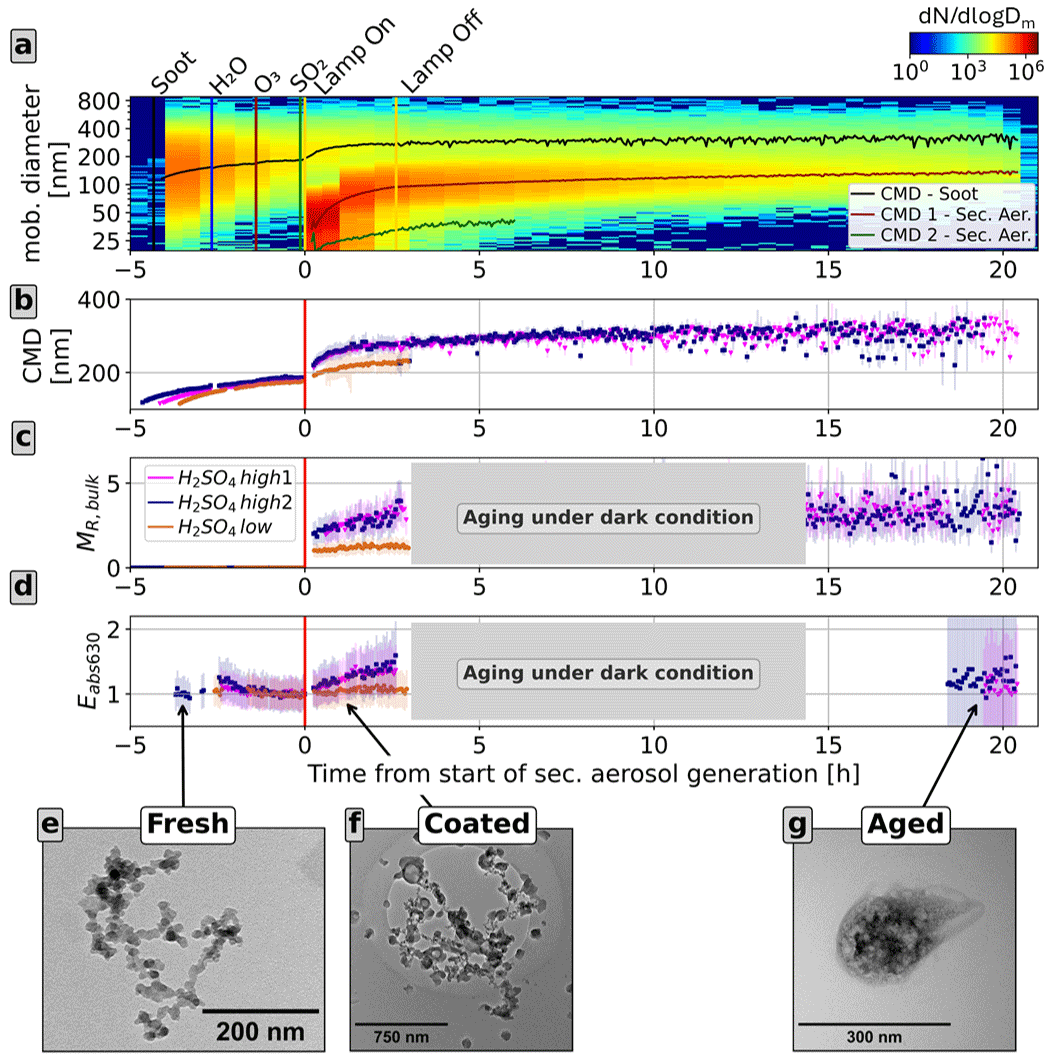
Figure 1(A) Time evolution of number size distribution as a function of the mobility diameter for the H2SO4-high1 experiment (t=D is the start of the secondary aerosol generation). The evolution of the count median diameters (CMD) of identified modes determined from log-normal fits of the size distribution is overlayed (soot: black, H2SO4: red, green). Error bars are omitted for clarity. Vertical lines indicate the occurrence of various events during the experiment (injection of soot, water vapour, O3, SO2; start and stop of irradiation, indicated as lamp on and lamp off). Time evolution of the (B) count median diameter (CMD) of the soot peak mode, (C) bulk coating-to-soot mass ratio MR,bulk, (D) absorption enhancement factor at 630 nm for the H2SO4-high1, H2SO4-high2 and H2SO4-low experiments. (E, F, G) Illustrative TEM pictures for the fresh, coated, and aged soot particles from the H2SO4-high1 experiment.
The time evolution of number size distribution, CMD, MR,bulk, and Eabs at 630 nm, as well as TEM pictures for the fresh, coated, and aged soot particles for the H2SO4 and the α-pinene SOA coating experiments are shown in Figs. 1 and 2. Timelines for all the H2SO4 and SOA coating experiments, also including Eabs at 450 nm, are shown in Figs. S2–S3, and S11–S16 in the Supplement. Timelines and results of the ageing control experiments are shown in Figs. S17–S23. The size-resolved ρeff (Dm) measured for the different control and coating experiments is shown in Fig. 3. Table 2 synthesises the physico-chemical and optical properties of the fresh, coated and aged soot aerosols.
3.1 Pre-coating soot evolution and ageing control experiments
The start point for the experiments is an about two-hour-old soot aerosol for which a complete set of properties was measured to determine an initial reference. In its fresh state the investigated soot has a lacy fractal morphology, as shown in TEM images (Figs. 1e, 2e), quantified by a mass-mobility exponent Dfm of 2.11 ± 0.04. The soot shows a mono-modal size distribution with an initial count median diameter CMD around 100–120 nm, increasing to values between 150 and 250 nm due to coagulation within the first 2 h of experiments (Figs. 1a, 2a). For the CMD of 200 nm the fresh soot particles have an average ρeff of 232 ± 13 kg m−3 (Fig. 3). The soot mass concentration at the end of this characterisation and just prior to the water vapour injection ranges between 13 and 169 µg m−3 for the different experiments.
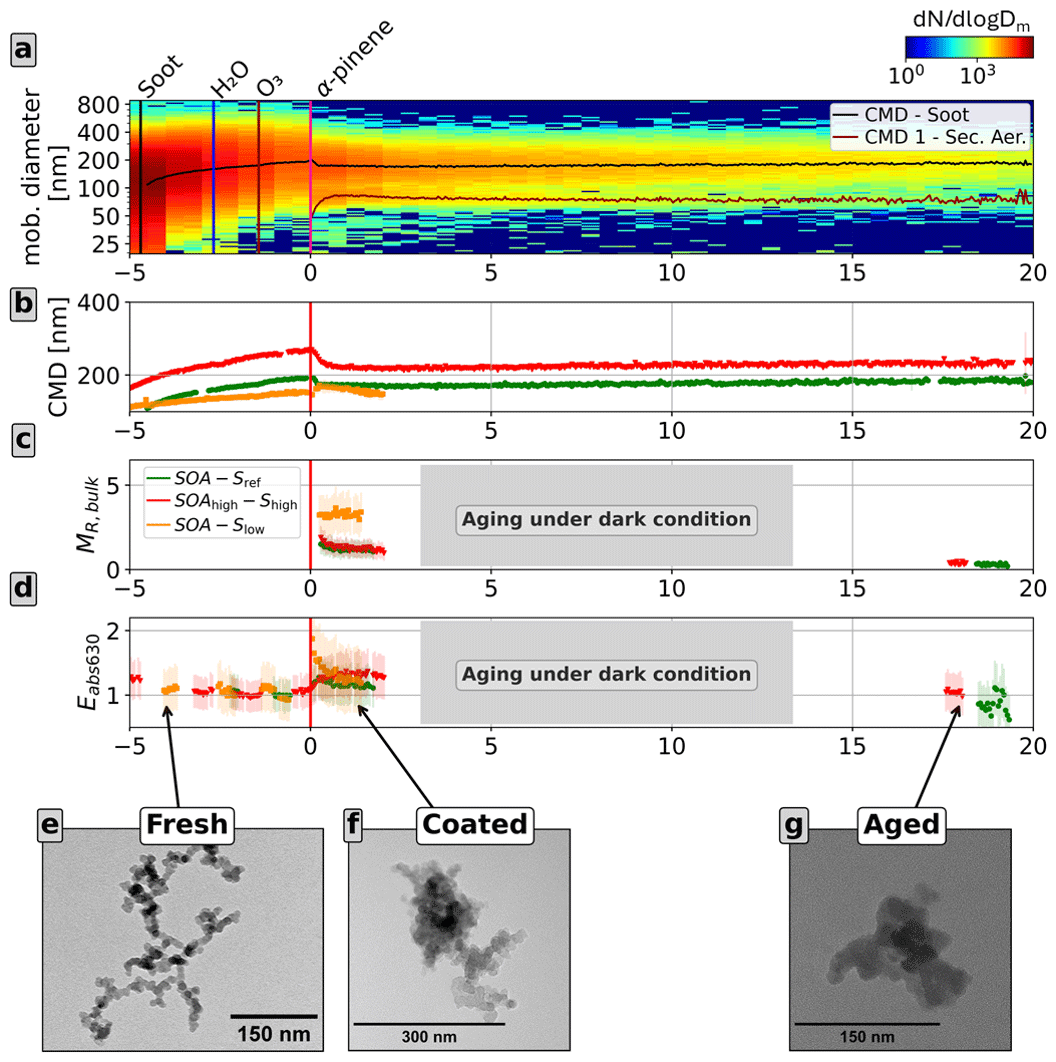
Figure 2(A) Time evolution of number size distribution as a function of the mobility diameter for the SOA-Sref coating experiment (t=D is the start of the secondary aerosol generation). The evolution of the count median diameter (CMD) of different identified modes determined from log-normal fits of the size distribution is shown (soot: black, SOA: red). Error bars are omitted for clarity. Vertical lines indicate the occurrence of various events during the experiments (injection of soot, water vapour, O3, and α-pinene). Time evolution of the (B) count median diameter (CMD) of the soot peak mode, (C) bulk coating-to-soot mass ratio MR,bulk, (D) absorption enhancement factor at 630 nm for the SOA–Sref, SOAhigh–Shigh, and SOA–Slow experiments. (E, F, G) Illustrative TEM pictures for the fresh, coated, and aged soot particles from the SOA–Sref experiment.
As shown in Figs. 1a and 2a, no significant changes in the CMD or number concentration are observed due to water vapour injection, with the exception of minimal loss of particles that can be attributed to a physical washout and the short pressure change in the chamber. Similarly, no significant effect on the soot physico-chemical properties is observed due to ozone injection and the following 2–3 h prior to the H2SO4 and SOA generation. Measurements of ρeff (Dm) show only slight differences, within uncertainties, between pre-coating steps and fresh soot (Fig. 3), indicating no significant chemical or morphological changes. The MAC values show a consistent minor declining trend during the pre-coating steps, as indicated by the decrease of Eabs (Figs. 1d, 2d). This decrease remains however well inside one standard deviation of the MAC values of fresh soot (Heuser et al., 2025a, Fig. S1). To account for this minor evolution, as described in Sect. 2.3.1, the reference MACprior to calculate Eabs is taken by averaging values over the last undisturbed suspension period prior to the coating generation, corresponding to about 60 to 90 min.
No significant changes in the soot physico-chemical and optical properties are likewise observed for the control experiments for the various conditions tested. The effective density measurements (Fig. 3a) and the mobility exponents determined from them are found to be rather stable compared to the fresh soot and the pre-coating steps. The only exception was a moderate increase in ρeff (Dm) observed during the irradiated humid experiments, both in absence and in presence of ozone (Figs. S22–S23). These changes in effective density indicate that some, albeit minor, physicochemical transformations occurred during the experiments. Specifically, illumination under humid conditions may promote the photooxidation of surface organic carbon, as previously reported by Han et al. (2012). In the humid experiment with ozone, the increase in effective density is likely associated with ozone uptake by the particles, consistent with previous chamber studies (Kamm et al., 1999; Zelenay et al., 2011). The long-term ageing control experiments, named Soot coagulation dry 1 and 2, also showed some deviations for Dfm, with values around 1.96 ± 0.01. These deviations are however attributed to measurement bias due to the very low aerosol concentrations after 24 h of coagulation and dilution. The MAC values remain for all conditions inside one standard deviation of the values of fresh soot as reported in Heuser et al. (2025a) (Fig. S1).
3.2 Soot-H2SO4 coating and ageing
As shown in Fig. 1a and b, the start of the H2SO4 generation leads to a progressive increase of soot CMD due to the condensation of coating material on the particles, reflected in a marked increase of the soot ρeff(Dm) (Fig. 3b), as well as to the production of new modes associated with homogeneous particle formation below CMDs of 120 nm. The estimated H2SO4 mass deposited on the soot due to condensation, but also coagulation with the H2SO4 mode, is quantified via the bulk coating-to-soot mass ratio MR,bulk (Fig. 1c). The H2SO4-low condition (lower OH oxidant availability) produces lower coating mass with MR,bulk increasing from a value of about 1.0 roughly 15 min after the beginning of H2SO4 generation, to 1.2 about 3 h later. Conversely, the H2SO4-high conditions (higher OH availability) lead MR,bulk to a quick rise to around 2.0–2.2 and a continuous increase to 3.5–3.9. The continued accumulation of coating material on soot induces a progressive increase in absorption (Fig. 1c–d). The Eabs values at 630 nm average at a maximum of around 1.3–1.4 (Fig. 1d), with values at 450 nm exceeding 1.5 (Fig. S2).
The retrieved average Dfm ranges from 1.89 to 2.01, and remains comparable with the value for fresh soot, indicating minimal changes to the shape of the lacy fractal particles after the initial coating addition. Nonetheless, TEM images depict a more heterogeneous mixing state, with both partial and fully coated particles, and both compacted and fractal-like soot (Fig. 1f; more illustrative images are shown in Fig. S4).
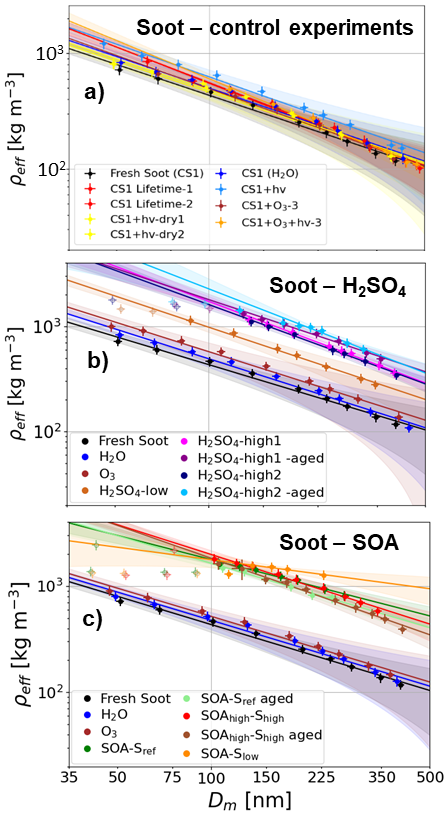
Figure 3Effective density measured as a function of the mobility diameter, ρeff (Dm), for (A) the different control experiments, and for (B) the H2SO4 and (C) the α-pinene SOA coating experiments. The power-law fits of ρeff (Dm) based on Eq. (1) (coloured lines) and the fitting uncertainties (coloured-shaded areas) are shown. As a reference, the measurements for fresh soot are shown in (A). Additional plots of ρeff (Dm) for the coating experiments are provided in Fig. S8.
A decrease in Eabs down to about 1.0–1.3 is measured at both wavelengths after 15 h of simulated dark ageing of the coated soot (grey area Figs. 1b–1d, S2), despite the MR,bulk showing no significant differences. The decrease in Eabs is likely associated to a size reduction of the absorbing soot core, as observed in TEM images analysis (Figs. 1g, S4), showing significant particles' restructuration. This restructuration is assumed to be caused by the continued accumulation of coating on the soot by condensation and coagulation, which homogenises the soot core structure while the MR,bulk remains relatively unchanged. This continuous coating formation is supported by a slight observed increase of both CMD and ρeff(Dm) (Fig. 3b), and a decrease in residual O3 and soot number concentration.
Table 2Physico-chemical and optical properties of the fresh and the coated soot aerosol. The given properties of the fresh soot are retrieved in Heuser et al. (2025a) and corresponds to soot after 60 min in suspension in the CESAM chamber. The properties of the coated soot aerosols are given at two stages: the “coated”, representing the average of soot properties between 15 and 240 min after coating formation, and the “aged”, representing the coated soot properties averaged between 1000 and 1300 min after coating formation, i.e. after the long-term ageing. The average and standard deviation of the bulk coating-to-soot mass ratio (MR,bulk) and the absorption enhancement (Eabs) at 450 and 630 nm wavelengths are provided. The mobility exponent (Dfm) values are reported for the “coated” soot.

3.3 Soot-SOA coating and ageing
In contrast with the slower H2SO4 experiments, the injection of the α-pinene precursor in the O3–rich chamber leads to a quasi-instantaneous start of the SOA generation marked by a rapid appearance and growth of a mode below 100 nm mobility diameter associated with new particle formation (Fig. 2a, ρeff(Dm) data Fig. 3c). The start of the SOA generation also marks an increase of MR,bulk due to the condensation of coating material on the soot particles (Fig. 2c), supported by a ρeff(Dm) increase in the soot containing fraction above 100 nm diameter. The MR,bulk rapidly reaches an average value of around 3.3 for SOA-Slow (experiments with the highest precursor-to-soot-ratio), and of 1.2 to 1.3 for the SOA-Sref (initial soot mass comparable to H2SO4 experiments) and SOAhigh-Shigh experiments (about twice the soot and precursor concentration than SOA-Sref). The Dfm rises to 2.06 ± 0.04 (SOAhigh-Shigh), 2.24 ± 0.05 (SOA-Sref), and 2.61 ± 0.04 (SOA-Slow), indicating that the coating formation induced a transition towards more spherical and compacted particle morphologies. This restructuring is also reflected by the marked and simultaneous decrease in the CMD for SOA-Sref and SOAhigh-Shigh. In contrast, the CMD of SOA-Slow increases rapidly after coating formation. The TEM images additionally support the coating-induced soot restructuring in all experiments. They show that the majority of soot collapsed to form small and compact aggregates (Fig. 2f–g; more illustrative images in Fig. S5), and, when visible from microscopy, the coating is identified to encapsulate soot particles. The net increase in CMD observed for SOA-Slow is then attributed to the larger amount of condensed coating material for this experiment, which masks the reduction in particle size associated with soot restructuring (Figs. 2b, S3). After this initial evolution, the soot CMD for SOA-Sref and SOAhigh-Shigh stabilizes as a consequence of minimal further SOA deposition (α-pinene precursor consumed) and negligible coagulation (as discussed in Sect. S2, Fig. S10). In contrast, for SOA-Slow the CMD of the soot peak is found to continuously decrease, interpreted as ongoing restructuration.
The Eabs measured at 450 and 630 nm rapidly rises following MR,bulk as the SOA coating on soot establishes. Then, until the ageing, it remains rather stable at values between 1.2 and 1.4 for SOA-Sref (Fig. 2d) and SOAhigh-Shigh. Higher Eabs up to 2 are measured for SOA-Slow right after coating starts due to larger MR,bulk, decreasing afterwards following the CMD decrease and its underlying restructuration (Fig. S3).
After 15 h of ageing in the dark, a significant decrease of and Eabs (0.83–1.04) at rather constant CMD is observed for the SOA-Sref and SOAhigh-Shigh experiments. The reduction of MR,bulk, concurrently with the absence of further SOA production, negligible coagulation, invariance of CMD, and a slight reduction in the soot density, indicates a loss of coating mass on the particles. Such a loss can occur during the continuous dilution of the chamber volume, despite minimal, which can lead to the evaporation of some of the more volatile compounds of the SOA (Grieshop et al., 2007; Metcalf et al., 2013), while low-volatile organics remain on the soot and continue to affect the absorption (Zhang et al., 2023). Such a loss of coating may cause further compaction of the soot (Corbin et al., 2023), as TEM pictures show dominantly collapsed particles (Fig. 2g). Therefore, the pronounced decrease in Eabs (down to values lower than 1) after 15 h of ageing is attributed to the combined effects of coating mass loss through evaporation and continued soot restructuring, which further reduced the particle size relative to the pre-coated soot.
4.1 Impact of coating dynamics and morphological restructuring on Eabs
The results presented in this work evidence that Eabs depends not only on the quantity of coating material deposited on the soot, but also on size and morphological modifications that affect Eabs magnitude and evolution, modulated by different coating dynamics and ageing.
In the experiments, larger Eabs are observed when aggregate shapes are more widespread and lacy aggregates are present. On the contrary, lower Eabs for given MR,bulk are measured for all conditions with more compacted soot aggregates. This is especially prominent when comparing the clusters of the observations of SOA-Sref and SOAhigh-Shigh and can be explained by the collapse of the soot aggregate, reducing particle size and optical absorption cross section (Kahnert and Devasthale, 2011) while the coating mass remains constant. Morphological restructuration is observed both directly at the early stages of the SOA coating and for aged H2SO4-coated soot, indicating that Eabs can evolve further after an initial coating formation. This size effect can be strong enough to reduce the Eabs to values lower than the pre-coating state (<1) even with light coatings, as for aged SOA-coated soot.
The shape, i.e. restructuration of the particles, and the coating distribution are found to vary with experiments and ageing time. The slower production of H2SO4 impacts the shape and thus the morphology of the soot less in the initial coating formation stages than the much faster SOA formation, which rapidly reduces mobility diameter and compacts soot particles. Only after long term ageing, the majority of particles for H2SO4 experiments is restructured, accompanied by a reduced Eabsfor the aged and collapsed H2SO4-coated soot. Based on previous flow reactor-type measurements observing soot compaction during rapid H2SO4 condensation (Khalizov et al., 2009b; Zhang et al., 2008), it can be assumed that the difference is not purely compound-related but likely a result of the dynamics of the coating formation.
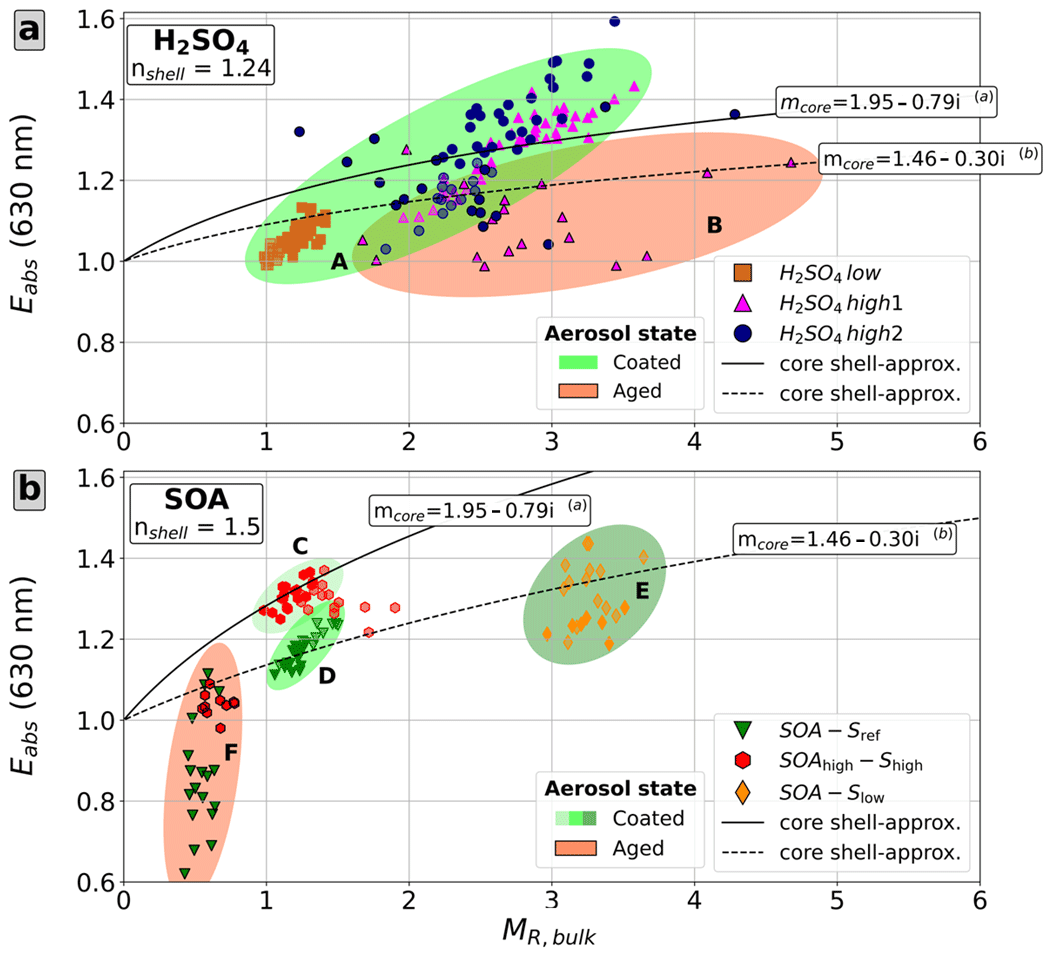
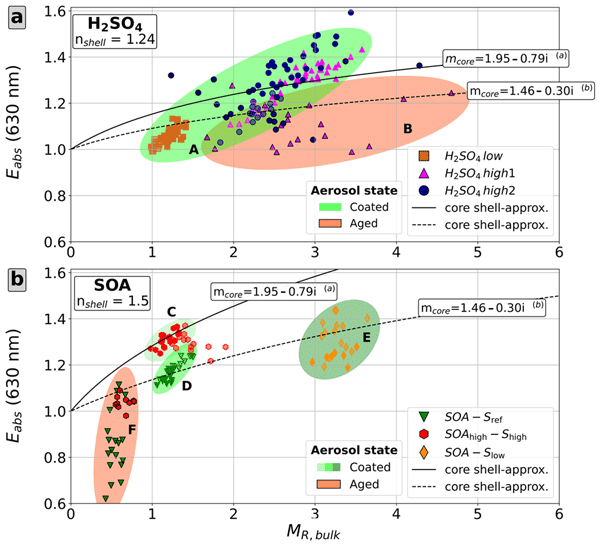
Figure 4Absorption enhancement factor (Eabs) at 630 nm as a function of the coating-to-soot mass ratio (MR,bulk) for (A) the H2SO4 and (B) the α-pinene SOA coating experiments. Symbols and color separate the measured data of different experiments. Slightly transparent values are measured during the initial 60 min and points with black edges are taken after the ageing. Groupings of pre- (green) and post-ageing (red) values are manually highlighted using coloured ellipses. Additionally, the theoretical calculations using the Mie core-shell approximation for the different coating types are shown. The EF-core-shell curve is shown for the value of the real part corresponding to the refractive index associated to the coating material: a value of nshell=1.5 for the SOA and nshell=1.24 for H2SO4. The refractive index of the soot core (ncore) is set at (a) 1.95−0.79i, representative of BC based on Bond and Bergstrom (2006), and at (b) 1.46−0.3i (Habib and Vervisch, 1988), representing a value on the other end of the refractive index range associated with soot. Error bars are omitted for clarity. A version of this figure including error bars is shown in Fig. S7.
4.2 Misprediction of the absorption enhancement by core-shell and fixed Eabs assumption
Experimental observations in the present study suggest that the Eabs can be significantly mispredicted if restructuration and size changes are not taken into account, a process frequently observed in ambient observations (Colbeck et al., 1990; Corbin et al., 2023; Fierce et al., 2020; Khalizov et al., 2009a; Wang et al., 2023). However, this is not possible with the commonly used idealized Mie calculations, as they rely on volumetric-based sizing, nor with fixed Eabs approximation. Implications of this drawback are visualized in Fig. 4 (630 nm) and Fig. S6 (450 nm), which each contain two predictions of the relation based on Mie core-shell calculations for each of the two coating types. The calculated curves differ in the refractive index assumptions for the soot core, which was selected to represent both pure BC and soot, as well as values with contrasting real and imaginary components. The effect of changes in morphology is best shown in the SOA results (Fig. 4b), where clusters of Eabs at the same MR,bulk can be observed. These can be described as core-shell by varying the refractive index, even though neither the soot's nor the coating's intrinsic optical properties change between experiments. The cases for which the modelled Eabs align more closely with measured ones are conditions with freshly well-established coatings. While for SOA they happen instantly, for H2SO4, this only applies for conditions with higher MR,bulk (). This is in line with the observations of Liu et al. (2017) showing that a sufficient enhancement is only possible when a certain mixing ratio or threshold is reached. In this case, a core-shell internal mixing approximation may be potentially suitable for describing it. Observations from this study show that, in the range of MR,bulk investigated, the core-shell approximation fails to predict Eabs for the other conditions, i.e., uncollapsed partially coated soot with significant particle-to-particle heterogeneity and aged coated particles. Previous works using both models and experimental studies have shown that the distribution of the coating and position of the soot in the coated particles (e.g., partial coating, embedded soot) can have a significant impact on the absorption enhancement and that the shape of the particle can influence this distribution (Adachi et al., 2010; Fierce et al., 2016, 2020; Liu et al., 2017; Zhang et al., 2025). Adachi et al. (2010) noted relevant inhomogeneity in particle-coating mixing, particularly for elongated non-collapsed particles. Such an inhomogeneity is likely the cause of the systematic differences between the observed and core-shell predicted Eabs, in particular during a slow coating generation.
Compared to experimental observations, the Eabs predictions at 630 nm overestimate absorption by up to 60 % in the Mie-based retrieval, and by up to 40 % for the, commonly used, fixed Eabs value of 1.5, but increasing up to 75 % for fresh partial coatings or soot that has undergone restructuration. Experimental conditions characterized by established coating and only limited soot restructuring exhibit improved agreement between predicted and measured Eabs values, although underestimations between 2 % and 30 % persist.
4.3 Comparison with previous chamber studies investigating soot ageing
Only a limited number of chamber studies have examined both the formation and subsequent ageing of coatings on soot particles. Although their soot generation methods, coating protocols, and the extent of soot and coating characterization differ from those employed in the present study, two studies, the ones by Schnaiter et al. (2005) and by Metcalf et al. (2013), investigated the formation and ageing of organic coatings on polydisperse soot and are discussed below. To the best of our knowledge, no comparable chamber studies examining the formation and ageing of sulfuric acid coatings on soot have been reported.
Schnaiter et al. (2005) investigated the impact of α-pinene SOA coatings on diesel soot using experiments conducted in the 84 m3 AIDA chamber. In their study, the soot underwent five successive coating steps through the in situ ozonolysis of α-pinene before being aged for an additional 10 h in the chamber, resulting in total experiment durations of up to 25 h. They reported absorption enhancement factors of 1.8–2.1 at wavelengths of 450, 550, and 700 nm for collapsed soot aggregates. These values are at the upper end of the range observed in our SOA experiments, particularly for the SOA-Slow experiment, which most closely resembles the conditions in terms of the soot-to-α-pinene precursor ratio as investigated at the AIDA chamber. In contrast to our observations, Schnaiter et al. (2005) found that Eabs remained nearly constant during the ageing period. This discrepancy is likely explained by fundamental differences in the experimental protocols, particularly the ageing conditions. In our experiments, the aerosol was aged under slight continuous dilution and in the absence of additional α-pinene precursor. Under these conditions, the more volatile SOA components gradually evaporated, leading to a reduction in the coating mass. In the AIDA experiments, however, the soot experienced continuous SOA growth throughout the ageing period. This was achieved by first introducing ozone into the chamber and subsequently supplying a continuous flow of air saturated with α-pinene vapor, thereby sustaining ongoing SOA condensation onto the soot particles. These conditions maintained the particle coating and likely explain why Eabs remained nearly constant during the 10 h ageing period. Schnaiter et al. (2005) further showed that the Mie core–shell model cannot accurately reproduce the optical behaviour of thinly coated soot particles, although its agreement with observations improves with increasing coating-to-soot ratios.
Metcalf et al. (2013) performed chamber experiments with fullerene soot, a surrogate for fractal carbonaceous particles, in the 28 m3 Caltech Teflon chamber. The soot was exposed to several types of organic coatings, including SOA formed from the high-NOx photooxidation of naphthalene and from the high- and low-NOx photooxidation of α-pinene. The experiments consisted of an initial irradiation period lasting several hours, during which SOA formed and the chamber temperature increased, followed by several hours of dilution accompanied by a gradual decrease in temperature. Consistent with our observations, Metcalf et al. (2013) reported absorption enhancement factors of 1.25–1.35 at 405 nm and 1.15–1.30 at 781 nm for the α-pinene SOA experiments. They also observed that the SOA coating partially evaporated during the course of the experiments, particularly during the dilution phase. The extent of evaporation depended on the chamber temperature, both during the irradiation period, which influenced the formation of more or less semi-volatile SOA components, and during dilution, where the magnitude of the temperature decrease controlled the degree of evaporation. In our experiments, temperature variations during dilution were limited to 1–2 K, suggesting that changes in coating mass were primarily driven by dilution rather than by temperature-induced volatility changes. Unlike our observations, Metcalf et al. (2013) demonstrated that Eabs can be accurately predicted when the coating mass or thickness is known and the particle can be represented by a simple core–shell geometry. However, this approach relies on fullerene spherical particles instead of fractal soot, thereby limiting the representativeness of the results for atmospheric conditions.
Overall, these previous studies have provided evidence that coating-induced absorption enhancement occurs and provide key complementary observations to our study. However, they have important limitations because they provide only limited information on the simultaneous evolution of particle coating and morphology throughout the different stages of the coating process and, in the case of Metcalf et al. (2013), rely on simplified particle morphologies. Consequently, it remains difficult to directly compare these studies or derive predictive relationships applicable to atmospheric soot. The present work addresses this gap by systematically characterizing both coating evolution and soot restructuring throughout the ageing process, so to move towards a mechanistic understanding of Eabs. Although such measurements are experimentally challenging, this approach provides new insights into the underlying processes and demonstrates that this combined characterization is essential for developing a predictive understanding of coating-induced absorption enhancement.
The inability of the Mie core-shell and fixed 1.5 value to systematically predict Eabs has consequences for the estimates of the single scattering albedo (SSA, ratio of scattering to extinction) and radiative forcing (RF) for BC-containing aerosols. An illustrative example is given in Table 3 reporting the differences in estimated and measured SSA and the resulting relative differences in RF at 630 nm, for two assumed surface albedos. The SSA in Table 3 was estimated from Mie core-shell theory (SSAMieCS) assuming the same complex refractive indices and particle representation as described in Sect. 2.3.2, or by assuming a fixed Eabs of 1.5 (SSAfixed−1.5). To note that in the case of fixed Eabs, only the impact of the coating on absorption is considered for the calculation of SSAfixed−1.5, while scattering is assumed unchanged. These values were compared to the measured SSA during experiments (SSAmeas). The signal by the SOA and H2SO4 nucleating modes was subtracted from the total scattering and extinction when calculating SSAmeas. Further details on the SSA calculations are provided in Sect. S3.
Table 3Average values of the single scattering albedo measured (SSAmeas) and calculated at 630 nm based on the Mie core-shell approach (SSAMieCS) for two refractive indices of the soot core (ncore) set at 1.95−0.79i (Bond and Bergstrom, 2006), and 1.46−0.3i (Habib and Vervisch, 1988) and for fixed Eabs of 1.5 (SSAfixed−1.5). The corresponding associated fractional change in radiative forcing, ΔRF, at 630 nm due to the SSA change is reported for varying aerosol processing states of the performed experiments. Data corresponds to a surface albedo (RS) of 0.2 and 0.7.

The calculated and measured SSA values were then used to determine the change in RF by utilizing the following equation (Haywood and Shine, 1995), providing the instantaneous forcing for a thin layer of absorbing aerosols at the top-of-atmosphere:
where D is the fractional day length, S0 the solar constant, Tat the atmospheric transmission, Ac the fractional cloud amount, SSA the aerosol single scattering albedo, β the aerosol upscatter fraction of scattering, δ the aerosol optical depth, and Rs the surface reflectivity. Despite Eq. (4) provides a simplistic estimate of RF considering only aerosol-radiation interactions and not accounting for changes compared to pre-industrial conditions, it can be used to quantify the impact of Eabs mispredictions on BC radiative effect. The relative change of RF due to a change from SSAmeas and SSAMieCS (or SSAfixed−1.5) was determined as:
For Eq. (5) two values of RS (0.2, bare soil, and 0.7, snow/ice) were used as exemplary values. The upscatter fraction β was calculated from a backscattering ratio of 0.27, determined from experimental data using the equations in Moosmüller and Ogren (2017). Calculations for SSA and RF were performed by separating data for fresh coatings (up to 1 h from the onset of secondary aerosol formation), established coatings (second and third hour), and aged coatings (more than 15 h). The uncertainty on ΔRF was estimated at ∼ 20 % based on the error propagation formula and considering only the uncertainty on the measured SSA (12 %–25 %, Heuser et al., 2025a) and the sensitivity of the modelled SSA on the assumed complex refractive (15 % on average based on the comparison of the SSA values calculated with 1.95−0.79i and 1.46−0.3i).
The results in Table 3 show that for conditions that are associated with collapsed soot (H2SO4-aged and SOA), the core-shell calculations underestimate the SSA on average between 12 % and 56 % for early, medium, and latter stages of processing. This underestimation results in an overestimation of the RF averaging at around 46 %, but reaching up to 84 %, for a bare soil scenario (RS=0.2), when compared to RF estimates based on SSAmeas. For processing stages where coatings are forming and/or the soot undergoes limited restructuration, SSA values are generally found to be overestimated by 2 % to 122 %. This indicates that not only is the Eabs overestimated by the Mie-based calculations for these conditions, but so is the scattering. These SSA overpredictions lead to an average underestimation of RF of about 17 % for the different stages of the experiments in a bare soil scenario. The impact of the SSA misprediction on the RF reduces with increasing surface albedo, being about 20 % (collapsed soot) and 10 % (inhomogeneous coating and non-collapsed soot) for a surface albedo of 0.7 associated with fresh snow.
The common alternative of a fixed Eabs of 1.5 leads to similar SSA and RF mispredictions. Compared to the observations, the SSA at 630 nm is consistently underestimated, in turn leading to an RF overestimation ranging between 6 % and 58 % in the bare soil and between 4 % and 20 % for the snow scenario.
This study provides a laboratory-based investigation to advance the mechanistic understanding of soot Eabs and its variability. Taking advantage of the long aerosol lifetime in the CESAM chamber, experiments were designed to explore the relationship between Eabs and MR,bulk across a variety of atmospherically relevant processes. The range of Eabs observed in this study for polydispersed soot under varying coating and ageing conditions lies within laboratory observations for uniform coating on monodispersed soot (Fierce et al., 2020; Peng et al., 2016) and ambient measurements in background, suburban, and urban environments (Cappa et al., 2019; Liu et al., 2017; Zeng et al., 2024). The MR,bulk extends up to values of 5, representing most common urban and suburban conditions (Cappa et al., 2019; Liu et al., 2017; Zeng et al., 2024), even if values as high as 10 or more are observed in urban and suburban atmospheres and during biomass burning events (McMeeking et al., 2014; Taylor et al., 2020; Wu et al., 2020; Zeng et al., 2024).
Results from the present analysis support the evidence of a correlation between Eabs and the coating amount on soot. We highlight, however, the ambiguity of this relation based on experimental observations with varying coating and soot properties. The measured Eabs and the corresponding particle physico-chemical properties confirm the impact of the morphological organization of both the soot and the coating-soot system on the Eabs. Our controlled laboratory experiments show that the coating formation dynamics, coating type (non-volatile/volatile), and subsequent ageing affect the composition, morphology, and size of the soot and the coating-soot system, whose combined effect ultimately rules the Eabs magnitude and its temporal evolution. Based on this dependence, the range of measured Eabs cannot systematically be predicted by the Mie core-shell approximation or by a fixed Eabs value, as commonly used in models.
Improving radiative forcing predictions requires models to account for the evolution of both particle and coating properties beyond coating thickness alone, in order to capture changes in optical properties, particularly the magnitude of Eabs and its evolution. Additional considerations include inhomogeneities in particle coatings, which we found to depend on the coating generation process, as well as the effects of morphological organization of both soot and coatings, which influence the entire soot lifetime.
In order to achieve this objective, previous studies have proposed empirical adjustments of the core-shell model to reconcile with laboratory and ambient observations. These took into account morphological effects to describe single particle mixing state (Fierce et al., 2020; Liu et al., 2017) and particle-to-particle heterogeneity in mixing state (Fierce et al., 2020; Wang et al., 2023; Zeng et al., 2024). While these empirically determined adjustments allow for an improved prediction of the Eabs, they are often constrained to specific cases and are limited in general applicability.
More reliable approaches can be envisaged by using more advanced spectral optical theories, such as discrete dipole approximation (DDA), T-matrix, Rayleigh–Debye–Gans for coated fractal aggregate (RDG-CFA), or others (Adachi et al., 2010; Lefevre et al., 2019; Liu et al., 2016; Zhang et al., 2017). As these require detailed information on the soot and coating properties and generally also higher computational resources, they have not found wide use in large-scale models in the past decades. However, recent studies show that progressively increasing consideration of BC mixing state and nonsphericity in models leads to more accurate estimates of BC radiative forcing (Chen et al., 2024; Fierce et al., 2025; Romshoo et al., 2024; Wang et al., 2023; Zeng et al., 2024). In line with these studies, this systematic laboratory investigation stresses the need for more sophisticated approaches than core-shell Mie or fixed Eabs approximation to provide accurate calculations of BC absorption enhancement. The physical, chemical, and optical datasets in this study, which are made openly available to the scientific community (all data doi are listed in Table 1), can provide support for such model developments. The experimental data (such as size, MR,bulk, Eabs) can be used to test and evaluate model parameterizations, in particular optical modules, and including machine learning and neural network approaches (e.g., Beeler et al., 2026). Nonetheless, more experimental investigation is required, extending to varying chemical systems and ageing conditions. With laboratory experiments being most commonly used for such mechanistic studies, we advise that setups which simulate BC coating formation under very rapid dynamics (such as flow tubes or simulation chambers considering short ageing times) should be used with care, as these approaches may produce overly idealised observations.
The CESAM data used in this study are available through the Database of Atmospheric Simulation Chamber Studies (DASCS) of the EUROCHAMP Data Centre (https://data.eurochamp.org/data-access/chamber-experiments/, last access: 17 July 2026) also available via the ACTRIS data portal (https://data.actris.eu/, last access: 17 July 2026) with the identifiers listed in Table 1. The core-shell optical calculations were performed with PyMieScatt, which is available at https://github.com/bsumlin/PyMieScatt (last access: 17 July 2026, Sumlin et al., 2018).
The supplement related to this article is available online at https://doi.org/10.5194/acp-26-15831-2026-supplement.
CDB and JFD conceived the study. JH, CDB, and JFD designed the experiments and discussed the results. JH conducted the experiments with contributions by CDB, JY, MC, AB, EP, MZ, LR, AM, CY, SC, PL, MM, PF, BPV, and JFD. MM and DF performed transmission microscopy measurements. JH performed the full data analysis under the supervision of CDB and JFD and with contributions from JY, MZ, LR, AM, CY, MC, and DF. BPV, as PI of the CESAM facility, contributed to full experiment realization and management. PL provided the SP2 used in the experiments. JY provided the CPMA used in the experiments. CDB provided funding acquisition and project administration. JH, CDB, and JFD wrote the manuscript. All authors reviewed and commented on the paper.
The contact author has declared that none of the authors has any competing interests.
Publisher's note: Copernicus Publications remains neutral with regard to jurisdictional claims made in the text, published maps, institutional affiliations, or any other geographical representation in this paper. The authors bear the ultimate responsibility for providing appropriate place names. Views expressed in the text are those of the authors and do not necessarily reflect the views of the publisher.
The authors gratefully acknowledge CNRS-INSU, Université Paris Est Créteil, Université Paris Cité, and OSU-EFLUVE for supporting CESAM platform as a component of ACTRIS Research Infrastructure. This platform also benefits from the support of ACTRIS-FR, registered on the Roadmap of the French Ministry of Research. The authors thank AERIS for curating and distributing the data produced by CESAM chamber through ACTRIS portal (https://dc.actris.nilu.no/, last access: 17 July 2026) and ACTRIS DC ASC Unit (formerly known as EUROCHAMP DC, https://data.eurochamp.org, last access: 17 July 2026). Patrick Ginot is acknowledged for logistic support with SP2 operations. Contributions by Patrick Ausset, Mouad Essani, Gael Noyalet, Vera Bernardoni, Dario Massabò, Federico Mazzei, Brice Temime-Roussel, Roberta Vecchi, and Virginia Vernocchi to experimental activities are gratefully acknowledged. Helpful comments by two anonymous reviewers and by Dr. Schnaiter are gratefully acknowledged.
This study has been supported by the French National Research Agency (Agence Nationale de la Recherche, ANR) through the B2C project (grant no. ANR-19-CE01-0024-01), by the Centre National de la Recherche Scientifique, Institut national des sciences de l’Univers, French National program LEFE-CHAT (Les Enveloppes Fluides et l’Environnement – Chimie Atmosphérique) through the BACON project. This work has received funding from the TNA activity of the European Union’s Horizon 2020 research and innovation programme through the EUROCHAMP-2020 Infrastructure Activity under grant agreement No 730997. It has also been supported by DIM Qi2 and Paris Ile-de-France Region. L. Renzi and M. Zanatta were partially supported by ITINERIS project (IR0000032), the Italian Integrated Environmental Research Infrastructures System (D.D. n. 130/2022 - CUP B53C22002150006), funded by EU – Next Generation EU PNRR-Mission 4 “Education and Research”.
This paper was edited by Gunnar Myhre and reviewed by two anonymous referees.
Adachi, K., Chung, S. H., and Buseck, P. R.: Shapes of soot aerosol particles and implications for their effects on climate, J. Geophys. Res., 115, 2009JD012868, https://doi.org/10.1029/2009JD012868, 2010.
Anderson, T. L., Covert, D. S., Marshall, S. F., Laucks, M. L., Charlson, R. J., Waggoner, A. P., Ogren, J. A., Caldow, R., Holm, R. L., Quant, F. R., Sem, G. J., Wiedensohler, A., Ahlquist, N. A., and Bates, T. S.: Performance Characteristics of a High-Sensitivity, Three-Wavelength, Total Scatter/Backscatter Nephelometer, J. Atmos. Ocean. Tech., 13, 967–986, https://doi.org/10.1175/1520-0426(1996)013<0967:PCOAHS>2.0.CO;2, 1996.
Asmi, E., Sipkens, T. A., Saturno, J., Backman, J., Vasilatou, K., Weingartner, E., Keller, A., Ciupek, K., Müller, T., Babu Suja, A., Močnik, G., Drinovec, L., Eleftheriadis, K., Gini, M. I., Nowak, A., and Corbin, J. C.: Mass absorption cross-section of ambient black carbon aerosols – a review, npj Clim. Atmos. Sci., 9, 17, https://doi.org/10.1038/s41612-025-01288-2, 2025.
Baldo, C., Formenti, P., Nowak, S., Chevaillier, S., Cazaunau, M., Pangui, E., Di Biagio, C., Doussin, J.-F., Ignatyev, K., Dagsson-Waldhauserova, P., Arnalds, O., MacKenzie, A. R., and Shi, Z.: Distinct chemical and mineralogical composition of Icelandic dust compared to northern African and Asian dust, Atmos. Chem. Phys., 20, 13521–13539, https://doi.org/10.5194/acp-20-13521-2020, 2020.
Baldo, C., Formenti, P., Di Biagio, C., Lu, G., Song, C., Cazaunau, M., Pangui, E., Doussin, J.-F., Dagsson-Waldhauserova, P., Arnalds, O., Beddows, D., MacKenzie, A. R., and Shi, Z.: Complex refractive index and single scattering albedo of Icelandic dust in the shortwave part of the spectrum, Atmos. Chem. Phys., 23, 7975–8000, https://doi.org/10.5194/acp-23-7975-2023, 2023.
Battaglia, F., Formenti, P., Giorio, C., Cazaunau, M., Pangui, E., Bergé, A., Gratien, A., Pereira, D. L., Bertin, T., de Brito, J. F., Romanias, M. N., Michoud, V., Baldo, C., Chevaillier, S., Noyalet, G., Decorse, P., Picquet-Varrault, B., and Doussin, J.-F.: Formation and composition of organic aerosols from the uptake of glyoxal on natural mineral dust aerosols: a laboratory study, Atmos. Chem. Phys., 25, 12409–12431, https://doi.org/10.5194/acp-25-12409-2025, 2025.
Beeler, P., Donald, S., and Fierce, L.: DDA-BNN v1.0: A Morphology-Aware Surrogate Model for the Optical Properties of Black Carbon–Containing Particles, EGUsphere [preprint], https://doi.org/10.5194/egusphere-2026-1270, 2026.
Bond, T. C. and Bergstrom, R. W.: Light Absorption by Carbonaceous Particles: An Investigative Review, Aerosol Sci. Technol., 40, 27–67, https://doi.org/10.1080/02786820500421521, 2006.
Bond, T. C., Doherty, S. J., Fahey, D. W., Forster, P. M., Berntsen, T., DeAngelo, B. J., Flanner, M. G., Ghan, S., Kärcher, B., Koch, D., Kinne, S., Kondo, Y., Quinn, P. K., Sarofim, M. C., Schultz, M. G., Schulz, M., Venkataraman, C., Zhang, H., Zhang, S., Bellouin, N., Guttikunda, S. K., Hopke, P. K., Jacobson, M. Z., Kaiser, J. W., Klimont, Z., Lohmann, U., Schwarz, J. P., Shindell, D., Storelvmo, T., Warren, S. G., and Zender, C. S.: Bounding the role of black carbon in the climate system: A scientific assessment: BLACK CARBON IN THE CLIMATE SYSTEM, J. Geophys. Res.-Atmos., 118, 5380–5552, https://doi.org/10.1002/jgrd.50171, 2013.
Caponi, L., Formenti, P., Massabó, D., Di Biagio, C., Cazaunau, M., Pangui, E., Chevaillier, S., Landrot, G., Andreae, M. O., Kandler, K., Piketh, S., Saeed, T., Seibert, D., Williams, E., Balkanski, Y., Prati, P., and Doussin, J.-F.: Spectral- and size-resolved mass absorption efficiency of mineral dust aerosols in the shortwave spectrum: a simulation chamber study, Atmos. Chem. Phys., 17, 7175–7191, https://doi.org/10.5194/acp-17-7175-2017, 2017.
Cappa, C. D., Onasch, T. B., Massoli, P., Worsnop, D. R., Bates, T. S., Cross, E. S., Davidovits, P., Hakala, J., Hayden, K. L., Jobson, B. T., Kolesar, K. R., Lack, D. A., Lerner, B. M., Li, S.-M., Mellon, D., Nuaaman, I., Olfert, J. S., Petäjä, T., Quinn, P. K., Song, C., Subramanian, R., Williams, E. J., and Zaveri, R. A.: Radiative Absorption Enhancements Due to the Mixing State of Atmospheric Black Carbon, Science, 337, 1078–1081, https://doi.org/10.1126/science.1223447, 2012.
Cappa, C. D., Zhang, X., Russell, L. M., Collier, S., Lee, A. K. Y., Chen, C., Betha, R., Chen, S., Liu, J., Price, D. J., Sanchez, K. J., McMeeking, G. R., Williams, L. R., Onasch, T. B., Worsnop, D. R., Abbatt, J., and Zhang, Q.: Light Absorption by Ambient Black and Brown Carbon and its Dependence on Black Carbon Coating State for Two California, USA, Cities in Winter and Summer, J. Geophys. Res.-Atmos., 124, 1550–1577, https://doi.org/10.1029/2018JD029501, 2019.
Chan, T. W., Huang, L., Leaitch, W. R., Sharma, S., Brook, J. R., Slowik, J. G., Abbatt, J. P. D., Brickell, P. C., Liggio, J., Li, S.-M., and Moosmüller, H.: Observations of OM/OC and specific attenuation coefficients (SAC) in ambient fine PM at a rural site in central Ontario, Canada, Atmos. Chem. Phys., 10, 2393–2411, https://doi.org/10.5194/acp-10-2393-2010, 2010.
Chen, G., Liu, C., Wang, J., Yin, Y., and Wang, Y.: Accounting for Black Carbon Mixing State, Nonsphericity, and Heterogeneity Effects in Its Optical Property Parameterization in a Climate Model, J. Geophys. Res.-Atmos., 129, https://doi.org/10.1029/2024jd041135, 2024.
Cheng, Z., Atwi ,K., Onyima ,T., and Saleh, R.: Investigating the dependence of light-absorption properties of combustion carbonaceous aerosols on combustion conditions, Aerosol Sci. Technol., 53, 419–434, https://doi.org/10.1080/02786826.2019.1566593, 2019.
Colbeck, I., Appleby, L., Hardman, E. J., and Harrison, R. M.: The optical properties and morphology of cloud-processed carbonaceous smoke, J. Aerosol Sci., 21, 527–538, https://doi.org/10.1016/0021-8502(90)90129-L, 1990.
Corbin, J. C., Modini, R. L., and Gysel-Beer, M.: Mechanisms of soot-aggregate restructuring and compaction, Aerosol Sci. Technol., 57, 89–111, https://doi.org/10.1080/02786826.2022.2137385, 2023.
De Haan, D. O., Hawkins, L. N., Wickremasinghe, P. D., Andretta, A. D., Dignum, J. R., De Haan, A. C., Welsh, H. G., Pennington, E. A., Cui, T., Surratt, J. D., Cazaunau, M., Pangui, E., and Doussin, J.-F.: Brown Carbon from Photo-Oxidation of Glyoxal and SO2 in Aqueous Aerosol, ACS Earth Space Chem., 7, 1131–1140, https://doi.org/10.1021/acsearthspacechem.3c00035, 2023.
Denjean, C., Formenti, P., Picquet-Varrault, B., Pangui, E., Zapf, P., Katrib, Y., Giorio, C., Tapparo, A., Monod, A., Temime-Roussel, B., Decorse, P., Mangeney, C., and Doussin, J. F.: Relating hygroscopicity and optical properties to chemical composition and structure of secondary organic aerosol particles generated from the ozonolysis of α-pinene, Atmos. Chem. Phys., 15, 3339–3358, https://doi.org/10.5194/acp-15-3339-2015, 2015.
Di Biagio, C., Formenti, P., Balkanski, Y., Caponi, L., Cazaunau, M., Pangui, E., Journet, E., Nowak, S., Caquineau, S., Andreae, M. O., Kandler, K., Saeed, T., Piketh, S., Seibert, D., Williams, E., and Doussin, J.-F.: Global scale variability of the mineral dust long-wave refractive index: a new dataset of in situ measurements for climate modeling and remote sensing, Atmos. Chem. Phys., 17, 1901–1929, https://doi.org/10.5194/acp-17-1901-2017, 2017.
Di Biagio, C., Formenti, P., Balkanski, Y., Caponi, L., Cazaunau, M., Pangui, E., Journet, E., Nowak, S., Andreae, M. O., Kandler, K., Saeed, T., Piketh, S., Seibert, D., Williams, E., and Doussin, J.-F.: Complex refractive indices and single-scattering albedo of global dust aerosols in the shortwave spectrum and relationship to size and iron content, Atmos. Chem. Phys., 19, 15503–15531, https://doi.org/10.5194/acp-19-15503-2019, 2019.
Di Biagio, C., Doussin, J.-F., Cazaunau, M., Pangui, E., Cuesta, J., Sellitto, P., Ródenas, M., and Formenti, P.: Infrared optical signature reveals the source–dependency and along–transport evolution of dust mineralogy as shown by laboratory study, Sci. Rep., 13, 13252, https://doi.org/10.1038/s41598-023-39336-7, 2023.
Doussin, J.-F., Fuchs, H., Kiendler-Scharr, A., Seakins, P., and Wenger, J. (Eds.): A Practical Guide to Atmospheric Simulation Chambers, Springer International Publishing, Cham, https://doi.org/10.1007/978-3-031-22277-1, 2023.
Ess, M. N., Bertò, M., Irwin, M., Modini, R. L., Gysel-Beer, M., and Vasilatou, K.: Optical and morphological properties of soot particles generated by the miniCAST 5201 BC generator, Aerosol Sci. Technol., 55, 828–847, https://doi.org/10.1080/02786826.2021.1901847, 2021.
Fierce, L., Bond, T. C., Bauer, S. E., Mena, F., and Riemer, N.: Black carbon absorption at the global scale is affected by particle-scale diversity in composition, Nat. Commun., 7, 12361, https://doi.org/10.1038/ncomms12361, 2016.
Fierce, L., Onasch, T. B., Cappa, C. D., Mazzoleni, C., China, S., Bhandari, J., Davidovits, P., Fischer, D. A., Helgestad, T., Lambe, A. T., Sedlacek, A. J., Smith, G. D., and Wolff, L.: Radiative absorption enhancements by black carbon controlled by particle-to-particle heterogeneity in composition, P. Natl. Acad. Sci. USA, 117, 5196–5203, https://doi.org/10.1073/pnas.1919723117, 2020.
Fierce, L., Li, Y., Feng, Y., Riemer, N., Schutgens, N. A. J., Aiken, A. C., Dubey, M. K., Ma, P., and Wuebbles, D.: Constraining Black Carbon Aging in Global Models to Reflect Timescales for Internal Mixing, J. Adv. Model. Earth Sy., 17, https://doi.org/10.1029/2024ms004471, 2025.
Fuller, K. A., Malm, W. C., and Kreidenweis, S. M.: Effects of mixing on extinction by carbonaceous particles, J. Geophys. Res., 104, 15941–15954, https://doi.org/10.1029/1998JD100069, 1999.
Grieshop, A. P., Donahue, N. M., and Robinson, A. L.: Is the gas‐particle partitioning in alpha-pinene secondary organic aerosol reversible?, Geophys. Res. Lett., 34, 2007GL029987, https://doi.org/10.1029/2007GL029987, 2007.
Habib, Z. G. and Vervisch, P.: On The Refractive Index of Soot at Flame Temperature, Combust. Sci. Technol., 59, 261–274, https://doi.org/10.1080/00102208808947100, 1988.
Han, C., Liu, Y., Ma, J., and He, H.: Key role of organic carbon in the sunlight-enhanced atmospheric aging of soot by O2, P. Natl. Acad. Sci. USA, 109, 21250–21255, https://doi.org/10.1073/pnas.1212690110, 2012.
Haywood, J. M. and Shine, K. P.: The effect of anthropogenic sulfate and soot aerosol on the clear sky planetary radiation budget, Geophys. Res. Lett., 22, 603–606, https://doi.org/10.1029/95GL00075, 1995.
Healy, R. M., Wang, J. M., Jeong, C.-H., Lee, A. K. Y., Willis, M. D., Jaroudi, E., Zimmerman, N., Hilker, N., Murphy, M., Eckhardt, S., Stohl, A., Abbatt, J. P. D., Wenger, J. C., and Evans, G. J.: Light‐absorbing properties of ambient black carbon and brown carbon from fossil fuel and biomass burning sources, J. Geophys. Res.-Atmos., 120, 6619–6633, https://doi.org/10.1002/2015JD023382, 2015.
Heuser, J., Di Biagio, C., Yon, J., Cazaunau, M., Bergé, A., Pangui, E., Zanatta, M., Renzi, L., Marinoni, A., Inomata, S., Yu, C., Bernardoni, V., Chevaillier, S., Ferry, D., Laj, P., Maillé, M., Massabò, D., Mazzei, F., Noyalet, G., Tanimoto, H., Temime-Roussel, B., Vecchi, R., Vernocchi, V., Formenti, P., Picquet-Varrault, B., and Doussin, J.-F.: Spectral optical properties of soot: laboratory investigation of propane flame particles and their link to composition, Atmos. Chem. Phys., 25, 6407–6428, https://doi.org/10.5194/acp-25-6407-2025, 2025a.
Heuser, J., Di Biagio, C., Cazaunau, M., Berge, A., Pangui, E., Yon, J., Zanatta, M., Renzi, L., Marinoni, A., Laj, P., Temime-Roussel, B., Formenti, P., Picquet-Varrault, B., and Doussin, J.-F.: Atmospheric simulation chamber study: Soot + sulfuric acid + None - Aerosol study - optical properties - 2021-03-03 (Version 1.1), AERIS [data set], https://doi.org/10.25326/76FN-TA55, 2025b.
Heuser, J., Di Biagio, C., Cazaunau, M., Berge, A., Pangui, E., Yon, J., Zanatta, M., Renzi, L., Marinoni, A., Laj, P., Temime-Roussel, B., Formenti, P., Picquet-Varrault, B., and Doussin, J.-F.: Atmospheric simulation chamber study: Soot + sulfuric acid + O3 - Aerosol study - optical properties - 2021-03-04 (Version 1.1), AERIS [data set], https://doi.org/10.25326/PWHP-ED62, 2025c.
Heuser, J., Di Biagio, C., Cazaunau, M., Berge, A., Pangui, E., Yon, J., Zanatta, M., Renzi, L., Marinoni, A., Laj, P., Temime-Roussel, B., Formenti, P., Picquet-Varrault, B., and Doussin, J.-F.: Atmospheric simulation chamber study: Soot + sulfuric acid + O3 - Aerosol study - optical properties - 2021-03-09 (Version 1.3), AERIS [data set], https://doi.org/10.25326/A18P-JF85, 2025d.
Heuser, J., Di Biagio, C., Cazaunau, M., Berge, A., Pangui, E., Yon, J., Zanatta, M., Renzi, L., Marinoni, A., Laj, P., Formenti, P., Picquet-Varrault, B., and Doussin, J.-F.: Atmospheric simulation chamber study: Soot + alpha-pinene + O3 - Aerosol study - optical properties - 2021-05-18 (Version 1.1), AERIS [data set], https://doi.org/10.25326/AK6B-ZA08, 2026e.
Heuser, J., Di Biagio, C., Cazaunau, M., Berge, A., Pangui, E., Yon, J., Zanatta, M., Renzi, L., Marinoni, A., Laj, P., Formenti, P., Picquet-Varrault, B., and Doussin, J.-F.: Atmospheric simulation chamber study: Soot + alpha-pinene + O3 - Aerosol study - optical properties - 2021-05-20 (Version 1.1), AERIS [data set], https://doi.org/10.25326/N7S0-S115, 2025f.
Heuser, J., Di Biagio, C., Cazaunau, M., Berge, A., Pangui, E., Yon, J., Zanatta, M., Renzi, L., Marinoni, A., Laj, P., Formenti, P., Picquet-Varrault, B., and Doussin, J.-F.: Atmospheric simulation chamber study: Soot + alpha-pinene + O3 - Aerosol study - optical properties - 2021-05-26 (Version 1.1), AERIS [data set], https://doi.org/10.25326/BGRM-3554, 2025g.
Heuser, J., Di Biagio, C., Cazaunau, M., Berge, A., Pangui, E., Yon, J., Zanatta, M., Renzi, L., Marinoni, A., Laj, P., Temime-Roussel, B., Formenti, P., Picquet-Varrault, B., and Doussin, J.-F.: Atmospheric simulation chamber study: Soot + None - Aerosol study - optical properties - 2021-02-23 (Version 1.1), AERIS [data set], https://doi.org/10.25326/8KVR-AA70, 2025h.
Heuser, J., Di Biagio, C., Cazaunau, M., Berge, A., Pangui, E., Yon, J., Zanatta, M., Renzi, L., Marinoni, A., Laj, P., Temime-Roussel, B., Formenti, P., Picquet-Varrault, B., and Doussin, J.-F.: Atmospheric simulation chamber study: Soot + None - Aerosol study - optical properties - 2021-02-24 (Version 1.1), AERIS [data set], https://doi.org/10.25326/M24W-V933, 2025i.
Heuser, J., Di Biagio, C., Cazaunau, M., Berge, A., Pangui, E., Yon, J., Zanatta, M., Renzi, L., Marinoni, A., Laj, P., Formenti, P., Picquet-Varrault, B., and Doussin, J.-F.: Atmospheric simulation chamber study: Soot + None - Aerosol study - optical properties - 2021-05-17 (Version 1.1), AERIS [data set], https://doi.org/10.25326/2QRB-4E45, 2025j.
Heuser, J., Di Biagio, C., Cazaunau, M., Berge, A., Pangui, E., Yon, J., Zanatta, M., Renzi, L., Marinoni, A., Laj, P., Formenti, P., Picquet-Varrault, B., and Doussin, J.-F.: Atmospheric simulation chamber study: Soot + None - Aerosol study - optical properties - 2021-05-19 (Version 1.1), AERIS [data set], https://doi.org/10.25326/8HT1-WA13, 2025k.
Heuser, J., Di Biagio, C., Cazaunau, M., Berge, A., Pangui, E., Yon, J., Zanatta, M., Renzi, L., Marinoni, A., Laj, P., Temime-Roussel, B., Formenti, P., Picquet-Varrault, B., and Doussin, J.-F.: Atmospheric simulation chamber study: Soot + None - Aerosol study - optical properties - 2021-02-26 (Version 1.1), AERIS [data set], https://doi.org/10.25326/WN6E-0272, 2025l.
Heuser, J., Di Biagio, C., Cazaunau, M., Berge, A., Pangui, E., Yon, J., Zanatta, M., Renzi, L., Marinoni, A., Laj, P., Temime-Roussel, B., Formenti, P., Picquet-Varrault, B., and Doussin, J.-F.: Atmospheric simulation chamber study: Soot + None - Aerosol study - optical properties - 2021-03-01 (Version 1.1), AERIS [data set], https://doi.org/10.25326/EAQE-VX80, 2025m.
Heuser, J., Di Biagio, C., Cazaunau, M., Berge, A., Pangui, E., Yon, J., Zanatta, M., Renzi, L., Marinoni, A., Laj, P., Temime-Roussel, B., Formenti, P., Picquet-Varrault, B., and Doussin, J.-F.: Atmospheric simulation chamber study: Soot + O3 - Aerosol study - optical properties - 2021-03-02 (Version 1.1), AERIS [data set], https://doi.org/10.25326/JRAC-4W36, 2025n.
Heuser, J., Di Biagio, C., Cazaunau, M., Berge, A., Pangui, E., Yon, J., Zanatta, M., Laj, P., Yu, C., Formenti, P., Picquet-Varrault, B., and Doussin, J.-F. (2025). Atmospheric simulation chamber study: Soot + O3 - Aerosol study - optical properties - 2022-12-12 (Version 1.0), AERIS [data set], https://doi.org/10.25326/2BD3-Q151, 2025o.
Heuser, J., Di Biagio, C., Cazaunau, M., Berge, A., Pangui, E., Yon, J., Zanatta, M., Laj, P., Yu, C., Formenti, P., Picquet-Varrault, B., and Doussin, J.-F.: Atmospheric simulation chamber study: Soot + O3 - Aerosol study - optical properties - 2022-12-14 (Version 1.0), AERIS [data set], https://doi.org/10.25326/9G66-MG61, 2025p.
Heuser, J., Di Biagio, C., Cazaunau, M., Berge, A., Pangui, E., Yon, J., Zanatta, M., Laj, P., Yu, C., Formenti, P., Picquet-Varrault, B., and Doussin, J.-F.: Atmospheric simulation chamber study: Soot + O3 - Aerosol study - optical properties - 2022-12-15 (Version 1.0), AERIS [data set], https://doi.org/10.25326/XJKP-JD08, 2025q.
Huang, X.-F., Peng, Y., Wei, J., Peng, J., Lin, X.-Y., Tang, M.-X., Cheng, Y., Men, Z., Fang, T., Zhang, J., He, L.-Y., Cao, L.-M., Liu, C., Zhang, C., Mao, H., Seinfeld, J. H., and Wang, Y.: Microphysical complexity of black carbon particles restricts their warming potential, One Earth, 7, 136–145, https://doi.org/10.1016/j.oneear.2023.12.004, 2024.
Intergovernmental Panel on Climate Change (IPCC) (Ed.): Short-lived Climate Forcers, in: Climate Change 2021 – The Physical Science Basis: Working Group I Contribution to the Sixth Assessment Report of the Intergovernmental Panel on Climate Change, Cambridge University Press, Cambridge, 817–922, https://doi.org/10.1017/9781009157896.008, 2023.
Jordan, A., Haidacher, S., Hanel, G., Hartungen, E., Märk, L., Seehauser, H., Schottkowsky, R., Sulzer, P., and Märk, T. D.: A high resolution and high sensitivity proton-transfer-reaction time-of-flight mass spectrometer (PTR-TOF-MS), Int. J. Mass Spectrom., 286, 122–128, https://doi.org/10.1016/j.ijms.2009.07.005, 2009.
Kahnert, M. and Devasthale, A.: Black carbon fractal morphology and short-wave radiative impact: a modelling study, Atmos. Chem. Phys., 11, 11745–11759, https://doi.org/10.5194/acp-11-11745-2011, 2011.
Kamm, S., Möhler, O., Naumann, K. H., Saathoff, H., and Schurath, U.: The Heterogeneous Reaction of Ozone with Soot Aerosol, Atmos. Environ., 33, 4651–4661, https://doi.org/10.1016/S1352-2310(99)00235-6, 1999.
Kasper, G.: Dynamics and Measurement of Smokes. I Size Characterization of Nonspherical Particles, Aerosol Sci. Technol., 1, 187–199, https://doi.org/10.1080/02786828208958587, 1982.
Kebabian, P. L., Robinson, W. A., and Freedman, A.: Optical extinction monitor using cw cavity enhanced detection, Rev. Sci. Instrum., 78, 063102, https://doi.org/10.1063/1.2744223, 2007.
Khalizov, A. F., Xue, H., Wang, L., Zheng, J., and Zhang, R.: Enhanced Light Absorption and Scattering by Carbon Soot Aerosol Internally Mixed with Sulfuric Acid, J. Phys. Chem. A, 113, 1066–1074, https://doi.org/10.1021/jp807531n, 2009a.
Khalizov, A. F., Zhang, R., Zhang, D., Xue, H., Pagels, J., and McMurry, P. H.: Formation of highly hygroscopic soot aerosols upon internal mixing with sulfuric acid vapor, J. Geophys. Res., 114, 2008JD010595, https://doi.org/10.1029/2008JD010595, 2009b.
Kim, H., Barkey, B., and Paulson, S. E.: Real refractive indices of α- and β-pinene and toluene secondary organic aerosols generated from ozonolysis and photo-oxidation, J. Geophys. Res.-Atmos., 115, https://doi.org/10.1029/2010JD014549, 2010.
Lack, D. A., Cappa, C. D., Cross, E. S., Massoli, P., Ahern, A. T., Davidovits, P., and Onasch, T. B.: Absorption Enhancement of Coated Absorbing Aerosols: Validation of the Photo-Acoustic Technique for Measuring the Enhancement, Aerosol Sci. Technol., 43, 1006–1012, https://doi.org/10.1080/02786820903117932, 2009.
Lamkaddam, H., Gratien, A., Pangui, E., Cazaunau, M., Picquet-Varrault, B., and Doussin, J.-F.: High-NOx Photooxidation of n-Dodecane: Temperature Dependence of SOA Formation, Environ. Sci. Technol., 51, 192–201, https://doi.org/10.1021/acs.est.6b03821, 2017.
Lee, D. S., Fahey, D. W., Skowron, A., Allen, M. R., Burkhardt, U., Chen, Q., Doherty, S. J., Freeman, S., Forster, P. M., Fuglestvedt, J., Gettelman, A., De León, R. R., Lim, L. L., Lund, M. T., Millar, R. J., Owen, B., Penner, J. E., Pitari, G., Prather, M. J., Sausen, R., and Wilcox, L. J.: The contribution of global aviation to anthropogenic climate forcing for 2000 to 2018, Atmos. Environ., 244, 117834, https://doi.org/10.1016/j.atmosenv.2020.117834, 2021.
Lefevre, G., Yon, J., Bouvier, M., Liu, F., and Coppalle, A.: Impact of Organic Coating on Soot Angular and Spectral Scattering Properties, Environ. Sci. Technol., 53, 6383–6391, https://doi.org/10.1021/acs.est.8b05482, 2019.
Liu, D., Allan, J. D., Young, D. E., Coe, H., Beddows, D., Fleming, Z. L., Flynn, M. J., Gallagher, M. W., Harrison, R. M., Lee, J., Prevot, A. S. H., Taylor, J. W., Yin, J., Williams, P. I., and Zotter, P.: Size distribution, mixing state and source apportionment of black carbon aerosol in London during wintertime, Atmos. Chem. Phys., 14, 10061–10084, https://doi.org/10.5194/acp-14-10061-2014, 2014.
Liu, D., Whitehead, J., Alfarra, M. R., Reyes-Villegas, E., Spracklen, D. V., Reddington, C. L., Kong, S., Williams, P. I., Ting, Y.-C., Haslett, S., Taylor, J. W., Flynn, M. J., Morgan, W. T., McFiggans, G., Coe, H., and Allan, J. D.: Black-carbon absorption enhancement in the atmosphere determined by particle mixing state, Nat. Geosci., 10, 184–188, https://doi.org/10.1038/ngeo2901, 2017.
Liu, D., He, C., Schwarz, J. P., and Wang, X.: Lifecycle of light-absorbing carbonaceous aerosols in the atmosphere, npj Clim. Atmos. Sci., 3, 40, https://doi.org/10.1038/s41612-020-00145-8, 2020.
Liu, F., Yon, J., and Bescond, A.: On the radiative properties of soot aggregates – Part 2: Effects of coating, J. Quant. Spectrosc. Ra., 172, 134–145, https://doi.org/10.1016/j.jqsrt.2015.08.005, 2016.
Liu, S., Aiken, A. C., Gorkowski, K., Dubey, M. K., Cappa, C. D., Williams, L. R., Herndon, S. C., Massoli, P., Fortner, E. C., Chhabra, P. S., Brooks, W. A., Onasch, T. B., Jayne, J. T., Worsnop, D. R., China, S., Sharma, N., Mazzoleni, C., Xu, L., Ng, N. L., Liu, D., Allan, J. D., Lee, J. D., Fleming, Z. L., Mohr, C., Zotter, P., Szidat, S., and Prévôt, A. S. H.: Enhanced light absorption by mixed source black and brown carbon particles in UK winter, Nat. Commun., 6, 8435, https://doi.org/10.1038/ncomms9435, 2015.
Maricq, M. M. and Xu, N.: The effective density and fractal dimension of soot particles from premixed flames and motor vehicle exhaust, J. Aerosol Sci., 35, 1251–1274, https://doi.org/10.1016/j.jaerosci.2004.05.002, 2004.
Massabò, D., Bernardoni, V., Bove, M. C., Brunengo, A., Cuccia, E., Piazzalunga, A., Prati, P., Valli, G., and Vecchi, R.: A multi-wavelength optical set-up for the characterization of carbonaceous particulate matter, J. Aerosol Sci., 60, 34–46, https://doi.org/10.1016/j.jaerosci.2013.02.006, 2013.
Massoli, P., Murphy, D. M., Lack, D. A., Baynard, T., Brock, C. A., and Lovejoy, E. R.: Uncertainty in Light Scattering Measurements by TSI Nephelometer: Results from Laboratory Studies and Implications for Ambient Measurements, Aerosol Sci. Technol., 43, 1064–1074, https://doi.org/10.1080/02786820903156542, 2009.
Massoli, P., Kebabian, P. L., Onasch, T. B., Hills, F. B., and Freedman, A.: Aerosol Light Extinction Measurements by Cavity Attenuated Phase Shift (CAPS) Spectroscopy: Laboratory Validation and Field Deployment of a Compact Aerosol Particle Extinction Monitor, Aerosol Sci. Technol., 44, 428–435, https://doi.org/10.1080/02786821003716599, 2010.
McMeeking, G. R., Fortner, E., Onasch, T. B., Taylor, J. W., Flynn, M., Coe, H., and Kreidenweis, S. M.: Impacts of nonrefractory material on light absorption by aerosols emitted from biomass burning, J. Geophys. Res.-Atmos., 119, 12272–12286, https://doi.org/10.1002/2014JD021750, 2014.
Metcalf, A. R., Loza, C. L., Coggon, M. M., Craven, J. S., Jonsson, H. H., Flagan, R. C., and Seinfeld, J. H.: Secondary Organic Aerosol Coating Formation and Evaporation: Chamber Studies Using Black Carbon Seed Aerosol and the Single-Particle Soot Photometer, Aerosol Sci. Technol., 47, 326–347, https://doi.org/10.1080/02786826.2012.750712, 2013.
Moore, R. H., Ziemba, L. D., Dutcher, D., Beyersdorf, A. J., Chan, K., Crumeyrolle, S., Raymond, T. M., Thornhill, K. L., Winstead, E. L., and Anderson, B. E.: Mapping the Operation of the Miniature Combustion Aerosol Standard (Mini-CAST) Soot Generator, Aerosol Sci. Technol., 48, 467–479, https://doi.org/10.1080/02786826.2014.890694, 2014.
Moosmüller, H. and Ogren, J. A.: Parameterization of the Aerosol Upscatter Fraction as Function of the Backscatter Fraction and Their Relationships to the Asymmetry Parameter for Radiative Transfer Calculations, Atmosphere, 8, 133, https://doi.org/10.3390/atmos8080133, 2017.
Onasch, T. B., Massoli, P., Kebabian, P. L., Hills, F. B., Bacon, F. W., and Freedman, A.: Single Scattering Albedo Monitor for Airborne Particulates, Aerosol Sci. Technol., 49, 267–279, https://doi.org/10.1080/02786826.2015.1022248, 2015.
Park, K., Cao, F., Kittelson, D. B., and McMurry, P. H.: Relationship between Particle Mass and Mobility for Diesel Exhaust Particles, Environ. Sci. Technol., 37, 577–583, https://doi.org/10.1021/es025960v, 2003.
Peng, J., Hu, M., Guo, S., Du, Z., Zheng, J., Shang, D., Levy Zamora, M., Zeng, L., Shao, M., Wu, Y.-S., Zheng, J., Wang, Y., Glen, C. R., Collins, D. R., Molina, M. J., and Zhang, R.: Markedly enhanced absorption and direct radiative forcing of black carbon under polluted urban environments, P. Natl. Acad. Sci. USA, 113, 4266–4271, https://doi.org/10.1073/pnas.1602310113, 2016.
Petzold, A., Schloesser, H., Sheridan, P. J., Arnott, W. P., Ogren, J. A., and Virkkula, A.: Evaluation of Multiangle Absorption Photometry for Measuring Aerosol Light Absorption, Aerosol Sci. Technol., 39, 40–51, https://doi.org/10.1080/027868290901945, 2005.
Romshoo, B., Müller, T., Ahlawat, A., Wiedensohler, A., Haneef, M. V., Imran, M., Warsi, A. B., Mandariya, A. K., Habib, G., and Pöhlker, M. L.: Significant contribution of fractal morphology to aerosol light absorption in polluted environments dominated by black carbon (BC), npj Clim. Atmos. Sci., 7, 87, https://doi.org/10.1038/s41612-024-00634-0, 2024.
Saffaripour, M., Tay, L.-L., Thomson, K. A., Smallwood, G. J., Brem, B. T., Durdina, L., and Johnson, M.: Raman spectroscopy and TEM characterization of solid particulate matter emitted from soot generators and aircraft turbine engines, Aerosol Sci. Technol., 51, 518–531, https://doi.org/10.1080/02786826.2016.1274368, 2017.
Sand, M., Samset, B. H., Myhre, G., Gliß, J., Bauer, S. E., Bian, H., Chin, M., Checa-Garcia, R., Ginoux, P., Kipling, Z., Kirkevåg, A., Kokkola, H., Le Sager, P., Lund, M. T., Matsui, H., van Noije, T., Olivié, D. J. L., Remy, S., Schulz, M., Stier, P., Stjern, C. W., Takemura, T., Tsigaridis, K., Tsyro, S. G., and Watson-Parris, D.: Aerosol absorption in global models from AeroCom phase III, Atmos. Chem. Phys., 21, 15929–15947, https://doi.org/10.5194/acp-21-15929-2021, 2021.
Schnaiter, M., Linke, C., Möhler, O., Naumann, K. ‐H., Saathoff, H., Wagner, R., Schurath, U., and Wehner, B.: Absorption amplification of black carbon internally mixed with secondary organic aerosol, J. Geophys. Res., 110, 2005JD006046, https://doi.org/10.1029/2005JD006046, 2005.
Schwarz, J. P., Gao, R. S., Fahey, D. W., Thomson, D. S., Watts, L. A., Wilson, J. C., Reeves, J. M., Darbeheshti, M., Baumgardner, D. G., Kok, G. L., Chung, S. H., Schulz, M., Hendricks, J., Lauer, A., Kärcher, B., Slowik, J. G., Rosenlof, K. H., Thompson, T. L., Langford, A. O., Loewenstein, M., and Aikin, K. C.: Single-particle measurements of midlatitude black carbon and light‐scattering aerosols from the boundary layer to the lower stratosphere, J. Geophys. Res., 111, 2006JD007076, https://doi.org/10.1029/2006JD007076, 2006.
Sedlacek III, A. J., Lewis, E. R., Kleinman, L., Xu, J., and Zhang, Q.: Determination of and evidence for non-core-shell structure of particles containing black carbon using the Single-Particle Soot Photometer (SP2), Geophys. Res. Lett., 39, https://doi.org/10.1029/2012GL050905, 2012.
Sorensen, C. M.: The Mobility of Fractal Aggregates: A Review, Aerosol Sci. Technol., 45, 765–779, https://doi.org/10.1080/02786826.2011.560909, 2011.
Stephens, M., Turner, N., and Sandberg, J.: Particle identification by laser-induced incandescence in a solid-state laser cavity, Appl. Optics, 42, 3726–3736, https://doi.org/10.1364/AO.42.003726, 2003.
Sumlin B. J., Heinson W. R., and Chakrabarty R. K.: Retrieving the Aerosol Complex Refractive Index using PyMieScatt: A Mie Computational Package with Visualization Capabilities, J. Quant. Spectrosc. Ra., 205, 127–134, https://doi.org/10.1016/j.jqsrt.2017.10.012, 2018.
Taylor, J. W., Wu, H., Szpek, K., Bower, K., Crawford, I., Flynn, M. J., Williams, P. I., Dorsey, J., Langridge, J. M., Cotterell, M. I., Fox, C., Davies, N. W., Haywood, J. M., and Coe, H.: Absorption closure in highly aged biomass burning smoke, Atmos. Chem. Phys., 20, 11201–11221, https://doi.org/10.5194/acp-20-11201-2020, 2020.
Vecchi, R., Bernardoni, V., Paganelli, C., and Valli, G.: A filter-based light-absorption measurement with polar photometer: Effects of sampling artefacts from organic carbon, J. Aerosol Sci. 70, 15–25, https://doi.org/10.1016/j.jaerosci.2013.12.012, 2014.
Wang, J., Doussin, J. F., Perrier, S., Perraudin, E., Katrib, Y., Pangui, E., and Picquet-Varrault, B.: Design of a new multi-phase experimental simulation chamber for atmospheric photosmog, aerosol and cloud chemistry research, Atmos. Meas. Tech., 4, 2465–2494, https://doi.org/10.5194/amt-4-2465-2011, 2011.
Wang, J., Wang, J., Cai, R., Liu, C., Jiang, J., Nie, W., Wang, J., Moteki, N., Zaveri, R. A., Huang, X., Ma, N., Chen, G., Wang, Z., Jin, Y., Cai, J., Zhang, Y., Chi, X., Holanda, B. A., Xing, J., Liu, T., Qi, X., Wang, Q., Pöhlker, C., Su, H., Cheng, Y., Wang, S., Hao, J., Andreae, M. O., and Ding, A.: Unified theoretical framework for black carbon mixing state allows greater accuracy of climate effect estimation, Nat. Commun., 14, 2703, https://doi.org/10.1038/s41467-023-38330-x, 2023.
Wang, Y., Liu, F., He, C., Bi, L., Cheng, T., Wang, Z., Zhang, H., Zhang, X., Shi, Z., and Li, W.: Fractal Dimensions and Mixing Structures of Soot Particles during Atmospheric Processing, Environ. Sci. Technol. Lett., 4, 487–493, https://doi.org/10.1021/acs.estlett.7b00418, 2017.
Wu, Y., Cheng, T., Pan, X., Zheng, L., Shi, S., and Liu, H.: The role of biomass burning states in light absorption enhancement of carbonaceous aerosols, Sci. Rep., 10, 12829, https://doi.org/10.1038/s41598-020-69611-w, 2020.
Yon, J., Bescond, A., and Ouf, F.-X.: A simple semi-empirical model for effective density measurements of fractal aggregates, J. Aerosol Sci., 87, 28–37, https://doi.org/10.1016/j.jaerosci.2015.05.003, 2015.
Yu, C., Pangui, E., Tu, K., Cazaunau, M., Feingesicht, M., Xavier, L., Bourrianne, T., Michoud, V., Cantrell, C., Onasch, T. B., Freedman, A., and Formenti, P.: Characterisation of particle single-scattering albedo with a modified airborne dual-wavelength CAPS monitor, Atmos. Meas. Tech., 17, 3419–3437, https://doi.org/10.5194/amt-17-3419-2024, 2024.
Zanatta, M., Bogert, P., Ginot, P., Gong, Y., Hoshyaripour, G. A., Hu, Y., Jiang, F., Laj, P., Li, Y., Linke, C., Möhler, O., Saathoff, H., Schnaiter, M., Umo, N. S., Vogel, F., and Wagner, R.: AIDA Arctic transport experiment – Part 1: Simulation of northward transport and aging effect on fundamental black carbon properties, Aerosol Research, 3, 477–502, https://doi.org/10.5194/ar-3-477-2025, 2025.
Zelenay, V., Monge, M. E., D'Anna, B., George, C., Styler, S. A., Huthwelker, T., and Ammann, M.: Increased steady state uptake of ozone on soot due to UV/Vis radiation, J. Geophys. Res.-Atmos., 116, https://doi.org/10.1029/2010JD015500, 2011.
Zeng, L., Tan, T., Zhao, G., Du, Z., Hu, S., Shang, D., and Hu, M.: Overestimation of black carbon light absorption due to mixing state heterogeneity, npj Clim. Atmos. Sci., 7, 1–8, https://doi.org/10.1038/s41612-023-00535-8, 2024.
Zhang, R., Khalizov, A. F., Pagels, J., Zhang, D., Xue, H., and McMurry, P. H.: Variability in morphology, hygroscopicity, and optical properties of soot aerosols during atmospheric processing, P. Natl. Acad. Sci. USA, 105, 10291–10296, https://doi.org/10.1073/pnas.0804860105, 2008.
Zhang, X., Mao, M., Yin, Y., and Wang, B.: Absorption enhancement of aged black carbon aerosols affected by their microphysics: A numerical investigation, J. Quant. Spectrosc. Ra., 202, 90–97, https://doi.org/10.1016/j.jqsrt.2017.07.025, 2017.
Zhang, Y., Favez, O., Canonaco, F., Liu, D., Močnik, G., Amodeo, T., Sciare, J., Prévôt, A. S. H., Gros, V., and Albinet, A.: Evidence of major secondary organic aerosol contribution to lensing effect black carbon absorption enhancement, npj Clim. Atmos. Sci., 1, 47, https://doi.org/10.1038/s41612-018-0056-2, 2018.
Zhang, Y., Su, H., Kecorius, S., Ma, N., Wang, Z., Sun, Y., Zhang, Q., Pöschl, U., Wiedensohler, A., Andreae, M. O., and Cheng, Y.: Extremely low-volatility organic coating leads to underestimation of black carbon climate impact, One Earth, 6, 158–166, https://doi.org/10.1016/j.oneear.2023.01.009, 2023.
Zhang, Z., Wang, Y., Chen, X., Xu, L., Zheng, Z., Ching, J., Zhu, S., Liu, D., and Li, W.: Absorption enhancement and shielding effect of brown organic coating on black carbon aerosols, npj Clim. Atmos. Sci., 8, 102, https://doi.org/10.1038/s41612-025-00989-y, 2025.