
Articles | Volume 26, issue 21
https://doi.org/10.5194/acp-26-15563-2026
© Author(s) 2026. This work is distributed under
the Creative Commons Attribution 4.0 License.
the Creative Commons Attribution 4.0 License.
https://doi.org/10.5194/acp-26-15563-2026
© Author(s) 2026. This work is distributed under
the Creative Commons Attribution 4.0 License.
the Creative Commons Attribution 4.0 License.
Research article
| 
05 Nov 2026
Research article |
| 05 Nov 2026
| 05 Nov 2026
Unveiling the multiphase fate of 2,4-dinitrophenol on aerosols: interfacial hydration modulates competing oxidation pathways and predicted toxicity indicators
Chenlei Wang
School of Environmental and Material Engineering, Yantai University, Yantai 264005, P. R. China
Ran Li
School of Environmental and Material Engineering, Yantai University, Yantai 264005, P. R. China
Jiaxing Sun
Shandong Pengbo Safety & Environmental Services Limited, Yantai 265600, P. R. China
Zihan Zhang
School of Environmental and Material Engineering, Yantai University, Yantai 264005, P. R. China
Nan Zhao
School of Environmental and Material Engineering, Yantai University, Yantai 264005, P. R. China
Leilei Liu
CORRESPONDING AUTHOR

School of Environmental and Material Engineering, Yantai University, Yantai 264005, P. R. China
Zuju Ma
School of Environmental and Material Engineering, Yantai University, Yantai 264005, P. R. China
Maoxia He
Environment Research Institute, Shandong University, Qingdao 266237, P. R. China
Jianfei Sun
CORRESPONDING AUTHOR
School of Environmental and Material Engineering, Yantai University, Yantai 264005, P. R. China
Related authors
No articles found.
Mingxue Li, Men Xia, Chunshui Lin, Yifan Jiang, Weihang Sun, Yurun Wang, Yingnan Zhang, Maoxia He, and Tao Wang
Atmos. Chem. Phys., 25, 3753–3764, https://doi.org/10.5194/acp-25-3753-2025, https://doi.org/10.5194/acp-25-3753-2025, 2025
Short summary
Short summary
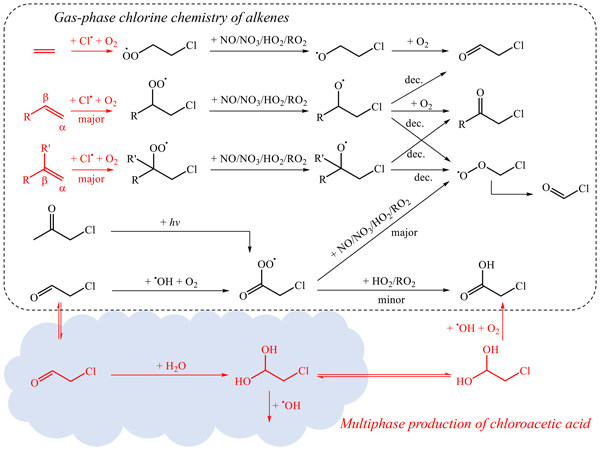
Our field campaigns observed a strong diel pattern of chloroacetic acid as well as a strong correlation between its level and that of reactive chlorine species at a coastal site. Using quantum chemical calculations and box model simulation with an updated Master Chemical Mechanism, we found that the formation pathway of chloroacetic acid involved multiphase processes. Our study enhances understanding of atmospheric organic chlorine chemistry and emphasizes the importance of multiphase reactions.

Yanru Huo, Mingxue Li, Xueyu Wang, Jianfei Sun, Yuxin Zhou, Yuhui Ma, and Maoxia He
Atmos. Chem. Phys., 24, 12409–12423, https://doi.org/10.5194/acp-24-12409-2024, https://doi.org/10.5194/acp-24-12409-2024, 2024
Short summary
Short summary
This work found that the air–water (A–W) interface and TiO2 clusters promote the oxidation of phenolic compounds (PhCs) to varying degrees compared with the gas phase and bulk water. Some byproducts are more harmful than their parent compounds. This work provides important evidence for the rapid oxidation observed in O3/HO• + PhC experiments at the A–W interface and in mineral dust.
Cited articles
Al-Abadleh, H. A., Motaghedi, F., Mohammed, W., Rana, M. S., Malek, K. A., Rastogi, D., Asa-Awuku, A. A., and Guzman, M. I.: Reactivity of aminophenols in forming nitrogen-containing brown carbon from iron-catalyzed reactions, Commun. Chem., 5, 112, https://doi.org/10.1038/s42004-022-00732-1, 2022.
Albinet, A., Minero, C., and Vione, D.: Phototransformation processes of 2,4-dinitrophenol, relevant to atmospheric water droplets, Chemosphere, 80, 753–758, https://doi.org/10.1016/j.chemosphere.2010.05.016, 2010.
Andreae, M. O. and Gelencsér, A.: Black carbon or brown carbon? The nature of light-absorbing carbonaceous aerosols, Atmos. Chem. Phys., 6, 3131–3148, https://doi.org/10.5194/acp-6-3131-2006, 2006.
Athar, M. and Patnaik, A.: Through-Bond-Driven Through-Space Interactions in a Fullerene C60 Noncovalent Dyad: An Unusual Strong Binding between Spherical and Planar π Electron Clouds and Culmination of Dyadic Fractals, J. Phys. Chem. A, 126, 3629–3641, https://doi.org/10.1021/acs.jpca.1c10828, 2022.
Atkinson, R., Tuazon, E. C., Wallington, T. J., Aschmann, S. M., Arey, J., Winer, A. M., and Pitts, J. N.: Atmospheric chemistry of aniline, N, N-dimethylaniline, pyridine, 1,3,5-triazine, and nitrobenzene, Environ. Sci. Technol., 21, 64–72, https://doi.org/10.1021/es00155a007, 1987.
Bejan, I., Barnes, I., Olariu, R., Zhou, S., Wiesen, P., and Benter, T.: Investigations on the gas-phase photolysis and OH radical kinetics of methyl-2-nitrophenols, Phys. Chem. Chem. Phys., 9, 5686–5692, https://doi.org/10.1039/b709464g, 2007.
Benfenati, E., Benigni, R., DeMarini, D. M., Helma, C., Kirkland, D., Martin, T. M., Mazzatorta, P., Ouédraogo-Arras, G., Richard, A. M., Schilter, B., Schoonen, W., Snyder, R., and Yang, C.: Predictive Models for Carcinogenicity and Mutagenicity: Frameworks, State-of-the-Art, and Perspectives, J. Environ. Sci. Heal. C, 27, 57–90, https://doi.org/10.1080/10590500902885593, 2009.
Benigni, R., Bossa, C., Netzeva, T., Rodomonte, A., and Tsakovska, I.: Mechanistic QSAR of aromatic amines: new models for discriminating between homocyclic mutagens and nonmutagens, and validation of models for carcinogens, Environ. Mol. Mutagen., 48, 754–771, https://doi.org/10.1002/em.20355, 2007.
Calvert, J. G., Orlando, J. J., Stockwell, W. R., and Wallington, T. J.: The Mechanisms of Reactions Influencing Atmospheric Ozone, Oxford University Press, https://doi.org/10.1093/oso/9780190233020.001.0001, 2015.
Canneaux, S., Bohr, F., and Henon, E.: KiSThelP: A Program to Predict Thermodynamic Properties and Rate Constants from Quantum Chemistry Results, J. Comput. Chem., 35, 82–93, https://doi.org/10.1002/jcc.23470, 2014.
Cassano, A., Manganaro, A., Martin, T., Young, D., Piclin, N., Pintore, M., Bigoni, D., and Benfenati, E.: CAESAR models for developmental toxicity, Chem. Cent. J., 4, https://doi.org/10.1186/1752-153x-4-s1-s4, 2010.
Chapleski, R. C., Zhang, Y. F., Troya, D., and Morris, J. R.: Heterogeneous chemistry and reaction dynamics of the atmospheric oxidants, O3, NO3, and OH, on organic surfaces, Chem. Soci. Rev., 45, 3731–3746, https://doi.org/10.1039/c5cs00375j, 2016.
Cornelissen, G., Gustafsson, O., Bucheli, T. D., Jonker, M. T. O., Koelmans, A. A., and van Noort, P. C. M.: Extensive sorption of organic compounds to black carbon, coal, and kerogen in sediments and soils: mechanisms and consequences for distribution, bioaccumulation, and biodegradation, Environ. Sci. Technol., 39, https://doi.org/10.1021/es050191b, 2005.
Cramer, G. M., Ford, R. A., and Hall, R. L.: Estimation of toxic hazard – A decision tree approach, Food Cosmet. Toxicol., 16, 255–276, https://doi.org/10.1016/S0015-6264(76)80522-6, 1976.
Decesari, S., Kovarich, S., Pavan, M., Bassan, A., Ciacci, A., and Topping, D.: Evaluating the mutagenic potential of aerosol organic compounds using informatics-based screening, Atmos. Chem. Phys., 18, 2329–2340, https://doi.org/10.5194/acp-18-2329-2018, 2018.
Delaria, E. R. and Cohen, R. C.: Measurements of Atmosphere-Biosphere Exchange of Oxidized Nitrogen and Implications for the Chemistry of Atmospheric NOx, Accounts of Chem. Res., 56, 1720–1730, https://doi.org/10.1021/acs.accounts.3c00090, 2023.
US EPA: User's Guide for T.E.S.T. (version 5.1) (Toxicity Estimation Software Tool): A Program to Estimate Toxicity from Molecular Structure, U.S. Environmental Protection Agency, https://www.epa.gov/comptox-tools/toxicity-estimation-software-tool-test (last access: 23 November 2025), 2020.
Fan, W. L., Chen, T., Zhu, Z. L., Zhang, H., Qiu, Y. L., and Yin, D. Q.: A review of secondary organic aerosols formation focusing on organosulfates and organic nitrates, J. Hazard. Mater., 430, https://doi.org/10.1016/j.jhazmat.2022.128406, 2022.
Geyer, A., Bächmann, K., Hofzumahaus, A., Holland, F., Stefan, Konrad, Klüpfel, T., Pätz, H. W., Perner, D., Mihelcic, D., Schäfer, H. J., Volz-Thomas, A., and Platt, U.: Nighttime formation of peroxy and hydroxyl radicals during the BERLIOZ campaign: Observations and modeling studies, J. Geophys. Res., 108, 8249, https://doi.org/10.1029/2001JD000656, 2003.
Guzman, M. I., Pillar-Little, E. A., and Eugene, A. J.: Interfacial Oxidative Oligomerization of Catechol, ACS Omega, 7, 36009–36016, https://doi.org/10.1021/acsomega.2c05290, 2022.
Hems, R. F. and Abbatt, J. P. D.: Aqueous Phase Photo-oxidation of Brown Carbon Nitrophenols: Reaction Kinetics, Mechanism, and Evolution of Light Absorption, ACS Earth and Space Chemistry, 2, 225–234, https://doi.org/10.1021/acsearthspacechem.7b00123, 2018.
Humphrey, W., Dalke, A., and Schulten, K.: VMD: Visual molecular dynamics, J. Molecul. Graphics, 14, 33–38, https://doi.org/10.1016/0263-7855(96)00018-5, 1996.
Khan, M. A. H., Hoque, M. M. N., Alam, S. S., Ashfold, M. J., Nickless, G., and Shallcross, D. E.: Estimation and comparison of night-time OH levels in the UK urban atmosphere using two different analysis methods, J. Environ. Sci., 23, 60–64, https://doi.org/10.1016/S1001-0742(10)60373-7, 2011.
Kroll, J. H. and Seinfeld, J. H.: Chemistry of secondary organic aerosol: Formation and evolution of low-volatility organics in the atmosphere, Atmos. Environ., 42, 3593–3624, https://doi.org/10.1016/j.atmosenv.2008.01.003, 2008.
Kromann, J. C., Steinmann, C., and Jensen, J. H.: Improving solvation energy predictions using the SMD solvation method and semiempirical electronic structure methods, J. Chem. Phys., 149, https://doi.org/10.1063/1.5047273, 2018.
Lefebvre, C., Rubez, G., Khartabil, H., Boisson, J. C., Contreras-García, J., and Hénon, E.: Accurately extracting the signature of intermolecular interactions present in the NCI plot of the reduced density gradient versus electron density, Phys. Chem. Chem. Phys., 19, 17928–17936, https://doi.org/10.1039/c7cp02110k, 2017.
Li, J., Han, Z. W., Sun, Y. L., Li, J. W., and Liang, L.: Chemical formation pathways of secondary organic aerosols in the Beijing-Tianjin-Hebei region in wintertime, Atmos. Environ., 244, https://doi.org/10.1016/j.atmosenv.2020.117996, 2021.
Li, J., Han, Z. W., Wu, J., Tao, J., Li, J. W., Sun, Y. L., Liang, L., Liang, M. J., and Wang, Q. G.: Secondary organic aerosol formation and source contributions over east China in summertime, Environ. Pollut., 306, https://doi.org/10.1016/j.envpol.2022.119383, 2022a.
Li, M., Wang, X. F., Lu, C. Y., Li, R., Zhang, J., Dong, S. W., Yang, L. X., Xue, L. K., Chen, J. M., and Wang, W. X.: Nitrated phenols and the phenolic precursors in the atmosphere in urban Jinan, China, Sci. Total Environ., 714, https://doi.org/10.1016/j.scitotenv.2020.136760, 2020.
Li, M., Wang, X. F., Zhao, Y. N., Du, P., Li, H. Y., Li, J. R., Shen, H. Q., Liu, Z. Y., Jiang, Y. R., Chen, J., Bi, Y. J., Zhao, Y., Xue, L. K., Wang, Y., Chen, J. M., and Wang, W. X.: Atmospheric Nitrated Phenolic Compounds in Particle, Gaseous, and Aqueous Phases During Cloud Events at a Mountain Site in North China: Distribution Characteristics and Aqueous-Phase Formation, J. Geophys. Res.-Atmos., 127, https://doi.org/10.1029/2022jd037130, 2022b.
Li, P. Y., Feng, L., Li, G. Y., and Bai, F. Q.: Effects of Electron Donating Ability of Substituents and Molecular Conjugation on the Electronic Structures of Organic Radicals, Chem. Res. Chinese U., 39, 202–207, https://doi.org/10.1007/s40242-023-2364-2, 2023.
Lindorff-Larsen, K., Piana, S., Palmo, K., Maragakis, P., Klepeis, J. L., Dror, R. O., and Shaw, D. E.: Improved side-chain torsion potentials for the Amber ff99SB protein force field, Proteins, 78, 1950–1958, https://doi.org/10.1002/prot.22711, 2010.
Liu, Z. Y. and Lu, T.: Theoretical Insight into Complexation Between Cyclocarbons and C60 Fullerene, Chemistry-a European Journal, 30, https://doi.org/10.1002/chem.202402227, 2024.
Lu, T.: TST calculator, http://sobereva.com/310, last access: 12 November 2025.
Lu, T.: Sobtop, Version [1.0], http://sobereva.com/soft/Sobtop, last access: 17 January 2026.
Lu, T. and Chen, F. W.: Multiwfn: A multifunctional wavefunction analyzer, J. Comput. Chem., 33, 580–592, https://doi.org/10.1002/jcc.22885, 2012.
Lu, T. and Chen, Q. X.: Independent gradient model based on Hirshfeld partition: A new method for visual study of interactions in chemical systems, J. Comput. Chem., 43, 539–555, https://doi.org/10.1002/jcc.26812, 2022.
Lüttke, J. and Levsen, K.: Phase partitioning of phenol and nitrophenols in clouds, Atmos. Environ., 31, 2649–2655, https://doi.org/10.1016/S1352-2310(96)00228-2, 1997.
Lyu, Y., Xu, H., Yuan, H. X., Cui, Y. L., Zhang, C. Z., and Meng, Q. T.: Intermolecular interaction mechanisms between dinitrophenol and water: a molecular dynamics and DFT study, Eur. Phys. J. Plus, 140, https://doi.org/10.1140/epjp/s13360-025-06478-8, 2025.
Maeda, S., Harabuchi, Y., Ono, Y., Taketsugu, T., and Morokuma, K.: Intrinsic Reaction Coordinate: Calculation, Bifurcation, and Automated Search, Int. J. Quantum Chem., 115, 258–269, https://doi.org/10.1002/qua.24757, 2015.
Mahilang, M., Deb, M. K., and Pervez, S.: Biogenic secondary organic aerosols: A review on formation mechanism, analytical challenges and environmental impacts, Chemosphere, 262, https://doi.org/10.1016/j.chemosphere.2020.127771, 2021.
Mayer, J. M.: Understanding hydrogen atom transfer: from bond strengths to Marcus theory, Accounts Chem. Res., 44, 36–46, https://doi.org/10.1021/ar100093z, 2011.
McNeill, V. F.: Atmospheric Aerosols: Clouds, Chemistry, and Climate, Annu. Rev. Chem. Biomol., 8, https://doi.org/10.1146/annurev-chembioeng-060816-101538, 2017.
Miyoshi, A., Matsui, H., and Washida, N.: Rates of reaction of hydroxyalkyl radicals with molecular oxygen, J. Phys. Chem., 94, 3016–3019, 1990.
Morgan, C. A., Pilling, M. J., Tulloch, J. M., Ruiz, R. P., and Bayes, K. D.: Direct determination of the equilibrium constant and thermodynamic parameters for the reaction allyl radical + oxygen ⇌ allylperoxy radical, ChemInform, 13, 1323–1330, https://doi.org/10.1039/F29827801323, 1982.
Munro, I. C., Ford, R. A., Kennepohl, E., and Sprenger, J. G.: Correlation of structural class with no-observed-effect levels: A proposal for establishing a threshold of concern, Food Chem. Toxicol., 34, 829–867, https://doi.org/10.1016/S0278-6915(96)00049-X, 1996.
Nagy, P. R.: State-of-the-art local correlation methods enable affordable gold standard quantum chemistry for up to hundreds of atoms, Chem. Sci., 15, 14556–14584, https://doi.org/10.1039/d4sc04755a, 2024.
Ng, N. L., Brown, S. S., Archibald, A. T., Atlas, E., Cohen, R. C., Crowley, J. N., Day, D. A., Donahue, N. M., Fry, J. L., Fuchs, H., Griffin, R. J., Guzman, M. I., Herrmann, H., Hodzic, A., Iinuma, Y., Jimenez, J. L., Kiendler-Scharr, A., Lee, B. H., Luecken, D. J., Mao, J., McLaren, R., Mutzel, A., Osthoff, H. D., Ouyang, B., Picquet-Varrault, B., Platt, U., Pye, H. O. T., Rudich, Y., Schwantes, R. H., Shiraiwa, M., Stutz, J., Thornton, J. A., Tilgner, A., Williams, B. J., and Zaveri, R. A.: Nitrate radicals and biogenic volatile organic compounds: oxidation, mechanisms, and organic aerosol, Atmos. Chem. Phys., 17, 2103–2162, https://doi.org/10.5194/acp-17-2103-2017, 2017.
Patlewicz, G., Jeliazkova, N., Safford, R. J., Worth, A. P., and Aleksiev, B.: An evaluation of the implementation of the Cramer classification scheme in the Toxtree software, SAR QSAR Environ. Res., 19, 495–524, https://doi.org/10.1080/10629360802083871, 2008.
Perumpully, S. J. and Gautam, S.: Impact of aerosols on atmospheric processes and climate variability: A synthesis of recent research findings, Geosystems and Geoenvironment, 4, 100317, https://doi.org/10.1016/j.geogeo.2024.100317, 2025.
Pillar-Little, E. A. and Guzman, M. I.: Oxidation of Substituted Catechols at the Air–Water Interface: Production of Carboxylic Acids, Quinones, and Polyphenols, Environ. Sci. Technol., 51, 4951–4959, https://doi.org/10.1021/acs.est.7b00232, 2017.
Pillar-Little, E. A. and Guzman, M. I.: An Overview of Dynamic Heterogeneous Oxidations in the Troposphere, Environments, 5, 104, https://doi.org/10.3390/environments5090104, 2018.
Pillar-Little, E. A., Camm, R. C., and Guzman, M. I.: Catechol oxidation by ozone and hydroxyl radicals at the air-water interface, Environ. Sci. Technol., 48, 14352–14360, https://doi.org/10.1021/es504094x, 2014.
Pillar-Little, E. A., Zhou, R., and Guzman, M. I.: Heterogeneous Oxidation of Catechol, J. Phys. Chem. A, 119, 10349–10359, https://doi.org/10.1021/acs.jpca.5b07914, 2015.
Pino-Rios, R., Inostroza, D., Cárdenas-Jirón, G., and Tiznado, W.: Orbital-Weighted Dual Descriptor for the Study of Local Reactivity of Systems with (Quasi-) Degenerate States, J. Phys. Chem. A, 123, 10556–10562, https://doi.org/10.1021/acs.jpca.9b07516, 2019.
Poster, D., Nguyen, T., Brown, R., and Ball, W.: Evidence for a pore-filling mechanism in the adsorption of aromatic hydrocarbons to a natural wood char, Environ. Sci. Technol., https://doi.org/10.1021/es0617845, 2007.
Qin, M., Xie, P., Su, H., Gu, J., Peng, F., Li, S., Zeng, L., Liu, J., Liu, W., and Zhang, Y.: An observational study of the HONO–NO2 coupling at an urban site in Guangzhou City, South China, Atmos. Environ., 43, 5731–5742, https://doi.org/10.1016/j.atmosenv.2009.08.017, 2009.
Rana, M. S. and Guzman, M. I.: Oxidation of Phenolic Aldehydes by Ozone and Hydroxyl Radicals at the Air–Water Interface, J. Phys. Chem. A, 124, 8822–8833, https://doi.org/10.1021/acs.jpca.0c05944, 2020.
Rana, M. S. and Guzman, M. I.: Oxidation of Phenolic Aldehydes by Ozone and Hydroxyl Radicals at the Air-Solid Interface, ACS Earth Space Chem., 6, 2900–2909, https://doi.org/10.1021/acsearthspacechem.2c00206, 2022a.
Rana, M. S. and Guzman, M. I.: Oxidation of Catechols at the Air-Water Interface by Nitrate Radicals, Environ. Sci. Technol., 56, 15437–15448, https://doi.org/10.1021/acs.est.2c05640, 2022b.
Rana, M. S. and Guzman, M. I.: Mechanistic Insights into Heterogeneous Oxidation: Product-Resolved Analysis of Phenolic Aldehyde Films, ACS Physical Chemistry Au., https://doi.org/10.1021/acsphyschemau.6c00106, 2026a.
Rana, M. S. and Guzman, M. I.: Heterogeneous Nitrate Radical Oxidation of Catechol Produces Nitrocatechols, Oligomers, and Brown Carbon, ACS Earth & Space Chemistry, 10, 2159–2170, 2026b.
Rana, M. S., Bradley, S. T., and Guzman, M. I.: Conversion of Catechol to 4-Nitrocatechol in Aqueous Microdroplets Exposed to O3 and NO2, ACS ES&T Air, 1, 80–91, https://doi.org/10.1021/acsestair.3c00001, 2023.
Salvador, C. M. G., Tang, R., Priestley, M., Li, L., Tsiligiannis, E., Le Breton, M., Zhu, W., Zeng, L., Wang, H., Yu, Y., Hu, M., Guo, S., and Hallquist, M.: Ambient nitro-aromatic compounds – biomass burning versus secondary formation in rural China, Atmos. Chem. Phys., 21, 1389–1406, https://doi.org/10.5194/acp-21-1389-2021, 2021.
Schwarzenbach, R. P., Stierli, R., Folsom, B. R., and Zeyer, J.: Compound properties relevant for assessing the environmental partitioning of nitrophenols, Environ. Sci. Technol., 22, https://doi.org/10.1021/es00166a009, 1988.
Shi, K., Mei, X. L., Chen, C. R., and Liu, C. Q.: Impact of atmospheric O3 and NO2 on the secondary sulfates in real atmosphere, J. Environ. Sci., 150, 277–287, https://doi.org/10.1016/j.jes.2024.02.019, 2025.
Shirts, M. R., Pitera, J. W., Swope, W. C., and Pande, V. S.: Extremely precise free energy calculations of amino acid side chain analogs: Comparison of common molecular mechanics force fields for proteins, J. Chem. Phys., 119, 5740–5761, https://doi.org/10.1063/1.1587119, 2003.
Shukla, S. S., Dorris, K. L., and Chikkaveeraiah, B. V.: Photocatalytic degradation of 2,4-dinitrophenol, J. Hazard. Mater., 164, 310–314, https://doi.org/10.1016/j.jhazmat.2008.08.047, 2009.
Spiegel, M., Semidalas, E., Martin, J. M. L., Bentley, M. R., and Stanton, J. F.: Post-CCSD(T) corrections to bond distances and vibrational frequencies: the power of Λ, Mol. Phys., 122, https://doi.org/10.1080/00268976.2023.2252114, 2024.
Steiner, T.: The Hydrogen Bond in the Solid State, Angew. Chem. Int. Edit., 41, 48–76, https://doi.org/10.1002/1521-3773(20020104)41:1<48::AID-ANIE48>3.0.CO;2-U, 2002.
Sun, J., Mu, Q., Kimura, H., Murugadoss, V., He, M., Du, W., and Hou, C.: Oxidative degradation of phenols and substituted phenols in the water and atmosphere: a review, Advanced Composites and Hybrid Materials, 5, 627–640, 2022.
Sushko, I., Novotarskyi, S., Körner, R., Pandey, A. K., Cherkasov, A., Li, J., Gramatica, P., Hansen, K., Schroeter, T., Müller, K. R., Xi, L., Liu, H., Yao, X., Öberg, T., Hormozdiari, F., Dao, P., Sahinalp, C., Todeschini, R., Polishchuk, P., Artemenko, A., Kuz'min, V., Martin, T. M., Young, D. M., Fourches, D., Muratov, E., Tropsha, A., Baskin, I., Horvath, D., Marcou, G., Muller, C., Varnek, A., Prokopenko, V. V., and Tetko, I. V.: Applicability domains for classification problems: Benchmarking of distance to models for Ames mutagenicity set, J. Chem. Inf. Model, 50, 2094–2111, https://doi.org/10.1021/ci100253r, 2010.
Szatylowicz, H., Jezuita, A., Ejsmont, K., and Krygowski, T. M.: Substituent Effect on the σ- and π-Electron Structure of the Nitro Group and the Ring in Meta- and Para-Substituted Nitrobenzenes, J. Phys. Chem. A, 121, 5196–5203, https://doi.org/10.1021/acs.jpca.7b03418, 2017.
Tam, J. Y. C., Lorsbach, T., Schmidt, S., and Wicker, J. S.: Holistic evaluation of biodegradation pathway prediction: assessing multi-step reactions and intermediate products, J. Cheminformatics, 13, 63, https://doi.org/10.1186/s13321-021-00543-x, 2021.
Tintó-Moliner, A. and Martin, M.: Quantitative weight of evidence method for combining predictions of quantitative structure-activity relationship models, SAR QSAR Environ. Res., 31, 261–279, https://doi.org/10.1080/1062936X.2020.1725116, 2020.
Tiwari, J., Tarale, P., Sivanesan, S., and Bafana, A.: Environmental persistence, hazard, and mitigation challenges of nitroaromatic compounds, Environ. Sci. Pollut. Res., 26, 28650–28667, https://doi.org/10.1007/s11356-019-06043-8, 2019.
Tomas, A., Olariu, R. I., Barnes, I., and Becker, K. H.: Kinetics of the reaction of O3 with selected benzenediols, Int. J. Chem. Kinet., 35, 223–230, https://doi.org/10.1002/kin.10121, 2003.
Tuñón, I. and Williams, I. H.: Chapter Two – The transition state and cognate concepts, in: Advances in Physical Organic Chemistry, edited by: Williams, I. H. and Williams, N. H., Academic Press, 29–68, https://doi.org/10.1016/bs.apoc.2019.09.001, 2019.
Uesawa, Y.: Progress in Predicting Ames Test Outcomes from Chemical Structures: An In-Depth Re-Evaluation of Models from the 1st and 2nd Ames/QSAR International Challenge Projects, Int. J. Mol. Sci., 25, 1373, https://doi.org/10.3390/ijms25031373, 2024.
Van Der Spoel, D., Lindahl, E., Hess, B., Groenhof, G., Mark, A. E., and Berendsen, H. J. C.: GROMACS: Fast, flexible, and free, J. Comput. Chem., 26, 1701–1718, https://doi.org/10.1002/jcc.20291, 2005.
Vereecken, L. and Francisco, J. S.: Theoretical studies of atmospheric reaction mechanisms in the troposphere, Chem. Soc. Rev., 41, 6259–6293, https://doi.org/10.1039/c2cs35070j, 2012.
vom Eyser, C., Börgers, A., Richard, J., Dopp, E., Janzen, N., Bester, K., and Tuerk, J.: Chemical and toxicological evaluation of transformation products during advanced oxidation processes, Water Sci. Technol., 68, 1976–1983, https://doi.org/10.2166/wst.2013.452, 2013.
Wang, C. L., Zhao, N., Ma, Z. J., He, M. X., Hou, C. X., and Sun, J. F.: Unraveling the heterogeneous reaction of 4-nitrocatechol with ozone in the atmosphere: A combined DFT, molecular dynamics, and environmental risk assessment, Atmos. Res., 331, https://doi.org/10.1016/j.atmosres.2025.108632, 2026.
Wang, J., Wolf, R. M., Caldwell, J. W., Kollman, P. A., and Case, D. A.: Development and testing of a general amber force field, J. Comput. Chem., 25, 1157–1174, https://doi.org/10.1002/jcc.20035, 2004.
Witt, R. P., Todd, M. B., Oladele, M. E., and Guzman, M. I.: Ozonolysis of phenolic aldehydes from industrial-based lignin wastewaters, Sci. Total Environ., 998, 180190, https://doi.org/10.1016/j.scitotenv.2025.180190, 2025.
Yan, J. P., Wang, X. P., Gong, P., and Wang, C. F.: Nitrated polycyclic aromatic compounds in the atmospheric environment: A review, Crit. Rev. Env. Sci. Tec., 51, 1159–1185, https://doi.org/10.1080/10643389.2020.1748486, 2021.
Yang, B., Ren, P. P., Xing, L., Wang, S. H., and Sun, C. L.: Roles of hydrogen bonding interactions and hydrophobic effects on enhanced water structure in aqueous solutions of amphiphilic organic molecules, Spectrochim. Acta A, 296, https://doi.org/10.1016/j.saa.2023.122605, 2023a.
Yang, B. R., Liang, A. B., and Wang, L. M.: The atmospheric oxidation mechanism of acetophenone initiated by the hydroxyl radicals, Atmos. Environ., 309, https://doi.org/10.1016/j.atmosenv.2023.119905, 2023b.
Yong-Di, H. E., Jin-Ou, S., Bin, W. U., Xiao-Wen, W., Ji-Biao, X. I. E., and Bin, W.: Prediction of toxicity of nitro-organic compounds by Toxicity Estimation Software Tool and Toxtree software, Chinese Journal of Pharmacology and Toxicology, 36, 509–520, https://doi.org/10.3867/j.issn.1000-3002.2022.07.005, 2022.
Young, D., Martin, T., Venkatapathy, R., and Harten, P.: Are the Chemical Structures in Your QSAR Correct?, QSAR Comb. Sci., 27, 1337–1345, https://doi.org/10.1002/qsar.200810084, 2008.
Zhao, Y. and Truhlar, D. G.: The M06 suite of density functionals for main group thermochemistry, thermochemical kinetics, noncovalent interactions, excited states, and transition elements: two new functionals and systematic testing of four M06-class functionals and 12 other functionals, Theor. Chem. Acc., 120, 215–241, https://doi.org/10.1007/s00214-007-0310-x, 2008.
Short summary
2,4-Dinitrophenol reacts mainly with hydroxyl radicals and ozone, while solvation and nitro groups affect its reactivity. A key radical intermediate reacts with O2 and NO2. Adsorption varies non-monotonically with hydration. Quantitative structure activity relationship (QSAR) predictions show that some ozonolysis products may have higher mutagenicity and developmental toxicity than the parent compound, highlighting the need to assess transformation products.
2,4-Dinitrophenol reacts mainly with hydroxyl radicals and ozone, while solvation and nitro...


Altmetrics
Final-revised paper
Preprint