Articles | Volume 26, issue 19
https://doi.org/10.5194/acp-26-14385-2026
© Author(s) 2026. This work is distributed under
the Creative Commons Attribution 4.0 License.
https://doi.org/10.5194/acp-26-14385-2026
© Author(s) 2026. This work is distributed under
the Creative Commons Attribution 4.0 License.
Electrostatics and Collision dynamics of ice and anthropogenic smoke particles in the mesosphere/lower thermosphere

Planetary Sciences Division, Physical Research Laboratory, Ahmedabad, India
Sanjay K. Mishra
Planetary Sciences Division, Physical Research Laboratory, Ahmedabad, India
Department of Physics and Technology, UiT The Arctic University of Norway, Tromsø, Norway
Related authors
No articles found.
Arnaud Zaslavsky, Ingrid B. Mann, Russel A. Howard, Zoltan Sternovsky, Simon Anghel, Andreas Kvammen, David M. Malaspina, Nicole Meyer-Vernet, Filippo Pantellini, Arthur Pérrone, Kristina Rackovic-Babic, Veerle J. Sterken, Jamey R. Szalay, Stuart D. Bale, Volker Bothmer, Craig E. DeForest, L. Claire Gasque, Ryo Ishimaru, Hiroshi Kimura, Milan Maksimovic, Michiko Morooka, Teresa Nieves-Chinchilla, Libor Nouzák, David Píša, Petr Pokorný, Nour E. Raouafi, Mitchell M. Shen, Austin Matheus Smith, and Guillermo Stenborg
EGUsphere, https://doi.org/10.5194/egusphere-2026-4440, https://doi.org/10.5194/egusphere-2026-4440, 2026
This preprint is open for discussion and under review for Annales Geophysicae (ANGEO).
Short summary
Short summary
Small grains of dust, released by comets and asteroids, fill the space between the Sun and the planets. To learn how they behave near the Sun, we combined data from four spacecraft that either sense single grains hitting them or picture the sunlight scattered by the grains. Together, these observations build a consistent picture of where the dust sits and how it moves in the inner solar system, which helps us understand dust around other stars and grains coming from beyond our solar system.
Dorota Jozwicki, Puneet Sharma, Devin Huyghebaert, and Ingrid Mann
Ann. Geophys., 42, 431–453, https://doi.org/10.5194/angeo-42-431-2024, https://doi.org/10.5194/angeo-42-431-2024, 2024
Short summary
Short summary
We investigated the relationship between polar mesospheric summer echo (PMSE) layers and the solar cycle. Our results indicate that the average altitude of PMSEs, the echo power in the PMSEs and the thickness of the layers are, on average, higher during the solar maximum than during the solar minimum. We infer that higher electron densities at ionospheric altitudes might be necessary to observe multilayered PMSEs. We observe that the thickness decreases as the number of multilayers increases.
Adrien Pineau, Henriette Trollvik, Herman Greaker, Sveinung Olsen, Yngve Eilertsen, and Ingrid Mann
Atmos. Meas. Tech., 17, 3843–3861, https://doi.org/10.5194/amt-17-3843-2024, https://doi.org/10.5194/amt-17-3843-2024, 2024
Short summary
Short summary
The mesosphere, part of the upper atmosphere, contains small solid dust particles, mostly made up of material from interplanetary space. We are preparing an experiment to collect such particles during a rocket flight. A new instrument has been designed and numerical simulations have been performed to investigate the airflow nearby as well as its dust collection efficiency. The collected dust particles will be further analyzed in the laboratory in order to study their chemical composition.
Tinna L. Gunnarsdottir, Ingrid Mann, Wuhu Feng, Devin R. Huyghebaert, Ingemar Haeggstroem, Yasunobu Ogawa, Norihito Saito, Satonori Nozawa, and Takuya D. Kawahara
Ann. Geophys., 42, 213–228, https://doi.org/10.5194/angeo-42-213-2024, https://doi.org/10.5194/angeo-42-213-2024, 2024
Short summary
Short summary
Several tons of meteoric particles burn up in our atmosphere each day. This deposits a great deal of material that binds with other atmospheric particles and forms so-called meteoric smoke particles. These particles are assumed to influence radar measurements. Here, we have compared radar measurements with simulations of a radar spectrum with and without dust particles and found that dust influences the radar spectrum in the altitude range of 75–85 km.
Samuel Kočiščák, Andreas Kvammen, Ingrid Mann, Nicole Meyer-Vernet, David Píša, Jan Souček, Audun Theodorsen, Jakub Vaverka, and Arnaud Zaslavsky
Ann. Geophys., 42, 191–212, https://doi.org/10.5194/angeo-42-191-2024, https://doi.org/10.5194/angeo-42-191-2024, 2024
Short summary
Short summary
In situ observations are crucial for understanding interplanetary dust, yet not every spacecraft has a dedicated dust detector. Dust encounters happen at great speeds, leading to high energy density at impact, which leads to ionization and charge release, which is detected with electrical antennas. Our work looks at how the transient charge plume interacts with Solar Orbiter spacecraft. Our findings are relevant for the design of future experiments and the understanding of present data.
Florian Günzkofer, Dimitry Pokhotelov, Gunter Stober, Ingrid Mann, Sharon L. Vadas, Erich Becker, Anders Tjulin, Alexander Kozlovsky, Masaki Tsutsumi, Njål Gulbrandsen, Satonori Nozawa, Mark Lester, Evgenia Belova, Johan Kero, Nicholas J. Mitchell, and Claudia Borries
Ann. Geophys., 41, 409–428, https://doi.org/10.5194/angeo-41-409-2023, https://doi.org/10.5194/angeo-41-409-2023, 2023
Short summary
Short summary
Gravity waves (GWs) are waves in Earth's atmosphere and can be observed as cloud ripples. Under certain conditions, these waves can propagate up into the ionosphere. Here, they can cause ripples in the ionosphere plasma, observable as oscillations of the plasma density. Therefore, GWs contribute to the ionospheric variability, making them relevant for space weather prediction. Additionally, the behavior of these waves allows us to draw conclusions about the atmosphere at these altitudes.
Tinna L. Gunnarsdottir, Arne Poggenpohl, Ingrid Mann, Alireza Mahmoudian, Peter Dalin, Ingemar Haeggstroem, and Michael Rietveld
Ann. Geophys., 41, 93–114, https://doi.org/10.5194/angeo-41-93-2023, https://doi.org/10.5194/angeo-41-93-2023, 2023
Short summary
Short summary
Temperatures at 85 km around Earth's poles in summer can be so cold that small ice particles form. These can become charged, and, combined with turbulence at these altitudes, they can influence the many electrons present. This can cause large radar echoes called polar mesospheric summer echoes. We use radio waves to heat these echoes on and off when the sun is close to or below the horizon. This allows us to gain some insight into these ice particles and how the sun influences the echoes.
Andreas Kvammen, Kristoffer Wickstrøm, Samuel Kociscak, Jakub Vaverka, Libor Nouzak, Arnaud Zaslavsky, Kristina Rackovic Babic, Amalie Gjelsvik, David Pisa, Jan Soucek, and Ingrid Mann
Ann. Geophys., 41, 69–86, https://doi.org/10.5194/angeo-41-69-2023, https://doi.org/10.5194/angeo-41-69-2023, 2023
Short summary
Short summary
Collisional fragmentation of asteroids, comets and meteoroids is the main source of dust in the solar system. The dust distribution is however uncharted and the role of dust in the solar system is largely unknown. At present, the interplanetary medium is explored by the Solar Orbiter spacecraft. We present a novel method, based on artificial intelligence, that can be used for detecting dust impacts in Solar Orbiter observations with high accuracy, advancing the study of dust in the solar system.
Kyoko K. Tanaka, Ingrid Mann, and Yuki Kimura
Atmos. Chem. Phys., 22, 5639–5650, https://doi.org/10.5194/acp-22-5639-2022, https://doi.org/10.5194/acp-22-5639-2022, 2022
Short summary
Short summary
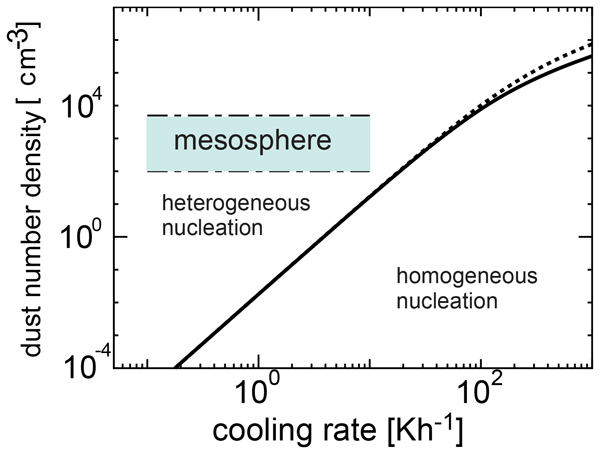
We have investigated the nucleation process of noctilucent clouds observed in the mesosphere using a theoretical approach, where we adopt a more accurate model called the semi-phenomenological model for the nucleation process. We obtained an important result that rejects one of the two dominant nucleation mechanisms that have been proposed. Our results show it is extremely difficult for homogeneous nucleation of water to occur in the mesosphere, while heterogeneous nucleation occurs effectively.
Margaretha Myrvang, Carsten Baumann, and Ingrid Mann
Ann. Geophys., 39, 1055–1068, https://doi.org/10.5194/angeo-39-1055-2021, https://doi.org/10.5194/angeo-39-1055-2021, 2021
Short summary
Short summary
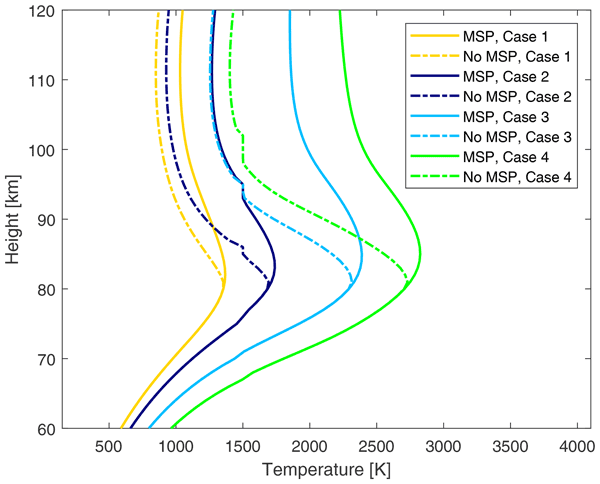
Our model calculations indicate that meteoric smoke particles (MSPs) influence both the magnitude and shape of the electron temperature during artificial heating. Others have found that current theoretical models most likely overestimate heating in the D-region compared to observations. In a future study, we will compare our results to observations of the electron temperature during heating to investigate if the presence of MSPs can explain the discrepancy between model and observations.
Cited articles
Baptiste, J., Williamson, C., Fox, J., Stace, A. J., Hassan, M., Braun, S., Stamm, B., Mann, I., and Besley, E.: The influence of surface charge on the coalescence of ice and dust particles in the mesosphere and lower thermosphere, Atmos. Chem. Phys., 21, 8735–8745, https://doi.org/10.5194/acp-21-8735-2021, 2021. a, b, c, d, e, f, g, h, i
Bardeen, C., Toon, O., Jensen, E., Marsh, D., and Harvey, V.: Numerical simulations of the three-dimensional distribution of meteoric dust in the mesosphere and upper stratosphere, J. Geophys. Res.-Atmos., 113, https://doi.org/10.1029/2007JD009515, 2008. a
Baumann, C., Rapp, M., Kero, A., and Enell, C.-F.: Meteor smoke influences on the D-region charge balance – review of recent in situ measurements and one-dimensional model results, Ann. Geophys., 31, 2049–2062, https://doi.org/10.5194/angeo-31-2049-2013, 2013. a, b
Di Renzo, M. and Urzay, J.: Aerodynamic generation of electric fields in turbulence laden with charged inertial particles, Nat. Commun., 9, 1676, https://doi.org/10.1038/s41467-018-03958-7, 2018. a
Filippov, A.: Electrostatic interaction of a charged dielectric sphere with a flat charged interface between homogeneous dielectrics, J. Exp. Theor. Phys.+, 134, 590–599, 2022. a
Gunnarsdottir, T. L., Mann, I., Feng, W., Huyghebaert, D. R., Haeggstroem, I., Ogawa, Y., Saito, N., Nozawa, S., and Kawahara, T. D.: Influence of meteoric smoke particles on the incoherent scatter measured with EISCAT VHF, Ann. Geophys., 42, 213–228, https://doi.org/10.5194/angeo-42-213-2024, 2024. a
Havnes, O., Aslaksen, T., and Brattli, A.: Charged dust in the Earth's middle atmosphere, Phys. Scripta, 2001, 133–137, 2001. a
Howard, K. and Ah, A.: Large constellations of satellites: Mitigating environmental and other effects, United States Government Accountability Office, Washington, DC, Tech. Rep. GAO-22–105166, https://www.gao.gov/products/gao-22-105166 (last access: 9 October 2026), 2022. a
Israelachvili, J. N.: Intermolecular and surface forces, Academic Press, ISBN 978-0-12-375182-9, https://doi.org/10.1016/C2009-0-21560-1, 2011. a
Johnson, D. R., Bocanski, A., Diorio, E. M., Chen, J., and Meng, H.: Amplification of particle collision through contact electrification in isotropic turbulence, P. Natl. Acad. Sci. USA, 122, e2507580122, https://doi.org/10.1073/pnas.2507580122, 2025. a
Latteck, R., Renkwitz, T., and Chau, J. L.: Two decades of long-term observations of polar mesospheric echoes at 69 N, J. Atmos. Sol.-Terr. Phy., 216, 105576, https://doi.org/10.1016/j.jastp.2021.105576, 2021. a
Lübken, F.-J., Baumgarten, G., and Berger, U.: Long term trends of mesopheric ice layers: A model study, J. Atmos. Sol.-Terr. Phy., 214, 105378, https://doi.org/10.1016/j.jastp.2020.105378, 2021. a
Mann, I., Gunnarsdottir, T., Häggström, I., Eren, S., Tjulin, A., Myrvang, M., Rietveld, M., Dalin, P., Jozwicki, D., and Trollvik, H.: Radar studies of ionospheric dusty plasma phenomena, Contrib. Plasm. Phys., 59, e201900005, https://doi.org/10.1002/ctpp.201900005, 2019. a
Megner, L., Siskind, D., Rapp, M., and Gumbel, J.: Global and temporal distribution of meteoric smoke: A two-dimensional simulation study, J. Geophys. Res.-Atmos., 113, https://doi.org/10.1029/2007JD009054 2008. a
Misra, S., Mishra, S., and Sodha, M.: Charge Distribution in Mesospheric Clouds, in: Dusty/complex Plasmas: Basic and Interdisciplinary Research: Sixth International Conference on the Physics of Dusty Plasmas, AIP Conference Proceedings, 1397, 417–418, https://doi.org/10.1063/1.3659871, 2011. a, b
Murphy, D. M., Abou-Ghanem, M., Cziczo, D. J., Froyd, K. D., Jacquot, J., Lawler, M. J., Maloney, C., Plane, J. M., Ross, M. N., Schill, G. P., and Shen, X.: Metals from spacecraft reentry in stratospheric aerosol particles, P. Natl. Acad. Sci. USA, 120, e2313374120, https://doi.org/10.1073/pnas.2313374120, 2023. a, b, c
Plane, J. M.: Atmospheric chemistry of meteoric metals, Chem. Rev., 103, 4963–4984, 2003. a
Plane, J. M., Feng, W., and Dawkins, E. C.: The mesosphere and metals: Chemistry and changes, Chem. Rev., 115, 4497–4541, 2015. a
Rapp, M. and Lübken, F.-J.: Modelling of particle charging in the polar summer mesosphere: Part 1 – General results, J. Atmos. Sol.-Terr. Phy., 63, 759–770, 2001. a
Rapp, M. and Thomas, G. E.: Modeling the microphysics of mesospheric ice particles: Assessment of current capabilities and basic sensitivities, J. Atmos. Sol.-Terr. Phy., 68, 715–744, 2006. a
Schulz, L., Glassmeier, K.-H., Herberhold, M., Mitchell, A., Murphy, D. M., Plane, J. M., and Plaschke, F.: Space waste: An update of the anthropogenic matter injection into Earth’s atmosphere, Adv. Space Res., 77, 9589–9616, https://doi.org/10.1016/j.asr.2026.03.026, 2026. a, b, c, d, e, f, g, h, i, j
Shen, X., Wang, A. E., Sankaran, R. M., and Lacks, D. J.: First-principles calculation of contact electrification and validation by experiment, J. Electrostat., 82, 11–16, 2016. a
Sodha, M., Misra, S., Mishra, S., and Dixit, A.: Kinetics of polar mesospheric plasma layers: Comparison of theoretical results with observations, Phys. Plasmas, 18, https://doi.org/10.1063/1.3624758, 2011. a, b, c
Tanaka, K. K., Mann, I., and Kimura, Y.: Formation of ice particles through nucleation in the mesosphere, Atmos. Chem. Phys., 22, 5639–5650, https://doi.org/10.5194/acp-22-5639-2022, 2022. a
Short summary
The increase in satellite launches raises the anthropogenic influx of various elements into the Mesosphere and Lower Thermosphere (MLT), comparable to the natural meteoric influx. Aggregation of ice and space debris remnant in the MLT is studied using classical electrostatic approaches. Stable aggregate formation from ice and anthropogenic particle collisions has been established in the MLT region, which is found to be similar to that formed with meteoric smoke particles.
The increase in satellite launches raises the anthropogenic influx of various elements into the...
Altmetrics
Final-revised paper
Preprint