
the Creative Commons Attribution 4.0 License.
the Creative Commons Attribution 4.0 License.
 | 18 Sep 2026
Continental pollutants modulate organic nitrogen and light absorption of marine organic aerosols over East Asian marginal seas
Chao Yu
Lin Zheng
Yujue Wang

Meijing Guo
Xu Yu
Yuqi Guo
Sisi Song
Kyoung-Soon Jang
Xiaohong Yao
Jian Zhen Yu
Huiwang Gao
Organic nitrogen (ON) in marine aerosols is not only an important fraction of atmospheric nitrogen deposition but also a vital contributor to light-absorbing organic aerosols. However, observational evidence is lacking on the driving factors of ON formation or its role in organic aerosol absorption, especially in marine atmosphere. Here, shipboard observations were conducted in spring, summer, and autumn over the Yellow Sea and Bohai Sea (YBS) to understand the spatiotemporal distributions and sources of aerosol ON over East Asian marginal seas. Aerosol ON was 0.35 ± 0.25 µg N m−3, accounting for 4 %–60 % of total nitrogen across seasons. Concentrations of ON were the highest in autumn due to severe impacts of anthropogenic pollutants, followed by those in spring and summer. Anthropogenic secondary pollutants (aged biomass burning and secondary nitrate formation) contributed 36 %–76 % of ON, 46 %–83 % of water-soluble ON, and 39 %–89 % of water-insoluble ON. In spring, 55 % of ON, 45 % of water-soluble ON, and 54 % of water-insoluble ON were attributed to dust, and its contribution increased to > 80 % during a dust episode. In summer, marine sources associated with biological activity were important for aerosol ON formation. Nitrogen-containing organic compounds played vital roles in regulating light absorption by organic aerosols over the YBS. Elevated organic aerosol absorption was attributed not only to higher ON concentrations but also to increased absorption capability at higher ON OC ratios. Our results highlight that transported continental ON drove the light absorption by marine organic aerosols over marginal seas.
- Article
(4200 KB) - Full-text XML
-
Supplement
(5735 KB) - BibTeX
- EndNote


Atmospheric organic nitrogen (ON) is a vital fraction among the total nitrogen (ON, NO–N, and NH–N) or among the organic matter in ambient aerosols (Altieri et al., 2021). Deposition of particulate ON was estimated 23 Tg N yr−1, and dominated the global atmospheric ON deposition (Li et al., 2023). Terrestrial aerosol nitrogen deposition can account for one-third of the external nitrogen supply to the open ocean per year, thereby influencing the marine nitrogen cycle and ecosystems (Duce et al., 2008; Jickells et al., 2017). Anthropogenic nitrogen deposition is especially important for maintaining primary productivity in the upper oligotrophic ocean (Dai et al., 2023; Tang et al., 2021). Aerosol ON also plays vital roles in the light absorption of organic aerosols (Xu et al., 2024). A recent modeling study suggests that absorptive nitrogenous components in organic aerosols contribute 61 % of their global absorptive optical depth (Li et al., 2025b). However, the abundance, distribution, sources, or environmental effects of ON are much less well understood compared to the inorganic nitrogen (IN, NO–N and NH–N) in marine aerosols.
Concentrations of ON in marine aerosols range from < 0.01 to 3.6 µg N m−3 (Li et al., 2019, 2023; Luo et al., 2016; Shi et al., 2010), and ON contributes 5 %–84 % of total aerosol nitrogen in various atmospheric environments (Luo et al., 2016; Violaki et al., 2015; Xiao et al., 2018). Previous studies usually used water-soluble ON to represent the ON abundance in marine aerosols, leading to an underestimation of ON in the marine atmosphere. A recently developed aerosol nitrogen analyzer system enables sensitive quantification of aerosol ON from remote open ocean to polluted urban environments (Sun et al., 2026; Yu et al., 2021, 2024, 2023a). Cruise observations found that the average concentration of aerosol ON in the Northern Hemisphere (83 ng N m−3) was much higher than in the Southern Hemisphere (15 ng N m−3) (Sun et al., 2026). During cruises across different oceanic regions, the highest aerosol ON levels were observed over coastal East Asia due to the strong influence of anthropogenic pollutants (Sun et al., 2026). High aerosol ON abundance was usually observed in areas influenced by biomass burning or with high anthropogenic pollutants. Downwind of biomass-burning regions, aerosol ON can account for as much as 40 %–80 % of total nitrogen deposition (Li et al., 2023).
Aerosol ON can originate from various sources, including biomass burning emissions (Wang et al., 2017), anthropogenic pollutants (Luo et al., 2018; Wang et al., 2019b), dust (Nie et al., 2014), atmospheric oxidation/aging processes (Laskin et al., 2010; Lin et al., 2015), marine emissions (Triesch et al., 2021), etc. Biomass burning activities can emit large amounts of heterocyclic N-bases and nitroaromatic compounds into the ambient atmosphere (Lin et al., 2017). Particulate ON in biomass burning plumes can be long-range transported and influence aerosol light absorption and marine ecosystems in downwind areas (Tang et al., 2021; Wang et al., 2019a). Aerosol ON can also be formed via oxidation of organic precursors or aging of organic aerosols in the presence of NOx or NH3 (Laskin et al., 2015; Li et al., 2020; Shi et al., 2023). Some organic nitrogen compounds (e.g., imines, amino acids, protein-like organic matters) can be emitted from the ocean through sea spray or sea-to-air exchange (Chen et al., 2016; Triesch et al., 2021; Zhang et al., 2025).
The East Asian marginal seas are a typical region subject to the combined effects of continental air masses (e.g., anthropogenic pollutants, Asian dust storms) and marine emissions. Our recent observations suggested that the formation and light absorption of marine organic aerosols over the East Asian marginal seas were obviously influenced by transported anthropogenic pollutants, Asian dust, and marine emissions, and highlighted distinct seasonal differences (Zhang et al., 2025). Nitrogenous organic components have been recognized as vital chromophores in light-absorptive organic aerosols (Li et al., 2025b). To elaborate ON distribution, sources, and their effects on the optical properties of marine aerosols over marginal seas, shipboard cruise observations were conducted in spring, summer, and autumn over the Bohai Sea and the Yellow Sea (YBS). Aerosol ON was quantified, and its spatiotemporal variations in different seasons were analyzed. The sources of ON were quantified using a source apportionment model. We further investigated the effects of organic nitrogen compounds on the light absorption and absorption capability of marine organic aerosols under the joint influence of terrestrial air mass outflows and marine emissions. Our results highlight that transported continental pollutants regulated the ON formation and light absorption by marine organic aerosols over East Asian marginal seas.
2.1 Cruise observations and sample collection
Shipboard cruise observations were conducted over the Bohai Sea and the Yellow Sea (YBS) during autumn (22 October–2 November) in 2021 and during spring (13–28 April) and summer (13 July–13 August) in 2023. During the campaigns, total suspended particles (TSP) and fine particles (PM2.5) were simultaneously collected on prebaked quartz fiber filters using a high-volume aerosol sampler (1.05 m3 min−1). The sampler was placed at the front of the upper deck to avoid potential contamination from ship exhaust. Each sample was collected for 15–20 h, ensuring sufficient mass loading for the following chemical analysis. A total of 9, 22, and 20 sets of aerosol samples were obtained during the autumn, spring, and summer cruises, respectively. Due to difficult marine conditions and the tight schedule of the vessel in autumn, 9 sets of aerosol samples were collected during the autumn cruise. Aerosol samples were collected continuously along the cruise when the ship was sailing, and sampling covered the whole observation region of the YBS. Thus, the samples can represent the general conditions of the YBS in each season. A field blank sample was collected during each cruise.
Air temperature and relative humidity (RH) were monitored using an onboard meteorological station during the observations. The 72 h backward trajectories of air masses at an altitude of 500 m were calculated using the HYSPLIT model (Fig. S1 in the Supplement) (Zhang et al., 2025), which can represent the marine boundary layer (Huang et al., 2018). Satellite-derived chlorophyll a (Chl a) in surface seawater was obtained from NASA Ocean Color (https://oceancolor.gsfc.nasa.gov/, last access: 21 April 2026).
2.2 Measurements of organic and inorganic nitrogen
Total ON in aerosol samples was determined using an aerosol IN&ON analyzer system, which integrates an online aerosol carbon analyzer and a NOx analyzer (Yu et al., 2023b). Programmed thermal evolution facilitates the separation of aerosol ON from IN, and quantification of ON is achieved through multivariate curve resolution treatment of carbon and nitrogen thermal fractions (Yu et al., 2021). The IN&ON analyzer has been widely used to quantify aerosol ON from various atmospheric environments. Water-soluble organic carbon (WSOC) and water-soluble total nitrogen (WSTN) are analyzed by the TOC/TN analyzer (TOC-L, Shimadzu, Japan). Inorganic nitrogen (NO–N and NH–N), other inorganic ions (SO, Cl−, Na+, K+, Ca2+, Mg2+), methanesulfonic acid (MSA), and oxalic acid were quantified using ion chromatograph systems (ICS‐Aquion, ICS‐2100 DIONEX). Concentrations of WSON and WION were calculated as follows:
The abundance of inorganic nitrogen quantified by the aerosol IN&ON analyzer or by the TOC/TN analyzer matched well with that measured by ion chromatograph (Fig. S2), which guarantees the accuracy of quantitative results of WSON and WION based on different analytical methods. The detection limit of aerosol IN&ON analyzer was 96 ng N, and that of TOC/TN analyzer was 0.01 µg N mL−1. Based on the measurement results of aerosol IN&ON analyzer, total nitrogen in the field blank samples was 0.040–0.068 µg N cm−2, much lower than that in the collected aerosol samples (0.49–44.2 µg N cm−2). Total nitrogen on the corresponding field blank sample was subtracted from each sample.
Organic carbon (OC) and elemental carbon (EC) in atmospheric aerosols were measured using a carbon analyzer (Sunset Laboratory) based on thermal-optical method. Water-insoluble organic carbon (WIOC) was calculated by the difference between OC and WSOC. Concentration of organic matter (OM) in the aerosol samples was calculated by multiplying OC by 1.6 (Turpin and Huntzicker, 1995; Wang et al., 2023b). Our previous observations over the YBS suggested that organics were dominant in fine particles (Zhang et al., 2025). Thus, we mainly focused on the PM2.5 results for further discussion, and concentrations of Ca2+ in TSP were only used to identify the dust episode.
2.3 UV-Visible absorption spectra
Light absorption properties of extracted organic aerosols were measured using a UV-visible spectrometer (UV-8000, Jingmi, China). Methanol and water were used to extract total organic matter and water-soluble organic matter (WSOM) in aerosols. Absorption spectra of the extracted solutions were detected using a UV-visible spectrometer within the wavelength range of 200–700 nm. Absorption coefficients (Absλ, Mm−1) and mass absorption efficiency (MAEλ) at a wavelength λ were calculated using the following equations:
where Aλ is the measured absorbance of extracted solutions at wavelength λ. A700 is used to correct the baseline shift of the UV-visible spectrometer during analysis. The L is the optical path length (10 mm). Vl and Va are the volumes of the extraction solution and the air passing through the extracted filters. The light absorption of methanol-soluble components was used to represent the absorption by total organic aerosols. The difference between methanol-extracted solutions and WSOM was the absorption by water-insoluble organic matter (WIOM).
2.4 Source apportionment of aerosol ON
To identify the aerosol ON from different sources, we used the positive matrix factorization (PMF) receptor model (PMF version 5.0, EPA) to apportion the sources of aerosol ON, WION, and WSON over the YBS. Measured concentrations of components in the PM2.5 samples were used as the input parameters of PMF, including OC, EC, WSOC, MSA, oxalic acid, ON, WION, WSON, and Abs300 by WIOM and WSOM, water-soluble cations (NH, K+, Na+, Ca2+, Mg2+), and water-soluble anions (SO, NO, Cl−). The Abs300 of WIOM and WSOM were included as variables to be apportioned rather than tracers. Uncertainties (Unc) of the parameters were calculated according to the EPA PMF 5.0 user guide:
where EF is the error fraction, c is the concentration, and MDL is species-specific method detection limit. Data below MDL were replaced with the value MDL 2, and () × MDL was used as the corresponding uncertainty value (Polissar et al., 1998). For the PMF analysis, a noticeably decreased value suggests an improved solution, and the parameters experience less dramatic change (Wang et al., 2018). Figure S3 shows the variations of with different solution numbers, and a five-factor solution is selected. Base Model Displacement and bootstrap combined displacement methods (BS-DISP) were used to assess the robustness of the PMF results. In the BS-DISP uncertainty estimation method, 85 % of the runs were acceptable and no factor swaps were observed. According to the EPA PMF user guide and previous studies (Brown et al., 2015; Paatero et al., 2014), > 80 % indicates that the uncertainties can be interpreted and the number of source factors may be appropriate.
3.1 Spatiotemporal variations of ON in marine aerosols over the YBS
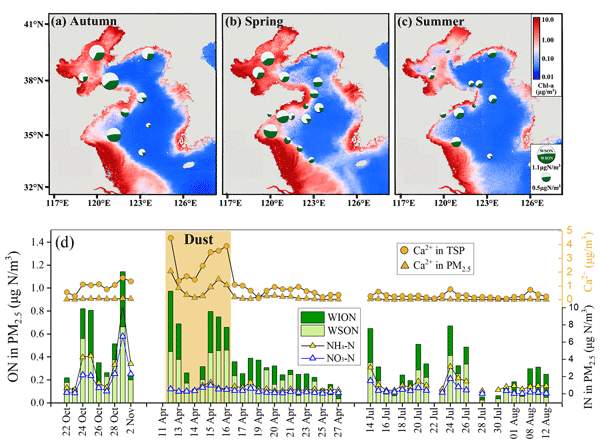
Spatial variation and time series of ON in the collected PM2.5 samples are shown in Fig. 1. The average concentration of ON in marine aerosols was 0.35 ± 0.25 µg N m−3 during the cruise observations over the YBS. The campaign-averaged concentrations of NO–N and NH–N were 0.63 ± 1.06 and 1.59 ± 2.14 µg N m−3, respectively. Organic nitrogen averagely accounted for 22 % (range: 4 %–60 %) of the total nitrogen (ON + NH–N + NO–N) and 6 % (range: 2 %–13 %) of organic matters in marine aerosols over the YBS. The observed aerosol ON over the YBS was among the ranges reported in previous studies over Mediterranean or Asian marginal seas (0.16–1.05 µg N m−3) (Sun et al., 2026; Tian et al., 2023; Violaki and Mihalopoulos, 2010), and lower than those in polluted continental environments (0.26–2.4 µg N m−3, e.g., urban Beijing, coastal Qingdao sites) (Shi et al., 2010; Wu et al., 2021; Xu et al., 2017). Under the joint influence of terrestrial transport and marine emissions, ON abundance in aerosols over the YBS was higher than that reported over open oceans (4.7–170 ng N m−3), such as the Southern Ocean, Atlantic, and Pacific Ocean (Luo et al., 2018; Matsumoto et al., 2022; Miyazaki et al., 2011; Sun et al., 2026; Violaki et al., 2015; Wang et al., 2026). Recent observations suggested that external aerosol organic nitrogen from transported combustion emissions or aged anthropogenic pollutants is important in the West Pacific Ocean (Ito et al., 2014; Wang et al., 2026). On a global scale, ON contributed 23 % of atmospheric total nitrogen deposition in marine ecosystems (Li et al., 2023).
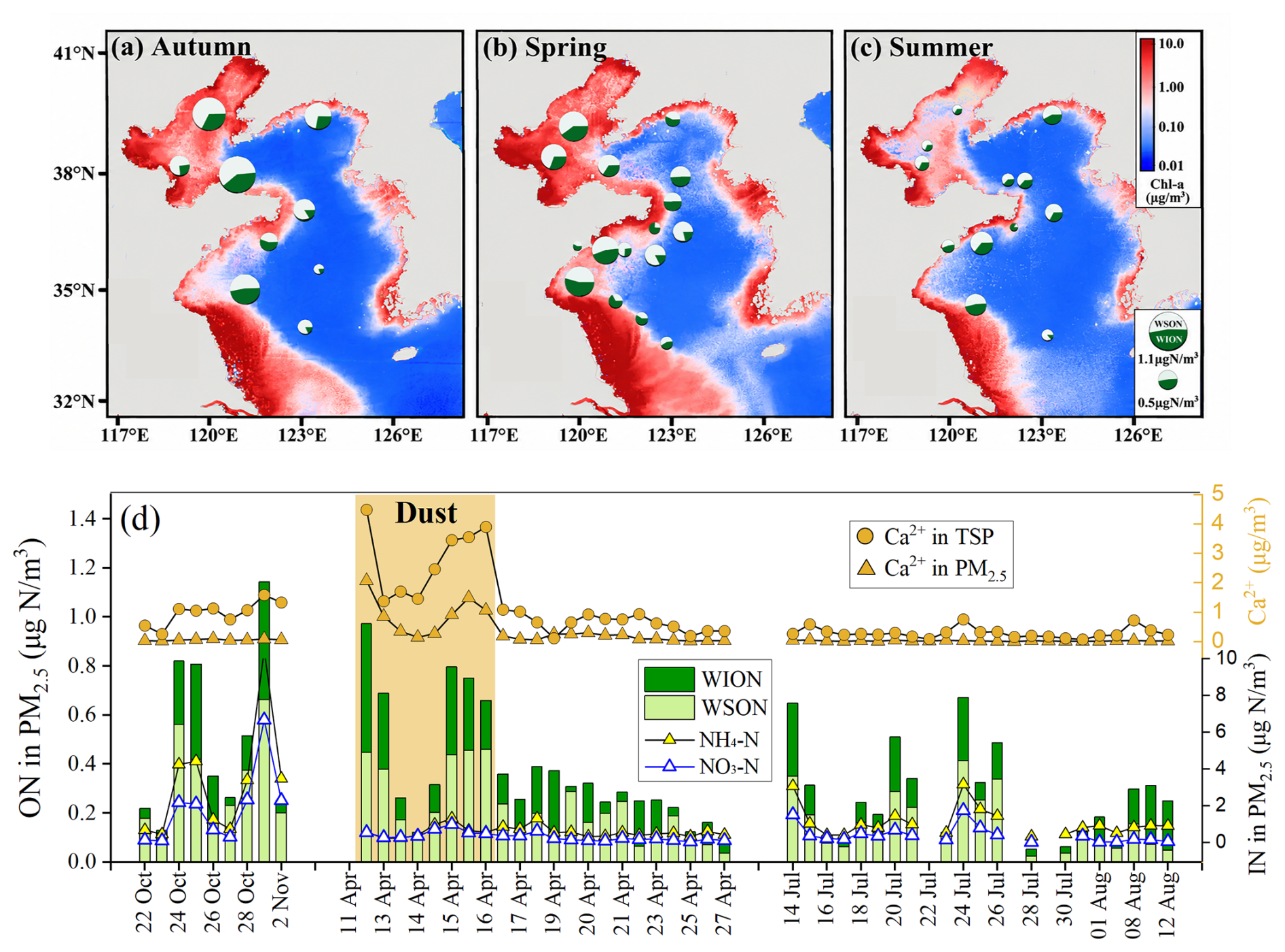
Figure 1(a, b, c) Spatial distribution of organic nitrogen (ON) in PM2.5 samples during cruises over the YBS. (d) Time series of ON, inorganic nitrogen (IN, including NH–N and NO–N) in PM2.5 and Ca2+ in marine aerosols during the observations. The color scales in panels (a)–(c) represent the sea surface Chl a during the cruise. A dust episode was identified based on the Ca2+ concentration in TSP and marked by orange shading in panel (d).
Aerosol ON over the YBS exhibited clear seasonal variations (Fig. 2), following the abundance order of autumn (0.50 ± 0.32 µg N m−3) > spring (0.37 ± 0.24 µg N m−3) > summer (0.27 ± 0.18 µg N m−3). The relative standard deviation (RSD) of ON concentrations in marine aerosols was comparable across seasons (70 %, 65 %, and 69 % for the autumn, spring, and summer samples). The average ON concentrations in autumn and summer were significantly different at the 0.05 level, while differences between other seasons were not significant. The observation regions were dominated by continental air masses in autumn and spring and by marine air masses in summer (Fig. S1). Under the severe impacts of continental air mass outflows, aerosol ON in autumn or spring was higher than that in summer (Figs. 1, 2). Concentrations of K+ and NO in the collected samples were the highest during the autumn cruise (0.26 and 8.20 µg m−3) than during the other two seasons (0.066 and 1.37 µg m−3 in spring, 0.076 and 1.82 µg m−3 in summer), indicating the severer impacts of biomass burning and anthropogenic pollutants in autumn. In addition, a dust episode was observed during 12–16 April during the spring cruise (Fig. 1d), when Ca2+ concentrations in TSP increased obviously to 1.36–4.47 µg m−3, twice higher than the average values during the non-dust period (0.64 ± 0.30 µg m−3) in spring. During the dust episode, ON abundance increased to 0.57 ± 0.30 µg N m−3, higher than the ON concentrations observed on non-dust days during the spring cruise. The seasonal variation of aerosol ON was different from that of OC in marine aerosols, with an abundance order of spring (4.8 µg C m−3) > autumn (3.4 µg C m−3) > summer (2.7 µg C m−3). The dust storms in spring lead to a more obvious elevation of OC than ON in marine aerosols. It is noted that we only used the Ca2+ data in TSP to reflect the variation of coarse particles and identify the dust episode more clearly in this work. Other analyses were based on the PM2.5 results, as previous observations have suggested that the organic mass and its absorption were dominant in fine particles over marginal seas (Zhang et al., 2025).
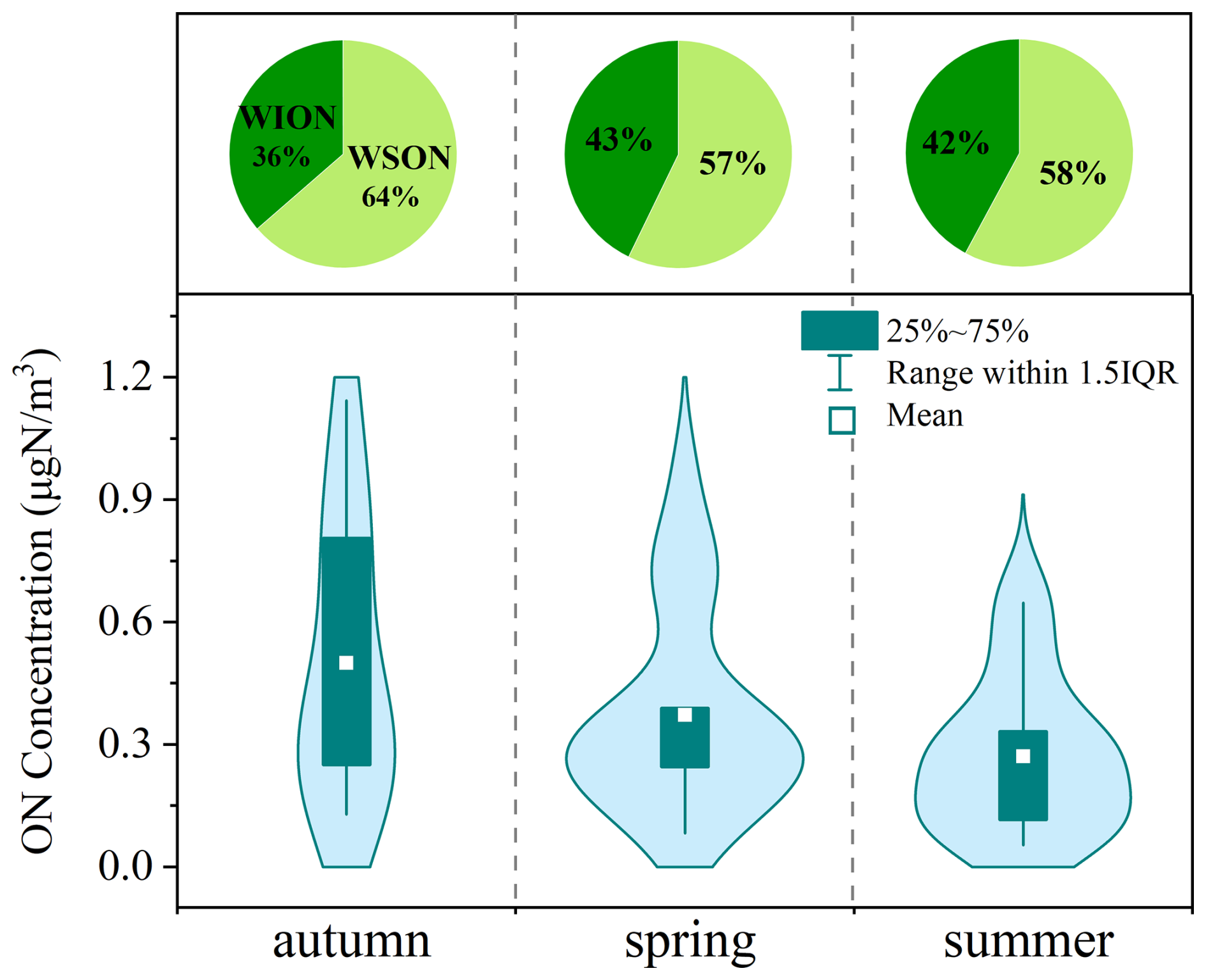
Figure 2Seasonal variation of ON concentrations and relative contributions of water-soluble ON (WSON) and water-insoluble ON (WION). The values in the pie charts are the average contribution of WSON versus WION in each season.
During the observations over the YBS, WSON (0.21 ± 0.15 µg N m−3) in marine aerosols was higher than WION (0.15 ± 0.12 µg N m−3). Previous studies suggested that aged or secondarily formed organic aerosols tend to be more soluble than primarily emitted organic aerosols (Fang et al., 2023; Zhang et al., 2025). For example, abundant WSON can be formed via oxidation of volatile organic compounds (VOCs) in the presence of anthropogenic NOx or in NH3-aged organic aerosols (Laskin et al., 2015). East Asian marginal seas are obviously influenced by continental air pollutants, which undergo oxidation and aging processes during transport, thereby contributing to water-soluble ON in marine aerosols over the YBS. Higher WSON WION ratios indicated an elevated contribution of aged anthropogenic pollutants in marine aerosols over marginal seas. The water-insoluble fractions of aerosol ON were higher in spring (43 %) or summer (42 %) than in autumn (36 %). Our recent observation suggested that long-range transport of Asian dust is a major source of water-insoluble organic aerosols in spring over the East Asian marginal seas (Zhang et al., 2025). The proportion of water-insoluble ON among the total aerosol ON increased under the influence of spring dust storms. During summer, dominated by marine air masses, the relative contribution of marine-related sources increased. This resulted in a higher proportion of water-insoluble ON in summer than in autumn (Fig. 2). A previous study over the open Northwest Pacific Ocean reported an average WION ON ratio of 55 %, and the contribution increased to 93 % at 40–44° N (Miyazaki et al., 2011), much higher than the fraction of WION over the YBS. Miyazaki et al. (2011) suggest that marine biological sources significantly contributed to WION in marine aerosols. Marine biological activities emit nitrogen-containing organic components (e.g., protein-like macromolecules), which can be emitted to marine aerosols and contribute to WION (Chen et al., 2016; Facchini et al., 2008).
3.2 Sources and influence factors of aerosol ON
Inter-species correlation and PMF source apportionment were analyzed to investigate the sources of aerosol ON over the YBS. As shown in Fig. S4, a five-factor solution was identified as a reasonable and stable result. The resolved source factors include: (1) aged biomass burning, characterized by high loadings of K+, EC, WSOC, and secondary inorganic ions; (2) dust-related formation, dominated by mineral dust tracers (Ca2+ and Mg2+); (3) secondary nitrate formation, with high loadings of inorganic nitrate aerosols; (4) Marine biogenic emission, characterized by MSA, a typical atmospheric oxidation product of dimethyl sulfide emitted by phytoplankton (Kurosaki et al., 2022; Stefels et al., 2007); (5) Sea spray aerosol, dominated by Na+, Cl−, and MSA. The PMF-resolved ON, WSON, and WION from different sources matched well with the measured concentrations in marine aerosols (Figs. S5, S6). Both aged biomass burning and secondary nitrate formation were anthropogenic secondary pollutants. The two factors are characterized by different tracers (Fig. S4) and showed different temporal variations (Fig. S7) during the observations, which thus were resolved as two separate sources.
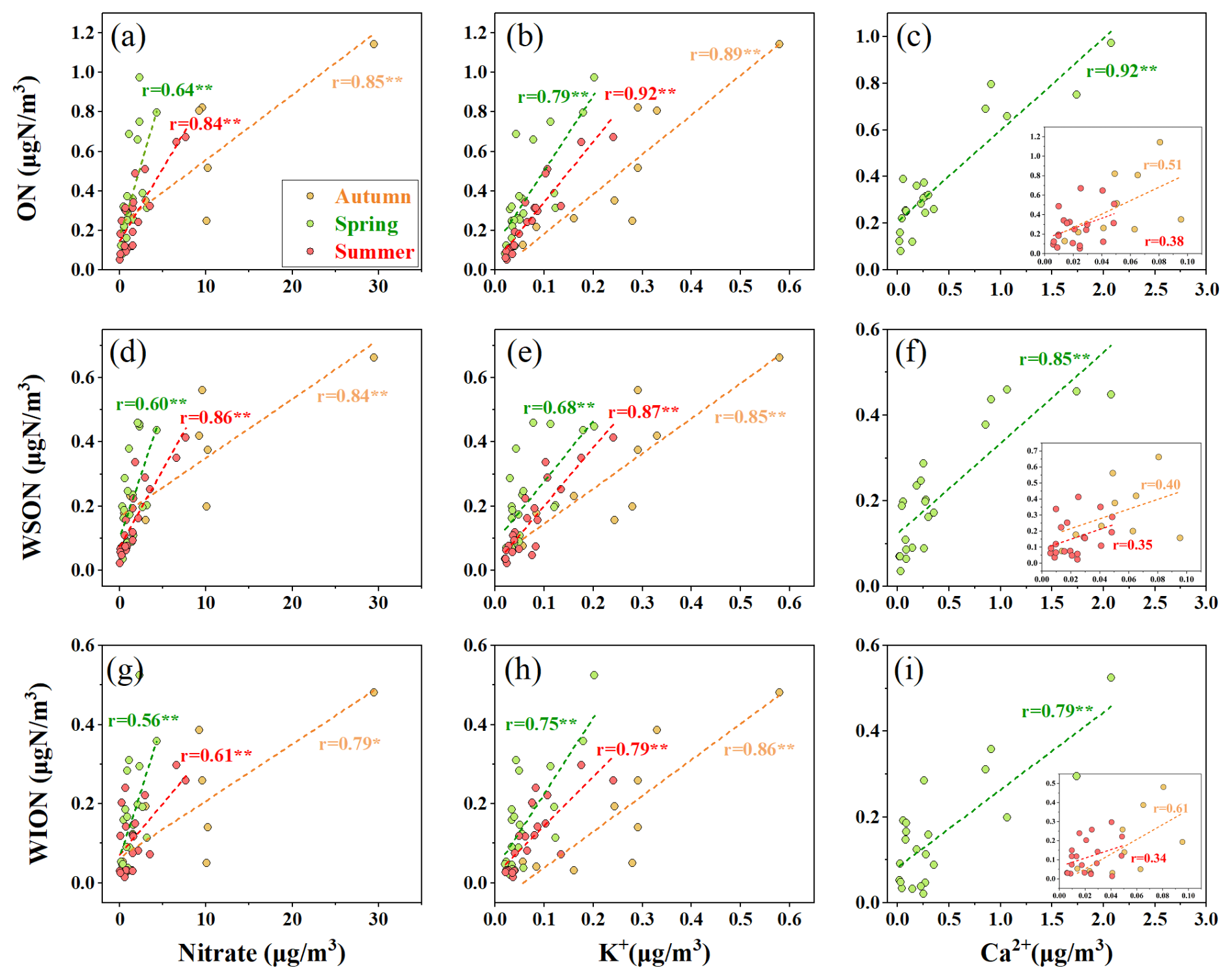
Figure 3Correlation between (a–c) ON, (d–f) WSON, or (g–i) WION and secondary nitrate aerosols, K+, and Ca2+ in PM2.5 over the YBS. Data for autumn, spring, and summer are represented in orange, green, and red, respectively. The dashed lines and r-values are the fitted curves and correlation coefficients of the data in each season. indicates the correlation is significant at the 0.01 level, and ∗ indicates the correlation is significant at the 0.05 level.
Anthropogenic secondary pollutants, including aged biomass burning and secondary nitrate formation, were important sources of organic nitrogen in atmospheric aerosols over the YBS. The concentrations of ON, WSON, and WION showed moderate or strong correlations with K+ and nitrate in marine aerosols (Fig. 3). The source apportionment result suggested that aged biomass burning and secondary nitrate formation totally contributed 36 %–76 % of ON, 46 %–83 % of WSON, and 39 %–89 % of WION during the observations (Fig. 4). Driven by continental air masses, the concentrations of K+ and nitrate in the collected aerosol samples were much higher in autumn (0.26 ± 0.15 and 8.2 ± 9.1 µg m−3) than in the other two seasons (0.066 ± 0.050 and 1.4 ± 1.1 µg m−3 in spring, 0.076 ± 0.056 and 1.8 ± 2.1 µg m−3 in summer). The autumn samples were generally under severe impacts of transported anthropogenic pollutants, with 59 %–86 % of aerosol ON contributed by anthropogenic secondary formation. Aerosol ON contributed by anthropogenic sources substantially exceed that by dust-related or natural sources (marine biogenic emission and sea spray aerosol) during the autumn cruise (Fig. 4).
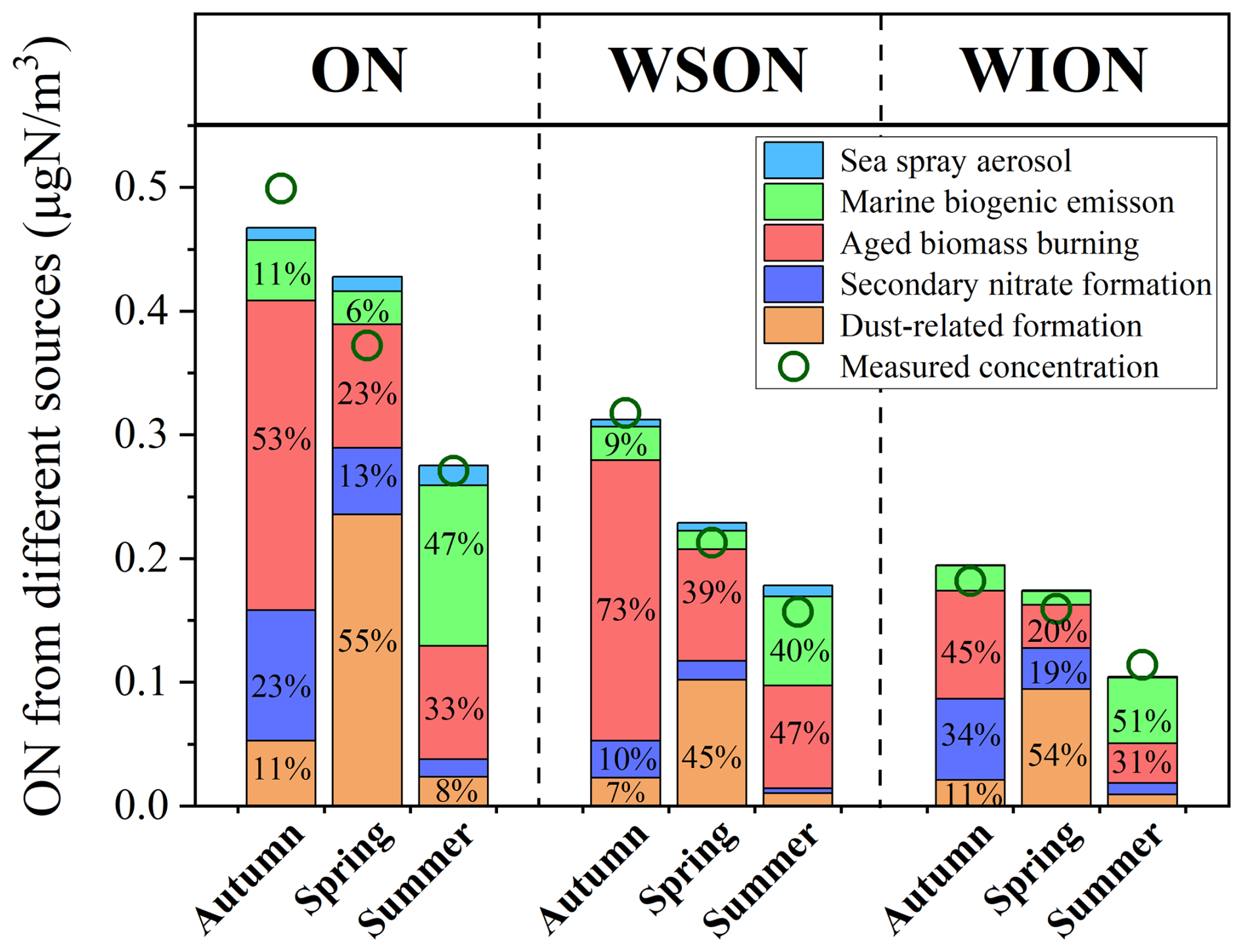
Figure 4Aerosol ON, WSON, and WION from different sources resolved by PMF during cruise observations over the YBS. The relative contribution of each source to the total ON, WSON, or WION is listed in the corresponding stacked column.
Previous studies have suggested that biomass burning and VOC oxidation with NOx involved in would produce atmospheric ON in terrestrial environments (Liu et al., 2019; Wang et al., 2019b), which can be long-range transported to marine atmosphere. For example, methyl-nitrocatechols can originate from the oxidation of VOCs emitted by biomass burning (Iinuma et al., 2010). Nitro-aromatic compounds (e.g., nitro-phenols, nitro-catechol, and their derivatives) can be formed via oxidation of anthropogenic toluene and benzene under high-NOx conditions (Wang et al., 2019b). Under mild aqueous-phase conditions, nitration of guaiacol can produce nitroguaiacols via the nonradical mechanism (Kroflic et al., 2018). Secondary formation of aerosol ON was typically associated with aqueous reaction processes (Chen et al., 2026). The contribution of aged biomass burning to WSON was higher than that to WION in aerosols (Fig. 4). Biomass burning is an important contributor to water-soluble organic components in the atmosphere, and aged organic aerosols tend to be more water-soluble than primarily emitted organic aerosols. A recent study suggested that wildfires contributed 37 % of global atmospheric ON deposition and that 40 %–80 % of total N deposition was attributable to aerosol ON downwind of biomass burning areas (Li et al., 2023).
We noted that ON abundance from secondary nitrate formation increased with the increase in RH in autumn (Fig. S8), with a correlation coefficient of 0.78 (p < 0.05). High-humidity conditions favor the secondary formation of aerosol ON via heterogeneous or aqueous-phase reactions. For example, high RH promotes the aqueous formation of nitrated aromatic compounds (e.g., methyl-nitrocatechols) (Shi et al., 2023; Vidovic et al., 2018; Wang et al., 2019b). Nitration of guaiacol can produce nitroguaiacols via the nonradical mechanism under aqueous-phase conditions (Kroflic et al., 2018). Aqueous reactions between dicarbonyls and ammonium, amine, or amino acids produce N-heterocycle compounds (De Haan et al., 2009; Marrero-Ortiz et al., 2019). For the spring samples, abundance of ON from secondary nitrate formation also showed an increasing trend with RH, but their correlation was not significant (p > 0.05). During the summertime cruise, however, we did not observe the influence of ambient RH on aerosol ON from secondary nitrate formation (Fig. S8c). The different dependence of ON formation on ambient RH was due to the higher RH in summer (79 % ± 7 %) than in spring (61 % ± 18 %) and autumn (54 % ± 9 %). Ambient humidity was not a limiting factor for aqueous formation of secondary organic aerosols (SOA) under the high RH in summer (Wang et al., 2023a). Under the low-RH conditions in autumn, humidity can be a more important limiting factor for ON formation, and elevated RH would favor its formation via aqueous reactions. Our results indicated that increased ambient RH promoted the formation of light-absorbing ON in marine aerosols. It is noted that we cannot distinguish the gas-phase and aqueous-phase formation pathways based on the PMF analysis here. The resolved ON from secondary nitrate formation included both the aqueous-phase formation pathway as well as the gas-phase formation and further gas-to-particle partitioning pathway.
During the spring cruise, ON, WSON, and WION showed strong positive correlations with Ca2+ in the aerosol samples (Fig. 3), indicating dust storms as an important source of aerosol ON over the YBS. However, the correlations between ON and Ca2+ during the other two seasons were weaker than in spring (Fig. 3). Based on the PMF result, contribution of dust-related formation to ON, WSON, and WION in marine aerosols elevated to 55 %, 45 %, and 54 % in spring, compared to 6 %–11 % in autumn and summer (Fig. 4). As shown in Fig. 1, a dust storm originating in Mongolia was recorded in spring (Wang et al., 2025; Zhang et al., 2025). The highest Ca2+ concentration was observed on 12 April. Based on the source apportionment result, 95 % of ON, 83 % of WSON, and 88 % of WION were attributed to dust-related formation on 12 April during the dust episode (Fig. S5). On one hand, dust surface favors the gas-to-particle partitioning or the uptake of gaseous organic precursors (Li et al., 2025c). On the other hand, aged dust particles could facilitate the formation of SOA via aqueous-phase or heterogeneous reactions, especially on nitrate-coating particles (Li et al., 2025a). For the spring samples, dust-related ON formation displayed a positive correlation with nitrate aerosol concentration (Fig. S9), indicating the secondary formation of ON on dust particles via mixing with nitrate aerosols. Mineral components provided favorable conditions for heterogeneous nitration reactions and further ON formation in aged dust particles coated by nitrate (Kroflic et al., 2018; Nie et al., 2014). Dust storms, mixing with anthropogenic nitrate pollutants during transport through East Asia, are a major contributor to inorganic and organic nitrogen deposition in marginal seas. Based on our previous study (Zhang et al., 2025), dust contributed 50 % of water-soluble OC and 70 % of the water-insoluble OC in marine aerosols during the spring cruise, higher than that to WSON (45 %) and WION (54 %) resolved in this work. The higher contribution of spring dust to aerosol OC than ON, especially for the water-insoluble fractions, explained their different seasonal variations. The aerosol ON formation, however, was more driven by anthropogenic secondary pollutants, and thus aerosol ON was higher in autumn than in spring. Dust-related aerosol ON likely formed during the long-range transport of dust storms via mixing with anthropogenic pollutants.
Marine sources, including marine biogenic emissions and sea spray aerosol, became a dominant contributor to ON in summer, accounting for 53 % of ON, 45 % of WSON, and 52 % of WION in aerosols over the YBS (Fig. 4). Marine-related ON was mainly associated with biogenic emissions. Amino acids, protein-like organic matter, urea, or other organic nitrogen compounds can be emitted from the ocean and enriched in marine aerosols (Matthews et al., 2023; Shi et al., 2010; Triesch et al., 2021; Wang et al., 2016). Marine-derived organic aerosols are usually enriched in fluorescent components related to marine biological activity (Miyazaki et al., 2018). These marine-generated reduced ON components are generally with lower light absorption capability compared with anthropogenic ON transported from the continent (Laskin et al., 2015). Marine biogenic emissions contributed 6 %–11 % of ON, 7 %–9 % of WSON, and 6 %–10 % of WION during the autumn and spring cruises, higher than the contribution of sea spray aerosols (< 3 %). Previous studies have suggested that marine-generated ON is usually related to biological activity or nitrogen-fixing microorganisms in seawater (Aller et al., 2017; Dobashi et al., 2023).
3.3 Influence of ON on light absorption by marine organic aerosols
A recent study suggests that brown nitrogen, the absorptive nitrogenous components of organic aerosols, dominates their light absorption (Li et al., 2025b). Brown nitrogen contributes 76 % of surface light absorption by organic aerosols over the US and 61 % of their global absorptive optical depth (Li et al., 2025b). To understand the role of ON in regulating the absorption of marine organic aerosols over the East Asian marginal seas, we analyzed the correlations between aerosol ON and light absorption (Abs300), absorption capability (MAE300) of organic aerosols (Fig. 5). The Abs365 and Abs300 of organic aerosols were respectively 1.47 ± 0.96 and 4.34 ± 2.83 Mm−1, and MAE365 and MAE300 were 0.43 ± 0.21 and 1.24 ± 0.38 m2 g−1 during the cruises. Light absorption parameters at 365 nm are more widely used in existing literature (Dasari et al., 2019). For some of our marine aerosol samples, however, the Abs365 values were quite low or close to the detection limit, especially for the summertime samples, which could result in uncertainty for further analysis. Thus, we used the light absorption value at a wavelength shorter than 365 nm to investigate the BrC absorption properties and sources in marine atmospheres. Our previous work has suggested that the Abs365 and Abs300 of organic aerosols over the YBS displayed a similar variation trend (Zhang et al., 2025).
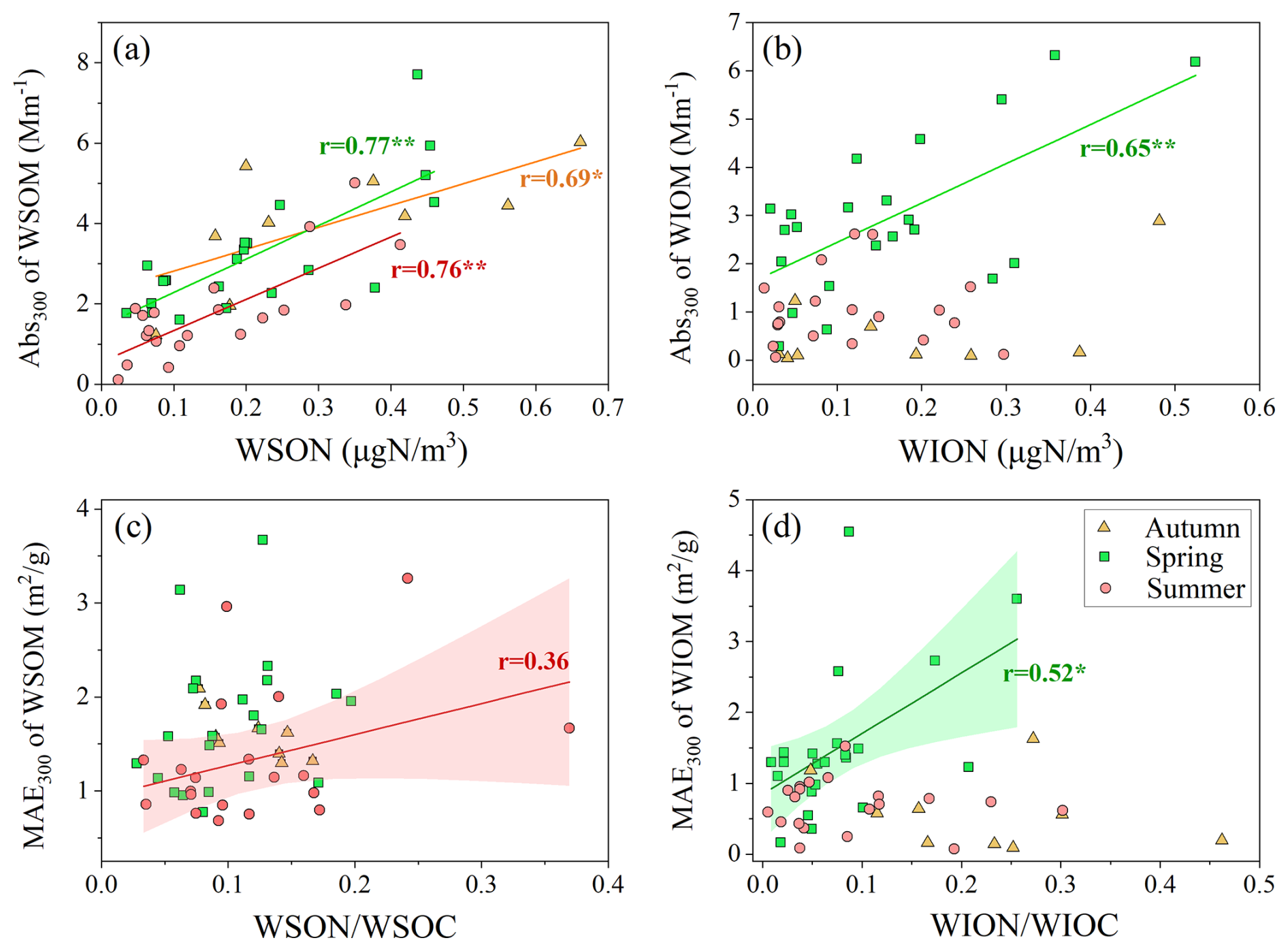
Figure 5(a, b) Variations of Abs300 by WSOM and Abs300 by WIOM as a function of WSON and WION. (c, d) Variations of MAE300 for WSOM and MAE300 for WIOM as functions of WSON WSOC and WION WSOC mass ratios. The markers and fitted lines for the summer, spring, and autumn data are shown in red, green, and yellow, respectively. indicates the correlation is significant at the 0.01 level, and ∗ indicates the correlation is significant at the 0.05 level.
For the water-soluble organics, Abs300 of WSOM displayed strong correlations with WSON concentration in the marine aerosols across seasons over the YBS (Fig. 5a). This revealed the importance of nitrogen-containing organic components for organic aerosol absorption. A strong dependence of WSOM absorption coefficient at 365 nm on WSON concentrations was also observed in atmospheric aerosols at inland city sites (Chen et al., 2026). However, for the water-insoluble fraction, we observed a strong correlation between Abs300 of WIOM and WION only in the spring samples (Fig. 5b). For the autumn or summer cruises, we did not observe an obvious variation trend between WIOM Abs300 and WION in the collected aerosol samples. This is consistent with our recent findings that absorption of brown carbon (BrC) over the YBS was generally dominated by water-soluble organics, and the contribution of water-insoluble organic aerosols increased during dust episodes (Zhang et al., 2025). Water-soluble organic nitrogen generally drove the light absorption by organic aerosols during non-dust periods over the YBS. During the spring dust period, both WSON and WION played important roles in the light absorption by marine organic aerosols over the East Asian marginal seas.
The elevated light absorption by organic aerosols was attributed not only to the higher ON concentrations but also to an increase in the absorption capability of organic aerosols. We plotted the variations of MAE300 as a function of ON OC ratios in Fig. 5c, d. For the summer samples, MAE300 of WSOM showed an increasing trend as WSON WSOC ratios increased (Fig. 5c). During the spring cruise, MAE300 of WIOM elevated as the WION WIOC ratios increased (Fig. 5d). Previous studies have concluded that organic molecules contributing to BrC absorption usually have a large degree of unsaturation and contain one or more nitrogen atoms (Laskin et al., 2015). These nitrogen-containing organic molecules are more prone to forming conjugated chromophores, thereby enhancing absorption by organic aerosols within the near-UV wavelength region (Laskin et al., 2015; Lin et al., 2016). For water-insoluble organic aerosols in autumn or summer, there was no clear variation trend in absorption capability with increasing WION WIOC mass ratios (Fig. 5d). This was because light absorption of organic aerosols could also be contributed by non-nitrogenous chromophores (e.g., polycyclic aromatic hydrocarbons) in autumn or summer (Lin et al., 2018).
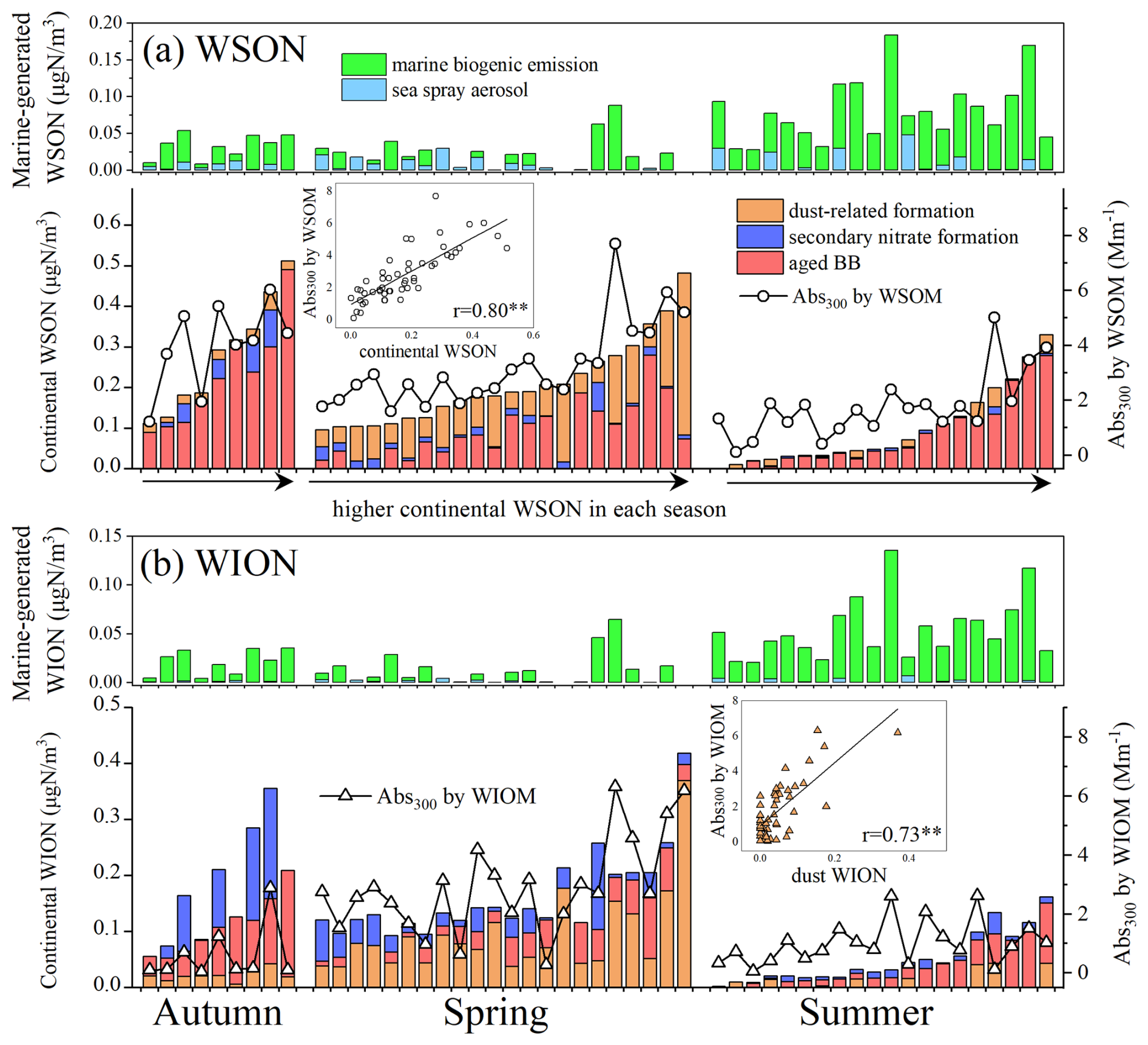
Figure 6(a) Variations of marine-generated WSON (WSON from marine biogenic emission and sea spray aerosol), continental WSON (WSON from dust-related formation, secondary nitrate formation, and aged biomass burning), and Abs300 by WSOM. (b) Variations of marine-generated WION, continental WION, and Abs300 by WIOM. The inserted chart in panel (a) shows the correlation between continental WSON and Abs300 by WSOM. The inserted chart in panel (b) is the correlation between WION from dust-related formation and Abs300 by WIOM. The samples during each cruise are ranked by the concentrations of continental WSON in aerosol samples.
Variations of aerosol ON from continental and marine sources, as well as BrC absorption coefficients, are shown in Fig. 6 to understand the roles of ON from different sources in regulating the light absorption by marine organic aerosols. Continental WSON or WION includes those from dust-related formation, secondary nitrate formation, and aged biomass burning. Marine-generated WSON or WION includes those from marine biogenic emissions and sea spray aerosols. Samples during each cruise are listed in ascending order of continental WSON concentrations shown in Fig. 6a. The Abs300 by WSOM or WIOM followed similar variation trends to the abundance of continental WSON or WION, and was different from that of marine-generated organic nitrogen (Fig. 6). Organic nitrogen compounds in marine-generated aerosols (e.g., amino acids, protein-like organic matters) are generally with low absorption within the UV to Vis wavelengths. Thus, marine-generated ON likely played a minor role in the organic aerosol absorption over East Asian marginal seas. Light absorption of WSOM showed a strong positive correlation (r=0.80) with continental WSON (inserted chart in Fig. 6a). This correlation also held within individual season (Fig. S10). The Abs300 by WIOM displayed a consistent variation trend to continental WION, especially to the dust-related WION formation. As shown in the inserted chart in Fig. 6b, a strong positive correlation (r=0.73) was observed between Abs300 by WIOM and dust-related WION formation. This clearly suggested the vital roles of transported continental aerosol ON in regulating the light absorption by organic aerosols over marginal seas. We used the mass ratio of Ca2+ NO to roughly indicate the variation of relative contribution of dust and anthropogenic pollutants. The MAE300 of WIOM, dominated by dust-related sources, displayed an increasing trend at a lower Ca2+ NO mass ratio in spring (Fig. S11). This indicated that light absorption of dust-related organics would increase via interactions with anthropogenic pollutants (e.g., nitrate aerosols) during long-range transport through East Asia. This work provided observational evidence that aerosol ON from continental pollutants modulated the light absorption of marine organic aerosols over marginal seas. Our results are consistent with a recent modeling study, which emphasized the importance of biomass burning, anthropogenic emissions, and secondary formation for light-absorbing brown nitrogen on a global scale (Li et al., 2025b). What's more, our observation also emphasized the vital role of dust, through mixing with anthropogenic pollutants, in aerosol ON formation and light absorption during dust-storm season, which needs to be considered in the model.
Organic nitrogen is an important fraction of the total nitrogen in atmospheric aerosols over the East Asian marginal seas. Aerosol ON concentration was 0.35 ± 0.25 µg N m−3, and accounted for 4 %–60 % of the total nitrogen in marine aerosols during the cruises over the YBS. Aerosol ON abundance was the highest in autumn (0.50 ± 0.32 µg N m−3), followed by those in spring and summer. The obvious seasonal variation trend was attributed to the severe impacts of anthropogenic pollutants in autumn and dust storms in spring. The concentration of WSON (0.21 ± 0.15 µg N m−3) was higher than WION (0.15 ± 0.12 µg N m−3) in marine aerosols over the YBS. During the dust episode in spring, ON increased to 0.57 ± 0.30 µg N m−3, and the proportion of water-insoluble ON increased.
Sources of aerosol ON in the marine atmosphere were apportioned using the PMF model. Anthropogenic secondary pollutants, including aged biomass burning and secondary nitrate formation, contributed 36 %–76 % of ON, 46 %–83 % of WSON, and 39 %–89 % of WION during the observations. Anthropogenic secondary pollutants dominated the formation of aerosol ON in autumn. An Asian dust storm originating from Mongolia was recorded during the spring cruise. In marine aerosols, 55 % of ON, 45 % of WSON, and 54 % of WION were attributed to dust in spring, much higher than its contribution in autumn or summer (6 %–11 %). The contribution of dust-related formation can increase to > 80 % during the dust episode. Dust particles mixed with anthropogenic pollutants during long-range transport through East Asia and were a vital contributor of organic nitrogen over marginal seas. During the summer cruise dominated by marine air masses, marine sources were important for aerosol ON formation, particularly those associated with marine biological activity.
Organic nitrogen played a vital role in regulating the light absorption of organic aerosols over the YBS. During non-dust periods, light absorption by marine organic aerosols was generally driven by water-soluble ON. Under the impacts of spring dust storms, both WSON and WION played important roles in organic aerosol absorption over the East Asian marginal seas. Enhanced light absorption by organic aerosols was attributed not only to the higher ON concentrations, but also to the increased absorption capability at elevated ON OC ratios (WSON WSOC for summer, and WION WIOC for spring). Transported continental aerosol ON, including those from dust-related formation, secondary nitrate formation, and aged biomass burning, modulated the light absorption by organic aerosols over marginal seas. Marine-generated ON, however, played a minor role in the light absorption by organic aerosols in the marine atmosphere.
The dataset is available at https://doi.org/10.5281/zenodo.22764042 (Wang, 2026).
The supplement related to this article is available online at https://doi.org/10.5194/acp-26-13175-2026-supplement.
Chao Yu: Investigation, Visualization, Writing – original draft; Lin Zheng: Data curation, Investigation, Validation, Writing – review and editing; Yujue Wang: Conceptualization, Funding acquisition, Supervision, Visualization, Writing – original draft, Writing – review and editing; Meijing Guo, Xu Yu, Yuqi Guo, and Sisi Song: Data curation, Methodology, Investigation, Writing – review and editing; Kyoung-Soon Jang: Writing – review and editing; Jian Zhen Yu: Resources, Writing – review and editing; Xiaohong Yao and Huiwang Gao: Supervision, Resources, Writing – review and editing.
The contact author has declared that none of the authors has any competing interests.
Publisher's note: Copernicus Publications remains neutral with regard to jurisdictional claims made in the text, published maps, institutional affiliations, or any other geographical representation in this paper. The authors bear the ultimate responsibility for providing appropriate place names. Views expressed in the text are those of the authors and do not necessarily reflect the views of the publisher.
Data and samples were collected onboard of R/V Lanhai101 implementing the open research cruise NORC2023-01, NORC2024-01, and NORC2025-01 supported by NSFC Shiptime Sharing Project (project number: 42449901).
This study has been supported by the Shandong Provincial Natural Science Foundation (grant no. ZR2026QB10), the National Natural Science Foundation of China (grant nos. 42576039 and 42411540229), the Fundamental Research Funds for the Central Universities (grant no. 202441011), and Shandong Young Innovative Talent Team of China (grant no. 2022KJ051).
This paper was edited by Zhibin Wang and reviewed by Sanjeev Dasari and one anonymous referee.
Aller, J. Y., Radway, J. C., Kilthau, W. P., Bothe, D. W., Wilson, T. W., Vaillancourt, R. D., Quinn, P. K., Coffman, D. J., Murray, B. J., and Knopf, D. A.: Size-resolved characterization of the polysaccharidic and proteinaceous components of sea spray aerosol, Atmos. Environ., 154, 331–347, https://doi.org/10.1016/j.atmosenv.2017.01.053, 2017.
Altieri, K. E., Fawcett, S. E., and Hastings, M. G.: Reactive Nitrogen Cycling in the Atmosphere and Ocean, Annu. Rev. Earth Pl. Sc., 49, 523–550, https://doi.org/10.1146/annurev-earth-083120-052147, 2021.
Brown, S. G., Eberly, S., Paatero, P., and Norris, G. A.: Methods for estimating uncertainty in PMF solutions: examples with ambient air and water quality data and guidance on reporting PMF results, Sci. Total Environ., 518–519, 626–635, https://doi.org/10.1016/j.scitotenv.2015.01.022, 2015.
Chen, L., Li, R., Xiao, B., Li, Z., Li, R., Chen, K., Li, R., Zhang, J., Cao, C., Yu, J. Z., Guo, H., and Wang, G.: Atmospheric Nitrogen-Containing Organic Aerosols in Wintertime Sichuan Basin of China: A Key Role of Aqueous-Phase Process in Secondary Production and Optical Absorption, Environ. Sci. Technol., https://doi.org/10.1021/acs.est.6c05422, 2026.
Chen, Q., Miyazaki, Y., Kawamura, K., Matsumoto, K., Coburn, S., Volkamer, R., Iwamoto, Y., Kagami, S., Deng, Y., Ogawa, S., Ramasamy, S., Kato, S., Ida, A., Kajii, Y., and Mochida, M.: Characterization of Chromophoric Water-Soluble Organic Matter in Urban, Forest, and Marine Aerosols by HR-ToF-AMS Analysis and Excitation-Emission Matrix Spectroscopy, Environ. Sci. Technol., 50, 10351–10360, https://doi.org/10.1021/acs.est.6b01643, 2016.
Dai, M., Luo, Y. W., Achterberg, E. P., Browning, T. J., Cai, Y., Cao, Z., Chai, F., Chen, B., Church, M. J., Ci, D., Du, C., Gao, K., Guo, X., Hu, Z., Kao, S. J., Laws, E. A., Lee, Z., Lin, H., Liu, Q., Liu, X., Luo, W., Meng, F., Shang, S., Shi, D., Saito, H., Song, L., Wan, X. S., Wang, Y., Wang, W. L., Wen, Z., Xiu, P., Zhang, J., Zhang, R., and Zhou, K.: Upper ocean biogeochemistry of the oligotrophic North Pacific subtropical gyre: from nutrient sources to carbon export, Rev. Geophys., 61, https://doi.org/10.1029/2022rg000800, 2023.
Dasari, S., Andersson, A., Bikkina, S., Holmstrand, H., Budhavant, K., Satheesh, S., Asmi, E., Kesti, J., Backman, J., Salam, A., Bisht, D. S., Tiwari, S., Hameed, Z., and Gustafsson, O.: Photochemical degradation affects the light absorption of water-soluble brown carbon in the South Asian outflow, Sci. Adv., 5, eaau8066, https://doi.org/10.1126/sciadv.aau8066, 2019.
De Haan, D. O., Corrigan, A. L., Smith, K. W., Stroik, D. R., Turley, J. J., Lee, F. E., Tolbert, M. A., Jimenez, J. L., Cordova, K. E., and Ferrell, G. R.: Secondary organic aerosol-forming reactions of glyoxal with amino acids, Environ. Sci. Technol., 43, 2818–2824, https://doi.org/10.1021/es803534f, 2009.
Dobashi, T., Miyazaki, Y., Tachibana, E., Takahashi, K., Horii, S., Hashihama, F., Yasui-Tamura, S., Iwamoto, Y., Wong, S.-K., and Hamasaki, K.: Marine nitrogen fixation as a possible source of atmospheric water-soluble organic nitrogen aerosols in the subtropical North Pacific, Biogeosciences, 20, 439–449, https://doi.org/10.5194/bg-20-439-2023, 2023.
Duce, R. A., LaRoche, J., Altieri, K., Arrigo, K. R., Baker, A. R., Capone, D. G., Cornell, S., Dentener, F., Galloway, J., Ganeshram, R. S., Geider, R. J., Jickells, T., Kuypers, M. M., Langlois, R., Liss, P. S., Liu, S. M., Middelburg, J. J., Moore, C. M., Nickovic, S., Oschlies, A., Pedersen, T., Prospero, J., Schlitzer, R., Seitzinger, S., Sorensen, L. L., Uematsu, M., Ulloa, O., Voss, M., Ward, B., and Zamora, L.: Impacts of atmospheric anthropogenic nitrogen on the open ocean, Science, 320, 893–897, https://doi.org/10.1126/science.1150369, 2008.
Facchini, M. C., Rinaldi, M., Decesari, S., Carbone, C., Finessi, E., Mircea, M., Fuzzi, S., Ceburnis, D., Flanagan, R., Nilsson, E. D., de Leeuw, G., Martino, M., Woeltjen, J., and O'Dowd, C. D.: Primary submicron marine aerosol dominated by insoluble organic colloids and aggregates, Geophys. Res. Lett., 35, https://doi.org/10.1029/2008gl034210, 2008.
Fang, W., Andersson, A., Lee, M., Zheng, M., Du, K., Kim, S.-W., Holmstrand, H., and Gustafsson, Ö.: Combined influences of sources and atmospheric bleaching on light absorption of water-soluble brown carbon aerosols, npj Clim. Atmos. Sci., 6, https://doi.org/10.1038/s41612-023-00438-8, 2023.
Huang, S., Wu, Z., Poulain, L., van Pinxteren, M., Merkel, M., Assmann, D., Herrmann, H., and Wiedensohler, A.: Source apportionment of the organic aerosol over the Atlantic Ocean from 53° N to 53° S: significant contributions from marine emissions and long-range transport, Atmos. Chem. Phys., 18, 18043–18062, https://doi.org/10.5194/acp-18-18043-2018, 2018.
Iinuma, Y., Boge, O., Grafe, R., and Herrmann, H.: Methyl-nitrocatechols: atmospheric tracer compounds for biomass burning secondary organic aerosols, Environ. Sci. Technol., 44, 8453–8459, https://doi.org/10.1021/es102938a, 2010.
Ito, A., Lin, G., and Penner, J. E.: Reconciling modeled and observed atmospheric deposition of soluble organic nitrogen at coastal locations, Global Biogeochem. Cy., 28, 617–630, https://doi.org/10.1002/2013gb004721, 2014.
Jickells, T. D., Buitenhuis, E., Altieri, K., Baker, A. R., Capone, D., Duce, R. A., Dentener, F., Fennel, K., Kanakidou, M., LaRoche, J., Lee, K., Liss, P., Middelburg, J. J., Moore, J. K., Okin, G., Oschlies, A., Sarin, M., Seitzinger, S., Sharples, J., Singh, A., Suntharalingam, P., Uematsu, M., and Zamora, L. M.: A reevaluation of the magnitude and impacts of anthropogenic atmospheric nitrogen inputs on the ocean, Global Biogeochem. Cy., 31, 289–305, https://doi.org/10.1002/2016gb005586, 2017.
Kroflic, A., Hus, M., Grilc, M., and Grgic, I.: Underappreciated and Complex Role of Nitrous Acid in Aromatic Nitration under Mild Environmental Conditions: The Case of Activated Methoxyphenols, Environ. Sci. Technol., 52, 13756–13765, https://doi.org/10.1021/acs.est.8b01903, 2018.
Kurosaki, Y., Matoba, S., Iizuka, Y., Fujita, K., and Shimada, R.: Increased oceanic dimethyl sulfide emissions in areas of sea ice retreat inferred from a Greenland ice core, Commun. Earth Environ., 3, https://doi.org/10.1038/s43247-022-00661-w, 2022.
Laskin, A., Laskin, J., and Nizkorodov, S. A.: Chemistry of atmospheric brown carbon, Chem. Rev., 115, 4335–4382, https://doi.org/10.1021/cr5006167, 2015.
Laskin, J., Laskin, A., Roach, P. J., Slysz, G. W., Anderson, G. A., Nizkorodov, S. A., Bones, D. L., and Nguyen, L. Q.: High-resolution desorption electrospray ionization mass spectrometry for chemical characterization of organic aerosols, Anal. Chem., 82, 2048–2058, https://doi.org/10.1021/ac902801f, 2010.
Li, C., He, Q., Hettiyadura, A. P. S., Kafer, U., Shmul, G., Meidan, D., Zimmermann, R., Brown, S. S., George, C., Laskin, A., and Rudich, Y.: Formation of Secondary Brown Carbon in Biomass Burning Aerosol Proxies through NO(3) Radical Reactions, Environ. Sci. Technol., 54, 1395–1405, https://doi.org/10.1021/acs.est.9b05641, 2020.
Li, R., Cui, L. L., Zhao, Y. L., Fu, H. B., Li, Q., Zhang, L. W., and Chen, J. M.: Size-segregated water-soluble N-bearing species in the land-sea boundary zone of East China, Atmos. Environ., 218, https://doi.org/10.1016/j.atmosenv.2019.116990, 2019.
Li, W., Ito, A., Wang, G., Zhi, M., Xu, L., Yuan, Q., Zhang, J., Liu, L., Wu, F., Laskin, A., Zhang, D., Zhang, X., Zhu, T., Chen, J., Mihalopoulos, N., Bougiatioti, A., Kanakidou, M., Wang, G., Hu, H., Zhao, Y., and Shi, Z.: Aqueous-phase secondary organic aerosol formation on mineral dust, Natl. Sci. Rev., 12, https://doi.org/10.1093/nsr/nwaf221, 2025a.
Li, Y., Fu, T. M., Yu, J. Z., Yu, X., Chen, Q., Miao, R., Zhou, Y., Zhang, A., Ye, J., Yang, X., Tao, S., Liu, H., and Yao, W.: Dissecting the contributions of organic nitrogen aerosols to global atmospheric nitrogen deposition and implications for ecosystems, Natl. Sci. Rev., 10, nwad244, https://doi.org/10.1093/nsr/nwad244, 2023.
Li, Y., Fu, T. M., Yu, J. Z., Zhang, A., Yu, X., Ye, J., Zhu, L., Shen, H., Wang, C., Yang, X., Tao, S., Chen, Q., Li, Y., Li, L., Che, H., and Heald, C. L.: Nitrogen dominates global atmospheric organic aerosol absorption, Science, 387, 989–995, https://doi.org/10.1126/science.adr4473, 2025b.
Li, Z., Wang, G., Xiao, B., Li, R., Wu, C., Lv, S., Wu, F., Fu, Q., and Duan, Y.: Measurement report: simultaneous measurement on gas- and particle-phase water-soluble organics in Shanghai: enhanced light absorption of transported Asian dust, Atmos. Chem. Phys., 25, 12037–12049, https://doi.org/10.5194/acp-25-12037-2025, 2025c.
Lin, P., Laskin, J., Nizkorodov, S. A., and Laskin, A.: Revealing Brown Carbon Chromophores Produced in Reactions of Methylglyoxal with Ammonium Sulfate, Environ. Sci. Technol., 49, 14257–14266, https://doi.org/10.1021/acs.est.5b03608, 2015.
Lin, P., Aiona, P. K., Li, Y., Shiraiwa, M., Laskin, J., Nizkorodov, S. A., and Laskin, A.: Molecular Characterization of Brown Carbon in Biomass Burning Aerosol Particles, Environ. Sci. Technol., 50, 11815–11824, https://doi.org/10.1021/acs.est.6b03024, 2016.
Lin, P., Bluvshtein, N., Rudich, Y., Nizkorodov, S. A., Laskin, J., and Laskin, A.: Molecular chemistry of atmospheric brown carbon inferred from a nationwide biomass burning event, Environ. Sci. Technol., 51, 11561–11570, https://doi.org/10.1021/acs.est.7b02276, 2017.
Lin, P., Fleming, L. T., Nizkorodov, S. A., Laskin, J., and Laskin, A.: Comprehensive Molecular Characterization of Atmospheric Brown Carbon by High Resolution Mass Spectrometry with Electrospray and Atmospheric Pressure Photoionization, Anal. Chem., 90, 12493–12502, https://doi.org/10.1021/acs.analchem.8b02177, 2018.
Liu, M., Huang, X., Song, Y., Tang, J., Cao, J., Zhang, X., Zhang, Q., Wang, S., Xu, T., Kang, L., Cai, X., Zhang, H., Yang, F., Wang, H., Yu, J. Z., Lau, A. K. H., He, L., Huang, X., Duan, L., Ding, A., Xue, L., Gao, J., Liu, B., and Zhu, T.: Ammonia emission control in China would mitigate haze pollution and nitrogen deposition, but worsen acid rain, P. Natl. Acad. Sci. USA, 201814880, https://doi.org/10.1073/pnas.1814880116, 2019.
Luo, L., Yao, X. H., Gao, H. W., Hsu, S. C., Li, J. W., and Kao, S. J.: Nitrogen speciation in various types of aerosols in spring over the northwestern Pacific Ocean, Atmos. Chem. Phys., 16, 325–341, https://doi.org/10.5194/acp-16-325-2016, 2016.
Luo, L., Kao, S.-J., Bao, H., Xiao, H., Xiao, H., Yao, X., Gao, H., Li, J., and Lu, Y.: Sources of reactive nitrogen in marine aerosol over the Northwest Pacific Ocean in spring, Atmos. Chem. Phys., 18, 6207–6222, https://doi.org/10.5194/acp-18-6207-2018, 2018.
Marrero-Ortiz, W., Hu, M., Du, Z., Ji, Y., Wang, Y., Guo, S., Lin, Y., Gomez-Hermandez, M., Peng, J., Li, Y., Secrest, J., Zamora, M. L., Wang, Y., An, T., and Zhang, R.: Formation and Optical Properties of Brown Carbon from Small α-Dicarbonyls and Amines, Environ. Sci. Technol., 53, 117–126, https://doi.org/10.1021/acs.est.8b03995, 2019.
Matsumoto, K., Kobayashi, H., Hara, K., Ishino, S., and Hayashi, M.: Water-soluble organic nitrogen in fine aerosols over the Southern Ocean, Atmos. Environ., 287, https://doi.org/10.1016/j.atmosenv.2022.119287, 2022.
Matthews, E., Bannan, T. J., Khan, M. A. H., Shallcross, D. E., Stark, H., Browne, E. C., Archibald, A. T., Mehra, A., Bauguitte, S. J., Reed, C., Thamban, N. M., Wu, H., Barker, P., Lee, J., Carpenter, L. J., Yang, M., Bell, T. G., Allen, G., Jayne, J. T., Percival, C. J., McFiggans, G., Gallagher, M., and Coe, H.: Airborne observations over the North Atlantic Ocean reveal the importance of gas-phase urea in the atmosphere, P. Natl. Acad. Sci. USA, 120, e2218127120, https://doi.org/10.1073/pnas.2218127120, 2023.
Miyazaki, Y., Kawamura, K., Jung, J., Furutani, H., and Uematsu, M.: Latitudinal distributions of organic nitrogen and organic carbon in marine aerosols over the western North Pacific, Atmos. Chem. Phys., 11, 3037–3049, https://doi.org/10.5194/acp-11-3037-2011, 2011.
Miyazaki, Y., Yamashita, Y., Kawana, K., Tachibana, E., Kagami, S., Mochida, M., Suzuki, K., and Nishioka, J.: Chemical transfer of dissolved organic matter from surface seawater to sea spray water-soluble organic aerosol in the marine atmosphere, Sci. Rep., 8, 14861, https://doi.org/10.1038/s41598-018-32864-7, 2018.
Nie, W., Ding, A., Wang, T., Kerminen, V.-M., George, C., Xue, L., Wang, W., Zhang, Q., Petäjä, T., Qi, X., Gao, X., Wang, X., Yang, X., Fu, C., and Kulmala, M.: Polluted dust promotes new particle formation and growth, Sci. Rep., 4, 6634, https://doi.org/10.1038/srep06634, 2014.
Paatero, P., Eberly, S., Brown, S. G., and Norris, G. A.: Methods for estimating uncertainty in factor analytic solutions, Atmos. Meas. Tech., 7, 781–797, https://doi.org/10.5194/amt-7-781-2014, 2014.
Polissar, A. V., Hopke, P. K., Paatero, P., Malm, W. C., and Sisler, J. F.: Atmospheric aerosol over Alaska: 2. Elemental composition and sources, J. Geophys. Res.-Atmos., 103, 19045–19057, https://doi.org/10.1029/98jd01212, 1998.
Shi, J., Gao, H., Qi, J., Zhang, J., and Yao, X.: Sources, compositions, and distributions of water-soluble organic nitrogen in aerosols over the China Sea, J. Geophys. Res.-Atmos., 115, https://doi.org/10.1029/2009jd013238, 2010.
Shi, X., Qiu, X., Li, A., Jiang, X., Wei, G., Zheng, Y., Chen, Q., Chen, S., Hu, M., Rudich, Y., and Zhu, T.: Polar Nitrated Aromatic Compounds in Urban Fine Particulate Matter: A Focus on Formation via an Aqueous-Phase Radical Mechanism, Environ. Sci. Technol., 57, 5160–5168, https://doi.org/10.1021/acs.est.2c07324, 2023.
Stefels, J., Steinke, M., Turner, S., Malin, G., and Belviso, S.: Environmental constraints on the production and removal of the climatically active gas dimethylsulphide (DMS) and implications for ecosystem modelling, Biogeochemistry, 83, 245–275, https://doi.org/10.1007/s10533-007-9091-5, 2007.
Sun, N., Yu, X., Yu, J. Z., Zhang, B., Li, Y., Hu, Y., Li, Z., Chen, Z., and Shi, G.: Aerosol organic nitrogen across the global marine boundary layer: distribution patterns and controlling factors, Atmos. Chem. Phys., 26, 1699–1712, https://doi.org/10.5194/acp-26-1699-2026, 2026.
Tang, W., Llort, J., Weis, J., Perron, M. M. G., Basart, S., Li, Z., Sathyendranath, S., Jackson, T., Sanz Rodriguez, E., Proemse, B. C., Bowie, A. R., Schallenberg, C., Strutton, P. G., Matear, R., and Cassar, N.: Widespread phytoplankton blooms triggered by 2019–2020 Australian wildfires, Nature, 597, 370–375, https://doi.org/10.1038/s41586-021-03805-8, 2021.
Tian, M., Li, H., Wang, G., Fu, M., Qin, X., Lu, D., Liu, C., Zhu, Y., Luo, X., Deng, C., Abdullaev, S. F., and Huang, K.: Seasonal source identification and formation processes of marine particulate water soluble organic nitrogen over an offshore island in the East China Sea, Sci. Total Environ., 863, 160895, https://doi.org/10.1016/j.scitotenv.2022.160895, 2023.
Triesch, N., van Pinxteren, M., Salter, M., Stolle, C., Pereira, R., Zieger, P., and Herrmann, H.: Sea spray aerosol chamber study on selective transfer and enrichment of free and combined amino acids, ACS Earth Space Chem., 5, 1564–1574, https://doi.org/10.1021/acsearthspacechem.1c00080, 2021.
Turpin, B. J. and Huntzicker, J. J.: Identification of secondary organic aerosol episodes and quantitation of primary and secondary organic aerosol concentrations during SCAQS, Atmos. Environ., 29, 3527–3544, https://doi.org/10.1016/1352-2310(94)00276-q, 1995.
Vidovic, K., Lasic Jurkovic, D., Sala, M., Kroflic, A., and Grgic, I.: Nighttime aqueous-phase formation of nitrocatechols in the atmospheric condensed phase, Environ. Sci. Technol., 52, 9722–9730, https://doi.org/10.1021/acs.est.8b01161, 2018.
Violaki, K. and Mihalopoulos, N.: Water-soluble organic nitrogen (WSON) in size-segregated atmospheric particles over the Eastern Mediterranean, Atmos. Environ., 44, 4339–4345, https://doi.org/10.1016/j.atmosenv.2010.07.056, 2010.
Violaki, K., Sciare, J., Williams, J., Baker, A. R., Martino, M., and Mihalopoulos, N.: Atmospheric water-soluble organic nitrogen (WSON) over marine environments: a global perspective, Biogeosciences, 12, 3131–3140, https://doi.org/10.5194/bg-12-3131-2015, 2015.
Wang, G., Shu, S., and Li, W.: Asian dust threatens air pollution control efforts, Science, 390, 451, https://doi.org/10.1126/science.aeb2629, 2025.
Wang, Q., Qiao, L., Zhou, M., Zhu, S., Griffith, S., Li, L., and Yu, J. Z.: Source Apportionment of PM2.5 Using Hourly Measurements of Elemental Tracers and Major Constituents in an Urban Environment: Investigation of Time‐Resolution Influence, J. Geophys. Res.-Atmos., 123, 5284–5300, https://doi.org/10.1029/2017jd027877, 2018.
Wang, X. K., Rossignol, S., Ma, Y., Yao, L., Wang, M. Y., Chen, J. M., George, C., and Wang, L.: Molecular characterization of atmospheric particulate organosulfates in three megacities at the middle and lower reaches of the Yangtze River, Atmos. Chem. Phys., 16, 2285–2298, https://doi.org/10.5194/acp-16-2285-2016, 2016.
Wang, Y.: Organic nitrogen and inorganic nitrogen in aerosols over the Yellow Sea and Bohai Sea, Zenodo [data set], https://doi.org/10.5281/zenodo.22764042, 2026.
Wang, Y., Hu, M., Lin, P., Guo, Q., Wu, Z., Li, M., Zeng, L., Song, Y., Zeng, L., Wu, Y., Guo, S., Huang, X., and He, L.: Molecular characterization of nitrogen-containing organic compounds in humic-like substances emitted from straw residue burning, Environ. Sci. Technol., 51, 5951–5961, https://doi.org/10.1021/acs.est.7b00248, 2017.
Wang, Y., Hu, M., Lin, P., Tan, T., Li, M., Xu, N., Zheng, J., Du, Z., Qin, Y., Wu, Y., Lu, S., Song, Y., Wu, Z., Guo, S., Zeng, L., Huang, X., and He, L.: Enhancement in Particulate Organic Nitrogen and Light Absorption of Humic-Like Substances over Tibetan Plateau Due to Long-Range Transported Biomass Burning Emissions, Environ. Sci. Technol., 53, 14222–14232, https://doi.org/10.1021/acs.est.9b06152, 2019a.
Wang, Y., Hu, M., Wang, Y., Zheng, J., Shang, D., Yang, Y., Liu, Y., Li, X., Tang, R., Zhu, W., Du, Z., Wu, Y., Guo, S., Wu, Z., Lou, S., Hallquist, M., and Yu, J. Z.: The formation of nitro-aromatic compounds under high NOx and anthropogenic VOC conditions in urban Beijing, China, Atmos. Chem. Phys., 19, 7649–7665, https://doi.org/10.5194/acp-19-7649-2019, 2019b.
Wang, Y., Feng, Z., Yuan, Q., Shang, D., Fang, Y., Guo, S., Wu, Z., Zhang, C., Gao, Y., Yao, X., Gao, H., and Hu, M.: Environmental factors driving the formation of water-soluble organic aerosols: A comparative study under contrasting atmospheric conditions, Sci. Total Environ., 866, https://doi.org/10.1016/j.scitotenv.2022.161364, 2023a.
Wang, Y., Zhang, Y., Li, W., Wu, G., Qi, Y., Li, S., Zhu, W., Yu, J. Z., Yu, X., Zhang, H. H., Sun, J., Wang, W., Sheng, L., Yao, X., Gao, H., Huang, C., Ma, Y., and Zhou, Y.: Important roles and formation of atmospheric organosulfates in marine organic aerosols: Influence of phytoplankton emissions and anthropogenic pollutants, Environ. Sci. Technol., 57, 10284–10294, https://doi.org/10.1021/acs.est.3c01422, 2023b.
Wang, Y., Jiang, Y., Yu, X., Yu, C., Bao, H., Li, S., Yi, Y., Zheng, L., Zhang, H. H., Zhang, C., Yao, X., Gao, H., Yu, J. Z., and Hu, M.: External Organic Nitrogen Supply by Atmospheric Aerosols is Important Over the Northwest Pacific Ocean, Geophys. Res. Lett., 53, https://doi.org/10.1029/2026gl123219, 2026.
Wu, L., Yue, S., Shi, Z., Hu, W., Chen, J., Ren, H., Deng, J., Ren, L., Fang, Y., Yan, H., Li, W., Harrison, R. M., and Fu, P.: Source forensics of inorganic and organic nitrogen using δ15N for tropospheric aerosols over Mt. Tai, npj Clim. Atmos. Sci., 4, https://doi.org/10.1038/s41612-021-00163-0, 2021.
Xiao, H.-W., Xiao, H.-Y., Shen, C.-Y., Zhang, Z.-Y., and Long, A.-M.: Chemical composition and sources of marine aerosol over the western North Pacific Ocean in winter, Atmosphere, 9, https://doi.org/10.3390/atmos9080298, 2018.
Xu, N., Hu, M., Li, X., Song, K., Qiu, Y., Sun, H. X., Wang, Y., Zeng, L., Li, M., Wang, H., Hu, S., Zong, T., Bai, Y., Zhang, Z., Li, S., Shuai, S., Chen, Y., and Guo, S.: Resolving Ultraviolet-Visible Spectra for Complex Dissolved Mixtures of Multitudinous Organic Matters in Aerosols, Anal. Chem., 96, 1834–1842, https://doi.org/10.1021/acs.analchem.3c02700, 2024.
Xu, W., Sun, Y., Wang, Q., Du, W., Zhao, J., Ge, X., Han, T., Zhang, Y., Zhou, W., Li, J., Fu, P., Wang, Z., and Worsnop, D. R.: Seasonal Characterization of Organic Nitrogen in Atmospheric Aerosols Using High Resolution Aerosol Mass Spectrometry in Beijing, China, ACS Earth Space Chem., 1, 673–682, https://doi.org/10.1021/acsearthspacechem.7b00106, 2017.
Yu, X., Li, Q., Ge, Y., Li, Y., Liao, K., Huang, X. H., Li, J., and Yu, J. Z.: Simultaneous determination of aerosol inorganic and organic nitrogen by thermal evolution and chemiluminescence detection, Environ. Sci. Technol., 55, 11579–11589, https://doi.org/10.1021/acs.est.1c04876, 2021.
Yu, X., Wong, Y. K., and Yu, J. Z.: Abundance and sources of organic nitrogen in fine (PM2.5) and coarse (PM2.5–10) particulate matter in urban Hong Kong, Sci. Total Environ., 901, 165880, https://doi.org/10.1016/j.scitotenv.2023.165880, 2023a.
Yu, X., Zhou, M., Li, J., Qiao, L., Lou, S., Han, W., Zhang, Z., Huang, C., and Yu, J. Z.: First Online Observation of Aerosol Total Organic Nitrogen at an Urban Site: Insights Into the Emission Sources and Formation Pathways of Nitrogenous Organic Aerosols, J. Geophys. Res.-Atmos., 128, e2023JD038921, https://doi.org/10.1029/2023JD038921, 2023b.
Yu, X., Li, Q., Liao, K., Li, Y., Wang, X., Zhou, Y., Liang, Y., and Yu, J. Z.: New measurements reveal a large contribution of nitrogenous molecules to ambient organic aerosol, npj Clim. Atmos. Sci., 7, https://doi.org/10.1038/s41612-024-00620-6, 2024.
Zhang, Y., Wang, Y., Li, S., Yi, Y., Guo, Y., Yu, C., Jiang, Y., Ni, Y., Hu, W., Zhu, J., Qi, J., Shi, J., Yao, X., and Gao, H.: Sources and Optical Properties of Marine Organic Aerosols Under the Influence of Marine Emissions, Asian Dust, and Anthropogenic Pollutants, J. Geophys. Res.-Atmos., 130, https://doi.org/10.1029/2025jd043472, 2025.