
the Creative Commons Attribution 4.0 License.
the Creative Commons Attribution 4.0 License.
 | 17 Sep 2026
Enhanced nocturnal N2O5-ClNO2 chemistry in Delhi under reduced NO conditions
Yijing Chen

Epameinondas Tsiligiannis
Ravi Kant Pathak
Jan B. C. Pettersson
Harsh Raj Mishra
Gazala Habib
Geetam Tiwari
Kebin He
Jingkun Jiang
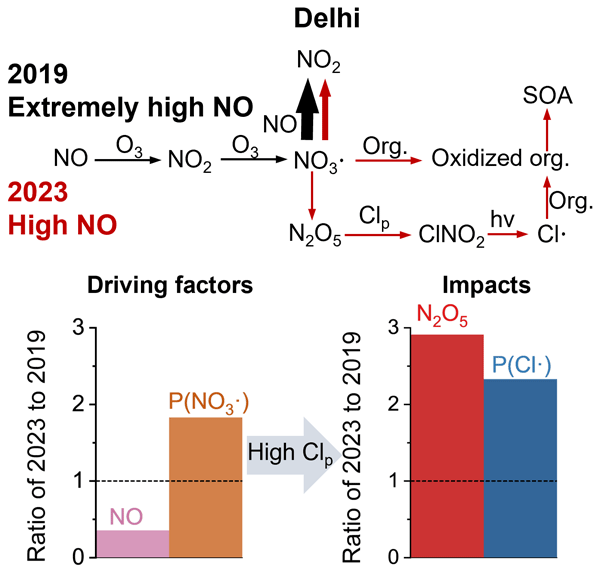
Nitryl chloride (ClNO2) is an important Cl• precursor, originating from the heterogeneous reactions of dinitrogen pentoxide (N2O5) on chloride-containing particles. This N2O5-ClNO2 chemical process plays critical roles in chloride activation, nitrate formation, and thus air pollution. Here we present field measurements made in the early springtime of 2023 in Delhi and compare with a previous study conducted during the winter of 2019. We found elevated nocturnal levels of N2O5 and ClNO2, averaging 13 and 80 ppt, respectively, which are approximately doubled compared to observations in 2019. This change is primarily driven by the reduced nighttime NO levels, from 124 ± 25 ppb in 2019 to 44 ± 9 ppb in 2023. In addition, the chloride concentration (nighttime average 4.7 µg m−3) in Delhi is among the highest reported globally, driving efficient conversion of N2O5to ClNO2. Decreased NO and elevated ClNO2 levels lead to higher NO3• and Cl• production that promote the oxidation of organics. Consistently, we observed increased fractions of gaseous nitrogen- and chlorine-containing organic products and a higher oxidation state of the organic aerosols. Our findings highlight the need for increased attention to atmospheric secondary pollution and stringent anthropogenic chlorine emissions control under reduced NOx conditions in Delhi.
- Article
(2958 KB) - Full-text XML
-
Supplement
(5028 KB) - BibTeX
- EndNote


Atmospheric N2O5-ClNO2 chemistry refers to the conversion of N2O5 to ClNO2 on chloride-containing particles (Finlayson-Pitts et al., 1989), which is ubiquitous worldwide (Wang et al., 2019) and exerts profound impacts on nitrogen budgets (Dentener and Crutzen, 1993), chloride activation (Thornton et al., 2010), and atmospheric oxidative capacity (Simpson et al., 2015; Yang et al., 2022). N2O5 is formed from the reaction between NO3• and NO2 (Reaction R1), and the heterogeneous reactions of N2O5 on atmospheric particles produce particulate nitrate and gaseous ClNO2 (Reactions R2–R5) (Bertram and Thornton, 2009; Finlayson-Pitts et al., 1989; Behnke et al., 1997; Thornton and Abbatt, 2005; Osthoff et al., 2008). The heterogeneous uptake of N2O5 on chloride containing particles is in general the main production mechanism of atmospheric ClNO2, which proceeds rapidly with the aqueous reaction between NO and Cl− (Reaction R5). Some studies (Dalton et al., 2023; Margerum et al., 1994) have shown that the aqueous reactions of NO and HONO with Cl2, HOCl and NH2Cl are potential sources of ClNO2, with a reaction rate constant about 3–4 orders of magnitude lower than the reaction between NO and Cl−. Other reactions such as HCl reacting with N2O5 on surfaces are not considered due to the relatively slow reaction rate constant (Raff et al., 2009).
ClNO2 is rather inert at night and undergoes negligible losses, while it photolyzes to produce Cl• during the daytime (Osthoff et al., 2008). Given the fast photolysis of NO3• and thermal decomposition of N2O5, the N2O5 to ClNO2 conversion is expected to happen mainly at night (Brown and Stutz, 2012). The occurrence of this nocturnal chemistry was confirmed by direct field observations of N2O5 and ClNO2 in the urban coastal air (Osthoff et al., 2008; Riedel et al., 2012), and later extended to polluted inland areas (Thornton et al., 2010; Phillips et al., 2012; Le Breton et al., 2018a; Ma et al., 2023; Chen et al., 2023), where abundant NOx and particulate chloride precursors co-exist, with measured nighttime peak mixing ratios consistently up to several parts per billion by volume (ppb), which are about an order of magnitude higher than those observed in the remote polar and marine regions (McNamara et al., 2019; Eger et al., 2019; Kercher et al., 2009).
Delhi is one of the world's most polluted megacities. Intense air pollutant emissions from transport, residential, industrial, and other sources provide abundant precursors (i.e., particulate chloride and NOx, Fig. S1a, b) for N2O5 and ClNO2 production. Previous studies in this region have mainly focused on measurements of chloride using AMS or ACSM (Fig. S2 and Table S1). Observations of gaseous chlorinated species (Mishra et al., 2024; Haslett et al., 2023) remain limited. Several recent modeling studies (Meidan et al., 2022; Soni et al., 2023; Patel et al., 2026) have indicated the potential for substantial ClNO2 production, resulting in concentrations up to several ppb in this region; however, the scarcity of field observations leaves these model predictions largely unvalidated, limiting our ability to quantify the impacts of chlorinated species on O3 and secondary aerosol formation.
The field measurement conducted in winter 2019 found that nighttime N2O5 and ClNO2 levels are rather low in Delhi (Haslett et al., 2023), which is attributed to the extremely high NO concentrations (hundreds of ppb) and the fast reaction rate constant between NO and NO3• (, 2.6 × 10⁻¹¹ cm3 molec.−1 s−1 at 298 K) (Burkholder et al., 2020), thereby largely quenching nocturnal NO3• (reaction scheme R1) and limiting subsequent N2O5 and ClNO2 production. Notably, the 2019 campaign predominantly captured the extremely polluted episodes during the wintertime in Delhi, with the peak occurrence frequencies of PM2.5 (185 µg m−3), NO (124 ppb) and chloride (21 µg m−3) concentrations largely falling at the high end of the concentration distributions commonly observed during the recent years (Fig. S3b, c, d). Due to the scarcity of field observations, the characteristics of N2O5-ClNO2 chemistry outside of such extreme NO and chloride conditions in Delhi remain unclear.
In this work, we present a recent field measurement of N2O5, ClNO2 and other relevant inorganic and organic species in both gas and particle-phases during the early springtime of 2023 in Delhi. This timing captures a broader range of NO concentrations (below 0.1 to hundreds of ppb) and chemical conditions, which overlaps with but extends beyond previous studies that primarily focused on the most polluted winter months. We characterize the changes in N2O5-ClNO2 chemistry relative to the previous observation in winter 2019 (Haslett et al., 2023) and examine the underlying driving factors and impacts. The field derived kinetic parameter, quantified as the product of N2O5 uptake coefficient () and ClNO2 yield (), is also estimated and compared to those reported from other atmospheric environments. We find enhanced N2O5 production driven by decreased NO concentrations, and the formation of ClNO2 is dependent on the chloride level in Delhi. The product of (average ∼ 0.02) is at the upper end of the values observed around the world, indicating efficient N2O5 conversion to ClNO2 in Delhi. We further investigate the impacts of associated increases in NO3• and Cl• production rates on the atmospheric oxidation of organics, utilizing concurrent measurements of a wide range of molecular-level organic oxidation products.
2.1 Field observation overview
The field campaign was performed at the Indian Institute of Technology Delhi campus (IIT Delhi, 28.54° N, 77.19° E; ∼ 230 m above the sea level) from 15 February to 14 March in 2023. The valid dataset collected during the early spring period (23 February–14 March) was used for analysis in this study. IIT Delhi is a representative continental urban site situated at the north-western of Indo-Gangetic Plain, which is frequently affected by intense anthropogenic emissions from biomass and waste burning activities, traffic exhaust, power plants, and industries (Kumar et al., 2022; Bryant et al., 2023; Kashyap et al., 2019; Rai et al., 2020), and potential biogenic emissions from the surrounding vegetations (Fig. S4). All the instruments were installed in an air-conditioned laboratory on the 8th floor, at a sampling height (∼ 30 m) above the local vegetation canopy, and thus the observation is representative of an urban background condition. In addition, considering the high aerosol loading and stable nighttime boundary layer (average nighttime wind speed of 0.6 m s−1) in Delhi, N2O5 or ClNO2 losses through dry deposition on building surfaces or vegetation are expected to be minor. There were no significant precipitation events during the periods selected for intensive chemical analysis. Consequently, wet deposition was not a significant factor in our nocturnal chemical budget and was omitted from the calculations. Details of the measurement design are found in the Supplement (Sect. S1).
-
FIGAERO-I−-CIMS. N2O5, reactive chlorines, and oxygenated organics were identified asiodide clusters (M• I−) by a Filter Inlet for Gases and AEROsols Iodide-Chemical Ionization-Time of Flight Mass Spectrometer (FIGAERO-I−-HR-ToF-CIMS, hereafter as CIMS) (Lopez-Hilfiker et al., 2014). Basic principles and configurations were described in previous field studies (Le Breton et al., 2018a, b). Each CIMS operation cycle consisted of background (∼2 min), ambient gas (∼ 16 min), a second background (∼ 2 min), and PM2.5 desorption measurements (∼ 50 min) (Fig. S5). The background signals were measured by periodically overflowing the inlet with ultrahigh purity N2 (Laser gases), and background subtractions were performed to minimize potential interference from contamination. The raw signals in counts per second (cps) were normalized by the sum of the reagent ions (I− + I• H2O−) and multiplied by 106. During the field campaign, ∼ 0.3 lpm perfluoropentanoic acid in N2 was injected into the CIMS (identified as C5HF9O2I−) every 1–2 d for mass calibration. The sensitivities of acetic acid, which was generated from a permeation source (permeation rate of 184.5 ng min−1 at 40 °C), was measured periodically on 27 February, 28 February, 5 March, 10 March, 12 March, and 14 March to track the instrument stability, which was 0.27 ± 0.05 cps ppt−1 with a variation of 17.7 %.
Calibrations of gaseous species were conducted after the campaign under RH conditions (IH2O− to I− ratio 0.42 ± 0.02) similar to those observed during the field measurement in Delhi (IH2O− to I− ratio 0.40 ± 0.08), with sensitivities of 7.5, 3.6, 0.013, 13.6, and 0.29 cps ppt−1 for N2O5, ClNO2, HCl, chloroacetic acid, and acetic acid, respectively. The sensitivity of acetic acid measured post-campaign (0.29 cps ppt−1) agreed well with the on-site calibration result (0.27 cps ppt−1), and therefore no additional scaling was applied for the on-site sensitivities of the detected species. Sensitivities for Cl2 (3.4 cps ppt−1), NCl3 (3.1 cps ppt−1), and NHCl2 (0.05 cps ppt−1) were estimated using their relative sensitivities to ClNO2 (Chen et al., 2025b). The detection limits were determined as three times the standard deviation of the hourly averaged background signals, which were 0.6 ppt for N2O5, 1.6 ppt for ClNO2, 0.6 ppt for Cl2, 22.6 ppt for NHCl2, 0.3 ppt for NCl3, 209.1 ppt for HCl, and 2.5 ppt for chloroacetic acid, respectively. For the remaining detected gaseous compounds, mainly oxygenated organics consisting of carbon, hydrogen, and oxygen (abbreviated as CHO) or carbon, hydrogen, oxygen, and nitrogen (abbreviated as CHON), the maximum value of the calibrated sensitivities (chloroacetic acid, 13.6 cps ppt−1) was used to derive conservative concentration estimates. For particulate compounds, the calibrated sensitivity of levoglucosan (2.2 × 10⁵ ions ng−1) was applied to obtain lower-limit estimates, as the detection of levoglucosan has recently been demonstrated to proceed at the collision limit (Aggarwal et al., 2025).
-
EDXRF. Ambient PM2.5 filter samples were collected for offline Energy Dispersive X-ray Fluorescence (EDXRF; SPECTRO-XEPOS, AMETEK Inc.) analysis. ED-XRF is a sensitive and non-destructive technique which requires negligible sample pre-treatment and has been widely used for measuring elements in ambient particles (Ogrizek et al., 2022; Unga et al., 2025). A total of 83 PM2.5 samples were collected at 3 lpm on polytetrafluoroethylene (PTFE) filters (25 mm in diameter of 0.4 µm) via a PM2.5 cyclone (Casella Solutions, UK) every 12 h from 22 to 28 February and every 4 h from 1 to 14 March. We increased the frequency of filter switches by the end of the campaign to capture the variations of Cl element concentrations within a night, i.e., before (19:00–23:00 all times are Indian Local Standard Time, UTC+05:30) and post (23:00–03:00) midnight. The mid-point of the measurement period, i.e., 1:00 indicates measurement from 23:00–03:00, 05:00 for 03:00–07:00, 09:00 for 07:00–11:00, 13:00 for 11:00–15:00, 17:00 for 15:00–19:00, and 21:00 for 19:00–23:00, was used as the representative timestamp for each filter sample. Four blank filters (without any air sampling) were collected during the daytime (07:00–19:00) on 5 and 11 March, and during nighttime (19:00–07:00) on 5 and 8 March. These blank filters underwent the same analytical procedures as the sample filters. The filter samples were directly analyzed by EDXRF without any pretreatment. Each sample was analyzed for approximately 22 min. The instrument measured 26 elements, i.e., Al, Si, P, S, Cl, K, Ca, Ti, V, Cr, Mn, Fe, Co, Ni, Cu, Zn, Ga, Ge, As, Se, Br, Sr, Ba, Ti, Pb and Bi, based on their characteristic fluorescence (150 to 600 eV). This manuscript reports the blank-subtracted concentrations of K and Cl.
The EDXRF instrument detects the total concentrations of elements in the collected filter samples, while the CIMS detects compounds that evaporate at temperatures up to 200 °C. Persistent signals of HCl• I− were observed from PM2.5 desorption during the CIMS measurement (Fig. S5), likely originating from the thermal decomposition of non-refractory chloride (e.g, NH4Cl). The trend of chloride measured by CIMS (pCl−-CIMS) largely followed that of the XRF-measured chloride (Cl-XRF) (r=0.70) (Fig. S6a). Since pCl−-CIMS was not calibrated, it was only used qualitatively to complement the average diurnal variations of Cl-XRF. Cl-XRF was used for further analysis throughout the manuscript.
-
Supporting measurements. Supporting measurements at IIT Delhi include trace gases O3 (ECOTECH Serinus 10), NO and NO2 (ECOTECH Serinus 40), SO2 (ECOTECH Serinus 50), and CO (ECOTECH Serinus 30) and meteorological parameters (T, RH, wind speed, and wind direction), which were measured by an automated weather station (AWS) (Davis Vantage Pro 2, Davis Instruments Corporation, USA). These concurrent online supporting measurements at IIT Delhi were used for key kinetic parameters calculations, such as P(NO3•) and NO3• reactivity, and the analysis of the CIMS data. Hourly PM2.5 concentrations and solar radiation data were obtained from the nearest national monitoring station, the R.K. Puram station operated by Delhi Pollution Control Committee (DPCC), which is located approximately 3 km northwest of IIT Delhi. Intercomparison of the trace gases, T, and RH measured at IIT Delhi and R.K. Puram showed overall good agreement (Fig. S6c). The solar radiation was converted to photolysis frequency (j) of NO2 () utilizing the method from Trebs et al (Trebs et al., 2009). The estimated was then used to derive real-time photolysis frequency of NO3•, O3 and reactive chlorines (Chen et al., 2025b). Additional details about the field observations are shown in Sect. S1.
Comparison with the measurements in 2019 (Haslett et al., 2023) was used to investigate the evolution of N2O5-ClNO2 chemistry under different chemical regimes (e.g., NO and chloride concentrations) in Delhi. It is noted that throughout the manuscript, “in 2023” and “in 2019” refer to the corresponding field campaigns conducted from 23 February to 14 March in 2023 (this study) and from 11 January to 5 February in 2019 (the previous campaign), respectively.
2.1.1 Kinetic calculations
-
N2O5-ClNO2 chemistry. Key kinetic parameters were derived to investigate factors controlling the variations of N2O5 and ClNO2 and compare with previous studies. The field-constrained uptake parameter, defined as the product () of the N2O5 uptake coefficient () and ClNO2 yield (), as is shown in Eq. (1), was calculated hourly using neighboring measurements during the nighttime following Eq. (3b) in Mielke et al. (2013) (Eq. 1), assuming the local heterogeneous uptake of N2O5 was the sole source of the measured ClNO2 and that ClNO2 experienced negligible nocturnal losses.
where is the average molecular velocity of N2O5, m s−1; T is temperature in Kelvin; k is Boltzmann's constant, 1.38 × 10⁻²³ m2 kg s−2 K−1; m is the molecular weight of N2O5, kg, which is calculated as the molar mass of N2O5 (kg mol−1) divided by the Avogadro's number (mol−1); Sa is aerosol surface area, m2 m−3, which is not directly measured but inferred from PM2.5 data. Based on the linear correlation between PM2.5 and Sa observed by Gani et al. (2020) from February to March 2018, we used PM2.5 concentrations from our 2023 campaign to derive the corresponding Sa values (Fig. S6b, r=0.78). This estimation of Sa using PM2.5 has also been employed and validated in other studies (Meidan et al., 2022; Zhang et al., 2025); t0 is the current time point, t1 is the subsequent time point, and dt is the time interval (in seconds) between them.
The theoretical values of the uptake parameter () range from 0 to 0.1, as the maximum values of and are generally below 0.1 and 1, respectively (Tham et al., 2018). However, nocturnal transport, i.e., changes in air masses, can invalidate this method and yield values exceeding 0.1 (sharp increases in ClNO2, occurrence frequency of ∼ 17 %) which were discussed separately (Sect. 3.2).
The production rate (P(NO3)) and reactivity (R(NO3)) of NO3• were calculated to evaluate N2O5 budgets, which are shown in Eqs. (3) and (4), respectively. The ClNO2 production efficiency (ϵ(ClNO2), Eq. 5), indicating the fraction of the total generated NO3• overnight that is ultimately transformed into ClNO2, was calculated for comparison with previous studies (Eger et al., 2019; Xia et al., 2025). The integration period was set from 20:00 to 04:00 to minimize influences of potential air mass mixing during the day-night and night-day transition periods.
where cm3 molec.−1 s−1 and cm3 molec.−1 s−1 (Burkholder et al., 2020); jNO3 is the photolysis frequency of NO3• and is retrieved from the Tropospheric Ultraviolet and Visible (TUV) radiation model and scaled with the field constrained j as discussed previously; khete is the first-order heterogeneous loss rate coefficient of N2O5, where ; was parametrized using Eq. (6) according to the experimental measurements of N2O5 uptake on aqueous organic aerosols (Evans and Jacob, 2005; Thornton et al., 2003). This parameterization method was supported by the consistency between the simulated nocturnal ClNO2 variations using the RH-parameterized and the observed ClNO2 levels, as detailed in Sect. S2; Keq is the equilibrium constant between NO3•, NO2, and N2O5, where (Wängberg et al., 1997). ∑ki[VOCi] is the sum of NO3• reactivity with different VOCs and we applied the same value of 0.081 s−1 in 2023 as in 2019 (Haslett et al., 2023) due to the lack of concurrent VOCs measurements in 2023. As shown in Fig. S7a and Table S2, the campaign-averaged NO3• reactivity to NO in 2023 is ∼ 15.6 s−1, which is approximately 2 orders of magnitude higher than the reactivity to VOCs and the heterogeneous loss of NO3• from N2O5 uptake (0.091 s−1). Limited field measurements in Mohali (Meidan et al., 2022) and Delhi (Wang et al., 2020; Mishra et al., 2024) showed that the total VOC concentrations exhibit inter-annual and seasonal variations ranging from a factor of less than two to approximately four. In this context, though we don't expect that the lack of concurrent VOCs observations would significantly influence the estimated total NO3• reactivity during the 2023 campaign, which is likely dominated by reactions with NO, it should be emphasized that the exact value of NO3• reactivity towards VOCs may deviate from the assumed value (0.081 s−1 on average). This uncertainty stems from the temporal and spatial changes in VOC speciation, concentration and reactivity. Long-term and dense VOCs measurements will help to better quantify NO3• reactivity in Delhi.
-
Production rates of Cl• and OH• radicals. The Cl• production rate (P(Cl•)) is calculated according to Eq. (7). For the 2023 campaign, we calculated P(Cl•) both from ClNO2 photolysis and from all the detected photolabile reactive chlorines. A direct comparison between 2019 and 2023 was conducted using P(Cl•) from ClNO2 photolysis. In 2019, only ClNO2 photolysis was considered as a source of Cl•, since mixing ratios of other reactive chlorines were not reported in the previous study (Haslett et al., 2023). Additionally, we estimated a lower-limit OH• production rate (P(OH•)) in Delhi from the photolysis of O3 in the presence of water vapor (Eq. 8) (Dunlea and Ravishankara, 2004).
where is the photolysis frequency of O3, , , and (Burkholder et al., 2020).
3.1 Characteristics of N2O5 and ClNO2 variations
We observed pronounced nocturnal enrichment of N2O5 and ClNO2 in 2023 (Fig. 1a, b). N2O5 and ClNO2 up to 566 and 1340 ppt were measured during the nighttime, with mixing ratios frequently exceeding 10 and 100 ppt, respectively (Fig. S8). Overall, the nighttime N2O5 and ClNO2 mixing ratios in 2023, with an average of 13.1 and 80.1 ppt, respectively, are significantly (Mann-Whitney test, p< 0.01) higher than those measured in 2019 (4.5 and 36.3 ppt, respectively) (Fig. 1a, b).
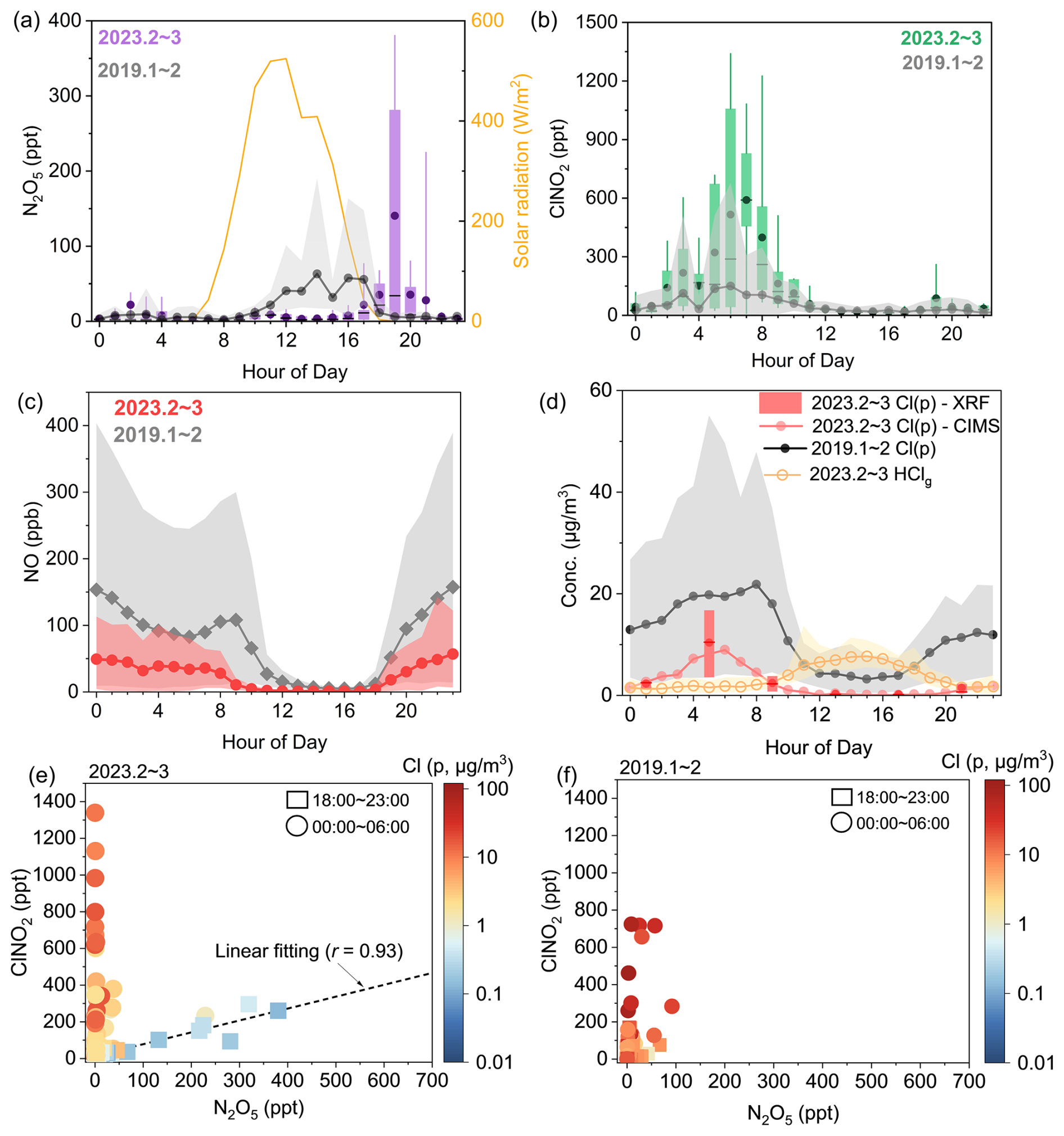
Figure 1Field characterization of N2O5 and ClNO2 in Delhi. Campaign-averaged diurnal variations of (a) N2O5, (b) ClNO2, (c) NO, and (d) particulate Cl and gaseous HCl. Scatter plots of N2O5 versus ClNO2 mixing ratios in (e) 2023 and (f) 2019, color-coded by the particulate Cl concentrations. The observation (Haslett et al., 2023) in 2019 is included for comparison, where the gaseous HCl measurements are not available. The right axis in (a) indicates solar radiation during the campaign in 2023. The exact sunrise (07:07–07:15) time in 2019 is about 30 min later than that in 2023 (06:55–06:32), while the sunset time in 2019 (17:24–18:03) is about 30 min earlier according to the records from timeanddate website. Gaseous HCl and particulate Cl measured by CIMS are also shown in (d). The upper and lower edge of the box and whisker in (a), (b) and (d) represent the 25th and 75th, and 10th and 90th percentiles, respectively. The dots and squares denote mean values and the lines inside the boxes indicate median levels. The shaded area in (a)–(d) indicates the 10th and 90th percentile range.
As shown in Table S3, the maximum N2O5 mixing ratio in Delhi is a third to half of those observed in urban areas of the United States (Thornton et al., 2010; Osthoff et al., 2008) and England (Bannan et al., 2015), and approximately an order of magnitude lower than those measured in aged air plumes from industrial regions in China (Chen et al., 2023; Wang et al., 2016; Ye et al., 2021). By contrast, the peak ClNO2 level in Delhi is much higher than those reported in urban regions of the North America (Thornton et al., 2010; McNamara et al., 2020; Wang et al., 2023a) and Europe (Bannan et al., 2015; Phillips et al., 2012; Priestley et al., 2018), and similar to or 1–2 times lower than those observed in the North China Plain (Tham et al., 2016; Xia et al., 2021; Peng et al., 2021; Chen et al., 2025a). The observed pattern of low N2O5 and high ClNO2 indicates efficient conversion of N2O5 to ClNO2 in Delhi.
We further examined N2O5 and ClNO2 variations every night and classified them into the enhanced and non-enhanced cases (Figs. S9 and S10). Among the enhanced cases, elevated N2O5 mixing ratios exceeding 10 ppt were characterized by both relatively low NO (median 3 ppb) and particulate Cl (median 0.7 µg m−3) concentrations, and appreciable ClNO2 levels larger than 100 ppt were observed under moderate NO (median 7 ppb) and high particulate Cl (median 3.3 µg m−3) conditions (Fig. S9). No notable N2O5 or ClNO2 mixing ratios were measured among the non-enhanced cases when NO levels were relatively high (median 31 ppb) (Fig. S10). The occurrence frequency of the enhanced cases (11 out of total 19 nights) is higher than the non-enhanced (8 nights) cases.
The measured N2O5 generally presents transient, spike-like patterns in 2023 (Fig. S8), peaking around the early evening (18:00–20:00) when both NO and particulate Cl are relatively low, and tapering off as the night proceeds (Fig. 1a, c–d). In comparison, the ClNO2 mixing ratio gradually built up after midnight with the increase of particulate Cl, reaching the highest level during the early morning hours (06:00–08:00, Fig. 1b, d). Overall, the nocturnal N2O5 mixing ratio shows a significant negative dependency (, p< 0.01) on the NO concentration (Fig. 2a), and high ClNO2 levels were accompanied by abundant chloride (Fig. S11a), indicating the critical roles of NO and chloride in controlling N2O5 and ClNO2 formation in Delhi.
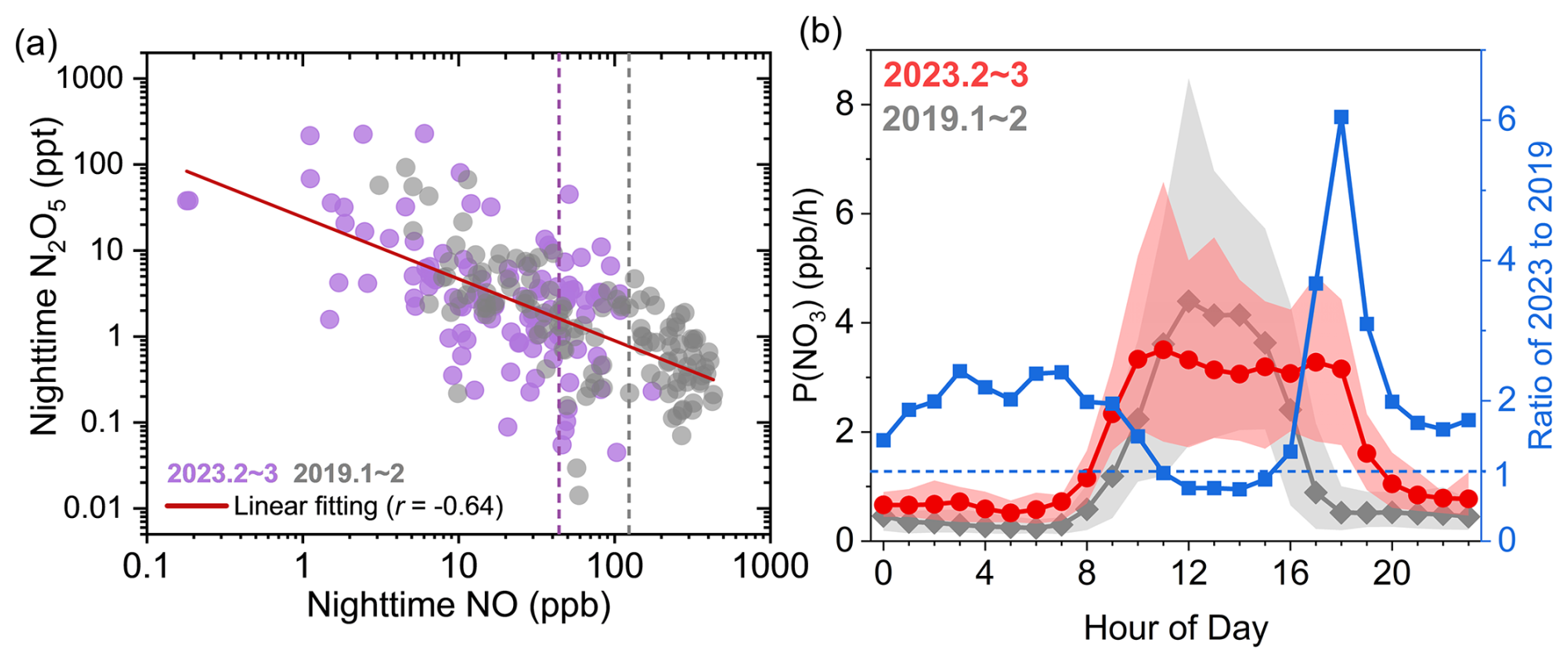
Figure 2Factors contributing to nocturnal N2O5 enhancement. (a) Scatter plot of nighttime NO versus N2O5. Nighttime is defined as the period from 20:00 to 04:00, excluding the transition period between day and night when the air mass was unstable. The purple and grey dashed lines indicate the average NO concentrations during the 2023 and 2019 campaign, respectively. (b) Campaign-averaged diurnal variations of P(NO3) in 2023 and 2019, respectively. The right axis in (b) displays the 2023-to-2019 ratio of P(NO3). The dots and squares denote mean values and the shaded area indicates the 10th and 90th percentile range.
The nocturnal mean ClNO2 production efficiency (ϵ(ClNO2)) also increases from 3.0 % in 2019 to 4.3 % in 2023, which is comparable to the values reported in marine and coastal areas (Eger et al., 2019; Xia et al., 2025). In addition, the diurnal profile of N2O5 in 2023 was inverted compared to 2019, with higher levels in the early evening rather than during the daytime (Fig. 1a). Consistently, distinct diurnal variations of N2O5 were also observed under relatively low- and high-NO conditions in 2023 (Fig. S12). The emerging early evening peak of N2O5 leads to a new N2O5-driven ClNO2 enhancement pattern in 2023 (the dashed linear fitting line in Fig. 1e), characterized by a strong positive correlation (r=0.93) between N2O5 and ClNO2 under conditions of elevated N2O5 (10–400 ppt) and limited chloride (0.1–3.4 µg m−3). This pattern resembles those observed in other continental air masses (Thornton et al., 2010; Bannan et al., 2015; Zhou et al., 2018), while the ClNO2 to N2O5 ratios are slightly higher in Delhi, ranging from 0.3 to 3.2, with an average of 1.2. Notably, despite the substantial decline in particulate Cl from 2019 (20.8 µg m−3) to 2023 (4.7 µg m−3), the higher ClNO2 levels in 2023 indicate that the promoting effect of elevated N2O5 potentially outcompetes the limiting impact of reduced chloride. Additionally, the estimated ClNO2 yield is around unity in Delhi (Fig. S13a).
3.2 Influencing factors of N2O5-ClNO2 chemistry
Decreased NO concentrations in 2023 relative to 2019 reduce NO3• losses to reactions with NO, resulting in elevated nocturnal N2O5 levels. The reaction with NO dominated NO3• losses both in 2019 and 2023 (∼ 99 %, Table S2 and Fig. S7a), contributing to the low abundances and short-lived occurrences of N2O5 in Delhi (Haslett et al., 2023). The strong anti-correlation between nocturnal N2O5 and NO persists in 2023, where the N2O5 mixing ratios overlap with those in 2019 when NO concentrations are within the same range (approximately 2–100 ppb) (Fig. 2a). However, in 2023, the frequency of relatively low-NO conditions (< 2 ppb) rose from 0 % to 8 % and extreme NO levels (> 100 ppb) nearly disappeared, indicating that NO titration in suppressing N2O5 production has diminished (Fig. 2a). With the decline in NO concentrations from 2019 (nighttime averages 124 ± 25 ppb) to 2023 (44 ± 9 ppb) (Fig. 1c), the nighttime average NO3• reactivity towards NO dropped by ∼ 66 % from 83.7 to 28.4 s−1, extending NO3• lifetimes approximately two folds during the nighttime in 2023 (0.04 s). The reduced NO3• losses to NO increased the availability of NO3• for reacting with NO2, thereby enhancing N2O5 production. Additionally, no significant correlation between chloride and ClNO2 was observed in 2019, likely because the chloride increases were accompanied by a substantial elevation in NO, which suppressed N2O5 formation (Fig. S11b).
Higher NO3• production rates (P(NO3)) enhance N2O5 formation. Due to the increases in nocturnal O3 levels (from 3.5 to 6.8 ppb) and the reaction rate constant between NO2 and O3 (from 2.36 × 10⁻¹⁷ to 2.93 × 10⁻¹⁷ cm3 molec.−1 s−1), the average nocturnal P(NO3) in 2023 almost doubled (0.75 ppb h−1) compared to 2019 (0.41 ppb h−1) (Fig. 2b). The observed (P(NO3)) in Delhi 2023 exceeds those reported in the United States (Wang et al., 2023b; Noxon et al., 1980) and Europe (Ljungström and Hallquist, 1996; Wang et al., 2023b), and 1–2 times lower than those observed in China (Wang et al., 2024; Yan et al., 2021; Chen et al., 2023). Consistently, N2O5 mixing ratios in 2023 peak after sunset around 18:00–19:00 (Fig. 1a), coinciding with the period of elevated P(NO3) (Fig. 2b) and relatively low NO levels (Fig. 1c). Other factors, such as the decreased aerosol surface area (2637 ± 152 and 1411 ± 162 µm2 cm−3 in 2019 and 2023, respectively) results in reduced first-order heterogenous loss rate coefficient of N2O5 (khete) from 0.74 ± 0.09 s−1 in 2019 to 0.14 ± 0.02 s−1 in 2023, which also contributes to the elevated nocturnal N2O5 mixing ratios observed in 2023. Overall, the enhanced NO3• production and reduced losses to NO led to elevated NO3• and N2O5 levels in 2023, aligning with the higher estimated steady-state NO3• mixing ratios (0.25 ppt vs. 0.03 ppt in 2019) (Fig. S7b).
As is shown in Fig. S1c, NOx emissions in Delhi almost doubled in recent years, mainly driven by the increase in the number of vehicles (Beig, 2010, 2018; Sahu et al., 2023). The observed decrease in NO concentrations during the 2023 campaign is therefore not driven by the changes in emissions. Notably, the 2019 and 2023 measurements were conducted in different seasons, i.e., January to early February (winter) in 2019 and late February to mid-March (early spring) in 2023. As is shown in Fig. S14, elevated O3 concentrations were observed in spring compared to winter, which facilitates the removal and decrease of NO and P(NO3). Overall, the seasonal variability in NO concentrations is the main driver of the differences in NO and P(NO3) observed between the two campaigns.
High chloride concentrations promote N2O5 uptake and ClNO2 production in Delhi. The field-derived uptake parameter (γ × f) in Delhi is similar to those observed in marine air (∼ 0.02 on average) (Eger et al., 2019) and several times to an order of magnitude higher than those reported in other continental regions (6 × 10⁻⁴–8 × 10⁻³) (Xia et al., 2021; Tham et al., 2018; Xia et al., 2020; Mielke et al., 2013). As is shown in Fig. 3a, this parameter increases with the chloride level in Delhi, reflecting the combined effects of chloride in promoting N2O5 uptake and ClNO2 yield observed in prior laboratory studies (Bertram and Thornton, 2009; Jahl et al., 2021). By contrast, despite comparable high chloride was observed in Wangdu (Xia et al., 2021) (upper triangle in Fig. 3b), both the uptake parameter (∼ 6 × 10⁻⁴ on average) and the nocturnal ClNO2 level (typically < 50 ppt) are significantly lower than those measured in Delhi. This is likely due to the lower ambient water content (∼ 0.4 %) compared to Delhi (∼ 1.5 %), which limits aerosol liquid water content and thereby suppresses N2O5 hydrolysis on particles (Xia et al., 2021; Tham et al., 2018).
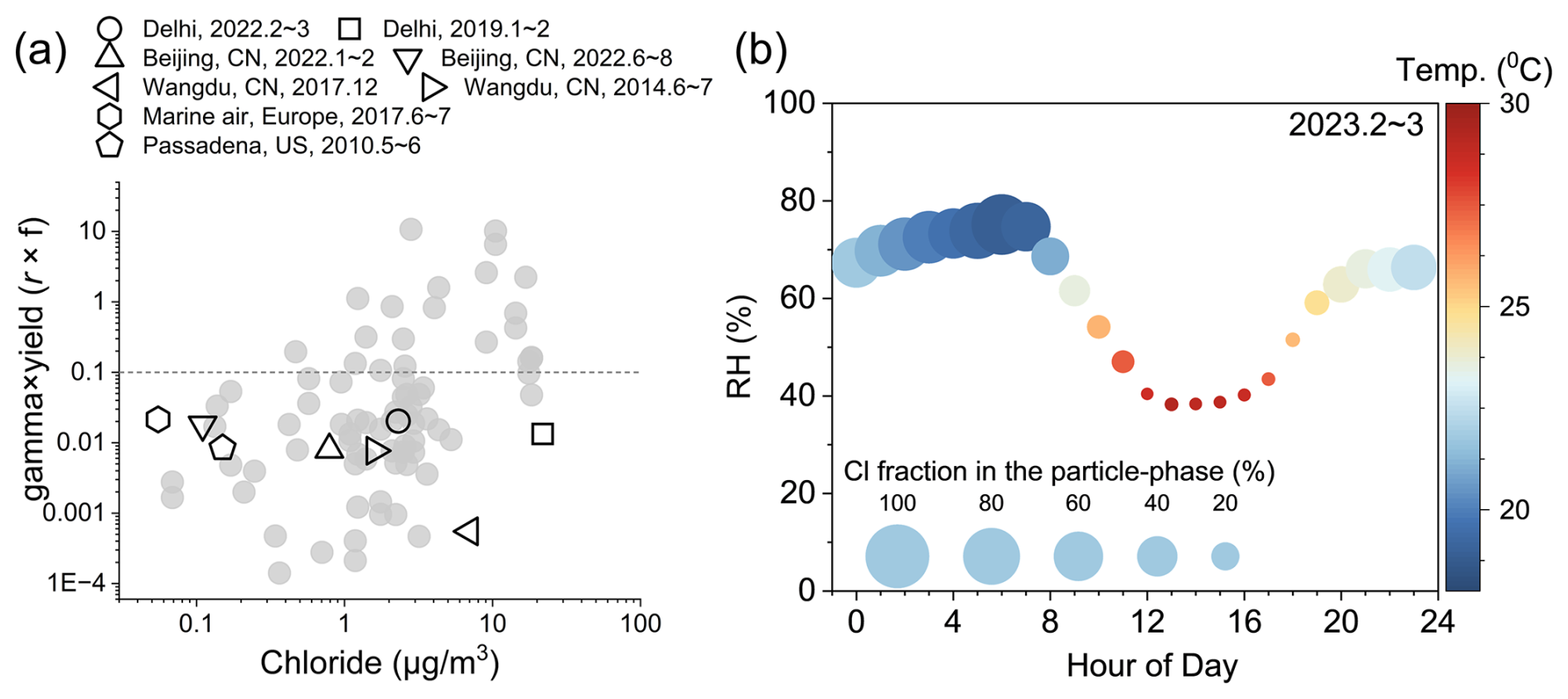
Figure 3Factors contributing to nocturnal ClNO2 enhancement in Delhi. (a) Dependence of the field-observed uptake parameter (γ×f) on particulate Cl concentrations in 2023. The campaign-average value for 2023 (excluding unusually high values of ) is shown as an open circle. The values derived from previous observations in Delhi 2019 (Haslett et al., 2023), Beijing (Chen et al., 2025b), Wangdu (Xia et al., 2021; Tham et al., 2018), Pasadena (Mielke et al., 2013), and marine air in Europe (Eger et al., 2019) are shown as different markers. The reference line of γ×f equals to 0.1 is also plotted. (b) Campaign-averaged diurnal variation of RH in 2023, color-coded by ambient temperature. The size of the datapoints is proportional to the observed Cl fraction in the particle-phase, which is calculated as Clp (Clp + HClg).
The high chloride in Delhi is largely in the form of semi-volatile NH4Cl, originating from gas to particle partitioning. We observed a concurrent late-evening enrichment of non-refractory chloride measured by CIMS and Cl element measured by XRF (Fig. 1d), indicating the semi-volatile nature of particulate Cl (i.e., NH4Cl) in Delhi. Additionally, direct measurements of both HCl and particulate Cl enabled us to examine the gas–particle partitioning behavior of Cl. As shown in Fig. 3b, the particle-phase Cl fraction amounted to up to 89 % on average at 06:00 whereas it remained below 20 % in the afternoon (12:00–18:00). This diurnal variation is attributed to lower temperatures (15–25 °C) and higher RH (56 %–92 %) in the early morning hours, which favored the co-condensation of HCl and water vapor into particles as NH4Cl under the NH3-rich conditions commonly found in Delhi (Acharja et al., 2023; Gunthe et al., 2021). A recent study suggests that increasing RH promotes the migration of chloride from the particle bulk phase to the gas-particle interface (Fauré et al., 2024). This phenomenon helps explain the observed post-midnight accumulation of ClNO2 and consistently low N2O5 levels in Delhi, which are attributed to enhanced heterogeneous conversion of N2O5 to ClNO2 on aerosol surfaces. The observed thermodynamically-driven partitioning behavior of Cl agrees with previous model simulations (Gunthe et al., 2021; Chen et al., 2022b).
ClNO2 levels in Delhi were influenced by the transport of ClNO2-laden biomass burning plumes from upwind regions, and vertical intrusion initiated by the breakup of the residual layer during the early morning (06:00–08:00). We observed some cases with unusually high γ×f values exceeding 0.1, implying additional ClNO2 sources beyond the local N2O5 uptake. Most of the high values were found during episodes of easterly (50–130°) winds with elevated particulate Cl concentrations (Fig. 4a), when the air masses passed over biomass-burning hotspots (Fig. S15). This suggests substantial ClNO2 production on high chloride containing biomass burning aerosols, as observed in previous laboratory experiments (Ahern et al., 2018;Jahl et al., 2021). A typical case is shown in Fig. S16, where ClNO2 abruptly increases concurrently with the sharp rise in particulate Cl, biomass-burning tracers (K and HCN), and easterly wind speeds. Additionally, a continued rise in ClNO2 was observed after sunrise (06:00–08:00; Figs. 1b and S16), likely due to the downward mixing of ClNO2-rich air masses aloft, as reported in previous studies (Tham et al., 2016; Haslett et al., 2023).
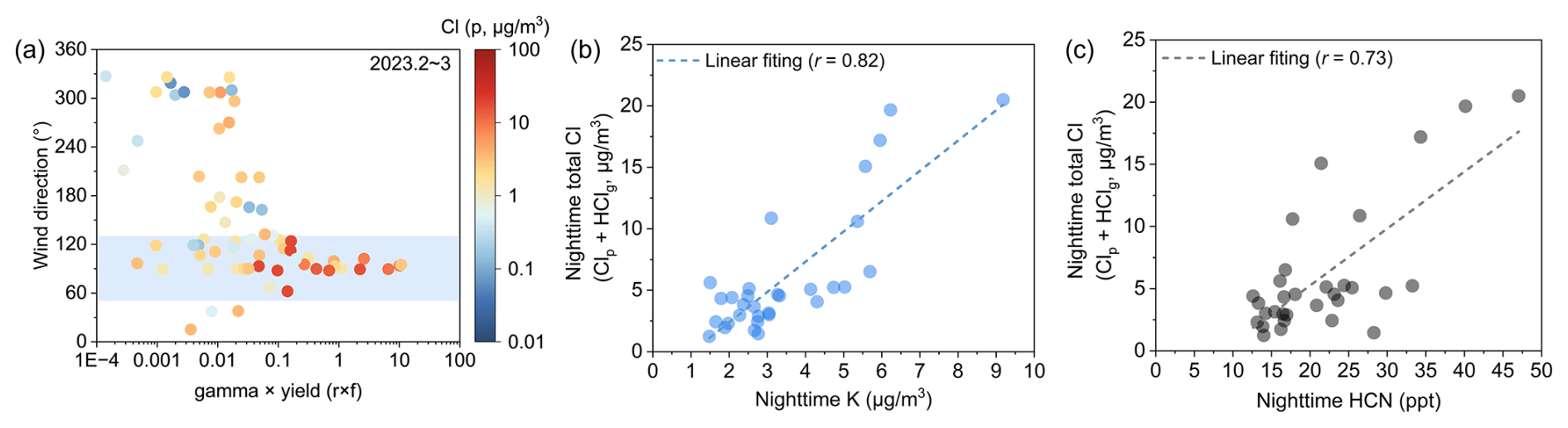
Figure 4Potential sources of chlorine in Delhi. (a) Scatter plot of uptake parameter (γ×f) and wind direction color-coded by particulate Cl concentrations. The shaded area in (a) indicates the region with wind direction ranging from 50 to 130°. Correlation of nocturnal total Cl (sum of Clp and HClg) with (b) particulate K and (c) gaseous HCN. The reported HCN mixing ratio can be considered a lower-limit estimate (see Sect. 2.1).
Delhi is an inland city located roughly 1000 km away from the nearest coastlines. Significant chlorine emissions from natural sea salt aerosols are not expected. The high chloride levels observed in Delhi point to intense chlorine emissions from anthropogenic sources. The nighttime Cl strongly correlates with K (r = 0.82) and HCN (r = 0.73) (Fig. 4b–c and Fig. S17), indicating significant Cl emissions from biomass burning in Delhi. The ambient nighttime Cl to K ratio (1.6 ± 0.8) in Delhi is about three-fold higher (0.4 ± 0.2) than those measured from biomass/biofuel emission sources (Table S4), indicating additional sources of Cl potentially from plastic-contained garbage burning, industrial processes, and coal combustion (Gunthe et al., 2021). Consistently, we observed a moderate correlation between Cl and and the coal combustion tracer SO2 (r=0.51). In contrast, the poor correlation of Cl with NO () and CO () indicated limited contributions from vehicle exhaust, consistent with their low Cl emission factors (Table S4).
Since the above discussions are built on two short-term campaigns, we further assess the prevalence of N2O5 and ClNO2 production in Delhi based on the long-term distributions of the identified influencing factors, i.e., NO, P(NO3), and chloride (Fig. S3). The occurrence distribution of nighttime NO and P(NO3) during the 2023 campaign largely overlapped with the conditions commonly occurred in Delhi (Fig. S3a–b), indicating comparable N2O5 production potential throughout the years in Delhi. In addition, the occurrence frequency distribution of chloride in 2023 campaign is comparable to that observed from January to April of 2022 and much higher than those reported from May to September (Fig. S3c). The seasonal variation of chloride reflects the temperature-driven evaporation of semi-volatile NH4Cl as discussed previously. Given the critical role of chloride in promoting N2O5 uptake and driving ClNO2 production in Delhi, these results suggest that elevated nighttime N2O5 and ClNO2 levels are most likely observed during the warm and cold seasons, respectively, in Delhi.
3.3 Impacts on atmospheric radical production and VOCs oxidation
Enhanced N2O5-ClNO2 chemistry at lower NO levels emphasizes the important roles of Cl• and NO3• in initiating the oxidation of VOCs in Delhi. The average daytime P(Cl•) from ClNO2 photolysis in 2023 (0.035 ppb h−1) is approximately twice that observed in 2019 (0.015 ppb h−1). The maximum daytime-averaged P(Cl•) (0.24 ppb h−1) from the photolysis of all the detected Cl• precursors (Cl2, ClNO2, NHCl2, and NCl3) is up to an order of magnitude higher than values reported for the urban inland areas of Europe and North America (0.02–0.07 ppb h−1) (Priestley et al., 2018; McNamara et al., 2020; Faxon et al., 2015), and remains several times lower than those observed during the pollution episodes in China (0.5–1.1 ppb h−1) (Chen et al., 2023; Tham et al., 2016; Liu et al., 2017). ClNO2 photolysis dominates the production of Cl• around the sunrise hours (07:00–08:00) when the P(Cl•)totalto P(OH) ratio (42 on average) was also the highest (Fig. 5a), suggesting non-negligible Cl-initiated oxidation of VOCs under these conditions in Delhi.
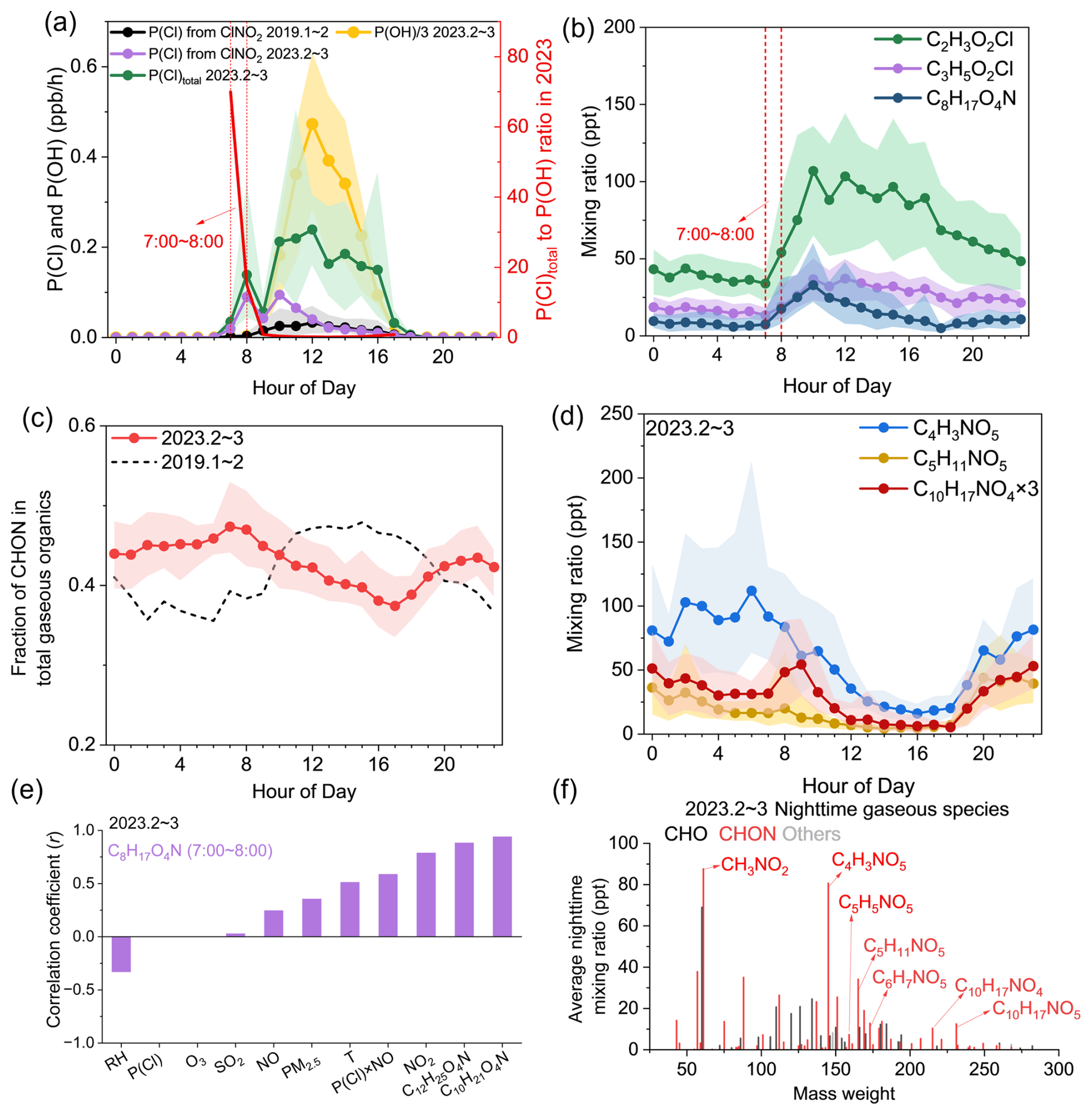
Figure 5Enhanced daytime Cl• and nocturnal NO3• initiated oxidation of organics in Delhi. (a) P(Cl) in 2023 and 2019, and P(OH) from the photolysis of O3 in 2023. The P(Cl)total 2023 includes Cl• production from the sum of ClNO2, Cl2, NHCl2, and NCl3 photolysis. The P(Cl)total to P(OH) ratio in 2023 is shown in the right axis. The value of P(OH) is divided by a factor of 3 to place it on the same scale as P(Cl). Average diurnal variations of tracer compounds indicating (b) Cl• and (d) NO3• initiated oxidation, respectively. (c) Comparison of the diurnal variations of CHON compounds fraction in total detected gaseous organics in 2019 and 2023. (e) Correlation coefficients, using observations between 07:00 and 08:00 of C8H17NO4 with P(Cl)total, meteorological parameters, trace gases, and related homologue species. (f) Molecular composition and average nighttime mixing ratios for the nighttime gaseous species. The shaded area in (a)–(d) indicates the 10th and 90th percentiles and the dots denote mean values.
Consistently, we observed specific gaseous organic oxidation products indicative of the prevalence of chlorine chemistry (Fig. 5b). We identified organochlorinated species, i.e., C2H3O2Cl and C3H5O2Cl (presumably chloroacetic acid and chloropropionic acid), which were previously measured in chamber experiments from Cl• reacting with ethylbenzene (Jahn et al., 2024) and isoprene (Wang et al., 2022) and used as markers for the occurrence of chlorine chemistry in field studies (Priestley et al., 2018; Li et al., 2025). The daytime concentration fraction of C2H3O2Cl in the total measured gaseous organics increases from ∼ 0.9 % in 2019 to ∼ 1.8 % in 2023. Additionally, the daytime average peak mixing ratio of C2H3O2Cl (∼ 100 ppt) in 2023 is about 5–30 times higher than those measured in Hong Kong (12–20 ppt) (Li et al., 2025) and Manchester (∼ 3 ppt) (Priestley et al., 2018), indicating significant C2H3ClO2 production in Delhi. We also identified a series of hydroxynitrates (HN) homologues, i.e., C8H17O4N, C10H21O4N, and C12H25O4N, which were potentially early-generation products from the chlorine-initiated oxidation of C-alkanes under high NOx conditions (Wang and Hildebrandt Ruiz, 2018). Here their sharp increase in the early morning hours (07:00–08:00) when Cl⋅ was likely the dominant atmospheric oxidant (Fig. 5a–b), together with the positive correlations between these HN and the product of P(Cl) and NO (r07:00–08:00=0.59, Fig. 5e), underscores the Cl• initiated alkane oxidation in the presence of NO as an important source of HN in Delhi. It is noted that these HN can also be formed via OH-initiated oxidation processes (Lim and Ziemann, 2009), but would then likely peak later in the day when OH concentrations are higher. Here, a quantitative comparison between the Cl- and OH-initiated reaction pathways is missing in the current study due to the lack of VOCs precursor measurements and needs further investigation.
The NO3-initiated nocturnal oxidation of VOCs was strengthened during the 2023 campaign. The fraction of nitrogen-containing organics (CHON) in the total measured gaseous oxygenated organic compounds in 2023 (∼ 46 %) was similar to that observed in 2019 (42 %). However, the diurnal pattern of the CHON fraction was inversed, exhibiting a moderate increase (∼ 9 %) during the nighttime (Fig. 5c), which resembles those found in other locations (Ye et al., 2021; Huang et al., 2019), indicating enhanced nocturnal NO3-driven organic oxidation in 2023. We further identified the nighttime gaseous organic species with the criteria of average nighttime (20:00–04:00) to daytime (07:00–16:00) mixing ratio larger than 1. Most of the nighttime species are nitrogen-containing compounds, primarily including CHO5N and C10H17O4,5N (Fig. 5f), which are typical first-generation oxidation products from NO3-induced oxidation of heterocyclics (i.e., furan, methylfuran, and dimethylfuran) (Chen et al., 2022a; Joo et al., 2019; Jiang et al., 2020) and monoterpenes (Jenks et al., 2023; Ayres et al., 2015), respectively. These oxidation products exhibited strong intra-group correlations (r20:00–04:00=0.71 to 0.77), whereas the correlations between the CHO5N and C10H17O4−5N groups were weak (r20:00–04:00< 0.2), confirming their production from distinct precursors. Moreover, their low correlations with CO and NO (r20:00–04:00 < 0.4) largely exclude direct combustion emissions as the dominant source. Notably, observations of furan-derived NO3• oxidation products have currently been limited to laboratory studies (Chen et al., 2022a; Joo et al., 2019; Jiang et al., 2020). Our findings offer direct field evidence of NO3-initiated furan oxidation in the atmosphere.
Another prominent nighttime compound potentially associated with NO3• induced oxidation is C5H11NO5 (Fig. 5f), which exhibited the largest nocturnal enhancement among all the observed species, increasing by a factor of 3.6. C5H11NO5 correlates well with C10H17O5N (r20:00–04:00=0.71) and shows a marked increase between 18:00 and 19:00 (Fig. 5d), coinciding with the peak of the estimated NO3• levels (∼ 2.3 ppt) (Fig. S7b). It is thus likely a co-product from the reaction of NO3• with monoterpenes. However, this compound has not been reported from any NO3• -initiated oxidation processes (Jenks et al., 2023; Ayres et al., 2015; Xu et al., 2025). Further investigation is required to elucidate the formation mechanisms of C5H11NO5 in Delhi's atmosphere.
In addition to the specific organic products discussed above, the overall oxidation state of the measured organic aerosols (OA) is elevated in 2023 compared to 2019. The bulk oxygen-to-carbon (O C) ratio of OA (0.76 on average) was higher than the value (0.66) reported in the 2019 campaign (Huang et al., 2024), indicating an increased contribution from more oxidized or aged secondary organic aerosols (SOA) (Jimenez et al., 2009). A clear negative dependence of the O C ratio on NO was observed at night when NO exceeded about 10 ppb (Fig. S18), agreeing with the suppression effect of NO on organic oxidation by increasing the competitive RO2+NO channel under the radical-limited regime commonly found in Delhi (Nelson et al., 2021; Kenagy et al., 2024). Taken together, the characteristics of the bulk organics provide additional field evidence for the enhanced atmospheric organics oxidation in 2023.
This study characterized N2O5-ClNO2 chemistry in Delhi. We observed a clear dependency on available nocturnal NO that high NO suppresses N2O5 production and reduces the formation of ClNO2 while decreased NO promotes nocturnal N2O5-ClNO2 chemistry. The former pattern is consistent with the previously reported significant NO suppression in 2019 (Haslett et al., 2023). With moderate NO in 2023, substantial ClNO2 is produced after midnight hours in Delhi, which is driven by the elevated RH and chloride levels that promote efficient conversion of N2O5 to ClNO2. The abundance of chloride strongly correlates with the biomass burning tracers, indicating emissions from biomass burning as an important source of Cl in Delhi. The increased ClNO2 levels at lower nocturnal NO conditions implies that the atmospheric oxidation of organics is amplified both during the nighttime (via NO3• pathways) and daytime (via Cl• pathways) in Delhi.
The differing behaviors of N2O5 and ClNO2 depending on the levels of nocturnal NO emphasize the need for continuous monitoring of air pollutants in Delhi, which is essential to understand the evolution of emission sources and atmospheric chemical processes. The complexity of the air pollution situation in Delhi has been further scrutinized where we noted that as chloride levels declined, nitrate has become the leading inorganic component since late 2019 (Fig. S2a–b) and plays an increasingly important role in exacerbating Delhi's PM2.5 pollution (Fig. S2c). Thus, future studies should pay attention to elucidating the dominant production pathways of nitrate in Delhi, especially the contribution from N2O5 heterogeneous hydrolysis (Wang et al., 2017; Yan et al., 2023).
The present study suggests that NOx emission control may intensify atmospheric oxidation of organics and secondary organic aerosol (SOA) formation in Delhi, whereas concurrent chlorine emission regulations may help mitigate the associated negative impacts. Previous studies have revealed the critical role chloride has in exacerbating haze formation in Delhi by enhancing aerosol liquid water content (ALWC) (Chen et al., 2022b; Gunthe et al., 2021), while our study implies that, with the decrease in NO concentrations, chloride can also be readily activated into photolabile gases, contributing to the formation of secondary pollutant, e.g., SOA, through generating radicals and advancing atmospheric organics oxidation. An updated chlorine emission inventory combined with modelling studies is necessary to quantitatively evaluate the contribution of chlorine chemistry to PM2.5 formation under different NOx conditions and inform targeted emission control strategies. Finally, the interplay between nitrogen and halogen chemistry in India warrants continued investigation in the context of ongoing industrialization, vehicle electrification, and a changing climate.
Measurement data from FIGAERO-I−-CIMS and EDXRF are available upon reasonable request to the corresponding authors. Data from the R.K. Puram monitoring station is obtained from https://www.dpccairdata.com/dpccairdata/display/AallStationView5MinData.php?stName=UktQdXJhbQ== (last access: 1 September 2026). The Tropospheric Ultraviolet and Visible Radiation (TUV) Model is accessible at https://www.acom.ucar.edu/Models/TUV/Interactive_TUV (last access: 1 September 2026). The exact sunrise and sunset time during the 2023 and 2019 campaign are retrieved from the website https://www.timeanddate.com/sun/india/delhi (last access: 1 September 2026).
The supplement related to this article is available online at https://doi.org/10.5194/acp-26-13121-2026-supplement.
M.H., Y.C., C.W., and J.J. designed the study. E.T., J.P., C.W., R.P., and M.H. organized and performed the field observations in Delhi. R.P., H.M., G.H., and G.T. provided the measurement space, helped setting up the instruments, and facilitated the measurements. Y.C., E.T. and J.P. calibrated and quantified the data. Y.C. analyzed and visualized the data. Y.C. wrote the original draft with inputs from J.J., M.H., and C.W. All co-authors contributed to discussions and reviewing the manuscript.
The contact author has declared that none of the authors has any competing interests.
Publisher's note: Copernicus Publications remains neutral with regard to jurisdictional claims made in the text, published maps, institutional affiliations, or any other geographical representation in this paper. The authors bear the ultimate responsibility for providing appropriate place names. Views expressed in the text are those of the authors and do not necessarily reflect the views of the publisher.
Nishu Sachdeva and Johan Boman from University of Gothenburg are gratefully acknowledged for their contributions to the EDXRF analyses.
This research has been supported by the National Natural Science Foundation of China (grant no. 22188102), the Vetenskapsrådet (grant no. 2023-045209), the Svenska Forskningsrådet Formas (grant nos. 2020-02009 and 2022-01441), and the Tsinghua Scholarship for Overseas Graduate Studies (grant no. 2023012).
This paper was edited by Steven Brown and reviewed by four anonymous referees.
Acharja, P., Ghude, S. D., Sinha, B., Barth, M., Govardhan, G., Kulkarni, R., Sinha, V., Kumar, R., Ali, K., Gultepe, I., Petit, J.-E., and Rajeevan, M. N.: Thermodynamical framework for effective mitigation of high aerosol loading in the Indo-Gangetic Plain during winter, Sci. Rep., 13, 13667, https://doi.org/10.1038/s41598-023-40657-w, 2023.
Aggarwal, S., Bansal, P., Wang, Y., Jorga, S., Macgregor, G., Rohner, U., Bannan, T., Salter, M., Zieger, P., Mohr, C., and Lopez-Hilfiker, F.: Identifying key parameters that affect sensitivity of flow tube chemical ionization mass spectrometers, Atmos. Meas. Tech., 18, 4227–4247, https://doi.org/10.5194/amt-18-4227-2025, 2025.
Ahern, A. T., Goldberger, L., Jahl, L., Thornton, J., and Sullivan, R. C.: Production of N2O5 and ClNO2 through nocturnal processing of biomass-burning aerosol, Environ. Sci. Technol., 52, 550–559, https://doi.org/10.1021/acs.est.7b04386, 2018.
Ayres, B. R., Allen, H. M., Draper, D. C., Brown, S. S., Wild, R. J., Jimenez, J. L., Day, D. A., Campuzano-Jost, P., Hu, W., de Gouw, J., Koss, A., Cohen, R. C., Duffey, K. C., Romer, P., Baumann, K., Edgerton, E., Takahama, S., Thornton, J. A., Lee, B. H., Lopez-Hilfiker, F. D., Mohr, C., Wennberg, P. O., Nguyen, T. B., Teng, A., Goldstein, A. H., Olson, K., and Fry, J. L.: Organic nitrate aerosol formation via NO3 + biogenic volatile organic compounds in the southeastern United States, Atmos. Chem. Phys., 15, 13377–13392, https://doi.org/10.5194/acp-15-13377-2015, 2015.
Bannan, T. J., Booth, A. M., Bacak, A., Muller, J. B. A., Leather, K. E., Le Breton, M., Jones, B., Young, D., Coe, H., Allan, J., Visser, S., Slowik, J. G., Furger, M., Prévôt, A. S. H., Lee, J., Dunmore, R. E., Hopkins, J. R., Hamilton, J. F., Lewis, A. C., Whalley, L. K., Sharp, T., Stone, D., Heard, D. E., Fleming, Z. L., Leigh, R., Shallcross, D. E., and Percival, C. J.: The first UK measurements of nitryl chloride using a chemical ionization mass spectrometer in central London in the summer of 2012, and an investigation of the role of Cl atom oxidation, J. Geophys. Res.-Atmos., 120, 5638–5657, https://doi.org/10.1002/2014jd022629, 2015.
Behnke, W., George, C., Scheer, V., and Zetzsch, C.: Production and decay of ClNO2from the reaction of gaseous N2O5 with NaCl solution: Bulk and aerosol experiments, J. Geophys. Res.-Atmos., 102, 3795–3804, https://doi.org/10.1029/96JD03057, 1997.
Beig, G.: SAFAR-Delhi-2010: Development of high resolution emission inventory for National Capital Region Delhi, Special Scientific Report SAFAR-2010-A, Ministry of Earth Sciences, Government of India/Indian Institute of Tropical Meteorology (IITM), Pune, India, 2010.
Beig, G.: SAFAR-Delhi-2018: SAFAR-High Resolution Emission Inventory of Megacity Delhi 2018, Special Scientific Report SAFAR-Delhi-2018-A, ISSN 0252-1075, Ministry of Earth Sciences, Government of India/Indian Institute of Tropical Meteorology (IITM), Pune, India, 2018.
Bertram, T. H. and Thornton, J. A.: Toward a general parameterization of N2O5 reactivity on aqueous particles: the competing effects of particle liquid water, nitrate and chloride, Atmos. Chem. Phys., 9, 8351–8363, https://doi.org/10.5194/acp-9-8351-2009, 2009.
Brown, S. S. and Stutz, J.: Nighttime radical observations and chemistry, Chem. Soc. Rev., 41, 6405–6447, https://doi.org/10.1039/C2CS35181A, 2012.
Bryant, D. J., Nelson, B. S., Swift, S. J., Budisulistiorini, S. H., Drysdale, W. S., Vaughan, A. R., Newland, M. J., Hopkins, J. R., Cash, J. M., Langford, B., Nemitz, E., Acton, W. J. F., Hewitt, C. N., Mandal, T., Gurjar, B. R., Shivani, Gadi, R., Lee, J. D., Rickard, A. R., and Hamilton, J. F.: Biogenic and anthropogenic sources of isoprene and monoterpenes and their secondary organic aerosol in Delhi, India, Atmos. Chem. Phys., 23, 61–83, https://doi.org/10.5194/acp-23-61-2023, 2023.
Burkholder, J., Sander, S., Abbatt, J., Barker, J., Cappa, C., Crounse, J., Dibble, T., Huie, R., Kolb, C., and Kurylo, M.: Chemical kinetics and photochemical data for use in atmospheric studies, evaluation Number 19 (JPL Publication 19-5), Jet Propulsion Laboratory, Pasadena, CA, USA, https://science.jpl.nasa.gov/documents/1487/NASA-JPL_Evaluation_19-5.pdf (last access: 15 September 2026), 2020.
Chen, K., Mayorga, R., Raeofy, N., Lum, M., Woods, M., Bahreini, R., Zhang, H., and Lin, Y.-H.: Effects of nitrate radical levels and pre-existing particles on secondary brown carbon formation from nighttime oxidation of furan, ACS Earth and Space Chemistry, 6, 2709–2721, https://doi.org/10.1021/acsearthspacechem.2c00244, 2022a.
Chen, X., Xia, M., Wang, W., Yun, H., Yue, D., and Wang, T.: Fast near-surface ClNO2 production and its impact on O3 formation during a heavy pollution event in South China, Sci. Total Environ., 858, 159998, https://doi.org/10.1016/j.scitotenv.2022.159998, 2023.
Chen, X., Jiang, Y., Zong, Z., Wang, Y., Sun, W., Wang, Y., Xia, M., Guan, L., Liu, P., Zhang, C., Chen, J., Mu, Y., and Wang, T.: Atmospheric reactive halogens reshaped by the clean energy policy and agricultural activity in a rural area of the north China plain, Environ. Sci. Technol., 59, 12775–12785, https://doi.org/10.1021/acs.est.4c13986, 2025a.
Chen, Y., Wang, Y., Nenes, A., Wild, O., Song, S., Hu, D., Liu, D., He, J., Hildebrandt Ruiz, L., Apte, J. S., Gunthe, S. S., and Liu, P.: Ammonium chloride associated aerosol liquid water enhances haze in Delhi, India, Environ. Sci. Technol., 56, 7163–7173, https://doi.org/10.1021/acs.est.2c00650, 2022b.
Chen, Y., Xia, M., Zhang, J., Tsiligiannis, E., Wu, C., Yan, C., Cai, R., Zheng, G., Li, Y., Guo, J., An, Z., Li, Y., Zhao, X., Qu, Q., Hua, C., Wang, Z., Wang, S., Liu, Y., Cao, L., He, K., Kulmala, M., Hallquist, M., Wang, T., Worsnop, D., and Jiang, J.: Chloramine chemistry as a missing link in atmospheric chlorine cycling, Science Advances, 11, eadv4298, https://doi.org/10.1126/sciadv.adv4298, 2025b.
Dalton, E. Z., Hoffmann, E. H., Schaefer, T., Tilgner, A., Herrmann, H., and Raff, J. D.: Daytime atmospheric halogen cycling through aqueous-phase oxygen atom chemistry, J. Am. Chem. Soc., 145, 15652–15657, https://doi.org/10.1021/jacs.3c03112, 2023.
Dentener, F. J. and Crutzen, P. J.: Reaction of N2O5 on tropospheric aerosols: Impact on the global distributions of NOx, O3, and OH, J. Geophys. Res.-Atmos., 98, 7149–7163, https://doi.org/10.1029/92JD02979, 1993.
Dunlea, E. J. and Ravishankara, A.: Measurement of the rate coefficient for the reaction of O(1D) with H2O and re-evaluation of the atmospheric OH production rate, Phys. Chem. Chem. Phys., 6, 3333–3340, 2004.
Eger, P. G., Friedrich, N., Schuladen, J., Shenolikar, J., Fischer, H., Tadic, I., Harder, H., Martinez, M., Rohloff, R., Tauer, S., Drewnick, F., Fachinger, F., Brooks, J., Darbyshire, E., Sciare, J., Pikridas, M., Lelieveld, J., and Crowley, J. N.: Shipborne measurements of ClNO2 in the Mediterranean Sea and around the Arabian Peninsula during summer, Atmos. Chem. Phys., 19, 12121–12140, https://doi.org/10.5194/acp-19-12121-2019, 2019.
Evans, M. J. and Jacob, D. J.: Impact of new laboratory studies of N2O5 hydrolysis on global model budgets of tropospheric nitrogen oxides, ozone, and OH, Geophys. Res. Lett., 32, L09813, https://doi.org/10.1029/2005GL022469, 2005.
Fauré, N., Chen, J., Artiglia, L., Ammann, M., Bartels-Rausch, T., Kanji, Z. A., Wang, S., Pettersson, J. B. C., Thomson, E. S., Gladich, I., and Kong, X.: Formation of sodium chloride on the surface of sulfate-rich Gobi desert salt in response to water adsorption, ACS ES&T Air, 1, 1373–1382, https://doi.org/10.1021/acsestair.4c00092, 2024.
Faxon, C., Bean, J., and Ruiz, L.: Inland Concentrations of Cl2 and ClNO2 in Southeast Texas Suggest Chlorine Chemistry Significantly Contributes to Atmospheric Reactivity, Atmosphere, 6, 1487–1506, https://doi.org/10.3390/atmos6101487, 2015.
Finlayson-Pitts, B. J., Ezell, M. J., and Pitts, J. N.: Formation of chemically active chlorine compounds by reactions of atmospheric NaCl particles with gaseous N2O5 and ClONO2, Nature, 337, 241–244, https://doi.org/10.1038/337241a0, 1989.
Gani, S., Bhandari, S., Patel, K., Seraj, S., Soni, P., Arub, Z., Habib, G., Hildebrandt Ruiz, L., and Apte, J. S.: Particle number concentrations and size distribution in a polluted megacity: the Delhi Aerosol Supersite study, Atmos. Chem. Phys., 20, 8533–8549, https://doi.org/10.5194/acp-20-8533-2020, 2020.
Gunthe, S. S., Liu, P., Panda, U., Raj, S. S., Sharma, A., Darbyshire, E., Reyes-Villegas, E., Allan, J., Chen, Y., Wang, X., Song, S., Pöhlker, M. L., Shi, L., Wang, Y., Kommula, S. M., Liu, T., Ravikrishna, R., McFiggans, G., Mickley, L. J., Martin, S. T., Pöschl, U., Andreae, M. O., and Coe, H.: Enhanced aerosol particle growth sustained by high continental chlorine emission in India, Nat. Geosci., 14, 77–84, https://doi.org/10.1038/s41561-020-00677-x, 2021.
Haslett, S. L., Bell, D. M., Kumar, V., Slowik, J. G., Wang, D. S., Mishra, S., Rastogi, N., Singh, A., Ganguly, D., Thornton, J., Zheng, F., Li, Y., Nie, W., Liu, Y., Ma, W., Yan, C., Kulmala, M., Daellenbach, K. R., Hadden, D., Baltensperger, U., Prevot, A. S. H., Tripathi, S. N., and Mohr, C.: Nighttime NO emissions strongly suppress chlorine and nitrate radical formation during the winter in Delhi, Atmos. Chem. Phys., 23, 9023–9036, https://doi.org/10.5194/acp-23-9023-2023, 2023.
Huang, W., Saathoff, H., Shen, X., Ramisetty, R., Leisner, T., and Mohr, C.: Chemical Characterization of Highly Functionalized Organonitrates Contributing to Night-Time Organic Aerosol Mass Loadings and Particle Growth, Environ. Sci. Technol., 53, 1165–1174, https://doi.org/10.1021/acs.est.8b05826, 2019.
Huang, W., Wu, C., Gao, L., Gramlich, Y., Haslett, S. L., Thornton, J., Lopez-Hilfiker, F. D., Lee, B. H., Song, J., Saathoff, H., Shen, X., Ramisetty, R., Tripathi, S. N., Ganguly, D., Jiang, F., Vallon, M., Schobesberger, S., Yli-Juuti, T., and Mohr, C.: Variation in chemical composition and volatility of oxygenated organic aerosol in different rural, urban, and mountain environments, Atmos. Chem. Phys., 24, 2607–2624, https://doi.org/10.5194/acp-24-2607-2024, 2024.
Jahl, L. G., Bowers, B. B., Jahn, L. G., Thornton, J. A., and Sullivan, R. C.: Response of the reaction probability of N2O5 with authentic biomass-burning aerosol to high relative humidity, ACS Earth and Space Chemistry, 5, 2587–2598, https://doi.org/10.1021/acsearthspacechem.1c00227, 2021.
Jahn, L. G., McPherson, K. N., and Hildebrandt Ruiz, L.: Effects of relative humidity and photoaging on the formation, composition, and aging of ethylbenzene SOA: Insights from chamber experiments on chlorine radical-initiated oxidation of ethylbenzene, ACS Earth and Space Chemistry, 8, 675–688, https://doi.org/10.1021/acsearthspacechem.3c00279, 2024.
Jenks, O. J., DeVault, M. P., Ziola, A. C., Morris, M. A., Schueneman, M. K., Stark, H., Jimenez, J. L., Ziemann, P. J., and de Gouw, J. A.: Investigation of gas-phase products from the NO3 radical oxidation of Δ-3-carene, ACS Earth and Space Chemistry, 7, 1097–1106, https://doi.org/10.1021/acsearthspacechem.3c00020, 2023.
Jiang, J., Carter, W. P. L., Cocker III, D. R., and Barsanti, K. C.: Development and evaluation of a detailed mechanism for gas-phase atmospheric reactions of furans, ACS Earth and Space Chemistry, 4, 1254–1268, https://doi.org/10.1021/acsearthspacechem.0c00058, 2020.
Jimenez, J. L., Canagaratna, M. R., Donahue, N. M., Prevot, A. S. H., Zhang, Q., Kroll, J. H., DeCarlo, P. F., Allan, J. D., Coe, H., Ng, N. L., Aiken, A. C., Docherty, K. S., Ulbrich, I. M., Grieshop, A. P., Robinson, A. L., Duplissy, J., Smith, J. D., Wilson, K. R., Lanz, V. A., Hueglin, C., Sun, Y. L., Tian, J., Laaksonen, A., Raatikainen, T., Rautiainen, J., Vaattovaara, P., Ehn, M., Kulmala, M., Tomlinson, J. M., Collins, D. R., Cubison, M. J., E., Dunlea, J., Huffman, J. A., Onasch, T. B., Alfarra, M. R., Williams, P. I., Bower, K., Kondo, Y., Schneider, J., Drewnick, F., Borrmann, S., Weimer, S., Demerjian, K., Salcedo, D., Cottrell, L., Griffin, R., Takami, A., Miyoshi, T., Hatakeyama, S., Shimono, A., Sun, J. Y., Zhang, Y. M., Dzepina, K., Kimmel, J. R., Sueper, D., Jayne, J. T., Herndon, S. C., Trimborn, A. M., Williams, L. R., Wood, E. C., Middlebrook, A. M., Kolb, C. E., Baltensperger, U., and Worsnop, D. R.: Evolution of organic aerosols in the atmosphere, Science, 326, 1525–1529, https://doi.org/10.1126/science.1180353, 2009.
Joo, T., Rivera-Rios, J. C., Takeuchi, M., Alvarado, M. J., and Ng, N. L.: Secondary organic aerosol formation from reaction of 3-methylfuran with nitrate radicals, ACS Earth and Space Chemistry, 3, 922–934, https://doi.org/10.1021/acsearthspacechem.9b00068, 2019.
Kashyap, P., Kumar, A., Kumar, R. P., and Kumar, K.: Biogenic and anthropogenic isoprene emissions in the subtropical urban atmosphere of Delhi, Atmos. Pollut. Res., 10, 1691–1698, https://doi.org/10.1016/j.apr.2019.07.004, 2019.
Kenagy, H. S., Heald, C. L., Tahsini, N., Goss, M. B., and Kroll, J. H.: Can we achieve atmospheric chemical environments in the laboratory? An integrated model-measurement approach to chamber SOA studies, Science Advances, 10, eado1482, https://doi.org/10.1126/sciadv.ado1482, 2024.
Kercher, J. P., Riedel, T. P., and Thornton, J. A.: Chlorine activation by N2O5: simultaneous, in situ detection of ClNO2 and N2O5 by chemical ionization mass spectrometry, Atmos. Meas. Tech., 2, 193–204, https://doi.org/10.5194/amt-2-193-2009, 2009.
Kumar, V., Giannoukos, S., Haslett, S. L., Tong, Y., Singh, A., Bertrand, A., Lee, C. P., Wang, D. S., Bhattu, D., Stefenelli, G., Dave, J. S., Puthussery, J. V., Qi, L., Vats, P., Rai, P., Casotto, R., Satish, R., Mishra, S., Pospisilova, V., Mohr, C., Bell, D. M., Ganguly, D., Verma, V., Rastogi, N., Baltensperger, U., Tripathi, S. N., Prévôt, A. S. H., and Slowik, J. G.: Highly time-resolved chemical speciation and source apportionment of organic aerosol components in Delhi, India, using extractive electrospray ionization mass spectrometry, Atmos. Chem. Phys., 22, 7739–7761, https://doi.org/10.5194/acp-22-7739-2022, 2022.
Le Breton, M., Hallquist, Å. M., Pathak, R. K., Simpson, D., Wang, Y., Johansson, J., Zheng, J., Yang, Y., Shang, D., Wang, H., Liu, Q., Chan, C., Wang, T., Bannan, T. J., Priestley, M., Percival, C. J., Shallcross, D. E., Lu, K., Guo, S., Hu, M., and Hallquist, M.: Chlorine oxidation of VOCs at a semi-rural site in Beijing: significant chlorine liberation from ClNO2 and subsequent gas- and particle-phase Cl–VOC production, Atmos. Chem. Phys., 18, 13013–13030, https://doi.org/10.5194/acp-18-13013-2018, 2018a.
Le Breton, M., Wang, Y., Hallquist, Å. M., Pathak, R. K., Zheng, J., Yang, Y., Shang, D., Glasius, M., Bannan, T. J., Liu, Q., Chan, C. K., Percival, C. J., Zhu, W., Lou, S., Topping, D., Wang, Y., Yu, J., Lu, K., Guo, S., Hu, M., and Hallquist, M.: Online gas- and particle-phase measurements of organosulfates, organosulfonates and nitrooxy organosulfates in Beijing utilizing a FIGAERO ToF-CIMS, Atmos. Chem. Phys., 18, 10355–10371, https://doi.org/10.5194/acp-18-10355-2018, 2018b.
Li, M., Xia, M., Lin, C., Jiang, Y., Sun, W., Wang, Y., Zhang, Y., He, M., and Wang, T.: Mechanistic insights into chloroacetic acid production from atmospheric multiphase volatile organic compound–chlorine chemistry, Atmos. Chem. Phys., 25, 3753–3764, https://doi.org/10.5194/acp-25-3753-2025, 2025.
Lim, Y. B. and Ziemann, P. J.: Chemistry of secondary organic aerosol formation from OH radical-initiated reactions of linear, branched, and cyclic alkanes in the presence of NOx, Aerosol Sci. Tech., 43, 604–619, https://doi.org/10.1080/02786820902802567, 2009.
Liu, X., Qu, H., Huey, L. G., Wang, Y., Sjostedt, S., Zeng, L., Lu, K., Wu, Y., Hu, M., Shao, M., Zhu, T., and Zhang, Y.: High levels of daytime molecular chlorine and nitryl chloride at a rural site on the North China Plain, Environ. Sci. Technol., 51, 9588–9595, https://doi.org/10.1021/acs.est.7b03039, 2017.
Ljungström, E. and Hallquist, M.: Nitrate radical formation rates in scandinavia, Atmos. Environ., 30, 2925–2932, https://doi.org/10.1016/1352-2310(96)00006-4, 1996.
Lopez-Hilfiker, F. D., Mohr, C., Ehn, M., Rubach, F., Kleist, E., Wildt, J., Mentel, Th. F., Lutz, A., Hallquist, M., Worsnop, D., and Thornton, J. A.: A novel method for online analysis of gas and particle composition: description and evaluation of a Filter Inlet for Gases and AEROsols (FIGAERO), Atmos. Meas. Tech., 7, 983–1001, https://doi.org/10.5194/amt-7-983-2014, 2014.
Ma, W., Chen, X., Xia, M., Liu, Y., Wang, Y., Zhang, Y., Zheng, F., Zhan, J., Hua, C., Wang, Z., Wang, W., Fu, P., Kulmala, M., and Liu, Y.: Reactive chlorine species advancing the atmospheric oxidation capacities of inland urban environments, Environ. Sci. Technol., 57, 14638–14647, https://doi.org/10.1021/acs.est.3c05169, 2023.
Margerum, D. W., Schurter, L. M., Hobson, J., and Moore, E. E.: Water chlorination chemistry: Nonmetal redox kinetics of chloramine and nitrite ion, Environ. Sci. Technol., 28, 331–337, 1994.
McNamara, S. M., Raso, A. R. W., Wang, S., Thanekar, S., Boone, E. J., Kolesar, K. R., Peterson, P. K., Simpson, W. R., Fuentes, J. D., Shepson, P. B., and Pratt, K. A.: Springtime nitrogen oxide-influenced chlorine chemistry in the coastal Arctic, Environ. Sci. Technol., 53, 8057–8067, https://doi.org/10.1021/acs.est.9b01797, 2019.
McNamara, S. M., Kolesar, K. R., Wang, S., Kirpes, R. M., May, N. W., Gunsch, M. J., Cook, R. D., Fuentes, J. D., Hornbrook, R. S., Apel, E. C., China, S., Laskin, A., and Pratt, K. A.: Observation of road salt aerosol driving inland wintertime atmospheric chlorine chemistry, ACS Central Science, 6, 684–694, https://doi.org/10.1021/acscentsci.9b00994, 2020.
Meidan, D., Brown, S. S., Sinha, V., and Rudich, Y.: Nocturnal atmospheric oxidative processes in the Indo-Gangetic plain and their variation during the COVID-19 lockdowns, Geophys. Res. Lett., 49, e2021GL097472, https://doi.org/10.1029/2021GL097472, 2022.
Mielke, L. H., Stutz, J., Tsai, C., Hurlock, S. C., Roberts, J. M., Veres, P. R., Froyd, K. D., Hayes, P. L., Cubison, M. J., Jimenez, J. L., Washenfelder, R. A., Young, C. J., Gilman, J. B., Gouw, J. A., Flynn, J. H., Grossberg, N., Lefer, B. L., Liu, J., Weber, R. J., and Osthoff, H. D.: Heterogeneous formation of nitryl chloride and its role as a nocturnal NOx reservoir species during CalNex‐LA 2010, J. Geophys. Res.-Atmos., 118, 10638–10652, https://doi.org/10.1002/jgrd.50783, 2013.
Mishra, S., Sinha, V., Hakkim, H., Awasthi, A., Ghude, S. D., Soni, V. K., Nigam, N., Sinha, B., and Rajeevan, M. N.: Reactive chlorine-, sulfur-, and nitrogen-containing volatile organic compounds impact atmospheric chemistry in the megacity of Delhi during both clean and extremely polluted seasons, Atmos. Chem. Phys., 24, 13129–13150, https://doi.org/10.5194/acp-24-13129-2024, 2024.
Nelson, B. S., Stewart, G. J., Drysdale, W. S., Newland, M. J., Vaughan, A. R., Dunmore, R. E., Edwards, P. M., Lewis, A. C., Hamilton, J. F., Acton, W. J., Hewitt, C. N., Crilley, L. R., Alam, M. S., Şahin, Ü. A., Beddows, D. C. S., Bloss, W. J., Slater, E., Whalley, L. K., Heard, D. E., Cash, J. M., Langford, B., Nemitz, E., Sommariva, R., Cox, S., Shivani, Gadi, R., Gurjar, B. R., Hopkins, J. R., Rickard, A. R., and Lee, J. D.: In situ ozone production is highly sensitive to volatile organic compounds in Delhi, India, Atmos. Chem. Phys., 21, 13609–13630, https://doi.org/10.5194/acp-21-13609-2021, 2021.
Noxon, J. F., Norton, R. B., and Marovich, E.: NO3 in the troposphere, Geophys. Res. Lett., 7, 125–128, https://doi.org/10.1029/GL007i002p00125, 1980.
Ogrizek, M., Kroflič, A., and Šala, M.: Critical review on the development of analytical techniques for the elemental analysis of airborne particulate matter, Trends in Environmental Analytical Chemistry, 33, e00155, https://doi.org/10.1016/j.teac.2022.e00155, 2022.
Osthoff, H. D., Roberts, J. M., Ravishankara, A. R., Williams, E. J., Lerner, B. M., Sommariva, R., Bates, T. S., Coffman, D., Quinn, P. K., Dibb, J. E., Stark, H., Burkholder, J. B., Talukdar, R. K., Meagher, J., Fehsenfeld, F. C., and Brown, S. S.: High levels of nitryl chloride in the polluted subtropical marine boundary layer, Nat. Geosci., 1, 324–328, https://doi.org/10.1038/ngeo177, 2008.
Patel, A., Reddy, M. C., Zhang, B., Swain, B., Pandithurai, G., Andreae, M. O., Martin, S. T., Liu, P., and Gunthe, S. S.: Linking anthropogenic chlorine emissions to regional air quality in India, npj Clean Air, 2, 23, https://doi.org/10.1038/s44407-026-00066-5, 2026.
Peng, X., Wang, W., Xia, M., Chen, H., Ravishankara, A. R., Li, Q., Saiz-Lopez, A., Liu, P., Zhang, F., Zhang, C., Xue, L., Wang, X., George, C., Wang, J., Mu, Y., Chen, J., and Wang, T.: An unexpected large continental source of reactive bromine and chlorine with significant impact on wintertime air quality, Nat. Sci. Rev., 8, nwaa304, https://doi.org/10.1093/nsr/nwaa304, 2021.
Phillips, G. J., Tang, M. J., Thieser, J., Brickwedde, B., Schuster, G., Bohn, B., Lelieveld, J., and Crowley, J. N.: Significant concentrations of nitryl chloride observed in rural continental Europe associated with the influence of sea salt chloride and anthropogenic emissions, Geophys. Res. Lett., 39, L10811, https://doi.org/10.1029/2012gl051912, 2012.
Priestley, M., le Breton, M., Bannan, T. J., Worrall, S. D., Bacak, A., Smedley, A. R. D., Reyes-Villegas, E., Mehra, A., Allan, J., Webb, A. R., Shallcross, D. E., Coe, H., and Percival, C. J.: Observations of organic and inorganic chlorinated compounds and their contribution to chlorine radical concentrations in an urban environment in northern Europe during the wintertime, Atmos. Chem. Phys., 18, 13481–13493, https://doi.org/10.5194/acp-18-13481-2018, 2018.
Raff, J. D., Njegic, B., Chang, W. L., Gordon, M. S., Dabdub, D., Gerber, R. B., and Finlayson-Pitts, B. J.: Chlorine activation indoors and outdoors via surface-mediated reactions of nitrogen oxides with hydrogen chloride, P. Natl. Acad. Sci. USA, 106, 13647–13654, https://doi.org/10.1073/pnas.0904195106, 2009.
Rai, P., Furger, M., El Haddad, I., Kumar, V., Wang, L., Singh, A., Dixit, K., Bhattu, D., Petit, J.-E., Ganguly, D., Rastogi, N., Baltensperger, U., Tripathi, S. N., Slowik, J. G., and Prévôt, A. S. H.: Real-time measurement and source apportionment of elements in Delhi's atmosphere, Sci. Total Environ., 742, 140332, https://doi.org/10.1016/j.scitotenv.2020.140332, 2020.
Riedel, T. P., Bertram, T. H., Crisp, T. A., Williams, E. J., Lerner, B. M., Vlasenko, A., Li, S. M., Gilman, J., de Gouw, J., Bon, D. M., Wagner, N. L., Brown, S. S., and Thornton, J. A.: Nitryl chloride and molecular chlorine in the coastal marine boundary layer, Environ. Sci. Technol., 46, 10463–10470, https://doi.org/10.1021/es204632r, 2012.
Sahu, S. K., Mangaraj, P., and Beig, G.: Decadal growth in emission load of major air pollutants in Delhi, Earth Syst. Sci. Data, 15, 3183–3202, https://doi.org/10.5194/essd-15-3183-2023, 2023.
Simpson, W. R., Brown, S. S., Saiz-Lopez, A., Thornton, J. A., and Glasow, R.: Tropospheric halogen chemistry: Sources, cycling, and impacts, Chem. Rev., 115, 4035–4062, https://doi.org/10.1021/cr5006638, 2015.
Soni, M., Sander, R., Sahu, L. K., Taraborrelli, D., Liu, P., Patel, A., Girach, I. A., Pozzer, A., Gunthe, S. S., and Ojha, N.: Comprehensive multiphase chlorine chemistry in the box model CAABA/MECCA: implications for atmospheric oxidative capacity, Atmos. Chem. Phys., 23, 15165–15180, https://doi.org/10.5194/acp-23-15165-2023, 2023.
Tham, Y. J., Wang, Z., Li, Q., Yun, H., Wang, W., Wang, X., Xue, L., Lu, K., Ma, N., Bohn, B., Li, X., Kecorius, S., Größ, J., Shao, M., Wiedensohler, A., Zhang, Y., and Wang, T.: Significant concentrations of nitryl chloride sustained in the morning: investigations of the causes and impacts on ozone production in a polluted region of northern China, Atmos. Chem. Phys., 16, 14959–14977, https://doi.org/10.5194/acp-16-14959-2016, 2016.
Tham, Y. J., Wang, Z., Li, Q., Wang, W., Wang, X., Lu, K., Ma, N., Yan, C., Kecorius, S., Wiedensohler, A., Zhang, Y., and Wang, T.: Heterogeneous N2O5 uptake coefficient and production yield of ClNO2 in polluted northern China: roles of aerosol water content and chemical composition, Atmos. Chem. Phys., 18, 13155–13171, https://doi.org/10.5194/acp-18-13155-2018, 2018.
Thornton, J. A. and Abbatt, J. P. D.: N2O5 reaction on submicron sea salt aerosol: Kinetics, products, and the effect of surface active organics, J. Phys. Chem. A, 109, 10004–10012, https://doi.org/10.1021/jp054183t, 2005.
Thornton, J. A., Braban, C. F., and Abbatt, J. P. D.: N2O5 hydrolysis on sub-micron organic aerosols: the effect of relative humidity, particle phase, and particle size, Phys. Chem. Chem. Phys., 5, 4593–4603, https://doi.org/10.1039/B307498F, 2003.
Thornton, J. A., Kercher, J. P., Riedel, T. P., Wagner, N. L., Cozic, J., Holloway, J. S., Dube, W. P., Wolfe, G. M., Quinn, P. K., Middlebrook, A. M., Alexander, B., and Brown, S. S.: A large atomic chlorine source inferred from mid-continental reactive nitrogen chemistry, Nature, 464, 271–274, https://doi.org/10.1038/nature08905, 2010.
Trebs, I., Bohn, B., Ammann, C., Rummel, U., Blumthaler, M., Königstedt, R., Meixner, F. X., Fan, S., and Andreae, M. O.: Relationship between the NO2 photolysis frequency and the solar global irradiance, Atmos. Meas. Tech., 2, 725–739, https://doi.org/10.5194/amt-2-725-2009, 2009.
Unga, F., Calzolai, G., Chiari, M., Cuccia, E., Colombi, C., Franciosa, M., Dinoi, A., Merico, E., Pennetta, A., Gómez-Sánchez, N., Mapelli, C., Pareti, S., Perrino, C., Yubero, E., and Contini, D.: Determination of aerosol composition by ED-XRF on Teflon and quartz substrates: potentialities and limits, Aerosol Res., 3, 405–415, https://doi.org/10.5194/ar-3-405-2025, 2025.
Wang, C., Liggio, J., Wentzell, J. J. B., Jorga, S., Folkerson, A., and Abbatt, J. P. D.: Chloramines as an important photochemical source of chlorine atoms in the urban atmosphere, P. Natl. Acad. Sci. USA, 120, e2220889120, https://doi.org/10.1073/pnas.2220889120, 2023a.
Wang, D. S. and Hildebrandt Ruiz, L.: Chlorine-initiated oxidation of n-alkanes under high-NOx conditions: insights into secondary organic aerosol composition and volatility using a FIGAERO–CIMS, Atmos. Chem. Phys., 18, 15535–15553, https://doi.org/10.5194/acp-18-15535-2018, 2018.
Wang, D. S., Masoud, C. G., Modi, M., and Hildebrandt Ruiz, L.: Isoprene-chlorine oxidation in the presence of NOx and implications for urban atmospheric chemistry, Environ. Sci. Technol., 56, 9251–9264, https://doi.org/10.1021/acs.est.1c07048, 2022.
Wang, H., Lu, K., Chen, X., Zhu, Q., Chen, Q., Guo, S., Jiang, M., Li, X., Shang, D., Tan, Z., Wu, Y., Wu, Z., Zou, Q., Zheng, Y., Zeng, L., Zhu, T., Hu, M., and Zhang, Y.: High N2O5 concentrations observed in urban Beijing: Implications of a large nitrate formation pathway, Environ. Sci. Tech. Lett., 4, 416–420, https://doi.org/10.1021/acs.estlett.7b00341, 2017.
Wang, H., Wang, H., Lu, X., Lu, K., Zhang, L., Tham, Y. J., Shi, Z., Aikin, K., Fan, S., Brown, S. S., and Zhang, Y.: Increased night-time oxidation over China despite widespread decrease across the globe, Nat. Geosci., 16, 217–223, https://doi.org/10.1038/s41561-022-01122-x, 2023b.
Wang, J., Wang, H., Tham, Y. J., Ming, L., Zheng, Z., Fang, G., Sun, C., Ling, Z., Zhao, J., and Fan, S.: Measurement report: Atmospheric nitrate radical chemistry in the South China Sea influenced by the urban outflow of the Pearl River Delta, Atmos. Chem. Phys., 24, 977–992, https://doi.org/10.5194/acp-24-977-2024, 2024.
Wang, L., Slowik, J. G., Tripathi, N., Bhattu, D., Rai, P., Kumar, V., Vats, P., Satish, R., Baltensperger, U., Ganguly, D., Rastogi, N., Sahu, L. K., Tripathi, S. N., and Prévôt, A. S. H.: Source characterization of volatile organic compounds measured by proton-transfer-reaction time-of-flight mass spectrometers in Delhi, India, Atmos. Chem. Phys., 20, 9753–9770, https://doi.org/10.5194/acp-20-9753-2020, 2020.
Wang, T., Brown, S. S., Dubé, W. P., Tham, Y. J., Zha, Q., Xue, L., Poon, S., Wang, Z., Blake, D. R., Tsui, W., and Parrish, D. D.: Observations of nitryl chloride and modeling its source and effect on ozone in the planetary boundary layer of southern China, J. Geophys. Res.-Atmos., 121, 2457–2475, https://doi.org/10.1002/2015jd024566, 2016.
Wang, X., Jacob, D. J., Eastham, S. D., Sulprizio, M. P., Zhu, L., Chen, Q., Alexander, B., Sherwen, T., Evans, M. J., Lee, B. H., Haskins, J. D., Lopez-Hilfiker, F. D., Thornton, J. A., Huey, G. L., and Liao, H.: The role of chlorine in global tropospheric chemistry, Atmos. Chem. Phys., 19, 3981–4003, https://doi.org/10.5194/acp-19-3981-2019, 2019.
Wängberg, I., Etzkorn, T., Barnes, I., Platt, U., and Becker, K. H.: Absolute determination of the temperature behavior of the NO2 + NO3 + (M) ↔ N2O5 + (M) equilibrium, J. Phys. Chem. A, 101, 9694–9698, https://doi.org/10.1021/jp972203o, 1997.
Xia, M., Peng, X., Wang, W., Yu, C., Sun, P., Li, Y., Liu, Y., Xu, Z., Wang, Z., Xu, Z., Nie, W., Ding, A., and Wang, T.: Significant production of ClNO2 and possible source of Cl2 from N2O5 uptake at a suburban site in eastern China, Atmos. Chem. Phys., 20, 6147–6158, https://doi.org/10.5194/acp-20-6147-2020, 2020.
Xia, M., Peng, X., Wang, W., Yu, C., Wang, Z., Tham, Y. J., Chen, J., Chen, H., Mu, Y., Zhang, C., Liu, P., Xue, L., Wang, X., Gao, J., Li, H., and Wang, T.: Winter ClNO2 formation in the region of fresh anthropogenic emissions: seasonal variability and insights into daytime peaks in northern China, Atmos. Chem. Phys., 21, 15985–16000, https://doi.org/10.5194/acp-21-15985-2021, 2021.
Xia, M., Jiang, Y., Dai, J., Liu, Y., Yan, C., Kulmala, M., and Wang, T.: Chlorine activation in marine air: Insights from chemical budgets of molecular chlorine and hypochlorous acid, J. Geophys. Res.-Atmos., 130, e2024JD042568, https://doi.org/10.1029/2024JD042568, 2025.
Xu, T., Takeuchi, M., Rivera-Rios, J. C., and Ng, N. L.: Multigeneration Chemistry in Secondary Organic Aerosol Formation from Nitrate Radical Oxidation of Isoprene, ACS Earth and Space Chemistry, 9, 411–423, https://doi.org/10.1021/acsearthspacechem.4c00417, 2025.
Yan, C., Tham, Y. J., Nie, W., Xia, M., Wang, H., Guo, Y., Ma, W., Zhan, J., Hua, C., Li, Y., Deng, C., Li, Y., Zheng, F., Chen, X., Li, Q., Zhang, G., Mahajan, A. S., Cuevas, C. A., Huang, D. D., Wang, Z., Sun, Y., Saiz-Lopez, A., Bianchi, F., Kerminen, V.-M., Worsnop, D. R., Donahue, N. M., Jiang, J., Liu, Y., Ding, A., and Kulmala, M.: Increasing contribution of nighttime nitrogen chemistry to wintertime haze formation in Beijing observed during COVID-19 lockdowns, Nat. Geosci., https://doi.org/10.1038/s41561-023-01285-1, 2023.
Yan, Y., Wang, S., Zhu, J., Guo, Y., Tang, G., Liu, B., An, X., Wang, Y., and Zhou, B.: Vertically increased NO3 radical in the nocturnal boundary layer, Sci. Total Environ., 763, 142969, https://doi.org/10.1016/j.scitotenv.2020.142969, 2021.
Yang, X., Wang, Q., Ma, N., Hu, W., Gao, Y., Huang, Z., Zheng, J., Yuan, B., Yang, N., Tao, J., Hong, J., Cheng, Y., and Su, H.: The impact of chlorine chemistry combined with heterogeneous N2O5 reactions on air quality in China, Atmos. Chem. Phys., 22, 3743–3762, https://doi.org/10.5194/acp-22-3743-2022, 2022.
Ye, C., Yuan, B., Lin, Y., Wang, Z., Hu, W., Li, T., Chen, W., Wu, C., Wang, C., Huang, S., Qi, J., Wang, B., Wang, C., Song, W., Wang, X., Zheng, E., Krechmer, J. E., Ye, P., Zhang, Z., Wang, X., Worsnop, D. R., and Shao, M.: Chemical characterization of oxygenated organic compounds in the gas phase and particle phase using iodide CIMS with FIGAERO in urban air, Atmos. Chem. Phys., 21, 8455–8478, https://doi.org/10.5194/acp-21-8455-2021, 2021.
Zhang, T., Zuo, P., Chen, Y., Liu, T., Zeng, L., Lin, W., and Ye, C.: Measurement report: Variations and environmental impacts of atmospheric N2O5 concentrations in urban Beijing during the 2022 Winter Olympics, Atmos. Chem. Phys., 25, 16331–16346, https://doi.org/10.5194/acp-25-16331-2025, 2025.
Zhou, W., Zhao, J., Ouyang, B., Mehra, A., Xu, W., Wang, Y., Bannan, T. J., Worrall, S. D., Priestley, M., Bacak, A., Chen, Q., Xie, C., Wang, Q., Wang, J., Du, W., Zhang, Y., Ge, X., Ye, P., Lee, J. D., Fu, P., Wang, Z., Worsnop, D., Jones, R., Percival, C. J., Coe, H., and Sun, Y.: Production of N2O5 and ClNO2 in summer in urban Beijing, China, Atmos. Chem. Phys., 18, 11581–11597, https://doi.org/10.5194/acp-18-11581-2018, 2018.