
the Creative Commons Attribution 4.0 License.
the Creative Commons Attribution 4.0 License.
 | 15 Sep 2026
Efficient formation of aqueous secondary organic aerosols from the hydroxyl radical reaction with fenchol, borneol, and menthol
Priyanka Jain
Bartłomiej Witkowski

Agata Błaziak
Tomasz Gierczak
Aqueous-phase oxidation of oxygenated monoterpenes likely contributes to the formation of secondary organic aerosol (SOA) from biogenic volatile organic compounds, but quantitative and mechanistic data for such precursors are limited. In this study, the aqueous-phase reactions of three atmospherically relevant terpenoic alcohols (TAs) – fenchol, borneol, and menthol – with hydroxyl radicals (OH) were investigated using a photochemical reactor combined with GC/MS and LC/ToF-MS analyses and kinetic modelling. The objectives were to elucidate reaction mechanisms, identify major products, and quantify yields of aqueous SOA (aqSOA) under atmospherically relevant conditions. Comprehensive product analysis revealed that oxidation proceeds via H–atom abstraction, yielding a wide range of multifunctional products. In addition to previously reported products, this work first identified low-volatility terpenoic acids formed as higher-generation products, providing new evidence for the formation of low-volatility compounds from aqueous OH reactions with TAs. The molar yields of quantified products approached unity within the estimated uncertainties, which were ca. 30 %, primarily due to the use of surrogate standards. Based on these data, explicit kinetic box models were developed, successfully reproducing the measured temporal evolution of reactants. Modelled aqSOA yields ranged from 10 % to 70 %, depending on liquid water content and reaction progress, representing the first quantitative estimates for the three TAs under investigation. The results demonstrate that aqueous oxidation of semi-volatile terpenoids can efficiently generate low-volatility products contributing to SOA formation. These findings highlight the importance of multiphase processing of oxygenated terpenoids and provide new mechanistic and quantitative data for atmospheric models.
- Article
(2230 KB) - Full-text XML
-
Supplement
(2333 KB) - BibTeX
- EndNote


Fine atmospheric particulate matter (PM) – solid and liquid particles suspended in the air – affects the climate, air quality, and harms human health (Jo et al., 2023). Aerosols with aerodynamic diameter≤2.5 µm (PM2.5) absorb and scatter solar radiation and act as cloud condensation nuclei (CCN) and ice nuclei (IN), thus influencing the formation and albedo of clouds and Earth's hydrological cycle (Shrivastava et al., 2017). Furthermore, exposure to PM2.5 negatively impacts human health and is associated with various cardiovascular and respiratory conditions (Wei et al., 2019).
Fine atmospheric PM is composed of various materials, often with a dominant contribution of organic compounds (Jimenez et al., 2009; Kelly et al., 2018; Xu et al., 2021). The majority of organics found in fine PM are secondary in origin, formed by oxidation of volatile organic compounds (VOCs) emitted from biogenic and man-made sources, including vegetation fires (Sindelarova et al., 2022; Kelly et al., 2018). Furthermore, because ca. 90 % of non-methane VOCs are emitted by vegetation (Sindelarova et al., 2022), the atmospheric oxidation of biogenic VOCs (BVOCs), mainly isoprene (major BVOC) and monoterpenes (Sindelarova et al., 2022), is a well-known source of secondary organic aerosols (SOAs) (Mahilang et al., 2021; Shrivastava et al., 2017). In fact, the production of SOAs from BVOCs is currently estimated at ∼73.6–140 Tg yr−1 (Hodzic et al., 2016; Kelly et al., 2018; Spracklen et al., 2011), contributing up to 90 % of fine PM mass (Jimenez et al., 2009; Zhang et al., 2005; Xu et al., 2021; Kanakidou et al., 2005; Fuzzi et al., 2015).
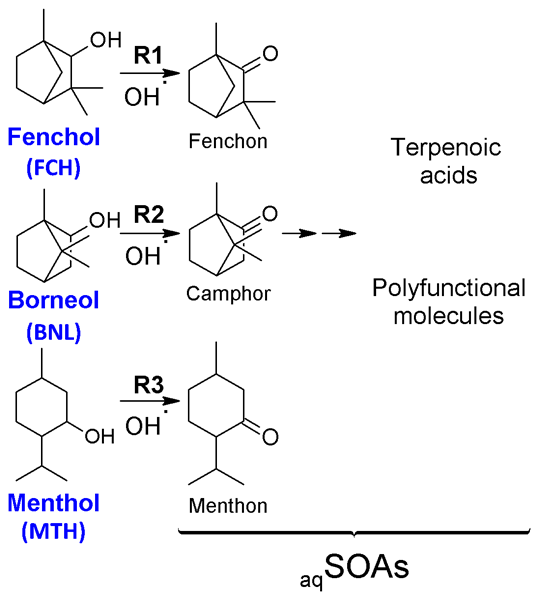
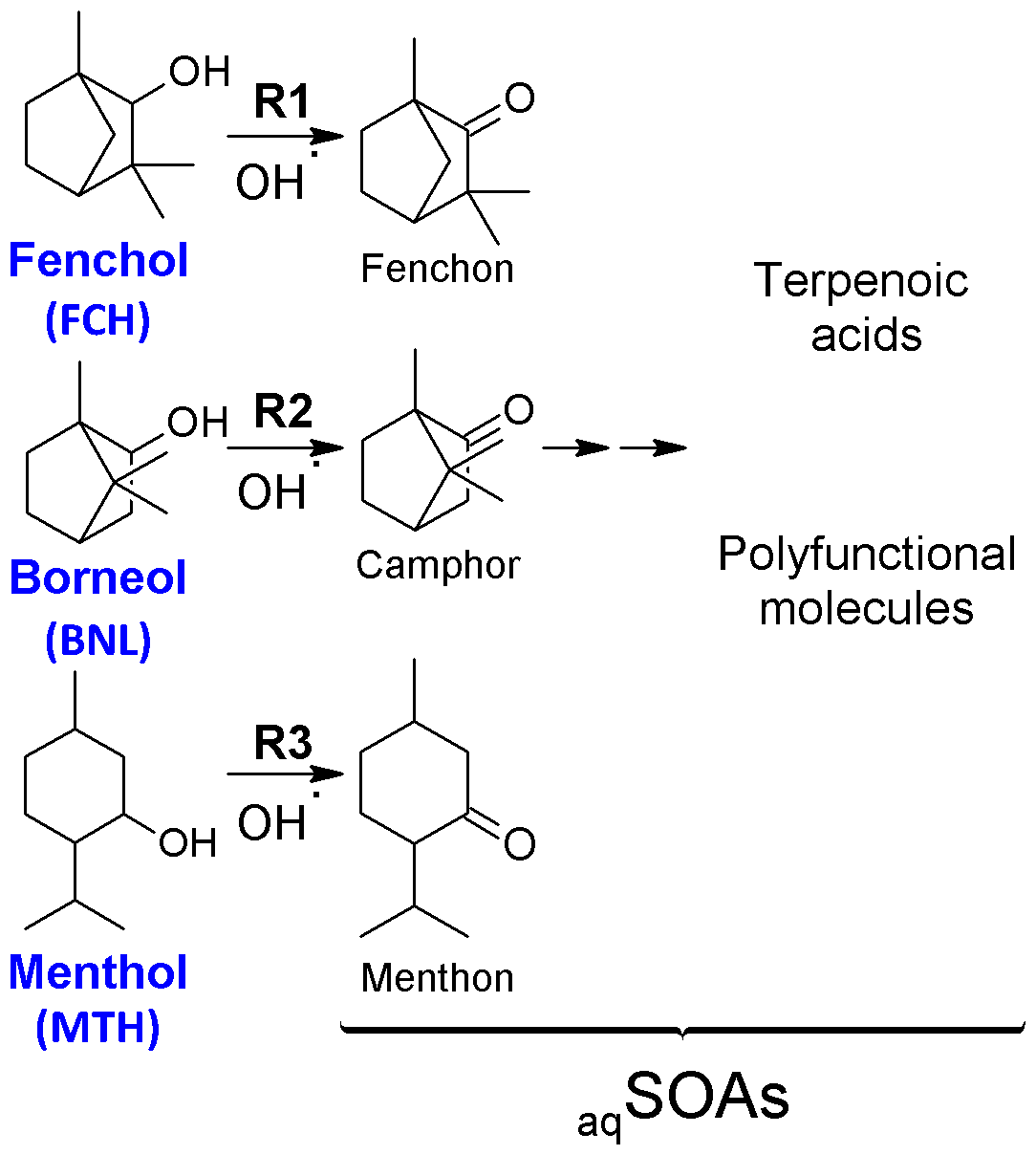
In addition to isoprene and monoterpenes, oxygenated monoterpenoids (MTDs) also contribute to BVOCs emissions (Guenther et al., 2012). For instance, the global emissions of 31 MTDs were estimated at 14.9 Tg yr−1 (Guenther et al., 2012), compared with α-pinene (the most abundant monoterpene) and isoprene emissions of 27 and 440 Tg yr−1, respectively (Sindelarova et al., 2022). Furthermore, emissions of all terpenoic alcohols (TAs), of which fenchol (FCH), borneol (BNL) and menthol (MTH) were the focus of this work (Fig. 1), can be estimated at 15 Tg yr−1, accounting for 9 % of reactive VOCs other than monoterpenes (Griffin et al., 1999).
The three TAs that were the focus of this work are among the major components of various plant oils (Kamatou et al., 2013; Ghaffari et al., 2019; Yassaa et al., 2000). FCH and BNL were identified in essential oils of Tarchonanthus camphoratus, Eucalyptus globulus, and Cedrus atlantica (Yassaa et al., 2000; Matasyoh et al., 2007), while MTH is produced by a wide variety of flowering plants from the Mentha genus (Kamatou et al., 2013). The fluxes of TAs investigated in this work from plants are difficult to constrain, as estimated emissions of all MTDs are very often lumped together (Fares et al., 2011; Kim et al., 2010). As such, the emissions of MTDs from plants range from 0.15 to 4.6 µg per g of dry weight per h () (Fares et al., 2011; Kim et al., 2010), and the emissions of BNL and FCH from pine and from broad-leaved trees were reported to increase following mechanical and insect damage and thermal stress (Joutsensaari et al., 2015; Yuan et al., 2025; Kivimäenpää et al., 2016). These data strongly indicate that globally widespread plant species are a significant source of TAs, alongside other MTDs (McKinney et al., 2011). The atmospheric abundance of MTD is further supported by field studies reporting ambient concentrations between 0.05 and 10 ppb in forested and agricultural regions (Li et al., 2020; Gentner et al., 2014; Fares et al., 2012). In addition to biogenic emissions, MTDs, including FCH and BNL, are commonly detected in biomass burning (BB) smoke, with measured ambient concentrations between 0.022 and 3.17 µg m−3 (Hatch et al., 2019; Dickinson et al., 2022). For these reasons, emissions of TAs and other MTDs from biomass burning and vegetation are likely to increase in the foreseeable future due to rising global temperatures and the increasing frequency and intensity of wildfires (Kelley et al., 2025; Abatzoglou et al., 2025; IPCC, 2023).
Because of their high abundance of essential oils, MTDs, including TAs shown in Fig. 1, are widely utilized as fragrance and flavouring agents; in the production of cigarettes, cleaning and personal care products, food, as well as environmentally friendly insecticides (Caputi and Aprea, 2011; Bhatia et al., 2008a; Bhatia et al., 2008b; Kamatou et al., 2013). MTH, in particular, has a wide variety of industrial applications with an estimated annual consumption of about 30 000 t, exceeding natural production by about 50 % (Kamatou et al., 2013; Shakil et al., 2026). Moreover, MTH and BNL are used in the pharmaceutical industry due to their antimicrobial, antiviral, and anticancer properties (Kamatou et al., 2013; Shakil et al., 2026). Relatively large quantities of MTD are also emitted from herbs and spices during cooking (Klein et al., 2016). Hence, the reported concentrations of MTDs and TAs in indoor air range from a few up to 900 µg m−3, primarily due to the use of cleaning products and air fresheners (Singer et al., 2006; Angulo Milhem et al., 2021; Rosales et al., 2022).
In the atmosphere, TAs can influence the oxidizing capacity, tropospheric ozone (O3) formation, and undergo atmospheric oxidation, forming SOAs, alongside other BVOCs (Mellouki et al., 2015; Wang et al., 2024b). The formation of SOA from BVOCs is initiated by reaction with O3, hydroxyl (OH), and nitrate (NO3) radicals, generating a cascade of oxygenated, low-volatility products (Zhang et al., 2015; Kamens and Jaoui, 2001; Kourtchev et al., 2014; Mahilang et al., 2021), which add to the pre-existing particle mass (Shrivastava et al., 2017; Xu et al., 2021). Because monoterpenes are non-polar hydrocarbons, the addition of even a single oxygenated moiety to their carbon skeleton results in the formation of water-soluble organic compounds (WSOCs). The WSOCs contributing to monoterpenoic SOAs include terpenoic acids (TACs), MTDs, and oligomers, some of which are classified as highly oxygenated molecules (HOMs) (Kenseth et al., 2020; Valorso et al., 2011; Yasmeen et al., 2011; Liu et al., 2023).
To date, numerous studies have focused on the formation of SOAs from the atmospherically abundant monoterpenes, primarily α/β-pinene and limonene (Wang et al., 2024a; Sindelarova et al., 2022; Kamens and Jaoui, 2001). At the same time, the mass yields of SOAs formed from the oxidation of MTDs, including BNL, are often higher than those of monoterpenes (alkenes) (Khalaj et al., 2025; Griffin et al., 1999). Because MTDs already contain at least one oxygenated moiety, they tend to produce HOMs and oligomers more efficiently following reactions with atmospheric oxidants compared with monoterpenes (Ceacero-Vega et al., 2012; Khalaj et al., 2025; Mehra et al., 2020). Indeed, gas-phase reactions of OH and chlorine atoms with MTH, FCH, and BNL resulted in the formation of various oxygenated products (Ceacero-Vega et al., 2012), including oligomers (Mehra et al., 2020), making some MTDs potentially efficient precursors of ambient and indoor SOA (Khalaj et al., 2025; Wu et al., 2024; Rosales et al., 2022).
It is now well established that the classical model involving the gas-phase oxidation of BVOCs followed by gas-particle partitioning of low-volatility organics (Pankow, 1994; Odum et al., 1996), does not provide a complete picture of the formation and evolution of SOAs (Su et al., 2020; Carlton et al., 2020; Tsigaridis and Kanakidou, 2018; Ervens, 2015). Because liquid water is ubiquitous in the atmosphere in the form of clouds, fogs, and aqueous aerosols, oxidation of WSOCs inside and on the surface of these hydrometeors can lead to so-called aqueous SOAs (aqSOAs) (Su et al., 2020; Carlton et al., 2020; Ervens, 2015). Aqueous oxidation of WSOCs in the atmosphere also involves unique species and mechanisms, distinct from the gas-phase reactions, leading to HOMs and extremely low-volatility organic compounds (ELVOCs) (Ervens, 2015; Zhu et al., 2020; Sullivan et al., 2016; Sun et al., 2010; Ervens et al., 2011; Mekic et al., 2019; Zheng et al., 2021; Gomez et al., 2015). Such molecules can be formed via (photo)chemical and non-radical “dark” reactions, producing aqSOAs after water evaporation (Sullivan et al., 2016; Paglione et al., 2020; Kuang et al., 2020b). Results of field and laboratory studies also indicate that the contribution of aqSOAs to the global and local organic aerosols (OAs) burden is likely significant (Paglione et al., 2020; Kuang et al., 2020b; Su et al., 2020; Tsui et al., 2019). In addition to affecting SOA formation and processing, the multiphase chemistry alters physicochemical characteristics of OAs, including composition, optical and toxicological properties, as well as CCN and IN activity (Carlton et al., 2020; Ervens, 2015; Sullivan et al., 2016; Decesari et al., 2017). Consequently, for over a decade, there has been an increasing focus on the still incompletely characterized aqueous reaction in clouds, fogs, haze, and some aerosols in the context of the formation and processing of SOAs (Su et al., 2020; Carlton et al., 2020; Lim et al., 2010; Ervens, 2015). At the same time, the fundamental data necessary to parametrize multiphase chemistry of SOAs remain incomplete, making it difficult to reliably constrain the climate forcing of fine PM (IPCC, 2023; Tsigaridis and Kanakidou, 2018).
In the atmosphere, OH (major daytime oxidant) is formed from O3 photolysis and diffuses into aqueous particles from the gas phase (Price et al., 2025). In addition to the gas-phase formation, OH can be produced inside hydrometeors by decomposition of hydrogen peroxide (H2O2) via photolytic or Fenton and Fenton-like processes, greatly enhancing the oxidative capacity of some aqueous particles (Kuang et al., 2020a; Bianco et al., 2020). For these reasons, several studies have investigated the OH-initiated formation and aging of monoterpenoic aqSOAs, focusing on individual precursors and BSOA mixtures (Witkowski et al., 2019; Amorim et al., 2021; Enami and Sakamoto, 2016; Huang et al., 2018; Otto et al., 2018; Amorim et al., 2020; Witkowski et al., 2023), as many MTDs and TACs lack C=C bonds of monoterpenes, making them unreactive towards O3 (Khalaj et al., 2025). Still, major knowledge gaps persist regarding the aqueous oxidation mechanisms and mass yields of aqSOA formed through aqueous OH reactions with MTDs (Leviss et al., 2016; Bleier and Elrod, 2013), as most studies published to date have often focused on TACs and acidic organosulfates (Witkowski et al., 2019; Amorim et al., 2021; Enami and Sakamoto, 2016; Huang et al., 2018; Otto et al., 2018; Lai et al., 2025).
This work aimed to address knowledge gaps in aqSOA formation from the OH-initiated oxidation of MTDs, focusing on reaction mechanisms and aerosol mass yields. An overarching goal was to constrain the global aqSOA flux from the aqueous OH reactions with MTDs. As concluded in our previous study, in the atmosphere, FCH, BNL, and MTH can enter water-containing particles considering their dimensionless Henry's law constants () (Sander, 2023). Furthermore, the estimated lifetimes indicate that these TAs can undergo aqueous reaction with OH in air masses with liquid water content (LWC) ≥0.1 g m−3 at atmospherically relevant timescales (Witkowski et al., 2024). Hence, these TAs were studied in this work as potential precursors of aqSOAs.
The TAs shown in Fig. 1 share structural features with many MTDs and atmospherically abundant monoterpenes, namely alkyl-substituted C6 rings, fused with C5 rings (Jenkin, 2004; Kamens and Jaoui, 2001; Khalaj et al., 2025). The TAs under investigation (C10H18O) are also suitable representative precursors for studying the formation of aqSOAs from the early-stage products of monoterpenes (C10H16) oxidation. Many secondary MTDs, including pinaketone, sabinaketone, limonaketone, norpinone, pinanediol, or 2-hydroxy-3-pinanone, retain the carbon skeleton of the parent monoterpene (Kamens and Jaoui, 2001; Bleier and Elrod, 2013; Jenkin, 2004; Glasius et al., 2000). At the same time, the addition of even a single oxygenated moiety makes such molecules sufficiently soluble in water to become a potential precursor of aqSOAs (Sander, 2023).
In this work, aqueous OH reactions with FCH, BNL, and MTH (Reactions R1–R3 in Fig. 1) were carried out in a custom-built photochemical reactor (Jain et al., 2024). Analyses were performed with gas (GC) and liquid chromatography (LC) coupled with mass spectrometry (MS) to study the formation of non-acidic products and TACs formed from Reactions (R1)–(R3). Previously reported and newly identified products were quantified with authentic and surrogate standards. Based on these data and the proposed mechanisms of Reactions (R1)–(R3), kinetic box models were developed. The chemical models were then combined with the Hcc values of the reactants to estimate the global flux of aqSOAs from MTDs.
2.1 Materials and reagents
The reagents are listed in Sect. S1 in the Supplement. LC/MS-grade water was used in all experiments.
2.2 Aqueous reaction with hydroxyl radical
The reactions were carried out in the aqueous photoreactor (Jain et al., 2024). The reaction vessel was a jacketed borosilicate glass reaction flask with an internal volume of 0.1 L and was irradiated with four UVB lamps (Philips, PL-S 9W/01/2P 1CT, λmax=310 nm). The lamps were mounted inside a circular chamber (ID 10 cm, height 18 cm) and air-cooled with a fan underneath the reaction vessel. The reactor was placed on a small pedestal with a built-in magnetic stirrer to mix the reaction solution. The reaction mixture was maintained at 298 K using a circulating water bath (SC100 a10, Thermo Fisher Scientific) connected to the outer jacket of the reaction flask.
2.3 Experimental procedures
Hydrogen peroxide (H2O2) was a photolytic precursor of OH. The aqueous reaction solution (0.1 L) contained one of the TAs (0.6 mM) and H2O2 (0.09 M). After the reactants were dissolved, the solution was filtered through a 0.7 µm GF syringe filter. Before initiating the reaction, the lamps were warmed up for 30 min, and the solution temperature was stabilized at 298 K.
The reaction was carried out for 30–35 min, and progress was monitored by sampling aliquots of the reaction mixture. These samples were analyzed using gas chromatography coupled with electron ionization (GC/MS-EI) and negative chemical ionization (GC/MS-NCI) utilizing ammonia (NH3) and methane (CH4) as reagent gases and liquid chromatography coupled with electrospray ionization and time-of-flight mass spectrometry (LC-ESI/ToF/MS). For GC/MS-EI and GC/MS-NCI analyses, 800 µL of the reaction solution was saturated with sodium chloride and extracted with 300 µL of ethyl acetate containing 0.6 mM dimethyl phthalate, used as an internal standard for peak area normalization. Afterward, the organic layer was dried with anhydrous sodium sulphate and injected into the instrument. For LC-ESI/ToF/MS analyses, each aliquot was filtered through a 0.22 µm syringe filter (PTFE) and injected into the instrument.
2.4 Chromatographic analyses
2.4.1 Gas chromatography coupled with mass spectrometry
GC/MS analyses were performed with a GC/MS-2010 Ultra gas chromatograph coupled with a single quadrupole mass spectrometer (Shimadzu). Precursors and products of Reactions (R1)–(R3) were separated with a VF-WAXms column (Agilent, ) and quantified in the EI mode. The column head pressure was set at 32.3 kPa, the total flow of the carrier gas (He) was maintained at 9.4 mL min−1, the column flow was 0.67 mL min−1 (30 cm s−1), the purge flow was 2 mL min−1, and the linear velocity flow control mode was used. The injector, ion source, and mass spectrometer transfer line temperatures were set at 250 °C. The temperature program involved an initial hold at 70 °C for 4 min, followed by a linear increase at a rate of 15 °C min−1 to 250 °C, a 6 min hold; the total analysis time was 22 min. The injection volume was 1 µL for all TAs, and the split ratio was set to 20. The MS was operating in scan (–300) and SIM modes. Specific values monitored in SIM mode are provided in Tables S1–S3 in the Supplement.
Qualitative analyses were carried out in the NCI mode using methane and ammonia as reagent gases. In these analyses, a ZB-5MSplus column (Zebron, ) was used. The column head pressure was 27.2 kPa, the total flow of the carrier gas (He) was 16.4 mL min−1, the column flow was 0.68 mL min−1 (30 cm s−1), and the purge flow was 2 mL min−1. The linear velocity flow control mode was used. The temperatures of the injector, ion source, and mass spectrometer transfer line were 280 °C. The temperature program included an initial hold at 50 °C for 2 min, followed by a linear increase at a rate of 16 °C min−1 to 70 °C, for 8 min hold, another linear increase at a rate of 10 °C min−1 to 170 °C, a 5 min hold, then a final linear increase at a rate of 15 °C min−1 to 250 °C, with a 1 min hold. The analysis time was 32.58 min. The injection volume was 0.5 µL (splitless mode), and the MS operated in the scan mode (–300).
2.4.2 Liquid chromatography coupled with time-of-flight mass spectrometry
LC-ESI/ToF/MS analyses were carried out with a Waters ACQUITY UHPLC liquid chromatograph coupled with the Xevo G2 ToF/MS instrument equipped with an ESI source operating in the negative ionization mode. The ESI source conditions were: source temperature 100 °C, offset 80 V, Desolvation temperature 350 °C, capillary voltage 2.8 kV, sampling cone 40 V, Cone gas 50 L h−1, desolvation gas 700 L h−1. The analytes were separated using a BEH C18 column (Waters), . Eluent A was a 0.2 % formic acid solution in water (pH≈2.8), and eluent B was ACN with 0.2 % formic acid. The flow rate of the mobile phase was 0.25 mL min−1, and the column temperature was maintained at 40 °C. A gradient elution program was used: initially 5 % B for 5 min, then a linear increase to 45 % B over 15 min, then a linear increase to 95 % B over 2 min, kept for 2 min, then a decrease to 5 % B over 1 min, kept for 2 min; total runtime was 27 min. Elemental compositions were assigned to the detected TACs, assuming they were singly charged, deprotonated pseudo-molecular ions [M-H]− composed of C, H, and O atoms.
2.5 Product identification and quantitative analyses
Products were analyzed with GC-EI/MS, GC-NCI/MS, and LC-ESI/ToF/MS (Sect. 2.4). Most structural assignments were based on MS data, including molecular masses, fragmentation patterns, elemental compositions, and plausible formation mechanisms of the detected products. Only TAs under investigation: FCH, BNL, MTH, menthone, fenchone, and camphor (Fig. 1), and camphoric acid were quantified with authentic standards. At the same time, the majority of non-acidic products were quantified with GC-EI/MS using 2-hydroxy-3-pinanone, camphorquinone, and camphanediol as surrogate standards (Tables S1–S3), which were assigned to specific products with similar structural motifs and close retention times. Calibration of the GC-EI/MS instrument was performed in the concentration range from 0.04 to 0.4 µg L−1. Linear coefficients of determination for all quantified analytes were >0.99 (Tables S1–S3). For some products generated in low quantities, particularly TACs, lacking experimental data on temporal evolution, their yields were derived from the kinetic model (Sect. 2.7).
The molar yields of the products were calculated with Eq. (1).
In Eq. (1), [Product]t is the concentration (mM) of a product at time t, from the onset of the reaction. Δ[TA] is the amount of the TA consumed at time t. The yields were derived as slopes of the linear portion of the plots obtained with Eq. (1) (Gierczak et al., 2021).
2.6 Structure-activity relationship
The structure-activity relationship (SAR) was used to predict the values (Witkowski et al., 2024). In SARs based on Atkinson's group contributions approach (Monod and Doussin, 2008; Kwok and Atkinson, 1995), the bimolecular reaction rate coefficient () for a given molecule is derived as a sum of site-specific values – Fig. 2.
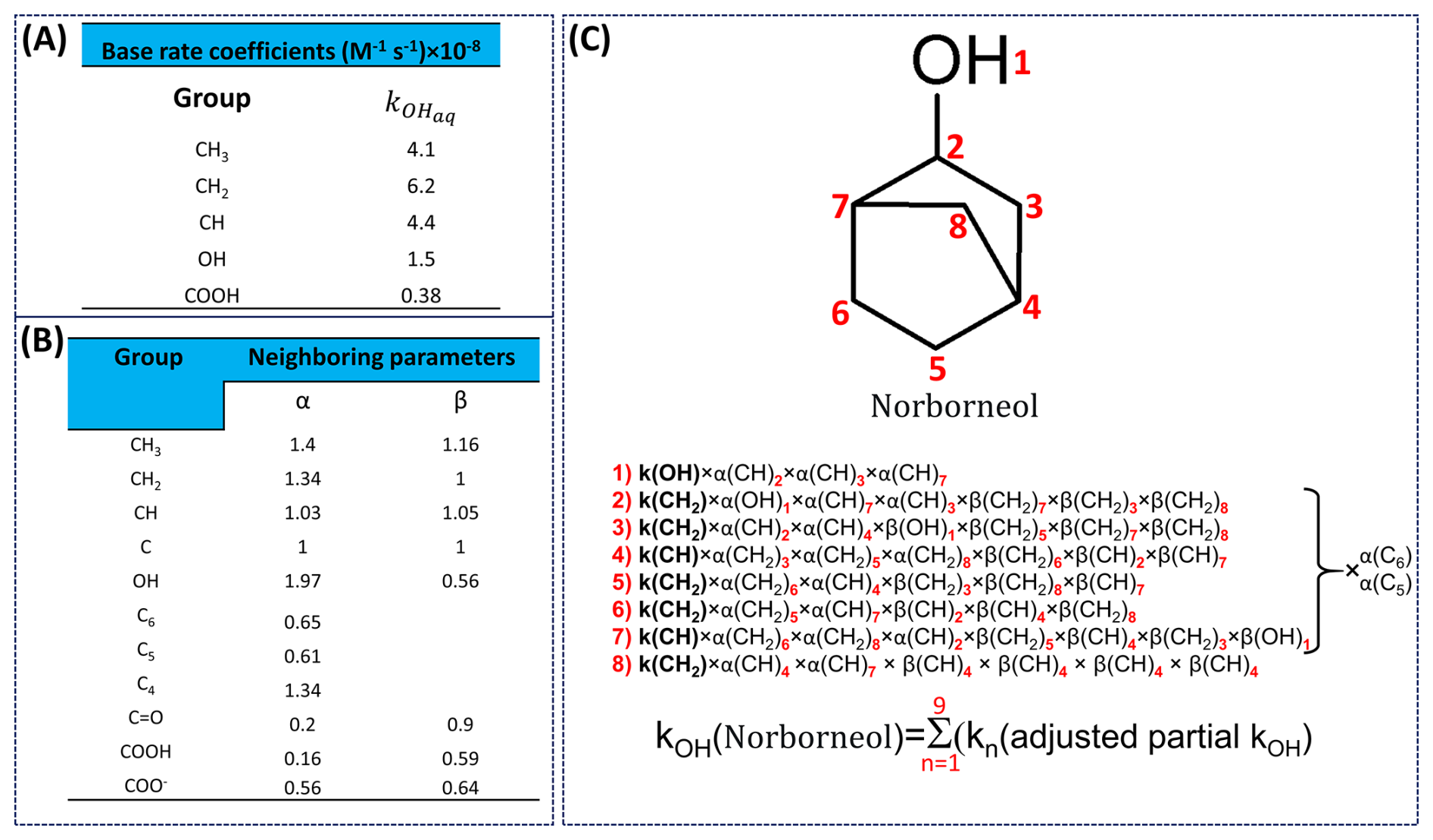
Figure 2Structure-activity relationship parameters: base rate coefficients (A), neighbouring factors (B), and (C) an example of deriving partial and total values for norborneol. (B) values of neighboring factors >1 correspond to activation, whereas values <1 indicate a deactivating effect.
The SAR model utilized the base values (Fig. 2A) for groups with abstractable H–atoms, which are modified via α and β neighbouring parameters (Fig. 2B) of the adjacent moieties. Note that norborneol (Fig. 2C), the same as FCH, BNL (Fig. 1), contains fused C5 and C6 rings. Hence, all base values for CHx groups in positions 2–7 (Fig. 2C) are modified by the C5 and C6 α and β neighboring factors (Fig. 2B). Afterward, the adjusted are added to yield a total value – Fig. 2C. Here, SAR was used to derive total and partial values for the observed products of Reactions (R1)–(R3), which are provided in Tables S4–S6 in the Supplement.
2.7 Kinetic modeling
Kinetic modeling was performed using the Acuchem program (Java version) (Braun et al., 1988). Kinetic models of Reactions (R1)–(R3) were developed using the observed temporal evolution of the reactants, their formation yields, and reaction pathways proposed based on structural assignments, SAR results, and mechanistic implications. The reactions in the models include H2O2 photolysis (Reactions 1–5 in Tables S7–S9 in the Supplement) and the formation and interconversion reactions of tentatively identified products. Most of the values used in the kinetic models were predicted with SAR; measured values were available only for FCH, BNL, MTH, and camphoric acid (Witkowski et al., 2024; Otto et al., 2018).
Initially, the models were adjusted by fitting the simulated temporal evolution of major (non-acidic) products to the experimental data. To this end, the yields of non-acidic products, quantified using surrogate standards, were adjusted, while the yields of primary ketones, quantified using authentic standards, were kept unchanged. This approach was adopted due to additional uncertainty arising from differences in GC-EI/MS response factors between the surrogate standards and target compounds (Bergmann et al., 2018). After adjusting the model, the yields of products formed in low quantities, particularly TACs, were derived using Eq. (1) from their simulated temporal evolution and were subsequently adjusted based on relative signal intensities from the LC-ESI/ToF/MS measurements.
2.8 Yields of aqueous secondary aerosols
Yields of aqSOAs from Reactions (R1)–(R3) were derived assuming that all reactants, at any given time, partition between aqueous and gas phases according to Henry's Law equilibrium – Eq. (2).
In Eq. (2), aqSOAs yield (%, ) is the mass yield of organic aerosols, ΔMTA(t) is the amount (g L−1) of the precursor consumed at time t, %aq is the mass fraction of reactant in the aqueous phase, which is multiplied by the concentration of this reactant (g L−1). The fraction of each reactant in the aqueous phase was derived with Eq. (3).
In Eq. (3), %aq is the fraction of each reactant in the aqueous phase. It depends on LWC and is calculated by multiplying the dimensionless Henry's law constant, Hcc, by the volume of water in 1 m3 of air. Experimentally measured values were used whenever available, but the majority of Hcc values (Tables S10–S12 in the Supplement) used in the models were predicted using HenryWin v4.11 (EPA, 2023).
2.9 Control experiments and uncertainty analysis
Control measurements performed without adding H2O2 to the reaction solution confirmed that the TAs under investigation were not photolyzed with the UVB radiation used to generate OH (Sect. 2.2). Also, no interactions were observed between the precursors and H2O2 within the timescale of the experiments when the reactor lamps were kept off. All measurements were carried out at least three times. The uncertainty associated with the use of authentic standards was derived as 2σ values from triplicate experiments and usually did not exceed 10 %. At the same time, the use of surrogate standards introduces a significantly higher uncertainty. However, because the yields initially obtained using surrogate standards were further adjusted based on experimental data, a 30 % uncertainty was imposed on all product yields lacking authentic standards; this value was increased to 50 % for the yields derived only from kinetic models (Sect. 2.7).
3.1 Analysis of products
The acquired chromatographic and mass spectrometric data were then used to propose the structures and formation pathways of the detected products, as detailed in Sects. 2.5 and 2.7. Products of Reactions (R1)–(R3) were analyzed with GC/MS-EI, GC/MS-NCI (Sect. 2.4.1), and LC-ESI/ToF/MS (Sect. 2.4.2). In addition to qualitative data, some products were quantified with GC/MS-EI (Tables S1–S3). At the same time, molecular masses of products of Reactions (R1)–(R3), and further structural characteristics, were obtained from GC/MS-NCI measurements, due to a much lower degree of fragmentation in this ionization mode (Javelle et al., 2021). GC/MS chromatograms of the products of Reaction (R1) are presented in Fig. 3.
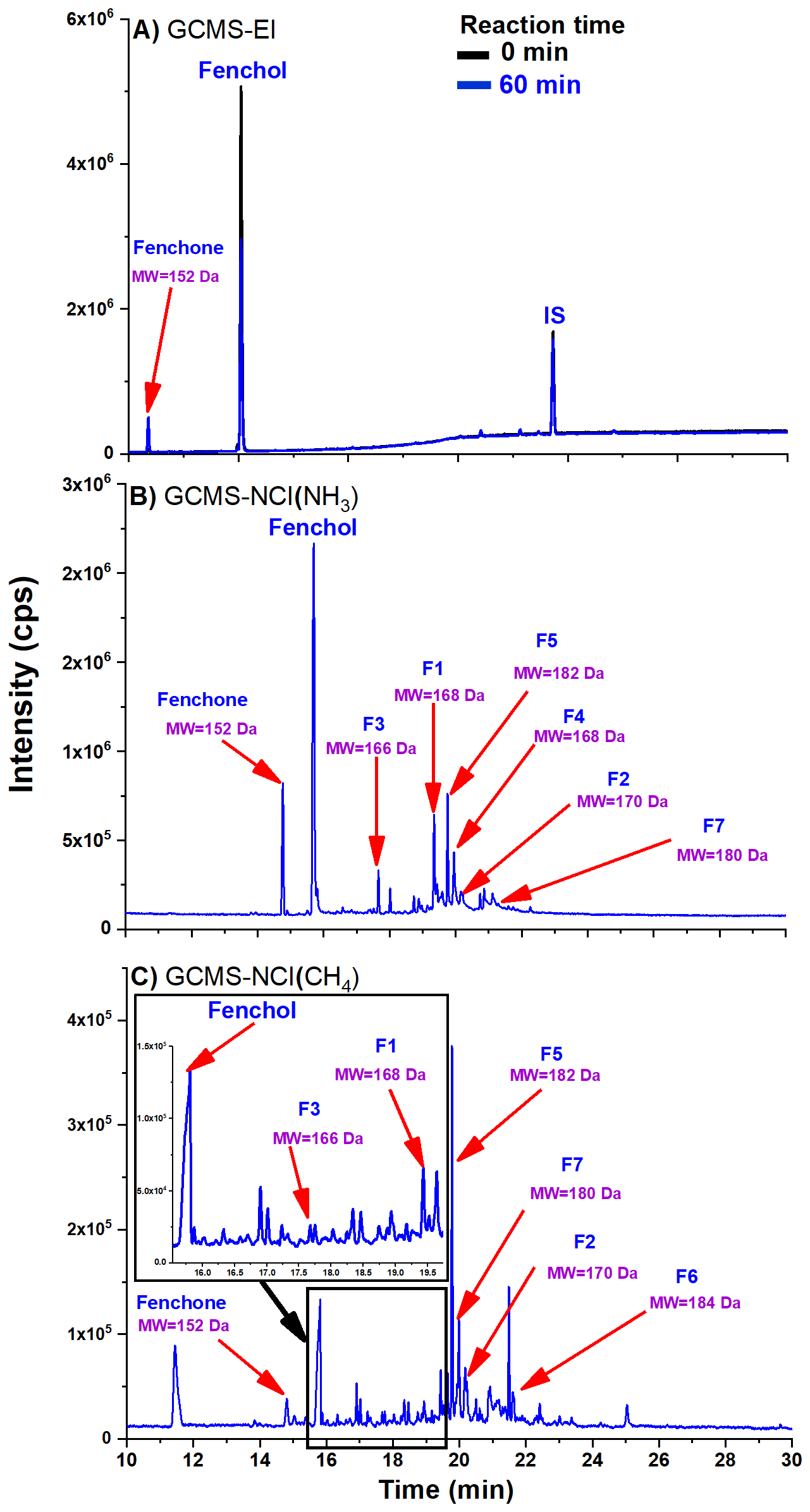
Figure 3GC/MS chromatograms of the products of fenchol (FCH) + OH reaction (R1) detected with EI (A) and NCI using NH3 (B), and CH4 (C) as reagent gases. Note that different chromatographic columns were used for GC-EI/MS and GC-NCI/MS analyses (Sect. 2.4.1), resulting in different retention times between chromatograms acquired using different ionization modes.
In the EI mode, only the formation of fenchone from Reaction (R1) was observed (Fig. 3A). Many additional products were detected with NCI (Fig. 3B and C), due to the higher overall sensitivity for products F1–F7 in this mode (Javelle et al., 2021). Very similar results were obtained for both reagent gases, but the sensitivity was about 10-times higher for NH3. For this reason, non-acidic products of Reactions (R1)–(R3) were analyzed with NCI using NH3 as a reagent gas. All GC/MS chromatograms for Reactions (R2) and (R3) are shown in Figs. S1 and S2 in the Supplement. Moreover, LC-ToF/MS was used to study the formation of TACs – results for Reaction (R1) are presented in Fig. 4, and data for Reactions (R2) and (R3) are provided in Figs. S3 and S4 in the Supplement.
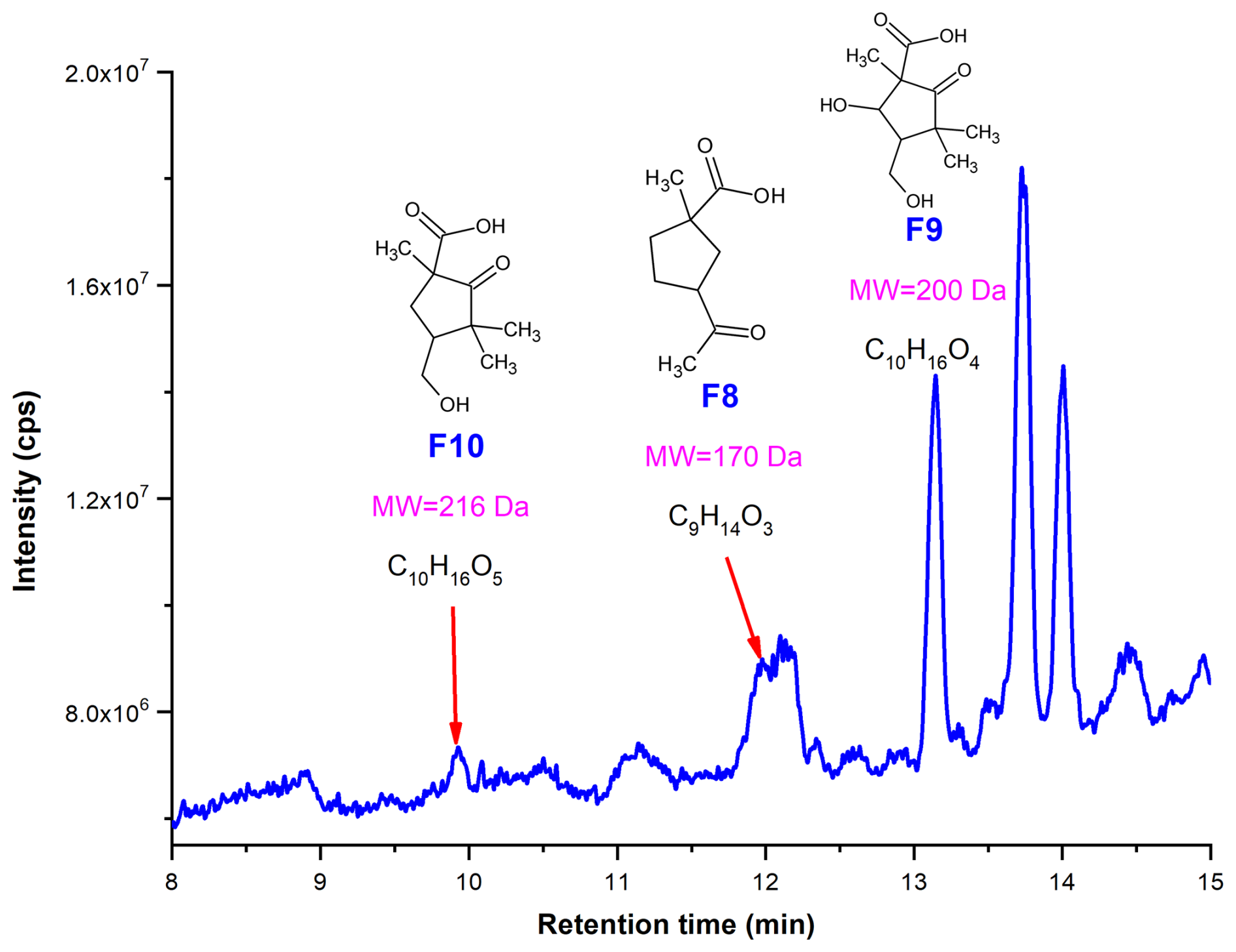
Figure 4LC-ToF/MS chromatogram of TACs formed from OH reaction with fenchol – Reaction (R1).
Results of LC-ToF/MS analysis confirmed the formation of TACs from Reactions (R1)–(R3). Elemental compositions of detected TACs were assigned based on the acquired high-resolution MS spectra and are provided in Tables S13–S15 in the Supplement. In general, the results of chromatographic analyses confirmed that the mechanisms of Reactions (R1)–(R3) involved the addition of oxygenated moieties to the carbon backbone of the precursors, similar to the same reactions previously investigated in the gas-phase (Ceacero-Vega et al., 2012).
3.2 Mechanism of aqueous OH reactions with terpenoic alcohols
Aliphatic WSOCs, including TAs and products of Reactions (R1)–(R3) (Fig. 1), react with OH via alkyl H–atom abstraction, with a minor contribution of acidic H–atom abstraction and single-electron transfer (SET) reaction for carboxylic acids and carboxylate anions, respectively (Witkowski et al., 2021; Ervens et al., 2003). Therefore, the intramolecular selectivity of OH in Reactions (R1)–(R3) was analyzed with SAR (Sect. 2.6), by deriving the partial values, which identified contributions of individual H–atom abstraction sites to the total value – Fig. 5.
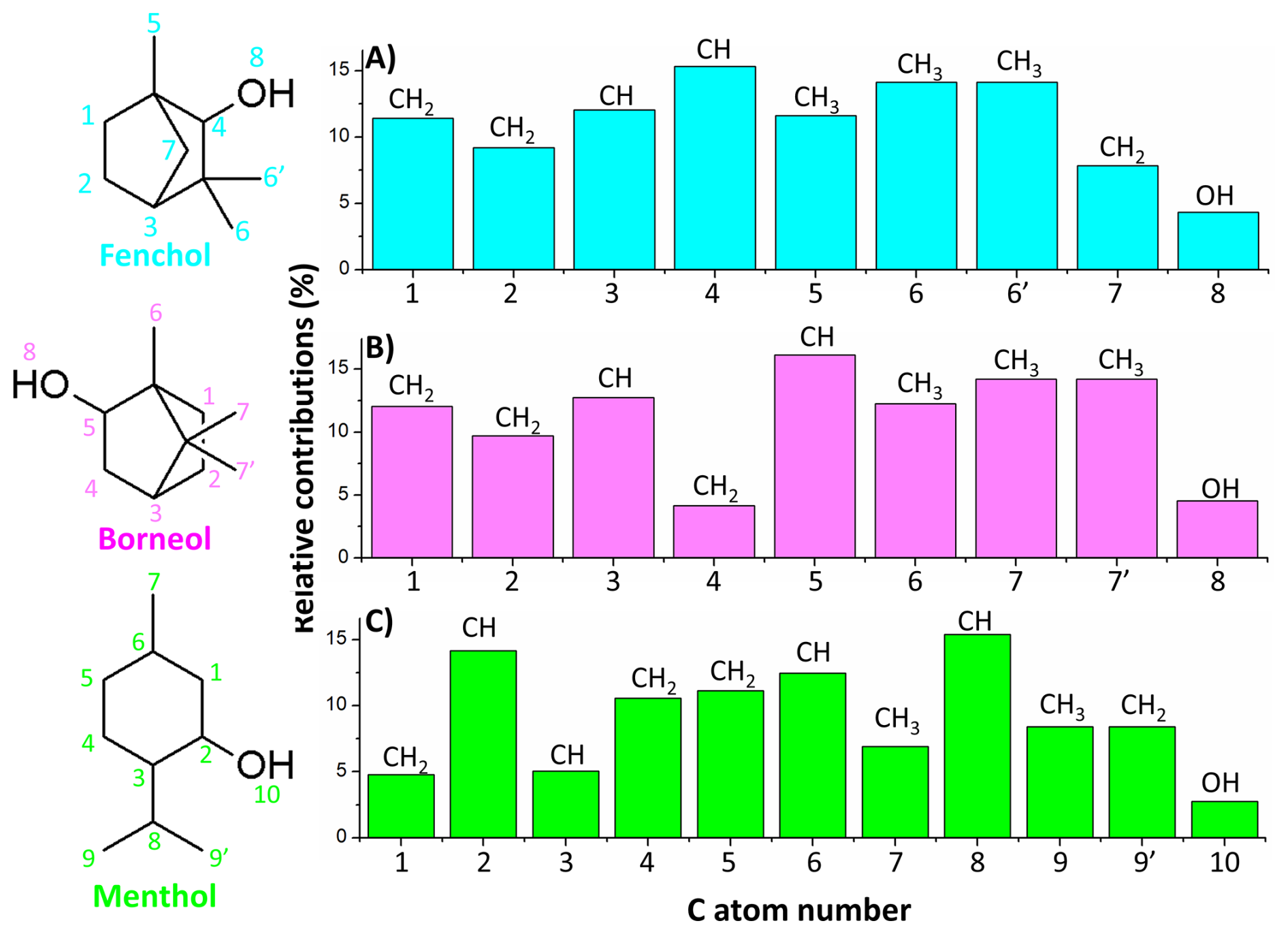
Figure 5The relative values of partial rate coefficients for the aliphatic H–atom abstraction from fenchol (A), borneol (B), and menthol (C) predicted with SAR (Sect. 2.6). SAR results for all reactants are provided in Tables S4–S6.
For all reactants, the predicted intramolecular selectivity of OH was strongly influenced by oxygen-containing moieties, as well as C5 and C6 rings, which generally exhibit stronger activating and deactivating effects in SAR than CHx groups (Fig. 2). The SAR model used predicted that for all TAs, the majority of partial values (Fig. 5) were of the same order. Unlike in the gas phase, in aqueous solutions OH exhibits little preference for H-atom abstraction from higher-order CHx groups (Rudakov et al., 1981). This phenomenon has been attributed to steric effects and solute–solvent interactions (Monod and Doussin, 2008; Kopinke and Georgi, 2017; Rudakov et al., 1981). In water, OH is strongly hydrated, which greatly increases its effective size, making site-specific reactivity depend more on steric hindrance (Monod and Doussin, 2008). Also, WSOCs and OH are trapped inside the water cage, which increases their contact time (Kopinke and Georgi, 2017). Consequently, because reactants can reorient inside the water cage (Kopinke and Georgi, 2017), the selectivity of OH towards different CHx groups is more uniformly distributed (Monod and Doussin, 2008; Rudakov et al., 1981). For these reasons, the predicted intramolecular selectivity of OH in aqueous reactions depends primarily on the local molecular environment and not on carbon order, as reflected by the values of base (Fig. 2A) and neighbouring factors (Fig. 2B) in aqueous SARs (Monod and Doussin, 2008; Witkowski et al., 2024).
Reaction pathways proposed for Reactions (R1)–(R3) were based on SAR results and experimental data and involved known reactions of alkoxy (RO) and peroxyl (RO2) radicals (Russell, 1957; Bennett and Summers, 1974). Because partial derived with SAR represent the relative contributions of the H-atom abstraction site, their values provide information on reaction pathways and thus distribution of products (Mellouki et al., 2003; Minakata and Von Gunten, 2023). At the same time, because relatively similar partial values were obtained for most alkyl H–atoms in TAs under investigation (Fig. 5), strongly indicating the formation of many isomeric products, all possible pathways are not discussed in Sects. 3.2.1–3.2.3 for clarity. Furthermore, the formation of TACs from Reactions (R1)–(R3) was based primarily on mechanistic implications, as generating the −COOH moiety requires specific pathways. Moreover, in the proposed mechanisms, OH does not attack tertiary C-atoms because tertiary alkyl radicals are not readily converted into stable products, particularly detected carbonyls, without fragmentation or rearrangement (Enami and Sakamoto, 2016). At the same time, the experimental data strongly indicated the formation of pairs of disproportionation products of RO2 radicals (alcohol and carbonyl) from Reactions (R1)–(R3) (Russell, 1957; Enami and Sakamoto, 2016), which retained the carbon skeleton of the precursors.
3.2.1 Mechanism of aqueous OH reaction with fenchol
Two pathways presented in Scheme 1 involve H–atom abstraction from position 1 (pathway I) and the formation of fenchone (pathway II).
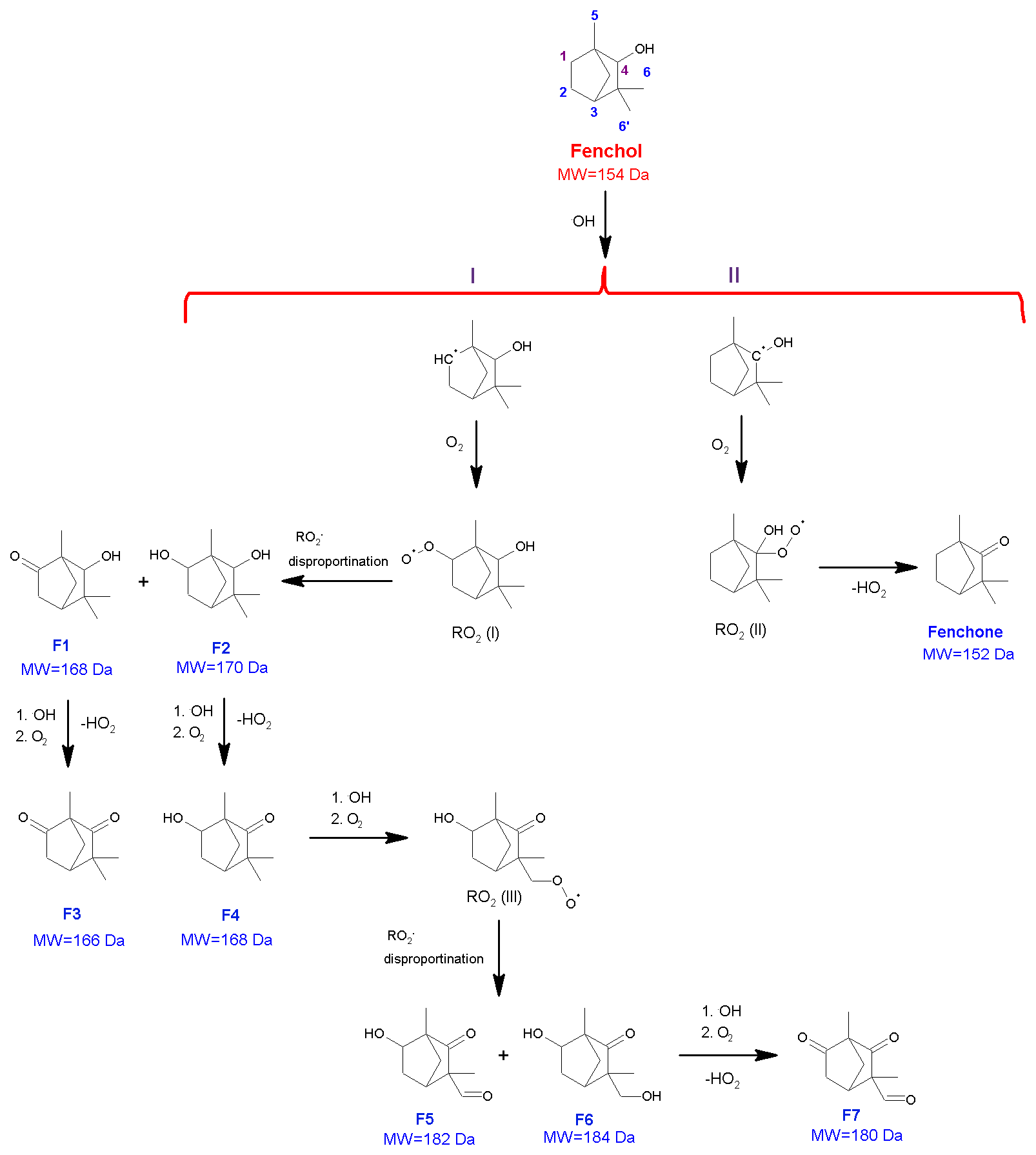
Scheme 1Proposed mechanism of fenchol + OH reaction (R1). The products tentatively identified in this work are highlighted in blue bold font. All possible pathways and isomeric products were not included for clarity. The mechanism of Reaction (R1) is continued in Scheme 2.
In Scheme 1, pathway (I) yields RO2(I), which undergoes the disproportionation reaction to produce carbonyl (F1) and alcohol (F2) (Russell, 1957). Because SAR indicates that H–atoms in the α-position of the −OH moiety are among the preferred abstraction sites (Table S4), the proposed mechanisms involve conversion of alcohols F1, F2, and also F6 into the corresponding carbonyls (Bradley et al., 2001; Puchkov et al., 2005). According to SAR (Witkowski et al., 2024), the OH attack on the exocyclic CH3 groups of F4 exhibited the highest partial values (Table S4) and the total value predicted for F4 (2.8×10⁹ ) was higher than that of F3 (2.0×10⁹ ). Hence, F4 is proposed to react with OH to yield RO2(III), which then produces another pair of disproportionation products – F5 and F6 (Russell, 1957). Likewise, in Scheme 1, F6 ( ) is oxidized faster than F5 ( ), resulting in F7, involving the H–atom abstraction from exocyclic CH2 group (Table S4). In pathway II, FCH is converted to fenchone by elimination of HO2 following the H–atom abstraction from the α-position of −OH (Bradley et al., 2001; Puchkov et al., 2005).
Considering the known reactions of RO and RO2 radicals, proposing a mechanism for the formation of TACs detected with LC-ToF/MS (Fig. 4) directly from FCH was difficult. Consequently, in Scheme 2, TACs F8–F10 are produced from the OH reaction with fenchone.
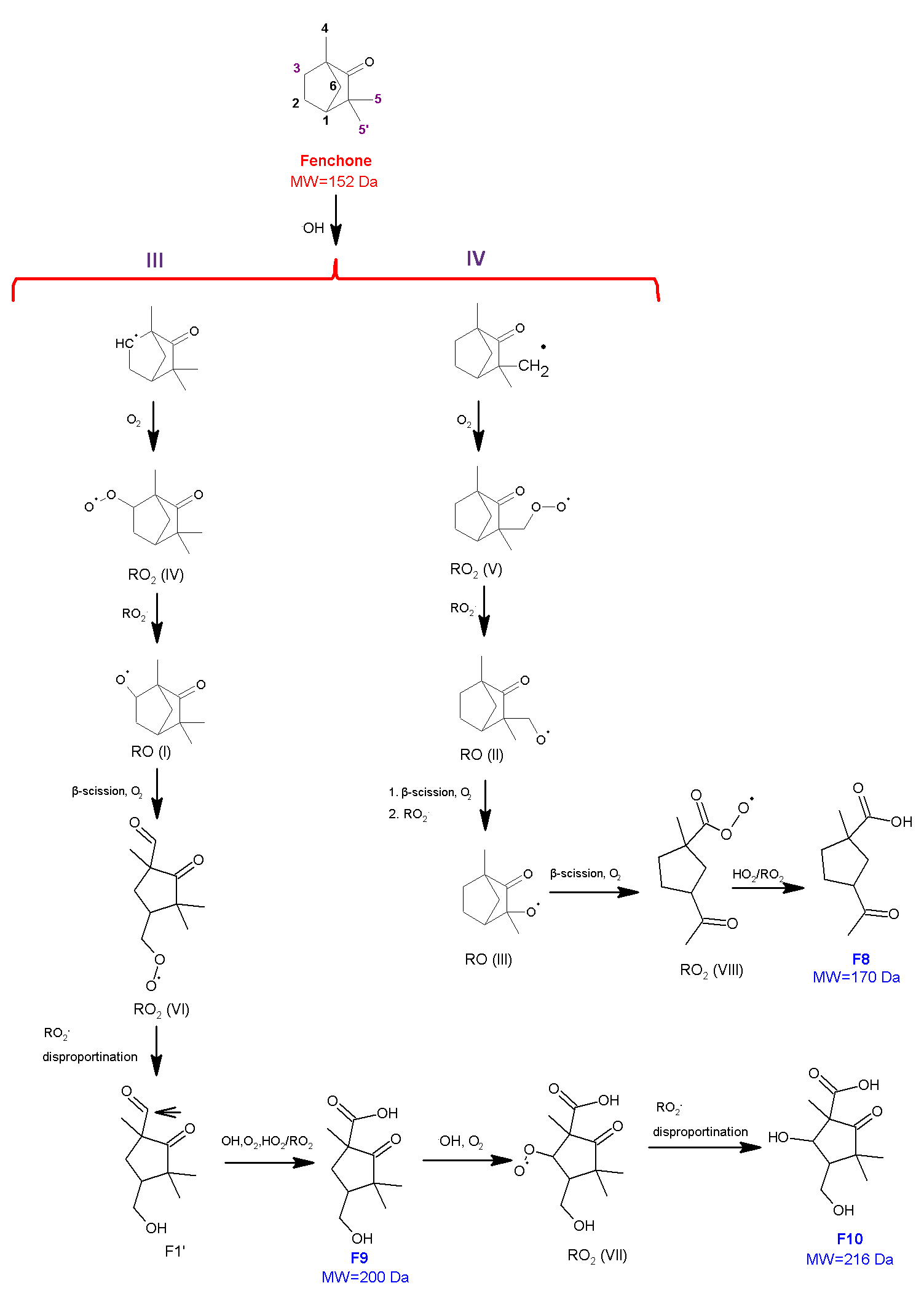
Scheme 2Proposed mechanism for the OH reaction with fenchone. Terpenoic acids detected with LC-ToF/MS are highlighted in bold blue font.
Partial values estimated with SAR for fenchone were all very similar – Table S4, but the formation of TACs first required generating an aldehyde moiety via cyclohexane ring opening, which is then converted to −COOH acid following aldehydic H–atom abstraction (Enami and Sakamoto, 2016). In Scheme 2, RO2(IV), and RO2(V) are formed by the H–atom abstraction from the 3 and 5/5' positions of fenchone, respectively. Pathway III in Scheme 2 involves the formation of RO2(IV), which then undergoes a β-scission reaction, resulting in RO2(VI). RO2(VI) yields by-product F1', which is then likely rapidly oxidized to F9 following OH attack on the aldehyde moiety (Scheme 2) (Enami and Sakamoto, 2016). Subsequently, F9 can undergo further oxidation to F10, via the addition of −OH moiety to the cyclopentane ring. Pathway (IV) yields RO2(V), which forms F8, following two consecutive β-scission reactions (Enami and Sakamoto, 2016).
3.2.2 Mechanism of OH reaction with borneol
The SAR results for BNL indicated that, of all H–atoms, abstraction from positions 4 and 8 (−OH group) was the slowest (Fig. 5B). Of the possible pathways of Reaction (R2), reactions included in Scheme 3 involve the abstraction from C6 ring positions 1 and 2 and position 5, resulting in the conversion of BNL into camphor.
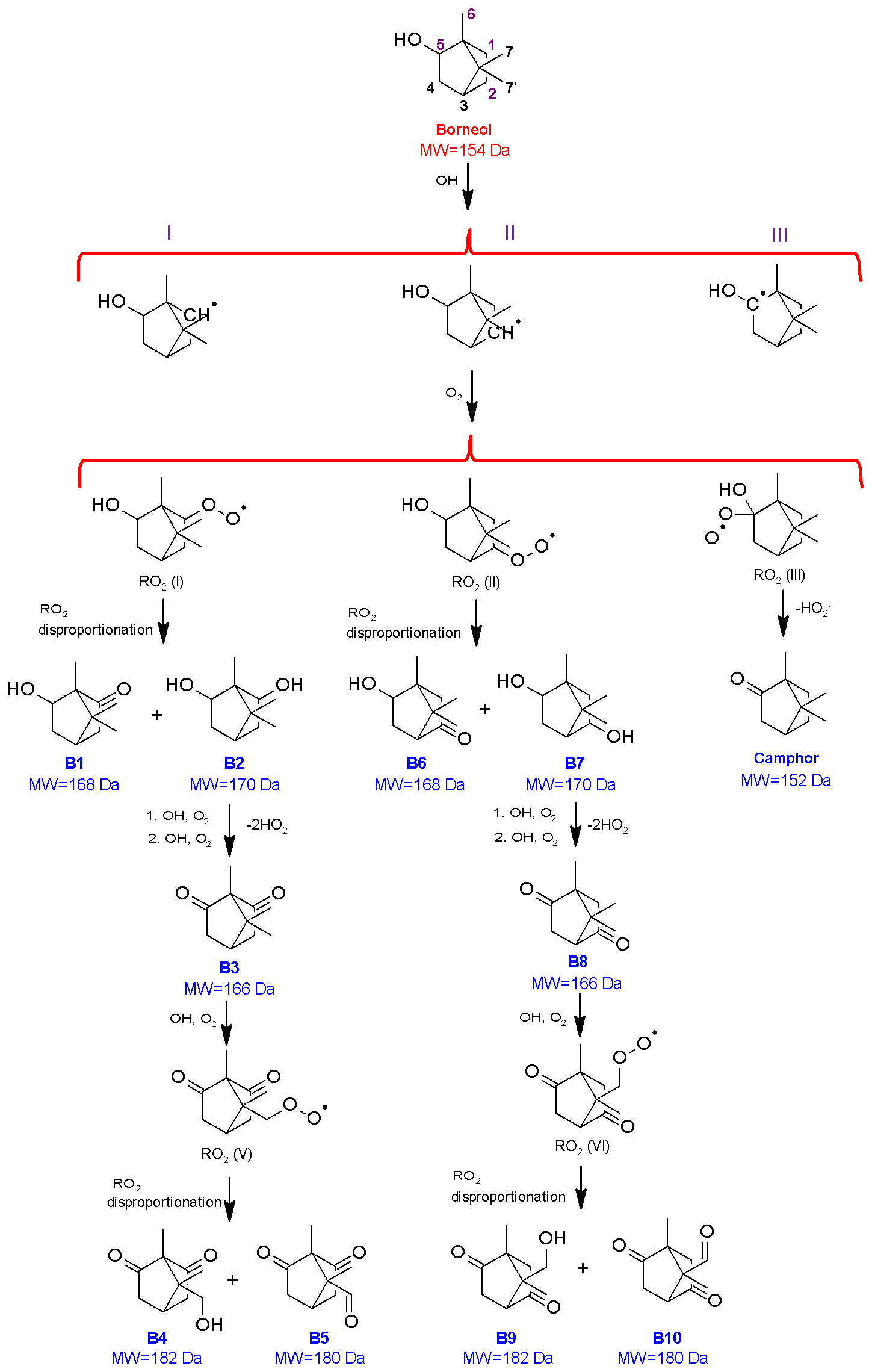
Scheme 3Proposed mechanism of borneol (BNL) + OH reaction (R2). The detected products are highlighted in bold blue font. The formation of all possible isomers is not included for clarity. The mechanism of Reaction (R2) is continued in Schemes 4 and 5 – formation of TACs.
In Scheme 3, RO2(I) and RO2(II) are formed via pathways I and II, respectively. Formation of B1–B2 and B6–B7 can be explained via disproportionation reactions of RO2(I) and RO2(II) (Russell, 1957). According to SAR, diols: B2 ( ), B7 ( ) are oxidized faster than B1 ( ) and, B6 ( ) (Witkowski et al., 2024). For this reason, in Scheme 3, dicarbonyls B3 and B8 are formed from B2 and B7. The results of SAR predictions (Table S5) also indicate that the H–atom abstraction by OH from the α-position of −OH moieties in B2 and B7 was among the major reaction channels for these products. The conversion of BNL into camphor (pathway III in Scheme 3) likely occurs via an analogous mechanism (Denisov and Khudyakov, 1987; Puchkov et al., 2005; Puchkov et al., 2013; Bradley et al., 2001). Even though the formation of TACs detected with LC/MS (see Fig. S3) from camphor is mechanistically more likely, the acidic product B12 may also be produced directly from BNL, involving the H–atom abstraction from position 6 – Scheme 4.
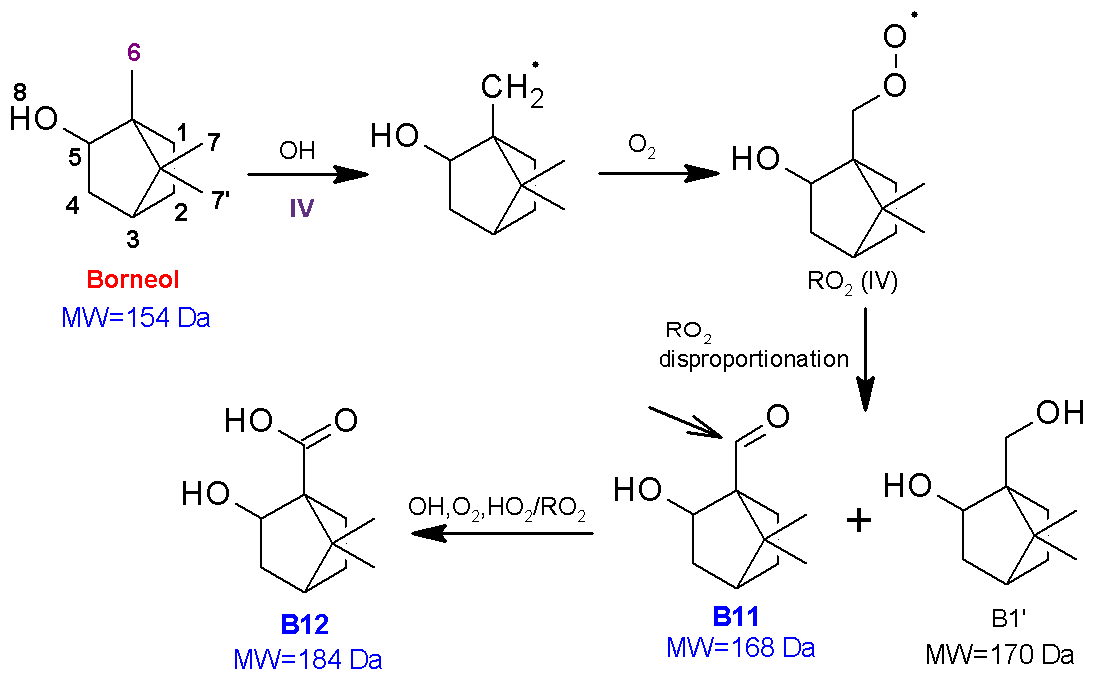
Scheme 4Formation of B12 from OH reaction with borneol (Reaction R2) via pathway IV, involving the H–atom abstraction from position 6.
In Scheme 4, pathway (IV) yields RO2(VI), which undergoes the disproportionation reaction, resulting in B1′ and B11, the latter of which is further oxidized to B12 (Enami and Sakamoto, 2016). The two by-products formed by pathway (IV) – B11 and B1′ – were not detected, likely due to their low formation yields and rapid conversion of B11 to B12. Camphoric acid and B14, formed from Reaction (R2), were most likely produced from camphor – Scheme 5.
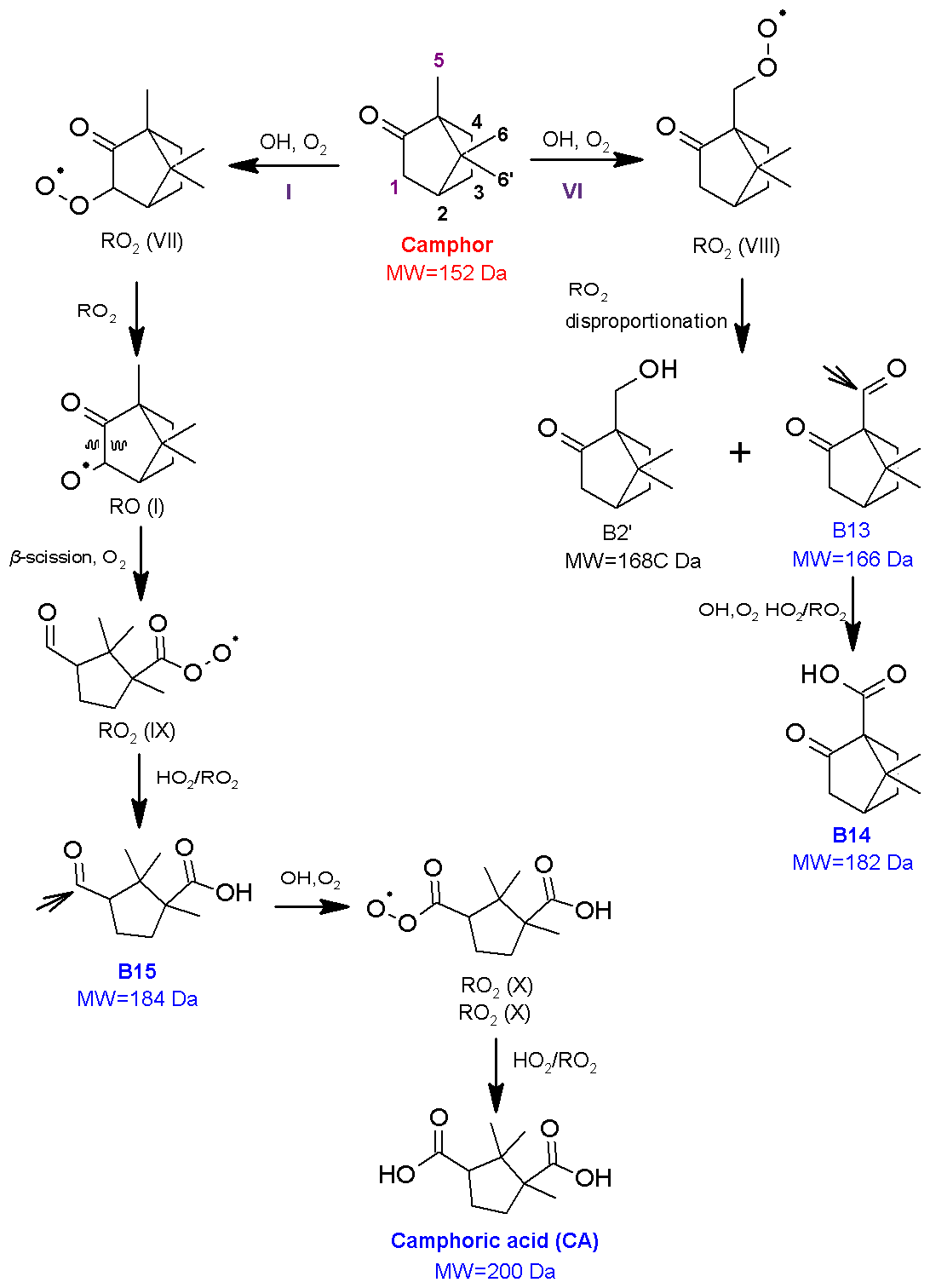
Scheme 5Proposed mechanism for OH reaction with camphor. The products detected (camphoric acid and B14) are highlighted in bold blue font.
In camphor, H–atom abstraction from position 1 leads to B15, which is oxidized to camphoric acid following aldehydic H–atom abstraction (Enami and Sakamoto, 2016). According to SAR (Table S5), position 1 in camphor is the least preferred H–atom abstraction site in camphor, but it leads to camphoric acid, which is formed following aldehydic H–atom abstraction from B15. The formation of B14 (pathway IV in Scheme 5) proceeds by the same mechanism (Enami and Sakamoto, 2016).
3.2.3 Mechanism of OH reaction with menthol
In MTH, according to SAR predictions (Fig. 5C), positions 1, 3 were the least preferred H–atom abstraction sites, followed by positions 7 and 10 (alcoholic H-atom), whereas the rest of the partial values were relatively similar. The possible pathways of Reaction (R3) in Scheme 6 involve H–atom abstraction from positions 2 (conversion into menthone), 4, and 5.
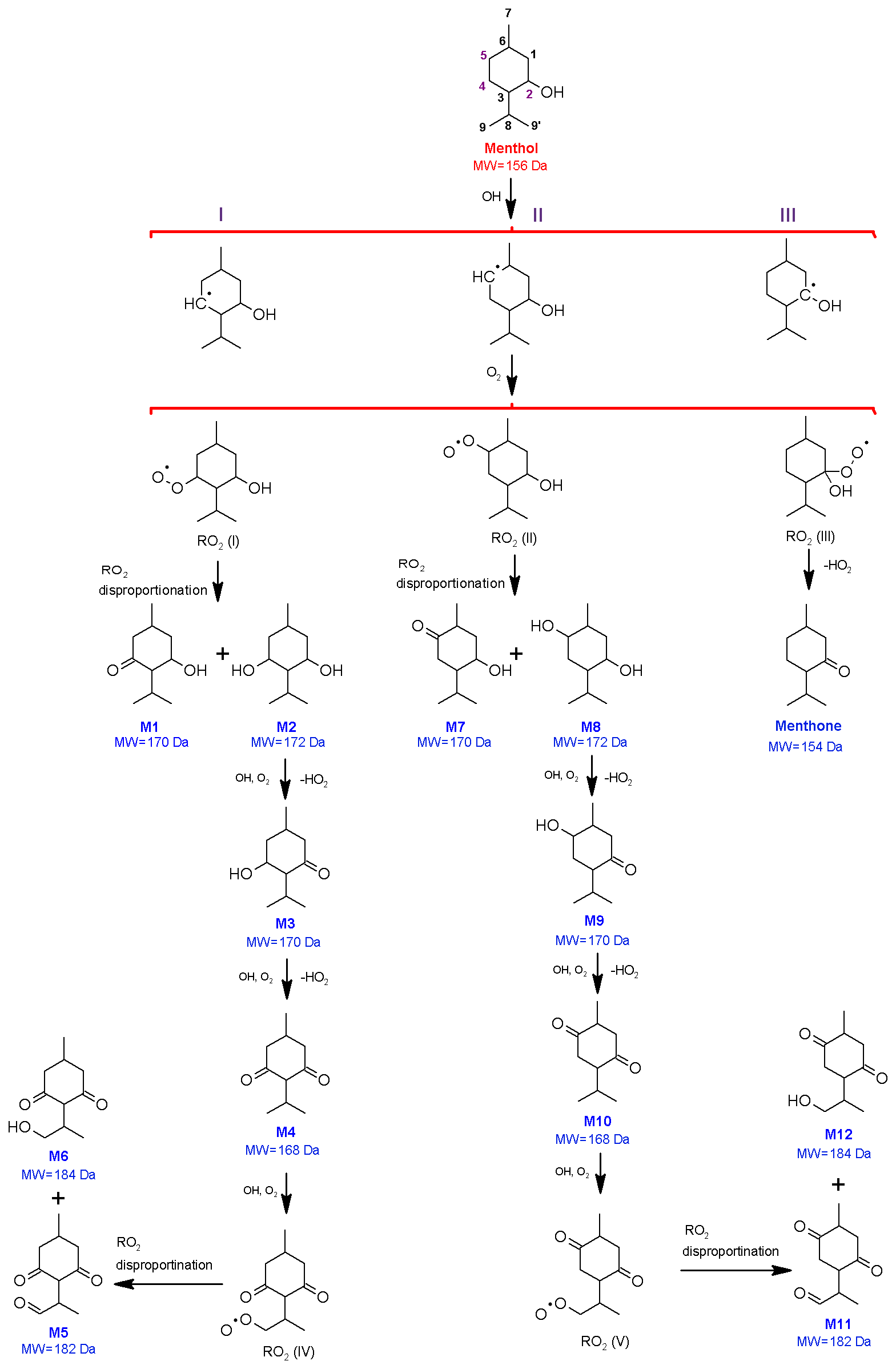
Scheme 6Proposed mechanism of menthol (MTH) + OH reaction (R3). Products observed in this work are highlighted in bold blue font. The formation of all possible isomers is not included for clarity. The mechanism of Reaction (R3) is continued in Scheme 7 – oxidation of menthone.
In Scheme 6, RO2(I), and RO2(II) are formed via pathways I and II, respectively, and undergo the disproportionation reaction, leading to pairs of isomeric products: M1, M7, and M2, M8. Afterward, M3 and M9 are formed in Scheme 6 by oxidation of M2 ( ), and M8 ( ), which likely react faster than M1 ( ) and M7 ( ), respectively (Witkowski et al., 2024). In pathways I and II, the elimination of HO2 from M3 and M9 results in M4 and M10, respectively (Bradley et al., 2001; Puchkov et al., 2005). Further oxidation of M4 and M10 results in M5, M6, and M11, M12, which are formed by the disproportionation reactions of the corresponding RO2 radicals (Russell, 1957). The formation of menthone via pathway III in Scheme 6 involves the H-atom abstraction from position 2, followed by elimination of HO2 (Bradley et al., 2001; Puchkov et al., 2005). TACs formed from Reaction (R3) (Fig. S4) are most likely produced from menthone – Scheme 7.
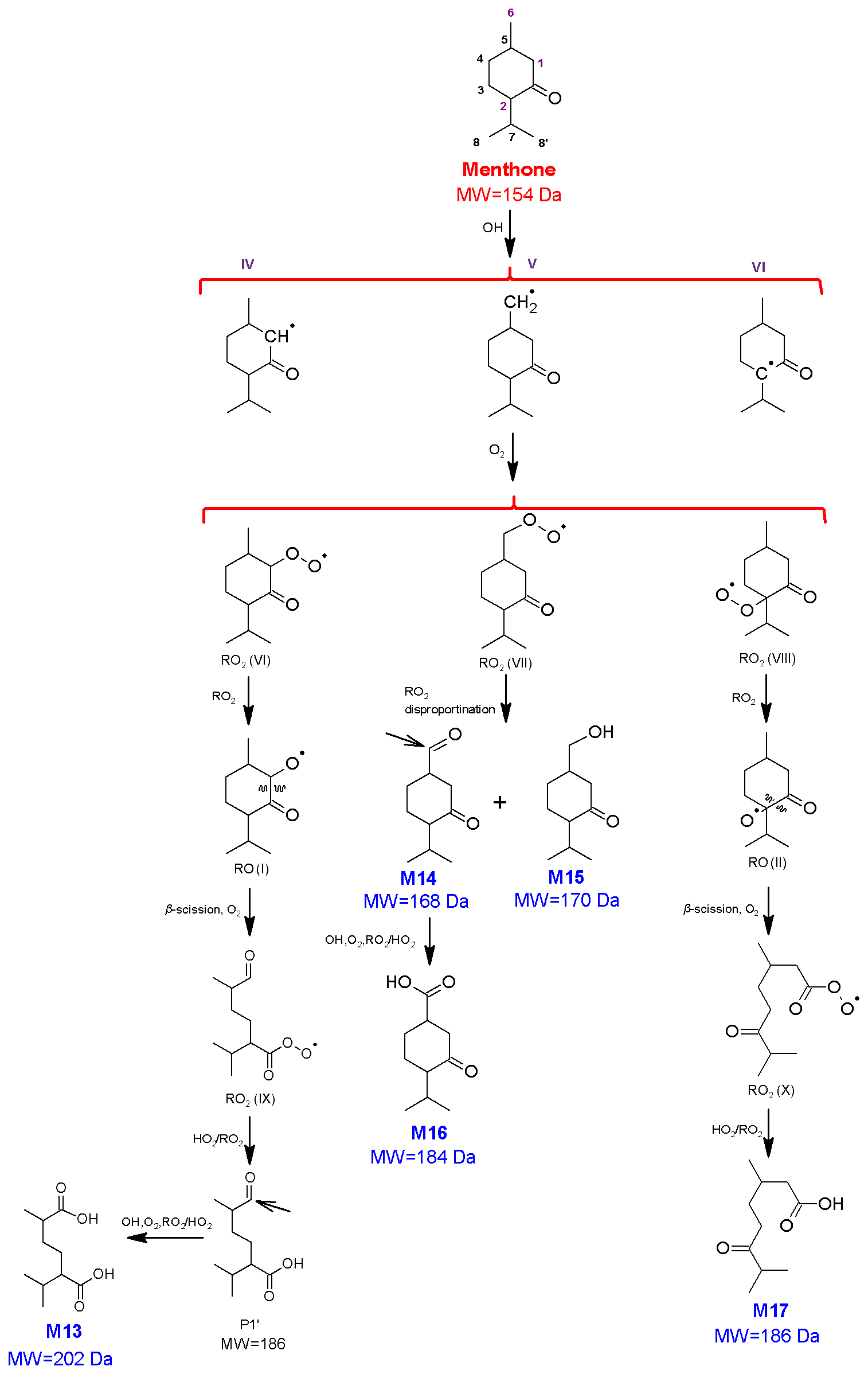
Scheme 7Proposed mechanism of the OH + menthone reaction. Products observed in this work are highlighted in bold blue font.
In menthone, H-atom abstraction from positions 2, 3, and 6, resulting in aldehyde by-products, is characterized by the lowest partial values (Table S6). Pathways IV–VI in Scheme 7 involve the formation of M13, M16, and M17 following menthone C6 ring opening via the β-scission reaction and disproportionation of resulting RO2 radicals (Enami and Sakamoto, 2016). Subsequently, the aldehyde by-products are converted to TACs following aldehydic H-atom abstraction (Enami and Sakamoto, 2016)
3.3 Product yields and comparison with the gas-phase data
Molar yields derived with Eq. (1) (Sect. 2.5) indicated that >88 % of the Reactions (R1)–(R3) products (Table 1) were quantified in this work. At the same time, even though near-carbon balance is obtained, the quantitative data are subject to a large uncertainty (see Sect. 2.9). For all TAs under investigation, the major products were non-acidic molecules containing −OH and C=O moieties, and the yields of TACs ranged from 1 % to 5 % – Table 1.
Table 1The yield of non-acidic products and acids from the aqueous OH reactions with fenchol (Reaction R1), borneol (Reaction R2), and menthol (Reaction R3) obtained in this work.
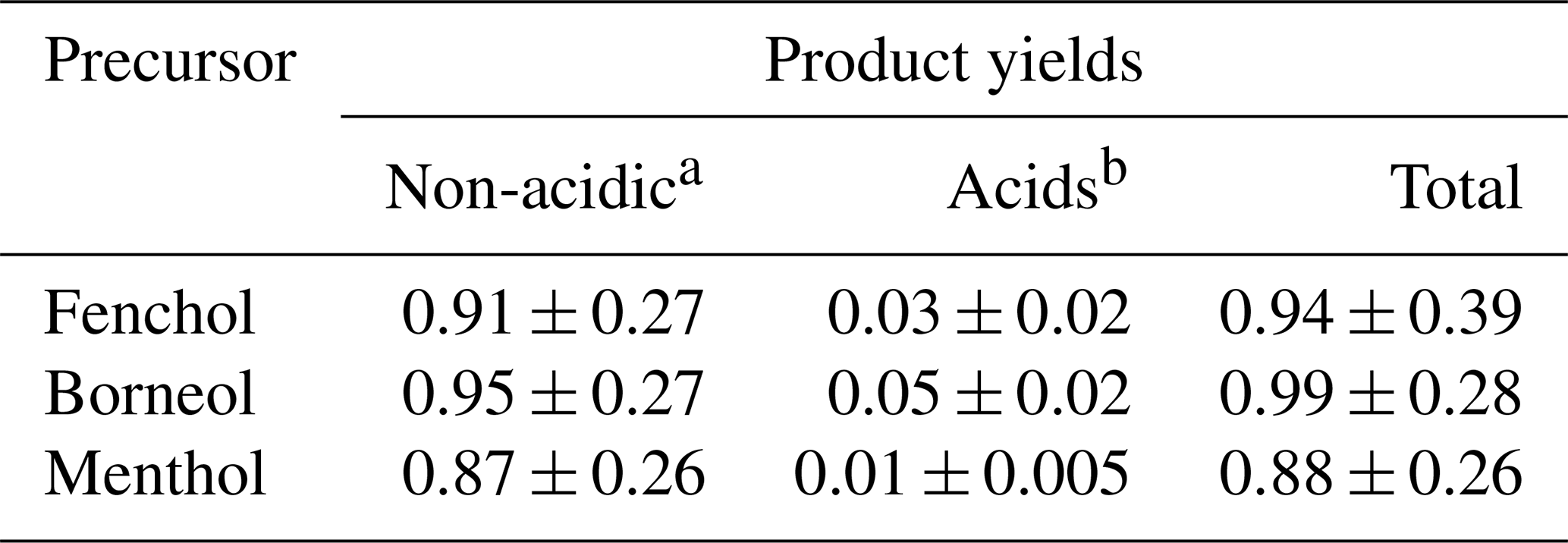
a Measured with authentic or surrogate standards. b Values obtained from the kinetic models.
The yields of TACs from Reactions (R1)–(R3) obtained in this work are comparable with the data obtained for OH reaction with terpenoic acids and diols in the gas (Müller et al., 2012) and aqueous phase (Aljawhary et al., 2016; Jain et al., 2024). Moreover, the yields of some non-acidic products in Table S16 in the Supplement are high, reaching up to 22 % for Reaction (R1) and 15 % and 19 % for Reactions (R2) and (R3), respectively. Because all possible reaction pathways were not discussed for clarity (Sect. 3.2), mechanisms of Reactions (R1)–(R3) likely involve formation of many isomeric products, which are only partially resolved by GC/MS. For this reason, the carbon mass is very likely more uniformly distributed among the isomeric products of Reactions (R1)–(R3).
The reactions of OH with MTH, FCH, BNL, and cyclohexanol were previously investigated in the gas phase (Ceacero-Vega et al., 2012). For instance, formation of fenchone and products F5–F7 from Reaction (R1) and B1, B2, B6, and B7 from Reaction (R2) was observed, likely occurring via similar mechanisms, but product yields in the gas phase were not reported (Ceacero-Vega et al., 2012). At the same time, the formation of TACs from Reactions (R1)–(R3) was not previously reported, likely because low quantities of underivatized TACs are difficult to detect with GC/MS, which was previously used to study the product distribution from gas-phase oxidation of MTH, FCH, and BNL by OH (Ceacero-Vega et al., 2012). At the same time, the yields of the corresponding ketones from the OH reaction with FCH, BNL, and cyclohexanol in the gas phase were previously measured and were significantly higher than in the aqueous phase – Table 2.
Table 2Molar yields of corresponding ketones formed from the OH reaction with fenchol, borneol, menthol, and cyclohexanol in the gas and aqueous phases.
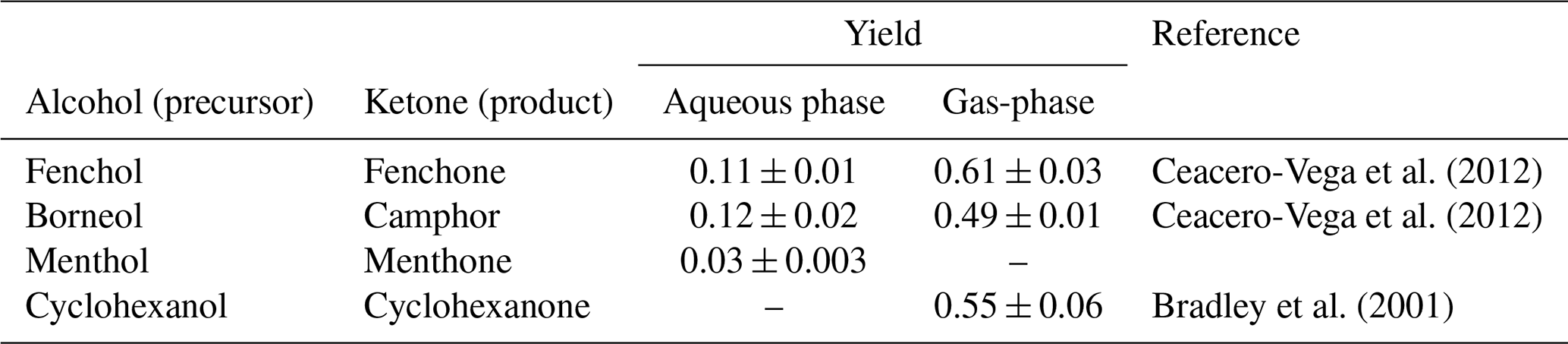
a Measured with authentic standards.
In the gas phase, the measured yields of ketones from the reaction with OH with the cyclic alcohols (Table 2) are between 0.49 and 0.61 (Table 2). These data indicate that in the gas phase, H–atom abstraction from the −OH moiety at the α-position was the main reaction pathway for the cyclic alcohols listed in Table 2 (Bradley et al., 2001; Puchkov et al., 2005). This conclusion is also supported by the partial values estimated with SAR (Ceacero-Vega et al., 2012), indicating that H-atom abstraction in the α-position of −OH is a major reaction channel (ca. 60 %) for cyclic alcohols, consistent with the measured yields of corresponding ketones (Ceacero-Vega et al., 2012). At the same time, according to aqueous SAR, the abstraction of the H–atom adjacent to the −OH group contributes 5 %–15 % to the total . These SAR predictions (Fig. 5) are consistent with the experimental data acquired in this work (Table 2), supporting differences in intramolecular selectivity of OH in reactions with TAs in the gas and aqueous phases, leading to lower yields of primary ketones from Reactions (R1)–(R3), compared with the reactions in the gas phase.
3.4 Kinetic models
The kinetic models for Reactions (R1)–(R3) are based on the measured product yields (Tables S16 and S17 in the Supplement) and their proposed formation pathways (Schemes 1–7). Even though the model was based on a simplified mechanism of Reactions (R1)–(R3), a good agreement with the experimental data was obtained. Measured and modelled temporal evolution of reactants in Reaction (R1) is presented in Fig. 6, while data for Reactions (R2) and (R3) are provided in Figs. S6 and S7 in the Supplement, respectively.
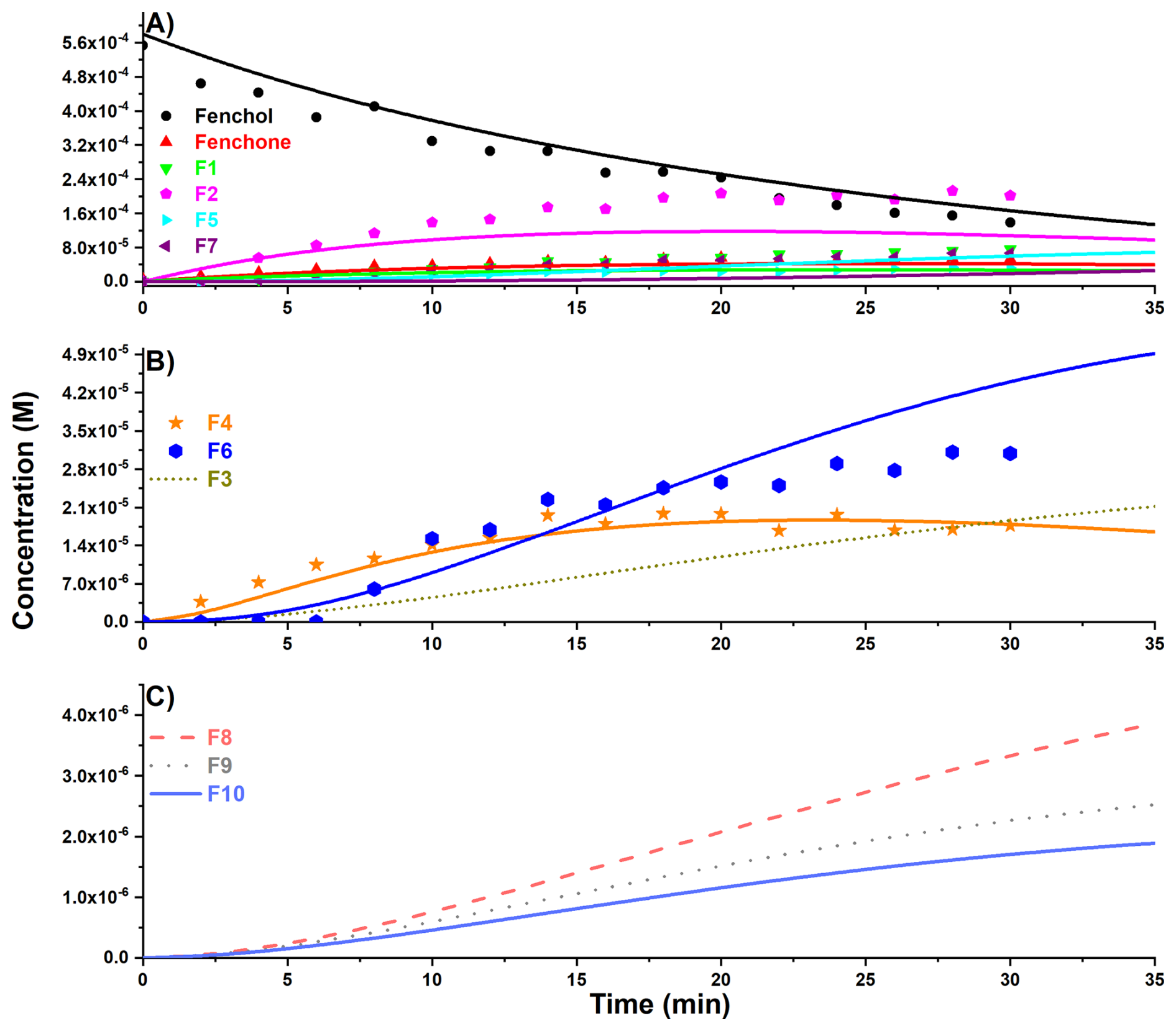
Figure 6Measured and modeled temporal evolution of the reactants for the fenchol + OH reaction (R1). Points represent experimental data, and lines are the temporal profiles generated by the model. Structures of non-acidic (A, B) and acidic (C) products are shown in Schemes 1 and 2, respectively.
For Reaction (R1), the box model reproduced the temporal evolution of the reactants with good accuracy (Fig. 6A and B) and was used to derive the yields of some products, particularly TACs (Fig. 6C). Only model data are shown for TACs and some non-acidic products since their yields could not be measured (Sect. 2.7). The predicted temporal evolution was combined with Hcc values for the reactants to estimate the yields of aqSOAs from Reactions (R1)–(R3).
As discussed in our previous work, Reactions (R1)–(R3) can be relevant in the atmosphere for LWC≥0.1 g m−3 (Witkowski et al., 2024). The values measured in our previous study indicated that liquid water affects the lifetimes of MTH, FCH, and BNL in clouds, fogs, and rain. The lifetimes, estimated for the average [OH]aq between M (urban clouds) and M (remote clouds), ranged from 10 to 300 h (Bianco et al., 2020). The lower limit estimate is comparable with the time an air parcel spends inside the cloud, which was estimated at 18 h (Herrmann et al., 2015). Furthermore, the lowest lifetimes were obtained for marine clouds with the average M, which were on the order of minutes (Witkowski et al., 2024). Even though the three TAs under investigation have no documented emission sources from marine biota, reactions in marine clouds may still be relevant due to the (long-range) atmospheric transport and near the shoreline (Coggon et al., 2014).
Furthermore, these lifetime estimates only consider OH diffusion from the gas phase following Henry's Law equilibrium (Sarang et al., 2021). At the same time, OH can also be formed in cloud water, which involves the photolysis of H2O2 and organic hydroperoxides, Fenton and Fenton-like reactions, and ozonolysis of dissolved organic matter (Kuang et al., 2020a; Bianco et al., 2020). Such processes can increase cloud water [OH]aq to micromolar levels (Paulson et al., 2019), thereby shortening the lifetimes of semi-volatile TAs even by a few orders of magnitude.
Consequently, the mass yields of aqSOAs from Reactions (R1)–(R3) were derived with Eq. (2) for LWC values ranging from 0.03 to 3 (g m−3) – Fig. 7.
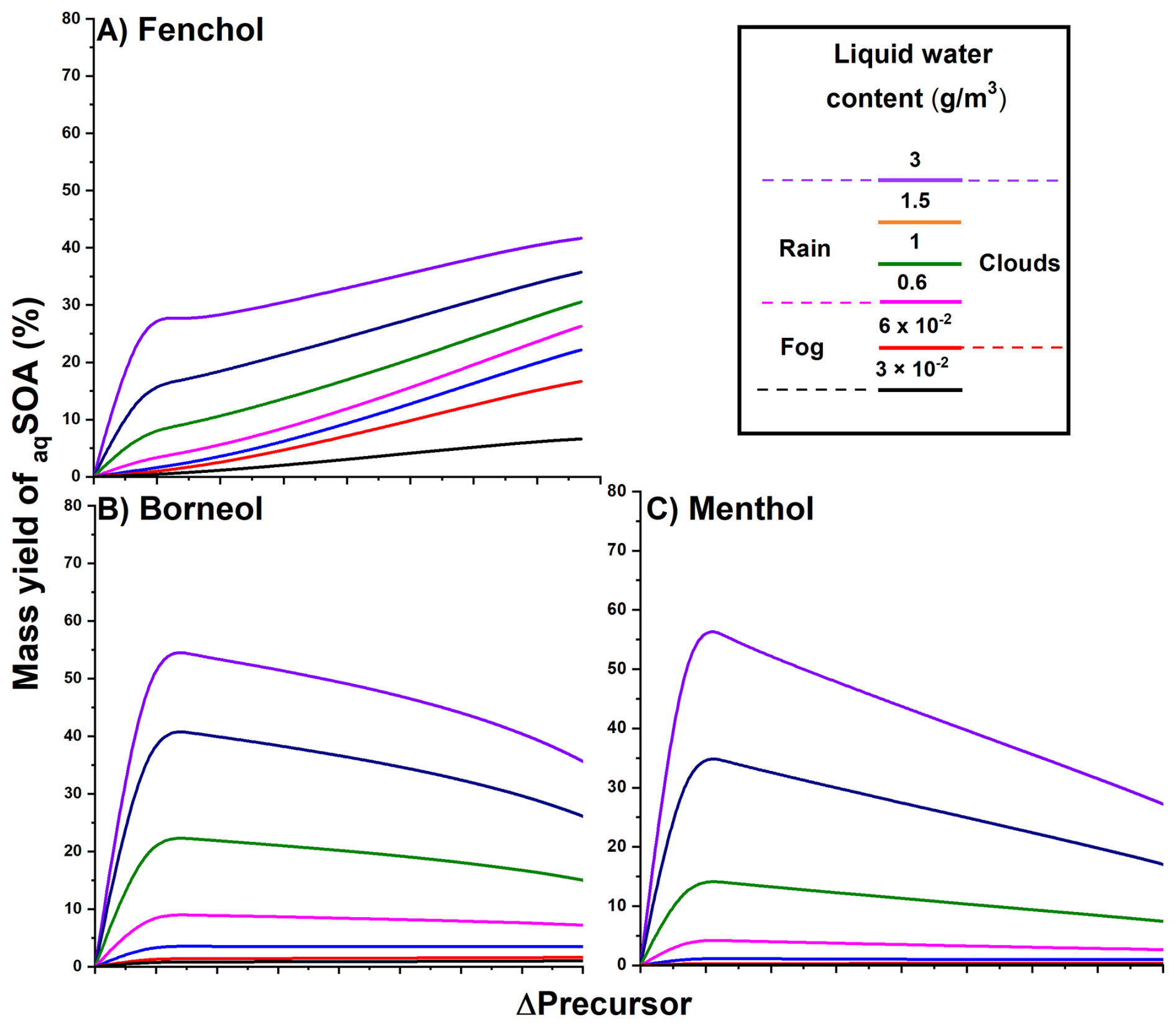
Figure 7Modelled yields of aqSOA from fenchol (A), borneol (B), and menthol (C) as a function of LWC and reaction coordinate.
The main components of aqSOA formed from Reactions (R1)–(R3) at LWC between 0.3–3 (g m−3) are the first- and second-generation TACs. However, at higher LWC, the relative contribution of non-acidic products, which were formed with much higher yields than TACs (Table 1), becomes dominant. The initial spikes in the mass yields of aqSOA are also due to the non-acidic products partitioning into the aqueous phase – Fig. 7. An increase in the yield of aqSOA for FCH (Fig. 7A) at the later stages of the reaction was observed, whereas BNL and MTH exhibited the opposite trend (Fig. 7B and C). The trends observed in Fig. 7B and C are due to the loss of the higher-generation (low-volatility) products during the initial and intermediate stages of the reaction (Sects. 3.1–3.3). These higher-generation products of Reactions (R2) and (R3) (Tables S8 and S9) are completely oxidized and thus removed by the time the precursors are consumed.
The yield of aqSOA from Reaction (R3) (Fig. 7C) was somewhat lower than that of Reaction (R2) (Fig. 7B). This can be due to the absence of the bridged cyclohexane ring in MTH, resulting in a higher degree of fragmentation of the carbon skeleton, thereby lowering the yield of aqSOA. For instance, in a study on the atmospheric degradation of cyclohexanol by OH, greater fragmentation of the precursor was observed, resulting in the formation of straight-chain alcohols and carbonyls (Bradley et al., 2001). In contrast, oxidation of precursors with bridged C6 rings yielded less fragmented products (Ceacero-Vega et al., 2012). The increase in aqSOA in Fig. 7A is attributed to the significantly high Hcc values of the products of Reaction (R1), particularly F5, F7, F9, and F10 (see Schemes 1 and 2 and Table S10). Additionally, the formation of highly oxygenated TACs (F9 and F10) from Reaction (R1) also contributed to the increase in the predicted aqSOA yield in Fig. 7A. Analogous products, with very high Hcc values, were not formed from Reactions (R2) or (R3) (Tables S11 and S12).
The modelled yields of aqSOA from Reactions (R1)–(R3) are between 10 % ± 3 % and 70 % ± 20 % (Fig. 7). In the gas phase, the yields of gasSOA of 49.0 % ± 1.0 % for BNL and 60.9 % ± 2.6 % for FCH were reported (Ceacero-Vega et al., 2012), within the range of values obtained in this work. Moreover, the yields of aqSOA for Reactions (R1)–(R3) are comparable with the values obtained for the aqueous OH reaction with terpenoic acids (Aljawhary et al., 2016), diols (Jain et al., 2024) and green-leaf volatiles (Hansel et al., 2015; Richards-Henderson et al., 2014).
In estimating the aqSOA flux, global and local scenarios are considered. As discussed in Sect. 1, the global flux of all TAs was estimated at 15 Tg yr−1 (Griffin et al., 1999). Moreover, the average stratocumulus cloud coverage is 20 %, and 15 % of the lower troposphere is filled with clouds (Hoffmann et al., 2018; Prisle, 2021). Hence, taking into account the emissions of TAs (Tg yr−1), availability of the aqueous reaction medium (15 %), the aerosol yields estimated in this work (0.1–0.7) and their uncertainty (±30 %), the global flux of aqSOAs from the reactions of TAs with OH can be roughly constrained between 0.2 ± 0.1 and 1.5 ± 0.5 Tg yr−1. These values are comparable with the fluxes of aqSOA previously estimated for WSOC produced from OH-oxidation of α-pinene (1.3 Tg yr−1) and limonene (0.15 Tg yr−1) (Zaragoza et al., 2026), glyoxal and methylglyoxal (2–23 Tg yr−1) (Ervens, 2015). Hence, the estimated fluxes of aqSOA from TAs are significant when compared with the estimated flux of aqSOAs (∼20–30 Tg yr−1) from WSOCs derived from isoprene, monoterpenes and aromatics (Liu et al., 2012), but still much lower than the total flux of BSOAs estimated at ∼107 Tg yr−1 (Hodzic et al., 2016; Kelly et al., 2018; Spracklen et al., 2011).
At the same time, emissions of BVOCs, including TAs and MTDs, vary strongly with vegetation type, phenological stage, and disturbance. For instance, among VOCs emitted by citrus trees, a TA (linalool) was the most abundant, exceeding the contribution from limonene and α-pinene by a factor of 10 and 20, respectively, with a 30-fold increase in emission during flowering (Gentner et al., 2014). Therefore, such episodic emissions can be regionally relevant, particularly during flowering, with some aromatic plants emitting terpene mixtures strongly enriched in oxygenated compounds. For example, oxygenated monoterpenes represented 62.3 % of the leaf essential oil of Tarchonanthus camphoratus, with fenchol and α-terpineol accounting for 15.9 % and 13.2 %, respectively, compared with only 6.87 % α-pinene and 1.18 % limonene (Matasyoh et al., 2007). Although essential-oil composition cannot be equated directly with atmospheric flux, it identifies vegetation in which damage, harvesting, or heat-driven volatilization can produce emission mixtures enriched in TAs (Matasyoh et al., 2007). Field observations also indicate that emissions of oxygenated terpenoids coexist with rapid local oxidation. For instance, in the Landes pine forest, compounds consistent with linalool, linalool oxide, and camphor exhibited increased night time emissions, whereas more oxygenated secondary terpenoids peaked during the day (Li et al., 2020). These data indicate that aqueous processing of TAs may become particularly important in foggy or cloudy air masses passing over flowering plantations, aromatic vegetation, or recently disturbed canopies. Under such conditions, the combination of locally elevated precursor concentrations and higher LWC could contribute substantially to the local aqSOA flux.
This work provides a comprehensive mechanistic and quantitative investigation of aqueous OH reactions with three representative TAs – FCH, BNL, and MTH. The results obtained demonstrate that these semi-volatile oxygenated terpenoids undergo efficient aqueous oxidation, primarily yielding multifunctional, non-acidic products and smaller but atmospherically important fractions of low-volatility terpenoic acids.
The near-unity molar yields of quantified products strongly indicate that the major reaction pathways were identified, enabling the development of explicit kinetic box models that successfully reproduce experimental observations. The proposed mechanisms reveal that, in contrast to the gas phase, aqueous-phase oxidation favors pathways involving H–atom abstraction from the carbon skeleton rather than the α-position of the hydroxyl group, highlighting the importance of solvation effects and different transition-state stabilization in both phases.
A key outcome of this study is the first quantitative estimation of aqSOA mass yields from terpenoic monoalcohols, reaching up to ∼70 % in air masses with high liquid water content. These yields are comparable with the previously reported gasSOA formation for similar precursors and oxygenated organic gases. Moreover, aqSOA formation from TAs may contribute to BSOA, particularly in regions with high MTD emissions.
Overall, the presented findings demonstrate that oxygenated monoterpenes, including non-acidic terpenoids, can be efficient precursors of aqSOA. The mechanistic insights and quantitative parameters provide a foundation for improved representation of multiphase SOA formation in atmospheric models.
Data can be obtained by contacting the corresponding author.
The supplement related to this article is available online at https://doi.org/10.5194/acp-26-13001-2026-supplement.
BW designed the study and developed the methodology. PJ and AB performed the experiments, analyzed, and interpreted the raw data. BW and TG supervised the study; TG provided the funding and infrastructure. PJ and BW wrote the original draft. All authors contributed to the manuscript writing and editing.
The contact author has declared that none of the authors has any competing interests.
Publisher's note: Copernicus Publications remains neutral with regard to jurisdictional claims made in the text, published maps, institutional affiliations, or any other geographical representation in this paper. The authors bear the ultimate responsibility for providing appropriate place names. Views expressed in the text are those of the authors and do not necessarily reflect the views of the publisher.
This work was carried out at the Biological and Chemical Research Centre, University of Warsaw, established within the project co-financed by the European Union from the European Regional Development Fund under the Operational Programme Innovative Economy, 2007–2013. We thank the anonymous reviewers for their insightful comments and suggestions that helped to enhance the scientific quality of this article.
This research has been supported by the Narodowe Centrum Nauki (grant no. 2021/43/B/ST10/00931).
This paper was edited by John Liggio and reviewed by two anonymous referees.
Abatzoglou, J. T., Kolden, C. A., Cullen, A. C., Sadegh, M., Williams, E. L., Turco, M., and Jones, M. W.: Climate change has increased the odds of extreme regional forest fire years globally, Nat. Commun., 16, 6390, https://doi.org/10.1038/s41467-025-61608-1, 2025.
Aljawhary, D., Zhao, R., Lee, A. K. Y., Wang, C., and Abbatt, J. P. D.: Kinetics, Mechanism, and Secondary Organic Aerosol Yield of Aqueous Phase Photo-oxidation of α-Pinene Oxidation Products, J. Phys. Chem. A, 120, 1395–1407, https://doi.org/10.1021/acs.jpca.5b06237, 2016.
Amorim, J. V., Wu, S., Klimchuk, K., Lau, C., Williams, F. J., Huang, Y., and Zhao, R.: pH Dependence of the OH Reactivity of Organic Acids in the Aqueous Phase, Environ. Sci. Technol., 54, 12484–12492, https://doi.org/10.1021/acs.est.0c03331, 2020.
Amorim, J. V., Guo, X., Gautam, T., Fang, R., Fotang, C., Williams, F. J., and Zhao, R.: Photo-oxidation of pinic acid in the aqueous phase: a mechanistic investigation under acidic and basic pH conditions, Environ. Sci.: Atmos., 1, 276–287, https://doi.org/10.1039/D1EA00031D, 2021.
Angulo Milhem, S., Verriele, M., Nicolas, M., and Thevenet, F.: Indoor use of essential oil-based cleaning products: Emission rate and indoor air quality impact assessment based on a realistic application methodology, Atmos. Environ., 246, 118060, https://doi.org/10.1016/j.atmosenv.2020.118060, 2021.
Bennett, J. E. and Summers, R.: Product Studies of the Mutual Termination Reactions of sec-Alkylperoxy Radicals: Evidence for Non-Cyclic Termination, Can. J. Chem., 52, 1377–1379, https://doi.org/10.1139/v74-209, 1974.
Bergmann, A. J., Points, G. L., Scott, R. P., Wilson, G., and Anderson, K. A.: Development of quantitative screen for 1550 chemicals with GC-MS, Anal. Bioanal. Chem., 410, 3101–3110, https://doi.org/10.1007/s00216-018-0997-7, 2018.
Bhatia, S. P., Letizia, C. S., and Api, A. M.: Fragrance material review on borneol, Food Chem. Toxicol., 46, S77–S80, https://doi.org/10.1016/j.fct.2008.06.031, 2008a.
Bhatia, S. P., McGinty, D., Letizia, C. S., and Api, A. M.: Fragrance material review on fenchyl alcohol, Food Chem. Toxicol., 46, S157–S159, https://doi.org/10.1016/j.fct.2008.06.047, 2008b.
Bianco, A., Passananti, M., Brigante, M., and Mailhot, G.: Photochemistry of the Cloud Aqueous Phase: A Review, Molecules, 25, 423, https://doi.org/10.3390/molecules25020423, 2020.
Bleier, D. B. and Elrod, M. J.: Kinetics and Thermodynamics of Atmospherically Relevant Aqueous Phase Reactions of α-Pinene Oxide, J. Phys. Chem. A, 117, 4223–4232, https://doi.org/10.1021/jp402093x, 2013.
Bradley, W. R., Wyatt, S. E., Wells, J. R., Henley, M. V., and Graziano, G. M.: The Hydroxyl Radical Reaction Rate Constant and Products of Cyclohexanol, Int. J. Chem. Kinet., 33, 108–117, https://doi.org/10.1002/1097-4601(200102)33:2<108::AID-KIN1002>3.0.CO;2-%23, 2001.
Braun, W., Herron, J. T., and Kahaner, D. K.: Acuchem: A computer program for modeling complex chemical reaction systems, Int. J. Chem. Kinet., 20, 51–62, https://doi.org/10.1002/kin.550200107, 1988.
Caputi, L. and Aprea, E.: Use of terpenoids as natural flavouring compounds in food industry, Recent Pat. Food Nutr. Agric., 3, 9–16, https://doi.org/10.2174/2212798411103010009, 2011.
Carlton, A. G., Christiansen, A. E., Flesch, M. M., Hennigan, C. J., and Sareen, N.: Multiphase Atmospheric Chemistry in Liquid Water: Impacts and Controllability of Organic Aerosol, Accounts Chem. Res., 53, 1715–1723, https://doi.org/10.1021/acs.accounts.0c00301, 2020.
Ceacero-Vega, A. A., Ballesteros, B., Bejan, I., Barnes, I., Jiménez, E., and Albaladejo, J.: Kinetics and mechanisms of the tropospheric reactions of menthol, borneol, fenchol, camphor, and fenchone with hydroxyl radicals (OH) and chlorine atoms (Cl), J. Phys. Chem. A, 116, 4097–4107, https://doi.org/10.1021/jp212076g, 2012.
Coggon, M. M., Sorooshian, A., Wang, Z., Craven, J. S., Metcalf, A. R., Lin, J. J., Nenes, A., Jonsson, H. H., Flagan, R. C., and Seinfeld, J. H.: Observations of continental biogenic impacts on marine aerosol and clouds off the coast of California, J. Geophys. Res.-Atmos., 119, 6724–6748, https://doi.org/10.1002/2013JD021228, 2014.
Decesari, S., Sowlat, M. H., Hasheminassab, S., Sandrini, S., Gilardoni, S., Facchini, M. C., Fuzzi, S., and Sioutas, C.: Enhanced toxicity of aerosol in fog conditions in the Po Valley, Italy, Atmos. Chem. Phys., 17, 7721–7731, https://doi.org/10.5194/acp-17-7721-2017, 2017.
Denisov, E. T. and Khudyakov, I.: Mechanisms of action and reactivities of the free radicals of inhibitors, Chem. Rev., 87, 1313–1357, https://doi.org/10.1021/cr00082a003, 1987.
Dickinson, G. N., Miller, D. D., Bajracharya, A., Bruchard, W., Durbin, T. A., McGarry, J. K. P., Moser, E. P., Nuñez, L. A., Pukkila, E. J., Scott, P. S., Sutton, P. J., and Johnston, N. A. C.: Health Risk Implications of Volatile Organic Compounds in Wildfire Smoke During the 2019 FIREX-AQ Campaign and Beyond, GeoHealth, 6, e2021GH000546, https://doi.org/10.1029/2021GH000546, 2022.
Enami, S. and Sakamoto, Y.: OH-radical oxidation of surface-active cis-pinonic acid at the air–water interface, J. Phys. Chem. A, 120, 3578–3587, https://doi.org/10.1021/acs.jpca.6b01261, 2016.
EPA: HenryWin (EPI Suite v4.11), https://www.epa.gov/tsca-screening-tools/epi-suitetm-estimation-program-interface, last access: 20 June 2023.
Ervens, B.: Modeling the processing of aerosol and trace gases in clouds and fogs, Chem. Rev., 115, 4157–4198, https://doi.org/10.1021/cr5005887, 2015.
Ervens, B., Gligorovski, S., and Herrmann, H.: Temperature-dependent rate constants for hydroxyl radical reactions with organic compounds in aqueous solutions, Phys. Chem. Chem. Phys., 5, 1811–1824, https://doi.org/10.1039/B300072A, 2003.
Ervens, B., Turpin, B. J., and Weber, R. J.: Secondary organic aerosol formation in cloud droplets and aqueous particles (aqSOA): a review of laboratory, field and model studies, Atmos. Chem. Phys., 11, 11069–11102, https://doi.org/10.5194/acp-11-11069-2011, 2011.
Fares, S., Gentner, D. R., Park, J.-H., Ormeno, E., Karlik, J., and Goldstein, A. H.: Biogenic emissions from Citrus species in California, Atmos. Environ., 45, 4557–4568, https://doi.org/10.1016/j.atmosenv.2011.05.066, 2011.
Fares, S., Park, J.-H., Gentner, D. R., Weber, R., Ormeño, E., Karlik, J., and Goldstein, A. H.: Seasonal cycles of biogenic volatile organic compound fluxes and concentrations in a California citrus orchard, Atmos. Chem. Phys., 12, 9865–9880, https://doi.org/10.5194/acp-12-9865-2012, 2012.
Fuzzi, S., Baltensperger, U., Carslaw, K., Decesari, S., Denier van der Gon, H., Facchini, M. C., Fowler, D., Koren, I., Langford, B., Lohmann, U., Nemitz, E., Pandis, S., Riipinen, I., Rudich, Y., Schaap, M., Slowik, J. G., Spracklen, D. V., Vignati, E., Wild, M., Williams, M., and Gilardoni, S.: Particulate matter, air quality and climate: lessons learned and future needs, Atmos. Chem. Phys., 15, 8217–8299, https://doi.org/10.5194/acp-15-8217-2015, 2015.
Gentner, D. R., Ormeño, E., Fares, S., Ford, T. B., Weber, R., Park, J.-H., Brioude, J., Angevine, W. M., Karlik, J. F., and Goldstein, A. H.: Emissions of terpenoids, benzenoids, and other biogenic gas-phase organic compounds from agricultural crops and their potential implications for air quality, Atmos. Chem. Phys., 14, 5393–5413, https://doi.org/10.5194/acp-14-5393-2014, 2014.
Ghaffari, Z., Rahimmalek, M., and Sabzalian, M. R.: Variation in the primary and secondary metabolites derived from the isoprenoid pathway in the Perovskia species in response to different wavelengths generated by light emitting diodes (LEDs), Ind. Crop. Prod., 140, 111592, https://doi.org/10.1016/j.indcrop.2019.111592, 2019.
Gierczak, T., Bernard, F., Papanastasiou, D. K., and Burkholder, J. B.: Atmospheric Chemistry of c-C5HF7 and c-C5F8: Temperature-Dependent OH Reaction Rate Coefficients, Degradation Products, Infrared Spectra, and Global Warming Potentials, J. Phys. Chem. A, 125, 1050–1061, https://doi.org/10.1021/acs.jpca.0c10561, 2021.
Glasius, M., Lahaniati, M., Calogirou, A., Di Bella, D., Jensen, N. R., Hjorth, J., Kotzias, D., and Larsen, B. R.: Carboxylic Acids in Secondary Aerosols from Oxidation of Cyclic Monoterpenes by Ozone, Environ. Sci. Technol., 34, 1001–1010, https://doi.org/10.1021/es990445r, 2000.
Gomez, M. E., Lin, Y., Guo, S., and Zhang, R.: Heterogeneous Chemistry of Glyoxal on Acidic Solutions. An Oligomerization Pathway for Secondary Organic Aerosol Formation, J. Phys. Chem. A, 119, 4457–4463, https://doi.org/10.1021/jp509916r, 2015.
Griffin, R. J., Cocker III, D. R., Seinfeld, J. H., and Dabdub, D.: Estimate of global atmospheric organic aerosol from oxidation of biogenic hydrocarbons, Geophys. Res. Lett., 26, 2721–2724, https://doi.org/10.1029/1999GL900476, 1999.
Guenther, A. B., Jiang, X., Heald, C. L., Sakulyanontvittaya, T., Duhl, T., Emmons, L. K., and Wang, X.: The Model of Emissions of Gases and Aerosols from Nature version 2.1 (MEGAN2.1): an extended and updated framework for modeling biogenic emissions, Geosci. Model Dev., 5, 1471–1492, https://doi.org/10.5194/gmd-5-1471-2012, 2012.
Hansel, A. K., Ehrenhauser, F. S., Richards-Henderson, N. K., Anastasio, C., and Valsaraj, K. T.: Aqueous-phase oxidation of green leaf volatiles by hydroxyl radical as a source of SOA: Product identification from methyl jasmonate and methyl salicylate oxidation, Atmos. Environ., 102, 43–51, https://doi.org/10.1016/j.atmosenv.2014.11.055, 2015.
Hatch, L. E., Jen, C. N., Kreisberg, N. M., Selimovic, V., Yokelson, R. J., Stamatis, C., York, R. A., Foster, D., Stephens, S. L., Goldstein, A. H., and Barsanti, K. C.: Highly Speciated Measurements of Terpenoids Emitted from Laboratory and Mixed-Conifer Forest Prescribed Fires, Environ. Sci. Technol., 53, 9418–9428, https://doi.org/10.1021/acs.est.9b02612, 2019.
Herrmann, H., Schaefer, T., Tilgner, A., Styler, S. A., Weller, C., Teich, M., and Otto, T.: Tropospheric Aqueous-Phase Chemistry: Kinetics, Mechanisms, and Its Coupling to a Changing Gas Phase, Chem. Rev., 115, 4259–4334, 2015.
Hodzic, A., Kasibhatla, P. S., Jo, D. S., Cappa, C. D., Jimenez, J. L., Madronich, S., and Park, R. J.: Rethinking the global secondary organic aerosol (SOA) budget: stronger production, faster removal, shorter lifetime, Atmos. Chem. Phys., 16, 7917–7941, https://doi.org/10.5194/acp-16-7917-2016, 2016.
Hoffmann, E. H., Tilgner, A., Wolke, R., Böge, O., Walter, A., and Herrmann, H.: Oxidation of substituted aromatic hydrocarbons in the tropospheric aqueous phase: kinetic mechanism development and modelling, Phys. Chem. Chem. Phys., 20, 10960–10977, https://doi.org/10.1039/c7cp08576a, 2018.
Huang, Y., Barraza, K. M., Kenseth, C. M., Zhao, R., Wang, C., Beauchamp, J. L., and Seinfeld, J. H.: Probing the OH Oxidation of Pinonic Acid at the Air–Water Interface Using Field-Induced Droplet Ionization Mass Spectrometry (FIDI-MS), J. Phys. Chem. A, 122, 6445–6456, https://doi.org/10.1021/acs.jpca.8b05353, 2018.
IPCC: AR6 Synthesis Report Climate Change 2023, Intergovernmental Panel on Climate Change, https://doi.org/10.59327/IPCC/AR6-9789291691647, 2023.
Jain, P., Witkowski, B., Błaziak, A., and Gierczak, T.: Efficient Formation of Secondary Organic Aerosols from the Aqueous Oxidation of Terpenoic 1,2-Diols by OH, Environ. Sci. Technol., 58, 22089–22103, https://doi.org/10.1021/acs.est.4c06347, 2024.
Javelle, T., Righezza, M., and Danger, G.: Identify low mass volatile organic compounds from cometary ice analogs using gas chromatography coupled to an Orbitrap mass spectrometer associated to electron and chemical ionizations, J. Chromatogr. A, 1652, 462343, https://doi.org/10.1016/j.chroma.2021.462343, 2021.
Jenkin, M. E.: Modelling the formation and composition of secondary organic aerosol from α- and β-pinene ozonolysis using MCM v3, Atmos. Chem. Phys., 4, 1741–1757, https://doi.org/10.5194/acp-4-1741-2004, 2004.
Jimenez, J. L., Canagaratna, M. R., Donahue, N. M., Prevot, A. S. H., Zhang, Q., Kroll, J. H., DeCarlo, P. F., Allan, J. D., Coe, H., Ng, N. L., Aiken, A. C., Docherty, K. S., Ulbrich, I. M., Grieshop, A. P., Robinson, A. L., Duplissy, J., Smith, J. D., Wilson, K. R., Lanz, V. A., Hueglin, C., Sun, Y. L., Tian, J., Laaksonen, A., Raatikainen, T., Rautiainen, J., Vaattovaara, P., Ehn, M., Kulmala, M., Tomlinson, J. M., Collins, D. R., Cubison, M. J., Dunlea, J., Huffman, J. A., Onasch, T. B., Alfarra, M. R., Williams, P. I., Bower, K., Kondo, Y., Schneider, J., Drewnick, F., Borrmann, S., Weimer, S., Demerjian, K., Salcedo, D., Cottrell, L., Griffin, R., Takami, A., Miyoshi, T., Hatakeyama, S., Shimono, A., Sun, J. Y., Zhang, Y. M., Dzepina, K., Kimmel, J. R., Sueper, D., Jayne, J. T., Herndon, S. C., Trimborn, A. M., Williams, L. R., Wood, E. C., Middlebrook, A. M., Kolb, C. E., Baltensperger, U., and Worsnop, D. R.: Evolution of Organic Aerosols in the Atmosphere, Science, 326, 1525–1529, https://doi.org/10.1126/science.1180353, 2009.
Jo, D. S., Nault, B. A., Tilmes, S., Gettelman, A., McCluskey, C. S., Hodzic, A., Henze, D. K., Nawaz, M. O., Fung, K. M., and Jimenez, J. L.: Global Health and Climate Effects of Organic Aerosols from Different Sources, Environ. Sci. Technol., 57, 13793–13807, https://doi.org/10.1021/acs.est.3c02823, 2023.
Joutsensaari, J., Yli-Pirilä, P., Korhonen, H., Arola, A., Blande, J. D., Heijari, J., Kivimäenpää, M., Mikkonen, S., Hao, L., Miettinen, P., Lyytikäinen-Saarenmaa, P., Faiola, C. L., Laaksonen, A., and Holopainen, J. K.: Biotic stress accelerates formation of climate-relevant aerosols in boreal forests, Atmos. Chem. Phys., 15, 12139–12157, https://doi.org/10.5194/acp-15-12139-2015, 2015.
Kamatou, G. P. P., Vermaak, I., Viljoen, A. M., and Lawrence, B. M.: Menthol: A simple monoterpene with remarkable biological properties, Phytochemistry, 96, 15–25, https://doi.org/10.1016/j.phytochem.2013.08.005, 2013.
Kamens, R. M. and Jaoui, M.: Modeling aerosol formation from alpha-pinene plus NOx in the presence of natural sunlight using gas-phase kinetics and gas-particle partitioning theory, Environ. Sci. Technol., 35, 1394–1405, https://doi.org/10.1021/es001626s, 2001.
Kanakidou, M., Seinfeld, J. H., Pandis, S. N., Barnes, I., Dentener, F. J., Facchini, M. C., Van Dingenen, R., Ervens, B., Nenes, A., Nielsen, C. J., Swietlicki, E., Putaud, J. P., Balkanski, Y., Fuzzi, S., Horth, J., Moortgat, G. K., Winterhalter, R., Myhre, C. E. L., Tsigaridis, K., Vignati, E., Stephanou, E. G., and Wilson, J.: Organic aerosol and global climate modelling: a review, Atmos. Chem. Phys., 5, 1053–1123, https://doi.org/10.5194/acp-5-1053-2005, 2005.
Kelley, D. I., Burton, C., Di Giuseppe, F., Jones, M. W., Barbosa, M. L. F., Brambleby, E., McNorton, J. R., Liu, Z., Bradley, A. S. I., Blackford, K., Burke, E., Ciavarella, A., Di Tomaso, E., Eden, J., Ferreira, I. J. M., Fiedler, L., Hartley, A. J., Keeping, T. R., Lampe, S., Lombardi, A., Mataveli, G., Qu, Y., Silva, P. S., Spuler, F. R., Steinmann, C. B., Torres-Vázquez, M. Á., Veiga, R., van Wees, D., Wessel, J. B., Wright, E., Bilbao, B., Bourbonnais, M., Gao, C., Di Bella, C. M., Dintwe, K., Donovan, V. M., Harris, S., Kukavskaya, E. A., N'Dri, A. B., Santín, C., Selaya, G., Sjöström, J., Abatzoglou, J. T., Andela, N., Carmenta, R., Chuvieco, E., Giglio, L., Hamilton, D. S., Hantson, S., Meier, S., Parrington, M., Sadegh, M., San-Miguel-Ayanz, J., Sedano, F., Turco, M., van der Werf, G. R., Veraverbeke, S., Anderson, L. O., Clarke, H., Fernandes, P. M., and Kolden, C. A.: State of Wildfires 2024–2025, Earth Syst. Sci. Data, 17, 5377–5488, https://doi.org/10.5194/essd-17-5377-2025, 2025.
Kelly, J. M., Doherty, R. M., O'Connor, F. M., and Mann, G. W.: The impact of biogenic, anthropogenic, and biomass burning volatile organic compound emissions on regional and seasonal variations in secondary organic aerosol, Atmos. Chem. Phys., 18, 7393–7422, https://doi.org/10.5194/acp-18-7393-2018, 2018.
Kenseth, C. M., Hafeman, N. J., Huang, Y., Dalleska, N. F., Stoltz, B. M., and Seinfeld, J. H.: Synthesis of Carboxylic Acid and Dimer Ester Surrogates to Constrain the Abundance and Distribution of Molecular Products in α-Pinene and β-Pinene Secondary Organic Aerosol, Environ. Sci. Technol., 54, 12829–12839, https://doi.org/10.1021/acs.est.0c01566, 2020.
Khalaj, F., Gu, S., Mehra, A., Williams, L. R., Krechmer, J., Lambe, A., Perraud, V., and Faiola, C. L.: Aerosol chemistry of oxygenated terpenes in simple and complex chemical systems, Aerosol Sci. Tech., 59, 470–486, https://doi.org/10.1080/02786826.2024.2427283, 2025.
Kim, S., Karl, T., Guenther, A., Tyndall, G., Orlando, J., Harley, P., Rasmussen, R., and Apel, E.: Emissions and ambient distributions of Biogenic Volatile Organic Compounds (BVOC) in a ponderosa pine ecosystem: interpretation of PTR-MS mass spectra, Atmos. Chem. Phys., 10, 1759–1771, https://doi.org/10.5194/acp-10-1759-2010, 2010.
Kivimäenpää, M., Ghimire, R. P., Sutinen, S., Häikiö, E., Kasurinen, A., Holopainen, T., and Holopainen, J. K.: Increases in volatile organic compound emissions of Scots pine in response to elevated ozone and warming are modified by herbivory and soil nitrogen availability, Eur. J. For. Res., 135, 343–360, https://doi.org/10.1007/s10342-016-0939-x, 2016.
Klein, F., Farren, N. J., Bozzetti, C., Daellenbach, K. R., Kilic, D., Kumar, N. K., Pieber, S. M., Slowik, J. G., Tuthill, R. N., Hamilton, J. F., Baltensperger, U., Prévôt, A. S. H., and El Haddad, I.: Indoor terpene emissions from cooking with herbs and pepper and their secondary organic aerosol production potential, Sci. Rep.-UK, 6, 36623, https://doi.org/10.1038/srep36623, 2016.
Kopinke, F.-D. and Georgi, A.: What Controls Selectivity of Hydroxyl Radicals in Aqueous Solution? Indications for a Cage Effect, J. Phys. Chem. A, 121, 7947–7955, https://doi.org/10.1021/acs.jpca.7b05782, 2017.
Kourtchev, I., Fuller, S. J., Giorio, C., Healy, R. M., Wilson, E., O'Connor, I., Wenger, J. C., McLeod, M., Aalto, J., Ruuskanen, T. M., Maenhaut, W., Jones, R., Venables, D. S., Sodeau, J. R., Kulmala, M., and Kalberer, M.: Molecular composition of biogenic secondary organic aerosols using ultrahigh-resolution mass spectrometry: comparing laboratory and field studies, Atmos. Chem. Phys., 14, 2155–2167, https://doi.org/10.5194/acp-14-2155-2014, 2014.
Kuang, X. M., Gonzalez, D. H., Scott, J. A., Vu, K., Hasson, A., Charbouillot, T., Hawkins, L., and Paulson, S. E.: Cloud Water Chemistry Associated with Urban Aerosols: Rapid Hydroxyl Radical Formation, Soluble Metals, Fe(II), Fe(III), and Quinones, ACS Earth Space Chem., 4, 67–76, https://doi.org/10.1021/acsearthspacechem.9b00243, 2020a.
Kuang, Y., He, Y., Xu, W., Yuan, B., Zhang, G., Ma, Z., Wu, C., Wang, C., Wang, S., Zhang, S., Tao, J., Ma, N., Su, H., Cheng, Y., Shao, M., and Sun, Y.: Photochemical Aqueous-Phase Reactions Induce Rapid Daytime Formation of Oxygenated Organic Aerosol on the North China Plain, Environ. Sci. Technol., 54, 3849–3860, https://doi.org/10.1021/acs.est.9b06836, 2020b.
Kwok, E. S. C. and Atkinson, R.: Estimation of hydroxyl radical reaction rate constants for gas-phase organic compounds using a structure-reactivity relationship: An update, Atmos. Environ., 29, 1685–1695, https://doi.org/10.1016/1352-2310(95)00069-B, 1995.
Lai, D., Bai, Y., Zhang, Z., So, P.-K., Li, Y. J., Tse, Y.-L. S., Yeung, Y.-Y., Schaefer, T., Herrmann, H., Yu, J. Z., Wang, Y., and Chan, M. N.: Rapid aqueous-phase oxidation of an α-pinene-derived organosulfate by hydroxyl radicals: a potential source of some unclassified oxygenated and small organosulfates in the atmosphere, Atmos. Chem. Phys., 25, 12569–12584, https://doi.org/10.5194/acp-25-12569-2025, 2025.
Leviss, D. H., Van Ry, D. A., and Hinrichs, R. Z.: Multiphase Ozonolysis of Aqueous α-Terpineol, Environ. Sci. Technol., 50, 11698–11705, https://doi.org/10.1021/acs.est.6b03612, 2016.
Li, H., Riva, M., Rantala, P., Heikkinen, L., Daellenbach, K., Krechmer, J. E., Flaud, P.-M., Worsnop, D., Kulmala, M., Villenave, E., Perraudin, E., Ehn, M., and Bianchi, F.: Terpenes and their oxidation products in the French Landes forest: insights from Vocus PTR-TOF measurements, Atmos. Chem. Phys., 20, 1941–1959, https://doi.org/10.5194/acp-20-1941-2020, 2020.
Lim, Y. B., Tan, Y., Perri, M. J., Seitzinger, S. P., and Turpin, B. J.: Aqueous chemistry and its role in secondary organic aerosol (SOA) formation, Atmos. Chem. Phys., 10, 10521–10539, https://doi.org/10.5194/acp-10-10521-2010, 2010.
Liu, D., Zhang, Y., Zhong, S., Chen, S., Xie, Q., Zhang, D., Zhang, Q., Hu, W., Deng, J., Wu, L., Ma, C., Tong, H., and Fu, P.: Large differences of highly oxygenated organic molecules (HOMs) and low-volatile species in secondary organic aerosols (SOAs) formed from ozonolysis of β-pinene and limonene, Atmos. Chem. Phys., 23, 8383–8402, https://doi.org/10.5194/acp-23-8383-2023, 2023.
Liu, J., Horowitz, L. W., Fan, S., Carlton, A. G., and Levy II, H.: Global in-cloud production of secondary organic aerosols: Implementation of a detailed chemical mechanism in the GFDL atmospheric model AM3, J. Geophys. Res.-Atmos., 117, https://doi.org/10.1029/2012JD017838, 2012.
Mahilang, M., Deb, M. K., and Pervez, S.: Biogenic secondary organic aerosols: A review on formation mechanism, analytical challenges and environmental impacts, Chemosphere, 262, 127771, https://doi.org/10.1016/j.chemosphere.2020.127771, 2021.
Matasyoh, J. C., Kiplimo, J. J., Karubiu, N. M., and Hailstorks, T. P.: Chemical composition and antimicrobial activity of essential oil of Tarchonanthus camphoratus, Food Chem., 101, 1183–1187, https://doi.org/10.1016/j.foodchem.2006.03.021, 2007.
McKinney, K. A., Lee, B. H., Vasta, A., Pho, T. V., and Munger, J. W.: Emissions of isoprenoids and oxygenated biogenic volatile organic compounds from a New England mixed forest, Atmos. Chem. Phys., 11, 4807–4831, https://doi.org/10.5194/acp-11-4807-2011, 2011.
Mehra, A., Krechmer, J. E., Lambe, A., Sarkar, C., Williams, L., Khalaj, F., Guenther, A., Jayne, J., Coe, H., Worsnop, D., Faiola, C., and Canagaratna, M.: Oligomer and highly oxygenated organic molecule formation from oxidation of oxygenated monoterpenes emitted by California sage plants, Atmos. Chem. Phys., 20, 10953–10965, https://doi.org/10.5194/acp-20-10953-2020, 2020.
Mekic, M., Liu, J., Zhou, W., Loisel, G., Cai, J., He, T., Jiang, B., Yu, Z., Lazarou, Y. G., Li, X., Brigante, M., Vione, D., and Gligorovski, S.: Formation of highly oxygenated multifunctional compounds from cross-reactions of carbonyl compounds in the atmospheric aqueous phase, Atmos. Environ., 219, 117046, https://doi.org/10.1016/j.atmosenv.2019.117046, 2019.
Mellouki, A., Le Bras, G., and Sidebottom, H.: Kinetics and Mechanisms of the Oxidation of Oxygenated Organic Compounds in the Gas Phase, Chem. Rev., 103, 5077–5096, https://doi.org/10.1021/cr020526x, 2003.
Mellouki, A., Wallington, T. J., and Chen, J.: Atmospheric Chemistry of Oxygenated Volatile Organic Compounds: Impacts on Air Quality and Climate, Chem. Rev., 115, 3984–4014, https://doi.org/10.1021/cr500549n, 2015.
Minakata, D. and von Gunten, U.: Predicting transformation products during aqueous oxidation processes: current state and outlook, Environ. Sci. Technol., 57, 18410–18419, https://doi.org/10.1021/acs.est.3c04086, 2023.
Monod, A. and Doussin, J. F.: Structure-activity relationship for the estimation of OH-oxidation rate constants of aliphatic organic compounds in the aqueous phase: alkanes, alcohols, organic acids and bases, Atmos. Environ., 42, 7611–7622, https://doi.org/10.1016/j.atmosenv.2008.06.005, 2008.
Müller, L., Reinnig, M.-C., Naumann, K. H., Saathoff, H., Mentel, T. F., Donahue, N. M., and Hoffmann, T.: Formation of 3-methyl-1,2,3-butanetricarboxylic acid via gas phase oxidation of pinonic acid – a mass spectrometric study of SOA aging, Atmos. Chem. Phys., 12, 1483–1496, https://doi.org/10.5194/acp-12-1483-2012, 2012.
Odum, J. R., Hoffmann, T., Bowman, F., Collins, D., Flagan, R. C., and Seinfeld, J. H.: Gas/Particle Partitioning and Secondary Organic Aerosol Yields, Environ. Sci. Technol., 30, 2580–2585, https://doi.org/10.1021/es950943+, 1996.
Otto, T., Schaefer, T., and Herrmann, H.: Aqueous-Phase Oxidation of Terpene-Derived Acids by Atmospherically Relevant Radicals, J. Phys. Chem. A, 122, 9233–9241, https://doi.org/10.1021/acs.jpca.8b08922, 2018.
Paglione, M., Gilardoni, S., Rinaldi, M., Decesari, S., Zanca, N., Sandrini, S., Giulianelli, L., Bacco, D., Ferrari, S., Poluzzi, V., Scotto, F., Trentini, A., Poulain, L., Herrmann, H., Wiedensohler, A., Canonaco, F., Prévôt, A. S. H., Massoli, P., Carbone, C., Facchini, M. C., and Fuzzi, S.: The impact of biomass burning and aqueous-phase processing on air quality: a multi-year source apportionment study in the Po Valley, Italy, Atmos. Chem. Phys., 20, 1233–1254, https://doi.org/10.5194/acp-20-1233-2020, 2020.
Pankow, J. F.: An absorption model of the gas/aerosol partitioning involved in the formation of secondary organic aerosol, Atmos. Environ., 28, 189–193, https://doi.org/10.1016/1352-2310(94)90094-9, 1994.
Paulson, S. E., Gallimore, P. J., Kuang, X. M., Chen, J. R., Kalberer, M., and Gonzalez, D. H.: A light-driven burst of hydroxyl radicals dominates oxidation chemistry in newly activated cloud droplets, Sci. Adv., 5, eaav7689, https://doi.org/10.1126/sciadv.aav7689, 2019.
Price, P., Bottorff, B., Jenkins, J., Brune, W. H., and Stevens, P. S.: Re-assessing hydroxyl radical chemistry in the atmosphere: Instrument interferences may explain previous measurement discrepancies, Commun. Earth Environ., 6, 325, https://doi.org/10.1038/s43247-025-02308-y, 2025.
Prisle, N. L.: A predictive thermodynamic framework of cloud droplet activation for chemically unresolved aerosol mixtures, including surface tension, non-ideality, and bulk–surface partitioning, Atmos. Chem. Phys., 21, 16387–16411, https://doi.org/10.5194/acp-21-16387-2021, 2021.
Puchkov, S., Buneeva, E., and Perkel', A.: Composition and stability of peroxide products of liquid-phase cyclohexanol oxidation, Kinet. Catal.+, 46, 340–343, https://doi.org/10.1007/s10975-005-0082-z, 2005.
Puchkov, S., Moskvitina, E., Nepomnyashchikh, Y. V., and Perkel', A.: Features of the kinetics of the liquid-phase oxidation of cyclohexanol, Russ. J. Phys. Chem. A, 87, 737–741, https://doi.org/10.1134/S0036024413050191, 2013.
Richards-Henderson, N. K., Hansel, A. K., Valsaraj, K. T., and Anastasio, C.: Aqueous oxidation of green leaf volatiles by hydroxyl radical as a source of SOA: Kinetics and SOA yields, Atmos. Environ., 95, 105–112, https://doi.org/10.1016/j.atmosenv.2014.06.026, 2014.
Rosales, C. M. F., Jiang, J., Lahib, A., Bottorff, B. P., Reidy, E. K., Kumar, V., Tasoglou, A., Huber, H., Dusanter, S., Tomas, A., Boor, B. E., and Stevens, P. S.: Chemistry and human exposure implications of secondary organic aerosol production from indoor terpene ozonolysis, Sci. Adv., 8, eabj9156, https://doi.org/10.1126/sciadv.abj9156, 2022.
Rudakov, E. S., Volkova, L. K., and Tretyakov, V. P.: Low selectivity reactions of oh radicals with alkanes in aqueous-solutions, React. Kinet. Catal. L., 16, 333–337, https://doi.org/10.1007/BF02066586, 1981.
Russell, G. A.: Deuterium-isotope effects in the autoxidation of aralkyl hydrocarbons. Mechanism of the interaction of peroxy radicals1, J. Am. Chem. Soc., 79, 3871–3877, https://doi.org/10.1021/ja01571a068, 1957.
Sander, R.: Compilation of Henry's law constants (version 5.0.0) for water as solvent, Atmos. Chem. Phys., 23, 10901–12440, https://doi.org/10.5194/acp-23-10901-2023, 2023.
Sarang, K., Otto, T., Rudzinski, K., Schaefer, T., Grgić, I., Nestorowicz, K., Herrmann, H., and Szmigielski, R.: Reaction Kinetics of Green Leaf Volatiles with Sulfate, Hydroxyl, and Nitrate Radicals in Tropospheric Aqueous Phase, Environ. Sci. Technol., 55, 13666–13676, https://doi.org/10.1021/acs.est.1c03276, 2021.
Shakil, M. A. K., Shadin, M., Akter, K., Khalipha, A. B. R., Altemani, A. H., Altemani, F. H., Islam, M. H., Siddique, A. B., Coutinho, H. D. M., and Islam, M. T.: Anticancer effect of borneol: Mechanistic insights through literature review and in silico studies, Eur. J. Integr. Med., 83, 102634, https://doi.org/10.1016/j.eujim.2026.102634, 2026.
Shrivastava, M., Cappa, C. D., Fan, J., Goldstein, A. H., Guenther, A. B., Jimenez, J. L., Kuang, C., Laskin, A., Martin, S. T., Ng, N. L., Petaja, T., Pierce, J. R., Rasch, P. J., Roldin, P., Seinfeld, J. H., Shilling, J., Smith, J. N., Thornton, J. A., Volkamer, R., Wang, J., Worsnop, D. R., Zaveri, R. A., Zelenyuk, A., and Zhang, Q.: Recent advances in understanding secondary organic aerosol: Implications for global climate forcing, Rev. Geophys., 55, 509–559, https://doi.org/10.1002/2016RG000540, 2017.
Sindelarova, K., Markova, J., Simpson, D., Huszar, P., Karlicky, J., Darras, S., and Granier, C.: High-resolution biogenic global emission inventory for the time period 2000–2019 for air quality modelling, Earth Syst. Sci. Data, 14, 251–270, https://doi.org/10.5194/essd-14-251-2022, 2022.
Singer, B. C., Destaillats, H., Hodgson, A. T., and Nazaroff, W. W.: Cleaning products and air fresheners: emissions and resulting concentrations of glycol ethers and terpenoids, Indoor Air, 16, 179–191, https://doi.org/10.1111/j.1600-0668.2005.00414.x, 2006.
Spracklen, D. V., Jimenez, J. L., Carslaw, K. S., Worsnop, D. R., Evans, M. J., Mann, G. W., Zhang, Q., Canagaratna, M. R., Allan, J., Coe, H., McFiggans, G., Rap, A., and Forster, P.: Aerosol mass spectrometer constraint on the global secondary organic aerosol budget, Atmos. Chem. Phys., 11, 12109–12136, https://doi.org/10.5194/acp-11-12109-2011, 2011.
Su, H., Cheng, Y., and Pöschl, U.: New Multiphase Chemical Processes Influencing Atmospheric Aerosols, Air Quality, and Climate in the Anthropocene, Accounts Chem. Res., 53, 2034–2043, https://doi.org/10.1021/acs.accounts.0c00246, 2020.
Sullivan, A. P., Hodas, N., Turpin, B. J., Skog, K., Keutsch, F. N., Gilardoni, S., Paglione, M., Rinaldi, M., Decesari, S., Facchini, M. C., Poulain, L., Herrmann, H., Wiedensohler, A., Nemitz, E., Twigg, M. M., and Collett Jr., J. L.: Evidence for ambient dark aqueous SOA formation in the Po Valley, Italy, Atmos. Chem. Phys., 16, 8095–8108, https://doi.org/10.5194/acp-16-8095-2016, 2016.
Sun, Y. L., Zhang, Q., Anastasio, C., and Sun, J.: Insights into secondary organic aerosol formed via aqueous-phase reactions of phenolic compounds based on high resolution mass spectrometry, Atmos. Chem. Phys., 10, 4809–4822, https://doi.org/10.5194/acp-10-4809-2010, 2010.
Tsigaridis, K. and Kanakidou, M.: The Present and Future of Secondary Organic Aerosol Direct Forcing on Climate, Curr. Clim. Change Rep., 4, 84–98, https://doi.org/10.1007/s40641-018-0092-3, 2018.
Tsui, W. G., Woo, J. L., and McNeill, V. F.: Impact of Aerosol-Cloud Cycling on Aqueous Secondary Organic Aerosol Formation, Atmosphere-Basel, 10, 666, https://doi.org/10.3390/atmos10110666, 2019.
Valorso, R., Aumont, B., Camredon, M., Raventos-Duran, T., Mouchel-Vallon, C., Ng, N. L., Seinfeld, J. H., Lee-Taylor, J., and Madronich, S.: Explicit modelling of SOA formation from α-pinene photooxidation: sensitivity to vapour pressure estimation, Atmos. Chem. Phys., 11, 6895–6910, https://doi.org/10.5194/acp-11-6895-2011, 2011.
Wang, H., Liu, X., Wu, C., and Lin, G.: Regional to global distributions, trends, and drivers of biogenic volatile organic compound emission from 2001 to 2020, Atmos. Chem. Phys., 24, 3309–3328, https://doi.org/10.5194/acp-24-3309-2024, 2024a.
Wang, L., Lun, X., Wang, Q., and Wu, J.: Biogenic volatile organic compounds emissions, atmospheric chemistry, and environmental implications: a review, Environ. Chem. Lett., 22, 3033–3058, https://doi.org/10.1007/s10311-024-01785-5, 2024b.
Wei, Y., Wang, Y., Di, Q., Choirat, C., Wang, Y., Koutrakis, P., Zanobetti, A., Dominici, F., and Schwartz, J. D.: Short term exposure to fine particulate matter and hospital admission risks and costs in the Medicare population: time stratified, case crossover study, BMJ, 367, l6258, https://doi.org/10.1136/bmj.l6258, 2019.
Witkowski, B., Al-sharafi, M., and Gierczak, T.: Ozonolysis of β-Caryophyllonic and Limononic Acids in the Aqueous Phase: Kinetics, Product Yield, and Mechanism, Environ. Sci. Technol., 53, 8823–8832, https://doi.org/10.1021/acs.est.9b02471, 2019.
Witkowski, B., Chi, J., Jain, P., Błaziak, K., and Gierczak, T.: Aqueous OH kinetics of saturated C6–C10 dicarboxylic acids under acidic and basic conditions between 283 and 318 K; new structure-activity relationship parameters, Atmos. Environ., 267, 118761, https://doi.org/10.1016/j.atmosenv.2021.118761, 2021.
Witkowski, B., al-Sharafi, M., Błaziak, K., and Gierczak, T.: Aging of α-Pinene Secondary Organic Aerosol by Hydroxyl Radicals in the Aqueous Phase: Kinetics and Products, Environ. Sci. Technol., 57, 6040–6051, https://doi.org/10.1021/acs.est.2c07630, 2023.
Witkowski, B., Jain, P., Wileńska, B., and Gierczak, T.: Temperature-dependent aqueous OH kinetics of C2–C10 linear and terpenoid alcohols and diols: new rate coefficients, structure–activity relationship, and atmospheric lifetimes, Atmos. Chem. Phys., 24, 663–688, https://doi.org/10.5194/acp-24-663-2024, 2024.
Wu, T., Müller, T., Wang, N., Byron, J., Langer, S., Williams, J., and Licina, D.: Indoor Emission, Oxidation, and New Particle Formation of Personal Care Product Related Volatile Organic Compounds, Environ. Sci. Tech. Let., 11, 1053–1061, https://doi.org/10.1021/acs.estlett.4c00353, 2024.
Xu, L., Du, L., Tsona, N. T., and Ge, M.: Anthropogenic Effects on Biogenic Secondary Organic Aerosol Formation, Adv. Atmos. Sci., 38, 1053–1084, https://doi.org/10.1007/s00376-020-0284-3, 2021.
Yasmeen, F., Szmigielski, R., Vermeylen, R., Gómez-González, Y., Surratt, J. D., Chan, A. W. H., Seinfeld, J. H., Maenhaut, W., and Claeys, M.: Mass spectrometric characterization of isomeric terpenoic acids from the oxidation of α-pinene, β-pinene, d-limonene, and Δ3-carene in fine forest aerosol, J. Mass Spectrom., 46, 425–442, https://doi.org/10.1002/jms.1911, 2011.
Yassaa, N., Youcef Meklati, B., and Cecinato, A.: Evaluation of monoterpenic biogenic volatile organic compounds in ambient air around Eucalyptus globulus, Pinus halepensis and Cedrus atlantica trees growing in Algiers city area by chiral and achiral capillary gas chromatography, Atmos. Environ., 34, 2809–2816, https://doi.org/10.1016/S1352-2310(99)00436-7, 2000.
Yuan, Y., Mao, Y., Yuan, H., Guo, M., Zhou, G., Niinemets, Ü., and Sun, Z.: Impacts of Mechanical Injury on Volatile Emission Rate and Composition in 45 Subtropical Woody Broad-Leaved Storage and Non-Storage Emitters, Plants, 14, 821, https://doi.org/10.3390/plants14050821, 2025.
Zaragoza, M. L., Wingen, L. M., Nizkorodov, S. A., and Carlton, A. G.: Photochemical Cloud Processing of Water-Soluble Organic Gases Produced by Aqueous-Phase Photooxidation of α-Pinene, d-Limonene, and Toluene, ACS ES&T Air, 3, 1811–1821, https://doi.org/10.1021/acsestair.6c00044, 2026.
Zhang, Q., Alfarra, M. R., Worsnop, D. R., Allan, J. D., Coe, H., Canagaratna, M. R., and Jimenez, J. L.: Deconvolution and Quantification of Hydrocarbon-like and Oxygenated Organic Aerosols Based on Aerosol Mass Spectrometry, Environ. Sci. Technol., 39, 4938–4952, https://doi.org/10.1021/es048568l, 2005.
Zhang, X., McVay, R. C., Huang, D. D., Dalleska, N. F., Aumont, B., Flagan, R. C., and Seinfeld, J. H.: Formation and evolution of molecular products in α-pinene secondary organic aerosol, P. Natl. Acad. Sci. USA, 112, 14168–14173, https://doi.org/10.1073/pnas.1517742112, 2015.
Zheng, Y., Chen, Q., Cheng, X., Mohr, C., Cai, J., Huang, W., Shrivastava, M., Ye, P., Fu, P., Shi, X., Ge, Y., Liao, K., Miao, R., Qiu, X., Koenig, T. K., and Chen, S.: Precursors and Pathways Leading to Enhanced Secondary Organic Aerosol Formation during Severe Haze Episodes, Environ. Sci. Technol., 55, 15680–15693, https://doi.org/10.1021/acs.est.1c04255, 2021.
Zhu, Y., Tilgner, A., Hoffmann, E. H., Herrmann, H., Kawamura, K., Yang, L., Xue, L., and Wang, W.: Multiphase MCM–CAPRAM modeling of the formation and processing of secondary aerosol constituents observed during the Mt. Tai summer campaign in 2014, Atmos. Chem. Phys., 20, 6725–6747, https://doi.org/10.5194/acp-20-6725-2020, 2020.