
the Creative Commons Attribution 4.0 License.
the Creative Commons Attribution 4.0 License.
 | 31 Aug 2026
Resolving systematic errors in sulfate source apportionment: a field-validated kinetic isotope fractionation framework
Zhaobing Guo
Xuexue Bai
Qiwei Ai
Zizheng Xu
Shangshun Ma
Jiayu Gu
Qingjun Guo
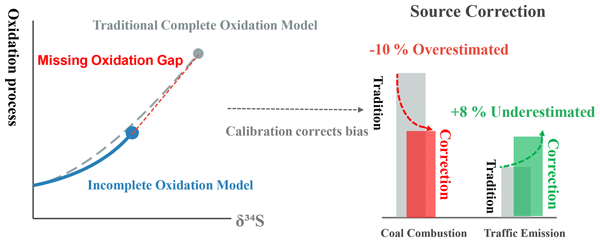
Sulfates are critical constituents of atmospheric fine particulate matter (PM2.5) that significantly influence air quality and climate dynamics. While stable isotope fractionation analysis is a powerful tool for tracing atmospheric sulfate formation mechanisms, conventional isotopic models rely on idealized complete SO2 oxidation scenarios. This oversimplification introduces systematic errors and neglects vital kinetic isotope effects generated during incomplete SO2 processing. To address this knowledge gap, we established a field-validated analytical framework combining seasonal PM2.5 observations in Nanjing, China, with Bayesian isotope mixing and process-specific Rayleigh fractionation modeling. Our kinetic fractionation-corrected approach accounts for actual atmospheric oxidation processes, revealing that transition-metal ion (TMI)-catalyzed and NO2-mediated pathways dominate secondary sulfate production. Conversely, comparative analysis demonstrates that traditional complete-oxidation models disproportionately diminish TMI pathway contributions. Furthermore, implementing kinetic fractionation corrections successfully resolves systematic biases in source apportionment. We demonstrate that traditional models misrepresent source contributions, overestimating coal combustion by 10 % and underestimating traffic emissions by 8 % during summer photochemical episodes. These findings establish a refined isotopic tracing framework that resolves long-standing calculation discrepancies. Ultimately, this framework delivers essential constraints for atmospheric sulfur cycle modeling and underscores the necessity for multi-pollutant regulation strategies targeting vehicular emissions and co-emitted transition meals.
- Article
(4248 KB) - Full-text XML
-
Supplement
(1703 KB) - BibTeX
- EndNote


Sulfate aerosols constitute a critical fraction of atmospheric particulate matter, with their formation mechanisms representing a pivotal yet unresolved aspect of air pollution control (He et al., 2012; Wang et al., 2018; Dao et al., 2019; Tao et al., 2016; Chen et al., 2023; Yu et al., 2026). The oxidation processes of sulfur dioxide (SO2) exhibit remarkable mechanistic complexity stemming from its dual physicochemical nature (Kang et al., 2016; Mukai et al., 2001; Ma et al., 2026). The exceptionally high hydration equilibrium constant drives near-instantaneous formation of S(IV) species (HSO/SO) (Zhang et al., 2026), while the thermodynamically favorable oxidation potential creates a multidimensional reaction pathways including both homogeneous radical processes and heterogeneous interfacial reactions (He et al., 2018; Harris et al., 2013b; Tanaka et al., 1994; Zhang and Chan, 2023). These intrinsic reaction dynamics, when coupled with the extreme spatiotemporal variability of atmospheric conditions, create substantial obstacles for mechanistic elucidation under ambient environments. Current investigative approaches, including controlled laboratory simulations, field measurement, and computational modeling, each face inherent limitations when applied in isolation. Laboratory studies inevitably simplify the unbounded nature of atmospheric systems, while field observations struggle to isolate specific chemical processes amid complex real-world interactions. Modeling studies (Yang et al., 2025; Zheng et al., 2024; Lin et al., 2022, 2025), though valuable for hypothesis testing, remain constrained by incomplete mechanistic understanding and parameterization challenges. This methodological trilemma has resulted in persistent knowledge gaps regarding the dominant pathways and quantitative contributions of various sulfate formation mechanisms in different atmospheric regimes.
The application of stable isotope techniques in sulfate source attribution has emerged as a powerful analytical approach, leveraging the distinct isotopic fingerprints characteristic of different pollution sources and their remarkable stability during atmospheric transport (Yang et al., 2025; Lin et al., 2022; Harris et al., 2012b; Guo et al., 2024). This methodology capitalizes on the system-specific fractionation patterns inherent to various sulfate formation pathways, which serve as critical tracers for reconstructing oxidation mechanisms. Contemporary research has quantitatively established the sulfur isotopic signatures (δ34S) (Han et al., 2022; Yang et al., 2025) associated with major atmospheric oxidation routes, including transition metal ion-catalyzed (TMI), ozone-mediated (O3), nitrogen oxide-driven (NOx), and hydrogen peroxide-initiated (H2O2) pathways, through systematic analysis of particulate matter samples (Yang et al., 2025; Fan et al., 2020a; Harris et al., 2013a; Guo et al., 2019; Ruan et al., 2025; Wang et al., 2016, 2020). Advanced analytical tools, particularly Bayesian isotopic mixing and Rayleigh fractionation models, have demonstrated substantial utility in deconvoluting complex sulfate formation mechanisms. Yet, their diagnostic potential is often overshadowed by a fundamental theoretical flaw: the reliance on complete SO2 oxidation paradigms. Because genuine atmospheric regimes rarely achieve such idealized conversion, this oversimplification severely penalizes the accuracy of sulfur transformation kinetics. Ultimately, conventional Rayleigh approaches introduce systematic uncertainties into source apportionment by neglecting the vital kinetic isotope effects and partial intermediates generated during incomplete SO2 processing.
Building upon these insights, the present study establishes a comprehensive multi-model analytical framework that synergistically couples ambient field observations with a suite of diagnostic tools, ranging from backward trajectory analysis to Bayesian isotope mixing and process-specific Rayleigh fractionation modeling. This integrated approach achieves precision in quantifying sulfate formation pathways while systematically addressing the critical but often neglected kinetic limitations inherent to incomplete SO2 oxidation under real atmospheric conditions. By applying sulfur and oxygen isotope analyses to seasonally resolved aerosol samples from Nanjing, we demonstrate significant divergence between conventional complete-oxidation Rayleigh models and our kinetic fractionation-corrected framework. Our systematic model intercomparison highlights the essential calibration requirements for stable isotope fractionation, successfully resolving the systematic biases that have long plagued sulfate source attribution. This methodological leap provides a refined method for tracking urban sulfate pollution, particularly within complex environments characterized by incomplete oxidation. Ultimately, the seasonally partitioned data from Nanjing serves as a quantitative benchmark, explicitly detailing how traditional complete-oxidation frameworks misrepresent source contributions during both summer photochemical and winter coal-combustion episodes.
2.1 Sampling Sites
The atmospheric sampling protocol employed a monitoring site (118°43′ E, 32°12′ N) (Fig. S1 in the Supplement) capturing seasonal extremes through January (winter) and July (summer) observations. A modified TH1000H high-volume sampler (Wuhan Tianhong Instrument) incorporated a dual-layer filtration assembly enabling concurrent PM2.5 and SO2 collection through co-laminated quartz (203 mm × 254 mm) and alkali-impregnated glass fiber filters (203 mm × 254 mm). Pre-treatment protocols involved muffle furnace combustion (723 K for 2 h) followed by immersion in 2 % K2CO3+2 % glycerol solution for glass fiber filters. Sampling operations maintained 1.05 m3 min−1 flow rates during 24 h cycles with meteorological parameters (wind speed/direction, temperature, pressure, humidity) continuously logged. Post-sampling handling included foil-wrapping (pre-combusted 723 K) followed by 24 h desiccation and dark refrigeration. The final dataset comprised samples after excluding precipitation events, with quartz filters positioned upstream for particulate collection and treated glass fiber membranes downstream for gaseous SO2 capture.
2.2 Sample Collection
The ionic composition analysis of PM2.5 samples was performed using Dionex ICS-3000 and ICS-2000 ion chromatography systems (Thermo Fisher Scientific) for simultaneous determination of major water-soluble ions. The analytical suite comprised five cations (Na+, NH, K+, Mg2+, Ca2+) and three anions (Cl−, NO, SO). For the determination of sulfate δ34S values, water-soluble sulfate within the filter extracts was initially isolated as BaSO4 through the addition of an excess BaCl2 solution. Because the sampling matrix inevitably captures both sulfate and sulfite, the latter originating from ambient SO2, a targeted purification protocol was introduced; specifically, treating the co-precipitate with 1 M HCl selectively dissolved any residual BaSO3 while leaving the acid-insoluble BaSO4 intact. Following collection via filtration, the purified precipitate was rinsed thoroughly with deionized water until completely free of chloride ions and subsequently dried. To eliminate potential organic interferences prior to isotopic interrogation, the dried BaSO4 underwent thermal treatment in a muffle furnace at 1073 K for 2 h. Sulfur and oxygen isotope ratios were determined by elemental analyzer (EA, Flash 2000, Thermo) combined with isotope mass spectrometer (IRMS, Delta V Plus, Finningan). Since BaSO4 is an analytical sample for the determination of sulfur and oxygen isotope values in sulfate, the determination of sulfur isotope is to thermally decompose BaSO4 and Cu2O in a vacuum state, and use the generated SO2 to analyze in a mass spectrometer (Yanagisawa and Sakai, 1983). In the determination of oxygen isotope, BaSO4 was pyrolyzed by graphite furnace at 1723 K, and the oxygen isotope value of CO produced was measured in continuous flow mode (Mizutani and Rafter, 1969). The oxygen isotope in water was determined by the automatic carbon dioxide-water equilibrium method.
To ensure robust data quality, the analytical precision for all major water-soluble ions was rigorously verified via replicate measurements, consistently yielding values better than 5 %. For the isotopic composition, results are reported in standard delta notation relative to international reference scales, specifically, Vienna Canyon Diablo Troilite (V-CDT) for δ34S and Vienna Standard Mean Ocean Water (V-SMOW) for δ18O, as formulated in Eqs. (1) and (2). Notably, our analytical system demonstrated high stability, with long-term reproducibility constrained to better than 0.2 ‰ and 0.3 ‰ for sulfur and oxygen isotopes, respectively.
Meteorological parameters and criteria air pollutant concentrations were acquired from two authoritative national databases during the sampling campaign. The China Meteorological Administration Data Service Center (https://data.cma.cn, last access: 16 August 2025) provided comprehensive weather records, while real-time air quality metrics were retrieved from the China National Environmental Monitoring Centre's online platform (http://www.aqistudy.cn/, last access: 20 August 2025), representing the official monitoring network for atmospheric composition surveillance.
2.3 Air Mass Back Trajectories and Identification of Source Regions
We conducted analysis of air mass back trajectories (Figs. S3 and S4). The potential source regions were identified with (a) cluster analysis, (b) fractional cluster contributions, and (c) concentrated weighted trajectory (CWT) analysis of sulfate concentrations (Lin et al., 2022; Dasari et al., 2020; Fan et al., 2023) (methodological details in Sect. S2 in the Supplement).
2.4 Bayesian Stable Isotope Mixing Model
The source apportionment of sulfate aerosols was conducted through Stable Isotope Analysis in R (SIAR) modeling, a Bayesian framework that probabilistically quantifies contribution distributions and associated uncertainties from multiple emission sources by processing ambient δ34S-SO measurements (Eq. 4) alongside source-specific δ34S signatures of precursor sulfur gases with all environmental samples maintaining consistent natural properties to eliminate cross-data variability particularly seasonal δ34S-SO fluctuations where the winter dataset (n=16) and summer dataset (n=15) were separately processed through SIAR to establish seasonally resolved sulfate source profiles for the Nanjing region.
The SIAR model determines the probability distribution of source contributions to mixtures and uncertainties associated with multiple sources (Fan et al., 2020a; Zheng et al., 2024; Harris et al., 2012a). In the SIAR framework, the isotopic value j in species i (Xij) is expressed as:
Where qjk is isotopic value j in source; Sjk is source k for isotope j, normally distributed with mean (μjk) and variance (); Cjk is isotopic enrichment factor for isotope j in source k, normally distributed with mean (λjk) and variance (); pk is proportion of source k; εij is residual error representing unquantified variation between individual species, normally distributed with mean (0) and variance ().
2.5 Relative Contributions of SO2 Oxidation Pathways to Sulfate Aerosols
Four sulfate formation pathways were considered: OH, , TMI, and NO2 oxidation. Given the similar fractionation factors of H2O2 and O3 (Harris et al., 2012a, b; Lin et al., 2022), we used α() to represent their combined fractionation. The temperature-independent α34S fractionation factors are calculated as (Lin et al., 2022; Fan et al., 2020b):
Where T is ambient temperature (°C). The total α34S fractionation is computed as (Fan et al., 2020b; Harris et al., 2013a):
Where fOH, , fTMI and denote relative fractions of sulfate production from respective pathways, constrained by .
2.6 Sulfur Isotope Fractionation Modeling via Rayleigh Fractionation
Due to the absence of sulfur isotope equilibrium between atmospheric SO2 and SO, the Rayleigh Fractionation model can be applied to calculate the sulfur isotope fractionation effects between them. Within this framework, the δ34S value of residual atmospheric SO2 (δ34S-SO2) is described by (Zheng et al., 2024; Lin et al., 2022):
Where α34Sg→p denotes the fractionation factor for SO2 (gaseous) → SO (particles) conversion through gas and aqueous phases, represents the δ34S value of emission sources, and SOR is the SO2 oxidation ratio, which can be calculated by the molar mass of SO2 and SO:
The source δ34S value can be estimated from isotopic mass balance:
Where δ34S-SO is the observed δ34S in sulfate. When SOR approaches 1 (complete SO2 oxidation), equals δ34S-SO. The fractionation effects α is derived by combining Eqs. (14) and (15):
The Complete Oxidation (CO) Process acts as an idealized baseline, operating on the premise that all gaseous SO2 is exhaustively converted to particulate sulfate, yielding a sulfur oxidation ratio (SOR) of 1. Consequently, this framework directly equates the calculated source isotopic signature (δ34S-source) to the measured sulfate value (δ34S-SO), intentionally omitting the isotopic fractionation kinetics that govern the oxidation pathway. In contrast, the Incomplete Oxidation (InCO) Process reflects actual atmospheric conditions, specifically the reality that SO2-to-sulfate conversion is inherently partial (SOR <1). Grounded in the Rayleigh fractionation model, this framework synchronously integrates the observed isotopic values of gaseous SO2 and particulate SO with the corresponding SOR. By doing so, it inversely derives more realistic source isotopic signatures alongside the kinetic fractionation factors (α), a conceptual advancement that forms the core innovation of our study.
2.7 Estimation of Primary Sulfate and Secondary Sulfate
The underestimation of primary sulfate emissions can partially account for the phenomenon known as missing sulfates (Ding et al., 2021). The anthropogenic primary sulfate is estimated as 3 % of anthropogenic sources of sulfur emissions in the model (Alexander et al., 2009). Assuming all the detected concentrations of SO2 and precursors of secondary sulfate are anthropogenic, we can deduce Eq. (17). Considering the influence of anthropogenic sulfate sources on primary sulfate (He et al., 2018), the method for estimating primary sulfate can be expressed as follows:
Where ntos, nps and nsas represent the molar concentrations of the total primary, and secondary atmospheric sulfate, respectively, with the primary fraction further resolved into sea-salt (nss), terrestrial (nts), and anthropogenic primary (nap) components. To constrain these natural backgrounds, we employed companion tracer concentrations and mass ratios; specifically, sea-salt sulfate was quantified from soluble Na+ assuming a purely marine origin (nss=k[Na+], where ) (Zheng et al., 2024; He et al., 2018), while terrestrial sulfate was evaluated based on crustal Ca2+ abundances () (Zheng et al., 2024; He et al., 2018; Dasari et al., 2022; Dasari and Widory, 2024). Building upon this physical allocation, the stable sulfur isotope signatures (δ34S) are integrated via an isotopic mass-balance framework to isolate the secondary formation pathways (Zheng et al., 2024):
Here, δ34Sobs denotes the bulk observed δ34S-SO value, while the terms prefixed with f represent the corresponding molar fractions of each discrete source relative to the total sulfate burden, matched with their respective endmember isotopic signatures where fps, fss, fts, fap, and fsas are the proportion of primary sulfate, sea salt sulfate, terrestrial sulfate, anthropogenic primary sulfate, and secondary sulfate, respectively (δ34Sobs, δ34Sss, δ34Sts, δ34Sap, and δ34Ssas).
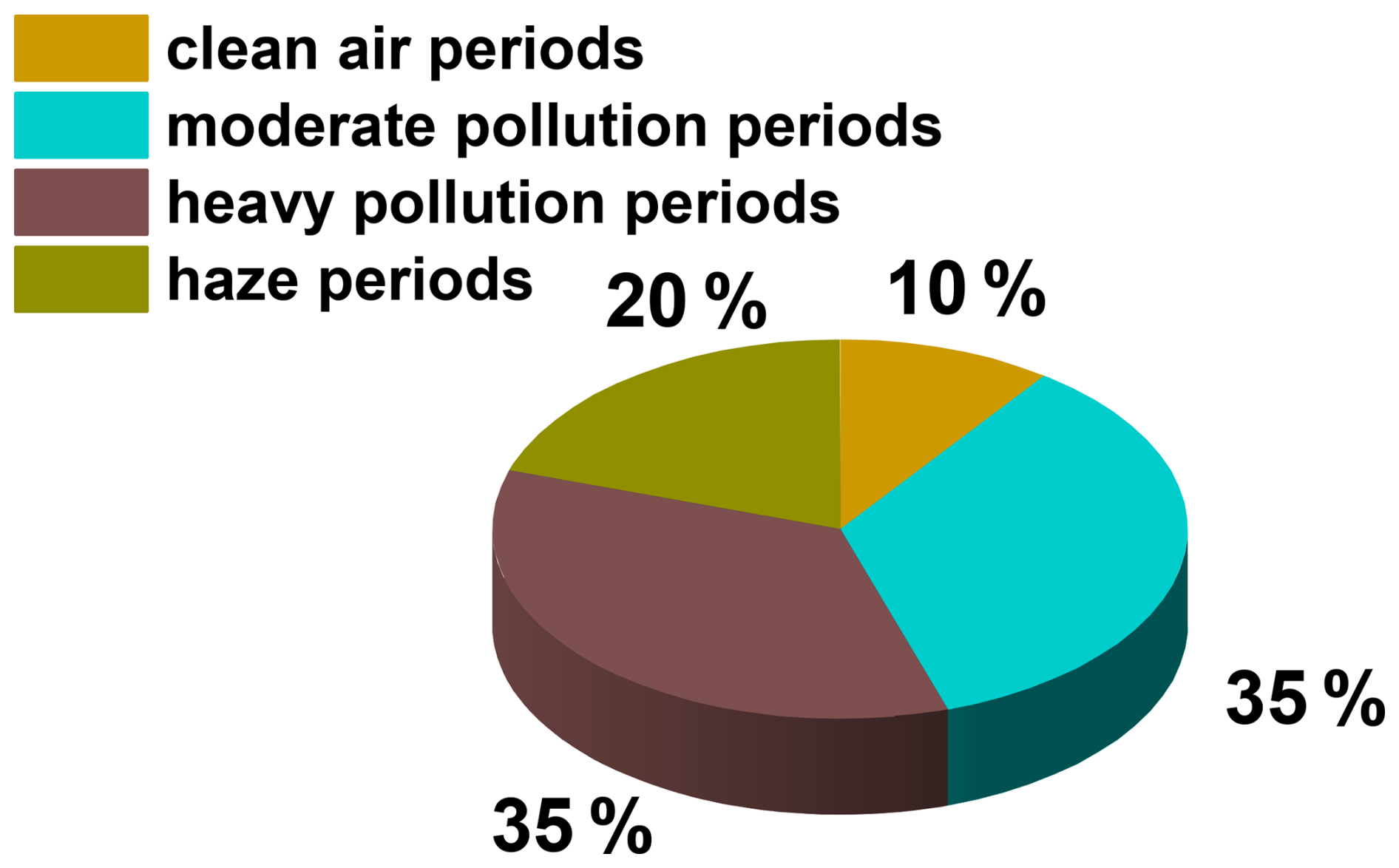
Chemical profiling of fine particulate matter in Nanjing reveals that sulfate dictates the water-soluble inorganic fraction, accounting for 27.9 % to 42.3 % of the total ionic mass. This pronounced dominance explicitly underscores the region's persistent susceptibility to sulfate-driven aerosol pollution. This pattern aligns with observations from other Chinese urban centers including Hangzhou (33.7 %) (Lin et al., 2022), Guangzhou (40.2 %–61.0 %) (Tao et al., 2014b), and Beijing (33.0 %) (Wei et al., 2018), collectively highlighting the prevalence of sulfate-rich PM2.5 across China. Pollution episodes were categorized by PM2.5 concentrations into clean (≤35 µg m−3), moderate (35–75 µg m−3), heavy (75–150 µg m−3), and haze (>150 µg m−3) periods, with haze frequency (20 %, Fig. 1) doubling that of clean periods (10 %). Sulfate concentrations exhibited pronounced pollution-dependence, peaking at (27.55±14.36 µg m−3) during haze events 3.2 times higher than clean-phase levels (8.56±3.19 µg m−3).
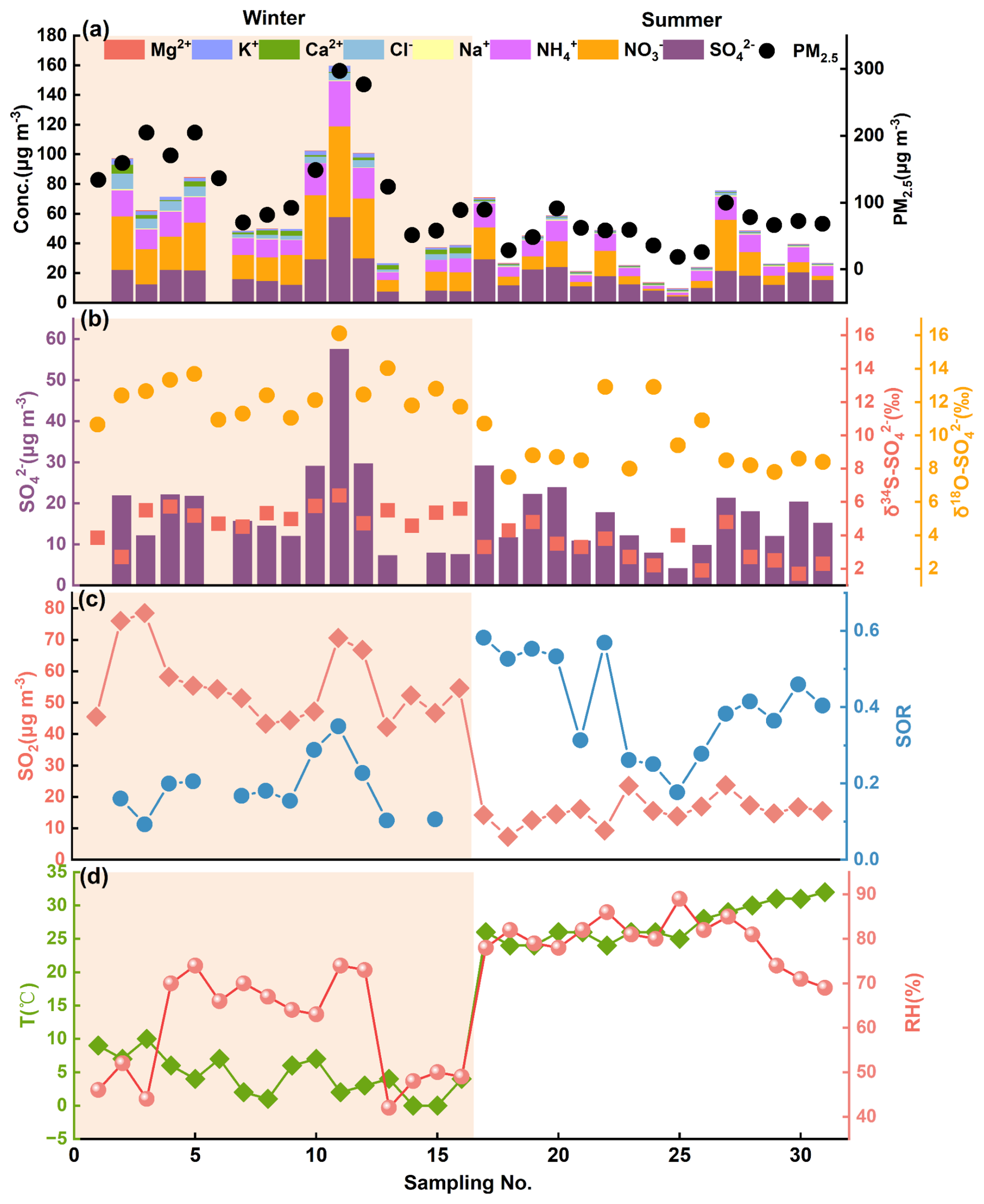
Figure 2Time series of concentrations (values) of (a) PM2.5 and ions, (b) SO and δ34S−SO, δ18O−SO, (c) SO2 and SOR, and (d) ambient temperature (T) and RH.
NH and NO jointly accounted for 50.1 %–57.9 % of water-soluble ions (Fig. 2a), while their strong covariation with SO (Fig. 2a, b) substantiates secondary sulfate formation as the principal PM2.5 component and implicates combustion-derived emissions as its dominant source. The significant positive correlation between SO and PM2.5 concentrations (Fig. S2) further establishes sulfate's direct mechanistic role in particulate pollution escalation. The atmospheric source apportionment can be quantitatively assessed through the mass ratio, where elevated values reflect increasing dominance of mobile versus stationary emission sources (Xiao et al., 2014; Arimoto et al., 1996). Our measurements yielded ratios spanning 0.15–1.95 (mean 0.98±0.42), exceeding Shanghai's 2002 baseline (0.43) (Yao et al., 2002) yet remaining below Jiaozuo's 2017 levels (1.36) (Zheng et al., 2024), collectively demonstrating Nanjing's intermediate position in mobile-source contribution among Chinese cities. These secondary aerosols originate through atmospheric oxidation of precursor gases, with SO2 and NOx principally derived from coal combustion and vehicular emissions respectively, while NH3 predominantly stems from agricultural and livestock activities (Tao et al., 2014a). The strong inter-species correlations (Fig. S3a, b) confirm the co-formation of (NH4)2SO4 and NH4NO3 through gas-to-particle conversion processes. Revealed across distinct pollution episodes, the unique sulfur and oxygen isotopic signatures (Fig. 2b) provide unequivocal evidence of temporal shifts in sulfate formation pathways. To accurately deconvolute the relative contributions of these specific reaction routes, rigorous mechanistic modeling becomes indispensable. Crucially, the persistent incomplete oxidation of sulfur dioxide to sulfate under all pollution conditions (Fig. 2c) underscores the imperative for oxidation-process-constrained model optimization to elucidate the authentic atmospheric sulfate formation mechanisms.
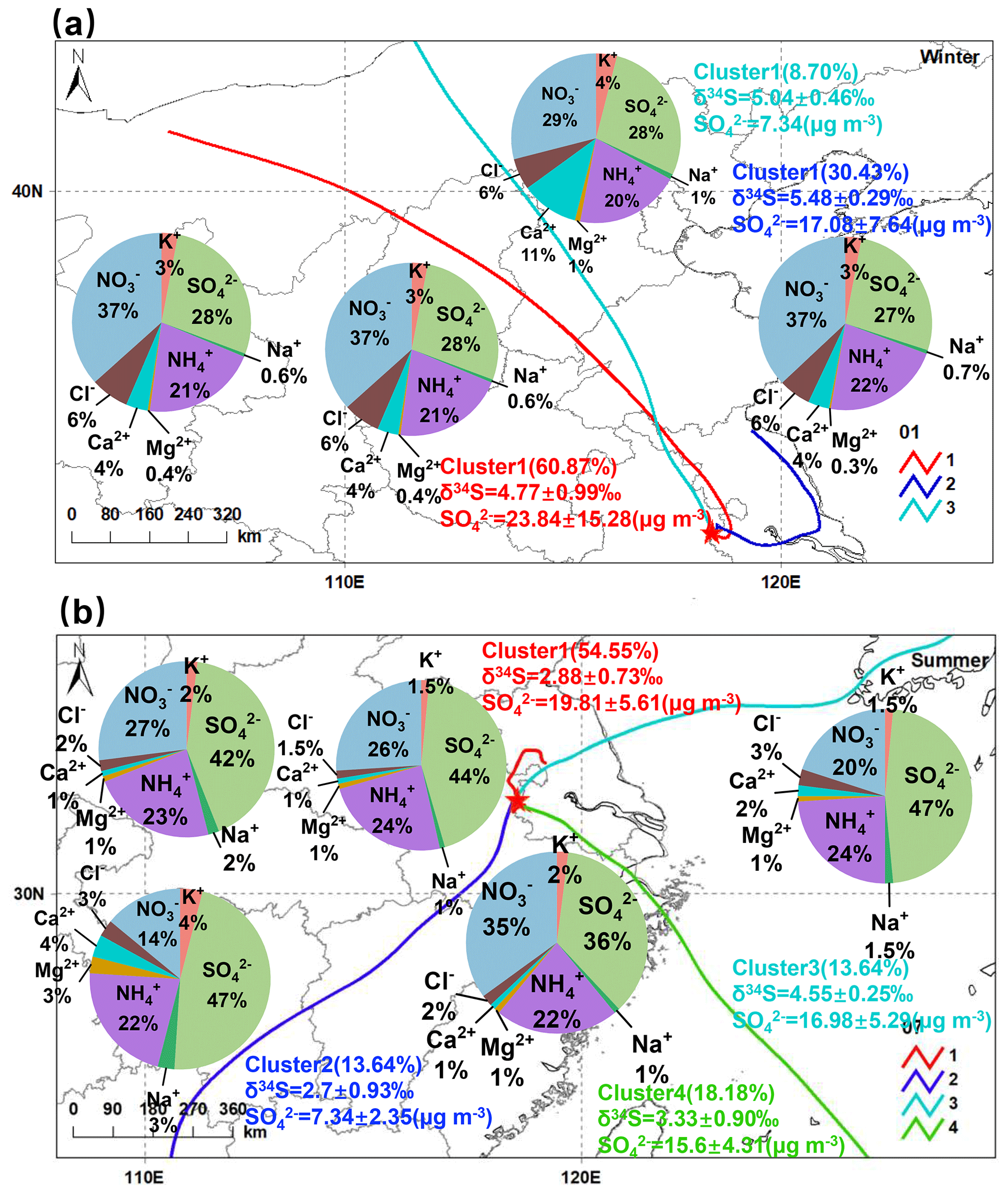
Figure 3Pie charts of relative abundances of ions to TWSIIs and the values in Nanjing for the different air clusters. The concentrations of TWSIIs and the δ34S–SO values are shown in the parentheses (a: winter b: summer).
The oxygen isotopic composition of atmospheric sulfate serves as a reliable indicator of oxidation pathways, with sulfate in PM2.5 predominantly originating from SO2 oxidation, consistent with established atmospheric chemistry. The δ34S-SO values (+1.7 ‰ to +6.3 ‰) of Nanjing sulfate aerosols, indicating coal combustion (+4.6 ‰ to +6.6 ‰) as the dominant source, thereby reflecting a greater coal-derived contribution relative to other Chinese regions. Cluster analysis of air mass trajectories reveals distinct seasonal patterns. During summer (Fig. 3b), trajectories originating locally (54.55 %), southwest China (13.64 %), southeast China (18.18 %), and the eastern Yellow Sea (13.64 %) exhibit higher SO concentrations locally (19.81±5.61 µg m−3) versus southwest (7.34±2.35 µg m−3), southeast (15.6±4.31 µg m−3), and Yellow Sea (16.98±5.29 µg m−3) sources, while δ34S-SO values show an inverse trend with lower values locally (2.88±0.73 ‰) and in the southwest (2.70±0.93 ‰) compared to southeast (3.33±0.9 ‰) and Yellow Sea regions (4.55±0.25 ‰), suggesting heterogeneous sources and formation mechanisms. Winter measurements (Fig. 3a) display significant sulfate concentration disparities across back trajectories of air mass (e.g., cluster 1: 23.84±15.28 µg m−3; cluster 3: 7.34 µg m−3), but statistically invariant δ34S-SO values (cluster 1: 4.77±0.99 ‰; cluster 3: 5.04±0.46 ‰); northeastern province (5.48±0.29 ‰), with both concentration and δ34S elevated versus summer, attributable to long-range transport of primary sulfates and coal-combustion emissions enriched in heavy isotopes. The significant negative correlation (Fig. 2b, d) between δ34S and temperature arises as higher temperatures promote OH-mediated uniform oxidation, facilitating isotopic equilibrium fractionation during exchange, which favors light-sulfur-isotope incorporation into sulfate and lowers summer δ34S (Han et al., 2016; Novák et al., 2001). Thus, secondary sulfate formation pathways and source variations primarily drive the observed winter-high/summer-low δ34S pattern in PM2.5, underscoring the mechanistic study's critical role in sulfate pollution control.
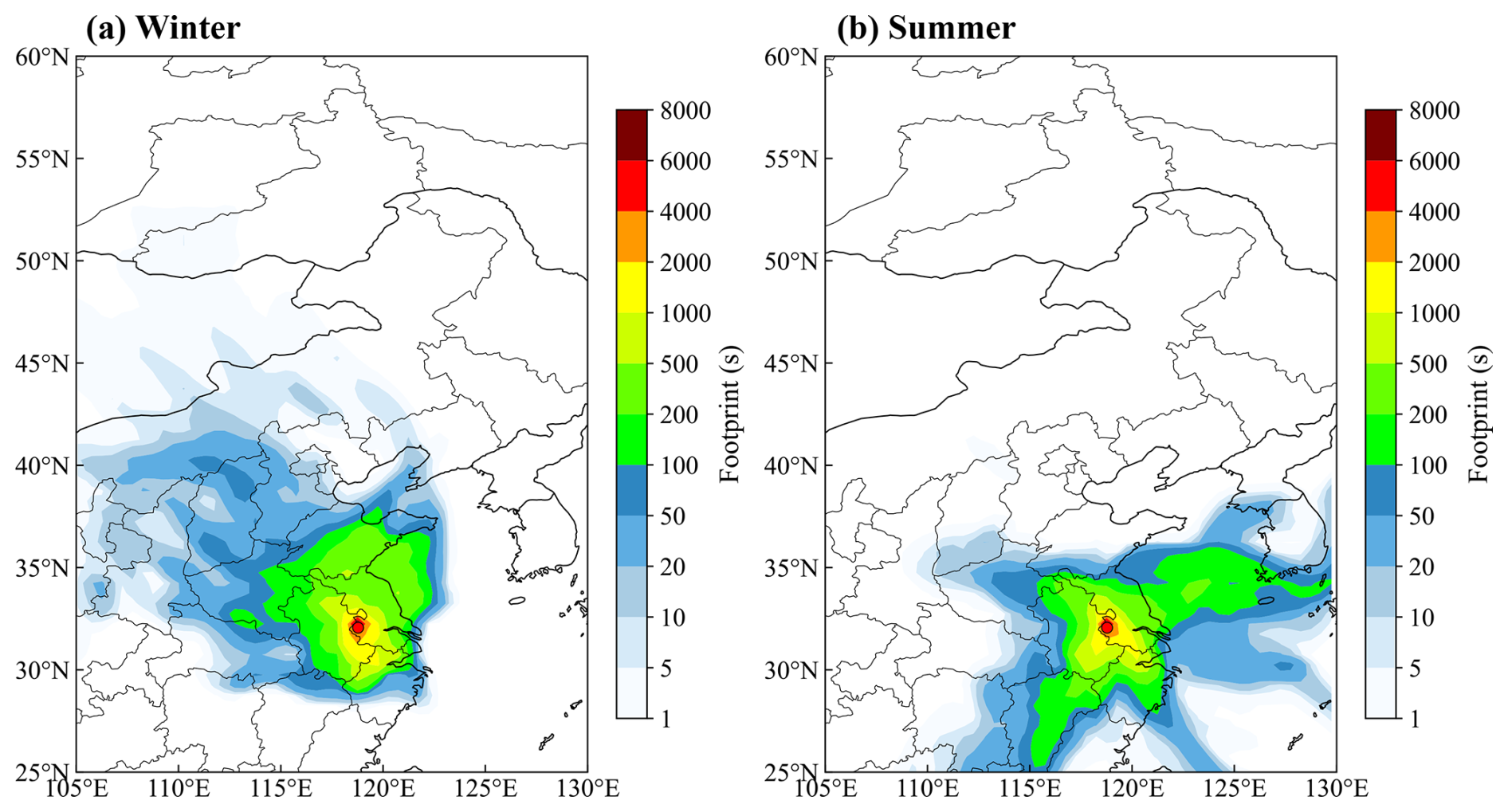
Figure 4Footprints of sulfate aerosols at the receptor site during the (a) winter and (b) summer computed by the FLEXPART model. The color scale denotes the residence time (s) of sulfate aerosols in the grid cell.
Besides, by synergistically combining AMBTs (Fig. S4), CWT (Fig. S5) analysis, and FLEXPART footprint modeling (Fig. 4a, b), our integrated framework now successfully bridges the gap between empirical trajectory data and actual emission source strengths. This robust spatial validation explicitly supports our overarching objective to resolve long-standing discrepancies in atmospheric sulfate source attribution.
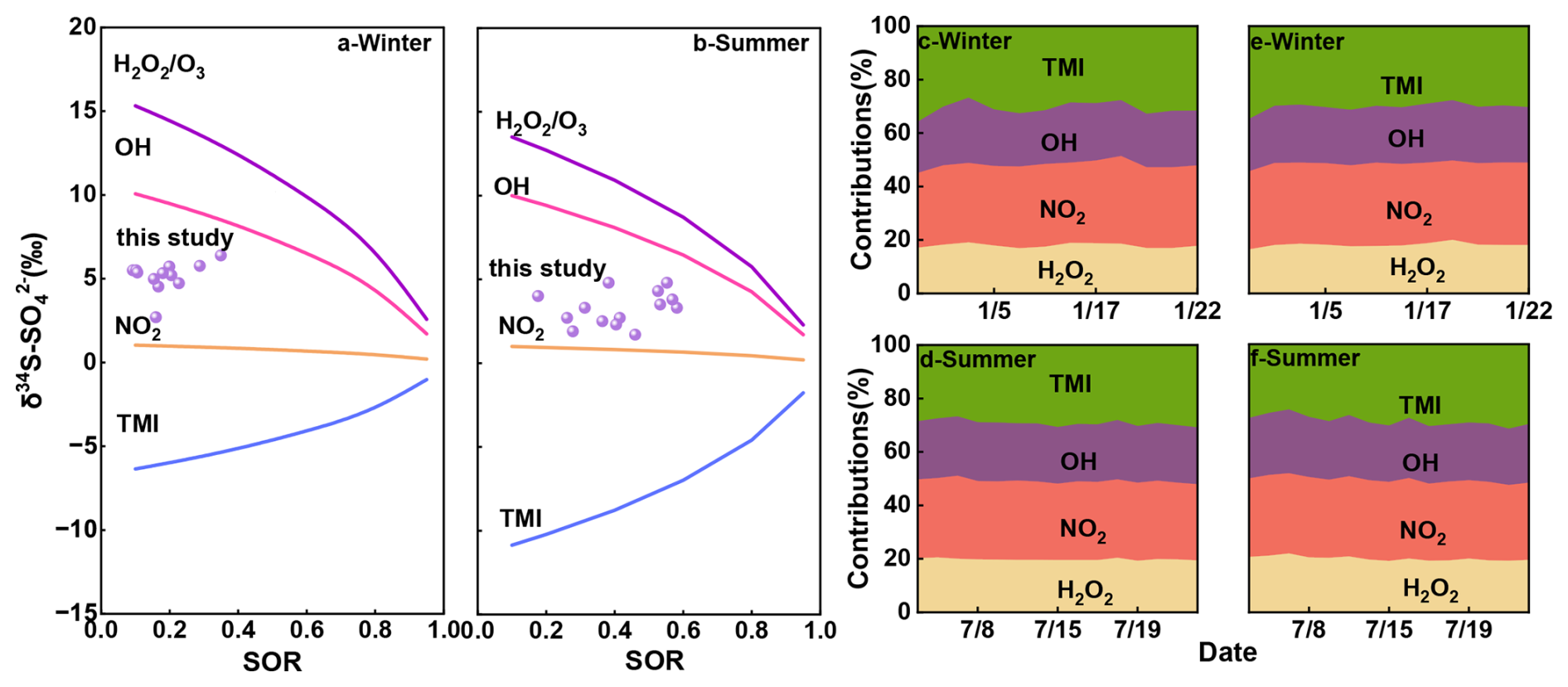
Figure 5(a, b) Rayleigh fractionation models for secondary SO formation in different seasons. (c, d, e, f) Relative contributions of primary, OH, TMI, NO2, and pathways to secondary SO generation across different seasons. (c) and (d) represent the fractionation effects under InCO Process; (e) and (f) represent the fractionation effects under CO Process.
The atmospheric sulfate formation pathways exhibit distinct sulfur isotope fractionation signatures, as demonstrated by theoretical calculations of δ34S-SO evolution under different oxidation mechanisms. Complete oxidation of SO2 via pathways would drive δ34S-SO depletion from 15.3 ‰ to 2.6 ‰ (Fig. 5a), while OH-mediated oxidation would produce isotopic depletion from 11.8 ‰ to 3.4 ‰ (Fig. 5a), both scenarios reflecting progressive sulfur oxidation (SOR 0 to 1). Conversely, exclusive S(IV) + O2 (TMI) pathway participation would generate δ34S-SO enrichment from −6.4 ‰ to −1.0 ‰ (Fig. 5a). These differential fractionation patterns confirm the coexistence of multiple sulfate production routes in the atmosphere, with all observed δ34S-SO values falling within the predicted theoretical ranges. However, our field measurements demonstrate that total particulate sulfate concentrations peak at 27.55±14.36 µg m−3 during severe haze events, which predominantly occur in winter. Consequently, when translating these relative fractions into absolute mass concentrations, the NO2 pathway produces a substantially higher burden of particulate sulfate in winter compared to summer.
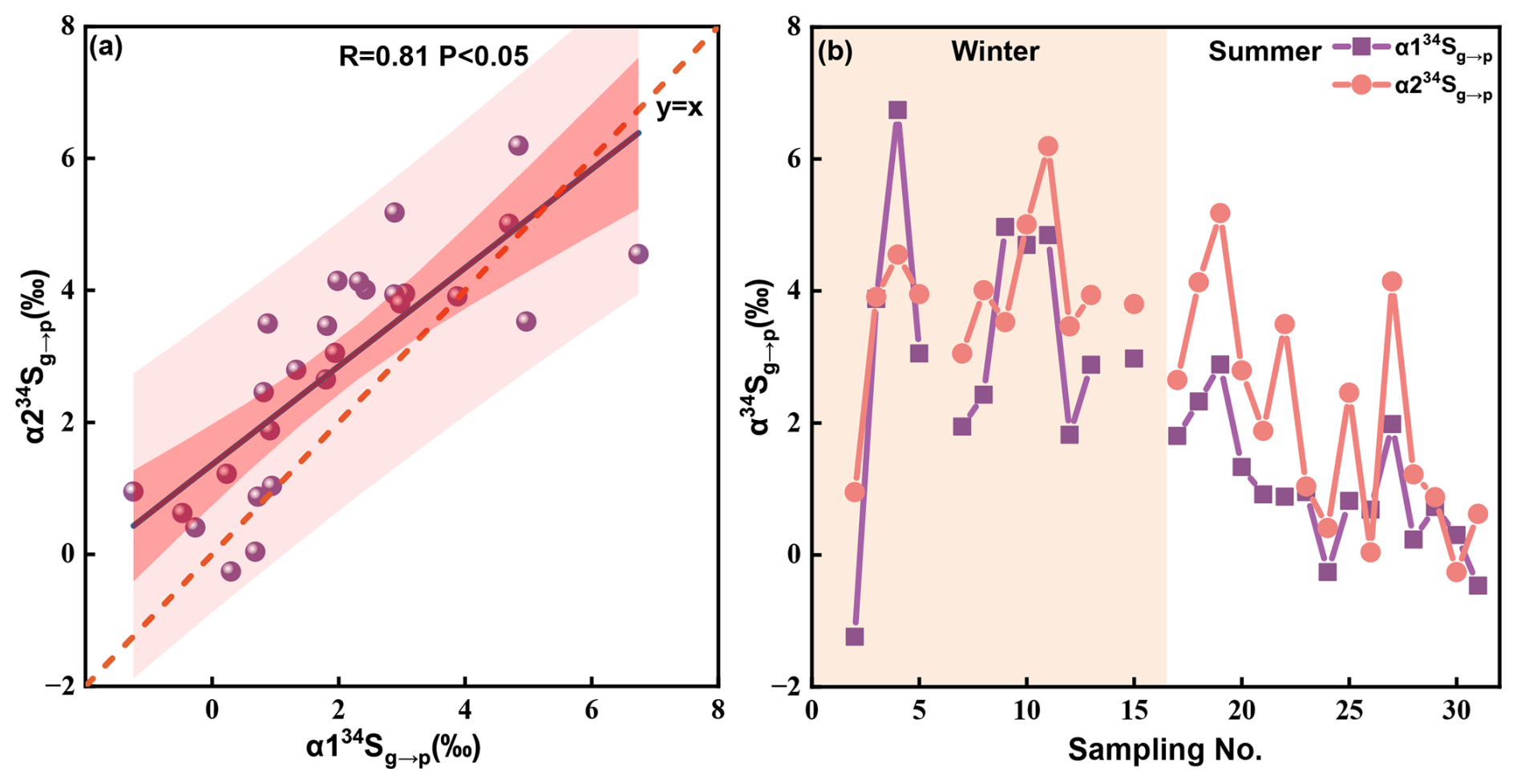
Figure 6Linear regression between fractionation factor α1 (InCO Process) and fractionation factor α2 (CO Process) (the red line represents y=x [1:1 line], and the dark teal-blue line represents the fitted regression line between them).
The isotopic fractionation factor α for sulfur isotopes was derived via Rayleigh fractionation models applied to δ34S-SO2−emission calculations based on atmospheric δ34S-SO and SOR, with synchronous field measurements (InCO Process) of δ34S-SO2 averaging 1.7±1.2 ‰ (range: −1.80 ‰ to +4.05 ‰), yielding ‰ (range: −1.2 ‰ to +6.7 ‰) (Fig. 6b) per designated formula. Under complete oxidation (CO Process) (SOR = 1), δ34S-SO demonstrated a significant negative correlation with SOR (δ34S-SO; , p≤0.05) (Fig. S6), resulting in δ34S-SO2−emission of 1.8 ‰ at full conversion, which exceeds values from Shanghai (1.3 ‰) (Li et al., 2020), Hangzhou (1.5 ‰) (Lin et al., 2022), and Jiaozuo (1.7 ‰) (Zheng et al., 2024) and represents the pre-transformation source signature. An alternative α calculation (formula 9) generated a mean of 2.8±1.7 ‰ (range: −0.2 ‰ to +6.1 ‰), higher than Guangzhou (<1.5 ‰) (Fan et al., 2020b) but lower than Beijing (4.2±1.2 ‰) (Lin et al., 2018) with elevated α in eastern China attributable to temperature-dependent fractionation increases (Fig. S7). The discrepancies arose from oxidation-rate variations under full-oxidation assumptions that alter pathway quantification.
By systematically evaluating the reaction-specific fractionation factors intrinsic to distinct SO2 oxidation mechanisms, we successfully apportioned the diverse pathways governing sulfate formation. This evaluation reveals that TMI-catalyzed and NO2-mediated reactions collectively dictate atmospheric sulfate production across all considered scenarios. Crucially, as corroborated by isotopic mass balance calculations, imposing idealized complete-oxidation assumptions systematically suppresses the calculated contribution of the TMI pathway, a bias successfully resolved through the application of kinetic partial-oxidation models. This systematic bias originates from neglecting kinetic fractionation effects during intermediate oxidation stages, particularly under high aerosol acidity conditions where TMI chemistry prevails. The persistent dominance of these two pathways persists despite varying meteorological conditions and emission profiles, suggesting their fundamental role in sulfur cycling.
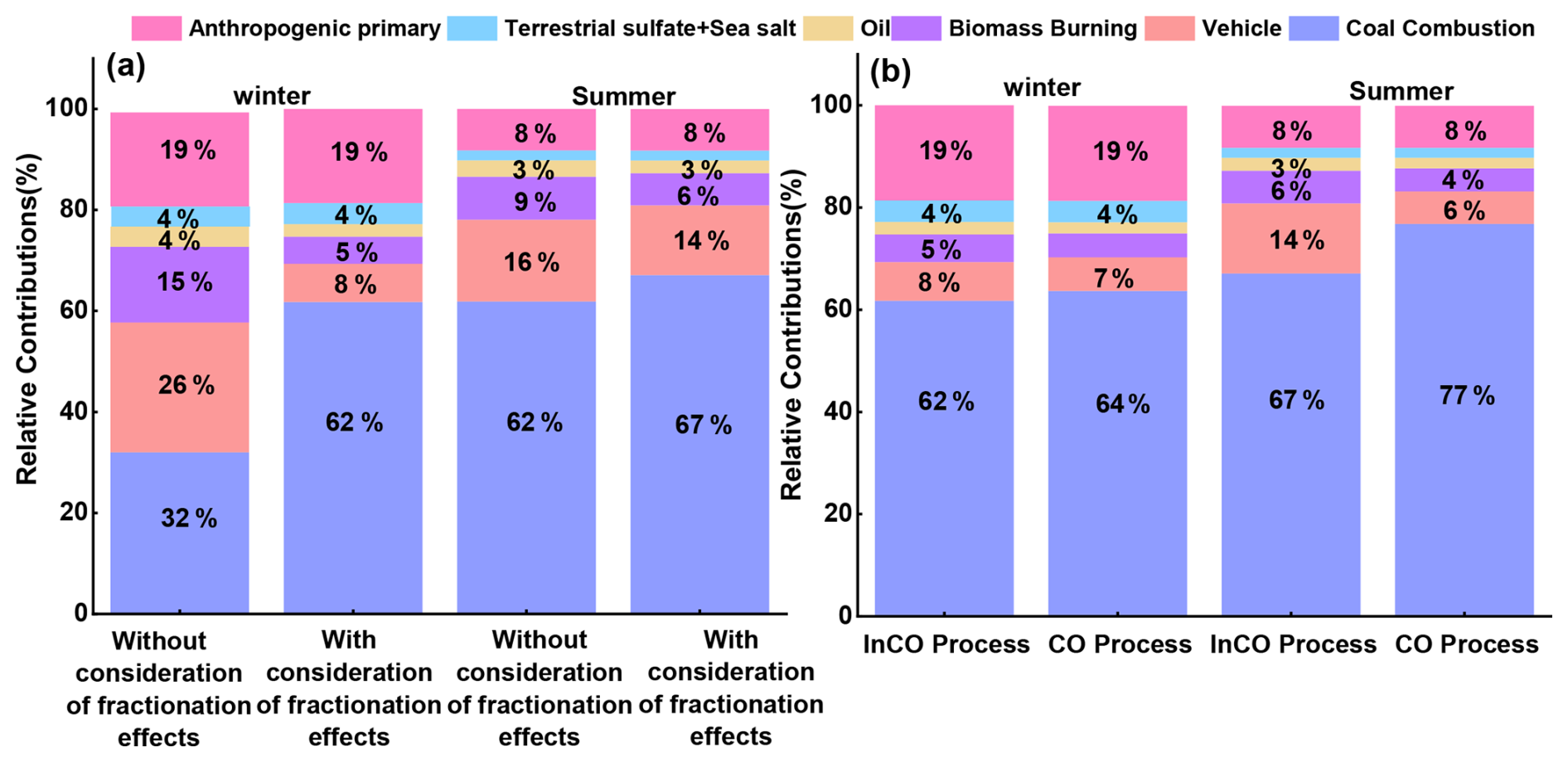
Figure 7(a) Seasonal variations of source apportionments to sulfate aerosols in Nanjing. (b) Source apportionments of sulfate aerosols in Nanjing resolved by the SIAR model with consideration of fractionation effects under InCO Process and CO Process.
Quantitative source apportionment of atmospheric sulfate was achieved through coupled δ34S-SO measurements and Bayesian isotopic mixing models, requiring emission source-specific δ34S signatures as critical input parameters. Correction for sulfur isotopic fractionation during SO2– to –SO conversion is essential, as this process enriches δ34S values by 1.2 ‰–7.2 ‰ (Lin et al., 2022), necessitating subtraction of pathway-specific fractionation coefficients prior to source quantification. Neglecting fractionation effects distorts source contributions, yielding winter estimates of 19 % (anthropogenic primary sulfate), 4 % (terrestrial sulfate and sea salt), 32 % (coal), 4 % (oil), 15 % (biomass), and 26 % (vehicle), alongside summer values of 8 %, 2 %, 62 %, 3 %, 9 %, and 16 % (Fig. 7a) respectively–results that inaccurately emphasize traffic emissions contrary to regional emission inventories and chemical transport modeling. Incorporating fractionation factors resolves this discrepancy, aligning sulfate sources with inventory data where coal combustion dominates annually, while idealized complete-oxidation models underestimate summer vehicle contributions by 8 % and overestimate coal combustion proportions (about 10 %) by comparable margins despite minimal winter deviations (Fig. 7b). This systematic validation underscores the requirement for fractionation correction in isotope-based atmospheric sulfate sourcing.
This study advances atmospheric sulfate source apportionment by transcending the idealized complete SO2 oxidation assumptions that constrain conventional isotopic models. By integrating ambient sulfur and oxygen isotope field observations with Rayleigh fractionation models, we successfully derived kinetic partial-oxidation fractionation factors that reflect genuine atmospheric conditions. Our integrated framework reveals the predominance of TMI-catalyzed and NO2-mediated pathways in atmospheric sulfate production across varying seasonal extremes. By comparing our kinetic fractionation-corrected framework against traditional complete-oxidation models, we demonstrate that idealized frameworks systematically obscure chemical realities. Neglecting kinetic fractionation effects during intermediate oxidation stages disproportionately diminishes the calculated contributions of the TMI pathway, particularly under high aerosol acidity conditions where TMI chemistry prevails. By applying our corrected framework, we align our source apportionment more accurately with regional emission inventories, successfully resolving calculation discrepancies that have long plagued isotopic and transport-modeling approaches. While our multi-model analytical framework corrects systematic biases in pathway quantification, certain caveats remain. The empirical validation in this study is currently constrained to seasonal extremes, specifically January and July observations, at a single monitoring site in Nanjing. Future work is needed to expand this kinetic fractionation-corrected framework across diverse geographical regions and continuous temporal scales to further validate oxidation-process-constrained model optimizations. Correcting these systematic isotopic biases carries profound implications for our understanding of atmospheric pollution states and climate regulation. Our findings expose a significant seasonal misalignment in current evaluations, demonstrating that traditional approaches overestimate summer coal combustion contributions by 10 % while underestimating summer traffic emissions by 8 %. Consequently, effective sulfate mitigation cannot rely solely on blanket SO2 reductions. Regulatory frameworks must pivot toward multi-pollutant, seasonally differentiated strategies that dynamically target summer vehicular dynamics and the co-emitted transition metals driving catalytic sulfate formation.
Data are available on Zenodo (https://doi.org/10.5281/zenodo.21307973, Guo et al., 2026). The data underlying the findings of this study are available from the corresponding author upon reasonable request. Global data assimilation system (GDAS) data were obtained from the multi-scale meteorological data set provided by the National Centers for Environmental Prediction in the United States (http://www.ready.noaa.gov/hypub-bin/trajtype.pl, last access: 15 June 2026). The stable isotope mixing models in R is an upgraded version of the SIAR package, and it has many similar functionalities. This new version includes more complex mixing models and has advanced plotting capabilities (http://cran.r-project.org/web/packages/simmr/vignettes/simmr.html, last access: 10 June 2026).
The supplement related to this article is available online at https://doi.org/10.5194/acp-26-12231-2026-supplement.
ZG designed the research. XB performed the model experiments. JG analyzed the data. ZX and QA: conceptualization, methodology, software, investigation, funding acquisition, resources, data curation, validation, formal analysis. QG and SM: methodology, investigation, and software. XB and PQ prepared the manuscript and all co-authors helped improve the manuscript.
The contact author has declared that none of the authors has any competing interests.
Publisher's note: Copernicus Publications remains neutral with regard to jurisdictional claims made in the text, published maps, institutional affiliations, or any other geographical representation in this paper. The authors bear the ultimate responsibility for providing appropriate place names. Views expressed in the text are those of the authors and do not necessarily reflect the views of the publisher.
This research has been supported by the National Natural Science Foundation of China (grant no. 42473024).
This paper was edited by Dara Salcedo and reviewed by Sanjeev Dasari and one anonymous referee.
Alexander, B., Park, R. J., Jacob, D. J., and Gong, S.: Transition metal-catalyzed oxidation of atmospheric sulfur: Global implications for the sulfur budget, J. Geophys. Res.-Atmos., 114, D02309, https://doi.org/10.1029/2008JD010486, 2009.
Arimoto, R., Duce, R., Savoie, D., Prospero, J., Talbot, R., Cullen, J., Tomza, U., Lewis, N., and Ray, B.: Relationships among aerosol constituents from Asia and the North Pacific during PEM-West A, J. Geophys. Res.-Atmos., 101, 2011–2023, https://doi.org/10.1029/95JD01071, 1996.
Chen, Z., Li, H., Shang, H., Liu, X., Guo, F., Liu, X., Yu, L., Zhou, B., Liu, X., Shi, Y., Zhang, L., and Ai, Z.: Oxalate-promoted SO2 uptake and oxidation on iron minerals: Implications for secondary sulfate aerosol formation, Environ. Sci. Technol., 57, 13559–13568, https://doi.org/10.1021/acs.est.3c03369, 2023.
Dao, X., Lin, Y.-C., Cao, F., Di, S.-Y., Hong, Y., Xing, G., Li, J., Fu, P., and Zhang, Y.-L.: Introduction to the National Aerosol Chemical Composition Monitoring Network of China: Objectives, current status, and outlook, B. Am. Meteorol. Soc., 100, ES337–ES351, https://doi.org/10.1175/BAMS-D-18-0325.1, 2019.
Dasari, S. and Widory, D.: Retrospective isotopic analysis of summertime urban atmospheric sulfate in South Asia using improved source constraints, ACS ES&T Air, 1, 357–364, https://doi.org/10.1021/acsestair.3c00060, 2024.
Dasari, S., Andersson, A., Stohl, A., Evangeliou, N., Bikkina, S., Holmstrand, H., Budhavant, K., Salam, A., and Gustafsson, Ö.: Source quantification of South Asian black carbon aerosols with isotopes and modeling, Environ. Sci. Technol., 54, 11771–11779, https://doi.org/10.1021/acs.est.0c02193, 2020.
Dasari, S., Paris, G., Saar, B., Pei, Q., Cong, Z., and Widory, D.: Sulfur Isotope Anomalies (Δ33S) in Urban Air Pollution Linked to Mineral-Dust-Associated Sulfate, Environ. Sci. Technol. Lett., 9, 604–610, https://doi.org/10.1021/acs.estlett.2c00312, 2022.
Ding, X., Li, Q., Wu, D., Wang, X., Li, M., Wang, T., Wang, L., and Chen, J.: Direct observation of sulfate explosive growth in wet plumes emitted from typical coal-fired stationary sources, Geophys. Res. Lett., 48, e2020GL092071, https://doi.org/10.1029/2020GL092071, 2021.
Fan, M., Zhang, Y., Lin, Y., Cao, F., Zhao, Z., Sun, Y., Qiu, Y., Fu, P., and Wang, Y.: Changes of emission sources to nitrate aerosols in Beijing after the clean air actions: Evidence from dual isotope compositions, J. Geophys. Res.-Atmos., 125, e2019JD031998, https://doi.org/10.1029/2019JD031998, 2020a.
Fan, M., Zhang, Y., Lin, Y., Li, J., Cheng, H., An, N., Sun, Y., Qiu, Y., Cao, F., and Fu, P.: Roles of sulfur oxidation pathways in the variability in stable sulfur isotopic composition of sulfate aerosols at an urban site in Beijing, China, Environ. Sci. Technol. Lett., 7, 883–888, https://doi.org/10.1021/acs.estlett.0c00623, 2020b.
Fan, M., Hong, Y., Zhang, Y., Sha, T., Lin, Y., Cao, F., and Guo, H.: Increasing nonfossil fuel contributions to atmospheric nitrate in urban China from observation to prediction, Environ. Sci. Technol., 57, 18172–18182, https://doi.org/10.1021/acs.est.3c01651, 2023.
Guo, Z., Guo, Q., Chen, S., Zhu, B., Zhang, Y., Yu, J., and Guo, Z.: Study on pollution behavior and sulfate formation during the typical haze event in Nanjing with water soluble inorganic ions and sulfur isotopes, Atmos. Res., 217, 198–207, https://doi.org/10.1016/j.atmosres.2018.11.009, 2019.
Guo, Z., Lu, K., Qiu, P., Xu, M., and Guo, Z.: Quantifying SO2 oxidation pathways to atmospheric sulfate using stable sulfur and oxygen isotopes: laboratory simulation and field observation, Atmos. Chem. Phys., 24, 2195–2205, https://doi.org/10.5194/acp-24-2195-2024, 2024.
Guo, Z., Bai, X., Ai, Q., Xu, Z., Ma, S., Gu, J., Qiu, P., and Guo, Q.: Zenodo test upload, Zenodo [data set], https://doi.org/10.5281/zenodo.21307973, 2026.
Han, X., Guo, Q., Liu, C., Fu, P., Strauss, H., Yang, J., Hu, J., Wei, L., Ren, H., Peters, M., Wei, R., and Tian, L.: Using stable isotopes to trace sources and formation processes of sulfate aerosols from Beijing, China, Sci. Rep., 6, 29958, https://doi.org/10.1038/srep29958, 2016.
Han, X., Lang, Y., Guo, Q., Li, X., Ding, H., and Li, S.: Enhanced oxidation of SO2 by H2O2 during haze events: constraints from sulfur isotopes, J. Geophys. Res.-Atmos., 127, e2022JD036960, https://doi.org/10.1029/2022JD036960, 2022.
Harris, E., Sinha, B., Hoppe, P., Crowley, J. N., Ono, S., and Foley, S.: Sulfur isotope fractionation during oxidation of sulfur dioxide: gas-phase oxidation by OH radicals and aqueous oxidation by H2O2, O3 and iron catalysis, Atmos. Chem. Phys., 12, 407–423, https://doi.org/10.5194/acp-12-407-2012, 2012a.
Harris, E., Sinha, B., Hoppe, P., Foley, S., and Borrmann, S.: Fractionation of sulfur isotopes during heterogeneous oxidation of SO2 on sea salt aerosol: a new tool to investigate non-sea salt sulfate production in the marine boundary layer, Atmos. Chem. Phys., 12, 4619–4631, https://doi.org/10.5194/acp-12-4619-2012, 2012b.
Harris, E., Sinha, B., Hoppe, P., and Ono, S.: High-precision measurements of 33S and 34S fractionation during SO2 oxidation reveal causes of seasonality in SO2 and sulfate isotopic composition, Environ. Sci. Technol., 47, 12174–12183, https://doi.org/10.1021/es402824c, 2013a.
Harris, E., Sinha, B., van Pinxteren, D., Tilgner, A., Fomba, K. W., Schneider, J., Roth, A., Gnauk, T., Fahlbusch, B., Mertes, S., Lee, T., Collett, J., Foley, S., Borrmann, S., Hoppe, P., and Herrmann, H.: Enhanced role of transition metal ion catalysis during in-cloud oxidation of SO2, Science, 340, 727–730, https://doi.org/10.1126/science.1230911, 2013b.
He, K., Zhao, Q., Ma, Y., Duan, F., Yang, F., Shi, Z., and Chen, G.: Spatial and seasonal variability of PM2.5 acidity at two Chinese megacities: insights into the formation of secondary inorganic aerosols, Atmos. Chem. Phys., 12, 1377–1395, https://doi.org/10.5194/acp-12-1377-2012, 2012.
He, P., Alexander, B., Geng, L., Chi, X., Fan, S., Zhan, H., Kang, H., Zheng, G., Cheng, Y., Su, H., Liu, C., and Xie, Z.: Isotopic constraints on heterogeneous sulfate production in Beijing haze, Atmos. Chem. Phys., 18, 5515–5528, https://doi.org/10.5194/acp-18-5515-2018, 2018.
Kang, Y., Liu, M., Song, Y., Huang, X., Yao, H., Cai, X., Zhang, H., Kang, L., Liu, X., Yan, X., He, H., Zhang, Q., Shao, M., and Zhu, T.: High-resolution ammonia emissions inventories in China from 1980 to 2012, Atmos. Chem. Phys., 16, 2043–2058, https://doi.org/10.5194/acp-16-2043-2016, 2016.
Li, J., Zhang, Y., Cao, F., Zhang, W., Fan, M., Lee, X., and Michalski, G.: Stable sulfur isotopes revealed a major role of transition-metal ion-catalyzed SO2 oxidation in haze episodes, Environ. Sci. Technol., 54, 2626–2634, https://doi.org/10.1021/acs.est.9b07150, 2020.
Lin, M., Zhang, X., Li, M., Xu, Y., Zhang, Z., Tao, J., Su, B., Liu, L., Shen, Y., and Thiemens, M. H.: Five-S-isotope evidence of two distinct mass-independent sulfur isotope effects and implications for the modern and Archean atmospheres, P. Natl. Acad. Sci. USA, 115, 8541–8546, https://doi.org/10.1073/pnas.1803420115, 2018.
Lin, Y., Yu, M., Xie, F., and Zhang, Y.: Anthropogenic emission sources of sulfate aerosols in Hangzhou, East China: insights from isotope techniques with consideration of fractionation effects between gas-to-particle transformations, Environ. Sci. Technol., 56, 3905–3914, https://doi.org/10.1021/acs.est.1c05823, 2022.
Lin, Y., Fan, M., Yu, M., Abulimiti, A., Xie, F., Xu, R., and Zhang, Y.: Significant contributions of regional transport to sulfate aerosols during haze events in northern China Plain: constrained by sulfur isotopic compositions, J. Geophys. Res.-Atmos., 130, e2025JD043716, https://doi.org/10.1029/2025JD043716, 2025.
Ma, J., Chen, B., He, Q., Yan, X., Wang, G., Cheng, S., Steil, B., Brühl, C., Tost, H., Höpfner, M., Pozzer, A., and Lelieveld, J.: Modelling the deep convective transport of trace gases (CO, NH3 and SO2) from the planetary boundary layer to the Asian summer monsoon anticyclone, Atmos. Chem. Phys., 26, 8125–8144, https://doi.org/10.5194/acp-26-8125-2026, 2026.
Mizutani, Y. and Rafter, T.: Oxygen isotopic composition of sulphates. Part 4. Bacterial fractionation of oxygen isotopes in the reduction of sulphate and in the oxidation of sulphur, N. Z. J. Sci., 12, 60–68, 1969.
Mukai, H., Tanaka, A., Fujii, T., Zeng, Y., Hong, Y., Tang, J., Guo, S., Xue, H., Sun, Z., Zhou, J., Xue, D., Zhao, J., Zhai, G., Gu, J., and Zhai, P.: Regional characteristics of sulfur and lead isotope ratios in the atmosphere at several Chinese urban sites, Environ. Sci. Technol., 35, 1064–1071, https://doi.org/10.1021/es001399u, 2001.
Novák, M., Jačková, I., and Přechová, E.: Temporal trends in the isotope signature of air-borne sulfur in Central Europe, Environ. Sci. Technol., 35, 255–260, https://doi.org/10.1021/es0000753, 2001.
Ruan, X., Zhao, C., Zhou, T., Zhang, Z., Ma, T., Wang, X., Zhao, W., Su, G., and Geng, L.: Cloud and aerosol chemistry together explain the high sulfate aerosol content in a heavy haze episode in Central Eastern China, Environ. Sci. Technol., 59, 23398–23409, https://doi.org/10.1021/acs.est.5c07415, 2025.
Tanaka, N., Rye, D. M., Xiao, Y., and Lasaga, A. C.: Use of stable sulfur isotope systematics for evaluating oxidation reaction pathways and in-cloud-scavenging of sulfur dioxide in the atmosphere, Geophys. Res. Lett., 21, 1519–1522, https://doi.org/10.1029/94GL00893, 1994.
Tao, J., Gao, J., Zhang, L., Zhang, R., Che, H., Zhang, Z., Lin, Z., Jing, J., Cao, J., and Hsu, S.-C.: PM2.5 pollution in a megacity of southwest China: source apportionment and implication, Atmos. Chem. Phys., 14, 8679–8699, https://doi.org/10.5194/acp-14-8679-2014, 2014a.
Tao, J., Zhang, L., Ho, K., Zhang, R., Lin, Z., Zhang, Z., Lin, M., Cao, J., Liu, S., and Wang, G.: Impact of PM2.5 chemical compositions on aerosol light scattering in Guangzhou – the largest megacity in South China, Atmos. Res., 135, 48–58, https://doi.org/10.1016/j.atmosres.2013.08.015, 2014b.
Tao, Y., Ye, X., Ma, Z., Xie, Y., Wang, R., Chen, J., Yang, X., and Jiang, S.: Insights into different nitrate formation mechanisms from seasonal variations of secondary inorganic aerosols in Shanghai, Atmos. Environ., 145, 1–9, https://doi.org/10.1016/j.atmosenv.2016.09.012, 2016.
Wang, G., Zhang, R., Gomez, M. E., Yang, L., Levy Zamora, M., Hu, M., Lin, Y., Peng, J., Guo, S., Meng, J., Li, J., Cheng, C., Hu, T., Ren, Y., Wang, Y., Gao, J., Cao, J., An, Z., Zhou, W., Li, G., Wang, J., Tian, P., Marrero-Ortiz, W., Secrest, J., Du, Z., Zheng, J., Shang, D., Zeng, L., Shao, M., Wang, W., Huang, Y., Wang, Y., Zhu, Y., Li, Y., Hu, J., Pan, B., Cai, L., Cheng, Y., Ji, Y., Zhang, F., Rosenfeld, D., Liss, P. S., Duce, R. A., Kolb, C. E., and Molina, M. J.: Persistent sulfate for-mation from London Fog to Chinese haze, P. Natl. Acad. Sci. USA, 113, 13630–13635, https://doi.org/10.1073/pnas.1616540113, 2016.
Wang, J., Li, J., Ye, J., Zhao, J., Wu, Y., Hu, J., Liu, D., Nie, D., Shen, F., Huang, X., Huang, D., Ji, D., Sun, X., Xu, W., Guo, J., Song, S., Qin, Y., Lin, P., Turner, J., Lee, H., Hwang, S., Liao, H., Martin, S., Zhang, Q., Chen, M., Sun, Y., Ge, X., and Jacob, D.: Fast sulfate formation from oxidation of SO2 by NO2 and HONO observed in Beijing haze, Nat. Commun., 11, 2844, https://doi.org/10.1038/s41467-020-16683-x, 2020.
Wang, W., Yu, J., Cui, Y., He, J., Xue, P., Cao, W., Ying, H., Gao, W., Yan, Y., Hu, B., Xin, J., Wang, L., Liu, Z., Sun, Y., Ji, D., and Wang, Y.: Characteristics of fine particulate matter and its sources in an industrialized coastal city, Ningbo, Yangtze River Delta, China, Atmos. Res., 203, 105–117, https://doi.org/10.1016/j.atmosres.2017.11.033, 2018.
Wei, L., Yue, S., Zhao, W., Yang, W., Zhang, Y., Ren, L., Han, X., Guo, Q., Sun, Y., Wang, Z., and Fu, P.: Stable sulfur isotope ratios and chemical compositions of fine aerosols (PM2.5) in Beijing, China, Sci. Total Environ., 633, 1156–1164, https://doi.org/10.1016/j.scitotenv.2018.03.153, 2018.
Xiao, H., Xiao, H., Long, A., Wang, Y., and Liu, C.: Sources and meteorological factors that control seasonal variation of δ34S values in rainwater, Atmos. Res., 149, 154–165, https://doi.org/10.1016/j.atmosres.2014.06.003, 2014.
Yanagisawa, F. and Sakai, H.: Thermal decomposition of barium sulfate-vanadium pentoxide-silica glass mixtures for preparation of sulfur dioxide in sulfur isotope ratio measurements, Anal. Chem., 55, 985–987, https://doi.org/10.1021/ac00257a046, 1983.
Yang, R., Lou, Q., Wang, M., Cao, L., and Luo, L.: Using stable sulfur isotopes to quantify the formation mechanism and sources of SO in PM2.5 in Haikou City, ACS Earth Space Chem., 9, 560–568, https://doi.org/10.1021/acsearthspacechem.4c00304, 2025.
Yao, X., Chan, C. K., Fang, M., Cadle, S., Chan, T., Mulawa, P., He, K., and Ye, B.: The water-soluble ionic composition of PM2.5 in Shanghai and Beijing, China, Atmos. Environ., 36, 4223–4234, https://doi.org/10.1016/S1352-2310(02)00342-4, 2002.
Yu, C., Liu, T., Chi, X., Huang, X., and Ding, A.: Salting-in of HCHO sustains fast hydroxymethanesulfonate formation in deliquesced sulfate aerosols, Environ. Sci. Technol. Lett., 13, 744–750, https://doi.org/10.1021/acs.estlett.6c00300, 2026.
Zhang, R. and Chan, C. K.: Simultaneous formation of sulfate and nitrate via co-uptake of SO2 and NO2 by aqueous NaCl droplets: combined effect of nitrate photolysis and chlorine chemistry, Atmos. Chem. Phys., 23, 6113–6126, https://doi.org/10.5194/acp-23-6113-2023, 2023.
Zhang, X., Liu, J., Li, H., Zuo, Y., Zhang, C., Su, Z., Wang, S., Zhang, P., Chu, B., and He, H.: pH-dependent Fe(III) speciation and concerted proton–electron transfer mechanism accelerated S(IV) oxidation at the air–water interface, J. Am. Chem. Soc., 148, 11812–11821, https://doi.org/10.1021/jacs.5c21077, 2026.
Zheng, M., Song, D., Zhang, D., Cao, Y., and Fan, H.: Using sulfur isotopes to constrain the sources of sulfate in PM2.5 during the winter in Jiaozuo City, Atmos. Environ., 332, 120618, https://doi.org/10.1016/j.atmosenv.2024.120618, 2024.