
the Creative Commons Attribution 4.0 License.
the Creative Commons Attribution 4.0 License.
 | 06 Aug 2026
Size-resolved isotope analysis reveals anthropogenic reactive nitrogen transport and transformation in Taiwan mountain forests: A case study
Wen-Chien Lee
Ming-Hao Huang
Wei-Chieh Huang
Jen-Ping Chen
Yen-Jen Lai
Haojia Ren
Reactive nitrogen (Nr) species such as particulate ammonium (pNH) and nitrate (pNO) are critical drivers of air pollution and ecosystem health, yet their transformation in mountain forests remains poorly characterized. We performed a one-week field campaign in a subtropical mountain forest at Xitou, Taiwan, using size-segregated aerosol sampling, stable isotopic techniques, and Bayesian modeling. Functional groups were analyzed by Fourier-transform infrared spectroscopy (FTIR-ATR), and isotopes δ15N and δ18O were measured using gas chromatography-isotope ratio mass spectrometry (GC-IRMS) to quantify pNH source contributions and pNO formation pathways. During the sampling week, diurnal patterns of higher daytime particle concentrations were disrupted by a 26 h fog event, which suppressed δ15N-enriched urban plume influx and promoted aqueous-phase uptake of isotopically depleted local gas-phase species. Under clear conditions, size-resolved δ15N-NH exhibited a bell-shaped distribution peaking at the accumulation mode, whereas this gradient flattened during the fog event. Size-resolved δ15N and δ18O signatures of pNO revealed two nitrate formation regimes: urban plumes retained O3-driven oxidation signatures with higher δ18O, and rural/local regimes were dominated by RO2-involved processes with greater isotopic depletion and/or biogenic contributions. Bayesian source apportionment constrained by δ15N-NH indicated 50 %–83 % of NH3 emissions originated from combustion-related sources. Concurrently, δ18O source apportionment showed RO2-initiated oxidation dominated daytime pNO formation (42 %–95 %) and heterogeneous reactions contributed 6 %–84 % at night. Although based on a short-term campaign capturing a single fog episode, this case study highlights the value of size-resolved isotopic approaches for characterizing reactive nitrogen transport and evolution under contrasting meteorological conditions, providing mechanistic insights into complex environments.
- Article
(2558 KB) - Full-text XML
-
Supplement
(3010 KB) - BibTeX
- EndNote


Anthropogenic activities have significantly altered the global reactive nitrogen (Nr) cycle, with profound implications for climate change (Pinder et al., 2012), biodiversity loss (Humbert et al., 2016), acid deposition (Doney et al., 2007), and regional air quality degradation (Cheng et al., 2016). Among Nr species, particulate ammonium (pNH) and nitrate (pNO) derived from ammonia (NH3) and nitrogen oxides (NOx), respectively, are major pollutants that degrade visibility and increase human morbidity (Gong et al., 2024; Zhang et al., 2017). In Asian regions, these species account for approximately 10 %–37 % of non-refractory PM1 (particulate matter with a diameter less than 1 µm) mass (Zhou et al., 2020). While anthropogenic Nr is frequently transported to rural and remote areas, its distribution remains heterogeneous, exacerbating regional disparities in nitrogen deposition and environmental impacts (Galloway et al., 2008). Therefore, understanding the formation pathways, transport mechanisms, and sources of Nr is essential for evaluating its origins and ecological impacts.
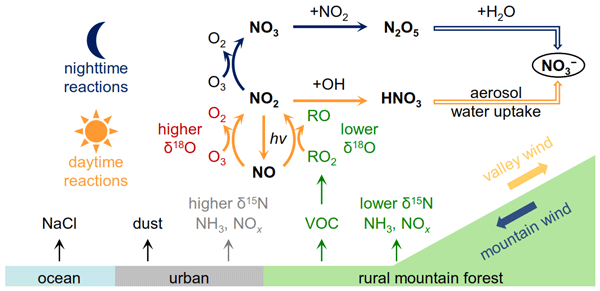
Nr is emitted from a diverse array of anthropogenic and biogenic sources. NH3 is predominantly released from agricultural activities and is removed through dry deposition, precipitation scavenging, and chemical conversion to pNH via reactions with acidic precursors from NOx and sulfur dioxide (SO2) oxidations (Meng et al., 2017). Sources of NOx include coal combustion, vehicle exhausts, biomass burning, and soil emissions (Fan et al., 2020). In the presence of sunlight, NOx undergoes rapid oxidation through ozone (O3) or peroxy radical (RO2) pathways (termed and , respectively) before converting to nitric acid (HNO3) via the following reactions:
Tropospheric O3 is a key oxidant formed from the photolysis of NO2 (Haagen-Smit et al., 1953). Another important oxidant is the RO2 radical, which is primarily formed through the reaction of VOC with hydroxyl radicals (OH) and might be more abundant in forested environments (Romer et al., 2016). Under nocturnal or low-light conditions, NOx accumulates as nitrogen dioxide (NO2) through reaction with O3, which then undergoes heterogeneous reactions (termed as het) to produce HNO3 as follows:
These oxidation processes leave distinct isotopic signatures for nitrate, making stable isotope analysis a robust tool for tracing the evolution of aerosol particles (Moore, 1977). Nitrogen isotope ratios (δ15N = [(15Rsample)/(15Rair)− 1] × 1000 ‰, where 15R is the ratio of ) are used to distinguish emission sources of pNH and transport of pNO (Savard et al., 2017; Chang et al., 2018), while oxygen isotope ratios (δ18O = × 1000 ‰, where 18R is the ratio of 18O/16O and VSMOW is the Vienna Standard Mean Ocean Water) in pNO provide insights into specific oxidation pathways, as each oxidant (O3, OH, RO2) imparts a unique isotopic fingerprint (Walters and Michalski, 2016). Although isotopic Bayesian mixing model frameworks (e.g., IsoSource, SIAR, or MixSIAR) have successfully identified the sources of Nr and the formation mechanisms of pNO (Fan et al., 2020; Chang et al., 2018; Kawashima et al., 2023; Pan et al., 2016), these processes are highly variable in complex terrains. Little is known about the sources and atmospheric processing of Nr in East Asian mountain forests, where local emissions and transported pollutants interact under high-humidity conditions (Guha et al., 2017). During transport, δ15N values are modified by kinetic fractionation and gas-particle partitioning, often leading to a progressive depletion of heavier isotopes (Gobel et al., 2013; Walters and Michalski, 2016). Furthermore, the typically low concentrations of mountain aerosols have historically limited detailed size-segregated isotopic analyses, constraining our understanding of emission sources and size-dependent nitrogen transformation pathways (Morin et al., 2009).
Xitou, a representative cloud forest in central Taiwan, offers a suitable field setting to investigate these gaps. The site is situated at 1179 m a.s.l. in a valley-basin terrain enclosed on three sides by higher mountain ridges (up to ∼ 2000–3000 m a.s.l.) to the south, east, and west, with a topographic opening toward the northwest facing urbanized and agricultural lowlands. This specialized geographic configuration drives predictable valley-mountain breeze circulations that transport anthropogenic plumes into a biogenic-rich environment where Nr accounts for 13 %–23 % of PM10 mass (Chen et al., 2021). The densely vegetated catchment and enclosed terrain promote the accumulation of locally emitted biogenic VOCs, supporting active RO2 chemistry at the site (Salvador et al., 2020). This mixing vessel is characterized by frequent fog and persistent humidity, with a mean relative humidity (RH) above 80 %. Fog droplets serve as a reactive aqueous medium, facilitating the dissolution of Nr species and accelerating secondary aerosol formation through aqueous-phase oxidation, thereby modifying aerosol hygroscopicity and chemical aging (Ervens, 2015). Specifically, aqueous-phase nitrate formation during fog proceeds via oxidation of NO2 by •OH radicals and heterogeneous hydrolysis of N2O5 on fog droplet surfaces. Furthermore, NO2 disproportionation represents an additional pathway, a process enhanced by the larger radii of fog droplets compared to aerosol particles (Zhang et al., 2022; Lin et al., 2026; Yu et al., 2023). In addition, recent field research has demonstrated that efficient nitrate formation during fog occurs mainly on fog interstitial aerosols through NO2 and N2O5 hydrolysis, highlighting the importance of size-resolved characterization of aerosols under fog conditions (Xu et al., 2024).
While previous work at Xitou has characterized winter Nr sources (T.-Y. Chen et al., 2022), the influence of prolonged fog and stagnant atmospheric conditions on size-segregated isotopic distributions remains poorly resolved. In this case study of a one-week field campaign capturing a rare ∼ 26 h fog episode, we examine (1) how prolonged fog modifies the size-dependent isotopic structure of pNH, and (2) how the combination of δ15N-NO and δ18O-NO with size resolution resolves the partitioning between O3- and RO2-initiated nitrate formation pathways. By combining size-segregated sampling with Bayesian source apportionment, we evaluate the relative contributions of NH3 emission sources and evaluate how fog conditions modulate pNO formation pathways.
2.1 Site description and sampling
Field measurements were conducted from 17 to 24 April 2021 at the Xitou Experimental Forest of National Taiwan University (23°40′12′′ N, 120°47′54′′ E, 1179 m a.s.l.; Fig. S1). April represents the spring transition in Taiwan, a period characterized by frequent fog at Xitou, and a shift in aerosol loading from wintertime maxima to summertime minima. Size-segregated aerosol samples were collected during alternating daytime (09:00 to 17:00 LT, denoted as “D”) and nighttime (18:00 to 06:00 LT on the following day, denoted as “N”) intervals using a micro-orifice uniform deposit impactor (MOUDI, Model 125R, MSP Corporation, Shoreview, Minnesota, USA). The MOUDI was operated at a flow rate of 30 L min−1, with aerodynamic cut-point diameters of 0.056, 0.1, 0.18, 0.32, 0.56, 1.0, 1.8, 3.2, 5.6, and 10 µm. The higher flow rate (30 vs. 10 L min−1) relative to the prior winter study yielded greater particle mass for analysis. Sampling was conducted on 46.2 mm polytetrafluoroethylene (PTFE) filters (Whatman 7592-104) labeled by day and night intervals (e.g., “17D”). Samples were sealed in aluminum foil and stored at 4 °C prior to analysis.
Meteorological parameters, including pressure, temperature, RH, trace gases, visibility, and radiation, were monitored by a custom-built Air Quality Box (AQB) and the on-site Agricultural Meteorological Station. Among the trace gases measured by AQB, carbon monoxide (CO) was selected as the primary tracer for analysis due to its reliable calibration (W.-C. Huang et al., 2024).
2.2 Sample analysis and isotope measurements
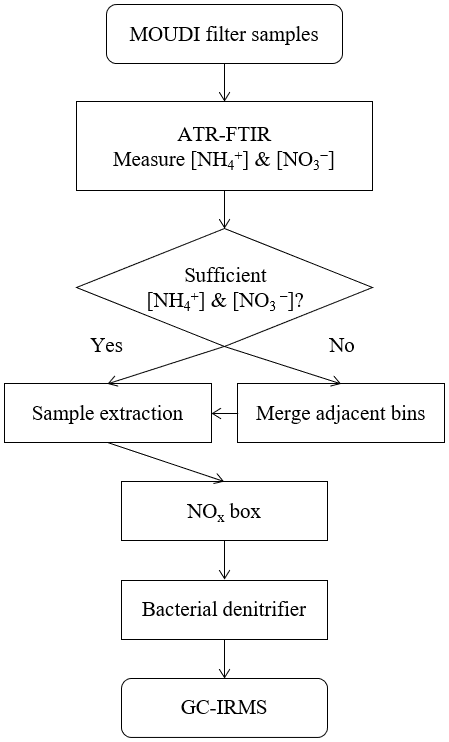
The analytical workflow involved: concentration screening, aqueous extraction, and isotopic measurements (Fig. 1). Initially, attenuated total reflectance Fourier transform infrared spectroscopy (ATR-FTIR, Nicolet 6700, Thermo Fisher Scientific, Madison, WI, USA) was used to semi-quantitatively screen filters for sufficient nitrogen content (≥1 µM N as NO + NH, with details in Supplement Description S1). Filters from adjacent size bins with insufficient loading were combined, and a mass-weighted diameter was calculated as detailed in Supplement Description S2.
Filters were extracted in 30 mL Milli-Q water (18.2 MΩ at 25 °C) using 30 min ultrasonication, followed by filtering through 0.22 µm Millipore syringe filters. Total nitrogen (TN) was determined by oxidizing part of the extracts to nitrate (NO) using potassium persulfate. The bacterial denitrifier method was subsequently employed to measure the δ15N of TN, and the δ15N and δ18O of nitrate + nitrite (NO + NO, NN). Two bacterial strains were employed: Pseudomonas chlororaphis (ATCC® 43928™, Manassas, VA, USA) for TN analysis and Pseudomonas chlororaphis ssp. aureofaciens (ATCC® 13985™, Manassas, VA, USA) for NN analysis to convert NO to nitrous oxide (N2O) gas while preserving isotopic integrity (Weigand et al., 2016). Isotopic ratios of N2O were measured via gas chromatography-isotope ratio mass spectrometry (GC-IRMS) and calibrated against international isotope standards: USGS 34 (δ15N = −1.8 ‰; δ18O = −27.93 ‰) and IAEA-NO3 (δ15N = +4.7 ‰; δ18O = +25.61 ‰) (Böhlke et al., 2003). Detailed descriptions of isotope measurement procedures can be found in T.-Y. Chen et al. (2022).
Given that NO concentrations detected by IC analysis were negligible, NN values were considered as representative of pNO (i.e., δ15N-NN ≈ δ15N-NO; δ18O-NN ≈ δ18O-NO). If TN primarily comprises NH and NN, the δ15N of pNH can be calculated via mass balance:
where MTN and MNN represent the molarities of TN and NN, respectively, measured by the photolytic NO/NO2/NOx analyzer (NOx box, Model T200P, Teledyne API). Stringent quality control was applied: data points were excluded if NN exceeded 80 % of TN or if NH was less than 60 % of water-soluble reduced nitrogen (i.e., MTN−MNN). The latter criterion was based on the assumption that contributions from organic nitrogen were negligible under these conditions. The NH concentration was determined on a fluorescence spectrophotometer (Hitachi F-2700) using a fluorometric method (Holmes et al., 1999).
2.3 Bayesian isotope mixing model framework (MixSIAR)
Source contributions of NH3 and the formation pathways of pNO were estimated using the MixSIAR framework (v3.1.12), which employs Bayesian models to estimate source contributions while accounting for uncertainties in source values (Stock et al., 2018). The model follows the general form as follows:
where Xij is the measured isotope value of tracer j (δ15N-NH or δ18O-NO) for sample i, Pk is the proportion of source k with , Sjk is the isotope value of tracer j of source k (as a normal distribution with mean values and standard deviations), and errij is the residual error. The model was run with extended Markov Chain Monte Carlo (MCMC) parameters to ensure convergence, with all runs confirmed to have converged based on the Gelman-Rubin potential scale reduction factor and the Geweke diagnostic (Stock and Semmens, 2016). Results are reported as mean source contributions with associated standard deviations. To further assess model performance, reconstructed Xij was calculated by weighting Sjk with the model-derived Pk and compared to the measured Xij.
2.3.1 Source apportionments of NH3
To account for isotopic fractionation during the NH3 to pNH transition, the initial δ15N-NH3 (i.e., δ15N-NH) was estimated from the concentration-weighted mean δ15N-NH following Pan et al. (2016):
where is the isotope fractionation constant (+33 ‰ for equilibrium isotope effect (EIE) between NH3(g) and pNH) (Heaton et al., 1997), and f is the fraction of pNH in the NH3-pNH system. Sensitivity tests regarding the temperature dependence, gas−particle equilibrium, and the approximation of equilibrium on were performed, as detailed in Supplement Description S3 and Table S1 (Chang et al., 2025). The f values were derived from the Community Multiscale Air Quality (CMAQ) model (version 4.7.1), incorporating meteorological data from the Weather Research and Forecasting (WRF) model (version 3.7.1). The anthropogenic emission database was from the Taiwan Emission Data System (version 12) (Tsai et al., 2024) while biogenic VOC emissions were calculated with the Model of Emission of Gases and Aerosols from Nature algorithm (MEGAN, version 2.04) (Tsai et al., 2015). Concentrations of NH3 and NH were simulated using the SAPRC99-AERO5 chemical mechanism, in which inorganic gas-particle partitioning of was computed by the ISORROPIA thermodynamic equilibrium module embedded within AERO5. The model-simulated pNH mass concentrations agreed with laboratory measurements within a 20 % uncertainty range (Fig. S2).
For NH3 source apportionment, four major emission sources were considered: fertilizer (−28.3 ± 5.8 ‰), waste (−17.6 ± 5.6 ‰), NH3 slip (−8.2 ± 5.5 ‰), and fossil fuel emissions (1.8 ± 3.2 ‰) (Kawashima et al., 2023). These sources can be categorized into two groups based on their δ15N-NH3 signatures: (1) volatilization-related sources (fertilizer and waste) with lower δ15N-NH3 values, and (2) combustion-related sources (NH3 slip and fossil fuel emissions) with higher values (Z.-L. Chen et al., 2022). δ15N-NH3 obtained using passive techniques was adjusted by 15 ‰ to account for systematic differences between collection methods (Kawashima et al., 2023; Walters et al., 2020). Statistical values for MixSIAR analysis are provided in Table S2.
2.3.2 Estimating formation pathways of pNO
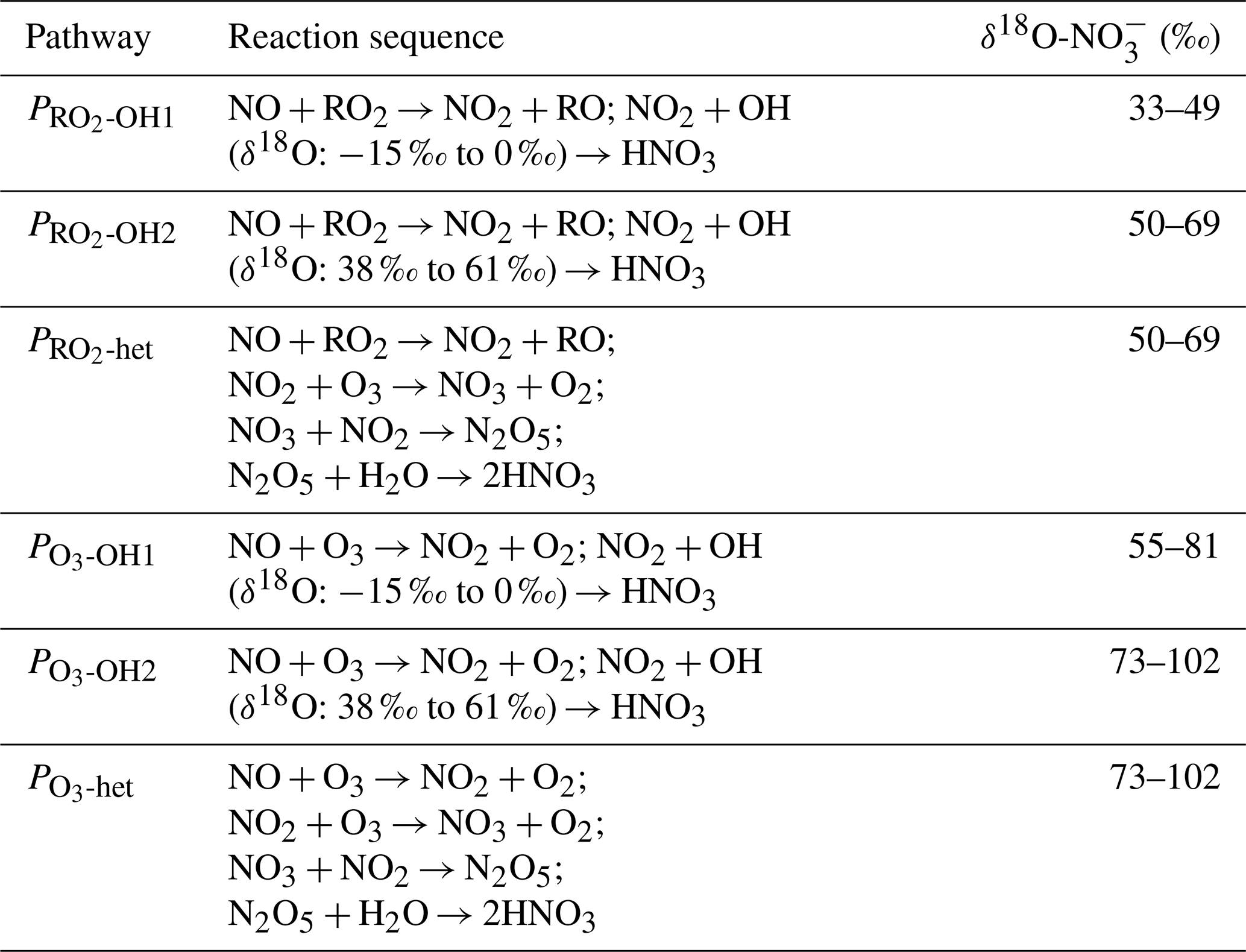
δ18O-NO is applied to evaluate the relative contributions of various HNO3 formation. Six potential pathways were considered by combining the primary oxidants ( and ) with three terminal mechanisms (OH1, OH2, and heterogeneous processes (het)). These pathways are characterized by their specific δ18O-NO signatures (Fig. S3), calculated using a mass-balance approach assuming no kinetic isotope fractionation (Walters and Michalski, 2016). RO2 was assigned a δ18O of 23.5 ‰, reflecting that O in RO2 originates from O2 (Kroopnick and Craig, 1972). O3 exhibits elevated δ18O values ranging from 90 ‰ to 122 ‰ (Hastings et al., 2003). OH radicals were split into OH1 (−15 ‰ to 0 ‰) (Dubey et al., 1997), and OH2 (38 ‰ to 61 ‰). Daytime mechanisms included (33 ‰–49 ‰), (50 ‰–69 ‰), (55 ‰–81 ‰), and (73 ‰–102 ‰). Nighttime analysis focused on (50 ‰–69 ‰) and (73 ‰–102 ‰), while retaining to account for residual daytime nitrate that persists into the night. The reaction sequences and resulting δ18O-NO ranges for each pathway are summarized in Table 1. Sensitivity analyses regarding pathway exclusion are detailed in Supplement Description S4, Tables S3 and S4.
Table 1Summary of the six HNO3 formation pathways evaluated in this study, defined by their primary oxidant (RO2 or O3) and terminal mechanism (OH or heterogeneous reactions), with the corresponding δ18O-NO ranges calculated using a mass-balance approach assuming no kinetic isotope fractionation (Walters and Michalski, 2016).
3.1 Environmental variability
Figure 2 shows the temporal evolution of key environmental parameters, including temperature (Temp), relative humidity (RH), wind speed (WS), wind direction (WD), radiation (Rad), visibility (Vis), and carbon monoxide (CO) concentration for the sampling period. During clear-sky periods, the site exhibited pronounced diurnal cycles driven by complex terrain. Daytime temperatures (20 ± 2 °C) were consistently higher than nighttime values (15 ± 1 °C). Conversely, RH peaked at night (99 ± 1 %) and reached a minimum during daytime (87 ± 8 %). Wind patterns followed typical valley-mountain circulation, with daytime valley winds predominant from the north (316–33°) while nighttime mountain breezes shifted to the southeast (124–179°), consistent with previous observations (Chen et al., 2021). This circulation, often coupled with sea breezes, facilitated the diurnal upslope transport of air masses from low-altitude urban areas toward the mountain forest, likely introducing anthropogenic pollutants. This transport mechanism is further evidenced by CO concentrations, a reliable tracer of combustion emissions, which were consistently higher during the daytime (0.23 ± 0.03 ppm) than at nighttime (0.14 ± 0.03 ppm).
A significant departure from these typical diurnal patterns occurred during a prolonged fog episode lasting approximately 26 h (from 18 April 12:00 to 19 April 14:00 LT). This event was characterized by visibility below 1000 m and RH exceeding 90 % for at least one hour. During this episode, the local atmosphere became exceptionally stagnant: Mean wind speed decreased from 0.9 ± 0.6 to 0.5 ± 0.5 m s−1, with approximately 25 % of observations < 0.1 m s−1. Temperature (15 ± 1 °C) and RH (99.5 ± 0.2 %) remained relatively stable, effectively locking the meteorological state. Notably, CO concentrations during the foggy night (0.22 ± 0.03 ppm) remained as high as clear-daytime levels. This lack of nocturnal ventilation suggests that pollutants were trapped within the valley, creating a quasi-closed system highly conducive to in-situ chemical transformations and aqueous-phase processing.
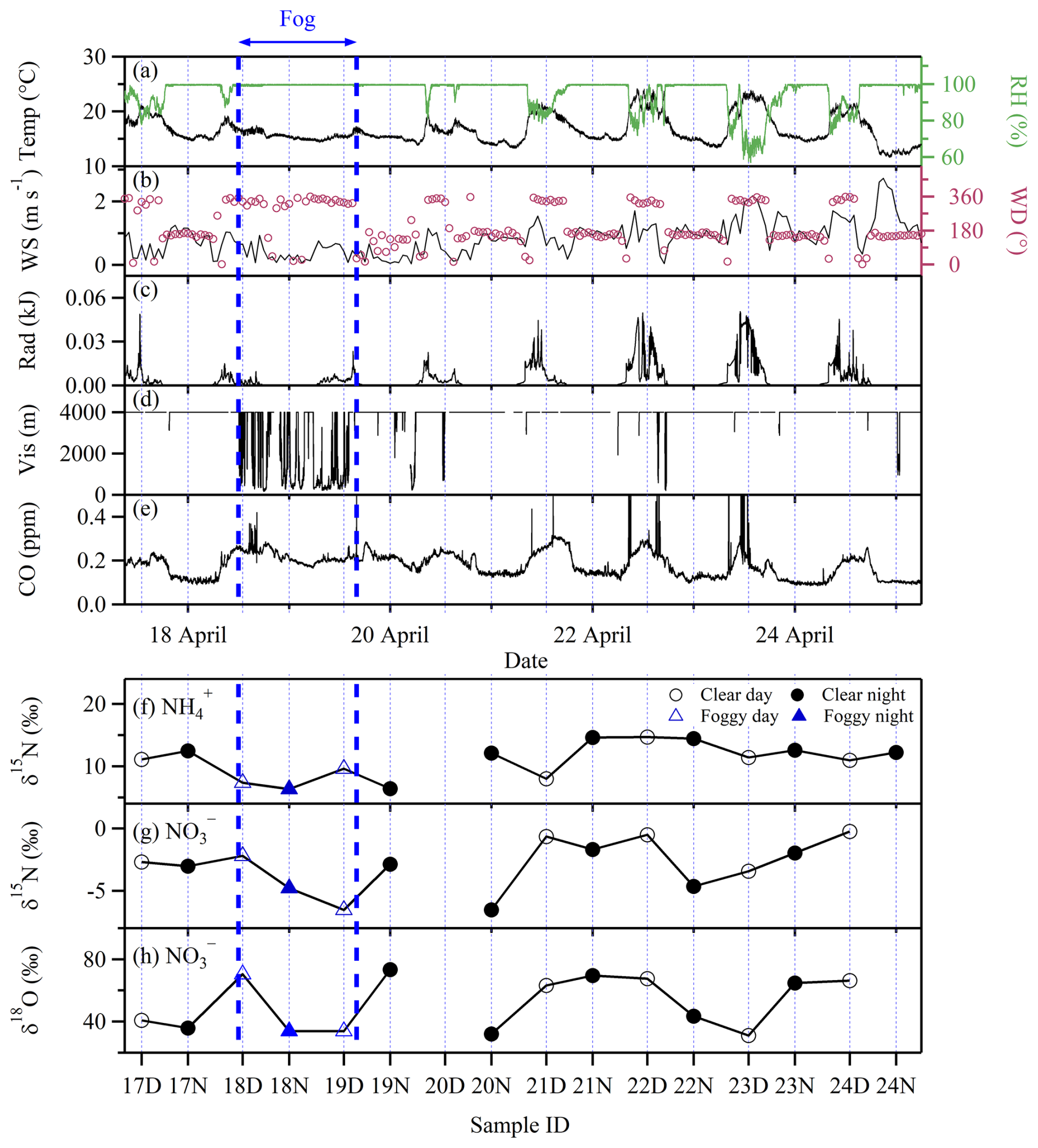
Figure 2Time series of various environmental parameters measured from 17–24 April 2021, including (a) temperature (Temp) and relative humidity (RH), (b) wind speed (WS) and wind direction (WD), (c) radiation (Rad), (d) visibility (Vis), and (e) CO concentration. The concentration-weighted isotope values for (f) δ15N-NH, (g) δ15N-NO, and (h) δ18O-NO over daytime (09:00–17:00 LT, D) and nighttime (18:00–06:00 LT the next day, N) sampling periods. Uncertainties for δ15N and δ18O measurements are generally less than 0.1 ‰ and are smaller than the symbol size.
3.2 Size-resolved aerosol chemical composition
The impact of the prolonged fog on the mass concentration distributions of NH, NO, SO, and black carbon (BC) as a function of particle size is shown in Fig. 3 (detailed temporal variation is provided in Fig. S4). Under the clear period (left panels), all four species exhibited higher daytime concentrations than nighttime values. NH, SO, and BC peaked in the 0.32–0.56 µm range during the daytime, and shifted to 1–1.8 µm with a broader distribution and lower total concentrations at nighttime. In comparison, NO showed a bimodal distribution, with peaks at 0.56–1 and 3.2–5.6 µm during daytime, shifting to 1–1.8 µm and 3.2–5.6 µm at nighttime. These shifts likely reflect coagulation and hygroscopic growth under elevated nocturnal RH.
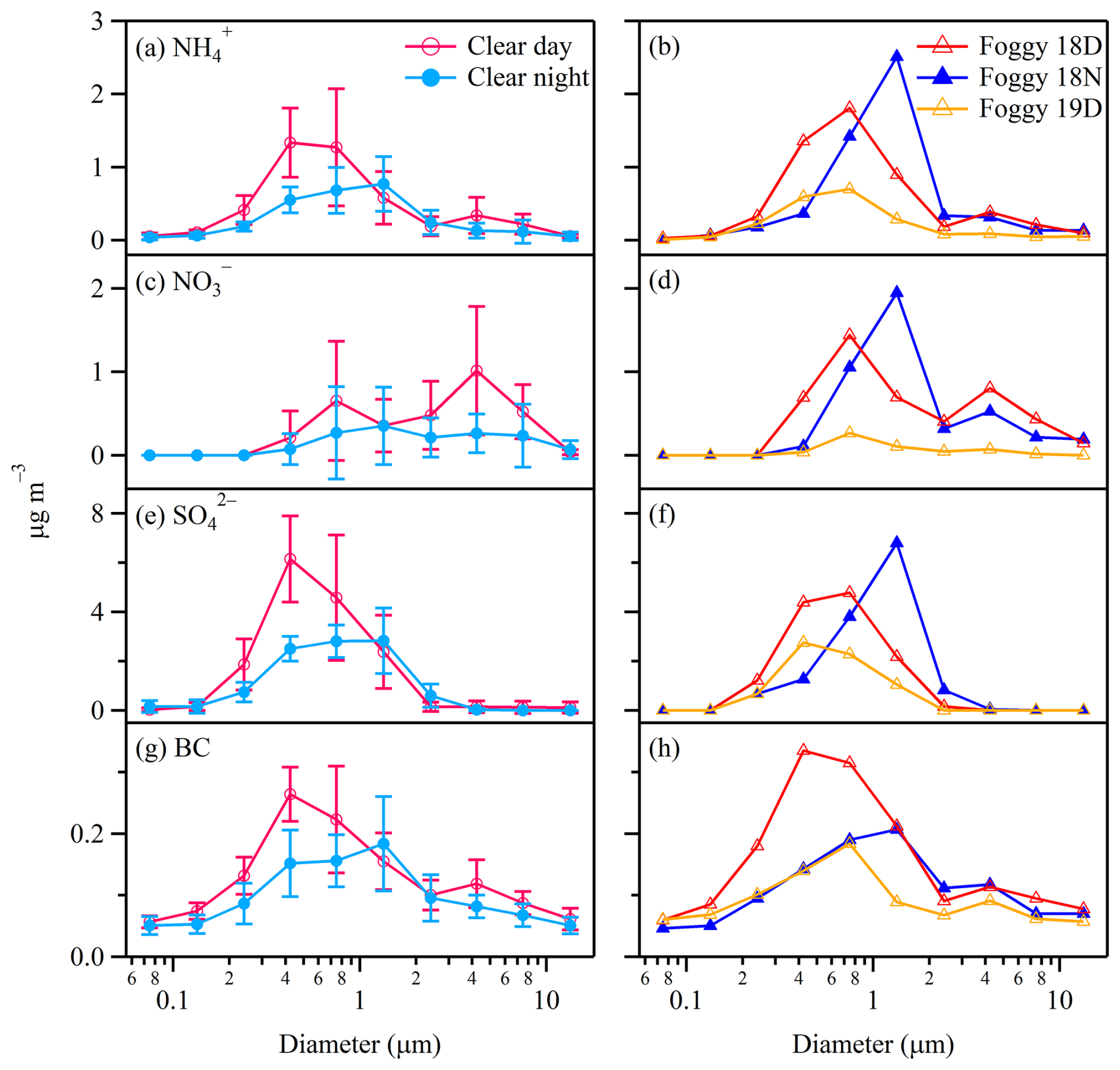
Figure 3Size-resolved mass concentration distributions of particulate (a, b) NH, (c, d) NO, (e, f) SO, and (g, h) black carbon (BC) estimated from FTIR analysis during clear (left panels) and foggy (right panels) periods.
During the foggy period (right panels), sub-micrometer NO concentrations increased for 18D, surpassing coarse-mode levels. This enhancement likely resulted from the accelerated HNO3-NH3 partitioning, promoted by the high surface-to-volume ratio and elevated water content of sub-micrometer particles during the onset of fog. By 18N, all species shifted to the 1–1.8 µm range, indicating substantial droplet hygroscopic growth and interstitial particle coagulation during the fog period. While total concentrations of NH, SO, and NO remained relatively stable compared to 18D, the observed decrease in BC suggests a transition, where aqueous chemistry in the fog droplets compensated for the mass lost to deposition. In the subsequent interval (19D), concentrations of all species decreased, likely resulting from wet deposition of larger droplets and suppressed pollutant transport under stagnant conditions. These observations demonstrate that prolonged fog episodes not only enhance local chemical transformations but also fundamentally alter particle size distributions. Such shifts in composition and size provide the critical framework for interpreting isotopic fractionation and Nr transformations discussed in the following sections.
3.3 δ15N-NH and derivation of emitted δ15N-NH3
3.3.1 δ15N-NH
The daily concentration-weighted δ15N-NH values at the Xitou site ranged from 6.31 ‰ to 14.69 ‰, with an average of 10.95 ± 2.76 ‰ (Fig. 2f, calculation details in Supplement Description S5). These results are consistent with previous winter observations at this site (−3.7 ‰ to 21.39 ‰, with an average of 11.95 ± 2.65 ‰) (T.-Y. Chen et al., 2022). As shown in Fig. S5, these values fall between those typical urban-influenced environments (∼ 19.6 ‰) and remote/forest sites (∼ 5.6 ‰), reflecting the mixed-source characteristics of Xitou (T.-Y. Chen et al., 2022; Kawashima et al., 2023; Hall et al., 2016; Kundu et al., 2010; Moore, 1977; Proemse et al., 2012; Savard et al., 2017; Ti et al., 2018; Walters et al., 2022). This isotopic signature is particularly comparable to other semi-rural receptor sites in East Asia that receive diluted urban plumes mixed with a regional agricultural background.
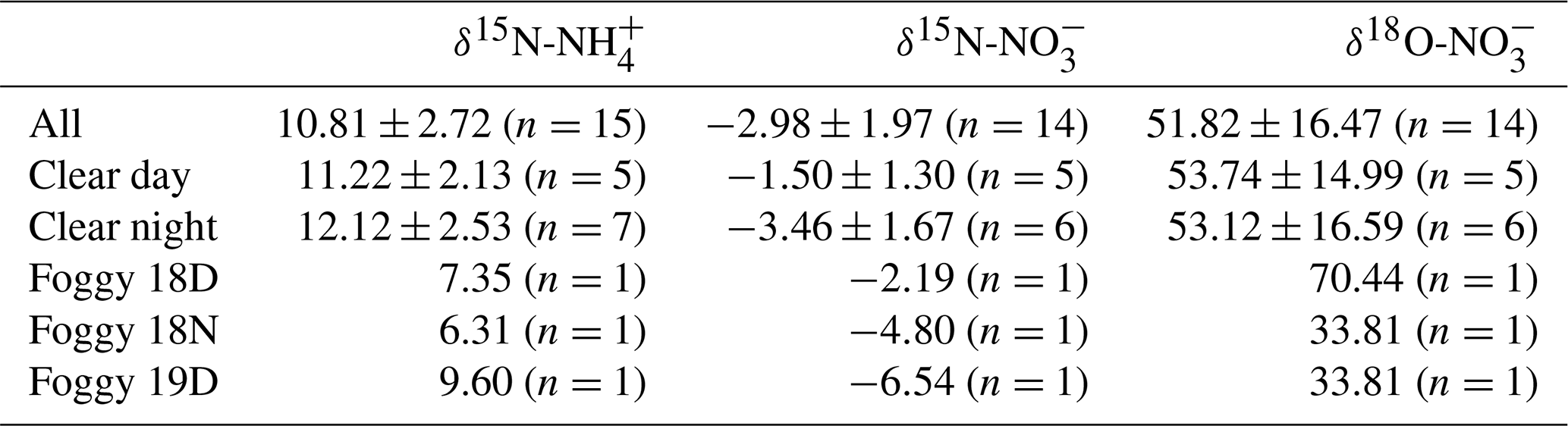
Temporal patterns showed higher δ15N-NH during the clear period, with daytime and nighttime averages of 11.22 ± 2.13 ‰ and 12.12 ± 2.53 ‰, respectively (Table 2). In contrast, lower values were observed during fog, dropping to 7.35 ‰ (18D), 6.31 ‰ (18N), and 9.60 ‰ (19D). This decline of δ15N during the fog event likely results from several concurrent processes under stagnant conditions: first, stagnant conditions suppressed the upslope transport of δ15N-enriched urban plumes from nearby lowlands; second, continuous exchange between gas-phase NH3 and pNH shifts the particle phase toward the signature of the local NH3 pool, which is depleted in δ15N due to agricultural volatilization; third, efficient wet deposition during the fog event may have removed early-formed 15N-enriched particles, forcing the remaining pNH to re-equilibrate with an increasingly δ15N-depleted gas phase; finally, the hygroscopic growth and aqueous-phase processing under fog conditions likely reflect a shift toward equilibrium isotope exchange driven by the NH3 gaseous-aqueous phase interactions for acidic particles, leading to a smaller gas-liquid isotope fractionation of ∼ 4 ‰ (Walters et al., 2019). This observed decrease in δ15N-NH during the foggy period contrasts with our previous study, which showed slight increases during shorter fog events (<6 h) at the same site (T.-Y. Chen et al., 2022). The exceptionally prolonged duration of the current fog episode (∼ 26 h) likely allowed for a more complete chemical and physical equilibration between gas-phase NH3 and the aqueous fog droplets, thereby sustaining isotopic depletion over an extended period. Furthermore, the mass concentrations of both pNH and pNO in this study were nearly double those reported by T.-Y. Chen et al. (2022), indicating a stronger partition of NH3 into the particle phase, leading to much lower δ15N-NH in this study.
Table 2Concentration-weighted isotope values (unit: ‰) under different weather circumstances.
Under clear conditions (excluding 19N and 21D), the size-resolved δ15N-NH distribution revealed a bell-shaped distribution (Fig. 4). Values peaked at ∼ 15 ‰ in the accumulation mode (∼ 0.5–2 µm) and decreased to ∼ 7 ‰ in both the ultrafine and coarse particles. This pattern reflects a transition between local emissions and aged, transported aerosols. For ultrafine mode (<0.5 µm), particles maintain isotopic equilibrium with the local NH3 pool, dominated by δ15N-depleted residual NH3 or volatilization sources (typically −28.3 ‰ to −17.6 ‰). For accumulation-mode (∼ 0.5–2 µm), particles preserve the signatures of lower-elevation anthropogenic emission regions. Here, combustion-derived NH3 (typically −8.2 ‰ to 1.8 ‰) reacts with H2SO4 to form non-volatile ammonium sulfate and ammonium bisulfate. Unlike ammonium nitrate, which is more volatile and easily re-equilibrates with gas-phase NH3 during transport, sulfate-bound NH is more resistant to isotopic re-equilibration, allowing it to act as a conservative tracer of urban source signatures during upslope transport (Wu et al., 2022). For the coarse mode (>2 µm), particles are likely dominated by mineral dust and sea salt and present a substantially weaker thermodynamic sink for NH3 absorption compared to acidic fine-mode sulfate aerosols (Fig. S6) (Pye et al., 2020). Therefore, NH in this mode likely maintains a dynamic equilibrium with local gas-phase NH3, which becomes progressively depleted in 15N as the air mass ages.
During the fog event, the bell-shaped distribution flattened significantly. Weakened wind suppressed the upslope transport of enriched anthropogenic pollutants, while enhanced aqueous-phase processing promoted uniform isotopic re-equilibrium across all particle sizes. Hygroscopic growth and aqueous processing during fog shifted the dominant partitioning pathway from gas–solid equilibrium (∼ 33 ‰) toward a gas–liquid exchange mechanism driven by the NH3 gaseous-aqueous phase interactions with a much smaller isotope fractionation factor (∼ 4 ‰) (Walters et al., 2019). This reduced isotopic separation between the gaseous and condensed phases, while promoting uniform chemical processing across all size bins, effectively dampens the size-dependent isotopic gradient. Concurrently, the high pNO concentration from aqueous chemistry can thermodynamically favor the partition of locally-generated isotopically depleted NH3 into the particle phase, further suppressing accumulation-mode enrichment.
The flat δ15N-NH size distribution was also observed on 19N and 21D. For 19N, it is likely a legacy effect of the preceding fog period (18D, 18N, and 19D). The NH3 pool remained isotopically depleted from sustained fog-driven scavenging and re-equilibration, and regional transport had not yet replenished the accumulation-mode signal. However, high sub-micrometer NO concentration (Fig. S4) suggests that fog-like aqueous chemistry persisted, maintaining isotopic signatures similar to 18D. Conversely, the flat distribution on 21D reflects a distinct source influence. HYSPLIT back-trajectories (Figs. S7–S8) indicate that the air parcel traveled through agricultural regions characterized by heavily depleted NH3 (e.g., livestock waste, −28.3 ‰ to −17.6 ‰). The partitioning of this isotopically light NH3 during transit effectively erased the characteristic accumulation-mode enrichment.
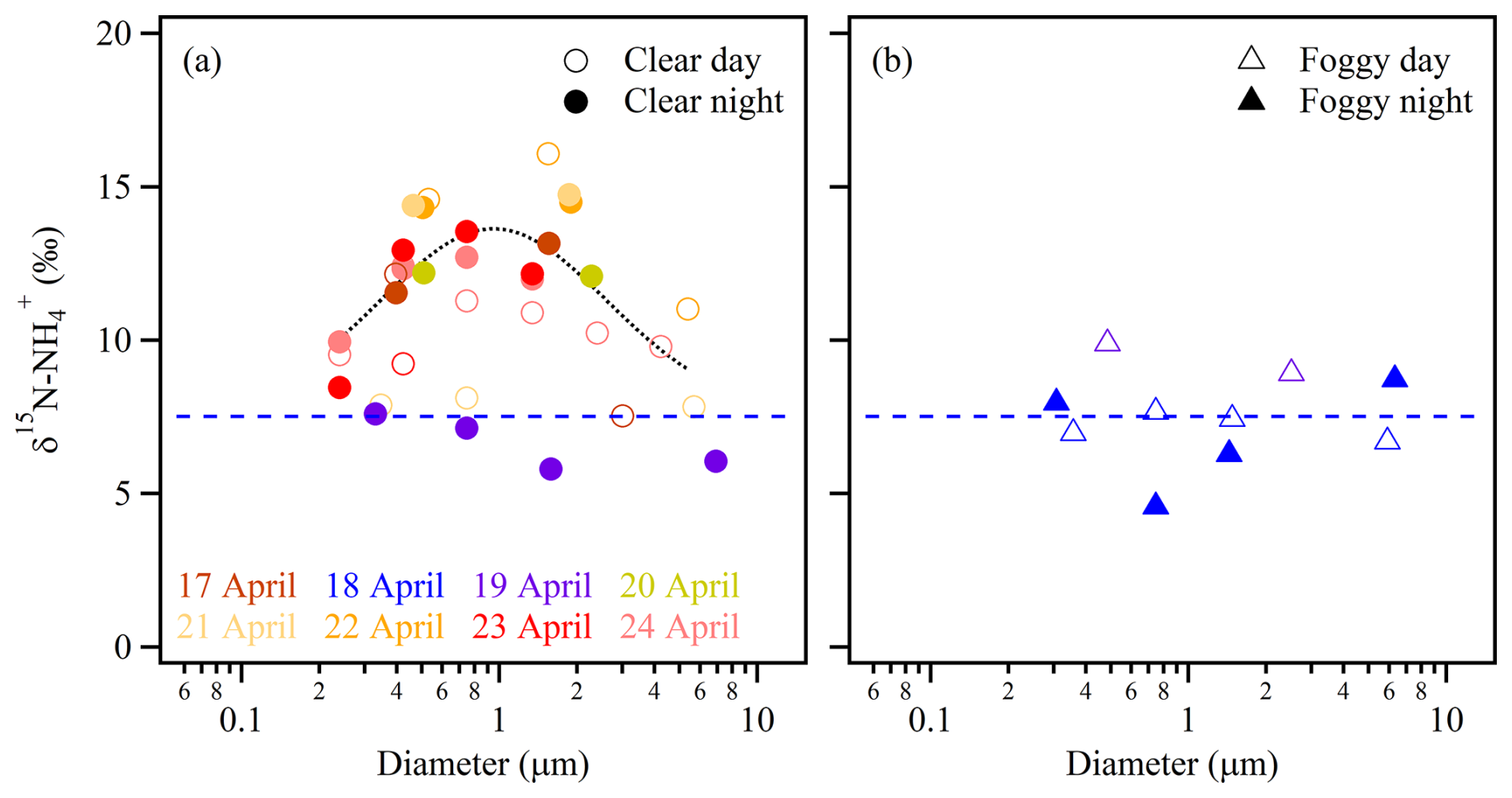
Figure 4δ15N of size-segregated pNH during (a) clear and (b) foggy conditions. The dashed blue line indicates the mean δ15N-NH for foggy periods. The dotted curve represents LogNormal distribution fits for clear conditions, excluding 19N and 21D, where no distinct bell-shaped size dependence was identified.
3.3.2 δ15N-NH and source apportionment
The δ15N-NH values were derived using f values estimated from CMAQ-simulated NH3 and measured pNH concentrations (Fig. S9, as described in Eq. 3). The resulting δ15N-NH ranged from −12.55 ‰ to −6.71 ‰, consistently lower than the concentration-weighted δ15N-NH, as shown in Fig. 5a. Based on the derived δ15N-NH values and assuming a single-source contribution, NH3 can be mainly attributed to NH3 slip. However, because real-world air parcels are typically influenced by a complex mixture of emission sources, the MixSIAR Bayesian framework was employed to quantitatively assess multiple source contributions (Fig. 5b). Overall, combustion-related sources (fossil fuel and NH3 slip) were the dominant contributors to NH (i.e., NH + NH3) in the Xitou area, accounting for 50 %–83 % of total NH3 emissions. During periods with higher δ15N-NH, such as 17D, 17N, and 19D, fossil fuel combustion dominated (54 ± 3 %), followed by NH3 slip (26 ± 1 %), waste (13 ± 1 %), and fertilizer (8 ± 1 %). In comparison, during periods with lower δ15N-NH, the source contributions were more evenly distributed. Fossil fuel combustion and NH3 slip remain significant, accounting for 30 ± 5 % and 29 ± 1 %, respectively, while the relative contributions from waste and fertilizer sources increased to 24 ± 2 % and 17 ± 3 % (Fig. S10).
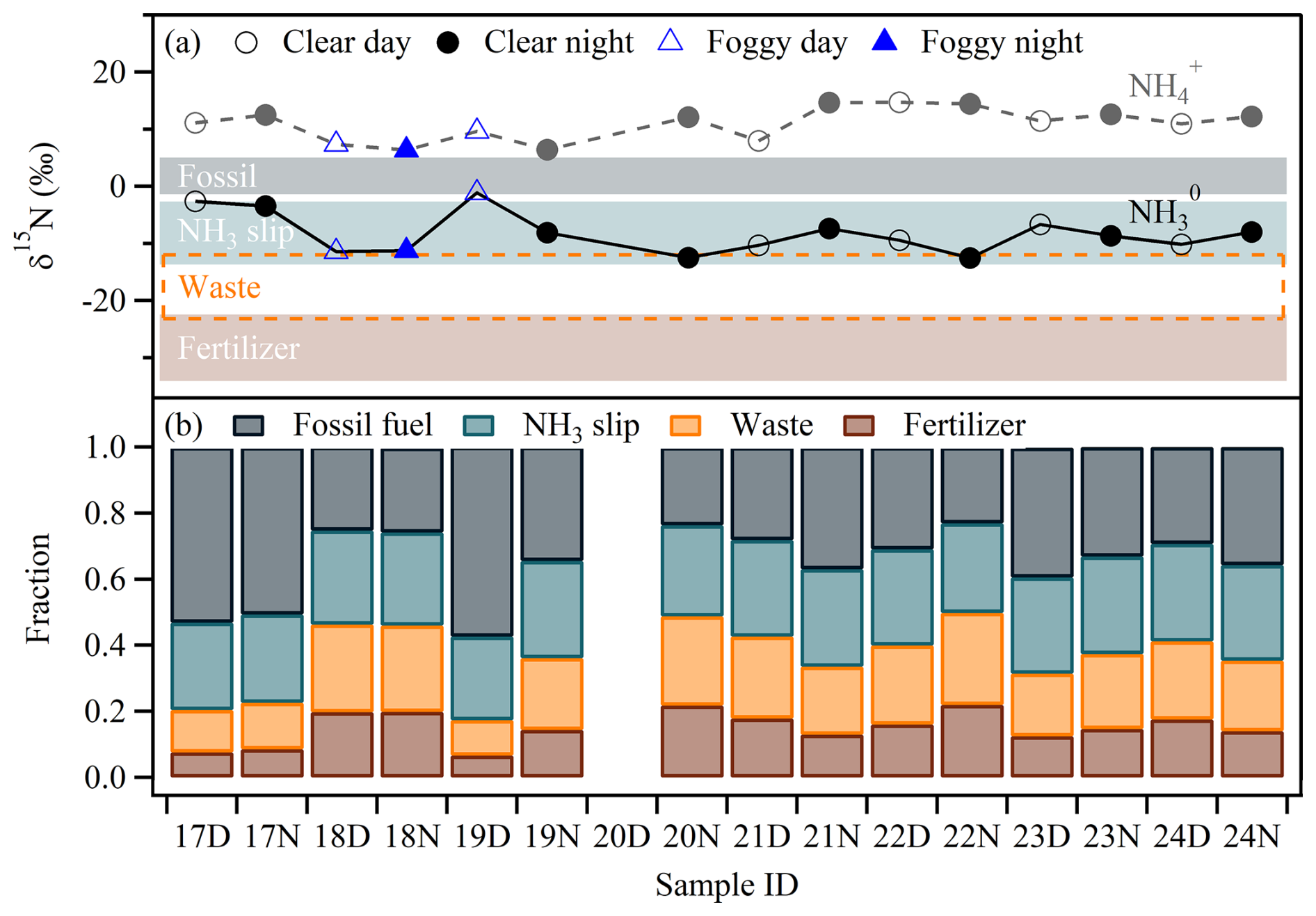
Figure 5(a) Estimated δ15N-NH at Xitou derived from measured δ15N-NH, and compared with the characteristic δ15N ranges of NH3 sources reported in the literature (Table S2). (b) Source apportionment results of NH3 from the MixSIAR framework. Uncertainties of each contribution are shown in Fig. S10.
It is noted that the temperature effect yields values ranging between 33 ‰ and 37 ‰ (Kawashima et al., 2023), while consideration of gas–particle equilibrium pathways under normal (neutral) and foggy (acidic) conditions would lead to an isotope fractionation with values of 33 ‰ and 4 ‰, respectively, as described in Sect. 3.3.1. (Chang et al., 2025; Walters et al., 2019). In real-world environments, these two isotope fraction effects likely operate concurrently, and the δ15N-NH values are expected to lie between the estimations derived from ‰ and 33 ‰. Nevertheless, despite this sensitivity of δ15N-NH calculation to those shifting values, the MixSIAR Bayesian model outputs remained consistent with combustion-related sources accounting for 88 %–95 % of total NH3 emissions (see Supplement Description S3 and Table S1). The persistent dominance of combustion-related sources at this remote mountain site, even during the stagnant fog condition, strongly demonstrates the profound, overarching influence of transport from urban and industrial areas.
These findings underscore the need for regional emission control strategies targeting anthropogenic NH3 sources, which may represent a more cost-effective mitigation strategy for Taiwan, potentially yielding greater air quality benefits than NOx or SO2 reductions alone (P.-C. Huang et al., 2024). It should be noted, however, that the differences in source contributions between daytime and nighttime periods, or between fog and clear conditions, remain within the overlapping ranges of the posterior distributions; consequently, the current sample number precludes statistically robust discrimination between these conditions. Expanded measurements encompassing multiple seasons and contrasting meteorological regimes would be necessary to establish whether systematic diurnal or fog-driven shifts in NH3 source apportionment exist at this site.
3.4 δ15N and δ18O of pNO
3.4.1 δ15N-NO
The daily concentration-weighted δ15N-NO values ranged from −6.54 ‰ to −0.24 ‰, with an average of −2.98 ± 1.97 ‰ (Fig. 2g). These values are consistent with those reported in mountain sites such as Mt. Lulin (−3.6 ± 3.8 ‰) (Guha et al., 2017) and the Himalayan-Tibetan Plateau (0.44 ± 4.89 ‰) (Lin et al., 2021), as illustrated in Fig. S11. Compared to wintertime measurements at the same site (2.98 ± 1.20 ‰) (T.-Y. Chen et al., 2022), these lower springtime values likely reflect seasonal shifts in NOx sources and transport-related fractionation. The depletion relative to urban values, such as ∼ 11.5 ‰ in Beijing and Gosan (Fan et al., 2020; Kundu et al., 2010), indicates that NOx-to-HNO3 conversion during transport to the mountain receptors is accompanied by progressive isotopic fractionation (Freyer et al., 1993; Gobel et al., 2013).
Under clear conditions, δ15N-NO showed minor diurnal variation, with slightly higher values during daytime (−1.50 ± 1.30 ‰) than nighttime (−3.46 ± 1.67 ‰; Table 2), likely reflecting shifts between transported urban and local biogenic NOx sources or the depletion through deposition. During the fog, δ15N-NO decreased significantly from −2.19 ‰ (18D) to −4.80 ‰ (18N), and further to −6.54 ‰ (19D) (Fig. 2g). This decline, contrasting with previous shorter fog events (T.-Y. Chen et al., 2022), reflects the combined effects of prolonged stagnation and a reduced influx of urban air. These conditions promote enhanced aqueous-phase pNO formation, predominantly driven by δ15N-depleted NOx from locally derived biogenic precursors or precursors that have undergone extensive fractionation during transport (Vicars et al., 2013; Gobel et al., 2013).
Relatively low concentration-weighted δ15N-NO values were observed outside the fog periods on 20N and 22N, likely attributable to distinct mechanisms. For 20N, the depletion is linked to enhanced local production, supported by elevated sub-micrometer NO concentration shown in Fig. S4. For 22N, the low δ15N coincides with significant deposition loss, as evidenced by low total NO levels. Because HNO3 readily reacts with coarse-mode mineral dust and sea salt, the deposition efficiency during transport is high; this preferential removal of δ15N-enriched species often leaves the residual nitrate pool isotopically lower. Furthermore, the thermodynamic partitioning of HNO3, governed by ambient temperature and particle acidity regulated by sulfate and ammonium, critically influences the observed δ15N. Ultimately, the observed δ15N at this site serves as an integrated signal of physical and chemical dynamics processes within the air parcel during its transit.
Size-segregated δ15N-NO values ranged from −10.05 ‰ to 0.78 ‰, showing a weak positive correlation with particle diameter (Fig. 6a). Fine particles (PM1) had slightly lower δ15N-NO values (−3.59 ± 2.38 ‰) compared to larger, coarse-mode particles (PM1–10, −2.07 ± 2.10 ‰), a trend consistent with previous findings (T.-Y. Chen et al., 2022). This size-dependent distribution likely reflects isotopic fractionation occurring during HNO3 formation and its subsequent partitioning across different size modes. In environments (nearby coast) proximal to major NOx sources, HNO3 may react preferentially with coarse-mode particles (e.g., NaCl or mineral dust), forming δ15N-enriched pNO. The residual NOx pool, consequently depleted in δ15N, subsequently forms HNO3 that condenses onto fine-mode particles as they undergo transport toward the sampling site (Gobel et al., 2013). However, it is important to note that the complex physical and chemical dynamic processes within the air parcel during its transit, as detailed above, may diminish these distinct isotopic signatures under varying daily meteorological conditions.
3.4.2 Using δ18O-NO to estimate contributions of pNO formation pathways
The daily concentration-weighted δ18O-NO ranged from 30.98 ‰ to 73.27 ‰, with an average value of 51.82 ± 16.47 ‰ (Fig. 2h). Similar to δ15N-NO, these values align with measurements from other mountain regions such as 10.8 ‰–92.4 ‰ at Mt. Lulin (Guha et al., 2017) and 64.71 ± 11.52 ‰ at the Himalayan-Tibetan Plateau (Lin et al., 2021), but are lower than previous winter observations (72.66 ± 3.42 ‰) (T.-Y. Chen et al., 2022), as illustrated in Fig. S12. In contrast, δ18O-NO at urban sites such as Changchun (68.16 ± 9.52 ‰) and Beijing (83.8 ± 13.4 ‰) are substantially higher, consistent with O3-dominated oxidation under polluted conditions. The relatively lower δ18O-NO values at Xitou and other mountain sites suggest that RO2-initiated pathways contribute more substantially to nitrate formation under less-polluted conditions. A sharp decrease in δ18O-NO from 70.44 ‰ (18D) to 33.81 ‰ (18N and 19D) occurred during the fog, coinciding with δ15N-NO depletion. This shift from O3- to RO2-dominated oxidation is likely driven by stagnant winds, suppressed urban input, and enhanced local aqueous-phase chemistry under high RH.
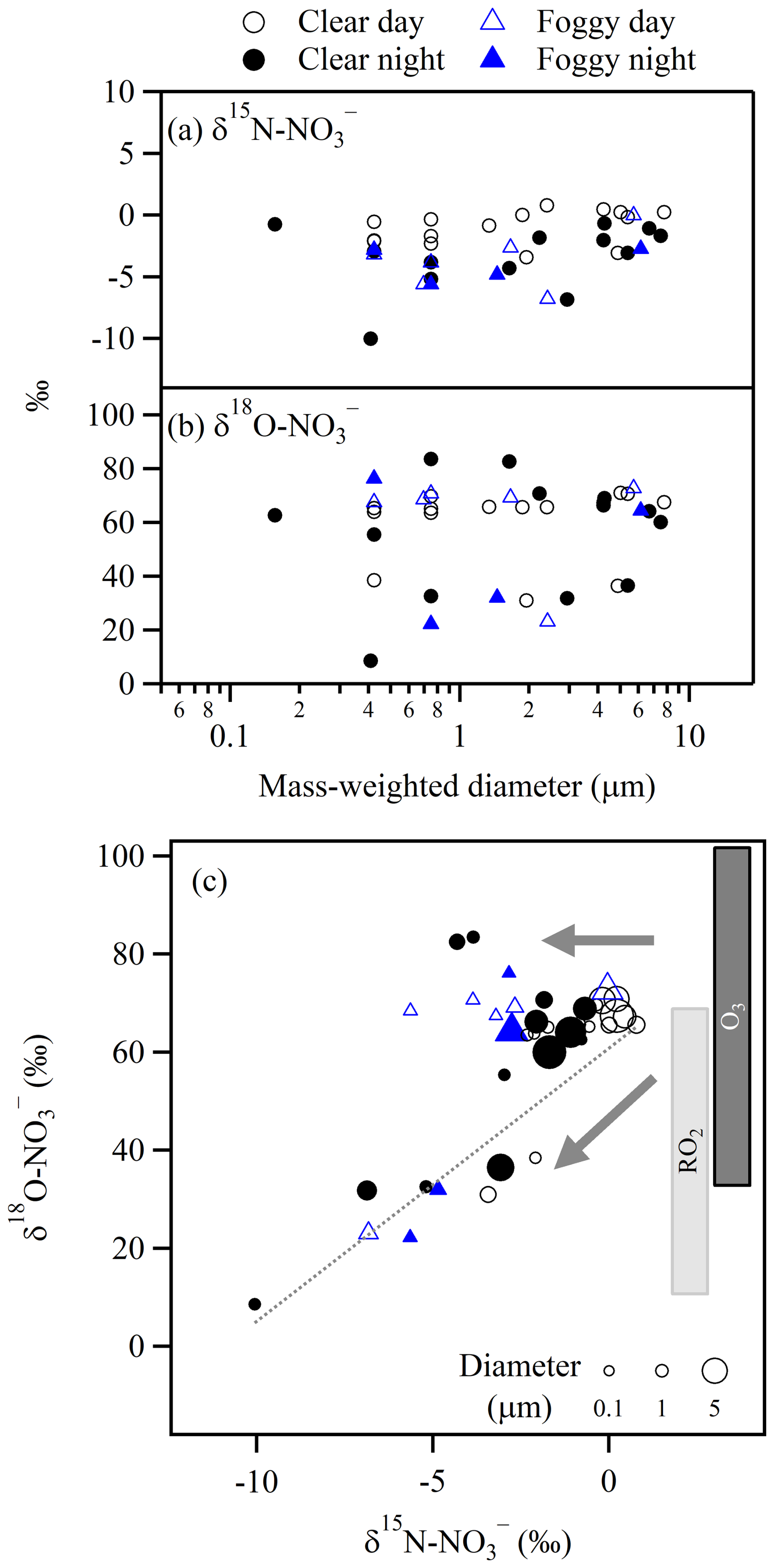
Figure 6Size-resolved isotopic composition of pNO. (a) δ15N-NO values as a function of mass-weighted particle diameter. (b) δ18O-NO values as a function of mass-weighted particle diameter. (c) Two-dimensional plot of δ15N versus δ18O across particle sizes. The dotted line provides a visual guide to possible source groupings. The gray boxes labeled “RO2” and “O3” indicate the potential δ18O-NO ranges resulting from reactions with RO2 and O3, respectively.
Notably, no significant systematic size-dependent trend of δ18O-NO on particle size was observed (Fig. 6b). The spatial heterogeneity of oxidants (O3 and RO2), coupled with the complex HNO3 partitioning dynamics within the air parcel, likely erases any size-dependent isotopic pattern and daily variation. However, the δ15N-NO vs. δ18O-NO relationship (Figs. 6c, S13, and S14) resolves two geochemically distinct regimes reflecting contrasting formation environments and aerosol histories. The higher δ18O-NO (55 ‰–83 ‰) with enriched δ15N-NO (−6 ‰ to 1 ‰) can be assigned as an urban/transported regime. Freshly emitted in metropolitan areas contributed to elevated δ15N, while O3-driven oxidation leads to high δ18O (Gobel et al., 2013). The observed lower δ18O-NO (9 ‰–38 ‰) and depleted δ15N-NO (−10 ‰ to −2 ‰) is assigned as a rural/fog regime. These signatures reflect RO2-initiated oxidation and δ15N-depleted NOx from locally derived biogenic precursors or after extensive fractionation during transport, particularly under stagnant conditions. A moderate positive correlation (r=0.66) between δ18O-NO and δ15N-NO further highlights the intrinsic interplay between oxidation processes and nitrogen cycling at the site. These data demonstrate a δ18O-NO and δ15N-NO relationship that covers a broad isotopic range, spanning from the signatures observed at the Himalayan-Tibetan Plateau to those at regional background sites like Mt. Lulin (Fig. S15).
Formation pathways of pNO were quantitatively analyzed using the MixSIAR framework based on δ18O-NO values, as shown in Fig. 7. During daytime periods characterized by low δ18O-NO values (31 ‰–41 ‰) and low CO concentrations (<0.22 ppm, 17D, 19D, and 23D), accounted for 82 %–92 % of pNO formation (Fig. 7a and b). These conditions are consistent with periods with limited influence from urban air masses, suggesting the dominance of local RO2 oxidation processes. In contrast, during daytime with higher δ18O-NO values (63 ‰–70 ‰) and elevated CO concentrations (0.24–0.27 ppm, 18D, 21D, 22D), the dominant pathways shifted toward , , and , contributing an average of 29 ± 1 %, 27 ± 3 %, and 28 ± 5 %, respectively. This shift probably reflects the enhanced transport of urban air masses enriched in O3 and NOx precursors.
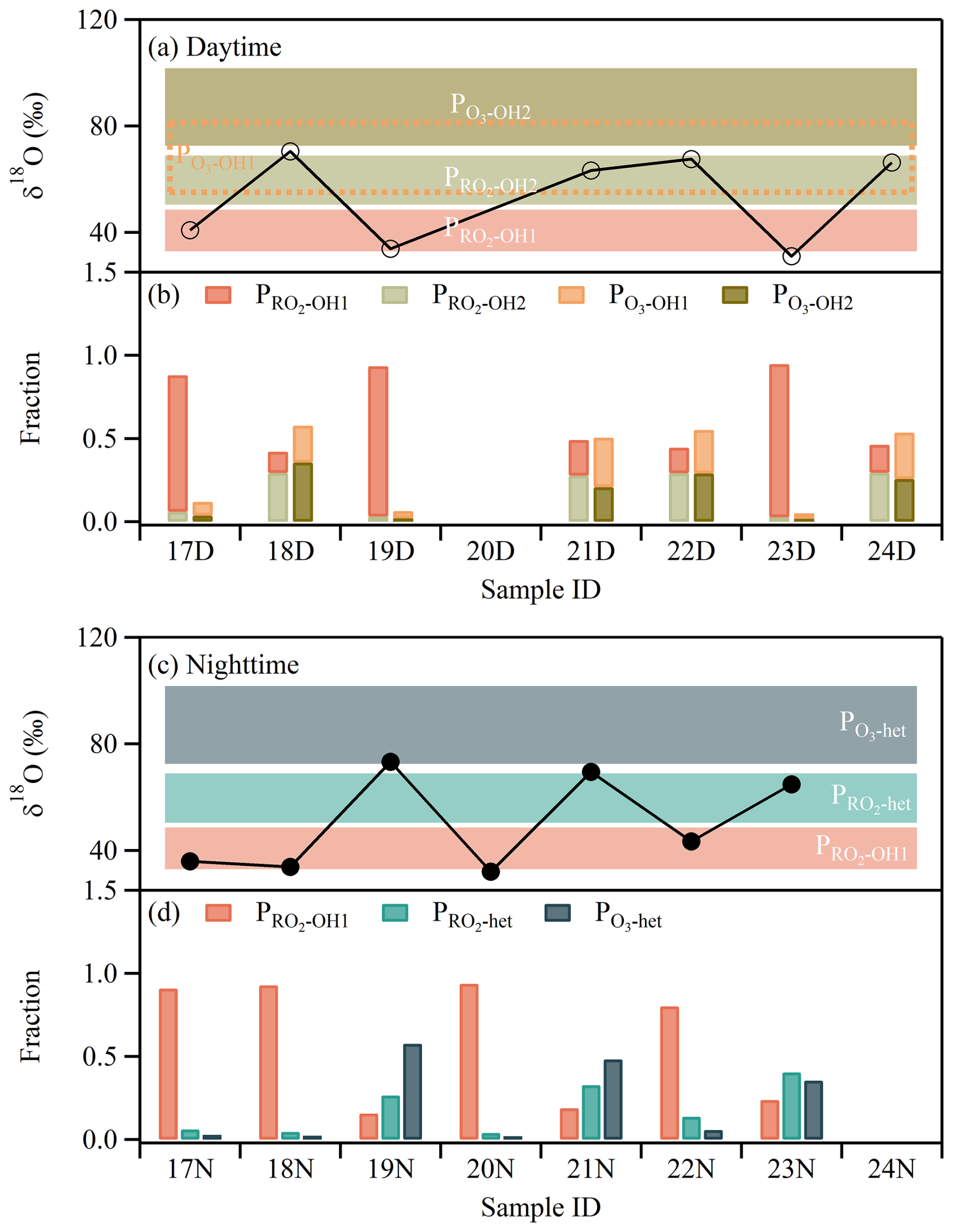
Figure 7Contributions of nitrate formation pathways estimated by MixSIAR. (a, c) Measured δ18O-NO values with the corresponding δ18O ranges of potential formation pathways; (b, d) estimated fractional contributions of these pathways.
Although nighttime nitrate formation is theoretically dominated by heterogeneous reactions, our results reveal a more complex process. On nights with elevated δ18O-NO values, heterogeneous pathways ( and ) were the dominant contributors, accounting for 33 ± 6 % and 47 ± 9 % of pNO formation on 19N, 21N, 23N. In contrast, on nights with lower δ18O-NO values (32 ‰–43 ‰, 17N, 18N, 20N, and 22N), remained a major contributor, accounting for 80 %–94 % of formation. This high contribution might stem from the residual pNO from daytime or nighttime •OH generated via reactions between O3 and alkenes and/or terpenes. The latter pathway is chemically plausible at Xitou given the documented nighttime accumulation of monoterpenes at this site (Salvador et al., 2020) and the known positive correlation between monoterpene concentrations and dark radical production in forested environments, which likely proceeds via ozonolysis (Kroll et al., 2001; Aschmann et al., 2002; Kanaya et al., 2007; Salvador et al., 2020). However, direct measurements would be needed in future campaigns to quantify the relative importance of these mechanisms. The weak night-to-night covariation between δ18O-NO and CO concentrations further suggests that nighttime nitrate isotope signatures are governed by the interplay among fog processing, reduced advection, and heterogeneous chemistry, rather than transport intensity alone.
A distinct shift in nitrate formation pathways was observed during the fog event. On 18D, high δ18O-NO values (∼ 70 ‰) and elevated CO concentrations (0.24 ppm) were associated with the dominance of (30 ± 20 %) and (36 ± 16 %), indicating that O3 from transported urban precursors remained active (Fig. S16). As fog intensified during 18N and persisted into 19D, δ18O-NO values decreased sharply to ∼ 34 ‰, and became dominant (93 ± 5 % on 18N, and 90 ± 5 % on 19D). This transition is driven by two coupled effects: (1) the attenuation of incoming solar radiation suppresses O3 photolysis and thereby reduces the availability of high-δ18O oxidants, and (2) the scavenging of upslope transported particles by wet deposition diminishes the influx of urban NOx and O3. Together, these foggy conditions favor locally derived low δ18O-RO2 cycling as the predominant oxidant driving nitrate formation. While low values of individual isotopic tracers were occasionally observed during non-fog periods, attributable to source footprint effects or transport-induced fractionation (Sect. 3.3.1 and 3.4.1), the fog episode represents the unique period during this campaign where simultaneous depletion across all three tracers (δ15N-NH, δ15N-NO and δ18O-NO) occurred with coherent temporal progression. This multi-tracer convergence supports the concurrent operation of several fog-induced processes: intense atmospheric stagnation, progressive wet scavenging, aqueous-phase re-equilibration with isotopically depleted gas-phase species, and a mechanistic shift toward RO2-dominated oxidation, all of which are mechanistically coupled to fog conditions rather than to individual source or regional transport effects.
Distinguishing the relative contributions helps clarify how nitrate formation processes vary with air mass origin, photochemical activity, and fog processing, which is directly relevant to emission control strategies since the efficacy of nitrate reduction depends on the dominant oxidation pathway. At the global scale, model estimated that the NO2 + •OH (same as our /) and N2O5 hydrolysis (same as our /) pathways each contributed approximately 41 % to tropospheric nitrate formation (Alexander et al., 2020), while observation studies in both urban and mountain environments suggest that heterogeneous pathways become more important for nitrate formation under elevated pollution levels (Fan et al., 2020; Lin et al., 2021). The pathway apportionment presented here provides finer resolution than gas-phase and heterogeneous partitioning by explicitly distinguishing RO2- from O3-initiated formation, which can be useful in regions where RO2 oxidation dominates.
Beyond inorganic HNO3 formation, the total particulate nitrogen budget includes particulate organic nitrate (pON) species, which can account for 17 %–31 % of total particulate nitrogen (Yu et al., 2024) in mixed urban-biogenic environments, and up to 50 % in urban plumes (Murphy et al., 2025). pON forms via the reaction of NO with RO2 (NO + RO2 → RONO2) during the day, and NO3 with alkenes and biogenic VOC at night (NO3 + R → RONO2) (Murphy et al., 2025; Ward et al., 2025; Guo et al., 2024). These mechanisms operate through the same RO2- and NO3-driven pathways identified here ( and , respectively), suggesting that the oxidation chemistry inferred from δ18O-NO signatures at Xitou also drives concurrent pON production. Because isotope analysis in this study assumes TN comprises only NO and NH, organic nitrogen contribution could bias the derived δ15N-NH toward the signature of pON. While this was partially mitigated by excluding samples with low [NH] (<60 % of ([TN] − [NN])), future research should prioritize direct δ15N-NH measurement, which would enable the estimation of organic nitrate isotopes via residual mass balance (i.e., [ON] = [TN] − [NH] − [NO]) and provide a more complete characterization of the Nr budget in mountain forest environments.
A one-week campaign at a subtropical mountain forest in Taiwan revealed that daytime upslope transport of urban plumes consistently elevated particle concentrations above nighttime levels. Conversely, a single ∼ 26 h fog event suppressed urban input and drove progressive isotopic depletion in both δ15N-NH and δ15N-NO. Simultaneously, size-resolved δ15N-NH signatures shifted from a bell-shaped distribution with a peak at accumulation-mode under clear conditions to a flattened distribution during the fog event, while a marked decline in δ18O-NO indicated a transition from O3- to RO2-dominated nitrate formation. Because these distinct signals are easily obscured in bulk measurements, this study underscores the value of size-segregated isotope analysis. Furthermore, Bayesian source apportionment analysis showed that 50 %–83 % of total NH3 was consistently attributed to combustion-related sources, suggesting that targeting combustion-related NH3 emissions could represent an effective PM mitigation approach in Taiwan.
Overall, this study demonstrates that size-resolved isotope analysis provides process-level insights into nitrogen transport and transformation within a complex, high-altitude forest ecosystem. Nevertheless, certain analytical limits remain: accurate source apportionment of NH3 and the precise quantification of discrete pNO formation pathways remain constrained by simplified equilibrium fractionation assumptions and overlapping isotopic end-members. Future research incorporating direct gas-phase isotope observations and controlled chamber studies of aqueous-phase reactions will help improve the differentiation between urban and biogenic contributions, enabling a more rigorous evaluation of targeted emission reduction frameworks. Finally, as this work constitutes a specialized case study from a short spring campaign capturing a single fog episode, multi-event observations across seasons and contrasting meteorological regimes are needed to establish the broader generality and long-term representativeness of Nr evolution.
Codes for the MixSIAR model framework are available at https://brianstock.github.io/MixSIAR/ (Stock et al., 2018).
The data presented in this study are available in the Zenodo repository at https://doi.org/10.5281/zenodo.20787090 (Lee et al., 2026).
Samples are no longer available due to full consumption during analytical procedures.
The supplement related to this article is available online at https://doi.org/10.5194/acp-26-10947-2026-supplement.
WCL: data curation, formal analysis, MixSIAR analysis, visualization, writing original draft; MHH: laboratory experiments, data curation, formal analysis; WCH: field observations, filter sample collection, laboratory experiments, data curation; JPC: CMAQ modeling and analysis; YJL: meteorological data collection; HR: supervision of isotope measurements and analysis; HMH: project design, project supervision, data discussion, manuscript review and editing. All authors approved the final version of the manuscript.
The contact author has declared that none of the authors has any competing interests.
Publisher's note: Copernicus Publications remains neutral with regard to jurisdictional claims made in the text, published maps, institutional affiliations, or any other geographical representation in this paper. The authors bear the ultimate responsibility for providing appropriate place names. Views expressed in the text are those of the authors and do not necessarily reflect the views of the publisher.
The authors acknowledge Hsu-Hung Lee and Ting-Yu Chen for their assistance with field observations, filter sampling, and preliminary data analysis. We also thank Prof. Jr-Chuan Huang from the Department of Geography, National Taiwan University, for IC instrumentation support, and the administration of the Xitou Experimental Forest, College of Bio-Resources and Agriculture, National Taiwan University, for local site support. AI tools (ChatGPT, Gemini, and Claude) were used to improve the clarity of language; all scientific content was developed and verified by the authors.
This study has been supported by the National Science and Technology Council of Taiwan (grant nos. 112-2111-M-002-014, 113-2111-M-002-012, and 114-2111-M-002-014). W.-C. Lee received support from the National Science and Technology Council of Taiwan (grant nos. 113-2811-M-002-114 and 114-2811-M-002-083).
This paper was edited by Alex Lee and reviewed by three anonymous referees.
Alexander, B., Sherwen, T., Holmes, C. D., Fisher, J. A., Chen, Q., Evans, M. J., and Kasibhatla, P.: Global inorganic nitrate production mechanisms: comparison of a global model with nitrate isotope observations, Atmos. Chem. Phys., 20, 3859–3877, https://doi.org/10.5194/acp-20-3859-2020, 2020.
Aschmann, S. M., Arey, J., and Atkinson, R.: OH radical formation from the gas-phase reactions of O3 with a series of terpenes, Atmos. Environ., 36, 4347–4355, https://doi.org/10.1016/S1352-2310(02)00355-2, 2002.
Böhlke, J. K., Mroczkowski, S. J., and Coplen, T. B.: Oxygen isotopes in nitrate: new reference materials for measurements and observations on nitrate-water equilibration, Rapid Commun. Mass Spectrom., 17, 1835–1846, https://doi.org/10.1002/rcm.1123, 2003.
Chang, Y., Zhang, Y., Tian, C., Zhang, S., Ma, X., Cao, F., Liu, X., Zhang, W., Kuhn, T., and Lehmann, M. F.: Nitrogen isotope fractionation during gas-to-particle conversion of NOx to NO in the atmosphere – implications for isotope-based NOx source apportionment, Atmos. Chem. Phys., 18, 11647–11661, https://doi.org/10.5194/acp-18-11647-2018, 2018.
Chang, Y., Zhang, Y., Wang, Q., Shao, S., Bao, M., Zhang, C., and Lehmann, M. F.: Nitrogen isotope fractionation associated with ammonia gas-to-aerosol conversion and implications for determining isotopic source signatures and tracing atmospheric ammonium origins, Environ. Sci. Technol., 59, 22110–22121, https://doi.org/10.1021/acs.est.5c11271, 2025.
Chen, C.-L., Chen, T.-Y., Hung, H.-M., Tsai, P.-W., Chou, C. C. K., and Chen, W.-N.: The influence of upslope fog on hygroscopicity and chemical composition of aerosols at a forest site in Taiwan, Atmos. Environ., 246, 118150, https://doi.org/10.1016/j.atmosenv.2020.118150, 2021.
Chen, T.-Y., Chen, C.-L., Chen, Y.-C., Chou, C. C.-K., Ren, H., and Hung, H.-M.: Source apportionment and evolution of N-containing aerosols at a rural cloud forest in Taiwan by isotope analysis, Atmos. Chem. Phys., 22, 13001–13012, https://doi.org/10.5194/acp-22-13001-2022, 2022.
Chen, Z.-L., Song, W., Hu, C.-C., Liu, X.-J., Chen, G.-Y., Walters, W. W., Michalski, G., Liu, C.-Q., Fowler, D., and Liu, X.-Y.: Significant contributions of combustion-related sources to ammonia emissions, Nat. Commun., 13, 7710, https://doi.org/10.1038/s41467-022-35381-4, 2022.
Cheng, Y., Zheng, G., Wei, C., Mu, Q., Zheng, B., Wang, Z., Gao, M., Zhang, Q., He, K., Carmichael, G., Pöschl, U., and Su, H.: Reactive nitrogen chemistry in aerosol water as a source of sulfate during haze events in China, Sci. Adv., 2, e1601530, https://doi.org/10.1126/sciadv.1601530, 2016.
Doney, S. C., Mahowald, N., Lima, I., Feely, R. A., Mackenzie, F. T., Lamarque, J.-F., and Rasch, P. J.: Impact of anthropogenic atmospheric nitrogen and sulfur deposition on ocean acidification and the inorganic carbon system, P. Natl. Acad. Sci. USA, 104, 14580–14585, https://doi.org/10.1073/pnas.0702218104, 2007.
Dubey, M. K., Mohrschladt, R., Donahue, N. M., and Anderson, J. G.: Isotope specific kinetics of hydroxyl radical (OH) with water (H2O): Testing models of reactivity and atmospheric fractionation, J. Phys. Chem. A, 101, 1494–1500, https://doi.org/10.1021/jp962332p, 1997.
Ervens, B.: Modeling the processing of aerosol and trace gases in clouds and fogs, Chem. Rev., 115, 4157–4198, https://doi.org/10.1021/cr5005887, 2015.
Fan, M.-Y., Zhang, Y.-L., Lin, Y.-C., Cao, F., Zhao, Z.-Y., Sun, Y., Qiu, Y., Fu, P., and Wang, Y.: Changes of emission sources to nitrate aerosols in Beijing after the clean air actions: Evidence from dual isotope compositions, J. Geophys. Res.-Atmos., 125, e2019JD031998, https://doi.org/10.1029/2019JD031998, 2020.
Freyer, H. D., Kley, D., Volz-Thomas, A., and Kobel, K.: On the interaction of isotopic exchange processes with photochemical reactions in atmospheric oxides of nitrogen, J. Geophys. Res.-Atmos., 98, 14791–14796, https://doi.org/10.1029/93JD00874, 1993.
Galloway, J. N., Townsend, A. R., Erisman, J. W., Bekunda, M., Cai, Z., Freney, J. R., Martinelli, L. A., Seitzinger, S. P., and Sutton, M. A.: Transformation of the nitrogen cycle: Recent trends, questions, and potential solutions, Science, 320, 889–892, https://doi.org/10.1126/science.1136674, 2008.
Gobel, A. R., Altieri, K. E., Peters, A. J., Hastings, M. G., and Sigman, D. M.: Insights into anthropogenic nitrogen deposition to the North Atlantic investigated using the isotopic composition of aerosol and rainwater nitrate, Geophys. Res. Lett., 40, 5977–5982, https://doi.org/10.1002/2013GL058167, 2013.
Gong, C., Tian, H., Liao, H., Pan, N., Pan, S., Ito, A., Jain, A. K., Kou-Giesbrecht, S., Joos, F., Sun, Q., Shi, H., Vuichard, N., Zhu, Q., Peng, C., Maggi, F., Tang, F. H. M., and Zaehle, S.: Global net climate effects of anthropogenic reactive nitrogen, Nature, 632, 557–563, https://doi.org/10.1038/s41586-024-07714-4, 2024.
Guha, T., Lin, C. T., Bhattacharya, S. K., Mahajan, A. S., Ou-Yang, C.-F., Lan, Y.-P., Hsu, S. C., and Liang, M.-C.: Isotopic ratios of nitrate in aerosol samples from Mt. Lulin, a high-altitude station in Central Taiwan, Atmos. Environ., 154, 53–69, https://doi.org/10.1016/j.atmosenv.2017.01.036, 2017.
Guo, F., Bui, A. A. T., Schulze, B. C., Dai, Q., Yoon, S., Shrestha, S., Wallace, H. W., Sanchez, N. P., Alvarez, S., Erickson, M. H., Sheesley, R. J., Usenko, S., Flynn, J., and Griffin, R. J.: Airmass history, night-time particulate organonitrates, and meteorology impact urban SOA formation rate, Atmos. Environ., 322, 120362, https://doi.org/10.1016/j.atmosenv.2024.120362, 2024.
Haagen-Smit, A. J., Bradley, C. E., and Fox, M. M.: Ozone formation in photochemical oxidation of organic substances, Ind. Eng. Chem., 45, 2086–2089, https://doi.org/10.1021/ie50525a044, 1953.
Hall, S. J., Ogata, E. M., Weintraub, S. R., Baker, M. A., Ehleringer, J. R., Czimczik, C. I., and Bowling, D. R.: Convergence in nitrogen deposition and cryptic isotopic variation across urban and agricultural valleys in northern Utah, J. Geophys. Res.-Biogeo., 121, 2340–2355, https://doi.org/10.1002/2016JG003354, 2016.
Hastings, M. G., Sigman, D. M., and Lipschultz, F.: Isotopic evidence for source changes of nitrate in rain at Bermuda, J. Geophys. Res.-Atmos., 108, 4790, https://doi.org/10.1029/2003JD003789, 2003.
Heaton, T. H. E., Spiro, B., and Robertson, S. M. C.: Potential canopy influences on the isotopic composition of nitrogen and sulphur in atmospheric deposition, Oecologia, 109, 600–607, https://doi.org/10.1007/s004420050122, 1997.
Holmes, R. M., Aminot, A., Kérouel, R., Hooker, B. A., and Peterson, B. J.: A simple and precise method for measuring ammonium in marine and freshwater ecosystems, Can. J. Fish. Aquat. Sci., 56, 1801–1808, https://doi.org/10.1139/f99-128, 1999.
Huang, P.-C., Hung, H.-M., Lai, H.-C., and Chou, C. C.-K.: Assessing the effectiveness of SO2, NOx, and NH3 emission reductions in mitigating winter PM2.5 in Taiwan using CMAQ, Atmos. Chem. Phys., 24, 10759–10772, https://doi.org/10.5194/acp-24-10759-2024, 2024.
Huang, W.-C., Hung, H.-M., Chu, C.-W., Hwang, W.-C., and Lung, S.-C. C.: Deriving the hygroscopicity of ambient particles using low-cost optical particle counters, Atmos. Meas. Tech., 17, 6073–6084, https://doi.org/10.5194/amt-17-6073-2024, 2024.
Humbert, J. Y., Dwyer, J. M., Andrey, A., and Arlettaz, R.: Impacts of nitrogen addition on plant biodiversity in mountain grasslands depend on dose, application duration and climate: a systematic review, Glob. Change Biol., 22, 110–120, https://doi.org/10.1111/gcb.12986, 2016.
Kanaya, Y., Cao, R., Kato, S., Miyakawa, Y., Kajii, Y., Tanimoto, H., Yokouchi, Y., Mochida, M., Kawamura, K., and Akimoto, H.: Chemistry of OH and HO2 radicals observed at Rishiri Island, Japan, in September 2003: Missing daytime sink of HO2 and positive nighttime correlations with monoterpenes, J. Geophys. Res.-Atmos., 112, D11308, https://doi.org/10.1029/2006JD007987, 2007.
Kawashima, H., Yoshida, O., and Suto, N.: Long-term source apportionment of ammonium in PM2.5 at a suburban and a rural site using stable nitrogen isotopes, Environ. Sci. Technol., 57, 1268–1277, https://doi.org/10.1021/acs.est.2c06311, 2023.
Kroll, J. H., Clarke, J. S., Donahue, N. M., Anderson, J. G., and Demerjian, K. L.: Mechanism of HOx formation in the gas-phase ozone–alkene reaction. 1. Direct, pressure-dependent measurements of prompt OH yields, J. Phys. Chem. A, 105, 1554–1560, https://doi.org/10.1021/jp002121r, 2001.
Kroopnick, P. and Craig, H.: Atmospheric oxygen: Isotopic composition and solubility fractionation, Science, 175, 54–55, https://doi.org/10.1126/science.175.4017.54, 1972.
Kundu, S., Kawamura, K., and Lee, M.: Seasonal variation of the concentrations of nitrogenous species and their nitrogen isotopic ratios in aerosols at Gosan, Jeju Island: Implications for atmospheric processing and source changes of aerosols, J. Geophys. Res.-Atmos., 115, D20305, https://doi.org/10.1029/2009JD013323, 2010.
Lee, W.-C., Huang, M.-H., Huang, W.-C., Chen, J.-P., Ren, H.-J., and Hung, H.-M.: Size-resolved isotope analysis reveals anthropogenic reactive nitrogen transport and transformation in Taiwan mountain forests: A case study, Zenodo [data set], https://doi.org/10.5281/zenodo.20787090, 2026.
Lin, Y.-C., Zhang, Y.-L., Yu, M., Fan, M.-Y., Xie, F., Zhang, W.-Q., Wu, G., Cong, Z., and Michalski, G.: Formation mechanisms and source apportionments of airborne nitrate aerosols at a Himalayan-Tibetan Plateau site: Insights from nitrogen and oxygen isotopic compositions, Environ. Sci. Technol., 55, 12261–12271, https://doi.org/10.1021/acs.est.1c03957, 2021.
Lin, Z., Ji, X., Xu, L., Chen, G., Yang, C., Zhang, K., Zhang, F., Li, L., Chen, Y., and Chen, J.: Enhanced NO2-driven multiphase formation of particulate nitrate and sulfate under high-humidity conditions, npj Clim. Atmos. Sci., 9, 76, https://doi.org/10.1038/s41612-026-01352-5, 2026.
Meng, W., Zhong, Q., Yun, X., Zhu, X., Huang, T., Shen, H., Chen, Y., Chen, H., Zhou, F., Liu, J., Wang, X., Zeng, E. Y., and Tao, S.: Improvement of a global high-resolution ammonia emission inventory for combustion and industrial sources with new data from the residential and transportation sectors, Environ. Sci. Technol., 51, 2821–2829, https://doi.org/10.1021/acs.est.6b03694, 2017.
Moore, H.: The isotopic composition of ammonia, nitrogen dioxide and nitrate in the atmosphere, Atmos. Environ., 11, 1239–1243, https://doi.org/10.1016/0004-6981(77)90102-0, 1977.
Morin, S., Savarino, J., Frey, M. M., Domine, F., Jacobi, H.-W., Kaleschke, L., and Martins, J. M. F.: Comprehensive isotopic composition of atmospheric nitrate in the Atlantic Ocean boundary layer from 65° S to 79° N, J. Geophys. Res.-Atmos., 114, D05303, https://doi.org/10.1029/2008JD010696, 2009.
Murphy, S. E., Buenconsejo, R. S., Draper, D. C., Crounse, J. D., Baliaka, H. D., Ward, R. X., Schulze, B. C., Rezgui, S. P., Ball, K., Susskind, T., Kappaganthula, G., and Wennberg, P. O.: Multi-functional organic nitrogen in the Los Angeles Air Basin, ACS ES&T Air, 2, 2009–2027, https://doi.org/10.1021/acsestair.5c00206, 2025.
Pan, Y., Tian, S., Liu, D., Fang, Y., Zhu, X., Zhang, Q., Zheng, B., Michalski, G., and Wang, Y.: Fossil fuel combustion-related emissions dominate atmospheric ammonia sources during severe haze episodes: Evidence from 15N-stable isotope in size-resolved aerosol ammonium, Environ. Sci. Technol., 50, 8049–8056, https://doi.org/10.1021/acs.est.6b00634, 2016.
Pinder, R. W., Davidson, E. A., Goodale, C. L., Greaver, T. L., Herrick, J. D., and Liu, L.: Climate change impacts of US reactive nitrogen, P. Natl. Acad. Sci. USA, 109, 7671–7675, https://doi.org/10.1073/pnas.1114243109, 2012.
Proemse, B. C., Mayer, B., Chow, J. C., and Watson, J. G.: Isotopic characterization of nitrate, ammonium and sulfate in stack PM2.5 emissions in the Athabasca Oil Sands Region, Alberta, Canada, Atmos. Environ., 60, 555–563, https://doi.org/10.1016/j.atmosenv.2012.06.046, 2012.
Pye, H. O. T., Nenes, A., Alexander, B., Ault, A. P., Barth, M. C., Clegg, S. L., Collett Jr., J. L., Fahey, K. M., Hennigan, C. J., Herrmann, H., Kanakidou, M., Kelly, J. T., Ku, I.-T., McNeill, V. F., Riemer, N., Schaefer, T., Shi, G., Tilgner, A., Walker, J. T., Wang, T., Weber, R., Xing, J., Zaveri, R. A., and Zuend, A.: The acidity of atmospheric particles and clouds, Atmos. Chem. Phys., 20, 4809–4888, https://doi.org/10.5194/acp-20-4809-2020, 2020.
Romer, P. S., Duffey, K. C., Wooldridge, P. J., Allen, H. M., Ayres, B. R., Brown, S. S., Brune, W. H., Crounse, J. D., de Gouw, J., Draper, D. C., Feiner, P. A., Fry, J. L., Goldstein, A. H., Koss, A., Misztal, P. K., Nguyen, T. B., Olson, K., Teng, A. P., Wennberg, P. O., Wild, R. J., Zhang, L., and Cohen, R. C.: The lifetime of nitrogen oxides in an isoprene-dominated forest, Atmos. Chem. Phys., 16, 7623–7637, https://doi.org/10.5194/acp-16-7623-2016, 2016.
Salvador, C. M., Chou, C. C.-K., Ho, T.-T., Tsai, C.-Y., Tsao, T.-M., Tsai, M.-J., and Su, T.-C.: Contribution of terpenes to ozone formation and secondary organic aerosols in a subtropical forest impacted by urban pollution, Atmosphere, 11, 1232, https://doi.org/10.3390/atmos11111232, 2020.
Savard, M. M., Cole, A., Smirnoff, A., and Vet, R.: δ15N values of atmospheric N species simultaneously collected using sector-based samplers distant from sources – Isotopic inheritance and fractionation, Atmos. Environ., 162, 11–22, https://doi.org/10.1016/j.atmosenv.2017.05.010, 2017.
Stock, B. C. and Semmens, B. X.: MixSIAR GUI User Manual, Version 3.1, https://doi.org/10.5281/zenodo.1209993, 2016.
Stock, B. C., Jackson, A. L., Ward, E. J., Parnell, A. C., Phillips, D. L., and Semmens, B. X.: Analyzing mixing systems using a new generation of Bayesian tracer mixing models, PeerJ, 6, e5096, https://doi.org/10.7717/peerj.5096, 2018 (code available at: https://brianstock.github.io/MixSIAR/, last access: 31 July 2026).
Ti, C., Gao, B., Luo, Y., Wang, X., Wang, S., and Yan, X.: Isotopic characterization of NHx-N in deposition and major emission sources, Biogeochemistry, 138, 85–102, https://doi.org/10.1007/s10533-018-0432-3, 2018.
Tsai, I.-C., Chen, J.-P., Lung, C. S.-C., Li, N., Chen, W.-N., Fu, T.-M., Chang, C.-C., and Hwang, G.-D.: Sources and formation pathways of organic aerosol in a subtropical metropolis during summer, Atmos. Environ., 117, 51–60, https://doi.org/10.1016/j.atmosenv.2015.07.005, 2015.
Tsai, I.-C., Hsieh, P.-R., Hsu, H.-H., Tung, Y.-S., Chen, Y.-M., and Cheng, C.-T.: Climate change-induced impacts on PM2.5 in Taiwan under 2 and 4 °C global warming, Atmos. Pollut. Res., 15, 102106, https://doi.org/10.1016/j.apr.2024.102106, 2024.
Vicars, W. C., Morin, S., Savarino, J., Wagner, N. L., Erbland, J., Vince, E., Martins, J. M. F., Lerner, B. M., Quinn, P. K., Coffman, D. J., Williams, E. J., and Brown, S. S.: Spatial and diurnal variability in reactive nitrogen oxide chemistry as reflected in the isotopic composition of atmospheric nitrate: Results from the CalNex 2010 field study, J. Geophys. Res.-Atmos., 118, 10567–10588, https://doi.org/10.1002/jgrd.50680, 2013.
Walters, W. W. and Michalski, G.: Theoretical calculation of oxygen equilibrium isotope fractionation factors involving various NOy molecules, OH, and H2O and its implications for isotope variations in atmospheric nitrate, Geochim. Cosmochim. Ac., 191, 89–101, https://doi.org/10.1016/j.gca.2016.06.039, 2016.
Walters, W. W., Chai, J., and Hastings, M. G.: Theoretical phase resolved ammonia–ammonium nitrogen equilibrium isotope exchange fractionations: Applications for tracking atmospheric ammonia gas-to-particle conversion, ACS Earth Space Chem., 3, 79–89, https://doi.org/10.1021/acsearthspacechem.8b00140, 2019.
Walters, W. W., Karod, M., Willcocks, E., Baek, B. H., Blum, D. E., and Hastings, M. G.: Quantifying the importance of vehicle ammonia emissions in an urban area of northeastern USA utilizing nitrogen isotopes, Atmos. Chem. Phys., 22, 13431–13448, https://doi.org/10.5194/acp-22-13431-2022, 2022.
Walters, W. W., Song, L., Chai, J., Fang, Y., Colombi, N., and Hastings, M. G.: Characterizing the spatiotemporal nitrogen stable isotopic composition of ammonia in vehicle plumes, Atmos. Chem. Phys., 20, 11551–11567, https://doi.org/10.5194/acp-20-11551-2020, 2020.
Ward, R. X., Baliaka, H. D., Schulze, B. C., Kerr, G. H., Crounse, J. D., Hasheminassab, S., Bahreini, R., Dillner, A. M., Russell, A., Ng, N. L., Wennberg, P. O., Flagan, R. C., and Seinfeld, J. H.: Poorly quantified trends in ammonium nitrate remain critical to understand future urban aerosol control strategies, Sci. Adv., 11, eadt8957, https://doi.org/10.1126/sciadv.adt8957, 2025.
Weigand, M. A., Foriel, J., Barnett, B., Oleynik, S., and Sigman, D. M.: Updates to instrumentation and protocols for isotopic analysis of nitrate by the denitrifier method, Rapid Commun. Mass Spectrom., 30, 1365–1383, https://doi.org/10.1002/rcm.7570, 2016.
Wu, C., Cao, C., Li, J., Lv, S., Li, J., Liu, X., Zhang, S., Liu, S., Zhang, F., Meng, J., and Wang, G.: Different physicochemical behaviors of nitrate and ammonium during transport: a case study on Mt. Hua, China, Atmos. Chem. Phys., 22, 15621–15635, https://doi.org/10.5194/acp-22-15621-2022, 2022.
Xu, W., Kuang, Y., Xu, W., Liu, L., Xu, H., Wang, X., Liu, Y., Cheng, H., Zhang, X., Zhai, M., Liu, C., Liang, L., Zhang, G., Luo, B., Tao, J., Liu, J., Zhao, H., Ren, S., Zhou, G., Liu, P., Xu, X., and Sun, Y.: Efficient nitrate formation in fog events implicates fog interstitial aerosols as significant drivers of atmospheric chemistry, Environ. Sci. Technol., 58, 22298–22311, https://doi.org/10.1021/acs.est.4c09078, 2024.
Yu, H.-R., Zhang, Y.-L., Cao, F., Zhao, Z.-Y., Fan, M.-Y., and Yang, X.-Y.: Fog event is possibly a source rather than a sink of atmospheric nitrate aerosols: Insights from isotopic measurements in Nanjing, China, Appl. Geochem., 155, 105721, https://doi.org/10.1016/j.apgeochem.2023.105721, 2023.
Yu, X., Li, Q., Liao, K., Li, Y., Wang, X., Zhou, Y., Liang, Y., and Yu, J. Z.: New measurements reveal a large contribution of nitrogenous molecules to ambient organic aerosol, npj Clim. Atmos. Sci., 7, 72, https://doi.org/10.1038/s41612-024-00620-6, 2024.
Zhang, G., Hu, X., Sun, W., Yang, Y., Guo, Z., Fu, Y., Wang, H., Zhou, S., Li, L., Tang, M., Shi, Z., Chen, D., Bi, X., and Wang, X.: A comprehensive study about the in-cloud processing of nitrate through coupled measurements of individual cloud residuals and cloud water, Atmos. Chem. Phys., 22, 9571–9582, https://doi.org/10.5194/acp-22-9571-2022, 2022.
Zhang, Q., Jiang, X., Tong, D., Davis, S. J., Zhao, H., Geng, G., Feng, T., Zheng, B., Lu, Z., Streets, D. G., Ni, R., Brauer, M., van Donkelaar, A., Martin, R. V., Huo, H., Liu, Z., Pan, D., Kan, H., Yan, Y., Lin, J., He, K., and Guan, D.: Transboundary health impacts of transported global air pollution and international trade, Nature, 543, 705–709, https://doi.org/10.1038/nature21712, 2017.
Zhou, W., Xu, W., Kim, H., Zhang, Q., Fu, P., Worsnop, D. R., and Sun, Y.: A review of aerosol chemistry in Asia: Insights from aerosol mass spectrometer measurements, Environ. Sci. Processes Impacts, 22, 1616–1653, https://doi.org/10.1039/D0EM00212G, 2020.