Articles | Volume 26, issue 15
https://doi.org/10.5194/acp-26-10881-2026
© Author(s) 2026. This work is distributed under
the Creative Commons Attribution 4.0 License.
https://doi.org/10.5194/acp-26-10881-2026
© Author(s) 2026. This work is distributed under
the Creative Commons Attribution 4.0 License.
Response of a liquid water cloud to in situ hygroscopic seeding

James Simmons
Department of Physics and Atmospheric Sciences Program, Michigan Technological University, Houghton, MI, USA
Jesse Anderson
Department of Physics and Atmospheric Sciences Program, Michigan Technological University, Houghton, MI, USA
Corey Bois
Department of Atmospheric Sciences, University of Utah, Salt Lake City, UT, USA
Hamed Fahandezh Sadi
Department of Physics and Atmospheric Sciences Program, Michigan Technological University, Houghton, MI, USA
Kadja Flore Gali
Department of Physics and Atmospheric Sciences Program, Michigan Technological University, Houghton, MI, USA
Suryadev Pratap Singh
Department of Physics and Atmospheric Sciences Program, Michigan Technological University, Houghton, MI, USA
Andrei Vakhtin
Mesa Photonics, Santa Fe, NM, USA
Kurt Hibert
Weather Modification International, Fargo, ND, USA
Bruce Boe
Weather Modification International, Fargo, ND, USA
Youssef Wehbe
National Center of Meteorology, Abu Dhabi 4815, UAE
Steve Krueger
Department of Atmospheric Sciences, University of Utah, Salt Lake City, UT, USA
Raymond A. Shaw
Department of Physics and Atmospheric Sciences Program, Michigan Technological University, Houghton, MI, USA
Related authors
No articles found.
Zeen Zhu, Fan Yang, Steven Krueger, and Yangang Liu
Atmos. Chem. Phys., 25, 18461–18474, https://doi.org/10.5194/acp-25-18461-2025, https://doi.org/10.5194/acp-25-18461-2025, 2025
Short summary
Short summary
To better understand cloud behavior, we used model simulation to study how the air mix in clouds. Our results show that the pattern of mixing seen from aircraft measurements may not reflect the true mixing process happening inside clouds. This result suggests that care is needed when using aircraft data to study the cloud mixing process and that new ways of observing clouds could offer clearer insights.
Robert Grosz, Kamal Kant Chandrakar, Raymond A. Shaw, Jesse C. Anderson, Will Cantrell, and Szymon P. Malinowski
Atmos. Meas. Tech., 18, 2619–2638, https://doi.org/10.5194/amt-18-2619-2025, https://doi.org/10.5194/amt-18-2619-2025, 2025
Short summary
Short summary
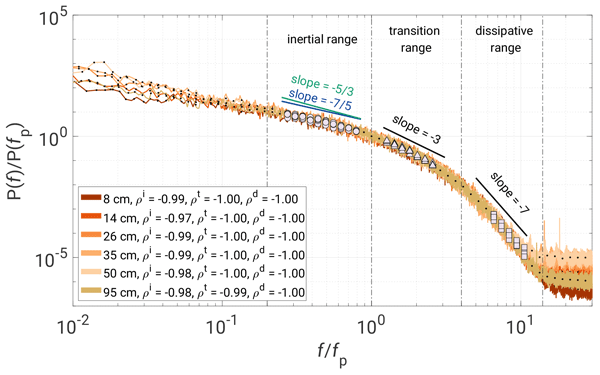
Our objective was to enhance understanding of thermally driven convection in terms of small-scale variations in the temperature scalar field. We conducted a small-scale study of the temperature field in the Π Chamber using three different temperature differences (10 K, 15 K, and 20 K). Measurements were carried out using a miniaturized UltraFast Thermometer operating at 2 kHz, allowing undisturbed vertical temperature profiling from 8 cm above the floor to 5 cm below the ceiling.
Fan Yang, Hamed Fahandezh Sadi, Raymond A. Shaw, Fabian Hoffmann, Pei Hou, Aaron Wang, and Mikhail Ovchinnikov
Atmos. Chem. Phys., 25, 3785–3806, https://doi.org/10.5194/acp-25-3785-2025, https://doi.org/10.5194/acp-25-3785-2025, 2025
Short summary
Short summary
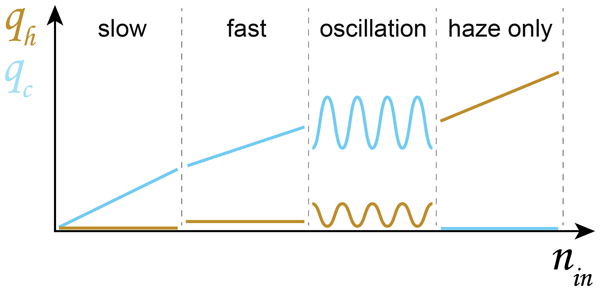
Large-eddy simulations of a convection cloud chamber show two new microphysics regimes, cloud oscillation and cloud collapse, due to haze–cloud interactions. Our results suggest that haze particles and their interactions with cloud droplets should be considered especially in polluted conditions. To properly simulate haze–cloud interactions, we need to resolve droplet activation and deactivation processes, instead of using Twomey-type activation parameterization.
Karlie N. Rees, Timothy J. Garrett, Thomas D. DeWitt, Corey Bois, Steven K. Krueger, and Jérôme C. Riedi
Nonlin. Processes Geophys., 31, 497–513, https://doi.org/10.5194/npg-31-497-2024, https://doi.org/10.5194/npg-31-497-2024, 2024
Short summary
Short summary
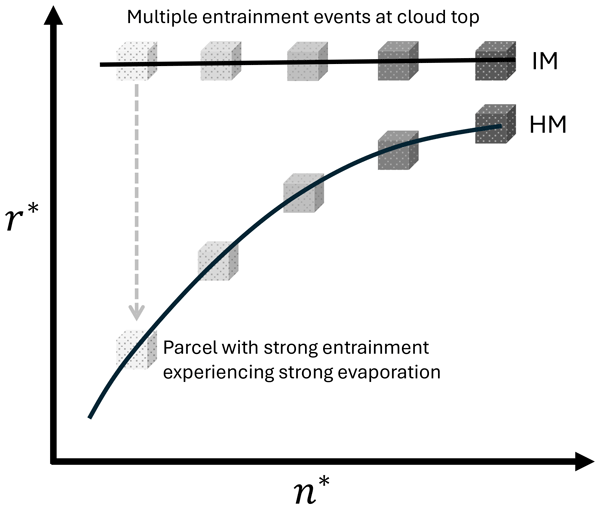
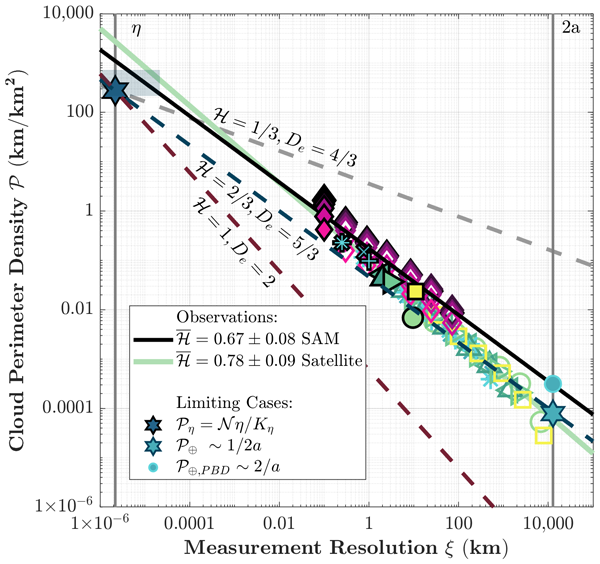
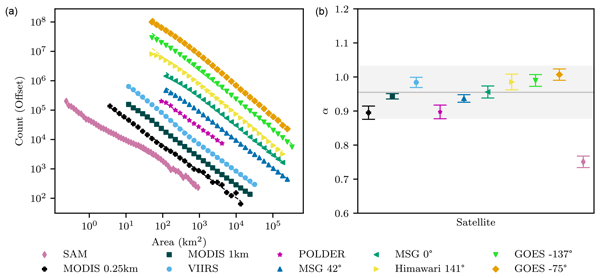
The shapes of clouds viewed from space reflect vertical and horizontal motions in the atmosphere. We theorize that, globally, cloud perimeter complexity is related to the dimension of turbulence also governed by horizontal and vertical motions. We find agreement between theory and observations from various satellites and a numerical model and, remarkably, that the theory applies globally using only basic planetary physical parameters from the smallest scales of turbulence to the planetary scale.
Aaron Wang, Steve Krueger, Sisi Chen, Mikhail Ovchinnikov, Will Cantrell, and Raymond A. Shaw
Atmos. Chem. Phys., 24, 10245–10260, https://doi.org/10.5194/acp-24-10245-2024, https://doi.org/10.5194/acp-24-10245-2024, 2024
Short summary
Short summary
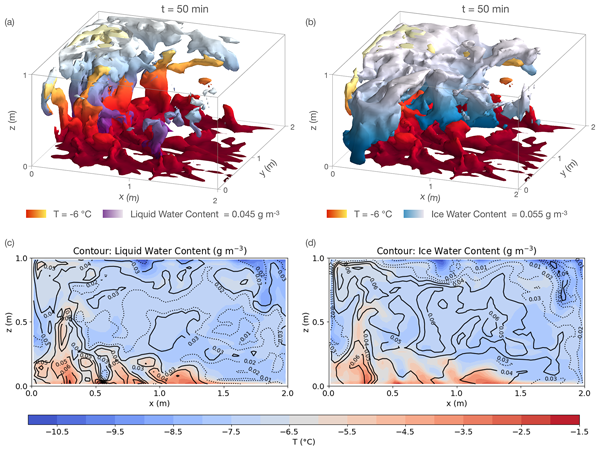
We employ two methods to examine a laboratory experiment on clouds with both ice and liquid phases. The first assumes well-mixed properties; the second resolves the spatial distribution of turbulence and cloud particles. Results show that while the trends in mean properties generally align, when turbulence is resolved, liquid droplets are not fully depleted by ice due to incomplete mixing. This underscores the threshold of ice mass fraction in distinguishing mixed-phase clouds from ice clouds.
Mahen Konwar, Benjamin Werden, Edward C. Fortner, Sudarsan Bera, Mercy Varghese, Subharthi Chowdhuri, Kurt Hibert, Philip Croteau, John Jayne, Manjula Canagaratna, Neelam Malap, Sandeep Jayakumar, Shivsai A. Dixit, Palani Murugavel, Duncan Axisa, Darrel Baumgardner, Peter F. DeCarlo, Doug R. Worsnop, and Thara Prabhakaran
Atmos. Meas. Tech., 17, 2387–2400, https://doi.org/10.5194/amt-17-2387-2024, https://doi.org/10.5194/amt-17-2387-2024, 2024
Short summary
Short summary
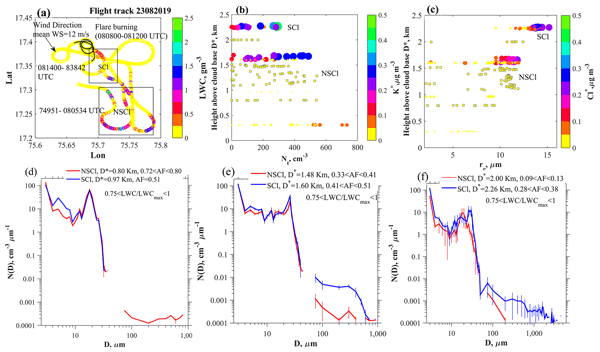
In a warm cloud seeding experiment hygroscopic particles are released to alter cloud processes to induce early raindrops. During the Cloud–Aerosol Interaction and Precipitation Enhancement Experiment, airborne mini aerosol mass spectrometers analyse the particles on which clouds form. The seeded clouds showed higher concentrations of chlorine and potassium, the oxidizing agents of flares. Small cloud droplet concentrations increased, and seeding particles were detected in deep cloud depths.
Zeen Zhu, Fan Yang, Pavlos Kollias, Raymond A. Shaw, Alex B. Kostinski, Steve Krueger, Katia Lamer, Nithin Allwayin, and Mariko Oue
Atmos. Meas. Tech., 17, 1133–1143, https://doi.org/10.5194/amt-17-1133-2024, https://doi.org/10.5194/amt-17-1133-2024, 2024
Short summary
Short summary
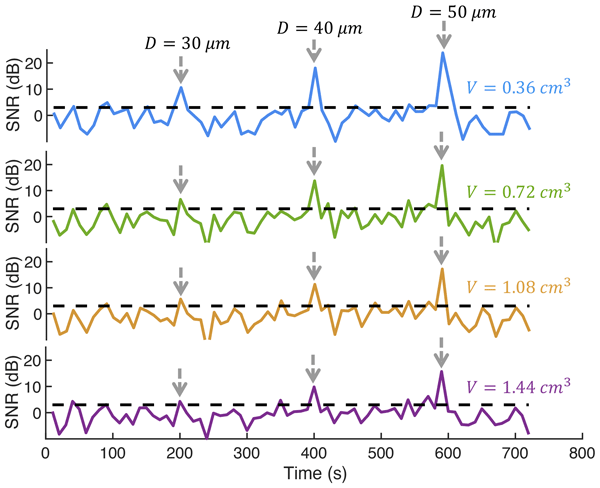
In this article, we demonstrate the feasibility of applying advanced radar technology to detect liquid droplets generated in the cloud chamber. Specifically, we show that using radar with centimeter-scale resolution, single drizzle drops with a diameter larger than 40 µm can be detected. This study demonstrates the applicability of remote sensing instruments in laboratory experiments and suggests new applications of ultrahigh-resolution radar for atmospheric sensing.
Thomas D. DeWitt, Timothy J. Garrett, Karlie N. Rees, Corey Bois, Steven K. Krueger, and Nicolas Ferlay
Atmos. Chem. Phys., 24, 109–122, https://doi.org/10.5194/acp-24-109-2024, https://doi.org/10.5194/acp-24-109-2024, 2024
Short summary
Short summary
Viewed from space, a defining feature of Earth's atmosphere is the wide spectrum of cloud sizes. A recent study predicted the distribution of cloud sizes, and this paper compares the prediction to observations. Although there is nuance in viewing perspective, we find robust agreement with theory across different climatological conditions, including land–ocean contrasts, time of year, or latitude, suggesting a minor role for Coriolis forces, aerosol loading, or surface temperature.
Elise Rosky, Will Cantrell, Tianshu Li, Issei Nakamura, and Raymond A. Shaw
Atmos. Chem. Phys., 23, 10625–10642, https://doi.org/10.5194/acp-23-10625-2023, https://doi.org/10.5194/acp-23-10625-2023, 2023
Short summary
Short summary
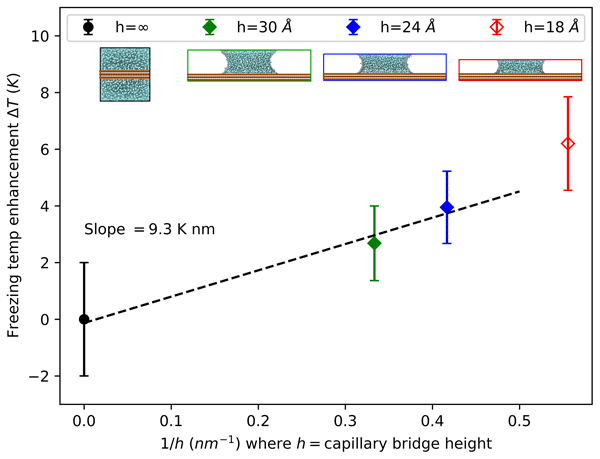
Using computer simulations of water, we find that water under tension freezes more easily than under normal conditions. A linear equation describes how freezing temperature increases with tension. Accordingly, simulations show that naturally occurring tension in water capillary bridges leads to higher freezing temperatures. This work is an early step in determining if atmospheric cloud droplets freeze due to naturally occurring tension, for example, during processes such as droplet collisions.
Jesse C. Anderson, Subin Thomas, Prasanth Prabhakaran, Raymond A. Shaw, and Will Cantrell
Atmos. Meas. Tech., 14, 5473–5485, https://doi.org/10.5194/amt-14-5473-2021, https://doi.org/10.5194/amt-14-5473-2021, 2021
Short summary
Short summary
Fluctuations due to turbulence in Earth's atmosphere can play a role in how many droplets a cloud has and, eventually, whether that cloud rains or evaporates. We study such processes in Michigan Tech's cloud chamber. Here, we characterize the turbulent and large-scale motions of air in the chamber, measuring the spatial and temporal distributions of temperature and water vapor, which we can combine to get the distribution of relative humidity, which governs cloud formation and dissipation.
Cited articles
Anderson, J. C., Thomas, S., Prabhakaran, P., Shaw, R. A., and Cantrell, W.: Effects of the large-scale circulation on temperature and water vapor distributions in the Π Chamber, Atmos. Meas. Tech., 14, 5473–5485, https://doi.org/10.5194/amt-14-5473-2021, 2021. a
Bahadur, R. and Russell, L. M.: Water uptake coefficients and deliquescence of NaCl nanoparticles at atmospheric relative humidities from molecular dynamics simulations, J. Chem. Phys., 129, https://doi.org/10.1063/1.2971040, 2008. a
Biswas, K. R. and Dennis, A. S.: Formation of a Rain Shower by Salt Seeding, J. Appl. Meteorol., 10, 780–784, https://doi.org/10.1175/1520-0450(1971)010<0780:FOARSB>2.0.CO;2, 1971. a
Chandrakar, K., Cantrell, W., Chang, K., Ciochetto, D., Niedermeier, D., Ovchinnikov, M., Shaw, R. A., and Yang, F.: Aerosol indirect effect from turbulence-induced broadening of cloud-droplet size distributions, P. Natl. Acad. Sci. USA, 113, 14243–14248, 2016. a
Chen, J., Rösch, C., Rösch, M., Shilin, A., and Kanji, Z. A.: Critical size of silver iodide containing glaciogenic cloud seeding particles, Geophys. Res. Lett., 51, e2023GL106680, https://doi.org/10.1029/2023GL106680, 2024. a
Cooper, W. A., Bruintjes, R. T., and Mather, G. K.: Calculations Pertaining to Hygroscopic Seeding with Flares, J. Appl. Meteor., 36, 1449–1469, https://doi.org/10.1175/1520-0450(1997)036<1449:CPTHSW>2.0.CO;2, 1997. a, b
Drofa, A. S., Ivanov, V. N., Rosenfeld, D., and Shilin, A. G.: Studying an effect of salt powder seeding used for precipitation enhancement from convective clouds, Atmos. Chem. Phys., 10, 8011–8023, https://doi.org/10.5194/acp-10-8011-2010, 2010. a, b
Flossmann, A. I., Manton, M., Abshaev, A., Bruintjes, R., Murakami, M., Prabhakaran, T., and Yao, Z.: Review of advances in precipitation enhancement research, B. Am. Meteorol. Soc., 100, 1465–1480, 2019. a
Ghate, V. P., Albrecht, B. A., Kollias, P., Jonsson, H. H., and Breed, D. W.: Cloud seeding as a technique for studying aerosol-cloud interactions in marine stratocumulus, Geophys. Res. Lett., 34, L14807, https://doi.org/10.1029/2007GL029748, 2007. a, b
Greenspan, L.: Humidity fixed points of binary saturated aqueous solutions, J. Res. NBS A Phys. Ch., 81, 89, https://doi.org/10.6028/jres.081A.011, 1977. a
Houghton, H. G. and Radford, W. H.: On the local dissipation of warm fog, Papers in Physical Oceanography and Meteorology, 6, 63, 1938. a
Khain, A., Pinsky, M., Gavze, E., Ronen, A., Elisha, S., Shoshanim, O., and Khain, P.: Warm Fog Elimination by Seeding with Salty Drops: Experiments and Theory, Journal of Weather Modification, 55, 30–51, 2023. a
Kim, B.-Y., Belorid, M., Cha, J. W., Kim, Y., and Kim, S.: Analysis of hygroscopic cloud seeding materials using the Korea Cloud Physics Experimental Chamber (K-CPEC): a case study for powder-type sodium chloride and calcium chloride, Atmos. Meas. Tech., 18, 3781–3797, https://doi.org/10.5194/amt-18-3781-2025, 2025. a
Konwar, M., Werden, B., Fortner, E. C., Bera, S., Varghese, M., Chowdhuri, S., Hibert, K., Croteau, P., Jayne, J., Canagaratna, M., Malap, N., Jayakumar, S., Dixit, S. A., Murugavel, P., Axisa, D., Baumgardner, D., DeCarlo, P. F., Worsnop, D. R., and Prabhakaran, T.: Identifying the seeding signature in cloud particles from hydrometeor residuals, Atmos. Meas. Tech., 17, 2387–2400, https://doi.org/10.5194/amt-17-2387-2024, 2024. a
Langmuir, I.: The production of rain by a chain reaction in cumulus clouds at temperatures above freezing, J. Meteor., 5, 175–192, https://doi.org/10.1175/1520-0469(1948)005<0175:TPORBA>2.0.CO;2, 1948. a
Lin, K.-I., Chung, K.-S., Wang, S.-H., Chen, L.-H., Liou, Y.-C., Lin, P.-L., Chang, W.-Y., Chiu, H.-J., and Chang, Y.-H.: Evaluation of hygroscopic cloud seeding in warm-rain processes by a hybrid microphysics scheme using a Weather Research and Forecasting (WRF) model: a real case study, Atmos. Chem. Phys., 23, 10423–10438, https://doi.org/10.5194/acp-23-10423-2023, 2023. a
Mather, G. K., Terblanche, D. E., Steffens, F. E., and Fletcher, L.: Results of the South African Cloud-Seeding Experiments Using Hygroscopic Flares, J. Appl. Meteorol., 36, 1433–1447, 1997. a
Mülmenstädt, J., Sourdeval, O., Del Genio, A. D., and Neubauer, D.: Frequency of occurrence of rain from liquid‐, mixed‐, and ice‐phase clouds derived from three satellite sensors, Geophys. Res. Lett., 42, 6502–6509, https://doi.org/10.1002/2015GL064604, 2015. a
Rosenfeld, D., Axisa, D., Woodley, W. L., and Lahav, R.: A quest for effective hygroscopic cloud seeding, J. Appl. Meteorol. Clim., 49, 1548–1562, 2010. a
Schaefer, V. J.: The production of ice crystals in a cloud of supercooled water droplets, Science, 104, 457–459, 1946. a
Simmons, J.: Datasets for Response of a liquid water cloud to in situ hygroscopic seeding, Digital Commons and Michigan Technological University [data set], https://digitalcommons.mtu.edu/all-datasets/67 (last access: 9 February 2026), 2026. a
Swietlicki, E., Hansson, H.-C., Hämeri, K., Svenningsson, B., Massling, A., McFiggans, G., McMurry, P. H., Petäjä, T., Tunved, P., Gysel, M., Topping, D., Weingartner, E., Baltensperger, U., Rissler, J., Wiedensohler, A., and Kulmala, M.: Hygroscopic properties of submicrometer atmospheric aerosol particles measured with H-TDMA instruments in various environments – a review, Tellus B, 60, 432–469, 2008. a
Tai, Y., Liang, H., Zaki, A., El Hadri, N., Abshaev, A. M., Huchunaev, B. M., Griffiths, S., Jouiad, M., and Zou, L.: Core/shell microstructure induced synergistic effect for efficient water-droplet formation and cloud-seeding application, ACS Nano, 11, 12318–12325, 2017. a
Vonnegut, B.: The nucleation of ice formation by silver iodide, J. Appl. Phys., 18, 593–595, 1947. a
Wang, F., Li, Z., Jiang, Q., Wang, G., Jia, S., Duan, J., and Zhou, Y.: Evaluation of hygroscopic cloud seeding in liquid-water clouds: a feasibility study, Atmos. Chem. Phys., 19, 14967–14977, https://doi.org/10.5194/acp-19-14967-2019, 2019. a
Wehbe, Y., Griffiths, S., Al Mazrouei, A., Al Yazeedi, O., and Al Mandous, A.: Rethinking water security in a warming climate: rainfall enhancement as an innovative augmentation technique, npj Clim. Atmos. Sci., 6, 171, https://doi.org/10.1038/s41612-023-00503-2, 2023. a
Zieger, P., Kristensson, E. F., Facchini, F. G. R., Swietlicki, E., Wise, D. F., and Nilsson, E. N.: Revising the hygroscopicity of inorganic sea salt particles, Nat. Commun., 8, 15883, https://doi.org/10.1038/ncomms15883, 2017. a
Short summary
Precipitation from warm clouds requires large droplets to promote collision-coalescence. As part of an investigation into cloud seeding, we tested two hygroscopic materials in a laboratory cloud chamber where they formed large droplets and increased the concentration of liquid water. Sodium chloride particles with diameters of 4 to 25 micrometers proved most effective, supporting in-cloud seeding for precipitation enhancement in warm clouds, particularly in arid regions.
Precipitation from warm clouds requires large droplets to promote collision-coalescence. As part...
Altmetrics
Final-revised paper
Preprint