
Articles | Volume 25, issue 14
https://doi.org/10.5194/acp-25-8087-2025
© Author(s) 2025. This work is distributed under
the Creative Commons Attribution 4.0 License.
the Creative Commons Attribution 4.0 License.
https://doi.org/10.5194/acp-25-8087-2025
© Author(s) 2025. This work is distributed under
the Creative Commons Attribution 4.0 License.
the Creative Commons Attribution 4.0 License.
Research article
| 
29 Jul 2025
Research article |
| 29 Jul 2025
| 29 Jul 2025
Ambient and intrinsic dependencies of evolving ice-phase particles within a decaying winter storm during IMPACTS
Andrew DeLaFrance
CORRESPONDING AUTHOR
Department of Atmospheric and Climate Science, University of Washington, Seattle, WA, USA
now at: Institute for Atmospheric and Environmental Research, University of Wuppertal, Wuppertal, Germany
Lynn A. McMurdie
Department of Atmospheric and Climate Science, University of Washington, Seattle, WA, USA
Angela K. Rowe
Department of Atmospheric and Oceanic Sciences, University of Wisconsin-Madison, Madison, WI, USA
Andrew J. Heymsfield
National Science Foundation National Center for Atmospheric Research, Boulder CO, USA
Related authors
Andrew DeLaFrance, Lynn A. McMurdie, Angela K. Rowe, and Andrew J. Heymsfield
Atmos. Chem. Phys., 24, 11191–11206, https://doi.org/10.5194/acp-24-11191-2024, https://doi.org/10.5194/acp-24-11191-2024, 2024
Short summary
Short summary
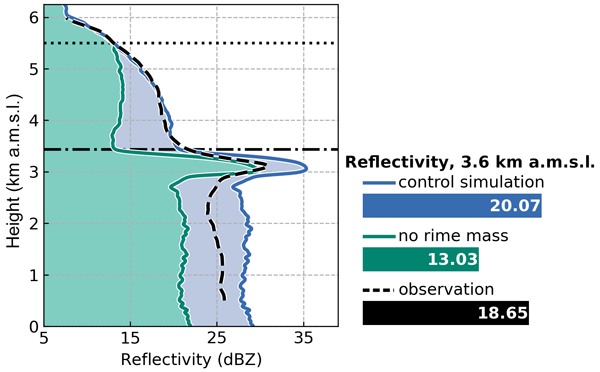
Using a numerical model, the process whereby falling ice crystals accumulate supercooled liquid water droplets is investigated to elucidate its effects on radar-based measurements and surface precipitation. We demonstrate that this process accounted for 55% of the precipitation during a wintertime storm and is uniquely discernable from other ice crystal growth processes in Doppler velocity measurements. These results have implications for measurements from airborne and spaceborne platforms.
Anthony C. Bernal Ayala, Angela K. Rowe, Lucia E. Arena, and William O. Nachlas
Atmos. Chem. Phys., 25, 7597–7617, https://doi.org/10.5194/acp-25-7597-2025, https://doi.org/10.5194/acp-25-7597-2025, 2025
Short summary
Short summary
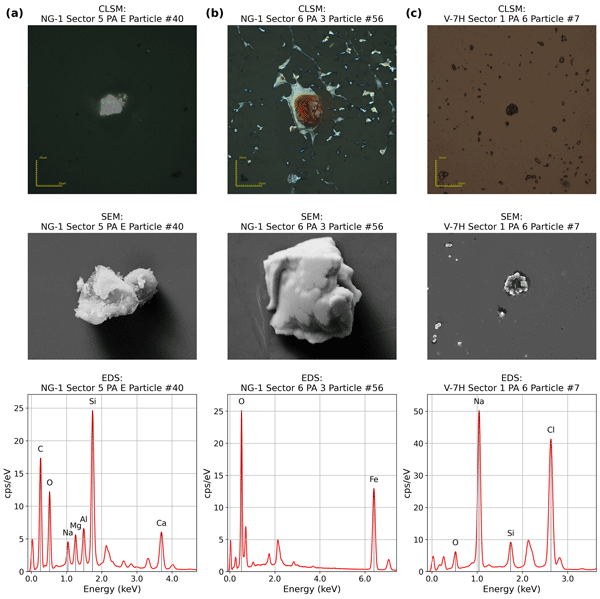
This study analyzed particles in hailstones from Argentina to better understand hail formation and growth. A unique method was used that revealed the particles’ size, composition, and location within the hail, including a variety of particle sizes and compositions linked to local land uses, such as mountainous, agricultural, and urban areas. The findings highlight the potential impacts of natural and human-related factors on hail formation and provide a new method for studying hail globally.
Andrew DeLaFrance, Lynn A. McMurdie, Angela K. Rowe, and Andrew J. Heymsfield
Atmos. Chem. Phys., 24, 11191–11206, https://doi.org/10.5194/acp-24-11191-2024, https://doi.org/10.5194/acp-24-11191-2024, 2024
Short summary
Short summary
Using a numerical model, the process whereby falling ice crystals accumulate supercooled liquid water droplets is investigated to elucidate its effects on radar-based measurements and surface precipitation. We demonstrate that this process accounted for 55% of the precipitation during a wintertime storm and is uniquely discernable from other ice crystal growth processes in Doppler velocity measurements. These results have implications for measurements from airborne and spaceborne platforms.
Anthony C. Bernal Ayala, Angela K. Rowe, Lucia E. Arena, William O. Nachlas, and Maria L. Asar
Atmos. Meas. Tech., 17, 5561–5579, https://doi.org/10.5194/amt-17-5561-2024, https://doi.org/10.5194/amt-17-5561-2024, 2024
Short summary
Short summary
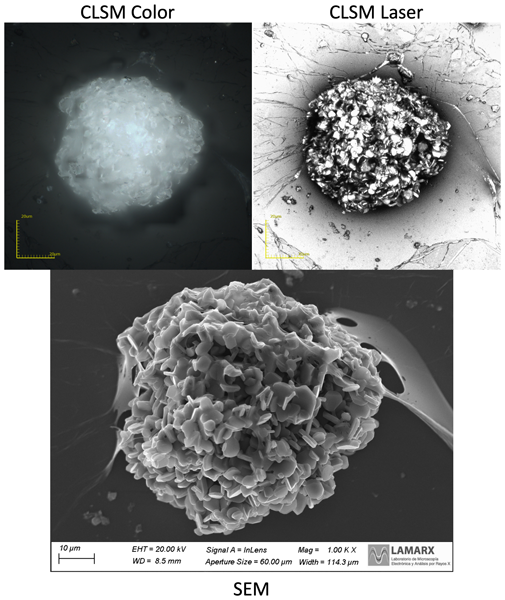
Hail is a challenging weather phenomenon to forecast due to an incomplete understanding of hailstone formation. Microscopy temperature limitations required previous studies to melt hail for analysis. This paper introduces a unique technique using a plastic cover to preserve particles in their location within the hailstone without melting. Therefore, CLSM and SEM–EDS microscopes can be used to determine individual particle sizes and their chemical composition related to hail-formation processes.
Armin Blanke, Andrew J. Heymsfield, Manuel Moser, and Silke Trömel
Atmos. Meas. Tech., 16, 2089–2106, https://doi.org/10.5194/amt-16-2089-2023, https://doi.org/10.5194/amt-16-2089-2023, 2023
Short summary
Short summary
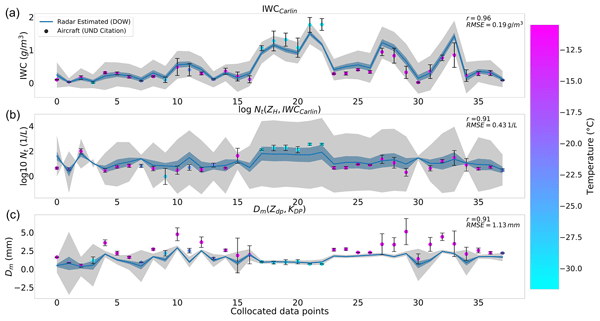
We present an evaluation of current retrieval techniques in the ice phase applied to polarimetric radar measurements with collocated in situ observations of aircraft conducted over the Olympic Mountains, Washington State, during winter 2015. Radar estimates of ice properties agreed most with aircraft observations in regions with pronounced radar signatures, but uncertainties were identified that indicate issues of some retrievals, particularly in warmer temperature regimes.

Étienne Vignon, Lea Raillard, Christophe Genthon, Massimo Del Guasta, Andrew J. Heymsfield, Jean-Baptiste Madeleine, and Alexis Berne
Atmos. Chem. Phys., 22, 12857–12872, https://doi.org/10.5194/acp-22-12857-2022, https://doi.org/10.5194/acp-22-12857-2022, 2022
Short summary
Short summary
The near-surface atmosphere over the Antarctic Plateau is cold and pristine and resembles to a certain extent the high troposphere where cirrus clouds form. In this study, we use innovative humidity measurements at Concordia Station to study the formation of ice fogs at temperatures <−40°C. We provide observational evidence that ice fogs can form through the homogeneous freezing of solution aerosols, a common nucleation pathway for cirrus clouds.
Kamil Mroz, Alessandro Battaglia, Cuong Nguyen, Andrew Heymsfield, Alain Protat, and Mengistu Wolde
Atmos. Meas. Tech., 14, 7243–7254, https://doi.org/10.5194/amt-14-7243-2021, https://doi.org/10.5194/amt-14-7243-2021, 2021
Short summary
Short summary
A method for estimating microphysical properties of ice clouds based on radar measurements is presented. The algorithm exploits the information provided by differences in the radar response at different frequency bands in relation to changes in the snow morphology. The inversion scheme is based on a statistical relation between the radar simulations and the properties of snow calculated from in-cloud sampling.
Cited articles
Bansemer, A., Delene, D., Heymsfield, A., and OBrien, J.: NCAR Particle Probes IMPACTS, NASA Global Hydrometeorology Resource Center DAAC [data set], Huntsville, Alabama, USA, https://doi.org/10.5067/IMPACTS/PROBES/DATA101, 2022.
Benjamin, S. G., Weygandt, S. S., Brown, J. M., Hu, M., Alexander, C. R., Smirnova, T. G., Olson, J. B., James, E. P., Dowell, D. C., Grell, G. A., Lin, H., Peckham, S. E., Smith, T. L., Moninger, W. R., Kenyon, J. S., and Manikin, G. S.: A North American Hourly Assimilation and Model Forecast Cycle: The Rapid Refresh, Mon. Weather Rev., 144, 1669–1694, https://doi.org/10.1175/MWR-D-15-0242.1, 2016.
Boucher, R. J. and Wieler, J. G.: Radar Determination of Snowfall Rate and Accumulation, J. Appl. Meteorol. Clim., 24, 68–73, https://doi.org/10.1175/1520-0450(1985)024<0068:RDOSRA>2.0.CO;2, 1985.
Brdar, S. and Seifert, A.: McSnow: A Monte-Carlo Particle Model for Riming and Aggregation of Ice Particles in a Multidimensional Microphysical Phase Space, J. Adv. Model Earth Sy., 10, 187–206, https://doi.org/10.1002/2017MS001167, 2018.
Bringi, V., Seifert, A., Wu, W., Thurai, M., Huang, G.-J., and Siewert, C.: Hurricane Dorian Outer Rain Band Observations and 1D Particle Model Simulations: A Case Study, Atmosphere, 11, 879, https://doi.org/10.3390/atmos11080879, 2020.
Brodzik, S.: Automated Surface Observing System (ASOS) IMPACTS, NASA Global Hydrometeorology Resource Center DAAC [data set], Huntsville, Alabama, USA, https://doi.org/10.5067/IMPACTS/ASOS/DATA101, 2022a.
Brodzik, S.: Multi-Radar/Multi-Sensor (MRMS) Precipitation Reanalysis for Satellite Validation Product IMPACTS, NASA Global Hydrometeorology Resource Center DAAC [data set], Huntsville, Alabama, USA, https://doi.org/10.5067/IMPACTS/MRMS/DATA101, 2022b.
Brown, P. R. A. and Francis, P. N.: Improved Measurements of the Ice Water Content in Cirrus Using a Total-Water Probe, J. Atmos. Ocean. Tech., 12, 410–414, https://doi.org/10.1175/1520-0426(1995)012<0410:IMOTIW>2.0.CO;2, 1995.
Chase, R. J., Nesbitt, S. W., and McFarquhar, G. M.: Evaluation of the Microphysical Assumptions within GPM-DPR Using Ground-Based Observations of Rain and Snow, Atmosphere, 11, 619, https://doi.org/10.3390/atmos11060619, 2020.
Chase, R. J., Nesbitt, S. W., McFarquhar, G. M., Wood, N. B., and Heymsfield, G. M.: Direct Comparisons between GPM-DPR and CloudSat Snowfall Retrievals, J. Appl. Meteorol. Clim., 61, 1257–1271, https://doi.org/10.1175/JAMC-D-21-0081.1, 2022.
Colle, B. A., Stark, D., and Yuter, S. E.: Surface Microphysical Observations within East Coast Winter Storms on Long Island, New York, Mon. Weather Rev., 142, 3126–3146, https://doi.org/10.1175/MWR-D-14-00035.1, 2014.
Colle, B. A., Yeh, P., Finlon, J. A., McMurdie, L., McDonald, V., and DeLaFrance, A.: An Investigation of a Northeast U. S. Cyclone Event without Well-Defined Snow Banding during IMPACTS, Mon. Weather Rev., 151, 2465–2484, https://doi.org/10.1175/MWR-D-22-0296.1, 2023.
Connolly, P. J., Emersic, C., and Field, P. R.: A laboratory investigation into the aggregation efficiency of small ice crystals, Atmos. Chem. Phys., 12, 2055–2076, https://doi.org/10.5194/acp-12-2055-2012, 2012.
DeLaFrance, A., McMurdie, L. A., Rowe, A. K., and Conrick, R.: Effects of Riming on Ice-Phase Precipitation Growth and Transport Over an Orographic Barrier, J. Adv. Model Earth Sy., 16, e2023MS003778, https://doi.org/10.1029/2023MS003778, 2024a.
DeLaFrance, A., McMurdie, L. A., Rowe, A. K., and Heymsfield, A. J.: Simulated particle evolution within a winter storm: contributions of riming to radar moments and precipitation fallout, Atmos. Chem. Phys., 24, 11191–11206, https://doi.org/10.5194/acp-24-11191-2024, 2024b.
Dunnavan, E. L., Carlin, J. T., Schvartzman, D., Ryzhkov, A. V., Bluestein, H., Emmerson, S., McFarquhar, G. M., Heymsfield, G. M., and Yorks, J.: High-Resolution Snowstorm Measurements and Retrievals Using Cross-Platform Multi-Frequency and Polarimetric Radars, Geophys. Res. Lett., 50, e2023GL103692, https://doi.org/10.1029/2023GL103692, 2023.
Evans, A. G., Locatelli, J. D., Stoelinga, M. T., and Hobbs, P. V.: The IMPROVE-1 Storm of 1–2 February 2001. Part II: Cloud Structures and the Growth of Precipitation, J. Atmos. Sci., 62, 3456–3473, https://doi.org/10.1175/JAS3547.1, 2005.
Finlon, J. A., McMurdie, L. A., and Chase, R. J.: Investigation of Microphysical Properties within Regions of Enhanced Dual-Frequency Ratio during the IMPACTS Field Campaign, J. Atmos. Sci., 79, 2773–2795, https://doi.org/10.1175/JAS-D-21-0311.1, 2022.
Fujiyoshi, Y., Endoh, T., Yamada, T., Tsuboki, K., Tachibana, Y., and Wakahama, G.: Determination of a Z – R Relationship for Snowfall Using a Radar and High Sensitivity Snow Gauges, J. Appl. Meteorol., 29, 147–152, https://doi.org/10.1175/1520-0450(1990)029<0147:DOARFS>2.0.CO;2, 1990.
Ganetis, S. A., Colle, B. A., Yuter, S. E., and Hoban, N. P.: Environmental Conditions Associated with Observed Snowband Structures within Northeast U. S. Winter Storms, Mon. Weather Rev., 146, 3675–3690, https://doi.org/10.1175/MWR-D-18-0054.1, 2018.
Grecu, M., Olson, W. S., Munchak, S. J., Ringerud, S., Liao, L., Haddad, Z., Kelley, B. L., and McLaughlin, S. F.: The GPM Combined Algorithm, J. Atmos. Ocean Tech., 33, 2225–2245, https://doi.org/10.1175/JTECH-D-16-0019.1, 2016.
Herzegh, P. H. and Hobbs, P. V.: The Mesoscale and Microscale Structure and Organization of Clouds and Precipitation in Midlatitude Cyclones. II: Warm-Frontal Clouds, J. Atmos. Sci., 37, 597–611, https://doi.org/10.1175/1520-0469(1980)037<0597:TMAMSA>2.0.CO;2, 1980.
Heymsfield, A., Bansemer, A., Heymsfield, G., Noone, D., Grecu, M., and Toohey, D.: Relationship of Multiwavelength Radar Measurements to Ice Microphysics from the IMPACTS Field Program, J. Appl. Meteorol. Clim., 62, 289–315, https://doi.org/10.1175/JAMC-D-22-0057.1, 2023.
Heymsfield, A. J. and Westbrook, C. D.: Advances in the Estimation of Ice Particle Fall Speeds Using Laboratory and Field Measurements, J. Atmos. Sci., 67, 2469–2482, https://doi.org/10.1175/2010JAS3379.1, 2010.
Heymsfield, A. J., Matrosov, S. Y., and Wood, N. B.: Toward Improving Ice Water Content and Snow-Rate Retrievals from Radars. Part I: X and W Bands, Emphasizing CloudSat, J. Appl. Meteorol. Clim., 55, 2063–2090, https://doi.org/10.1175/JAMC-D-15-0290.1, 2016.
Houze, R. A., Rutledge, S. A., Matejka, T. J., and Hobbs, P. V.: The Mesoscale and Microscale Structure and Organization of Clouds and Precipitation in Midlatitude Cyclones. III: Air Motions and Precipitation Growth in a Warm-Frontal Rainband, J. Atmos. Sci., 38, 639–649, https://doi.org/10.1175/1520-0469(1981)038<0639:TMAMSA>2.0.CO;2, 1981.
Ikeda, K., Rasmussen, R. M., Hall, W. D., and Thompson, G.: Observations of Freezing Drizzle in Extratropical Cyclonic Storms during IMPROVE-2, J. Atmos. Sci., 64, 3016–3043, https://doi.org/10.1175/JAS3999.1, 2007.
Jensen, A. A. and Harrington, J. Y.: Modeling Ice Crystal Aspect Ratio Evolution during Riming: A Single-Particle Growth Model, J. Atmos. Sci., 72, 2569–2590, https://doi.org/10.1175/JAS-D-14-0297.1, 2015.
Kalesse, H., Szyrmer, W., Kneifel, S., Kollias, P., and Luke, E.: Fingerprints of a riming event on cloud radar Doppler spectra: observations and modeling, Atmos. Chem. Phys., 16, 2997–3012, https://doi.org/10.5194/acp-16-2997-2016, 2016.
Keeler, J. M., Jewett, B. F., Rauber, R. M., McFarquhar, G. M., Rasmussen, R. M., Xue, L., Liu, C., and Thompson, G.: Dynamics of Cloud-Top Generating Cells in Winter Cyclones. Part I: Idealized Simulations in the Context of Field Observations, J. Atmos. Sci., 73, 1507–1527, https://doi.org/10.1175/JAS-D-15-0126.1, 2016.
Kneifel, S., Kulie, M. S., and Bennartz, R.: A Triple-Frequency Approach to Retrieve Microphysical Snowfall Parameters, J. Geophys. Res.-Atmos., 116, D11203, https://doi.org/10.1029/2010JD015430, 2011.
Kneifel, S., Von Lerber, A., Tiira, J., Moisseev, D., Kollias, P., and Leinonen, J.: Observed Relations Between Snowfall Microphysics and Triple-Frequency Radar Measurements, J. Geophys. Res.-Atmos., 120, 6034–6055, https://doi.org/10.1002/2015JD023156, 2015.
Kumjian, M. R., Rutledge, S. A., Rasmussen, R. M., Kennedy, P. C., and Dixon, M.: High-Resolution Polarimetric Radar Observations of Snow-Generating Cells, J. Appl. Meteorol. Clim., 53, 1636–1658, https://doi.org/10.1175/JAMC-D-13-0312.1, 2014.
Lawson, P., Gurganus, C., Woods, S., and Bruintjes, R.: Aircraft Observations of Cumulus Microphysics Ranging from the Tropics to Midlatitudes: Implications for a “New” Secondary Ice Process, J. Atmos. Sci., 74, 2899–2920, https://doi.org/10.1175/JAS-D-17-0033.1, 2017.
Lawson, R. P., Stewart, R. E., Strapp, J. W., and Isaac, G. A.: Aircraft Observations of the Origin and Growth of Very Large Snowflakes, Geophys. Res. Lett., 20, 53–56, https://doi.org/10.1029/92GL02917, 1993.
Leinonen, J.: High-Level Interface to T-Matrix Scattering Calculations: Architecture, Capabilities and Limitations, Opt. Express, 22, 1655, https://doi.org/10.1364/OE.22.001655, 2014.
Leinonen, J. and Moisseev, D.: What do Triple-Frequency Radar Signatures Reveal about Aggregate Snowflakes?, J. Geophys. Res.-Atmos., 120, 229–239, https://doi.org/10.1002/2014JD022072, 2015.
Leinonen, J. and Szyrmer, W.: Radar Signatures of Snowflake Riming: A Modeling Study, Earth Space Sci., 2, 346–358, https://doi.org/10.1002/2015EA000102, 2015.
Li, L., Heymsfield, G., Carswell, J., Schaubert, D. H., McLinden, M. L., Creticos, J., Perrine, M., Coon, M., Cervantes, J. I., Vega, M., Guimond, S., Tian, L., and Emory, A.: The NASA High-Altitude Imaging Wind and Rain Airborne Profiler, IEEE T. Geosci. Remote, 54, 298–310, https://doi.org/10.1109/TGRS.2015.2456501, 2016.
Locatelli, J. D. and Hobbs, P. V.: Fall Speeds and Masses of Solid Precipitation Particles, J. Geophys. Res., 79, 2185–2197, https://doi.org/10.1029/JC079i015p02185, 1974.
Marshall, J. S. and Palmer, W. M. K.: The Distribution of Raindrops With Size, J. Meteorol., 5, 165–166, https://doi.org/10.1175/1520-0469(1948)005<0165:TDORWS>2.0.CO;2, 1948.
Mason, S. L., Chiu, C. J., Hogan, R. J., Moisseev, D., and Kneifel, S.: Retrievals of Riming and Snow Density from Vertically Pointing Doppler Radars, J. Geophys. Res.-Atmos., 123, 13807–13834, https://doi.org/10.1029/2018JD028603, 2018.
Mason, S. L., Hogan, R. J., Westbrook, C. D., Kneifel, S., Moisseev, D., and von Terzi, L.: The importance of particle size distribution and internal structure for triple-frequency radar retrievals of the morphology of snow, Atmos. Meas. Tech., 12, 4993–5018, https://doi.org/10.5194/amt-12-4993-2019, 2019.
Matrosov, S. Y., Korolev, A., Wolde, M., and Nguyen, C.: Sizing ice hydrometeor populations using the dual-wavelength radar ratio, Atmos. Meas. Tech., 15, 6373–6386, https://doi.org/10.5194/amt-15-6373-2022, 2022.
McLinden, M., Li, Lihua, and Heymsfield, Gerald M.: High Altitude Imaging Wind and Rain Airborne Profiler (HIWRAP) IMPACTS, NASA Global Hydrometeorology Resource Center DAAC [data set], Huntsville, Alabama, USA, https://doi.org/10.5067/IMPACTS/HIWRAP/DATA101, 2022.
McMurdie, L. A., Heymsfield, G., Yorks, J. E., and Braun, S. A.: Investigation of Microphysics and Precipitation for Atlantic Coast-Threatening Snowstorms (IMPACTS) Collection, NASA Global Hydrometeorology Resource Center DAAC [data set], Huntsville, Alabama, USA, https://doi.org/10.5067/IMPACTS/DATA101, 2019.
McMurdie, L. A., Heymsfield, G. M., Yorks, J. E., Braun, S. A., Skofronick-Jackson, G., Rauber, R. M., Yuter, S., Colle, B., McFarquhar, G. M., Poellot, M., Novak, D. R., Lang, T. J., Kroodsma, R., McLinden, M., Oue, M., Kollias, P., Kumjian, M. R., Greybush, S. J., Heymsfield, A. J., Finlon, J. A., McDonald, V. L., and Nicholls, S.: Chasing Snowstorms: The Investigation of Microphysics and Precipitation for Atlantic Coast-Threatening Snowstorms (IMPACTS) Campaign, B. Am. Meteorol. Soc., 103, E1243–E1269, https://doi.org/10.1175/BAMS-D-20-0246.1, 2022a.
McMurdie, L. A., Finlon, J. A., Heymsfield, G. M., and Yorks, J. E.: Investigation of Microphysics and Precipitation for Atlantic Coast Threatening Snowstorms (Impacts): The 2022 Deployment, in: IGARSS 2022 – 2022 IEEE International Geoscience and Remote Sensing Symposium, 17-22 July 2022, Kuala Lumpur, Malaysia, IEEE, 4461–4464, https://doi.org/10.1109/IGARSS46834.2022.9883693, 2022b.
Miller, J. E.: On the Concept of Frontogenesis, J. Meteorol., 5, 169–171, https://doi.org/10.1175/1520-0469(1948)005<0169:OTCOF>2.0.CO;2, 1948.
Mitchell, D. L.: Use of Mass- and Area-Dimensional Power Laws for Determining Precipitation Particle Terminal Velocities, J. Atmos. Sci., 53, 1710–1723, https://doi.org/10.1175/1520-0469(1996)053<1710:UOMAAD>2.0.CO;2, 1996.
Morrison, H., Van Lier-Walqui, M., Fridlind, A. M., Grabowski, W. W., Harrington, J. Y., Hoose, C., Korolev, A., Kumjian, M. R., Milbrandt, J. A., Pawlowska, H., Posselt, D. J., Prat, O. P., Reimel, K. J., Shima, S., Van Diedenhoven, B., and Xue, L.: Confronting the Challenge of Modeling Cloud and Precipitation Microphysics, J. Adv. Model Earth Sy., 12, e2019MS001689, https://doi.org/10.1029/2019MS001689, 2020.
Nelson, J.: Sublimation of Ice Crystals, J. Atmos. Sci., 55, 910–919, https://doi.org/10.1175/1520-0469(1998)055<0910:SOIC>2.0.CO;2, 1998.
Novak, D. R., Bosart, L. F., Keyser, D., and Waldstreicher, J. S.: An Observational Study of Cold Season–Banded Precipitation in Northeast U. S. Cyclones, Weather Forecast., 19, 993–1010, https://doi.org/10.1175/815.1, 2004.
Novak, D. R., Waldstreicher, J. S., Keyser, D., and Bosart, L. F.: A Forecast Strategy for Anticipating Cold Season Mesoscale Band Formation within Eastern U. S. Cyclones, Weather Forecast., 21, 3–23, https://doi.org/10.1175/WAF907.1, 2006.
Novak, D. R., Colle, B. A., and Yuter, S. E.: High-Resolution Observations and Model Simulations of the Life Cycle of an Intense Mesoscale Snowband over the Northeastern United States, Mon. Weather Rev., 136, 1433–1456, https://doi.org/10.1175/2007MWR2233.1, 2008.
Petty, G. W. and Huang, W.: Microwave Backscatter and Extinction by Soft Ice Spheres and Complex Snow Aggregates, J. Atmos. Sci., 67, 769–787, https://doi.org/10.1175/2009JAS3146.1, 2010.
Plummer, D. M., McFarquhar, G. M., Rauber, R. M., Jewett, B. F., and Leon, D. C.: Structure and Statistical Analysis of the Microphysical Properties of Generating Cells in the Comma Head Region of Continental Winter Cyclones, J. Atmos. Sci., 71, 4181–4203, https://doi.org/10.1175/JAS-D-14-0100.1, 2014.
Pruppacher, H. R. and Klett, J. D.: Microphysics Of Clouds And Precipitation, 2nd rev. and enl. ed., Kluwer Academic Publishers, Dordrecht, Boston, 954 pp., https://doi.org/10.1007/978-0-306-48100-0, 1997.
Rauber, R. M. and Tokay, A.: An Explanation for the Existence of Supercooled Water at the Top of Cold Clouds, J. Atmos. Sci., 48, 1005–1023, https://doi.org/10.1175/1520-0469(1991)048<1005:AEFTEO>2.0.CO;2, 1991.
Rosenow, A. A., Plummer, D. M., Rauber, R. M., McFarquhar, G. M., Jewett, B. F., and Leon, D.: Vertical Velocity and Physical Structure of Generating Cells and Convection in the Comma Head Region of Continental Winter Cyclones, J. Atmos. Sci., 71, 1538–1558, https://doi.org/10.1175/JAS-D-13-0249.1, 2014.
Roy, P., Rauber, R. M., and Di Girolamo, L.: A Closer Look at the Evolution of Supercooled Cloud Droplet Temperature and Lifetime in Different Environmental Conditions with Implications for Ice Nucleation in the Evaporating Regions of Clouds, J. Atmos. Sci., 80, 2481–2501, https://doi.org/10.1175/JAS-D-22-0239.1, 2023.
Schnaiter, F. M.: Particle Habit Imaging and Polar Scattering Probe (PHIPS) IMPACTS, NASA Global Hydrometeorology Resource Center DAAC [data set], Huntsville, Alabama, USA, https://doi.org/10.5067/IMPACTS/PHIPS/DATA101, 2022.
Stark, D., Colle, B. A., and Yuter, S. E.: Observed Microphysical Evolution for Two East Coast Winter Storms and the Associated Snow Bands, Mon. Weather Rev., 141, 2037–2057, https://doi.org/10.1175/MWR-D-12-00276.1, 2013.
Thornhill, K. L.: Turbulent Air Motion Measurement System (TAMMS) IMPACTS, NASA Global Hydrometeorology Resource Center DAAC [data set], Huntsville, Alabama, USA, https://doi.org/10.5067/IMPACTS/TAMMS/DATA101, 2022.
Thornhill, K. L., Anderson, B. E., Barrick, J. D. W., Bagwell, D. R., Friesen, R., and Lenschow, D. H.: Air Motion Intercomparison Flights during Transport and Chemical Evolution in the Pacific (TRACE-P)/ACE-ASIA, J. Geophys. Res.-Atmos., 108, 2002JD003108, https://doi.org/10.1029/2002JD003108, 2003.
Waldstreicher, J. and Brodzik, S.: NOAA Sounding IMPACTS, NASA Global Hydrometeorology Resource Center DAAC [data set], Huntsville, Alabama, USA, https://doi.org/10.5067/IMPACTS/SOUNDING/DATA201, 2022.
Williams, C. R.: How Much Attenuation Extinguishes mm-Wave Vertically Pointing Radar Return Signals?, Remote Sens.-Basel, 14, 1305, https://doi.org/10.3390/rs14061305, 2022.
Wolde, M. and Vali, G.: Polarimetric Signatures from Ice Crystals Observed at 95 GHz in Winter Clouds. Part II: Frequencies of Occurrence, J. Atmos. Sci., 58, 842–849, https://doi.org/10.1175/1520-0469(2001)058<0842:PSFICO>2.0.CO;2, 2001.
Yang-Martin, M. and Bennett, R.: P-3 Meteorological and Navigation Data IMPACTS, NASA Global Hydrometeorology Resource Center DAAC [data set], Huntsville, Alabama, USA, https://doi.org/10.5067/IMPACTS/P3/DATA101, 2022.
Zaremba, T. J., Rauber, R. M., Heimes, K., Yorks, J. E., Finlon, J. A., Nicholls, S. D., Selmer, P., McMurdie, L. A., and McFarquhar, G. M.: Cloud-Top Phase Characterization of Extratropical Cyclones over the Northeast and Midwest United States: Results from IMPACTS, J. Atmos. Sci., 81, 341–361, https://doi.org/10.1175/JAS-D-23-0123.1, 2024.
Zhang, J., Howard, K., Langston, C., Vasiloff, S., Kaney, B., Arthur, A., Van Cooten, S., Kelleher, K., Kitzmiller, D., Ding, F., Seo, D.-J., Wells, E., and Dempsey, C.: National Mosaic and Multi-Sensor QPE (NMQ) System: Description, Results, and Future Plans, B. Am. Meteorol. Soc., 92, 1321–1338, https://doi.org/10.1175/2011BAMS-D-11-00047.1, 2011.
Short summary
Numerical modeling simulations are used to investigate ice crystal growth and decay processes within a banded region of enhanced precipitation rates during a prominent winter storm. We identify robust primary ice growth in the upper portion of the cloud but decay exceeding 70 % during fallout through a subsaturated layer. The ice fall characteristics and decay rate are sensitive to the ambient cloud properties, which has implications for radar-based measurements and precipitation accumulations.
Numerical modeling simulations are used to investigate ice crystal growth and decay processes...


Altmetrics
Final-revised paper
Preprint