
the Creative Commons Attribution 4.0 License.
the Creative Commons Attribution 4.0 License.
 | 10 Dec 2025
Modeling atmospheric sulfate oxidation chemistry via the oxygen isotope anomaly using the Community Multiscale Air Quality Model (CMAQ)
Huan Fang
Atmospheric sulfate formation influences climate and air quality, yet its chemical pathways remain difficult to constrain. This study utilizes the oxygen isotope anomaly (Δ17O) of sulfate aerosol (ASO4) as a tracer to distinguish formation processes. This work presents a simulation of Δ17O(ASO4) within the contiguous United States, conducted over full annual cycles, which enables the quantification of seasonal and spatial patterns of sulfate oxidation pathways and their response to major emission reductions, for the first time at this scale and temporal coverage. In 2019, Δ17O(ASO4) values were predicted to be below 1 ‰ in the Gulf Coast, indicating acidic, ASO4-rich conditions dominated by S(IV) + H2O2 oxidation, while values above 2 ‰ in the West suggested less acidic conditions, leading to enhanced ASO4 production via S(IV) + O3 oxidation. Peak Δ17O(ASO4) values of ∼4.5 ‰ in April across the Western US reflected O3-driven ASO4 formation during high ammonia (NH3) emissions from fertilization. Between 2006 and 2019, mean Δ17O(ASO4) was predicted to increase by up to 2 ‰, driven by declining sulfur dioxide (SO2) emissions from regulatory measures. Model comparisons with historical measurements show reasonable agreement in the acidic southeastern US (RMSE = 0.20 ‰, Baton Rouge, LA). However, the model overpredicts Δ17O(ASO4) in the Western US with RMSE values of 0.36 ‰ (La Jolla, CA) and 1.9 ‰ (White Mountain Research Center, CA). This overestimation suggests an excessive model response to aqueous S(IV) + O3 reactions. These findings underscore the diagnostic potential of Δ17O(ASO4) for assessing sulfate formation mechanisms and pinpointing shortcomings in chemical transport models. However, Δ17O(ASO4) observations across the United States remain exceedingly limited, with most available data dating back to the late 1990s and early 2000s, highlighting the need for renewed measurement efforts.
Please read the corrigendum first before continuing.
-
Notice on corrigendum
The requested paper has a corresponding corrigendum published. Please read the corrigendum first before downloading the article.
-
Article
(12890 KB)
- Corrigendum
-
Supplement
(22760 KB)
-
The requested paper has a corresponding corrigendum published. Please read the corrigendum first before downloading the article.
- Article
(12890 KB) - Full-text XML
- Corrigendum
-
Supplement
(22760 KB) - BibTeX
- EndNote


Atmospheric sulfate (SO) plays a critical role in climate and air quality. As a major component of aerosols, SO influences aerosol pH, atmospheric chemistry, and precipitation acidity (Calvo et al., 2013; Weber et al., 2016). SO aerosols (ASO4) significantly contribute to radiative forcing by scattering sunlight and serving as cloud condensation nuclei, which impacts cloud properties and the Earth's radiation balance (Lohmann and Feichter, 1997; Jones et al., 1994; Kaufman and Tanré, 1994). The anthropogenic influence on the ASO4 budget, primarily from fossil fuel combustion, has been widely documented, contributing to regional and global climate effects (Langner et al., 1992; Smith et al., 2011). The presence of ASO4 alters cloud albedo and lifetime, affecting regional and global climate patterns through indirect radiative forcing (Jones et al., 1994; Haywood and Boucher, 2000). Additionally, the health impacts of ASO4-containing particles underscore their importance in air quality management (Reiss et al., 2007). The formation of ASO4 is influenced by complex interactions with secondary organic aerosols (SOA) and other atmospheric components. Emerging research highlights the significant role of highly oxygenated organic molecules (HOMs) in enhancing ASO4 formation under humid conditions (Hallquist et al., 2009; Bianchi et al., 2019). These interactions highlight the complex connections between ASO4, atmospheric chemistry, and climate dynamics. Despite a 70 % reduction in ASO4 concentrations over the past 15 years, aerosol acidity has remained high, primarily due to the buffering effect of ammonia partitioning between the gas and particle phases (Weber et al., 2016). This persistent acidity impacts both air quality and health, as it enhances the solubility of harmful metals and promotes acid-catalyzed chemical reactions in the atmosphere.
Despite their significance, atmospheric chemistry models often face significant challenges in accurately reproducing ASO4 concentrations, potentially due to uncertainties surrounding ASO4 formation mechanisms (Harris et al., 2013; Li et al., 2020; Vannucci et al., 2024). ASO4 can originate from both primary emissions and secondary formation. Primary sources include natural emissions, such as sea salt, volcanic eruptions, and soil dust (Alexander et al., 2005; Arimoto et al., 2001; Savarino et al., 2003), as well as anthropogenic emissions from fossil fuel combustion (Langner et al., 1992; Smith et al., 2011; Sofen et al., 2011). Secondary ASO4 formation involves complex oxidation processes that occur in both the gas phase and the aqueous phase. In the gas phase, sulfur dioxide (SO2) is oxidized by hydroxyl radicals (•OH), producing sulfuric acid (H2SO4). This sulfuric acid can either condense to form new particles or add mass to existing aerosols. The rate of this process is highly dependent on environmental conditions such as temperature and pH, which introduces significant uncertainties in predicting ASO4 concentrations (Seigneur and Saxena, 1988). For instance, Vannucci et al. (2024) demonstrated that temperature plays a crucial role in modulating ASO4 aerosol concentrations, particularly during summertime pollution episodes, where aerosol composition and temperature sensitivity can significantly impact model accuracy. Aqueous-phase ASO4 formation occurs when dissolved sulfur species (S(IV) = SO2⋅ H2O + HSO SO) are oxidized by molecules including ozone (O3), hydrogen peroxide (H2O2), and oxygen, catalyzed by transition metal ions (TMI) (e.g., Fe3+ and Mn2+). The role of other oxidants, such as hypohalous acids (HOX, X= Br and Cl), is increasingly recognized, particularly in marine boundary layers (Chen et al., 2016; Ishino et al., 2017). Chen et al. (2016) highlighted the significant contribution of HOX in ASO4 formation in the remote marine boundary layer, estimating that 33 %–50 % of ASO4 is produced via this pathway. This suggests that HOX may play a larger role in ASO4 formation than previously recognized. Additionally, aqueous oxidation of S(IV) induced by nitrogen dioxide (NO2) has also been proposed as a potential pathway, particularly under polluted and low-oxidant wintertime conditions (Sarwar et al., 2013). Although generally less important than H2O2 and O3 oxidation, this pathway may contribute to ASO4 formation in specific environments and conditions.
Sensitivity analyses have shown that the rate of aqueous-phase ASO4 formation is particularly influenced by pH, oxidant availability, and environmental conditions, further complicating ASO4 modeling (Pandis and Seinfeld, 1989). Harris et al. (2013) showed that TMI-catalyzed oxidation can dominate under specific conditions, particularly in the presence of coarse dust particles, significantly altering ASO4 formation rates in cloud droplets. Similarly, Li et al. (2020) highlighted the critical role of TMI-driven SO2 oxidation during haze episodes, where such pathways can account for up to 50 % of ASO4 production under polluted conditions. Heterogeneous reactions on aerosol surfaces may also play a critical role in ASO4 formation (Harris et al., 2013). These surface reactions involve the interaction of gaseous sulfur species with aerosols, significantly influencing ASO4 formation and elevating the complexity of predicting ASO4 concentrations. Meidan et al. (2019) emphasized the importance of Criegee intermediates (CIs) in ASO4 formation, particularly in nocturnal power plant plumes, where SO2 is oxidized under conditions with minimal photochemical activity. This study revealed that CIs could account for a significant portion of ASO4 production in the absence of sunlight. Additionally, Liu et al. (2019) examined the role of stabilized Criegee intermediates (sCIs) in ASO4 formation in the Beijing-Tianjin-Hebei region, showing that under certain atmospheric conditions, sCI-driven SO2 oxidation can contribute substantially to secondary ASO4 production, adding another layer of complexity to ASO4 formation models. These interactions highlight the challenges in modeling ASO4 concentrations, as heterogeneous reactions, TMIs, and Criegee intermediates all contribute to the uncertainty in atmospheric ASO4 predictions.
The use of oxygen isotope mass-independent fractionation () has emerged as a promising tool to explore atmospheric ASO4 formation pathways (Alexander et al., 2004; Barkan and Luz, 2003; Kaiser et al., 2004; Michalski et al., 2003; Morin et al., 2007; Savarino et al., 2007; Walters et al., 2019; Weston, 2006). This isotopic indicator is crucial for tracking ASO4 formation, providing a refined tool for model evaluation and prediction. This is because Δ17O has distinct values associated with different oxidation processes, making it a powerful tool in understanding ASO4 production mechanisms. The dominant source of Δ17O in the lower atmosphere derives from O3 formation. The average Δ17O(O3) near the surface is approximately 26 ‰ (Vicars and Savarino, 2014). This contrasts with other tropospheric oxidants, which have Δ17O values near 0 ‰. Hydrogen peroxide (H2O2) has a Δ17O value of about 1.6 ‰ due to the influence of O3 involved in H2O2 formation (Savarino and Thiemens, 1999). Laboratory studies have shown that oxidants will proportionally transfer their Δ17O values into the ASO4 product. Table 1 summarizes the Δ17O ranges associated with major tropospheric ASO4 production pathways based on oxygen isotopic mass balance (Alexander et al., 2005, 2009; Ishino et al., 2017; Savarino et al., 2000; Walters et al., 2019). The gas-phase oxidation of SO2 by OH and metal-catalyzed O2 oxidation yields Δ17O(ASO4) values near 0 ‰, indicating a negligible transfer of the Δ17O signature. Similarly, aqueous-phase oxidation of SO2 by hypohalous acids (HOX) results in Δ17O(ASO4) values around 0 ‰. In contrast, aqueous-phase oxidation involving H2O2 and O3 exhibits significantly higher Δ17O values. H2O2 oxidation produces Δ17O(ASO4) values around 0.8 ‰, while O3 oxidation results in Δ17O(ASO4) values of about 6.5 ‰. These distinctions enable the ability to track ASO4 formation.
Previous studies have utilized Δ17O(ASO4) observations to evaluate the impact of anthropogenic emissions on ASO4 production routes. In polluted regions, anthropogenic emissions of metals such as Fe3+ and Mn2+ enhance O2-catalyzed ASO4 formation, particularly in the Northern Hemisphere during winter. This metal-catalyzed ASO4 formation can suppress ASO4 production via O3 and H2O2 pathways, impacting Δ17O(ASO4) values and complicating model predictions (Savarino et al., 2000). Furthermore, ship emissions, which have been underrepresented in atmospheric models, significantly contribute to ASO4 source in marine environments. Triple-oxygen isotope measurements suggest these emissions play a larger role in ASO4 production than previously recognized, with implications for air quality and climate modeling (Dominguez et al., 2008). To fully utilize the diagnostic potential of Δ17O(ASO4), a comprehensive model framework is essential for interpreting ASO4 formation. Previous models, such as GEOS-Chem, have incorporated Δ17O tracking to investigate ASO4 formation pathways, highlighting the growing importance of metal-catalyzed O2 oxidation in polluted regions, which surpasses the traditional O3 and H2O2 pathways (Sofen et al., 2011). Despite rising tropospheric O3 levels since preindustrial times, Δ17O(ASO4) values in the Arctic have declined due to enhanced metal-catalyzed ASO4 formation. Recent studies have applied Δ17O of ASO4 in chemical transport models to explore long-term changes and regional processes, including GEOS-Chem simulations coupled with ice core observations (Hattori et al., 2021; Peng et al., 2023) and CMAQ applications in East Asia (Itahashi et al., 2022; Lin et al., 2025). These works highlight the diagnostic potential of Δ17O across diverse regions and timescales. Building upon these advances, our study presents the first CMAQ simulations of Δ17O(ASO4) within the contiguous United States over full annual cycles for 2006 and 2019, allowing for the assessment of seasonal and spatial patterns of ASO4 oxidation pathways in response to emission reductions.
2.1 Model Description and EQUATES 2019 Dataset
This study utilizes the CMAQ (Community Multiscale Air Quality) version 5.4 model to simulate ASO4 formation and its Δ17O values across the contiguous United States (CONUS). The CMAQ model is configured with the cb6r5_ae7_aq chemical mechanism, which stands for Carbon Bond 6 revision 5, with aerosol 7 for standard cloud chemistry (Yarwood et al., 2010). This mechanism encompasses both gas-phase and aqueous-phase oxidation processes of SO2, which are essential for accurately modeling ASO4 formation. Specifically, it involves the oxidation of SO2 by •OH in the gas phase and by H2O2 and O3 in cloud droplets and aqueous environments. Cloud water pH in CMAQ is calculated dynamically within the default cloud chemistry module, which is based on the work of Walcek and Taylor (1986) and assumes instantaneous equilibrium among gas, aqueous, and ionic species. The pH is determined by the charge balance between dissolved acidic and basic ions. As S(IV) is oxidized to S(VI) and additional species are scavenged from interstitial aerosols, the pH evolves dynamically throughout cloud processing. The resulting pH fields respond to emissions and meteorological variability, directly governing the relative importance of the H2O2 and O3 oxidation pathways for aqueous S(IV) oxidation. Previous evaluations have demonstrated that CMAQ accurately reproduces observed cloud droplet acidity, with differences generally within 0.5 pH units across multiple sites in the United States (Pye et al., 2020). The model's ability to capture these complex interactions facilitates a detailed assessment of ASO4 dynamics under various atmospheric conditions (Appel et al., 2021).
The CMAQ simulations are based on the EQUATES (EPA's Air Quality Time Series Project) dataset, which provides a comprehensive and high-resolution emissions inventory derived from the 2017 National Emissions Inventory (NEI) (Benish et al., 2022; Foley et al., 2023). This dataset spans over two decades and provides detailed information on both natural and anthropogenic emissions, including those from industrial sources, vehicular traffic, power plants, and wildfires. It also accounts for seasonal and regional variations in emissions, enhancing the model's accuracy. The EQUATES 2019 dataset supplies critical inputs for CMAQ simulations, including emissions data, meteorological variables, as well as boundary and initial conditions, capturing pollutant variability across different seasons and regions.
Meteorological inputs for the CMAQ simulations were integrated from the Weather Research and Forecasting (WRF) model version 4.1.1. This integration provides detailed representations of temperature, wind speed, relative humidity, cloud cover, and precipitation rates. These meteorological factors influence cloud formation, pollutant dispersion, and oxidation processes. Boundary and initial conditions for the CMAQ model were sourced from EQUATES to ensure accurate representation of pollutant inflows and outflows at the edges of the modeling domain. The initial conditions were established through a spin-up period starting on 15 December 2018, providing accurate starting concentrations for the 2019 simulation period. The CMAQ simulations were conducted at a resolution of 12×12 km over the CONUS domain using the Hyperion high-performance computing cluster at the University of South Carolina. This advanced computing infrastructure enabled the processing of large datasets and the execution of complex simulations necessary for this study.
2.2 Implementation of the Sulfur Tracking Mechanism (STM)
The Sulfur Tracking Mechanism (STM), utilized in the CMAQ model, provides a detailed analysis of ASO4 formation pathways in the atmosphere (Appel et al., 2021). It distinguishes between various aqueous-phase and gas-phase formation processes and assesses contributions from emissions, initial conditions, and boundary conditions, offering valuable insights into the roles of these factors in overall ASO4 production (Table 2). The sulfur budget comprises 14 ASO4 species (AE) and 1 nonreactive ASO4 species (NR), as documented in the CMAQ repository (https://github.com/USEPA/CMAQ/blob/main/CCTM/src/MECHS/README.md, last access: 1 March 2025). The STM output includes hourly simulations of the 15 tagged ASO4 species across the model domain, which were then aggregated into monthly averages to analyze spatial and temporal variations in ASO4 production. STM allows for an efficient way for the model to distinguish the contributions of different chemical pathways and emission contributions to ASO4. This approach also enables a seamless calculation of Δ17O of ASO4.
A known bookkeeping bug in the STM implementation in CMAQ v5.4 resulted in the systematic underestimation of ASO4 formed via the gas-phase SO2 + OH pathway, despite the pathway being chemically active in the model. This issue has been documented by the CMAQ development team (https://github.com/USEPA/CMAQ/wiki/CMAQ-Release-Notes:-Process-Analysis-&-Sulfur-Tracking-Model-(STM), last access: 3 October 2025; U.S. Environmental Protection Agency, 2025) and has since been corrected in version 5.5. In our study, we fixed the issue by adjusting the call order of STM update routines in the sciproc.F module (matching the v5.5 fix) and ran the simulations using the corrected code. The updated STM diagnostic module used in this work is publicly available for reproducibility at: https://doi.org/10.5281/zenodo.14954960 (Fang, 2025).
Table 1Major ASO4 formation pathways and their associated Δ17O signatures. The pathways that are included in the CMAQ model using the cb6r5-ae7-aq mechanism are indicated.

Table 2Overview of the ASO4 species in the Sulfur Tracking Mechanism (STM) incorporated into CMAQ.

N/A: Not applicable
2.3 Calculation and Analysis of Δ17O(ASO4)
The fractional contributions of each pathway, obtained from the STM, are used to calculate Δ17O(ASO4) across different grid cells.
where fi represents the fractional contribution of pathway i; Xi is the amount of ASO4 produced by pathway i; and is the total Aitken mode and accumulation mode ASO4 produced by all pathways except initial conditions and boundary conditions in each grid cell.
The gas-phase oxidation of SO2 by •OH radical results in ASO4 with no significant Δ17O enrichment (∼ 0 ‰). ASO4 formed via aqueous-phase oxidation by O3 has a Δ17O value of ∼ 6.5 ‰, indicating significant cloud chemistry processes. ASO4 formed via aqueous-phase oxidation by H2O2 has a Δ17O value of ∼ 0.8 ‰. Metal-catalyzed oxidation of SO2 by O2 in metal-rich environments results in a Δ17O value of ∼ 0 ‰ and does not exhibit a transfer of mass-independent fractionation signature. Although previous studies reported slightly negative Δ17O values (−0.1 ‰; Hattori et al., 2021; Itahashi et al., 2022), this pathway contributes less than 10 % to total ASO4 formation in our simulations, leading to a negligible (<0.01 ‰) effect on the modeled Δ17O(ASO4). Therefore, it is approximated as 0 ‰ in this study. Heterogeneous reactions, such as those involving organic peroxides on aerosol surfaces, contribute to ASO4 formation and are expected to have a Δ17O ∼ 0 ‰. Although the fractional contributions (fi) include all ASO4 formation pathways diagnosed by the Sulfur Tracking Mechanism (STM), only H2O2 and O3 carry non-zero Δ17O signatures, all other pathways are assigned Δ17O ≈ 0 ‰. Therefore, the Δ17O(ASO4) is calculated using the following equation:
where ASO4AQH2O2J represents ASO4 formed through the oxidation of SO2 by H2O2; ASO4AQO3J represents ASO4 formed through oxidation by O3; the constants 0.8 ‰ and 6.5 ‰ correspond to the characteristic Δ17O values for each pathway.
3.1 Predicted Fractional ASO4 Formation and Δ17O(ASO4) in the Contiguous US in 2019
ASO4 production in the contiguous United States arises from a combination of primary emissions and secondary formation pathways, the latter being dominated by H2O2- and O3-driven aqueous S(IV) oxidation and gas-phase oxidation of SO2 via •OH (Fig. 1). These secondary reactions occur within cloud water, where SO2 is oxidized by H2O2, O3, and by O2 (catalyzed by TMI). Compared to these dominant pathways, the TMI-catalyzed oxidation and reactions involving organic peroxides, such as methyl hydrogen peroxide (MHP) and peroxyacetic acid (PAA), have a minimal impact on ASO4 production. While primary emissions contribute little overall, they exhibit localized hotspots in certain regions.
The fractional contributions of ASO4 formation pathways demonstrate distinct spatial patterns that align with the predicted Δ17O(ASO4) variability. The H2O2 pathway () is the most dominant, accounting for 35.4±14.0 % of the ASO4 formation across the domain (Fig. 1). This pathway is particularly influential in the Gulf Coast States, where abundant cloud cover and water vapor, acidic conditions (cloud pH <6), and high concentrations of H2O2 (Figs. S1, S2 in the Supplement) support the oxidation of S(IV) in cloud droplets. The highest in these regions contribute to the low Δ17O(ASO4) values below 1 ‰, due to the relatively lighter Δ17O(ASO4) resulted from the H2O2 pathway (0.8 ‰). Gas-phase oxidation of SO2 by •OH () contributes to 34.4±9.5 of the ASO4 production across the domain (Fig. 1), exhibiting clear seasonal variability under photochemically active conditions, with the highest contributions occurring in summer (up to ∼75 %) and lowest in winter (<25 %) (Fig. 5). The O3 pathway () is the third most significant, contributing approximately 18.7±5.2 % to the ASO4 formation across the domain (Fig. 1). The highest occurs in the Western States, due to the high O3 concentration and high cloud pH (Fig. S1), which facilitates the aqueous oxidation of S(IV) by O3. With a higher Δ17O(ASO4) value resulting from the S(IV) + O3 pathway of 6.5 ‰, the higher in these regions results in elevated Δ17O(ASO4) values, typically above 2 ‰. Minor pathways, such as those involving TMI, MHP, and PAA, contribute 2.3±1.8 %, 0.25±0.25 %, and 0.17±0.12 %, respectively (Fig. 1), to ASO4 formation across the US continuous domain. Primary ASO4 emissions account for 8.7±6.4 % of total ASO4 (Fig. 1), with substantial contributions originating from urban and industrial regions. High SO2 emissions from anthropogenic activities in these areas elevate the role of primary ASO4, and their impact on Δ17O(ASO4) is correspondingly notable but limited to these localized hotspots.
Cloud pH is a critical determinant of ASO4 formation pathways and Δ17O(ASO4) values, with lower cloud pH favoring the H2O2 pathway and higher cloud pH supporting the O3 pathway (Seigneur and Saxena, 1988; Fahey and Pandis, 2001). The concentration of ASO4 plays a dominant role in lowering cloud pH, primarily due to its origin from sulfuric acid (H2SO4). As a strong acid, H2SO4 dissociates completely, releasing significant amounts of hydrogen ions (H+) and causing substantial acidification of cloud water. In regions such as the Northeast, Southeast, and Midwest, relatively high SO2 emissions result in elevated ASO4 concentrations, which further favor the dominance of the H2O2 oxidation pathway over O3, thereby sustaining low Δ17O(ASO4) values in the Northeast and Southeast (Fig. S1). This is due to the efficient conversion of dissolved S(IV) species to ASO4, primarily through the aqueous S(IV) + H2O2 pathway under acidic cloud water. Frequent cloud occurrence and abundant oxidant availability accelerate SO2 to ASO4 production. These high ASO4 levels contribute significantly to lowering cloud pH in these areas, creating an acidic environment (Fig. S1). In contrast, in the Western States, SO2 emissions and ASO4 concentrations are comparatively lower (Fig. S1). This results in reduced acidification and a higher cloud pH, as the influence of ASO4 on the acidity of cloud water is diminished. Ammonium in cloud water (ANH4), on the other hand, primarily acts as a buffering agent, mitigating the acidity caused by ASO4 (Fig. S1). NH3 reacts with H2SO4 to form (NH4)2SO4 (ammonium sulfate), which reduces the availability of free H+ and partially neutralizes the acidification caused by ASO4. However, the neutralizing capacity of ANH4 is limited. In regions with high ASO4 concentrations, such as the Northeast and Southeast, the buffering effect of ANH4 is insufficient to fully counteract the strong acidity introduced by ASO4. In the Midwest, where NH3 emissions from agricultural activities, particularly fertilization, are significant, the resulting high concentrations of ANH4 partially neutralize the acidity from ASO4 (Fig. S1). This interaction raises cloud pH slightly, preventing extreme acidification (Fig. S1). Nevertheless, even in regions with abundant NH3 emissions, cloud water pH typically remains acidic because of the dominant influence of ASO4 and other atmospheric acids.

Figure 1The annual fractional contribution from each ASO4 formation pathway, along with Δ17O(ASO4) across the contiguous US in the year 2019, based on CMAQ simulation.

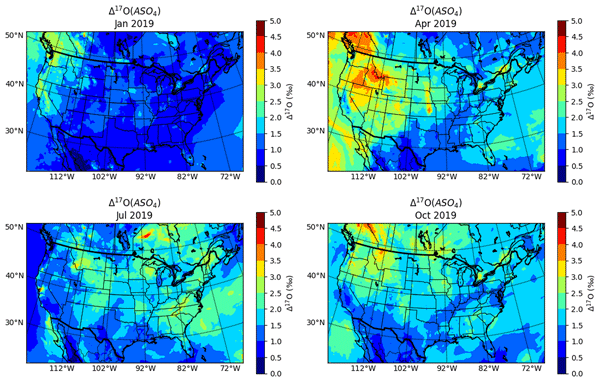
Figure 2The simulated Δ17O(ASO4) values across the contiguous US for the year 2019 in each season (winter: January, spring: April, summer: July, fall: October), based on CMAQ simulation.

Figure 3The fraction of ASO4 formation from S(IV) + O3 pathway across the contiguous US for the year 2019 in each season (winter: January, spring: April, summer: July, fall: October), based on CMAQ simulation.

Figure 4The fraction of ASO4 formation from S(IV) + H2O2 pathway across the contiguous US for the year 2019 in each season (winter: January, spring: April, summer: July, fall: October), based on CMAQ simulation.

Figure 5The fraction of ASO4 formation from SO2 + OH pathway across the contiguous US for the year 2019 in each season (winter: January, spring: April, summer: July, fall: October), based on CMAQ simulation.

Figure 6The fraction of ASO4 from primary emission across the contiguous US for the year 2019 in each season (winter: January, spring: April, summer: July, fall: October), based on CMAQ simulation.
3.2 Seasonal Variation in Fractional ASO4 Formation and Δ17O(ASO4) in the Contiguous US in 2019
ASO4 formation across the contiguous United States exhibits distinct seasonal patterns, shaped by varying contributions from the H2O2 and O3 pathways, as well as shifts in cloud pH and precursor concentrations (Fig. S1). The isotopic composition of ASO4, represented by Δ17O(ASO4), reflects the dominance of specific pathways under different meteorological and chemical conditions. In regions with low cloud pH, the H2O2 pathway dominates, resulting in low Δ17O values (Figs. S1, 2). Conversely, areas with high cloud pH favor the O3 pathway, resulting in high Δ17O values (Figs. S1, 2). Meanwhile, gas-phase SO2+•OH oxidation (Fig. 5) acts as a consistent background process throughout the year. Its near-zero Δ17O signature moderates the contrast between H2O2- and O3-dominated regimes, with a stronger influence during summer when photochemical activity peaks. Together with seasonal variations in cloud pH, ASO4, and ANH4 (Figs. S3, S4, S6), this process shapes the overall spatiotemporal pattern of Δ17O(ASO4), reflecting the coupled effects of emissions, atmospheric chemistry, and meteorology.
In January, the Western States exhibit the highest Δ17O(ASO4) values, exceeding 2 ‰ (Fig. 2). This is driven by the increased importance of the S(IV) + O3 oxidation pathway (Fig. 3), supported by elevated cloud pH levels resulting from low ASO4 concentrations (Figs. S3, S4). Conversely, the Gulf Coast States show the lowest Δ17O(ASO4) values, typically below 1 ‰ (Fig. S1), primarily due to the prevalence of the H2O2 pathway (Fig. 4). This pathway dominates under low cloud pH conditions caused by high ASO4 concentrations and limited ANH4 levels (Figs. S3, S4, S6). In the Midwest, moderate Δ17O(ASO4) values are shown, reflecting a balance between pathways. Elevated ANH4 levels partially neutralize the acidity from high ASO4 concentrations (Figs. S4, S6). This neutralization raises cloud pH (Fig. S3), slightly lowering the fractional contribution of the S(IV) + H2O2 pathway (Fig. 4) and contributing to the intermediate Δ17O(ASO4) values. During this period, the SO2+•OH pathway remains weak due to limited photochemical activity but provides a modest background effect that slightly reduces the isotopic contrast between H2O2- and O3-dominated regimes.
In April, Δ17O values increase significantly, particularly in the Western States, rising above 3 ‰ (Fig. 2). This trend indicates an enhanced influence of the O3 pathway, supported by elevated cloud pH and increased O3 levels (Figs. 3, S3, S8). In contrast, the Gulf Coast States continue to exhibit low Δ17O values (<1.5 ‰) (Fig. 2), as the H2O2 pathway remains dominant due to persistently low cloud pH (Figs. 4, S3). This acidity is driven by high ASO4 concentrations and low ANH4 concentrations (Figs. S4, S6). Meanwhile, in the Midwest, cloud pH begins to rise as increased NH3 levels, partially neutralizing the acidity from ASO4 and shifting the balance of ASO4 formation pathways (Figs. S3, S4, S7). The influence of the SO2 + •OH pathway decreases relative to January (Fig. 5), as O3 oxidation becomes more dominant, thereby exerting a weaker moderating effect on the isotopic contrast across regions.
In July, Δ17O values decrease in the Western States as the increases compared to April (Fig. 2). This shift is driven by higher water vapor levels and increased cloud cover (Fig. S10), despite the regional consistently high cloud pH (Fig. S3). In the Gulf Coast States, Δ17O values remain low, below 1.5 ‰ (Fig. S1), highlighting the continued dominance of the H2O2 pathway (Fig. 4) under conditions of abundant water vapor (Fig. S10), frequent cloud cover (Fig. S11), and persistently low cloud pH (Fig. S3). In the Midwest, cloud pH continues to rise from April (Fig. S3), driven by increasing NH3 concentrations (Fig. S7), which partially neutralize the acidity caused by ASO4 (Fig. S4). This elevation in cloud pH enhances the activity of the O3 pathway (Fig. S2), leading to an increase in Δ17O values compared to April. At the same time, the SO2+•OH pathway reaches its maximum importance (Fig. 5) under strong photochemical conditions, offsetting the isotopic enrichment from O3 oxidation and contributing to the relative decrease in Δ17O(ASO4) compared to April.
In October, Δ17O values in the Western States increase compared to July but remain slightly lower than in April (Fig. 2). This change is attributed to the enhanced (Fig. S2), supported by high cloud pH and low ASO4 concentrations (Figs. S3, S4). In the Gulf Coast States, Δ17O values remain low (Fig. 2), reflecting the continued dominance of the H2O2 pathway under acidic conditions sustained by high ASO4 levels and low ANH4 concentrations (Figs. S3, S4, S6). In the Midwest, decreasing NH3 levels from July reduce the neutralization of acidity (Figs. S3, S7), making conditions less favorable for O3-driven ASO4 formation (Fig. 3). This results in lower cloud pH (Fig. S3) and diminished Δ17O values compared to earlier months. As photochemical activity weakens, the relative contribution of the SO2 + •OH pathway declines (Fig. 5), reducing its moderating effect and allowing O3-driven isotopic enrichment to strengthen in high-pH regions.
Seasonal variations in ASO4 formation and Δ17O(ASO4) highlight the interplay of chemical drivers and meteorological conditions. The dominance of the H2O2 pathway in acidic, ASO4-rich regions, such as the Gulf Coast States, leads to low Δ17O values year-round. In contrast, the O3 pathway prevails in higher pH regions such as the Western States, driving elevated Δ17O values, particularly in April. The Midwest experiences transitional conditions, where cloud pH and NH3 concentrations modulate the relative contributions of ASO4 formation pathways. Alongside these seasonal and spatial contrasts, the gas-phase SO2+•OH pathway acts as a persistent, near-zero-Δ17O background that offsets isotopic enrichment from O3 oxidation, particularly during summer when photochemical activity peaks. These findings underscore the dynamic nature of ASO4 chemistry across seasons, emphasizing the importance of emissions, atmospheric composition, and cloud chemistry in shaping regional and seasonal patterns of ASO4 formation.
3.3 Change in Fractional Annual ASO4 Formation and Δ17O(ASO4) from 2006 to 2019
From 2006 to 2019, the annual Δ17O(ASO4) values across the contiguous US showed a consistent increase, highlighting the growing importance of the O3 pathway in ASO4 formation (Fig. 7). In the central and eastern US, Δ17O(ASO4) values increased by up to 2 ‰ (Fig. 7), primarily driven by significant reductions in SO2 emissions, largely attributable to regulatory measures such as the Clean Air Act. These reductions led to lower ASO4 concentrations, which elevated cloud pH and shifted the ASO4 formation process toward the O3 pathway (Fig. S12), resulting in ASO4 with higher Δ17O values. Conversely, the western US exhibited only modest increases in Δ17O(ASO4), typically less than 1 ‰ (Fig. 7). This is because the region historically favored O3-dominated ASO4 formation due to consistently high O3 and cloud pH levels (Fig. S13), making the impacts of rising cloud pH and reduced SO2 emissions less obvious. Changes in H2O2 concentrations played a significant role in shaping these trends. In the central and eastern US, slight increases in H2O2 concentrations continued to support the H2O2 pathway, to a limited extent, even as the O3 pathway became more dominant (Figs. 7, S12). In contrast, in the western US, H2O2 concentrations decreased slightly, resulting in a slight reduction in (Fig. 7). A decrease in across the domain along with the negligible contributions from other pathways caused a relative increase in fEMIS in these regions (Fig. 7). Between 2006 and 2019, the domain-averaged decreased by 12.5 %, primarily due to the enhanced contribution of the O3 oxidation pathway () and lower SO2 concentrations under reduced precursor emissions, which together shifted the overall oxidation balance toward aqueous-phase processes. Consistent with these trends, spatial patterns of concentration changes (Fig. S12) show substantial decreases in SO2 and ASO4, particularly in the eastern US, while NH3 and ANH4 increased, leading to higher cloud pH and favoring O3 oxidation. Meanwhile, primary ASO4 emissions, which do not carry a mass-independent signature and exhibit Δ17O values close to 0 ‰, directly added to ASO4 levels and tempered changes in Δ17O(ASO4) values (Fig. 7). This dynamic explains why the increases in Δ17O(ASO4) values from 2006 to 2019 were smaller in the western US compared to the central and eastern regions.

Figure 7The change in the fraction from each ASO4 formation pathway and Δ17O values across the contiguous US, from 2006 to 2019, based on CMAQ simulation.
3.4 Comparison of Model Δ17O(ASO4) with Observations
The CMAQ simulations of Δ17O(ASO4) across the contiguous United States reveal significant insights into atmospheric ASO4 formation over recent decades. However, observations of Δ17O(ASO4) in the contiguous US are very limited, with data primarily collected in the late 1990s at La Jolla, CA, and White Mountain Research Station, CA (Lee and Thiemens, 2001), and in the early 2000s at Baton Rouge, LA (Jenkins and Bao, 2006). These historical Δ17O(ASO4) data exhibit a range from 0.2 ‰ to 1.6 ‰ (Table S1). Due to the predicted change in ASO4 chemistry from 2006 to 2019, the 2006 model simulation was chosen for evaluation against these observations (Figs. 8, 9). The comparison with historical Δ17O(ASO4) data is intended as a preliminary evaluation rather than a strict validation, given the temporal mismatch between the available observations (1990s–early 2000s) and the simulation years (2006, 2019). The observed range of 0.2 ‰ to 1.6 ‰ provides a useful benchmark for assessing whether the model produces realistic isotopic signatures. However, the limited number and dated nature of these measurements preclude a comprehensive validation of ASO4 chemistry. This further emphasizes the critical need for new Δ17O(ASO4) observations within the contiguous United States to enable robust model-observation comparisons.
Generally, the CMAQ model reasonably reproduced Δ17O(ASO4) at the Baton Rouge, LA site, with a Root Mean Square Error (RMSE) of 0.20 ‰ (n=17). This region is characterized by relatively low predicted Δ17O(ASO4) values, consistent with high regional SO2 emissions and low cloud water pH that favor ASO4 formation through aqueous S(IV) + H2O2 reactions. In contrast, the CMAQ-simulated Δ17O(ASO4) values tended to be overestimated at the California sites, suggesting possible inaccuracies in representing additional ASO4 production pathways in this region. The La Jolla, CA site had an RMSE of 0.36 ‰ (n=31), while the White Mountain, CA site had a notably higher RMSE of 1.9 ‰ (n=6). Despite the limited number of Δ17O(ASO4) observations, a temporal analysis of model simulations versus observations indicates a consistent overprediction during the spring (Fig. 9). The Δ17O(ASO4) overestimation in spring could be associated with higher predicted cloud pH during this season, which promotes the S(IV) + O3 oxidation pathway in the model (Fig. S26). The elevated cloud pH may result from increased NH3 emissions, likely related to fertilizer use in surrounding agricultural areas or to underrepresentation of marine boundary layer processes that could influence ASO4 production (Guo et al., 2017; Lim et al., 2022; Zheng et al., 2024; Wang et al., 2025). Given the strong nonlinear pH dependence of ASO4 formation, even moderate NH3 emission biases can produce significant changes in isotopic composition. Future work should include explicit sensitivity simulations to better quantify the coupled effects of NH3, cloud pH, and oxidant chemistry on modeled Δ17O(ASO4). While organic acids (e.g., formic, acetic) can locally influence cloud water acidity, their contribution to bulk pH is generally minor relative to the dominant SO2-H2SO4-NH3 system (Herrmann et al., 2015; Shah et al., 2020; Tsui et al., 2019). Still, future model developments should evaluate their role in regional cloud pH and isotopic composition. Additionally, certain ASO4 formation pathways, such as marine boundary layer chemistry involving S(IV) oxidation by HOX, may not be fully captured, particularly at coastal sites like La Jolla, CA. These reactions can efficiently oxidize S(IV) even under moderately acidic conditions and produce ASO4 with relatively low Δ17O signatures (Chen et al., 2016; Ishino et al., 2017), which may partly explain the model overestimation at this site. Another possible factor is the omission of S(IV) oxidation induced by NO2, an emerging multiphase pathway in polluted environments. Such reactions can proceed alongside metal-catalyzed and other aqueous pathways and are anticipated to result in low or near-zero Δ17O. Sensitivity simulations suggest that this mechanism can enhance ASO4 concentrations by ∼ 0.4 %–1.2 % with a low rate constant and up to 4 %–20 % with a higher rate constant, particularly under polluted, low-oxidant wintertime conditions, when the aqueous S(IV) oxidation by H2O2 and O3 becomes less efficient (Sarwar et al., 2013), while its overall impact on Δ17O(ASO4) is expected to be minor.
Overall, the model-observation comparison of Δ17O(ASO4) suggests that CMAQ performs well in more acidic environments but struggles to simulate ASO4 formation under less acidic conditions accurately. However, the limited availability of Δ17O(ASO4) observations constrains a more comprehensive evaluation of regional and temporal ASO4 chemistry variations. This highlights the critical need for expanded observational datasets and model refinements to better represent the complex atmospheric ASO4 dynamics. While this study highlights consistent patterns in ASO4 oxidation pathways across the contiguous US, the evaluation of Δ17O(ASO4) remains constrained by the limited and dated nature of available measurements. Expanded and more recent datasets will be essential to validate and extend the findings presented here, particularly to quantify seasonal and regional variability in ASO4 formation.

Figure 8Temporal variations in Δ17O(ASO4) measurements and model simulations at (a) Baton Rouge, LA (top); (b) La Jolla, CA (middle); and (c) White Mountain Research Station, CA (bottom). The x axis error bars correspond to collection times.

Figure 9Comparison of Δ17O(ASO4) measurements and model simulations at La Jolla, CA, White Mountain Research Station, CA, and Baton Rouge, LA from 1996 to 2005.
This study modeled ASO4 formation pathways and the Δ17O(ASO4) for the contiguous United States using the CMAQ model for 2006 and 2019. The results reveal distinct seasonal and regional patterns in ASO4 chemistry, strongly influenced by photochemical conditions, emissions of SO2 and NH3, and variations in cloud pH. From 2006 to 2019, significant changes in ASO4 formation dynamics were observed, driven primarily by regulatory-driven reductions in SO2 emissions. These shifts highlight the evolving balance between aqueous-phase oxidation pathways, particularly those driven by H2O2 and O3.
The reductions in SO2 emissions due to the Clean Air Act resulted in lower cloud water ASO4, which subsequently increased cloud pH. This change shifted ASO4 production toward the O3 pathway, particularly in the eastern US, where the O3 pathway was once limited by lower pH levels in 2006. By 2019, ASO4 formation via O3 oxidation had increased significantly, indicating a more efficient production mechanism under elevated pH conditions. The sub-linear response of ASO4 concentrations to SO2 emission reductions highlights the complexity of ASO4 formation chemistry and the role of co-emitted species, such as NH3, in modifying pH levels and influencing pathway dominance.
The isotopic signature Δ17O(ASO4) serves as a powerful tracer for tracking shifts in ASO4 formation pathways. In regions with limited photochemical activity, such as during winter or in areas with high primary ASO4 emissions, lower Δ17O(ASO4) values were associated with greater contributions from primary ASO4 emissions. Conversely, higher Δ17O(ASO4) values reflected an increased role of the O3 pathway, particularly in regions with elevated cloud pH, reduced SO2 emissions, and higher ozone concentrations.
This work demonstrates a significant and predictable shift in ASO4 chemistry over the study period. The introduction of Δ17O(ASO4) as a diagnostic tool for probing ASO4 formation mechanisms provides a novel approach for investigating these changes. Expanding the measurement of Δ17O(ASO4) across diverse regions and time periods will be critical for validating and extending these findings. Future studies should prioritize exploring how changes in atmospheric composition and regulatory measures continue to influence ASO4 chemistry, with a particular focus on understanding the increasing prominence of O3-driven chemistry. This effort will be crucial for enhancing atmospheric models and understanding the implications of ASO4 chemistry on air quality, human health, and climate.
The source code for CMAQ version 5.4 is available at https://github.com/USEPA/CMAQ/tree/5.4 (last access: 1 March 2025).
The input datasets for CMAQ simulation are available at https://cmas-equates.s3.amazonaws.com/index.html#CMAQ_12US1/INPUT/ (last access: 1 March 2025). The in-detail simulation results for Δ17O(ASO4) are archived on Zenodo.org (https://doi.org/10.5281/zenodo.14954960, Fang, 2025).
The supplement related to this article is available online at https://doi.org/10.5194/acp-25-18093-2025-supplement.
HF and WW designed the study. HF conducted the model simulations and analysis with input from WW. HF wrote the manuscript with input from all authors. WW secured funding.
The contact author has declared that neither of the authors has any competing interests.
Publisher's note: Copernicus Publications remains neutral with regard to jurisdictional claims made in the text, published maps, institutional affiliations, or any other geographical representation in this paper. While Copernicus Publications makes every effort to include appropriate place names, the final responsibility lies with the authors. Views expressed in the text are those of the authors and do not necessarily reflect the views of the publisher.
We thank Kristen Foley for providing the base model input files. We thank Myk Milligan and Nathan Elger and the staff of the Hyperion cluster for helping to install CMAQ, transferring data, and maintaining the computing cluster.
This research has been supported by NSF AGS (grant nos. 2414561 and 2441725), NSF EPSCOR RII Track-4 (grant no. 2410015), and USC start-up funds.
This paper was edited by Pablo Saide and reviewed by three anonymous referees.
Alexander, B., Savarino, J., Kreutz, K. J., and Thiemens, M. H.: Impact of preindustrial biomass-burning emissions on the oxidation pathways of tropospheric sulfur and nitrogen, Journal of Geophysical Research, 109, D08303, https://doi.org/10.1029/2003JD004218, 2004.
Alexander, B., Park, R. J., Jacob, D. J., Li, Q. B., Yantosca, R. M., Savarino, J., Lee, C. C. W., and Thiemens, M. H.: Sulfate formation in sea-salt aerosols: Constraints from oxygen isotopes, Journal of Geophysical Research, 110, D10307, https://doi.org/10.1029/2004JD005659, 2005.
Alexander, B., Park, R. J., Jacob, D. J., and Gong, S.: Transition metal-catalyzed oxidation of atmospheric sulfur: Global implications for the sulfur budget, Journal of Geophysical Research: Atmospheres, 114, https://doi.org/10.1029/2008JD010486, 2009.
Appel, K. W., Bash, J. O., Fahey, K. M., Foley, K. M., Gilliam, R. C., Hogrefe, C., Hutzell, W. T., Kang, D., Mathur, R., Murphy, B. N., Napelenok, S. L., Nolte, C. G., Pleim, J. E., Pouliot, G. A., Pye, H. O. T., Ran, L., Roselle, S. J., Sarwar, G., Schwede, D. B., Sidi, F. I., Spero, T. L., and Wong, D. C.: The Community Multiscale Air Quality (CMAQ) model versions 5.3 and 5.3.1: system updates and evaluation, Geosci. Model Dev., 14, 2867–2897, https://doi.org/10.5194/gmd-14-2867-2021, 2021.
Arimoto, R., Nottingham, A. S., Webb, J., Schloesslin, C. A., and Davis, D. D.: Non-sea salt sulfate and other aerosol constituents at the South Pole during ISCAT, Geophysical Research Letters, 28, 3645–3648, https://doi.org/10.1029/2000GL012714, 2001.
Barkan, E. and Luz, B.: High-precision measurements of and of O2 and ratio in air, Rapid Communications in Mass Spectrometry, 17, 2809–2814, https://doi.org/10.1002/rcm.1267, 2003.
Benish, S. E., Bash, J. O., Foley, K. M., Appel, K. W., Hogrefe, C., Gilliam, R., and Pouliot, G.: Long-term regional trends of nitrogen and sulfur deposition in the United States from 2002 to 2017, Atmos. Chem. Phys., 22, 12749–12767, https://doi.org/10.5194/acp-22-12749-2022, 2022.
Bianchi, F., Kurtén, T., Riva, M., Mohr, C., Rissanen, M. P., Roldin, P., Berndt, T., Crounse, J. D., Wennberg, P. O., Mentel, Th. F., Wildt, J., Junninen, H., Jokinen, T., Kulmala, M., Worsnop, D. R., Thornton, J. A., Donahue, N., Kjaergaard, H. G., and Ehn, M.: Highly oxygenated organic molecules (HOM) from gas-phase autoxidation involving peroxy radicals: A key contributor to atmospheric aerosol, Chemical Reviews, 119, 3472–3509, https://doi.org/10.1021/acs.chemrev.8b00395, 2019.
Calvo, A. I., Alves, C., Castro, A., Pont, V., Vicente, A. M., and Fraile, R.: Research on aerosol sources and chemical composition: Past, current and emerging issues, Atmospheric Research, 120, 1–28, https://doi.org/10.1016/j.atmosres.2012.09.021, 2013.
Chen, Q., Geng, L., Schmidt, J. A., Xie, Z., Kang, H., Dachs, J., Cole-Dai, J., Schauer, A. J., Camp, M. G., and Alexander, B.: Isotopic constraints on the role of hypohalous acids in sulfate aerosol formation in the remote marine boundary layer, Atmos. Chem. Phys., 16, 11433–11450, https://doi.org/10.5194/acp-16-11433-2016, 2016.
Dominguez, G., Jackson, T., Brothers, L., Barnett, B., Nguyen, B., and Thiemens, M. H.: Discovery and measurement of an isotopically distinct source of sulfate in Earth's atmosphere, Proceedings of the National Academy of Sciences, 105, 12769–12773, https://doi.org/10.1073/pnas.0805255105, 2008.
Fahey, K. M. and Pandis, S. N.: Optimizing model performance: variable size resolution in cloud chemistry modeling, Atmospheric Environment, 35, https://doi.org/10.1016/S1352-2310(01)00224-2 4471–4478, 2001.
Fang, H.: Simulating Δ17O of sulfate aerosol within the contiguous United States to trace the formation processes, Zenodo [data set], https://doi.org/10.5281/zenodo.14954960, 2025.
Foley, K. M., Pouliot, G. A., Eyth, A., Aldridge, M. F., Allen, C., Appel, K. W., Bash, J. O., Beardsley, M., Beidler, J., Choi, D., Farkas, C., Gilliam, R. C., Godfrey, J., Henderson, B. H., Hogrefe, C., Koplitz, S. N., Mason, R., Mathur, R., Misenis, C., Possiel, N., Pye, H. O. T., Reynolds, L., Roark, M., Roberts, S., Schwede, D. B., Seltzer, K. M., Sonntag, D., Talgo, K., Toro, C., Vukovich, J., Xing, J., and Adams, E.: 2002–2017 anthropogenic emissions data for air quality modeling over the United States, Data in Brief, 47, 109022, https://doi.org/10.1016/j.dib.2023.109022, 2023.
Guo, H., Weber, R. J., and Nenes, A.: High levels of ammonia do not raise fine particle pH sufficiently to yield nitrogen oxide-dominated sulfate production, Scientific Reports, 7, 12109, https://doi.org/10.1038/s41598-017-11704-0, 2017.
Hallquist, M., Wenger, J. C., Baltensperger, U., Rudich, Y., Simpson, D., Claeys, M., Dommen, J., Donahue, N. M., George, C., Goldstein, A. H., Hamilton, J. F., Herrmann, H., Hoffmann, T., Iinuma, Y., Jang, M., Jenkin, M. E., Jimenez, J. L., Kiendler-Scharr, A., Maenhaut, W., McFiggans, G., Mentel, Th. F., Monod, A., Prévôt, A. S. H., Seinfeld, J. H., Surratt, J. D., Szmigielski, R., and Wildt, J.: The formation, properties and impact of secondary organic aerosol: current and emerging issues, Atmos. Chem. Phys., 9, 5155–5236, https://doi.org/10.5194/acp-9-5155-2009, 2009.
Harris, E., Sinha, B., Van Pinxteren, D., Tilgner, A., Fomba, K. W., Schneider, J., Roth, A., Gnauk, T., Fahlbusch, B., Mertes, S., Lee, T., Collett, J., Foley, S., Borrmann, S., Hoppe, P., and Herrmann, H.: Enhanced role of transition metal ion catalysis during in-cloud oxidation of SO2, Science, 340, 727–730, https://doi.org/10.1126/science.1230911, 2013.
Hattori, S., Iizuka, Y., Alexander, B., Ishino, S., Fujita, K., Zhai, S., Sherwen, T., Oshima, N., Uemura, R., Yamada, A., Suzuki, N., Matoba, S., Tsuruta, A., Savarino, J., and Yoshida, N.: Isotopic evidence for acidity-driven enhancement of sulfate formation after SO2 emission control, Science Advances, 7, eabd4610, https://doi.org/10.1126/sciadv.abd4610, 2021.
Haywood, J. and Boucher, O.: Estimates of the direct and indirect radiative forcing due to tropospheric aerosols: A review, Reviews of Geophysics, 38, 513–543, https://doi.org/10.1029/1999RG000078, 2000.
Herrmann, H., Schaefer, T., Tilgner, A., Styler, S. A., Weller, C., Teich, M., and Otto, T.: Tropospheric aqueous-phase chemistry: kinetics, mechanisms, and its coupling to a changing gas phase, Chemical Reviews, 115, 4259–4334, 2015.
Ishino, S., Hattori, S., Savarino, J., Jourdain, B., Preunkert, S., Legrand, M., Caillon, N., Barbero, A., Kuribayashi, K., and Yoshida, N.: Seasonal variations of triple oxygen isotopic compositions of atmospheric sulfate, nitrate, and ozone at Dumont d'Urville, coastal Antarctica, Atmos. Chem. Phys., 17, 3713–3727, https://doi.org/10.5194/acp-17-3713-2017, 2017.
Itahashi, S., Hattori, S., Ito, A., Sadanaga, Y., Yoshida, N., and Matsuki, A.: Role of dust and iron solubility in sulfate formation during the long-range transport in East Asia evidenced by 17O-excess signatures, Environmental Science and Technology, 56, 13634–13643, https://doi.org/10.1021/acs.est.2c03574, 2022.
Jenkins, K. A. and Bao, H.: Multiple oxygen and sulfur isotope compositions of atmospheric sulfate in Baton Rouge, LA, USA, Atmospheric Environment, 40, 4528–4537, https://doi.org/10.1016/j.atmosenv.2006.04.010, 2006.
Jones, A. D. L. A., Roberts, D. L., and Slingo, A.: A climate model study of indirect radiative forcing by anthropogenic sulphate aerosols, Nature, 370, 450–453, https://doi.org/10.1038/370450a0, 1994.
Kaiser, J., Röckmann, T., and Brenninkmeijer, C. A.: Contribution of mass-dependent fractionation to the oxygen isotope anomaly of atmospheric nitrous oxide, Journal of Geophysical Research, 109, D033055, https://doi.org/10.1029/2003JD004088, 2004.
Kaufman, Y. J. and Tanré, D.: Effect of variations in super-saturation on the formation of cloud condensation nuclei, Nature, 369, 45–48, https://doi.org/10.1038/369045a0, 1994.
Langner, J., Rodhe, H., Crutzen, P. J., and Zimmermann, P.: Anthropogenic influence on the distribution of tropospheric sulphate aerosol, Nature, 359, 712–716, https://doi.org/10.1038/359712a0, 1992.
Lee, C. C. W. and Thiemens, M. H.: The δ17O and δ18O measurements of atmospheric sulfate from a coastal and high alpine region: A mass independent isotopic anomaly, Journal of Geophysical Research: Atmospheres, 106, 17359–17373, https://doi.org/10.1029/2000JD900805, 2001.
Li, J., Zhang, Y. L., Cao, F., Zhang, W., Fan, M., Lee, X., and Michalski, G.: Stable sulfur isotopes revealed a major role of transition-metal ion-catalyzed SO2 oxidation in haze episodes, Environmental Science and Technology, 54, 2626–2634, https://doi.org/10.1021/acs.est.9b07150, 2020.
Lim, J., Park, H., and Cho, S.: Evaluation of the ammonia emission sensitivity of secondary inorganic aerosol concentrations measured by the national reference method, Atmospheric Environment, 270, 118903, https://doi.org/10.1016/j.atmosenv.2021.118903, 2022.
Lin, Y. C., Zhao, Y., Zhang, Y. L., Hong, Y., Hattori, S., Itahashi, S., Fan, MY., Xie, F., Zhao, Z. Y., Yu, M., Cao, F., Xu, R., Li, J., Kawamura, K., and Thiemens, M. H.: China's SO2 emission reductions enhance atmospheric ozone–driven sulfate aerosol production in East Asia, Proceedings of the National Academy of Sciences, 122, e2414064122, https://doi.org/10.1073/pnas.2414064122, 2025.
Liu, L., Bei, N., Wu, J., Liu, S., Zhou, J., Li, X., Yang, Q., Feng, T., Cao, J., Tie, X., and Li, G.: Effects of stabilized Criegee intermediates (sCIs) on sulfate formation: a sensitivity analysis during summertime in Beijing–Tianjin–Hebei (BTH), China, Atmos. Chem. Phys., 19, 13341–13354, https://doi.org/10.5194/acp-19-13341-2019, 2019.
Lohmann, U. and Feichter, J.: Impact of sulfate aerosols on albedo and lifetime of clouds: A sensitivity study with the ECHAM4 GCM, Journal of Geophysical Research: Atmospheres, 102, 13685–13700, https://doi.org/10.1029/97JD00631, 1997.
Meidan, D., Holloway, J. S., Edwards, P. M., Dube, W. P., Middlebrook, A. M., Liao, J., Welti, A., Graus, M., Warneke, C., Ryerson, T. B., Pollack, I. B., Brown, S. S., and Rudich, Y.: Role of Criegee intermediates in secondary sulfate aerosol formation in nocturnal power plant plumes in the Southeast US, ACS Earth and Space Chemistry, 3, 748–759, https://doi.org/10.1021/acsearthspacechem.8b00215, 2019.
Michalski, G. M., Scott, Z., Kabiling, M., and Thiemens, M. H.: First measurements and modeling of 17O in atmospheric nitrate, Geophys. Res. Lett., 30, 1870, https://doi.org/10.1029/2003GL017015, 2003.
Morin, S., Savarino, J., Bekki, S., Gong, S., and Bottenheim, J. W.: Signature of Arctic surface ozone depletion events in the isotope anomaly (Δ17O) of atmospheric nitrate, Atmos. Chem. Phys., 7, 1451–1469, https://doi.org/10.5194/acp-7-1451-2007, 2007.
Pandis, S. N. and Seinfeld, J. H.: Sensitivity analysis of a chemical mechanism for aqueous-phase atmospheric chemistry, Journal of Geophysical Research, 94, 1105–1126, https://doi.org/10.1029/JD094iD01p01105, 1989.
Peng, Y., Hattori, S., Zuo, P., Ma, H., and Bao, H.: Record of pre-industrial atmospheric sulfate in continental interiors, Nature Geoscience, 16, 619–624, https://doi.org/10.1038/s41561-023-01211-5, 2023.
Pye, H. O. T., Nenes, A., Alexander, B., Ault, A. P., Barth, M. C., Clegg, S. L., Collett Jr., J. L., Fahey, K. M., Hennigan, C. J., Herrmann, H., Kanakidou, M., Kelly, J. T., Ku, I.-T., McNeill, V. F., Riemer, N., Schaefer, T., Shi, G., Tilgner, A., Walker, J. T., Wang, T., Weber, R., Xing, J., Zaveri, R. A., and Zuend, A.: The acidity of atmospheric particles and clouds, Atmos. Chem. Phys., 20, 4809–4888, https://doi.org/10.5194/acp-20-4809-2020, 2020.
Reiss, R., Anderson, E. L., Cross, C. E., Hidy, G., Hoel, D., McClellan, R., and Moolgavkar, S.: Evidence of health impacts of sulfate-and nitrate-containing particles in ambient air, Inhalation Toxicology, 19, 419–449, https://doi.org/10.1080/08958370601174941, 2007.
Sarwar, G., Fahey, K., Kwok, R., Gilliam, R. C., Roselle, S. J., Mathur, R., Xue, J., Yu, J., and Carter, W. P.: Potential impacts of two SO2 oxidation pathways on regional sulfate concentrations: Aqueous-phase oxidation by NO2 and gas-phase oxidation by Stabilized Criegee Intermediates, Atmospheric Environment, 68, 186–197, https://doi.org/10.1016/j.atmosenv.2012.11.036, 2013.
Savarino, J. and Thiemens, M. H.: Mass-independent oxygen isotope (16O, 17O, 18O) fractionation found in Hx, Ox reactions. The Journal of Physical Chemistry A, 103, 9221–9229, https://doi.org/10.1021/jp991221y, 1999.
Savarino, J., Lee, C. C., and Thiemens, M. H.: Laboratory oxygen isotopic study of sulfur (IV) oxidation: Origin of the mass-independent oxygen isotopic anomaly in atmospheric sulfates and sulfate mineral deposits on Earth, Journal of Geophysical Research, 105, 29079–29088, https://doi.org/10.1029/2000JD900456, 2000.
Savarino, J., Bekki, S., ColeDai, J., and Thiemens, M. H.: Evidence from sulfate mass independent oxygen isotopic compositions of dramatic changes in atmospheric oxidation following massive volcanic eruptions, Journal of Geophysical Research, 108, 4671, https://doi.org/10.1029/2003JD003737, 2003.
Savarino, J., Kaiser, J., Morin, S., Sigman, D. M., and Thiemens, M. H.: Nitrogen and oxygen isotopic constraints on the origin of atmospheric nitrate in coastal Antarctica, Atmos. Chem. Phys., 7, 1925–1945, https://doi.org/10.5194/acp-7-1925-2007, 2007.
Seigneur, C. and Saxena, P.: A theoretical investigation of sulfate formation in clouds, Atmospheric Environment, 22, 101–115, https://doi.org/10.1016/0004-6981(88)90303-4, 1988.
Shah, V., Jacob, D. J., Moch, J. M., Wang, X., and Zhai, S.: Global modeling of cloud water acidity, precipitation acidity, and acid inputs to ecosystems, Atmos. Chem. Phys., 20, 12223–12245, https://doi.org/10.5194/acp-20-12223-2020, 2020.
Smith, S. J., van Aardenne, J., Klimont, Z., Andres, R. J., Volke, A., and Delgado Arias, S.: Anthropogenic sulfur dioxide emissions: 1850–2005, Atmos. Chem. Phys., 11, 1101–1116, https://doi.org/10.5194/acp-11-1101-2011, 2011.
Sofen, E. D., Alexander, B., and Kunasek, S. A.: The impact of anthropogenic emissions on atmospheric sulfate production pathways, oxidants, and ice core Δ17O(SO), Atmos. Chem. Phys., 11, 3565–3578, https://doi.org/10.5194/acp-11-3565-2011, 2011.
Tsui, W. G., Woo, J. L., and McNeill, V. F.: Impact of aerosol-cloud cycling on aqueous secondary organic aerosol formation, Atmosphere, 10, 666, https://doi.org/10.3390/atmos10110666, 2019.
U.S. Environmental Protection Agency: CMAQ release notes: Process analysis and sulfur tracking model (STM), in: USEPA/CMAQ Wiki. GitHub [code], https://github.com/USEPA/CMAQ/wiki/CMAQ-Release-Notes:-Process-Analysis-&-Sulfur-Tracking-Model-(STM), last access: 9 October 2025.
U.S. Environmental Protection Agency: CMAQv5.4, in: USEPA/CMAQ Wiki, GitHub [code], https://github.com/USEPA/CMAQ/tree/5.4, last access: 1 March 2025.
Vannucci, P. F., Foley, K., Murphy, B. N., Hogrefe, C., Cohen, R. C., and Pye, H. O.: Temperature-Dependent Composition of Summertime PM2.5 in Observations and Model Predictions across the Eastern US, ACS Earth and Space Chemistry, 8, 381–392, https://doi.org/10.1021/acsearthspacechem.3c00333, 2024.
Vicars, W. C. and Savarino, J.: Quantitative constraints on the O-17-excess (Delta 17O) signature of surface ozone: Ambient measurements from 50° N to 50° S using the nitrite-coated filter technique, Geochimica et Cosmochimica Acta, 135, 270–287, https://doi.org/10.1016/j.gca.2014.03.023, 2014.
Wang, X., Tsimpidi, A. P., Luo, Z., Steil, B., Pozzer, A., Lelieveld, J., and Karydis, V. A.: The influence of ammonia emission inventories on size-resolved global atmospheric aerosol composition and acidity, Atmos. Chem. Phys., 25, 10559–10586, https://doi.org/10.5194/acp-25-10559-2025, 2025.
Walcek, C. J. and Taylor, G. R.: A theoretical method for computing vertical distributions of acidity and sulfate production within cumulus clouds, Journal of Atmospheric Sciences, 43, 339–355, https://doi.org/10.1175/1520-0469(1986)043<0339:ATMFCV>2.0.CO;2 1986.
Walters, W. W., Michalski, G., Böhlke, J. K., Alexander, B., Savarino, J., and Thiemens, M. H.: Assessing the seasonal dynamics of nitrate and sulfate aerosols at the South Pole utilizing stable isotopes, Journal of Geophysical Research: Atmospheres, 124, 8161–8177, https://doi.org/10.1029/2019JD030517, 2019.
Weber, R. J., Guo, H., Russell, A. G., and Nenes, A.: High aerosol acidity despite declining atmospheric sulfate concentrations over the past 15 years, Nature Geoscience, 9, 282–285, https://doi.org/10.1038/ngeo2665, 2016.
Weston Jr., R. E.: When is an isotope effect non-mass dependent, Journal of Nuclear Science and Technology, 43, 295–299, https://doi.org/10.1080/18811248.2006.9711092, 2006.
Yarwood, G., Jung, J., Whitten, G. Z., Heo, G., Mellberg, J., and Estes, M.: Updates to the Carbon Bond mechanism for version 6 (CB6), in: proceedings of the 9th Annual CMAS Conference, Chapel Hill, NC, USA, 11–13 October 2010, 2010.
Zheng, G., Su, H., Andreae, M. O., Pöschl, U., and Cheng, Y.: Multiphase buffering by ammonia sustains sulfate production in atmospheric aerosols, AGU Advances, 5, e2024AV001238, https://doi.org/10.1029/2024AV001238, 2024.
The requested paper has a corresponding corrigendum published. Please read the corrigendum first before downloading the article.
- Article
(12890 KB) - Full-text XML
- Corrigendum
-
Supplement
(22760 KB) - BibTeX
- EndNote