
Articles | Volume 26, issue 13
https://doi.org/10.5194/acp-26-9541-2026
© Author(s) 2026. This work is distributed under
the Creative Commons Attribution 4.0 License.
the Creative Commons Attribution 4.0 License.
Special issue:
https://doi.org/10.5194/acp-26-9541-2026
© Author(s) 2026. This work is distributed under
the Creative Commons Attribution 4.0 License.
the Creative Commons Attribution 4.0 License.
Research article
| 
08 Jul 2026
Research article |
| 08 Jul 2026
| 08 Jul 2026
Variability of local gravity wave spectra from data of a high-resolution icosahedral-grid global model
Zuzana Procházková
CORRESPONDING AUTHOR

Department of Atmospheric Physics, Faculty of Mathematics and Physics, Charles University, Prague, Czech Republic
Erfan Mahmoudi
Institute for Atmospheric and Environmental Sciences, Goethe University Frankfurt, Germany
Institute for Atmospheric and Environmental Sciences, Goethe University Frankfurt, Germany
Department of Planetary and Geosciences, California Institute of Technology, Pasadena, California, USA
Stamen Dolaptchiev
Institute for Atmospheric and Environmental Sciences, Goethe University Frankfurt, Germany
Claudia Christine Stephan
Leibniz Institute of Atmospheric Physics at the University of Rostock, Kühlungsborn, Germany
Georg Sebastian Völker
Institute for Atmospheric and Environmental Sciences, Goethe University Frankfurt, Germany
Department of Physical Oceanography, Leibniz Institute for Baltic Sea Research Warnemünde, Rostock, Germany
Ulrich Achatz
Institute for Atmospheric and Environmental Sciences, Goethe University Frankfurt, Germany
Related authors
Radek Zajíček, Zuzana Procházková, and Petr Šácha
EGUsphere, https://doi.org/10.5194/egusphere-2026-909, https://doi.org/10.5194/egusphere-2026-909, 2026
Short summary
Short summary
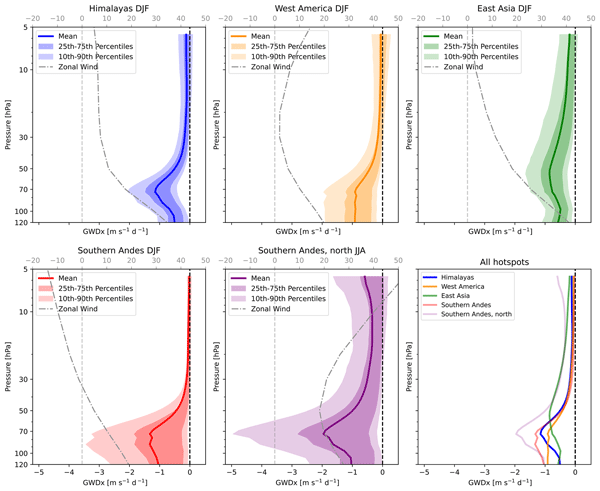
We compare resolved gravity wave drag from high-resolution reanalysis data with parameterized drag from global climate model simulations. Our results show strong similarity between parameterized and resolved drag, but their interactions with Rossby waves differ markedly. This discrepancy suggests that current climate models may misrepresent gravity wave influences on atmospheric circulation and highlight the need to improve gravity wave parameterizations for more reliable climate predictions.
Zuzana Procházková, Radek Zajíček, and Petr Šácha
Weather Clim. Dynam., 6, 927–947, https://doi.org/10.5194/wcd-6-927-2025, https://doi.org/10.5194/wcd-6-927-2025, 2025
Short summary
Short summary
In this work, we compute and analyze resolved gravity wave drag in high-resolution reanalysis data. Studying gravity waves with a realistic dataset helps us to understand them better and potentially improve climate projections. Part of our results supports a key hypothesis governing the vertical distribution of parameterized gravity wave drag in climate models; however, we also provide evidence of the strong influence of horizontal wave propagation, a mechanism that is currently missing in the models.
Mark Schlutow, Ray Chew, and Mathias Göckede
Geosci. Model Dev., 19, 6259–6272, https://doi.org/10.5194/gmd-19-6259-2026, https://doi.org/10.5194/gmd-19-6259-2026, 2026
Short summary
Short summary
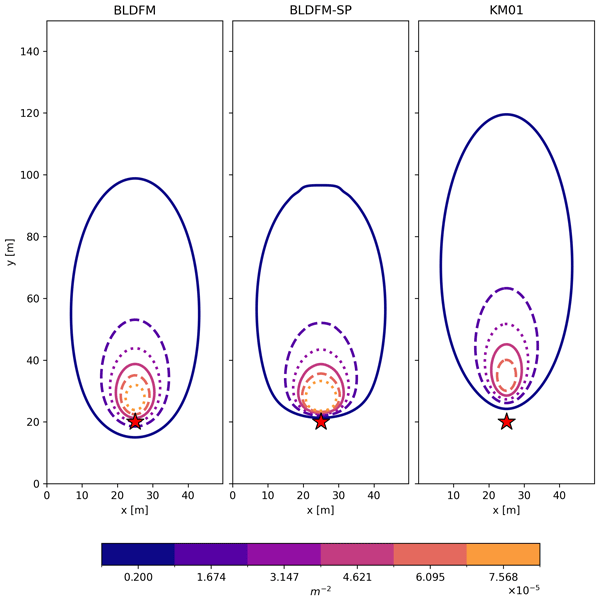
Understanding how greenhouse gases and pollutants move through the atmosphere is crucial. A new model, the Boundary Layer Dispersion and Footprint Model (BLDFM), tracks their movement. Unlike previous models, BLDFM uses a numerical approach without simplifying assumptions. It is flexible and can be used for climate impact studies and industrial emissions monitoring. Our testing and comparison results show BLDFM's potential as a valuable research tool.
Devin Huyghebaert, Juha Vierinen, Björn Gustavsson, Ralph Latteck, Toralf Renkwitz, Marius Zecha, Claudia C. Stephan, J. Federico Conte, Daniel Kastinen, Johan Kero, and Jorge L. Chau
Atmos. Meas. Tech., 19, 4277–4292, https://doi.org/10.5194/amt-19-4277-2026, https://doi.org/10.5194/amt-19-4277-2026, 2026
Short summary
Short summary
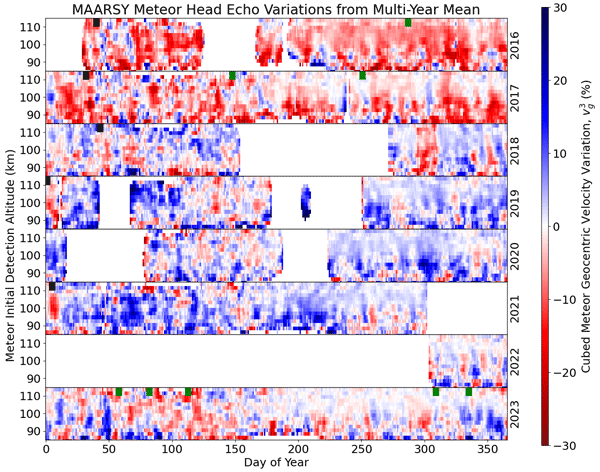
The phenomena of meteors occurs at altitudes of 60–120 km and can be used to measure the neutral atmosphere. We use a large high power radar system in Norway (Middle Atmosphere Alomar Radar System (MAARSY)) to measure the meteors and determine changes to the atmospheric density between the years of 2016–2023 at altitudes of 85–115 km. The same time period between years are compared, minimizing changes to the measurements due to factors other than the atmosphere.
Phoebe Noble, Haruka Okui, Joan Alexander, Manfred Ern, Neil P. Hindley, Lars Hoffmann, Laura Holt, Annelize van Niekerk, Riwal Plougonven, Inna Polichtchouk, Claudia C. Stephan, Martina Bramberger, Milena Corcos, William Putnam, Christopher Kruse, and Corwin J. Wright
Atmos. Chem. Phys., 26, 7607–7630, https://doi.org/10.5194/acp-26-7607-2026, https://doi.org/10.5194/acp-26-7607-2026, 2026
Short summary
Short summary
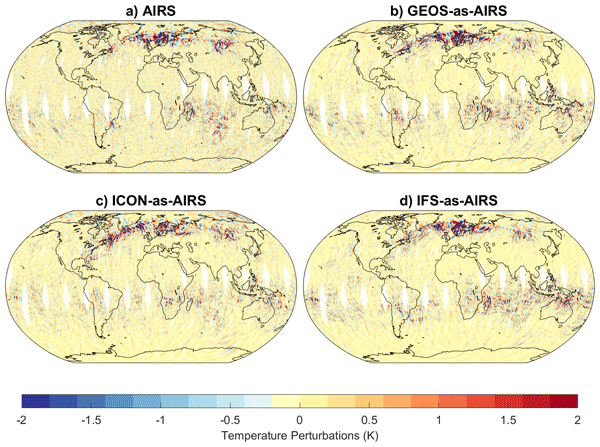
Gravity waves are small-scale processes that drive the circulation in the middle and upper atmosphere. In this work, we assess 3 new high-resolution (3-5km horizontal resolution) models against satellite data. Generally, models capture the spatial patterns and represent stratospheric northern hemisphere mountain generated waves well. However, they still underestimate amplitudes globally and struggle with the representation of southern hemispheric convective waves.
Andreas Dörnbrack, Andreas Giez, Christian Mallaun, and Claudia Christine Stephan
EGUsphere, https://doi.org/10.5194/egusphere-2026-2628, https://doi.org/10.5194/egusphere-2026-2628, 2026
Short summary
Short summary
Upper-tropospheric turbulence over the Atlantic intertropical convergence zone is quantified from in situ measurements onboard the German research aircraft HALO, with a focus on whether the anticipated subsidence in the doldrums leads to reduced turbulence.
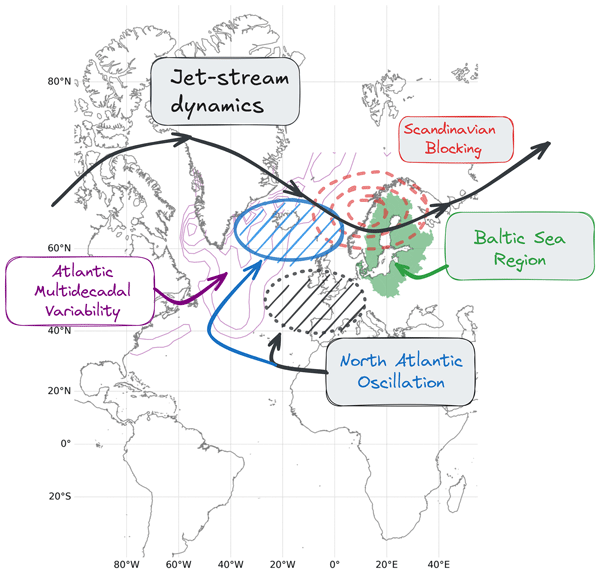
Florian Börgel, Itzel Ruvalcaba Baroni, Leonie Barghorn, Leonard Borchert, Bronwyn Cahill, Cyril Dutheil, Leonie Esters, Małgorzata Falarz, Helena L. Filipsson, Matthias Gröger, Jari Hänninen, Magnus Hieronymus, Erko Jakobson, Mehdi Pasha Karami, Karol Kuliński, Taavi Liblik, H. E. Markus Meier, Gabriele Messori, Lev Naumov, Thomas Neumann, Piia Post, Gregor Rehder, Anna Rutgersson, and Georg Sebastian Voelker
Earth Syst. Dynam., 17, 415–450, https://doi.org/10.5194/esd-17-415-2026, https://doi.org/10.5194/esd-17-415-2026, 2026
Short summary
Short summary
This review explains how weather patterns, guided by the polar jet stream, influence the Baltic Sea’s climate and ecosystem. It covers the North Atlantic Oscillation, blocking events and other processes and discusses how they affect temperature, rainfall, and storms from days to decades. These shifts then impact oxygen levels, productivity, and acidification in the Baltic Sea. Physical links are fairly well known, but biogeochemical pathways remain uncertain.
Madhuri Umbarkar, Daniel Kunkel, and Ulrich Achatz
EGUsphere, https://doi.org/10.5194/egusphere-2026-413, https://doi.org/10.5194/egusphere-2026-413, 2026
Short summary
Short summary
We present co-occurrence of gravity waves (GWs) and vertical shear in the North Atlantic lowermost stratosphere using ERA5 reanalysis data. Our results suggest the importance of GWs in the formation and maintenance of tropopause shear layer and ultimately to the potential turbulence occurrence in the extratropical upper troposphere lower stratosphere (UTLS). Overall, small-scale processes, and in particular, GWs can have larger implications for dynamics and composition in the UTLS.
Radek Zajíček, Zuzana Procházková, and Petr Šácha
EGUsphere, https://doi.org/10.5194/egusphere-2026-909, https://doi.org/10.5194/egusphere-2026-909, 2026
Short summary
Short summary
We compare resolved gravity wave drag from high-resolution reanalysis data with parameterized drag from global climate model simulations. Our results show strong similarity between parameterized and resolved drag, but their interactions with Rossby waves differ markedly. This discrepancy suggests that current climate models may misrepresent gravity wave influences on atmospheric circulation and highlight the need to improve gravity wave parameterizations for more reliable climate predictions.
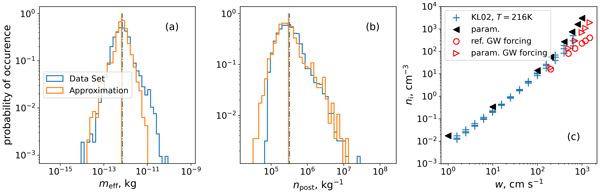
Alena Kosareva, Stamen Dolaptchiev, Peter Spichtinger, and Ulrich Achatz
Geosci. Model Dev., 18, 6117–6133, https://doi.org/10.5194/gmd-18-6117-2025, https://doi.org/10.5194/gmd-18-6117-2025, 2025
Short summary
Short summary
This study improves how we predict ice formation in clouds by accounting for variable ice sizes and different weather conditions. Using simulations, we developed a more accurate method that works efficiently, making it suitable for application in weather and climate prediction models. The new approach is numerically verified and provides precise predictions of ice formation events and reliable estimates of key parameters.
Zuzana Procházková, Radek Zajíček, and Petr Šácha
Weather Clim. Dynam., 6, 927–947, https://doi.org/10.5194/wcd-6-927-2025, https://doi.org/10.5194/wcd-6-927-2025, 2025
Short summary
Short summary
In this work, we compute and analyze resolved gravity wave drag in high-resolution reanalysis data. Studying gravity waves with a realistic dataset helps us to understand them better and potentially improve climate projections. Part of our results supports a key hypothesis governing the vertical distribution of parameterized gravity wave drag in climate models; however, we also provide evidence of the strong influence of horizontal wave propagation, a mechanism that is currently missing in the models.
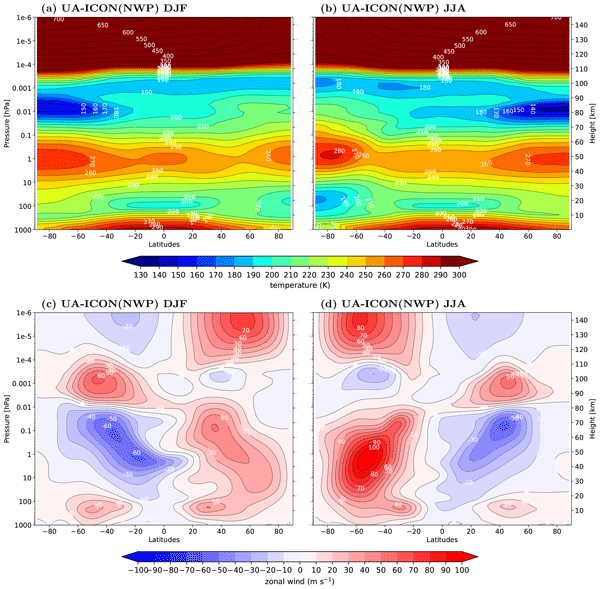
Markus Kunze, Christoph Zülicke, Tarique A. Siddiqui, Claudia C. Stephan, Yosuke Yamazaki, Claudia Stolle, Sebastian Borchert, and Hauke Schmidt
Geosci. Model Dev., 18, 3359–3385, https://doi.org/10.5194/gmd-18-3359-2025, https://doi.org/10.5194/gmd-18-3359-2025, 2025
Short summary
Short summary
We present the Icosahedral Nonhydrostatic (ICON) general circulation model with an upper-atmospheric extension with the physics package for numerical weather prediction (UA-ICON(NWP)). We optimized the parameters for the gravity wave parameterizations and achieved realistic modeling of the thermal and dynamic states of the mesopause regions. UA-ICON(NWP) now shows a realistic frequency of major sudden stratospheric warmings and well-represented solar tides in temperature.
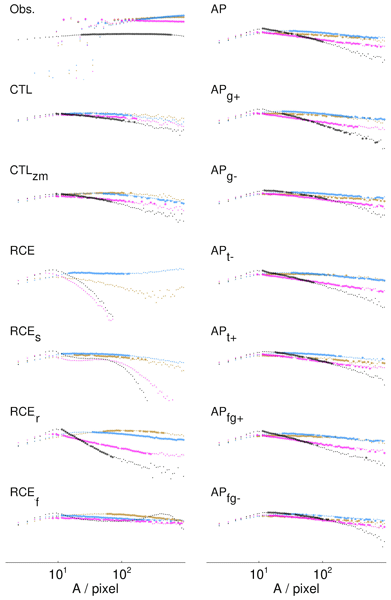
Claudia Christine Stephan and Bjorn Stevens
Atmos. Chem. Phys., 25, 1209–1226, https://doi.org/10.5194/acp-25-1209-2025, https://doi.org/10.5194/acp-25-1209-2025, 2025
Short summary
Short summary
Tropical precipitation cluster area and intensity distributions follow power laws, but the physical processes responsible for this behavior remain unknown. We analyze global simulations that realistically represent precipitation processes. We consider Earth-like planets as well as virtual planets to realize different types of large-scale dynamics. Our finding is that power laws in Earth’s precipitation cluster statistics stem from the robust power laws in Earth’s atmospheric wind field.
Young-Ha Kim, Georg Sebastian Voelker, Gergely Bölöni, Günther Zängl, and Ulrich Achatz
Atmos. Chem. Phys., 24, 3297–3308, https://doi.org/10.5194/acp-24-3297-2024, https://doi.org/10.5194/acp-24-3297-2024, 2024
Short summary
Short summary
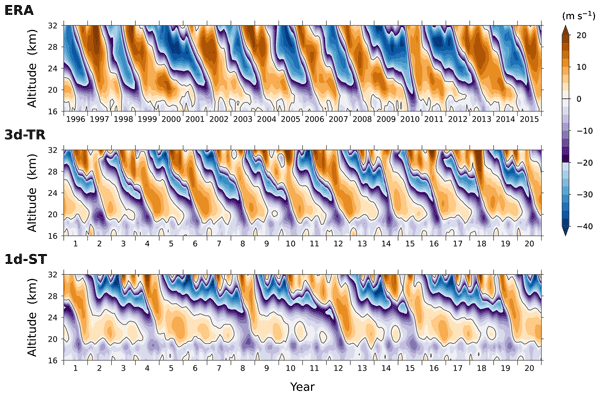
The quasi-biennial oscillation, which governs the tropical stratospheric circulation, is driven primarily by small-scale wave processes. We employ a novel method to realistically represent these wave processes in a global model, thereby revealing an aspect of the oscillation that has not been identified before. We find that the oblique propagation of waves, a process neglected by existing climate models, plays a pivotal role in the stratospheric circulation and its oscillation.
Cathy Hohenegger, Peter Korn, Leonidas Linardakis, René Redler, Reiner Schnur, Panagiotis Adamidis, Jiawei Bao, Swantje Bastin, Milad Behravesh, Martin Bergemann, Joachim Biercamp, Hendryk Bockelmann, Renate Brokopf, Nils Brüggemann, Lucas Casaroli, Fatemeh Chegini, George Datseris, Monika Esch, Geet George, Marco Giorgetta, Oliver Gutjahr, Helmuth Haak, Moritz Hanke, Tatiana Ilyina, Thomas Jahns, Johann Jungclaus, Marcel Kern, Daniel Klocke, Lukas Kluft, Tobias Kölling, Luis Kornblueh, Sergey Kosukhin, Clarissa Kroll, Junhong Lee, Thorsten Mauritsen, Carolin Mehlmann, Theresa Mieslinger, Ann Kristin Naumann, Laura Paccini, Angel Peinado, Divya Sri Praturi, Dian Putrasahan, Sebastian Rast, Thomas Riddick, Niklas Roeber, Hauke Schmidt, Uwe Schulzweida, Florian Schütte, Hans Segura, Radomyra Shevchenko, Vikram Singh, Mia Specht, Claudia Christine Stephan, Jin-Song von Storch, Raphaela Vogel, Christian Wengel, Marius Winkler, Florian Ziemen, Jochem Marotzke, and Bjorn Stevens
Geosci. Model Dev., 16, 779–811, https://doi.org/10.5194/gmd-16-779-2023, https://doi.org/10.5194/gmd-16-779-2023, 2023
Short summary
Short summary
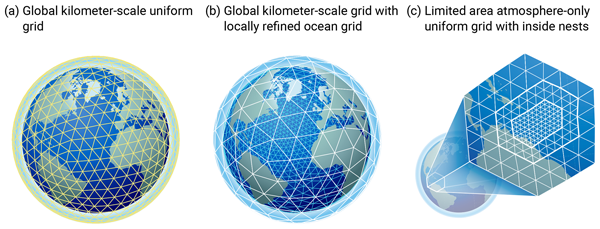
Models of the Earth system used to understand climate and predict its change typically employ a grid spacing of about 100 km. Yet, many atmospheric and oceanic processes occur on much smaller scales. In this study, we present a new model configuration designed for the simulation of the components of the Earth system and their interactions at kilometer and smaller scales, allowing an explicit representation of the main drivers of the flow of energy and matter by solving the underlying equations.
Cited articles
Achatz, U.: Atmospheric dynamics, Springer, https://doi.org/https://doi.org/10.1007/978-3-662-63941-2, 2022. a, b, c
Achatz, U., Alexander, M. J., Becker, E., Chun, H.-Y., Dörnbrack, A., Holt, L., Plougonven, R., Polichtchouk, I., Sato, K., Sheshadri, A., Stephan, C. C., van Niekerk, A., and Wright, C. J.: Atmospheric gravity waves: Processes and parameterization, J. Atmos. Sci., 81, 237–262, https://doi.org/10.1175/JAS-D-23-0210.1, 2024. a, b
Becker, E., Vadas, S. L., Bossert, K., Harvey, V. L., Zülicke, C., and Hoffmann, L.: A high-resolution whole-atmosphere model with resolved gravity waves and specified large-scale dynamics in the troposphere and stratosphere, J. Geophys. Res.-Atmos., 127, e2021JD035018, https://doi.org/10.1029/2021JD035018, 2022. a
Blažica, V., Gustafsson, N., and Žagar, N.: The impact of periodization methods on the kinetic energy spectra for limited-area numerical weather prediction models, Geosci. Model Dev., 8, 87–97, https://doi.org/10.5194/gmd-8-87-2015, 2015. a
Bölöni, G., Kim, Y.-H., Borchert, S., and Achatz, U.: Toward transient subgrid-scale gravity wave representation in atmospheric models. Part I: Propagation model including nondissipative wave–mean-flow interactions, J. Atmos. Sci., 78, 1317–1338, https://doi.org/10.1175/JAS-D-20-0065.1, 2021. a, b
Borchert, S., Achatz, U., and Fruman, M. D.: Gravity wave emission in an atmosphere-like configuration of the differentially heated rotating annulus experiment, J. Fluid Mech., 758, 287–311, https://doi.org/10.1017/jfm.2014.528, 2014. a, b
Chane Ming, F., Vignelles, D., Jegou, F., Berthet, G., Renard, J.-B., Gheusi, F., and Kuleshov, Y.: Gravity-wave effects on tracer gases and stratospheric aerosol concentrations during the 2013 ChArMEx campaign, Atmos. Chem. Phys., 16, 8023–8042, https://doi.org/10.5194/acp-16-8023-2016, 2016. a
Chew, R.: pyCSA, Zemodo [code], https://doi.org/10.5281/zenodo.20634759, 2026. a
Chew, R., Dolaptchiev, S., Wedel, M.-S., and Achatz, U.: A constrained spectral approximation of subgrid-scale orography on unstructured grids, J. Adv. Model. Earth Sy., 16, e2024MS004361, https://doi.org/10.1029/2024MS004361, 2024. a, b, c, d
Corcos, M., Bramberger, M., Alexander, M. J., Hertzog, A., Liu, C., and Wright, C.: Observation of gravity waves generated by convection and the “moving mountain” mechanism during stratéole-2 campaigns and their impact on the QBO, J. Geophys. Res.-Atmos., 130, e2024JD041804, https://doi.org/10.1029/2024JD041804, 2025. a
Dolaptchiev, S. I., Spichtinger, P., Baumgartner, M., and Achatz, U.: Interactions between gravity waves and cirrus clouds: Asymptotic modeling of wave-induced ice nucleation, J. Atmos. Sci., 80, 2861–2879, https://doi.org/10.1175/JAS-D-22-0234.1, 2023. a
Dörnbrack, A.: Transient tropopause waves, J. Atmos. Sci., 81, 1647–1668, 2024. a
Ern, M., Ploeger, F., Preusse, P., Gille, J., Gray, L., Kalisch, S., Mlynczak, M., Russell III, J., and Riese, M.: Interaction of gravity waves with the QBO: A satellite perspective, J. Geophys. Res.-Atmos., 119, 2329–2355, https://doi.org/10.1002/2013JD020731, 2014. a
Fritts, D. C. and Alexander, M. J.: Gravity wave dynamics and effects in the middle atmosphere, Rev. Geophys., 41, 1003, https://doi.org/10.1029/2001RG000106, 2003. a, b, c
Fritts, D. C. and VanZandt, T. E.: Spectral estimates of gravity wave energy and momentum fluxes. Part I: Energy dissipation, acceleration, and constraints, J. Atmos. Sci., 50, 3685–3694, https://doi.org/10.1175/1520-0469(1993)050<3685:SEOGWE>2.0.CO;2, 1993. a, b
Gupta, A., Sheshadri, A., Alexander, M. J., and Birner, T.: Insights on lateral gravity wave propagation in the extratropical stratosphere from 44 years of ERA5 data, Geophys. Res. Lett., 51, e2024GL108541, https://doi.org/10.1029/2024GL108541, 2024. a
Hertzog, A. and Vial, F.: A study of the dynamics of the equatorial lower stratosphere by use of ultra-long-duration balloons: 2. Gravity waves, J. Geophys. Res.-Atmos., 106, 22745–22761, https://doi.org/10.1029/2000JD000242, 2001. a
Hertzog, A., Alexander, M. J., and Plougonven, R.: On the intermittency of gravity wave momentum flux in the stratosphere, J. Atmos. Sci., 69, 3433–3448, https://doi.org/10.1175/JAS-D-12-09.1, 2012. a
Kawatani, Y., Hamilton, K., Watanabe, S., Taguchi, M., Serva, F., Anstey, J. A., Richter, J. H., Butchart, N., Orbe, C., Osprey, S. M., Naoe, H., Elsbury, D., Chen, C.-C., García-Serrano, J., Glanville, A., Kerzenmacher, T., Lott, F., Palmeiro, F. M., Park, M., Versick, S., and Yoshida, K.: QBOi El Niño–Southern Oscillation experiments: overview of the experimental design and ENSO modulation of the QBO, Weather Clim. Dynam., 6, 1045–1073, https://doi.org/10.5194/wcd-6-1045-2025, 2025. a
Lane, T. P., Reeder, M. J., and Clark, T. L.: Numerical modeling of gravity wave generation by deep tropical convection, J. Atmos. Sci., 58, 1249–1274, https://doi.org/10.1175/1520-0469(1992)049<1427:NSOCGS>2.0.CO;2, 2001. a
Lindborg, E.: Can the atmospheric kinetic energy spectrum be explained by two-dimensional turbulence?, J. Fluid Mech., 388, 259–288, https://doi.org/10.1017/S0022112099004851, 1999. a
Liu, H.-L., Lauritzen, P., Vitt, F., and Goldhaber, S.: Assessment of gravity waves from tropopause to thermosphere and ionosphere in high-resolution WACCM-X simulations, J. Adv. Model. Earth Sy., 16, e2023MS004024, https://doi.org/10.1029/2023MS004024, 2024. a
Lomb, N. R.: Least-squares frequency analysis of unequally spaced data, Astrophys. Space Sci., 39, 447–462, https://doi.org/10.1007/BF00648343, 1976. a
Morfa, Y. A. and Stephan, C. C.: The relationship between horizontal and vertical velocity wavenumber spectra in global storm-resolving simulations, J. Atmos. Sci., 80, 1087–1105, https://doi.org/10.1175/JAS-D-22-0105.1, 2023. a
Morfa, Y. A. and Stephan, C. C.: Mesoscale Spectral Energy Transfers in Global Storm-Resolving Simulations, J. Atmos. Sci., 82, 2121–2139, https://doi.org/10.1175/JAS-D-24-0102.1, 2025. a, b, c
Mossad, M., Strelnikova, I., Wing, R., and Baumgarten, G.: Assessing atmospheric gravity wave spectra in the presence of observational gaps, Atmos. Meas. Tech., 17, 783–799, https://doi.org/10.5194/amt-17-783-2024, 2024. a
Nastrom, G. D. and Gage, K. S.: A Climatology of Atmospheric Wavenumber Spectra of Wind and Temperature Observed by Commercial Aircraft, J. Atmos. Sci., 42, 950–960, https://doi.org/10.1175/1520-0469(1985)042<0950:ACOAWS>2.0.CO;2, 1985. a, b
Okui, H., Sato, K., and Watanabe, S.: Contribution of gravity waves to universal vertical wavenumber (∼ m−3) spectra revealed by a gravity-wave-permitting general circulation model, J. Geophys. Res.-Atmos., 127, e2021JD036222, https://doi.org/10.1029/2021JD036222, 2022. a
Orr, A., Bechtold, P., Scinocca, J., Ern, M., and Janiskova, M.: Improved middle atmosphere climate and forecasts in the ECMWF model through a nonorographic gravity wave drag parameterization, J. Climate, 23, 5905–5926, https://doi.org/10.1175/2010JCLI3490.1, 2010. a
Plougonven, R. and Zhang, F.: Internal gravity waves from atmospheric jets and fronts, Rev. Geophys., 52, 33–76, https://doi.org/10.1002/2012RG000419, 2014. a
Plougonven, R., Hertzog, A., and Alexander, M. J.: Case studies of nonorographic gravity waves over the Southern Ocean emphasize the role of moisture, J. Geophys. Res.-Atmos., 120, 1278–1299, https://doi.org/10.1002/2014JD022332, 2015. a
Plougonven, R., de la Cámara, A., Hertzog, A., and Lott, F.: How does knowledge of atmospheric gravity waves guide their parameterizations?, Q. J. Roy. Meteor. Soc., 146, 1529–1543, https://doi.org/10.1002/qj.3732, 2020. a, b
Polichtchouk, I., Van Niekerk, A., and Wedi, N.: Resolved gravity waves in the extratropical stratosphere: Effect of horizontal resolution increase from O(10) to O(1) km, J. Atmos. Sci., 80, 473–486, https://doi.org/10.1175/JAS-D-22-0138.1, 2023. a, b
Powell, M. J.: A direct search optimization method that models the objective and constraint functions by linear interpolation, in: Advances in optimization and numerical analysis, Springer, 51–67, https://doi.org/10.1007/978-94-015-8330-5_4, 1994. a
Procházková, Z., Zajíček, R., and Šácha, P.: Climatology, long-term variability and trend of resolved gravity wave drag in the stratosphererevealed by ERA5, Weather Clim. Dynam., 6, 927–947, https://doi.org/10.5194/wcd-6-927-2025, 2025. a
Procházková, Z., Mahmoudi, E., Chew, R., Dolaptchiev, S., Stephan, C. C., Voelker, G. S., and Achatz, U.: prochazz/GWspectra: Codes for analysis of local gravity wave spectra, Zenodo [code], https://doi.org/10.5281/zenodo.20644673, 2026a. a
Procházková, Z., Mahmoudi, E., Chew, R., Dolaptchiev, S., Stephan, C. C., Voelker, G. S., and Achatz, U.: Local three-dimensional gravity wave spectra, Zenodo [data set], https://doi.org/10.5281/zenodo.20612524, 2026b. a
Sacha, P., Kuchar, A., Eichinger, R., Pisoft, P., Jacobi, C., and Rieder, H. E.: Diverse dynamical response to orographic gravity wave drag hotspots – A zonal mean perspective, Geophys. Res. Lett., 48, e2021GL093305, https://doi.org/10.1029/2021GL093305, 2021. a
Sato, K., Tsuchiya, C., Alexander, M. J., and Hoffmann, L.: Climatology and ENSO-related interannual variability of gravity waves in the Southern Hemisphere subtropical stratosphere revealed by high-resolution AIRS observations, J. Geophys. Res.-Atmos., 121, 7622–7640, https://doi.org/10.1002/2015JD024462, 2016. a
Scargle, J. D.: Studies in astronomical time series analysis. II-Statistical aspects of spectral analysis of unevenly spaced data, Astrophys. J., 263, 835–853, https://doi.org/10.1086/160554, 1982. a
Schirber, S., Manzini, E., and Alexander, M. J.: A convection-based gravity wave parameterization in a general circulation model: Implementation and improvements on the QBO, J. Adv. Model. Earth Sy., 6, 264–279, https://doi.org/10.1002/2013MS000286, 2014. a
Stephan, C. C., Duras, J., Harris, L., Klocke, D., Putman, W. M., Taylor, M., Wedi, N., Žagar, N., and Ziemen, F.: Atmospheric energy spectra in global kilometre-scale models, Tellus A, 74, 280––299, https://doi.org/10.16993/tellusa.26, 2022. a
Strube, C., Ern, M., Preusse, P., and Riese, M.: Removing spurious inertial instability signals from gravity wave temperature perturbations using spectral filtering methods, Atmos. Meas. Tech., 13, 4927–4945, https://doi.org/10.5194/amt-13-4927-2020, 2020. a
Subba Reddy, I. V., Narayana Rao, D., Narendra Babu, A., Venkat Ratnam, M., Kishore, P., and Vijaya Bhaskara Rao, S.: Studies on atmospheric gravity wave activity in the troposphere and lower stratosphere over a tropical station at Gadanki, Ann. Geophys., 23, 3237–3260, https://doi.org/10.5194/angeo-23-3237-2005, 2005. a
Sun, Y. Q., Hassanzadeh, P., Alexander, M. J., and Kruse, C. G.: Quantifying 3D gravity wave drag in a library of tropical convection-permitting simulations for data-driven parameterizations, J. Adv. Model. Earth Sy., 15, e2022MS003585, https://doi.org/10.1029/2022MS003585, 2023. a
Sutherland, B. R.: Internal Gravity Waves, Cambridge University Press, https://doi.org/10.1017/CBO9780511780318, 2010. a
Vadas, S. L., Becker, E., Bossert, K., Baumgarten, G., Hoffmann, L., and Harvey, V. L.: Secondary gravity waves from the stratospheric polar vortex over ALOMAR observatory on 12–14 January 2016: Observations and modeling, J. Geophys. Res.-Atmos., 128, e2022JD036985, https://doi.org/10.1029/2022JD036985, 2023. a
VanderPlas, J. T. and Ivezic, Ž.: Periodograms for multiband astronomical time series, Astrophys. J., 812, 18, https://doi.org/10.1088/0004-637X/812/1/18, 2015. a
Žagar, N., Kasahara, A., Terasaki, K., Tribbia, J., and Tanaka, H.: Normal-mode function representation of global 3-D data sets: open-access software for the atmospheric research community, Geosci. Model Dev., 8, 1169–1195, https://doi.org/10.5194/gmd-8-1169-2015, 2015. a
Short summary
The study analyzes gravity waves in a high-resolution simulation. A unique methodology is applied to compute three-dimensional gravity wave spectra while keeping the data on the original triangular model grid and using linear wave theory. The results show the structure of gravity waves that would remain unresolved by a model with lower horizontal resolution. It is shown that the spectra can be highly simplified, which can help constructing precise but efficient gravity wave parametrisation.
The study analyzes gravity waves in a high-resolution simulation. A unique methodology is...


Altmetrics
Final-revised paper
Preprint