
the Creative Commons Attribution 4.0 License.
the Creative Commons Attribution 4.0 License.
 | 18 May 2026
Assessment of regional and interannual variations in tropospheric ozone in chemical reanalyses
Dylan B. A. Jones
Lucas Prates
William Y. Y. Cheng
Kazuyuki Miyazaki
Takashi Sekiya
Antje Inness
Rajesh Kumar
Xiao Tang
Helen Worden
Gerbrand Koren
Vincent Huijnen
We evaluate regional and interannual variations in tropospheric ozone in five global and regional chemical reanalyses, consisting of the Copernicus Atmosphere Monitoring Service reanalysis (CAMSRA), the second-generation Tropospheric Chemistry Reanalysis (TCR-2), the GEOS-Chem reanalysis, the Community Multiscale Air Quality (CMAQ) regional analysis, and the Chinese air quality reanalysis (CAQRA). We find that there are large regional differences (about 10–15 nmol mol−1) in mean surface ozone between the reanalyses. GEOS-Chem has high ozone relative to the ensemble mean across most continental regions, whereas CAMSRA has low ozone. Comparison with surface ozone observations shows that the reanalyses are biased high relative to the observations, with surface ozone biases exceeding 10 nmol mol−1 in GEOS-Chem. We find that CAMSRA has the smallest bias with respect to the observations, with negative biases in Europe, and in the central and western US, and positive biases everywhere else. In the free troposphere the reanalyses are in good agreement, and the mean bias between the reanalyses and ozonesonde observations are small, less than 4 nmol mol−1 at 500 hPa. In addition, the correlations between the ozonesondes and the reanalyses are as high as 0.8 and 0.9 in the southern and northern midlatitudes respectively. The results suggest that chemical reanalyses should provide valuable information for quantifying variations in ozone in the free troposphere. However, to enhance the utility of the surface ozone analyses, improvements in the reanalyses are needed to better exploit assimilated observations to mitigate the impact of discrepancies in the model chemistry and ozone precursor emissions.
- Article
(9466 KB) - Full-text XML
-
Supplement
(1485 KB) - BibTeX
- EndNote


Tropospheric ozone (O3) plays a critical role in the chemistry of the troposphere. It is an important precursor of the hydroxyl radical (OH), the main atmospheric oxidant. It is also a greenhouse gas and an air quality pollutant. It is produced by reaction of volatile organic compounds (VOCs) and carbon monoxide (CO) in the presence of nitrogen oxides (NOx = NO + NO2), and its distribution reflects the combined influence of atmospheric transport and local chemical sources and sinks. The ozone-NOx-VOC chemistry is non-linear, with ozone production increasing with NOx emissions at low NOx concentrations, which is referred to as the NOx-limited regime. In contrast, ozone production decreases with increasing NOx emissions at high NOx concentrations. Under high NOx concentrations, ozone production can increase with increasing VOC emissions, which is called the VOC-limited regime. A detailed review of the ozone-NOx-VOC chemistry can be found in Monks et al. (2015). Globally, the chemical source of tropospheric ozone is about 5000 Tg yr−1, with a chemical sink of about 4550 Tg yr−1. The net chemical source of about 450 Tg yr−1 is balanced by deposition to the surface, which is about 1000 Tg yr−1, and input from the stratosphere of about 550 Tg yr−1 (Monks et al., 2015). There are uncertainties in the global budget and large regional variations in the various sources and sinks. Observations of surface level ozone indicate that across eastern North America and parts of Europe surface ozone concentrations have decreased during the past two decades (Strode et al., 2015; Chang et al., 2017). Satellite observations have also revealed associated reductions in ozone precursors such as NOx and CO (e.g., Worden et al., 2013; Lamsal et al., 2015; Duncan et al., 2016; Elshorbany et al., 2024). Despite these reductions, it is estimated that 126 million people in the United States (US) in 2023 lived in counties in which ozone levels exceeded the US national ambient air quality standards (NAAQS) for ozone (EPA, 2024).
A challenge with quantifying and monitoring changes in surface ozone globally is that the surface observing network is sparse, with measurements concentrated mainly in North America, Europe, and East Asia. Space-based observations of ozone and its precursors have provided significantly greater observational coverage, starting with the Total Ozone Mapping Spectrometer (TOMS) in the 1980s (Ziemke et al., 2005) and the Global Ozone Monitoring Experiment (GOME; Burrows et al., 1999) and Measurement of Pollution In The Troposphere satellite instruments (MOPITT; Drummond, 1992, Drummond et al., 2010) in the 1990s. However, satellite instruments that measure in the thermal infrared (TIR) part of the spectrum have limited sensitivity to the lower troposphere. Instruments that measure in the ultraviolet and visible (UV/VIS) or the shortwave infrared (SWIR) have greater sensitivity to the lower troposphere, but still lack sensitivity to the surface (Boersma et al., 2016), and offer limited information on the vertical distribution of trace gases in the troposphere. Satellite retrievals that combine information from the SWIR and TIR (e.g., Worden et al., 2010; Deeter et al., 2011), or the UV/VIS and TIR (e.g., Fu et al., 2013; Colombi et al., 2021, Cuesta et al., 2013) provide more information near the surface and greater constraints on the vertical distribution of trace gases. However, for these multispectral retrievals, the trace gas information near the surface reflects a blend of information from the surface and free troposphere, which complicates the use of these retrievals for interpreting variations in trace gases at the surface.
Atmospheric chemistry models provide a means of filling the observational gaps in both the surface and space-based networks, but atmospheric chemistry models typically exhibit spatially and temporally varying biases (e.g., Shindell et al., 2006; Stevenson et al., 2006; Young et al., 2013, 2018; Wild et al., 2020). Young et al. (2018), for example, found that atmospheric chemistry models typically have positive biases throughout the northern troposphere and negative biases in the southern troposphere. Parrish et al. (2014) showed that models underestimate the observed long-term, decadal changes in tropospheric ozone. These discrepancies can arise from a number of issues in the models. First, the specified emission inventories in the model can have large uncertainties (e.g., Elguindi et al., 2020), which will adversely impact the fidelity of the models. In this context, the treatment of NOx emissions from lightning, which can have a significant impact of ozone in the upper troposphere, and which varies across models is another potential source of uncertainty. Second, discrepancy in transport in the models will impact the simulated spatial distribution of ozone and its precursors. Third, the spatial resolution of the model can also impact the model fidelity. Coarse resolution global models typically exhibit excessive stratosphere-troposphere exchange (STE), which degrades the model simulation in the upper troposphere and lower stratosphere (UTLS) (Strahan and Polansky, 2006), with implications for the lower troposphere. Lin et al. (2012) showed that in a model with a high resolution of 50 km × 50 km, episodic stratospheric intrusions could enhance daily maximum 8 h average ozone at surface sites in the western United States (US) by as much as 20–40 nmol mol−1. They found that the intrusions enhanced the influence of the stratosphere on springtime surface ozone in the western US by a factor of 2–3 compared to previous studies using lower resolution models. Furthermore, the contribution of STE to the ozone budget is highly uncertain. For example, Young et al. (2018) found that the stratospheric source of ozone varied by as much as a factor 3 between models, and observation-based estimates of the stratospheric source also had large uncertainties. Wild and Prather (2006) showed that ozone production in the planetary boundary layer decreases with increasing model resolution. They also found that at coarse resolution, the export of ozone precursors such as NOx from continental source regions is overestimated. They suggested that even at a resolution of 1.1° × 1.1° models will overestimate regional ozone production.
Chemical data assimilation seeks to statistically combine models with observations to obtain an improved description of the chemical state of the atmosphere. Global space-based observations are available for a suite of atmospheric trace constituents including ozone, NO2, CO, nitric acid (HNO3), formaldehyde (HCHO), isoprene, sulfur dioxide (SO2), and aerosol optical depth (AOD). These observations, when assimilated into a model, can provide valuable constraints on tropospheric ozone chemistry (e.g., Parrington et al., 2008; Inness et at al., 2013; Miyazaki et al., 2015; Gaubert et al., 2017; Zhang et al., 2019). The assimilation provides a means of correcting for discrepancies in the modeled chemical processes while the model fills the spatiotemporal gaps in the observing network. Chemical reanalyses extend this data assimilation approach in time to produce a consistent, long-term record of changes in atmospheric composition. Assimilation of satellite limb measurements for ozone profiles and nadir measurements for ozone columns has been used to evaluate ozone changes in the stratosphere and the upper troposphere (e.g., Stajner and Wargan, 2004; Jackson, 2007; Barré et al., 2013; Emili et al., 2014). Long-term integrated data sets of stratospheric ozone have been produced by combining multiple satellite retrieval data sets (e.g., van der A et al., 2015). The first tropospheric chemistry reanalysis (TCR-1), which was conducted for 2005–2012 (Miyazaki et al., 2012, 2015), was a pioneer study for providing long-term integrated data of tropospheric composition. Global chemical reanalysis products also have been produced for 2003–2010 by the Monitoring Atmospheric Composition and Climate (MACC; Inness et al., 2013) and Copernicus Atmospheric Service (CAMS; Flemming et al., 2017) projects. Chemical reanalyses were used to study decadal changes in NOx and CO emissions (Miyazaki et al., 2014; Jiang et al., 2017; Miyazaki and Bowman, 2017) and evaluate chemistry climate models (Miyazaki et al., 2017; Kuai et al., 2020) and satellite retrievals (Cady-Pereira et al., 2017; Cuesta et al., 2018; Fu et al., 2018). The Multi-Model Multi-Component Chemistry (MOMO-Chem) framework (Miyazaki et al., 2020a) is a methodological advance that applies the same assimilation system to multiple models, and is a unique approach to provide the range of uncertainty in the assimilation due to model errors and differences in chemistry governing air pollutant production. The recent reanalysis products have been used in various science applications (Thompson et al., 2019; Miyazaki et al., 2019; Park et al., 2020; Gaubert et al., 2020).
In support of the International Global Atmospheric Chemistry (IGAC) Tropospheric Ozone Assessment Report Phase II (TOAR-II) (https://igacproject.org/activities/TOAR/TOAR-II, last access: 5 May 2026) Chemical Reanalysis Focus Working Group, we present here an evaluation of the potential utility of the following five chemical reanalyses, which are listed in Table 1, for quantifying regional and interannual variations in tropospheric ozone: TCR-2 (Miyazaki et al., 2020b), the Copernicus Atmosphere Monitoring Service reanalysis (CAMSRA) (Inness et al., 2019), GEOS-Chem (Qu et al., 2020a), the Chinese air quality reanalysis (CAQRA) (Kong et al., 2021), and the Community Multiscale Air Quality (CMAQ) chemical reanalysis (Kumar et al., 2025). The CAMSRA, GEOS-Chem, and TCR-2 reanalyses are global, whereas CAQRA and CMAQ are regional reanalyses focused on China and the contiguous United States (CONUS), respectively. The regional reanalyses are evaluated only at the surface. The objective of the work presented here is to examine the consistency of the ozone field between the reanalyses and observations to assess the potential utility of the reanalyses for air quality studies. A companion TOAR-II study by Sekiya et al. (2025) examines the impact of the choice of assimilated ozone and ozone precursor observations in the chemical reanalyses on the resulting ozone fields. We begin in Sect. 2 with a description of the five chemical reanalyses and the independent data sets used for the evaluation. The results of the evaluation are presented in Sect. 3, followed by a discussion in Sect. 4. We end with a summary in Sect. 5.
Table 1Chemical reanalyses used in this study.
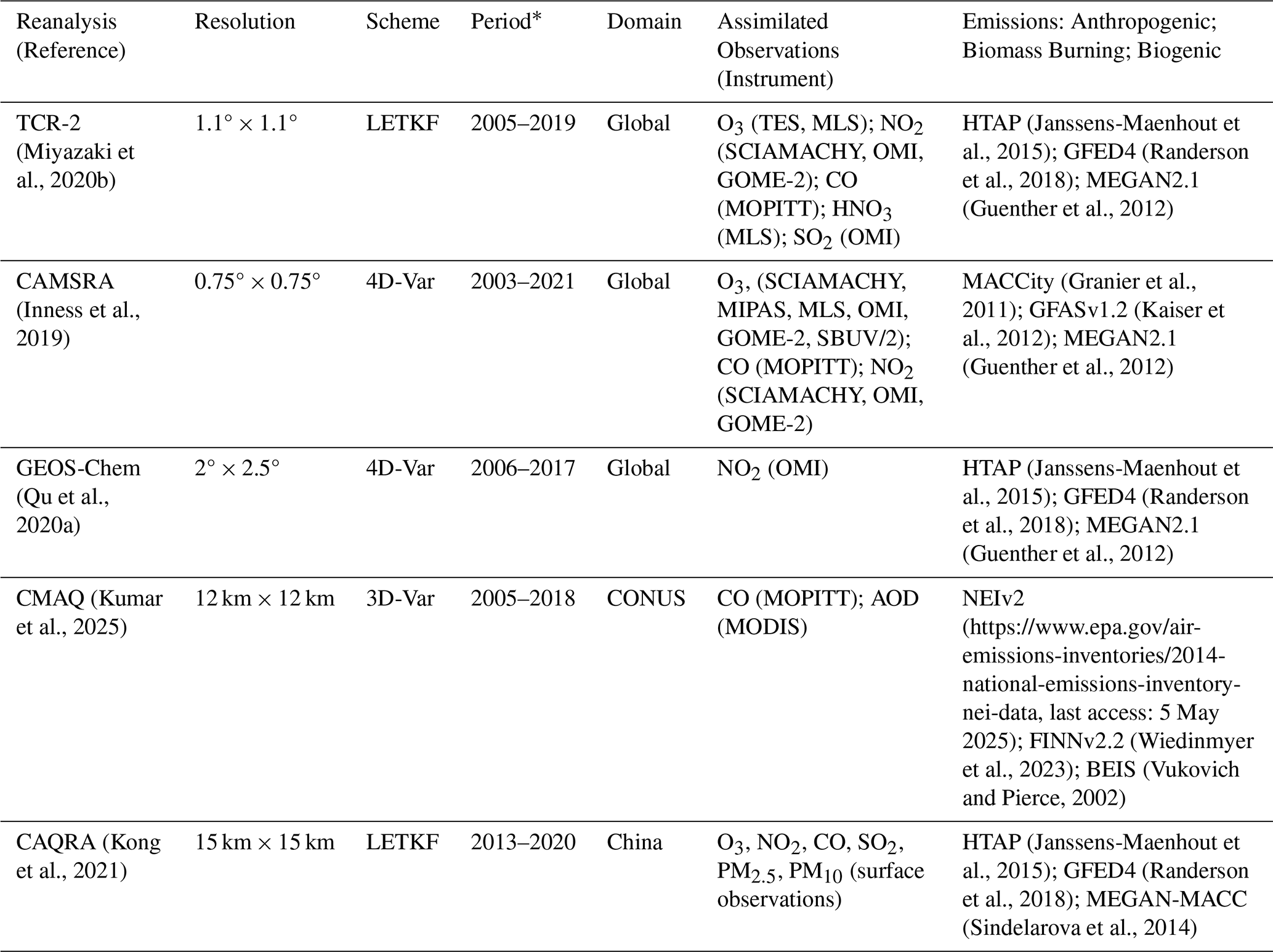
∗ This refers to the period for which reanalysis data was available. The work presented here focused on the 2006–2016 period, unless otherwise noted, to maximize overlap between the reanalyses.
2.1 TCR-2
The TCR-2 product employs the MIROC-Chem global chemistry transport model. The model has a T106 (1.1° × 1.1°) horizontal resolution with 32 vertical levels extending from the surface to 4 hPa. The TCR-2 meteorological fields are produced using the MIROC-AGCM (Watanabe et al., 2011) general circulation model with the model simulation nudged toward 6-hourly ERA-Interim reanalysis fields (Dee et al., 2011). The chemical mechanism in the model consists of 92 chemical species and 292 reactions. A priori anthropogenic emissions in the model are from the HTAP version 2 inventory (Janssens-Maenhout et al., 2015). NOx emissions from soils are based on the Global Emissions Inventory Activity (GEIA) (Graedel et al., 1993). Biomass burning emissions are from the Global Fire Emissions Database version 4 (GFED4) (Randerson et al., 2018) and biogenic emissions are from version 2.1 of the Model of Emissions of Gases and Aerosols from Nature (MEGAN2.1; Guenther et al., 2006, 2012).
TCR-2 used a Local Ensemble Transform Kalman Filter (LETKF) (Hunt et al., 2007) to assimilate NO2 observations from the SCanning Imaging Absorption spectroMeter for Atmospheric CartograpHY (SCIAMACHY), the Ozone Monitoring Instrument (OMI), and GOME-2; ozone observations from the Tropospheric Emission Spectrometer (TES) and the Microwave Limb Sounder (MLS); CO data from MOPITT; HNO3 observations from MLS; and SO2 data from OMI. The assimilated observations were used to optimize the atmospheric mixing ratio of ozone, NOx, HNO3, pernitric acid (HNO4), dinitrogen pentoxide (N2O5), peroxyacetyl nitrate (PAN), and peroxymethacryloyl nitrate (MPAN). Emissions of NOx (from the surface and lightning), SO2, and CO were also optimized in the assimilation. Although the model has 92 chemical species, the state vector in the assimilation consisted of a smaller subset of 35 species as well as the NOx, CO, and SO2 emissions. The emissions were optimized using a state augmentation approach that used the background error covariance, determined from the forecast ensemble, to link the emissions and the atmospheric concentrations in the optimization.
2.2 CAMSRA
The Copernicus Atmosphere Monitoring Service reanalysis (CAMSRA) product (Inness et al., 2019) is produced using the Integrated Forecast System (IFS) of the European Centre for Medium-Range Weather Forecasts (ECMWF). The product has a horizontal resolution of T255 (≈ 0.75°), with 60 vertical levels from the surface to 0.1 hPa. The chemical mechanism in IFS is an extended version of the CB05 (Yarwood et al., 2005) chemical mechanism for the troposphere, which consists of 55 chemical species and 126 reactions. Explicit chemistry is not included in the stratosphere. Instead, stratospheric ozone chemistry is parameterized using the “Cariolle-scheme” (Cariolle and Déqué, 1986; Cariolle and Teyssèdre, 2007). Anthropogenic emissions in CAMSRA are from the MACCity inventory (Granier et al., 2011), with modifications to increase wintertime road traffic emissions over North America and Europe following the correction of Stein et al. (2014). Biogenic emissions are from MEGAN2.1 (Guenther et al., 2006, 2012) driven by meteorological fields from the Modern-Era Retrospective analysis for Research and Applications, Version 2 (MERRA-2; Gelaro et al., 2017). Soil and oceanic emissions are from the Precursors of Ozone and their Effects in the Troposphere (POET) database for 2000 (Olivier et al., 2003; Granier et al., 2005). Biomass burning emissions are from the Global Fire Assimilation System, version 1.2 (GFASv1.2; Kaiser et al., 2012).
The CAMSRA assimilation scheme is an incremental four-dimensional variational (4D-Var) data assimilation scheme (Courtier et al., 1994) with 12 h assimilation windows from 09:00–21:00 and 21:00–09:00 UTC. Background error covariances are diagonal so that chemical species in the control vector are optimized independently. CAMSRA optimizes ozone, CO, NO2, and aerosol mass mixing ratios using observations of ozone from SCIAMACHY, the Michelson Interferometer for Passive Atmospheric Sounding (MIPAS), MLS, OMI, GOME-2, and the Solar Backscatter Ultraviolet Radiometer (SBUV/2), together with CO observations from MOPITT and NO2 observations from SCIAMACHY, OMI, and GOME-2. Ozone precursor emissions are not optimized in the assimilation.
2.3 GEOS-Chem
The GEOS-Chem reanalysis (Qu et al., 2020a) was produced using version v35k of the GEOS-Chem adjoint model (Henze et al., 2007). The model is driven by MERRA-2 (Gelaro et al., 2017) meteorological fields at a horizontal resolution of 2° × 2.5° with 47 levels from the surface to 0.01 hPa. The model has detailed tropospheric ozone chemistry, with 43 transported species and 297 chemical reactions. Stratospheric ozone is parameterized based on the linearized ozone scheme of McLinden et al. (2000). A priori anthropogenic emissions in the model are from the HTAP version 2 inventory (Janssens-Maenhout et al., 2015). Biomass burning emissions are from GFED4 (Randerson et al., 2018), NOx emissions from soils are based on Yienger and Levy (1995), and biogenic emissions are from MEGAN2.1 (Guenther et al., 2006, 2012)
GEOS-Chem uses a 4D-Var data assimilation scheme to assimilate NO2 slant column densities (SCD) from OMI to optimize NOx emissions. The GEOS-Chem reanalysis presented here assimilated OMI NO2 retrievals from version 3 of the NASA standard product OMNO2 (Krotkov et al., 2017). The GEOS-Chem reanalysis assimilated only NO2 as the focus of Qu et al. (2020a) was on the impact of discrepancies in OMI NO2 retrievals on inferred NOx emissions and posterior ozone simulations. The assimilation minimizes a cost function that is the sum of observation-error-weighted differences between the modeled and retrieved SCDs and departures of the emission scaling factors from the prior estimates weighted by the prior emissions error. In constructing the cost function, the modeled NO2 vertical column densities (VCDs) are converted to SCDs using scattering weights from the OMI retrievals. Additional details of the GEOS-Chem assimilation are discussed in Qu et al. (2020a).
2.4 CMAQ
The CMAQ regional reanalysis (Kumar et al., 2025) uses version 5.3.2 of the CMAQ model driven by meteorological fields from version 4.1 of the Weather Research and Forecasting (WRF) model (Skamarock and Klemp, 2008). The reanalysis was conducted at a horizonal resolution of 12 km × 12 km over the CONUS with 35 vertical levels from the surface to 50 hPa. The meteorological initial and boundary conditions for WRF are from the ERA-Interim reanalysis, while chemical initial and boundary conditions for CMAQ are from the Whole Atmosphere Community Climate Model (Marsh et al., 2013; Gettelman et al., 2019). The chemical mechanism in the model is based on the Carbon Bond 6 version r3 scheme for gas-phase chemistry with the AERO7 aerosol module for aerosol processes, including secondary organic aerosols (Appel et al., 2021). The chemical mechanism has 147 species and 343 reactions. A priori anthropogenic emissions in CMAQ are based on the US EPA National Emissions Inventory (NEIv2) for 2011 (https://www.epa.gov/air-emissions-inventories/2014-national-emissions-inventory-nei-data, last access: 5 May 2025). WRF meteorology was used with the Sparse Matrix Operator Kernel Emissions (SMOKE) (de Almeida Albuquerque et al., 2018) to produce meteorology-dependent anthropogenic emissions for 2011, 2014, and 2017, which were adjusted in time using EPA reported annual state-wise trends. Biomass burning emissions are from the Fire Inventory from NCAR (FINN) version 2.2 (Wiedinmyer et al., 2023). Biogenic emissions are specified using the Biogenic Emission Inventory System (BEIS) (Vukovich and Pierce, 2002).
CMAQ assimilated standard Level 2 Collection 6.1 AOD from the Moderate Resolution Imaging Spectroradiometer (MODIS) and Version 8 of the MOPITT CO multispectral retrievals using a three-dimensional variational (3D-Var) data assimilation scheme. The CO chemical data assimilation capability in Kumar et al. (2025) was a recent addition to the previously existing MODIS AOD data assimilation capability. The assimilation optimized total aerosol mass per mode (Aiken, accumulation, and coarse) and CO mixing ratios. Background error covariance matrices generated for January and July are used seasonally to represent wintertime and summertime background error covariances, respectively. The wintertime background error covariance matrix is used for assimilating observations between November to March, while the summertime background error covariance matrix is used during the other months.
2.5 CAQRA
The CAQRA product (Kong et al., 2021) is a regional reanalysis for Asia that employs the Nested Air Quality Prediction Modeling System (NAQPMS) chemical transport model (Wang et al., 2000). The model is driven by meteorological fields from WRF at a horizontal resolution of 15 km × 15 km. The meteorological initial and boundary conditions for WRF are from the NCAR-NCEP reanalysis, while chemical boundary conditions are from the Model for Ozone and Related Chemical Tracers (MOZART; Brasseur et al., 1998; Hauglustaine et al., 1998) model. The chemical mechanism in CAQRA is the carbon bond mechanism Z (Zaveri and Peters, 1999), with aqueous-phase chemistry and wet deposition based on the Regional Acid Deposition Model (RADM) mechanism from version 4.6 of CMAQ and inorganic aerosol processes represented by ISORROPIA1.7 (Nenes et al., 1998). Anthropogenic emissions in the model are from the HTAP version 2.2 inventory with a 2010 base year (Janssens-Maenhout et al., 2015). Emissions of VOCs are from the MEGAN-MACC model (Sindelarova et al., 2014). Biomass burning emissions are from GFED4 (Randerson et al., 2018), soil NOx emissions are from the Regional Emission Inventory in Asia (Yan et al., 2003), and oceanic emissions are from the POET database (Granier et al., 2005).
CAQRA uses an LETFK data assimilation scheme to assimilate surface observations of ozone, CO, NO2, SO2, PM2.5, and PM10 to optimize the atmospheric concentration of these constituents. In constructing the background error covariance, inter-species correlation is neglected. Thus, in the assimilation, each chemical species is optimized using only observations of that species. Additional details of the CAQRA assimilation configuration are available in Kong et al. (2021).
2.6 Ozonesondes
To evaluate the reanalyses, we use ozonesonde observations from the TOAR-II Harmonization and Evaluation of Ground-based Instruments for Free Tropospheric Ozone Measurements (HEGIFTOM) effort (https://hegiftom.meteo.be/datasets/ozonesondes, last access: 5 May 2025). The measurement precision for the ozonesondes is better than 3 %–5 % with an accuracy of about 5 %–10 % (Smit et al., 2007). The HEGIFTOM ozonesonde data were harmonized to remove systematic biases and to provide an uncertainty estimate for every measurement. The database contains time series observations from 43 sites. Here we use data from 39 sites that each had a minimum of 48 measurements between January 2003 and December 2022.
2.7 Surface ozone observations
Surface ozone observations from the TOAR-I data set (Schultz et al., 2017) were used for evaluation of the reanalyses. The dataset consists of a consistent long-term record (1990–2014) of surface ozone observations that have been harmonized and processed with consistent quality control. We used the 2° × 2° gridded monthly mean observations for the period 2003–2014 for comparison with the reanalysis. All of the reanalyses were regridded onto the ozone 2° × 2° grid for the evaluation. The ozone data are available for both rural and urban sites. However, since the lowest resolution of the available reanalyses is 2° × 2.5°, which cannot reliably distinguish between urban and rural locations, we follow the approach of Huijnen et al. (2020) and Sekiya et al. (2025) and use only rural TOAR-I observations in the evaluation of the reanalyses.
3.1 Climatological ozone distribution
The mean ozone distribution at the surface from the five reanalyses for 2006–2016 and the differences between the individual reanalyses and the ensemble mean are shown in Fig. 1. The global mean distribution (Fig. 1a) consists of a band of high ozone across the northern subtropics and a minimum in the tropics. In North America, there are high values over the southeastern US and the mountain west. In Asia, high ozone values are located over the Tibetan plateau. Figure 1b shows that GEOS-Chem is high everywhere compared to the ensemble mean, with differences exceeding 10 nmol mol−1 in Asia and western North America. Figure S1 shows that the largest relative differences in GEOS-Chem are between 20 %–40 %. In contrast, CAMSRA is low over all continental regions, with the largest difference of about 10–15 nmol mol−1 over central Africa and parts of Asia. The largest relative differences in CAMSRA are in central Africa and western South America, where the reanalysis is more than 40 % lower than the ensemble mean (Fig. S1 in the Supplement). TCR-2 is slightly lower than the ensemble mean at the high latitudes and about 5–10 nmol mol−1 higher over tropical South America and central Africa. The high ozone over tropical South America and central Africa in TCR-2 correspond to differences exceeding 40 % relative to the ensemble mean in these regions. For the regional reanalyses, CAQRA is about 5 to 15 nmol mol−1 lower (less than 40 %) across much of Asia, with small positive differences over Thailand and Myanmar, whereas CMAQ had small differences of less than 5 nmol mol−1 across much of the US, with positive differences in the Pacific Northwest and negative differences in the southeastern US. Examination of the seasonal differences between the individual reanalyses and the ensemble mean (Fig. S2) reveals that the pattern of differences shown in Fig. 1b is relatively consistent seasonally in all reanalyses, with the exception of CMAQ, although the magnitude of the differences is generally larger in the winter hemisphere. CMAQ has positive differences across much of the US in December–February (DJF), and negative differences in June–August (JJA). However, the high ozone in GEOS-Chem relative to the ensemble mean could be because the GEOS-Chem reanalysis did not assimilate ozone observations. Sekiya et al. (2025) found that ozone in the lower troposphere was high in the GEOS-Chem control (the model without assimilation) relative to the TCR-2 and CAMSRA controls, and that data assimilation increased ozone in CAMSRA and TCR-2, but had a minimal impact on ozone in GEOS-Chem.
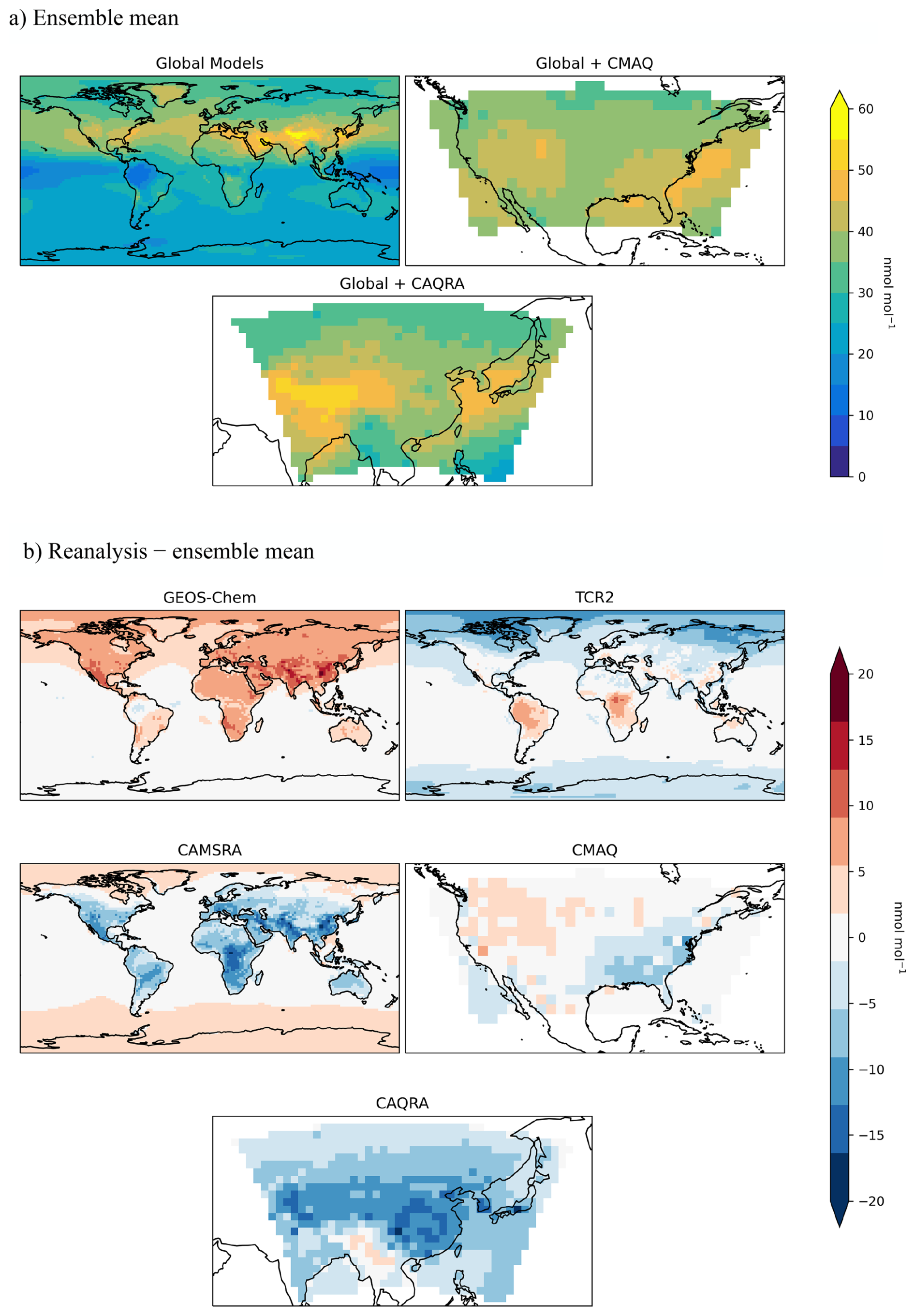
Figure 1(a) Ensemble mean ozone (nmol mol−1) at the surface for the global reanalyses (CAMSRA, GEOS-Chem, and TCR-2) for 2006–2016 (top), the global reanalyses and CMAQ over the United States (top right), and the global reanalyses and CAQRA over Asia (bottom). (b) Mean differences (nmol mol−1) between surface ozone in the individual reanalyses and the ensemble mean. The ensemble mean and the differences from the mean for the CAQRA evaluation were calculated for 2013–2016 since CAQRA data are only available starting in 2013.
In the middle troposphere, the mean ozone distribution, shown in Fig. 2a, is similar to that at the surface, with a band of high ozone across the northern subtropics and mid-latitudes, but with fewer small-scale features than at the surface. Note that only the global reanalyses are evaluated in the free troposphere since only surface fields are available from the regional reanalyses. Examination of the differences between the individual global reanalyses and the ensemble mean (in Fig. 3a) shows that the reanalyses are all closer to the mean in the middle troposphere. The relative differences are shown in Fig. S3. The major differences with respect to the ensemble mean are mainly in the tropics and subtropics, with TCR-2 and GEOS-Chem exhibiting an opposite pattern of differences. The differences in the individual reanalyses are generally less than 5 nmol mol−1, except for localized regions in the tropics where the differences are larger. TCR-2 has a large difference with respect to the ensemble mean over the tropical Atlantic, northern South America, and the Indian Ocean, where the relative differences are 10 %–20 %, with the largest relative difference exceeding 20 % over northern South America (Fig. S3). The GEOS-Chem relative differences are 10 %–20 % and are opposite in sign to those of TCR-2 over the tropical Atlantic, northern South America, and the Indian Ocean. CAMSRA has small positive differences over the Pacific and small negative differences over Africa and the southern tropical Atlantic and Indian Oceans (Fig. 3a). The pattern of the differences in the reanalyses is consistent seasonally (see Fig. S4) but with a seasonally-dependent latitudinal shift. In GEOS-Chem and TCR-2 the difference pattern is shifted into the tropics of the summer hemisphere in a manner similar to the seasonal shift of the Intertropical Convergence Zone (ITCZ). The spatial distribution of the differences in GEOS-Chem and TCR-2 in the tropics and subtropic is similar to the spatial pattern of the multi-model spread in ozone in the middle troposphere reported by Miyazaki et al. (2020a) in their multi-model data assimilation analysis using four different CTMs, including GEOS-Chem and MIROC-Chem. Indeed, they found that the largest multi-model spread was over northern south America, where we see large differences in TCR-2 and GEOS-Chem. Miyazaki et al. (2020a) suggested that the large multi-model spread over northern South America could be due to the background errors not accurately capturing rapid error growth associated with deep convection and biomass burning. They also suggested that discrepancies in isoprene emissions and the isoprene oxidation chemistry could be another factor contributing to the large multi-model spread in the region.
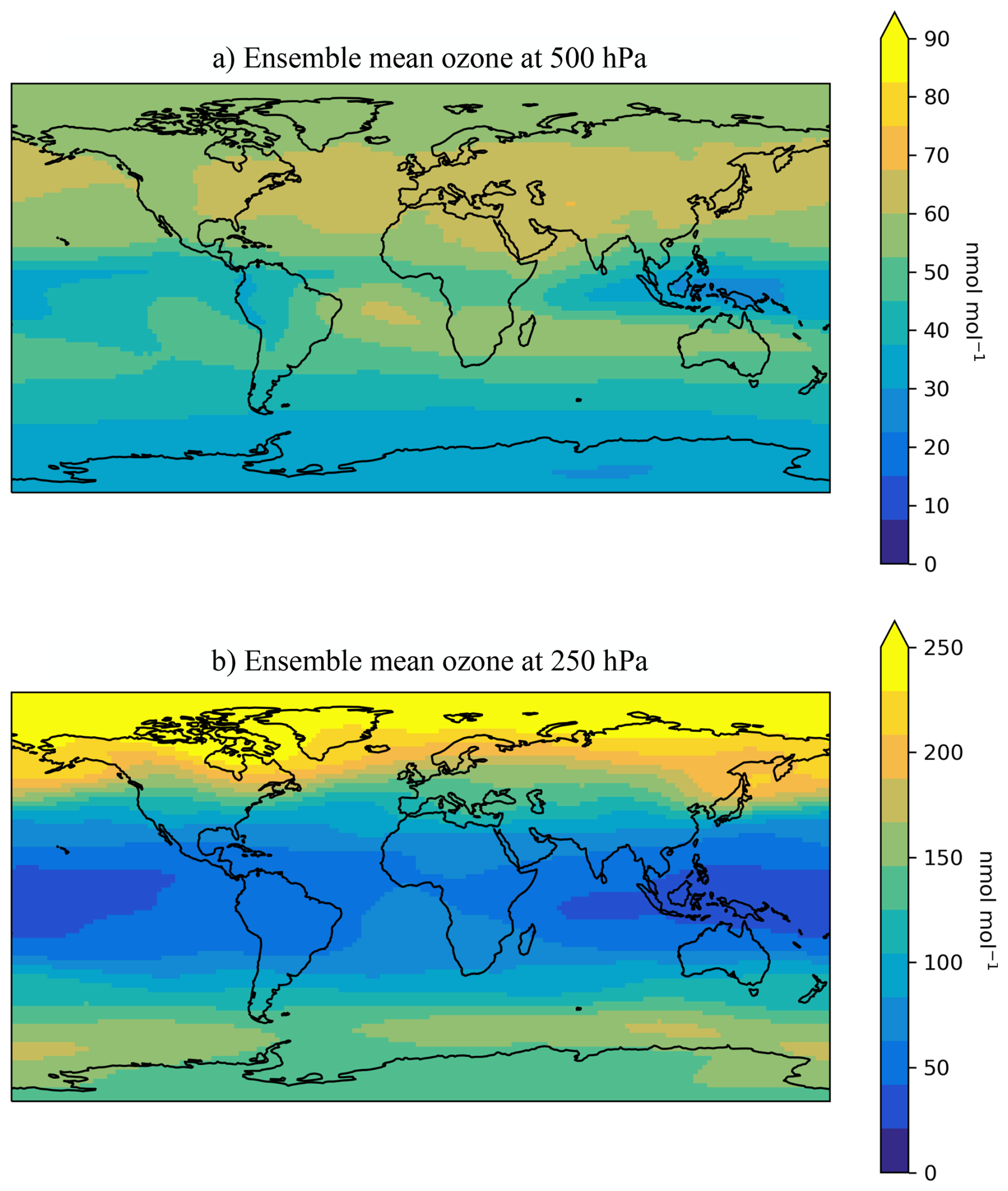
Figure 2Ensemble mean ozone (nmol mol−1) at 500 hPa (a) and 250 hPa (b) for the three global reanalyses for 2006–2016.
At 250 hPa the mean ozone distribution shown in Fig. 2b reveals the influence of the extratropical lower stratosphere with high ozone at the high-latitudes. In the tropics there is a minimum in ozone over the warm pool of the tropical western Pacific, which reflects the influence of convective transport (e.g., Pan et al., 2017). The mean differences between the individual reanalyses and the ensemble mean (Fig. 3b) are small, with the largest differences mainly in the southern midlatitudes. As a result of the minimum in ozone over the tropical western Pacific, the largest relative differences in TCR-2 and CAMSRA are found in this region (Fig. S5). In addition to large relative differences over the western Pacific, GEOS-Chem also has large relative ozone differences in the southern midlatitudes, where it is high relative to the ensemble mean. The spatial pattern of the differences in TCR-2 is opposite that in GEOS-Chem. The high ozone in GEOS-Chem relative to the ensemble mean is likely due to the fact that GEOS-Chem did not assimilate ozone observations. The high ozone in GEOS-Chem extends across the southern extratropics in DJF and MAM (see Fig. S6), whereas it is confined to the southern midlatitudes in JJA and SON. In TCR-2, the differences in the southern midlatitudes are largest in JJA and SON. CAMSRA has high ozone relative to the ensemble mean in the northern high-latitudes in JJA and low ozone in the southern high-latitudes in DJF.
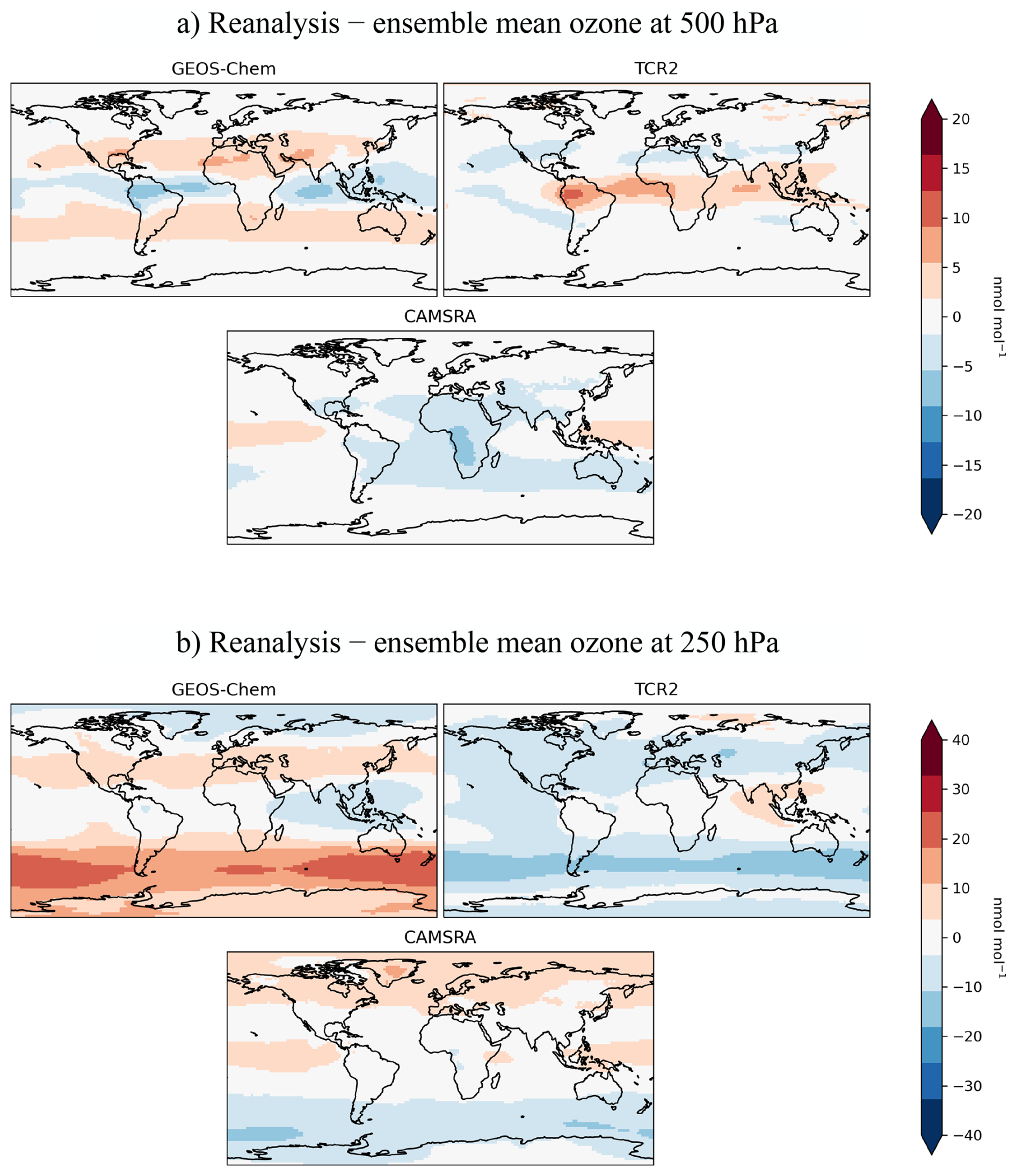
Figure 3Mean differences (nmol mol−1) between the individual reanalyses and the ensemble mean (shown in Fig. 2) at 500 hPa (a) and 250 hPa (b).
Daily maximum 8 h average (MDA8) ozone is a daily metric widely used for air quality standards and for ozone exposure studies (e.g., Turner et al., 2016; Fleming et al., 2018; Lyu et al., 2019; Chen et al., 2024). In particular, it is used for evaluating the mortality risks associated with short-term ozone exposure (Fleming et al., 2018). We include MDA8 in our evaluation since the ozone reanalyses could be useful for ozone exposure studies where local surface air quality observations are lacking. The ensemble mean MDA8 ozone distribution and the differences between the individual reanalyses and the ensemble mean are shown in Fig. 4. The spatial pattern of differences in MDA8 (Fig. 4b) is similar to that shown for ozone in Fig. 1b, except for the CMAQ reanalysis. In CMAQ, MDA8 ozone is high relative to the ensemble mean over the western and central US, in contrast to the pattern of differences in mean ozone shown in Fig. 1b. Overall, we find that the regional differences in MDA8 ozone between the individual reanalyses and the ensemble mean are generally smaller than the differences shown for surface ozone in Fig. 1b. The exception is the TCR-2 reanalysis which has larger MDA8 differences with respect to the ensemble mean over South America and central Africa.
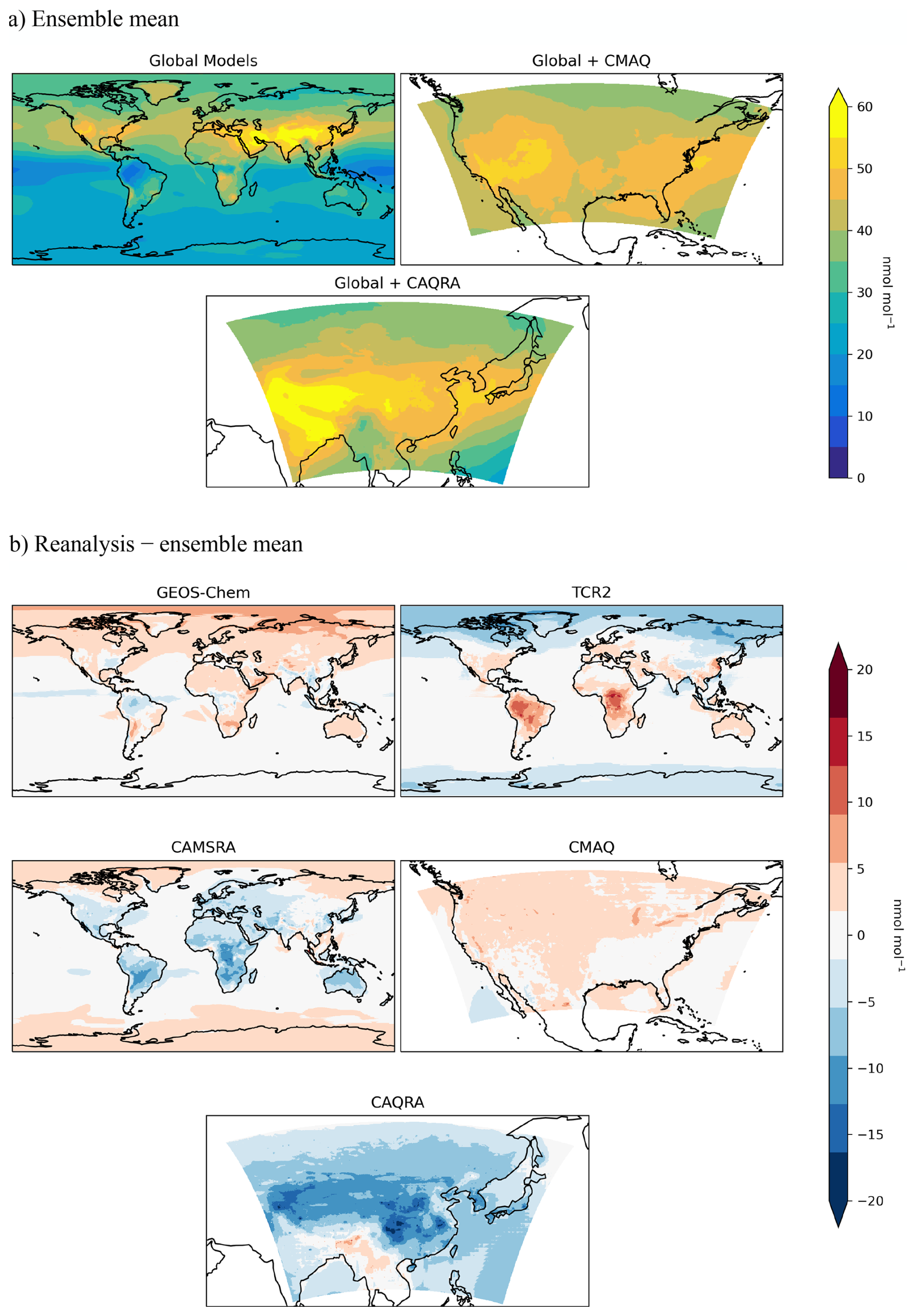
Figure 4(a) Ensemble mean MDA8 ozone (nmol mol−1) at the surface for the global reanalyses (CAMSRA, GEOS-Chem, and TCR-2) for 2006–2016 (top), the global reanalyses and CMAQ over the United States (top right), and the global reanalyses and CAQRA over Asia (bottom). (b) Mean differences (nmol mol−1) between MDA8 ozone in the individual reanalyses and the ensemble mean. The ensemble mean and the differences from the mean for the CAQRA evaluation were calculated for 2013–2016 since CAQRA data are only available starting in 2013.
3.2 Regional ozone variations
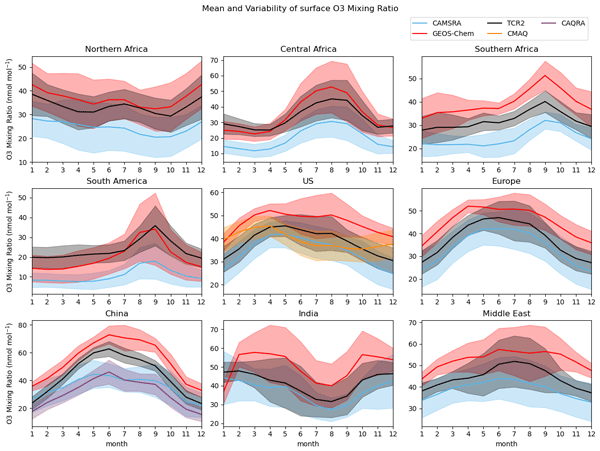
The seasonal variations in regional mean ozone are shown in Figs. 5–7 for the nine regions defined in Table 2 (and shown in Fig. S7). The regions are based on those in Miyazaki and Bowman (2017). At the surface (Fig. 5), the seasonal cycle is consistent across all the reanalyses. In all regions, CAMSRA has the lowest ozone mixing ratios. For example, in the US, ozone in CAMSRA is about 5 nmol mol−1 lower than in TCR-2. In contrast, GEOS-Chem ozone is 5–10 nmol mol−1 higher than in TCR-2. Indeed, GEOS-Chem has the highest ozone concentrations in all regions except for South America. In South America, TCR-2 has higher mean ozone than GEOS-Chem in all months except for August. In China, CAQRA is fairly consistent with CAMSRA.
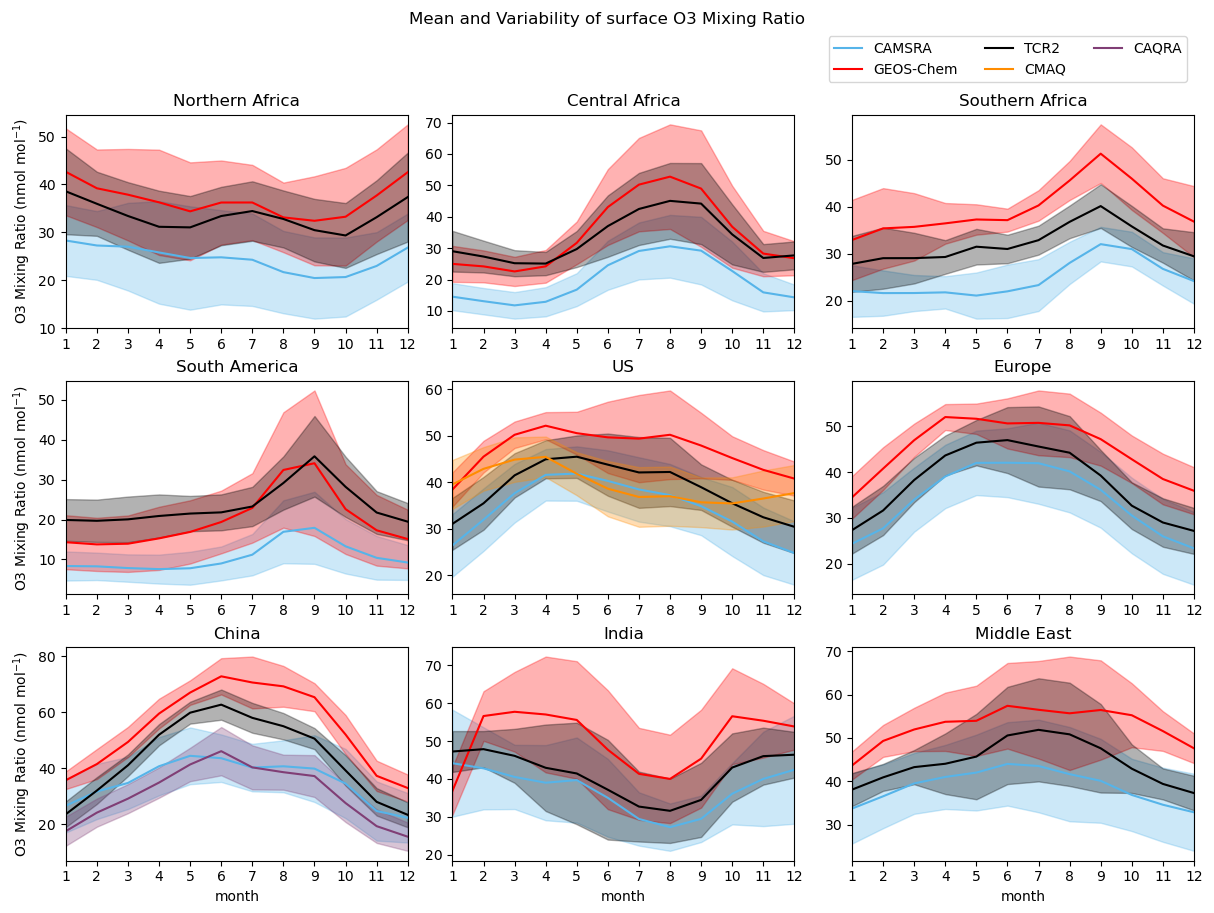
Figure 5Seasonal variations in regional mean ozone (nmol mol−1) at the surface for the regions defined in Table 2. Shown are the monthly mean fields for CAMSRA, GEOS-Chem, TCR-2, CMAQ, and CAQRA. The monthly fields were averaged for 2006–2016, except for CAQRA, which was averaged for 2013–2016. The regional and temporal standard deviation for each month is indicated by the shading.
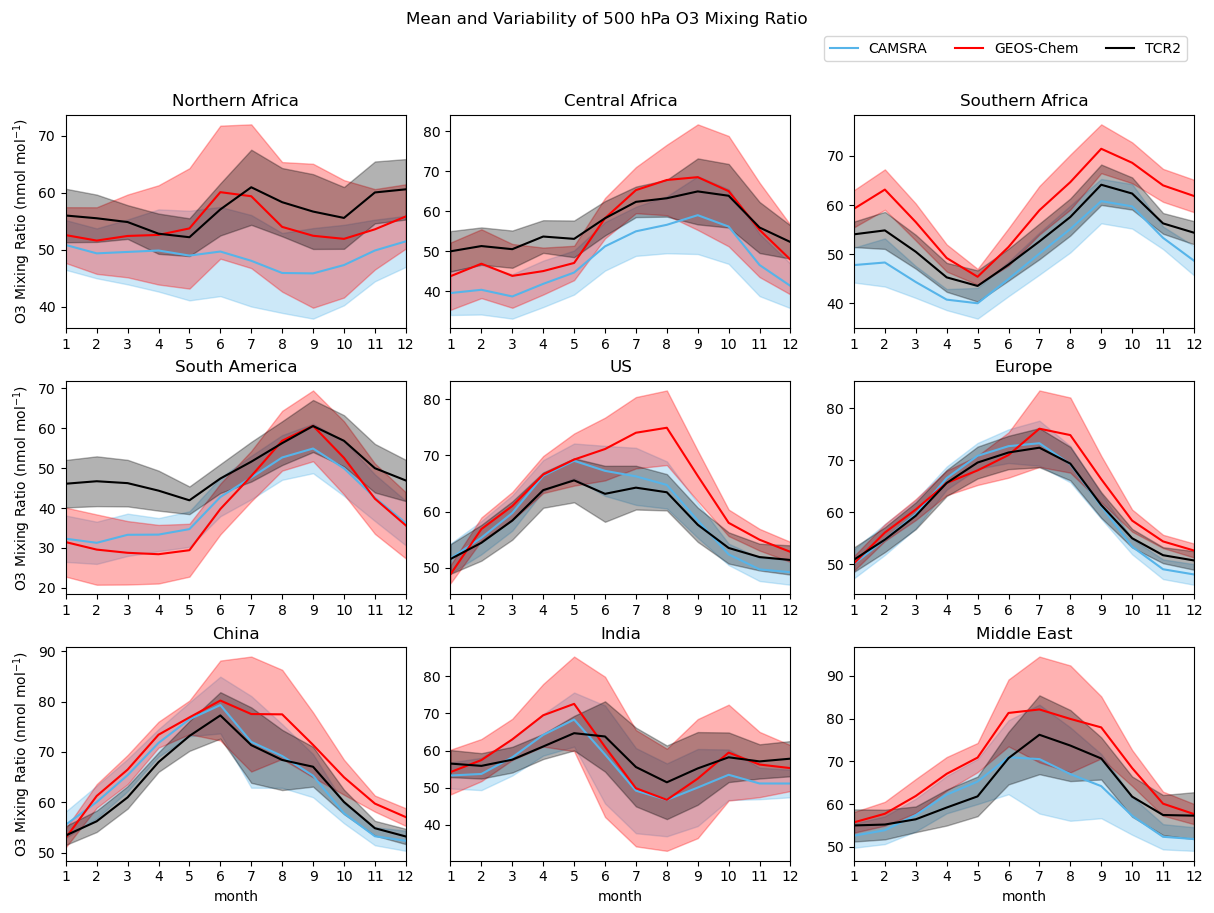
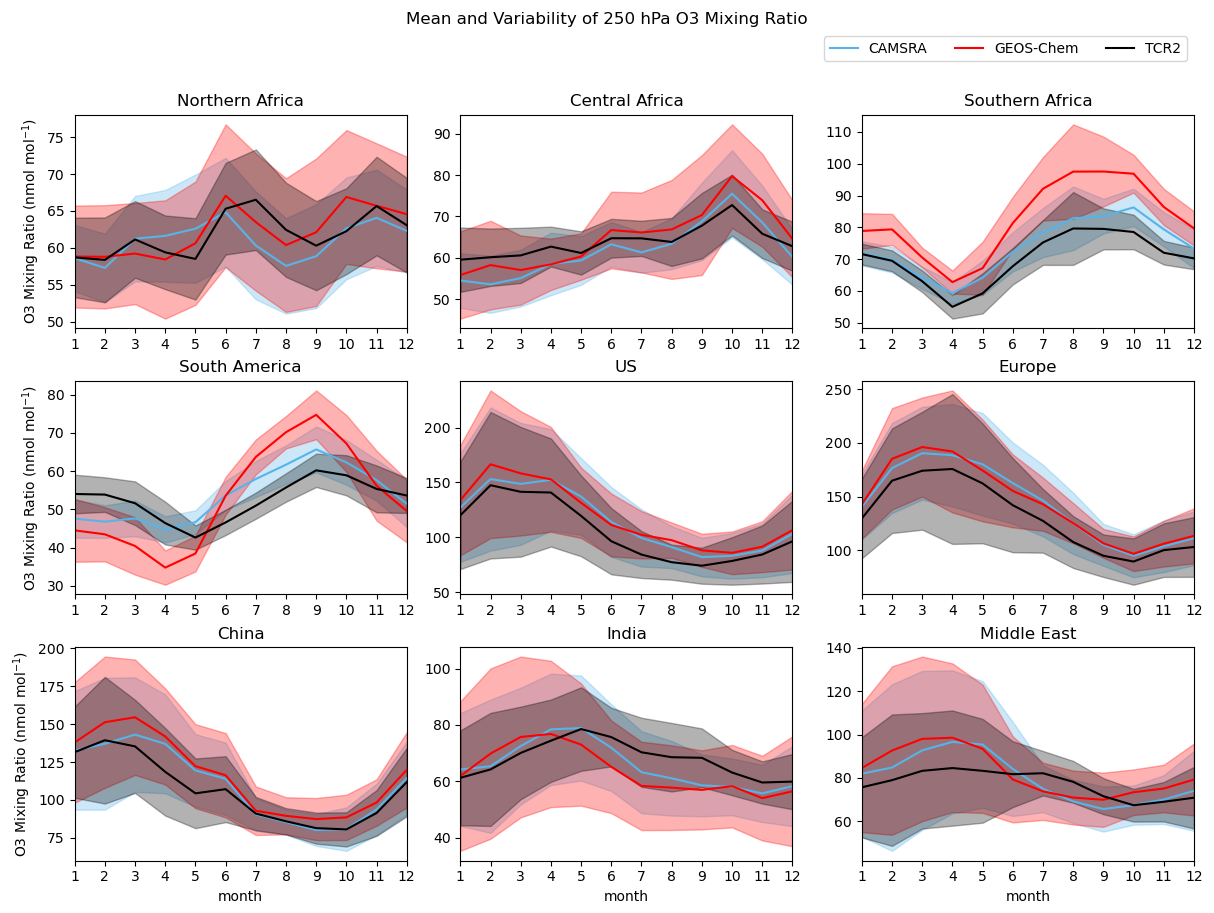
In the free troposphere, at 500 hPa (Fig. 6), the seasonality of the global reanalyses is generally consistent in the extratropics, which is in agreement with the results shown in Fig. 3a. In the tropics, there are larger discrepancies between the reanalyses over South America, North Africa, and the Middle East. Over South America, for example, TCR-2 has higher ozone concentrations between January–July and October–December, similar to the discrepancies observed at the surface (Fig. 5). Over the US, ozone concentrations peak about three months later in GEOS-Chem than in the other reanalyses. And over China, GEOS-Chem has a broader ozone maximum than CAMSRA and TCR-2. In the UTLS (Fig. 7), TCR-2 and CAMSRA are generally in agreement in terms of the ozone concentrations and variability in all regions, probably due to the assimilation of ozone measurements from MLS (Sekiya et al., 2025). Over South America and southern Africa, GEOS-Chem exhibits a larger seasonal cycle than CAMSRA and TCR-2. The discrepancy could be attributed to the lack of assimilation of ozone measurements in GEOS-Chem.
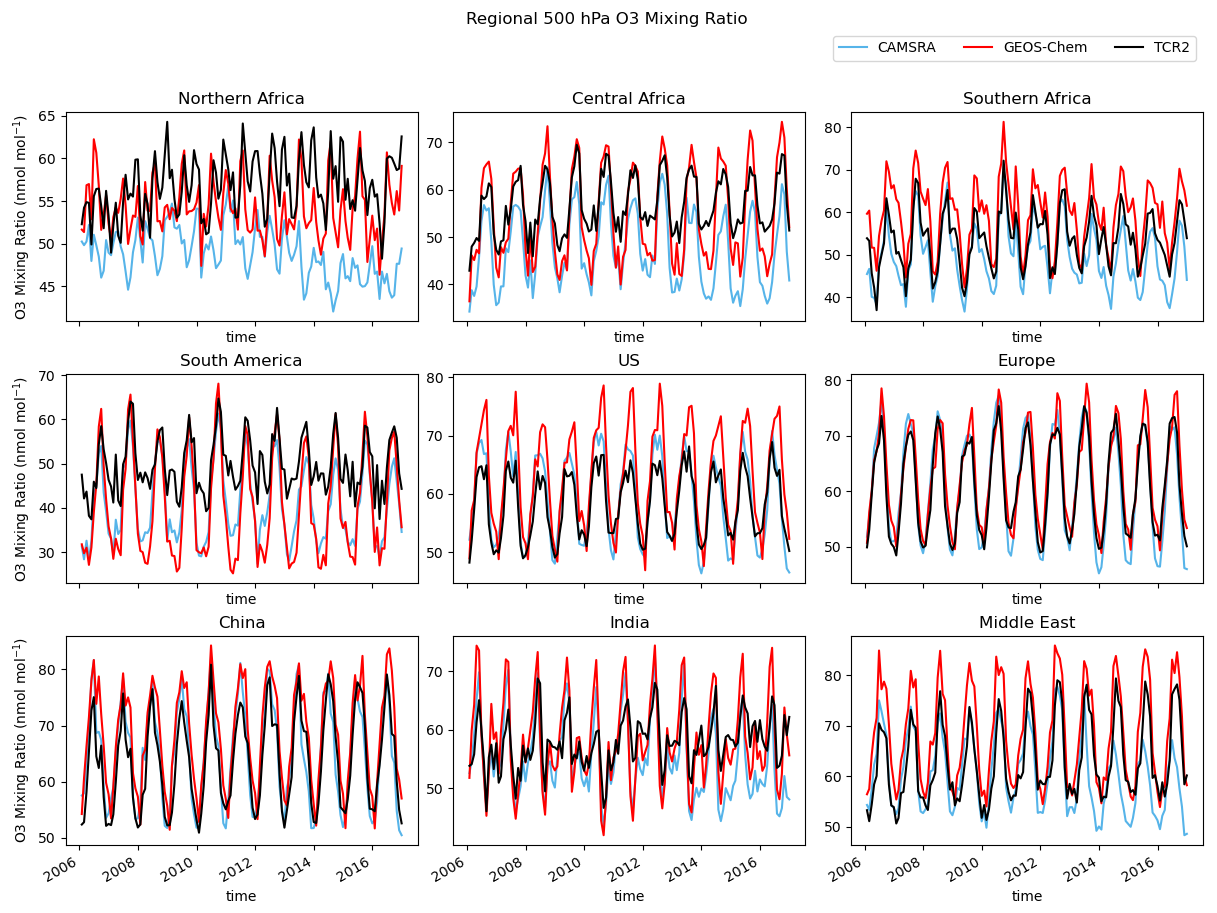
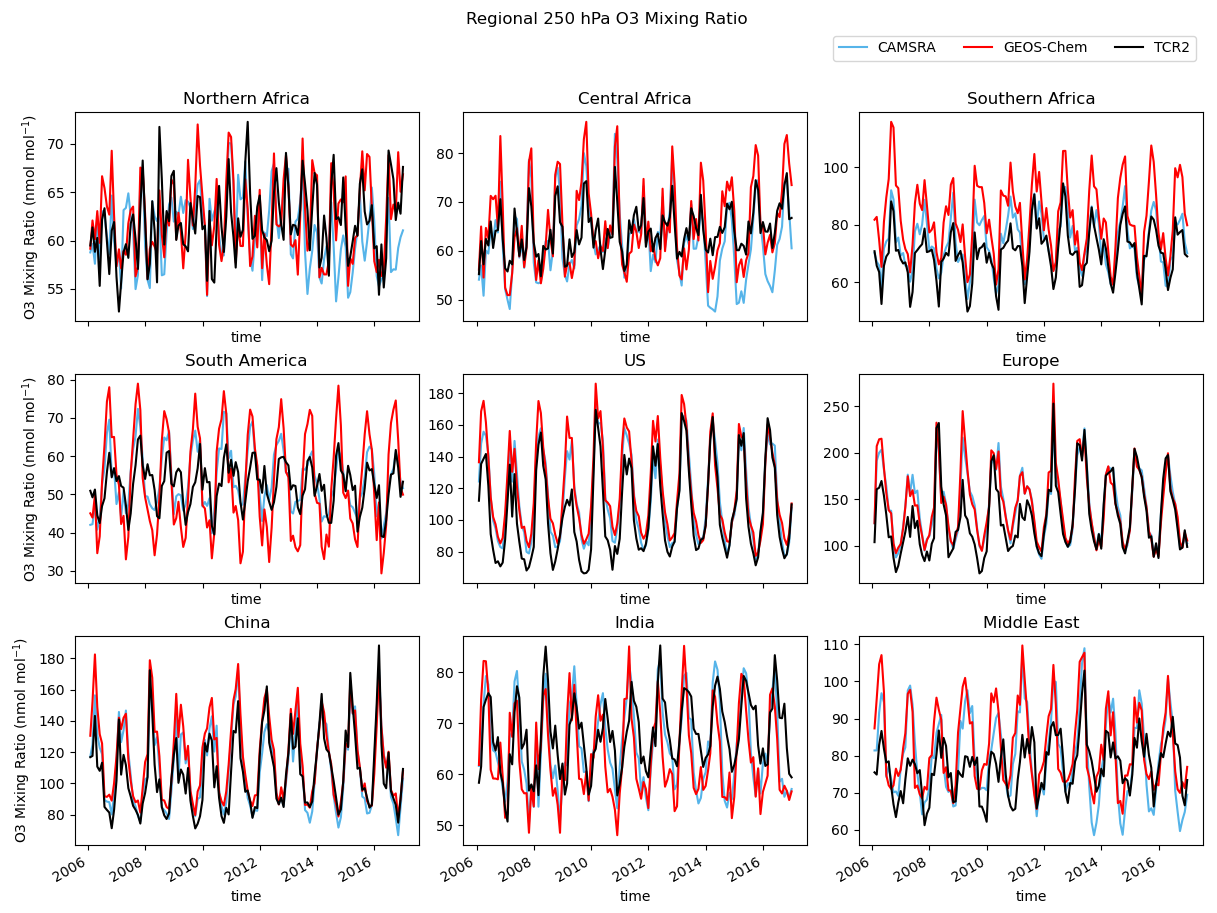
The time series of the regional mean ozone concentrations are shown in Figs. 8–10. As can be seen in Fig. 8, the lower ozone mixing ratios at the surface in CAMSRA are present in all years. The differences in the mean concentrations between CAMSRA and the other reanalyses is particularly pronounced in the three African regions. Across most regions, with the exception of South America, the three global reanalyses have similar interannual variability in surface ozone, with a high ozone in GEOS-Chem and a low ozone in CAMSRA. In South America, ozone in TCR-2 is generally higher than 20 nmol mol−1 throughout the year, while CAMSRA ozone is lower than 10 nmol mol−1 during the summer months. For the regional reanalyses, we find that in the US, surface ozone variability in CMAQ is similar to that in GEOS-Chem, whereas in China, CAQRA is similar to CAMSRA. In the northern extratropical middle troposphere, over the US, Europe, and China (Fig. 9), the variability in the three global reanalyses is remarkably similar. The worst agreement is found over Northern Africa, where the interannual variability is significantly different in each of the three global reanalyses. Over South America and central Africa the simulation of the ozone maxima in TCR-2 is consistent with the other reanalyses, but TCR-2 significantly overestimates the ozone minima. In the UTLS (Fig. 10), Northern Africa is the region with the greatest disagreement between the reanalyses in their simulation of the ozone variability. The South American, Northern African, and Central African regions are all strongly influenced by convective transport, which is highly variable and will pose a challenge for the reanalyses. These regions are also strongly influenced by biomass burning emissions and biogenic ozone precursor emissions, which are poorly constrained in models.
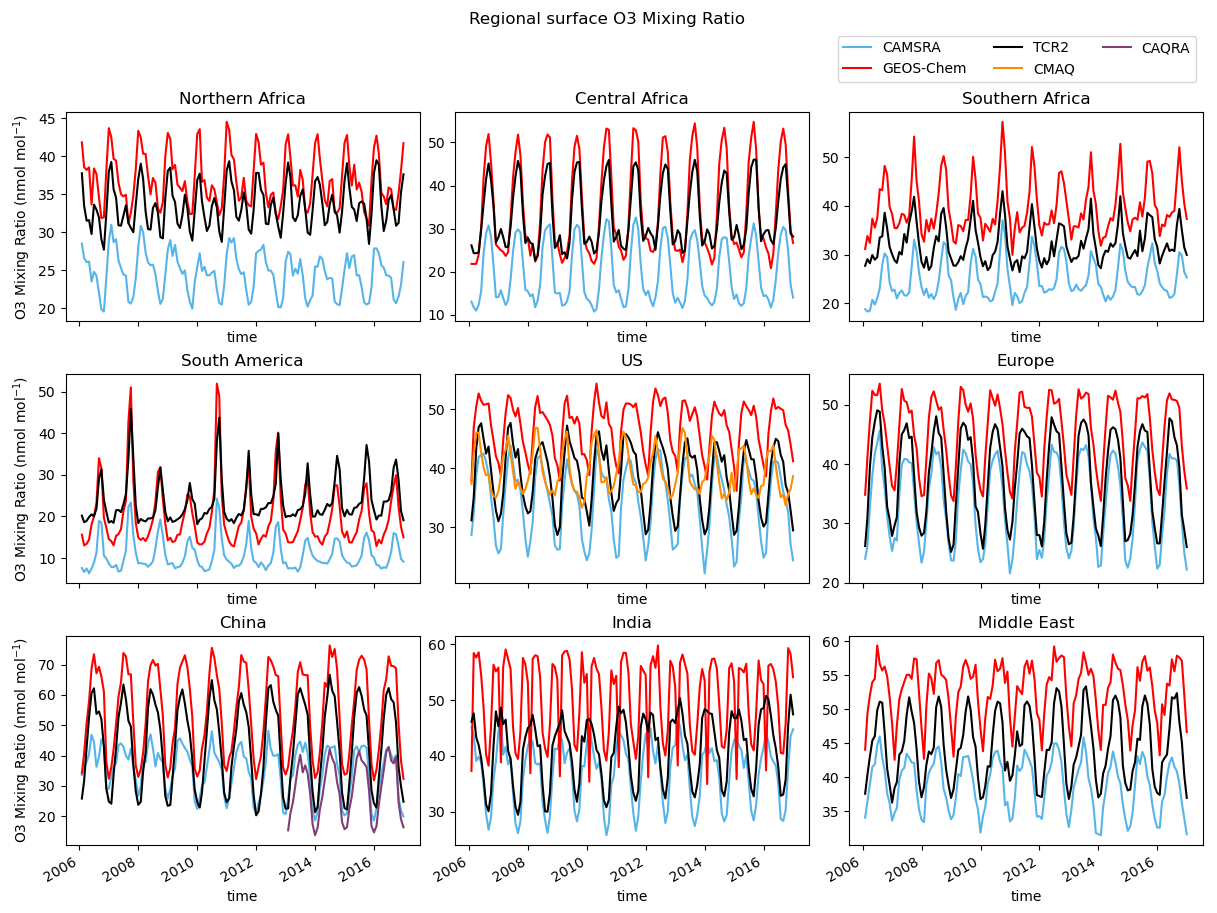
Figure 8Time series of regional mean ozone (nmol mol−1) at the surface for 2006–2016 for the regions defined in Table 2 (and shown in Fig. S7). Shown are the monthly mean fields for CAMSRA, GEOS-Chem, TCR-2, CMAQ, and CAQRA. The time series for the CAQRA product extends from 2013–2016.
The linear trend in surface ozone in the reanalyses is shown in Fig. 11. There are large regional differences between the reanalyses in the trends. For example, in Asia TCR-2 has positive trends (that are as much as 0.4 nmol mol−1 yr−1), whereas CAMSRA has large negative trends in East Asia (exceeding −0.4 nmol mol−1 yr−1) with small positive trends in South Asia. In North America, the pattern of the trends is similar in CAMSRA, GEOS-Chem, and CMAQ, with negative trends over the southeastern US and the mountain west, and positive trends over northern and eastern Canada, although the negative trends in GEOS-Chem are not statistically significant. In TCR-2 there are negative trends over much of North America. The main statistically significant trends in GEOS-Chem are in the southern mid-latitudes, where there are negative trends that are consistent with the negative trends that TCR-2 exhibits across the southern extratropics. However, in this region CAMSRA has positive trends.
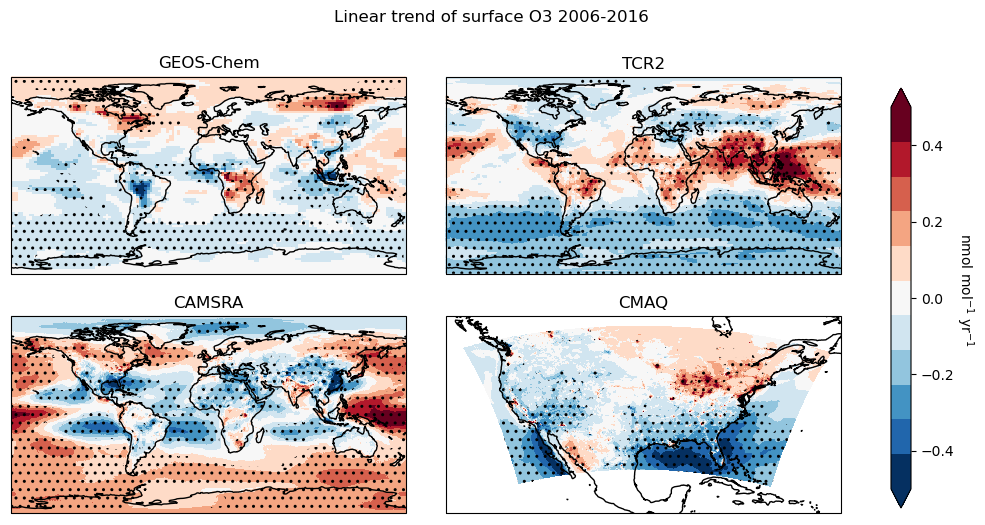
Figure 11Spatial distribution of the linear trends (nmol mol−1 yr−1) in surface ozone for 2006–2016 for the individual reanalysis. The trend was not calculated for CAQRA since the CAQRA fields are only available starting in 2013. The stippling indicates where the trend is statistically significant with p<0.05.
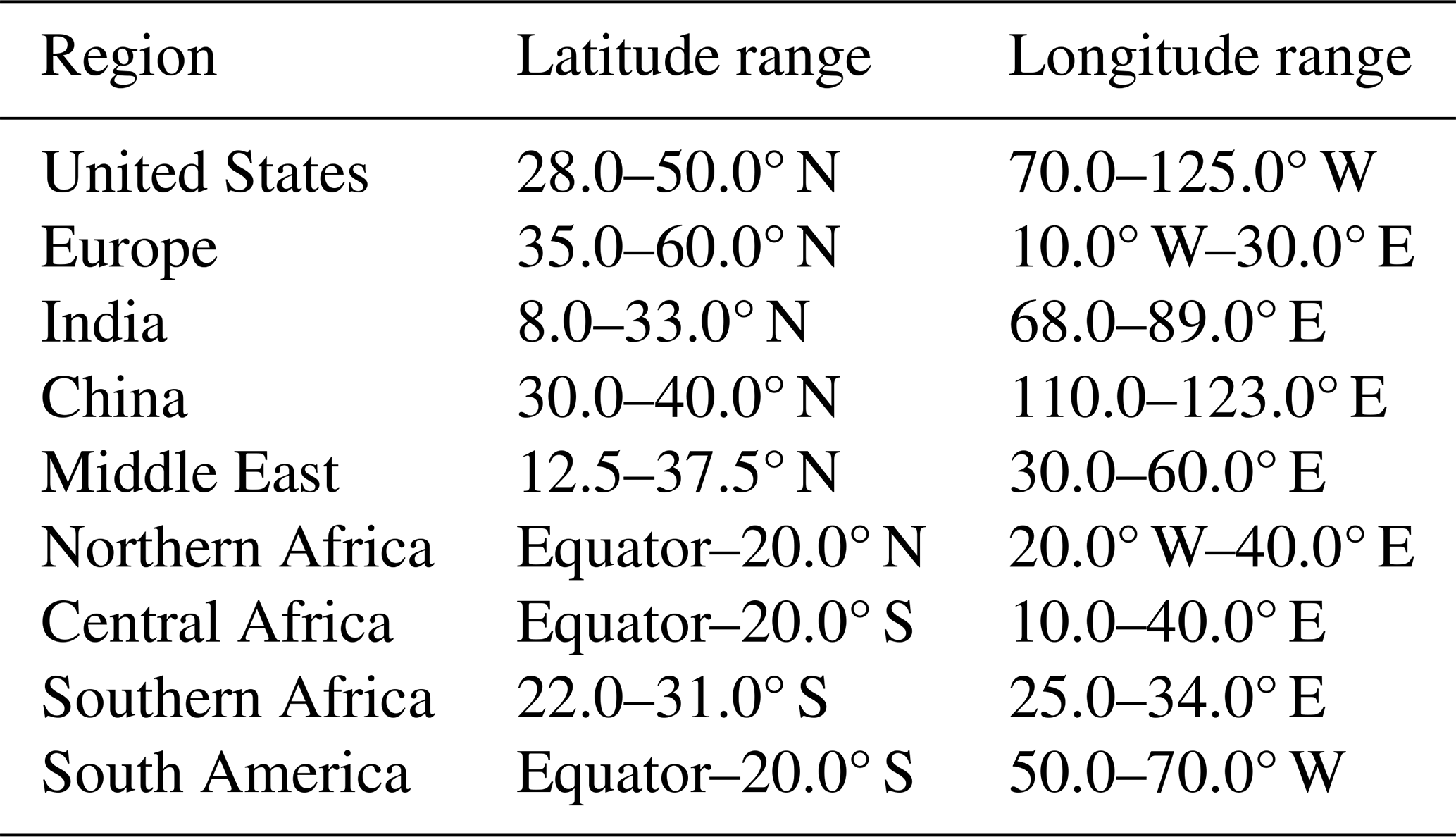
3.3 Evaluation with independent observations
The mean surface ozone observations from TOAR-I for 2006–2014 and the differences between the individual reanalyses and the TOAR observations are plotted in Fig. 12. The relative biases are shown in Fig. S8. The evaluation only extends to 2014 because observations in the TOAR-I database are not available after 2014. In addition, the CAQRA reanalysis was not included in this evaluation because of the short temporal overlap between CAQRA and the TOAR-I database and the limited number of TOAR-1 observations over Asia. As can be seen in Fig. 8b, GEOS-Chem, TCR-2, and CMAQ are biased high relative to the TOAR observations, with GEOS-Chem exhibiting the highest global bias of about 14 nmol mol−1 (47 %). The mean bias for CAMSRA and TCR-2 is 1.6 nmol mol−1 (7 %) and 5.5 nmol mol−1 (20 %), respectively. Over the US, CMAQ has a mean high bias of 6.4 nmol mol−1 (22 %). The CAMSRA global mean bias reflects the compensating influence of negative biases over the central and western US and over central and eastern Europe, and positive biases everywhere else. Examination of the seasonality of the bias (see Fig. S9) reveals that in GEOS-Chem the largest global mean bias with respect to the TOAR observations is 16.6 nmol mol−1 in JJA and the smallest mean bias is 10.5 nmol mol−1 in DJF. In TCR-2 and CAMSRA the largest mean bias is 9.8 nmol mol−1 and 5.3 nmol mol−1, respectively, in JJA and the smallest mean bias is 1.7 nmol mol−1 and −1.6 nmol mol−1, respectively, in DJF. In CMAQ the largest total mean bias is 10.4 nmol mol−1 in DJF, while the smallest total mean bias is 4.3 nmol mol−1 in JJA.
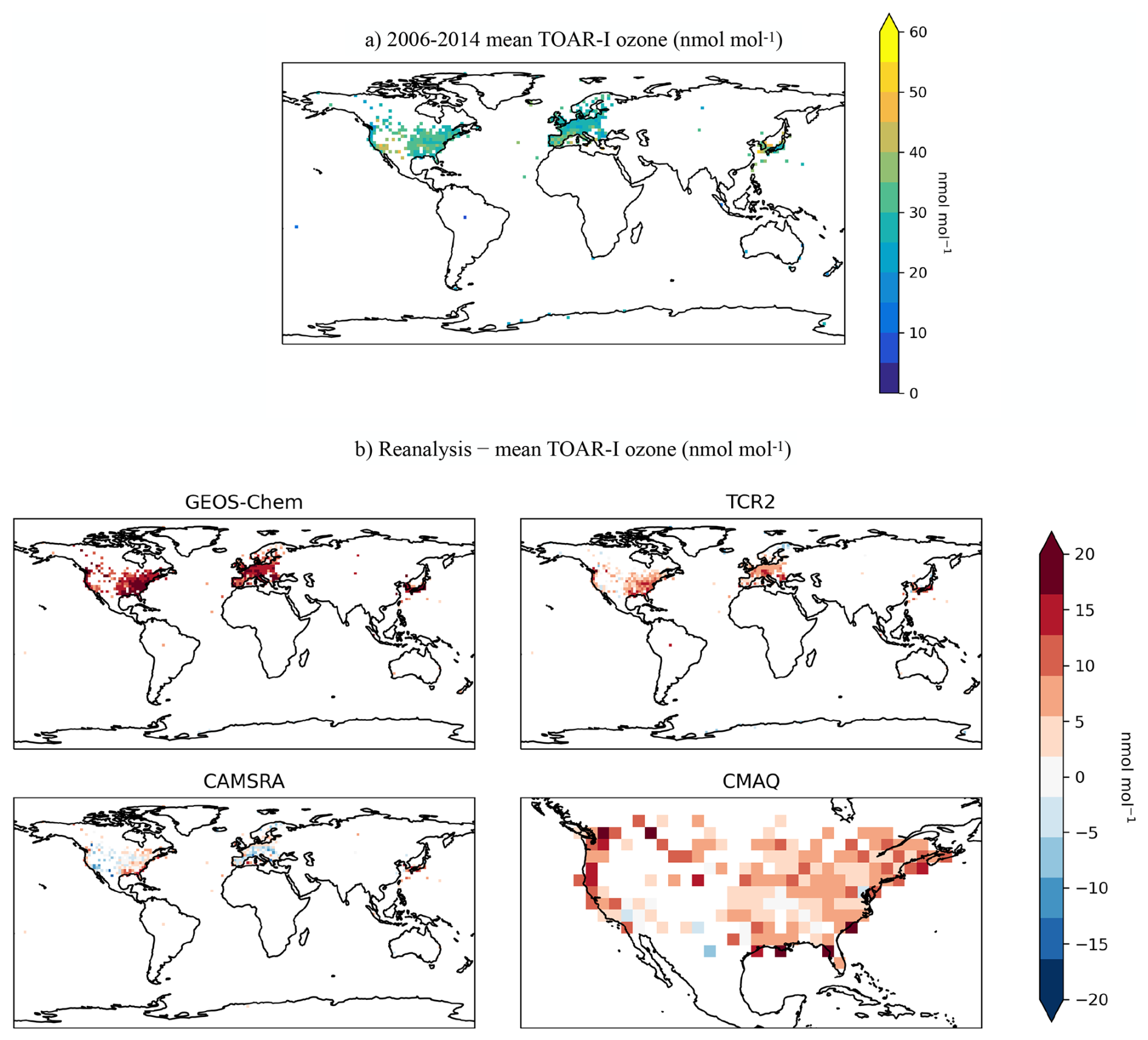
Figure 12(a) Mean surface ozone (nmol mol−1) for 2006–2014 from the TOAR-I database. (b) Mean bias (nmol mol−1) between surface ozone in the individual reanalyses and the TOAR-I observations. The CAQRA product was not included in the evaluation because of the short temporal overlap between CAQRA and the TOAR-I database and the limited number of TOAR-1 observations over Asia.
A comparison of the global reanalyses with ozonesonde data in the middle troposphere and UTLS is shown in Fig. 13. The ozonesonde data were binned into the following three latitude bins: 20–60° S, 20° S–20° N, and 20–60° N. There were three ozonesonde sites used in the 20–60° S latitude bin, 11 in the 20° S–20° N bin, and 17 in the 20–60° N bin. At 500 hPa the reanalyses capture the variability in the ozonesonde data well, with correlations of about 0.8 and 0.9 in the southern and northern midlatitudes, respectively. The correlation is lower in the tropics, with values between 0.5–0.7. The higher correlation in the midlatitudes is expected since ozone transport in this region is dominated by large-scale synoptic processes that are well constrained by meteorological reanalyses. In contrast, transport in the tropics is dominated by convective processes, which are less well constrained by models and meteorological reanalyses. The mean bias across all three regions in the middle troposphere is less than 4 nmol mol−1 (10 %). In the northern midlatitudes, the largest bias, which is in the GEOS-Chem reanalysis, is only about 2 nmol mol−1 (4 %). The standard deviation is also low, less than 4 nmol mol−1, in the tropics and northern midlatitudes. The standard deviation increases to about 6 nmol mol−1 in the southern midlatitudes. However, it should be noted that there are only three ozonesonde sites in the southern midlatitude region.
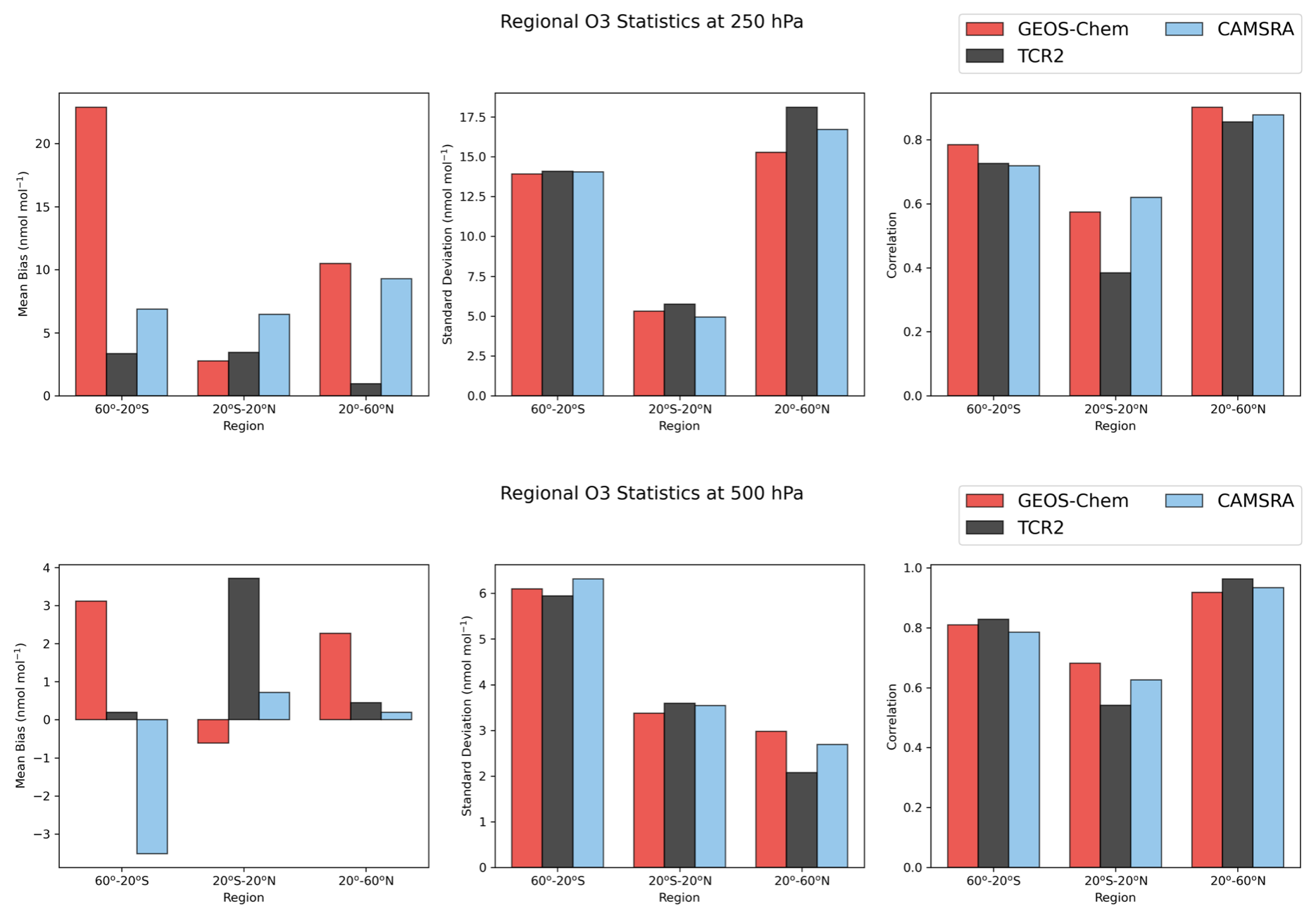
Figure 13Regional statistics for the evaluation of the reanalyses with ozonesondes at 250 hPa (top row) and 500 hPa (bottom row). Shown are the mean bias (nmol mol−1) between the reanalyses and the ozonesondes (left column), the standard deviation between the reanalyses and the ozonesondes (middle column), and the correlation between the reanalyses and the ozonesondes (right column).
In the UTLS (at 250 hPa) the correlations in the midlatitudes are just as high as at 500 hPa. However, the correlations in the upper tropical troposphere are slightly lower. In the northern midlatitudes, the largest mean bias is about 10 nmol mol−1 (10 %). In the tropics, where the ozone mixing ratio is lower, the mean bias is smaller. The largest mean bias, exceeding 20 nmol mol−1 (30 %) is found in GEOS-Chem in the southern midlatitudes. This large bias in GEOS-Chem in the southern midlatitudes could explain the high ozone in GEOS-Chem relative to the ensemble mean in the upper troposphere of the southern midlatitudes shown in Fig. 3b. The standard deviation in the UTLS is larger than at 500 hPa, particularly in the midlatitudes, which is expected given the higher ozone mixing ratios in the lower stratosphere and the small-scale meteorological processes that drive variability in the tropopause region. At 250 hPa the ozone distribution will be strongly influenced by variations in the tropopause and it is a challenge for models to reproduce the small-scale, dynamically-driven variations in ozone in this region.
3.4 Surface NO2 distribution
As NO2 is a key ozone precursor, examination of the NO2 distribution in the reanalyses could provide insight in the source of the differences in surface ozone between the reanalyses. The ensemble mean NO2 distribution and the differences between the individual reanalyses and the ensemble mean are plotted in Fig. 14. As shown in Fig. 14b, the ensemble mean reflects the combined influence of low NO2 mixing ratios in GEOS-Chem and high NO2 in CAMSRA. CMAQ has low NO2 in the US, whereas CAQRA generally has high NO2 in eastern China and low NO2 in western China, northern India, and southeast Asia. The seasonal variations in regional mean NO2 at the surface are shown in Fig. 15. Across all region, GEOS-Chem has low NO2 seasonally compared to the other reanalyses. For most regions, except South America and China, CAMSRA has higher NO2 than TCR-2. For example, over North America, India, and the Middle East, CAMSRA has much higher NO2 than TCR-2. The large discrepancies in surface NO2 between the reanalyses is due, in part, to the differences in the assimilation configuration employed in the reanalyses. For example, GEOS-Chem constrained only NOx emissions, CAMSRA constrained NO2 and ozone mixing ratios, TCR-2 constrained NO2 and ozone mixing ratios as well NOx emissions, and CMAQ constrained aerosol mass and CO mixing ratios. In addition, GEOS-Chem has the lowest spatial resolution at 2° × 2.5°. These differences will have a significant impact on the simulated surface NO2 in the reanalyses since NOx emissions represent a strong forcing on surface NO2 mixing ratios in the assimilation, with implications for surface ozone. In their observing system experiments, Sekiya et al. (2025) found that assimilation of the satellite NO2 data produced a larger increase in lower tropospheric ozone in TCR-2 than in GEOS-Chem, which they suggested could be due to differences in the sensitivities of ozone to changes in NOx emissions in GEOS-Chem and TCR-2, as reported by Miyazaki et al. (2020a) in the multi-model data assimilation system. Sekiya et al. (2025) also noted that Qu et al. (2020a) reported lower posterior NOx emission estimates in GEOS-Chem when assimilating the NASA standard OMNO2 NO2 product compared to when assimilating the KNMI DOMINO product (Boersma et al., 2011) or the QA4ECV product (Boersma et al., 2018). The GEOS-Chem results presented here are based on the OMNO2 product.
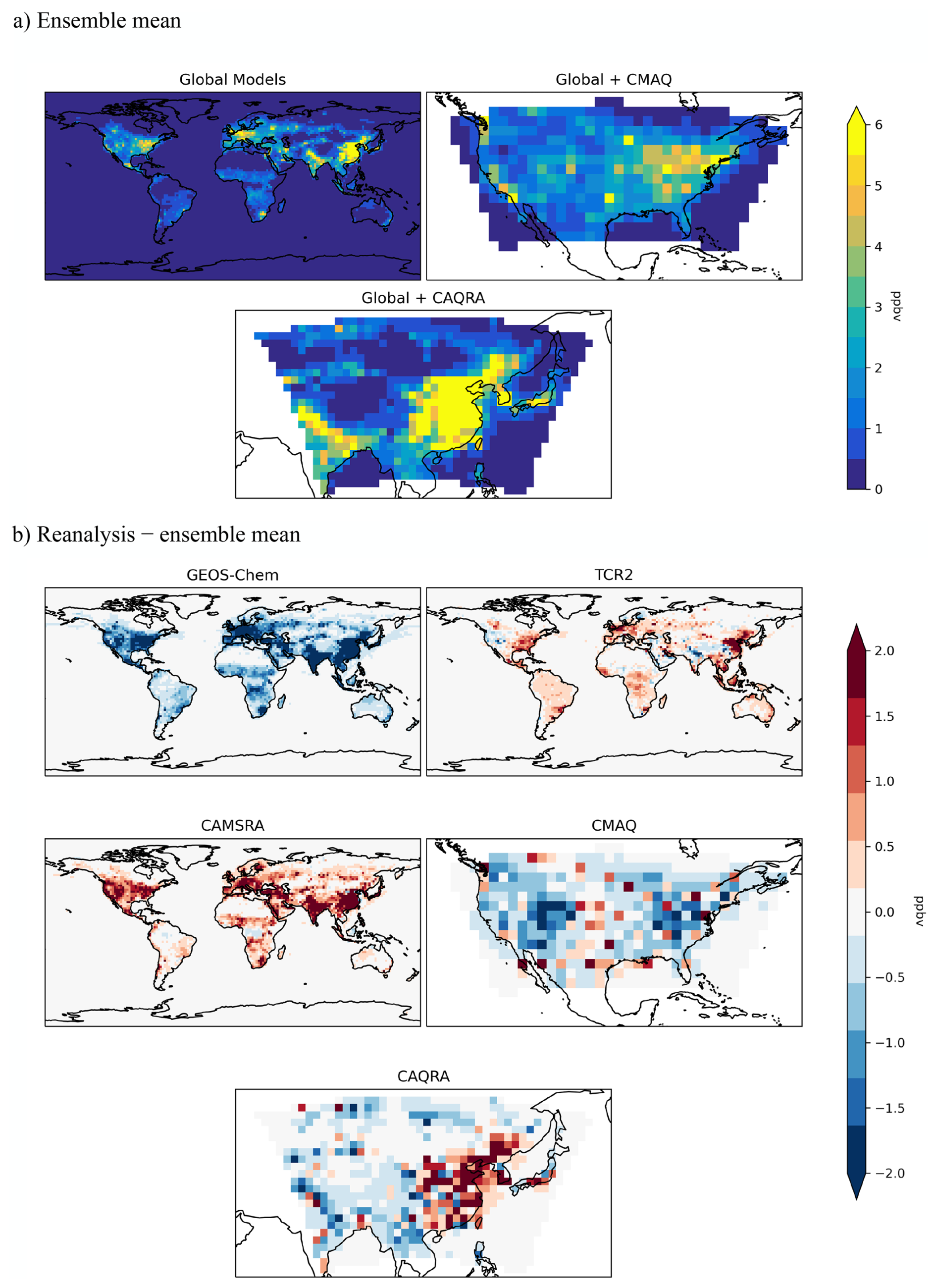
Figure 14Ensemble mean NO2 (ppbv) at the surface for the global reanalyses (CAMSRA, GEOS-Chem, and TCR-2) for 2006–2016 (top), the global reanalyses and CMAQ over the United States (top right), and the global reanalyses and CAQRA over Asia (bottom). (b) Mean differences (ppbv) between surface NO2 in the individual reanalyses and the ensemble mean. The ensemble mean and the differences from the mean for the CAQRA evaluation were calculated for 2013–2016 since CAQRA data are only available starting in 2013.
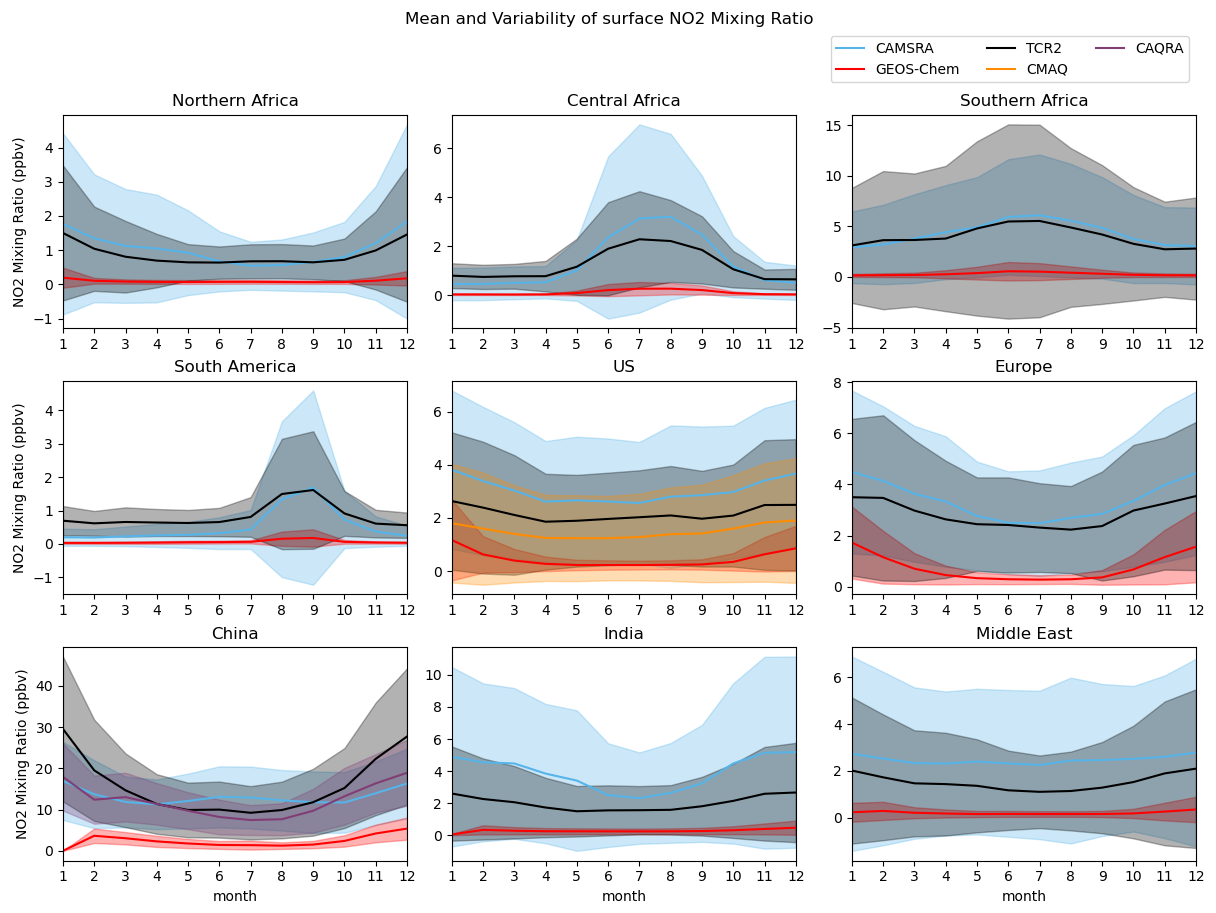
Figure 15Seasonal variations in regional mean NO2 (ppbv) at the surface for the regions defined in Table 2. Shown are the monthly mean fields for CAMSRA, GEOS-Chem, TCR-2, CMAQ, and CAQRA. The monthly fields were averaged for 2006–2016, except for CAQRA, which was averaged for 2013–2016. The regional and temporal standard deviation for each month is indicated by the shading.
The larger biases in ozone at the surface compared to the free troposphere is consistent with previous studies that showed that atmospheric chemistry models tend to overestimate surface ozone concentrations (e.g., Reidmiller et al., 2009; Travis et al., 2016). The large positive mean biases of up 10–15 nmol mol−1 found here are similar to those reported by Young et al. (2018) in their evaluation of models used in the Atmospheric Chemistry and Climate Model Intercomparison Project (ACCMIP). One potential contributor to the overestimate of surface ozone in the reanalyses could be the model resolution, since according to Wild and Prather (2006), even at a horizontal resolution of 1.1° × 1.1° models will overestimate regional ozone production. Furthermore, it was suggested by Valin et al. (2011) that high spatial resolution of 4–12 km is required to capture the non-linear NOx chemistry. CMAQ was run at a high spatial resolution of 12 km × 12 km, however only aerosol optical depth and the CO mixing ratio were optimized in the analysis. Thus, in CMAQ, ozone was adjusted indirectly through changes in the model chemistry. TCR-2 and CAMSRA both optimized the ozone mixing ratio, but the spatial resolution of both models, 1.1 and 0.75°, respectively, is still coarse. Higher resolution is also important to more effectively assimilate the satellite observations to analyze emissions and concentrations on a megacity scale (Sekiya et al., 2021). GEOS-Chem has the lowest spatial resolution (at 2° × 2.5°) and the highest ozone bias. Another possible source of the high surface ozone in GEOS-Chem is bias in the chemical mechanism in the model. Qu et al. (2020a) found that using the a posteriori NOx emissions from the GEOS-Chem reanalysis in a more recent version of the model resulted in lower ozone mixing ratios, which they attributed to differences in the chemical mechanism and VOC emissions in the two versions of GEOS-Chem.
The regional discrepancies in surface ozone between the reanalyses clearly reflects the fact that atmospheric composition measurements from space have less sensitivity to ozone and its precursors near the surface. However, the discrepancies in surface ozone in the reanalyses also reflect differences in the assimilation configuration employed in the reanalyses as well as discrepancies in the chemical mechanisms used in the models. Near the surface the ozone lifetime is shorter than in the middle and upper troposphere, thus, near-surface information from the observations ingested in the assimilation will be rapidly destroyed and the surface ozone analysis will be strongly influenced by discrepancies in the model chemistry and precursor emissions at the surface. As a result, the configuration of the assimilation will have a significant impact on the surface ozone analysis. This could explain the larger discrepancies that we see between the reanalyses at the surface as compared to the middle and upper troposphere in Figs. 5–10. For the reanalyses considered here, GEOS-Chem optimized only NOx emissions, CAMSRA optimized the atmospheric concentration of ozone and its precursors, CMAQ optimized the atmospheric concentration of aerosols and CO, and CAQRA assimilated only in situ surface observations, but optimized the atmospheric concentration of ozone, CO, NO2, SO2, and particulate matter. Zhang et al. (2019) showed that optimizing only NOx emissions can result in large regional differences in the inferred emissions compared to jointly optimizing the emissions together with the ozone concentrations due to the influence of discrepancies in the ozone field on the NO2 concentrations. TCR-2 is the only reanalysis that optimized both the atmospheric concentrations of ozone and its precursors as well as the precursor emissions. To mitigate the impact of discrepancies in model chemistry and ozone precursor emissions, improvements in the chemical reanalyses are required to jointly optimize the atmospheric concentrations of ozone and its precursors together with the ozone precursor emissions. In this context, the construction of better background error covariances in the reanalyses is needed to propagate the information from the observations in space, time, and, in particular, across species.
In our evaluation of the reanalyses, we have focused on discrepancies in NO2 as possible factor influences the ozone analysis. However, VOCs also play an important role in ozone formation and none of the reanalyses examined here assimilated observations to constrain the VOC emissions. Isoprene is the dominant non-methane VOC (Guenther et al., 2012) and HCHO is a key byproduct of isoprene oxidation. Assimilation of satellite observations of HCHO have been widely used to quantify isoprene emissions (e.g., Palmer et al., 2003; Millet et al., 2008; Stavrakou et al., 2015; Kaiser et al., 2018). In addition, satellite observations of isoprene are now available from the Cross-Track Infrared Sounder (CrIS) satellite instrument and can provide constraints on isoprene emissions (Wells et al., 2020). Integrating HCHO and isoprene observations should provide greater constrains on tropospheric ozone. For the first time, observations of ozone, NO2, and HCHO are also available from geostationary (GEO) orbit by the Geostationary Environment Monitoring Spectrometer (GEMS) and the Tropospheric Emissions: Monitoring of Pollution (TEMPO) instruments. In contrast to low-earth orbiting (LEO) satellites, GEO instruments greater daytime temporal coverage to capture diurnal variations in ozone, NO2, and HCHO. Park et al. (2024) and Hsu et al. (2024) showed that assimilating GEO observations of NO2 results in improved NOx emission estimates compared to those inferred from assimilating LEO data. Integrating GEO and LEO observations will enhance the constraints on tropospheric ozone in the reanalyses. Ultimately, given the limitations in the vertical sensitivity of the satellite measurements near the surface, and the limitations in the observational coverage of the surface network, integrating the surface and satellite observations in the reanalyses to exploit their complementarity will provide valuable constraints on surface ozone variability.
We have conducted an evaluation of the regional and interannual variations in tropospheric ozone in five chemical reanalyses, consisting of three global (TCR-2, CAMSRA, and GEOS-Chem) and two regional (CMAQ and CAQRA) reanalyses. We found that at the surface there can be large regional differences in mean ozone (exceeding 10 nmol mol−1) between the reanalyses. In general, the GEOS-Chem reanalysis was biased high relative to the ensemble mean across most continental regions, whereas CAMSRA was biased low. The TCR-2 reanalysis was closest to the ensemble mean at the surface except in tropical South America and central Africa. In the free troposphere the global reanalyses were in closer agreement. At 500 hPa the mean bias between individual reanalyses and the ensemble mean was less than 5 nmol mol−1 in most regions. Similarly, in the UTLS the mean bias between the individual reanalyses and the ensemble mean was less than 5 nmol mol−1, except in the northern high-latitudes where the biases exceeded 30 nmol mol−1, with GEOS-Chem and CAMSRA exhibiting large positive bias and negative biases, respectively.
Regionally, at the surface the reanalyses were generally consistent in their simulation of the seasonal cycle and interannual variations in regional mean ozone, with high ozone in GEOS-Chem and low ozone in CAMSRA at the surface. In the free troposphere the reanalyses are in better agreement in their simulation of the ozone variability as well as the ozone mixing ratio, with a few exceptions. At 500 hPa the seasonal maximum in ozone over the US occurs three months later in GEOS-Chem than in the other reanalyses. At 250 hPa the amplitude of the seasonal cycle in ozone is larger over South America and southern Africa in GEOS-Chem than in CAMSRA or TCR-2. At both 500 and 250 hPa there are significant differences across the reanalyses in the interannual variability in ozone over northern Africa.
Evaluation of the reanalyses with TOAR surface ozone observations reveal that GEOS-Chem, TCR-2, and CMAQ are biased high, with surface ozone biases exceeding 10 nmol mol−1 in GEOS-Chem. The CAMSRA product has the smallest bias with negative biases in central, eastern, and southern Europe, and in the central and western US, and positive biases everywhere else. We did not evaluate CAQRA with the surface ozone observations because of the limited number of observations available in Asia in the TOAR-I database. In the free troposphere the biases in the reanalyses relative to the ozonesonde data are small, for example, less than 4 nmol mol−1 everywhere at 500 hPa. The correlations between the reanalyses and the ozonesonde data were about 0.9 and 0.8 for the northern and southern midlatitudes, respectively, with lower correlations of between 0.4–0.7 in the tropics. The higher correlations in the midlatitudes likely reflect that fact that ozone transport in the extratropical free troposphere is controlled by large-scale synoptic processes that are well represented by meteorological reanalyses. In contrast, in the tropics, despite the constraints that satellite observations provide on atmospheric composition, transport of trace gases is dominated by convective processes, which are less well captured in meteorological reanalyses.
Our results suggest that chemical reanalyses should provide valuable information for quantifying regional and interannual variations in ozone in the free troposphere. Large regional discrepancies in ozone at the surface between the reanalyses impact their utility for surface ozone studies. The discrepancies reflect differences in the configuration of the assimilation schemes employed in the reanalyses as well as discrepancies in the chemical mechanisms and prior emission inventories in the models. The reported discrepancies suggest the need for a detailed follow-up intercomparison study to better determine the influence of the prior emissions, model transport and chemistry, and choice of assimilated observations on the ozone reanalyses. Improvements in the reanalyses are needed to mitigate these discrepancies by better exploiting the assimilated observations, both satellite and in situ observations, to jointly optimize the atmospheric concentrations of ozone and its precursors together with the ozone precursor emissions. Incorporating newly available satellite observations, such as isoprene observations from CrIS and high temporal resolution GEO observations of ozone, NO2, and HCHO from GEMS and TEMPO (Zoogman et al., 2017), will provide greater constraints on tropospheric ozone. This will enhance the consistency and quality of the surface ozone analyses and thus the utility of the reanalyses for quantifying regional and long-term variations in surface ozone.
The CAMSRA data are available at https://doi.org/10.24381/d58bbf47 (Copernicus Atmosphere Monitoring Service, 2020) TCR-2 data can be publicly accessed at https://disc.gsfc.nasa.gov/information/data-release?title=Release%20of%20TROPESS%20Chemical%20Reanalysis%20Products (last access: 5 May 2026). The CMAQ reanalysis is available at https://doi.org/10.5065/cfya-4g50 (Kumar and He, 2023). The GEOS-Chem-adjoint top-down NOx emission data are available at https://doi.org/10.7910/DVN/HVT1FO (Qu et al., 2020b). Details about the ozonesonde data and how to download them can be found at https://hegiftom.meteo.be/datasets/ozonesondes (last access: 5 May 2026). Information on the TOAR ozone dataset and instructions for accessing the data are available at https://toar-data.fz-juelich.de (last access: 5 May 2026).
The supplement related to this article is available online at https://doi.org/10.5194/acp-26-6655-2026-supplement.
DJ, KM, and HW designed the research. LP, ZQ, and WC performed the analysis. ZQ, KM, AI, RK, and XT provided chemical reanalysis products. All authors contributed to the writing of the manuscript.
The contact author has declared that none of the authors has any competing interests.
Publisher’s note: Copernicus Publications remains neutral with regard to jurisdictional claims made in the text, published maps, institutional affiliations, or any other geographical representation in this paper. While Copernicus Publications makes every effort to include appropriate place names, the final responsibility lies with the authors. Views expressed in the text are those of the authors and do not necessarily reflect the views of the publisher.
SI statement: This article is part of the special issue “Tropospheric Ozone Assessment Report Phase II (TOAR-II) Community Special Issue (ACP/AMT/BG/ESSD/GMD inter-journal SI)”. It is a result of the Tropospheric Ozone Assessment Report, Phase II (TOAR-II, 2020–2024).
Part of this work was conducted at the Jet Propulsion Laboratory, California Institute of Technology, under contract with the NASA. The NSF National Center for Atmospheric Research is sponsored by the U.S. National Science Foundation. The TCR-2 product was generated by the calculations using the Earth Simulator with the support of the Japan Agency for Marine-Earth Science and Technology. The Copernicus Atmosphere Monitoring Service is operated by the European Centre for Medium-Range Weather Forecasts (ECMWF) on behalf of the European Commission as part of the Copernicus Programme (http://copernicus.eu, last access: 5 May 2026).
This work was supported by the Natural Science and Engineering Research Council of Canada (grant no. RGPIN-2019-06804).
This paper was edited by Tim Butler and reviewed by two anonymous referees.
Appel, K. W., Bash, J. O., Fahey, K. M., Foley, K. M., Gilliam, R. C., Hogrefe, C., Hutzell, W. T., Kang, D., Mathur, R., Murphy, B. N., Napelenok, S. L., Nolte, C. G., Pleim, J. E., Pouliot, G. A., Pye, H. O. T., Ran, L., Roselle, S. J., Sarwar, G., Schwede, D. B., Sidi, F. I., Spero, T. L., and Wong, D. C.: The Community Multiscale Air Quality (CMAQ) model versions 5.3 and 5.3.1: system updates and evaluation, Geosci. Model Dev., 14, 2867–2897, https://doi.org/10.5194/gmd-14-2867-2021, 2021.
Barré, J., Peuch, V.-H., Lahoz, W. A., Attié, J.-L., Josse, B., Piacentini, A., Eremenko, M., Dufour, G., Nedelec, P., von Clarmann, T., and El Amraoui, L.: Combined data assimilation of ozone tro- pospheric columns and stratospheric profiles in a high-resolution CTM, Q. J. Roy. Meteorol. Soc., https://doi.org/10.1002/qj.2176, 2013.
Boersma, K. F., Eskes, H. J., Dirksen, R. J., van der A, R. J., Veefkind, J. P., Stammes, P., Huijnen, V., Kleipool, Q. L., Sneep, M., Claas, J., Leitão, J., Richter, A., Zhou, Y., and Brunner, D.: An improved tropospheric NO2 column retrieval algorithm for the Ozone Monitoring Instrument, Atmos. Meas. Tech., 4, 1905–1928, https://doi.org/10.5194/amt-4-1905-2011, 2011.
Boersma, K. F., Vinken, G. C. M., and Eskes, H. J.: Representativeness errors in comparing chemistry transport and chemistry climate models with satellite UV–Vis tropospheric column retrievals, Geosci. Model Dev., 9, 875–898, https://doi.org/10.5194/gmd-9-875-2016, 2016.
Boersma, K. F., Eskes, H. J., Richter, A., De Smedt, I., Lorente, A., Beirle, S., van Geffen, J. H. G. M., Zara, M., Peters, E., Van Roozendael, M., Wagner, T., Maasakkers, J. D., van der A, R. J., Nightingale, J., De Rudder, A., Irie, H., Pinardi, G., Lambert, J.-C., and Compernolle, S. C.: Improving algorithms and uncertainty estimates for satellite NO2 retrievals: results from the quality assurance for the essential climate variables (QA4ECV) project, Atmos. Meas. Tech., 11, 6651–6678, https://doi.org/10.5194/amt-11-6651-2018, 2018.
Brasseur, G. P., Hauglustaine, D. A., Walters, S., Rasch, P. J., Muller, J. F., Granier, C., and Tie, X. X.: MOZART, a global chemical transport model for ozone and related chemical tracers 1. Model description, J. Geophys. Res.-Atmos., 103, 28265–28289, https://doi.org/10.1029/98jd02397, 1998.
Burrows, J. P., Weber, M., Buchwitz, M., Rozanov, V., Ladstätter-Weißenmayer, A., Richter, A., DeBeek, R., Hoogen, R. Bramstedt, K., Eichmann, K.-U., Eisinger, M., and Perner, D.: The Global Ozone Monitoring Experiment (GOME): Mission concept and first scientific results, J. Atmos. Sci., 56, 151–175, https://doi.org/10.1175/1520-0469(1999)056<0151:TGOMEG>2.0.CO;2, 1999.
Cady-Pereira, K. E., Payne, V. H., Neu, J. L., Bowman, K. W., Miyazaki, K., Marais, E. A., Kulawik, S., Tzompa-Sosa, Z. A., and Hegarty, J. D.: Seasonal and spatial changes in trace gases over megacities from Aura TES observations: two case studies, Atmos. Chem. Phys., 17, 9379–9398, https://doi.org/10.5194/acp-17-9379-2017, 2017.
Cariolle, D. and Déqué, M.: Southern hemisphere medium-scale waves and total ozone disturbances in a spectral general circulation model, J. Geophys. Res., 91, 10825–10846, 1986.
Cariolle, D. and Teyssèdre, H.: A revised linear ozone photochemistry parameterization for use in transport and general circulation models: multi-annual simulations, Atmos. Chem. Phys., 7, 2183–2196, https://doi.org/10.5194/acp-7-2183-2007, 2007.
Chang, K.-L., Petropavlovskikh, I., Cooper, O. R., Schultz, M. G., and Wang, T.: Regional trend analysis of surface ozone observations from monitoring networks in eastern North America, Europe and East Asia. Elem. Sci. Anth., 5, 50, https://doi.org/10.1525/elementa.243, 2017.
Chen, Z. Y., Petetin, H., Méndez Turrubiates, R. F., Achebak, H., García-Pando, C. P., and Ballester, J.: Population exposure to multiple air pollutants and its compound episodes in Europe, Nat. Commun., 15, 2094, https://doi.org/10.1038/s41467-024-46103-3, 2024.
Colombi, N., Miyazaki, K., Bowman, K. W., Neu, J. L., and Jacob, D. J.: A new methodology for inferring surface ozone from multispectral satellite measurements, Environ. Res. Lett., 16, 105005, https://doi.org/10.1088/1748-9326/ac243d, 2021.
Copernicus Atmosphere Monitoring Service: CAMS global reanalysis (EAC4), Copernicus Atmosphere Monitoring Service (CAMS) Atmosphere Data Store [data set], https://doi.org/10.24381/d58bbf47, 2020.
Courtier, P., Thépaut, J.-N., and Hollingsworth, A.: A strategy for operational implementation of 4D-Var, using an incremental approach, Q. J. Roy. Meteor. Soc., 120, 1367–1388, 1994.
Cuesta, J., Eremenko, M., Liu, X., Dufour, G., Cai, Z., Höpfner, M., von Clarmann, T., Sellitto, P., Foret, G., Gaubert, B., Beekmann, M., Orphal, J., Chance, K., Spurr, R., and Flaud, J.-M.: Satellite observation of lowermost tropospheric ozone by multispectral synergism of IASI thermal infrared and GOME-2 ultraviolet measurements over Europe, Atmos. Chem. Phys., 13, 9675–9693, https://doi.org/10.5194/acp-13-9675-2013, 2013.
Cuesta, J., Kanaya, Y., Takigawa, M., Dufour, G., Eremenko, M., Foret, G., Miyazaki, K., and Beekmann, M.: Transboundary ozone pollution across East Asia: daily evolution and photochemical production analysed by IASI + GOME2 multispectral satellite observations and models, Atmos. Chem. Phys., 18, 9499–9525, https://doi.org/10.5194/acp-18-9499-2018, 2018.
de Almeida Albuquerque, T. T., de Fátima Andrade, M., Ynoue, R. Y., Moreira, D. M., Andreão, W . L., Soares dos Santos, F., and Sperandio Nascimento, E. G.: WRF-SMOKE-CMAQ modeling system for air quality evaluation in São Paulo megacity with a 2008 experimental campaign data, Environ. Sci. Pollut. Res., 25, 36555–36569, https://doi.org/10.1007/s11356-018-3583-9, 2018.
Dee, D. P., Uppala, S. M., Simmons, A. J., Berrisford, P., Poli, P., Kobayashi, S., Andrae, U., Balmaseda, M. A., Balsamo, G., Bauer, P., Bechtold, P., Beljaars, A. C. M., van de Berg, L., Bidlot, J., Bormann, N., Delsol, C., Dragani, R., Fuentes, M., Geer, A. J., Haimberger, L., Healy, S. B., Hersbach, H., Hólm, E. V., Isaksen, L., Kållberg, P., Köhler, M., Matricardi, M., McNally, A. P., Monge-Sanz, B. M., Morcrette, J.-J., Park, B.-K., Peubey, C., de Rosnay, P., Tavolato, C., Thépaut, J.-N., and Vitart, F.: The ERA-Interim reanalysis: Configuration and performance of the data assimilation system, Q. J. Roy. Meteor. Soc., 137, 553–597, 2011.
Deeter, M. N., Worden, H. M., Gille, J. C., Edwards, D. P., Mao, D., and Drummond, J. R.: MOPITT multispectral CO retrievals: Origins and effects of geophysical radiance errors. J. Geophys. Res.-Atmos., 116, https://doi.org/10.1029/2011JD015703, 2011.
Drummond, J. R.: Measurements Of Pollution In The Troposphere (MOPITT), in: The use of EOS for studies of Atmospheric Physics, edited by: Gille, J. C. and Visconti, G., North- Holland, New York, 77–101, ISBN 0-444-89896-4, 1992.
Drummond, J. R., Zou, J., Nichitiu, F., Kar, J., Deschambaut, R., and Hackett, J.: A review of 9-year performance and operation of the MOPITT instrument, Adv. Space Res., 45, 760–774, https://doi.org/10.1016/j.asr.2009.11.019, 2010.
Duncan, B. N., Lamsal, L. N., Thompson, A. M., Yoshida, Y., Lu, Z., Streets, D. G., Hurwitz, M. M., and Pickering, K. E.: A space-based, high-resolution view of notable changes in urban NOx pollution around the world (2005–2014), J. Geophys. Res.-Atmos., 121, 976–996, https://doi.org/10.1002/2015JD024121, 2016.
Elguindi, N., Granier, C., Stavrakou, T., Darras, S., Bauwens, M., Cao, H., Chen, C., Denier van der Gon, H. A. C., Dubovik, O., Fu, T. M., Henze, D. K., Jiang, Z., Keita, S., Kuenen, J. J. P., Kurokawa, J., Liousse, C., Miyazaki, K., Müller, J.‐F., Qu, Z., Solmon, F., and Zheng, B.: Intercomparison of magnitudes and trends in anthropogenic surface emissions from bottom-up inventories, top-down estimates, and emission scenarios. Earth's Future, 8, e2020EF001520, https://doi.org/10.1029/2020EF001520, 2020.
Elshorbany, Y., Ziemke, J. R., Strode, S., Petetin, H., Miyazaki, K., De Smedt, I., Pickering, K., Seguel, R. J., Worden, H., Emmerichs, T., Taraborrelli, D., Cazorla, M., Fadnavis, S., Buchholz, R. R., Gaubert, B., Rojas, N. Y., Nogueira, T., Salameh, T., and Huang, M.: Tropospheric ozone precursors: global and regional distributions, trends, and variability, Atmos. Chem. Phys., 24, 12225–12257, https://doi.org/10.5194/acp-24-12225-2024, 2024.
Emili, E., Barret, B., Massart, S., Le Flochmoen, E., Piacentini, A., El Amraoui, L., Pannekoucke, O., and Cariolle, D.: Combined assimilation of IASI and MLS observations to constrain tropospheric and stratospheric ozone in a global chemical transport model, Atmos. Chem. Phys., 14, 177–198, https://doi.org/10.5194/acp-14-177-2014, 2014.
Environmental Protection Agency (EPA): Air Quality – National Summary, https://www.epa.gov/air-trends/air-quality-national-summary (last access: 7 May 2026), 2024.
Fleming, Z. L., Doherty, R., Von Schneidemesser, E., Malley, C. S., Cooper, O. R., Pinto, J. P., Colette, A., Xu, X., Simpson, D., Schultz, M. G., Lefohn, A. S., Hamad, S., Moolla, R., Solberg, S., and Feng, Z.: Tropospheric Ozone Assessment Report: Present-day ozone distribution and trends relevant to human health, Elem. Sci. Anth., 6, 12, https://doi.org/10.1525/elementa.273, 2018.
Flemming, J., Benedetti, A., Inness, A., Engelen, R. J., Jones, L., Huijnen, V., Remy, S., Parrington, M., Suttie, M., Bozzo, A., Peuch, V.-H., Akritidis, D., and Katragkou, E.: The CAMS interim Reanalysis of Carbon Monoxide, Ozone and Aerosol for 2003–2015, Atmos. Chem. Phys., 17, 1945–1983, https://doi.org/10.5194/acp-17-1945-2017, 2017.
Fu, D., Worden, J. R., Liu, X., Kulawik, S. S., Bowman, K. W., and Natraj, V.: Characterization of ozone profiles derived from Aura TES and OMI radiances, Atmos. Chem. Phys., 13, 3445–3462, https://doi.org/10.5194/acp-13-3445-2013, 2013.
Fu, D., Kulawik, S. S., Miyazaki, K., Bowman, K. W., Worden, J. R., Eldering, A., Livesey, N. J., Teixeira, J., Irion, F. W., Herman, R. L., Osterman, G. B., Liu, X., Levelt, P. F., Thompson, A. M., and Luo, M.: Retrievals of tropospheric ozone profiles from the synergism of AIRS and OMI: methodology and validation, Atmos. Meas. Tech., 11, 5587–5605, https://doi.org/10.5194/amt-11-5587-2018, 2018.
Gaubert, B., Worden, H. M., Arellano, A. F. J., Emmons, L. K., Tilmes, S., Barré, J., Martinez Alonso, S., Vitt, F., Anderson, J. L., Alkemade, F., Houweling, S., and Edwards, D. P.: Chemical feedback from decreasing carbon monoxide emissions, Geophysical Research Letters, 44, https://doi.org/10.1002/2017GL074987, 2017.
Gaubert, B., Emmons, L. K., Raeder, K., Tilmes, S., Miyazaki, K., Arellano Jr., A. F., Elguindi, N., Granier, C., Tang, W., Barré, J., Worden, H. M., Buchholz, R. R., Edwards, D. P., Franke, P., Anderson, J. L., Saunois, M., Schroeder, J., Woo, J.-H., Simpson, I. J., Blake, D. R., Meinardi, S., Wennberg, P. O., Crounse, J., Teng, A., Kim, M., Dickerson, R. R., He, H., Ren, X., Pusede, S. E., and Diskin, G. S.: Correcting model biases of CO in East Asia: impact on oxidant distributions during KORUS-AQ, Atmos. Chem. Phys., 20, 14617–14647, https://doi.org/10.5194/acp-20-14617-2020, 2020.
Gelaro, R., McCarty, W., Suárez, M. J., Todling, R., Molod, A., Takacs, L., Randles, C. A., Darmenov, A., Bosilovich, M. G., Reichle, R., Wargan, K., Coy, L., Cullather, R., Draper, C., Akella, S., Buchard, V., Conaty, A., da Silva, A. M., Gu, W., Kim, G.-K., Koster, R., Lucchesi, R., Merkova, D., Nielsen, J. E., Partyka, G., Pawson, S., Putman, W., Rienecker, M., Schubert, S. D., Sienkiewicz, M., and Zhao, B.: The modern-era retrospective analysis for research and applications, version 2 (MERRA-2), J. Climate, 30, 5419–5454. https://doi.org/10.1175/jcli-d-16-0758.1, 2017.
Gettelman, A., Mills, M. J., Kinnison, D. E., Garcia, R. R., Smith, A. K., Marsh, D. R., Tilmes, S., Vitt, F., Bardeen, C. G., McInerny, J., Liu, H.-L., Solomon, S. C., Polvani, L. M., Emmons, L. K., Lamarque, J.-F., Richter, J. H., Glanville, A. S., Bacmeister, J. T., Phillips, A. S., Neale, R. B., Simpson, I. R., DuVivier, A. K., Hodzic, A., and Randel, W. J.: The Whole Atmosphere Community Climate Model Version 6 (WACCM6), J. Geophys. Res.-Atmos., 124, 12380–12403, https://doi.org/10.1029/2019JD030943, 2019.
Graedel, T. E., Bates, T. S., Bouwman, A. F., Cunnold, D., Dignon, J., Fung, I., Jacob, D. J., Lamb, B. K., Logan, J. A., Marland, G., Middleton, P., Pacyna, J. M., Placet, M., and Veldt, C.: A compilation of inventories of emissions to the atmosphere, Global Biogeochem. Cy., 7, 1–26, 1993.
Granier, C., Guenther, A., Lamarque, J. F., Mieville, A., Muller, J. F., Olivier, J., Orlando, J., Peters, J., Petron, G., Tyndall, G., and Wallens, S.: POET, a database of surface emissions of ozone precursors, http://www.aero.jussieu.fr/projet/ACCENT/POET.php (last access: 16 November 2024), 2005.
Granier, C., Bessagnet, B., Bond, T., D'Angiola, A., Denier van der Gon, H., Frost, G. J., Heil, A., Kaiser, J. W., Kinne, S., Klimont, Z., Kloster, S., Lamarque, J.-F., Liousse, C., Masui, T., Meleux, F., Mieville, A., Ohara, R., Raut, J.-C., Riahi, K., Schultz, M. G., Smith, S. G., Thompson, A., van Aardenne, J., van der Werf, G. R., and van Vuuren, D. P.: Evolution of anthropogenic and biomass burning emissions of air pollutants at global and regional scales during the 1980–2010 period, Climatic Change, 109, 163–190, https://doi.org/10.1007/s10584-011-0154-1, 2011.
Guenther, A., Karl, T., Harley, P., Wiedinmyer, C., Palmer, P. I., and Geron, C.: Estimates of global terrestrial isoprene emissions using MEGAN (Model of Emissions of Gases and Aerosols from Nature), Atmos. Chem. Phys., 6, 3181–3210, https://doi.org/10.5194/acp-6-3181-2006, 2006.
Guenther, A. B., Jiang, X., Heald, C. L., Sakulyanontvittaya, T., Duhl, T., Emmons, L. K., and Wang, X.: The Model of Emissions of Gases and Aerosols from Nature version 2.1 (MEGAN2.1): an extended and updated framework for modeling biogenic emissions, Geosci. Model Dev., 5, 1471–1492, https://doi.org/10.5194/gmd-5-1471-2012, 2012.
Hauglustaine, D. A., Brasseur, G. P., Walters, S., Rasch, P. J., Muller, J. F., Emmons, L. K., and Carroll, C. A.: MOZART, a global chemical transport model for ozone and related chemical tracers 2. Model results and evaluation, J. Geophys. Res.-Atmos., 103, 28291–28335, https://doi.org/10.1029/98jd02398, 1998.
Henze, D. K., Hakami, A., and Seinfeld, J. H.: Development of the adjoint of GEOS-Chem, Atmos. Chem. Phys., 7, 2413–2433, https://doi.org/10.5194/acp-7-2413-2007, 2007.
Huijnen, V., Miyazaki, K., Flemming, J., Inness, A., Sekiya, T., and Schultz, M. G.: An intercomparison of tropospheric ozone reanalysis products from CAMS, CAMS interim, TCR-1, and TCR-2, Geosci. Model Dev., 13, 1513–1544, https://doi.org/10.5194/gmd-13-1513-2020, 2020.
Hunt, B. R., Kostelich, E. J., and Szunyogh, I.: Efficient data assimilation for spatiotemporal chaos: A local ensemble transform Kalman filter, Physica D, 230, 112–126, 2007.
Hsu, C.-H., Henze, D. K., Mizzi, A. P., González Abad, G., He, J., Harkins, C., Naeger, A. R., Lyu, C., Liu, X., Chan Miller, C., Pierce, R. B., Johnson, M. S., and McDonald, B. C.: An observing system simulation experiment analysis of how well geostationary satellite trace-gas observations constrain NOx emissions in the US, J. Geophys. Res.-Atmos., 129, e2023JD039323, https://doi.org/10.1029/2023JD039323, 2024.
Inness, A., Baier, F., Benedetti, A., Bouarar, I., Chabrillat, S., Clark, H., Clerbaux, C., Coheur, P., Engelen, R. J., Errera, Q., Flemming, J., George, M., Granier, C., Hadji-Lazaro, J., Huijnen, V., Hurtmans, D., Jones, L., Kaiser, J. W., Kapsomenakis, J., Lefever, K., Leitão, J., Razinger, M., Richter, A., Schultz, M. G., Simmons, A. J., Suttie, M., Stein, O., Thépaut, J.-N., Thouret, V., Vrekoussis, M., Zerefos, C., and the MACC team: The MACC reanalysis: an 8 yr data set of atmospheric composition, Atmos. Chem. Phys., 13, 4073–4109, https://doi.org/10.5194/acp-13-4073-2013, 2013.
Inness, A., Ades, M., Agustí-Panareda, A., Barré, J., Benedictow, A., Blechschmidt, A.-M., Dominguez, J. J., Engelen, R., Eskes, H., Flemming, J., Huijnen, V., Jones, L., Kipling, Z., Massart, S., Parrington, M., Peuch, V.-H., Razinger, M., Remy, S., Schulz, M., and Suttie, M.: The CAMS reanalysis of atmospheric composition, Atmos. Chem. Phys., 19, 3515–3556, https://doi.org/10.5194/acp-19-3515-2019, 2019.
Jackson, D. R.: Assimilation of EOS MLS ozone observations in the Met Office data-assimilation system, Q. J. Roy. Meteor. Soc., 133, 1771–1788, 2007.
Janssens-Maenhout, G., Crippa, M., Guizzardi, D., Dentener, F., Muntean, M., Pouliot, G., Keating, T., Zhang, Q., Kurokawa, J., Wankmüller, R., Denier van der Gon, H., Kuenen, J. J. P., Klimont, Z., Frost, G., Darras, S., Koffi, B., and Li, M.: HTAP_v2.2: a mosaic of regional and global emission grid maps for 2008 and 2010 to study hemispheric transport of air pollution, Atmos. Chem. Phys., 15, 11411–11432, https://doi.org/10.5194/acp-15-11411-2015, 2015.
Jiang, Z., Worden, J. R., Worden, H., Deeter, M., Jones, D. B. A., Arellano, A. F., and Henze, D. K.: A 15-year record of CO emissions constrained by MOPITT CO observations, Atmos. Chem. Phys., 17, 4565–4583, https://doi.org/10.5194/acp-17-4565-2017, 2017.
Jiang, Z., McDonald, B. C., Worden, H., Worden, J. R., Miyazaki, K., Qu, Z., Henze, D. K., Jones, D. B. A., Arellano, A. F., Fischer, E. V., Zhu, L., and Boersma, K. F.: Unexpected slowdown of us pollutant emission reduction in the past decade, Proceedings of the National Academy of Sciences, 115, 5099–5104, 2018.
Kaiser, J., Jacob, D. J., Zhu, L., Travis, K. R., Fisher, J. A., González Abad, G., Zhang, L., Zhang, X., Fried, A., Crounse, J. D., St. Clair, J. M., and Wisthaler, A.: High-resolution inversion of OMI formaldehyde columns to quantify isoprene emission on ecosystem-relevant scales: application to the southeast US, Atmos. Chem. Phys., 18, 5483–5497, https://doi.org/10.5194/acp-18-5483-2018, 2018.
Kaiser, J. W., Heil, A., Andreae, M. O., Benedetti, A., Chubarova, N., Jones, L., Morcrette, J.-J., Razinger, M., Schultz, M. G., Suttie, M., and van der Werf, G. R.: Biomass burning emissions estimated with a global fire assimilation system based on observed fire radiative power, Biogeosciences, 9, 527–554, https://doi.org/10.5194/bg-9-527-2012, 2012.
Kong, L., Tang, X., Zhu, J., Wang, Z., Li, J., Wu, H., Wu, Q., Chen, H., Zhu, L., Wang, W., Liu, B., Wang, Q., Chen, D., Pan, Y., Song, T., Li, F., Zheng, H., Jia, G., Lu, M., Wu, L., and Carmichael, G. R.: A 6-year-long (2013–2018) high-resolution air quality reanalysis dataset in China based on the assimilation of surface observations from CNEMC, Earth Syst. Sci. Data, 13, 529–570, https://doi.org/10.5194/essd-13-529-2021, 2021.
Krotkov, N. A., Lamsal, L. N., Celarier, E. A., Swartz, W. H., Marchenko, S. V., Bucsela, E. J., Chan, K. L., Wenig, M., and Zara, M.: The version 3 OMI NO2 standard product, Atmos. Meas. Tech., 10, 3133–3149, https://doi.org/10.5194/amt-10-3133-2017, 2017.
Kuai, L., Bowman, K. W., Miyazaki, K., Deushi, M., Revell, L., Rozanov, E., Paulot, F., Strode, S., Conley, A., Lamarque, J.-F., Jöckel, P., Plummer, D. A., Oman, L. D., Worden, H., Kulawik, S., Paynter, D., Stenke, A., and Kunze, M.: Attribution of Chemistry-Climate Model Initiative (CCMI) ozone radiative flux bias from satellites, Atmos. Chem. Phys., 20, 281–301, https://doi.org/10.5194/acp-20-281-2020, 2020.
Kumar, R. and He, C.: CONUS air quality reanalysis dataset (2005–2018), NSF National Center for Atmospheric Research [data set], https://doi.org/10.5065/cfya-4g50, 2023.
Kumar, R., Bhardwaj, P., He, C., Boehnert, J., Lacey, F., Alessandrini, S., Sampson, K., Casali, M., Swerdlin, S., Wilhelmi, O., Pfister, G. G., Gaubert, B., and Worden, H.: A long-term high-resolution air quality reanalysis with a public-facing air quality dashboard over the Contiguous United States (CONUS), Earth Syst. Sci. Data, 17, 1807–1834, https://doi.org/10.5194/essd-17-1807-2025, 2025.
Lamsal, L. N., Duncan, B. N., Yoshida, Y., Krotkov, Ni. A., Pickering, K. E., Streets, D. G., and Lu, Z.: U.S. NO2 trends (2005–2013): EPA Air Quality System (AQS) data versus improved observations from the Ozone Monitoring Instrument (OMI), Atmos. Environ., 110, 130–143, https://doi.org/10.1016/j.atmosenv.2015.03.055, 2015.
Lin, M., Fiore, A. M., Cooper, O. R., Horowitz, L. W. Langford, A. O., Levy II, H., Johnson, B. J., Naik, V., Oltmans, S. J., and Senff, C. J.: Springtime high surface ozone events over the western United States: Quantifying the role of stratospheric intrusions, J. Geophys. Res., 117, D00V22, https://doi.org/10.1029/2012JD018151, 2012.
Lyu, C., Capps, S. L., Hakami, A., Zhao, S., Resler, J., Carmichael, G. R., Sandu, S., Russell, A. G., Chai, T., and Henze, D. K.: Elucidating emissions control strategies for ozone to protect human health and public welfare within the continental United States, Environ. Res. Lett., 14, 124093, https://doi.org/10.1088/1748-9326/ab5e05, 2019.
Marsh, D. R., Mills, M. J., Kinnison, D. E., Lamarque, J.-F., Calvo, N., and Polvani, L. M.: Climate Change from 1850 to 2005 Simulated in CESM1(WACCM), J. Climate, 26, 7372–7391, https://doi.org/10.1175/JCLI-D-12-00558.1, 2013.
McLinden, C. A., Olsen, S. C., Hannegan, B., Wild, O., Prather, M. J., and Sundet, J.: Stratospheric ozone in 3-D models: A simple chemistry and the cross-tropopause flux, J. Geophys. Res., 105, 14653–14665, https://doi.org/10.1029/2000JD900124, 2000.
Millet, D. B., Jacob, D. J., Boersma, K. F., Fu, T., Kurosu, T. P., Chance, K., Heald, C. L., and Guenther, A.: Spatial distribution of isoprene emissions from North America derived from formaldehyde column measurements by the OMI satellite sensor, J. Geophys. Res., 113, https://doi.org/10.1029/2007jd008950, 2008.
Miyazaki, K. and Bowman, K.: Evaluation of ACCMIP ozone simulations and ozonesonde sampling biases using a satellite-based multi-constituent chemical reanalysis, Atmos. Chem. Phys., 17, 8285–8312, https://doi.org/10.5194/acp-17-8285-2017, 2017.
Miyazaki, K., Eskes, H. J., Sudo, K., Takigawa, M., van Weele, M., and Boersma, K. F.: Simultaneous assimilation of satellite NO2, O3, CO, and HNO3 data for the analysis of tropospheric chemical composition and emissions, Atmos. Chem. Phys., 12, 9545–9579, https://doi.org/10.5194/acp-12-9545-2012, 2012.
Miyazaki, K., Eskes, H. J., Sudo, K., and Zhang, C.: Global lightning NOx production estimated by an assimilation of multiple satellite data sets, Atmos. Chem. Phys., 14, 3277–3305, https://doi.org/10.5194/acp-14-3277-2014, 2014.
Miyazaki, K., Eskes, H. J., and Sudo, K.: A tropospheric chemistry reanalysis for the years 2005–2012 based on an assimilation of OMI, MLS, TES, and MOPITT satellite data, Atmos. Chem. Phys., 15, 8315–8348, https://doi.org/10.5194/acp-15-8315-2015, 2015.
Miyazaki, K., Eskes, H., Sudo, K., Boersma, K. F., Bowman, K., and Kanaya, Y.: Decadal changes in global surface NOx emissions from multi-constituent satellite data assimilation, Atmos. Chem. Phys., 17, 807–837, https://doi.org/10.5194/acp-17-807-2017, 2017.
Miyazaki, K., Sekiya, T., Fu, D., Bowman, K. W., Kulawik, S. S., Sudo, K., Walker, T., Kanaya, Y., Takigawa, M., Ogochi, K., Eskes, H., Boersma, K. F., Thompson, A. M., Gaubert, B., Barre, J., and Emmons, L. K.: Balance of emission and dynamical controls on ozone during the Korea-United States Air Quality campaign from multiconstituent satellite data assimilation, J. Geophys. Res., 124, 387–413, https://doi.org/10.1029/2018JD028912, 2019.
Miyazaki, K., Bowman, K. W., Yumimoto, K., Walker, T., and Sudo, K.: Evaluation of a multi-model, multi-constituent assimilation framework for tropospheric chemical reanalysis, Atmos. Chem. Phys., 20, 931–967, https://doi.org/10.5194/acp-20-931-2020, 2020a.
Miyazaki, K., Bowman, K., Sekiya, T., Eskes, H., Boersma, F., Worden, H., Livesey, N., Payne, V. H., Sudo, K., Kanaya, Y., Takigawa, M., and Ogochi, K.: Updated tropospheric chemistry reanalysis and emission estimates, TCR-2, for 2005–2018, Earth Syst. Sci. Data, 12, 2223–2259, https://doi.org/10.5194/essd-12-2223-2020, 2020b.
Monks, P. S., Archibald, A. T., Colette, A., Cooper, O., Coyle, M., Derwent, R., Fowler, D., Granier, C., Law, K. S., Mills, G. E., Stevenson, D. S., Tarasova, O., Thouret, V., von Schneidemesser, E., Sommariva, R., Wild, O., and Williams, M. L.: Tropospheric ozone and its precursors from the urban to the global scale from air quality to short-lived climate forcer, Atmos. Chem. Phys., 15, 8889–8973, https://doi.org/10.5194/acp-15-8889-2015, 2015.
Nenes, A., Pandis, S. N., and Pilinis, C.: ISORROPIA: A new thermodynamic equilibrium model for multiphase multicomponent inorganic aerosols, Aquat. Geochem., 4, 123–152, https://doi.org/10.1023/a:1009604003981, 1998.
Olivier, J., Peters, J., Granier, C., Petron, G., Müller, J. F., and Wallens, S.: Present and future surface emissions of atmospheric compounds, POET report #2, EU project EVK2-1999-00011, 2003.
Palmer, P. I., Jacob, D. J., Fiore, A. M., Martin, R. V., Chance, K., and Kurosu, T. P.: Mapping isoprene emissions over North America using formaldehyde column observations from space, J. Geophys. Res.-Atmos., 108, https://doi.org/10.1029/2002jd002153, 2003.
Pan, L. L., Atlas, E. L., Salawitch, R. J., Honomichl, S. B., Bresch, J. F., Randel, W. J., Apel, E. C., Hornbrook, R. S., Weinheimer, A. J., Anderson, D. C., Andrews, S. J., Baidar, S., Beaton, S. P., Campos, T. L., Carpenter, L. J., Chen, D., Dix, B., Donets, V., Hall, S. R., Hanisco, T. F., Homeyer, C. R., Huey, L. G., Jensen, J. B., Kaser, L., Kinnison, D. E., Koenig, T. K., Lamarque, J.-F., Liu, C., Luo, J., Luo, Z. J., Montzka, D. D., Nicely, J. M., Pierce, R. B., Riemer, D. D., Robinson, T., Romashkin, P., Saiz-Lopez, A., Schauffler, S., Shieh, O., Stell, M. H., Ullmann, K., Vaughan, G., Volkamer, R., and Wolfe, G.: The Convective Transport of Active Species in the Tropics (CONTRAST) Experiment, B. Am. Meteorol. Soc., 98, 106–128, https://doi.org/10.1175/BAMS-D-14-00272.1, 2017.
Park, J., Choi, Y., Jung, J., Lee, K., and Yeganeh, A. K.: First top-down diurnal adjustment to NOx emissions inventory in Asia informed by the Geostationary Environment Monitoring Spectrometer (GEMS) tropospheric NO2 columns, Sci. Rep., 14, 24338, https://doi.org/10.1038/s41598-024-76223-1, 2024.
Park, S., Son, S.-W., Jung, M.-I., Park, J., and Park, S. S.: Evaluation of tropospheric ozone reanalyses with independent ozonesonde observations in East Asia, Geosci. Lett., 7, 12, https://doi.org/10.1186/s40562-020-00161-9, 2020.
Parrington, M., Jones, D. B. A., Bowman, K. W., Horowitz, L. W., Thompson, A. M., Tarasick, D. W., and Witte, J. C.: Estimating the summertime tropospheric ozone distribution over North America through assimilation of observations from the Tropospheric Emission Spectrometer, J. Geophys. Res., 113, D18307, https://doi.org/10.1029/2007JD009341, 2008.
Parrish, D. D., Lamarque, J.-F., Naik, V., Horowitz, L., Shindell, D. T., Staehelin, J., Derwent, R., Cooper, O. R., Tanimoto, H., Volz-Thomas, A., Gilge, S., Scheel, H.-E., Steinbacher, M., and Fröhlich, M.: Long-term changes in lower tropospheric baseline ozone concentrations: Comparing chemistry-climate models and observations at northern midlatitudes, J. Geophys. Res.-Atmos., 119, 5719–5736, https://doi.org/10.1002/2013JD021435, 2014.
Qu, Z., Henze, D. K., Cooper, O. R., and Neu, J. L.: Impacts of global NOx inversions on NO2 and ozone simulations, Atmos. Chem. Phys., 20, 13109–13130, https://doi.org/10.5194/acp-20-13109-2020, 2020a.
Qu, Z., Henze, D. K., Cooper, O. R., and Neu, J. L.: Global (2°x2.5°) top-down NOx emissions from OMI NASA product (2005–2016), Harvard Dataverse V1 [data set], https://doi.org/10.7910/DVN/HVT1FO, 2020b.
Randerson, J., van der Werf, G., Giglio, L., Collatz, G., and Kasibhatla, P.: Global Fire Emissions Database, Version 4, (GFEDv4), ORNL DAAC [data set], Oak Ridge, Tennessee, USA, https://doi.org/10.3334/ORNLDAAC/1293, 2018.
Reidmiller, D. R., Fiore, A. M., Jaffe, D. A., Bergmann, D., Cuvelier, C., Dentener, F. J., Duncan, B. N., Folberth, G., Gauss, M., Gong, S., Hess, P., Jonson, J. E., Keating, T., Lupu, A., Marmer, E., Park, R., Schultz, M. G., Shindell, D. T., Szopa, S., Vivanco, M. G., Wild, O., and Zuber, A.: The influence of foreign vs. North American emissions on surface ozone in the US, Atmos. Chem. Phys., 9, 5027–5042, https://doi.org/10.5194/acp-9-5027-2009, 2009.
Schultz,M. G., Schröder, S., Lyapina, O., Cooper, O. R., Galbally, I., Petropavlovskikh, I., von Schneidemesser, E., Tanimoto, H., Elshorbany, Y., Naja, M., Seguel, R. J., Dauert, U., Eckhardt, P., Feigenspan, S., Fiebig, M., Hjellbrekke, A.-G., Hong, Y.-D., Kjeld, P. C., Koide, H., Lear, G., Tarasick, D., Ueno, M., Wallasch, M., Baumgardner, D., Chuang, M.-T., Gillett, R., Lee, M., Molloy, S., Moolla, R., Wang, T., Sharps, K., Adame, J. A., Ancellet, G., Apadula, F., Artaxo, P., Barlasina, M. E., Bogucka, M., Bonasoni, P., Chang, L., Colomb, A., Cuevas-Agull., E., Cupeiro, M., Degorska, A., Ding, A., Fröhlich, M., Frolova, M., Gadhavi, H., Gheusi, F., Gilge, S., Gonzalez, M. Y., Gros, V., Hamad, S. H., Helmig, D., Henriques, D., Hermansen, O., Holla, R., Hueber, J., Im, U., Jaffe, D. A., Komala, N., Kubistin, D., Lam, K.-S., Laurila, T., Lee, H., Levy, I., Mazzoleni, C., Mazzoleni, L. R., McClure-Begley, A., Mohamad, M., Murovec, M., Navarro-Comas, M., Nicodim, F., Parrish, D., Read, K. A., Reid, N., Ries, L., Saxena, P., Schwab, J. J., Scorgie, Y., Senik, I., Simmonds, P., Sinha, V., Skorokhod, A. I., Spain, G., Spangl, W., Spoor, R., Springston, S. R., Steer, K., Steinbacher, M., Suharguniyawan, E., Torre, P., Trickl, T., Weili, L., Weller, R., Xiaobin, X., Xue, L., and Zhiqiang, M.: Tropospheric Ozone Assessment Report: Database and metrics data of global surface ozone observations, Elem. Sci. Anth., 5, 58, https://doi.org/10.1525/elementa.244, 2017.
Sekiya, T., Emili, E., Miyazaki, K., Inness, A., Qu, Z., Pierce, R. B., Jones, D., Worden, H., Cheng, W. Y. Y., Huijnen, V., and Koren, G.: Assessing the relative impacts of satellite ozone and its precursor observations to improve global tropospheric ozone analysis using multiple chemical reanalysis systems, Atmos. Chem. Phys., 25, 2243–2268, https://doi.org/10.5194/acp-25-2243-2025, 2025.
Sekiya, T., Miyazaki, K., Ogochi, K., Sudo, K., Takigawa, M., Eskes, H., and Boersma, K. F.: Impacts of horizontal resolution on global data assimilation of satellite measurements for tropospheric chemistry analysis, Journal of Advances in Modeling Earth Systems, 13, e2020MS002180, https://doi.org/10.1029/2020MS002180, 2021.
Shindell, D. T., Faluvegi, G., Stevenson, D. S., Krol, M. C., Emmons, L. K., Lamarque, J.-F., Pétron, G., Dentener, F. J., Ellingsen, K., Schultz, M. G., Wild, O., Amann, M., Atherton, C. S., Bergmann, D. J., Bey, I., Butler, T., Cofala, J., Collins, W. J., Derwent, R. G., Doherty, R. M., Drevet, J., Eskes, H. J., Fiore, A. M., Gauss, M., Hauglustaine, D. A., Horowitz, L. W., Isaksen, I. S. A., Lawrence, M. G., Montanaro, V., Müller, J.-F., Pitari, G., Prather, M. J., Pyle, J. A., Rast, S., Rodriguez, J. M., Sanderson, M. G., Savage, N. H., Strahan, S. E., Sudo, K., Szopa, S., Unger, N., van Noije, T. P. C., and Zeng, G.: Multimodel simulations of carbon monoxide: Comparison with observations and projected near-future changes, J. Geophys. Res., 111, D19306, https://doi.org/10.1029/2006JD007100, 2006.
Sindelarova, K., Granier, C., Bouarar, I., Guenther, A., Tilmes, S., Stavrakou, T., Müller, J.-F., Kuhn, U., Stefani, P., and Knorr, W.: Global data set of biogenic VOC emissions calculated by the MEGAN model over the last 30 years, Atmos. Chem. Phys., 14, 9317–9341, https://doi.org/10.5194/acp-14-9317-2014, 2014.
Skamarock, W. and Klemp, J.: A time-split nonhydrostatic atmospheric model for weather research and forecasting applications, Journal of Computational Physics, 227, 3465–3485, 2008.
Smit, H. G. J., Straeter, W., Johnson, B. J., Oltmans, S. J., Davies, J., Tarasick, D. W., Hoegger, B., Stubi, R., Schmidlin, F. J., Northam, T., Thompson, A. M., Witte, J. C., Boyd, I., and Posny, F.: Assessment of the performance of ECC-ozonesondes under quasi-flight conditions in the environmental simulation chamber: Insights from the Juelich Ozone Sonde Intercomparison Experiment (JOSIE), J. Geophys. Res., 112, https://doi.org/10.1029/2006JD007308, 2007.
Stajner, I. and Wargan, K.: Antarctic stratospheric ozone from the assimilation of occultation data, Geophys. Res. Lett., 31, L18108, https://doi.org/10.1029/2004GL020846, 2004.
Stavrakou, T., Müller, J.-F., Bauwens, M., De Smedt, I., Van Roozendael, M., De Mazière, M., Vigouroux, C., Hendrick, F., George, M., Clerbaux, C., Coheur, P.-F., and Guenther, A.: How consistent are top-down hydrocarbon emissions based on formaldehyde observations from GOME-2 and OMI?, Atmos. Chem. Phys., 15, 11861–11884, https://doi.org/10.5194/acp-15-11861-2015, 2015.
Stevenson, D. S., Dentener, F. J., Schultz, M. G., Ellingsen, K., van Noije, T. P. C., Wild, O., Zeng, G., Amann, M., Atherton, C. S., Bell, N., Bergmann, D. J., Bey, I., Butler, T., Cofala, J., Collins, W. J., Derwent, R. G., Doherty, R. M., Drevet, J., Eskes, H. J., Fiore, A. M., Gauss, M., Hauglustaine, D. A., Horowitz, L. W., Isaksen, I. S. A., Krol, M. C., Lamarque, J.-F., Lawrence, M. G., Montanaro, V., Müller, J.-F., Pitari, G., Prather, M. J., Pyle, J. A., Rast, S., Rodriguez, J. M., Sanderson, M. G., Savage, N. H., Shindell, D. T., Strahan, S. E., Sudo, K., and Szopa, S.: Multimodel ensemble simulations of present-day and near-future tropospheric ozone, J. Geophys. Res., 111, D08301, https://doi.org/10.1029/2005JD006338, 2006.
Stein, O., Schultz, M. G., Bouarar, I., Clark, H., Huijnen, V., Gaudel, A., George, M., and Clerbaux, C.: On the wintertime low bias of Northern Hemisphere carbon monoxide found in global model simulations, Atmos. Chem. Phys., 14, 9295–9316, https://doi.org/10.5194/acp-14-9295-2014, 2014.
Strahan, S. E. and Polansky, B. C.: Meteorological implementation issues in chemistry and transport models, Atmos. Chem. Phys., 6, 2895–2910, https://doi.org/10.5194/acp-6-2895-2006, 2006.
Strode, S. A., Rodriguez, J. M., Logan, J. A., Cooper, O. R., Witte, J. C., Lamsal, L. N., Damon, M., Van Aartsen, B., Steenrod, S. D., and Strahan, S. E.: Trends and variability in surface ozone over the United States, J. Geophys. Res.-Atmos., 120, 9020–9042, https://doi.org/10.1002/2014JD022784, 2015.
Thompson, A. M., Stauffer, R. M., Boyle, T. P., Kollonige, D. E., Miyazaki, K., Tzortziou, M., Herman, J. R., Abuhassan, N., Jordan, C. E., and Lamb, B. T.: Comparison of Near-Surface NO2 Pollution With Pandora Total Column NO2 During the Korea-United States Ocean Color (KORUS OC) Campaign, J. Geophys. Res., 124, 13560–13575, https://doi.org/10.1029/2019JD030765, 2019.
Travis, K. R., Jacob, D. J., Fisher, J. A., Kim, P. S., Marais, E. A., Zhu, L., Yu, K., Miller, C. C., Yantosca, R. M., Sulprizio, M. P., Thompson, A. M., Wennberg, P. O., Crounse, J. D., St. Clair, J. M., Cohen, R. C., Laughner, J. L., Dibb, J. E., Hall, S. R., Ullmann, K., Wolfe, G. M., Pollack, I. B., Peischl, J., Neuman, J. A., and Zhou, X.: Why do models overestimate surface ozone in the Southeast United States?, Atmos. Chem. Phys., 16, 13561–13577, https://doi.org/10.5194/acp-16-13561-2016, 2016.
Turner, M. C., Jerrett, M., Pope, III, C. A., Krewski, D., Gapstur, S. M., Diver, W. R., Beckerman, B. S., Marshall, J. D., Su, J., Crouse, D. L., and Burnett, R. T.: Long-Term Ozone Exposure and Mortality in a Large Prospective Study, Am. J. Respir. Crit. Care Med., 193, https://doi.org/10.1164/rccm.201508-1633OC, 2016.
Valin, L. C., Russell, A. R., Hudman, R. C., and Cohen, R. C.: Effects of model resolution on the interpretation of satellite NO2 observations, Atmos. Chem. Phys., 11, 11647–11655, https://doi.org/10.5194/acp-11-11647-2011, 2011.
van der A, R. J., Allaart, M. A. F., and Eskes, H. J.: Extended and refined multi sensor reanalysis of total ozone for the period 1970–2012, Atmos. Meas. Tech., 8, 3021–3035, https://doi.org/10.5194/amt-8-3021-2015, 2015.
Vukovich, J. and Pierce, T.: The Implementation of BEIS3 within the SMOKE Modeling Framework”, in: Proceedings of the 11th International Emissions Inventory Conference, Atlanta, Georgia, https://gaftp.epa.gov/Air/nei/ei_conference/EI11/modeling/vukovich.pdf (last access: 7 May 2026), 15–18 April 2002.
Wang, Z. F., Sha, W. M., and Ueda, H.: Numerical modeling of pollutant transport and chemistry during a high-ozone event in northern Taiwan, Tellus B, 52, 1189–1205, https://doi.org/10.1034/j.1600-0889.2000.01064.x, 2000.
Watanabe, S., Hajima, T., Sudo, K., Nagashima, T., Takemura, T., Okajima, H., Nozawa, T., Kawase, H., Abe, M., Yokohata, T., Ise, T., Sato, H., Kato, E., Takata, K., Emori, S., and Kawamiya, M.: MIROC-ESM 2010: model description and basic results of CMIP5-20c3m experiments, Geosci. Model Dev., 4, 845–872, https://doi.org/10.5194/gmd-4-845-2011, 2011.
Wells, K. C., Millet, D. B., Payne, V. H., Deventer, M. J., Bates, K. H., de Gouw, J. A., Graus, M., Warneke, C., Wisthaler, A., and Fuentes, J. D.: Satellite isoprene retrievals constrain emissions and atmospheric oxidation, Nature, 585, 225–233, https://doi.org/10.1038/s41586-020-2664-3, 2020.
Wiedinmyer, C., Kimura, Y., McDonald-Buller, E. C., Emmons, L. K., Buchholz, R. R., Tang, W., Seto, K., Joseph, M. B., Barsanti, K. C., Carlton, A. G., and Yokelson, R.: The Fire Inventory from NCAR version 2.5: an updated global fire emissions model for climate and chemistry applications, Geosci. Model Dev., 16, 3873–3891, https://doi.org/10.5194/gmd-16-3873-2023, 2023.
Wild, O., Voulgarakis, A., O'Connor, F., Lamarque, J.-F., Ryan, E. M., and Lee, L.: Global sensitivity analysis of chemistry–climate model budgets of tropospheric ozone and OH: exploring model diversity, Atmos. Chem. Phys., 20, 4047–4058, https://doi.org/10.5194/acp-20-4047-2020, 2020.
Wild, O. and Prather, M. J.: Global tropospheric ozone modelling: Quantifying errors due to grid resolution, J. Geophys. Res., 111, D11305, https://doi.org/10.1029/2005JD006605, 2006.
Worden, H. M., Deeter, M. N., Frankenberg, C., George, M., Nichitiu, F., Worden, J., Aben, I., Bowman, K. W., Clerbaux, C., Coheur, P. F., de Laat, A. T. J., Detweiler, R., Drummond, J. R., Edwards, D. P., Gille, J. C., Hurtmans, D., Luo, M., Martínez-Alonso, S., Massie, S., Pfister, G., and Warner, J. X.: Decadal record of satellite carbon monoxide observations, Atmos. Chem. Phys., 13, 837–850, https://doi.org/10.5194/acp-13-837-2013, 2013.
Worden, H. M., Deeter, M. N., Edwards, D. P., Gille, J. C., Drummond, J. R., and Nédélec, P.: Observations of near-surface carbon monoxide from space using MOPITT multispectral retrievals, J. Geophys. Res., 115, D18314, https://doi.org/10.1029/2010JD014242, 2010.
Yan, X. Y., Akimoto, H., and Ohara, T.: Estimation of nitrous oxide, nitric oxide and ammonia emissions from croplands in East, Southeast and South Asia, Glob. Change Biol., 9, 1080–1096, https://doi.org/10.1046/j.1365-2486.2003.00649.x, 2003.
Yarwood, G., Rao, S., Yocke, M., and Whitten, G.: Updates to the carbon bond chemical mechanism: CB05, Final report to the US EPA, EPA Report Number: RT-0400675, https://www.camx.com/Files/CB05_Final_Report_120805.pdf (last access: 16 November 2024), 2005.
Yienger, J. J. and Levy, H.: Empirical model of global soil-biogenic NOx emissions, J. Geophys. Res., 100, 11447–11464, https://doi.org/10.1029/95JD00370, 1995.
Young, P. J., Naik, V., Fiore, A. M., Gaudel, A., Guo, J., Lin, M. Y., Neu, J. L., Parrish, D. D., Rieder, H. E., Schnell, J. L., Tilmes, S., Wild, O., Zhang, L., Ziemke, J., Brandt, J., Delcloo, A., Doherty, R. M., Geels, C., Hegglin, M. I., Hu, L., Im, U., Kumar, R., Luhar, A., Murray, L., Plummer, D., Rodriguez, J., Saiz-Lopez, A., Schultz, M. G., Woodhouse, M. T., and Zeng, G.: Tropospheric Ozone Assessment Report: Assessment of global-scale model performance for global and regional ozone distributions, variability, and trends, Elem. Sci. Anth., 6, 10, https://doi.org/10.1525/elementa.265, 2018.
Young, P. J., Archibald, A. T., Bowman, K. W., Lamarque, J.-F., Naik, V., Stevenson, D. S., Tilmes, S., Voulgarakis, A., Wild, O., Bergmann, D., Cameron-Smith, P., Cionni, I., Collins, W. J., Dalsøren, S. B., Doherty, R. M., Eyring, V., Faluvegi, G., Horowitz, L. W., Josse, B., Lee, Y. H., MacKenzie, I. A., Nagashima, T., Plummer, D. A., Righi, M., Rumbold, S. T., Skeie, R. B., Shindell, D. T., Strode, S. A., Sudo, K., Szopa, S., and Zeng, G.: Pre-industrial to end 21st century projections of tropospheric ozone from the Atmospheric Chemistry and Climate Model Intercomparison Project (ACCMIP), Atmos. Chem. Phys., 13, 2063–2090, https://doi.org/10.5194/acp-13-2063-2013, 2013.
Zaveri, R. A. and Peters, L. K.: A new lumped structure photochemical mechanism for large-scale applications, J. Geophys. Res.-Atmos., 104, 30387–30415, https://doi.org/10.1029/1999jd900876, 1999.
Zhang, X., Jones, D. B. A., Keller, M., Walker, T. W., Jiang, Z., Henze, D. K., Worden, H. M., Bourassa, A. E., Degenstein, D. A., and Rochon, Y. J.: Quantifying emissions of CO and NOx using observations from MOPITT, OMI, TES, and OSIRIS. Journal of Geophysical Research: Atmospheres, 124, 1170–1193, https://doi.org/10.1029/2018JD028670, 2019.
Ziemke, J. R., Chandra, S., and Bhartia, P. K.: A 25-year data record of atmospheric ozone in the Pacific from Total Ozone Mapping Spectrometer (TOMS) cloud slicing: Implications for ozone trends in the stratosphere and troposphere, J. Geophys. Res., 110, D15105, https://doi.org/10.1029/2004JD005687, 2005.
Zoogman, P., Liu, X., Suleiman, R. M., Pennington, W. F., Flittner, D. E., Al-Saadi, J. A., Hilton, B. B., Nicks, D. K., Newchurch, M. J., Carr, J. L., Janz, S. J., Andraschko, M. R., Arola, A., Baker, B. D., Canova, B. P., Chan Miller, C., Cohen, R. C., Davis, J. E., Dussault, M. E., Edwards, D. P., Fishman, J., Ghulam, A., González Abad, G., Grutter, M., Herman, J. R., Houck, J., Jacob, D. J., Joiner, J., Kerridge, B. J., Kim, J., Krotkov, N. A., Lamsal, L., Li, C., Lindfors, A., Martin, R. V., McElroy, C. T., McLinden, C., Natraj, V., Neil, D. O., Nowlan, C. R., O'Sullivan, E. J., Palmer, P. I., Pierce, R. B., Pippin, M. R., Saiz-Lopez, A., Spurr, R. J. D., Szykman, J. J., Torres, O., Veefkind, J. P., Veihelmann, B., Wang, H., Wang, J., and Chance, K.: Tropospheric emissions: Monitoring of pollution (TEMPO), Journal of Quantitative Spectroscopy and Radiative Transfer, 186, 17–39, https://doi.org/10.1016/j.jqsrt.2016.05.008, 2017.