
the Creative Commons Attribution 4.0 License.
the Creative Commons Attribution 4.0 License.
 | 09 Apr 2026
Opinion: The importance and future development of perturbed parameter ensembles in climate and atmospheric science
Leighton A. Regayre
Ulrike Proske
Andrew Gettelman
David M. H. Sexton
Yun Qian
Lauren R. Marshall
Oliver Wild
Marcus van Lier-Walqui
Annika Oertel
Saloua Peatier
Ben Yang
Jill S. Johnson
Daniel T. McCoy
Benjamin M. Sanderson
Christina J. Williamson
Gregory S. Elsaesser
Kuniko Yamazaki
Ben B. B. Booth
A grand challenge in climate science is to translate advances in our fundamental understanding into reduced uncertainty in climate projections. Model uncertainty, characterized for example by the spread of simulations of future climate projections, has changed little over the past few decades despite major advances in model complexity, resolution, and the growing number of intercomparison projects and observational datasets. Here we argue that the use of perturbed parameter ensembles (PPEs) would accelerate our understanding of uncertainty in its broadest sense and help identify strategies for reducing it. We make eleven recommendations for future research priorities, drawing on existing studies that have used PPEs to guide model development and simplification, understand inter-model differences, more fully characterize the plausible spread in climate projections, define observational requirements, and to enhance our understanding of complex atmospheric processes. These studies extend across climate, weather, atmospheric chemistry, clouds, aerosols and renewable energy using process-based high-resolution models through to global-scale models. Although increases in model complexity, resolution and intercomparison projects consume most computing resources today, we argue that, in synergy with these efforts, PPEs are essential for fully characterizing model uncertainty and improving model reliability.
- Article
(1018 KB) - Full-text XML
- BibTeX
- EndNote


The future evolution of atmospheric, climate and Earth system models involves several well-motivated yet partly competing priorities, each placing increasing demands on computing resources. Most model development is motivated by the goal of improving model fidelity – the extent to which model simulations reproduce the observed state and behaviour of the climate and Earth system. To that end, the community has focused primarily on increasing process-level detail (complexity) and spatial resolution, as well as on running initial-condition ensembles to characterize decadal and regional climate variability by sampling internal variability. This effort has produced impressive model simulations that look and behave in many ways like the real world.
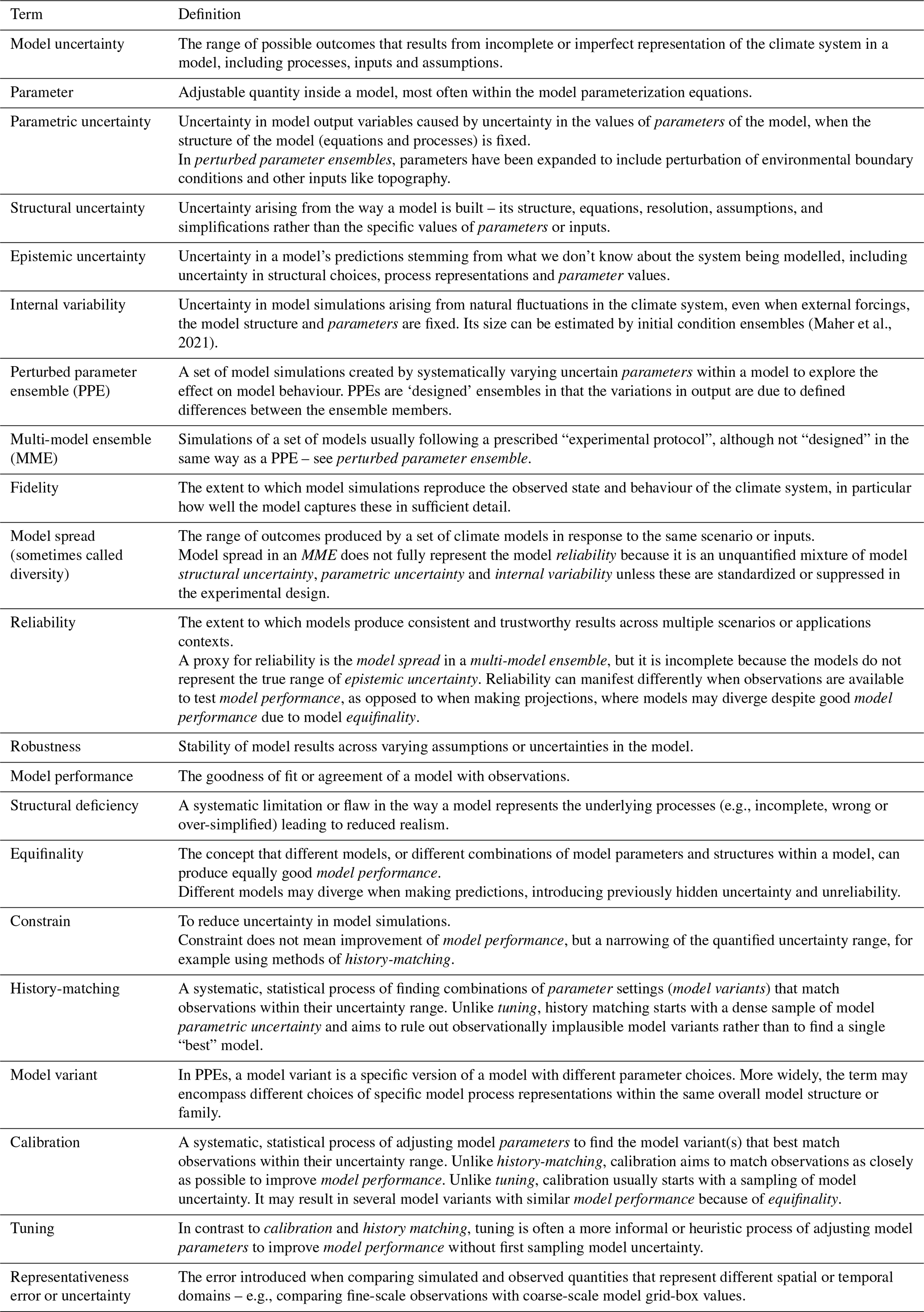
The other vital aspect of modelling alongside fidelity is reliability – the extent to which models produce consistent and trustworthy results across multiple scenarios. The primary approach used to assess model reliability is the model intercomparison project (MIP), where the spread of simulations serves as a rough, yet incomplete, proxy for reliability (see Table 1 for a glossary of uncertainty terms used in this article). The number of climate MIPs has grown from two standardized experimental protocols in the 1990s to 322 in phase 6 of the Coupled Model Intercomparison Project (CMIP) in 2017 (Durack et al., 2025; Stevens, 2024). MIPs have revealed systematic model biases, improved our understanding of the climate system, and guided international assessments and policy. However, MIPs represent an incomplete and unquantified mixture of model structural differences, parametric uncertainties and internal variability (Knutti et al., 2010).
The incompleteness of MIPs has two important consequences. Firstly, MIPs represent the main way that we communicate plausible uncertainties to wider science and impact communities – for example through a subset of CMIP simulations that inform IPCC's Impacts, Adaptation and Vulnerability assessments (WG2). An incomplete representation of uncertainties may therefore have conveyed an unjustifiably high level of confidence, inconsistent with the underlying physical modelling. The second consequence relates to how we move forward. Without a full understanding of the magnitude and causes of model spread, we lack the information required to improve model reliability, assuming this is possible.
Although the community emphasizes model complexity, greater complexity does not equate to greater reliability (Baartman et al., 2020; Knüsel and Baumberger, 2020; Proske et al., 2024; Puy et al., 2022). This is essentially the over-fitting problem – see Fig. 1. Over more than 30 years and six phases of CMIP, increasingly detailed components of the climate system have been evaluated and compared across models (Durack et al., 2025). Yet, for key emergent climate metrics – such as climate sensitivity, cloud feedback, and aerosol radiative forcing – the spread among models has remained substantial. The famous quote from George Box “All models are wrong, but some are useful” was followed by perhaps the more relevant statement that “The scientist cannot obtain a `correct' [model] by excessive elaboration” (Box, 1976; Carslaw et al., 2018). Climate model spread might persist or even grow as we obtain new knowledge (Knutti and Sedláček, 2013), and we may at present even be underestimating the spread. But it is also the case that efforts to enhance model complexity have not been matched by efforts to understand and reduce the uncertainty that it introduces. In short, our understanding of model uncertainty is incomplete, and we are certainly not on a path to reducing it.
Increases in model resolution will further enhance model fidelity (Slingo et al., 2022). However, some critical processes will always be parameterized even in km-scale models (Morrison et al., 2020), which will continue to affect model reliability. Furthermore, any high-resolution MIP to assess reliability would still represent an unquantified mixture of structural differences, parametric uncertainties and internal variability, making assessment of reliability perhaps even more challenging.
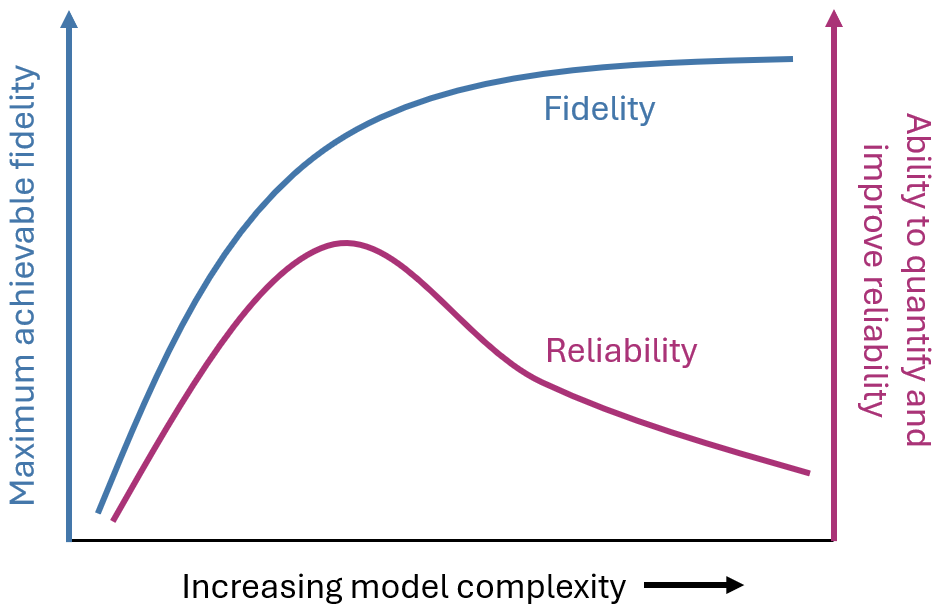
Figure 1Schematic of the model complexity-reliability challenge. Models with greater complexity can in principle achieve higher fidelity. However, higher-complexity models have a larger number of uncertain processes in them, which become increasingly difficult to verify against observations. This is often referred to as over-fitting. Complex models are also slower to run, which limits how the tools of uncertainty quantification and reliability assessment, such as PPEs, can be applied.
What is the role of perturbed parameter ensembles? The prevailing view is that the uncertainty caused by adjustable quantities inside a model (the parameters – see Table 1) is just a small part of the overall uncertainty challenge – mainly just a component of model tuning. While tuning is essential and universal (Hourdin et al., 2017; Mauritsen et al., 2012), expansion into full perturbed parameter ensembles (PPEs) in which combinations of parameters are systematically perturbed, is given much lower priority than structural changes to models. When a model is structurally deficient – due to low resolution or missing processes – addressing these issues is prioritized, while PPEs are seen as merely “over-polishing” a structurally deficient model. This narrow perspective is one that we challenge here.
In this article, we highlight how PPE science has expanded since the 2015 Workshop on Uncertainty Quantification in Climate Modeling and Projection (Qian et al., 2016) to address the overall challenge of model uncertainty and to provide an increasingly deep, process-level understanding of model behaviour. In particular, we argue that PPEs can help to more fully characterize current model uncertainty and provide a path toward reducing it. We start with a brief introduction to PPEs before summarizing the range of recent PPE studies in atmospheric and climate science, how they are contributing to wider climate science challenges, and how these efforts could be further developed.
Table 1Glossary of uncertainty terms referred to in this article. Terms in italic are defined elsewhere in the table.
A perturbed parameter ensemble (PPE) is a set (ensemble) of model simulations in which each simulation has a different combination of selected parameters. In a traditional PPE, the parameters are most-often quantities in the model's defining equations (parameterizations) and the purpose is to determine how combinations of parameter perturbations affect the model outputs. A PPE therefore explores the joint effects of changes in several parameters across a multi-dimensional “parameter space” that cannot be learned by adjusting one parameter at a time. The increasingly diverse application of PPEs in climate and atmospheric science originated in pioneering work on idealised experiments that doubled CO2 concentrations (Murphy et al., 2004; Stainforth et al., 2005).
The PPE approach has been extended to include a wider range of quantities that can control the model outputs, such as gas and aerosol emission factors and, for some types of model set-up, boundary conditions (or “forcings”) like sea surface temperature or humidity. One benefit of this hybrid approach is that model behaviour and uncertainty can be explored in a consistent way over a range of environmental conditions (Wellmann et al., 2018).
PPEs are often combined with statistical (Lee et al., 2011; Qian et al., 2018) or machine learning (Elsaesser et al., 2025; Gettelman et al., 2024) emulation to create a much larger sample of input/output combinations for statistical analysis (Fig. 2). This is often necessary due to the high computational cost of the model, which limits simulations to a very sparse coverage of the multi-dimensional parameter space. Emulators are trained to learn the relationship between parameter settings and model outputs and, once trained, are fast to compute. Emulators enable model outputs to be estimated, ideally with associated emulator uncertainty, for any combination of parameter settings within the parameter space, which then provides a way to scale up from, say, 100 PPE members to millions of evaluations for statistical analysis. Typically, an ensemble of around 5–10 simulations per parameter produces a useful emulator, making PPEs a highly efficient computational method for exploring model behaviour and uncertainty. New ML/AI methods are enabling emulators to be built efficiently, reducing the cost of sampling parameter space for PPEs (Elsaesser et al., 2025; Gettelman et al., 2024).
Although PPEs are distinct from initial-condition ensembles (Maher et al., 2021), a PPE may sample internal variability, and methods have been developed to account for it in building emulators (Rostron et al., 2020; Sansom et al., 2024).
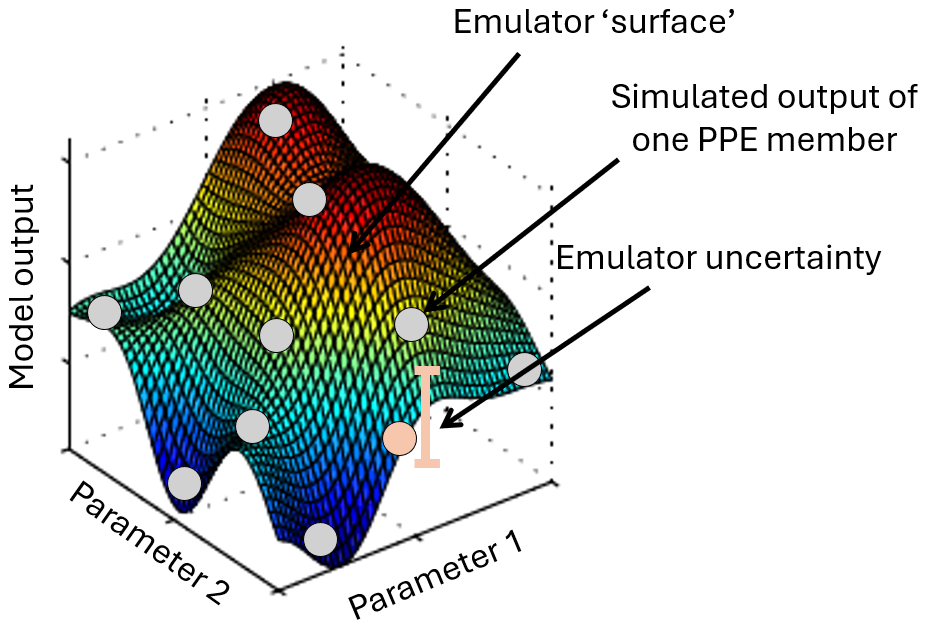
Figure 2A perturbed parameter ensemble and an emulator trained on the data to describe a mapping between the input parameter values and the model outputs across a multi-dimensional parameter space. The emulator can then be used to generate millions of “model variants” for any combination of parameter values for statistical analysis.
This article is partly based on discussions between around 70 participants at the World Climate Research Programme workshop on the Analysis of PPEs in Atmospheric Research (APPEAR) in 2022. The APPEAR workshop demonstrated an enormous breadth of research using PPEs across over twenty models covering climate, aerosols, atmospheric chemistry, clouds and meteorology over spatial scales from large-eddy models through to regional weather and global climate models – see Fig. 3. The articles cited in this Opinion represent PPE studies from around 28 research groups across these science areas.
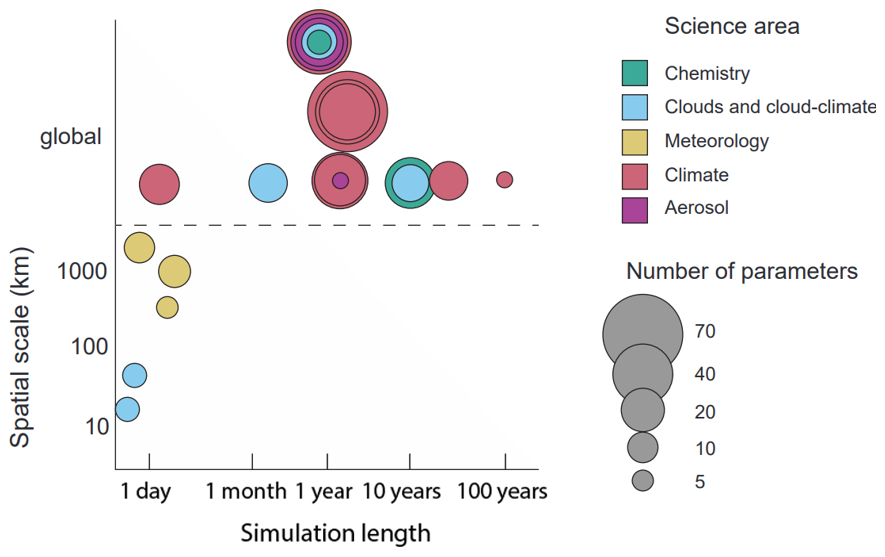
Figure 3PPEs in climate and atmospheric science presented at the WCRP APPEAR workshop. The area of each point scales with the number of parameters that were perturbed. The simulation length represents the time horizon of the simulations of each individual PPE member.
In global climate, PPEs cover timescales of a few days to 100 years with 3 to more than 70 parameters perturbed. PPEs have been used to:
-
Understand and constrain uncertainty in climate sensitivity (Brown et al., 2025; Hourdin et al., 2023; Peatier et al., 2022; Shiogama et al., 2014; Yokohata et al., 2010), energy budgets (Yang et al., 2023), precipitation (Jiang et al., 2025; Qian et al., 2015), and cloud forcing and feedbacks (Duffy et al., 2023; Eidhammer et al., 2024; Furtado et al., 2023; Gettelman et al., 2024; Tsushima et al., 2020; Zhang et al., 2018).
-
Constrain climate projections and future warming rates (Peace et al., 2020; Watson-Parris, 2025; Yamazaki et al., 2021), the latter using model performance over a range of timescales from weather to climate (Sexton et al., 2021).
-
Understand regional climate (Bellprat et al., 2012; Liu et al., 2022a), regional atmospheric circulation systems (Peace et al., 2022; Zhang et al., 2023), drivers of the Atlantic Meridional Overturning Circulation (Yamazaki et al., 2024), and the causes of regional temperature and precipitation biases (Li et al., 2019).
-
Define “variants” of a model that span a range of behaviours, such as the “calibrated physics ensemble” of GISS ModelE for submission to CMIP6 (Elsaesser et al., 2025), climate model variants that span a range of climate sensitivities (Hourdin et al., 2023; Peatier et al., 2022), and samples of extreme climates to support climate adaptation (Leach et al., 2022). PPEs show that the parametric uncertainty of a single model can be similar to that of multi-model ensembles (Duffy et al., 2023).
-
Define and categorise structural errors within a climate model by identifying trade-offs between errors in different locations and fields and biases that are orthogonal to those resulting from parameter perturbations (Peatier et al., 2024).
In aerosol, global-scale PPEs have been used to:
-
Understand and quantify model parameters controlling aerosol properties (Carslaw et al., 2013; Fanourgakis et al., 2019; Hamilton et al., 2014; Lee et al., 2011, 2012, 2013) and radiative forcing (Bhatti et al., 2026; Carslaw et al., 2013; Regayre et al., 2015, 2014), and to inform wider climate model tuning efforts (Sexton et al., 2021).
-
Observationally constrain uncertainty in aerosol radiative forcing (Carzon et al., 2023; Johnson et al., 2018, 2020; Lee et al., 2016; McCoy et al., 2020; Regayre et al., 2018, 2020; Watson-Parris et al., 2020) and aerosol–cloud adjustments (Mikkelsen et al., 2025a; Song et al., 2024). In the stratosphere, a PPE explored how combinations of eruption properties affect volcanic radiative forcing (Marshall et al., 2019). As is the case for the whole climate system, parametric uncertainty in aerosol radiative forcing in one model can be comparable to the multi-model spread (Regayre et al., 2018; Yoshioka et al., 2019).
-
Quantify the effect of aerosol on climate change, including climate threshold exceedances (Peace et al., 2020) and the climatic effect of historical volcanic eruptions using ice core sulfate measurements (Marshall et al., 2021).
-
Expose model structural deficiencies in the representation of aerosols and clouds (Prévost et al., 2026; Regayre et al., 2023).
-
Simulate the aerosol effects on East Asian climate and their parametric uncertainties associated with emissions and cloud microphysics (Yan et al., 2015).
In chemistry, PPEs have been used to:
-
Quantify the sensitivity of ozone, hydroxyl radicals and methane lifetime to atmospheric conditions, uncertain processes and emissions across three global models, identifying the cause of differing model responses (Wild et al., 2020).
-
Robustly calibrate model parameters through observational constraint to measured gas concentrations (Ryan and Wild, 2021). In a regional chemistry model, PPEs were used to define the important parameters of a complex organic chemistry scheme (Reyes-Villegas et al., 2023) and on the global scale to expose potential structural deficiencies in a secondary organic aerosol scheme (Sengupta et al., 2021).
In cloud physics, PPEs have been applied from large-eddy scale to global scale.
-
For shallow clouds, PPEs at the large-eddy scale with model domains of tens of km and resolutions of tens of metres have exposed how combinations of cloud-controlling factors (environmental conditions such as above-cloud humidity and potential temperature) affect cloud evolution and adjustments to changes in aerosol (Glassmeier et al., 2019; Sansom et al., 2024, 2026). They have provided considerable insight into how stratocumulus cloud-field properties vary over a wide range of states and to understand the timescales of cloud response to shipping emissions (Glassmeier et al., 2021). For mixed-phase clouds, they have exposed how microphysical processes have a non-linear interacting effect on cloud properties (Huang et al., 2026).
-
For deep convective clouds, the key parameters controlling liquid and ice hydrometeors and precipitation (Johnson et al., 2015) and anvil cirrus (Hawker et al., 2021) in high-resolution (60 to 250 m) models have been identified, as well as the relative importance of model parameters and environmental conditions for forecasting deep convection and hail (Wellmann et al., 2018, 2020). On the global scale, the response of circulation and cloud responses to surface warming has been analysed to understand the results from multi-model ensembles (Schiro et al., 2019).
-
On regional climate scales, Qian et al. (2015) used a set of short PPE simulations to understand how cloud forcing depends on different sets of parameters over different regions.
In meteorology, PPEs have been used to:
-
Understand how environmental conditions and uncertainties in cloud microphysics affect the evolution of weather-scale phenomena. Studies with 500 m grid spacing examined how 11 environmental conditions like boundary layer height and soil moisture interact to affect the characteristics of sea breezes under dry (Igel et al., 2018) and moist (Park et al., 2020) convective conditions. At 3.3 km grid spacing a PPE has been used to quantify the relative importance of uncertainties in low-level temperature and moisture compared to uncertainty in cloud microphysical processes in numerical weather predictions of warm conveyor belts (Oertel et al., 2025). This PPE was also used to quantify sensitivities of cirrus cloud properties and water vapor transport into the upper troposphere/lower stratosphere region to cloud microphysical parameters (Schwenk et al., 2025).
-
Guide model development for improved tracking of wind and solar energy, as well as the design of major field studies (Berg et al., 2021; Yang et al., 2017, 2019). These studies examined the sensitivity of turbine-height wind speeds to parameters in planetary boundary layer and surface-layer schemes, quantifying both parametric and structural sensitivities. The parametric sensitivity of solar irradiance to model parameters related to cloud and aerosol processes has also been assessed in WRF-Solar, allowing these parameters to be optimized to enhance irradiance forecasting skill by up to 33 % (Liu et al., 2022b, c).
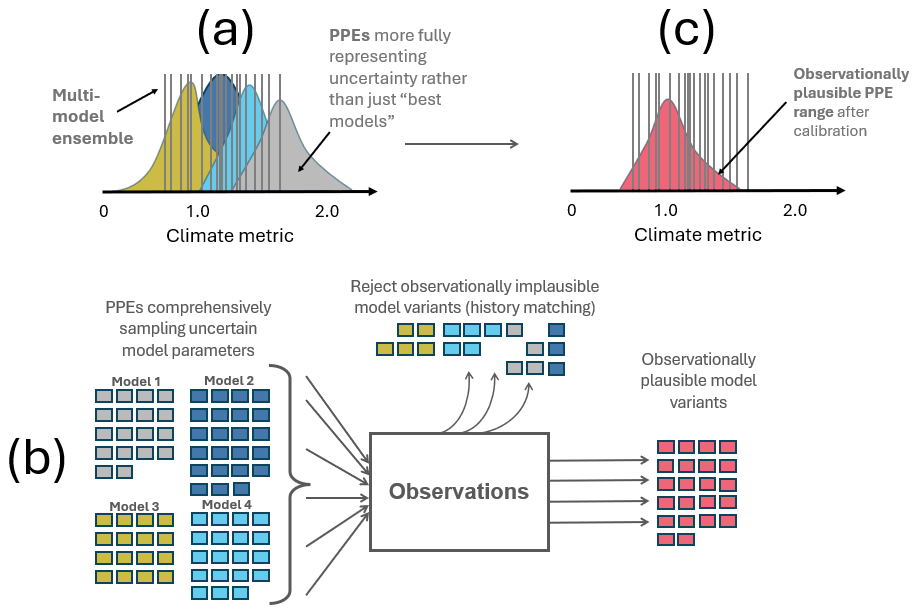
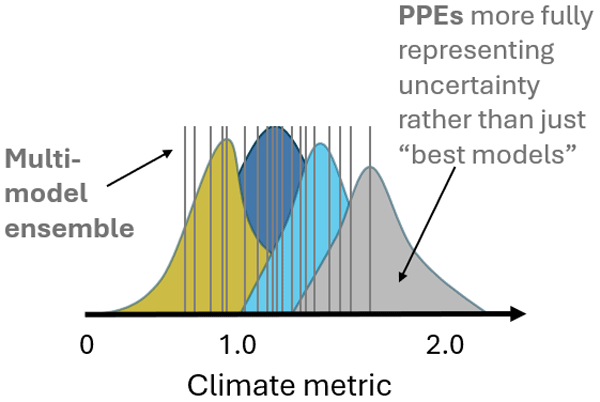
Figure 4Schematic illustrating two aspects of PPEs. (a) PPEs more fully represent model uncertainties than a multi-model ensemble (MME) of well-configured best estimates from several modelling centres. The MME (grey vertical lines) represents an unquantified mixture of structural differences, parametric uncertainties and internal variability, making it difficult to understand and ultimately reduce the spread in predictions or projections. PPEs (shown by pdfs) provide a way of cleanly separating structural and parametric uncertainty. (b) Statistically rigorous model calibration can be used to constrain the multi-model PPE range – shown in (c) – by defining a set of observationally plausible model variants. If emulators are trained on the PPE data, then effectively millions of model variants can be generated, allowing for rigorous statistical analysis (see Sect. 2), which is not possible with an MME. Variants are typically ruled out using a scoring approach like the implausibility metric (Craig et al., 1997; Williamson et al., 2013).
In this “golden age of climate modeling” (Betancourt, 2022) we argue that PPEs ought to be included alongside the increases in complexity, resolution, initial-condition ensembles and model intercomparison projects. Effort in this direction would adjust the balance towards greater consideration of model reliability (consistent and trustworthy results) and plausible model spread alongside existing efforts to improve model fidelity (models resembling the real world). We make eleven recommendations in six areas:
-
Use PPEs to understand model structural differences and deficiencies, and to define priorities for model development or simplification. PPEs provide a very effective way to disentangle structural and parametric causes of model–observation biases, which would provide valuable information for prioritising model developments. For example, such separation would help to prevent over-tuning of parameters, a practice that is likely to obscure structural deficiencies and the need for targeted model developments. It would also help to prevent the addition of process-level details to a model where a comprehensive sampling of parameter space might remove biases – i.e., where the need for structural changes is not supported by observational evidence. PPEs offer a rigorous framework for identifying where model developments would be most effective, reducing reliance on the interests or parameterization-specific expertise of development teams.
PPEs have exposed structural errors when a comprehensive sampling of the model's parameter space fails to capture observed system behaviour (Peatier et al., 2024) and when there are inconsistencies among observational constraints (Regayre et al., 2023). Successful efforts to understand structural differences and to detect deficiencies have so far involved global climate models (Furtado et al., 2023; Rostron et al., 2020; Sanderson, 2011; Shiogama et al., 2014; Tsushima et al., 2020; Yokohata et al., 2010), land surface models (Hawkins et al., 2019; McNeall et al., 2016), ocean models (Williamson et al., 2015), and regional and global chemistry and aerosol models (Regayre et al., 2023; Reyes-Villegas et al., 2023; Sengupta et al., 2021).
Alongside the detection of model deficiencies, PPEs can also help to identify opportunities for model simplification (Proske et al., 2022, 2023). Developing parsimonious models that maintain simplicity without sacrificing fidelity increases model robustness, computational efficiency, and interpretability.
The effort needed to operationalize this activity – integrating PPEs into the model development cycle – should be seen in the context of the current, suboptimal approach to model development. A well-designed PPE can be exploited by an entire development team to consistently tackle biases. There have been several barriers to wider adoption of the PPE approach, such as the challenge of selecting appropriate parameters and perturbation ranges (which often requires input from multiple developers), designing the simulations, implementing the perturbations in models, defining efficient workflows and simulation submission scripts, and the large data volumes that are produced. However, we estimate that PPEs have now been developed across a wide range of model types by over twenty research groups in small research teams and large modelling centres, which has reduced some of the knowledge barriers. Barriers to wider operationalisation have been successfully tackled at several modelling centres with streamlined PPE workflows (Elsaesser et al., 2025; Yarger et al., 2024). We argue that operationalization could enable a step-change in model evaluation and development that takes us beyond the current incremental advancements between MIPs.
We recommend developing a deeper understanding of how PPEs in combination with observations can be used to detect structural deficiencies in models. This should include new methods, e.g., using machine learning and structurally diverse models, to relate model-observation biases to deficiencies in the way that processes are represented in models.
We also recommend building PPEs into the model development cycle rather than being a separate activity after the tuned model version has been released. Such integration would enable model developers to understand the strengths and limitations of their parameterisation schemes and where model development is most needed and would be most effective.
-
Include PPEs in MIPs to link known uncertainties through to adaptation and mitigation decision making, to understand inter-model differences, and to lay the foundation for rigorous multi-model calibration.
Multi-Model Ensembles (MMEs) are the main way that we communicate plausible uncertainties to wider science and impact communities. Adaptation, for example, is informed through a subset of CMIP simulations that are considered in IPCC's Impacts, Adaptation and Vulnerability assessments (WG2). However, we lack a mechanism to capture the wider uncertainties associated with PPEs in current MMEs (Fig. 4a), even when modelling centres are aware of them. For example, Golaz et al. (2013) showed that there were multiple parameter configurations of their GFDL climate model consistent with observed present-day climate, but which simulated very different historical temperature evolutions. PPE ensembles subsequent to IPCC's 4th Assessment MIP (CMIP3) (Shiogama et al., 2014; Watanabe et al., 2012) showed that the CMIP3 MIROC3 configuration was right on the lower end of the 4–10 K PPE range of climate sensitivities consistent with MIROC3's formulation. Absence of this PPE context led to the impression of a more confident CMIP3 uncertainty range than supported by the known model uncertainties. There is likely to be similar tension for modelling centres for the upcoming CMIP7. For example, PPEs show how the development of the UK climate model has led to improvements in radiative fluxes compared to observations (Rostron et al., 2025), but with typically larger climate feedbacks than the previous model configuration (that was deemed in CMIP6 to already be warmer than the IPCC's likely range). In the absence of a mechanism to capture PPE configurations in MMEs, insights from potential alternative configurations will not be captured in CMIP7 and will therefore not be visible to the wider science and impact communities.
Systematic inclusion of PPEs within MMEs opens up the potential for fuller, more rigorous multi-model calibration. A multi-model PPE (MMPPE) combined with emulators to generate dense samples of model data (Fig. 2) would offer new opportunities to exploit statistical history matching (Craig et al., 1997; Lee et al., 2016; Williamson et al., 2013) or other calibration methods to observationally constrain climate metrics – Fig. 4b. In contrast, the unquantified mix of dozens of model structural, parametric and initial-condition uncertainties represented by an extremely small number of MME members makes it statistically inappropriate to constrain the spread by down-weighting single models (Knutti et al., 2010) – Fig. 4c. History matching has been used successfully to constrain individual PPEs and would be readily extendable to multi-model PPEs regardless of whether they followed a standardized protocol. Submission of a few PPE members to MIPs that span a range of model behaviours or climate metrics would be an efficient initial approach (Elsaesser et al., 2025; Hourdin et al., 2023; Peatier et al., 2022).
We recommend submission of selected PPE simulations to multi-model intercomparison projects to (i) remove the emphasis on over-tuned “best” models so that plausible uncertainties can be more fully communicated to wider science and impacts communities, (ii) more-comprehensively define model reliability, (iii) gain a deeper insight into the causes of multi-model spread, and (iv) enable statistically rigorous calibration of MMEs against observations. Multi-model PPEs (MMPPEs) will require an improved level of parameterization documentation, although efforts to design MMPPEs may naturally bring this about.
We also recommend efforts to separate internal variability and parametric uncertainty so that PPEs of models exhibiting dynamic variability can be more easily compared. This could be achieved by running an initial condition ensemble in combination with a PPE.
-
Adopt a common set of constraining observations and associated uncertainties. While observations are extensively used in MIPs (Waliser et al., 2020) to document and compare model skill, with MMPPEs they could also be used for model calibration (Fig. 4). This would require systematic quantification of observational uncertainties and model-observation representation errors (Johnson et al., 2020; Schutgens et al., 2017, 2016). The challenge is particularly large because inspection of individual uncertainties is infeasible when comparing millions of model variants (estimates from emulators) against thousands of observations in an automated statistical manner (Johnson et al., 2020). Reliable information on observation uncertainty is also required in the detection of potential structural deficiencies (point 1) to avoid misattributing the causes of model-observations biases.
We recommend defining sets of observations for model constraint, including consideration of observation uncertainties and their representation errors in a form that would enable automated calibration of very large sets of model output.
We also recommend closer collaboration of the modelling and observational communities to understand the requirements of model uncertainty quantification. This could include (i) efforts towards systematic measurement strategies in field campaigns that consider the representativeness of the measurements (Kahn et al., 2023) and how they would be ingested into automated model calibration; (ii) consideration of structural uncertainty in retrieval products through, for example, retrieval bundles (Chiu et al., 2024; Elsaesser et al., 2025).
-
Account for and address model equifinality as a major cause of model unreliability. Equifinality is where different combinations of model parameters or structures produce simulations that cannot be distinguished within the uncertainty of observations (Beven, 2006), but may diverge and cause large uncertainty in predictions or retrodictions (e.g., projections or historical climate simulations – see Fig. 5). In one example related to aerosols (Lee et al., 2016), equifinality was so strong that aerosol observations with arbitrarily small uncertainty had a very weak effect on the uncertainty in aerosol radiative forcing despite both quantities having common uncertain parameters. Equifinality has profound implications for our interpretation of model performance (how well models match observations), which does not guarantee reliable historical or future simulations (Golaz et al., 2013). Without a PPE, it is impossible to assess the scale of this problem.
Research is needed to identify the model processes responsible for compensating effects so that strategies can be developed to reduce their effect on model constraint. There are ways forward given that equifinality often occurs because observations of state variables (such as aerosol concentration) do not constrain the compensating processes, which we highlight in point 5.
We recommend research to understand the causes of error compensation (equifinality) and ways to minimize the effects.
We also recommend submission of equifinal model variants developed using PPE methods to future MIPs to better characterize model reliability and to understand which projection metrics are most affected by equifinality.
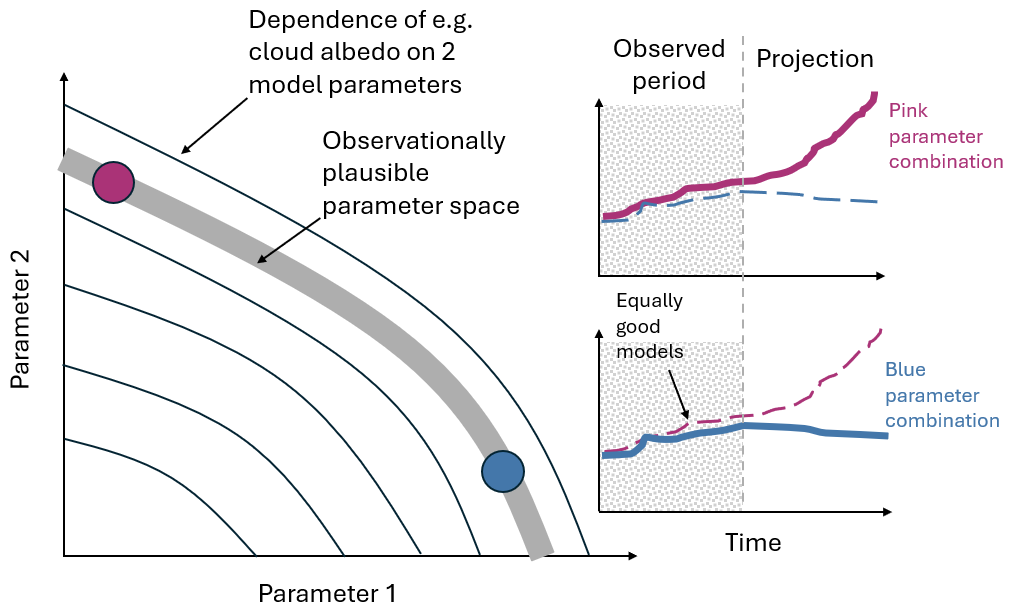
Figure 5Schematic of how equifinality affects model reliability. During the period with observations (stippled), the pink and blue parameter combinations have similar model performance and appear to be reliable, but they can diverge and become unreliable in projections. Poor model projection reliability can therefore be masked when simulating only one of the parameter combinations, but will become visible with a PPE.
- 5.
Use PPEs to identify new observations and new ways of using observations to constrain models. PPEs are a valuable tool to not only leverage existing observations better, but also to plan future observations targeted at model constraint. This objective was highlighted by community consensus in the US-CLIVAR sponsored workshop Micro2Macro: Origins of Climate Change Uncertainty (McCoy et al., 2025). There are opportunities, for example, to understand where observations are effective or ineffective at reducing model uncertainty, the processes that cause the remaining uncertainty, and which observations would help to reduce it (Regayre et al., 2026). There are also opportunities to use observations in more creative ways, such as observational constraint of model processes rather than just simulated states, which would help to reduce equifinality. Ultimately, we observe states, not processes, and we must stitch these states together with models to infer causation (Feingold et al., 2025; Hume, 1751). Outside of a few cases (Christensen et al., 2022; Malavelle et al., 2017; McCoy et al., 2018), it is very hard to infer causality from observations of state because of equifinality – many combinations of processes can yield the same state (Gryspeerdt et al., 2019; Stevens and Feingold, 2009; Wood et al., 2012). PPEs provide an opportunity to infer causation from observations (Mikkelsen et al., 2025b).
We recommend using PPEs to develop ways of identifying new observations or new combinations of existing observations with the greatest potential to constrain model uncertainty.
We also recommend exploiting PPEs to infer causation and process-level understanding from observations of atmospheric state.
- 6.
Exploit PPEs of hierarchies of models to understand system behaviour and develop parameterizations. Parameterization development typically involves a hierarchy of models and several steps, including understanding key process interactions across diverse environmental conditions, conducting sensitivity tests, and performing optimization and simplification (Gettelman, 2023). PPEs are ideal for tackling all these steps. PPEs of high-resolution process-based models have been performed in recent years and, as described above, they have helped to understand the joint effects of co-varying environmental conditions (Park et al., 2020; Sansom et al., 2024, 2026; Wellmann et al., 2020). Early research on connecting several models is very promising (Couvreux et al., 2021; Hourdin et al., 2021) and there is considerable scope to test or develop regime-aware parameterizations in a more comprehensive way than is possible with single perturbation studies or intercomparisons of process-based models (Blossey et al., 2016; Zhang et al., 2013).
We recommend applying PPEs across hierarchies of multi-scale models with varying levels of process sophistication to enhance our understanding of complex, nonlinear processes and to develop parameterisations for large-scale models.
In summary, we argue that PPEs:
-
Improve our understanding and quantification of model uncertainty in the widest sense by cleanly separating structural and parametric causes of uncertainty.
-
Provide deep insight into the causes of multi-model spread.
-
More fully characterize the plausible spread in climate projections, which is vital to better communicate current knowledge to downstream science, impacts and decisions.
-
Generate rich datasets that can be used for statistically rigorous observational calibration of model outputs to better characterize and reduce multi-model spread.
-
Guide the judicious selection of model structural developments or simplifications.
-
Guide observational strategies and ways of using existing observations to achieve the greatest possible constraint of models.
-
Provide a way to disentangle the interacting environmental drivers of system behaviour and to infer causation from observations of atmospheric state.
-
Contribute to the development of parameterizations by linking processes and sensitivities across a hierarchy of models.
We started this opinion piece by pointing out that there are several essentially competing efforts in climate modelling – complexity, resolution and initial condition ensembles. To this list we add perturbed parameter ensembles, which we argue are making a substantial contribution to assessing and improving model reliability and understanding model behaviour, which are vital given the high societal cost of model uncertainty (Hope, 2015). Increased model complexity and resolution will undoubtedly provide additional detailed and actionable information, for example about some types of extreme or local events, and there are proposals to consolidate such efforts (Stevens et al., 2024). However, the development of climate models over several decades has shown that, while our understanding of fundamental processes (knowledge uncertainty) has improved, we have not translated this improved knowledge into commensurate improvements in our understanding of model reliability. This lack of translation is what Box meant by “The scientist cannot obtain a `correct' [model] by excessive elaboration” (Box, 1976). We argue that PPEs provide the best opportunity to obtain models that are as `correct' as possible. Critically, applying PPEs as outlined here would enable more robust estimates of model uncertainty, empowering stakeholders to realistically evaluate risk and make informed decisions based on information from the Earth system modelling community, rather than relying on a single high-fidelity model variant. Treading a new path, with increased emphasis on the use of PPEs in model evaluation and development will help to address the model uncertainty challenge.
No original research data was generated in this article.
All authors contributed to the conceptualization and writing.
At least one of the (co-)authors is a member of the editorial board of Atmospheric Chemistry and Physics. The peer-review process was guided by an independent editor, and the authors also have no other competing interests to declare.
Publisher's note: Copernicus Publications remains neutral with regard to jurisdictional claims made in the text, published maps, institutional affiliations, or any other geographical representation in this paper. The authors bear the ultimate responsibility for providing appropriate place names. Views expressed in the text are those of the authors and do not necessarily reflect the views of the publisher.
The authors thank the World Climate Research Programme for supporting and facilitating the Workshop on Analysis of PPEs in Atmospheric Research. LR, DS and KY were supported by the Met Office Hadley Centre Climate Programme funded by DSIT. The Pacific Northwest National Laboratory is operated for the U.S. Department of Energy by the Battelle Memorial Institute under contract DE-AC05-76RL01830.
This research has been supported by the Natural Environment Research Council (grant nos. NE/X013901/1 and NE/Y001028/1); the European Commission, Horizon 2020 Framework Programme (grant no. 821205); the Research Council of Finland (grant no. 359166); the U.S. Department of Energy (grant nos. DE-SC0024161, DE-SC0021270, DE-SC0022323, and DESC0023151); the Transregional Collaborative Research Center SFB/TRR 165 “Waves to Weather”; the National Aeronautics and Space Administration (grant nos. MAP NNH16ZDA001 and MAP 80NSSC21K1498); the U.S. NSF (STC Learning the Earth with Artificial Intelligence and Physics – LEAP/AGS-2019625 and AGS-2203001); the Schweizerischer Nationalfonds zur Förderung der Wissenschaftlichen Forschung (grant no. 217899); and the Italia–Deutschland science-4-services network in weather and climate (4823IDEAP6) funded by the German Federal Ministry of Digital and Transport.
This paper was edited by Ivy Tan and Barbara Ervens and reviewed by Bjorn Stevens and Michael Schulz.
Baartman, J. E. M., Melsen, L. A., Moore, D., and van der Ploeg, M. J.: On the complexity of model complexity: Viewpoints across the geosciences, CATENA, 186, 104261, https://doi.org/10.1016/j.catena.2019.104261, 2020.
Bhatti, Y. A., Watson-Parris, D., Regayre, L. A., Jia, H., Neubauer, D., Im, U., Svenhag, C., Schutgens, N., Tsikerdekis, A., Nenes, A., Irfan, M., van Diedenhoven, B., Arifi, A., Fu, G., and Hasekamp, O. P.: Uncertainty in aerosol effective radiative forcing from anthropogenic and natural aerosol parameters in ECHAM6.3-HAM2.3, Atmos. Chem. Phys., 26, 269–293, https://doi.org/10.5194/acp-26-269-2026, 2026.
Bellprat, O., Kotlarski, S., Lüthi, D., and Schär, C.: Exploring Perturbed Physics Ensembles in a Regional Climate Model, J. Climate, 25, 4582–4599, https://doi.org/10.1175/JCLI-D-11-00275.1, 2012.
Berg, L. K., Liu, Y., Yang, B., Qian, Y., Krishnamurthy, R., Sheridan, L., and Olson, J.: Time Evolution and Diurnal Variability of the Parametric Sensitivity of Turbine-Height Winds in the MYNN-EDMF Parameterization, J. Geophys. Res.-Atmos., 126, e2020JD034000, https://doi.org/10.1029/2020JD034000, 2021.
Betancourt, M.: Are We Entering The Golden Age Of Climate Modeling?, Eos, https://doi.org/10.1029/2022EO220538, 2022.
Beven, K.: A manifesto for the equifinality thesis, J. Hydrol., 320, 18–36, https://doi.org/10.1016/j.jhydrol.2005.07.007, 2006.
Blossey, P. N., Bretherton, C. S., Cheng, A., Endo, S., Heus, T., Lock, A. P., and van der Dussen, J. J.: CGILS Phase 2 LES intercomparison of response of subtropical marine low cloud regimes to CO2 quadrupling and a CMIP3 composite forcing change, J. Adv. Model. Earth Sy., 8, 1714–1726, https://doi.org/10.1002/2016MS000765, 2016.
Box, G. E. P.: Science and Statistics, J. Am. Stat. A., 71, 791–799, https://doi.org/10.1080/01621459.1976.10480949, 1976.
Brown, J. K., Dorheim, K., Mu, D., Snyder, A., Tebaldi, C., and Bond-Lamberty, B.: The Effect of Different Climate Sensitivity Priors on Projected Climate: A Probabilistic Analysis, Geophys. Res. Lett., 52, e2024GL113505, https://doi.org/10.1029/2024GL113505, 2025.
Carslaw, K. S., Lee, L. A., Reddington, C. L., Pringle, K. J., Rap, A., Forster, P. M., Mann, G. W., Spracklen, D. V., Woodhouse, M. T., Regayre, L. A., and Pierce, J. R.: Large contribution of natural aerosols to uncertainty in indirect forcing, Nature, 503, 67–71, https://doi.org/10.1038/nature12674, 2013.
Carslaw, K. S., Lee, L. A., Regayre, L. A., and Johnson, J. S.: Climate Models Are Uncertain, but We Can Do Something About It, Eos, 99, https://doi.org/10.1029/2018EO093757, 2018.
Carzon, J., Abreu, B., Regayre, L., Carslaw, K., Deaconu, L., Stier, P., Gordon, H., and Kuusela, M.: Statistical constraints on climate model parameters using a scalable cloud-based inference framework, Environ. Data Sci., 2, e24, https://doi.org/10.1017/eds.2023.12, 2023.
Chiu, C., Ma, P.-L., Silber, I., Theisen, A., Williams, C., Ghate, V., O'Brien, J., Zhang, D., Chen, H., Comstock, J., Elsaesser, G., Feng, Y.-C., Gupta, S., Gustafson, W., Muradyan, P., Sockol, A., Yuan, T., Zhang, Y., Zheng, X., and Zhu, Z.: ARM Cloud and Precipitation Measurements and Science Group (CPMSG) 2024 Workshop Report, U.S. Department of Energy, Atmospheric Radiation Measurement user facility, Richland, Washington, 2024.
Christensen, M. W., Gettelman, A., Cermak, J., Dagan, G., Diamond, M., Douglas, A., Feingold, G., Glassmeier, F., Goren, T., Grosvenor, D. P., Gryspeerdt, E., Kahn, R., Li, Z., Ma, P.-L., Malavelle, F., McCoy, I. L., McCoy, D. T., McFarquhar, G., Mülmenstädt, J., Pal, S., Possner, A., Povey, A., Quaas, J., Rosenfeld, D., Schmidt, A., Schrödner, R., Sorooshian, A., Stier, P., Toll, V., Watson-Parris, D., Wood, R., Yang, M., and Yuan, T.: Opportunistic experiments to constrain aerosol effective radiative forcing, Atmos. Chem. Phys., 22, 641–674, https://doi.org/10.5194/acp-22-641-2022, 2022.
Couvreux, F., Hourdin, F., Williamson, D., Roehrig, R., Volodina, V., Villefranque, N., Rio, C., Audouin, O., Salter, J., Bazile, E., Brient, F., Favot, F., Honnert, R., Lefebvre, M.-P., Madeleine, J.-B., Rodier, Q., and Xu, W.: Process-Based Climate Model Development Harnessing Machine Learning: I. A Calibration Tool for Parameterization Improvement, J. Adv. Model. Earth Sy., 13, e2020MS002217, https://doi.org/10.1029/2020MS002217, 2021.
Craig, P. S., Goldstein, M., Seheult, A. H., and Smith, J. A.: Pressure Matching for Hydrocarbon Reservoirs: A Case Study in the Use of Bayes Linear Strategies for Large Computer Experiments, in: Case Studies in Bayesian Statistics, Conference paper, Springer, New York, NY, 37–93, https://doi.org/10.1007/978-1-4612-2290-3_2, 1997.
Duffy, M. L., Medeiros, B., Gettelman, A., and Eidhammer, T.: Perturbing Parameters to Understand Cloud Contributions to Climate Change, J. Climate, 37, 213-227, https://doi.org/10.1175/JCLI-D-23-0250.1, 2023.
Durack, P. J., Taylor, K. E., Gleckler, P. J., Meehl, G. A., Lawrence, B. N., Covey, C., Stouffer, R. J., Levavasseur, G., Ben-Nasser, A., Denvil, S., Stockhause, M., Gregory, J. M., Juckes, M., Ames, S. K., Antonio, F., Bader, D. C., Dunne, J. P., Ellis, D., Eyring, V., Fiore, S. L., Joussaume, S., Kershaw, P., Lamarque, J.-F., Lautenschlager, M., Lee, J., Mauzey, C. F., Mizielinski, M., Nassisi, P., Nuzzo, A., O’Rourke, E., Painter, J., Potter, G. L., Rodriguez, S., and Williams, D. N.: The Coupled Model Intercomparison Project (CMIP): Reviewing project history, evolution, infrastructure and implementation, EGUsphere [preprint], https://doi.org/10.5194/egusphere-2024-3729, 2025.
Eidhammer, T., Gettelman, A., Thayer-Calder, K., Watson-Parris, D., Elsaesser, G., Morrison, H., van Lier-Walqui, M., Song, C., and McCoy, D.: An extensible perturbed parameter ensemble for the Community Atmosphere Model version 6, Geosci. Model Dev., 17, 7835–7853, https://doi.org/10.5194/gmd-17-7835-2024, 2024.
Elsaesser, G. S., van Lier-Walqui, M., Yang, Q., Kelley, M., Ackerman, A. S., Fridlind, A. M., Cesana, G. V., Schmidt, G. A., Wu, J., Behrangi, A., Camargo, S. J., De, B., Inoue, K., Leitmann-Niimi, N. M., and Strong, J. D. O.: Using Machine Learning to Generate a GISS ModelE Calibrated Physics Ensemble (CPE), J. Adv. Model. Earth Sy., 17, e2024MS004713, https://doi.org/10.1029/2024MS004713, 2025.
Fanourgakis, G. S., Kanakidou, M., Nenes, A., Bauer, S. E., Bergman, T., Carslaw, K. S., Grini, A., Hamilton, D. S., Johnson, J. S., Karydis, V. A., Kirkevåg, A., Kodros, J. K., Lohmann, U., Luo, G., Makkonen, R., Matsui, H., Neubauer, D., Pierce, J. R., Schmale, J., Stier, P., Tsigaridis, K., van Noije, T., Wang, H., Watson-Parris, D., Westervelt, D. M., Yang, Y., Yoshioka, M., Daskalakis, N., Decesari, S., Gysel-Beer, M., Kalivitis, N., Liu, X., Mahowald, N. M., Myriokefalitakis, S., Schrödner, R., Sfakianaki, M., Tsimpidi, A. P., Wu, M., and Yu, F.: Evaluation of global simulations of aerosol particle and cloud condensation nuclei number, with implications for cloud droplet formation, Atmos. Chem. Phys., 19, 8591–8617, https://doi.org/10.5194/acp-19-8591-2019, 2019.
Feingold, G., Glassmeier, F., Zhang, J., and Hoffmann, F.: Opinion: Inferring process from snapshots of cloud systems, Atmos. Chem. Phys., 25, 10869–10885, https://doi.org/10.5194/acp-25-10869-2025, 2025.
Furtado, K., Tsushima, Y., Field, P. R., Rostron, J., and Sexton, D.: The Relationship Between the Present-Day Seasonal Cycles of Clouds in the Mid-Latitudes and Cloud-Radiative Feedback, Geophys. Res. Lett., 50, e2023GL103902, https://doi.org/10.1029/2023GL103902, 2023.
Gettelman, A.: Rainbows and climate change: a tutorial on climate model diagnostics and parameterization, Geosci. Model Dev., 16, 4937–4956, https://doi.org/10.5194/gmd-16-4937-2023, 2023.
Gettelman, A., Eidhammer, T., Duffy, M. L., McCoy, D. T., Song, C., and Watson-Parris, D.: The Interaction Between Climate Forcing and Feedbacks, J. Geophys. Res.-Atmos., 129, e2024JD040857, https://doi.org/10.1029/2024JD040857, 2024.
Glassmeier, F., Hoffmann, F., Johnson, J. S., Yamaguchi, T., Carslaw, K. S., and Feingold, G.: An emulator approach to stratocumulus susceptibility, Atmos. Chem. Phys., 19, 10191–10203, https://doi.org/10.5194/acp-19-10191-2019, 2019.
Glassmeier, F., Hoffmann, F., Johnson, J., Yamaguchi, T., Carslaw, K., and Feingold, G.: Aerosol-cloud-climate cooling overestimated by ship-track data, Science, 371, 485, https://doi.org/10.1126/science.abd3980, 2021.
Golaz, J.-C., Horowitz, L. W., and Levy II, H.: Cloud tuning in a coupled climate model: Impact on 20th century warming, Geophys. Res. Lett., 40, 2246–2251, https://doi.org/10.1002/grl.50232, 2013.
Gryspeerdt, E., Goren, T., Sourdeval, O., Quaas, J., Mülmenstädt, J., Dipu, S., Unglaub, C., Gettelman, A., and Christensen, M.: Constraining the aerosol influence on cloud liquid water path, Atmos. Chem. Phys., 19, 5331–5347, https://doi.org/10.5194/acp-19-5331-2019, 2019.
Hamilton, D. S., Lee, L. A., Pringle, K. J., Reddington, C. L., Spracklen, D. V., and Carslaw, K. S.: Occurrence of pristine aerosol environments on a polluted planet, P. Natl. Acad. Sci. USA, 111, 18466–18471, https://doi.org/10.1073/pnas.1415440111, 2014.
Hawker, R. E., Miltenberger, A. K., Johnson, J. S., Wilkinson, J. M., Hill, A. A., Shipway, B. J., Field, P. R., Murray, B. J., and Carslaw, K. S.: Model emulation to understand the joint effects of ice-nucleating particles and secondary ice production on deep convective anvil cirrus, Atmos. Chem. Phys., 21, 17315–17343, https://doi.org/10.5194/acp-21-17315-2021, 2021.
Hawkins, L. R., Rupp, D. E., McNeall, D. J., Li, S., Betts, R. A., Mote, P. W., Sparrow, S. N., and Wallom, D. C. H.: Parametric Sensitivity of Vegetation Dynamics in the TRIFFID Model and the Associated Uncertainty in Projected Climate Change Impacts on Western U.S. Forests, J. Adv. Model. Earth Sy., 11, 2787–2813, https://doi.org/10.1029/2018MS001577, 2019.
Hope, C.: The $10 trillion value of better information about the transient climate response, Philos. T. R. Soc. A, 373, 20140429, https://doi.org/10.1098/rsta.2014.0429, 2015.
Hourdin, F., Mauritsen, T., Gettelman, A., Golaz, J.-C., Balaji, V., Duan, Q., Folini, D., Ji, D., Klocke, D., Qian, Y., Rauser, F., Rio, C., Tomassini, L., Watanabe, M., and Williamson, D.: The Art and Science of Climate Model Tuning, B. Am. Meteorol. Soc., 98, 589–602, https://doi.org/10.1175/BAMS-D-15-00135.1, 2017.
Hourdin, F., Williamson, D., Rio, C., Couvreux, F., Roehrig, R., Villefranque, N., Musat, I., Fairhead, L., Diallo, F. B., and Volodina, V.: Process-Based Climate Model Development Harnessing Machine Learning: II. Model Calibration From Single Column to Global, J. Adv. Model. Earth Sy., 13, e2020MS002225, https://doi.org/10.1029/2020MS002225, 2021.
Hourdin, F., Ferster, B., Deshayes, J., Mignot, J., Musat, I., and Williamson, D.: Toward machine-assisted tuning avoiding the underestimation of uncertainty in climate change projections, Sci. Adv., 9, eadf2758, https://doi.org/10.1126/sciadv.adf2758, 2023.
Huang, X., Field, P. R., Herbert, R. J., Murray, B. J., van den Heuvel, F., Grosvenor, D. P., Sansom, R. W. N., and Carslaw, K. S.: Interacting effects of droplet number and ice formation processes on mixed-phase cold-air outbreak clouds, EGUsphere [preprint], https://doi.org/10.5194/egusphere-2026-311, 2026.
Hume, D.: Philosophical essays concerning human understanding, Second edition, with additions and corrections, Printed for M. Cooper, London, 1751.
Igel, A. L., van den Heever, S. C., and Johnson, J. S.: Meteorological and Land Surface Properties Impacting Sea Breeze Extent and Aerosol Distribution in a Dry Environment, J. Geophys. Res.-Atmos., 123, 22–37, https://doi.org/10.1002/2017JD027339, 2018.
Jiang, Y., Chen, L., Li, H., and Zhu, Y.: Parametric sensitivity analysis of East Asian summer-mean precipitation simulations by perturbed parameter ensemble experiments in CAM6, Atmos. Ocean. Sc. Lett., 19, 100667, https://doi.org/10.1016/j.aosl.2025.100667, 2025.
Johnson, J. S., Cui, Z., Lee, L. A., Gosling, J. P., Blyth, A. M., and Carslaw, K. S.: Evaluating uncertainty in convective cloud microphysics using statistical emulation, J. Adv. Model. Earth Sy., 7, 162–187, https://doi.org/10.1002/2014MS000383, 2015.
Johnson, J. S., Regayre, L. A., Yoshioka, M., Pringle, K. J., Lee, L. A., Sexton, D. M. H., Rostron, J. W., Booth, B. B. B., and Carslaw, K. S.: The importance of comprehensive parameter sampling and multiple observations for robust constraint of aerosol radiative forcing, Atmos. Chem. Phys., 18, 13031–13053, https://doi.org/10.5194/acp-18-13031-2018, 2018.
Johnson, J. S., Regayre, L. A., Yoshioka, M., Pringle, K. J., Turnock, S. T., Browse, J., Sexton, D. M. H., Rostron, J. W., Schutgens, N. A. J., Partridge, D. G., Liu, D., Allan, J. D., Coe, H., Ding, A., Cohen, D. D., Atanacio, A., Vakkari, V., Asmi, E., and Carslaw, K. S.: Robust observational constraint of uncertain aerosol processes and emissions in a climate model and the effect on aerosol radiative forcing, Atmos. Chem. Phys., 20, 9491–9524, https://doi.org/10.5194/acp-20-9491-2020, 2020.
Kahn, R. A., Andrews, E., Brock, C. A., Chin, M., Feingold, G., Gettelman, A., Levy, R. C., Murphy, D. M., Nenes, A., Pierce, J. R., Popp, T., Redemann, J., Sayer, A. M., da Silva, A. M., Sogacheva, L., and Stier, P.: Reducing Aerosol Forcing Uncertainty by Combining Models With Satellite and Within-The-Atmosphere Observations: A Three-Way Street, Rev. Geophys., 61, e2022RG000796, https://doi.org/10.1029/2022RG000796, 2023.
Knüsel, B. and Baumberger, C.: Understanding climate phenomena with data-driven models, Stud. Hist. Philos. Sci. A, 84, 46–56, https://doi.org/10.1016/j.shpsa.2020.08.003, 2020.
Knutti, R. and Sedláček, J.: Robustness and uncertainties in the new CMIP5 climate model projections, Nat. Clim. Change, 3, 369–373, https://doi.org/10.1038/nclimate1716, 2013.
Knutti, R., Furrer, R., Tebaldi, C., Cermak, J., and Meehl, G.: Challenges in Combining Projections from Multiple Climate Models, J. Climate, 23, 2739–2758, https://doi.org/10.1175/2009JCLI3361.1, 2010.
Leach, N. J., Watson, P. A. G., Sparrow, S. N., Wallom, D. C. H., and Sexton, D. M. H.: Generating samples of extreme winters to support climate adaptation, Weather and Climate Extremes, 36, 100419, https://doi.org/10.1016/j.wace.2022.100419, 2022.
Lee, L. A., Carslaw, K. S., Pringle, K. J., Mann, G. W., and Spracklen, D. V.: Emulation of a complex global aerosol model to quantify sensitivity to uncertain parameters, Atmos. Chem. Phys., 11, 12253–12273, https://doi.org/10.5194/acp-11-12253-2011, 2011.
Lee, L. A., Carslaw, K. S., Pringle, K. J., and Mann, G. W.: Mapping the uncertainty in global CCN using emulation, Atmos. Chem. Phys., 12, 9739–9751, https://doi.org/10.5194/acp-12-9739-2012, 2012.
Lee, L. A., Pringle, K. J., Reddington, C. L., Mann, G. W., Stier, P., Spracklen, D. V., Pierce, J. R., and Carslaw, K. S.: The magnitude and causes of uncertainty in global model simulations of cloud condensation nuclei, Atmos. Chem. Phys., 13, 8879–8914, https://doi.org/10.5194/acp-13-8879-2013, 2013.
Lee, L. A., Reddington, C. L., and Carslaw, K. S.: On the relationship between aerosol model uncertainty and radiative forcing uncertainty, P. Natl. Acad. Sci. USA, 113, 5820–5827, https://doi.org/10.1073/pnas.1507050113, 2016.
Li, S., Rupp, D. E., Hawkins, L., Mote, P. W., McNeall, D., Sparrow, S. N., Wallom, D. C. H., Betts, R. A., and Wettstein, J. J.: Reducing climate model biases by exploring parameter space with large ensembles of climate model simulations and statistical emulation, Geosci. Model Dev., 12, 3017–3043, https://doi.org/10.5194/gmd-12-3017-2019, 2019.
Liu, S., Yang, B., Guo, Z., Wang, M., Qian, Y., Huang, A., and Zhang, Y.: Quantifying the local and remote impacts of sub-grid physical processes on the Southeast Pacific sea surface fluxes in the Community Atmosphere Model version 5 by a limited-area parameter perturbation approach, Int. J. Climatol., 42, 1369–1387, https://doi.org/10.1002/joc.7308, 2022a.
Liu, Y., Qian, Y., Feng, S., Berg, L. K., Juliano, T. W., Jiménez, P. A., Grimit, E., and Liu, Y.: Calibration of cloud and aerosol related parameters for solar irradiance forecasts in WRF-solar, Sol. Energy, 241, 1–12, https://doi.org/10.1016/j.solener.2022.05.064, 2022b.
Liu, Y., Qian, Y., Feng, S., Berg, L. K., Juliano, T. W., Jiménez, P. A., and Liu, Y.: Sensitivity of solar irradiance to model parameters in cloud and aerosol treatments of WRF-solar, Sol. Energy, 233, 446–460, https://doi.org/10.1016/j.solener.2022.01.061, 2022c.
Maher, N., Milinski, S., and Ludwig, R.: Large ensemble climate model simulations: introduction, overview, and future prospects for utilising multiple types of large ensemble, Earth Syst. Dynam., 12, 401–418, https://doi.org/10.5194/esd-12-401-2021, 2021.
Malavelle, F. F., Haywood, J. M., Jones, A., Gettelman, A., Clarisse, L., Bauduin, S., Allan, R. P., Karset, I. H. H., Kristjánsson, J. E., Oreopoulos, L., Cho, N., Lee, D., Bellouin, N., Boucher, O., Grosvenor, D. P., Carslaw, K. S., Dhomse, S., Mann, G. W., Schmidt, A., Coe, H., Hartley, M. E., Dalvi, M., Hill, A. A., Johnson, B. T., Johnson, C. E., Knight, J. R., O'Connor, F. M., Partridge, D. G., Stier, P., Myhre, G., Platnick, S., Stephens, G. L., Takahashi, H., and Thordarson, T.: Strong constraints on aerosol–cloud interactions from volcanic eruptions, Nature, 546, 485–491, https://doi.org/10.1038/nature22974, 2017.
Marshall, L., Johnson, J., Mann, G., Lee, L., Dhomse, S., Regayre, L., Yoshioka, M., Carslaw, K., and Schmidt, A.: Exploring How Eruption Source Parameters Affect Volcanic Radiative Forcing Using Statistical Emulation, J. Geophys. Res.-Atmos., 124, 964–985, https://doi.org/10.1029/2018JD028675, 2019.
Marshall, L., Schmidt, A., Johnson, J., Mann, G., Lee, L., Rigby, R., and Carslaw, K.: Unknown Eruption Source Parameters Cause Large Uncertainty in Historical Volcanic Radiative Forcing Reconstructions, J. Geophys. Res.-Atmos., 126, https://doi.org/10.1029/2020JD033578, 2021.
Mauritsen, T., Stevens, B., Roeckner, E., Crueger, T., Esch, M., Giorgetta, M., Haak, H., Jungclaus, J., Klocke, D., Matei, D., Mikolajewicz, U., Notz, D., Pincus, R., Schmidt, H., and Tomassini, L.: Tuning the climate of a global model, J. Adv. Model. Earth Sy., 4, https://doi.org/10.1029/2012MS000154, 2012.
McCoy, A. D., Wood, A. R., Burrows, A. S. M., Fridlind, A. A., Igel, A. A., Jen, A. C., Regayre, A. L., Saito, A. M., Watson-Parris, A. D., Cannistraci, E. A., and Patterson, E. M.: Micro2Macro: Origins of Climate Change Uncertainty: A US CLIVAR Workshop Report, U.S. CLIVAR Project Office, 2025.
McCoy, D. T., Bender, F. A.-M., Grosvenor, D. P., Mohrmann, J. K., Hartmann, D. L., Wood, R., and Field, P. R.: Predicting decadal trends in cloud droplet number concentration using reanalysis and satellite data, Atmos. Chem. Phys., 18, 2035–2047, https://doi.org/10.5194/acp-18-2035-2018, 2018.
McCoy, I. L., McCoy, D. T., Wood, R., Regayre, L., Watson-Parris, D., Grosvenor, D. P., Mulcahy, J. P., Hu, Y., Bender, F. A.-M., Field, P. R., Carslaw, K. S., and Gordon, H.: The hemispheric contrast in cloud microphysical properties constrains aerosol forcing, P. Natl. Acad. Sci. USA, 117, 18998–19006, https://doi.org/10.1073/pnas.1922502117, 2020.
McNeall, D., Williams, J., Booth, B., Betts, R., Challenor, P., Wiltshire, A., and Sexton, D.: The impact of structural error on parameter constraint in a climate model, Earth Syst. Dynam., 7, 917–935, https://doi.org/10.5194/esd-7-917-2016, 2016.
Mikkelsen, A., McCoy, D. T., Eidhammer, T., Gettelman, A., Song, C., Gordon, H., and McCoy, I. L.: Constraining aerosol–cloud adjustments by uniting surface observations with a perturbed parameter ensemble, Atmos. Chem. Phys., 25, 4547–4570, https://doi.org/10.5194/acp-25-4547-2025, 2025a.
Mikkelsen, A., McCoy, D. T., Eidhammer, T., Gettelman, A., Song, C., Gordon, H., and McCoy, I. L.: Constraining aerosol–cloud adjustments by uniting surface observations with a perturbed parameter ensemble, Atmos. Chem. Phys., 25, 4547–4570, https://doi.org/10.5194/acp-25-4547-2025, 2025b.
Morrison, H., van Lier-Walqui, M., Fridlind, A. M., Grabowski, W. W., Harrington, J. Y., Hoose, C., Korolev, A., Kumjian, M. R., Milbrandt, J. A., Pawlowska, H., Posselt, D. J., Prat, O. P., Reimel, K. J., Shima, S.-I., van Diedenhoven, B., and Xue, L.: Confronting the Challenge of Modeling Cloud and Precipitation Microphysics, J. Adv. Model. Earth Sy., 12, e2019MS001689, https://doi.org/10.1029/2019MS001689, 2020.
Murphy, J. M., Sexton, D. M. H., Barnett, D. N., Jones, G. S., Webb, M. J., Collins, M., and Stainforth, D. A.: Quantification of modelling uncertainties in a large ensemble of climate change simulations, Nature, 430, 768–772, https://doi.org/10.1038/nature02771, 2004.
Oertel, A., Miltenberger, A. K., Grams, C. M., and Hoose, C.: Sensitivities of warm conveyor belt ascent, associated precipitation characteristics and large-scale flow pattern: Insights from a perturbed parameter ensemble, Q. J. Roy. Meteor. Soc., 151, e4986, https://doi.org/10.1002/qj.4986, 2025.
Park, J. M., Heever, S. C. van den, Igel, A. L., Grant, L. D., Johnson, J. S., Saleeby, S. M., Miller, S. D., and Reid, J. S.: Environmental Controls on Tropical Sea Breeze Convection and Resulting Aerosol Redistribution, J. Geophys. Res.-Atmos., 125, e2019JD031699, https://doi.org/10.1029/2019JD031699, 2020.
Peace, A. H., Carslaw, K. S., Lee, L. A., Regayre, L. A., Booth, B. B. B., Johnson, J. S., and Bernie, D.: Effect of aerosol radiative forcing uncertainty on projected exceedance year of a 1.5 °C global temperature rise, Environ. Res. Lett., 15, 0940a6, https://doi.org/10.1088/1748-9326/aba20c, 2020.
Peace, A. H., Booth, B. B. B., Regayre, L. A., Carslaw, K. S., Sexton, D. M. H., Bonfils, C. J. W., and Rostron, J. W.: Evaluating uncertainty in aerosol forcing of tropical precipitation shifts, Earth Syst. Dynam., 13, 1215–1232, https://doi.org/10.5194/esd-13-1215-2022, 2022.
Peatier, S., Sanderson, B. M., Terray, L., and Roehrig, R.: Investigating Parametric Dependence of Climate Feedbacks in the Atmospheric Component of CNRM-CM6-1, Geophys. Res. Lett., 49, e2021GL095084, https://doi.org/10.1029/2021GL095084, 2022.
Peatier, S., Sanderson, B. M., and Terray, L.: Exploration of diverse solutions for the calibration of imperfect climate models, Earth Syst. Dynam., 15, 987–1014, https://doi.org/10.5194/esd-15-987-2024, 2024.
Prévost, L. M. C., Regayre, L. A., Johnson, J. S., McNeall, D., Milton, S., and Carslaw, K. S.: Detection of potential structural deficiencies in a global aerosol model using a perturbed parameter ensemble, Atmos. Chem. Phys., 26, 2487–2530, https://doi.org/10.5194/acp-26-2487-2026, 2026.
Proske, U., Ferrachat, S., Neubauer, D., Staab, M., and Lohmann, U.: Assessing the potential for simplification in global climate model cloud microphysics, Atmos. Chem. Phys., 22, 4737–4762, https://doi.org/10.5194/acp-22-4737-2022, 2022.
Proske, U., Ferrachat, S., Klampt, S., Abeling, M., and Lohmann, U.: Addressing Complexity in Global Aerosol Climate Model Cloud Microphysics, J. Adv. Model. Earth Sy., 15, e2022MS003571, https://doi.org/10.1029/2022MS003571, 2023.
Proske, U., Ferrachat, S., and Lohmann, U.: Developing a climatological simplification of aerosols to enter the cloud microphysics of a global climate model, Atmos. Chem. Phys., 24, 5907–5933, https://doi.org/10.5194/acp-24-5907-2024, 2024.
Puy, A., Beneventano, P., Levin, S. A., Lo Piano, S., Portaluri, T., and Saltelli, A.: Models with higher effective dimensions tend to produce more uncertain estimates, Sci. Adv., 8, eabn9450, https://doi.org/10.1126/sciadv.abn9450, 2022.
Qian, Y., Yan, H., Hou, Z., Johannesson, G., Klein, S., Lucas, D., Neale, R., Rasch, P., Swiler, L., Tannahill, J., Wang, H., Wang, M., and Zhao, C.: Parametric sensitivity analysis of precipitation at global and local scales in the Community Atmosphere Model CAM5, J. Adv. Model. Earth Sy., 7, 382–411, https://doi.org/10.1002/2014MS000354, 2015.
Qian, Y., Jackson, C., Giorgi, F., Booth, B., Duan, Q., Forest, C., Higdon, D., and Hou, Z.: Uncertainty Quantification in Climate Modeling and Projection, B. Am. Meteorol. Soc., 54, 821–824, https://doi.org/10.1175/BAMS-D-15-00297.1, 2016.
Qian, Y., Wan, H., Yang, B., Golaz, J.-C., Harrop, B., Hou, Z., Larson, V. E., Leung, L. R., Lin, G., Lin, W., Ma, P.-L., Ma, H.-Y., Rasch, P., Singh, B., Wang, H., Xie, S., and Zhang, K.: Parametric Sensitivity and Uncertainty Quantification in the Version 1 of E3SM Atmosphere Model Based on Short Perturbed Parameter Ensemble Simulations, J. Geophys. Res.-Atmos., 123, 13046–13073, https://doi.org/10.1029/2018JD028927, 2018.
Regayre, L., Pringle, K., Lee, L., Rap, A., Browse, J., Mann, G., Reddington, C., Carslaw, K., Booth, B., and Woodhouse, M.: The Climatic Importance of Uncertainties in Regional Aerosol-Cloud Radiative Forcings over Recent Decades, J. Climate, 28, 6589–6607, https://doi.org/10.1175/JCLI-D-15-0127.1, 2015.
Regayre, L. A., Pringle, K. J., Booth, B. B. B., Lee, L. A., Mann, G. W., Browse, J., Woodhouse, M. T., Rap, A., Reddington, C. L., and Carslaw, K. S.: Uncertainty in the magnitude of aerosol-cloud radiative forcing over recent decades, Geophys. Res. Lett., 41, 9040–9049, https://doi.org/10.1002/2014GL062029, 2014.
Regayre, L. A., Johnson, J. S., Yoshioka, M., Pringle, K. J., Sexton, D. M. H., Booth, B. B. B., Lee, L. A., Bellouin, N., and Carslaw, K. S.: Aerosol and physical atmosphere model parameters are both important sources of uncertainty in aerosol ERF, Atmos. Chem. Phys., 18, 9975–10006, https://doi.org/10.5194/acp-18-9975-2018, 2018.
Regayre, L. A., Schmale, J., Johnson, J. S., Tatzelt, C., Baccarini, A., Henning, S., Yoshioka, M., Stratmann, F., Gysel-Beer, M., Grosvenor, D. P., and Carslaw, K. S.: The value of remote marine aerosol measurements for constraining radiative forcing uncertainty, Atmos. Chem. Phys., 20, 10063–10072, https://doi.org/10.5194/acp-20-10063-2020, 2020.
Regayre, L. A., Deaconu, L., Grosvenor, D. P., Sexton, D. M. H., Symonds, C., Langton, T., Watson-Paris, D., Mulcahy, J. P., Pringle, K. J., Richardson, M., Johnson, J. S., Rostron, J. W., Gordon, H., Lister, G., Stier, P., and Carslaw, K. S.: Identifying climate model structural inconsistencies allows for tight constraint of aerosol radiative forcing, Atmos. Chem. Phys., 23, 8749–8768, https://doi.org/10.5194/acp-23-8749-2023, 2023.
Regayre, L. A., Prévost, L. M. C., Ghosh, K., Johnson, J. S., Oakley, J. E., Owen, J., Webb, I., and Carslaw, K. S.: Remaining aerosol forcing uncertainty after observational constraint and the processes that cause it, Atmos. Chem. Phys., 26, 2293–2317, https://doi.org/10.5194/acp-26-2293-2026, 2026.
Reyes-Villegas, E., Lowe, D., Johnson, J. S., Carslaw, K. S., Darbyshire, E., Flynn, M., Allan, J. D., Coe, H., Chen, Y., Wild, O., Archer-Nicholls, S., Archibald, A., Singh, S., Shrivastava, M., Zaveri, R. A., Singh, V., Beig, G., Sokhi, R., and McFiggans, G.: Simulating organic aerosol in Delhi with WRF-Chem using the volatility-basis-set approach: exploring model uncertainty with a Gaussian process emulator, Atmos. Chem. Phys., 23, 5763–5782, https://doi.org/10.5194/acp-23-5763-2023, 2023.
Rostron, J. W., Sexton, D. M. H., McSweeney, C. F., Yamazaki, K., Andrews, T., Furtado, K., Ringer, M. A., and Tsushima, Y.: The impact of performance filtering on climate feedbacks in a perturbed parameter ensemble, Clim. Dynam., 55, 521–551, https://doi.org/10.1007/s00382-020-05281-8, 2020.
Rostron, J. W., Sexton, D. M. H., Furtado, K., and Tsushima, Y.: A clearer view of systematic errors in model development: two practical approaches using perturbed parameter ensembles, Research Square, https://doi.org/10.21203/rs.3.rs-5025285/v1, 19 March 2025.
Ryan, E. and Wild, O.: Calibrating a global atmospheric chemistry transport model using Gaussian process emulation and ground-level concentrations of ozone and carbon monoxide, Geosci. Model Dev., 14, 5373–5391, https://doi.org/10.5194/gmd-14-5373-2021, 2021.
Sanderson, B. M.: A Multimodel Study of Parametric Uncertainty in Predictions of Climate Response to Rising Greenhouse Gas Concentrations, J. Climate, 65, 1362–1377, https://doi.org/10.1175/2010JCLI3498.1, 2011.
Sansom, R. W. N., Carslaw, K. S., Johnson, J. S., and Lee, L.: An Emulator of Stratocumulus Cloud Response to Two Cloud-Controlling Factors Accounting for Internal Variability, J. Adv. Model. Earth Sy., 16, e2023MS004179, https://doi.org/10.1029/2023MS004179, 2024.
Sansom, R. W. N., Johnson, J. S., Regayre, L. A., Lee, L. A., and Carslaw, K. S.: Strong control of the stratocumulus-to-cumulus transition time by aerosol: analysis of the joint roles of several cloud-controlling factors using Gaussian process emulation, Atmos. Chem. Phys., 26, 1713–1733, https://doi.org/10.5194/acp-26-1713-2026, 2026.
Schiro, K. A., Su, H., Wang, Y., Langenbrunner, B., Jiang, J. H., and Neelin, J. D.: Relationships Between Tropical Ascent and High Cloud Fraction Changes With Warming Revealed by Perturbation Physics Experiments in CAM5, Geophys. Res. Lett., 46, 10112–10121, https://doi.org/10.1029/2019GL083026, 2019.
Schutgens, N., Tsyro, S., Gryspeerdt, E., Goto, D., Weigum, N., Schulz, M., and Stier, P.: On the spatio-temporal representativeness of observations, Atmos. Chem. Phys., 17, 9761–9780, https://doi.org/10.5194/acp-17-9761-2017, 2017.
Schutgens, N. A. J., Gryspeerdt, E., Weigum, N., Tsyro, S., Goto, D., Schulz, M., and Stier, P.: Will a perfect model agree with perfect observations? The impact of spatial sampling, Atmos. Chem. Phys., 16, 6335–6353, https://doi.org/10.5194/acp-16-6335-2016, 2016.
Schwenk, C., Miltenberger, A., and Oertel, A.: Microphysical parameter choices modulate ice content and relative humidity in the outflow of a warm conveyor belt, Atmos. Chem. Phys., 25, 11333–11361, https://doi.org/10.5194/acp-25-11333-2025, 2025.
Sengupta, K., Pringle, K., Johnson, J. S., Reddington, C., Browse, J., Scott, C. E., and Carslaw, K.: A global model perturbed parameter ensemble study of secondary organic aerosol formation, Atmos. Chem. Phys., 21, 2693–2723, https://doi.org/10.5194/acp-21-2693-2021, 2021.
Sexton, D. M. H., McSweeney, C. F., Rostron, J. W., Yamazaki, K., Booth, B. B. B., Murphy, J. M., Regayre, L., Johnson, J. S., and Karmalkar, A. V.: A perturbed parameter ensemble of HadGEM3-GC3.05 coupled model projections: part 1: selecting the parameter combinations, Clim. Dynam., 56, 3395–3436, https://doi.org/10.1007/s00382-021-05709-9, 2021.
Shiogama, H., Watanabe, M., Ogura, T., Yokohata, T., and Kimoto, M.: Multi-parameter multi-physics ensemble (MPMPE): a new approach exploring the uncertainties of climate sensitivity, Atmos. Sci. Lett., 15, 97–102, https://doi.org/10.1002/asl2.472, 2014.
Slingo, J., Bates, P., Bauer, P., Belcher, S., Palmer, T., Stephens, G., Stevens, B., Stocker, T., and Teutsch, G.: Ambitious partnership needed for reliable climate prediction, Nat. Clim. Chang., 12, 499–503, https://doi.org/10.1038/s41558-022-01384-8, 2022.
Song, C., McCoy, D. T., Eidhammer, T., Gettelman, A., McCoy, I. L., Watson-Parris, D., Wall, C. J., Elsaesser, G., and Wood, R.: Buffering of Aerosol-Cloud Adjustments by Coupling Between Radiative Susceptibility and Precipitation Efficiency, Geophys. Res. Lett., 51, e2024GL108663, https://doi.org/10.1029/2024GL108663, 2024.
Stainforth, D. A., Aina, T., Christensen, C., Collins, M., Faull, N., Frame, D. J., Kettleborough, J. A., Knight, S., Martin, A., Murphy, J. M., Piani, C., Sexton, D., Smith, L. A., Spicer, R. A., Thorpe, A. J., and Allen, M. R.: Uncertainty in predictions of the climate response to rising levels of greenhouse gases, Nature, 433, 403–406, https://doi.org/10.1038/nature03301, 2005.
Stevens, B. and Feingold, G.: Untangling aerosol effects on clouds and precipitation in a buffered system, Nature, 461, 607–613, 2009.
Stevens, B.: A Perspective on the Future of CMIP, AGU Adv., 5, e2023AV001086, https://doi.org/10.1029/2023AV001086, 2024.
Stevens, B., Adami, S., Ali, T., Anzt, H., Aslan, Z., Attinger, S., Bäck, J., Baehr, J., Bauer, P., Bernier, N., Bishop, B., Bockelmann, H., Bony, S., Brasseur, G., Bresch, D. N., Breyer, S., Brunet, G., Buttigieg, P. L., Cao, J., Castet, C., Cheng, Y., Dey Choudhury, A., Coen, D., Crewell, S., Dabholkar, A., Dai, Q., Doblas-Reyes, F., Durran, D., El Gaidi, A., Ewen, C., Exarchou, E., Eyring, V., Falkinhoff, F., Farrell, D., Forster, P. M., Frassoni, A., Frauen, C., Fuhrer, O., Gani, S., Gerber, E., Goldfarb, D., Grieger, J., Gruber, N., Hazeleger, W., Herken, R., Hewitt, C., Hoefler, T., Hsu, H.-H., Jacob, D., Jahn, A., Jakob, C., Jung, T., Kadow, C., Kang, I.-S., Kang, S., Kashinath, K., Kleinen-von Königslöw, K., Klocke, D., Kloenne, U., Klöwer, M., Kodama, C., Kollet, S., Kölling, T., Kontkanen, J., Kopp, S., Koran, M., Kulmala, M., Lappalainen, H., Latifi, F., Lawrence, B., Lee, J. Y., Lejeun, Q., Lessig, C., Li, C., Lippert, T., Luterbacher, J., Manninen, P., Marotzke, J., Matsouoka, S., Merchant, C., Messmer, P., Michel, G., Michielsen, K., Miyakawa, T., Müller, J., Munir, R., Narayanasetti, S., Ndiaye, O., Nobre, C., Oberg, A., Oki, R., Özkan-Haller, T., Palmer, T., Posey, S., Prein, A., Primus, O., Pritchard, M., Pullen, J., Putrasahan, D., Quaas, J., Raghavan, K., Ramaswamy, V., Rapp, M., Rauser, F., Reichstein, M., Revi, A., Saluja, S., Satoh, M., Schemann, V., Schemm, S., Schnadt Poberaj, C., Schulthess, T., Senior, C., Shukla, J., Singh, M., Slingo, J., Sobel, A., Solman, S., Spitzer, J., Stier, P., Stocker, T., Strock, S., Su, H., Taalas, P., Taylor, J., Tegtmeier, S., Teutsch, G., Tompkins, A., Ulbrich, U., Vidale, P.-L., Wu, C.-M., Xu, H., Zaki, N., Zanna, L., Zhou, T., and Ziemen, F.: Earth Virtualization Engines (EVE), Earth Syst. Sci. Data, 16, 2113–2122, https://doi.org/10.5194/essd-16-2113-2024, 2024.
Tsushima, Y., Ringer, M. A., Martin, G. M., Rostron, J. W., and Sexton, D. M. H.: Investigating physical constraints on climate feedbacks using a perturbed parameter ensemble, Clim. Dynam., 55, 1159–1185, https://doi.org/10.1007/s00382-020-05318-y, 2020.
Waliser, D., Gleckler, P. J., Ferraro, R., Taylor, K. E., Ames, S., Biard, J., Bosilovich, M. G., Brown, O., Chepfer, H., Cinquini, L., Durack, P. J., Eyring, V., Mathieu, P.-P., Lee, T., Pinnock, S., Potter, G. L., Rixen, M., Saunders, R., Schulz, J., Thépaut, J.-N., and Tuma, M.: Observations for Model Intercomparison Project (Obs4MIPs): status for CMIP6, Geosci. Model Dev., 13, 2945–2958, https://doi.org/10.5194/gmd-13-2945-2020, 2020.
Watanabe, M., Shiogama, H., Yokohata, T., Kamae, Y., Yoshimori, M., Ogura, T., Annan, J. D., Hargreaves, J. C., Emori, S., and Kimoto, M.: Using a Multiphysics Ensemble for Exploring Diversity in Cloud–Shortwave Feedback in GCMs, J. Climate, 31, 5416–5431, https://doi.org/10.1175/JCLI-D-11-00564.1, 2012.
Watson-Parris, D.: Integrating Top-Down Energetic Constraints With Bottom-Up Process-Based Constraints for More Accurate Projections of Future Warming, Geophys. Res. Lett., 52, e2024GL114269, https://doi.org/10.1029/2024GL114269, 2025.
Watson-Parris, D., Bellouin, N., Deaconu, L., Schutgens, N., Yoshioka, M., Regayre, L., Pringle, K., Johnson, J., Smith, C., Carslaw, K., and Stier, P.: Constraining Uncertainty in Aerosol Direct Forcing, Geophys. Res. Lett., 47, https://doi.org/10.1029/2020GL087141, 2020.
Wellmann, C., Barrett, A. I., Johnson, J. S., Kunz, M., Vogel, B., Carslaw, K. S., and Hoose, C.: Using Emulators to Understand the Sensitivity of Deep Convective Clouds and Hail to Environmental Conditions, J. Adv. Model. Earth Sy., 10, 3103–3122, https://doi.org/10.1029/2018MS001465, 2018.
Wellmann, C., Barrett, A. I., Johnson, J. S., Kunz, M., Vogel, B., Carslaw, K. S., and Hoose, C.: Comparing the impact of environmental conditions and microphysics on the forecast uncertainty of deep convective clouds and hail, Atmos. Chem. Phys., 20, 2201–2219, https://doi.org/10.5194/acp-20-2201-2020, 2020.
Wild, O., Voulgarakis, A., O'Connor, F., Lamarque, J.-F., Ryan, E. M., and Lee, L.: Global sensitivity analysis of chemistry–climate model budgets of tropospheric ozone and OH: exploring model diversity, Atmos. Chem. Phys., 20, 4047–4058, https://doi.org/10.5194/acp-20-4047-2020, 2020.
Williamson, D., Goldstein, M., Allison, L., Blaker, A., Challenor, P., Jackson, L., and Yamazaki, K.: History matching for exploring and reducing climate model parameter space using observations and a large perturbed physics ensemble, Clim. Dynam., 41, 1703–1729, https://doi.org/10.1007/s00382-013-1896-4, 2013.
Williamson, D., Blaker, A. T., Hampton, C., and Salter, J.: Identifying and removing structural biases in climate models with history matching, Clim. Dynam., 45, 1299–1324, https://doi.org/10.1007/s00382-014-2378-z, 2015.
Wood, R., Leon, D., Lebsock, M., Snider, J., and Clarke, A. D.: Precipitation driving of droplet concentration variability in marine low clouds, J. Geophys. Res.-Atmos., 117, D19210, https://doi.org/10.1029/2012jd018305, 2012.
Yamazaki, K., Sexton, D. M. H., Rostron, J. W., McSweeney, C. F., Murphy, J. M., and Harris, G. R.: A perturbed parameter ensemble of HadGEM3-GC3.05 coupled model projections: part 2: global performance and future changes, Clim. Dynam., 56, 3437–3471, https://doi.org/10.1007/s00382-020-05608-5, 2021.
Yamazaki, K., Jackson, L. C., and Sexton, D. M. H.: Prediction of slowdown of the Atlantic Meridional Overturning Circulation in coupled model simulations, Clim. Dynam., 62, 5197–5217, https://doi.org/10.1007/s00382-024-07159-5, 2024.
Yan, H., Qian, Y., Zhao, C., Wang, H., Wang, M., Yang, B., Liu, X., and Fu, Q.: A new approach to modeling aerosol effects on East Asian climate: Parametric uncertainties associated with emissions, cloud microphysics, and their interactions, J. Geophys. Res.-Atmos., 120, 8905–8924, https://doi.org/10.1002/2015JD023442, 2015.
Yang, B., Qian, Y., Berg, L. K., Ma, P.-L., Wharton, S., Bulaevskaya, V., Yan, H., Hou, Z., and Shaw, W. J.: Sensitivity of Turbine-Height Wind Speeds to Parameters in Planetary Boundary-Layer and Surface-Layer Schemes in the Weather Research and Forecasting Model, Bound.-Lay. Meteorol., 162, 117–142, https://doi.org/10.1007/s10546-016-0185-2, 2017.
Yang, B., Berg, L. K., Qian, Y., Wang, C., Hou, Z., Liu, Y., Shin, H. H., Hong, S., and Pekour, M.: Parametric and Structural Sensitivities of Turbine-Height Wind Speeds in the Boundary Layer Parameterizations in the Weather Research and Forecasting Model, J. Geophys. Res.-Atmos., 124, 5951–5969, https://doi.org/10.1029/2018JD029691, 2019.
Yang, B., Guo, Z., Song, F., Zhang, Y., Zhou, T., and Qian, Y.: Fast and Slow Responses of Atmospheric Energy Budgets to Perturbed Cloud and Convection Processes in an Atmospheric Global Climate Model, Geophys. Res. Lett., 50, e2023GL104305, https://doi.org/10.1029/2023GL104305, 2023.
Yarger, D., Wagman, B. M., Chowdhary, K., and Shand, L.: Autocalibration of the E3SM Version 2 Atmosphere Model Using a PCA-Based Surrogate for Spatial Fields, J. Adv. Model. Earth Sy., 16, e2023MS003961, https://doi.org/10.1029/2023MS003961, 2024.
Yokohata, T., Webb, M. J., Collins, M., Williams, K. D., Yoshimori, M., Hargreaves, J. C., and Annan, J. D.: Structural Similarities and Differences in Climate Responses to CO2 Increase between Two Perturbed Physics Ensembles, J. Climate, 53, 1392–1410, https://doi.org/10.1175/2009JCLI2917.1, 2010.
Yoshioka, M., Regayre, L. A., Pringle, K. J., Johnson, J. S., Mann, G. W., Partridge, D. G., Sexton, D. M. H., Lister, G. M. S., Schutgens, N., Stier, P., Kipling, Z., Bellouin, N., Browse, J., Booth, B. B. B., Johnson, C. E., Johnson, B., Mollard, J. D. P., Lee, L., and Carslaw, K. S.: Ensembles of Global Climate Model Variants Designed for the Quantification and Constraint of Uncertainty in Aerosols and Their Radiative Forcing, J. Adv. Model. Earth Sy., 11, 3728–3754, https://doi.org/10.1029/2019MS001628, 2019.
Zhang, H., Wang, M., Guo, Z., Zhou, C., Zhou, T., Qian, Y., Larson, V. E., Ghan, S., Ovchinnikov, M., Bogenschutz, P. A., and Gettelman, A.: Low-Cloud Feedback in CAM5-CLUBB: Physical Mechanisms and Parameter Sensitivity Analysis, J. Adv. Model. Earth Sy., 10, 2844–2864, https://doi.org/10.1029/2018MS001423, 2018.
Zhang, M., Bretherton, C. S., Blossey, P. N., Austin, P. H., Bacmeister, J. T., Bony, S., Brient, F., Cheedela, S. K., Cheng, A., Del Genio, A. D., De Roode, S. R., Endo, S., Franklin, C. N., Golaz, J.-C., Hannay, C., Heus, T., Isotta, F. A., Dufresne, J.-L., Kang, I.-S., Kawai, H., Köhler, M., Larson, V. E., Liu, Y., Lock, A. P., Lohmann, U., Khairoutdinov, M. F., Molod, A. M., Neggers, R. A. J., Rasch, P., Sandu, I., Senkbeil, R., Siebesma, A. P., Siegenthaler-Le Drian, C., Stevens, B., Suarez, M. J., Xu, K.-M., von Salzen, K., Webb, M. J., Wolf, A., and Zhao, M.: CGILS: Results from the first phase of an international project to understand the physical mechanisms of low cloud feedbacks in single column models, J. Adv. Model. Earth Sy., 5, 826–842, https://doi.org/10.1002/2013MS000246, 2013.
Zhang, X., He, B., Guo, Z., Sexton, D. M. H., Rostron, J. W., and Furtado, K.: Sensitivities of the Asian Summer Monsoon Simulations to Physical Parameters for the Perturbed Parameter Ensemble of HadGEM3-GC3.05, Geophys. Res. Lett., 50, e2022GL101826, https://doi.org/10.1029/2022GL101826, 2023.
- Abstract
- The challenges of climate modelling
- A PPE primer
- What science challenges are being tackled using PPEs?
- How can PPEs contribute to the future of climate modelling?
- Conclusions
- Data availability
- Author contributions
- Competing interests
- Disclaimer
- Acknowledgements
- Financial support
- Review statement
- References
- Abstract
- The challenges of climate modelling
- A PPE primer
- What science challenges are being tackled using PPEs?
- How can PPEs contribute to the future of climate modelling?
- Conclusions
- Data availability
- Author contributions
- Competing interests
- Disclaimer
- Acknowledgements
- Financial support
- Review statement
- References