
Articles | Volume 26, issue 1
https://doi.org/10.5194/acp-26-443-2026
© Author(s) 2026. This work is distributed under
the Creative Commons Attribution 4.0 License.
the Creative Commons Attribution 4.0 License.
https://doi.org/10.5194/acp-26-443-2026
© Author(s) 2026. This work is distributed under
the Creative Commons Attribution 4.0 License.
the Creative Commons Attribution 4.0 License.
Research article
| 
08 Jan 2026
Research article |
| 08 Jan 2026
| 08 Jan 2026
Demonstrating Aeolus capability to observe wind-cloud interactions
Zacharie Titus
CORRESPONDING AUTHOR

Laboratoire de Météorologie Dynamique/Institut Pierre Simon Laplace (IPSL), Sorbonne Université, CNRS, Institut Polytechnique de Paris, Paris, France
Marine Bonazzola
Laboratoire de Météorologie Dynamique/Institut Pierre Simon Laplace (IPSL), Sorbonne Université, CNRS, Institut Polytechnique de Paris, Paris, France
Hélène Chepfer
Laboratoire de Météorologie Dynamique/Institut Pierre Simon Laplace (IPSL), Sorbonne Université, CNRS, Institut Polytechnique de Paris, Paris, France
Artem G. Feofilov
Laboratoire de Météorologie Dynamique/Institut Pierre Simon Laplace (IPSL), Sorbonne Université, CNRS, Institut Polytechnique de Paris, Paris, France
Marie-Laure Roussel
Laboratoire de Météorologie Dynamique/Institut Pierre Simon Laplace (IPSL), Sorbonne Université, CNRS, Institut Polytechnique de Paris, Paris, France
Benjamin Witschas
Deutsches Zentrum für Luft- und Raumfahrt e.V. (DLR), Institut für Physik der Atmosphäre, 82234 Oberpfaffenhofen, Germany
Sophie Bastin
Laboratoire ATmosphere Milieux Observations Spatiales/Institut Pierre Simon Laplace (IPSL), UVSQ Université Paris-Saclay, Sorbonne Université, CNRS, CNES, Guyancourt, France
Related authors
Marie-Laure Roussel, Hélène Chepfer, Zacharie Titus, and Marine Bonazzola
Atmos. Chem. Phys., 26, 117–134, https://doi.org/10.5194/acp-26-117-2026, https://doi.org/10.5194/acp-26-117-2026, 2026
Short summary
Short summary
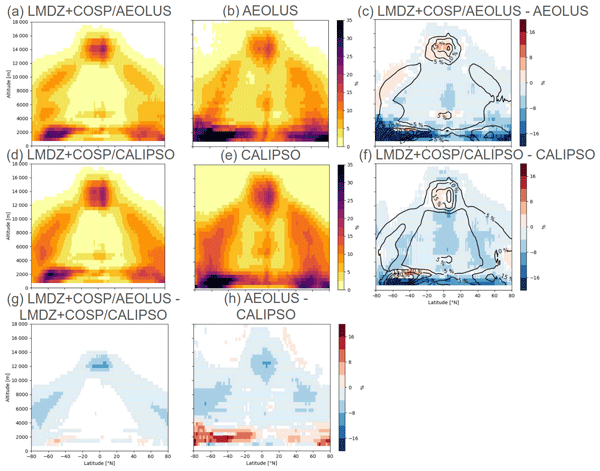
Clouds are crucial for understanding and predicting climate, yet their processes remain uncertain in global models. We reproduced detailed observations from a lidar and a wind-lidar using an advanced instrument simulator to evaluate how well the model represents clouds. A dedicated module was developed for the wind-lidar. Both instruments reveal comparable cloud biases, confirming its value for improving model evaluation and enabling consistent multi-decade assessments with more recent sensors.
Zacharie Titus, Marine Bonazzola, Hélène Chepfer, Artem Feofilov, and Marie-Laure Roussel
EGUsphere, https://doi.org/10.5194/egusphere-2025-5335, https://doi.org/10.5194/egusphere-2025-5335, 2025
Short summary
Short summary
In this paper, we use satellite observations to study the relationships between profiles of clouds and profiles of wind from June to October around India. We found that thin clouds between 14 and 17 km are transported over the Arabian Sea by fast westward winds. We also show that the wind can be modified by 3 m/s because of the presence of deep convective clouds that spread out between 14 and 17 km of altitude. We discuss the implications of these interactions in a warming climate.
Zacharie Titus, Amélie Cuynet, Elodie Salmon, and Catherine Ottlé
The Cryosphere, 19, 2105–2114, https://doi.org/10.5194/tc-19-2105-2025, https://doi.org/10.5194/tc-19-2105-2025, 2025
Short summary
Short summary
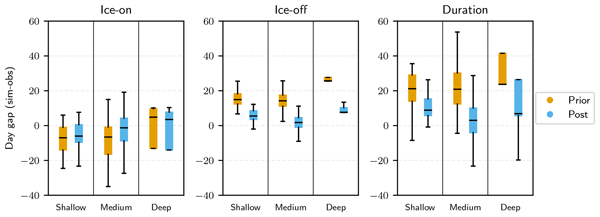
The representation of lake ice dynamics is key to model water–atmosphere energy and mass transfers in cold environments. The use of albedo satellite products to constrain the modeling of ice coverage appears to be very suitable and valuable. In this work, we show how the modeling of lake albedo and ice phenology in the land surface model ORCHIDEE was improved by accounting for fractional ice cover calibrated against lake surface albedo data.
Morgane Lalonde, Sophie Bastin, Ludovic Oudin, Pedro Felipe Arboleda-Obando, and Agnès Ducharne
Geosci. Model Dev., 19, 9463–9488, https://doi.org/10.5194/gmd-19-9463-2026, https://doi.org/10.5194/gmd-19-9463-2026, 2026
Short summary
Short summary
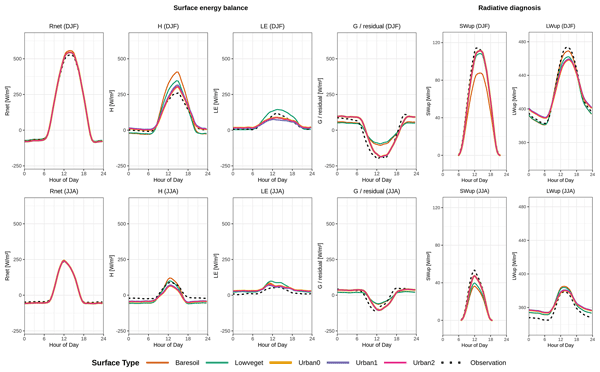
Some climate models still represent cities as if they were natural ground. For one of these models, we built a new way to represent cities. The update includes how reflective surfaces are, building height, stored heat, and how much ground is sealed. The novelty is to treat sealed ground not only at the surface, but also below it. Tested at twenty urban sites, the new version better represents exchanges of energy between the ground and the air, supporting more reliable urban climate studies.
Benjamin Witschas, Elina Köster, Oliver Kleinert, Christian Lemmerz, and Stephan Rahm
EGUsphere, https://doi.org/10.5194/egusphere-2026-4731, https://doi.org/10.5194/egusphere-2026-4731, 2026
Short summary
Short summary
We developed a new laser-based instrument that measures wind from a research aircraft with high accuracy and fine detail. By steering the laser beam in different directions, it captures both horizontal and vertical air motion. First flight tests confirmed its reliable performance and excellent accuracy. The new observations will improve our understanding of atmospheric processes, support the testing of satellite measurements, and benefit future weather and climate research.
Maximilian Dollner, Josef Gasteiger, Konrad Kandler, Manuel Schöberl, Sudharaj Aryasree, Benjamin Witschas, and Bernadett Weinzierl
EGUsphere, https://doi.org/10.5194/egusphere-2026-531, https://doi.org/10.5194/egusphere-2026-531, 2026
Short summary
Short summary
During the A-LIFE campaign in the Eastern Mediterranean, a research aircraft observed clouds in a Saharan dust layer using in situ and remote sensing measurements. With new analysis tools for improved particle sizing and liquid water content measurements, this study assesses two different aerosol-cloud interaction processes: heterogeneous ice nucleation on super-micron dust particles at the cloud top, and small-scale activation of mineral dust particles to liquid droplets within the cloud.
Jean Lac, Hélène Chepfer, Matthew D. Shupe, and Hannes Griesche
Atmos. Chem. Phys., 26, 4189–4213, https://doi.org/10.5194/acp-26-4189-2026, https://doi.org/10.5194/acp-26-4189-2026, 2026
Short summary
Short summary
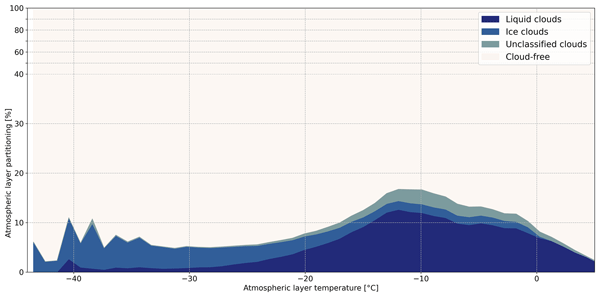
Satellite observations show that Arctic spring experiences a rapid increase in liquid-containing clouds over sea ice. Our study shows that this transition is mostly driven by warmer temperatures in early spring than in late spring, favoring more liquid clouds formation, rather than a limited moisture source in early spring. It suggests that, in the future, this transition is likely to occur earlier in spring considering the rapid Arctic warming.
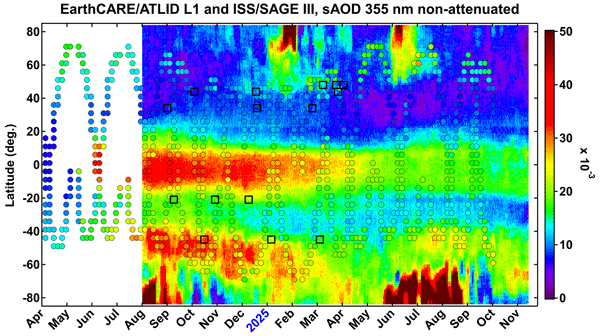
Sergey Khaykin, Michaël Sicard, Thierry Leblanc, Tetsu Sakai, Nickolay Balugin, Gwenaël Berthet, Stëphane Chevrier, Fernando Chouza, Artem Feofilov, Dominique Gantois, Sophie Godin-Beekmann, Arezki Haddouche, Yoshitaka Jin, Isamu Morino, Nicolas Kadygrov, Thomas Lecas, Ben Liley, Richard Querel, Ghasssan Taha, and Vladimir Yushkov
Atmos. Chem. Phys., 26, 607–622, https://doi.org/10.5194/acp-26-607-2026, https://doi.org/10.5194/acp-26-607-2026, 2026
Short summary
Short summary
In April 2024, the Ruang volcano in Indonesia sent large amounts of gas and particles high into the atmosphere, which then spread worldwide. Using the new European EarthCARE satellite and its advanced laser instrument ATLID (Atmospheric LIDar), together with ground and balloon observations, we tracked how these particles doubled levels in the tropics and spread into both hemispheres. The study shows ATLID’s power to reveal how eruptions can affect climate, clouds, and ozone for more than a year.
Marie-Laure Roussel, Hélène Chepfer, Zacharie Titus, and Marine Bonazzola
Atmos. Chem. Phys., 26, 117–134, https://doi.org/10.5194/acp-26-117-2026, https://doi.org/10.5194/acp-26-117-2026, 2026
Short summary
Short summary
Clouds are crucial for understanding and predicting climate, yet their processes remain uncertain in global models. We reproduced detailed observations from a lidar and a wind-lidar using an advanced instrument simulator to evaluate how well the model represents clouds. A dedicated module was developed for the wind-lidar. Both instruments reveal comparable cloud biases, confirming its value for improving model evaluation and enabling consistent multi-decade assessments with more recent sensors.
Zacharie Titus, Marine Bonazzola, Hélène Chepfer, Artem Feofilov, and Marie-Laure Roussel
EGUsphere, https://doi.org/10.5194/egusphere-2025-5335, https://doi.org/10.5194/egusphere-2025-5335, 2025
Short summary
Short summary
In this paper, we use satellite observations to study the relationships between profiles of clouds and profiles of wind from June to October around India. We found that thin clouds between 14 and 17 km are transported over the Arabian Sea by fast westward winds. We also show that the wind can be modified by 3 m/s because of the presence of deep convective clouds that spread out between 14 and 17 km of altitude. We discuss the implications of these interactions in a warming climate.
Zacharie Titus, Amélie Cuynet, Elodie Salmon, and Catherine Ottlé
The Cryosphere, 19, 2105–2114, https://doi.org/10.5194/tc-19-2105-2025, https://doi.org/10.5194/tc-19-2105-2025, 2025
Short summary
Short summary
The representation of lake ice dynamics is key to model water–atmosphere energy and mass transfers in cold environments. The use of albedo satellite products to constrain the modeling of ice coverage appears to be very suitable and valuable. In this work, we show how the modeling of lake albedo and ice phenology in the land surface model ORCHIDEE was improved by accounting for fractional ice cover calibrated against lake surface albedo data.
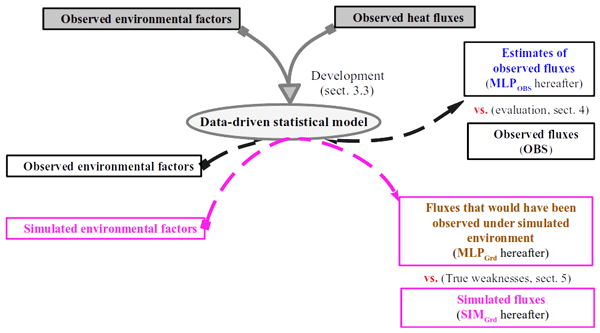
Maurin Zouzoua, Sophie Bastin, Fabienne Lohou, Marie Lothon, Marjolaine Chiriaco, Mathilde Jome, Cécile Mallet, Laurent Barthes, and Guylaine Canut
Geosci. Model Dev., 18, 3211–3239, https://doi.org/10.5194/gmd-18-3211-2025, https://doi.org/10.5194/gmd-18-3211-2025, 2025
Short summary
Short summary
This study proposes using a statistical model to freeze errors due to differences in environmental forcing when evaluating the surface turbulent heat fluxes from numerical simulations with observations. The statistical model is first built with observations and then applied to the simulated environment to generate possibly observed fluxes. This novel method provides insight into differently evaluating the numerical formulation of turbulent heat fluxes with a long period of observational data.
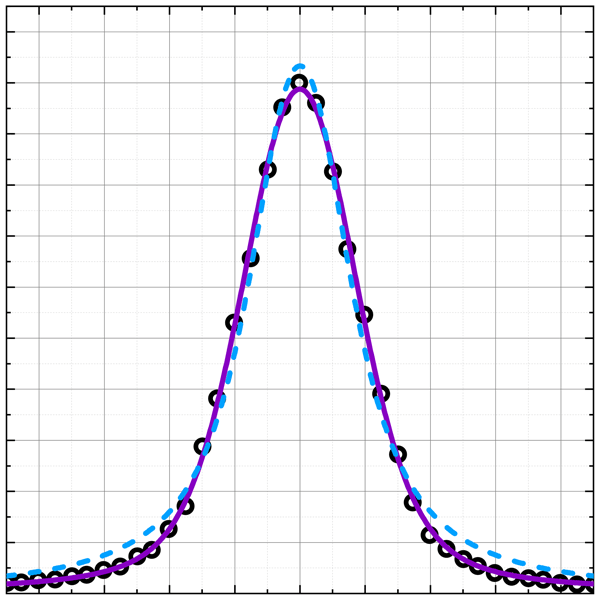
Michael Vaughan, Kevin Ridley, Benjamin Witschas, Oliver Lux, Ines Nikolaus, and Oliver Reitebuch
Atmos. Meas. Tech., 18, 2149–2181, https://doi.org/10.5194/amt-18-2149-2025, https://doi.org/10.5194/amt-18-2149-2025, 2025
Short summary
Short summary
ESA's Aeolus mission, launched in 2018, has exceeded expectations, providing valuable global wind lidar data for nearly 5 years. Its data have improved weather forecasting, with Mie-cloudy winds proving to be especially precise. Challenges have emerged, such as unexpected misalignments in signal angles and reduced signal levels due to beam clipping and laser issues. Lessons from Aeolus highlight the need for better optical alignment and active control systems for future lidar missions.
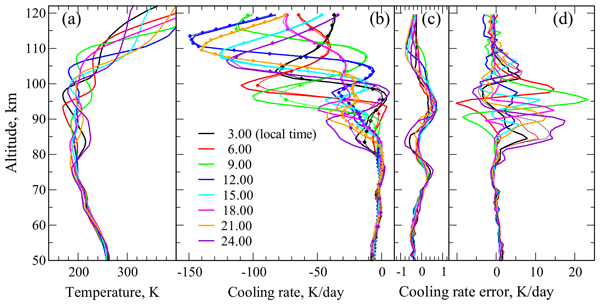
Alexander Kutepov and Artem Feofilov
Geosci. Model Dev., 17, 5331–5347, https://doi.org/10.5194/gmd-17-5331-2024, https://doi.org/10.5194/gmd-17-5331-2024, 2024
Short summary
Short summary
Infrared CO2 cooling of the middle and upper atmosphere is increasing. We developed a new routine for very fast and accurate calculations of this cooling in general circulation models. The new algorithm accounts for non-local thermodynamic equilibrium and is about 1000 times faster than the standard matrix algorithms. It is based on advanced techniques for non-equilibrium emission calculations in stellar atmospheres, which so far have not been used in Earth’s and planetary atmospheres.
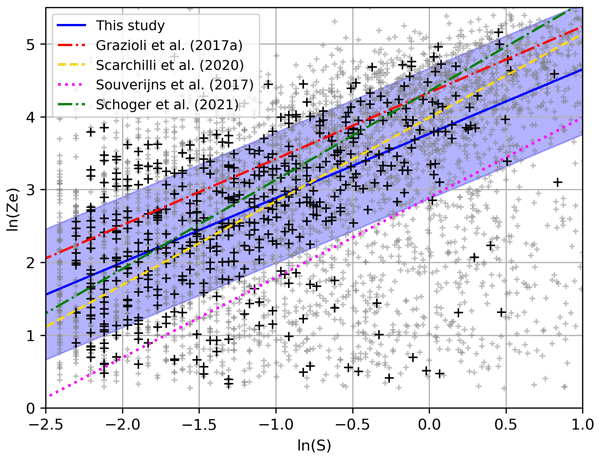
Valentin Wiener, Marie-Laure Roussel, Christophe Genthon, Étienne Vignon, Jacopo Grazioli, and Alexis Berne
Earth Syst. Sci. Data, 16, 821–836, https://doi.org/10.5194/essd-16-821-2024, https://doi.org/10.5194/essd-16-821-2024, 2024
Short summary
Short summary
This paper presents 7 years of data from a precipitation radar deployed at the Dumont d'Urville station in East Antarctica. The main characteristics of the dataset are outlined in a short statistical study. Interannual and seasonal variability are also investigated. Then, we extensively describe the processing method to retrieve snowfall profiles from the radar data. Lastly, a brief comparison is made with two climate models as an application example of the dataset.
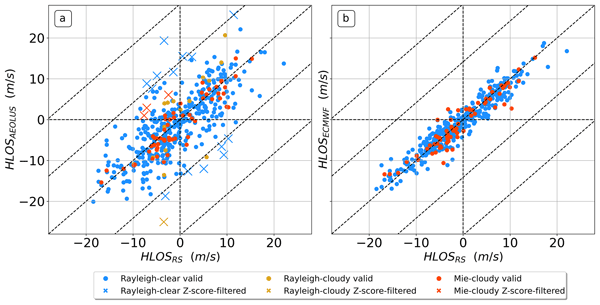
Maurus Borne, Peter Knippertz, Martin Weissmann, Benjamin Witschas, Cyrille Flamant, Rosimar Rios-Berrios, and Peter Veals
Atmos. Meas. Tech., 17, 561–581, https://doi.org/10.5194/amt-17-561-2024, https://doi.org/10.5194/amt-17-561-2024, 2024
Short summary
Short summary
This study assesses the quality of Aeolus wind measurements over the tropical Atlantic. The results identified the accuracy and precision of the Aeolus wind measurements and the potential source of errors. For instance, the study revealed atmospheric conditions that can deteriorate the measurement quality, such as weaker laser signal in cloudy or dusty conditions, and confirmed the presence of an orbital-dependant bias. These results can help to improve the Aeolus wind measurement algorithm.
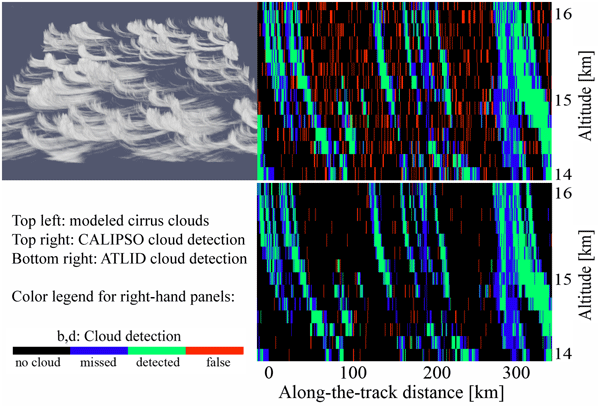
Artem G. Feofilov, Hélène Chepfer, Vincent Noël, and Frederic Szczap
Atmos. Meas. Tech., 16, 3363–3390, https://doi.org/10.5194/amt-16-3363-2023, https://doi.org/10.5194/amt-16-3363-2023, 2023
Short summary
Short summary
The response of clouds to human-induced climate warming remains the largest source of uncertainty in model predictions of climate. We consider cloud retrievals from spaceborne observations, the existing CALIOP lidar and future ATLID lidar; show how they compare for the same scenes; and discuss the advantage of adding a new lidar for detecting cloud changes in the long run. We show that ATLID's advanced technology should allow for better detecting thinner clouds during daytime than before.
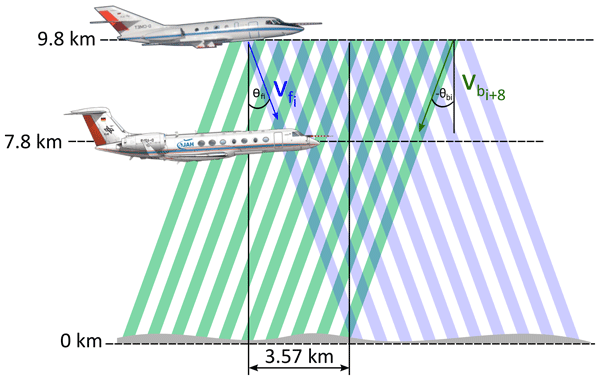
Benjamin Witschas, Sonja Gisinger, Stephan Rahm, Andreas Dörnbrack, David C. Fritts, and Markus Rapp
Atmos. Meas. Tech., 16, 1087–1101, https://doi.org/10.5194/amt-16-1087-2023, https://doi.org/10.5194/amt-16-1087-2023, 2023
Short summary
Short summary
In this paper, a novel scan technique is applied to an airborne coherent Doppler wind lidar, enabling us to measure the vertical wind speed and the horizontal wind speed along flight direction simultaneously with a horizontal resolution of about 800 m and a vertical resolution of 100 m. The performed observations are valuable for gravity wave characterization as they allow us to calculate the leg-averaged momentum flux profile and, with that, the propagation direction of excited gravity waves.
Marine Bonazzola, Hélène Chepfer, Po-Lun Ma, Johannes Quaas, David M. Winker, Artem Feofilov, and Nick Schutgens
Geosci. Model Dev., 16, 1359–1377, https://doi.org/10.5194/gmd-16-1359-2023, https://doi.org/10.5194/gmd-16-1359-2023, 2023
Short summary
Short summary
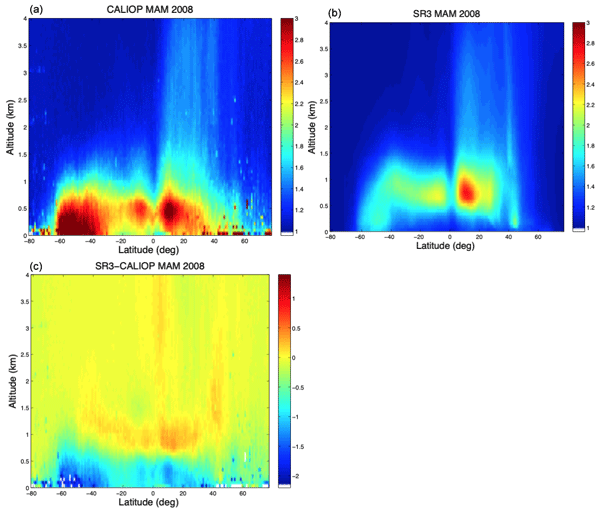
Aerosol has a large impact on climate. Using a lidar aerosol simulator ensures consistent comparisons between modeled and observed aerosol. We present a lidar aerosol simulator that applies a cloud masking and an aerosol detection threshold. We estimate the lidar signals that would be observed at 532 nm by the Cloud-Aerosol Lidar with Orthogonal Polarization overflying the atmosphere predicted by a climate model. Our comparison at the seasonal timescale shows a discrepancy in the Southern Ocean.

Benjamin Witschas, Christian Lemmerz, Alexander Geiß, Oliver Lux, Uwe Marksteiner, Stephan Rahm, Oliver Reitebuch, Andreas Schäfler, and Fabian Weiler
Atmos. Meas. Tech., 15, 7049–7070, https://doi.org/10.5194/amt-15-7049-2022, https://doi.org/10.5194/amt-15-7049-2022, 2022
Short summary
Short summary
In August 2018, the first wind lidar Aeolus was launched into space and has since then been providing data of the global wind field. The primary goal of Aeolus was the improvement of numerical weather prediction. To verify the quality of Aeolus wind data, DLR performed four airborne validation campaigns with two wind lidar systems. In this paper, we report on results from the two later campaigns, performed in Iceland and the tropics.
Oliver Lux, Benjamin Witschas, Alexander Geiß, Christian Lemmerz, Fabian Weiler, Uwe Marksteiner, Stephan Rahm, Andreas Schäfler, and Oliver Reitebuch
Atmos. Meas. Tech., 15, 6467–6488, https://doi.org/10.5194/amt-15-6467-2022, https://doi.org/10.5194/amt-15-6467-2022, 2022
Short summary
Short summary
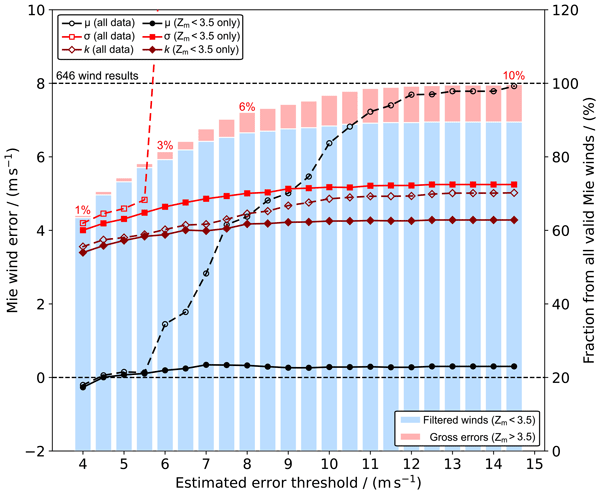
We discuss the influence of different quality control schemes on the results of Aeolus wind product validation and present statistical tools for ensuring consistency and comparability among diverse validation studies with regard to the specific error characteristics of the Rayleigh-clear and Mie-cloudy winds. The developed methods are applied for the validation of Aeolus winds against an ECMWF model background and airborne wind lidar data from the Joint Aeolus Tropical Atlantic Campaign.
Assia Arouf, Hélène Chepfer, Thibault Vaillant de Guélis, Marjolaine Chiriaco, Matthew D. Shupe, Rodrigo Guzman, Artem Feofilov, Patrick Raberanto, Tristan S. L'Ecuyer, Seiji Kato, and Michael R. Gallagher
Atmos. Meas. Tech., 15, 3893–3923, https://doi.org/10.5194/amt-15-3893-2022, https://doi.org/10.5194/amt-15-3893-2022, 2022
Short summary
Short summary
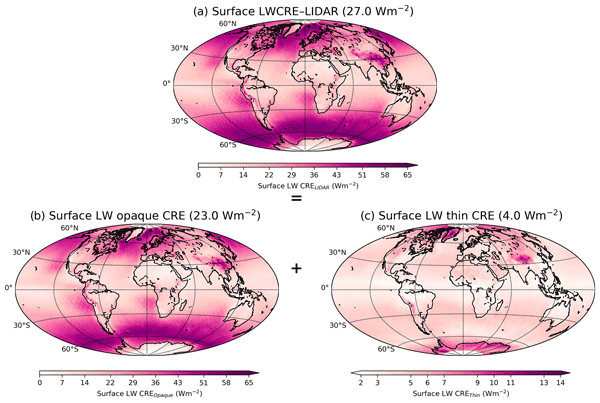
We proposed new estimates of the surface longwave (LW) cloud radiative effect (CRE) derived from observations collected by a space-based lidar on board the CALIPSO satellite and radiative transfer computations. Our estimate appropriately captures the surface LW CRE annual variability over bright polar surfaces, and it provides a dataset more than 13 years long.
Ada Mariska Koning, Louise Nuijens, Christian Mallaun, Benjamin Witschas, and Christian Lemmerz
Atmos. Chem. Phys., 22, 7373–7388, https://doi.org/10.5194/acp-22-7373-2022, https://doi.org/10.5194/acp-22-7373-2022, 2022
Short summary
Short summary
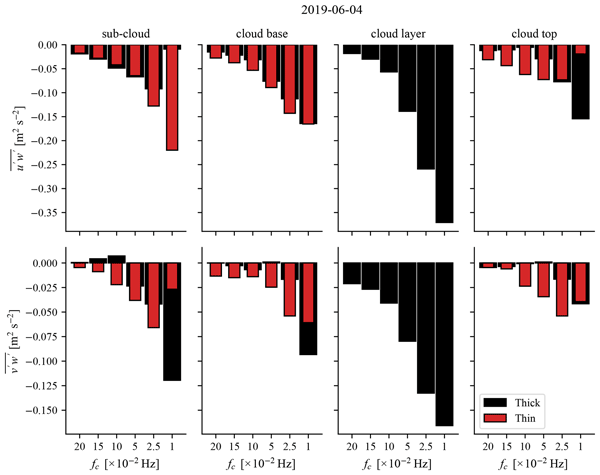
Wind measurements from the mixed layer to cloud tops are scarce, causing a lack of knowledge on wind mixing between and within these layers. We use airborne observations of wind profiles and local wind at high frequency to study wind transport in cloud fields. A case with thick clouds had its maximum transport in the cloud layer, caused by eddies > 700 m, which was not expected from turbulence theory. In other cases large eddies undid transport of smaller eddies resulting in no net transport.
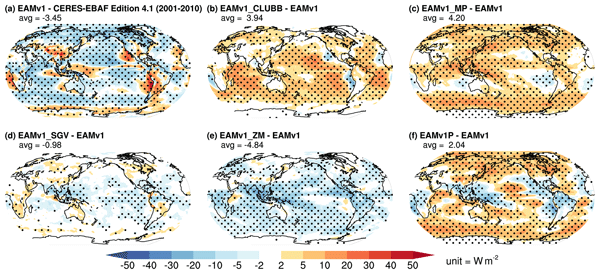
Po-Lun Ma, Bryce E. Harrop, Vincent E. Larson, Richard B. Neale, Andrew Gettelman, Hugh Morrison, Hailong Wang, Kai Zhang, Stephen A. Klein, Mark D. Zelinka, Yuying Zhang, Yun Qian, Jin-Ho Yoon, Christopher R. Jones, Meng Huang, Sheng-Lun Tai, Balwinder Singh, Peter A. Bogenschutz, Xue Zheng, Wuyin Lin, Johannes Quaas, Hélène Chepfer, Michael A. Brunke, Xubin Zeng, Johannes Mülmenstädt, Samson Hagos, Zhibo Zhang, Hua Song, Xiaohong Liu, Michael S. Pritchard, Hui Wan, Jingyu Wang, Qi Tang, Peter M. Caldwell, Jiwen Fan, Larry K. Berg, Jerome D. Fast, Mark A. Taylor, Jean-Christophe Golaz, Shaocheng Xie, Philip J. Rasch, and L. Ruby Leung
Geosci. Model Dev., 15, 2881–2916, https://doi.org/10.5194/gmd-15-2881-2022, https://doi.org/10.5194/gmd-15-2881-2022, 2022
Short summary
Short summary
An alternative set of parameters for E3SM Atmospheric Model version 1 has been developed based on a tuning strategy that focuses on clouds. When clouds in every regime are improved, other aspects of the model are also improved, even though they are not the direct targets for calibration. The recalibrated model shows a lower sensitivity to anthropogenic aerosols and surface warming, suggesting potential improvements to the simulated climate in the past and future.
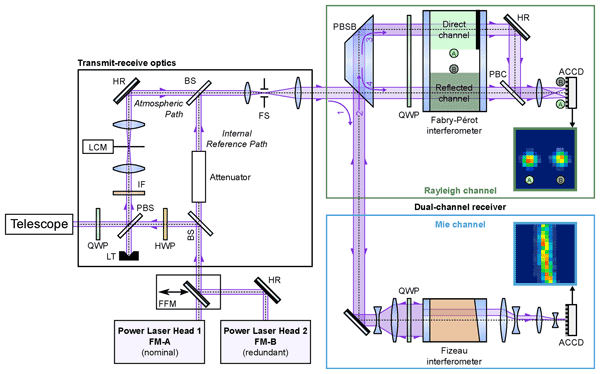
Benjamin Witschas, Christian Lemmerz, Oliver Lux, Uwe Marksteiner, Oliver Reitebuch, Fabian Weiler, Frederic Fabre, Alain Dabas, Thomas Flament, Dorit Huber, and Michael Vaughan
Atmos. Meas. Tech., 15, 1465–1489, https://doi.org/10.5194/amt-15-1465-2022, https://doi.org/10.5194/amt-15-1465-2022, 2022
Short summary
Short summary
In August 2018, the ESA launched the first Doppler wind lidar into space. In order to calibrate the instrument and to monitor the overall instrument conditions, instrument spectral registration measurements have been performed with Aeolus on a weekly basis. Based on these measurements, the alignment drift of the Aeolus satellite instrument is estimated by applying tools and mathematical model functions to analyze the spectrometer transmission curves.
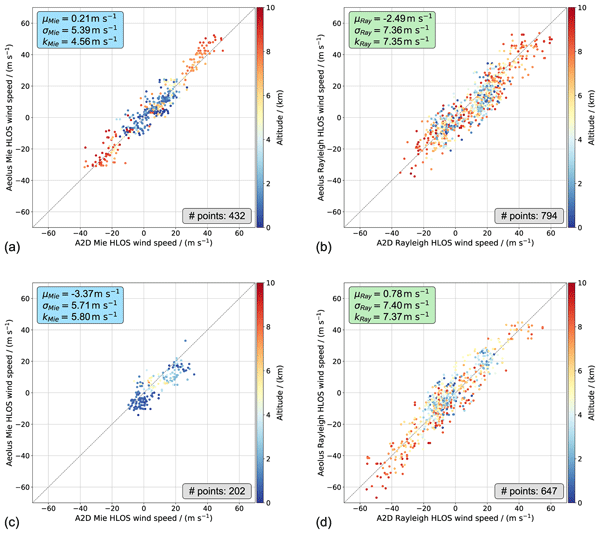
Oliver Lux, Christian Lemmerz, Fabian Weiler, Uwe Marksteiner, Benjamin Witschas, Stephan Rahm, Alexander Geiß, Andreas Schäfler, and Oliver Reitebuch
Atmos. Meas. Tech., 15, 1303–1331, https://doi.org/10.5194/amt-15-1303-2022, https://doi.org/10.5194/amt-15-1303-2022, 2022
Short summary
Short summary
The article discusses modifications in the wind retrieval of the ALADIN Airborne Demonstrator (A2D) – one of the key instruments for the validation of Aeolus. Thanks to the retrieval refinements, which are demonstrated in the context of two airborne campaigns in 2019, the systematic and random wind errors of the A2D were significantly reduced, thereby enhancing its validation capabilities. Finally, wind comparisons between A2D and Aeolus for the validation of the satellite data are presented.
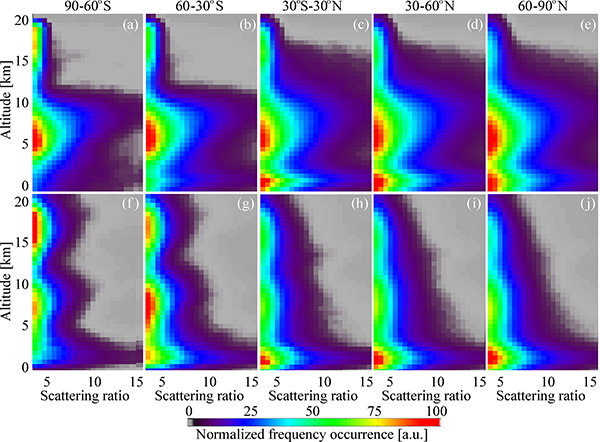
Artem G. Feofilov, Hélène Chepfer, Vincent Noël, Rodrigo Guzman, Cyprien Gindre, Po-Lun Ma, and Marjolaine Chiriaco
Atmos. Meas. Tech., 15, 1055–1074, https://doi.org/10.5194/amt-15-1055-2022, https://doi.org/10.5194/amt-15-1055-2022, 2022
Short summary
Short summary
Space-borne lidars have been providing invaluable information of atmospheric optical properties since 2006, and new lidar missions are on the way to ensure continuous observations. In this work, we compare the clouds estimated from space-borne ALADIN and CALIOP lidar observations. The analysis of collocated data shows that the agreement between the retrieved clouds is good up to 3 km height. Above that, ALADIN detects 40 % less clouds than CALIOP, except for polar stratospheric clouds (PSCs).
Michael R. Gallagher, Matthew D. Shupe, Hélène Chepfer, and Tristan L'Ecuyer
The Cryosphere, 16, 435–450, https://doi.org/10.5194/tc-16-435-2022, https://doi.org/10.5194/tc-16-435-2022, 2022
Short summary
Short summary
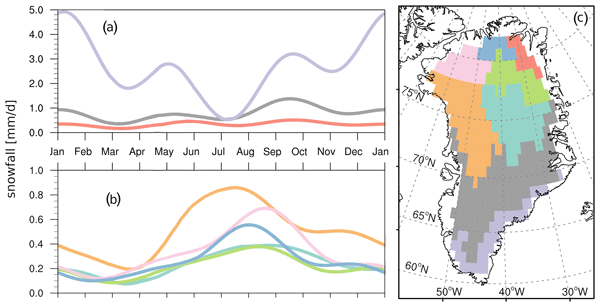
By using direct observations of snowfall and mass changes, the variability of daily snowfall mass input to the Greenland ice sheet is quantified for the first time. With new methods we conclude that cyclones west of Greenland in summer contribute the most snowfall, with 1.66 Gt per occurrence. These cyclones are contextualized in the broader Greenland climate, and snowfall is validated against mass changes to verify the results. Snowfall and mass change observations are shown to agree well.
Oscar Javier Rojas Muñoz, Marjolaine Chiriaco, Sophie Bastin, and Justine Ringard
Atmos. Chem. Phys., 21, 15699–15723, https://doi.org/10.5194/acp-21-15699-2021, https://doi.org/10.5194/acp-21-15699-2021, 2021
Short summary
Short summary
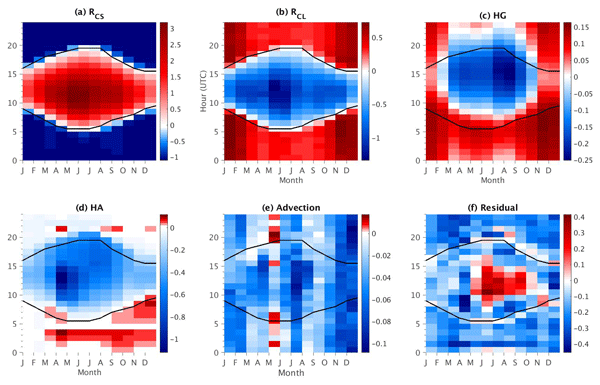
A method is developed and evaluated to quantify each process that affects hourly 2 m temperature variations on a local scale, based almost exclusively on observations retrieved from an observatory near the Paris region. Each term involved in surface temperature variations is estimated, and its contribution and importance are also assessed. It is found that clouds are the main modulator on hourly temperature variations for most hours of the day, and thus their characterization is addressed.
Cited articles
Abramian, S., Muller, C., and Risi, C.: Shear-Convection Interactions and Orientation of Tropical Squall Lines, Geophys. Res. Lett., 49, https://doi.org/10.1029/2021GL095184, 2022.
Aeolus Data Innovation and Science Cluster (Aeolus DISC): The Earth Explorer Mission Aeolus for atmospheric wind observations – Final Report from the Aeolus Data Innovation and Science Cluster DISC of Phase E, https://doi.org/10.57676/93c3-n766, 2024.
Ali, S., Mehta, S. K., Ananthavel, A., and Reddy, T. V. R.: Temporal and vertical distributions of the occurrence of cirrus clouds over a coastal station in the Indian monsoon region, Atmos. Chem. Phys., 22, 8321–8342, https://doi.org/10.5194/acp-22-8321-2022, 2022.
Baars, H., Herzog, A., Heese, B., Ohneiser, K., Hanbuch, K., Hofer, J., Yin, Z., Engelmann, R., and Wandinger, U.: Validation of Aeolus wind products above the Atlantic Ocean, Atmos. Meas. Tech., 13, 6007–6024, https://doi.org/10.5194/amt-13-6007-2020, 2020.
Ban, N., Caillaud, C., Coppola, E., Pichelli, E., Sobol, A., Adinolfi, M., Ahrens, B., Alias, A., Anders, I., Bastin, S., Belušić, D., Berthou, S., Brisson, E., Cardoso, R. M., Chan, S. C., Christensen, O. B., Fernández, J., Fita, L., Frisius, T., Gašparac, G., Giorgi, F., Goergen, K., Haugen, J. E., Hodnebrog, Ø., Kartsios, S., Katragkou, E., Kendon, E. J., Keuler, K., Lavin-Gullon, A., Lenderink, G., Leutwyler, D., Lorenz, T., Maraun, D., Mercogliano, P., Milovac, J., Panitz, H.-J., Raffa, M., Remedio, A. R., Schär, C., Soares, P. M. M., Srnec, L., Steensen, B. M., Stocchi, P., Tölle, M. H., Truhetz, H., Vergara-Temprado, J., de Vries, H., Warrach-Sagi, K., Wulfmeyer, V., and Zander, M. J.: The first multi-model ensemble of regional climate simulations at the kilometer-scale resolution, Part I: Evaluation of precipitation, Clim. Dynam. 57, 275–302, https://doi.org/10.1007/s00382-021-05708-w, 2021.
Belova, E., Kirkwood, S., Voelger, P., Chatterjee, S., Satheesan, K., Hagelin, S., Lindskog, M., and Körnich, H.: Validation of Aeolus winds using ground-based radars in Antarctica and in northern Sweden, Atmos. Meas. Tech., 14, 5415–5428, https://doi.org/10.5194/amt-14-5415-2021, 2021.
Bernardino, M., Rusu, L., and Soares, C. G.: Evaluation of the wave energy resources in the Cape Verde Islands, Renewable Energy, 101, 316–326, https://doi.org/10.1016/j.renene.2016.08.040, 2017.
Bodas-Salcedo, A., Webb, M. J., Bony, S., Chepfer, H., Dufresne, J. L., Klein, S. A., Zhang, Y., Marchand. R., Haynes, J. M., Pincus, R., and John, V. O.: COSP: Satellite simulation software for model assessment, B. Am. Meteorol. Soc., 92, 1023–1043, https://doi.org/10.1175/2011BAMS2856.1, 2011.
Bony, S., Schulz, H., Vial, J., and Stevens, B.: Sugar, Gravel, Fish, and Flowers: Dependence of Mesoscale Patterns of Trade-Wind Clouds on Environmental Conditions, Geophys. Res. Lett., 48, https://doi.org/10.1029/2019GL085988, 2020.
Cesana, G., Del Genio, A. D., and Chepfer, H.: The Cumulus And Stratocumulus CloudSat-CALIPSO Dataset (CASCCAD), Earth Syst. Sci. Data, 11, 1745–1764, https://doi.org/10.5194/essd-11-1745-2019, 2019.
Chepfer, H., Bony, S., Winker, D., Cesana, G., Dufresne, J. L., Minnis, P., Stubenrauch, C. J., and Zeng, S.: The GCM-Oriented CALIPSO Cloud Product (CALIPSO-GOCCP), J. Geophys. Res., 115, D00H16, https://doi.org/10.1029/2009JD012251, 2010.
Chepfer, H., Brogniez, H., and Noel, V.: Diurnal variations of cloud and relative humidity profiles across the tropics, Nature Scientific Report, 9, https://doi.org/10.1038/s41598-019-52437-6, 2019.
Ehlers, F., Flament, T., Dabas, A., Trapon, D., Lacour, A., Baars, H., and Straume-Lindner, A. G.: Optimization of Aeolus' aerosol optical properties by maximum-likelihood estimation, Atmos. Meas. Tech., 15, 185–203, https://doi.org/10.5194/amt-15-185-2022, 2022.
Das, S. K., Chiang, C- W., and Nee, J- B. : Influence of tropical easterly jet on upper tropical cirrus: An observational study from CALIPSO, Aura-MLS, and NCEP/NCAR data, J. Geophys. Res., 116, https://doi.org/10.1029/2011JD015923, 2011.
Donovan, D. P., van Zadelhoff, G.-J., and Wang, P.: Aeolus/ALADIN Algorithm Theoretical Basis Document Level 2A products AEL-FM, AEL-PRO, Document Version V2.00, https://earth.esa.int/documents/d/earth-online/aeolus-level-2a-algorithm-theoretical-baseline-document-ael-fm-and-ael-pro-products (last access: 8 August 2025), 2024.
Feofilov, A. G.: Interactive comment on “Characterization of dark current signal measurements of the ACCDs used on-board the Aeolus satellite” by Fabian Weiler et al., Atmos. Meas. Tech. Discuss., https://doi.org/10.5194/amt-2020-458-RC1, 2021.
Feofilov, A. G. and Stubenrauch, C. J.: Diurnal variation of high-level clouds from the synergy of AIRS and IASI space-borne infrared sounders, Atmos. Chem. Phys., 19, 13957–13972, https://doi.org/10.5194/acp-19-13957-2019, 2019.
Feofilov, A. G., Chepfer, H., Noël, V., Guzman, R., Gindre, C., Ma, P.-L., and Chiriaco, M.: Comparison of scattering ratio profiles retrieved from ALADIN/Aeolus and CALIOP/CALIPSO observations and preliminary estimates of cloud fraction profiles, Atmos. Meas. Tech., 15, 1055–1074, https://doi.org/10.5194/amt-15-1055-2022, 2022.
Flamant, P., Cuesta, J., Denneulin, M.-L., Dabas, A., and Huber, D.: ADM-Aeolus retrieval algorithms for aerosol and cloud products, Tellus A, 60, 273–288, https://doi.org/10.1111/j.1600-0870.2007.00287.x, 2008.
Fujiwara, M., Xie, S.-P., Shiotani, M., Hashizume, H., and Hasebe, F.: Upper-tropospheric inversion and easterly jet in the tropics, J. Geophys. Res., 108, https://doi.org/10.1029/2003JD003928 , 2003.
Goldberg, R. A., Feofilov, A. G., Pesnell, W. D., and Kutepov, A. A.: Inter-hemispheric Coupling during Northern Polar Summer Periods of 2002–2010 using TIMED/SABER Measurements, J. Atmos. Sol.-Terr. Phys., 104, 277–284, https://doi.org/10.1016/j.jastp.2012.11.018, 2013.
Grubisic, V. and Moncrieff, M. W.: Parameterization of Convective Momentum Transport in Highly Baroclinic Conditions, J. Atmos. Sci., 57, 3035–3049, https://doi.org/10.1175/1520-0469(2000)057<3035:POCMTI>2.0.CO;2, 2000.
Guzman, R., Chepfer, H., Noel, V., Vaillant de Guélis, T., Kay, J. E., Raberanto, P., Cesana, G., Vaughan, M. A., and Winker, D. M.: Direct atmosphere opacity observations from CALIPSO provide new constraints on cloud-radiation interactions, J. Geophys. Res.-Atmos., 122, 1066–1085, https://doi.org/10.1002/2016JD025946, 2017.
Helfer, K. C., Nuijens, L., de Roode, S. R., and Siebesma, A. P.: How wind shear affects trade-wind cumulus convection, J. Adv. Model. Earth Sy., 12, e2020MS002183, https://doi.org/10.1029/2020MS002183, 2020.
Hemanth Kumar, A., Venkat Ratnam, M., Sunilkumar, S. V., Parameswaran, K., and Krishna Murthy, B. V.: Role of deep convection on the tropical tropopause characteristics at sub-daily scales over the South India monsoon region, Atmos. Res., 14–24, https://doi.org/10.1016/j.atmosres.2015.03.012, 2015.
Hersbach, H., Bell, B., Berrisford, P., Hirahara, S., Horányi, A., Muñoz-Sabater, J., Nicolas, J., Peubey, C., Radu, R., Schepers, D., Simmons, A., Soci, C., Abdalla, S., Abellan, X., Balsamo, G., Bechtold, P., Biavati, G., Bidlot, J., Bonavita, M., Chiara, G., Dahlgren, P., Dee, D., Diamantakis, M., Dragani, R., Flemming, J., Forbes, R., Fuentes, M., Geer, A., Haimberger, L., Healy, S., Hogan, R. J., Hólm, E., Janisková, M., Keeley, S., Laloyaux, P., Lopez, P., Lupu, C., Radnoti, G., Rosnay, P., Rozum, I., Vamborg, F., Villaume, S., and Thépaut, J. N.: The ERA5 global reanalysis, Q. J. Roy. Meteor. Soc., 146, 1999–2049, https://doi.org/10.1002/qj.3803, 2020.
Hibbert, K., Glenn, E., Smith, T. M., and González-Cruz, J. E.: Changes to sea surface temperatures and vertical wind shear and their influence on tropical cyclone activity in the Caribbean and the main developing region, Atmosphere, 14, 999, https://doi.org/10.3390/atmos14060999, 2023.
Hierro, R., Steiner, A. K., de la Torre, A., Alexander, P., Llamedo, P., and Cremades, P.: Orographic and convective gravity waves above the Alps and Andes Mountains during GPS radio occultation events – a case study, Atmos. Meas. Tech., 11, 3523–3539, https://doi.org/10.5194/amt-11-3523-2018, 2018.
Hildebrand, P. H.: Shear-Parallel Moist Convection over the Tropical Ocean: A Case Study from 18 February 1993 TOGA COARE, Mon. Weather Rev., 126, 1952–1976, https://doi.org/10.1175/1520-0493(1998)126<1952:spmcot>2.0.co;2, 1998.
Höjgård-Olsen, E., Chepfer, H., and Brogniez, H.: Satellite observed sensitivity of tropical clouds and moisture to sea surface temperature on various time and space scales: 2. Focus on marine low level clouds, J. Geophys. Res.-Atmos., 127, e2021JD035402, https://doi.org/10.1029/2021JD035402, 2022.
Houchi, K., Stoffelen, A., Marseille, G. J., and De Kloe, J.: Comparison of wind and wind shear climatologies derived from high-resolution radiosondes and the ECMWF model, J. Geophys. Res.-Atmos., 115, https://doi.org/10.1029/2009JD013196, 2010.
Hourdin, F., Jam, A., Rio, C., Couvreux, F., Sandu, I., Lefebvre, M. P., Brient, F., and Idelkadi, A.: Unified parameterization of convective boundary layer transport and clouds with the thermal plume model, J. Adv. Model. Earth Sy., 11, 2910–2933, https://doi.org/10.1029/2019MS001666, 2019.
Houze, R. A.: Mesoscale Convective Systems, Rev. Geophys., 42, https://doi.org/10.1029/2004RG000150, 2004.
Iwai, H., Aoki, M., Oshiro, M., and Ishii, S.: Validation of Aeolus Level 2B wind products using wind profilers, ground-based Doppler wind lidars, and radiosondes in Japan, Atmos. Meas. Tech., 14, 7255–7275, https://doi.org/10.5194/amt-14-7255-2021, 2021.
Jauregui, Y. R. and Chen, S. S.: MJO-induced warm pool eastward extension prior to the onset of El Niño: Observations from 1998 to 2019, J. Clim., 37, 855–873, https://doi.org/10.1175/JCLI-D-23-0234.1, 2024.
Jensen, E. J., Ueyama, R., Pfister, L., and Atlas, R. L.: The impacts of gravity waves and wind shear on the lifecycle of cirrus clouds in the tropical tropopause layer, J. Geophys. Res.-Atmos., 130, e2024JD042308, https://doi.org/10.1029/2024JD042308, 2025.
Koning, A. M., Nuijens, L., Mallaun, C., Witschas, B., and Lemmerz, C.: Momentum fluxes from airborne wind measurements in three cumulus cases over land, Atmos. Chem. Phys., 22, 7373–7388, https://doi.org/10.5194/acp-22-7373-2022, 2022.
Koren, I., Oreopoulos, L., Feingold, G., Remer, L. A., and Altaratz, O.: How small is a small cloud?, Atmos. Chem. Phys., 8, 3855–3864, https://doi.org/10.5194/acp-8-3855-2008, 2008.
Koren, I., Remer, L. A., Altaratz, O., Martins, J. V., and Davidi, A.: Aerosol-induced changes of convective cloud anvils produce strong climate warming, Atmos. Chem. Phys., 10, 5001–5010, https://doi.org/10.5194/acp-10-5001-2010, 2010.
Krisch, I., Hindley, N. P., Reitebuch, O., and Wright, C. J.: On the derivation of zonal and meridional wind components from Aeolus horizontal line-of-sight wind, Atmos. Meas. Tech., 15, 3465–3479, https://doi.org/10.5194/amt-15-3465-2022, 2022.
Koteswaram, P.: The easterly jet stream in the tropics, Tellus, 10, 43–57, https://doi.org/10.3402/tellusa.v10i1.9220, 1958.
Liu, S., Huang, S., Tan, Y., Wen, Z., Chen, X., and Guo, Y.: Characteristics and mechanisms of the interannual variability of the Northwest–Southeast shift of the tropical easterly Jet's core in July, J. Clim., 37, 3219–3235, https://doi.org/10.1175/JCLI-D-23-0291.1, 2024.
Lux, O., Lemmerz, C., Weiler, F., Marksteiner, U., Witschas, B., Rahm, S., Geiß, A., and Reitebuch, O.: Intercomparison of wind observations from the European Space Agency's Aeolus satellite mission and the ALADIN Airborne Demonstrator, Atmos. Meas. Tech., 13, 2075–2097, https://doi.org/10.5194/amt-13-2075-2020, 2020.
Lux, O., Witschas, B., Geiß, A., Lemmerz, C., Weiler, F., Marksteiner, U., Rahm, S., Schäfler, A., and Reitebuch, O.: Quality control and error assessment of the Aeolus L2B wind results from the Joint Aeolus Tropical Atlantic Campaign, Atmos. Meas. Tech., 15, 6467–6488, https://doi.org/10.5194/amt-15-6467-2022, 2022.
Marinescu, P. J., Cucurull, L., Apodaca, K., Bucci, L., and Genkova, I.: The characterization and impact of Aeolus wind profile observations in NOAA's regional tropical cyclone model (HWRF), Q. J. Roy. Meteor. Soc., 148, 3491–3508, https://doi.org/10.1002/qj.4370, 2022.
Massie, S., Gettelman, A., Randel, W., and Baumgardner, D.: Distribution of tropical cirrus in relation to convection, J. Geophys. Res.-Atmos., 107, AAC-19, https://doi.org/10.1029/2001JD001293, 2002.
McCoy, D. T., Eastman, R., Hartmann, D. L., and Wood, R.: The Change in Low Cloud Cover in a Warmed Climate Inferred from AIRS, MODIS, and ERA-Interim, J. Clim., 30, 3609–3620, https://doi.org/10.1175/JCLI-D-15-0734.1, 2017.
McGill, M. J., Yorks, J. E., Scott, V. S., Kupchock, A. W., and Selmer, P. A.: The Cloud-Aerosol Transport System (CATS): a technology demonstration on the International Space Station, Lidar Remote Sensing for Environmental Monitoring XV, edited by: Singh, U. N., International Society for Optics and Photonics, SPIE, 9612, 34–39, https://doi.org/10.1117/12.2190841, 2015.
Mieslinger, T., Horváth, Á., Buehler, S. A., and Sakradzija, M.: The dependence of shallow cumulus macrophysical properties on large-scale meteorology as observed in ASTER imagery, J. Geophys. Res.-Atmos., 124, 11477–11505, https://doi.org/10.1029/2019JD030768, 2019.
Mitra, A. P.: Indian ocean experiment [INDOEX]: an overview, 2004, Indian J. Mar. Sci., 33, 30–39, 2004.
Noel, V., Chepfer, H., Chiriaco, M., and Yorks, J.: The diurnal cycle of cloud profiles over land and ocean between 51° S and 51° N, seen by the CATS spaceborne lidar from the International Space Station, Atmos. Chem. Phys., 18, 9457–9473, https://doi.org/10.5194/acp-18-9457-2018, 2018.
Nuijens, L. and Stevens, B.: The Influence of Wind Speed on Shallow Marine Cumulus Convection, J. Atmos. Sci., 69, 168–184, https://doi.org/10.1175/JAS-D-11-02.1, 2012.
Parker, D. J.: Cold pools in shear, Q. J. Roy. Meteor. Soc., 122, 1655–1674, https://doi.org/10.1002/qj.49712253509, 1996.
Qu, X., A. Hall, S. Klein, and DeAngelis, A.: Positive tropical marine low-cloud cover feedback inferred from cloud-controlling factors, Geophys. Res. Lett., 42, 7767–7775, https://doi.org/10.1002/2015GL065627 , 2015.
Reitebuch, O.: The Spaceborne Wind Lidar Mission ADM-Aeolus, in: Atmospheric Physics. Research Topics in Aerospace, edited by: Schumann, U., Springer, Berlin, Heidelberg, https://doi.org/10.1007/978-3-642-30183-4_49, 2012.
Reitebuch, O., Huber, D., and Nikolaus, I.: Algorithm Theoretical Basis Document ATBD Level1B Products, https://earth.esa.int/eogateway/documents/20142/37627/Aeolus-L1B-Algorithm-ATBD.pdf (last access: 12 November 2025), 2018.
Ratynski, M., Khaykin, S., Hauchecorne, A., Wing, R., Cammas, J.-P., Hello, Y., and Keckhut, P.: Validation of Aeolus wind profiles using ground-based lidar and radiosonde observations at Réunion island and the Observatoire de Haute-Provence, Atmos. Meas. Tech., 16, 997–1016, https://doi.org/10.5194/amt-16-997-2023, 2023.
Rennie, M., Tan, D., Andersson, E., Poli, P., Dabas, A., De Kloe, J., Marseille, G.-J., and Stoffelen, A.: Aeolus Level-2B algorithm theoretical basis document (mathematical description of the Aeolus Level-2B processor). Change, 3, 23–12, https://earth.esa.int/documents/20142/37627/Aeolus-L2B-Algorithm-ATBD.pdf (last access: 8 August 2025), 2020.
Robe, F. R. and Emanuel, K. A.: The Effect of Vertical Wind Shear on Radiative-Convective Equilibrium States, J. Atmos. Sci., 69, 1427–1445, https://doi.org/10.1175/1520-0469(2001)058<1427:TEOVWS>2.0.CO;2, 2001.
Rotunno, R., Klemp, J. B., and Weisman, M. L.: A Theory for Strong, Long-Lived Squall Lines, J. Atmos. Sci., 45, 463–485, https://doi.org/10.1175/1520-0469(1988)045<0463:ATFSLL>2.0.CO;2, 1988.
Sassen, K., Wang, Z., and Liu, D.: Cirrus clouds and deep convection in the tropics: Insights from CALIPSO and CloudSat, J. Geophys. Res.-Atmos., 114, https://doi.org/10.1029/2009JD011916, 2009.
Sathiyamoorthy, V., Pal, P. K., and Joshi, P. C.: Influence of the Upper-Tropospheric Wind Shear upon Cloud Radiative Forcing in the Asian Monsoon Region, Journal of Climate, 17, 2725–2735, https://doi.org/10.1175/1520-0442(2004)017<2725:IOTUWS>2.0.CO;2, 2004.
Savazzi, A. C. M., Nuijens, L., Sandu, I., George, G., and Bechtold, P.: The representation of the trade winds in ECMWF forecasts and reanalyses during EUREC4A, Atmos. Chem. Phys., 22, 13049–13066, https://doi.org/10.5194/acp-22-13049-2022, 2022.
Schäfler, A., Harvey, B., Methven, J., Doyle, J. D., Rahm, S., Reitebuch, O., and Witschas, B.: Observation of jet stream winds during NAWDEX and characterization of systematic meteorological analysis errors, Mon. Weather Rev., 148, 2889–290, https://doi.org/10.1175/MWR-D-19-0229.1, 2020.
Schulz, B. and Mellado, J. P.: Wind Shear Effects on Radiatively and Evaporatively Driven Stratocumulus Tops, J. Atmos. Sci., 75, 3245–3263, https://doi.org/10.1175/JAS-D-18-0027.1, 2018.
Schumacher, R. S. and Rasmussen, K. L.: The formation, character and changing nature of mesoscale convective systems, Nature Reviews Earth and Environment, 1, 300–314, https://doi.org/10.1038/s43017-020-0057-7, 2020.
Scott, R. C., Myers, T. A., Norris, J. R., Zelinka, M. D., Klein, S. A., Sun, M., and Doelling, D. R.: Observed sensitivity of low-cloud radiative effects to meteorological perturbations over the global oceans, J. Clim., 33, 7717–7734, https://doi.org/10.1175/JCLI-D-19-1028.1, 2020.
Siebesma, A. P., Bretherton, C. S., Brown, A., Chlond, A., Cuxart, J., Duynkerke, P. G., Jiang, H., Khairoutdinov, M., Lewellen, D., Moeng, C-H., Sanchez, E., Stevens, B., and Stevens, D. E.: A Large Eddy Simulation Intercomparison Study of Shallow Cumulus Convection, J. Atmos. Sci., 60, 1201–12019, https://doi.org/10.1175/1520-0469(2003)60<1201:ALESIS>2.0.CO;2, 2003.
Stoffelen, A., Pailleux, J., Källen, E., Vaughan, M., Isaksen, L., Flamant, P., Wergen, W., Andersson, E., Schyberg, H., Culoma, A., Meynart, R., Endemann, M., and Ingmann, P.: The atmospheric dynamics mission for global wind field measurement, B. Am. Meteorol. Soc., 86, 73–88, https://doi.org/10.1175/BAMS-86-1-73, 2005.
Thorpe, A. J., Miller, M. J., Moncrieff, M. W.: Two-dimensional convection in non-constant shear: A model of mid-latitude squall lines, Q. J. Roy. Meteor. Soc., 108, 739–762, https://doi.org/10.1002/qj.49710845802, 1982.
Tian, Y., Zhang, Y., Klein, S. A., and Schumacher, C.: Interpreting the diurnal cycle of clouds and precipitation in the ARM GoAmazon observations: Shallow to deep convection transition, J. Geophys. Res.-Atmos., 126, e2020JD033766, https://doi.org/10.1029/2020JD033766, 2021.
Titus, Z.: Data/* and Codes/*, Aeris [data set] and [code], https://doi.org/10.25326/746, 2024.
Voigt, A., Albern, N., Ceppi, P., Grise, K., Li, Y., and Medeiros, B.: Clouds, radiation, and atmospheric circulation in the present-day climate and under climate change, WIREs Clim Change, 12, e694, https://doi.org/10.1002/wcc.694, 2021.
Wang, P., Donovan, D. P., van Zadelhoff, G.-J., de Kloe, J., Huber, D., and Reissig, K.: Evaluation of Aeolus feature mask and particle extinction coefficient profile products using CALIPSO data, Atmos. Meas. Tech., 17, 5935–5955, https://doi.org/10.5194/amt-17-5935-2024, 2024.
Wang, S., Golaz, J. C., and Wang, Q.: Effect of intense wind shear across the inversion on stratocumulus clouds, Geophys. Res. Lett., 35, L15814, https://doi.org/10.1029/2008GL033865, 2008.
Weiler, F., Kanitz, T., Wernham, D., Rennie, M., Huber, D., Schillinger, M., Saint-Pe, O., Bell, R., Parrinello, T., and Reitebuch, O.: Characterization of dark current signal measurements of the ACCDs used on board the Aeolus satellite, Atmos. Meas. Tech., 14, 5153–5177, https://doi.org/10.5194/amt-14-5153-2021, 2021.
Weisman, M. L. Rotunno, R., and Klemp, J. B.: “A Theory for Strong, Long-Lived Squall Lines” revisited, J. Atmos. Sci., 55, 361–382, https://doi.org/10.1175/1520-0469(2004)061<0361:ATFSLS>2.0.CO;2, 2004.
Winker, D. M., Hunt, W. H., and Hostetler, C. A.: Status and Performance of the CALIOP Lidar, Proc. SPIE, 5575, 8–15, https://doi.org/10.1117/12.571955, 2004.
Witschas, B., Rahm, S., Dörnbrack, A., Wagner, J., and Rapp, M.: Airborne Wind Lidar Measurements of Vertical and Horizontal Winds for the Investigation of Orographically Induced Gravity Waves, J. Atmos. Ocean. Technol., 34, 1371–1386, https://doi.org/10.1175/jtech-d-17-0021.1, 2017.
Witschas, B., Lemmerz, C., Geiß, A., Lux, O., Marksteiner, U., Rahm, S., Reitebuch, O., and Weiler, F.: First validation of Aeolus wind observations by airborne Doppler wind lidar measurements, Atmos. Meas. Tech., 13, 2381–2396, https://doi.org/10.5194/amt-13-2381-2020, 2020.
Witschas, B., Lemmerz, C., Geiß, A., Lux, O., Marksteiner, U., Rahm, S., Reitebuch, O., Schäfler, A., and Weiler, F.: Validation of the Aeolus L2B wind product with airborne wind lidar measurements in the polar North Atlantic region and in the tropics, Atmos. Meas. Tech., 15, 7049–7070, https://doi.org/10.5194/amt-15-7049-2022, 2022.
Wood, R.: Stratocumulus clouds, Mon. Weather Rev., 140, 2373–2423, https://doi.org/10.1175/MWR-D-11-00121.1, 2012.
Zamora Zapata, M., Heus, T., and Kleissl, J.: Effects of Surface and Top Wind Shear on the Spatial Organization of Marine Stratocumulus‐Topped Boundary Layers, Journal of Geophysical Research: Atmospheres, 126, https://doi.org/10.1029/2020JD034162, 2021.
Zuidema, P.: Convective clouds over the Bay of Bengal, Mon. Weather Rev., 131, 780–798, https://doi.org/10.1175/1520-0493(2003)131<0780:CCOTBO>2.0.CO;2, 2003.
Short summary
Aeolus spaceborne Doppler Wind Lidar observes perfectly co-located vertical profiles of clouds and vertical profiles of horizontal wind that can be used to study cloud-wind interactions. At regional scale, we show that over the Indian Ocean, high cloud fractions increase when the Tropical Easterly Jet is active. At a smaller scale, we observe for the first time from space differences in the wind profiles within the cloud and its surrounding clear sky, that can be imputed to convective motions.
Aeolus spaceborne Doppler Wind Lidar observes perfectly co-located vertical profiles of clouds...


Altmetrics
Final-revised paper
Preprint