
Articles | Volume 26, issue 4
https://doi.org/10.5194/acp-26-2443-2026
© Author(s) 2026. This work is distributed under the Creative Commons Attribution 4.0 License.
Research article
| 
17 Feb 2026
Research article |
| 17 Feb 2026
| 17 Feb 2026
Photochemical and ozone-induced aging significantly alter the viscosity of aqueous trans-aconitic acid aerosol particles
Related authors
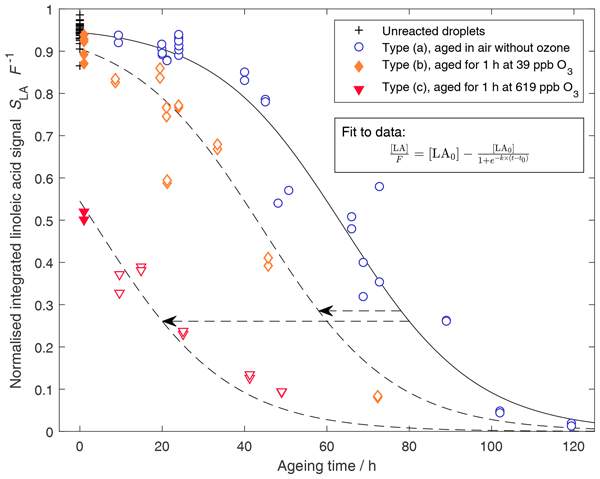
Atmos. Chem. Phys., 25, 11441–11451, 2025
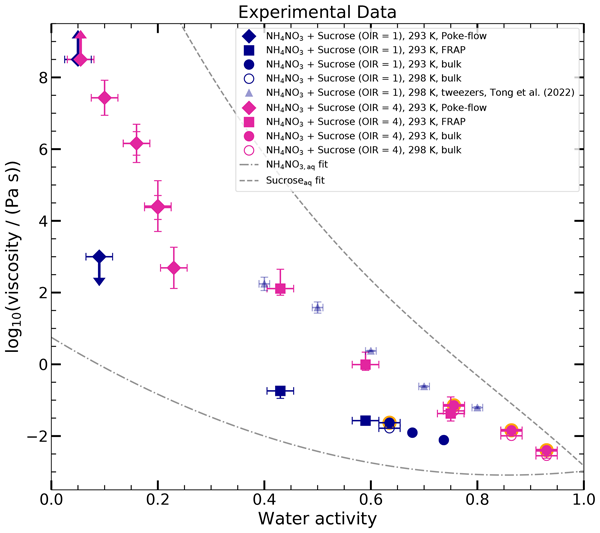
Atmos. Chem. Phys., 24, 13341–13359, 2024
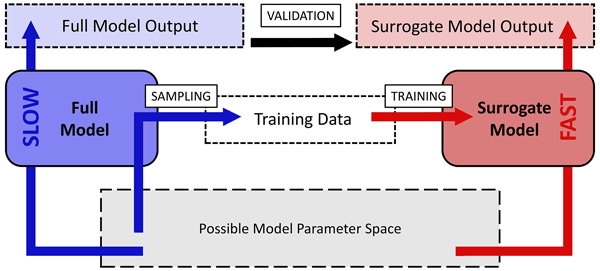
Geosci. Model Dev., 16, 2037–2054, 2023
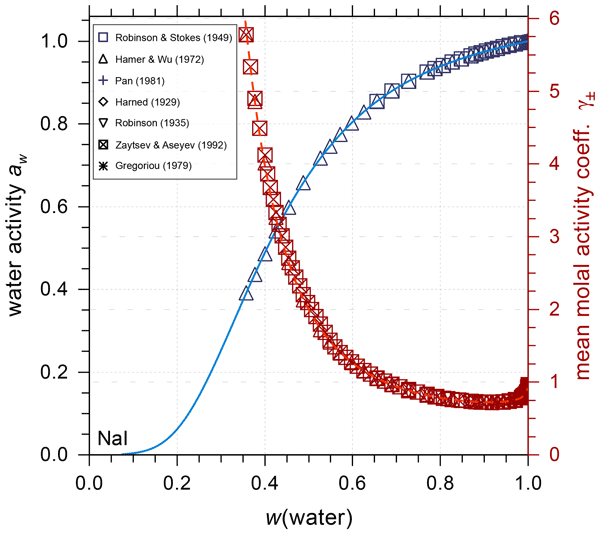
Atmos. Chem. Phys., 22, 973–1013, 2022
Cited articles
Antossian, C., Müller, M., and Krieger, U. K.: Photochemical and ozone-induced aging significantly alter the viscosity of aqueous trans-aconitic acid aerosol particles (Data collection), ETH Research Collection [data set], https://doi.org/10.3929/ethz-c-000788184, 2025.
Athanasiadis, A., Fitzgerald, C., Davidson, N. M., Giorio, C., Botchway, S. W., Ward, A. D., Kalberer, M., Pope, F. D., and Kuimova, M. K.: Dynamic viscosity mapping of the oxidation of squalene aerosol particles, Phys. Chem. Chem. Phys., 18, 30385–30393, https://doi.org/10.1039/c6cp05674a, 2016.
Baboomian, V. J., Crescenzo, G., Huang, Y. Z., Mahrt, F., Shiraiwa, M., Bertram, A. K., and Nizkorodov, S. A.: Sunlight can convert atmospheric aerosols into a glassy solid state and modify their environmental impacts, Proc. Natl. Acad. Sci. USA, 119, https://doi.org/10.1073/pnas.2208121119, 2022.
Bastelberger, S., Krieger, U. K., Luo, B., and Peter, T.: Diffusivity measurements of volatile organics in levitated viscous aerosol particles, Atmos. Chem. Phys., 17, 8453–8471, https://doi.org/10.5194/acp-17-8453-2017, 2017.
Bones, D. L., Reid, J. P., Lienhard, D. M., and Krieger, U. K.: Comparing the mechanism of water condensation and evaporation in glassy aerosol, Proc. Natl. Acad. Sci. USA, 109, 11613–11618, https://doi.org/10.1073/pnas.1200691109, 2012.


