
the Creative Commons Attribution 4.0 License.
the Creative Commons Attribution 4.0 License.
 | 06 Feb 2026
Sensitivity of photochemical surface ozone formation regimes to emissions and meteorology in India
Gopalakrishna Pillai Gopikrishnan
Daniel M. Westervelt
Jayanarayanan Kuttippurath
Atmospheric aerosols significantly contribute to air pollution and influence atmospheric chemistry, impacting air quality and public health. Decrease in aerosols can hinder the radical uptake sink of HO2, and thus increase NOx and OH, and subsequently increase ozone levels. This study investigates the seasonal variations of PM10 and aerosol surface area and their effect on surface ozone levels in India, using the GEOS-Chem Chemical Transport Model for the years 2018 and 2022, two years with high and low simulated PM10 concentrations, respectively. The results reveal substantial seasonal variations in PM10 and aerosol surface area. In winter (DJF), higher PM10 and aerosol surface area in the Indo-Gangetic Plain (IGP) and western Central India (CI) result from biomass burning and industrial activity, while coastal regions show lower aerosol surface area. A decrease in aerosol surface area is seen during the pre-monsoon (March–April–May; MAM) and monsoon (June–July–August–Septmember; JJAS), followed by an increase in the post-monsoon (ON) season. As a result, aerosol-induced HO2 uptake during winter and post-monsoon suppress surface ozone by approximately 5–10 µg m−3 in 2022 when compared to that of 2018. In contrast, during monsoon in 2022, the decrease in aerosol surface area caused an ozone increase of 5–7.5 µg m−3 when compared to that of 2018. On average, this increase in surface ozone due to the decrease in aerosols can be mitigated by reducing anthropogenic NOx emissions by about 25 %–50 %. Thus, we recommend integrated strategies addressing aerosols, precursor emissions and regional meteorology to combat ozone pollution.
- Article
(2937 KB) - Full-text XML
-
Supplement
(10265 KB) - BibTeX
- EndNote


In recent decades, surface ozone (O3) has gained significant research attention due to its role as a transient (ranging from a few hours to a few weeks) secondary pollutant and its detrimental impacts on human health and agricultural yield (e.g., Mills et al., 2007; Avnery et al., 2011; Rathore et al., 2023; Gopikrishnan and Kuttippurath, 2024). It is an important trace gas in tropospheric chemistry, facilitating oxidation processes as the principal source of hydroxyl radicals (OH) (Logan, 1985) while also involved in chemical reactions with various organic molecules (Anderson et al., 2007). Ozone in the troposphere is a secondary pollutant generated via photochemical reactions that involve carbon monoxide (CO) and volatile organic compounds (VOCs) together with nitrogen oxides (), recognised as ozone precursors (Crutzen et al., 1995; Gopikrishnan et al., 2022). However, these processes are dependent on solar radiation, with the reaction rate often peaking during summer months.
The formation dynamics of surface ozone is greatly affected by the presence of precursors such as NOx and VOCs, resulting in NOx-limited and VOC-limited regimes (Fiore et al., 2002; Lu et al., 2019). In the NOx-limited regime, the concentration of NOx is low compared to VOCs, implying that increasing NOx levels can promote further ozone generation due to inadequate NOx to completely react with VOCs. In a VOC-limited regime, the availability of VOCs is restricted, and further VOC emissions can significantly enhance ozone formation, whereas additional NOx may have less effect on ozone formation. Nevertheless, these regimes are significantly affected by local emission sources, atmospheric chemistry and climatic conditions. For instance, aerosols can influence these regimes by modifying the concentration of hydroxyl (OH) and hydroperoxyl (HO2) radicals, affecting the equilibrium between NOx and VOCs and eventually determining the rate and extent of ozone generation in different locations (Jacob et al., 1995; Feng et al., 2016; Wang et al., 2018; Li et al., 2019a; Ivatt et al., 2022; Gopikrishnan et al., 2025).
Previous studies based on ground-based measurements from urban centers and industrial sites have shown substantial decrease in the particulate matter (PM) in the Indian cities post the implementation of National Clean Air Programme (NCAP), which primarily targets reducing the city-level PM pollution by 20 %–30 % in 131 cities when compared to that of 2017–2018. Gopikrishnan and Kuttippurath (2024) studied the Daily maximum 8 h average (MDA-8) ozone changes and observed that cities such as Visakhapatnam and Tirupati reported zero days of MDA-8 ozone surpassing 100 ppb post the implementation of NCAP in 2022. In contrast, during the 2018 base year, Visakhapatnam and Tirupati experienced about 60 and 10 such days, respectively. Nevertheless, some cities in the Indo-Gangetic Plains (IGP) of India, for instance, Agra, Singrauli, Ghaziabad, with decreasing aerosol loading and particulate matter pollution (Gopikrishnan and Kuttippurath, 2025), show an increase in the surface ozone levels. This trade-off between PM and O3 was also mentioned in other highly populated regions of the world. For example, Wang et al. (2020) also observed that the opposite changes in surface ozone and PM2.5 emerged as an unforeseen consequence of China's Clean Air Action Plan, aimed at reducing air pollution. Following the implementation of the plan, ozone levels increased over the summer in the North China Plain, due to reduced NOx emissions and steady or rising VOC emissions, alongside significant decreases in PM2.5 concentrations. This indicates that addressing ozone pollution requires deeper knowledge than broadly categorising it as NOx-limited or VOC-limited, as the influence of PM and aerosols is significant (Zhao et al., 2023). Nevertheless, this variability in PM can also arise substantially due to changes in meteorology (Ivatt et al., 2022). Therefore, future air quality management systems worldwide must include the intricate relationship between O3, PM, precursor emissions and the regionally prevailing meteorology to effectively reduce both pollutants simultaneously.
Rural pollution is also a critical, yet often overlooked aspect of air quality management, especially in a country like India, where a significant portion of the population resides in rural areas (Pathak and Kuttippurath, 2022, 2024). Rural regions are not immune to air pollution; they face unique challenges such as solid fuel combustion for cooking, agricultural residue burning and increasing vehicular emissions due to expanding road networks (Bhuvaneshwari et al., 2019; Chanana et al., 2023). These activities contribute to elevated levels of PM and ozone precursors, which can drift into urban areas, exacerbating pollution in cities through regional transport mechanisms. Furthermore, rural air pollution has profound implications for public health, as rural populations often lack access to healthcare infrastructure to address respiratory and cardiovascular diseases caused by poor air quality (Coker and Kizito, 2018; Manisalidis et al., 2020). It also impacts agricultural productivity, with rising ozone levels reducing crop yields, thereby threatening food security in agrarian economies like India (Pandya et al., 2022; Anagha et al., 2024). Addressing rural pollution is essential for achieving holistic improvements in air quality and ensuring equitable environmental health benefits across urban and rural populations.
Studies on the impact of aerosols on near-surface ozone formation have predominantly focused on the significance of Aerosol Optical Depth (AOD) extinction in photochemical processes that generate ozone (Bian et al., 2007; Kim et al., 2013; Wang et al., 2019a). AOD quantifies the degree to which aerosols scatter and absorb sunlight, hence influencing the quantity of solar radiation that reaches the Earth's surface. This subsequently affects the photochemical mechanisms that facilitate ozone synthesis in the lower atmosphere. Nevertheless, in areas with high aerosol concentrations, the reduction of surface ozone is not only governed by AOD extinction, but also the aerosol surface area by offering reactive sites for chemical reactions with molecules such as HO2 (Macintyre and Evans, 2011; Song et al., 2021). The interaction between aerosols and these species leads to the elimination of ozone precursors, including OH radicals, which are vital for ozone production.
In this study, we aim to evaluate the impact of PM10 and aerosol surface area on surface ozone pollution in India. PM10 affects surface ozone formation mainly by enhancing aerosol optical depth and surface area, which reduce the photolysis rates of NO2 and O3 and decreases the concentrations of OH and HO2 radicals, resulting in reduced net photochemical ozone production (Liu et al., 2024). To characterise the aerosol-driven ozone inhibition, we explicitly account for the surface area contributions from secondary organic aerosol, mineral dust, sea salt, black carbon, and primary organic carbon. As mineral dust and sea salt predominantly reside in the coarse fraction of PM10, this framework captures aerosol–ozone interactions that are not fully represented by PM2.5 alone (Bian and Zender, 2003; Bonasoni et al., 2004; George et al., 2017; Alves et al., 2018). Furthermore, given that national air-quality initiatives in India, such as the National Clean Air Programme (NCAP), target a 20 %–30 % reduction in PM10 relative to 2018 levels, this analysis also assesses the potential implications of PM10 mitigation for surface ozone pollution (NCAP, 2023). Since several studies are available on the air pollution concentrated in the urban regions of India, our analysis therefore explores the ozone formation regimes across entire India, using a high-resolution GEOS-Chem Chemical Transport Model. This allows us to examine the impact of regional and larger scale dynamics of ozone production, which are often influenced by agricultural practices, biomass burning and long-range pollutant transport. By simulating two distinct years – 2018 (a high PM10 year and low rainfall year) and 2022 (a low PM10 year and normal rainfall year) with and without fixed meteorology for the two years – and incorporating/excluding the reactive absorption of HO2 onto aerosols (via the γHO2 parameter), we aim to understand how reductions in PM10 levels influence aerosol surface area and the secondary ozone chemistry (Figs. S1 and S2 in the Supplement). Furthermore, we categorize ozone generation regimes into NOx-limited, VOC-limited and Aerosol Inhibited Regime (AIR) regions based on the dominant termination reactions in surface ozone formation for each model grid (Ivatt et al., 2022). Additionally, by scaling down NOx emissions by 25 % and 50 %, we assess the efficacy of national and local emission control measures in mitigating NOx emissions and their subsequent impact on surface ozone levels. This approach provides important insights into the chemistry between PM, precursor emissions and surface ozone across diverse geographical regions in India, highlighting the need for integrated air quality management strategies beyond urban boundaries.
2.1 Region of Study
India can be delineated into six regions based on topographical characteristics, demographic factors, and pollution levels: Peninsular India (PI), Northwest (NW), Northeast (NE), Central India (CI), Indo-Gangetic Plain (IGP), and Hilly Regions (HR), as shown in Fig. 1. Peninsular India, which encompasses Kerala, Tamil Nadu, Karnataka, Goa, Andhra Pradesh, and Telangana, has three of the ten most populous states – Andhra Pradesh, Tamil Nadu, and Karnataka – and features substantial forest cover in the Western Ghats. Sources of pollution in this region are automobile emissions, industrial operations and biomass combustion, especially in urban areas like Bengaluru and Chennai. Central India, comprising Maharashtra, Madhya Pradesh, Chhattisgarh, Jharkhand and Odisha, is marked by low population density yet is linked to thermal power plants, coal mines and steel factories. Cities like Mumbai and Pune have higher pollution levels attributable to industrialisation and trash incineration. Northwest India includes Rajasthan and Gujarat, characterised by dry landscapes like the Thar Desert; pollution is attributed to dust from unpaved roads and construction activity, along with industrial emissions from sectors such as textiles. Northeast India comprises Tripura, Mizoram, Manipur, Nagaland, Meghalaya and Assam; despite its low population density and extensive vegetation, this region is affected by automobile pollution and slash-and-burn agriculture methods. The Indo-Gangetic Plain encompasses West Bengal, Bihar, Uttar Pradesh, Haryana and Punjab; it is characterised by a high population density exceeding 1000 individuals per square kilometre and has substantial pollution resulting from heavy traffic, industrial effluents and extensive crop residue burning during harvest periods. The Hilly Regions encompass Jammu and Kashmir, Himachal Pradesh, Uttarakhand, Sikkim and Arunachal Pradesh. These areas are less industrialised and ecologically sensitive, with economies dependent on agriculture and forestry. They experience localised pollution from vehicular emissions and biomass combustion, which is intensified by winter temperature inversions that confine pollutants near the surface (Kuttippurath et al., 2020; Gopikrishnan et al., 2022). A detailed summary of regional delineation, including constituent states and dominant pollution characteristics, is provided in Table S1 in the Supplement.

Figure 1The region of study. The regions considered are also shown in the respective colours. Here, NW is Northwest, NE is Northeast India and IGP is Indo Gangetic Plain. The star marks indicate the respective ground-based stations. The red and blue dots indicate the metropolitan and Industrial cities in India. The abbreviations represent the first three letters of each city considered (e.g. DEL is Delhi), and their full names are given in Fig. S3.
2.2 GEOS-Chem
GEOS-Chem is an extensive model developed for modelling complex oxidant-aerosol chemistry in the troposphere and stratosphere (Zhang et al., 2011; Kim et al., 2015). We have used GEOS-Chem version 14.4.3 in this study (https://doi.org/10.5281/zenodo.13314490, The International GEOS-Chem User Community, 2024). The model complies with the most recent JPL/IUPAC guidelines for chemical mechanisms, with substantial modifications that improve the depiction of diverse chemical processes, including those related to isoprene, aromatics and nitrates (Bates et al., 2023). Recent advancements have enhanced the treatment of complex chemical reactions, including methanol synthesis and mercury redox chemistry, facilitating more precise atmospheric forecasts (Horowitz et al., 2017; Guil-López et al., 2019). Additionally, the model incorporates the reactive absorption of NOx by aerosols and computes aerosol hygroscopicity, which is essential for comprehending aerosol-cloud interactions. GEOS-Chem offers a comprehensive framework for investigating atmospheric chemistry and its effects on air quality and climate change, accommodating various chemical species and reactions, including halogens and hydroxymethanesulfonate. This model provides thorough understanding into ozone generation mechanisms and pollutant interactions, serving as an essential resource for addressing air quality challenges and comprehending the wider implications of atmospheric dynamics.
GEOS-Chem has been rigorously validated by researchers globally. For instance, Travis and Jacob (2019) showed that, despite the successful simulation of ozone and its precursors in the SEAC4RS aircraft data below 1 km of altitude, MDA8 surface ozone was biased high in the model by on average. David et al. (2019) used the GEOS-Chem transport model in India and observed that the model reasonably simulated the tropospheric O3 abundances and vertical profiles, with a mean bias of 1–3 DU compared to observations for the period 2000–2015. Christiansen et al. (2022) found that the GEOS-Chem model, when validated against ozonesonde, aircraft, and satellite observations globally, showed reasonable agreement with a mean bias of 1–3 DU for the period from 1990–2017. Mao et al. (2024) reported that the GEOS-Chem model, validated against MDA8 O3 concentration observations in central and eastern China from May–July 2017, showed a strong correlation of 0.77 (95 % confidence level). In Nanjing, the simulated MDA8 O3 concentrations converged with the observed trend, with a correlation coefficient of 0.65, a normalised mean bias (NMB) of 5 %, and a normalised mean error (NME) of 21 %. Karambelas et al. (2022) used the GEOS-Chem model to simulate PM2.5 concentrations during high PM episodes in the fall of 2015 and 2017, finding that the model underestimated observed concentrations by 28 %, with an average observed PM2.5 concentration of 142 µg m−3 compared to 125 µg m−3 from the model. Pai et al. (2022) validated the GEOS-Chem simulation against speciated airborne aerosol measurements over India and reported significantly reduced normalized mean biases: NMBModified=0.19 compared to NMBBase=0.61 overall – with nitrate improving from 1.64–0.08 and ammonium from 0.90–0.49. Despite this underestimation, the model demonstrated strong spatial correlations with observed concentrations (r2=0.67), accurately capturing the spatial distribution of PM2.5 across India. David and Ravishankara (2019) used the GEOS-Chem model to estimate boundary layer ozone contributions across eight regions of the Indian subcontinent, finding that boundary layer ozone in northern India, Pakistan, and Sri Lanka is largely (about 65 %–70 %) influenced by regions outside the subcontinent. They also highlighted the growing importance of central India in contributing to ozone pollution, with regional meteorology playing a key role in the redistribution of boundary layer ozone and its precursors including Chlorine (Cl).
In this study, GEOS-Chem is simulated in a 2.0°×2.5° latitude by longitude grid resolution globally for the boundary conditions for the years 2018 and 2022. One year spin up simulations are used to generate the model restart files and the boundary conditions. The nested model has a grid resolution of 0.25°×0.3125° latitude by longitude and a spin up period of 1 month. We use the data from the lowest level of the ETA coordinate system from GEOS-Chem model simulations to analyse the correlation between modelled and observed PM10 and ozone data. The model is driven by the GEOS–FP assimilated meteorological data provided by the Goddard Earth Observing System (GEOS) of the Earth Modelling and Assimilation Office (GMAO) and with a temporal resolution of 1 h (Lucchesi, 2013). Emissions in the GEOS-Chem model are handled using the Harvard–NASA Emission Component (HEMCO; Keller et al., 2014). Anthropogenic emissions are derived from the Community Emissions Data System (CEDS), which provides global coverage at a native resolution of 0.1°×0.1°, with data aggregated to the model resolution (Hoesly et al., 2018). Sea salt emissions are calculated offline following the approach of Zhu et al. (2019), while dust emissions are calculated offline following the method of Ginoux et al. (2012). Emissions of biogenic origin are simulated using the Model of Emissions of Gases and Aerosols from Nature (MEGAN), which provides global emissions at 0.01° latitude×0.01° longitude resolution (Guenther et al., 2012) and Soil NOx emissions follow the approach outlined by Hudman et al. (2012). Biomass burning emissions are sourced from the Global Fire Emissions Database version 4 (GFED4), which provides a global coverage at 0.25° latitude×0.25° longitude (Giglio et al., 2013).
GEOS-Chem uses a set of chemical mechanisms implemented with the Kinetic PreProcessor (KPP) (Damian et al., 2002). The standard chemical mechanism in GEOS-Chem has undergone continuous development since the original tropospheric gas-phase scheme of Bey et al. (2001), with subsequent extensions to include aerosol chemistry (Park, 2004), stratospheric chemistry (Eastham et al., 2014), and a detailed tropospheric–stratospheric halogen chemistry module (Wang et al., 2019b), which include 299 chemical species (Fritz et al., 2022). Sulfate–nitrate–ammonium aerosols are simulated with a bulk thermodynamic approach (Park, 2004), where gas–particle partitioning is calculated using ISORROPIA II (Fountoukis and Nenes, 2007). Sea salt is represented with two modes distinguishing fine and coarse particles (Jaeglé et al., 2011), while mineral dust is described using four particle size bins (Fairlie et al., 2007). Furthermore, the simple SOA scheme is employed for secondary organic aerosols, based on reversible partitioning of semivolatile products of VOC oxidation (Pye et al., 2010). Furthermore, in GEOS-Chem, PM10 is diagnosed as the sum of PM2.5 plus size-resolved dust (70 % of DST2, all of DST3, 90 % of DST4) and coarse sea-salt (SALC scaled by the hygroscopic growth factor, e.g., 1.86 at 35 %–50 % RH), with the final values archived at standard temperature and pressure (STP) using the ideal gas law (GEOS-Chem Support Team, 2023).
Furthermore, we use ground-based measurements from Central Pollution Control Board (CPCB) monitoring sites situated in different regions of India, as shown in Figs. 1 and S3, reflecting a wide array of meteorological conditions. The CPCB monitors ambient ozone using UV photometric methods (based on the absorption of UV light by ozone at 254 nm), chemiluminescence (where ozone reacts with a reagent to produce light that is quantified), and chemical methods (colorimetric reactions providing concentration estimates). PM10 is measured using gravimetric analysis (filter-based mass determination after sampling), Tapered Element Oscillating Microbalance or TEOM (continuous real-time mass measurement through frequency change of a vibrating element), and beta attenuation techniques (attenuation of beta radiation as it passes through particle-laden filters to infer mass concentration) and these data are available at a resolution of 1 h (NAAQS, 2023).
The altitude of the lowest model level may not consistently align with the actual altitude of ground-based monitoring locations, thereby causing inconsistencies between modelled and observed data. Therefore, we calculate the correlation coefficient for the time series of ozone and PM10 values at each station to evaluate the strength of the association between these variables, as shown in Fig. S3. The correlation coefficient between modelled and observed values of PM10 and ozone is above 0.6 for most of the stations, except in Jaipur in the northwest, where the correlations are 0.5 and 0.4 for PM10 and ozone, respectively. Although these moderate to strong correlations suggest a satisfactory alignment between the model and the facts, certain systematic differences remain. The GEOS-Chem model generally underestimates PM10 concentration, possibly attributable to its 0.25°×0.3125° resolution, which fails to account for fine-scale local variations, including point sources of pollution. In contrast, the model often overestimates surface ozone concentrations for most of the stations considered here. Despite the model's higher bias caused by uncertainties in emissions of anthropogenic and biogenic precursors, uncertainties in ozone sinks such as dry deposition, and the coarse resolution of the model limits its ability to capture ozone titration and other localised chemical processes (Westervelt et al., 2019). Our analysis focuses on the differences between simulations for 2018 and 2022, with model performance evaluated using ground-based CPCB observations of surface ozone and PM10 (Figs. 2, S4 and S5). GEOS-Chem broadly captures regional patterns of annually averaged PM10 and ozone, but ground-based stations show higher PM10 in north west and IGP (140–160 µg m−3 vs. model 120–140 µg m−3, which is about 15 %–20 % low bias) and lower values in central and peninsular India (about 10 %–15 % high bias). For ozone, the model underestimates HR and IGP peaks by about 10 %–15 % () while overestimating coastal peninsular levels by about 10 %–20 % (observed 70–90 µg m−3). The model reproduces the temporal patterns reasonably well, with annually averaged differences between modelled and observed values remaining within 10 %–20 % across most stations. Despite a few regionally specific biases (higher relative differences in PM10 in cities like Talcher, Noida, Jodhpur during the monsoon season), the consistent performance across two meteorologically different years lends confidence to the overall robustness of the high-resolution GEOS-Chem simulations for India.
2.3 Methods
The aerosol uptake coefficient, which quantifies the efficacy of particles in absorbing reactive gases, substantially impacts surface ozone concentrations (Jacob, 2000). In areas with elevated aerosol concentrations, aerosols possessing a high uptake coefficient can more efficiently eliminate ozone precursors, including HO2 and other reactive radicals, from the atmosphere (Li et al., 2018). These aerosols interact with atmospheric chemical species, reducing the levels of OH and HO2 radicals, which are essential for ozone synthesis. The aerosol uptake coefficient of HO2 (γHO2), however, is affected by several factors, including the physical and chemical characteristics of the aerosol particles, such as size, composition and moisture content (George and Abbatt, 2010). These parameters show the efficacy of aerosol interactions with atmospheric radicals, thereby affecting ozone production.
Termination rates of chain reactions were determined using archived species concentrations and physical parameters such as temperature, pressure and humidity, in addition to aerosol properties, as in Ivatt et al. (2022). Although we do not classify radical product generation in peroxyl-radical self-reactions as termination stages, we regard non-radical products as ongoing termination processes. The heterogeneous loss rate of HO2 was assessed by evaluating the radius and surface area of different aerosol forms from the archived model outputs. For our simulations, we employed a default HO2 reactive uptake coefficient (γHO2) of 0.2. Laboratory studies of pure synthetic aerosols indicate lower uptake coefficients (γHO2<0.2), whereas real-world aerosol studies reveal values between 0.08–0.40, implying that elements such as transition metals may increase aerosol uptake (Kolb et al., 2010; Christian et al., 2018). We have also simulated the model with γHO2 to be zero to evaluate its impact on ozone formation mechanism. While we presumed H2O to be the exclusive product of HO2 absorption, our results remain valid when H2O2 is considered. Employing a singular γHO2 value likely oversimplifies the variability, as existing models fail to account for its temporal oscillations (Stavrakou et al., 2013; Sheehy et al., 2010).
The heterogeneous radical loss rate of HO2 is determined by iterating through the radius and surface area of various aerosol types, which includes sulfate–nitrate–ammonium thermodynamics, secondary organic aerosol, dust, sea salt, black carbon, and primary organic carbon (Ivatt et al., 2022). These factors, along with temperature and air density, are used to calculate the first-order loss rate of HO2. Furthermore, emissions and photochemical reactions are strongly affected by seasonal variations in India. The seasons are defined as Winter (December–January–February; DJF), Pre-monsoon (March–April–May; MAM), Monsoon (June–July–August–September; JJAS) and Post-monsoon (October–November; ON).
3.1 Distribution of Surface Ozone and PM for the years 2018 and 2022
3.1.1 Annual Distribution
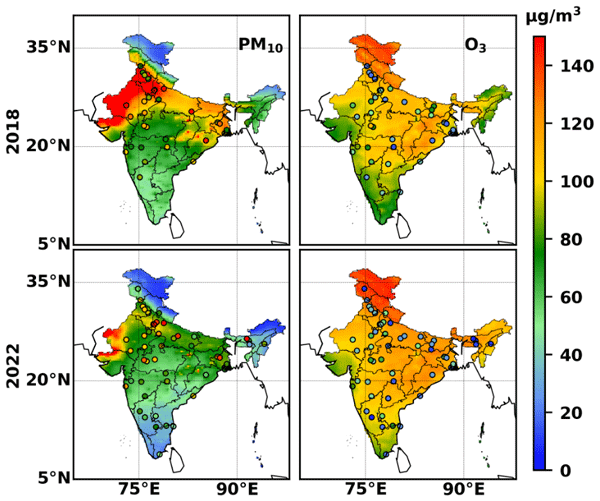
Figure 2 shows the annual average PM10 and ozone in India for the years 2018 and 2022. The highest PM10 concentrations (130–150 µg m−3) occur in the north west dry regions due to dust mobilisation from the Thar Desert (Santra et al., 2018; Kashyap et al., 2025), consistent with studies showing dry and semi-arid areas as key mineral dust sources (Maji and Sonwani, 2022). Ground-based observations here often exceed 160 µg m−3, indicating that the model underestimates by about 10 %–20 %. This bias may partly arise from uncertainties in dust emission parameterisations and coarse-resolution representation of wind-driven dust mobilisation in GEOS-Chem (Saxena and Pandey, 2025). IGP also shows higher PM10 (120–140 µg m−3) from industrial, vehicular and agricultural emissions including biomass and crop-residue burning (Devi et al., 2020, 2024; Hassan et al., 2023). Station data shows average concentrations of about 140–160 µg m−3, indicating that the model is biased low by about 15 %. Such biases are likely linked to uncertainties in anthropogenic emission inventories, particularly for primary PM, NOx and VOC emissions in India, which are often underreported or lack temporal and sectoral detail (Smith et al., 2001; Ge et al., 2024; Tripathi et al., 2025). In addition, simplifications in secondary aerosol formation pathways can further contribute to PM underestimation (Lane et al., 2008). Despite higher emissions, greater humidity and rainfall promote wet deposition and particle scavenging, lowering levels relative to north west India (Sen et al., 2017; Singh et al., 2023). Central India records 60–100 µg m−3 with industrial hotspots up to 130–150 µg m−3 (Lokhande and Khan, 2021; Saini et al., 2023), but observations show about 50–90 µg m−3, suggesting the model slightly overestimates by about 10 %–15 %. North east India shows lower levels (40–70 µg m−3) due to sparse population and vegetation sinks (Guttikunda and Nishadh, 2022; Kumari et al., 2025).

Figure 2Annual average distribution of PM10 and ozone for the years (top) 2018 and (bottom) 2022 from GEOS-Chem simulations. The dots show the annually averaged mean values of PM10 and ozone at the respective ground-based CPCB stations for the years 2018 and 2022.
Surface ozone peaks in the hilly regions (120–140 µg m−3) due to high stratospheric-to-troposphere transport (STT), Ground-based data here often reach 150–160 µg m−3, showing that model underpredicts by about 15 % (Phanikumar et al., 2017; Wang et al., 2024a). STT is included in the GEOS Chem model through the unified tropospheric–stratospheric chemical mechanism (UCX; Eastham et al., 2014). High values also occur in IGP and eastern central India (100–120 µg m−3) driven by secondary photochemistry from NOx and VOCs (Payra et al., 2022; Sinha and Sinha, 2019; Mahilang et al., 2021; Kuttippurath et al., 2022). These enhancements occur under stagnant conditions, where low wind speeds (), suppressed boundary-layer mixing, and limited dispersion enhance the accumulation of ozone and its precursors near the surface (Gopikrishnan and Kuttippurath, 2024). Observations in these regions are typically 110–130 µg m−3, reflecting a model underestimation of about 10 %–15 %. Peninsular India shows the lowest ozone (80–100 µg m−3) due to coastal ventilation, humidity, precipitation and oceanic loss, with observed levels closer to 70–90 µg m−3, showing that the model overestimates by about 10 %–20 %. This positive bias likely arises from uncertainties in NOx and VOC emission inventories in peninsular India and an underrepresentation of coastal ozone loss processes, including marine deposition and halogen chemistry, in CTMs (Li et al., 2019b; Lakshmi et al., 2024; Galbally and Roy, 1980; Lavanyaa et al., 2023; Nilaya et al., 2024). A detailed discussion of seasonal changes in surface ozone is provided in Sect. S1.1 in the Supplement.
Seasonally, PM10 is highest in IGP during winter and post-monsoon (100–140 µg m−3) under stable, inversion conditions and intensified biomass and crop-residue burning (Mhawish et al., 2020; Paulot et al., 2022; Jayachandran and Rao, 2024; Payra et al., 2022; Mogno et al., 2021). The north west records its peak during the monsoon from dust storms (Yadav et al., 2022; Yu et al., 2023), while pre-monsoon sees widespread elevated PM10 (60–100 µg m−3) with north west reaching 140–160 µg m−3 due to dust, traffic, industrial and construction sources (Patil et al., 2013; Garg and Gupta, 2020). These high levels pose severe health risks, particularly for vulnerable groups (Adhikary et al., 2024; Pathak et al., 2024; Gopikrishnan and Kuttippurath, 2025). Ozone peaks in pre-monsoon, especially over central, IGP and north east India, where it exceeds 140–160 µg m−3, driven by strong solar radiation and abundant precursors (Kutal et al., 2022; Sinha et al., 2014). Winter ozone is also high in central India (100–120 µg m−3), followed by IGP and north east India (80–100 µg m−3) under stagnant meteorology and local emissions (David and Nair, 2011; Gao et al., 2020). In contrast, monsoon levels are lowest, with the west coast at 60–80 µg m−3, north west at 80–100 µg m−3 and north east and IGP at 120–140 µg m−3, owing to cloud cover, precipitation and circulation that suppress ozone production and enhance removal (Lal et al., 2014; Lu et al., 2018). Post-monsoon levels are moderate (100–120 µg m−3) across central, north west and IGP, with peninsular and north east India slightly lower (60–90 µg m−3) (Lu et al., 2018). A detailed discussion of seasonal changes in surface ozone is provided in Sect. S1.2.
3.1.2 Comparison of PM10 and Ozone levels
The relationship between PM10 and ozone is often inverse, attributable to their distinct formation mechanisms and atmospheric interactions, but varies substantially depending on meteorological conditions and precursor availability (Jia et al., 2017). Higher PM levels, frequent during winter in areas such as IGP, often correlate with lower ozone concentrations (Song et al., 2022). PM disperses and absorbs sunlight, reducing the solar radiation essential for photochemical ozone formation, which depends on NOx and VOCs concentration in the presence of intense sunlight. This reduction in actinic flux directly suppresses photolysis frequencies (e.g., J(NO2) and J(O1D)), thereby limiting radical production (OH and HO2) and slowing ozone formation rates (Harrison, 2007). Black carbon (BC), a constituent of PM from combustion, can directly scavenge ozone by acting as a deposition surface. This occurs through heterogeneous uptake of O3 onto the porous and highly reactive BC surface, where ozone is adsorbed and decomposed into molecular oxygen, effectively removing O3 from the gas phase (Gao et al., 2018). However, this direct BC–ozone scavenging pathway is not explicitly represented in most chemical transport models (Koch et al., 2009), but its overall contribution is considered modest compared to dominant photochemical production and deposition processes. The large BC loadings and high surface-area densities in South Asia may render this pathway locally important, particularly under stagnant wintertime conditions (Kumar et al., 2015, Pathak et al., 2024). Furthermore, stable atmospheric conditions including temperature inversions that confine PM at the surface also impede vertical mixing, limiting ozone transport from the upper atmosphere, hence facilitating the accumulation of ozone near the surface (Gopikrishnan and Kuttippurath, 2025). In addition, high PM loading enhances aerosol radiative cooling at the surface, reducing sensible heat flux and suppressing turbulent mixing, which leads to a shallower planetary boundary layer (PBL; Budakoti and Singh, 2021). In such cases, the co-accumulation of PM and ozone near the surface does not imply a simple inverse relationship, as aerosol–radiation interactions can further suppress the PBL height (Li et al., 2017; Zou et al., 2017), thereby enhancing pollutant trapping. A shallower PBL reduces vertical dilution, increasing the residence time of both ozone and its precursors in the near-surface layer (Torres-Vazquez et al., 2022). Under suppressed PBL conditions and high NOx emissions, ozone titration can also occur, leading to additional complexity in the surface ozone response (Lin et al., 2008; Li et al., 2024). Conversely, cleaner environments with reduced PM concentrations enhance ozone generation due to the lack of light scattering and scavenging, which fosters photochemical activity (Rathore et al., 2023; Sicard et al., 2023). Though GEOS-Chem robustly captures aerosol-induced photolysis attenuation and radical scavenging (HO2 uptake), the direct heterogeneous loss of ozone on black carbon surfaces remains a source of model uncertainty as it is not explicitly represented in the standard chemical mechanism (Wang et al., 2022).
Figure 3 shows the change in PM10 and ozone in India for the year 2022 when compared to that of 2018. In the monsoon and post-monsoon seasons, PM concentrations drop by 40–60 µg m−3 in the north west, IGP and eastern central India, while reductions of 10–30 µg m−3 occur in other regions, due to changes in the spatial distribution of precipitation as shown in Figs. S6 and S7. Such reductions in PM weaken aerosol direct radiative effects by decreasing scattering and absorption of incoming shortwave radiation, thereby increasing surface solar irradiance and actinic flux, , thereby altering photolysis rates (Singh et al., 2023). Figure S8 presents the changes in aerosol surface area between 2018 and 2022, whereas Fig. S9 illustrates the contributions from different aerosol sources in these two years. The reduction in PM facilitates increased solar radiation penetration (Aladwani et al., 2024), hence promoting photochemical ozone production, resulting in a substantial rise in ozone concentrations (20–30 µg m−3 in most of India during monsoon and 20–30 µg m−3 in peninsular and western central India during post-monsoon). This response is primarily driven by aerosol direct effects, through enhanced photolysis rates of NO2 and O3, while reduced aerosol loading may also weaken aerosol–cloud interactions that otherwise increase cloud albedo and lifetime during the monsoon (Singh et al., 2023). The decrease in PM10 reduces the surface area accessible for heterogeneous processes that might otherwise reduce ozone levels (Gopikrishnan et al., 2025). Conversely, in pre-monsoon and winter seasons, PM concentrations increase by 10–30 µg m−3 regionally, particularly in north west and central IGP, inhibiting ozone formation due to reduced solar radiation and enhanced heterogeneous chemistry that depletes reactive species such as HO2 (Wang et al., 2024b). In these seasons, enhanced aerosol direct effects dominate by attenuating surface radiation, while aerosol indirect effects, through increased cloud condensation nuclei and persistent low-level clouds, can further suppress photolysis, especially under high-humidity conditions (Wu et al., 2020). The stagnant meteorological conditions associated with winter (DJF) and post-monsoon season (ON), including temperature inversions, elevated humidity, and minimal wind speeds, intensify PM buildup, particularly in IGP (Fig. S10), resulting in further reductions in ozone levels (Gopikrishnan and Kuttippurath, 2024). Elevated PM loading under such conditions also enhances surface radiative cooling, suppressing turbulent mixing and leading to a shallower planetary boundary layer, which reinforces pollutant trapping (Torres-Vazquez et al., 2022). Nonetheless, geographical disparities remain, exemplified by a 20 µg m−3 reduction in PM in the Upper Northeast of IGP during pre-monsoon, which causes a 20–30 µg m−3 rise in ozone levels, and a 10–20 µg m−3 decline in PM near the west coast, resulting in a 40–60 µg m−3 increase in ozone. In winter, ozone variations are negligible (within 10 µg m−3) over much of India; however, a reduction in PM (10–30 µg m−3) in the northeast correlates with a 20–30 µg m−3 rise in ozone levels. The seasonal variability is additionally affected by the aerosol-photolysis feedback, wherein PM influences ozone by absorbing important species such as odd-hydrogen radical family (HxOy, including OH, HO2, and related peroxides) and NOx, hence reducing surface photolysis rates and inhibiting ozone production (Ivatt et al., 2022; Gopikrishnan et al., 2025).

Figure 3The difference in (top) PM10 and (bottom) Ozone in 2022 when compared to that of 2018. Here, DJF is December–January–February, MAM is March–April–May, JJAS is June–July–August–September and ON is October–November.
4.1 Impact of HO2 uptake onto aerosol on surface ozone
The GEOS-Chem model simulations for 2018 and 2022 were performed without and with aerosol uptake of HO2 to study the impact of γHO2 on surface ozone concentrations in India in the absence of this mechanism. The results show that the aerosol absorption of HO2 substantially influences ozone concentrations, as shown in Fig. 4, especially in areas like the IGP and eastern central India. The increase in ozone concentrations in these regions without aerosols (Fig. S11), attributed to the absorption of HO2 by aerosols, varies from 5–10 µg m−3, with the most significant changes during winter and post monsoon season. Winter season is defined by higher aerosol surface area, which promotes heterogeneous processes that enhance the removal of HO2, hence restricting its availability for ozone formation (Dyson et al., 2022). In 2022, aerosol concentrations rose substantially in winter when compared to 2018, especially in the middle IGP and western central India. This augmentation of aerosol surface area in 2022 inhibited ozone generation by about 5–7.5 µg m−3 in these areas. The most notable changes in ozone concentrations were during post-monsoon, with an increase of about 5–10 µg m−3 when no aerosol absorption is considered, especially in IGP and western central India. In 2022, there was a rise in aerosol surface area in western central India compared to 2018, resulting in an additional suppression of surface ozone. The pre-monsoon season period had similar changes in ozone concentration, with an increase of about 2.5–5 µg m−3, whereas the monsoon period observed minimal variation, with ozone concentration changes between 0 and 5 µg m−3. Thus, the changes in ozone concentrations are directly influenced by aerosol surface area, which amplifies the heterogeneous elimination of HO2, thereby restricting its availability for ozone synthesis (Anurose et al., 2024). Seasonal fluctuations in aerosol load, influenced by factors like monsoon dynamics, atmospheric transport, and emissions, greatly influence the effects of aerosol-HO2 interactions on ozone levels. The rise in aerosol concentrations in 2022, especially during winter and post-monsoon, can be attributed to higher anthropogenic activities increasing sulphate, BC and OC, which enhance the suppression of ozone production in these seasons (Austin et al.,2015; Zhang et al., 2023).

Figure 4Difference in surface ozone response to aerosol uptake between 2022 and 2018, expressed relative to the no-uptake case (γHO2=0). The top panel shows [(O3 at γHO2=0.0 in 2022 – O3 at γHO2=0.1 in 2022) – (O3 at γHO2=0.0 in 2018 – O3 at γHO2=0.1 in 2018)], while the middle panel shows the analogous calculation for γHO2=0.2. The bottom panel shows the change in surface ozone averaged for the entire year when γHO2=0.1 and γHO2=0.2. The bottom panel presents a bar chart of regionally averaged annual surface ozone changes for γHO2=0.1 and γHO2=0.2, derived from the top and middle panels. Here, negative values indicate stronger ozone suppression in 2018, while positive values indicate stronger suppression in 2022. Here, DJF is December–January–February, MAM is March–April–May, JJAS is June–July–August–September, ON is October–November, NW is Northwest, NE is Northeast India and IGP is Indo Gangetic Plains.
In addition to the simulation with a γHO2 of 0.2, a sensitivity analysis using γHO2=0.1 was conducted for the years 2018 and 2022, as shown in Figs. 4 and S12, respectively. This lower value was chosen, as previous studies suggest that γHO2=0.2 may overestimate heterogeneous uptake, particularly over East Asia, where values closer to 0.1 have been reported under typical ambient conditions (Yang et al., 2023). Given the large uncertainty and variability in γHO2 arising from factors such as aerosol composition, relative humidity, and particle acidity (Lakey et al., 2024), it is critical to assess the sensitivity of modeled ozone to a range of uptake efficiencies. This uncertainty can lead to substantial differences in simulated ozone, as even a halving of γHO2 (from 0.2–0.1) significantly reduces the magnitude and spatial extent of ozone suppression. The comparison between the two scenarios indicates that the impact on surface ozone concentrations is both spatially and seasonally dependent, with γHO2=0.2 yielding a more pronounced and widespread increase when compared to a no aerosol uptake scenario. During the DJF and ON seasons, the increase in ozone is up to 10 µg m−3 across IGP, eastern, and central India, while the γHO2=0.1 simulation shows more modest reductions in the range of 5–10 µg m−3 over similar regions. In the MAM and JJAS seasons, the differences in ozone concentrations are comparatively weaker in both scenarios, generally within 0–5 µg m−3, although localized reductions persist over northern and eastern parts of India. The interannual differences (2022–2018) shows a consistent spatial pattern, particularly when γHO2 is 0.1, where negative anomalies of up to 7.5 µg m−3 are observed across northern and central India. Additionally, small positive anomalies (up to 3 µg m−3) are observed in isolated regions such as parts of western Rajasthan, Gujarat and southern peninsular India.
4.2 Surface Ozone Formation Regimes
Figure 5 shows the surface distribution of the relative chemical fluxes associated with the termination steps of ozone formation in India for the years 2018 and 2022. During monsoon in 2022, peroxyl-radical self-reactions (green) dominate most of peninsular, north east and north west arid regions, while in 2018, ozone termination was equally influenced by NO2+OH reactions and peroxyl-radical self-reactions in PI, whereas north west and north east India by HO2 uptake onto aerosols (blue). When emissions are updated to 2022 levels but meteorology is fixed at 2018 (middle column), the chemical regimes remain almost similar, indicating that meteorology contributes substantially to the changing chemical regimes, as found in the 2022 meteorology and chemistry coupled simulations (third column). The peroxyl-radical self-reactions are more widespread across major cities in India (for e.g., Visakhapatnam, Delhi and Hyderabad), reflecting the reduced availability of NOx as a radical sink. This weakening of NO2+OH termination is particularly evident outside IGP, where declining NOx emissions shift the balance toward radical–radical termination pathways. Thus, the dominance of peroxyl-radical self-reactions indicates that NOx emissions in these cities limit ozone formation, promoting pathways where peroxy radicals neutralize ozone, through the VOC limited ozone formation regime (Romer et al., 2018).

Figure 5Mean fraction of radical termination at the surface that occurs through OH+NO2 (red), peroxyl-radical self-reactions (green) and aerosol uptake of HO2 (blue) for the year (left) 2018 and (right) 2022. Here, DJF is December–January–February, MAM is March–April–May, JJAS is June–July–August–September and ON is October–November.
During winter, NO2+OH termination and the uptake of HO2 on aerosols became prominent over much of India, particularly in IGP. The increased aerosol surface area during this period enhances the uptake of HO2, thereby inhibiting ozone production (Figs. S8 and S9). The presence of aerosols, often exacerbated by biomass burning and dust transport, amplifies this effect in areas where aerosols are abundant (Ivatt et al., 2022; Singh et al., 2018). Under fixed 2018 meteorology with 2022 emissions, the chemical termination mechanisms remain similar in most regions. Nevertheless, we observe the dominance of HO2 uptake chemical termination in the peninsular region in 2022 when model simulations are coupled with the 2022 meteorology and emissions. In post-monsoon, the termination of ozone formation shifts predominantly to HO2 uptake across many regions, particularly in IGP, Central, and parts of peninsular India. The north east regions, however, is an exception, where peroxyl-radical self-reactions continue to dominate the termination process. This variation in termination pathways can be attributed to regional differences in aerosol loading and the influence of seasonal emissions, including biomass burning during the post-monsoon season, which contributes to higher aerosol concentrations in IGP and central I. The fixed meteorology simulations show that the spatial extent of chemical termination mechanisms closely resembles the results of the simulations with 2022 emissions and 2018 meteorology in ON.
During the pre-monsoon period in 2022, the southern parts of northern IGP are predominantly influenced by HO2 uptake, whereas the rest of IGP and much of India find dominant termination by peroxyl-radical self-reactions. The increased aerosol surface area and the presence of fire events, particularly in the dry regions of north west and north east regions, enhance the uptake of HO2, suppressing ozone formation (Kumari et al., 2025). Fire events and desert dust also contribute to higher aerosol concentrations, reinforcing the impact of heterogeneous reactions on ozone chemistry (Pio et al., 2008; Badarinath et al., 2010; Vadrevu et al., 2012; Aher et al., 2014; Dhanurkar et al., 2024). With 2018 and 2022 emissions under 2018 meteorology, the chemical termination in MAM is clearly through peroxyl-radical reactions and NO2+OH regimes, except in IGP where HO2 uptake dominated the chemical termination mechanism, which can be attributed to high fire activity and dust loading (Kuttippurath et al., 2022).
Furthermore, Fig. 6 splits the domain based on the local largest termination step. In regions characterized as “NOx-limited,” the peroxy self-reactions dominate, making reductions in nitrogen oxides (NOx) the most effective strategy for mitigating ozone pollution; this contrasts with “VOC limited” regimes, where VOC reductions are more beneficial, with the transition between these regimes dictated by the atmospheric concentrations of NOx and VOCs. Aerosol uptake of hydroperoxyl radicals (HO2) on aerosol surfaces can lead to an “aerosol inhibited” environment, diminishing ozone formation in areas with elevated aerosol concentrations.

Figure 6The regional distribution of various ozone generation photochemical regimes modelled with γHO2 of 0.2 in (left) 2018 and (right) 2022. Here, AIR is Aerosol Inhibited Regions.Here, DJF is December–January–February, MAM is March–April–May, JJAS is June–July–August–September and ON is October–November.
In 2018, much of IGP and central India were in an AIR during summer and monsoon, where the presence of aerosols, particularly in regions with high anthropogenic emissions and biomass burning, suppressed ozone formation by promoting the heterogeneous uptake of HO2. However, a substantial reduction in aerosol surface area in 2022, shifted some of these regions into a NOx-limited regime (for e.g. eastern CI, eastern IGP), where the availability of NOx becomes the limiting factor for ozone formation. This transition to a NOx-limited regime is associated with a subsequent increase in ozone concentrations in 2022 compared to 2018, as the reduction in aerosols resulted in more ozone to form via the photochemical pathways involving NOx and VOCs. The decrease in aerosol surface area, coupled with reduced aerosol-induced HO2 removal, enhanced the ozone production efficiency, leading to higher ozone levels in these regions. Nevertheless, when emissions are updated to 2022 but meteorology is fixed for 2018, large parts of central, peninsular, and north east India transit out of AIR into NOx-limited regimes. This shows that emission reductions, particularly in NOx, are sufficient to drive regime shifts, but the meteorological changes also play a major role in these regions, with IGP remaining the strongest VOC-limited hotspot among the urban centers.
In contrast, during winter and post-monsoon, there is less to no difference in the dominant regimes between 2022 and 2018. In winter, most of India remains in a VOC-limited regime, where VOCs (such as those from biogenic sources and fossil fuel emissions) limit ozone formation. Central and north-east India continues to be in AIR during this period, with high aerosol concentrations suppressing ozone production through HO2 uptake. During post-monsoon, the majority of India remains in AIR, except for northern IGP, which is in a VOC-limited regime, and north east India, where the region is predominantly NOx-limited. The fixed meteorology simulations show that, during the post-monsoon season, the western coast turns out to be in an AIR, whereas this region is NOx-limited in the 2022 meteorology simulations. However, IGP remains strongly VOC-limited due to persistent high NOx emissions and stagnant meteorological conditions, mostly during DJF and partly in ON. The seasonal consistency in winter and post-monsoon suggests that the aerosol levels together with the overall seasonal and regional variations in emissions, meteorology and chemistry play a larger role in initiating the ozone formation regime in these periods. Therefore, while aerosol changes in 2022 had a notable impact on ozone production during monsoon, they had a lesser influence on the seasonal regimes in winter and post-monsoon. This enhanced sensitivity during the monsoon is attributable to elevated humidity and aerosol liquid water content, stronger photochemical radical production, and deeper boundary layer dynamics, which collectively amplify the influence of aerosol uptake on ozone formation relative to winter or post-monsoon.
4.3 Impact of meteorology on surface ozone formation regimes
The interannual comparison shows that surface ozone variability in India is governed primarily by meteorological drivers, with a secondary contribution from emission-induced changes in PM and associated HO2 uptake. The difference between 2018 and 2022 (Fig. 3) shows large and spatially coherent ozone anomalies, often exceeding across northern and central India. These differences are most pronounced during MAM and JJAS, when enhanced solar radiation, elevated temperatures, and changes in circulation patterns strongly modulate precursor availability and photochemical activity (Tyagi et al., 2020; Yadav et al., 2023; Rathore et al., 2023). For instance, ozone increases of about 30–40 µg m−3 are evident across northern India during JJAS, coinciding with large PM reductions (), while the signal is weaker in southern India (about 10–15 µg m−3). This can be attributed to the combined influence of regional circulation (more ventilated towards the southern regions versus stagnant atmospheric conditions towards the northern regions) and boundary layer dynamics (Gopikrishnan and Kuttippurath, 2024). Figures S10 and S13 show that, during the monsoon season, elevated Planetary Boundary Layer Heights (PBLH), frequently exceeding 1.0–1.25 km, together with relatively strong wind speeds (often greater than 4 m s−1 over central and southern India), enhance both vertical mixing and horizontal ventilation. In contrast, during winter and post-monsoon, a marked reduction in PBLH (generally below 0.75 km), coupled with weaker winds (commonly within the conditions), limits atmospheric dispersion, promoting the accumulation of pollutants near the surface and thereby contributing to the pronounced regional differences in air quality. Such large magnitudes strongly suggest that the direct impact of meteorology on surface ozone pathways, through direct modulation of precursor lifetimes, photolysis rates and vertical mixing also exert dominant influence on ozone variability.
In contrast, the isolated influence of aerosol HO2 uptake, as represented in the γHO2 sensitivity simulations (Fig. 4), yields substantially smaller ozone changes, typically limited to about 5–10 µg m−3. This is most visible in IGP and eastern coasts of India, where high PM levels enhance HO2 uptake, thereby suppressing ozone formation under polluted conditions. However, even in these regions, the HO2 uptake effect is an order of magnitude smaller than the direct meteorological impact (20–40 µg m−3). The radical termination budget (Fig. 5) provides mechanistic clarity: across most of India, ozone termination is dominated by OH+NO2 reactions (accounting for about 60 %–70 %), whereas the contribution of HO2 uptake is rarely about 20 %–30 %. The HO2 uptake pathway becomes substantial only in persistently polluted environments, such as urban regions, where high pollutant concentrations are maintained over extended periods, rather than occurring only during short episodic events (for instance, concentrations exceeding the annual average limit of 60 µg m−3 for PM10 and the 8 h maximum of 100 µg m−3 for O3). This means that while aerosol uptake of HO2 can influence local ozone production regimes by shifting the balance between propagation and termination, its influence on interannual ozone variability is minor compared to the large-scale and seasonally varying imprint of meteorology.
However, in future, the relative balance between these pathways is expected to evolve. As PM concentrations decline due to emission controls, the buffering capacity of aerosol HO2 uptake will weaken, leaving ozone formation increasingly sensitive to direct meteorological perturbations. Under present conditions, the PM–HO2 uptake pathway contributes only about 10 %–20 % of the ozone variability seen in Fig. 5. However, in a future low-PM environment, even normal fluctuations in rainfall and atmospheric circulation could lead to disproportionately higher ozone. For example, during dry years with reduced wet scavenging and enhanced precursor accumulation, the absence of strong PM sinks may amplify ozone increases relative to normal or wet years, particularly in NOx-rich urban regions of northern India. This suggests that while emissions have already reduced the potential for PM-driven radical termination, the dominant role of meteorology in setting ozone levels will likely strengthen, leading to more frequent and intense ozone enhancements during adverse meteorological episodes. Therefore, to counteract the enhanced ozone production expected under declining PM conditions, additional NOx controls will be essential.
4.4 Impact of the national efforts in reducing NOx and its effect on surface ozone pollution
National and local efforts to reduce NOx emissions in India have had a noticeable impact on surface ozone pollution, particularly in urban and industrialized regions (Chen et al., 2021; Misra et al., 2021; Gopikrishnan et al., 2022). NOx, primarily emitted by vehicular traffic, power plants and industrial processes, plays a critical role in the formation of surface ozone through photochemical reactions. By reducing NOx emissions, several regions in India have observed a significant decrease in ozone formation. National initiatives such as stricter emission standards for vehicles, the promotion of cleaner fuels, and the adoption of advanced technologies in industrial operations have contributed to the reduction in NOx emissions (UNESCAP, 2022). These efforts are particularly impactful in regions like IGP, which has been a hotspot for high NOx concentrations and consequent ozone pollution. Furthermore, policies aimed at reducing vehicular traffic, such as improved public transport systems and the promotion of electric vehicles, have shown promise in lowering NOx levels and mitigating surface ozone formation (Saikia, 2025). These measures help disrupt the photochemical cycle that leads to high ozone levels, as lower NOx concentrations slow down ozone generation. However, the success of these efforts is often offset by increasing emissions from other sectors, such as agriculture, where practices like biomass burning continue to release NOx (Usmani et al., 2020). Despite these challenges, sustained efforts to reduce NOx emissions have contributed to a gradual improvement in air quality, particularly in urban centers, leading to a secondary reduction in surface ozone pollution in time. Nevertheless, more stringent emission reductions are required to tackle the increasing ozone problem in India. Therefore, we scaled down the emissions of NOx in the model simulations to see how this decrease in NOx would facilitate the ozone generation or destruction in different regions of India. Figure S14 shows the impact of 25 % and 50 % NOx emission cuts on aerosol surface area. Eastern India and the IGP region experience the most substantial reduction in aerosol surface area due to NOx reductions, especially during the post-monsoon (ON) and winter (DJF) periods. In the 50 % reduction scenario, the decrease in these areas reaches values as low as .
Figure 7 shows the difference in surface ozone in 2022 with 25 % and 50 % reduction in NOx emissions when compared to that of 2022 with no reduction in emissions. A decrease of approximately 5–10 µg m−3 in ozone levels is found with a 25 % reduction in NOx emissions, while a 10–15 µg m−3 decrease occurs with a 50 % reduction in NOx emissions in India. The most substantial reduction occurs during the monsoon season, characterised by a NOx-limited regime prevalent throughout much of India, succeeded by the post-monsoon and pre-monsoon periods. During winter, particularly in IGP and eastern central India, ozone levels increase, as these regions are limited by VOCs during this period. The increase is about 5–10 µg m−3 with a 25 % decrease in NOx emissions, and about 10–15 µg m−3 with a 50 % reduction. Additionally, regional variations in ozone reduction are more pronounced in the 50 % decrease scenario, while the 25 % reduction shows a more uniform decrease across India (5–10 µg m−3). The reduction of ozone is most noticeable in peninsular India during pre-monsoon and post monsoon (10–15 µg m−3), but, the ozone reduction occurs primarily during monsoon in IGP (10–15 µg m−3), with the smallest levels (5–10 µg m−3) in peninsular India. During monsoon, enhanced cloud cover and aerosol–cloud interactions substantially reduce photolysis rates, while increased precipitation and convective mixing shorten NOx and VOC lifetimes and promote vertical dilution, particularly in IGP (Liao et al., 1999; Li et al., 2016; Ojha et al., 2022). In contrast, pre-monsoon and post-monsoon conditions in peninsular India are characterised by higher solar insolation, deeper boundary layers, and weaker wet scavenging, allowing meteorology-driven changes in aerosol loading and chemical regimes to exert a stronger influence on surface ozone (Badarinath et al., 2009; Keerthi Lakshmi et al., 2024). The seasonal change can be due to decreased NOx levels in peninsular India during the monsoon, as rainfall significantly removes precursors in the atmosphere during this season. The findings indicate that roughly 75 %–80 % of the ozone increase attributed to the decrease in PM and aerosols in India could possibly be alleviated through enhanced regulation of NOx emissions. Also, the findings suggest that winter strategies must focus on reducing VOCs, whereas stricter NOx control efforts are essential in other seasons to mitigate ozone pollution.

Figure 7The change in ozone levels when NOx emissions are scaled down by (top) 25 % and (middle) 50 % when compared to that of base simulation in 2022 with no reduction of emissions. (bottom) Region-wise averaged surface ozone reduction when NOx emissions are scaled down by 25 % and 50 % for the year 2022. The whiskers represent the standard deviations. Here, DJF is December–January–February, MAM is March–April–May, JJAS is June–July–August–September, ON is October–November, NW is NorthWest, NE is North East India, IGP is Indo-Gangetic Plains and HR is Hilly Regions.
This study examines the interactions between PM10, aerosols and surface ozone concentrations in India, focusing on the changes modelled between 2018, a higher PM10 year, and 2022, a lower PM10 year. The findings highlight that the seasonal and regional variability of PM10 and aerosol surface area play a major role in modulating surface ozone formation. During winter and post-monsoon seasons, elevated PM10 and aerosols, particularly in IGP and central India, led to higher uptake of HO2, reducing its availability for ozone production and hence suppressing ozone levels by about 30 %–40 % when compared to the surface ozone levels in 2018 and 2022. However, during monsoon and pre-monsoon seasons, reduced aerosol surface area and PM concentrations enhance photochemical ozone formation, as the decrease in aerosol surface area allows more HO2 to participate in ozone production. The shift from an aerosol-inhibited regime to a NOx-limited regime in 2022, due to lower aerosol pollution compared to 2018, resulted in an increase in ozone levels in several regions, especially in the IGP contributing to an increase in its levels by about 20–30 µg m−3. This suggests that the balance between aerosols, NOx and VOCs dictates ozone formation, with aerosol concentrations continuing to significantly influence ozone levels during these seasons. These results are consistent with previous observational and modelling studies over India and other polluted regions, which have reported ozone suppression under high aerosol loading due to reduced photolysis and enhanced heterogeneous radical loss, and ozone enhancement following PM reductions under emission control measures, whereas this study advances earlier work by providing a nationally coherent, seasonally resolved quantification of aerosol–HO2 uptake and meteorological influences on surface ozone. Nevertheless, local emissions from vehicular traffic, regional transportation, industrial operations, household sources and agricultural residue combustion substantially control PM10 and ozone levels, highlighting the necessity for thorough, region-specific emission control measures. Furthermore, scaling down the NOx emissions in the model simulations by 25 % and 50 % shows a spatial variability in the reduction of surface ozone, with decreases of about 5–10 and 10–15 µg m−3 across India, respectively. Thus, the unintended increase in surface ozone associated with declining PM levels under changing meteorological conditions can be mitigated through additional efforts in reducing anthropogenic NOx emissions. Uncertainties related to emission inventories, representation of heterogeneous chemistry, model resolution and interannual meteorological variability may influence the magnitude of the simulated responses, but do not affect the robustness of the identified mechanisms or the relative importance of aerosol–chemistry–meteorology interactions. Therefore, this study recommends the need for integrated air quality management strategies that consider both aerosol and precursor emissions, along with regional meteorological patterns, to address ozone pollution in India effectively, highlighting that future reductions in particulate pollution, while beneficial for public health, may exacerbate surface ozone unless accompanied by coordinated NOx and VOC mitigation under evolving climatic conditions.
GEOS-Chem model is available via https://geos-chem.readthedocs.io/en/stable/ (last access: 10 February 2025) and CPCB data is available via https://app.cpcbccr.com/ccr/ (last access: 15 February 2025).
The supplement related to this article is available online at https://doi.org/10.5194/acp-26-1907-2026-supplement.
GPG: Writing – review & editing, Writing – original draft, Visualization, Validation, Software, Methodology, Investigation, Formal analysis, Data curation. DMW: Writing – review & editing, Writing – original draft, Supervision, Visualization, Validation, Software, Methodology, Investigation, Conceptualisation. JK: Writing – review & editing, Writing – original draft, Supervision, Visualization, Validation, Methodology, Investigation, Conceptualisation.
At least one of the (co-)authors is a member of the editorial board of Atmospheric Chemistry and Physics. The peer-review process was guided by an independent editor, and the authors also have no other competing interests to declare.
Publisher's note: Copernicus Publications remains neutral with regard to jurisdictional claims made in the text, published maps, institutional affiliations, or any other geographical representation in this paper. The authors bear the ultimate responsibility for providing appropriate place names. Views expressed in the text are those of the authors and do not necessarily reflect the views of the publisher.
We thank all the data managers and the scientists who made available those data for this study. JK and GSG thank the Director, Indian Institute of Technology Kharagpur (IIT Kgp), HoC, CORAL IIT Kgp and the Ministry of Education (MoE) for facilitating the study.
This research has been supported by the Office of International Science and Engineering (grant-no. 2020677).
This paper was edited by Benjamin A. Nault and reviewed by five anonymous referees.
Adhikary, M., Mal, P., and Saikia, N.: Exploring the link between particulate matter pollution and acute respiratory infection risk in children using generalized estimating equations analysis: a robust statistical approach, Environmental Health, 23, 12, https://doi.org/10.1186/s12940-024-01049-3, 2024.
Aher, G. R., Pawar, G. V., Gupta, P., and Devara, P. C. S.: Effect of major dust storm on optical, physical, and radiative properties of aerosols over coastal and urban environments in Western India, Int. J. Remote Sens., 35, 871–903, https://doi.org/10.1080/01431161.2013.873153, 2014.
Aladwani, S. M., Almutairi, A., Alolayan, M. A., Abdullah, H., and Abraham, L. M.: Prediction of solar radiation as a function of particulate matter pollution and meteorological data using machine learning models, Journal of Engineering Research, https://doi.org/10.1016/j.jer.2024.11.005, 2024.
Alves, C. A., Evtyugina, M., Vicente, A. M. P., Vicente, E. D., Nunes, T. V., Silva, P. M. A., Duarte, M. A. C., Pio, C. A., Amato, F., and Querol, X.: Chemical profiling of PM10 from urban road dust, Sci. Total Environ., 634, 41–51, https://doi.org/10.1016/j.scitotenv.2018.03.338, 2018.
Anagha, K. S., Kuttippurath, J., Sharma, M., and Cuesta, J.: A comprehensive assessment of yield loss in rice due to surface ozone pollution in India during 2005–2020: A great concern for food security, Agr. Syst., 215, 103849, https://doi.org/10.1016/j.agsy.2023.103849, 2024.
Anderson, H. R., Atkinson, R. W., Bremner, S. A., Carrington, J., and Peacock, J.: Quantitative systematic review of short term associations between ambient air pollution (particulate matter, ozone, nitrogen dioxide, sulphur dioxide and carbon monoxide), and mortality and morbidity, Report to Department of Health revised following first review, https://assets.publishing.service.gov.uk/media/5a7507c2e5274a3cb2869199/dh_121202.pdf (last access: 15 February 2025), 2007.
Anurose, T. J., Jayakumar, A., Sandhya, M., Gordon, H., Aryasree, S., Mohandas, S., Bhati, S., and Prasad, V. S.: Unraveling the Mechanism of the Holes in the Blanket of Fog Over the Indo-Gangetic Plains: Are They Driven by Urban Heat Islands or Aerosol?, Geophys. Res. Lett., 51, e2023GL107252, https://doi.org/10.1029/2023GL107252, 2024.
Austin, E., Zanobetti, A., Coull, B., Schwartz, J., Gold, D. R., and Koutrakis, P.: Ozone trends and their relationship to characteristic weather patterns, Journal of Exposure Science and Environmental Epidemiology, 25, 532–542, https://doi.org/10.1038/jes.2014.45, 2015.
Avnery, S., Mauzerall, D. L., Liu, J., and Horowitz, L. W.: Global crop yield reductions due to surface ozone exposure: 2. Year 2030 potential crop production losses and economic damage under two scenarios of O3 pollution, Atmos. Environ., 45, 2297–2309, https://doi.org/10.1016/j.atmosenv.2011.01.002, 2011.
Badarinath, K. V. S., Sharma, A. R., Kharol, S. K., and Prasad, V. K.: Variations in CO, O3 and black carbon aerosol mass concentrations associated with planetary boundary layer (PBL) over tropical urban environment in India, J. Atmos. Chem., 62, 73–86, https://doi.org/10.1007/s10874-009-9137-2, 2009.
Badarinath, K. V. S., Kharol, S. K., Kaskaoutis, D. G., Sharma, A. R., Ramaswamy, V., and Kambezidis, H. D.: Long-range transport of dust aerosols over the Arabian Sea and Indian region – A case study using satellite data and ground-based measurements, Global Planet. Change, 72, 164–181, https://doi.org/10.1016/j.gloplacha.2010.02.003, 2010.
Bates, K., Evans, M., Henderson, B., and Jacob, D.: Impacts of updated reaction kinetics on the global GEOS-Chem simulation of atmospheric chemistry, EGUsphere [preprint], https://doi.org/10.5194/egusphere-2023-1374, 2023.
Bey, I., Jacob, D. J., Yantosca, R. M., Logan, J. A., Field, B. D., Fiore, A. M., Li, Q., Liu, H. Y., Mickley, L. J., and Schultz, M. G.: Global modeling of tropospheric chemistry with assimilated meteorology: Model description and evaluation, J. Geophys. Res., 106, 23073–23095, 2001.
Bhuvaneshwari, S., Hettiarachchi, H., and Meegoda, J. N.: Crop residue burning in India: policy challenges and potential solutions, International journal of Environ. Res. and public health, 16, 832, https://doi.org/10.3390/ijerph16050832, 2019.
Bian, H. and Zender, C. S.: Mineral dust and global tropospheric chemistry: Relative roles of photolysis and heterogeneous uptake, J. Geophys. Res.-Atmos., 108, https://doi.org/10.1029/2002JD003143, 2003.
Bian, H., Han, S., Tie, X., Sun, M., and Liu, A.: Evidence of impact of aerosols on surface ozone concentration in Tianjin, China, Atmos. Environ., 41, 4672–4681, https://doi.org/10.1016/j.atmosenv.2007.03.041, 2007.
Bonasoni, P., Cristofanelli, P., Calzolari, F., Bonafè, U., Evangelisti, F., Stohl, A., Zauli Sajani, S., van Dingenen, R., Colombo, T., and Balkanski, Y.: Aerosol-ozone correlations during dust transport episodes, Atmos. Chem. Phys., 4, 1201–1215, https://doi.org/10.5194/acp-4-1201-2004, 2004.
Budakoti, S. and Singh, C.: Examining the characteristics of planetary boundary layer height and its relationship with atmospheric parameters over Indian sub-continent, Atmos. Res., 264, 105854, https://doi.org/10.1016/j.atmosres.2021.105854, 2021.
Chanana, I., Sharma, A., Kumar, P., Kumar, L., Kulshreshtha, S., Kumar, S., and Patel, S. K. S.: Combustion and stubble burning: A major concern for the environment and Human Health, Fire, 6, 79, https://doi.org/10.3390/fire6020079, 2023.
Chen, Y., Beig, G., Archer-Nicholls, S., Drysdale, W., Acton, W. J. F., Lowe, D., Nelson, B., Lee, J., Ran, L., Wang, Y., and Wu, Z.: Avoiding high ozone pollution in Delhi, India, Faraday Discuss., 226, 502–514, https://doi.org/10.1039/D0FD00079E, 2021.
Christian, K. E., Brune, W. H., Mao, J., and Ren, X.: Global sensitivity analysis of GEOS-Chem modeled ozone and hydrogen oxides during the INTEX campaigns, Atmos. Chem. Phys., 18, 2443–2460, https://doi.org/10.5194/acp-18-2443-2018, 2018.
Christiansen, A., Mickley, L. J., Liu, J., Oman, L. D., and Hu, L.: Multidecadal increases in global tropospheric ozone derived from ozonesonde and surface site observations: can models reproduce ozone trends?, Atmos. Chem. Phys., 22, 14751–14782, https://doi.org/10.5194/acp-22-14751-2022, 2022.
Coker, E. and Kizito, S.: A narrative review on the human health effects of ambient air pollution in Sub-Saharan Africa: an urgent need for health effects studies, International Journal of Environmental Research and Public Health, 15, 427, https://doi.org/10.3390/ijerph15030427, 2018.
Crutzen, P. J., Grooß, J. U., Brühl, C., Müller, R., and Russell III, J. M.: A reevaluation of the ozone budget with HALOE UARS data: No evidence for the ozone deficit, Science, 268, 705–708, https://doi.org/10.1126/science.268.5211.705, 1995.
Damian, V., Sandu, A., Damian, M., Potra, F., and Carmichael, G. R.: The kinetic preprocessor KPP-a software environment for solving chemical kinetics, Computers & Chemical Engineering, 26, 1567–1579, https://doi.org/10.1016/S0098-1354(02)00128-X, 2002.
David, L. M. and Nair, P. R.: Diurnal and seasonal variability of surface ozone and NOx at a tropical coastal site: Association with mesoscale and synoptic meteorological conditions, J. Geophys. Res.-Atmos., 116, https://doi.org/10.1029/2010JD015076, 2011.
David, L. M. and Ravishankara, A. R.: Boundary layer ozone across the Indian subcontinent: Who influences whom?, Geophys. Res. Lett., 46, 10008–10014, https://doi.org/10.1029/2019GL082416, 2019.
David, L. M., Ravishankara, A. R., Brewer, J. F., Sauvage, B., Thouret, V., Venkataramani, S., and Sinha, V.: Tropospheric ozone over the Indian subcontinent from 2000 to 2015: Data set and simulation using GEOS-Chem chemical transport model, Atmos. Environ., 219, 117039, https://doi.org/10.1016/j.atmosenv.2019.117039, 2019.
Devi, N. L., Kumar, A., and Yadav, I. C.: PM10 and PM2.5 in Indo-Gangetic Plain (IGP) of India: Chemical characterization, source analysis, and transport pathways, Urban Climate, 33, 100663, https://doi.org/10.1016/j.uclim.2020.100663, 2020.
Devi, N. L., Chandra Yadav, I., and Kumar, A.: Estimation of Particulate Matter (PM10) Over Middle Indo-Gangetic Plain (Patna) of India: Seasonal Variation and Source Apportionment, Atmosphere, 15, https://doi.org/10.1016/j.uclim.2020.100663, 2024.
Dhanurkar, T., Budamala, V., and Bhowmik, R. D.: Understanding the association between global forest fire products and hydrometeorological variables, Sci. Total Environ., 945, 173911, https://doi.org/10.1016/j.scitotenv.2024.173911, 2024.
Dyson, J. E., Whalley, L. K., Slater, E. J., Woodward-Massey, R., Ye, C., Lee, J. D., Squires, F., Hopkins, J. R., Dunmore, R. E., Shaw, M., Hamilton, J. F., Lewis, A. C., Worrall, S. D., Bacak, A., Mehra, A., Bannan, T. J., Coe, H., Percival, C. J., Ouyang, B., Hewitt, C. N., Jones, R. L., Crilley, L. R., Kramer, L. J., Acton, W. J. F., Bloss, W. J., Saksakulkrai, S., Xu, J., Shi, Z., Harrison, R. M., Kotthaus, S., Grimmond, S., Sun, Y., Xu, W., Yue, S., Wei, L., Fu, P., Wang, X., Arnold, S. R., and Heard, D. E.: Impact of HO2 aerosol uptake on radical levels and O3 production during summertime in Beijing, Atmos. Chem. Phys., 23, 5679–5697, https://doi.org/10.5194/acp-23-5679-2023, 2023.
Eastham, S. D., Weisenstein, D. K., and Barrett, S. R. H.: Development and evaluation of the unified tropospheric–stratospheric chemistry extension (UCX) for the global chemistry-transport model GEOS-Chem, Atmos. Environ., 89, 52–63, 2014.
Fairlie, D. T., Jacob, D. J., and Park, R. J.: The impact of transpacific transport of mineral dust in the United States, Atmos. Environ., 41, 1251–1266, 2007.
Feng, T., Bei, N., Huang, R.-J., Cao, J., Zhang, Q., Zhou, W., Tie, X., Liu, S., Zhang, T., Su, X., Lei, W., Molina, L. T., and Li, G.: Summertime ozone formation in Xi'an and surrounding areas, China, Atmos. Chem. Phys., 16, 4323–4342, https://doi.org/10.5194/acp-16-4323-2016, 2016.
Fiore, A. M., Jacob, D. J., Bey, I., Yantosca, R. M., Field, B. D., Fusco, A. C., and Wilkinson, J. G.: Background ozone over the United States in summer: Origin, trend, and contribution to pollution episodes, J. Geophys. Res.-Atmos., 107, ACH 11-1–ACH 11-25, https://doi.org/10.1029/2001JD000982, 2002.
Fountoukis, C. and Nenes, A.: ISORROPIA II: a computationally efficient thermodynamic equilibrium model for K+–Ca2+–Mg2+––Na+–––Cl−–H2O aerosols, Atmos. Chem. Phys., 7, 4639–4659, https://doi.org/10.5194/acp-7-4639-2007, 2007.
Fritz, T. M., Eastham, S. D., Emmons, L. K., Lin, H., Lundgren, E. W., Goldhaber, S., Barrett, S. R. H., and Jacob, D. J.: Implementation and evaluation of the GEOS-Chem chemistry module version 13.1.2 within the Community Earth System Model v2.1, Geosci. Model Dev., 15, 8669–8704, https://doi.org/10.5194/gmd-15-8669-2022, 2022
Galbally, I. E. and Roy, C. R.: Destruction of ozone at the earth's surface, Q. J. Roy. Meteor. Soc., 106, 599–620, https://doi.org/10.1002/qj.49710644915, 1980.
Gao, J., Zhu, B., Xiao, H., Kang, H., Pan, C., Wang, D., and Wang, H.: Effects of black carbon and boundary layer interaction on surface ozone in Nanjing, China, Atmos. Chem. Phys., 18, 7081–7094, https://doi.org/10.5194/acp-18-7081-2018, 2018.
Gao, M., Gao, J., Zhu, B., Kumar, R., Lu, X., Song, S., Zhang, Y., Jia, B., Wang, P., Beig, G., Hu, J., Ying, Q., Zhang, H., Sherman, P., and McElroy, M. B.: Ozone pollution over China and India: seasonality and sources, Atmos. Chem. Phys., 20, 4399–4414, https://doi.org/10.5194/acp-20-4399-2020, 2020.
Garg, A. and Gupta, N. C.: The great smog month and spatial and monthly variation in air quality in ambient air in Delhi, India, Journal of Health and Pollution, 10, 200910, https://doi.org/10.5696/2156-9614-10.27.200910, 2020.
Ge, Y., Solberg, S., Heal, M. R., Reimann, S., van Caspel, W., Hellack, B., Salameh, T., and Simpson, D.: Evaluation of modelled versus observed non-methane volatile organic compounds at European Monitoring and Evaluation Programme sites in Europe, Atmos. Chem. Phys., 24, 7699–7729, https://doi.org/10.5194/acp-24-7699-2024, 2024.
George, I. J. and Abbatt, J. P. D.: Heterogeneous oxidation of atmospheric aerosol particles by gas-phase radicals, Nature Chemistry, 2, 713–722, https://doi.org/10.1038/nchem.806, 2010.
George, K. V., Patil, D. D., Anil, M. N., Kamal, N., Alappat, B. J., and Kumar, P.: Evaluation of coarse and fine particles in diverse Indian environments, Environ. Sci. Pollut. R., 24, 3363–3374, https://doi.org/10.1007/s11356-016-8049-3, 2017.
GEOS-Chem Support Team: Particulate matter in GEOS-Chem: PM2.5PM10 guide, GEOS-Chem Classic 14.6.3 documentation, https://geos-chem.readthedocs.io/en/latest/geos-chem-shared-docs/supplemental-guides/pm25-pm10-guide.html (last access: 20 December 2024), 2023.
Giglio, L., Randerson, J. T., and Van Der Werf, G. R.: Analysis of daily, monthly, and annual burned area using the fourth-generation global fire emissions database (GFED4), J. Geophys. Res.-Biogeo., 118, 317–328, https://doi.org/10.1002/jgrg.20042, 2013.
Ginoux, P., Prospero, J. M., Gill, T. E., Hsu, N. C., and Zhao, M.: Global-scale attribution of anthropogenic and natural dust sources and their emission rates based on MODIS Deep Blue aerosol products, Rev. Geophys., 50, https://doi.org/10.1029/2012RG000388, 2012.
Gopikrishnan, G. S. and Kuttippurath, J.: Global tropical and extra-tropical tropospheric ozone trends and radiative forcing deduced from satellite and ozonesonde measurements for the period 2005–2020, Environ. Pollut., 361, 124869, https://doi.org/10.1016/j.envpol.2024.124869, 2024.
Gopikrishnan, G. S. and Kuttippurath, J.: Impact of the National Clean Air Programme (NCAP) on the particulate matter pollution and associated reduction in human mortalities in Indian cities, Science of the Total Environment, 968, 178787, https://doi.org/10.1016/j.scitotenv.2025.178787, 2025.
Gopikrishnan, G. S., Kuttippurath, J., Raj, S., Singh, A., and Abbhishek, K.: Air quality during the COVID-19 lockdown and unlock periods in India analyzed using satellite and ground-based measurements, Environmental Processes, 9, 28, https://doi.org/10.1007/s40710-022-00585-9, 2022.
Gopikrishnan, G. S., Ardra, T. S., and Kuttippurath, J.: Exposure to surface ozone and its associated health effects and economic burden in India, Global Transitions, 7, 148–158, https://doi.org/10.1016/j.glt.2025.03.002, 2025.
Guenther, A. B., Jiang, X., Heald, C. L., Sakulyanontvittaya, T., Duhl, T., Emmons, L. K., and Wang, X.: The Model of Emissions of Gases and Aerosols from Nature version 2.1 (MEGAN2.1): an extended and updated framework for modeling biogenic emissions, Geosci. Model Dev., 5, 1471–1492, https://doi.org/10.5194/gmd-5-1471-2012, 2012.
Guil-López, R., Mota, N., Llorente, J., Millán, E., Pawelec, B., Fierro, J. L. G., and Navarro, R. M.: Methanol synthesis from CO2: a review of the latest developments in heterogeneous catalysis, Materials, 12, 3902, https://doi.org/10.3390/ma12233902. 2019.
Guttikunda, S. and Nishadh, K. A.: Evolution of India's PM2.5 pollution between 1998 and 2020 using global reanalysis fields coupled with satellite observations and fuel consumption patterns, Environmental Science: Atmospheres, 2, 1502–1515, https://doi.org/10.1039/D2EA00027J, 2022.
Harrison, R. M.: Principles of environmental chemistry, Royal Society of Chemistry, https://doi.org/10.1039/9781847557780, 2007.
Hassan, M. A., Mehmood, T., Liu, J., Luo, X., Li, X., Tanveer, M., Faheem, M., Shakoor, A., Dar, A. A., and Abid, M.: A review of particulate pollution over Himalaya region: Characteristics and salient factors contributing ambient PM pollution, Atmos. Environ., 294, 119472, https://doi.org/10.1016/j.atmosenv.2022.119472, 2023.
Hoesly, R. M., Smith, S. J., Feng, L., Klimont, Z., Janssens-Maenhout, G., Pitkanen, T., Seibert, J. J., Vu, L., Andres, R. J., Bolt, R. M., Bond, T. C., Dawidowski, L., Kholod, N., Kurokawa, J.-I., Li, M., Liu, L., Lu, Z., Moura, M. C. P., O'Rourke, P. R., and Zhang, Q.: Historical (1750–2014) anthropogenic emissions of reactive gases and aerosols from the Community Emissions Data System (CEDS), Geosci. Model Dev., 11, 369–408, https://doi.org/10.5194/gmd-11-369-2018, 2018.
Horowitz, H. M., Jacob, D. J., Zhang, Y., Dibble, T. S., Slemr, F., Amos, H. M., Schmidt, J. A., Corbitt, E. S., Marais, E. A., and Sunderland, E. M.: A new mechanism for atmospheric mercury redox chemistry: implications for the global mercury budget, Atmos. Chem. Phys., 17, 6353–6371, https://doi.org/10.5194/acp-17-6353-2017, 2017.
Hudman, R. C., Moore, N. E., Mebust, A. K., Martin, R. V., Russell, A. R., Valin, L. C., and Cohen, R. C.: Steps towards a mechanistic model of global soil nitric oxide emissions: implementation and space based-constraints, Atmos. Chem. Phys., 12, 7779–7795, https://doi.org/10.5194/acp-12-7779-2012, 2012.
Ivatt, P. D., Evans, M. J., and Lewis, A.C: Suppression of surface ozone by an aerosol-inhibited photochemical ozone regime, Nat. Geosci., 15, 536–540, https://doi.org/10.1038/s41561-022-00972-9, 2022.
Jacob, D. J., Horowitz, L. W., Munger, J. W., Heikes, B. G., Dickerson, R. R., Artz, R. S., and Keene, W. C.: Seasonal transition from NOx- to hydrocarbon-limited conditions for ozone production over the eastern United States in September, J. Geophys. Res.-Atmos., 100, 9315–9324, https://doi.org/10.1029/94JD03125, 1995.
Jacob, D. J.: Heterogeneous chemistry and tropospheric ozone, Atmos. Environ., 34, 2131–2159, https://doi.org/10.1016/S1352-2310(99)00462-8, 2000.
Jaeglé, L., Quinn, P. K., Bates, T. S., Alexander, B., and Lin, J.-T.: Global distribution of sea salt aerosols: new constraints from in situ and remote sensing observations, Atmos. Chem. Phys., 11, 3137–3157, https://doi.org/10.5194/acp-11-3137-2011, 2011.
Jayachandran, V. and Rao, T. N.: Long-term regional air pollution characteristics in and around Hyderabad, India: Effects of natural and anthropogenic sources, Atmos. Environ. X, 22, 100254, https://doi.org/10.1016/j.aeaoa.2024.100254, 2024.
Jia, M., Zhao, T., Cheng, X., Gong, S., Zhang, X., Tang, L., Liu, D., Wu, X., Wang, L., and Chen, Y.: Inverse relations of PM2.5 and O3 in air compound pollution between cold and hot seasons over an urban area of east China, Atmosphere, 8, 59, https://doi.org/10.3390/atmos8030059, 2017.
Karambelas, A., Fiore, A. M., Westervelt, D. M., McNeill, V. F., Randles, C. A., Venkataraman, C., Pierce, J. R., Bilsback, K. R., and Milly, G. P.: Investigating drivers of particulate matter pollution over India and the implications for radiative forcing with GEOS-Chem-TOMAS15. J. Geophys. Res.-Atmos., 127, e2021JD036195, https://doi.org/10.1029/2021JD036195, 2022.
Kashyap, R., Kuttippurath, J., and Patel, V. K.: Agriculture intensification and moisture-induced Thar desert greening: implications for energy balance, socio-economy, and biodiversity, GIScience & Remote Sensing, 62, 2483458, https://doi.org/10.1080/15481603.2025.2483458, 2025.
Keerthi Lakshmi, K. A., Nishanth, T., Satheesh Kumar, M. K., and Valsaraj, K. T.: A comprehensive review of surface ozone variations in several indian hotspots, Atmosphere, 15, 852, https://doi.org/10.3390/atmos15070852, 2024.
Keller, C. A., Long, M. S., Yantosca, R. M., Da Silva, A. M., Pawson, S., and Jacob, D. J.: HEMCO v1.0: a versatile, ESMF-compliant component for calculating emissions in atmospheric models, Geosci. Model Dev., 7, 1409–1417, https://doi.org/10.5194/gmd-7-1409-2014, 2014.
Kim, J., Cho, H. K., Mok, J., Yoo, H. D., and Cho, N.: Effects of ozone and aerosol on surface UV radiation variability, Journal of Photochemistry and Photobiology B: Biology, 119, 46–51, https://doi.org/10.1016/j.jphotobiol.2012.11.007, 2013.
Kim, P. S., Jacob, D. J., Fisher, J. A., Travis, K., Yu, K., Zhu, L., Yantosca, R. M., Sulprizio, M. P., Jimenez, J. L., Campuzano-Jost, P., Froyd, K. D., Liao, J., Hair, J. W., Fenn, M. A., Butler, C. F., Wagner, N. L., Gordon, T. D., Welti, A., Wennberg, P. O., Crounse, J. D., St. Clair, J. M., Teng, A. P., Millet, D. B., Schwarz, J. P., Markovic, M. Z., and Perring, A. E.: Sources, seasonality, and trends of southeast US aerosol: an integrated analysis of surface, aircraft, and satellite observations with the GEOS-Chem chemical transport model, Atmos. Chem. Phys., 15, 10411–10433, https://doi.org/10.5194/acp-15-10411-2015, 2015.
Koch, D., Schulz, M., Kinne, S., McNaughton, C., Spackman, J. R., Balkanski, Y., Bauer, S., Berntsen, T., Bond, T. C., Boucher, O., Chin, M., Clarke, A., De Luca, N., Dentener, F., Diehl, T., Dubovik, O., Easter, R., Fahey, D. W., Feichter, J., Fillmore, D., Freitag, S., Ghan, S., Ginoux, P., Gong, S., Horowitz, L., Iversen, T., Kirkevåg, A., Klimont, Z., Kondo, Y., Krol, M., Liu, X., Miller, R., Montanaro, V., Moteki, N., Myhre, G., Penner, J. E., Perlwitz, J., Pitari, G., Reddy, S., Sahu, L., Sakamoto, H., Schuster, G., Schwarz, J. P., Seland, Ø., Stier, P., Takegawa, N., Takemura, T., Textor, C., van Aardenne, J. A., and Zhao, Y.: Evaluation of black carbon estimations in global aerosol models, Atmos. Chem. Phys., 9, 9001–9026, https://doi.org/10.5194/acp-9-9001-2009, 2009.
Kolb, C. E., Cox, R. A., Abbatt, J. P. D., Ammann, M., Davis, E. J., Donaldson, D. J., Garrett, B. C., George, C., Griffiths, P. T., Hanson, D. R., Kulmala, M., McFiggans, G., Pöschl, U., Riipinen, I., Rossi, M. J., Rudich, Y., Wagner, P. E., Winkler, P. M., Worsnop, D. R., and O' Dowd, C. D.: An overview of current issues in the uptake of atmospheric trace gases by aerosols and clouds, Atmos. Chem. Phys., 10, 10561–10605, https://doi.org/10.5194/acp-10-10561-2010, 2010.
Kumar, R., Barth, M. C., Nair, V. S., Pfister, G. G., Suresh Babu, S., Satheesh, S. K., Krishna Moorthy, K., Carmichael, G. R., Lu, Z., and Streets, D. G.: Sources of black carbon aerosols in South Asia and surrounding regions during the Integrated Campaign for Aerosols, Gases and Radiation Budget (ICARB), Atmos. Chem. Phys., 15, 5415–5428, https://doi.org/10.5194/acp-15-5415-2015, 2015.
Kumari, S., Radhadevi, L., Gujre, N., Rao, N., and Bandaru, M.: Assessing the impact of forest fires on air quality in Northeast India, Environmental Science: Atmospheres, 5, 82–93, https://doi.org/10.1039/D4EA00107A, 2025.
Kutal, G., Kolhe, A., Mahajan, C., Varpe, S., Patil, R., Singh, P., and Aher, G. R.: Characteristics of Surface ozone levels at climatologically and topographically distinct Metropolitan cities in India, Asian Journal of Atmospheric Environment, 16, 2022004, https://doi.org/10.5572/ajae.2022.004, 2022.
Kuttippurath, J., Singh, A., Dash, S. P., Mallick, N., Clerbaux, C., Van Damme, M., Clarisse, L., Coheur, P. F., Raj, S., Abbhishek, K., and Varikoden, H.: Record high levels of atmospheric ammonia over India: Spatial and temporal analyses, Sci. Total Environ., 740, 139986, https://doi.org/10.1016/j.scitotenv.2020.139986, 2020.
Kuttippurath, J., Abbhishek, K., Gopikrishnan, G. S., and Pathak, M.: Investigation of long-term trends and major sources of atmospheric HCHO over India, Environmental Challenges, 7, 100477, https://doi.org/10.1016/j.envc.2022.100477, 2022.
Lakey, P. S. J., Berkemeier, T., Baeza-Romero, M. T., Pöschl, U., Shiraiwa, M., and Heard, D. E.: Towards a better understanding of the HO2 uptake coefficient to aerosol particles measured during laboratory experiments, Environmental Science: Atmospheres, 4, 813–829, https://doi.org/10.1039/D4EA00025K, 2024.
Lakshmi, K. K., Nishanth, T., Kumar, M. S., and Valsaraj, K. T.: A comprehensive review of surface ozone variations in several indian hotspots, Atmosphere, 15, 852, https://doi.org/10.3390/atmos15070852, 2024.
Lal, S., Venkataramani, S., Chandra, N., Cooper, O. R., Brioude, J., and Naja, M.: Transport effects on the vertical distribution of tropospheric ozone over western India, J. Geophys. Res.-Atmos., 119, 10012–10026, https://doi.org/10.1002/2014JD021854, 2014.
Lane, T. E., Donahue, N. M., and Pandis, S. N.: Simulating secondary organic aerosol formation using the volatility basis-set approach in a chemical transport model, Atmos. Environ., 42, 7439–7451, https://doi.org/10.1016/j.atmosenv.2008.06.026, 2008.
Lavanyaa, V. P., Harshitha, K. M., Beig, G., and Srikanth, R.: Background and baseline levels of PM2.5 and PM10 pollution in major cities of peninsular India, Urban Climate, 48, 101407, https://doi.org/10.1016/j.uclim.2023.101407, 2023.
Li, J., Chen, X., Wang, Z., Du, H., Yang, W., Sun, Y., Hu, B., Li, J., Wang, W., Wang, T., and Fu, P.: Radiative and heterogeneous chemical effects of aerosols on ozone and inorganic aerosols over East Asia, Sci. Total Environ., 622, 1327–1342, https://doi.org/10.1016/j.scitotenv.2017.12.041, 2018.
Li, K., Jacob, D. J., Liao, H., Shen, L., Zhang, Q., and Bates, K. H.: Anthropogenic drivers of 2013–2017 trends in summer surface ozone in China, P. Natl. Acad. Sci. USA, 116, 422–427, https://doi.org/10.1073/pnas.1812168116, 2019a.
Li, Q., Borge, R., Sarwar, G., de la Paz, D., Gantt, B., Domingo, J., Cuevas, C. A., and Saiz-Lopez, A.: Impact of halogen chemistry on summertime air quality in coastal and continental Europe: application of the CMAQ model and implications for regulation, Atmos. Chem. Phys., 19, 15321–15337, https://doi.org/10.5194/acp-19-15321-2019, 2019b.
Li, X., Wang, W., Yang, S., Cheng, Y., Zeng, L., Yu, X., Lu, S., Liu, Y., Hu, M., Xie, S., and Huang, X.: Ozone sensitivity regimes vary at different heights in the planetary boundary layer, Sci. Total Environ., 944, 173712, https://doi.org/10.1016/j.scitotenv.2024.173712, 2024.
Li, Z., Lau, W. M., Ramanathan, V., Wu, G., Ding, Y., Manoj, M. G., Liu, J., Qian, Y., Li, J., Zhou, T., and Fan, J.: Aerosol and monsoon climate interactions over Asia, Rev. Geophys., 54, 866–929, https://doi.org/10.1002/2015RG000500, 2016.
Li, Z., Guo, J., Ding, A., Liao, H., Liu, J., Sun, Y., Wang, T., Xue, H., Zhang, H., and Zhu, B.: Aerosol and boundary-layer interactions and impact on air quality, National Science Review, 4, 810–833, https://doi.org/10.1093/nsr/nwx117, 2017.
Liao, H., Yung, Y. L., and Seinfeld, J. H.: Effects of aerosols on tropospheric photolysis rates in clear and cloudy atmospheres, J. Geophys. Res.-Atmos., 104, 23697–23707, https://doi.org/10.1029/1999JD900409, 1999.
Lin, J. T., Youn, D., Liang, X. Z., and Wuebbles, D. J.: Global model simulation of summertime US ozone diurnal cycle and its sensitivity to PBL mixing, spatial resolution, and emissions, Atmos. Environ., 42, 8470–8483, https://doi.org/10.1016/j.atmosenv.2008.08.012, 2008.
Liu, M., Wang, X., and Wang, Y.: Interactions between aerosols and surface ozone in arid and semi-arid regions of China, Environ. Monit. Assess., 196, 390, https://doi.org/10.1007/s10661-024-12555-9, 2024.
Logan, J. A.: Tropospheric ozone: Seasonal behavior, trends, and anthropogenic influence, J. Geophys. Res.-Atmos., 90, 10463–10482, https://doi.org/10.1029/JD090iD06p10463, 1985.
Lokhande, S. V. and Khan, A.: Assessment of Impact of Vehicular Pollution on Ambient Air Quality A Case Study of Nagpur City, International Journal of Engineering Research and Technology (IJERT), 10, https://www.ijert.org/research/assessment-of-impact-of-vehicular-pollution-on-ambient-air-quality-a-case-study-of-nagpur-city-IJERTV10IS060206.pdf (last access: 15 February 2025), 2021.
Lu, H., Lyu, X., Cheng, H., Ling, Z., and Guo, H.: Overview on the spatial–temporal characteristics of the ozone formation regime in China, Environmental Science: Processes and Impacts, 21, 916–929, https://pubs.rsc.org/en/content/articlelanding/2019/em/c9em00098d (last access: 25 February 2025), 2019.
Lu, X., Zhang, L., Liu, X., Gao, M., Zhao, Y., and Shao, J.: Lower tropospheric ozone over India and its linkage to the South Asian monsoon, Atmos. Chem. Phys., 18, 3101–3118, https://doi.org/10.5194/acp-18-3101-2018, 2018.
Lucchesi, R.: File specification for GEOS-5 FP (Forward processing) (No. GSFC-E-DAA-TN19791), https://ntrs.nasa.gov/api/citations/20150001437/downloads/20150001437.pdf (last access: 10 February 2025), 2013.
Macintyre, H. L. and Evans, M. J.: Parameterisation and impact of aerosol uptake of HO2 on a global tropospheric model, Atmos. Chem. Phys., 11, 10965–10974, https://doi.org/10.5194/acp-11-10965-2011, 2011.
Mahilang, M., Deb, M. K., Pervez, S., Tiwari, S., and Jain, V. K.: Biogenic secondary organic aerosol formation in an urban area of eastern central India: Seasonal variation, size distribution and source characterization, Environ. Res., 195, 110802, https://doi.org/10.1016/j.envres.2021.110802, 2021.
Maji, S. and Sonwani, S.: Nature of Sand and Dust Storm in South Asian Region: Extremities and Environmental Impacts, in: Extremes in Atmospheric Processes and Phenomenon: Assessment, Impacts and Mitigation, Springer Nature Singapore, Singapore, 113–139, https://doi.org/10.1007/978-981-16-7727-4_6, 2022.
Manisalidis, I., Stavropoulou, E., Stavropoulos, A., and Bezirtzoglou, E.: Environmental and health impacts of air pollution: a review, Frontiers in Public Health, 8, 14, https://doi.org/10.3389/fpubh.2020.00014, 2020.
Mao, Y. H., Shang, Y., Liao, H., Cao, H., Qu, Z., and Henze, D. K.: Sensitivities of ozone to its precursors during heavy ozone pollution events in the Yangtze River Delta using the adjoint method, Sci. Total Environ., 925, 171585, https://doi.org/10.1016/j.scitotenv.2024.171585, 2024.
Mhawish, A., Banerjee, T., Sorek-Hamer, M., Bilal, M., Lyapustin, A. I., Chatfield, R., and Broday, D. M.: Estimation of high-resolution PM2.5 over the Indo-Gangetic Plain by fusion of satellite data, meteorology, and land use variables, Environ. Sci. Technol., 54, 7891–7900. https://doi.org/10.1021/acs.est.0c01769, 2020.
Mills, G., Buse, A., Gimeno, B., Bermejo, V., Holland, M., Emberson, L., and Pleijel, H.: A synthesis of AOT40-based response functions and critical levels of ozone for agricultural and horticultural crops, Atmos. Environ., 41, 2630–2643, https://doi.org/10.1016/j.atmosenv.2006.11.016, 2007.
Misra, P., Takigawa, M., Khatri, P., Dhaka, S. K., Dimri, A. P., Yamaji, K., Kajino, M., Takeuchi, W., Imasu, R., Nitta, K., and Patra, P. K.: Nitrogen oxides concentration and emission change detection during COVID-19 restrictions in North India, Scientific Reports, 11, 9800, https://doi.org/10.1038/s41598-021-87673-2, 2021.
Mogno, C., Palmer, P. I., Knote, C., Yao, F., and Wallington, T. J.: Seasonal distribution and drivers of surface fine particulate matter and organic aerosol over the Indo-Gangetic Plain, Atmos. Chem. Phys., 21, 10881–10909, https://doi.org/10.5194/acp-21-10881-2021, 2021.
NAAQS: Guidelines for the Measurement of Ambient Air Pollutants: Volume-II, https://cpcb.nic.in/openpdffile.php?id=UHVibGljYXRpb25GaWxlLzk5OV8xNzM1NjIyNTA0X21lZGlhcGhvdG8xNjkzMC5wZGY= (last access: 15 February 2025), 2023.
NCAP: National Clean Air Programme (NCAP) to improve air quality in 131 cities by engaging all stakeholders, https://www.pib.gov.in/PressReleaseIframePage.aspx?PRID=1909910®=3&lang=2 (last access: 25 February 2025), 2023.
Nilaya, M., Vaibhavi, V., Agrawal, S., and Gupta, L.: Analysing the anomalous relationship between precipitation and PM10 concentrations in Peninsular India, in: E3S Web of Conferences, vol. 559, 04011, EDP Sciences, https://doi.org/10.1051/e3sconf/202455904011, 2024.
Ojha, N., Girach, I., Soni, M., and Singh, N.: Distribution of reactive trace gases over South Asia: Observations and modeling, in: Asian Atmospheric Pollution, Elsevier, 147–169, https://doi.org/10.1016/B978-0-12-816693-2.00022-6, 2022.
Pai, S. J., Heald, C. L., Coe, H., Brooks, J., Shephard, M. W., Dammers, E., Apte, J. S., Luo, G., Yu, F., Holmes, C. D., and Venkataraman, C.: Compositional constraints are vital for atmospheric PM2.5 source attribution over India, ACS Earth and Space Chemistry, 6, 2432–2445, https://doi.org/10.1021/acsearthspacechem.2c00150, 2022.
Pallavi, Sinha, B., and Sinha, V.: Source apportionment of volatile organic compounds in the northwest Indo-Gangetic Plain using a positive matrix factorization model, Atmos. Chem. Phys., 19, 15467–15482, https://doi.org/10.5194/acp-19-15467-2019, 2019.
Pandya, S., Gadekallu, T. R., Maddikunta, P. K. R., and Sharma, R.: A study of the impacts of air pollution on the agricultural community and yield crops (Indian context), Sustainability, 14, 13098, https://doi.org/10.3390/su142013098, 2022.
Park, R. J.: Natural and transboundary pollution influences on sulfate-nitrate-ammonium aerosols in the United States: Implications for policy, J. Geophys. Res., 109, 13791, https://doi.org/10.1029/2003JD004473, 2004.
Pathak, M. and Kuttippurath, J.: Air quality trends in rural India: analysis of NO2 pollution using satellite measurements, Environmental Science: Processes and Impacts, 24, 2437–2449, https://doi.org/10.1039/D2EM00293K, 2022.
Pathak, M. and Kuttippurath, J.: Elucidating the changing particulate matter pollution and associated health effects in rural India during 2000–2019. Environ. Pollut., 348, 123830, https://doi.org/10.1016/j.envpol.2024.123830, 2024.
Pathak, M., Kuttippurath, J., and Kumar, R.: Long-term changes in black carbon aerosols and their health effects in rural India during the past two decades (2000–2019), Journal of Hazardous Materials Advances, 16, 100519, https://doi.org/10.1016/j.hazadv.2024.100519, 2024.
Patil, S. D., Preethi, B., Bansod, S. D., Singh, H. N., Revadekar, J. V., and Munot, A. A.: On the association between pre-monsoon aerosol and all-India summer monsoon rainfall, J. Atmos. Sol.-Terr. Phy., 102, 1–7, https://doi.org/10.1016/j.jastp.2013.04.006, 2013.
Paulot, F., Naik, V., and W. Horowitz, L.: Reduction in Near-Surface Wind Speeds With Increasing CO2 May Worsen Winter Air Quality in the Indo-Gangetic Plain, Geophys. Res. Lett., 49, e2022GL099039, https://doi.org/10.1029/2022GL099039, 2022.
Payra, S., Gupta, P., Sarkar, A., Bhatla, R., and Verma, S.: Changes in tropospheric ozone concentration over Indo-Gangetic Plains: the role of meteorological parameters, Meteorol. Atmos. Phys., 134, 96, https://doi.org/10.1007/s00703-022-00932-3, 2022.
Phanikumar, D. V., Kumar, K. N., Bhattacharjee, S., Naja, M., Girach, I. A., Nair, P. R., and Kumari, S.: Unusual enhancement in tropospheric and surface ozone due to orography induced gravity waves, Remote Sens. Environ., 199, 256–264, https://doi.org/10.1016/j.rse.2017.07.011, 2017.
Pio, C. A., Legrand, M., Alves, C. A., Oliveira, T., Afonso, J., Caseiro, A., Puxbaum, H., Sánchez-Ochoa, A., and Gelencsér, A.: Chemical composition of atmospheric aerosols during the 2003 summer intense forest fire period, Atmos. Environ., 42, 7530–7543, https://doi.org/10.1016/j.atmosenv.2008.05.032, 2008.
Pye, H. O. T., Chan, A. W. H., Barkley, M. P., and Seinfeld, J. H.: Global modeling of organic aerosol: the importance of reactive nitrogen (NOx and NO3), Atmos. Chem. Phys., 10, 11261–11276, https://doi.org/10.5194/acp-10-11261-2010, 2010.
Rathore, A., Gopikrishnan, G. S., and Kuttippurath, J.: Changes in tropospheric ozone over India: Variability, long-term trends and climate forcing, Atmos. Environ., 309, 119959, https://doi.org/10.1016/j.atmosenv.2023.119959, 2023.
Romer, P. S., Duffey, K. C., Wooldridge, P. J., Edgerton, E., Baumann, K., Feiner, P. A., Miller, D. O., Brune, W. H., Koss, A. R., de Gouw, J. A., Misztal, P. K., Goldstein, A. H., and Cohen, R. C.: Effects of temperature-dependent NOx emissions on continental ozone production, Atmos. Chem. Phys., 18, 2601–2614, https://doi.org/10.5194/acp-18-2601-2018, 2018.
Saikia, A.: The Burning Issue: Why it's so urgent to stop burning agricultural residues in the Indo-Gangetic Plain and Himalayan Foothills of South Asia, https://blog.icimod.org/clean-air/the-burning-issue-why-its-so-urgent-to-stop-burning-agricultural-residues-in-the-indo-gangetic-plain-and-himalayan-foothills-of-south-asia/ (last access: 25 February 2025), 2025.
Saini, D., Lataye, D., and Motghare, V.: Studies on the variation in concentrations of respirable suspended particulate matter (PM10), NO2 and SO2 in and around Nagpur, MAUSAM, 74, 761–786, https://doi.org/10.54302/mausam.v74i3.828, 2023.
Santra, P., Kumar, S., and Roy, M. M.: Thar Desert: Source for dust storm, in: Natural hazards, CRC Press, 233–252, https://doi.org/10.1201/9781315166841-11, 2018.
Saxena, H. and Pandey, V. K.: Towards an Improved Representation of Dust Aerosol–Rainfall Relationship Influenced by 2018 Dust Event over Indian Region by Using Regional Climate Model: Impact of Horizontal Resolution, Aerosol. Sci. Eng., 9, 224–243, https://doi.org/10.1007/s41810-024-00256-2, 2025.
Sen, A., Abdelmaksoud, A. S., Ahammed, Y. N., Banerjee, T., Bhat, M. A., Chatterjee, A., Choudhuri, A. K., Das, T., Dhir, A., Dhyani, P. P., and Gadi, R.: Variations in particulate matter over Indo-Gangetic Plains and Indo-Himalayan Range during four field campaigns in winter monsoon and summer monsoon: role of pollution pathways, Atmos. Environ., 154, 200–224, https://doi.org/10.1016/j.atmosenv.2016.12.054, 2017.
Sheehy, P. M., Volkamer, R., Molina, L. T., and Molina, M. J.: Oxidative capacity of the Mexico City atmosphere – Part 2: A ROx radical cycling perspective, Atmos. Chem. Phys., 10, 6993–7008, https://doi.org/10.5194/acp-10-6993-2010, 2010.
Sicard, P., Khaniabadi, Y. O., Leca, S., and De Marco, A.: Relationships between ozone and particles during air pollution episodes in arid continental climate, Atmospheric Pollution Research, 14, 101838, https://doi.org/10.1016/j.apr.2023.101838, 2023.
Singh, N., Banerjee, T., Raju, M. P., Deboudt, K., Sorek-Hamer, M., Singh, R. S., and Mall, R. K.: Aerosol chemistry, transport, and climatic implications during extreme biomass burning emissions over the Indo-Gangetic Plain, Atmos. Chem. Phys., 18, 14197–14215, https://doi.org/10.5194/acp-18-14197-2018, 2018.
Singh, T., Matsumi, Y., Nakayama, T., Hayashida, S., Patra, P. K., Yasutomi, N., Kajino, M., Yamaji, K., Khatri, P., Takigawa, M., and Araki, H.: Very high particulate pollution over northwest India captured by a high-density in situ sensor network, Scientific Reports, 13, 13201, https://doi.org/10.1038/s41598-023-39471-1, 2023.
Singh, T., Matsumi, Y., Nakayama, T., Hayashida, S., Patra, P. K., Yasutomi, N., Kajino, M., Yamaji, K., Khatri, P., Takigawa, M., and Araki, H.: Very high particulate pollution over northwest India captured by a high-density in situ sensor network, Scientific Reports, 13, 13201, https://doi.org/10.1038/s41598-023-39471-1, 2023.
Sinha, V., Kumar, V., and Sarkar, C.: Chemical composition of pre-monsoon air in the Indo-Gangetic Plain measured using a new air quality facility and PTR-MS: high surface ozone and strong influence of biomass burning, Atmos. Chem. Phys., 14, 5921–5941, https://doi.org/10.5194/acp-14-5921-2014, 2014.
Smith, S. J., Pitcher, H., and Wigley, T. M.: Global and regional anthropogenic sulfur dioxide emissions, Global Planet. Change, 29, 99–119, https://doi.org/10.1016/S0921-8181(00)00057-6, 2001.
Song, H., Lu, K., Dong, H., Tan, Z., Chen, S., Zeng, L., and Zhang, Y.: Reduced aerosol uptake of hydroperoxyl radical may increase the sensitivity of ozone production to volatile organic compounds, Environ. Sci. Technol. Lett., 9, 22–29, https://doi.org/10.1021/acs.estlett.1c00893, 2021.
Song, Z., Wang, M., and Yang, H.: Quantification of the impact of fine particulate matter on solar energy resources and energy performance of different photovoltaic technologies, ACS Environmental Au, 2, 275–286, https://doi.org/10.1021/acsenvironau.1c00048, 2022.
Stavrakou, T., Müller, J.-F., Boersma, K. F., van der A, R. J., Kurokawa, J., Ohara, T., and Zhang, Q.: Key chemical NOx sink uncertainties and how they influence top-down emissions of nitrogen oxides, Atmos. Chem. Phys., 13, 9057–9082, https://doi.org/10.5194/acp-13-9057-2013, 2013.
The International GEOS-Chem User Community: GEOS-Chem Classic (GCClassic) v14.4.3, Zenodo [code], https://doi.org/10.5281/zenodo.13314490, 2024.
Torres-Vazquez, A., Pleim, J., Gilliam, R., and Pouliot, G.: Performance evaluation of the meteorology and air quality conditions from multiscale WRF-CMAQ simulations for the Long Island Sound Tropospheric Ozone Study (LISTOS), J. Geophys. Res.-Atmos., 127, e2021JD035890, https://doi.org/10.1029/2021JD035890, 2022.
Travis, K. R. and Jacob, D. J.: Systematic bias in evaluating chemical transport models with maximum daily 8 h average (MDA8) surface ozone for air quality applications: a case study with GEOS-Chem v9.02, Geosci. Model Dev., 12, 3641–3648, https://doi.org/10.5194/gmd-12-3641-2019, 2019.
Tripathi, T., Kale, A., Anand, M., Satsangi, P. G., and Taneja, A.: Variability of Fine Particulate Matter (PM1.0 and PM2.5) and its Oxidative Potential at Different Locations in the Northern Part of India, Aerosol. Sci. Eng., 9, 427–438, https://doi.org/10.1007/s41810-024-00269-x, 2025.
Tyagi, B., Singh, J., and Beig, G.: Seasonal progression of surface ozone and NOx concentrations over three tropical stations in North-East India, Environ. Pollut., 258, 113662, https://doi.org/10.1016/j.envpol.2019.113662, 2020.
UNESCAP: Key Initiatives of Government of India on “Low Carbon Transport”, https://www.unescap.org/sites/default/d8files/event-documents/16%20Key%20Initiatives%20on%20Low%20Carbon%20Transport%2C%20India.pdf (last access: 20 February 2025), 2022.
Usmani, M., Kondal, A., Wang, J., and Jutla, A.: Environmental association of burning agricultural biomass in the Indus River basin, GeoHealth, 4, e2020GH000281, https://doi.org/10.1029/2020GH000281, 2020.
Vadrevu, K. P., Ellicott, E., Giglio, L., Badarinath, K. V. S., Vermote, E., Justice, C., and Lau, W. K.: Vegetation fires in the himalayan region – Aerosol load, black carbon emissions and smoke plume heights, Atmos. Environ., 47, 241–251, https://doi.org/10.1016/j.atmosenv.2011.11.009, 2012.
Wang, H., Lu, X., Jacob, D. J., Cooper, O. R., Chang, K.-L., Li, K., Gao, M., Liu, Y., Sheng, B., Wu, K., Wu, T., Zhang, J., Sauvage, B., Nédélec, P., Blot, R., and Fan, S.: Global tropospheric ozone trends, attributions, and radiative impacts in 1995–2017: an integrated analysis using aircraft (IAGOS) observations, ozonesonde, and multi-decadal chemical model simulations, Atmos. Chem. Phys., 22, 13753–13782, https://doi.org/10.5194/acp-22-13753-2022, 2022.
Wang, K., Kang, S., Lin, M., Chen, P., Li, C., Yin, X., Hattori, S., Jackson, T. L., Yang, J., Liu, Y., and Yoshida, N.: Himalayas as a global hot spot of springtime stratospheric intrusions: Insight from isotopic signatures in sulfate aerosols, Research in Cold and Arid Regions, 16, 5–13, https://doi.org/10.1016/j.rcar.2024.03.002, 2024a.
Wang, L., Qin, K., and Zhao, B.: Spatiotemporal variations in the association between PM2.5 and ozone in the yangtze river economic belt: Impacts of meteorological and emissions factors, Atmos. Environ., 329, 120534, https://doi.org/10.1016/j.atmosenv.2024.120534, 2024b.
Wang, P., Chen, Y., Hu, J., Zhang, H., and Ying, Q.: Attribution of tropospheric ozone to NOx and VOC emissions: considering ozone formation in the transition regime, Environ. Sci. Technol., 53, 1404–1412, https://doi.org/10.1021/acs.est.8b05981, 2018.
Wang, W., Li, X., Shao, M., Hu, M., Zeng, L., Wu, Y., and Tan, T.: The impact of aerosols on photolysis frequencies and ozone production in Beijing during the 4-year period 2012–2015, Atmos. Chem. Phys., 19, 9413–9429, https://doi.org/10.5194/acp-19-9413-2019, 2019a.
Wang, X., Jacob, D. J., Eastham, S. D., Sulprizio, M. P., Zhu, L., Chen, Q., Alexander, B., Sherwen, T., Evans, M. J., Lee, B. H., Haskins, J. D., Lopez-Hilfiker, F. D., Thornton, J. A., Huey, G. L., and Liao, H.: The role of chlorine in global tropospheric chemistry, Atmos. Chem. Phys., 19, 3981–4003, https://doi.org/10.5194/acp-19-3981-2019, 2019b.
Wang, Y., Gao, W., Wang, S., Song, T., Gong, Z., Ji, D., Wang, L., Liu, Z., Tang, G., Huo, Y., and Tian, S.: Contrasting trends of PM2.5 and surface-ozone concentrations in China from 2013 to 2017, National Science Review, 7, 1331–1339, https://doi.org/10.1093/nsr/nwaa032, 2020.
Westervelt, D. M., Ma, C. T., He, M. Z., Fiore, A. M., Kinney, P. L., Kioumourtzoglou, M. A., Wang, S., Xing, J., Ding, D., and Correa, G.: Mid-21st century ozone air quality and health burden in China under emissions scenarios and climate change, Environmental Research Letters, 14, 074030, https://doi.org/10.1088/1748-9326/ab260b, 2019.
Wu, J., Bei, N., Hu, B., Liu, S., Wang, Y., Shen, Z., Li, X., Liu, L., Wang, R., Liu, Z., and Cao, J.: Aerosol–photolysis interaction reduces particulate matter during wintertime haze events, P. Natl. Acad. Sci. USA, 117, 9755–9761, https://doi.org/10.1073/pnas.1916775117, 2020.
Yadav, R., Vyas, P., Kumar, P., Sahu, L. K., Pandya, U., Tripathi, N., Gupta, M., Singh, V., Dave, P. N., Rathore, D. S., and Beig, G.: Particulate Matter Pollution in Urban Cities of India During Unusually Restricted Anthropogenic Activities, Frontiers in Sustainable Cities, 4, 792507, https://doi.org/10.3389/frsc.2022.792507, 2022.
Yadav, R. K., Gadhavi, H., Arora, A., Mohbey, K. K., Kumar, S., Lal, S., and Mallik, C.: Relation between PM2.5 and O3 over different urban environmental regimes in India, Urban Science, 7, 9, https://doi.org/10.3390/urbansci7010009, 2023.
Yang, L. H., Jacob, D. J., Colombi, N. K., Zhai, S., Bates, K. H., Shah, V., Beaudry, E., Yantosca, R. M., Lin, H., Brewer, J. F., Chong, H., Travis, K. R., Crawford, J. H., Lamsal, L. N., Koo, J.-H., and Kim, J.: Tropospheric NO2 vertical profiles over South Korea and their relation to oxidant chemistry: implications for geostationary satellite retrievals and the observation of NO2 diurnal variation from space, Atmos. Chem. Phys., 23, 2465–2481, https://doi.org/10.5194/acp-23-2465-2023, 2023.
Yu, W., Ye, T., Zhang, Y., Xu, R., Lei, Y., Chen, Z., Yang, Z., Zhang, Y., Song, J., Yue, X., and Li, S.: Global estimates of daily ambient fine particulate matter concentrations and unequal spatiotemporal distribution of population exposure: a machine learning modelling study, The Lancet Planetary Health, 7, e209–e218, https://www.thelancet.com/journals/lanplh/article/PIIS2542-5196(23)00008-6/fulltext (last access: 15 February 2025), 2023.
Zhang, L., Jacob, D. J., Downey, N. V., Wood, D. A., Blewitt, D., Carouge, C. C., van Donkelaar, A., Jones, D. B., Murray, L. T., and Wang, Y.: Improved estimate of the policy-relevant background ozone in the United States using the GEOS-Chem global model with horizontal resolution over North America, Atmos. Environ., 45, 6769–6776, https://doi.org/10.1016/j.atmosenv.2011.07.054, 2011.
Zhang, X., Xiao, X., Wang, F., Yang, Y., Liao, H., Wang, S., and Gao, M.: Discordant future climate-driven changes in winter PM2.5 pollution across India under a warming climate, Elementa: Science of the Anthropocene, 11, https://doi.org/10.1525/elementa.2022.00149, 2023.
Zhao, K., Yuan, Z., Wu, Y., Huang, J., Yang, F., Zhang, X., Huang, D., and Jiang, R.: Identification of synergistic control for ozone and PM2.5 pollution during a large-scale emission reduction in China, Atmos. Res., 295, 107025, https://doi.org/10.1016/j.atmosres.2023.107025, 2023.
Zhu, L., Jacob, D. J., Eastham, S. D., Sulprizio, M. P., Wang, X., Sherwen, T., Evans, M. J., Chen, Q., Alexander, B., Koenig, T. K., Volkamer, R., Huey, L. G., Le Breton, M., Bannan, T. J., and Percival, C. J.: Effect of sea salt aerosol on tropospheric bromine chemistry, Atmos. Chem. Phys., 19, 6497–6507, https://doi.org/10.5194/acp-19-6497-2019, 2019.
Zou, J., Sun, J., Ding, A., Wang, M., Guo, W., and Fu, C.: Observation-based estimation of aerosol-induced reduction of planetary boundary layer height, Adv. Atmos. Sci., 34, 1057–1068, https://doi.org/10.1007/s00376-016-6259-8, 2017.