Articles | Volume 26, issue 22
https://doi.org/10.5194/acp-26-16805-2026
© Author(s) 2026. This work is distributed under
the Creative Commons Attribution 4.0 License.
https://doi.org/10.5194/acp-26-16805-2026
© Author(s) 2026. This work is distributed under
the Creative Commons Attribution 4.0 License.
Gravity wave vertical wind distributions shape homogeneous ice nucleation in tropical tropopause layer cirrus

German Aerospace Center (DLR), Institute for Atmospheric Physics, Oberpfaffenhofen, Germany
Related authors
Milena Corcos, Bernd Kärcher, Thomas Lesigne, Aurélien Podglajen, and Eric J. Jensen
EGUsphere, https://doi.org/10.5194/egusphere-2026-3112, https://doi.org/10.5194/egusphere-2026-3112, 2026
Short summary
Short summary
Thin ice clouds near the boundary between the troposphere and stratosphere affect Earth's climate by influencing radiation and the transport of water into the upper atmosphere. Using a model constrained by cloud observations, we investigated why some clouds disappear within hours while others persist much longer. We show that their lifetime depends on both rapid fluctuations and slower temperature changes. Long-lived clouds are rare but may have a disproportionate influence on climate.
Joel Ponsonby, Roger Teoh, Bernd Kärcher, and Marc E. J. Stettler
Atmos. Chem. Phys., 25, 18617–18637, https://doi.org/10.5194/acp-25-18617-2025, https://doi.org/10.5194/acp-25-18617-2025, 2025
Short summary
Short summary
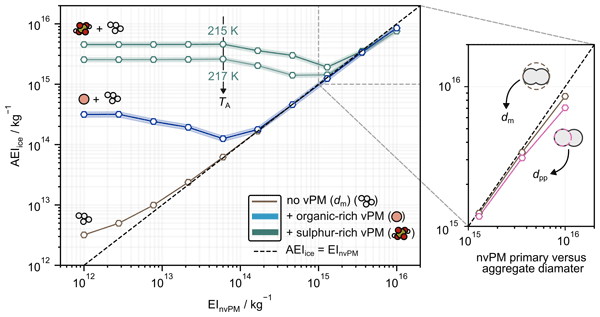
Aerosol emissions from aircraft engines contribute to the formation of contrails, which have a climate impact comparable to that of aviation’s CO2 emissions. We show that emissions of volatile particulate matter – from fuel sulphur, unburned fuel, and lubrication oil – can increase the number of ice particles formed within a contrail and therefore have an important role in the climate impacts of aviation. This has implications for emission regulation and climate mitigation strategies.
Kai Lyu, Xiaohong Liu, and Bernd Kärcher
Atmos. Chem. Phys., 25, 15369–15388, https://doi.org/10.5194/acp-25-15369-2025, https://doi.org/10.5194/acp-25-15369-2025, 2025
Short summary
Short summary
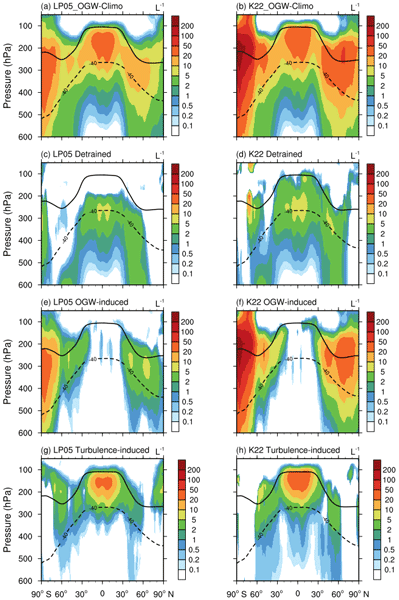
Two nucleation schemes are used to study ice nucleation, focusing on three ice sources: mountains, turbulence and anvils. Ice from mountains is concentrated in mid- and high-latitudes, while ice from turbulence and anvils is more common in low and mid-latitudes. Both schemes simulate orographic cirrus clouds, with mountain ice as the dominant source. The schemes differ in how they handle ice source competition, causing turbulence and anvils to influence clouds differently.
Blaž Gasparini, Sylvia C. Sullivan, Adam B. Sokol, Bernd Kärcher, Eric Jensen, and Dennis L. Hartmann
Atmos. Chem. Phys., 23, 15413–15444, https://doi.org/10.5194/acp-23-15413-2023, https://doi.org/10.5194/acp-23-15413-2023, 2023
Short summary
Short summary
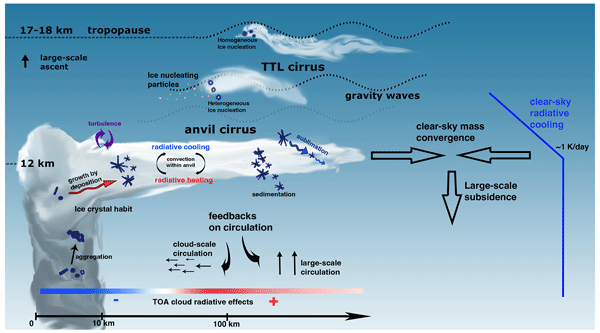
Tropical cirrus clouds are essential for climate, but our understanding of these clouds is limited due to their dependence on a wide range of small- and large-scale climate processes. In this opinion paper, we review recent advances in the study of tropical cirrus clouds, point out remaining open questions, and suggest ways to resolve them.
Cited articles
Ahrens, J. and Dieter, U.: Computer methods for sampling from the exponential and normal distributions, Commun. ACM, 15, 873–882, https://doi.org/10.1145/355604.361593, 1972. a
Atlas, R. and Bretherton, C. S.: Aircraft observations of gravity wave activity and turbulence in the tropical tropopause layer: prevalence, influence on cirrus clouds, and comparison with global storm-resolving models, Atmos. Chem. Phys., 23, 4009–4030, https://doi.org/10.5194/acp-23-4009-2023, 2023. a
Bacmeister, J. T., Eckerman, S. D., Tsias, A., Carslaw, K. S., and Peter, T.: Mesoscale temperature fluctuations induced by a spectrum of gravity waves: A comparison of parameterizations and their impact on stratospheric microphysics, J. Atmos. Sci., 56, https://doi.org/10.1175/1520-0469(1999)056%3C1913:MTFIBA%3E2.0.CO;2, 1999. a
Bartosch, L.: Generation of colored noise, Int. J. Mod. Phys. C, 12, https://doi.org/10.1142/S0129183101002012, 2001. a
Corcos, M., Hertzog, A., Plougonven, R., and Podglajen, A.: Observation of gravity waves at the tropical tropopause using superpressure balloons, J. Geophys. Res.-Atmos., 126, https://doi.org/10.1029/2021JD035165, 2021. a, b, c, d
Corcos, M., Hertzog, A., Plougonven, R., and Podglajen, A.: A simple model to assess the impact of gravity waves on ice-crystal populations in the tropical tropopause layer, Atmos. Chem. Phys., 23, 6923–6939, https://doi.org/10.5194/acp-23-6923-2023, 2023. a, b
Corcos, M., Kärcher, B., Lesigne, T., Podglajen, A., and Jensen, E. J.: On the Role of Atmospheric Waves in Governing the Persistence of Thin Cirrus Clouds in the Tropical Tropopause Layer, EGUsphere [preprint], https://doi.org/10.5194/egusphere-2026-3112, 2026. a
Dean, S. M., Lawrence, B. N., Grainger, R. G., and Heuff, D. N.: Orographic cloud in a GCM: the missing cirrus, Clim. Dynam., 24, https://doi.org/10.1007/s00382-005-0020-9, 2005. a
Dean, S. M., Flowerdew, J., Lawrence, B. N., and Eckerman, S. D.: Parameterisation of orographic cloud dynamics in a GCM, Clim. Dynam., 28, https://doi.org/10.1007/s00382-006-0202-0, 2007. a
Dinh, T., Podglajen, A., Hertzog, A., Legras, B., and Plougonven, R.: Effect of gravity wave temperature fluctuations on homogeneous ice nucleation in the tropical tropopause layer, Atmos. Chem. Phys., 16, 35–46, https://doi.org/10.5194/acp-16-35-2016, 2016. a, b
Farah, G. N. and Lindner, B.: Exponentially distributed noise – its correlation function and its effect on nonlinear dynamics, J. Phys. A-Math. Theor., 54, https://doi.org/10.1088/1751-8121/abd2fd, 2021. a, b
Fritts, D. C. and Alexander, M. J.: Gravity wave dynamics and effects in the middle atmosphere, Rev. Geophys., 41, https://doi.org/10.1029/2001RG000106, 2003. a, b
Gardiner, C. W.: Handbook of Stochastic Methods, Springer Verlag, Berlin, Heidelberg, New York, 1985. a
Gary, B. L.: Mesoscale temperature fluctuations in the stratosphere, Atmos. Chem. Phys., 6, 4577–4589, https://doi.org/10.5194/acp-6-4577-2006, 2006. a
Haase, J. S., Alexander, M. J., Hertzog, A., Kalnajs, L., Deshler, T., Davis, S. M., Plougonven, R., Cocquerez, P., and Venel, S.: Around the world in 84 days, EOS, 99, https://doi.org/10.1029/2018EO091907, 2018. a
Hertzog, A.: STRATEOLE2-C0: TSEN–Thermodynamics SENsor, LMD/IPSL [data set], https://doi.org/10.14768/7396b9ec-582f-4be2-8c37-c34ef41247a7, 2019. a
Hoyle, C. R., Luo, B. P., and Peter, T.: The origin of high ice crystal number densities in cirrus clouds, J. Atmos. Sci., 62, https://doi.org/10.1175/JAS3487.1, 2005. a
Jacobson, M. Z.: Fundamentals of Atmospheric Modeling, 2nd edn., Cambridge University Press, Cambridge, UK, https://doi.org/10.1017/CBO9781139165389, 2005. a
Jensen, E. J., Lawson, R. P., Bergman, J. W., Pfister, L., Bui, T. V., and Schmitt, C. G.: Physical processes controlling ice concentrations in synoptically forced, midlatitude cirrus, J. Geophys. Res., 118, https://doi.org/10.1002/jgrd.50421, 2013. a
Jensen, E. J., Ueyama, R., Pfister, L., Bui, T. V., Alexander, M. J., Podglajen, A., Hertzog, A., Woods, S., Lawson, R. P., Kim, J.-E., and Schoeberl, M. R.: High-frequency gravity waves and homogeneous ice nucleation in tropical tropopause layer cirrus, Geophys. Res. Lett., 43, https://doi.org/10.1002/2016GL069426, 2016a. a
Jensen, E. J., Ueyama, R., Pfister, L., Bui, T. V., Lawson, R. P., Woods, S., Thornberry, T., Rollins, A. W., Diskin, G. S., Digangi, J. P., and Avery, M. A.: On the susceptibility of cold tropical cirrus to ice nuclei abundance, J. Atmos. Sci., 73, https://doi.org/10.1175/JAS-D-15-0274.1, 2016b. a
Joos, H., Spichtinger, P., Lohmann, U., Gayet, J.-F., and Minikin, A.: Orographic cirrus in the global climate model ECHAM5, J. Geophys. Res., 113, https://doi.org/10.1029/2007JD009605, 2008. a
Kärcher, B.: Cirrus clouds and their response to anthropogenic activities, Curr. Clim. Chang. Rep., 3, https://doi.org/10.1007/s40641-017-0060-3, 2017. a
Kärcher, B.: Representation of gravity wave activity in models of cirrus ice formation [dataset], in: Atmospheric Chemistry and Physics (Vol. 26), Zenodo [data set], https://doi.org/10.5281/zenodo.22662438, 2026. a
Kärcher, B. and Corcos, M.: On the lifetimes of persistent contrails and contrail cirrus, J. Geophys. Res., 130, https://doi.org/10.1029/2025JD044488, 2025. a
Kärcher, B. and Koop, T.: The role of organic aerosols in homogeneous ice formation, Atmos. Chem. Phys., 5, 703–714, https://doi.org/10.5194/acp-5-703-2005, 2005. a
Kärcher, B. and Marcolli, C.: Aerosol–cloud interactions: the representation of heterogeneous ice activation in cloud models, Atmos. Chem. Phys., 21, 15213–15220, https://doi.org/10.5194/acp-21-15213-2021, 2021. a
Kärcher, B. and Podglajen, A.: A stochastic representation of temperature fluctuations induced by mesoscale gravity waves, J. Geophys. Res., 124, https://doi.org/10.1029/2019JD030680, 2019. a, b, c, d
Kärcher, B. and Ström, J.: The roles of dynamical variability and aerosols in cirrus cloud formation, Atmos. Chem. Phys., 3, 823–838, https://doi.org/10.5194/acp-3-823-2003, 2003. a, b
Kärcher, B., Jensen, E. J., Pokrifka, G. F., and Harrington, J. Y.: Ice supersaturation variability in cirrus clouds: Role of vertical wind speeds and deposition coefficients, J. Geophys. Res., 128, https://doi.org/10.1029/2023JD039324, 2023. a
Kärcher, B., Hoffmann, F., Sokol, A. B., Gasparini, B., Corcos, M., Jensen, E., Atlas, R., Podglajen, A., Morrison, H., Hertzog, A., Plougonven, R., Chandrakhar, K. K., and Grabowski, W. W.: Dissecting cirrus clouds: Navigating effects of turbulence on homogeneous ice formation, npj Clim. Atmos. Sci., 8, https://doi.org/10.1038/s41612-025-01024-w, 2025. a
Kim, J.-E., Alexander, M. J., Bui, T. P., Dean-Day, J. M., Lawson, R. P., Woods, S., Hlavka, D., Pfister, L., and Jensen, E. J.: Ubiquitous influence of waves on tropical high cirrus clouds, Geophys. Res. Lett., 43, https://doi.org/10.1002/2016GL069293, 2016. a
Koop, T., Luo, B., Tsias, A., and Peter, T.: Water activity as the determinant for homogeneous ice nucleation in aqueous solutions, Nature, 406, https://doi.org/10.1038/35020537, 2000. a
Kottayil, A., Podglajen, A., Legras, B., Atlas, R., Prajwal, K., Satheesan, K., and S, A.: High-frequency gravity waves and Kelvin-Helmholtz billows in the tropical UTLS, as seen from radar observations of vertical wind, Geophys. Res. Lett., 51, https://doi.org/10.1029/2024GL110366, 2024. a
Lamb, D. and Verlinde, J.: Physics and Chemistry of Clouds, University Press, Cambridge, NY, https://doi.org/10.1017/CBO9780511976377, 2011. a
L'Ecuyer, P. and Cote, S.: Implementing a random number package with splitting facilities, ACM T. Math. Software, 17, 98–111, https://doi.org/10.1145/103147.103158, 1991. a
Lesigne, T., Ravetta, F., Podglajen, A., Mariage, V., and Pelon, J.: Extensive coverage of ultrathin tropical tropopause layer cirrus clouds revealed by balloon-borne lidar observations, Atmos. Chem. Phys., 24, 5935–5952, https://doi.org/10.5194/acp-24-5935-2024, 2024. a
Lohmann, U. and Kärcher, B.: First interactive simulations of cirrus clouds formed by homogeneous freezing in the ECHAM general circulation model, J. Geophys. Res., 107, https://doi.org/10.1029/2001JD000767, 2002. a
Lyu, K., Liu, X., and Kärcher, B.: Exploring sources of ice crystals in cirrus clouds: comparative analysis of two ice nucleation schemes in CAM6, Atmos. Chem. Phys., 25, 15369–15388, https://doi.org/10.5194/acp-25-15369-2025, 2025. a, b
Morrison, H., Lier-Walqui, M., Fridlind, A. M., Grabowski, W. W., Harrington, J. Y., Hoose, C., Korolev, A., Kumjian, M. R., Milbrandt, J. A., Pawlowska, H., Posselt, D. J., Prat, O. P., Reime, K. J., Shima, S.-I., van Diedenhoven, B., and Xue, L.: Confronting the challenge of modeling cloud and precipitation microphysics, J. Adv. Mod. Earth Sys., 12, https://doi.org/10.1029/2019MS001689, 2020. a
Murphy, D. M. and Koop, T.: Review of the vapour pressures of ice and supercooled water for atmospheric applications, Q. J. Roy. Meteor. Soc., 131, https://doi.org/10.1256/qj.04.94, 2005. a
Nachbar, M., Duft, D., and Leisner, T.: The vapor pressure of liquid and solid water phases at conditions relevant to the atmosphere, J. Chem. Phys., 151, https://doi.org/10.1063/1.5100364, 2019. a
Noble, P., Okui, H., Alexander, J., Ern, M., Hindley, N. P., Hoffmann, L., Holt, L., van Niekerk, A., Plougonven, R., Polichtchouk, I., Stephan, C. C., Bramberger, M., Corcos, M., Putnam, W., Kruse, C., and Wright, C. J.: Stratospheric gravity waves in three high-resolution models and AIRS satellite observations, Atmos. Chem. Phys., 26, 7607–7630, https://doi.org/10.5194/acp-26-7607-2026, 2026. a
Petters, M. D. and Kreidenweis, S. M.: A single parameter representation of hygroscopic growth and cloud condensation nucleus activity, Atmos. Chem. Phys., 7, 1961–1971, https://doi.org/10.5194/acp-7-1961-2007, 2007. a
Podglajen, A., Plougonven, R., Hertzog, A., and Jensen, E.: Impact of gravity waves on the motion and distribution of atmospheric ice particles, Atmos. Chem. Phys., 18, 10799–10823, https://doi.org/10.5194/acp-18-10799-2018, 2018. a
Press, W. H., Teukolsky, S. A., Vetterling, W. T., and Flannery, B. P.: Numerical Recipes in Fortran 77: The Art of Scientific Computing, Cambridge University Press, ISBN 978-0-521-43064-7, 1992. a
Randel, W. J. and Jensen, E. J.: Physical processes in the tropical tropopause layer and their roles in a changing climate, Nat. Geosci., 6, https://doi.org/10.1038/ngeo1733, 2013. a
Schneider, J., Höhler, K., Wagner, R., Saathoff, H., Schnaiter, M., Schorr, T., Steinke, I., Benz, S., Baumgartner, M., Rolf, C., Krämer, M., Leisner, T., and Möhler, O.: High homogeneous freezing onsets of sulfuric acid aerosol at cirrus temperatures, Atmos. Chem. Phys., 21, 14403–14425, https://doi.org/10.5194/acp-21-14403-2021, 2021. a
Shinozuka, M. and Deodatis, G.: Simulation of stochastic processes by spectral representation, Appl. Mech. Rev., 44, https://doi.org/10.1115/1.3119501, 1991. a
Skrotzki, J., Connolly, P., Schnaiter, M., Saathoff, H., Möhler, O., Wagner, R., Niemand, M., Ebert, V., and Leisner, T.: The accommodation coefficient of water molecules on ice – cirrus cloud studies at the AIDA simulation chamber, Atmos. Chem. Phys., 13, 4451–4466, https://doi.org/10.5194/acp-13-4451-2013, 2013. a
Uhlenbeck, G. E. and Ornstein, L. S.: On the theory of Brownian motion, Phys. Rev., 36, https://doi.org/10.1103/PhysRev.36.823, 1930. a
van Zandt, T. E.: A universal spectrum of buoyancy waves in the atmosphere, Geophys. Res. Lett., 9, https://doi.org/10.1029/GL009i005p00575, 1982. a
Wang, M. and Penner, J. E.: Cirrus clouds in a global climate model with a statistical cirrus cloud scheme, Atmos. Chem. Phys., 10, 5449–5474, https://doi.org/10.5194/acp-10-5449-2010, 2010. a
Wang, P.-H., Minnis, P., McCormick, M. P., Geoffrey, S. K., and Skeens, K. M.: A 6-year climatology of cloud occurence frequency from Stratospheric Aerosol and Gas Experiment II observations (1985–1990), J. Geophys. Res., 101, https://doi.org/10.1029/96JD01780, 1996. a
Wilson, R., Pitois, C., Podglajen, A., Hertzog, A., Corcos, M., and Plougonven, R.: Detection of turbulence occurrences from temperature, pressure, and position measurements under superpressure balloons, Atmos. Meas. Tech., 16, 311–330, https://doi.org/10.5194/amt-16-311-2023, 2023. a
Zhang, C. and Harrington, J. Y.: Including surface kinetic effects in simple models of ice vapor diffusion, J. Atmos. Sci., 71, https://doi.org/10.1175/JAS-D-13-0103.1, 2014. a
Short summary
Cloud models rely on a faithful representation of vertical wind fluctuations due to gravity waves. This manuscript investigates methods that predict such wave activity, compares their statistical properties with those from long-duration balloon measurements, and applies the data and methods to study effects on tropical tropopause layer (TTL) cirrus formation.
Cloud models rely on a faithful representation of vertical wind fluctuations due to gravity...
Altmetrics
Final-revised paper
Preprint