
Articles | Volume 26, issue 22
https://doi.org/10.5194/acp-26-16415-2026
© Author(s) 2026. This work is distributed under
the Creative Commons Attribution 4.0 License.
https://doi.org/10.5194/acp-26-16415-2026
© Author(s) 2026. This work is distributed under
the Creative Commons Attribution 4.0 License.
Review article
| 
18 Nov 2026
Review article |
| 18 Nov 2026
Lightning in global chemistry-climate models: a review of parameterizations, evaluations, and future projections

Land Surface-Atmosphere Interactions, Technical University of Munich, TUM School of Life Sciences, Freising, 85354, Germany
Francisco Javier Pérez-Invernón
Department of Solar System, Instituto de Astrofísica de Andalucía (IAA), CSIC, P.O. Box 3004, Granada, 18080, Spain
Anja Rammig
Land Surface-Atmosphere Interactions, Technical University of Munich, TUM School of Life Sciences, Freising, 85354, Germany
Related authors
Benjamin F. Meyer, João P. Darela-Filho, Konstantin Gregor, Allan Buras, Qiao-Lin Gu, Andreas Krause, Daijun Liu, Phillip Papastefanou, Sijeh Asuk, Thorsten E. E. Grams, Christian S. Zang, and Anja Rammig
Geosci. Model Dev., 18, 4643–4666, https://doi.org/10.5194/gmd-18-4643-2025, https://doi.org/10.5194/gmd-18-4643-2025, 2025
Short summary
Short summary
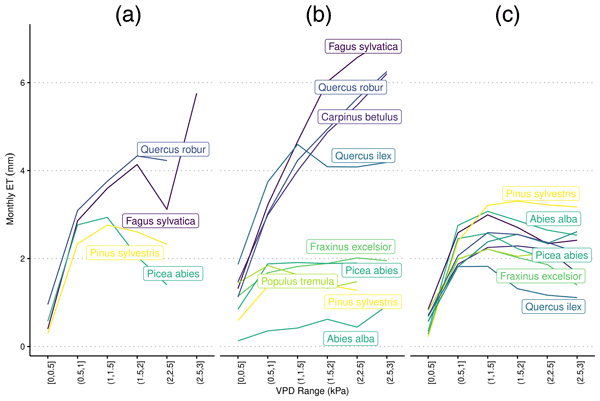
Climate change has increased the likelihood of drought events across Europe, potentially threatening the European forest carbon sink. Dynamic vegetation models with mechanistic plant hydraulic architecture are needed to model these developments. We evaluate the plant hydraulic architecture version of LPJ-GUESS and show its ability to capture species-specific evapotranspiration responses to drought and to reproduce flux observations of both gross primary production and evapotranspiration.
Lucia S. Layritz, Konstantin Gregor, Andreas Krause, Stefan Kruse, Benjamin F. Meyer, Thomas A. M. Pugh, and Anja Rammig
Biogeosciences, 22, 3635–3660, https://doi.org/10.5194/bg-22-3635-2025, https://doi.org/10.5194/bg-22-3635-2025, 2025
Short summary
Short summary
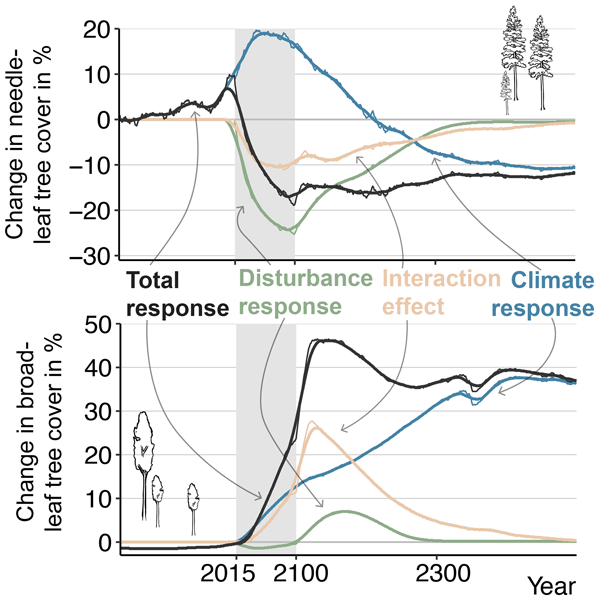
Disturbances, such as fire, can change which vegetation grows in a forest, affecting water and carbon flows and, thus, the climate. Disturbances are expected to increase with climate change, but it is uncertain by how much. Using a simulation model, we studied how future climate, disturbances, and their combined effect impact northern (high-latitude) forest ecosystems. Our findings highlight the importance of considering these factors and the need to better understand how disturbances will change in the future.
Johannes Oberpriller, Christine Herschlein, Peter Anthoni, Almut Arneth, Andreas Krause, Anja Rammig, Mats Lindeskog, Stefan Olin, and Florian Hartig
Geosci. Model Dev., 15, 6495–6519, https://doi.org/10.5194/gmd-15-6495-2022, https://doi.org/10.5194/gmd-15-6495-2022, 2022
Short summary
Short summary
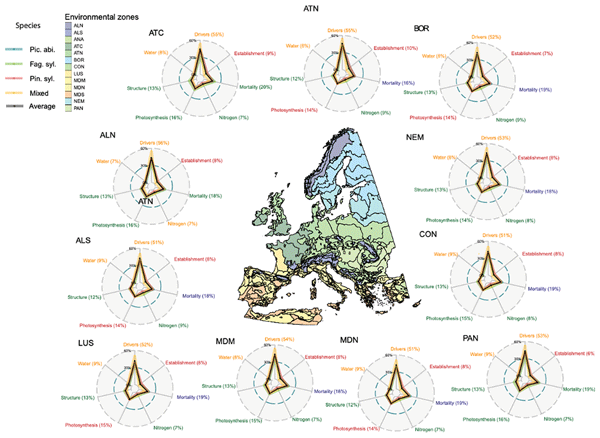
Understanding uncertainties of projected ecosystem dynamics under environmental change is of immense value for research and climate change policy. Here, we analyzed these across European forests. We find that uncertainties are dominantly induced by parameters related to water, mortality, and climate, with an increasing importance of climate from north to south. These results highlight that climate not only contributes uncertainty but also modifies uncertainties in other ecosystem processes.
Kristian Schufft, Katrin Fleischer, Anja Rammig, Belinda E. Medlyn, Min Zhao, Lin Yu, Catriona A. Macdonald, and Sönke Zaehle
EGUsphere, https://doi.org/10.5194/egusphere-2026-3553, https://doi.org/10.5194/egusphere-2026-3553, 2026
This preprint is open for discussion and under review for Biogeosciences (BG).
Short summary
Short summary
Soil respiration and its underlying drivers are heavily influenced by nutrient availability. We used a computer model that simulates ecosystem processes to investigate how phosphorus (P) addition influences soil respiration and its underlying drivers. Our model suggests that, reduced root exudation, the labile C flux from roots into soils, causes reduced soil respiration under P addition. Our results bring a new perspective in the dependence of soil respiration on nutrient availability.
Kristian Schufft, Katrin Fleischer, Anja Rammig, Lin Yu, Mingkai Jiang, Belinda E. Medlyn, and Sönke Zaehle
Biogeosciences, 23, 4529–4559, https://doi.org/10.5194/bg-23-4529-2026, https://doi.org/10.5194/bg-23-4529-2026, 2026
Short summary
Short summary
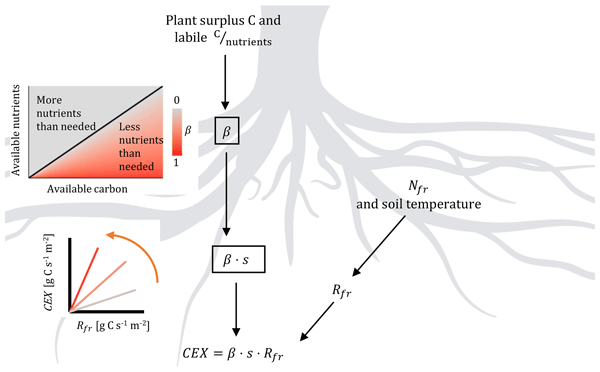
Root exudation describes a process in which plants allocate labile carbon (C) through roots into soils, thereby influencing microbial C and nutrient cycling. We implemented root exudation in a computer model that simulates ecosystem processes. Increased atmospheric CO2 increased root exudation, but the additional input was partially offset by enhanced microbial respiration. Our research brings new perspectives in modelling soil C and nutrient cycling in forests under increasing CO2.
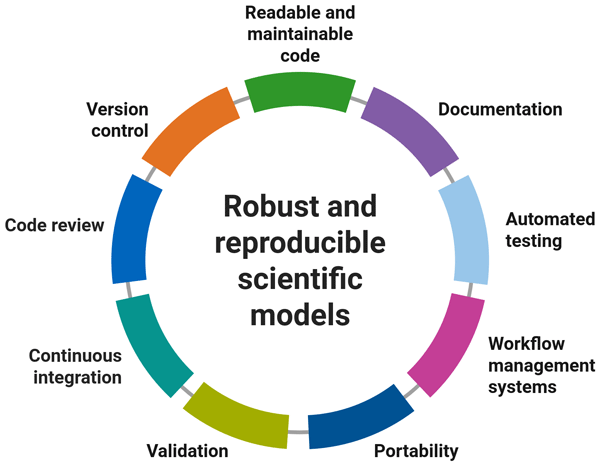
Konstantin Gregor, Benjamin F. Meyer, Tillmann Gaida, Victor Justo Vasquez, Karina Bett-Williams, Matthew Forrest, João P. Darela-Filho, Sam Rabin, Marcos Longo, Joe R. Melton, Johan Nord, Peter Anthoni, Vladislav Bastrikov, Thomas Colligan, Christine Delire, Michael C. Dietze, George Hurtt, Akihiko Ito, Lasse T. Keetz, Jürgen Knauer, Johannes Köster, Tzu-Shun Lin, Lei Ma, Marie Minvielle, Stefan Olin, Sebastian Ostberg, Hao Shi, Reiner Schnur, Qing Sun, Peter E. Thornton, and Anja Rammig
Geosci. Model Dev., 19, 2407–2436, https://doi.org/10.5194/gmd-19-2407-2026, https://doi.org/10.5194/gmd-19-2407-2026, 2026
Short summary
Short summary
Geoscientific models are crucial for understanding Earth’s processes. However, they sometimes do not adhere to highest software quality standards, and scientific results are often hard to reproduce due to the complexity of the workflows. Here we gather the expertise of 20 modeling groups and software engineers to define best practices for making geoscientific models maintainable, usable, and reproducible. We conclude with an open-source example serving as a reference for modeling communities.
Friedrich J. Bohn, Giles B. Sioen, Ana Bastos, Yolandi Ernst, Marcin P. Jarzebski, Niak S. Koh, Romina Martin, Anja Rammig, Alex Godoy-Faúndez, Alexandros Gasparatos, Alvaro G. Gutiérrez, Amanda J. Aceituno, Andra-Ioana Horcea-Milcu, Andrea Marais-Potgieter, Ayyoob Sharifi, Caroline Howe, Cornelia B. Krug, Eduardo E. Acosta, Emmanuel F. Nzunda, Erik Andersson, Hans-Otto Pörtner, Helen Sooväli-Sepping, Ishihara Hiroe, Ivan Palmegiani, Kaera Coetzer, Kirsten Thonike, Krizler Tanalgo, Lisa Biber-Freudenberger, Nicholas O. Oguge, Mi S. Park, Milena Gross, Pablo De La Cruz, Paula R. Prist, Peng Bi, Rivera Diego, Roman Isaac, Rosemary McFarlane, Sinikka J. Paulus, Stefanie Burkhart, Sung-Ching Lee, Susanne Müller, Uchi D. Terhile, Wan-Yu Shih, William K. Smith, Viola Hakkarainen, Virginia Murray, Yuki Yoshida, Yohannes T. Damtew, and Zeenat Niazi
EGUsphere, https://doi.org/10.5194/egusphere-2025-3619, https://doi.org/10.5194/egusphere-2025-3619, 2025
Short summary
Short summary
The aim of this series is to provide decision-makers with valuable insights into the current state of biosphere research. Firstly, it is intended to ensure the flow of information between the comprehensive assessment reports of the IPCC and IPBES. On the other hand, it is intended to support economic and political decisions closely related to the biosphere with scientifically sound findings – including uncertainties – and comprehensive polysolutions, helping to solve the earth system polycrisis.
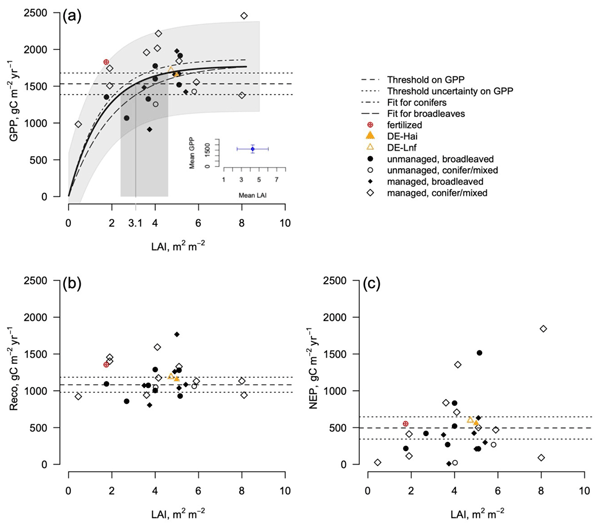
Olivier Bouriaud, Ernst-Detlef Schulze, Konstantin Gregor, Issam Boukhris, Peter Högberg, Roland Irslinger, Phillip Papastefanou, Julia Pongratz, Anja Rammig, Riccardo Valentini, and Christian Körner
Biogeosciences, 22, 4729–4741, https://doi.org/10.5194/bg-22-4729-2025, https://doi.org/10.5194/bg-22-4729-2025, 2025
Short summary
Short summary
The impact of harvesting on forests' carbon sink capacities is debated. One view is that their sink strength is resilient to harvesting, and the other is that it disrupts these capacities. Our work shows that leaf area index (LAI) has been overlooked in this discussion. We found that temperate forests' carbon uptake is largely insensitive to variations in LAI beyond 4.5 m² m-² but that forests operate at higher levels.
Benjamin F. Meyer, João P. Darela-Filho, Konstantin Gregor, Allan Buras, Qiao-Lin Gu, Andreas Krause, Daijun Liu, Phillip Papastefanou, Sijeh Asuk, Thorsten E. E. Grams, Christian S. Zang, and Anja Rammig
Geosci. Model Dev., 18, 4643–4666, https://doi.org/10.5194/gmd-18-4643-2025, https://doi.org/10.5194/gmd-18-4643-2025, 2025
Short summary
Short summary
Climate change has increased the likelihood of drought events across Europe, potentially threatening the European forest carbon sink. Dynamic vegetation models with mechanistic plant hydraulic architecture are needed to model these developments. We evaluate the plant hydraulic architecture version of LPJ-GUESS and show its ability to capture species-specific evapotranspiration responses to drought and to reproduce flux observations of both gross primary production and evapotranspiration.
Lucia S. Layritz, Konstantin Gregor, Andreas Krause, Stefan Kruse, Benjamin F. Meyer, Thomas A. M. Pugh, and Anja Rammig
Biogeosciences, 22, 3635–3660, https://doi.org/10.5194/bg-22-3635-2025, https://doi.org/10.5194/bg-22-3635-2025, 2025
Short summary
Short summary
Disturbances, such as fire, can change which vegetation grows in a forest, affecting water and carbon flows and, thus, the climate. Disturbances are expected to increase with climate change, but it is uncertain by how much. Using a simulation model, we studied how future climate, disturbances, and their combined effect impact northern (high-latitude) forest ecosystems. Our findings highlight the importance of considering these factors and the need to better understand how disturbances will change in the future.
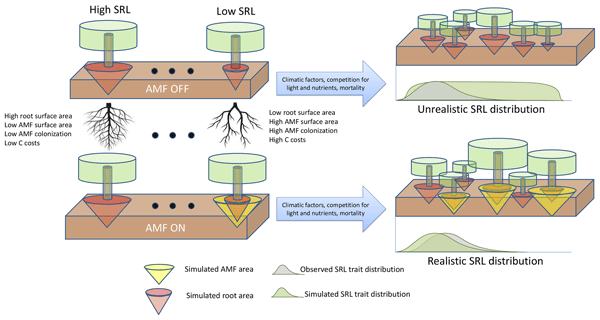
Mateus Dantas de Paula, Tatiana Reichert, Laynara F. Lugli, Erica McGale, Kerstin Pierick, João Paulo Darela-Filho, Liam Langan, Jürgen Homeier, Anja Rammig, and Thomas Hickler
Biogeosciences, 22, 2707–2732, https://doi.org/10.5194/bg-22-2707-2025, https://doi.org/10.5194/bg-22-2707-2025, 2025
Short summary
Short summary
This study explores how plant roots with different forms and functions rely on fungal partnerships for nutrient uptake. This relationship was integrated into a vegetation model and was tested in a tropical forest in Ecuador. The model accurately predicted root traits and showed that without fungi, biomass decreased by up to 80 %. The findings highlight the critical role of fungi in ecosystem processes and suggest that root–fungal interactions should be considered in vegetation models.
Friedrich J. Bohn, Ana Bastos, Romina Martin, Anja Rammig, Niak Sian Koh, Giles B. Sioen, Bram Buscher, Louise Carver, Fabrice DeClerck, Moritz Drupp, Robert Fletcher, Matthew Forrest, Alexandros Gasparatos, Alex Godoy-Faúndez, Gregor Hagedorn, Martin C. Hänsel, Jessica Hetzer, Thomas Hickler, Cornelia B. Krug, Stasja Koot, Xiuzhen Li, Amy Luers, Shelby Matevich, H. Damon Matthews, Ina C. Meier, Mirco Migliavacca, Awaz Mohamed, Sungmin O, David Obura, Ben Orlove, Rene Orth, Laura Pereira, Markus Reichstein, Lerato Thakholi, Peter H. Verburg, and Yuki Yoshida
Biogeosciences, 22, 2425–2460, https://doi.org/10.5194/bg-22-2425-2025, https://doi.org/10.5194/bg-22-2425-2025, 2025
Short summary
Short summary
An interdisciplinary collaboration of 36 international researchers from 35 institutions highlights recent findings in biosphere research. Within eight themes, they discuss issues arising from climate change and other anthropogenic stressors and highlight the co-benefits of nature-based solutions and ecosystem services. Based on an analysis of these eight topics, we have synthesized four overarching insights.
Mateus Dantas de Paula, Matthew Forrest, David Warlind, João Paulo Darela Filho, Katrin Fleischer, Anja Rammig, and Thomas Hickler
Geosci. Model Dev., 18, 2249–2274, https://doi.org/10.5194/gmd-18-2249-2025, https://doi.org/10.5194/gmd-18-2249-2025, 2025
Short summary
Short summary
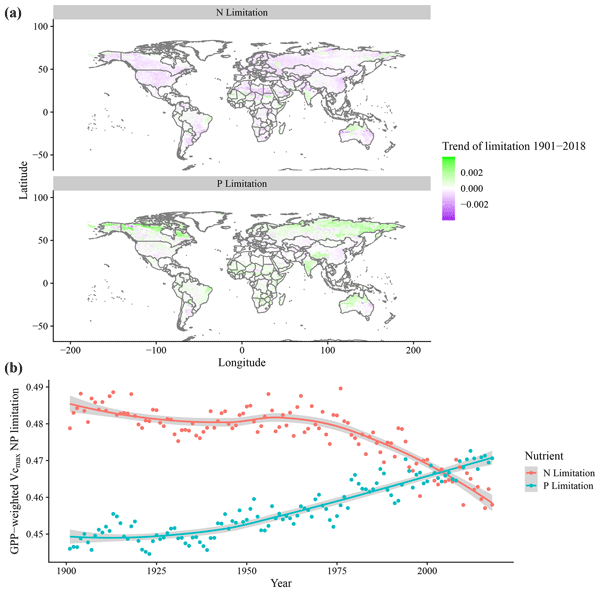
Our study maps global nitrogen (N) and phosphorus (P) availability and how they changed from 1901 to 2018. We find that tropical regions are mostly P-limited, while temperate and boreal areas face N limitations. Over time, P limitation increased, especially in the tropics, while N limitation decreased. These shifts are key to understanding global plant growth and carbon storage, highlighting the importance of including P dynamics in ecosystem models.
Melanie A. Thurner, Silvia Caldararu, Jan Engel, Anja Rammig, and Sönke Zaehle
Biogeosciences, 21, 1391–1410, https://doi.org/10.5194/bg-21-1391-2024, https://doi.org/10.5194/bg-21-1391-2024, 2024
Short summary
Short summary
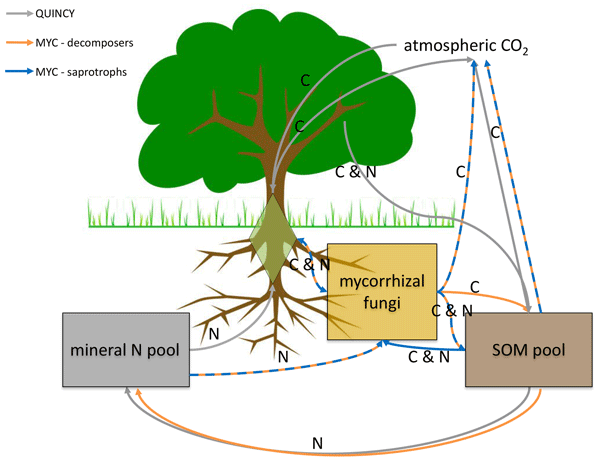
Due to their crucial role in terrestrial ecosystems, we implemented mycorrhizal fungi into the QUINCY terrestrial biosphere model. Fungi interact with mineral and organic soil to support plant N uptake and, thus, plant growth. Our results suggest that the effect of mycorrhizal interactions on simulated ecosystem dynamics is minor under constant environmental conditions but necessary to reproduce and understand observed patterns under changing conditions, such as rising atmospheric CO2.
Benjamin F. Meyer, Allan Buras, Konstantin Gregor, Lucia S. Layritz, Adriana Principe, Jürgen Kreyling, Anja Rammig, and Christian S. Zang
Biogeosciences, 21, 1355–1370, https://doi.org/10.5194/bg-21-1355-2024, https://doi.org/10.5194/bg-21-1355-2024, 2024
Short summary
Short summary
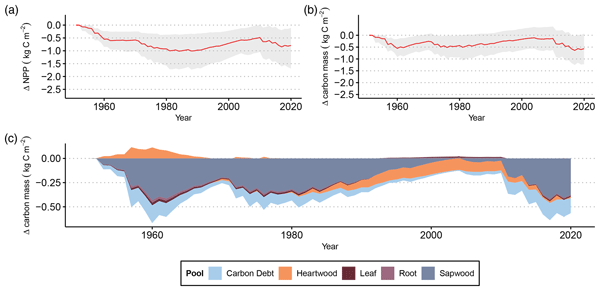
Late-spring frost (LSF), critically low temperatures when trees have already flushed their leaves, results in freezing damage leaving trees with reduced ability to perform photosynthesis. Forests with a high proportion of susceptible species like European beech are particularly vulnerable. However, this process is rarely included in dynamic vegetation models (DVMs). We show that the effect on simulated productivity and biomass is substantial, warranting more widespread inclusion of LSF in DVMs.
João Paulo Darela-Filho, Anja Rammig, Katrin Fleischer, Tatiana Reichert, Laynara Figueiredo Lugli, Carlos Alberto Quesada, Luis Carlos Colocho Hurtarte, Mateus Dantas de Paula, and David M. Lapola
Earth Syst. Sci. Data, 16, 715–729, https://doi.org/10.5194/essd-16-715-2024, https://doi.org/10.5194/essd-16-715-2024, 2024
Short summary
Short summary
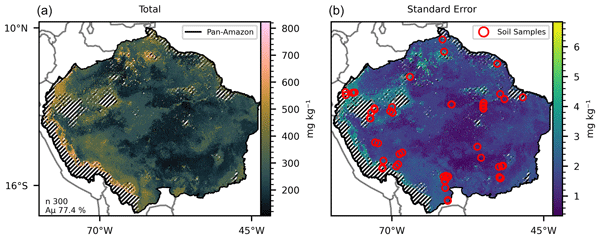
Phosphorus (P) is crucial for plant growth, and scientists have created models to study how it interacts with carbon cycle in ecosystems. To apply these models, it is important to know the distribution of phosphorus in soil. In this study we estimated the distribution of phosphorus in the Amazon region. The results showed a clear gradient of soil development and P content. These maps can help improve ecosystem models and generate new hypotheses about phosphorus availability in the Amazon.
Jennifer A. Holm, David M. Medvigy, Benjamin Smith, Jeffrey S. Dukes, Claus Beier, Mikhail Mishurov, Xiangtao Xu, Jeremy W. Lichstein, Craig D. Allen, Klaus S. Larsen, Yiqi Luo, Cari Ficken, William T. Pockman, William R. L. Anderegg, and Anja Rammig
Biogeosciences, 20, 2117–2142, https://doi.org/10.5194/bg-20-2117-2023, https://doi.org/10.5194/bg-20-2117-2023, 2023
Short summary
Short summary
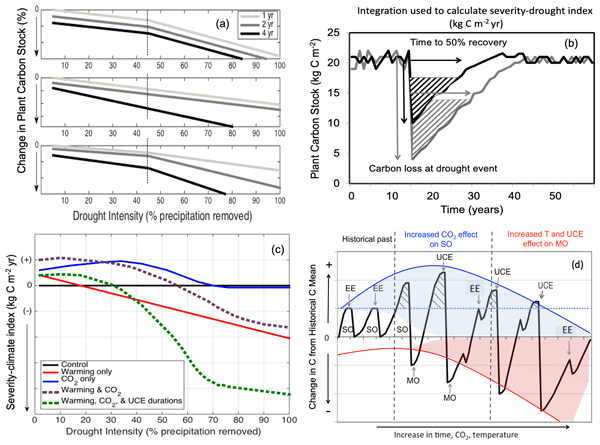
Unprecedented climate extremes (UCEs) are expected to have dramatic impacts on ecosystems. We present a road map of how dynamic vegetation models can explore extreme drought and climate change and assess ecological processes to measure and reduce model uncertainties. The models predict strong nonlinear responses to UCEs. Due to different model representations, the models differ in magnitude and trajectory of forest loss. Therefore, we explore specific plant responses that reflect knowledge gaps.
Johannes Oberpriller, Christine Herschlein, Peter Anthoni, Almut Arneth, Andreas Krause, Anja Rammig, Mats Lindeskog, Stefan Olin, and Florian Hartig
Geosci. Model Dev., 15, 6495–6519, https://doi.org/10.5194/gmd-15-6495-2022, https://doi.org/10.5194/gmd-15-6495-2022, 2022
Short summary
Short summary
Understanding uncertainties of projected ecosystem dynamics under environmental change is of immense value for research and climate change policy. Here, we analyzed these across European forests. We find that uncertainties are dominantly induced by parameters related to water, mortality, and climate, with an increasing importance of climate from north to south. These results highlight that climate not only contributes uncertainty but also modifies uncertainties in other ecosystem processes.
Phillip Papastefanou, Christian S. Zang, Zlatan Angelov, Aline Anderson de Castro, Juan Carlos Jimenez, Luiz Felipe Campos De Rezende, Romina C. Ruscica, Boris Sakschewski, Anna A. Sörensson, Kirsten Thonicke, Carolina Vera, Nicolas Viovy, Celso Von Randow, and Anja Rammig
Biogeosciences, 19, 3843–3861, https://doi.org/10.5194/bg-19-3843-2022, https://doi.org/10.5194/bg-19-3843-2022, 2022
Short summary
Short summary
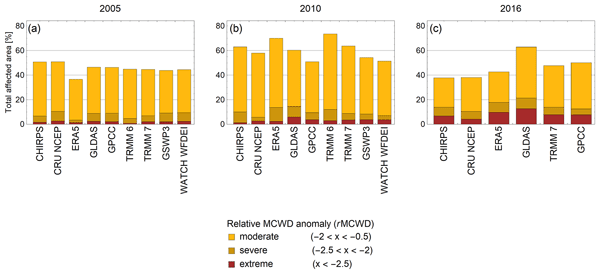
The Amazon rainforest has been hit by multiple severe drought events. In this study, we assess the severity and spatial extent of the extreme drought years 2005, 2010 and 2015/16 in the Amazon. Using nine different precipitation datasets and three drought indicators we find large differences in drought stress across the Amazon region. We conclude that future studies should use multiple rainfall datasets and drought indicators when estimating the impact of drought stress in the Amazon region.
Cited articles
Abbott, T. H., Jeevanjee, N., Cheng, K. Y., Zhou, L. J., and Harris, L.: The Land-Ocean Contrast in Deep Convective Intensity in a Global Storm-Resolving Model, J. Adv. Model. Earth Sy., 17, https://doi.org/10.1029/2024MS004467, 2025.
Allen, D., Pickering, K., Stenchikov, G., Thompson, A., and Kondo, Y.: A three-dimensional total odd nitrogen (NOy) simulation during SONEX using a stretched-grid chemical transport model, J. Geophys. Res.-Atmos., 105, 3851–3876, https://doi.org/10.1029/1999jd901029, 2000.
Allen, D., Pickering, K., Duncan, B., and Damon, M.: Impact of lightning NO emissions on North American photochemistry as determined using the Global Modeling Initiative (GMI) model, J. Geophys. Res.-Atmos., 115, https://doi.org/10.1029/2010jd014062, 2010.
Allen, D. J. and Pickering, K. E.: Evaluation of lightning flash rate parameterizations for use in a global chemical transport model, J. Geophys. Res.-Atmos., 107, https://doi.org/10.1029/2002jd002066, 2002.
Bandholnopparat, K., Sato, M., Adachi, T., Ushio, T., and Takahashi, Y.: Estimation of the IC to CG Ratio Using JEM-GLIMS and Ground-Based Lightning Network Data, J. Geophys. Res.-Atmos., 125, https://doi.org/10.1029/2019JD032195, 2020.
Blakeslee, R. J., Lang, T. J., Koshak, W. J., Buechler, D., Gatlin, P., Mach, D. M., Stano, G. T., Virts, K. S., Walker, T. D., Cecil, D. J., Ellett, W., Goodman, S. J., Harrison, S., Hawkins, D. L., Heumesser, M., Lin, H., Maskey, M., Schultz, C. J., Stewart, M., Bateman, M., Chanrion, O., and Christian, H.: Three Years of the Lightning Imaging Sensor Onboard the International Space Station: Expanded Global Coverage and Enhanced Applications, J. Geophys. Res.-Atmos., 125, https://doi.org/10.1029/2020JD032918, 2020.
Bliznák, V. and Sokol, Z.: First validation of the Lightning Imager aboard Meteosat Third Generation satellite with Earth Networks Total Lightning Network, Int. J. Appl. Earth Obs., 147, https://doi.org/10.1016/j.jag.2026.105205, 2026.
Boccippio, D. J.: Lightning scaling relations revisited, J. Atmos. Sci., 59, 1086–1104, https://doi.org/10.1175/1520-0469(2002)059<1086:Lsrr>2.0.Co;2, 2002.
Boersma, K. F., Eskes, H. J., Meijer, E. W., and Kelder, H. M.: Estimates of lightning NOx production from GOME satellite observations, Atmos. Chem. Phys., 5, 2311–2331, https://doi.org/10.5194/acp-5-2311-2005, 2005.
Bozóki, T., Sátori, G., Williams, E., Guha, A., Liu, Y., Steinbach, P., Leal, A., Herein, M., Atkinson, M., Beggan, C. D., DiGangi, E., Koloskov, A., Kulak, A., LaPierre, J., Milling, D. K., Mlynarczyk, J., Neska, A., Potapov, A., Raita, T., Rawat, R., Said, R., Sinha, A. K., and Yampolski, Y.: Day-To-Day Quantification of Changes in Global Lightning Activity Based on Schumann Resonances, J. Geophys. Res.-Atmos., 128, https://doi.org/10.1029/2023JD038557, 2023.
Brisson, E., Blahak, U., Lucas-Picher, P., Purr, C., and Ahrens, B.: Contrasting lightning projection using the lightning potential index adapted in a convection-permitting regional climate model, Clim. Dynam., 57, 2037–2051, https://doi.org/10.1007/s00382-021-05791-z, 2021.
Brune, W. H., McFarland, P. J., Bruning, E., Waugh, S., MacGorman, D., Miller, D. O., Jenkins, J. M., Ren, X., Mao, J., and Peischl, J.: Extreme oxidant amounts produced by lightning in storm clouds, Science, 372, 711–715, https://doi.org/10.1126/science.abg0492, 2021.
Cecil, D.: Reprocessed Lightning Imaging Sensor Climatology (LISCLIMO), NASA [data set], https://doi.org/10.5067/LIS/LISCLIMO/DATA101, 2025.
Cecil, D. J., Buechler, D. E., and Blakeslee, R. J.: Gridded lightning climatology from TRMM-LIS and OTD: Dataset description, Atmos. Res., 135, 404–414, https://doi.org/10.1016/j.atmosres.2012.06.028, 2014.
Cecil, D. J., Buechler, D. E., Lang, T. J., Virts, K. S., and Mach, D. M.: Lightning Climatology Datasets from TRMM LIS, ISS LIS, and OTD, J. Appl. Meteorol. Clim., 65, 51–72, https://doi.org/10.1175/Jamc-D-25-0110.1, 2026a.
Cecil, D. J., Buechler, D. E., Lang, T. J., Virts, K. S., and Mach, D. M.: Lightning Imaging Sensor (LIS) and Optical Transient Detector (OTD) Missions, 1995–2023, B. Am. Meteorol. Soc., 107, E404–E418, https://doi.org/10.1175/Bams-D-24-0268.1, 2026b.
Charn, A. B. and Parishani, H.: Predictive Proxies of Present and Future Lightning in a Superparameterized Model, J. Geophys. Res.-Atmos., 126, https://doi.org/10.1029/2021JD035461, 2021.
Chen, Y., Romps, D. M., Seeley, J. T., Veraverbeke, S., Riley, W. J., Mekonnen, Z. A., and Randerson, J. T.: Future increases in Arctic lightning and fire risk for permafrost carbon, Nat. Clim. Change, 11, 404–410, 10.1038/s41558-021-01011-y, 2021.
Cheng, W.-Y.: Lightning Parameterization and Prediction: Conventional and Data-Driven Approaches, Department of Atmospheric Sciences, University of Washington, https://digital.lib.washington.edu/bitstreams/e400f629-8f48-4d0c-8e72-8ace433daf6f/download (last access: 17 November 2026), 2021.
Cheng, W. Y., Kim, D., and Holzworth, R. H.: CAPE Threshold for Lightning Over the Tropical Ocean, J. Geophys. Res.-Atmos., 126, https://doi.org/10.1029/2021JD035621, 2021.
Clark, S. K., Ward, D. S., and Mahowald, N. M.: Parameterization-based uncertainty in future lightning flash density, Geophys. Res. Lett., 44, 2893–2901, https://doi.org/10.1002/2017gl073017, 2017.
Cummings, K. A., Pickering, K. E., Barth, M. C., Bela, M. M., Li, Y., Allen, D., Bruning, E., MacGorman, D. R., Ziegler, C. L., Biggerstaff, M. I., Fuchs, B., Davis, T., Carey, L., Mecikalski, R. M., and Finney, D. L.: Evaluation of Lightning Flash Rate Parameterizations in a Cloud-Resolved WRF-Chem Simulation of the 29–30 May 2012 Oklahoma Severe Supercell System Observed During DC3, J. Geophys. Res.-Atmos., 129, https://doi.org/10.1029/2023JD039492, 2024.
Dang, R., Jacob, D. J., Wang, H., Nowlan, C. R., Gonzalez Abad, G., Chong, H., Liu, X., Shah, V., Yang, L. H., Oak, Y. J., Marais, E. A., Horner, R. P., Rollins, A. W., Crawford, J. H., Li, K., and Liao, H.: High-resolution geostationary satellite observations of free tropospheric NO(2) over North America and implications for lightning emissions, P. Natl. Acad. Sci. USA, 122, e2510535122, https://doi.org/10.1073/pnas.2510535122, 2025.
Etten-Bohm, M., Yang, J., Schumacher, C., and Jun, M. Y.: Evaluating the Relationship Between Lightning and the Large-Scale Environment and its Use for Lightning Prediction in Global Climate Models, J. Geophys. Res.-Atmos., 126, https://doi.org/10.1029/2020JD033990, 2021.
Felsberg, A., Kloster, S., Wilkenskjeld, S., Krause, A., and Lasslop, G.: Lightning Forcing in Global Fire Models: The Importance of Temporal Resolution, J. Geophys. Res.-Biogeo., 123, 168–177, https://doi.org/10.1002/2017jg004080, 2018.
Field, P. R., Roberts, M. J., and Wilkinson, J. M.: Simulated Lightning in a Convection Permitting Global Model, J. Geophys. Res.-Atmos., 123, 9370–9377, https://doi.org/10.1029/2018jd029295, 2018.
Fierro, A. O., Mansell, E. R., MacGorman, D. R., and Ziegler, C. L.: The Implementation of an Explicit Charging and Discharge Lightning Scheme within the WRF-ARW Model: Benchmark Simulations of a Continental Squall Line, a Tropical Cyclone, and a Winter Storm, Mon. Weather Rev., 141, 2390–2415, https://doi.org/10.1175/Mwr-D-12-00278.1, 2013.
Finney, D. L., Doherty, R. M., Wild, O., and Abraham, N. L.: The impact of lightning on tropospheric ozone chemistry using a new global lightning parametrisation, Atmos. Chem. Phys., 16, 7507–7522, https://doi.org/10.5194/acp-16-7507-2016, 2016a.
Finney, D. L., Doherty, R. M., Wild, O., Young, P. J., and Butler, A.: Response of lightning NOx emissions and ozone production to climate change: Insights from the Atmospheric Chemistry and Climate Model Intercomparison Project, Geophys. Res. Lett., 43, 5492–5500, https://doi.org/10.1002/2016gl068825, 2016b.
Finney, D. L., Doherty, R. M., Wild, O., Huntrieser, H., Pumphrey, H. C., and Blyth, A. M.: Using cloud ice flux to parametrise large-scale lightning, Atmos. Chem. Phys., 14, 12665–12682, https://doi.org/10.5194/acp-14-12665-2014, 2014.
Finney, D. L., Doherty, R. M., Wild, O., Stevenson, D. S., MacKenzie, I. A., and Blyth, A. M.: A projected decrease in lightning under climate change, Nat. Clim. Change, 8, 210–213, https://doi.org/10.1038/s41558-018-0072-6, 2018.
Finney, D. L., Marsham, J. H., Wilkinson, J. M., Field, P. R., Blyth, A. M., Jackson, L. S., Kendon, E. J., Tucker, S. O., and Stratton, R. A.: African Lightning and its Relation to Rainfall and Climate Change in a Convection-Permitting Model, Geophys. Res. Lett., 47, https://doi.org/10.1029/2020GL088163, 2020.
Flemming, J., Huijnen, V., Arteta, J., Bechtold, P., Beljaars, A., Blechschmidt, A.-M., Diamantakis, M., Engelen, R. J., Gaudel, A., Inness, A., Jones, L., Josse, B., Katragkou, E., Marecal, V., Peuch, V.-H., Richter, A., Schultz, M. G., Stein, O., and Tsikerdekis, A.: Tropospheric chemistry in the Integrated Forecasting System of ECMWF, Geosci. Model Dev., 8, 975–1003, https://doi.org/10.5194/gmd-8-975-2015, 2015.
Gatlin, P., Lang, T., Quick, M., Remington, J., Koshak, B., Cecil, D., Schultz, C., Bang, S., Behnke, S., Edens, H., Bitzer, P., and Stough, S.: CubeSpark: A New 3D Lightning Observing Concept, 103rd Annual Meeting of the AMS, https://ntrs.nasa.gov/api/citations/20220019325/downloads/CubeSpark_AMS_2023_presentation_final.pdf (last access: 6 October 2026), 2023.
Ghosh, S., Cholakian, A., Mailler, S., and Menut, L.: Representing improved tropospheric ozone distribution over the Northern Hemisphere by including lightning NOx emissions in CHIMERE, Atmos. Chem. Phys., 25, 6273–6297, https://doi.org/10.5194/acp-25-6273-2025, 2025.
Gordillo-Vázquez, F. J., Pérez-Invernón, F. J., Huntrieser, H., and Smith, A. K.: Comparison of Six Lightning Parameterizations in CAM5 and the Impact on Global Atmospheric Chemistry, Earth Space Sci., 6, 2317–2346, https://doi.org/10.1029/2019ea000873, 2019.
Grewe, V., Brunner, D., Dameris, M., Grenfell, J. L., Hein, R., Shindell, D., and Staehelin, J.: Origin and variability of upper tropospheric nitrogen oxides and ozone at northern mid-latitudes, Atmos. Environ., 35, 3421–3433, https://doi.org/10.1016/S1352-2310(01)00134-0, 2001.
Guryanov, V. V., Mikhailov, R. P., and Eliseev, A. V.: Present-day and future lightning frequency as simulated by four CMIP6 models, Pure Appl. Geophys., 181, 3351–3374, https://doi.org/10.1007/s00024-024-03587-w, 2024.
He, Y., Hoque, H. M. S., and Sudo, K.: Introducing new lightning schemes into the CHASER (MIROC) chemistry–climate model, Geosci. Model Dev., 15, 5627–5650, https://doi.org/10.5194/gmd-15-5627-2022, 2022.
Holzworth, R. H., Brundell, J. B., McCarthy, M. P., Jacobson, A. R., Rodger, C. J., and Anderson, T. S.: Lightning in the Arctic, Geophys. Res. Lett., 48, https://doi.org/10.1029/2020GL091366, 2021.
Jacobson, A. R. and Heavner, M. J.: Comparison of narrow bipolar events with ordinary lightning as proxies for severe convection, Mon. Weather Rev., 133, 1144–1154, https://doi.org/10.1175/Mwr2915.1, 2005.
Jenkins, J. M., Brune, W. H., and Miller, D. O.: Electrical Discharges Produce Prodigious Amounts of Hydroxyl and Hydroperoxyl Radicals, J. Geophys. Res.-Atmos., 126, https://doi.org/10.1029/2021JD034557, 2021.
Kahraman, A., Kendon, E. J., Fowler, H. J., and Wilkinson, J. M.: Contrasting future lightning stories across Europe, Environ. Res. Lett., 17, https://doi.org/10.1088/1748-9326/ac9b78, 2022.
Kaplan, J. O.: The World Wide Lightning Location Network (WWLLN) Global Lightning Climatology (WGLC) and time series, Zenodo [data set], https://doi.org/10.5281/zenodo.20277101, 2026.
Kaplan, J. O. and Lau, K. H.-K.: The WGLC global gridded lightning climatology and time series, Earth Syst. Sci. Data, 13, 3219–3237, https://doi.org/10.5194/essd-13-3219-2021, 2021.
Kaplan, J. O. and Lau, K. H.-K.: World Wide Lightning Location Network (WWLLN) Global Lightning Climatology (WGLC) and time series, 2022 update, Earth Syst. Sci. Data, 14, 5665–5670, https://doi.org/10.5194/essd-14-5665-2022, 2022.
Kawazoe, S., Sato, Y., and Hayashi, S.: Investigating the Uncertainties in Future Lightning Activity over Eastern Japan Using Convective-Permitting Climate Simulations, Sola, 21b, 18–27, https://doi.org/10.2151/sola.21B-003, 2025.
Krause, A. and Rammig, A.: A Simple Climatology Benchmark Outperforms Machine-Learning Lightning Parameterizations, ESS Open Archive [preprint], https://doi.org/10.22541/essoar.15010630/v1, 2026.
Krause, A., Kloster, S., Wilkenskjeld, S., and Paeth, H.: The sensitivity of global wildfires to simulated past, present, and future lightning frequency, J. Geophys. Res.-Biogeo., 119, 312–322, https://doi.org/10.1002/2013jg002502, 2014.
Krause, A., Gregor, K., Meyer, B. F., and Rammig, A.: Simulating Lightning-Induced Tree Mortality in the Dynamic Global Vegetation Model LPJ-GUESS, Glob. Change Biol., 31, https://doi.org/10.1111/gcb.70312, 2025.
Krause, A., Gregor, K., Qu, Y., Veraverbeke, S., and Rammig, A.: Large Projected Increase in Cloud-to-Ground Lightning Under Future Climate, Earth's Future, ESS Open Archive [preprint], https://doi.org/10.22541/essoar.15010629/v1, 2026.
Lamarque, J. F., Kiehl, J. T., Brasseur, G. P., Butler, T., Cameron-Smith, P., Collins, W. D., Collins, W. J., Granier, C., Hauglustaine, D., Hess, P. G., Holland, E. A., Horowitz, L., Lawrence, M. G., McKenna, D., Merilees, P., Prather, M. J., Rasch, P. J., Rotman, D., Shindell, D., and Thornton, P.: Assessing future nitrogen deposition and carbon cycle feedback using a multimodel approach: Analysis of nitrogen deposition, J. Geophys. Res.-Atmos., 110, https://doi.org/10.1029/2005jd005825, 2005.
Lavigne, T., Liu, C. T., and Liu, N. N.: How Does the Trend in Thunder Days Relate to the Variation of Lightning Flash Density?, J. Geophys. Res.-Atmos., 124, 4955–4974, https://doi.org/10.1029/2018jd029920, 2019.
Liaskos, C. E., Allen, D. J., and Pickering, K. E.: Sensitivity of tropical tropospheric composition to lightning NOx production as determined by replay simulations with GEOS-5, J. Geophys. Res.-Atmos., 120, 8512–8534, https://doi.org/10.1002/2014jd022987, 2015.
Lopez, P.: A Lightning Parameterization for the ECMWF Integrated Forecasting System, Mon. Weather Rev., 144, 3057–3075, https://doi.org/10.1175/Mwr-D-16-0026.1, 2016.
Luhar, A. K., Galbally, I. E., Woodhouse, M. T., and Abraham, N. L.: Assessing and improving cloud-height-based parameterisations of global lightning flash rate, and their impact on lightning-produced NOx and tropospheric composition in a chemistry–climate model, Atmos. Chem. Phys., 21, 7053–7082, https://doi.org/10.5194/acp-21-7053-2021, 2021.
Ma, M., Tao, S. C., Zhu, B. Y., Lü, W. T., and Tan, Y. B.: Response of global lightning activity to air temperature variation, Chinese Sci. Bull., 50, 2640–2644, https://doi.org/10.1360/04wd0351, 2005.
Mackerras, D., Darveniza, M., Orville, R. E., Williams, E. R., and Goodman, S. J.: Global lightning: Total, cloud and ground flash estimates, J. Geophys. Res.-Atmos., 103, 19791–19809, https://doi.org/10.1029/98jd01461, 1998.
Magi, B. I.: Global Lightning Parameterization from CMIP5 Climate Model Output, J. Atmos. Ocean Tech., 32, 434–452, https://doi.org/10.1175/Jtech-D-13-00261.1, 2015.
Mao, J. Q., Zhao, T. L., Keller, C. A., Wang, X., McFarland, P. J., Jenkins, J. M., and Brune, W. H.: Global Impact of Lightning-Produced Oxidants, Geophys. Res. Lett., 48, https://doi.org/10.1029/2021GL095740, 2021.
McCaul, E. W., Goodman, S. J., LaCasse, K. M., and Cecil, D. J.: Forecasting Lightning Threat Using Cloud-Resolving Model Simulations, Weather Forecast., 24, 709–729, https://doi.org/10.1175/2008waf2222152.1, 2009.
Meijer, E. W., van Velthoven, P. F. J., Brunner, D. W., Huntrieser, H., and Kelder, H.: Improvement and evaluation of the parameterisation of nitrogen oxide production by lightning, Phys. Chem. Earth Pt. C, 26, 577–583, https://doi.org/10.1016/S1464-1917(01)00050-2, 2001.
Michalon, N., Nassif, A., Saouri, T., Royer, J. F., and Pontikis, C. A.: Contribution to the climatological study of lightning, Geophys. Res. Lett., 26, 3097–3100, https://doi.org/10.1029/1999gl010837, 1999.
Michibata, T.: Significant increase in graupel and lightning occurrence in a warmer climate simulated by prognostic graupel parameterization, Sci. Rep., 14, https://doi.org/10.1038/s41598-024-54544-5, 2024.
Murphy, M. J. and Said, R. K.: Comparisons of Lightning Rates and Properties From the US National Lightning Detection Network (NLDN) and GLD360 With GOES-16 Geostationary Lightning Mapper and Advanced Baseline Imager Data, J. Geophys. Res.-Atmos., 125, https://doi.org/10.1029/2019JD031172, 2020.
Murray, L. T.: An uncertain future for lightning, Nat. Clim. Change, 8, 191–192, https://doi.org/10.1038/s41558-018-0094-0, 2018.
Murray, L. T., Jacob, D. J., Logan, J. A., Hudman, R. C., and Koshak, W. J.: Optimized regional and interannual variability of lightning in a global chemical transport model constrained by LIS/OTD satellite data, J. Geophys. Res.-Atmos., 117, https://doi.org/10.1029/2012jd017934, 2012.
Nag, A., Murphy, M. J., Schulz, W., and Cummins, K. L.: Lightning locating systems: Insights on characteristics and validation techniques, Earth Space Sci., 2, 65–93, https://doi.org/10.1002/2014ea000051, 2015.
Ni, X., Hui, W., Zhang, Q. H., Huang, F. X., and Liu, C. T.: Comparison of Lightning Detection Between the FY-4A Lightning Mapping Imager and the ISS Lightning Imaging Sensor, Earth Space Sci., 8, https://doi.org/10.1029/2020EA001099, 2021.
Pasko, V. P., Celestin, S., Bourdon, A., Janalizadeh, R., Pervez, Z., Jansky, J., and Gourbin, P.: Photoelectric Effect in Air Explains Lightning Initiation and Terrestrial Gamma Ray Flashes, J. Geophys. Res.-Atmos., 130, https://doi.org/10.1029/2025JD043897, 2025.
Pérez-Invernón, F. J., Gordillo-Vázquez, F. J., Smith, A. K., Arnone, E., and Winkler, H.: Global Occurrence and Chemical Impact of Stratospheric Blue Jets Modeled With WACCM4, J. Geophys. Res.-Atmos., 124, 2841–2864, https://doi.org/10.1029/2018jd029593, 2019.
Pérez-Invernón, F. J., Gordillo-Vázquez, F. J., Huntrieser, H., and Jöckel, P.: Variation of lightning-ignited wildfire patterns under climate change, Nat. Commun., 14, https://doi.org/10.1038/s41467-023-36500-5, 2023.
Pérez-Invernón, F. J., Gordillo-Vázquez, F. J., Huntrieser, H., Jöckel, P., and Bucsela, E. J.: Sensitivity of climate–chemistry model simulated atmospheric composition to the application of an inverse relationship between NOx emission and lightning flash frequency, Atmos. Chem. Phys., 25, 5557–5575, https://doi.org/10.5194/acp-25-5557-2025, 2025.
Pickering, K. E., Allen, D. J., and Huntrieser, H.: The Role of Lightning in Atmospheric Chemistry, J. Geophys. Res.-Atmos., 131, https://doi.org/10.1029/2026JD046484, 2026.
Prentice, S. A. and Mackerras, D.: The Ratio of Cloud to Cloud-Ground Lightning Flashes in Thunderstorms, J. Appl. Meteorol. Clim., 16, https://doi.org/10.1175/1520-0450(1977)016<0545:TROCTC>2.0.CO;2, 1977.
Price, C.: ELF Electromagnetic Waves from Lightning: The Schumann Resonances, Atmosphere-Basel, 7, https://doi.org/10.3390/atmos7090116, 2016.
Price, C. and Rind, D.: A Simple Lightning Parameterization for Calculating Global Lightning Distributions, J. Geophys. Res.-Atmos., 97, 9919–9933, https://doi.org/10.1029/92jd00719, 1992.
Price, C. and Rind, D.: What Determines the Cloud-to-Ground Lightning Fraction in Thunderstorms, Geophys. Res. Lett., 20, 463–466, https://doi.org/10.1029/93gl00226, 1993.
Price, C. and Rind, D.: Possible Implications of Global Climate-Change on Global Lightning Distributions and Frequencies, J. Geophys. Res.-Atmos., 99, 10823–10831, https://doi.org/10.1029/94jd00019, 1994a.
Price, C. and Rind, D.: The Impact of a 2 × CO2 Climate on Lightning-Caused Fires, J. Climate, 7, 1484–1494, https://doi.org/10.1175/1520-0442(1994)007<1484:Tioacc>2.0.Co;2, 1994b.
Price, C. and Rind, D.: Modeling Global Lightning Distributions in a General-Circulation Model, Mon. Weather Rev., 122, 1930–1939, https://doi.org/10.1175/1520-0493(1994)122<1930:Mgldia>2.0.Co;2, 1994c.
Price, C., Penner, J., and Prather, M.: NOx from lightning .1. Global distribution based on lightning physics, J. Geophys. Res.-Atmos., 102, 5929–5941, https://doi.org/10.1029/96jd03504, 1997.
Price, C. G.: Lightning Applications in Weather and Climate Research, Surv. Geophys., 34, 755–767, https://doi.org/10.1007/s10712-012-9218-7, 2013.
Qie, X. S., Yair, Y., Di, S. X., Huang, Z. F., and Jiang, R. B.: Lightning response to temperature and aerosols, Environ. Res. Lett., 19, https://doi.org/10.1088/1748-9326/ad63bf, 2024.
Qu, Y., Brambleby, E., Janssen, T., Moris, J., Said, R., Murphy, M., Hunt, H., Joshi, M., Mataveli, G., Pérez Invernón, F. J., Yebra, M., Zhao, L., Jones, M., and Veraverbeke, S.: FLASHMAP: A Global Gridded Cloud-to-Ground and Intra-Cloud Lightning Dataset, Zenodo [data set], https://doi.org/10.5281/zenodo.18925362, 2026.
Reeve, N. and Toumi, R.: Lightning activity as an indicator of climate change, Q. J. Roy. Meteor. Soc., 125, 893–903, https://doi.org/10.1002/qj.49712555507, 1999.
Ringhausen, J., Bitzer, P., Koshak, W., and Mecikalski, J.: Classification of GLM Flashes Using Random Forests, Earth Space Sci., 8, https://doi.org/10.1029/2021EA001861, 2021.
Romps, D. M.: Evaluating the Future of Lightning in Cloud-Resolving Models, Geophys. Res. Lett., 46, 14863–14871, https://doi.org/10.1029/2019gl085748, 2019.
Romps, D. M., Seeley, J. T., Vollaro, D., and Molinari, J.: Projected increase in lightning strikes in the United States due to global warming, Science, 346, 851–854, https://doi.org/10.1126/science.1259100, 2014.
Romps, D. M., Charn, A. B., Holzworth, R. H., Lawrence, W. E., Molinari, J., and Vollaro, D.: CAPE Times P Explains Lightning Over Land But Not the Land-Ocean Contrast, Geophys. Res. Lett., 45, 12623–12630, https://doi.org/10.1029/2018gl080267, 2018.
Rudlosky, S. D., Goodman, S. J., Virts, K. S., and Bruning, E. C.: Initial Geostationary Lightning Mapper Observations, Geophys. Res. Lett., 46, 1097–1104, https://doi.org/10.1029/2018gl081052, 2019.
Santer, B. D., Sausen, R., Wigley, T. M. L., Boyle, J. S., AchutaRao, K., Doutriaux, C., Hansen, J. E., Meehl, G. A., Roeckner, E., Ruedy, R., Schmidt, G., and Taylor, K. E.: Behavior of tropopause height and atmospheric temperature in models, reanalyses, and observations: Decadal changes, J. Geophys. Res.-Atmos., 108, https://doi.org/10.1029/2002jd002258, 2003.
Saunders, C. P. R.: A Review of Thunderstorm Electrification Processes, J. Appl. Meteorol., 32, 642–655, https://doi.org/10.1175/1520-0450(1993)032<0642:Arotep>2.0.Co;2, 1993.
Schumann, U. and Huntrieser, H.: The global lightning-induced nitrogen oxides source, Atmos. Chem. Phys., 7, 3823–3907, https://doi.org/10.5194/acp-7-3823-2007, 2007.
Soler, S., Pérez-Invernón, F. J., Gordillo-Vázquez, F. J., Luque, A., Li, D., Malagón-Romero, A., Neubert, T., Chanrion, O., Reglero, Navarro-Gonzalez, J., Lu, G., Zhang, H., Huang, A., and Ostgaard, N.: Blue Optical Observations of Narrow Bipolar Events by ASIM Suggest Corona Streamer Activity in Thunderstorms, J. Geophys. Res.-Atmos., 125, https://doi.org/10.1029/2020JD032708, 2020.
Soler, S., Gordillo-Vázquez, F. J., Pérez-Invernón, F. J., Jöckel, P., Neubert, T., Chanrion, O., Reglero, V., and Østgaard, N.: Parameterizations for global thundercloud corona discharge distributions, Atmos. Chem. Phys., 24, 10225–10243, https://doi.org/10.5194/acp-24-10225-2024, 2024.
Stolz, D. C., Rutledge, S. A., Pierce, J. R., and van den Heever, S. C.: A global lightning parameterization based on statistical relationships among environmental factors, aerosols, and convective clouds in the TRMM climatology, J. Geophys. Res.-Atmos., 122, 7461–7492, https://doi.org/10.1002/2016jd026220, 2017.
Stolz, D. C., Bilsback, K. R., Pierce, J. R., and Rutledge, S. A.: Evaluating Empirical Lightning Parameterizations in Global Atmospheric Models, J. Geophys. Res.-Atmos., 126, https://doi.org/10.1029/2020JD033695, 2021.
Takahashi, T.: Riming Electrification as a Charge Generation Mechanism in Thunderstorms, J. Atmos. Sci., 35, 1536–1548, https://doi.org/10.1175/1520-0469(1978)035<1536:Reaacg>2.0.Co;2, 1978.
Thornhill, G., Collins, W., Olivié, D., Skeie, R. B., Archibald, A., Bauer, S., Checa-Garcia, R., Fiedler, S., Folberth, G., Gjermundsen, A., Horowitz, L., Lamarque, J.-F., Michou, M., Mulcahy, J., Nabat, P., Naik, V., O'Connor, F. M., Paulot, F., Schulz, M., Scott, C. E., Séférian, R., Smith, C., Takemura, T., Tilmes, S., Tsigaridis, K., and Weber, J.: Climate-driven chemistry and aerosol feedbacks in CMIP6 Earth system models, Atmos. Chem. Phys., 21, 1105–1126, https://doi.org/10.5194/acp-21-1105-2021, 2021.
Tost, H., Jöckel, P., and Lelieveld, J.: Lightning and convection parameterisations – uncertainties in global modelling, Atmos. Chem. Phys., 7, 4553–4568, https://doi.org/10.5194/acp-7-4553-2007, 2007.
Uribe, A., Contizanetti, M., Bender, F. A. M., and Mauritsen, T.: Icon simulations suggest model-dependent cloud feedbacks in global storm-resolving models, Clim. Dynam., 64, https://doi.org/10.1007/s00382-026-08235-8, 2026.
Verjans, V. and Franzke, C. L. E.: Development of a Data-Driven Lightning Scheme for Implementation in Global Climate Models, J. Adv. Model. Earth Sy., 17, https://doi.org/10.1029/2024MS004464, 2025.
Verjans, V., Franzke, C. L. E., Lee, S. S., Kim, I. W., Tilmes, S., Lawrence, D. M., Vitt, F., and Li, F.: Quantifying CO2 forcing effects on lightning, wildfires, and climate interactions, Sci. Adv., 11, https://doi.org/10.1126/sciadv.adt5088, 2025.
Vonnegut, B.: Some facts and speculation concerning the origin and role of thunderstorm electricity, Meteorol. Monogr., 5, 24–241, 1963.
Wang, X., Zhang, Y., Bozóki, T., Liang, R., Xie, X., Zhao, S., Wang, R., Zhao, Y., and Sun, S.: Contributions of lightning to long-term trends and inter-annual variability in global atmospheric chemistry constrained by Schumann resonance observations, Atmos. Chem. Phys., 25, 8929–8942, https://doi.org/10.5194/acp-25-8929-2025, 2025.
Whaley, C., Etten-Bohm, M., Schumacher, C., Akingunola, A., Arora, V., Cole, J., Lazare, M., Plummer, D., von Salzen, K., and Winter, B.: A new lightning scheme in the Canadian Atmospheric Model (CanAM5.1): implementation, evaluation, and projections of lightning and fire in future climates, Geosci. Model Dev., 17, 7141–7155, https://doi.org/10.5194/gmd-17-7141-2024, 2024.
Williams, E. and Stanfill, S.: The physical origin of the land-ocean contrast in lightning activity, C. R. Phys., 3, 1277–1292, https://doi.org/10.1016/S1631-0705(02)01407-X, 2002.
Williams, E. R.: Large-Scale Charge Separation in Thunderclouds, J. Geophys. Res.-Atmos., 90, 6013–6025, https://doi.org/10.1029/JD090iD04p06013, 1985.
Williams, E. R.: The Schumann Resonance – a Global Tropical Thermometer, Science, 256, 1184–1187, https://doi.org/10.1126/science.256.5060.1184, 1992.
Williams, E. R.: Global Circuit Response to Seasonal-Variations in Global Surface Air-Temperature, Mon. Weather Rev., 122, 1917–1929, https://doi.org/10.1175/1520-0493(1994)122<1917:Gcrtsv>2.0.Co;2, 1994.
Williams, E. R.: Lightning and climate: A review, Atmos. Res., 76, 272–287, https://doi.org/10.1016/j.atmosres.2004.11.014, 2005.
Wong, J., Barth, M. C., and Noone, D.: Evaluating a lightning parameterization based on cloud-top height for mesoscale numerical model simulations, Geosci. Model Dev., 6, 429–443, https://doi.org/10.5194/gmd-6-429-2013, 2013.
Wu, Y., Pour-Biazar, A., Koshak, W. J., and Cheng, P.: LNOx Emission Model for Air Quality and Climate Studies Using Satellite Lightning Mapper Observations, J. Geophys. Res.-Atmos., 128, https://doi.org/10.1029/2022JD037406, 2023.
Yair, Y.: Lightning hazards to human societies in a changing climate, Environ. Res. Lett., 13, https://doi.org/10.1088/1748-9326/aaea86, 2018.
Yair, Y., Lynn, B., Price, C., Kotroni, V., Lagouvardos, K., Morin, E., Mugnai, A., and Llasat, M. D.: Predicting the potential for lightning activity in Mediterranean storms based on the Weather Research and Forecasting (WRF) model dynamic and microphysical fields, J. Geophys. Res.-Atmos., 115, https://doi.org/10.1029/2008jd010868, 2010.
Yanoviak, S. P., Gora, E. M., Bitzer, P. M., Burchfield, J. C., Muller-Landau, H. C., Detto, M., Paton, S., and Hubbell, S. P.: Lightning is a major cause of large tree mortality in a lowland neotropical forest, New. Phytol., 225, 1936–1944, https://doi.org/10.1111/nph.16260, 2020.
Yin, M., Wang, Y., Fang, Y., Li, F., Qie, X. S., Wang, Y. Y., Wei, D. M., Yuan, H. H., Ji, Y. P., Zhang, Y., and Liu, J.: A Two-Dimensional Deep Learning Scheme With One Predicator Only to Parametrize Global Lightning, Geophys. Res. Lett., 53, https://doi.org/10.1029/2025GL120502, 2026.
Yoshida, S., Morimoto, T., Ushio, T., and Kawasaki, Z.: A fifth-power relationship for lightning activity from Tropical Rainfall Measuring Mission satellite observations, J. Geophys. Res.-Atmos., 114, https://doi.org/10.1029/2008jd010370, 2009.
Zhu, Y. A., Stock, M., Lapierre, J., and DiGangi, E.: Upgrades of the Earth Networks Total Lightning Network in 2021, Remote Sens-Basel, 14, https://doi.org/10.3390/rs14092209, 2022.
Short summary
Lightning activity may change as the world warms, but estimates vary widely because lightning cannot be directly represented in global climate models. We reviewed 19 methods used to estimate lightning and compared how well they reproduce present-day patterns. Some methods perform much better than others, yet all have limitations. Future projections range from decreases to large increases in lightning activity, highlighting substantial uncertainty, especially in the tropics.
Lightning activity may change as the world warms, but estimates vary widely because lightning...


Altmetrics
Final-revised paper
Preprint