
the Creative Commons Attribution 4.0 License.
the Creative Commons Attribution 4.0 License.
 | 12 Nov 2026
New particle formation contribution to aerosol mass: regimes and implications for future urban environments
Runlong Cai
Shimeng Xu
Veli-Matti Kerminen
Markku Kulmala

New particle formation (NPF) is a major source of global aerosol number concentration yet its contribution to aerosol mass remains unclear. Here we propose a regime framework for NPF mass contributions using aerosol dynamic simulations constrained by atmospheric measurements. We show that new particles can contribute more than 10 µg m−3 to particle mass under conditions characterized by high initial new particle concentrations, high condensable vapor production rates, and low background condensation sink (CSbg). Among these influencing factors, the initial CSbg governs NPF mass contribution under the simulation conditions: NPF contributes significantly to aerosol surface area and mass at an initial CSbg of ∼ 0.001 s−1 (regime I), while its contribution becomes negligible when CSbg exceeds 0.01 s−1 (regime III). Results show that NPF events in urban Beijing occur mostly in a transition regime (initial CSbg 0.001–0.01 s−1, regime II), in which the NPF mass contribution is also modulated by the mass accommodation coefficient of background particles, while events at a Finnish forest site fall in regimes I and II. Our simulations suggest that NPF mass contribution in urban environments with a declining CSbg will shift toward regimes I and II. This indicates that control of anthropogenic NPF precursors may represent an effective strategy for present and future particulate matter pollution in urban environments, which warrants further investigation.
- Article
(1861 KB) - Full-text XML
-
Supplement
(2763 KB) - BibTeX
- EndNote


Atmospheric aerosols have profound impacts on the climate (Szopa et al., 2021) and present severe threats to human health (Lelieveld et al., 2015). Episodic haze formation is often the result of complex interactions among emissions, meteorology, and atmospheric chemistry (An et al., 2019; Huang et al., 2020; Coe, 2020). New particle formation (NPF) via nucleation and subsequent growth is well established as a major contributor to aerosol number concentration, occurring frequently in environments ranging from pristine to polluted environments (Zhang et al., 2012; Kerminen et al., 2018; Zhao et al., 2024). However, as a key formation pathway for airborne aerosols, gas-to-particle conversion via condensation and reactive uptake is commonly assumed to be dominated by large background accumulation-mode aerosols due to their large surface area. While pioneering studies have proposed associations between NPF events and haze formation (Guo et al., 2014; Kulmala et al., 2021, 2022), the roles of growing new particles in promoting gas-to-particle conversion and contributing to aerosol mass remain an open problem.
The difficulty in addressing this problem lies in both observational and conceptual dimensions. Observationally, the new particle mode, after sufficient growth, and background particle mode coexist at overlapping sizes (e.g., ∼ 100 nm), making unambiguous mode separation inherently difficult. Conceptually, a hypothesis argues that gaseous precursors are converted into the particle phase independently of aerosol surface area distribution, implying that NPF is largely irrelevant to aerosol mass budgets: in the absence of NPF, the same amount of vapors would condense onto background particles. Existing theoretical frameworks based on particle survival probabilities have been successfully established to quantify NPF contributions to number concentration and CCN (Weber et al., 1997; Kerminen and Kulmala, 2002; Pierce and Adams, 2007) and later validated by atmospheric measurements (Cai et al., 2022), but the progress in similar approaches for assessing mass contributions remain limited. Kulmala et al. (2022) employed aerosol dynamic simulations with constant background condensation sink (CS) and fixed new particle growth rates (GR), showing that decreased primary emissions combined with sustained vapor emissions may enhance secondary aerosol production. However, the static treatment of vapor concentration precluded dynamic treatment of the competition of vapor uptake between growing new particles and background particles, which is fundamental in assessing NPF mass contributions.
The hypothesis that NPF is largely irrelevant to aerosol mass requires scrutiny on three aerosol kinetic grounds. First, vapor uptake is a kinetically influenced process, for which an elevated surface area concentration accelerates particle mass accumulation. The surface area of new particles during subsequent growth may approach or exceed that of background aerosols, directing vapor flux toward the growing new particle mode. Second, vapor uptake by large background particles is often retarded by surface aging, organic coatings, and particle-phase diffusion (Shiraiwa et al., 2011; Renbaum-Wolff et al., 2013). These effects are characterized by effective mass accommodation coefficients (αbg) substantially below unity (Kulmala and Wagner, 2001), reducing background particle competitiveness for vapor uptake relative to growing new particles. Third, observed growth rates of new particles exhibit moderate variability despite large variations in condensable vapor concentrations, particle concentrations, and CS, indicating an evident yet underrepresented weak response of new particle growth to the availability of measured condensable vapors (Kulmala et al., 2022; Stolzenburg et al., 2023). Additionally, for heterogeneous processes which are important for the uptake of volatile species such as N2O5 and SO2 (Davidovits et al., 2006; Yang et al., 2024), the rate of vapor uptake is proportional to aerosol surface area, suggesting that NPF-derived surface area may enhance secondary mass production beyond the condensation processes limited by available condensable vapor budget.
In this study, we investigate the role of NPF in aerosol mass budgets by establishing a conceptual framework to elucidate vapor uptake competition between new particles and background particles. We also identify conditions favoring significant NPF mass contributions and the governing factors. Using a zero-dimensional aerosol dynamic model that explicitly simulates both the growing new particles and background particles, we perform parametric analyses of key influencing factors and evaluate the results against long-term observations from urban Beijing and Finnish boreal forest. The resulting regime framework provides a mechanistic basis for anticipating how NPF mass contributions will evolve and also insights for air pollution control strategies targeting secondary aerosol formation under declining primary aerosol emissions.
2.1 Measurements and data analysis
Particle number size distributions (PNSD) measured from urban Beijing and Finnish boreal forest were used to provide constraints on typical conditions for atmospheric NPF. Measurements in Beijing were conducted at the BUCT site (39.94° N, 116.30° E), located on the west campus of Beijing University of Chemical Technology, representing polluted environments under the influences of strong anthropogenic emissions. Long-term measurements of atmospheric pollution with a focus on particulate matter pollution and new particle formation started in 2018. PNSD ranging from 1 nm to 10 µm was monitored using a home-built diethylene glycol scanning mobility particle spectrometer system (DEG-SMPS, 1–7.5 nm) and a particle size distribution system (3 nm–10 µm) (Liu et al., 2016; Cai et al., 2017a). Measurements at the Finnish boreal forest were conducted at the SMEAR (Station for Measuring Earth Surface–Atmosphere Relationships) II station (61.10° N, 24.17° E), located at Hyytiälä in southern Finland, representing relatively clean environments. Long-term measurements at SMEAR II started in 1995 (Nieminen et al., 2014). PNSD ranging from 3 nm–20 µm was measured using a differential mobility particle spectrometer (DMPS) (Aalto et al., 2001) and an aerodynamic aerosol spectrometer (APS, TSI 3321). Here we use the data measured until 2022 from Beijing and data in 2018–2019 from Hyytiälä. Detailed information on the measurement sites, instruments, and dataset have been reported elsewhere (Hari and Kulmala, 2005; Cai et al., 2021; Deng et al., 2022).
At both sites, standard data quality control procedures were applied, including removal of instrument artifacts and periods with abnormal meteorological conditions. NPF events were identified using established classification criteria based on the temporal evolution of PNSD (Dal Maso et al., 2005). New particle formation rate (J) was derived using a population balance equation with improved accuracy for the influence of coagulation (Cai and Jiang, 2017). GR was derived by tracking the trajectory of the growing new particle mode using the mode-fitting method (Stolzenburg et al., 2005). The value of CSbg was taken as the average total CS during the nucleation period (determined using the measured J) of every NPF event, during which the contribution of freshly nucleated particles to the total CS was negligible for their small sizes. dp,end of the growing mode was determined at the end of observed NPF events, characterized by a dramatic change in the mode diameter of the growing new particles due to the change in meteorology.
2.2 Model description
We employ a zero-dimensional box model to simulate the competition of vapor uptake between new particles and background particles. The model tracks two particle populations: particles originating from NPF (the new particle mode) and background particles (the background mode), together with the concentration of a single representative condensing vapor. The initial diameter of new particles is set to 5 nm, bypassing the high sensitivity of particle survival probability to the CS and GR in the sub-5 nm particle size range (Kulmala et al., 2017, 2022; Cai et al., 2022). The initial number concentration of the new particle mode represents the total number of particles produced at 5 nm during an NPF event, which is obtained by integrating the 5 nm formation rate (J5) over the NPF period. Accordingly, the number concentration of the new particle mode can be expressed as:
where dp,np is the count median diameter of the new particle mode, P is particle survival probability, and Nnp0 is the initial number concentration of the new particle mode. P is computed by calculating particle loss at every time step, accounting for both intramode coagulation (i.e., coagulation scavenging by background particles) and self-coagulation within the new particle mode.
The mass concentration of the new particle mode is
where mnp is the mean single particle mass of the new particle mode. Since particles within the same mode are not monodisperse, we assume that these particles follow a lognormal distribution and convert dp,np to the diameter of mean mass using the Hatch–Choate equation (Hatch and Choate, 1929). The geometric standard deviation of the new particle mode is set to 1.7, which is obtained from observed NPF events. This value overestimates the mass of new particles at small diameters (e.g., 10 nm), but does not affect the conclusions since new particle mass contribution at such sizes is negligible. Particle density is assumed to be 1400 kg m−3 (Stolzenburg et al., 2018).
Background particles are represented by a lognormal mode with an initial count median diameter of 100 nm and a geometric standard deviation of 1.7. Their initial number concentration was derived from the specified initial CSbg. Self-coagulation within the background mode is included but contributes negligibly due to the low particle number concentration. An effective mass accommodation coefficient of background particles (αbg) is introduced to account for the observed phenomenon that background particles sometimes grow more slowly than new particles, reflecting a limited vapor uptake efficiency. We also examine the sensitivity of NPF mass contribution to αbg.
The budget of condensing vapors can be expressed as
where Nv is gas-phase vapor concentration, Qv is the vapor source (i.e., production rate), f(αbg) is the Fuchs-Sutugin correction (Fuchs and Sutugin, 1971) for vapor uptake efficiency of the background mode, and CSnp is the condensation sink of the new particle mode. In this study, CSbg is reported at αbg = 1.0, with the accommodation correction applied separately via f(αbg), such that CSbg can be directly related to background particle concentration independently of uptake efficiency. A hypothetical vapor with a molar mass of 300 g mol−1 and a density of 1400 kg m−3 is used to represent the ensemble of condensable vapors.
Under simplifying assumptions, expanding particle survival probability using the Kerminen–Kulmala equation (Kerminen and Kulmala, 2002) yields an analytical expression for the relative mass contribution of new particles:
where Mbg is the background mode mass concentration, Nbg0 is the initial number concentration of the background mode, γ is a pre-factor the Kerminen-Kulmala equation, and CS is used herein to represent the total coagulation sink of new particles. Equation (4) shows that the factors governing the relative mass contribution of NPF can be reduced to four parameters: Nnp0, CSbg0 (equivalent to Nbg0), Qv (determining GR), and αbg. However, because the response of NPF mass contribution to these parameters can be highly non-linear, we do not pursue a closed-form analytical solution and instead rely on numerical simulations.
2.3 Uncertainties and limitations
The simulation results are derived based on a series of simplifications and assumptions. While these simplifications do not affect the proposed regime framework, they may lead to uncertainties in the predicted NPF mass contributions. Here we summarize the limitations of the model.
The zero-dimensional model assesses NPF processes within a hypothesized well-mixed air mass with uniform particle and vapor concentrations. It cannot resolve the influences of spatial heterogeneity and the diurnal evolution of the boundary layer on the NPF mass contributions. The vapor source Qv is assumed to be constant over the simulation period, whereas it is expected to vary diurnally and from day to day due to the variations in primary emissions, photochemical activity, and transport. Condensable vapors are represented by a single hypothetical species, which may not capture the synergistic effects of multicomponent condensation, volatility-dependent vapor uptake, and the possibility that different vapors dominate growth at different sizes or growth periods. The simulations use a fixed 48 h window, while the window for new particle growth during each episode varies with events. The observation results used to validate the input parameters for simulation are limited to two sites, which represent polluted and relatively clean environments but do not span the full range of atmospheric conditions and emission regimes. Extrapolating the results to other environments (e.g., marine, free-tropospheric, or polar atmospheres) should be made with caution. Overall, these uncertainties and limitations do not eliminate the main conclusion that NPF can contribute non-negligibly to aerosol surface area and mass under favorable conditions, but the reported mass contributions may need to be refined by more observational constraints and three-dimensional simulations.
3.1 New particle growth and its impacts on aerosol surface area
Long-term observations show that NPF events routinely produce a growing particle mode, reaching sizes (e.g., ∼ 100 nm) that significantly contribute to aerosol mass after growth for 1–2 d. At the end of analyzed NPF events in urban Beijing (see Sect. 4.1), the growing mode reached a count median diameter (dp,end) of 50–220 nm with an average value of 103.5 nm, and the number concentration was on average 6.8 × 103 cm−3 with values occasionally exceeding 104 cm−3. The corresponding mass concentration was on average 39.7 µg m−3, with values approaching ∼ 100 µg m−3 in a severe haze episode (Fig. S1 in the Supplement). At the Finnish boreal forest site (Hyytiälä site), the average number and mass concentration of the growing mode at the end of NPF event were 1.3 × 103 cm−3 and 5.4 µg m−3, respectively (Fig. S2), consistent with the cleaner environment compared to urban Beijing (Kulmala et al., 2025). While particles in the observed growing mode also originate from primary particle emissions and transport, i.e., the number and mass contributions reported above should not be taken as from NPF alone, these observations confirm that NPF events, under favorable conditions, can produce particles with sizes that are relevant to aerosol surface area and mass. This motivates a process-level analysis in which new particles and background particles are treated explicitly as two modes (see Sect. 3.2).
The key mechanistic question is whether NPF-derived particles can acquire significant mass from condensable vapors in competition with pre-existing background aerosols, which is fundamentally a question of the relative CS of these two competing aerosol populations. Figure 1 shows the simulated evolution of particles with a constant vapor source (Qv) that limits the total availability of vapors. The new particle mode grows from an initial diameter of 5 to ∼ 150 nm with an average GR of ∼ 3 nm h−1, consistent with observation results in the planetary boundary layer (Nieminen et al., 2018; Kerminen et al., 2018; Stolzenburg et al., 2023). Despite the CS of new particle mode (CSnp) being initially negligible, it increases rapidly as particles grow, surpassing the CS of background mode (CSbg) within 6 h and becoming the dominant vapor sink in the later stage of the event. Compared to another scenario without NPF, the total CS with NPF increases markedly.
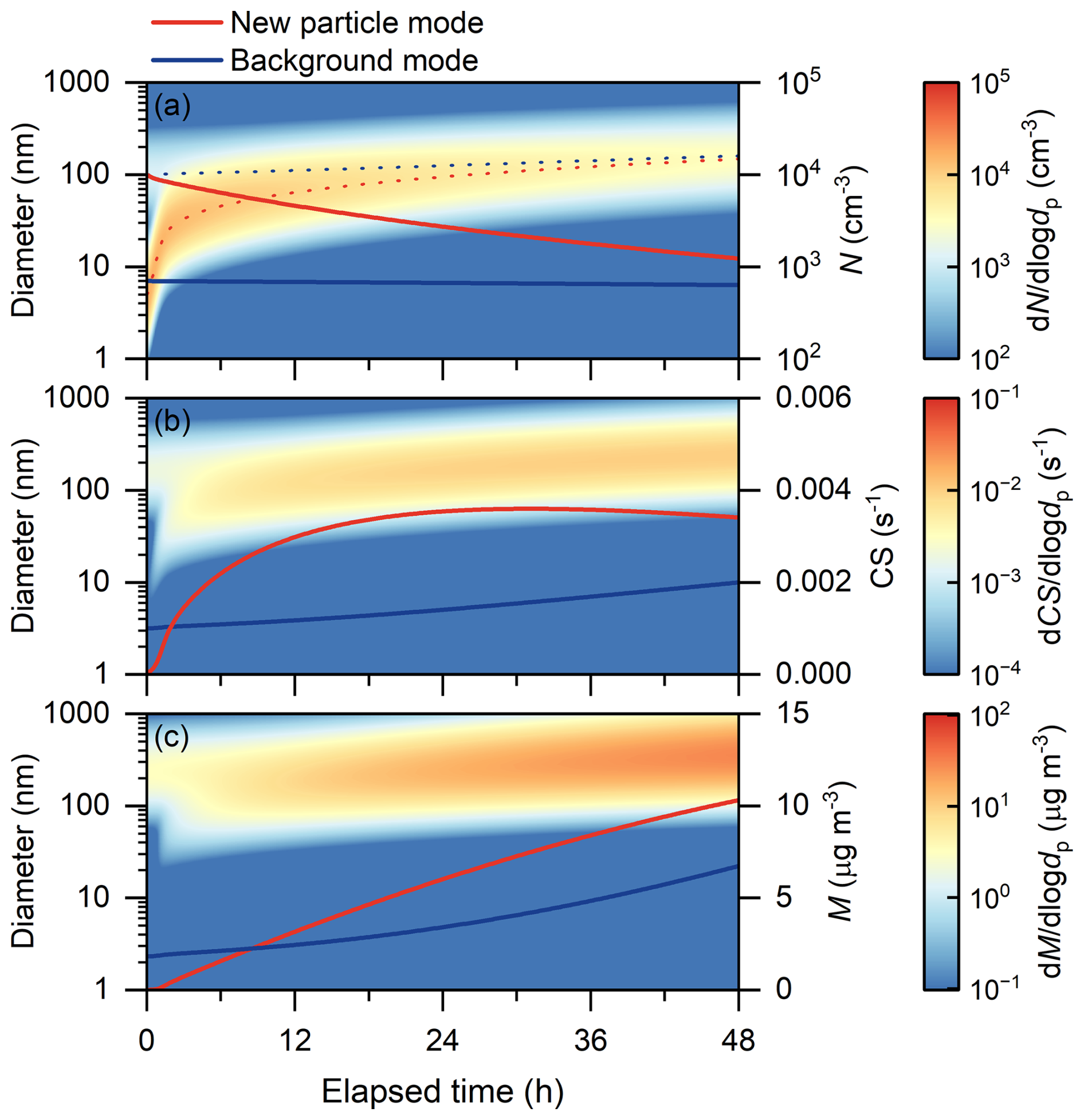
Figure 1Simulated evolution of the new particle mode and the background mode. (a) Particle number (N) and the number–size distribution (). The dotted lines indicate the count median diameter of both modes. (b) Contribution to the total condensation sink (CS) and the CS–size distribution (). (c) Particle mass concentration (M) and the mass-size distribution (). The model inputs are: constant Qv = 5 × 104 cm−3 s−1, Nnp0 = 104 cm−3, CSbg0 = 0.001 s−1, and αbg = 0.1. The value of Nnp0, CSbg0, and the derived GR represents typical values at Hyytiälä. The condensation sink of background particles in panel (b) is reported at αbg = 1.0 to better reflect its contribution to the surface area and the coagulation sink, which also applies to the figures below.
With a higher CS than the background mode, the new particle mode accumulates mass exceeding the background mode after a time lag (Fig. 1c). Similar evolution of particle size distributions, i.e., significant growth in mass-size distribution following the growth in number-size distribution, has been observed during atmospheric NPF events (Fig. S3). We note that although the constant vapor source used in Fig. 1 limited the total aerosol mass, this hypothesis holds only in the absence of heterogeneous chemistry and is not supported by atmospheric measurements. In the real world, heterogeneous chemistry can contribute additional mass preferentially on the high-CS new particle mode (Wang et al., 2010), amplifying the NPF mass contribution beyond the simulation results. Figure S4 shows that there is no strong correlation between new particle growth rate and the background CS, indicating that the competition of vapor between the two modes is not the governing factor for the rate of gas-to-particle conversion. Following this measurement fact, we also perform a simulation with constant vapor concentration (corresponding to a near constant growth rate), which shows a significant NPF mass contribution (Fig. S5). Nevertheless, we adopt the constant vapor source hypothesis in the following model simulations, which provide a conservative lower bound on NPF mass contributions, and focus on the relative contribution.
3.2 Regimes of NPF mass contribution
To map the conditions under which NPF mass contribution is significant or negligible, we first show the response and sensitivity of NPF mass contribution after 48 h of simulation to atmospheric conditions characterized by key influencing parameters (Fig. 2). Under the various simulated conditions, CSnp increases rapidly as new particles grow within ∼ 12 h of simulation and drives a sustained accumulation of the mass of new particles, indicating that prolonged continuous growth is not a prerequisite for large NPF contribution to CS. Figure S6 shows that increasing the initial number concentration of new particles produced (Nnp0) leads to a significant elevation in CSnp and only a moderate reduction in CSbg. Interestingly, the mass of the new particle mode is insensitive to Nnp0 above ∼ 104 cm−3 (Fig. 2b), showing that NPF mass contribution is mainly determined by the occurrence of NPF event or not but not its intensity. This is mainly because the available mass is limited by vapor production under a fixed vapor source, and also mass gains in the new particle mode are partially offset by increased scavenging of new particles by background particles, which transfers mass to the background mode.
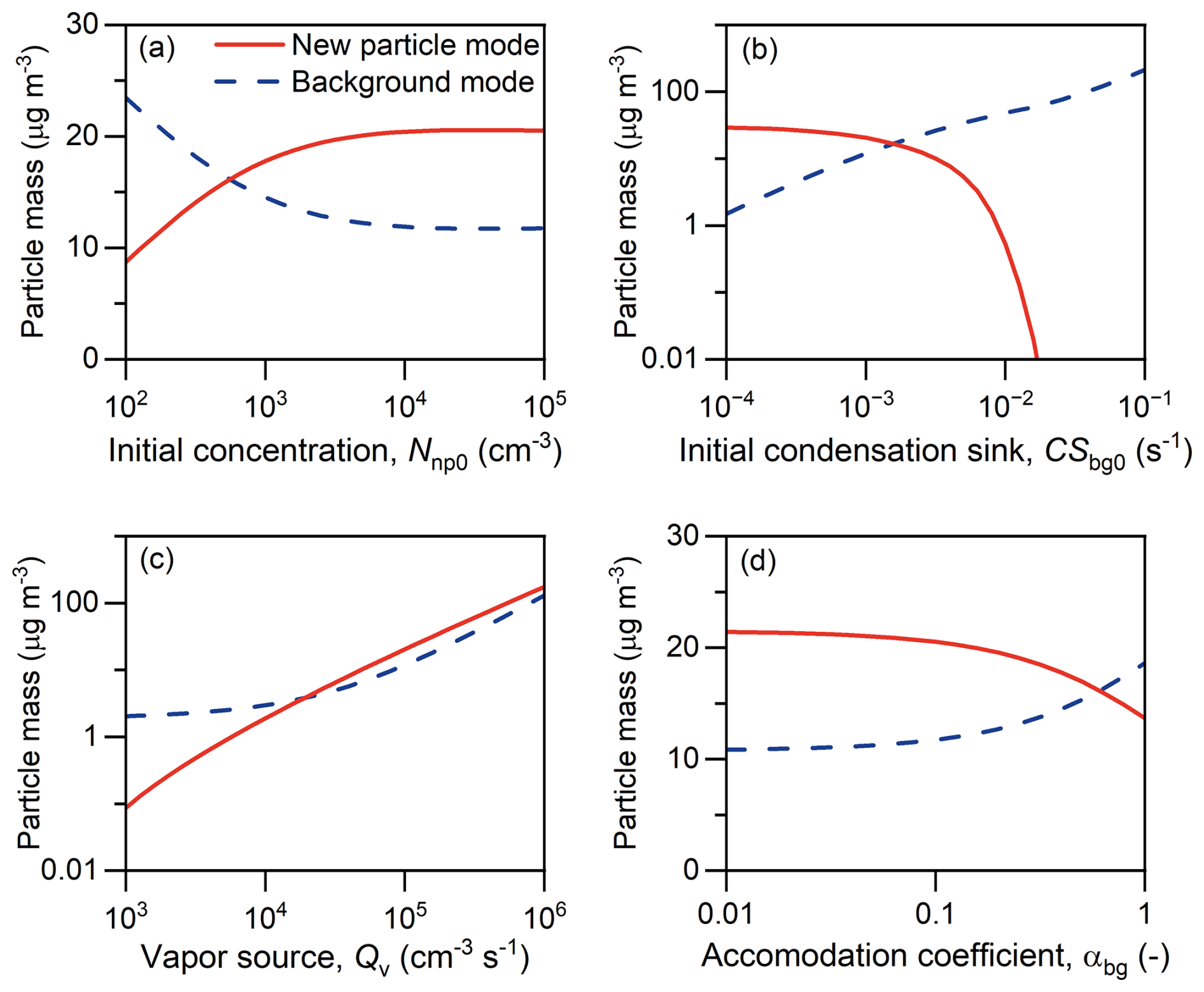
Figure 2Influences of atmospheric parameters on NPF mass contribution after 48 h simulation. (a) Influence of the initial new particle concentration produced (Nnp0); (b) influence of the initial condensation sink (CSbg0); (c) influence of the vapor source (Qv); (d) influence of the mass accommodation of background particles (αbg). The model inputs are: Nnp0 = 104 cm−3, CSbg0 = 0.001 s−1, Qv = 1 × 105 cm−3 s−1, and αbg = 0.1 unless a certain parameter is used as x-axis variable.
Figure 2b (and Fig. S7) shows a strong and non-linear dependence of NPF mass contribution on CSbg0, which results from the non-linear response of particle survival probability to CS (Kulmala et al., 2017; Cai et al., 2022). Consistently, in terms of particle number that determines the occurrence of NPF events, CS has been identified as a governing factor in polluted environments such as urban Beijing (Cai et al., 2017b; Deng et al., 2021), whereas in cleaner environments such as Hyytiälä, CS has only a weak negative association with NPF occurrence (Dada et al., 2017). We could hence conclude that the critical CS threshold for significant NPF mass contribution is ∼ 0.01 s−1 under the simulation conditions in Fig. 2b.
Sufficient vapor is a prerequisite for significant new-particle mass (Figs. 2c and S8), yet it does not have a strong influence on the relative mass contributions of the new particle mode and the background mode for Qv above a certain threshold (∼ 104 cm−3 s−1). At the highest vapor source examined (Qv = 106 cm−3 s−1), the background mode grows rapidly and enhances the scavenging of new particles, partially offsetting the benefit of higher GR for new particle survival (Fig. S9).
Measurements show that the GR in the sub-25 nm size range tends to increase with particle size, partly attributable to the diminishing Kelvin effect (Yli-Juuti et al., 2011; Tröstl et al., 2016; Deng et al., 2020). This finding also extends to sizes over 100 nm if only monotonic growth periods are accounted for; however, the average increase in the size of background particles over the whole growth event is sometimes slower than smaller new particles (Paasonen et al., 2018; Dai et al., 2023). This may reflect an ineffective vapor uptake of large background particles characterized by αbg below unity, i.e., vapor molecules colliding with the particle surface are not effectively incorporated into the bulk. For instance, the importance of particle-phase diffusion increases with particle size and may retard vapor uptake of large particles (Zaveri et al., 2014). Laboratory measurements have reported αbg on the order of 0.01–1.0 (Davidovits et al., 2006; Liu et al., 2019). For organic-coated or highly viscous particles, the αbg can be substantially lower than 1.0 (Zaveri et al., 2022). Considering that our atmospheric measurement results show that background particles grow slower than new particles, we take αbg = 0.1 as a representative default input for simulation and explore its influences on the mass contribution. Figure 2d shows that the mass contribution of the new particle mode increases as αbg decreases from 1.0 to 0.1. This dependence diminishes as αbg decreases further to 0.01, in which range vapor uptake is dominated by the new particle mode under the simulated condition (Fig. S10).
The findings above are summarized in Fig. 3. The results reveal a three-regime structure governed primarily by the initial CSbg (CSbg0). One regime is characterized by significant NPF contributions. Under low background aerosol concentrations (CSbg0 < 0.001 s−1, regime I), such as on clean days in boreal forest and in remote marine boundary layers (Zheng et al., 2021), new particles develop a mass comparable to or exceeding that of background particles. When CSbg0 falls below 0.0001 s−1, the total aerosol mass becomes NPF-dominated with only a minor contribution from background particles. Another regime is a background-dominated regime, characterized by high background aerosol concentrations (CSbg0 > 0.01 s−1, regime III), corresponding to polluted days in environments influenced by strong human activities. Under such conditions, new particles are rapidly removed by coagulation scavenging before they can grow to sizes with significant mass contributions. Even with the most favorable αbg (0.01) representing strongly retarded vapor uptake by background particles, the contribution from the new particle mode is less than 10 % (Fig. S11). In the intermediate range between these two regimes is a transitional regime (CSbg0 = 0.001–0.01 s−1, regime II). Whether the new particle mode in this transitional regime makes a significant mass contribution is also influenced by other parameters, with αbg being a key influencing factor. Note that although CSbg0 governs the threshold separating these three regimes in the simulation results, Fig. S11 shows that the threshold values are also affected by Qv and αbg. While Fig. S12 validates this three-regime structure for conditions with a constant vapor concentration (rather than a constant Qv), the threshold values may need re-evaluation when applied to other conditions and environments.
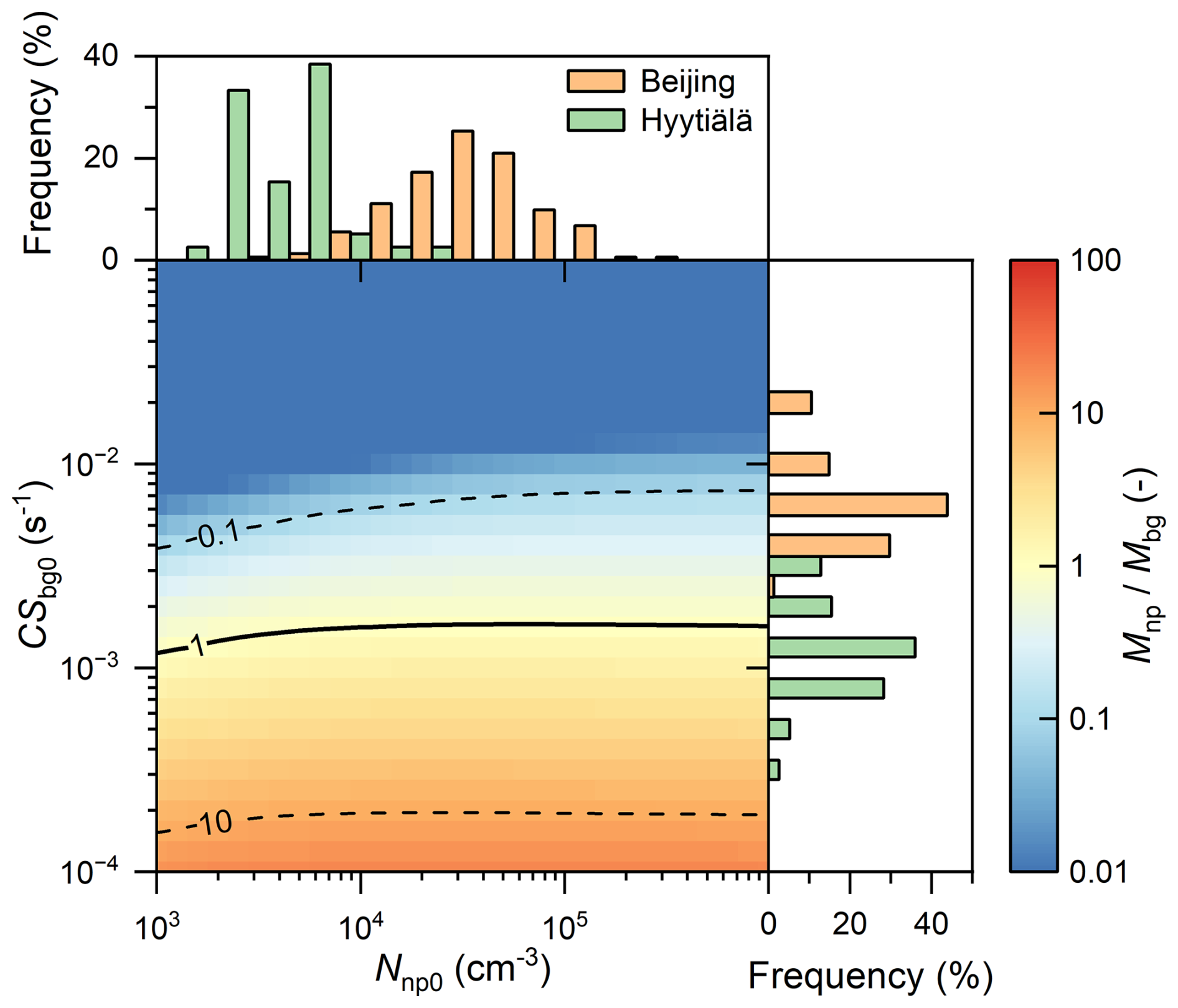
Figure 3Contribution of the new particle mode to particle mass concentration after 48 h as a function of initial new particle concentration and background aerosol condensation sink. The other model inputs are: Qv = 1 × 105 cm−3 s−1, and αbg = 0.1. Simulations results at different Qv and αbg values are given in Fig. S11. Statistical results of measured NPF events in relation to N and CS are given in the bar plots.
Positioning the observational data within the proposed regime framework quantifies the expected NPF mass contribution and its sensitivity to atmospheric variability. At both the Beijing and Hyytiälä sites, despite the difference in NPF intensities, Nnp0 often falls in the range where it exerts only a minor influence on the NPF mass contribution. That is, NPF events routinely produce sufficient seeds in the new particle mode, such that the limiting factor is the condensable vapor and particle survival probability rather than NPF intensity. The CSbg0 during NPF events in urban Beijing spans over 0.0026–0.019 s−1, locating most events in regimes II and III. This implies the new particle mode in Beijing can occasionally, but not consistently, make a significant mass contribution. This is in accordance with both previously reported case studies on significant NPF mass contributions during haze episodes (Kulmala et al., 2021) and also the success in previous control of aerosol mass by reducing primary emissions (Cheng et al., 2019). In contrast, CSbg0 at Hyytiälä falls within regimes I and II, where new particles can have a significant mass contribution after growth. This is qualitatively consistent with previous estimates that NPF accounts for a substantial fraction of cloud condensation nuclei in boreal forest environments (Tunved et al., 2006; Gordon et al., 2017; Petäjä et al., 2022), where low background aerosol concentration favors the growth and survival of new particles to sizes that are relevant to cloud condensation nuclei.
The significant contribution of NPF to CS also has direct implications for heterogeneous processes. As discussed above, the heterogeneous uptake rate scales with the available surface area. While noting that vapor uptake efficiency is also determined by the chemical compositions of the particles, which may differ between the new particle mode and background mode, Fig. S11 shows that NPF can have positive feedback on heterogeneous aerosol formation by augmenting the total particle surface area in regimes I and II. In regime III, this feedback is suppressed by the dominant CSbg.
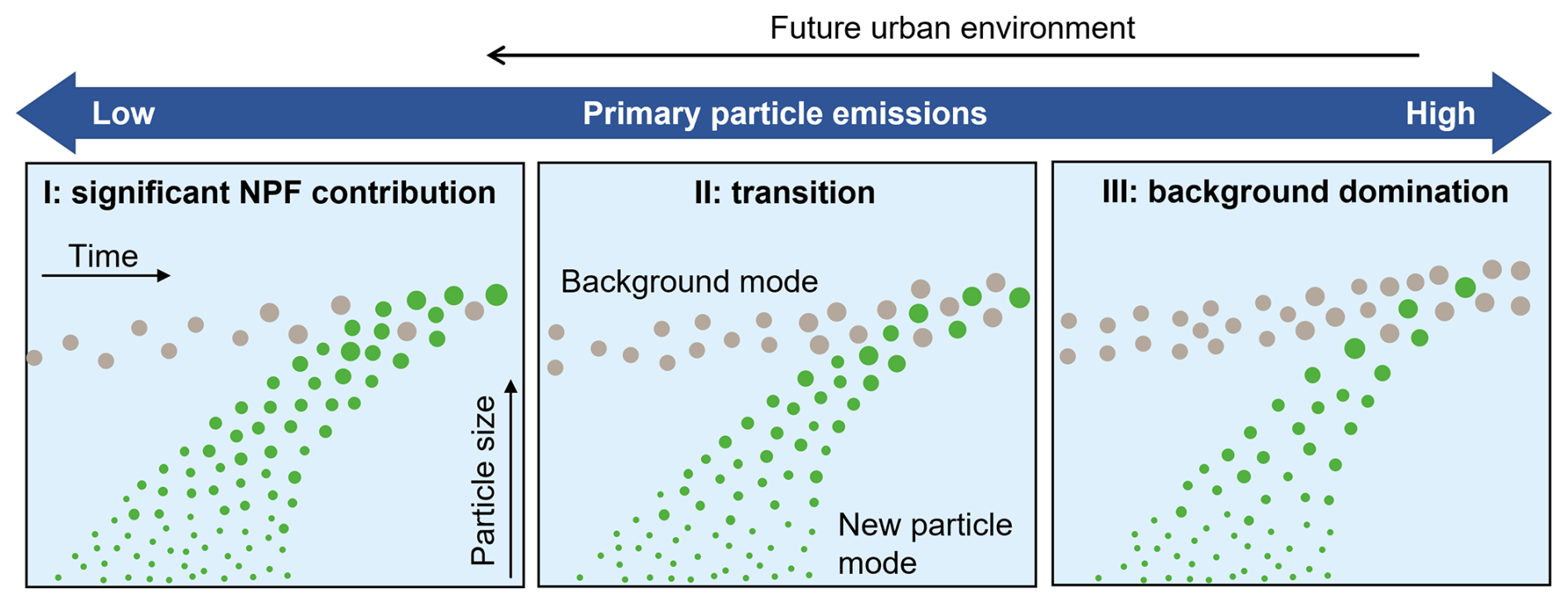
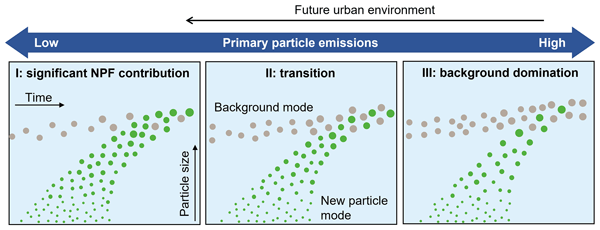
Figure 4Schematic illustration of the regimes governing NPF mass contribution. Green and gray markers denote newly formed and background particles, respectively, with the mark size representing particle diameter. The NPF mass contribution is categorized into different regimes according to the mass fraction contributed by new particles that survive to large sizes, which is primarily controlled by the concentration of background particles. With reduced primary particle emissions in future urban environment, the relative importance of NPF mass contribution is expected to increase as a result of lower background particle concentrations.
These results carry direct implications for interpreting the importance of NPF to air quality under different atmospheric conditions (Fig. 4). In present-day polluted environments such as those in East Asia, NPF makes a moderate and variable contribution to aerosol mass, which is governed by CSbg0. This also indicates an episodic characteristic of NPF mass contributions: on relatively clean days with low CSbg0, NPF events tend to occur and grow continuously during a haze episode, contributing significantly to aerosol mass but also suppress subsequent NPF events as “background particles”. Similar events and feedback have been reported in previous studies (Guo et al., 2014; Westervelt et al., 2014).
Looking forward, sustained air pollution control strategies including industrial abatement, energy upgrade, and transportation electrification, future urban atmospheres tend to be less influenced by primary particle emissions, shifting CSbg0 towards lower values. Meanwhile, due to the non-linear response of condensable vapor to unbalanced emission control (Tang et al., 2025), condensable vapor concentration may not decrease to the same extent as that in CSbg0. As a result, the NPF contribution in these environments will shift from regimes II–III towards I–II, offsetting the decrease in total particle mass. This finding derived from our simulations suggests that ongoing reductions in primary aerosol emissions, if not accompanied by equivalent reductions in NPF precursors, may disproportionately amplify NPF contributions to particle mass. Further studies with more observational constraints are needed to better assess the NPF mass contribution and its importance in different environments. Potential solutions for urban environments include reducing anthropogenic NPF precursors including amine and ammonia to decrease Nnp0 and reducing anthropogenic organic and inorganic precursors (Qv) to decrease the GR of growing new particles.
Data presented in this paper are available via the link https://doi.org/10.5281/zenodo.22037135 (Cai, 2026).
The supplement related to this article is available online at https://doi.org/10.5194/acp-26-16003-2026-supplement.
RC and MK designed the research; RC, SX and MK analyzed data with the help from VMK; RC, MK and VMK wrote the paper with inputs from SX.
The contact author has declared that none of the authors has any competing interests.
Publisher's note: Copernicus Publications remains neutral with regard to jurisdictional claims made in the text, published maps, institutional affiliations, or any other geographical representation in this paper. The authors bear the ultimate responsibility for providing appropriate place names. Views expressed in the text are those of the authors and do not necessarily reflect the views of the publisher.
University of Helsinki support via ACTRIS-HY is acknowledged. Support of the technical and scientific staff in Hyytiälä, BUCT/AHL, and THU are acknowledged.
This research has been supported by the National Natural Science Foundation of China (grant no. 22406024), the Research Council of Finland (grant nos. 337549, 302958, 325656, 311932, 334792, 316114, 325647, 325681, 333397, 328616, 357902, 345510, and 347782), the Jane ja Aatos Erkon Säätiö (“Quantifying carbon sink, CarbonSink+ and their interaction with air quality”), the Jenny ja Antti Wihurin Rahasto (“Gigacity” project), the European Research Council, HORIZON EUROPE European Research Council (grant no. 742206), the European Commission, Horizon 2020 (grant nos. 101056783, 101003826, 101036245, 856612, and 821205), and the Teknologiateollisuuden 100-Vuotisjuhlasäätiö (urbaani ilmanlaatu 2.0-project).
Open-access funding was provided by the Helsinki University Library.
This paper was edited by Imre Salma and reviewed by two anonymous referees.
Aalto, P., Hämeri, K., Becker, E., Weber, R., Salm, J., Mäkelä, J. M., Hoell, C., O'dowd, C. D., Karlsson, H., Hansson, H.-C., Väkevä, M., Koponen, I. K., Buzorius, G., and Kulmala, M.: Physical characterization of aerosol particles during nucleation events, Tellus B, 53, https://doi.org/10.3402/tellusb.v53i4.17127, 2001.
An, Z., Huang, R. J., Zhang, R., Tie, X., Li, G., Cao, J., Zhou, W., Shi, Z., Han, Y., Gu, Z., and Ji, Y.: Severe haze in northern China: A synergy of anthropogenic emissions and atmospheric processes, P. Natl. Acad. Sci. USA, 116, 8657–8666, https://doi.org/10.1073/pnas.1900125116, 2019.
Cai, R.: Data for Cai et al. New particle formation contribution to aerosol mass: regimes and implications for future urban environments, Zenodo [data set], https://doi.org/10.5281/zenodo.22037135, 2026.
Cai, R. and Jiang, J.: A new balance formula to estimate new particle formation rate: reevaluating the effect of coagulation scavenging, Atmos. Chem. Phys., 17, 12659–12675, https://doi.org/10.5194/acp-17-12659-2017, 2017.
Cai, R., Chen, D.-R., Hao, J., and Jiang, J.: A miniature cylindrical differential mobility analyzer for sub-3 nm particle sizing, J. Aerosol Sci., 106, 111–119, https://doi.org/10.1016/j.jaerosci.2017.01.004, 2017a.
Cai, R., Yang, D., Fu, Y., Wang, X., Li, X., Ma, Y., Hao, J., Zheng, J., and Jiang, J.: Aerosol surface area concentration: a governing factor in new particle formation in Beijing, Atmos. Chem. Phys., 17, 12327–12340, https://doi.org/10.5194/acp-17-12327-2017, 2017b.
Cai, R., Yan, C., Yang, D., Yin, R., Lu, Y., Deng, C., Fu, Y., Ruan, J., Li, X., Kontkanen, J., Zhang, Q., Kangasluoma, J., Ma, Y., Hao, J., Worsnop, D. R., Bianchi, F., Paasonen, P., Kerminen, V.-M., Liu, Y., Wang, L., Zheng, J., Kulmala, M., and Jiang, J.: Sulfuric acid–amine nucleation in urban Beijing, Atmos. Chem. Phys., 21, 2457–2468, https://doi.org/10.5194/acp-21-2457-2021, 2021.
Cai, R., Deng, C., Stolzenburg, D., Li, C., Guo, J., Kerminen, V.-M., Jiang, J., Kulmala, M., and Kangasluoma, J.: Survival probability of new atmospheric particles: closure between theory and measurements from 1.4 to 100 nm, Atmos. Chem. Phys., 22, 14571–14587, https://doi.org/10.5194/acp-22-14571-2022, 2022.
Cheng, J., Su, J., Cui, T., Li, X., Dong, X., Sun, F., Yang, Y., Tong, D., Zheng, Y., Li, Y., Li, J., Zhang, Q., and He, K.: Dominant role of emission reduction in PM2.5 air quality improvement in Beijing during 2013–2017: a model-based decomposition analysis, Atmos. Chem. Phys., 19, 6125–6146, https://doi.org/10.5194/acp-19-6125-2019, 2019.
Coe, H.: Airborne particles might grow fast in cities, Nature, 581, 145–146, https://doi.org/10.1038/d41586-020-01334-4, 2020.
Dada, L., Paasonen, P., Nieminen, T., Buenrostro Mazon, S., Kontkanen, J., Peräkylä, O., Lehtipalo, K., Hussein, T., Petäjä, T., Kerminen, V.-M., Bäck, J., and Kulmala, M.: Long-term analysis of clear-sky new particle formation events and nonevents in Hyytiälä, Atmos. Chem. Phys., 17, 6227–6241, https://doi.org/10.5194/acp-17-6227-2017, 2017.
Dai, L., Zhao, Y., Zhang, L., Chen, D., and Wu, R.: Particle number size distributions and formation and growth rates of different new particle formation types of a megacity in China, J. Environ. Sci., 131, 11–25, https://doi.org/10.1016/j.jes.2022.07.029, 2023.
Dal Maso, M., Kulmala, M., Riipinen, I., Wagner, R., Hussein, T., Aalto, P., and Lehtinen, K. E.: Formation and growth of fresh atmospheric aerosols: eight years of aerosol size distribution data from SMEAR II, Hyytiälä, Finland, Boreal Environ. Res., 10, 323–336, https://www.borenv.net/BER/archive/ber105.htm#323 (last access: 8 November 2026), 2005.
Davidovits, P., Kolb, C. E., Williams, L. R., Jayne, J. T., and Worsnop, D. R.: Mass Accommodation and Chemical Reactions at Gas-Liquid Interfaces, Chem. Rev., 106, 1323–1354, https://doi.org/10.1021/cr040366k, 2006.
Deng, C., Fu, Y., Dada, L., Yan, C., Cai, R., Yang, D., Zhou, Y., Yin, R., Lu, Y., Li, X., Qiao, X., Fan, X., Nie, W., Kontkanen, J., Kangasluoma, J., Chu, B., Ding, A., Kerminen, V., Paasonen, P., Worsnop, R. D., Bianchi, F., Liu, Y., Zheng, J., Wang, L., Kulmala, M., and Jiang, J.: Seasonal characteristics of new particle formation and growth in urban Beijing, Environ. Sci. Technol., 54, 8547–8557, https://doi.org/10.1021/acs.est.0c00808, 2020.
Deng, C., Cai, R., Yan, C., Zheng, J., and Jiang, J.: Formation and growth of sub-3 nm particles in megacities: impacts of background aerosols, Faraday Discuss., 226, 348–363, https://doi.org/10.1039/d0fd00083c, 2021.
Deng, C., Li, Y., Yan, C., Wu, J., Cai, R., Wang, D., Liu, Y., Kangasluoma, J., Kerminen, V.-M., Kulmala, M., and Jiang, J.: Measurement report: Size distributions of urban aerosols down to 1 nm from long-term measurements, Atmos. Chem. Phys., 22, 13569–13580, https://doi.org/10.5194/acp-22-13569-2022, 2022.
Fuchs, N. A. and Sutugin, A. G.: High-dispersed Aerosols, in: Topics in Current Aerosol Research, edited by: Hidy, G. M., and Brock, J. R., Pergamon, 1, https://doi.org/10.1016/B978-0-08-016674-2.50006-6, 1971.
Gordon, H., Kirkby, J., Baltensperger, U., Bianchi, F., Breitenlechner, M., Curtius, J., Dias, A., Dommen, J., Donahue, N. M., Dunne, E. M., Duplissy, J., Ehrhart, S., Flagan, R. C., Frege, C., Fuchs, C., Hansel, A., Hoyle, C. R., Kulmala, M., Kürten, A., Lehtipalo, K., Makhmutov, V., Molteni, U., Rissanen, M. P., Stozkhov, Y., Tröstl, J., Tsagkogeorgas, G., Wagner, R., Williamson, C., Wimmer, D., Winkler, P. M., Yan, C., and Carslaw, K. S.: Causes and importance of new particle formation in the present-day and preindustrial atmospheres, J. Geophys. Res.-Atmos., 122, 8739–8760, https://doi.org/10.1002/2017jd026844, 2017.
Guo, S., Hu, M., Zamora, M. L., Peng, J., Shang, D., Zheng, J., Du, Z., Wu, Z., Shao, M., Zeng, L., Molina, M. J., and Zhang, R.: Elucidating severe urban haze formation in China, P. Natl. Acad. Sci. USA, 111, 17373–17378, https://doi.org/10.1073/pnas.1419604111, 2014.
Hari, P. and Kulmala, M.: Station for measuring ecosystem-atmosphere relations (SMEAR II), Boreal Environ. Res., 10, 315–322, https://www.borenv.net/BER/archive/ber105.htm#315 (last access: 8 November 2026), 2005.
Hatch, T. and Choate, S. P.: Statistical description of the size properties of non uniform particulate substances, J. Franklin Inst., 207, 369–387, https://doi.org/10.1016/S0016-0032(29)91451-4, 1929.
Huang, X., Ding, A., Wang, Z., Ding, K., Gao, J., Chai, F., and Fu, C.: Amplified transboundary transport of haze by aerosol–boundary layer interaction in China, Nat. Geosci., 13, 428–434, https://doi.org/10.1038/s41561-020-0583-4, 2020.
Kerminen, V.-M. and Kulmala, M.: Analytical formulae connecting the “real” and the “apparent” nucleation rate and the nuclei number concentration for atmospheric nucleation events, J. Aerosol Sci., 33, 609–622, https://doi.org/10.1016/S0021-8502(01)00194-X, 2002.
Kerminen, V.-M., Chen, X., Vakkari, V., Petäjä, T., Kulmala, M., and Bianchi, F.: Atmospheric new particle formation and growth: review of field observations, Environ. Res. Lett., 13, 103003, https://doi.org/10.1088/1748-9326/aadf3c, 2018.
Kulmala, M. and Wagner, P. E.: Mass accommodation and uptake coefficients – a quantitative comparison, J. Aerosol Sci., 32, 833–841, https://doi.org/10.1016/S0021-8502(00)00116-6, 2001.
Kulmala, M., Kerminen, V. M., Petaja, T., Ding, A. J., and Wang, L.: Atmospheric gas-to-particle conversion: why NPF events are observed in megacities?, Faraday Discuss., 200, 271–288, https://doi.org/10.1039/c6fd00257a, 2017.
Kulmala, M., Dada, L., Daellenbach, K. R., Yan, C., Stolzenburg, D., Kontkanen, J., Ezhova, E., Hakala, S., Tuovinen, S., Kokkonen, T. V., Kurppa, M., Cai, R., Zhou, Y., Yin, R., Baalbaki, R., Chan, T., Chu, B., Deng, C., Fu, Y., Ge, M., He, H., Heikkinen, L., Junninen, H., Liu, Y., Lu, Y., Nie, W., Rusanen, A., Vakkari, V., Wang, Y., Yang, G., Yao, L., Zheng, J., Kujansuu, J., Kangasluoma, J., Petäjä, T., Paasonen, P., Jarvi, L., Worsnop, D., Ding, A., Liu, Y., Wang, L., Jiang, J., Bianchi, F., and Kerminen, V.-M.: Is reducing new particle formation a plausible solution to mitigate particulate air pollution in Beijing and other Chinese megacities?, Faraday Discuss., 226, https://doi.org/10.1039/d0fd00078g, 2021.
Kulmala, M., Cai, R., Stolzenburg, D., Zhou, Y., Dada, L., Guo, Y., Yan, C., Petäjä, T., Jiang, J., and Kerminen, V.-M.: The contribution of new particle formation and subsequent growth to haze formation, Environ. Sci.: Atmos., 2, 352–361, https://doi.org/10.1039/d1ea00096a, 2022.
Kulmala, M., Du, W., Zhang, X., Zhang, T., Xia, M., Wang, Y., Zou, Z., Zheng, F., Zhang, Y., Yang, C., Wu, J., Li, Y., Zha, Q., Yan, C., Feng, W., Wang, Z., Hua, C., Xie, J., Ma, W., Guo, Y., Chen, X., Liu, T., Li, J., Pang, H., Zhao, G., Chen, K., Zhao, Z., Zhong, W., Gao, S., Zhang, W., Yuan, Q., Qi, L., Petäjä, T., Sarnela, N., Ylivinkka, I., Aliaga, D., Cai, R., Agro, M., Ahonen, L., Schiestl-Aalto, P., Tuovinen, S., Cai, J., Kujansuu, J., Ciarelli, G., Cheng, Y., Ding, A., Dällenbach, K., Dada, L., Worsnop, D., Bianchi, F., Jiang, J., Liu, Y., Veli-Matti, K., and Kokkonen, T.: Understanding atmospheric processes: insights from the comparison between Beijing and Hyytiälä, npj Clean Air, 1, 26, https://doi.org/10.1038/s44407-025-00020-x, 2025.
Lelieveld, J., Evans, J. S., Fnais, M., Giannadaki, D., and Pozzer, A.: The contribution of outdoor air pollution sources to premature mortality on a global scale, Nature, 525, 367–371, https://doi.org/10.1038/nature15371, 2015.
Liu, J., Jiang, J., Zhang, Q., Deng, J., and Hao, J.: A spectrometer for measuring particle size distributions in the range of 3 nm to 10 µm, Front. Environ. Sci. Eng., 10, 63–72, https://doi.org/10.1007/s11783-014-0754-x, 2016.
Liu, X., Day, D. A., Krechmer, J. E., Brown, W., Peng, Z., Ziemann, P. J., and Jimenez, J. L.: Direct measurements of semi-volatile organic compound dynamics show near-unity mass accommodation coefficients for diverse aerosols, Commun. Chem., 2, https://doi.org/10.1038/s42004-019-0200-x, 2019.
Nieminen, T., Asmi, A., Dal Maso, M., Aalto, P. P., Keronen, P., Petäjä, T., Kulmala, M., and Kerminen, V.-M.: Trends in atmospheric new-particle formation: 16 years of observations in a boreal-forest environment, Boreal Environ. Res., 19, 191–214, https://www.borenv.net/BER/archive/ber19B.htm#191 (last access: 8 November 2026), 2014.
Nieminen, T., Kerminen, V.-M., Petäjä, T., Aalto, P. P., Arshinov, M., Asmi, E., Baltensperger, U., Beddows, D. C. S., Beukes, J. P., Collins, D., Ding, A., Harrison, R. M., Henzing, B., Hooda, R., Hu, M., Hõrrak, U., Kivekäs, N., Komsaare, K., Krejci, R., Kristensson, A., Laakso, L., Laaksonen, A., Leaitch, W. R., Lihavainen, H., Mihalopoulos, N., Németh, Z., Nie, W., O'Dowd, C., Salma, I., Sellegri, K., Svenningsson, B., Swietlicki, E., Tunved, P., Ulevicius, V., Vakkari, V., Vana, M., Wiedensohler, A., Wu, Z., Virtanen, A., and Kulmala, M.: Global analysis of continental boundary layer new particle formation based on long-term measurements, Atmos. Chem. Phys., 18, 14737–14756, https://doi.org/10.5194/acp-18-14737-2018, 2018.
Paasonen, P., Peltola, M., Kontkanen, J., Junninen, H., Kerminen, V.-M., and Kulmala, M.: Comprehensive analysis of particle growth rates from nucleation mode to cloud condensation nuclei in boreal forest, Atmos. Chem. Phys., 18, 12085–12103, https://doi.org/10.5194/acp-18-12085-2018, 2018.
Petäjä, T., Tabakova, K., Manninen, A., Ezhova, E., O'Connor, E., Moisseev, D., Sinclair, V. A., Backman, J., Levula, J., Luoma, K., Virkkula, A., Paramonov, M., Räty, M., Äijälä, M., Heikkinen, L., Ehn, M., Sipilä, M., Yli-Juuti, T., Virtanen, A., Ritsche, M., Hickmon, N., Pulik, G., Rosenfeld, D., Worsnop, D. R., Bäck, J., Kulmala, M., and Kerminen, V. M.: Influence of biogenic emissions from boreal forests on aerosol–cloud interactions, Nat. Geosci., 15, 42–47, https://doi.org/10.1038/s41561-021-00876-0, 2022.
Pierce, J. R. and Adams, P. J.: Efficiency of cloud condensation nuclei formation from ultrafine particles, Atmos. Chem. Phys., 7, 1367–1379, https://doi.org/10.5194/acp-7-1367-2007, 2007.
Renbaum-Wolff, L., Grayson, J. W., Bateman, A. P., Kuwata, M., Sellier, M., Murray, B. J., Shilling, J. E., Martin, S. T., and Bertram, A. K.: Viscosity of alpha-pinene secondary organic material and implications for particle growth and reactivity, P. Natl. Acad. Sci. USA, 110, 8014–8019, https://doi.org/10.1073/pnas.1219548110, 2013.
Shiraiwa, M., Ammann, M., Koop, T., and Pöschl, U.: Gas uptake and chemical aging of semisolid organic aerosol particles, P. Natl. Acad. Sci. USA, 108, 11003–11008, https://doi.org/10.1073/pnas.1103045108, 2011.
Stolzenburg, D., Fischer, L., Vogel, A. L., Heinritzi, M., Schervish, M., Simon, M., Wagner, A. C., Dada, L., Ahonen, L. R., Amorim, A., Baccarini, A., Bauer, P. S., Baumgartner, B., Bergen, A., Bianchi, F., Breitenlechner, M., Brilke, S., Mazon, S. B., Chen, D., Dias, A., Draper, D. C., Duplissy, J., El Haddad, I., Finkenzeller, H., Frege, C., Fuchs, C., Garmash, O., Gordon, H., He, X., Helm, J., Hofbauer, V., Hoyle, C. R., Kim, C., Kirkby, J., Kontkanen, J., Kuerten, A., Lampilahti, J., Lawler, M., Lehtipalo, K., Leiminger, M., Mai, H., Mathot, S., Mentler, B., Molteni, U., Nie, W., Nieminen, T., Nowak, J. B., Ojdanic, A., Onnela, A., Passananti, M., Petaja, T., Quelever, L. L. J., Rissanen, M. P., Sarnela, N., Schallhart, S., Tauber, C., Tome, A., Wagner, R., Wang, M., Weitz, L., Wimmer, D., Xiao, M., Yan, C., Ye, P., Zha, Q., Baltensperger, U., Curtius, J., Dommen, J., Flagan, R. C., Kulmala, M., Smith, J. N., Worsnop, D. R., Hansel, A., Donahue, N. M., and Winkler, P. M.: Rapid growth of organic aerosol nanoparticles over a wide tropospheric temperature range, P. Natl. Acad. Sci. USA, 115, 9122–9127, https://doi.org/10.1073/pnas.1807604115, 2018.
Stolzenburg, D., Cai, R., Blichner, S. M., Kontkanen, J., Zhou, P., Makkonen, R., Kerminen, V.-M., Kulmala, M., Riipinen, I., and Kangasluoma, J.: Atmospheric nanoparticle growth, Rev. Mod. Phys., 95, 045002, https://doi.org/10.1103/RevModPhys.95.045002, 2023.
Stolzenburg, M. R., McMurry, P. H., Sakurai, H., Smith, J. N., Mauldin, R. L., Eisele, F. L., and Clement, C. F.: Growth rates of freshly nucleated atmospheric particles in Atlanta, J. Geophys. Res.-Atmos., 110, D22S05, https://doi.org/10.1029/2005jd005935, 2005.
Szopa, S., Naik, V., Adhikary, B., Artaxo, P., Berntsen, T., Collins, W. D., Fuzzi, S., Gallardo, L., Kiendler-Scharr, A., Klimont, Z., Liao, H., Unger, N., and Zanis, P.: Short-Lived Climate Forcers, Cambridge University Press, Cambridge, United Kingdom and New York, NY, USA, 817–922, https://doi.org/10.1017/9781009157896.008, 2021.
Tang, L., Feng, Z., Shang, D., Zeng, L., Wu, Z., Wang, H., Chen, S., Li, X., Zeng, L., Hu, J., and Hu, M.: Ongoing uncoordinated anthropogenic emission abatement promotes atmospheric new particle growth in a Chinese megacity, Nat. Commun., 16, 6720, https://doi.org/10.1038/s41467-025-62011-6, 2025.
Tröstl, J., Chuang, W. K., Gordon, H., Heinritzi, M., Yan, C., Molteni, U., Ahlm, L., Frege, C., Bianchi, F., Wagner, R., Simon, M., Lehtipalo, K., Williamson, C., Craven, J. S., Duplissy, J., Adamov, A., Almeida, J., Bernhammer, A. K., Breitenlechner, M., Brilke, S., Dias, A., Ehrhart, S., Flagan, R. C., Franchin, A., Fuchs, C., Guida, R., Gysel, M., Hansel, A., Hoyle, C. R., Jokinen, T., Junninen, H., Kangasluoma, J., Keskinen, H., Kim, J., Krapf, M., Kurten, A., Laaksonen, A., Lawler, M., Leiminger, M., Mathot, S., Mohler, O., Nieminen, T., Onnela, A., Petaja, T., Piel, F. M., Miettinen, P., Rissanen, M. P., Rondo, L., Sarnela, N., Schobesberger, S., Sengupta, K., Sipila, M., Smith, J. N., Steiner, G., Tome, A., Virtanen, A., Wagner, A. C., Weingartner, E., Wimmer, D., Winkler, P. M., Ye, P., Carslaw, K. S., Curtius, J., Dommen, J., Kirkby, J., Kulmala, M., Riipinen, I., Worsnop, D. R., Donahue, N. M., and Baltensperger, U.: The role of low-volatility organic compounds in initial particle growth in the atmosphere, Nature, 533, 527–531, https://doi.org/10.1038/nature18271, 2016.
Tunved, P., Hansson, H.-C., Kerminen, V.-M., Ström, J., Maso, M. D., Lihavainen, H., Viisanen, Y., Aalto, P. P., Komppula, M., and Kulmala, M.: High Natural Aerosol Loading over Boreal Forests, Science, 312, 261–263, https://doi.org/10.1126/science.1123052, 2006.
Wang, L., Khalizov, A. F., Zheng, J., Xu, W., Ma, Y., Lal, V., and Zhang, R.: Atmospheric nanoparticles formed from heterogeneous reactions of organics, Nat. Geosci., 3, 238–242, https://doi.org/10.1038/ngeo778, 2010.
Weber, R. J., Marti, J. J., McMurry, P. H., Eisele, F. L., Tanner, D. J., and Jefferson, A.: Measurements of new particle formation and ultrafine particle growth rates at a clean continental site, J. Geophys. Res.-Atmos., 102, 4375–4385, https://doi.org/10.1029/96jd03656, 1997.
Westervelt, D. M., Pierce, J. R., and Adams, P. J.: Analysis of feedbacks between nucleation rate, survival probability and cloud condensation nuclei formation, Atmos. Chem. Phys., 14, 5577–5597, https://doi.org/10.5194/acp-14-5577-2014, 2014.
Yang, W., Ma, J., Yang, H., Li, F., and Han, C.: Photoenhanced sulfate formation by the heterogeneous uptake of SO2 on non-photoactive mineral dust, Atmos. Chem. Phys., 24, 6757–6768, https://doi.org/10.5194/acp-24-6757-2024, 2024.
Yli-Juuti, T., Nieminen, T., Hirsikko, A., Aalto, P. P., Asmi, E., Hõrrak, U., Manninen, H. E., Patokoski, J., Dal Maso, M., Petäjä, T., Rinne, J., Kulmala, M., and Riipinen, I.: Growth rates of nucleation mode particles in Hyytiälä during 2003−2009: variation with particle size, season, data analysis method and ambient conditions, Atmos. Chem. Phys., 11, 12865–12886, https://doi.org/10.5194/acp-11-12865-2011, 2011.
Zaveri, R. A., Easter, R. C., Shilling, J. E., and Seinfeld, J. H.: Modeling kinetic partitioning of secondary organic aerosol and size distribution dynamics: representing effects of volatility, phase state, and particle-phase reaction, Atmos. Chem. Phys., 14, 5153–5181, https://doi.org/10.5194/acp-14-5153-2014, 2014.
Zaveri, R. A., Wang, J., Fan, J., Zhang, Y., Shilling, J. E., Zelenyuk, A., Mei, F., Newsom, R., Pekour, M., Tomlinson, J., Comstock, J. M., Shrivastava, M., Fortner, E., Machado, L. A. T., Artaxo, P., and Martin, S. T.: Rapid growth of anthropogenic organic nanoparticles greatly alters cloud life cycle in the Amazon rainforest, Sci. Adv., 8, eabj0329, https://doi.org/10.1126/sciadv.abj0329, 2022.
Zhang, R., Khalizov, A., Wang, L., Hu, M., and Xu, W.: Nucleation and growth of nanoparticles in the atmosphere, Chem. Rev., 112, 1957–2011, https://doi.org/10.1021/cr2001756, 2012.
Zhao, B., Donahue, N. M., Zhang, K., Mao, L., Shrivastava, M., Ma, P.-L., Shen, J., Wang, S., Sun, J., Gordon, H., Tang, S., Fast, J., Wang, M., Gao, Y., Yan, C., Singh, B., Li, Z., Huang, L., Lou, S., Lin, G., Wang, H., Jiang, J., Ding, A., Nie, W., Qi, X., Chi, X., and Wang, L.: Global variability in atmospheric new particle formation mechanisms, Nature, 631, 98–105, https://doi.org/10.1038/s41586-024-07547-1, 2024.
Zheng, G., Wang, Y., Wood, R., Jensen, M. P., Kuang, C., McCoy, I. L., Matthews, A., Mei, F., Tomlinson, J. M., Shilling, J. E., Zawadowicz, M. A., Crosbie, E., Moore, R., Ziemba, L., Andreae, M. O., and Wang, J.: New particle formation in the remote marine boundary layer, Nat. Commun., 12, 527, https://doi.org/10.1038/s41467-020-20773-1, 2021.