
the Creative Commons Attribution 4.0 License.
the Creative Commons Attribution 4.0 License.
 | 16 Oct 2026
Linking molecular composition of organic aerosols to reactive oxygen species formation using an MCR-VK framework
Fobang Liu
Yun Zhang
Siyao Yue
Helmi-Marja K. Keskinen
Tuukka Petäjä
Markku Kulmala
Pingqing Fu
Thorsten Hoffmann

Reactive oxygen species (ROS) formation by atmospheric fine particulate matter (PM) is widely implicated in adverse health effects, yet the molecular determinants of particle-level ROS formation remain poorly constrained, largely due to the chemical complexity of organic aerosol (OA). Here, we link ROS formation to molecular-level OA composition by applying a maximum carbonyl ratio-Van Krevelen framework to ambient fine PM collected from four Chinese megacities, a German semi-urban site, a boreal forest, and laboratory-generated secondary organic aerosol (SOA) from multiple precursors. Using ultrahigh-resolution mass spectrometry combined with hydrogen peroxide (H2O2) and radical measurements, we show the intrinsic ROS (H2O2 + radicals) formation potential of fine PM is governed by OA composition rather than particle mass. Volume-normalized ROS yields increase with fine PM mass concentration and dominate overall exposure in polluted urban environments. In contrast, mass-normalized ROS yields vary independently of particle loading and are strongly driven by the balance between relative fractions of oxidized organic compounds (RFOOC) and unsaturated organic compounds (RFUOC), i.e., RFOOC RFUOC. Across urban sites, mass-normalized ROS and H2O2 yields exhibit strong correlations with RFOOC RFUOC, establishing this metric as a robust predictor of ROS formation. Remote, biogenic-influenced aerosols exhibit higher RFOOC RFUOC and higher ROS yields per unit mass, whereas urban aerosols exhibit the opposite behavior. Laboratory SOA further supports these composition-reactivity relationships, with OOC-rich biogenic SOA exhibiting the highest ROS yields. This study reveals molecular-level characteristics in governing aerosol ROS formation and introduces a framework for assessing health-relevant aerosol oxidative activity of chemically complex OA.
- Article
(3371 KB) - Full-text XML
-
Supplement
(1084 KB) - BibTeX
- EndNote


Exposure to atmospheric fine particulate matter (PM) is linked to a wide range of adverse health outcomes, including respiratory and cardiovascular diseases, and contributes to millions of deaths annually (Burnett et al., 2018; Lelieveld et al., 2015; Zhang et al., 2025; Shiraiwa et al., 2017). A key mechanism underlying these effects is the ability of PM to generate reactive oxygen species (ROS) in biological fluids and cells, triggering oxidative stress, inflammation, and cytotoxicity (Li et al., 2008; Gurgueira et al., 2002; Liu et al., 2022; Lakey et al., 2016). ROS, including hydrogen peroxide (H2O2), hydroxyl radicals (•OH), superoxide radicals (O), and organic radicals, can be produced by a variety of chemically reactive constituents in fine PM, including quinones, transition metals, environmentally persistent free radicals, and secondary organic aerosols (SOA) (Tong et al., 2016; Lin and Yu, 2020; PöSchl and Shiraiwa, 2015; Khachatryan et al., 2011; Yang et al., 2024).
Organic aerosol (OA) components are increasingly recognized as important contributors to the ROS formation of atmospheric aerosols. Multiple field studies have quantified the ROS formation of source-based OA components and demonstrated that OA is a major driver of the ROS formation of ambient fine PM (Zhou et al., 2019; Daellenbach et al., 2020; Liu et al., 2023). Field investigations have also found that some organic species, such as quinone-type compounds, highly oxygenated molecules (HOMs), and organic peroxides, significantly contribute to ROS formation (Verma et al., 2015; Tong et al., 2019, 2021). Complementary laboratory studies have examined the ROS formation of SOA formed from different gaseous precursors under well-controlled conditions (Campbell et al., 2025; Tong et al., 2018; Fang et al., 2024; Liu et al., 2020). These studies show that the oxidative properties of SOA largely depend on precursor identity, reaction conditions, and resulting chemical composition. For example, SOA derived from naphthalene, β-pinene, and isoprene, and have been shown to produce substantial H2O2 upon aqueous extraction, with organic hydroperoxides identified as the major ROS contributors (Tong et al., 2018). While these field and laboratory studies highlight the importance of specific OA sources and organic species, most of them have focused on bulk OA characteristics or small sets of target compounds. Consequently, the contributions of individual organic molecules and their structural classes to ROS formation in atmospheric aerosols remain poorly resolved.
This knowledge gap persists largely because atmospheric OA is chemically complex: thousands of species are present, yet only 10 %–30 % of OA mass is typically identified as specific compounds by the existing analytical techniques (Noziere et al., 2015; Hoffmann et al., 2011). Advances in ultrahigh-resolution mass spectrometry (UHRMS) have substantially expanded molecular-level characterization of OA. Fourier transform ion cyclotron (FT-ICR) and Orbitrap MS combined with soft ionization techniques including electrospray ionization (ESI) and atmospheric pressure chemical ionization (APCI), enable the assignment of thousands of molecular formulas (Zuth et al., 2018; Liu et al., 2025; Wang et al., 2024, 2018a). Molecular metrics such as aromaticity equivalent and double bond equivalent (DBE) are then commonly applied to interpret structural features such as aromaticity and unsaturation (Koch and Dittmar, 2006; Yassine et al., 2014). However, these parameters do not fully capture functional group chemistry that governs redox reactivity.
To overcome this limitation, we recently developed the maximum carbonyl ratio (MCR), a new metric that estimates the maximum number of carbonyl groups a molecule could contain based on its molecular formula (Zhang et al., 2021; Huang et al., 2025). By incorporating MCR into the traditional Van Krevelen (VK) diagram (plots by ratio against ratio) (Ng et al., 2011), we further established an MCR-VK framework that classifies individual compounds into distinct chemical regions. Some of these regions correspond to functional groups or structural features that may be associated with health-related effects. For example, higher MCR values indicate greater carbonyl functionality and electrophilic character, while lower MCR values reflect the dominance of highly oxidized, non-carbonyl species such as (hydro)peroxides, both of which may induce oxidative stress in the respiratory system. As MCR can be easily obtained from UHRMS-assigned formulas, the MCR-VK framework offers a promising new approach to identify organic constituents potentially responsible for ROS formation.
In this study, we apply the MCR-VK framework to investigate the relationship between OA molecular composition and ROS formation by ambient and laboratory-generated aerosols in liquid water (the scheme is illustrated in Fig. S1 in the Supplement). PM samples were collected from urban megacities (Beijing, Xi'an, Shanghai, Guangzhou), a European semi-urban site (Mainz), and a boreal forest site (Hyytiälä), and laboratory-generated SOA was formed from isoprene, monoterpenes, limonene, and naphthalene. Their molecular composition was analyzed using an ultra-high-performance liquid chromatography system coupled with an ESI-Orbitrap mass spectrometer (UHPLC/ESI-Orbitrap-MS). Based on their positions in the MCR-VK diagram, individual molecular formulas were categorized into oxidized organic compounds (OOC) and unsaturated organic compounds (UOC). ROS formation, including both H2O2 and radical yields, was quantified. H2O2 yields in aerosol aqueous extracts were quantified using a fluorometric probe, and radical yields were measured using electron paramagnetic resonance (EPR) spectroscopy in combination with a spin-trapping method. By integrating molecular-level chemical characterization with ROS measurements, the main objective is to evaluate whether the balance between OOC and UOC can serve as a generalized predictor of ROS formation by atmospheric aerosols. The findings provide a mechanistic basis for understanding OA-driven oxidative stress, offering a molecularly resolved metric to assess ROS formation by fine PM across diverse environments.
2.1 Ambient Sample Collection
The ambient PM samples were from six field campaigns, including a boreal-forest station in Hyytiälä, Finland; an urban site in Mainz, Germany; and four Chinese urban sites in Beijing, Xi'an, Shanghai, and Guangzhou. The key sampling details are presented below, while the complete sampling information is shown in Table S1 in the Supplement.
At SMEAR II in Hyytiälä, 47 mm PALL Teflon filters were paired with a Dekati impactor operated at 35 L min−1 between 2 and 14 June 2017 (Hari et al., 2012). In Mainz, a model 110-R micro-orifice uniform-deposition impactor (MOUDI; MSP Corporation) was deployed on the roof of the Max Planck Institute for Chemistry from 22 to 30 August 2017. Operating at 30 L min−1, the particles were collected on 47 mm Teflon membranes supplied by Merck Chemicals GmbH (100 nm pore size). In Beijing (Peking University), a TH-16 low-volume (flow rate at 16.7 L min−1) instrument (Tianhong Company, China) was applied for sample collection through 47 mm Whatman® Teflon filters from 26 February 2019 to 10 March 2019. For Xi'an, during 5–9 November 2018, a model TE-20-800 low-pressure cascade impactor (Tisch, USA; ∼ 50 L min−1) was used to collect PM samples through 90 mm Omnipore JVWP09025 Teflon filters (100 nm pore size, Millipore) on the roof of Xi'an Jiaotong University. Shanghai and Guangzhou fine PM samples were collected onto prebaked quartz-fiber filters (8 × 10 in.) using a high-volume air sampler (Tisch, Cleveland, OH, USA) at a flow rate of 1050 L min−1 from 5 to 27 January 2014.
During each sampling campaign, field blanks were prepared by placing blank filters in the sampler for several minutes without activating the sampling pump. The filters were subsequently retrieved, wrapped in aluminum foil, and stored under the same conditions as the collected samples until analysis. All field blanks were subjected to the same pretreatment and analytical procedures as the particulate matter samples.
2.2 Laboratory SOA generation and Collection
The SOA generation experiments were operated in a 7 L volume quartz flow tube and a 19 L volume potential aerosol mass (PAM) chamber. In the flow tube, particles were formed through gas-phase ozonolysis of α-pinene, β-pinene, or limonene with around 1000 ppb O3. In the PAM chamber, isoprene and naphthalene SOA were produced through gas-phase photooxidation under an •OH concentration of ∼ 5.0 × 1011 cm−3. The concentrations of α-pinene, β-pinene, and limonene were 1–2 ppm, while it was 0.5–1 ppm for isoprene and naphthalene. The generated SOA particle samples were captured onto 47 mm Omnipore Teflon membrane filters (JVWP04700), which were extracted immediately. The complete information of the SOA generation and sampling is presented in our previous papers (Tong et al., 2018, 2019).
2.3 Ultrahigh Resolution Mass Spectrometer Measurements and Data Processing
The process of sample preparation and instrumental analysis followed established protocols (Zhang et al., 2021; Wang et al., 2018a). Briefly, portions of each filter containing approximately 600 µg of particle mass were extracted two times through ultrasonics for 30 min with 1.5 mL methanol. The two methanolic extracts were pooled and passed through a 0.2 µm Teflon syringe membrane to eliminate insoluble residues. After gentle nitrogen evaporation to dryness, the residue was reconstituted in 1.0 mL of a 1:9 () acetonitrile-water solution before instrumental analysis.
An UHRMS platform was used for molecular identification. Chromatographic separation was performed on a Dionex UltiMate 3000 UHPLC coupled via a heated electrospray ionization (HESI) source to a Q-Exactive mass spectrometer (Thermo Scientific, Germany). Analytes were resolved with a Hypersil Gold C18 column (50 × 2.0 mm; 1.9 µm particles; Thermo Scientific, Germany). At 0.5 mL min−1, the binary gradient combined solvent A (ultrapure water containing 2 % acetonitrile and 0.04 % formic acid) with solvent B (acetonitrile containing 2 % ultrapure water). The complete gradient and UHPLC/HESI-Orbitrap settings were adopted from earlier work (Zhang et al., 2021; Zhang, 2023). Data acquisition used negative-ion electrospray (ESI−), a resolving power of 70 000 at 200, and an window of 50–500. The ESI− mode preferentially detects polar oxygenated organic compounds and therefore may not capture all organic species in the filter samples. However, all samples were analyzed using the same analytical protocol, enabling consistent comparison of the molecular composition across different ambient environments.
Non-target feature screening was carried out in the open-source package MZmine (v2.37) using the chromatographic and mass-spectral files. Table S2 lists the processing sequence and parameter settings. Signals were considered when peak abundance exceeded 1 × 10⁵; for each eligible ion, the software enumerated molecular formulas within ±2 ppm. Candidate compositions followed the notation CcHhOoNnSs. Allowed atom counts were C = 1–39, H = 1–72, O = 0–20, N = 0–7, and S = 0–4. Additional chemical-plausibility filters limited to 0.3–3, to 0–3, to 0–1.3, and to 0–0.8 (Zhang et al., 2021).
2.4 H2O2 assay
H2O2 was quantified in aqueous filter extracts. A quarter of each filter was extracted for 15 min on a vortex shaker with 1.0 mL ultrapure water. Insoluble material was removed by centrifugation for 3 min at 9000 rpm (Eppendorf Minispin), and the supernatant was analyzed with a fluorometric kit from Sigma (Hydrogen Peroxide Assay Kit, MAK165). The assay protocol followed our earlier work (Tong et al., 2021, 2018). In each well of a 96-well plate, 50 µL supernatant was combined with 50 µL detection reagent containing Amplex Red substrate and horseradish peroxidase. Following a 30 min incubation, a Synergy™ NEO microplate reader (BioTek) recorded fluorescence at 540 nm excitation and 590 nm emission. Extract H2O2 concentrations were calculated from a calibration curve prepared with standard H2O2 solutions and corrected using blank measurements. Although the assay is designed for H2O2 quantification, potential contributions from other peroxide or oxygenated species in chemically complex aerosol extracts cannot be completely excluded.
2.5 EPR measurement of trapped radicals
Radical formation in the aqueous extracts of ambient PM and laboratory-generated SOA was quantified using EPR with a spin-trapping method, following the procedures established in our previous studies. For ambient PM samples, a section representing 25 % of the filter was used, while the complete SOA-loaded filter was processed for laboratory-generated SOA samples. Each filter was immersed in 10 mM BMPO (Enzo Life Sciences GmbH; high-purity 5-tert-butoxycarbonyl-5-methyl-1-pyrroline N-oxide), which acted as the radical trap, and agitated for 15 min on a Heidolph Reax 1 vortex shaker. During this process, short-lived radicals present in PM extracts were assumed to rapidly react with BMPO to form stable radical adducts suitable for EPR detection (Villamena and Zweier, 2002; Mitchell et al., 2013).
Adduct spectra were recorded for identification and quantification on an EMXplus-10/12 continuous-wave X-band instrument (Bruker Corporation). Consistent with earlier work, acquisition settings were a 100 G magnetic-field span; 100 kHz modulation at 1.0 G amplitude; 2.1 mW microwave power (20 dB); 40 dB receiver gain; and 50 accumulated scans. Radical concentrations were obtained through spectral fitting and spin counting in the Bruker Xenon software package.
2.6 Quality assurance and quality control
For UHRMS analysis, blank samples were analyzed to identify and remove background features, and molecular formulas were assigned using the mass-error and chemical-plausibility criteria described above. a mixture of standards of 12 organic compounds covering a wide range of molecular weights (122–230 Da) and polarity (retention time from 1.34 to 7.12 min) was regularly measured to confirm the stability of the analytical method. The mean variability of retention time was less than 10 s, while the mean relative standard deviation of the peak intensity was less than 15 %.
For H2O2 measurements, concentrations were determined using calibration curves prepared with H2O2 standards, with blank measurements used for background correction. For EPR measurements, blank samples were analyzed under the same conditions as the aerosol extracts to account for background signals. All samples within each analysis were processed using the same analytical protocols and data-processing procedures to ensure consistency across sites and experiments.
3.1 MCR-VK-based molecular classification of OOC and UOC in ambient fine PM and laboratory-generated SOA
The UHRMS technique has become a powerful tool for characterizing the molecular composition of OA, enabling the assignment of elemental formulas to thousands of individual compounds in highly complex samples. To extract structural insights from UHRMS datasets, several metrics derived from elemental composition, such as DBE, aromaticity index (AI), and aromaticity equivalent (Xc), have been widely applied to capture unsaturation and aromaticity (Koch and Dittmar, 2006; Yassine et al., 2014; Steimer et al., 2020). We recently introduced MCR to estimate the maximum possible contribution of carbonyl-/epoxide-type functionalities based solely on molecular formula information (Zhang et al., 2021). For a given molecular formula of CcHhOoNnSs, MCR is defined as the ratio of DBE to the number of oxygen atoms (O) when O ≥ DBE, while MCR is set to unity when O < DBE. The equation of MCR is shown below:
By integrating MCR into the traditional VK diagram, we developed the MCR-VK framework, which enables classification of OA compounds into chemically meaningful groups (Zhang et al., 2021). As shown in Fig. 1, the MCR-VK diagram is divided into two major areas by an MCR threshold of 0.9. Compounds with MCR < 0.9 are classified as OOC, while those with MCR ≥ 0.9 are classified as UOC. The OOC comprise a wide range of oxygen-rich species, including very highly oxidized compounds such as organic peroxides and isoprene epoxydiols (IEPOX)-derived products, highly oxidized multifunctional molecules (e.g., 2-methyl-1,2,3-butanetricarboxylic acid (MBTCA) and other HOMs), and intermediately oxidized products such as pinic and pinonic acids derived from monoterpene oxidation (Fig. S2) (Yasmeen et al., 2012; Müller et al., 2012; Nguyen et al., 2014; Zhang et al., 2021; Mutzel et al., 2015). In contrast, UOC are dominated by oxidized unsaturated compounds, including aromatic SOA products, combustion-related organics, and species formed through condensational aging processes (Fig. S2) (Zhang et al., 2021; Srivastava et al., 2022; Al-Naiema et al., 2020; Chan et al., 2009).
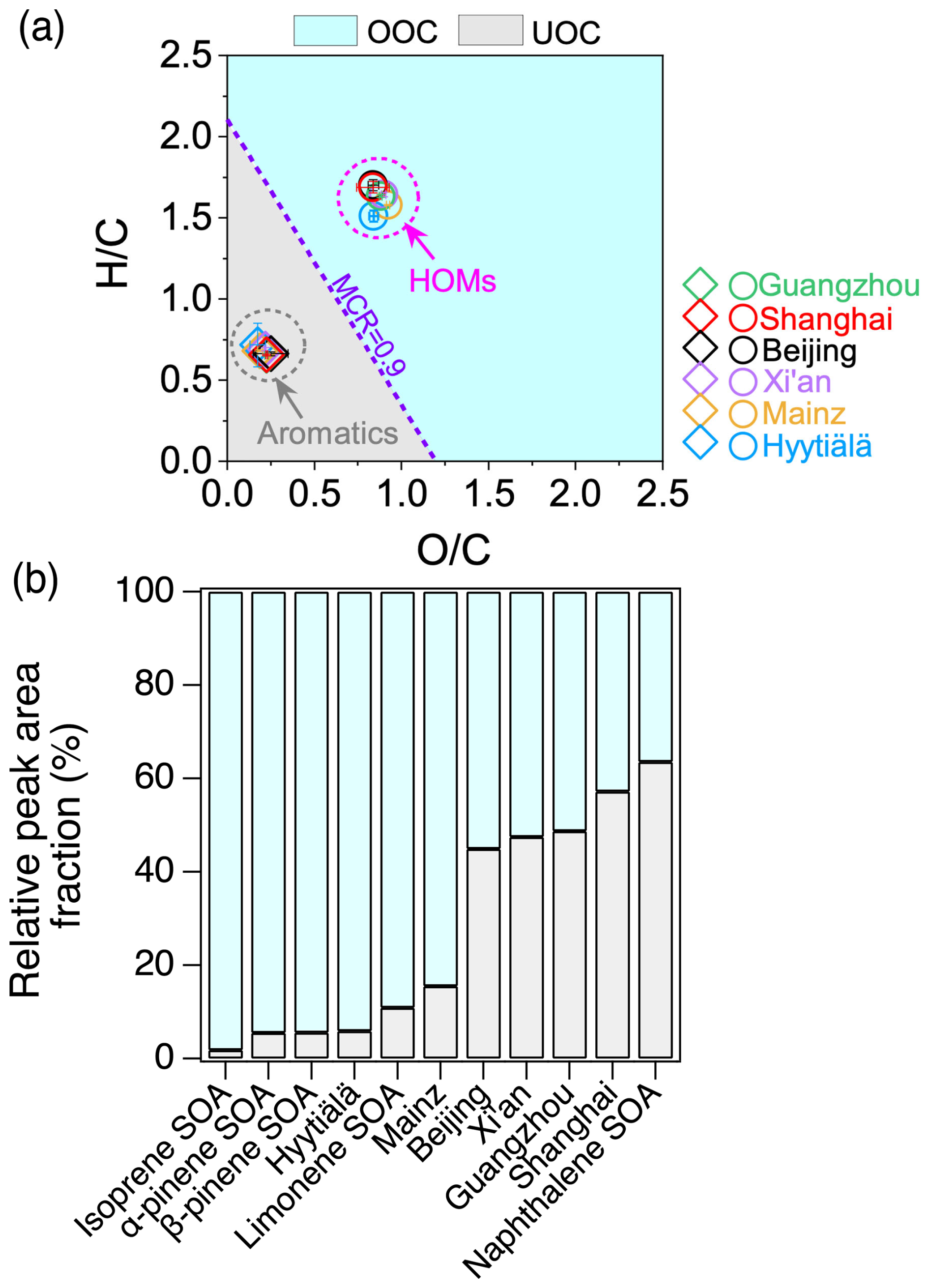
Figure 1(a) MCR-VK diagram to classify organic compounds in atmospheric aerosols. The dashed line represents the boundary (MCR = 0.9) between the oxidized organic compounds (OOC, MCR < 0.9, cyan area) and unsaturated organic compounds (UOC, MCR > 0.9, grey area). Dots and diamonds indicate the positions of highly oxygenated molecules (HOMs) and aromatics identified in ambient fine PM samples. (b) Relative peak area-weighted fractions of OOC and UOC in ambient fine PM samples and laboratory-generated SOA.
Figure 1b summarizes the relative peak-area-weighted fractions of OOC (RFOOC) and UOC (RFUOC) in ambient fine PM and laboratory-generated SOA samples, averaged for each site or experiment. Representative mass spectra and MCR-VK diagrams in ambient fine PM and laboratory-generated SOA samples are shown in Figs. S3 and S4, respectively. Note that because ESI response can vary among compounds, these peak area-weighted fractions should not be interpreted as quantitative measures of the actual abundance or mass fractions of OOC and UOC. Instead, they are used here as relative molecular-composition metrics based on the detected compounds. The resulting relative fractions show distinct differences in OA composition across precursor types and environments (Fig. 1b). Isoprene SOA exhibits the highest RFOOC (98 %), consistent with its dominant formation of highly oxygenated, low-MCR products such as 2-methyltetrols, in which most oxygen atoms are present as hydroxyl groups (Wang et al., 2018b; Surratt et al., 2010; Zhang et al., 2023; Surratt et al., 2006). Similarly, α-pinene and β-pinene SOA are overwhelmingly composed of OOC (95 % and 94 %, respectively), reflecting the prevalence of oxygen-rich ozonolysis products such as pinonic acid, pinic acid, nopinone, and MBTCA (Müller et al., 2012; Zhang et al., 2015; Mutzel et al., 2021; Fan et al., 2020). The fine PM samples collected in the boreal forest at Hyytiälä also exhibit a high RFOOC (94 %), comparable to that observed in monoterpene-derived SOA, reflecting the dominant contribution of biogenic precursors, particularly α- and β-pinene, to SOA formation at this site (Kourtchev et al., 2013; Roldin et al., 2019; Kourtchev et al., 2014; Petäjä et al., 2022).
In contrast, naphthalene SOA is characterized by a substantially higher RFUOC (64 %), indicating a strong contribution from aromatic, ring-retaining oxidation products. This observation is consistent with previous studies showing that naphthalene photooxidation under conditions of low nitrogen oxides (NOx) predominantly yields aromatic quinones and ring-opening products while largely retaining at least one benzene ring (Kautzman et al., 2010; Lannuque and Sartelet, 2024). Urban fine PM samples display a wide range of RFUOC (15 %–57 %), reflecting the diversity of emission sources and atmospheric processing pathways in urban environments. Samples from Chinese megacities of Beijing, Xi'an, Guangzhou, and Shanghai exhibit particularly high RFUOC (45 %–57 %), indicating a substantial contribution from aromatic and combustion-related organics. This result agrees with our previous findings that mono- and polyaromatic compounds constitute a major fraction of OA in Chinese megacities (Wang et al., 2021). In contrast, fine PM samples from Mainz show substantially lower RFUOC (15 %), suggesting a weaker contribution of aromatic emissions and a relatively greater biogenic influence compared with Chinese megacities, which is consistent with our previous study showing fewer compounds with high degree of unsaturation observed in Mainz OA compared to Beijing OA (Wang et al., 2018a).
To assess whether the MCR-VK-based classification reflects intrinsic molecular functionality, we further examined its relationships with complementary molecular indicators derived from the UHRMS data. Aromatic compounds and HOMs were identified from the assigned molecular formulas using established UHRMS-based criteria (Tong et al., 2019; Yassine et al., 2014). As shown in Fig. 1a, the aromatics of ambient fine PM samples from all sampling sites cluster within the UOC region in the MCR-VK diagram based on their average and values, whereas HOMs consistently fall within the OOC region, reflecting their distinct degrees of unsaturation and oxygenation. Importantly, the MCR-VK-based classification shows strong quantitative agreements with these complementary molecular indicators. Across all samples, the RFOOC correlates well with the relative fraction of HOMs (R2 = 0.75, Fig. 2a), while the RFUOC is strongly correlated with the relative fraction of aromatics (R2 = 0.88, Fig. 2b). These strong correlations arise from clear environmental contrasts, whereby biogenic-influenced sites show high fractions of HOMs and low aromatic contributions, while urban megacities exhibit the reverse trend. Moreover, the ratio of OOC to UOC fractions (RFOOC RFUOC) correlates well with the ratio of HOMs to aromatic fractions (R2 = 0.92, Fig. 2c), further demonstrating that the framework captures the balance between unsaturated, aromatic moieties and oxygen-rich, multifunctional compounds. Collectively, these results indicate that the MCR-VK-based classification reflects underlying molecular functionality. Importantly, unlike HOM or aromatics identification, which requires specific compositional criteria and captures only a subset of organic compounds, the OOC UOC classification encompasses the entire detected OA composition and therefore provides a more comprehensive representation of molecular functionality relevant to ROS formation.
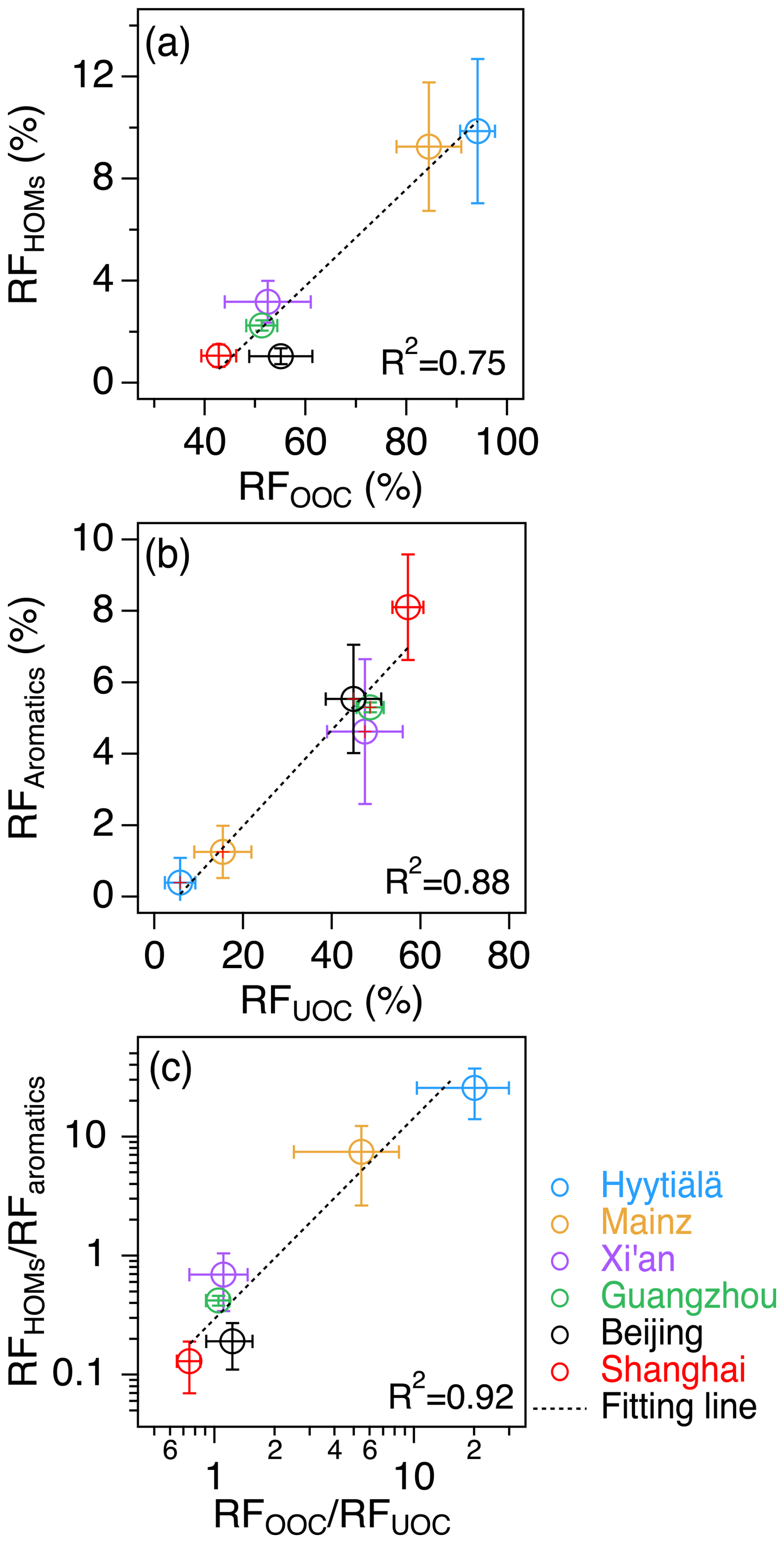
Figure 2(a) Correlation between relative peak area-weighted fractions of OOC (RFOOC) and HOMs (RFHOMs); (b) correlation between relative peak area-weighted fractions of UOC (RFUOC) and aromatics (RFaromatics); (c) correlation between the ratio of OOC to UOC fractions (RFOOC RFUOC) and the ratio of HOMs to aromatic fractions (RFHOMs RFaromatics). The dots and error bars represent the mean values and standard deviations, respectively. The regression models, p values, and 95 % confidence intervals for the correlations are provided in Table S3.
3.2 ROS yields and formation potential of ambient fine PM and laboratory-generated SOA
Figure 3a compares the volume-normalized ROS yields (H2O2 + radicals) together with fine PM mass concentrations across all ambient sites. Substantial site-to-site variability is observed, reflecting differences in both aerosol loadings and atmospheric environments. Urban megacities such as Beijing, Guangzhou, Shanghai, and Xi'an exhibit substantially higher volume-normalized ROS yields (57.8–260.5 pmol m−3) than the boreal forest site at Hyytiälä (13.0 pmol m−3) and the semi-urban site in Mainz (49.9 pmol m−3). This spatial pattern exhibits a similar trend with the corresponding fine PM mass concentrations (Fig. 3a), indicating that environments with higher particle loadings contain greater amounts of ROS-generating substances per unit air volume (Gali et al., 2020; Lakey et al., 2016). Across all sites, H2O2 dominates the ROS budget, accounting for approximately 78 %–97 % of total ROS. For example, H2O2 yields reach 253.7 pmol m−3 in Beijing and 148.0 pmol m−3 in Guangzhou, whereas radical yields remain comparatively low (≤ 10.6 pmol m−3). A similar dominance of H2O2 is observed at Hyytiälä and Mainz, despite their much lower ROS yields. We further examined the relationship between volume-normalized ROS and fine PM mass concentration. Strong positive correlations are observed between fine PM mass and volume-normalized total ROS, H2O2, and radical yields (Fig. S5). These correlations indicate that on an air-volume basis, ambient ROS exposure is largely governed by particle loading.
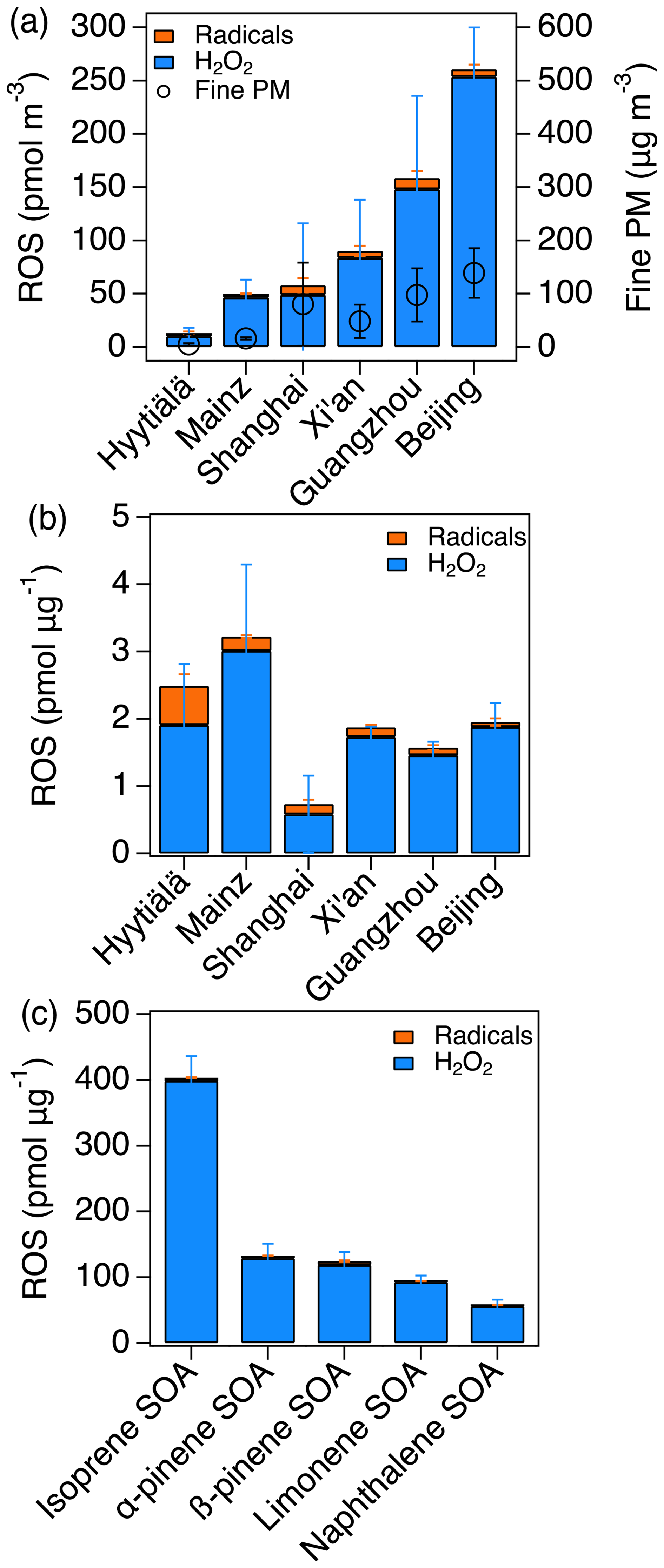
Figure 3(a) The volume-normalized ROS yields (bars, H2O2 + radicals) and fine PM mass concentrations (dots) in ambient fine PM; (b) the mass-normalized ROS yields (H2O2 + radicals) in ambient fine PM; (c) the mass-normalized ROS yields (H2O2 + radicals) in laboratory-generated SOA. The error bars represent the standard deviations.
However, volume-normalized metrics alone do not capture intrinsic differences in the ROS formation potential of particles themselves. Figure 3b shows the mass-normalized ROS yields across all ambient sites, expressed as pmol of ROS per microgram of fine PM. The individual H2O2, radical, and total ROS measurements underlying these site-averaged values are provided in Table S4. In contrast to the volume-normalized results, mass-normalized ROS yields show markedly different trends across sites and no longer scale with fine PM mass concentrations. For total ROS, the mass-normalized yields range from 0.73 pmol µg−1 in Shanghai to 3.32 pmol µg−1 in Mainz, with the boreal forest site at Hyytiälä also exhibiting relatively high values (2.49 pmol µg−1) despite its low fine PM mass concentration. This divergence clearly indicates that intrinsic particle composition, rather than particle mass, governs ROS formation on a per-mass basis. This observation further supports previous studies showing that intrinsic particle oxidative activity is more strongly governed by chemical composition than by PM mass concentration alone (Salana et al., 2024; Daellenbach et al., 2020). Across all sites, mass-normalized H2O2 yields dominate total ROS and exhibit a similar spatial pattern to total ROS, reflecting the widespread formation of relatively stable peroxide species in ambient fine PM. In contrast, radical yields exhibit a distinctly different behavior. Radical yields are the highest at the biogenic site Hyytiälä (0.58 pmol µg−1) and remain elevated in Mainz (0.21 pmol µg−1) but are substantially lower in some megacities such as Beijing (0.07 pmol µg−1) and Guangzhou (0.11 pmol µg−1). These differences point to pronounced variability in the chemical nature of fine PM across environments. The contrasting behaviors of H2O2 and radicals are further illustrated by their relative contributions to total ROS (Fig. S6). At Hyytiälä, radicals account for nearly one-quarter of total ROS (23 %), consistent with a greater contribution of reactive, short-lived ROS species in biogenic aerosols. In most urban environments, radical contributions are considerably smaller, typically around 7 %, and drop to as low as 3 % in Beijing. Notably, Shanghai exhibits a relatively high radical fraction (20 %) despite having the lowest total ROS yield, highlighting that radical contributions are not simply controlled by total ROS production but instead reflect distinct compositional features of the aerosol.
Correlation analysis further supports the interpretation that particle chemistry, rather than particle loading, governs intrinsic ROS formation potential. While volume-normalized ROS, H2O2, and radical yields all show strong positive correlations with fine PM mass concentration, no significant correlations are observed between fine PM mass concentration and mass-normalized total ROS or H2O2 yields (Fig. S7a and b). In contrast, radical yields display a significant negative correlation with fine PM mass concentration (R2 = 0.90, Fig. S7c). This inverse relationship indicates that although polluted environments generate higher total radical concentrations per unit air volume, individual particles in these environments are intrinsically less efficient at producing radicals. Conversely, particles in clean or biogenic environments, despite contributing less to the total atmospheric radical burden, exhibit a substantially higher radical yield on a per-mass basis. Interestingly, a similar negative relationship is observed between fine PM mass concentration and the RFOOC RFUOC derived from the MCR-VK classification (R2 = 0.87, Fig. S7d). Urban megacities with high fine PM mass concentrations tend to exhibit lower RFOOC RFUOC values, consistent with a greater contribution from unsaturated, aromatic-rich organic aerosols. In contrast, biogenic-influenced sites characterized by lower fine PM mass show higher RFOOC RFUOC values, reflecting a dominance of highly oxygenated, multifunctional organic species (Huang et al., 2024; Roldin et al., 2019). The parallel trends observed for radical yields and RFOOC RFUOC suggest that environments favoring oxygen-rich OA composition also enhance the intrinsic capacity of particles to generate reactive radical species.
Laboratory-generated SOA provides additional context for interpreting these ambient patterns. Mass-normalized ROS yields of SOA derived from different precursors (Fig. 3c) span a wide range, with isoprene SOA exhibiting exceptionally high ROS yields (403 pmol µg−1), followed by α-pinene and β-pinene SOA (125–133 pmol µg−1), and substantially lower yields for limonene SOA (94 pmol µg−1) and naphthalene SOA (58 pmol µg−1). Although ROS yields of laboratory-generated SOA exceed those of ambient fine PM, the relative ordering among precursors provides a mechanistic framework for understanding ambient observations. Specifically, aerosols enriched in highly oxygenated, biogenic SOA components are expected to exhibit greater aqueous ROS-forming potential, whereas aerosols dominated by aromatic, less oxygenated organics are comparatively less efficient at generating ROS on a mass basis (Tong et al., 2018). This interpretation is consistent with the elevated mass-normalized ROS yields observed at Hyytiälä and the lower yields in megacities such as Shanghai and Beijing, despite the much higher aerosol mass loading in the latter. However, ROS-forming potential can depend on experimental conditions, including the extraction medium, pH, and assay endpoint. For example, Tong et al. (2018) reported medium-dependent ROS yields for naphthalene SOA in water and surrogate lung fluid, while Li et al. (2022) showed that pH strongly affected the peroxide content and oxidative potential of biomass-burning HULIS. Previous studies have also reported higher oxidative potential for anthropogenic aerosols, such as naphthalene SOA, than for biogenic SOA based on the dithiothreitol (DTT) assay (Tuet et al., 2017; Bates et al., 2019). This discrepancy likely arises because the DTT assay quantifies electron-transfer capacity and is sensitive to redox-active species such as quinones, whereas the present study measures hydrogen peroxide and radical formation in aqueous extracts, reflecting product-based ROS formation pathways.
Overall, these results indicate that fine PM mass largely controls the total atmospheric ROS burden, whereas particle-level ROS formation potential is governed by OA composition. This contrast highlights the need for a molecularly resolved metric to link aqueous ROS-forming potential with OA chemistry.
3.3 Associations of RFOOC RFUOC with ROS yields in ambient fine PM and laboratory-generated SOA
To elucidate how molecular-level OA composition governs particle-level ROS formation, we examined the relationships between particle mass-normalized ROS yields (total ROS, H2O2, and radicals) and the RFOOC RFUOC derived from the MCR-VK framework for both ambient fine PM and laboratory-generated SOA (Fig. 4).
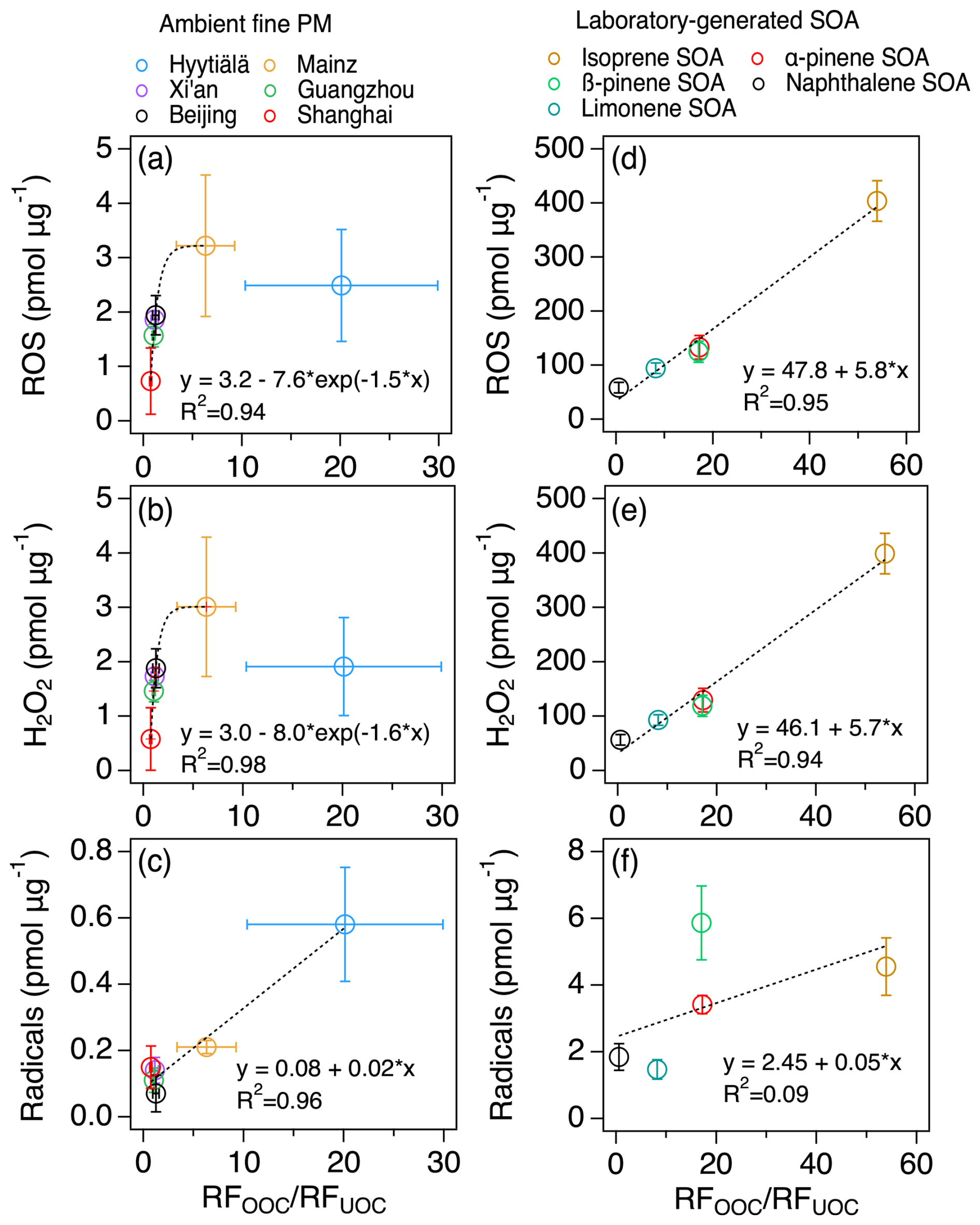
Figure 4Correlations of mass-specific ROS yields (a, d), H2O2 yields (b, e), and radical yields (c, f) with RFOOC RFUOC in ambient fine PM samples (a–c) and laboratory-generated SOA samples (d–f). The dots and error bars represent the mean values and standard deviations, respectively. The regression models, p values, and 95 % confidence intervals for the correlations are provided in Table S4.
For ambient urban fine PM samples (Mainz, Beijing, Xi'an, Guangzhou, and Shanghai), a strong positive exponential relationship (R2 = 0.94, Fig. 4a) is observed between total ROS yields and RFOOC RFUOC. Specifically, ROS yields increase rapidly with increasing RFOOC RFUOC at low to moderate values, followed by a gradual saturation at higher RFOOC RFUOC. This behavior suggests that ROS formation may initially be limited by the availability of oxygenated organic functionalities and become progressively constrained by competing chemical pathways and interactions as oxidation increases. This saturation behavior may reflect the chemically complex nature of urban fine PM, in which diverse OA constituents, including unsaturated species, aromatics, and redox-active components, interact to regulate ROS generation efficiency. Further studies are needed to better understand the mechanisms underlying this nonlinear relationship. It should also be noted that OOC covers a chemically diverse range of compounds, which may differ in their ROS-forming activity. Because these yields are normalized to particle mass, the observed relationship directly reflects differences in chemical composition rather than particle loading. The consistency of this relationship across multiple cities with diverse emission profiles suggests that RFOOC RFUOC captures a fundamental compositional control on ROS generation that is robust across urban environments.
Given the dominance of H2O2 in the total ROS of ambient urban fine PM (80 %–97 %; Fig. S6), its dependence on OA composition closely follows that of total ROS. Accordingly, H2O2 yields exhibit a similarly strong positive relationship with RFOOC RFUOC (R2 = 0.98, Fig. 4b), reinforcing that oxygenated organic enrichment strongly promotes aqueous ROS formation. Increases in OOC content therefore lead to higher mass-normalized ROS and H2O2 production. This behavior is consistent with previous studies showing that hydroperoxides, organic peroxides, and peroxy acids, functional groups commonly associated with OOC, can decompose or hydrolyze in aqueous environments to produce H2O2 (Wang et al., 2011; Tong et al., 2018; Hasson et al., 2001; Venkatachari and Hopke, 2008; Li et al., 2025). Liu et al. (2023) reported that the more oxidized oxygenated organic aerosols were associated with cellular ROS production, with highly unsaturated species containing carbon–oxygen double bonds and aromatic rings in OOA identified as important contributors. While oxidized organic species are found to play an important role in both studies, the present study links higher RFOOC RFUOC to enhanced ROS formation. This difference likely reflects the different oxidative endpoints investigated. The previous study evaluated intracellular ROS responses, whereas the present study quantifies the intrinsic formation of hydrogen peroxide and radicals in aqueous extracts.
An important deviation from the urban trend is observed for the boreal forest site at Hyytiälä. Although Hyytiälä fine PM exhibits a higher RFOOC RFUOC ratio than urban samples, its H2O2 and total ROS yields fall below the exponential relationship established for urban aerosols (Fig. 4a and b). This behavior indicates that the empirical relationship derived for urban fine PM cannot be directly extrapolated to biogenic-dominated environments. The discrepancy likely reflects fundamental differences in aerosol composition and ROS-forming pathways. Urban fine PM typically contains higher abundances of quinones (classified as UOC), which can substantially enhance H2O2 formation(Chung et al., 2006). In contrast, remote forest aerosols contain much lower abundances of metals and aromatic quinones, suggesting that ROS generation at Hyytiälä is dominated by biogenic SOA components.
Radical yields show a markedly different response to OA composition compared with H2O2. For ambient fine PM, radical yields exhibit a positive linear relationship with RFOOC RFUOC when the biogenic site is included (Fig. 4c). This trend is largely driven by the elevated radical yields observed at Hyytiälä, where exceptionally high RFOOC RFUOC coincides with a high relative fraction of HOMs (Fig. 2). This behavior is consistent with our previous findings showing that HOMs, which are preferentially classified as OOC, can play an important role in aqueous radical formation (Tong et al., 2019). The enhanced radical yield at Hyytiälä likely reflects its HOM-rich OA composition. Among the urban sites, however, radical yields exhibit relatively limited variation despite differences in RFOOC RFUOC, which could be due to additional influence by other aerosol constituents beyond the bulk balance between OOC and UOC. Therefore, RFOOC RFUOC may be more useful in predicting radical formation when comparing aerosols spanning contrasting source regimes (e.g., biogenic versus urban).
Laboratory-generated SOA further supports the compositional control inferred from the ambient observations. Across SOA formed from isoprene, α-pinene, β-pinene, limonene, and naphthalene, total ROS yields increase with the increase of RFOOC RFUOC and follow a strong positive linear relationship (Fig. 4d, R2 = 0.95). A similar dependence is observed for H2O2 yields (Fig. 4e, R2 = 0.94), consistent with the dominant contribution of H2O2 to total ROS in these systems. Unlike ambient urban PM, no saturation behavior is observed over the investigated compositional range, indicating that ROS formation in laboratory SOA remains composition-limited, with increasing oxygenation directly translating into greater aqueous ROS-forming potential under the present assay conditions. The absence of non-linear behavior further suggests minimal interference from competing redox-active components for SOA formed under control conditions.
In contrast, no clear relationship is found between radical yields and either RFOOC RFUOC for laboratory-generated SOA (Fig. 4f). This further suggests that radical formation depends more strongly on the abundance of specific radical-producing molecular species than on the overall balance between OOC and UOC. For example, semiquinone-type functionalities in naphthalene SOA can generate radicals through redox cycling pathways (Tong et al., 2019), leading to deviations from the overall composition–reactivity trends.
Since the MCR = 0.9 boundary was developed primarily for CHO compounds, we further performed a sensitivity analysis using only CHO formulas to assess whether the relationships described above were affected by its application to CHON, CHOS, and CHONS formulas (Fig. S8). For the five ambient fine PM samples (Mainz, Beijing, Xi'an, Guangzhou, and Shanghai), the CHO-only RFOOC RFUOC ratio showed positive exponential relationships with total ROS (R2 = 0.87; Fig. S8a) and H2O2 yields (R2 = 0.86; Fig. S8b). When Hyytiälä was included, a positive linear relationship with radical yield was also observed (R2 = 0.96; Fig. S8c). These relationships were consistent with those obtained using all molecular-formula classes (R2 = 0.94, 0.98, and 0.96, respectively), although the associations with total ROS and H2O2 were somewhat weaker. Thus, the observed composition–ROS relationships do not depend solely on the inclusion of heteroatom-containing formulas in the MCR classification. However, this sensitivity analysis does not independently validate the MCR = 0.9 boundary for CHON, CHOS, or CHONS compounds.
In this work, by applying the MCR-VK framework to a diverse range of ambient and laboratory aerosols, we show that the aqueous ROS-forming potential of fine PM is governed not by particle mass, but by the balance between two functionally distinct classes of organic compounds: OOC and UOC. The relative fraction of OOC compared with UOC is a key determinant of the ROS formation potential of fine PM. Particles enriched in OOC exhibit significantly higher mass-normalized ROS yields, particularly for H2O2, indicating that the molecular composition of OA, rather than particle mass, governs aqueous ROS production.
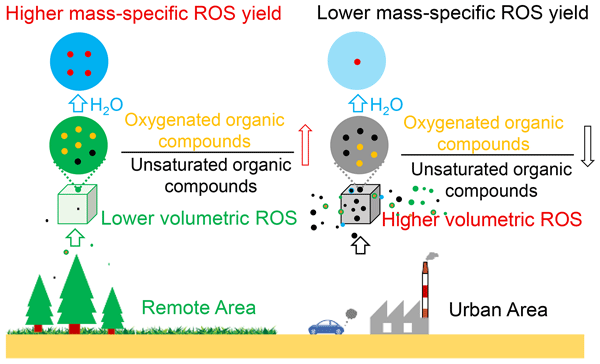
As illustrated in Fig. 5, this compositional control leads to a clear contrast between urban and remote environments. In polluted urban areas, high PM mass concentrations result in elevated volume-normalized ROS, driving greater overall exposure to ROS. However, the aerosols themselves are less efficient at generating ROS per unit mass due to a relatively smaller contribution from OOC and a larger contribution from UOC. By contrast, in remote (e.g., forest) areas, lower particle loadings produce lower volumetric ROS, yet individual particles are intrinsically more reactive. This enhanced per-mass ROS formation is driven by the dominance of OOC (e.g., HOMs), leading to higher RFOOC RFUOC ratios. These results highlight that both particle mass and particle composition independently shape ROS formation, and both must be jointly considered when evaluating ROS-related health risks of ambient fine PM (Zheng et al., 2025; Salana et al., 2024).
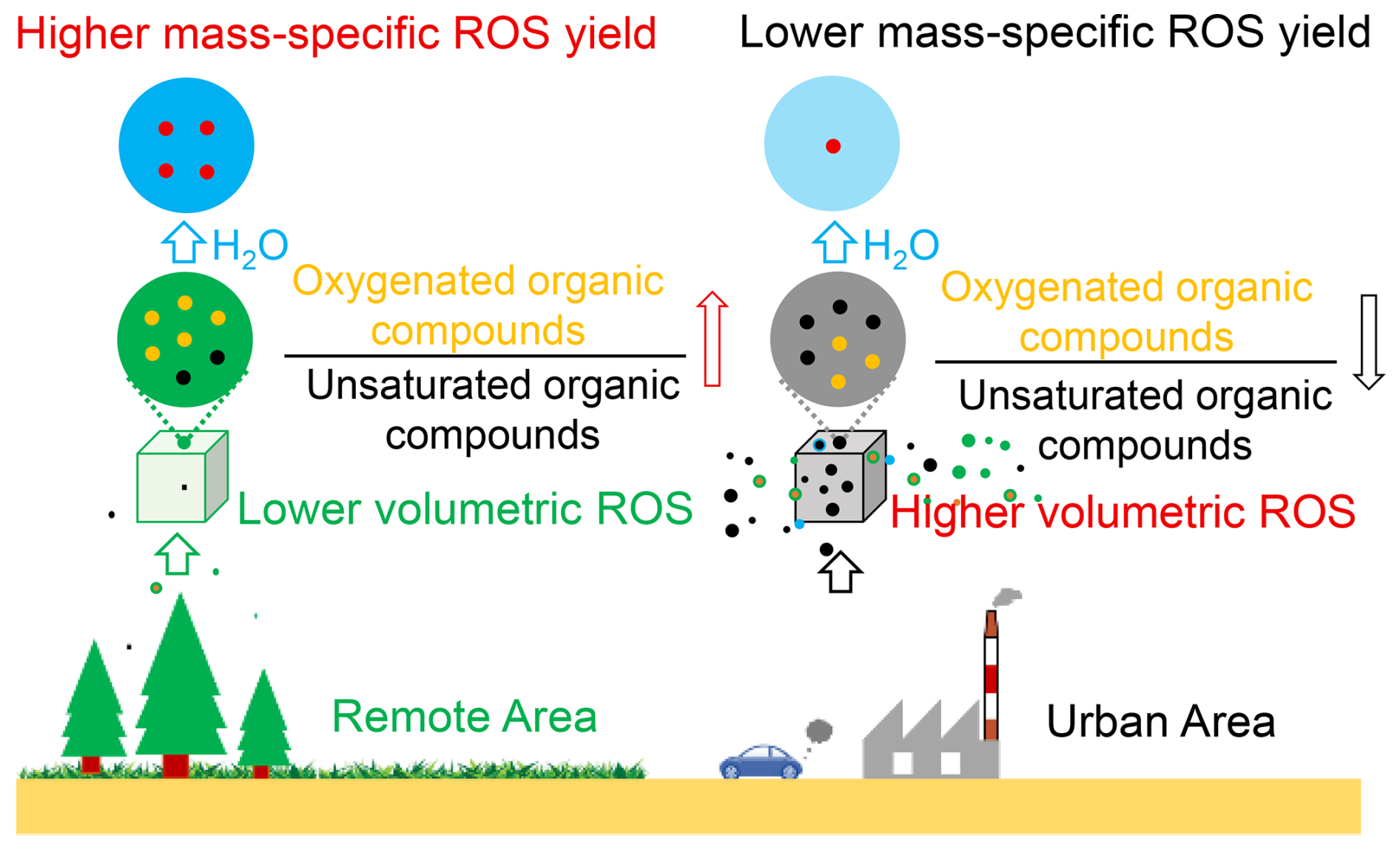
Figure 5Schematic illustration of the relationships of volumetric ROS, the balance between oxidized and unsaturated organic compounds, and mass-normalized ROS yield of fine PM from remote and urban areas.
The strong, consistent correlations between RFOOC RFUOC and mass-normalized ROS yields observed across urban megacities establish this ratio as a simple yet robust predictor for ROS formation potential of OA. Unlike previous studies that focused on specific ROS-active compound classes such as HOMs, organic peroxides, or quinones (Tong et al., 2019; Verma et al., 2015), the MCR-VK framework provides a generalized molecular-level descriptor that can be derived directly from UHRMS data without requiring targeted compound identification. This feature highlights the potential of the framework for application to chemically diverse atmospheric aerosols and offers a scalable approach for assessing aerosol oxidative activity. Within this framework, lower RFOOC RFUOC corresponds to reduced mass-normalized ROS yields, while higher RFOOC RFUOC likely indicates intrinsically more ROS-active aerosols. As a result, regional differences in precursor sources and atmospheric processing exert direct control over aerosol oxidative activity, providing a mechanistic explanation for the pronounced spatial variability in ROS formation. Laboratory-generated SOA provides further support for these conclusions. SOA formed from biogenic precursors such as isoprene and α-/β-pinene, characterized by high RFOOC RFUOC, exhibits the highest ROS formation efficiency, whereas SOA formed from naphthalene produces lower ROS yield per mass. Collectively, these ambient and laboratory results demonstrate that molecular composition, particularly the balance between OOC and UOC, provides a mechanistic basis for both the magnitude and spatial variability of ROS formation in atmospheric aerosols.
While this study focuses on the role of organic aerosol molecular composition, transition metals are also recognized contributors to ROS formation in ambient PM through metal-catalyzed redox cycling and Fenton-like reactions, particularly in urban environments (Charrier et al., 2014; Xiong et al., 2017; Tong et al., 2016). Interactions between redox-active metals and OA components, such as quinone- or peroxide-containing species, may further influence ROS formation pathways. However, the current analysis does not quantitatively separate the contributions of OA and inorganic components to the measured ROS formation. In addition, ROS formation was quantified in aqueous extracts of particulate matter in this study, providing a chemically controlled system to evaluate ROS formation potential of aerosols and enabling consistent comparison across samples. However, simulated lung fluids may better represent physiological conditions due to antioxidants and metal-binding ligands, and future studies incorporating simulated lung fluids may refine the translation of ROS formation to more biologically relevant exposure metrics. Nevertheless, the strong and consistent correlations observed between ROS yields and RFOOC RFUOC across diverse environments indicate that OA composition plays a critical role in particle-level ROS formation. Integrating molecularly resolved OA composition with metal speciation in future studies will be important for fully resolving their coupled and potentially synergistic effects (Charrier and Anastasio, 2015; Lin and Yu, 2026).
Overall, the MCR-VK framework offers a predictive, molecular-level approach to link OA composition with ROS formation potential. Future efforts should prioritize long-term, molecularly resolved measurements of OA across diverse environments, coupled with ROS assays, as well as concurrent, comprehensive, and complementary aerosol and aerosol precursor characterization during the sample collection, to capture the combined influence of particle loading, chemical composition, and atmospheric processing. Such integrated approaches will improve identification of the OA components most responsible for oxidative stress, advance understanding of the health risks associated with ambient fine PM, and support the development of more targeted and composition-aware air quality management strategies.
The data sets generated in the current study are available at Zenodo data repository at https://doi.org/10.5281/zenodo.19334829 (Wang, 2026).
Table showing the detailed information for the ambient particle sampling; figures showing the schematic outline of the experimental approach, maximum carbonyl ratio (MCR)-Van Krevelen (VK) diagram, detailed mass spectra and MCR-VK diagram for both ambient and laboratory-generated SOA samples, correlations of volume-normalized/mass-normalized ROS yield, H2O2 yield and radical yield with fine PM mass concentration, contributions of H2O2 and radicals to total ROS yield. The supplement related to this article is available online at https://doi.org/10.5194/acp-26-14655-2026-supplement.
This study was conceived by TH, KW and HT. YZ and KW conducted the sample analysis. SY, HK, TP, MK and PF assisted with the sample and data collections. FL and YZ wrote the original manuscript. All authors contributed to the final interpretation and writing of the manuscript.
At least one of the (co-)authors is a member of the editorial board of Atmospheric Chemistry and Physics. The peer-review process was guided by an independent editor, and the authors also have no other competing interests to declare.
Publisher's note: Copernicus Publications remains neutral with regard to jurisdictional claims made in the text, published maps, institutional affiliations, or any other geographical representation in this paper. The authors bear the ultimate responsibility for providing appropriate place names. Views expressed in the text are those of the authors and do not necessarily reflect the views of the publisher.
We thank Steven Lelieveld and Alexander Filippi for technical support.
This work is supported by the National Natural Science Foundation of China (42475111), Natural Science Basic Research Program of Shaanxi Province (2026TS4JC-YXQN-099), Research Council of Finland flagship Atmosphere and Climate Competence Center (359340) and INAR RI (358647, 367739), the Helmholtz-Zentrum Hereon, and the Deutsche Forschungsgemeinschaft (ZH 511/8-1, HO 1748/23-1, HO 1748/19-1).
This paper was edited by Quanfu He and reviewed by two anonymous referees.
Al-Naiema, I. M., Offenberg, J. H., Madler, C. J., Lewandowski, M., Kettler, J., Fang, T., and Stone, E. A.: Secondary organic aerosols from aromatic hydrocarbons and their contribution to fine particulate matter in Atlanta, Georgia, Atmos. Environ., 223, 117227, https://doi.org/10.1016/j.atmosenv.2019.117227, 2020.
Bates, J. T., Fang, T., Verma, V., Zeng, L., Weber, R. J., Tolbert, P. E., Abrams, J. Y., Sarnat, S. E., Klein, M., and Mulholland, J. A.: Review of acellular assays of ambient particulate matter oxidative potential: methods and relationships with composition, sources, and health effects, Environ. Sci. Technol., 53, 4003–4019, 2019.
Burnett, R., Chen, H., Szyszkowicz, M., Fann, N., Hubbell, B., Pope III, C. A., Apte, J. S., Brauer, M., Cohen, A., and Weichenthal, S.: Global estimates of mortality associated with long-term exposure to outdoor fine particulate matter, P. Natl. Acad. Sci. USA, 115, 9592–9597, 2018.
Campbell, S. J., Utinger, B., Barth, A., Leni, Z., Zhang, Z.-H., Resch, J., Li, K., Steimer, S. S., Banach, C., and Gfeller, B.: Short-lived reactive components substantially contribute to particulate matter oxidative potential, Science Advances, 11, eadp8100, https://doi.org/10.1126/sciadv.adp8100, 2025.
Chan, A. W. H., Kautzman, K. E., Chhabra, P. S., Surratt, J. D., Chan, M. N., Crounse, J. D., Kürten, A., Wennberg, P. O., Flagan, R. C., and Seinfeld, J. H.: Secondary organic aerosol formation from photooxidation of naphthalene and alkylnaphthalenes: implications for oxidation of intermediate volatility organic compounds (IVOCs), Atmos. Chem. Phys., 9, 3049–3060, https://doi.org/10.5194/acp-9-3049-2009, 2009.
Charrier, J. G. and Anastasio, C.: Rates of hydroxyl radical production from transition metals and quinones in a surrogate lung fluid, Environ. Sci. Technol., 49, 9317–9325, 2015.
Charrier, J. G., McFall, A. S., Richards-Henderson, N. K., and Anastasio, C.: Hydrogen peroxide formation in a surrogate lung fluid by transition metals and quinones present in particulate matter, Environ. Sci. Technol., 48, 7010–7017, 2014.
Chung, M. Y., Lazaro, R. A., Lim, D., Jackson, J., Lyon, J., Rendulic, D., and Hasson, A. S.: Aerosol-borne quinones and reactive oxygen species generation by particulate matter extracts, Environ. Sci. Technol., 40, 4880–4886, 2006.
Daellenbach, K. R., Uzu, G., Jiang, J., Cassagnes, L.-E., Leni, Z., Vlachou, A., Stefenelli, G., Canonaco, F., Weber, S., and Segers, A.: Sources of particulate-matter air pollution and its oxidative potential in Europe, Nature, 587, 414–419, 2020.
Fan, Y., Liu, C.-Q., Li, L., Ren, L., Ren, H., Zhang, Z., Li, Q., Wang, S., Hu, W., Deng, J., Wu, L., Zhong, S., Zhao, Y., Pavuluri, C. M., Li, X., Pan, X., Sun, Y., Wang, Z., Kawamura, K., Shi, Z., and Fu, P.: Large contributions of biogenic and anthropogenic sources to fine organic aerosols in Tianjin, North China, Atmos. Chem. Phys., 20, 117–137, https://doi.org/10.5194/acp-20-117-2020, 2020.
Fang, Z., Lai, A., Cai, D., Li, C., Carmieli, R., Chen, J., Wang, X., and Rudich, Y.: Secondary organic aerosol generated from biomass burning emitted phenolic compounds: oxidative potential, reactive oxygen species, and cytotoxicity, Environ. Sci. Technol., 58, 8194–8206, 2024.
Gali, N. K., Stevanovic, S., Brimblecombe, P., Brown, R. A., Ristovski, Z., and Ning, Z.: The diurnal characteristics of PM-bound ROS and its influencing factors at urban ambient and roadside environments, Atmos. Res., 244, 105039, https://doi.org/10.1016/j.atmosres.2020.105039, 2020.
Gurgueira, S. A., Lawrence, J., Coull, B., Murthy, G. K., and González-Flecha, B.: Rapid increases in the steady-state concentration of reactive oxygen species in the lungs and heart after particulate air pollution inhalation, Environ. Health Persp., 110, 749–755, 2002.
Hari, P., Nikinmaa, E., Pohja, T., Siivola, E., Bäck, J., Vesala, T., and Kulmala, M.: Station for measuring ecosystem-atmosphere relations: SMEAR, in: Physical and physiological forest ecology, Springer, 471–487, https://doi.org/10.1007/978-94-007-5603-8_9, 2012.
Hasson, A. S., Orzechowska, G., and Paulson, S. E.: Production of stabilized Criegee intermediates and peroxides in the gas phase ozonolysis of alkenes: 1. Ethene, trans-2-butene, and 2, 3-dimethyl-2-butene, J. Geophys. Res.-Atmos., 106, 34131–34142, 2001.
Hoffmann, T., Huang, R.-J., and Kalberer, M.: Atmospheric analytical chemistry, Anal. Chem., 83, 4649–4664, 2011.
Huang, R.-J., Li, Y. J., Chen, Q., Zhang, Y., Lin, C., Chan, C. K., Yu, J. Z., de Gouw, J., Tong, S., and Jiang, J.: Secondary organic aerosol in urban China: A distinct chemical regime for air pollution studies, Science, 389, eadq2840, https://doi.org/10.1126/science.adq2840, 2025.
Huang, W., Wu, C., Gao, L., Gramlich, Y., Haslett, S. L., Thornton, J., Lopez-Hilfiker, F. D., Lee, B. H., Song, J., Saathoff, H., Shen, X., Ramisetty, R., Tripathi, S. N., Ganguly, D., Jiang, F., Vallon, M., Schobesberger, S., Yli-Juuti, T., and Mohr, C.: Variation in chemical composition and volatility of oxygenated organic aerosol in different rural, urban, and mountain environments, Atmos. Chem. Phys., 24, 2607–2624, https://doi.org/10.5194/acp-24-2607-2024, 2024.
Kautzman, K., Surratt, J., Chan, M., Chan, A., Hersey, S., Chhabra, P., Dalleska, N., Wennberg, P., Flagan, R., and Seinfeld, J.: Chemical composition of gas-and aerosol-phase products from the photooxidation of naphthalene, J. Phys. Chem. A, 114, 913–934, 2010.
Khachatryan, L., Vejerano, E., Lomnicki, S., and Dellinger, B.: Environmentally persistent free radicals (EPFRs). 1. Generation of reactive oxygen species in aqueous solutions, Environ. Sci. Technol., 45, 8559–8566, 2011.
Koch, B. P. and Dittmar, T.: From mass to structure: An aromaticity index for high-resolution mass data of natural organic matter, Rapid Commun. Mass Sp., 20, 926–932, 2006.
Kourtchev, I., Fuller, S., Aalto, J., Ruuskanen, T. M., McLeod, M. W., Maenhaut, W., Jones, R., Kulmala, M., and Kalberer, M.: Molecular composition of boreal forest aerosol from Hyytiala, Finland, using ultrahigh resolution mass spectrometry, Environ. Sci. Technol., 47, 4069–4079, 2013.
Kourtchev, I., Fuller, S. J., Giorio, C., Healy, R. M., Wilson, E., O'Connor, I., Wenger, J. C., McLeod, M., Aalto, J., Ruuskanen, T. M., Maenhaut, W., Jones, R., Venables, D. S., Sodeau, J. R., Kulmala, M., and Kalberer, M.: Molecular composition of biogenic secondary organic aerosols using ultrahigh-resolution mass spectrometry: comparing laboratory and field studies, Atmos. Chem. Phys., 14, 2155–2167, https://doi.org/10.5194/acp-14-2155-2014, 2014.
Lakey, P. S., Berkemeier, T., Tong, H., Arangio, A. M., Lucas, K., Pöschl, U., and Shiraiwa, M.: Chemical exposure-response relationship between air pollutants and reactive oxygen species in the human respiratory tract, Scientific Reports, 6, 32916, https://doi.org/10.1038/srep32916, 2016.
Lannuque, V. and Sartelet, K.: Development of a detailed gaseous oxidation scheme of naphthalene for secondary organic aerosol (SOA) formation and speciation, Atmos. Chem. Phys., 24, 8589–8606, https://doi.org/10.5194/acp-24-8589-2024, 2024.
Lelieveld, J., Evans, J. S., Fnais, M., Giannadaki, D., and Pozzer, A.: The contribution of outdoor air pollution sources to premature mortality on a global scale, Nature, 525, 367–371, 2015.
Li, C., Fang, Z., Czech, H., Schneider, E., Rüger, C. P., Pardo, M., Zimmermann, R., Chen, J., Laskin, A., and Rudich, Y.: pH modifies the oxidative potential and peroxide content of biomass burning HULIS under dark aging, Sci. Total Environ., 834, 155365, https://doi.org/10.1016/j.scitotenv.2022.155365, 2022.
Li, K., Zheng, Z., Resch, J., Ma, J., Hansel, A., and Kalberer, M.: Molecular Composition of Organic Peroxides in Secondary Organic Aerosols Revealed by Peroxide-Iodide Reactivity, Environ. Sci. Technol., 59, 17126–17136, 2025.
Li, N., Xia, T., and Nel, A. E.: The role of oxidative stress in ambient particulate matter-induced lung diseases and its implications in the toxicity of engineered nanoparticles, Free Radical Bio. Med., 44, 1689–1699, 2008.
Lin, M. and Yu, J. Z.: Assessment of interactions between transition metals and atmospheric organics: Ascorbic acid depletion and hydroxyl radical formation in organic-metal mixtures, Environ. Sci. Technol., 54, 1431–1442, 2020.
Lin, M. and Yu, J. Z.: Oxidative Potential of Atmospheric Particulate Matter: A Review of the Role of Metal–Organic Interactions, Mechanistic Insights, and Key Determinants, Environ. Sci. Technol., 60, 1546–1559, https://doi.org/10.1021/acs.est.5c08535, 2026.
Liu, F., Xu, T., Ng, N. L., and Lu, H.: Linking cell health and reactive oxygen species from secondary organic aerosols exposure, Environ. Sci. Technol., 57, 1039–1048, 2022.
Liu, F., Saavedra, M. G., Champion, J. A., Griendling, K. K., and Ng, N. L.: Prominent contribution of hydrogen peroxide to intracellular reactive oxygen species generated upon exposure to naphthalene secondary organic aerosols, Environ. Sci. Tech. Let., 7, 171–177, 2020.
Liu, F., Joo, T., Ditto, J. C., Saavedra, M. G., Takeuchi, M., Boris, A. J., Yang, Y., Weber, R. J., Dillner, A. M., and Gentner, D. R.: Oxidized and unsaturated: Key organic aerosol traits associated with cellular reactive oxygen species production in the southeastern United States, Environ. Sci. Technol., 57, 14150–14161, 2023.
Liu, J., Liu, R., Ma, C., Feng, S., Yang, N., Wu, L., Deng, J., Hu, W., Xu, W., and Sun, Y.: Water-Soluble Nitrogen-Containing Organic Compounds in Biomass-Combustion-Derived PM2.5 Characterized by FT-ICR MS with Multiple Ionization Sources, Environ. Sci. Tech. Let., 12, 804–812, https://doi.org/10.1021/acs.estlett.5c00484, 2025.
Mitchell, D. G., Rosen, G. M., Tseitlin, M., Symmes, B., Eaton, S. S., and Eaton, G. R.: Use of rapid-scan EPR to improve detection sensitivity for spin-trapped radicals, Biophys. J., 105, 338–342, 2013.
Müller, L., Reinnig, M.-C., Naumann, K. H., Saathoff, H., Mentel, T. F., Donahue, N. M., and Hoffmann, T.: Formation of 3-methyl-1,2,3-butanetricarboxylic acid via gas phase oxidation of pinonic acid – a mass spectrometric study of SOA aging, Atmos. Chem. Phys., 12, 1483–1496, https://doi.org/10.5194/acp-12-1483-2012, 2012.
Mutzel, A., Zhang, Y., Böge, O., Rodigast, M., Kolodziejczyk, A., Wang, X., and Herrmann, H.: Importance of secondary organic aerosol formation of α-pinene, limonene, and m-cresol comparing day- and nighttime radical chemistry, Atmos. Chem. Phys., 21, 8479–8498, https://doi.org/10.5194/acp-21-8479-2021, 2021.
Mutzel, A., Poulain, L., Berndt, T., Iinuma, Y., Rodigast, M., Böge, O., Richters, S., Spindler, G., Sipilä, M., and Jokinen, T.: Highly oxidized multifunctional organic compounds observed in tropospheric particles: A field and laboratory study, Environ. Sci. Technol., 49, 7754-7761, 2015.
Ng, N. L., Canagaratna, M. R., Jimenez, J. L., Chhabra, P. S., Seinfeld, J. H., and Worsnop, D. R.: Changes in organic aerosol composition with aging inferred from aerosol mass spectra, Atmos. Chem. Phys., 11, 6465–6474, https://doi.org/10.5194/acp-11-6465-2011, 2011.
Nguyen, T. B., Coggon, M. M., Bates, K. H., Zhang, X., Schwantes, R. H., Schilling, K. A., Loza, C. L., Flagan, R. C., Wennberg, P. O., and Seinfeld, J. H.: Organic aerosol formation from the reactive uptake of isoprene epoxydiols (IEPOX) onto non-acidified inorganic seeds, Atmos. Chem. Phys., 14, 3497–3510, https://doi.org/10.5194/acp-14-3497-2014, 2014.
Noziere, B., Kalberer, M., Claeys, M., Allan, J., D'Anna, B., Decesari, S., Finessi, E., Glasius, M., Grgic, I., and Hamilton, J. F.: The molecular identification of organic compounds in the atmosphere: state of the art and challenges, Chem. Rev., 115, 3919–3983, 2015.
Petäjä, T., Tabakova, K., Manninen, A., Ezhova, E., O'Connor, E., Moisseev, D., Sinclair, V., Backman, J., Levula, J., and Luoma, K.: Influence of biogenic emissions from boreal forests on aerosol–cloud interactions, Nat. Geosci., 15, 42–47, 2022.
Pöschl, U. and Shiraiwa, M.: Multiphase chemistry at the atmosphere–biosphere interface influencing climate and public health in the anthropocene, Chem. Rev., 115, 4440–4475, 2015.
Roldin, P., Ehn, M., Kurtén, T., Olenius, T., Rissanen, M. P., Sarnela, N., Elm, J., Rantala, P., Hao, L., and Hyttinen, N.: The role of highly oxygenated organic molecules in the Boreal aerosol-cloud-climate system, Nat. Commun., 10, 4370, https://doi.org/10.1038/s41467-019-12338-8, 2019.
Salana, S., Yu, H., Dai, Z., Subramanian, P. G., Puthussery, J. V., Wang, Y., Singh, A., Pope, F. D., Leiva G, M. A., and Rastogi, N.: Inter-continental variability in the relationship of oxidative potential and cytotoxicity with PM2.5 mass, Nat. Commun., 15, 5263, https://doi.org/10.1038/s41467-024-49649-4, 2024.
Shiraiwa, M., Ueda, K., Pozzer, A., Lammel, G., Kampf, C. J., Fushimi, A., Enami, S., Arangio, A. M., Fröhlich-Nowoisky, J., and Fujitani, Y.: Aerosol health effects from molecular to global scales, Environ. Sci. Technol., 51, 13545–13567, 2017.
Srivastava, D., Vu, T. V., Tong, S., Shi, Z., and Harrison, R. M.: Formation of secondary organic aerosols from anthropogenic precursors in laboratory studies, npj Climate and Atmospheric Science, 5, 22, https://doi.org/10.1038/s41612-022-00238-6, 2022.
Steimer, S. S., Patton, D. J., Vu, T. V., Panagi, M., Monks, P. S., Harrison, R. M., Fleming, Z. L., Shi, Z., and Kalberer, M.: Differences in the composition of organic aerosols between winter and summer in Beijing: a study by direct-infusion ultrahigh-resolution mass spectrometry, Atmos. Chem. Phys., 20, 13303–13318, https://doi.org/10.5194/acp-20-13303-2020, 2020.
Surratt, J. D., Chan, A. W., Eddingsaas, N. C., Chan, M., Loza, C. L., Kwan, A. J., Hersey, S. P., Flagan, R. C., Wennberg, P. O., and Seinfeld, J. H.: Reactive intermediates revealed in secondary organic aerosol formation from isoprene, P. Natl. Acad. Sci. USA, 107, 6640–6645, 2010.
Surratt, J. D., Murphy, S. M., Kroll, J. H., Ng, N. L., Hildebrandt, L., Sorooshian, A., Szmigielski, R., Vermeylen, R., Maenhaut, W., and Claeys, M.: Chemical composition of secondary organic aerosol formed from the photooxidation of isoprene, J. Phys. Chem. A, 110, 9665–9690, 2006.
Tong, H., Arangio, A. M., Lakey, P. S. J., Berkemeier, T., Liu, F., Kampf, C. J., Brune, W. H., Pöschl, U., and Shiraiwa, M.: Hydroxyl radicals from secondary organic aerosol decomposition in water, Atmos. Chem. Phys., 16, 1761–1771, https://doi.org/10.5194/acp-16-1761-2016, 2016.
Tong, H., Lakey, P. S., Arangio, A. M., Socorro, J., Shen, F., Lucas, K., Brune, W. H., Pöschl, U., and Shiraiwa, M.: Reactive oxygen species formed by secondary organic aerosols in water and surrogate lung fluid, Environ. Sci. Technol., 52, 11642–11651, 2018.
Tong, H., Liu, F., Filippi, A., Wilson, J., Arangio, A. M., Zhang, Y., Yue, S., Lelieveld, S., Shen, F., Keskinen, H.-M. K., Li, J., Chen, H., Zhang, T., Hoffmann, T., Fu, P., Brune, W. H., Petäjä, T., Kulmala, M., Yao, M., Berkemeier, T., Shiraiwa, M., and Pöschl, U.: Aqueous-phase reactive species formed by fine particulate matter from remote forests and polluted urban air, Atmos. Chem. Phys., 21, 10439–10455, https://doi.org/10.5194/acp-21-10439-2021, 2021.
Tong, H., Zhang, Y., Filippi, A., Wang, T., Li, C., Liu, F., Leppla, D., Kourtchev, I., Wang, K., and Keskinen, H.-M.: Radical formation by fine particulate matter associated with highly oxygenated molecules, Environ. Sci. Technol., 53, 12506–12518, 2019.
Tuet, W. Y., Chen, Y., Xu, L., Fok, S., Gao, D., Weber, R. J., and Ng, N. L.: Chemical oxidative potential of secondary organic aerosol (SOA) generated from the photooxidation of biogenic and anthropogenic volatile organic compounds, Atmos. Chem. Phys., 17, 839–853, https://doi.org/10.5194/acp-17-839-2017, 2017.
Venkatachari, P. and Hopke, P. K.: Characterization of products formed in the reaction of ozone with α-pinene: case for organic peroxides, J. Environ. Monitor., 10, 966–974, 2008.
Verma, V., Wang, Y., El-Afifi, R., Fang, T., Rowland, J., Russell, A. G., and Weber, R. J.: Fractionating ambient humic-like substances (HULIS) for their reactive oxygen species activity–Assessing the importance of quinones and atmospheric aging, Atmos. Environ., 120, 351–359, 2015.
Villamena, F. A. and Zweier, J. L.: Superoxide radical trapping and spin adduct decay of 5-tert-butoxycarbonyl-5-methyl-1-pyrroline N-oxide (BocMPO): kinetics and theoretical analysis, J. Chem. Soc. Perk. T. 2, 31, 1340–1344, 2002.
Wang, K.: Linking Molecular Composition of Organic Aerosols to Reactive Oxygen Species Formation Using an MCR-VK Framework, Version v1, Zenodo [data set], https://doi.org/10.5281/zenodo.19334829, 2026.
Wang, K., Zhang, Y., Huang, R.-J., Cao, J., and Hoffmann, T.: UHPLC-Orbitrap mass spectrometric characterization of organic aerosol from a central European city (Mainz, Germany) and a Chinese megacity (Beijing), Atmos. Environ., 189, 22–29, 2018a.
Wang, K., Huang, R.-J., Brüggemann, M., Zhang, Y., Yang, L., Ni, H., Guo, J., Wang, M., Han, J., Bilde, M., Glasius, M., and Hoffmann, T.: Urban organic aerosol composition in eastern China differs from north to south: molecular insight from a liquid chromatography–mass spectrometry (Orbitrap) study, Atmos. Chem. Phys., 21, 9089–9104, https://doi.org/10.5194/acp-21-9089-2021, 2021.
Wang, S., Riva, M., Yan, C., Ehn, M., and Wang, L.: Primary formation of highly oxidized multifunctional products in the OH-initiated oxidation of isoprene: A combined theoretical and experimental study, Environ. Sci. Technol., 52, 12255–12264, 2018b.
Wang, T., Huang, R.-J., Jing, M., Che, J., Xing, J., Yang, L., Yuan, W., Wang, Y., Guo, J., and Zhong, H.: Overlooked trace molecules in organic aerosol revealed by gas chromatography–Orbitrap mass spectrometry, Environ. Sci. Technol., 58, 18264–18272, 2024.
Wang, Y., Kim, H., and Paulson, S. E.: Hydrogen peroxide generation from α-and β-pinene and toluene secondary organic aerosols, Atmos. Environ., 45, 3149–3156, 2011.
Xiong, Q., Yu, H., Wang, R., Wei, J., and Verma, V.: Rethinking dithiothreitol-based particulate matter oxidative potential: measuring dithiothreitol consumption versus reactive oxygen species generation, Environ. Sci. Technol., 51, 6507–6514, 2017.
Yang, X., Liu, F., Yang, S., Yang, Y., Wang, Y., Li, J., Zhao, M., Wang, Z., Wang, K., He, C., and Tong, H.: Atmospheric evolution of environmentally persistent free radicals in the rural North China Plain: effects on water solubility and PM2.5 oxidative potential, Atmos. Chem. Phys., 24, 11029–11043, https://doi.org/10.5194/acp-24-11029-2024, 2024.
Yasmeen, F., Vermeylen, R., Maurin, N., Perraudin, E., Doussin, J.-F., and Claeys, M.: Characterisation of tracers for aging of α-pinene secondary organic aerosol using liquid chromatography/negative ion electrospray ionisation mass spectrometry, Environ. Chem., 9, 236–246, 2012.
Yassine, M. M., Harir, M., Dabek-Zlotorzynska, E., and Schmitt-Kopplin, P.: Structural characterization of organic aerosol using Fourier transform ion cyclotron resonance mass spectrometry: aromaticity equivalent approach, Rapid Commun. Mass Sp., 28, 2445–2454, 2014.
Zhang, J., Liu, J., Ding, X., He, X., Zhang, T., Zheng, M., Choi, M., Isaacman-VanWertz, G., Yee, L., and Zhang, H.: New formation and fate of Isoprene SOA markers revealed by field data-constrained modeling, npj Climate and Atmospheric Science, 6, 69, https://doi.org/10.1038/s41612-023-00394-3, 2023.
Zhang, Q., Wang, Y., Xiao, Q., Geng, G., Davis, S. J., Liu, X., Yang, J., Liu, J., Huang, W., and He, C.: Long-range PM2.5 pollution and health impacts from the 2023 Canadian wildfires, Nature, 645, 672–678, https://doi.org/10.1038/s41586-025-09482-1, 2025.
Zhang, X., McVay, R. C., Huang, D. D., Dalleska, N. F., Aumont, B., Flagan, R. C., and Seinfeld, J. H.: Formation and evolution of molecular products in α-pinene secondary organic aerosol, P. Natl. Acad. Sci. USA, 112, 14168–14173, 2015.
Zhang, Y.: Chemical characterization of atmospheric organic aerosol using ultrahigh resolution mass spectrometry and molecular evidence for the association with reactive oxygen species formation, PhD thesis, Johannes Gutenberg-University, Mainz, https://doi.org/10.25358/openscience-6129, 2023.
Zhang, Y., Wang, K., Tong, H., Huang, R. J., and Hoffmann, T.: The maximum carbonyl ratio (MCR) as a new index for the structural classification of secondary organic aerosol components, Rapid Commun. Mass Sp., 35, e9113, https://doi.org/10.1002/rcm.9113, 2021.
Zheng, H., Wu, D., Wang, S., Li, X., Jin, L. N., Zhao, B., Li, S., Sun, Y., Dong, Z., and Wu, Q.: Control of toxicity of fine particulate matter emissions in China, Nature, 643, 404–411, 2025.
Zhou, J., Elser, M., Huang, R.-J., Krapf, M., Fröhlich, R., Bhattu, D., Stefenelli, G., Zotter, P., Bruns, E. A., Pieber, S. M., Ni, H., Wang, Q., Wang, Y., Zhou, Y., Chen, C., Xiao, M., Slowik, J. G., Brown, S., Cassagnes, L.-E., Daellenbach, K. R., Nussbaumer, T., Geiser, M., Prévôt, A. S. H., El-Haddad, I., Cao, J., Baltensperger, U., and Dommen, J.: Predominance of secondary organic aerosol to particle-bound reactive oxygen species activity in fine ambient aerosol, Atmos. Chem. Phys., 19, 14703–14720, https://doi.org/10.5194/acp-19-14703-2019, 2019.
Zuth, C., Vogel, A. L., Ockenfeld, S., Huesmann, R., and Hoffmann, T.: Ultrahigh-resolution mass spectrometry in real time: atmospheric pressure chemical ionization Orbitrap mass spectrometry of atmospheric organic aerosol, Anal. Chem., 90, 8816–8823, 2018.