
the Creative Commons Attribution 4.0 License.
the Creative Commons Attribution 4.0 License.
 | 23 Sep 2026
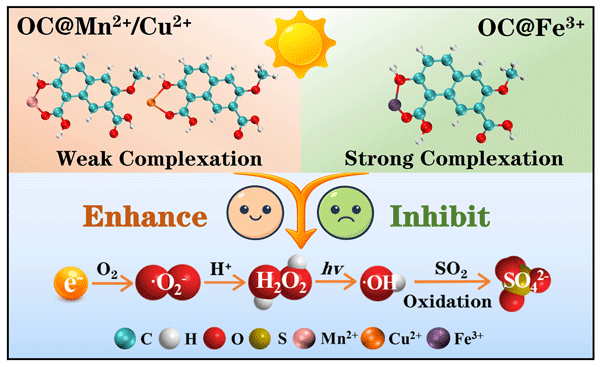
Complexation strength between organic carbon and transition metal ions dominates the photochemical conversion of SO2 to sulfates
Shaojie Yang
Shiwei Lai
Jianwei Zheng
Hao Na
Fu Li
Wangjin Yang
Chong Han

The photooxidation of SO2 on organic carbon (OC) is a critical pathway for sulfate formation, yet the role of interactions between OC and transition metal ions (TMIs) in this process remains scarcely understood. We systematically investigated potential influences of TMIs (Fe3+, Cu2+ and Mn2+) on the conversion of SO2 to sulfates on OC from coal combustion under irradiation. For OC and its coexistence with TMIs under experimental conditions adopted here, the steady-state uptake coefficients of SO2 and sulfate masses were (0.39–22.24) × 10−6 and (2.36–26.05) × 10−3 mg, respectively. Fe3+ exhibited a significantly antagonistic effect, whereas Cu2+ and Mn2+ enhanced SO2 uptake and sulfate generation on OC. Spectroscopic evidences, including absorbance decreasing and fluorescence quenching, confirmed the complexes formation of TMI with chromophores in OC. Fe3+ owned the strongest binding affinity with chromophores, followed by Cu2+ and Mn2+. This variation in the coordination strength dominated the generation of reactive species, such as free electrons (e−), superoxide radicals (•O), H2O2 and hydroxyl radicals (•OH), and •OH acted as a pivotal trigger to drive the sulfate production. Extended investigations confirmed a good linear relationship between •OH intensity (I) and sulfate mass (Msulfates): Msulfates = (1.68 ± 0.11) × 10−2 × I − (0.43 ± 0.08) × 10−2, demonstrating that the regulatory effects of metal ions on the sulfate production were generally governed through their ability to suppress or facilitate the •OH generation.
- Article
(5929 KB) - Full-text XML
-
Supplement
(5829 KB) - BibTeX
- EndNote


Fine particulate matter (PM2.5) is a complex mixture of inorganic and organic species, and plays a central role in the persistent haze events (Fan et al., 2016; Huang et al., 2014; Peng et al., 2021). The rapid accumulation of sulfates in PM2.5 significantly influences atmospheric radiative forcing, air quality and human health (Zhang et al., 2020a; Salana et al., 2024). Sulfates primarily stem from SO2 oxidation, including reactions with hydroxyl radicals (•OH) in the gas phase and aqueous oxidation in cloud and fog droplets involving various oxidizing species (Tsona and Du, 2019; Liu et al., 2020a; Jiang et al., 2009; Hoyle et al., 2016; Liu and Abbatt, 2021). However, only considering these pathways usually leads to a pronounced gap between the modeled and observed sulfate concentrations during the haze events (Li et al., 2017; Eckhardt et al., 2015; Zheng et al., 2015).
To bridge this gap, several heterogeneous pathways have been proposed, involving reactions of SO2 on PM2.5, mineral dust (e.g., Arizona test dust and metal oxides), inorganic salt (e.g., nitrates and NaCl), soot and organic aerosols (Zhang et al., 2020c, 2019, 2022; Dupart et al., 2012; Yang et al., 2024a; Cao et al., 2024b). Although these heterogeneous reactions have narrowed the discrepancies between model prediction and field observation concentrations of sulfates, substantial uncertainties and controversies still remain (Wang et al., 2014). This may be attributed to the fact that most studies mainly focus on simplified single-component systems and overlook the extreme complexity of multicomponent aerosols under realistic atmospheric conditions. Recent evidence highlighted that the potential interactions among distinct components in aerosols can significantly influence the transformation pathways of atmospheric pollutants (Zhang and Chan, 2023; Zhang et al., 2023). For instance, organic carbon (OC) in soot can donate electrons to elemental carbon (EC) and enhance the electron-hole separation under irradiation, thereby generating more •OH and promoting the conversion of SO2 to sulfates (Zhu et al., 2022). OC-derived photosensitizers activated both O2 and Cl− in NaCl-OC under ultraviolet light, producing •OH and Cl• that synergistically oxidized SO2 to sulfates (Tang et al., 2023).
OC from coal combustion can serve as a photosensitive electron donor under irradiation, initiating the formation of reactive oxygen species (ROS), which subsequently oxidized SO2 to sulfates (Yang et al., 2025). In atmospheric aerosols, OC often coexisted with various TMIs, especially in some regions influenced by the combustion, vehicular emissions, and industrial processes (Yang et al., 2024b; Deng et al., 2022; Zhang et al., 2020b; Shiraiwa et al., 2017; Hua et al., 2025). This coexistence was not a simple superposition of their specific roles. OC usually contained diverse functional groups such as carboxyl, hydroxyl and carbonyl moieties, which can interact with TMIs via the complexation, metal-proton ion exchange and electrostatic adsorption, forming organometallic complexes in aerosols (Li et al., 2022; Wang et al., 2021c, b). Furthermore, the binding strength between OC and TMIs varied with the specific type of TMIs, which was related to the differences in ionic radius, oxidation state and electronic configuration that influenced coordination chemistry and redox reactivity (Wang et al., 2021a; Pan et al., 2020). Fe, Cu and Mn are the most abundant transition metals in atmospheric aerosols and cloud water (Singh and Gupta, 2017). Their soluble ionic forms, including Fe3+, Cu2+ and Mn2+, can catalyze or regulate SO2 oxidation and sulfate formation (Liu et al., 2025). The potential roles of OC and these TMIs in the heterogeneous photochemical oxidation of SO2 haven't been systematically investigated, which may restrict the exact incorporation of OC photochemistry into the sulfate formation prediction models.
Our previous work mainly focused on the intrinsic photo-reactivity of OC and its dependence on the physicochemical properties (Yang et al., 2025). In this study, laboratory experiments and theoretical calculations were conducted to elucidate the influences of TMIs (Fe3+, Mn2+ and Cu2+) on the photooxidation of SO2 to sulfates on OC from coal combustion. Differences in the photochemical activity were quantified by measuring SO2 uptake coefficients and sulfate yields. Changes in the optical properties were examined to evaluate the potential interactions between OC and TMIs. Mechanism insights into the reactive species generation, including e−, •O, H2O2 and •OH, clarified how these interactions regulated the SO2 photooxidation. Finally, further investigation involving multiple metal ions commonly within atmospheric aerosols highlighted the broader significance of OC and TMIs interactions in the sulfate formation.
2.1 Preparation of OC and OC@TMIs samples
As shown in Fig. S1 in the Supplement, OC was obtained with a custom combustion and sampling apparatus. The coal in the combustion experiment originated from Shanxi Province, China. The details of OC sampling and preparation are provided in Sect. S1.1 in the Supplement. The background concentrations of Fe, Mn and Cu in OC were measured through ICP-MS, and they varied in the range of 1.23–7.70 µg L−1. The details of ICP-MS measurements are provided in Sect. S1.2. 1 mL of the extracted OC solution was dropped onto 6.0 × 1.5 cm prebaked quartz-fiber filters, and the solvents were dried under a N2 stream (100 mL min−1) in the dark at 298 K.
The sources and purities of salt chlorides used here are provided in Sect. S1.3. Stock solutions of metal salts (1.5 mM, in ultrapure water) were mixed with the OC solution at a 1:2 volume ratio, yielding mixtures containing 0.5 mM metal ions and 543.9 ± 35.4 µg C mL−1 (Fig. S1). This metal-ion concentration was close to the levels reported in heavily polluted atmospheric conditions (Li et al., 2022). Each mixture was ultrasonicated for 30 min at 25 °C in the dark. The resulting products were designated as OC@TMIs, including OC@Fe3+, OC@Cu2+ and OC@Mn2+. Here, OC@TMIs referred to the actual sample prepared by introducing a specific TMI into OC. OC+TMIs was defined as a reference sample, where the interaction between OC and TMIs was assumed to be nonoccurrence. The property of OC+TMIs represented the arithmetic sum of that measured separately for OC and metal ion. Thus, OC+TMIs was utilized as a reference for evaluating synergistic or antagonistic effects of OC and TMIs. In the OC@NaCl control experiment, the NaCl concentration was 1.5 mM. 1.5 mL of the mixed solution was deposited on the inner surface of a quartz flow tube (20 cm length, 1.0 cm inner diameter). The flow tube was rotated slowly to ensure the uniform wetting of the surface. The coating was obtained by drying the samples under a N2 stream (100 mL min−1) in the dark environment at 298 K to prevent photochemical interference. Because a single sample could not be used sequentially for all experimental measurements, separate subsamples from the same initial batch of OC@TMIs were used to minimize potential variability.
2.2 Flow tube experiments and SO2 uptake coefficients
The SO2 uptake experiments were performed at ambient pressure in a horizontal cylindrical quartz flow tube reactor (34 cm length, 1.6 cm i.d.), as shown in Fig. S1. The details of the flow reactor and reaction procedure are given in Sect. S1.4. The changes in the SO2 concentration were measured with a SO2 analyzer (Thermo 43i). The calculation of the SO2 uptake coefficient is described in Sect. S1.5.
2.3 Analysis methods
2.3.1 Measurements of sulfate products
The functional group changes during the photochemical reaction of SO2 on the samples were characterized using in situ attenuated total reflection infrared (ATR-IR) spectroscopy (Nicolet iS50, Thermo Scientific), which was equipped with a mercury-cadmium-telluride (MCT) detector. Descriptions of experimental process are given in Sect. S1.6.
The sulfate ions were quantified using an ion chromatography (IC) system (CIC-D120+, Shenghan) with an analytical column (AS11-HC, Thermo) and a conductivity detector. The testing procedures are described in Sect. S1.7.
2.3.2 Optical property measurements
The optical properties of OC, TMIs, and OC@TMIs were analyzed using the UV-vis absorption spectroscopy and the excitation-emission matrix (EEM) fluorescence spectroscopy. The UV-vis spectra were recorded by the UV-vis spectrophotometer (UV-2550, Shimadzu) with a 1.0 cm pathlength cell in the wavelength range of 200–600 nm. A mixed solution of methanol and water (2:1, ) was used as the blank background. Samples were diluted to one-fifteenth of the original concentrations. UV-vis analysis was carefully performed under identical testing conditions to minimize handling-related variations.
The EEM fluorescence spectra were measured via a fluorescence spectrophotometer (FP8550, Jasco) at 700 V voltage and 3-D mode in the wavelength ranges of 200–400 nm for excitation (Ex.) and 300–520 nm for emission (Em.). The fluorescence spectra were recorded at 5 nm intervals and a scan speed of 2400 nm min−1 in a 1 cm path-length quartz cuvette. Samples were diluted to one-fifteenth of the original concentrations to minimize the inner-filter effect (IFE) and reabsorption artifacts, which can distort the excitation–emission spectra at high sample concentrations. Instrument calibration, correction for inner-filter effects and normalization of fluorescence intensity to the Raman units (RU) of solvent were conducted before EEM spectral analysis. The EEM data were modeled with the parallel factor analysis (PARAFAC) through the DOMFluo toolbox (version 0.2.0) for MATLAB. Based on the evaluation of 2–4 components using EEM profiles and residual error patterns, a 3-component model was ultimately selected (Fig. S4).
2.3.3 Electrochemical measurements
The electron donating capacities (EDC) of the samples were determined using an electrochemical workstation (CHI760F, Shanghai Chenhua Co., Ltd.) equipped with a three-electrode system. The testing procedures are described in Sect. S1.8. The EDC was calculated as the following Eq. (1) (Ma et al., 2024),
where Iox means the OC oxidation curves; F is the constant of Faraday, which is equal to 96 485 s A mol−1 e−; morganic carbon represents the amount of organic carbon of samples.
2.3.4 Electron paramagnetic resonance spectrometer
ROS under irradiation were analyzed using an electron paramagnetic resonance spectrometer (EPR, A300, Bruker). For the radical detection, 20 µL of 0.05 M 5,5-dimethylpyrroline-Noxide (DMPO, in methanol) and 5-tert-butoxycarbonyl-5methyl-1-pyrroline-N-oxide (BMPO, in water) were used as spin traps for superoxide radicals (•O) and •OH, respectively. The parameters were set as follows: magnetic field range of 3450–3550 G, central field range of 3500 G, scan time of 30 s and microwave power of 20 mW.
2.3.5 H2O2 detection
The H2O2 generation was analyzed by the TiOSO4 colorimetric method (Liu et al., 2023; Li et al., 2023). TiOSO4 reacted with H2O2 to form a yellow titanium-peroxide complex (Ti(IV)O), which exhibited a characteristic absorbance peak at 405 nm. The H2O2 concentration was determined using the H2O2 standard curve (Fig. S5), and the testing procedure is given in Sect. S1.9.
2.3.6 X-ray photoelectron spectroscopy
The X-ray photoelectron spectroscopy (XPS, ESCALAB 250Xi, Thermo) was employed to investigate the valence state variations of metal ions under irradiation. Fresh samples (3 mL, prepared by 2 mL OC extraction with 1 mL ionic solution) or the ones photoaged by SO2 were combined with SiO2 (100 mg) and dried by rotary evaporation. Before the XPS analysis, the samples were stored in a vacuum environment to minimize the changes in the valence state of TMIs. Aluminum Kα radiation (hv = 1486.68 eV, spot size 500 µm) was used as the excitation source for XPS analysis. The measurements were conducted under ultrahigh vacuum conditions of approximately 10−9 mbar. The instrument was operated at 15 kV and 10 mA. Signals were accumulated over 5–10 scans, and the spectra were recorded with a pass energy of 30 eV and a step size of 0.05 eV. Beam-induced effects were assessed by collecting consecutive C 1 s spectra at the same sample position. The peak positions and spectral shapes remained consistent, indicating that beam-induced effects were negligible under the measurement conditions. Binding energies were calibrated using the C 1 s peak at 284.8 eV. Peak deconvolution was conducted to resolve the contributions of different valence states.
2.3.7 Density functional theory calculations
Molecular structures were constructed in GaussView 6. Density functional theory (DFT) calculations were carried out through the quantum chemistry software Gaussian 16. Geometry optimizations and frequency calculations were performed at the B3LYP/LANL2DZ level. The SMD water solvation model was used to represent aqueous solvation effects. Grimme's D3 dispersion correction was employed to account for van der Waals interactions. All optimized structures were confirmed as local minima without imaginary frequencies. Single-point energy calculations were conducted at the B3LYP/def2-TZVP level using the optimized geometries. O2 adsorption on OC and the corresponding IGMH diagrams were analyzed using Multiwfn (Lu and Chen, 2011; Lu, 2024). The calculations of complexation energy between OC and TMIs and O2 adsorption energy are described in Sect. S1.10.
3.1 Dependence of SO2 uptake on metal ions
Figure 1a–c illustrates the temporal evolution of SO2 concentration on OC, TMIs and OC@TMIs under irradiation. All errors denoted the standard deviations of three independent replicates. Because chloride salts were used here, OC@NaCl control experiments were conducted. The decreasing trend of SO2 concentration on OC@NaCl was the same as that on OC, suggesting no measurable effect of Cl− on SO2 uptake (Fig. S6). The SO2 loss on FeCl3 or MnCl2 was less than that on OC, while it was similar for CuCl2 and OC. When SO2 was exposed to OC@Fe3+, the SO2 concentration decreased by 1–2 ppb, which was obviously lower than that for OC+Fe3+. This indicates that the coexistence of Fe3+ with OC markedly suppressed the photochemical uptake of SO2. The SO2 loss on OC@Cu2+ and OC@Mn2+ was markedly greater than that on OC+Cu2+ and OC+Mn2+, respectively. This suggests that both Cu2+ and Mn2+ enhanced the photochemical reaction of SO2 with OC. Dark control experiments showed that SO2 uptake on OC@TMIs was slightly different from that on OC in the absence of light, indicating that the non-photochemical effects of TMIs to SO2 uptake was limited (Fig. S7).
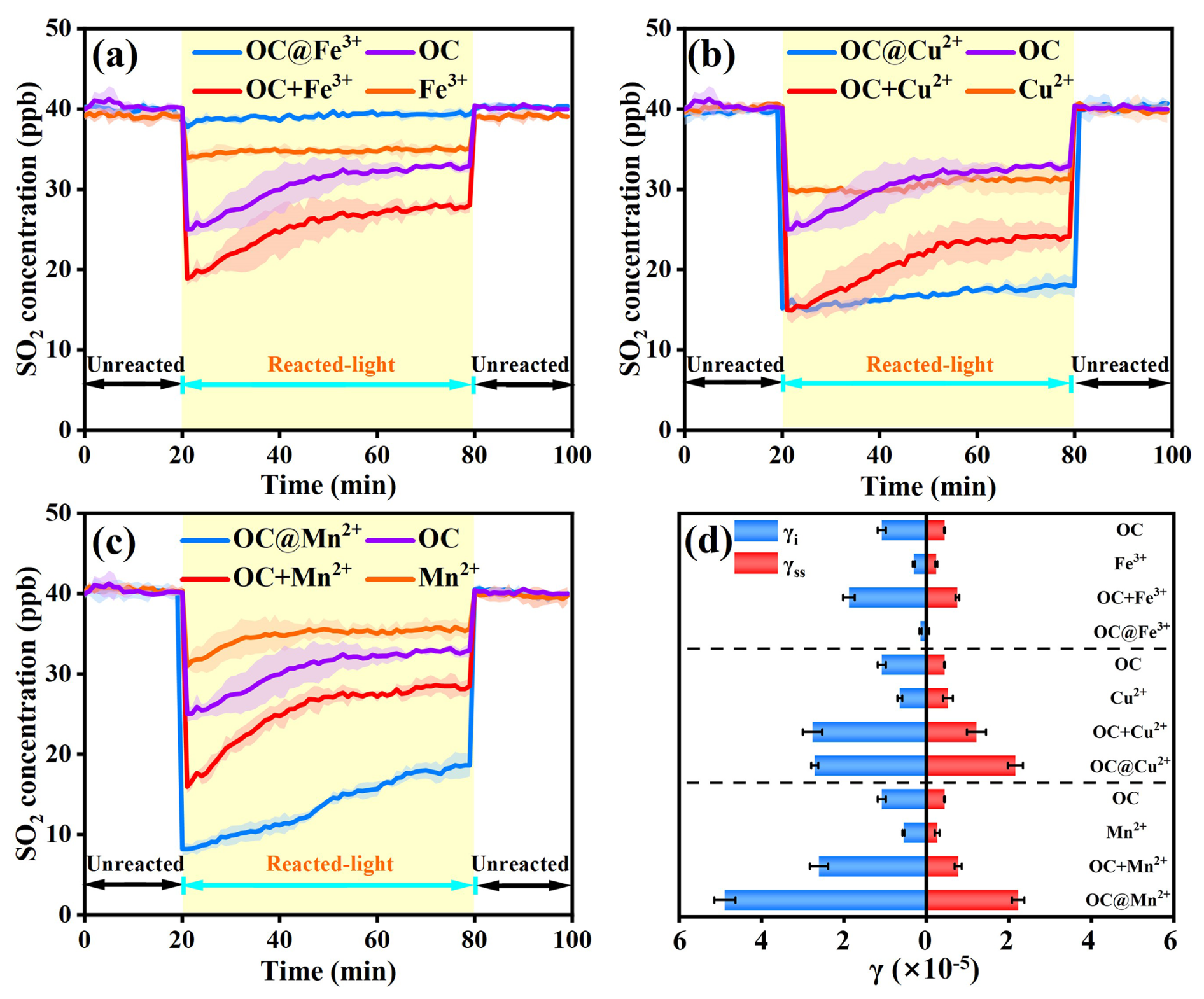
Figure 1(a–c) Temporal variations of the SO2 concentration during the heterogeneous reaction of SO2 with OC, TMIs, OC+TMIs and OC@TMIs under irradiation (For OC+TMIs, SO2 uptake was the arithmetic sum of that measured for OC and TMIs in the separate experiments). (d) Initial uptake coefficients (γi) and steady-state uptake coefficients (γss) of SO2 under irradiation. Reaction conditions: irradiance of 1.05 × 10¹⁶ photons cm−2 s−1, 40 ppb SO2, 298 K and 60 % RH.
The initial (γi) and steady-state (γss) uptake coefficients of SO2 are summarized in Fig. 1d. The γss was consistently lower than the γi due to the gradual aging and the depletion of photoactive components during the reaction. The γss on OC@Fe3+ only accounted for 5 % of that on OC+Fe3+, confirming that Fe3+ significantly restrained the photochemical SO2 uptake on OC. In contrast, γss for OC@Cu2+ and OC@Mn2+ was 1.83 and 2.93 times of the corresponding one for OC+Cu2+ and OC+Mn2+, respectively. This definitely suggests that the coexistence of Cu2+ and Mn2+ with OC has synergistic effects on the photochemical uptake of SO2, with Mn2+ exhibiting a stronger enhancement than Cu2+. Overall, these contrasting behaviors reveal that the addition of TMIs to OC can either restrict (Fe3+) or facilitate (Cu2+ and Mn2+) the photochemical uptake of SO2, highlighting the distinct roles of TMIs in modulating the OC reactivity.
3.2 Dependence of sulfate formation on metal ions
The contour maps of in-situ ATR-IR spectra of OC, TMIs and OC@TMIs exposed to SO2 under irradiation are displayed in Fig. 2a. Several characteristic sulfate (SO or HSO) bands were identified for all samples in the 1300–1000 cm−1 region (Zhang et al., 2023, 2019). It was noted that these bands intensified progressively with the time, reflecting the continuous accumulation of sulfates.
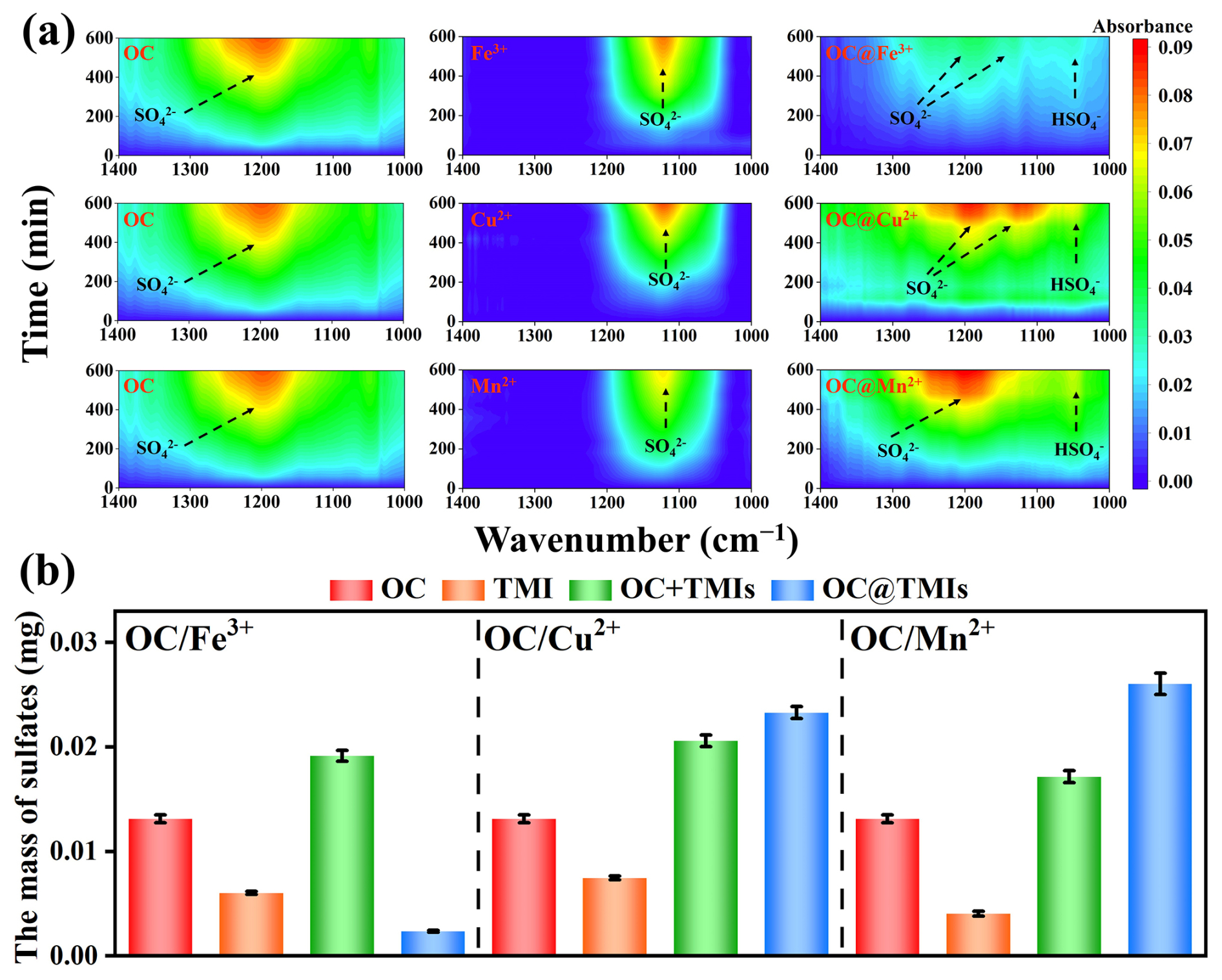
Figure 2(a) Contour map of in-situ ATR-IR spectra of OC, FeCl3, CuCl2, MnCl2, OC@Fe3+, OC@Cu2+ and OC@Mn2+ exposed to SO2 under irradiation. Reaction conditions: irradiance of 7.40 × 10¹⁵ photons cm−2 s−1, 2 ppm SO2, 298 K and 60 % RH. (b) Mass of sulfates produced on OC, TMIs, OC+TMIs and OC@TMIs after the 10 h reaction with SO2 under irradiation (For OC+TMIs, its sulfate mass was the arithmetic sum of that measured for OC and TMIs in the separate experiments). Reaction conditions: irradiance of 1.05 × 10¹⁶ photons cm−2 s−1, 200 ppb SO2, 298 K and 60 % RH.
The IC results provided quantitative evidence of sulfate formation under irradiation (Fig. 2b). For OC@Fe3+, sulfate production was much lower than that on OC or FeCl3. Specifically, the sulfate mass on OC@Fe3+ was merely 12 % of that for OC+Fe3+, confirming that Fe3+ restrained the formation of sulfates on OC. In contrast, the sulfate mass on OC@Cu2+ and OC@Mn2+ was 1.13 and 1.52 times larger than that for OC+Cu2+ and OC+Mn2+, respectively. These confirm that both Cu2+ and Mn2+ promote the photochemical oxidation of SO2 to sulfates on OC. Only limited sulfate formation was observed on OC@TMIs under dark conditions, indicating a minor contribution from the non-photochemical pathways (Fig. S8). Taken together with the SO2 uptake data in Fig. 1, TMIs exerted markedly different influences on SO2 conversion to sulfates on OC.
3.3 Spectroscopic evidence for complexation between OC and TMIs
The complexation between OC and TMIs may occur and alter the optical properties of OC (Wang et al., 2024). Changes in optical absorption and steady-state fluorescence signals were used to probe these interactions. Figure S9a–c displays the UV-vis spectra of OC, TMIs, OC+TMIs and OC@TMIs. OC and OC@TMIs exhibited a sharp increase in the absorbance at the shorter wavelengths. FeCl3, CuCl2 and MnCl2 owned very weak absorbance. OC@Fe3+, OC@Cu2+ and OC@Mn2+ presented lower absorbance than OC+Fe3+, OC+Cu2+ and OC+Mn2+, respectively. This decrease in the absorbance suggests the occurrence of interactions between OC and TMIs. The background concentrations of Fe, Mn and Cu in OC were measured by ICP-MS, and they varied in the range of 1.23–7.70 µg L−1. This accounted for only 0.0045 %–0.0276 % of TMI concentrations used for OC@TMIs. Therefore, the contribution of intrinsic Fe, Mn and Cu to the TMI dependent spectral changes was considered to be very limited. The FT-IR spectra of OC are displayed in Fig. S10, and the peak assignments are summarized in Table S1 in the Supplement. OC contained carboxyl, hydroxyl and carbonyl groups. These oxygen-containing groups with π bond electrons and lone pairs can serve as the complexation sites by donating electrons to the vacant orbitals of TMIs (Wang et al., 2021c). Coordination with TMIs can perturb the electronic structure of OC chromophores and affect or electronic transitions, which may induce a hypochromic effect in the UV-vis spectra (Qin et al., 2024). To further compare the spectral changes induced by TMIs, differential absorbance was calculated as ΔAbs = Abs(OC+TMIs) − Abs(OC@TMIs). Notably, as shown in Fig. S9d, there was the largest ΔAbs between OC@Fe3+ and OC+Fe3+ in the entire spectral range, indicating the strongest complexation of OC with Fe3+ among three TMIs.
EEM fluorescence spectroscopy combining with the PARAFAC analysis were employed to further investigate the complexation interactions between TMIs on OC. Three chromophores are identified in Figs. 3a–c and S11, and their peak positions and assignments are given in Table S2. C1 (Ex Em = 265(320) 380 nm) and C2 (Ex Em = 285(370) 420 nm) were assigned to chromophores with low and high oxidation states, respectively. C3 (Ex Em = 200(260) 340 nm) belonged to protein-like chromophores (Li et al., 2022; Wang et al., 2021b). Fluorophores at longer emission wavelengths, such as C2, typically owned abundant polar groups, including hydroxyl and carboxyl, which acted as primary binding sites for TMIs (Pan et al., 2020; Lu et al., 2019). The relative contributions of different components to OC shifted upon the addition of TMIs (Fig. 3d), reflecting the varied complexation strengths of TMIs with OC (Ma et al., 2022; Yan and Korshin, 2014). For OC@Fe3+ in comparison with OC, the ratio of C1 obviously increased by 14 %, while it decreased by 9 % and 5 % for C2 and C3, respectively. By contrast, OC@Cu2+ and OC@Mn2+ showed smaller changes in the C1–C3 proportions. These mean that Fe3+ forms the most stable complexes with OC due to its high charge density and trivalent oxidation state, which would enhance the ligand attraction and enable higher coordination numbers (Liu et al., 2022). Cu2+ and Mn2+, with lower charge densities and less favorable coordination geometries, exerted weaker complexation effects with OC.
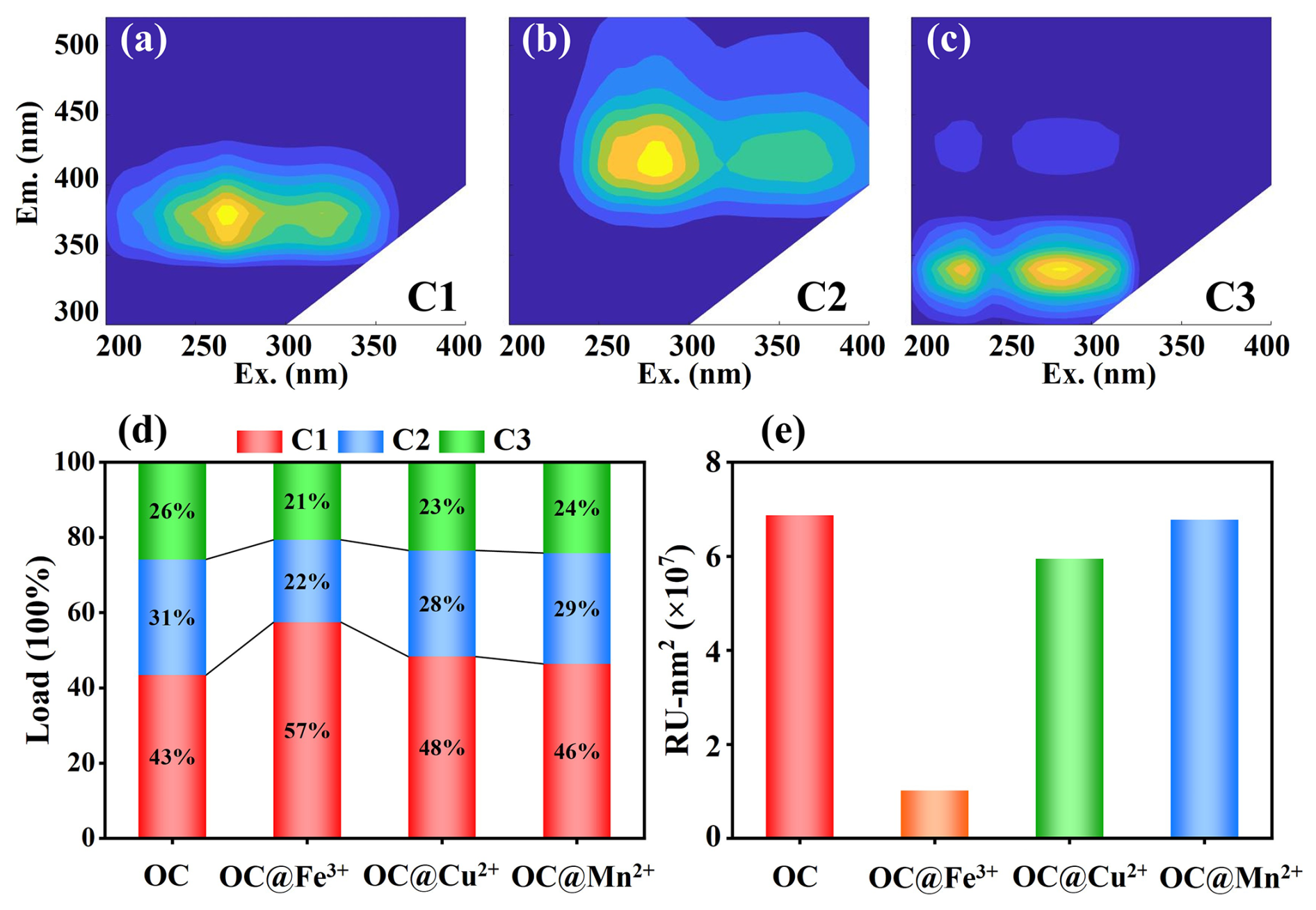
Figure 3(a–c) Three components extracted by the PARAFAC analysis. (d) Relative fluorescence contributions of C1–C3 in OC, OC@Fe3+, OC@Cu2+ and OC@Mn2+. (e) Total fluorescence volume of OC, OC@Fe3+, OC@Cu2+ and OC@Mn2+.
As a comprehensive measure of fluorescence intensity, the total fluorescence volume (TFV) was used to evaluate the overall impact of metal complexations (Fig. 3e). The addition of TMIs led to a reduction in TFV, confirming the fluorescence quenching occurrence. Fe3+ caused the most pronounced reduction of TFV (85.2 %), followed by Cu2+ (13.4 %) and Mn2+ (1.4 %). This strong quenching effect was attributed to the high binding affinity of Fe3+ with highly oxidative and protein-like fluorophores. The complexation between OC and TMIs can disrupt the conjugation and deactivate fluorescence centers, which contributed to a significant reduction in TFV (Kuramochi et al., 2018). In addition, the complexation of Fe3+ with OC could promote the intersystem crossing (ISC) from the singlet state (1OC∗) to the triplet state (3OC∗) (Ruzi et al., 2017; Treacy and Rovis, 2024), enhancing nonradiative decay and further suppressing the fluorescence emission.
To directly demonstrate the complexation strength between TMIs with species in OC, DFT calculations were conducted using Phenol (PH), benzoic acid (BA) and a model substance (MS) (Fig. S12). PH and BA were chosen according to FT-IR analysis (Fig. S10), as they represented species with hydroxyl and carboxyl groups commonly present in OC. MS simultaneously contained these functional groups with a π-conjugated aromatic backbone to better reflect the structural features of ambient OC. Section S3.1 and Fig. S13 illustrate the complexation structure of three molecular models with Fe3+, Cu2+ and Mn2+. As summarized in Table S3, all molecular models exhibited the strongest complexation energy with Fe3+, followed by Cu2+ and Mn2+. This was well consistent with the results observed in the UV-vis and fluorescence spectra. Although these models cannot capture the full molecular heterogeneity of OC, the consistency between the calculated results and experimental trends helped to understand the complexation effects of OC with TMIs. Complexation strength is commonly described using stability constants (log K). Because OC was a heterogeneous mixture with multiple potential binding sites, log K may not be exactly determined. Weak and strong complexation described here was relative sense, according to UV-vis spectral change, fluorescence quenching and complexation energy.
3.4 Mechanistic insights into TMIs-regulated oxidation of SO2 to sulfates
As described through Reactions (R1)–(R6), previous studies have proposed the photochemical conversion pathways of SO2 to sulfates on OC (Yang et al., 2025, 2024a). Upon accepting photons, OC is excited to 3OC∗, which subsequently generates free electrons (Reactions R1–R2) (Yang et al., 2024a; Wang et al., 2020). These electrons would reduce adsorbed O2 to •O (Reaction R3) (Zhang et al., 2022). •O can combine with protons to form hydroperoxyl radicals (HO2•), which are converted into O2 and hydrogen peroxide (H2O2) (Reaction R4) (Zhang et al., 2020c). H2O2 undergoes the photolysis to produce •OH (Reaction R5), and •OH drives the oxidation of adsorbed SO2 or H2SO3 or HSO to sulfates (Reaction R6) (Liu et al., 2020b).
To verify whether the above mechanism remained operative after the complexation between TMIs and OC, electrochemical and EPR analyses were conducted. Mediated electrochemical oxidation (MEO) data of OC without or with TMIs showed persistent occurrence of the photo-generated electron transfer (Figs. S14 and S15). BMPO was used as the spin-trapping agent. As displayed in Fig. 4a, the characteristic EPR signal of BMPO-•OH adducts was detected under irradiation, confirming the generation of •OH. Moreover, EPR signals of BMPO-•OH adducts followed the order: OC@Mn2+ > OC@Cu2+ > OC > OC@Fe3+, which well aligned with γss and sulfate production. The critical role of •OH in the conversion of SO2 to sulfates was further determined using NaHCO3 to scavenge •OH (Yang et al., 2024a), where the sulfate formation was markedly restricted (Fig. S17). These demonstrate that •OH generation capacity is the primary determinant of sulfate formation on OC@TMIs.
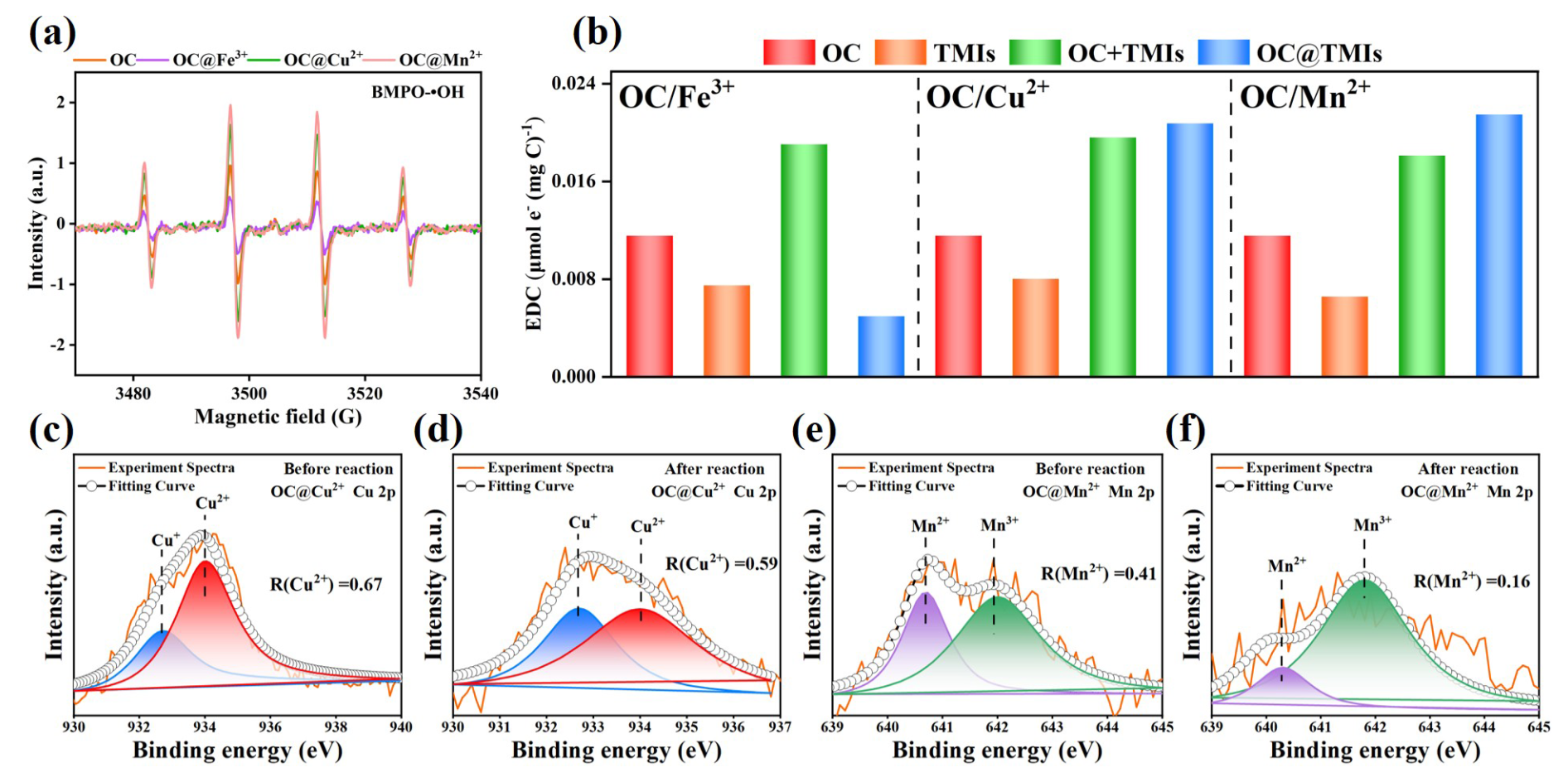
Figure 4(a) BMPO-•OH adduct EPR spectra of OC, OC@Fe3+, OC@Cu2+ and OC@Mn2+ under irradiation. (b) Electron donating capacity (EDC) of OC, TMIs, OC+TMIs and OC@TMIs (for OC+TMIs, EDC was the arithmetic sum of that measured for OC and TMIs in separate experiments). High-resolution XPS spectra of Cu 2p for OC@Cu2+ (c) before and (d) after the reaction, and Mn 2p for OC@Mn2+ (e) before and (f) after the reaction (R(Cu2+) and R(Mn2+) denoted the proportion of Cu2+ and Mn2+ on the surface, respectively).
According to Reactions (R1)–(R2), the photogeneration of electrons was an initial step that can affect the reaction activity of OC. Figure 4b summarizes the distinct regulatory roles of Fe3+, Cu2+ and Mn2+ in the EDC of OC under irradiation. The EDC of OC@Fe3+ (0.00496 µmol e− (mg C)−1) was substantially less than that of OC+Fe3+ (0.01904 µmol e− (mg C)−1), suggesting that Fe3+ significantly suppressed the photogeneration of electrons. This mainly stemmed from the strong complexation of Fe3+ and OC, which masked the redox-active moieties and dynamically quenched 3OC∗, restraining free electron formation (Li et al., 2022; Liu et al., 2024). Figure 4b shows that EDC of OC@Cu2+ (0.02074 µmol e− (mg C)−1) and OC@Mn2+ (0.02147 µmol e− (mg C)−1) was higher than that of OC+Cu2+ (0.01959 µmol e− (mg C)−1) and OC+Mn2+ (0.01812 µmol e− (mg C)−1), respectively. This means that Cu2+ and Mn2+ enhance the electron-donating ability of OC. These larger EDC may be related to reversible redox cycling of Cu2+ Cu+ and Mn2+ Mn3+ in the photochemical process. In contrast, Fe3+ formed more stable complexes with OC that trapped the photogenerated electrons, thereby suppressing efficient redox cycling of Fe3+ Fe2+. Under irradiation, Cu2+ was reduced to Cu+ by accepting photogenerated electrons, which was subsequently re-oxidized to Cu2+ by O2 or electron-deficient functional groups (e.g., quinones) (Pan et al., 2020). As displayed in XPS spectra of Cu 2p for OC@Cu2+ in Fig. 4c and d, the peaks at 932.5 and 934.3 eV corresponded to Cu+ and Cu2+, respectively (Biesinger et al., 2011). The proportion of Cu2+, denoted as R(Cu2+), decreased from 0.67 to 0.59 after photochemical SO2 aging. This confirms the existence of reversible redox cycling of Cu2+ Cu+. Similarly, Mn2+ can be oxidized to Mn3+ by photogenerated holes (OC+) or reactive oxygen-containing intermediates on OC, and then Mn3+ was reduced by phenolic or aromatic groups on OC (Hansard et al., 2011). The Mn 2p spectra of OC@Mn2+ exhibited two peaks at 640.4 and 641.9 eV (Fig. 4e and f), which were ascribed to Mn2+ and Mn3+, respectively (Cerrato et al., 2010; Xing et al., 2025). The proportion of Mn2+ (R(Mn2+)) decreased from 0.41 to 0.16 after the reaction, indicating Mn2+ Mn3+ redox interconversion. These reversible redox cycles facilitated dynamic interfacial electron transfer by accepting and releasing photogenerated electrons. This bidirectional electron flow can amplify the outward electron flux from OC, thereby increasing the electron-donating capacity (Fulda et al., 2013; Li et al., 2021).
As shown in Reaction (R3), •O formation relied not only on the photogenerated electrons but also on the O2 activation. To elucidate the effect of TMIs complexation on the O2 activation, DFT calculations were carried out in the interaction of O2 with MS (Fig. S18). Figure 5a displays that O2 adsorption energy on MS was −82.03 kJ mol−1, with O–O bond length of 1.20 Å. For MS@Fe3+, O2 adsorption energy became more negative (−205.59 kJ mol−1), reflecting stronger electrostatic binding due to high positive charge of metal center (Zhang et al., 2024). However, O–O bond length remained unchanged, suggesting negligible electron transfer into the π∗ antibonding orbital of O2. Thus, O2 is strongly bound yet not appreciably activated. Complexation between OC with Cu2+ or Mn2+ obviously enhanced the adsorption of O2 (−212.93 kJ mol−1 for Cu2+ and −366.32 kJ mol−1 for Mn2+). The O–O bond length slightly increased to 1.21 Å for MS@Cu2+, while it was markedly elongated to 1.32 Å for MS@Mn2+. These changes suggest electron transfer from the metal centers to the π∗ antibonding orbital of O2, boosting effective activation of O2 and facilitating the •O generation. Compared to Cu2+, Mn2+ exhibited stronger O2 activation, which was attributed to its half-filled 3d5 configuration and moderate redox potential, both of which favored efficient π∗ electron donation.
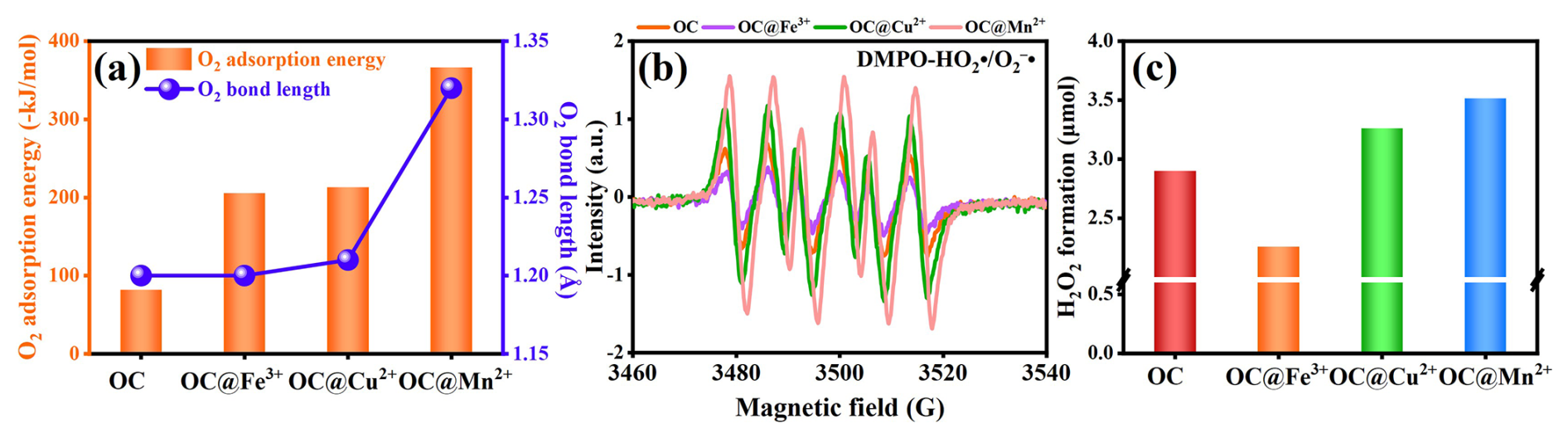
Figure 5(a) O2 adsorption energy and the bond length of O2 for MS, MS@Fe3+, MS@Cu2+ and MS@Mn2+. (b) EPR spectra of DMPO-HO2• •O adduct for OC, OC@Fe3+, OC@Cu2+ and OC@Mn2+ under irradiation. (c) H2O2 formation from the photochemical reactions on OC, OC@Fe3+, OC@Cu2+ and OC@Mn2+.
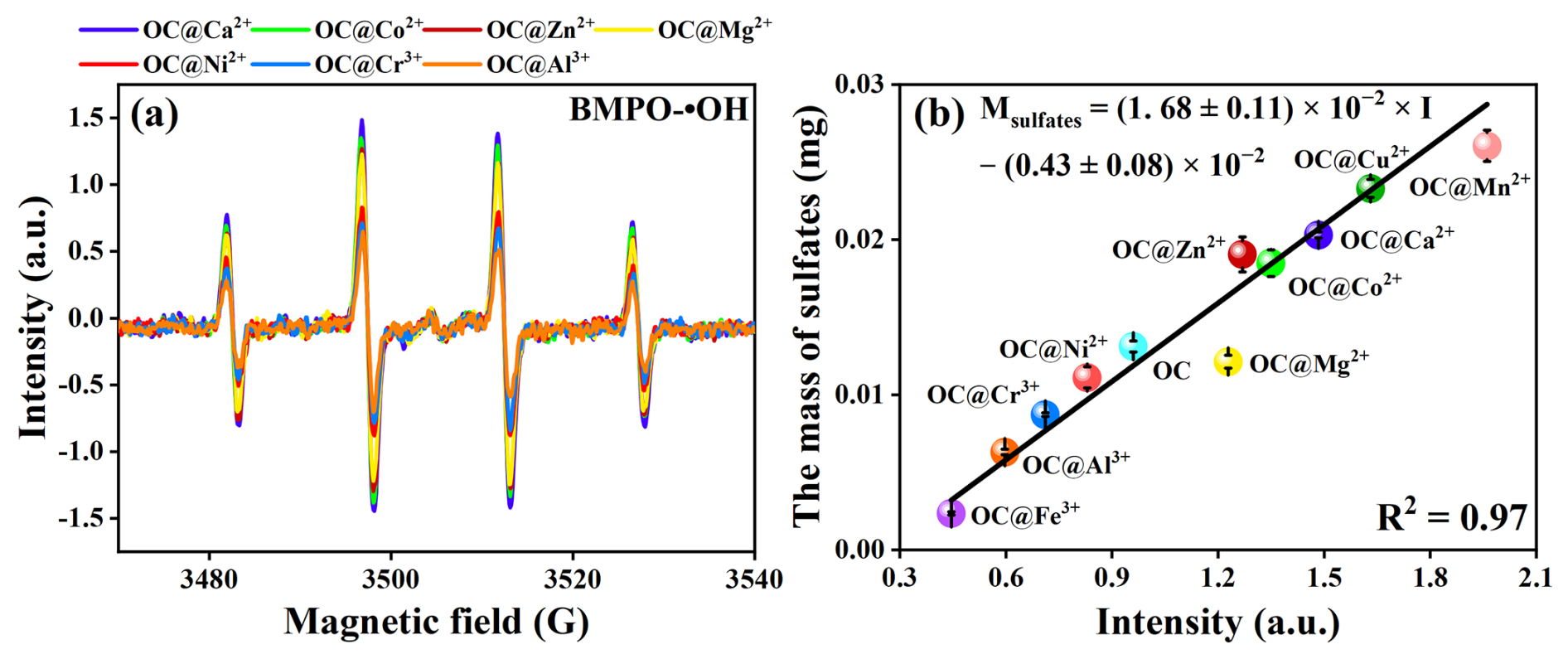
Figure 6(a) BMPO-•OH adduct EPR spectra under irradiation. (b) The correlation of Msulfates with the generation of •OH.
Accordingly, Fe3+ inhibited electron generation and failed to activate O2, whereas Cu2+ and Mn2+ promoted these two processes, with Mn2+ showing a stronger enhancement effect. This led to the •O signal intensity order of OC@Mn2+ > OC@Cu2+ > OC > OC@Fe3+ (Fig. 5b). •O directly contributed to H2O2 formation (Reaction R4), which was quantified with a TiOSO4 chromogenic method (Fig. S20). Figure 5c shows that H2O2 production trend had the consistency with •OH generation ability among these samples (Fig. 4a), which ultimately governed the photoconversion of SO2 to sulfates.
3.5 Discussion
The OC samples were collected from smoke aerosols generated during coal combustion. The TMIs concentrations selected here were atmospherically relevant soluble metal ion levels. These systems may roughly represent the coexistence of OC and TMIs for atmospheric aerosols in polluted regions affected by coal combustion emissions. High humidity and acidic conditions may promote metal dissolution and facilitate the complexation between soluble metal ions and OC. The photochemical lifetime of SO2 () on OC@TMIs was calculated with Eq. (2) (Yang et al., 2021),
where γ represents the uptake coefficient of SO2; ν denotes the mean SO2 molecular velocity; A corresponds to the aerosol surface area concentration. Based on field measurements during heavily polluted episodes, A ranged from 5.44 × 10⁻⁵ to 8.16 × 10⁻⁵ cm2 cm−3 (Zhang et al., 2018; Yang et al., 2021). Under typical atmospheric conditions (40 ppb SO2, 60 % RH), γss for SO2 on OC@TMIs were determined to be (0.39–22.24) × 10−6. Organic matters typically account for approximately 20 %–45 % of PM2.5 mass (Wu et al., 2018). The was estimated to be 1.8–379 d in the coexistence of OC and TMIs. By contrast, on OC from coal combustion was much narrower, which ranged from 17 to 53 d under the same conditions (Yang et al., 2025).
To assess the atmospheric production of sulfates during the photooxidation of SO2 on OC@TMIs, the sulfate formation rate (R) was estimated using Eq. (3),
where Dg refers to the diffusion coefficient of SO2 (1.12 × 10⁻⁵ m2 s−1); RP denotes the aerosol particle radius and is estimated via Eq. (4) (Li et al., 2020),
where [PM2.5] denotes the mean mass concentration of PM2.5, and a concentration range of 100–500 µg m−3 for the polluted episodes in typical Chinese cities was adopted here (Chu et al., 2020). Under these conditions, R was determined to be 0.07–5.95 µg m−3 h−1, which was a substantially broader range than 0.43–1.33 µg m−3 h−1 for OC (Yang et al., 2025). Broader ranges of and R on OC@TMIs indicate that the coexistence of OC and TMIs significantly modulates the photochemical conversion of SO2 to sulfates. These findings suggest that current model simulations may underestimate or overestimate sulfate formation on OC by overlooking such antagonistic or synergistic processes.
It has been well demonstrated that •OH was the dominant active species responsible for the oxidation of SO2 to sulfates on OC@TMIs (Figs. 4a and S17). Other metal ions (Ca2+, Co2+, Zn2+, Mg2+, Ni2+, Cr3+ and Al3+) commonly presenting in atmospheric aerosols were expanded to examine whether this mechanism exhibited broader generality (Hua et al., 2024). As shown in Fig. 6a, the peaks of BMPO-•OH adducts were observed under irradiation, confirming the •OH generation on all OC@TMIs. Relative to OC, the coexistence of Ca2+, Co2+, Zn2+ and Mg2+ obviously promoted the •OH generation, while Ni2+, Cr3+ and Al3+ exerted an inhibitory effect. Figure S21 summarizes the mass of sulfates formed on OC@TMIs, which was consistent with the •OH generation trend. Importantly, a linearly positive relationship (R2 = 0.97) between •OH intensity and sulfate mass (Msulfates) was determined in Fig. 6b. Msulfates can be parametrized as a function of •OH signal intensity (I) with an equation: Msulfates = (1.68 ± 0.11) × 10−2 × I − (0.43 ± 0.08) × 10−2. The linear relationship between •OH intensity and sulfate formation was established using fresh OC from coal combustion and different TMIs at the same concentration. OC in aerosols generally stems from diverse sources and undergoes the atmospheric aging processes, which would significantly modify the compositions and structures of OC (Cao et al., 2021; Deng et al., 2022). TMIs types and concentrations also display temporal and spatial variations (Ito et al., 2016; Moreno et al., 2011). These may alter the complexation between OC and TMIs and consequently affect •OH generation and sulfate formation. Thus, there may be some uncertainties for the applicability of this linear relationship under ambient conditions. Nevertheless, this quantitative relationship highlighted the potential dual roles of metal ion types in the sulfate formation, challenging the traditional view that metal ions often promote the SO2 oxidation (Cao et al., 2024a; Wang et al., 2022, 2021a). It also emphasized the critical role of •OH in the sulfate formation on OC@TMIs. Accordingly, incorporating the •OH generation ability of diverse OC@TMIs complexes into the atmospheric models may help to constrain sulfate source strength, predict haze evolution and assess associated health impacts in polluted environments.
It was well confirmed that the heterogeneous photooxidation of SO2 to sulfates was strongly modulated by the interactions of OC with TMIs. As evidenced by SO2 uptake coefficient and sulfate formation mass, Fe3+ exhibited a significantly inhibitory effect, whereas Cu2+ and Mn2+ promoted the conversion of SO2 to sulfates, with Mn2+ playing a more obvious enhancement role. Spectroscopic analyses and DFT calculations consistently demonstrated that Fe3+ had the strongest binding affinity to OC chromophores, followed by Cu2+ and Mn2+. This difference in the complexation strength controlled the electron generation, O2 activation, and the sequential formation of •O, H2O2, and •OH. In particular, a quantitative linear correlation was established between •OH intensity and sulfate mass across a wide range of metal ions. This clearly suggests that the regulation of sulfate formation on OC by metal ions is dominated by their capacity to suppress or enhance •OH generation.
The data used in this study are available from the corresponding author upon request.
The supplement related to this article is available online at https://doi.org/10.5194/acp-26-13387-2026-supplement.
CH and SY designed the experiment; SY and SL conducted the experiments; SY, SL, JZ, HN, FL and WY performed the data interpretation; CH and SY wrote the paper. CH supervised the project.
The contact author has declared that none of the authors has any competing interests.
Publisher's note: Copernicus Publications remains neutral with regard to jurisdictional claims made in the text, published maps, institutional affiliations, or any other geographical representation in this paper. The authors bear the ultimate responsibility for providing appropriate place names. Views expressed in the text are those of the authors and do not necessarily reflect the views of the publisher.
This work has been supported by the National Natural Science Foundation of China (grant nos. 42575113, 42577113, 42077198 and 22206023) and the Fundamental Research Funds for the Central Universities (grant nos. N25GFZ016 and N26BSS035). The characterization analysis of this work was supported by the Analytical and Testing Center of Northeastern University, China.
This paper was edited by Chiara Giorio and reviewed by Sayantee Roy and three anonymous referees.
Biesinger, M. C., Payne, B. P., Grosvenor, A. P., Lau, L. W. M., Gerson, A. R., and Smart, R. S. C.: Resolving surface chemical states in XPS analysis of first row transition metals, oxides and hydroxides: Cr, Mn, Fe, Co and Ni, Appl. Surf. Sci., 257, 2717–2730, https://doi.org/10.1016/j.apsusc.2010.10.051, 2011.
Cao, T., Li, M., Zou, C., Fan, X., Song, J., Jia, W., Yu, C., Yu, Z., and Peng, P.: Chemical composition, optical properties, and oxidative potential of water- and methanol-soluble organic compounds emitted from the combustion of biomass materials and coal, Atmos. Chem. Phys., 21, 13187–13205, https://doi.org/10.5194/acp-21-13187-2021, 2021.
Cao, X., Liu, Y.-X., Huang, Q., Chen, Z., Sun, J., Sun, J., Pang, S.-F., Liu, P., Wang, W., Zhang, Y.-H., and Ge, M.: Single droplet tweezer revealing the reaction mechanism of Mn(II)-catalyzed SO2 oxidation, Environ. Sci. Technol., 58, 5068–5078, https://doi.org/10.1021/acs.est.4c00309, 2024a.
Cao, Y., Liu, J., Ma, Q., Zhang, C., Zhang, P., Chen, T., Wang, Y., Chu, B., Zhang, X., Francisco, J. S., and He, H.: Photoactivation of chlorine and its catalytic role in the formation of sulfate aerosols, J. Am. Chem. Soc., 146, 1467–1475, https://doi.org/10.1021/jacs.3c10840, 2024b.
Cerrato, J. M., Hochella, M. F., Jr., Knocke, W. R., Dietrich, A. M., and Cromer, T. F.: Use of XPS to identify the oxidation state of Mn in solid surfaces of filtration media oxide samples from drinking water treatment plants, Environ. Sci. Technol., 44, 5881–5886, https://doi.org/10.1021/es100547q, 2010.
Chu, B., Ma, Q., Liu, J., Ma, J., Zhang, P., Chen, T., Feng, Q., Wang, C., Yang, N., Ma, H., Ma, J., Russell, A. G., and He, H.: Air pollutant correlations in China: Secondary air pollutant responses to NOx and SO2 control, Environ. Sci. Technol. Lett., 7, 695–700, https://doi.org/10.1021/acs.estlett.0c00403, 2020.
Deng, J., Ma, H., Wang, X., Zhong, S., Zhang, Z., Zhu, J., Fan, Y., Hu, W., Wu, L., Li, X., Ren, L., Pavuluri, C. M., Pan, X., Sun, Y., Wang, Z., Kawamura, K., and Fu, P.: Measurement report: Optical properties and sources of water-soluble brown carbon in Tianjin, North China – insights from organic molecular compositions, Atmos. Chem. Phys., 22, 6449–6470, https://doi.org/10.5194/acp-22-6449-2022, 2022.
Dupart, Y., King, S. M., Nekat, B., Nowak, A., Wiedensohler, A., Herrmann, H., David, G., Thomas, B., Miffre, A., Rairoux, P., D'Anna, B., and George, C.: Mineral dust photochemistry induces nucleation events in the presence of SO2, Proc. Natl. Acad. Sci. USA, 109, 20842–20847, https://doi.org/10.1073/pnas.1212297109, 2012.
Eckhardt, S., Quennehen, B., Olivié, D. J. L., Berntsen, T. K., Cherian, R., Christensen, J. H., Collins, W., Crepinsek, S., Daskalakis, N., Flanner, M., Herber, A., Heyes, C., Hodnebrog, Ø., Huang, L., Kanakidou, M., Klimont, Z., Langner, J., Law, K. S., Lund, M. T., Mahmood, R., Massling, A., Myriokefalitakis, S., Nielsen, I. E., Nøjgaard, J. K., Quaas, J., Quinn, P. K., Raut, J.-C., Rumbold, S. T., Schulz, M., Sharma, S., Skeie, R. B., Skov, H., Uttal, T., von Salzen, K., and Stohl, A.: Current model capabilities for simulating black carbon and sulfate concentrations in the Arctic atmosphere: a multi-model evaluation using a comprehensive measurement data set, Atmos. Chem. Phys., 15, 9413–9433, https://doi.org/10.5194/acp-15-9413-2015, 2015.
Fan, X., Wei, S., Zhu, M., Song, J., and Peng, P.: Comprehensive characterization of humic-like substances in smoke PM2.5 emitted from the combustion of biomass materials and fossil fuels, Atmos. Chem. Phys., 16, 13321–13340, https://doi.org/10.5194/acp-16-13321-2016, 2016.
Fulda, B., Voegelin, A., Maurer, F., Christl, I., and Kretzschmar, R.: Copper redox transformation and complexation by reduced and oxidized soil humic acid. 1. X-ray absorption spectroscopy study, Environ. Sci. Technol., 47, 10903–10911, https://doi.org/10.1021/es4024089, 2013.
Hansard, S. P., Easter, H. D., and Voelker, B. M.: Rapid reaction of nanomolar Mn(II) with superoxide radical in seawater and simulated freshwater, Environ. Sci. Technol., 45, 2811–2817, https://doi.org/10.1021/es104014s, 2011.
Hoyle, C. R., Fuchs, C., Järvinen, E., Saathoff, H., Dias, A., El Haddad, I., Gysel, M., Coburn, S. C., Tröstl, J., Bernhammer, A.-K., Bianchi, F., Breitenlechner, M., Corbin, J. C., Craven, J., Donahue, N. M., Duplissy, J., Ehrhart, S., Frege, C., Gordon, H., Höppel, N., Heinritzi, M., Kristensen, T. B., Molteni, U., Nichman, L., Pinterich, T., Prévôt, A. S. H., Simon, M., Slowik, J. G., Steiner, G., Tomé, A., Vogel, A. L., Volkamer, R., Wagner, A. C., Wagner, R., Wexler, A. S., Williamson, C., Winkler, P. M., Yan, C., Amorim, A., Dommen, J., Curtius, J., Gallagher, M. W., Flagan, R. C., Hansel, A., Kirkby, J., Kulmala, M., Möhler, O., Stratmann, F., Worsnop, D. R., and Baltensperger, U.: Aqueous phase oxidation of sulphur dioxide by ozone in cloud droplets, Atmos. Chem. Phys., 16, 1693–1712, https://doi.org/10.5194/acp-16-1693-2016, 2016.
Hua, C., Ma, W., Zheng, F., Zhang, Y., Xie, J., Ma, L., Song, B., Yan, C., Li, H., Liu, Z., Liu, Q., Kulmala, M., and Liu, Y.: Health risks and sources of trace elements and black carbon in PM2.5 from 2019 to 2021 in Beijing, J. Environ. Sci., 142, 69–82, https://doi.org/10.1016/j.jes.2023.05.023, 2024.
Hua, C., Ma, W., Li, J., Wang, Y., Zheng, F., Zhang, Y., Ren, Y., Chen, T., Li, H., Bianchi, F., Petaja, T., Kerminen, V. M., Worsnop, D., Kulmala, M., Kan, H., and Liu, Y.: Internal exposure risks of particle-bound polycyclic aromatic hydrocarbons with an hourly time resolution to humans in Beijing, Environ. Sci. Technol., 59, 12035–12047, https://doi.org/10.1021/acs.est.5c00578, 2025.
Huang, R.-J., Zhang, Y., Bozzetti, C., Ho, K.-F., Cao, J.-J., Han, Y., Daellenbach, K. R., Slowik, J. G., Platt, S. M., Canonaco, F., Zotter, P., Wolf, R., Pieber, S. M., Bruns, E. A., Crippa, M., Ciarelli, G., Piazzalunga, A., Schwikowski, M., Abbaszade, G., Schnelle-Kreis, J., Zimmermann, R., An, Z., Szidat, S., Baltensperger, U., Haddad, I. E., and Prévôt, A. S. H.: High secondary aerosol contribution to particulate pollution during haze events in China, Nature, 514, 218–222, https://doi.org/10.1038/nature13774, 2014.
Ito, K., Johnson, S., Kheirbek, I., Clougherty, J., Pezeshki, G., Ross, Z., Eisl, H., and Matte, T. D.: Intraurban variation of fine particle elemental concentrations in New York city, Environ. Sci. Technol., 50, 7517–7526, https://doi.org/10.1021/acs.est.6b00599, 2016.
Jiang, S.-D., Wang, Z.-H., Zhou, J.-H., Wen, Z.-C., and Cen, K.-F.: A quantum chemistry study on reaction mechanisms of SO2 with O3 and H2O2, J. Zhejiang Univ. Sci. A, 10, 1327–1333, https://doi.org/10.1631/jzus.A0820787, 2009.
Kuramochi, Y., Ishitani, O., and Ishida, H.: Reaction mechanisms of catalytic photochemical CO2 reduction using Re(I) and Ru(II) complexes, Coord. Chem. Rev., 373, 333–356, https://doi.org/10.1016/j.ccr.2017.11.023, 2018.
Li, G., Bei, N., Cao, J., Huang, R., Wu, J., Feng, T., Wang, Y., Liu, S., Zhang, Q., Tie, X., and Molina, L. T.: A possible pathway for rapid growth of sulfate during haze days in China, Atmos. Chem. Phys., 17, 3301–3316, https://doi.org/10.5194/acp-17-3301-2017, 2017.
Li, H., Santos, F., Butler, K., and Herndon, E.: A critical review on the multiple roles of manganese in stabilizing and destabilizing soil organic matter, Environ. Sci. Technol., 55, 12136–12152, https://doi.org/10.1021/acs.est.1c00299, 2021.
Li, H., Yang, K., Hai, L., Wang, Z., Luo, Y., He, L., Yi, W., Li, J., Xu, C., Deng, L., and He, D.: Photothermal-triggered release of alkyl radicals and cascade generation of hydroxyl radicals via a versatile hybrid nanocatalyst for hypoxia-irrelevant synergistic antibiofilm therapy, Chem. Eng. J., 455, 140903, https://doi.org/10.1016/j.cej.2022.140903, 2023.
Li, J., Zhang, Y.-L., Cao, F., Zhang, W., Fan, M., Lee, X., and Michalski, G.: Stable sulfur isotopes revealed a major role of transition-metal ion-catalyzed SO2 oxidation in haze episodes, Environ. Sci. Technol., 54, 2626–2634, https://doi.org/10.1021/acs.est.9b07150, 2020.
Li, J., Chen, Q., Sha, T., and Liu, Y.: Significant promotion of light absorption ability and formation of triplet organics and reactive oxygen species in atmospheric HULIS by Fe(III) ions, Environ. Sci. Technol., 56, 16652–16664, https://doi.org/10.1021/acs.est.2c05137, 2022.
Liu, J., Li, X., Chu, Y., Yuan, L., Lv, R., and Zhang, W.: An autocatalytic Fe(III)/H2O2 Fenton-like process triggered by tetracycline: The overlooked effect of quinone intermediates, Chem. Eng. J., 475, 146035, https://doi.org/10.1016/j.cej.2023.146035, 2023.
Liu, P., Liu, Y.-X., Huang, Q., Chao, X., Zhong, M., Yin, J., Zhang, X., Li, L.-F., Kang, X.-Y., Chen, Z., Pang, S., Wang, W., Zhang, Y.-H., and Ge, M.: Sulfate formation through copper-catalyzed SO2 oxidation by NO2 at aerosol surfaces, npj Clim. Atmos. Sci., 8, 57, https://doi.org/10.1038/s41612-025-00934-z, 2025.
Liu, T. and Abbatt, J. P. D.: Oxidation of sulfur dioxide by nitrogen dioxide accelerated at the interface of deliquesced aerosol particles, Nat. Chem., 13, 1173–1177, https://doi.org/10.1038/s41557-021-00777-0, 2021.
Liu, T., Clegg, S. L., and Abbatt, J. P. D.: Fast oxidation of sulfur dioxide by hydrogen peroxide in deliquesced aerosol particles, Proc. Natl. Acad. Sci. USA, 117, 1354–1359, https://doi.org/10.1073/pnas.1916401117, 2020a.
Liu, X., Lu, J., Fang, X., Zhou, J., and Chen, Q.: Complexation modelling and oxidation mechanism of organic pollutants in cotton pulp black liquor during iron salt precipitation and electrochemical treatment, Chemosphere, 308, 136374, https://doi.org/10.1016/j.chemosphere.2022.136374, 2022.
Liu, Y., Wang, T., Fang, X., Deng, Y., Cheng, H., Bacha, A.-U.-R., Nabi, I., and Zhang, L.: Brown carbon: An underlying driving force for rapid atmospheric sulfate formation and haze event, Sci. Total Environ., 734, 139415, https://doi.org/10.1016/j.scitotenv.2020.139415, 2020b.
Liu, Y., Zhao, W., Zhang, P., Fu, Q.-L., Yu, C., and Yuan, S.: Asymmetrical changes of electron-donating and electron-accepting capacities of natural organic matter during its interaction with Fe oxyhydroxides, Chem. Geol., 661, 122189, https://doi.org/10.1016/j.chemgeo.2024.122189, 2024.
Lu, S., Win, M. S., Zeng, J., Yao, C., Zhao, M., Xiu, G., Lin, Y., Xie, T., Dai, Y., Rao, L., Zhang, L., Yonemochi, S., and Wang, Q.: A characterization of HULIS-C and the oxidative potential of HULIS and HULIS-Fe(II) mixture in PM2.5 during hazy and non-hazy days in Shanghai, Atmos. Environ., 219, 117058, https://doi.org/10.1016/j.atmosenv.2019.117058, 2019.
Lu, T.: A comprehensive electron wavefunction analysis toolbox for chemists, Multiwfn, J. Chem. Phys., 161, 082503, https://doi.org/10.1063/5.0216272, 2024.
Lu, T. and Chen, F.: Multiwfn: A multifunctional wavefunction analyzer, J. Comput. Chem., 33, 580–592, https://doi.org/10.1002/jcc.22885, 2011.
Ma, L., Li, Z., Yabo, S. D., Li, B., Sun, S., and Qi, H.: Insight into the interaction between heavy metals and water-soluble organic compounds in PM2.5 affected by heavy haze using ultraviolet–visible and fluorescence spectra combined with two-dimensional correlation spectroscopy, J. Clean. Prod., 362, 132476, https://doi.org/10.1016/j.jclepro.2022.132476, 2022.
Ma, W., He, J., Han, L., Ma, C., Cai, Y., Guo, X., and Yang, Z.: Hydrophilic fraction of dissolved organic matter largely facilitated microplastics photoaging: Insights from redox properties and reactive oxygen species, Environ. Sci. Technol., 58, 11625–11636, https://doi.org/10.1021/acs.est.3c11111, 2024.
Moreno, T., Querol, X., Alastuey, A., Reche, C., Cusack, M., Amato, F., Pandolfi, M., Pey, J., Richard, A., Prévôt, A. S. H., Furger, M., and Gibbons, W.: Variations in time and space of trace metal aerosol concentrations in urban areas and their surroundings, Atmos. Chem. Phys., 11, 9415–9430, https://doi.org/10.5194/acp-11-9415-2011, 2011.
Pan, Y., Ruan, X., Garg, S., Waite, T. D., Lei, Y., and Yang, X.: Copper inhibition of triplet-sensitized phototransformation of phenolic and amine contaminants, Environ. Sci. Technol., 54, 9980–9989, https://doi.org/10.1021/acs.est.0c01693, 2020.
Peng, J., Hu, M., Shang, D., Wu, Z., Du, Z., Tan, T., Wang, Y., Zhang, F., and Zhang, R.: Explosive secondary aerosol formation during severe haze in the North China Plain, Environ. Sci. Technol., 55, 2189–2207, https://doi.org/10.1021/acs.est.0c07204, 2021.
Qin, J., Zhang, L., Qin, Y., Shi, S., Li, J., Shu, Z., Gao, Y., Qi, T., Tan, J., and Wang, X.: Measurement report: Effects of transition metal ions on the optical properties of humic-like substances (HULIS) reveal a structural preference – a case study of PM2.5 in Beijing, China, Atmos. Chem. Phys., 24, 7575–7589, https://doi.org/10.5194/acp-24-7575-2024, 2024.
Ruzi, R., Zhang, M., Ablajan, K., and Zhu, C.: Photoredox-catalyzed deoxygenative intramolecular acylation of biarylcarboxylic acids: Access to fluorenones, J. Org. Chem., 82, 12834–12839, https://doi.org/10.1021/acs.joc.7b02197, 2017.
Salana, S., Yu, H., Dai, Z., Subramanian, P. S. G., Puthussery, J. V., Wang, Y., Singh, A., Pope, F. D., Leiva, G. M., Rastogi, N., Tripathi, S. N., Weber, R. J., and Verma, V.: Inter-continental variability in the relationship of oxidative potential and cytotoxicity with PM2.5 mass, Nat. Commun., 15, 5263, https://doi.org/10.1038/s41467-024-49649-4, 2024.
Shiraiwa, M., Li, Y., Tsimpidi, A. P., Karydis, V. A., Berkemeier, T., Pandis, S. N., Lelieveld, J., Koop, T., and Pöschl, U.: Global distribution of particle phase state in atmospheric secondary organic aerosols, Nat. Commun., 8, 15002, https://doi.org/10.1038/ncomms15002, 2017.
Singh, D. K. and Gupta, T.: Role of ammonium ion and transition metals in the formation of secondary organic aerosol and metallo-organic complex within fog processed ambient deliquescent submicron particles collected in central part of Indo-Gangetic Plain, Chemosphere, 181, 725–737, https://doi.org/10.1016/j.chemosphere.2017.04.080, 2017.
Tang, R., Zhang, R., Ma, J., Song, K., Mabato, B. R. G., Cuevas, R. A. I., Zhou, L., Liang, Z., Vogel, A. L., Guo, S., and Chan, C. K.: Sulfate formation by photosensitization in mixed incense burning–sodium chloride particles: Effects of RH, light intensity, and aerosol aging, Environ. Sci. Technol., 57, 10295–10307, https://doi.org/10.1021/acs.est.3c02225, 2023.
Treacy, S. M. and Rovis, T.: Photoinduced ligand-to-metal charge transfer in base-metal catalysis, Synthesis, 56, 1967–1978, https://doi.org/10.1055/s-0042-1751518, 2024.
Tsona, N. T. and Du, L.: A potential source of atmospheric sulfate from O-induced SO2 oxidation by ozone, Atmos. Chem. Phys., 19, 649–661, https://doi.org/10.5194/acp-19-649-2019, 2019.
Wang, T., Liu, M., Liu, M., Song, Y., Xu, Z., Shang, F., Huang, X., Liao, W., Wang, W., Ge, M., Cao, J., Hu, J., Tang, G., Pan, Y., Hu, M., and Zhu, T.: Sulfate formation apportionment during winter haze events in North China, Environ. Sci. Technol., 56, 7771–7778, https://doi.org/10.1021/acs.est.2c02533, 2022.
Wang, W., Liu, M., Wang, T., Song, Y., Zhou, L., Cao, J., Hu, J., Tang, G., Chen, Z., Li, Z., Xu, Z., Peng, C., Lian, C., Chen, Y., Pan, Y., Zhang, Y., Sun, Y., Li, W., Zhu, T., Tian, H., and Ge, M.: Sulfate formation is dominated by manganese-catalyzed oxidation of SO2 on aerosol surfaces during haze events, Nat. Commun., 12, 1993, https://doi.org/10.1038/s41467-021-22091-6, 2021a.
Wang, W., Liu, Y., Wang, T., Ge, Q., Li, K., Liu, J., You, W., Wang, L., Xie, L., Fu, H., Chen, J., and Zhang, L.: Significantly accelerated photosensitized formation of atmospheric sulfate at the air-water interface of microdroplets, J. Am. Chem. Soc., 146, 6580–6590, https://doi.org/10.1021/jacs.3c11892, 2024.
Wang, X., Gemayel, R., Hayeck, N., Perrier, S., Charbonnel, N., Xu, C., Chen, H., Zhu, C., Zhang, L., Wang, L., Nizkorodov, S. A., Wang, X., Wang, Z., Wang, T., Mellouki, A., Riva, M., Chen, J., and George, C.: Atmospheric photosensitization: A new pathway for sulfate formation, Environ. Sci. Technol., 54, 3114–3120, https://doi.org/10.1021/acs.est.9b06347, 2020.
Wang, X., Qin, Y., Qin, J., Long, X., Qi, T., Chen, R., Xiao, K., and Tan, J.: Spectroscopic insight into the pH-dependent interactions between atmospheric heavy metals (Cu and Zn) and water-soluble organic compounds in PM2.5, Sci. Total Environ., 767, 145261, https://doi.org/10.1016/j.scitotenv.2021.145261, 2021b.
Wang, X., Qin, Y., Qin, J., Yang, Y., Qi, T., Chen, R., Tan, J., and Xiao, K.: The interaction laws of atmospheric heavy metal ions and water-soluble organic compounds in PM2.5 based on the excitation-emission matrix fluorescence spectroscopy, J. Hazard. Mater., 402, 123497, https://doi.org/10.1016/j.jhazmat.2020.123497, 2021c.
Wang, Y., Zhang, Q., Jiang, J., Zhou, W., Wang, B., He, K., Duan, F., Zhang, Q., Philip, S., and Xie, Y.: Enhanced sulfate formation during China's severe winter haze episode in January 2013 missing from current models, J. Geophys. Res.-Atmos., 119, 10425–10440, https://doi.org/10.1002/2013JD021426, 2014.
Wu, X., Vu, T. V., Shi, Z., Harrison, R. M., Liu, D., and Cen, K.: Characterization and source apportionment of carbonaceous PM2.5 particles in China-A review, Atmos. Environ., 189, 187–212, https://doi.org/10.1016/j.atmosenv.2018.06.025, 2018.
Xing, X., Li, Z., Wang, Y., Tian, Z., Liu, D., Cheng, J., and Hao, Z.: Synergistic catalytic degradation of benzene and toluene on spinel MMn2O4 (M = Co, Ni, Cu) catalysts, J. Environ. Sci., 154, 238–251, https://doi.org/10.1016/j.jes.2024.08.016, 2025.
Yan, M. and Korshin, G. V.: Comparative examination of effects of binding of different metals on chromophores of dissolved organic matter, Environ. Sci. Technol., 48, 3177–3185, https://doi.org/10.1021/es4045314, 2014.
Yang, H., Yang, W., Ma, J., and Han, C.: Heterogeneous photochemical uptake of SO2 on typical brown carbon species: A significant sulfate source, Atmos. Environ., 324, 120425, https://doi.org/10.1016/j.atmosenv.2024.120425, 2024a.
Yang, S., Yang, H., Na, H., Zheng, J., Yang, W., and Han, C.: Quantitative relationships between physicochemical properties of organic carbon from coal combustion and heterogeneous photooxidation of SO2 to sulfates, J. Hazard. Mater., 495, 139132, https://doi.org/10.1016/j.jhazmat.2025.139132, 2025.
Yang, W., Zhang, T., Han, C., Tang, N., Yang, H., and Xue, X.: Photoenhanced heterogeneous reaction of O3 with humic acid: Focus on O3 uptake and changes in the composition and optical property, Environ. Pollut., 268, 115696, https://doi.org/10.1016/j.envpol.2020.115696, 2021.
Yang, W., Xia, Z., Zheng, J., Li, F., Nan, X., Du, T., and Han, C.: Reactive oxygen species play key roles in the nitrite formation by the inorganic nitrate photolysis in the presence of urban water-soluble organic carbon, Sci. Total Environ., 946, 174203, https://doi.org/10.1016/j.scitotenv.2024.174203, 2024b.
Zhang, F., Wang, Y., Peng, J., Chen, L., Sun, Y., Duan, L., Ge, X., Li, Y., Zhao, J., Liu, C., Zhang, X., Zhang, G., Pan, Y., Wang, Y., Zhang, A. L., Ji, Y., Wang, G., Hu, M., Molina, M. J., and Zhang, R.: An unexpected catalyst dominates formation and radiative forcing of regional haze, Proc. Natl. Acad. Sci. USA, 117, 3960–3966, https://doi.org/10.1073/pnas.1919343117, 2020a.
Zhang, P., Chen, T., Ma, Q., Chu, B., Wang, Y., Mu, Y., Yu, Y., and He, H.: Diesel soot photooxidation enhances the heterogeneous formation of H2SO4, Nat. Commun., 13, 5364, https://doi.org/10.1038/s41467-022-33120-3, 2022.
Zhang, P., Wang, Y., Chen, T., Yu, Y., Ma, Q., Liu, C., Li, H., Chu, B., and He, H.: Insight into the mechanism and kinetics of the heterogeneous reaction between SO2 and NO2 on diesel black carbon under light irradiation, Environ. Sci. Technol., 57, 17718–17726, https://doi.org/10.1021/acs.est.2c09674, 2023.
Zhang, P., Chen, H. C., Zhu, H., Chen, K., Li, T., Zhao, Y., Li, J., Hu, R., Huang, S., Zhu, W., Liu, Y., and Pan, Y.: Inter-site structural heterogeneity induction of single atom Fe catalysts for robust oxygen reduction, Nat. Commun., 15, 2062, https://doi.org/10.1038/s41467-024-46389-3, 2024.
Zhang, Q., Shen, Z., Zhang, L., Zeng, Y., Ning, Z., Zhang, T., Lei, Y., Wang, Q., Li, G., Sun, J., Westerdahl, D., Xu, H., and Cao, J.: Investigation of primary and secondary particulate brown carbon in two chinese cities of Xi'an and Hong Kong in wintertime, Environ. Sci. Technol., 54, 3803–3813, https://doi.org/10.1021/acs.est.9b05332, 2020b.
Zhang, R. and Chan, C. K.: Simultaneous formation of sulfate and nitrate via co-uptake of SO2 and NO2 by aqueous NaCl droplets: combined effect of nitrate photolysis and chlorine chemistry, Atmos. Chem. Phys., 23, 6113–6126, https://doi.org/10.5194/acp-23-6113-2023, 2023.
Zhang, Y., Wen, L., Chen, J., Wang, X., Xue, L., Yang, L., Wang, L., Li, Z., Yu, C., Chen, T., and Wang, W.: Trend in fine sulfate concentrations and the associated secondary formation processes at an urban site in North China, Aerosol Air Qual. Res., 18, 1519–1530, https://doi.org/10.4209/aaqr.2017.10.0358, 2018.
Zhang, Y., Bao, F., Li, M., Chen, C., and Zhao, J.: Nitrate-enhanced oxidation of SO2 on mineral dust: A vital role of a proton, Environ. Sci. Technol., 53, 10139–10145, https://doi.org/10.1021/acs.est.9b01921, 2019.
Zhang, Y., Bao, F., Li, M., Xia, H., Huang, D., Chen, C., and Zhao, J.: Photoinduced uptake and oxidation of SO2 on Beijing urban PM2.5, Environ. Sci. Technol., 54, 14868–14876, https://doi.org/10.1021/acs.est.0c01532, 2020c.
Zheng, B., Zhang, Q., Zhang, Y., He, K. B., Wang, K., Zheng, G. J., Duan, F. K., Ma, Y. L., and Kimoto, T.: Heterogeneous chemistry: a mechanism missing in current models to explain secondary inorganic aerosol formation during the January 2013 haze episode in North China, Atmos. Chem. Phys., 15, 2031–2049, https://doi.org/10.5194/acp-15-2031-2015, 2015.
Zhu, J., Sheng, M., Shang, J., Kuang, Y., Shi, X., and Qiu, X.: Photocatalytic role of atmospheric soot particles under visible-light irradiation: Reactive oxygen species generation, self-oxidation process, and induced higher oxidative potential and cytotoxicity, Environ. Sci. Technol., 56, 7668–7678, https://doi.org/10.1021/acs.est.2c00420, 2022.