
Articles | Volume 26, issue 18
https://doi.org/10.5194/acp-26-13189-2026
© Author(s) 2026. This work is distributed under
the Creative Commons Attribution 4.0 License.
the Creative Commons Attribution 4.0 License.
https://doi.org/10.5194/acp-26-13189-2026
© Author(s) 2026. This work is distributed under
the Creative Commons Attribution 4.0 License.
the Creative Commons Attribution 4.0 License.
Research article
| 
21 Sep 2026
Research article |
| 21 Sep 2026
| 21 Sep 2026
Improving aerosol–radiation interactions in the operational forecasting system – AIRWISE

Indian Institute of Tropical Meteorology, Pune, India
Dept. of Atmospheric and Space Sciences, Savitribai Phule Pune University, Pune, India
Gaurav Govardhan
CORRESPONDING AUTHOR
Indian Institute of Tropical Meteorology, Pune, India
National Centre for Medium Range Weather Forecasting, Uttar Pradesh, India
Sreyashi Debnath
Indian Institute of Tropical Meteorology, Pune, India
Dept. of Atmospheric and Oceanic Sciences, University of California, Los Angeles, United States
Avinash N. Parde
Indian Institute of Tropical Meteorology, Pune, India
Sandeep Wagh
Indian Institute of Tropical Meteorology, Pune, India
Jimy Dudhia
National Center for Atmospheric Research, Boulder, United States
Sachin D. Ghude
Indian Institute of Tropical Meteorology, Pune, India
Related authors
No articles found.
Avinash N. Parde, Christina Oikonomou, and Haris Haralambous
Atmos. Meas. Tech., 19, 4517–4537, https://doi.org/10.5194/amt-19-4517-2026, https://doi.org/10.5194/amt-19-4517-2026, 2026
Short summary
Short summary
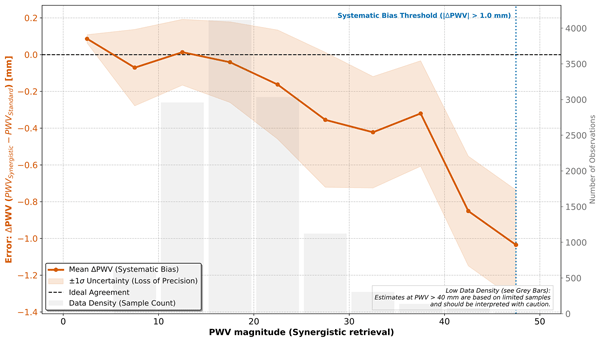
This research improved atmospheric moisture tracking, a key factor in severe weather, over the Eastern Mediterranean. Standard climate models fail to capture daily temperature shifts, causing significant moisture tracking errors during hot days. By pairing Global Navigation Satellite Systems with dynamic ground sensors, these temperature errors were corrected, halving the uncertainty in moisture measurements. This approach greatly improves climate records.
Rajmal Jat, Akash Sagar Vispute, Sachin D. Ghude, Rajesh Kumar, Vinayak Sinha, Baerbel Sinha, Gaurav Govardhan, Zhining Tao, Prafull P. Yadav, Sandeep Wagh, Sreyashi Debnath, Aditi Rathore, and Madhavan Rajeevan
EGUsphere, https://doi.org/10.5194/egusphere-2026-1302, https://doi.org/10.5194/egusphere-2026-1302, 2026
Short summary
Short summary
This study developed a simplified and computationally efficient secondary organic aerosol parameterization in the MOZART–GOCART scheme within WRF-Chem using volatile organic compound observations in Delhi. This parameterization was evaluated for a period with severe pollution influenced by crop residue burning. Results show that the approach improves the model’s ability to reproduce organic aerosols and fine particulate matter while remaining much faster than more complex chemical schemes.
Sachin Mishra, Vinayak Sinha, Haseeb Hakkim, Arpit Awasthi, Sachin D. Ghude, Vijay Kumar Soni, Narendra Nigam, Baerbel Sinha, and Madhavan N. Rajeevan
Atmos. Chem. Phys., 24, 13129–13150, https://doi.org/10.5194/acp-24-13129-2024, https://doi.org/10.5194/acp-24-13129-2024, 2024
Short summary
Short summary
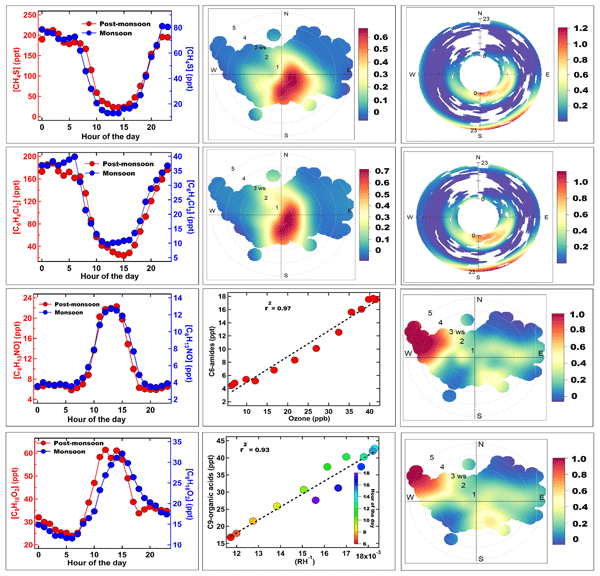
We quantified 111 gases using mass spectrometry to understand how seasonal and emission changes lead from clean air in the monsoon season to extremely polluted air in the post-monsoon season in Delhi. Averaged total mass concentrations (260 µg m-3) were > 4 times in polluted periods, driven by biomass burning emissions and reduced atmospheric ventilation. Reactive gaseous nitrogen, chlorine, and sulfur compounds hitherto unreported from such a polluted environment were discovered.
Arpit Awasthi, Baerbel Sinha, Haseeb Hakkim, Sachin Mishra, Varkrishna Mummidivarapu, Gurmanjot Singh, Sachin D. Ghude, Vijay Kumar Soni, Narendra Nigam, Vinayak Sinha, and Madhavan N. Rajeevan
Atmos. Chem. Phys., 24, 10279–10304, https://doi.org/10.5194/acp-24-10279-2024, https://doi.org/10.5194/acp-24-10279-2024, 2024
Short summary
Short summary
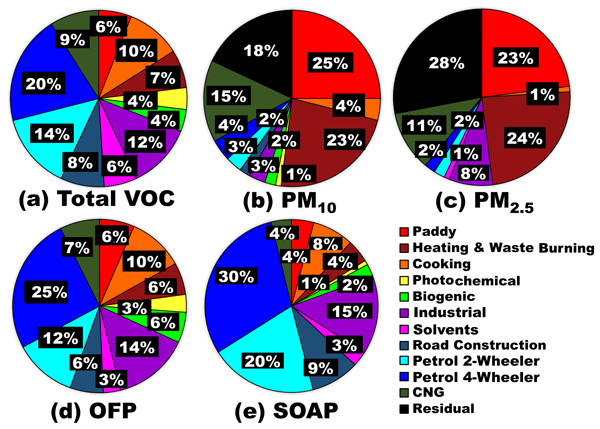
We use 111 volatile organic compounds (VOCs), PM10, and PM2.5 in a positive matrix factorization (PMF) model to resolve 11 pollution sources validated with chemical fingerprints. Crop residue burning and heating account for ~ 50 % of the PM, while traffic and industrial emissions dominate the gas-phase VOC burden and formation potential of secondary organic aerosols (> 60 %). Non-tailpipe emissions from compressed-natural-gas-fuelled commercial vehicles dominate the transport sector's PM burden.
Akinleye Folorunsho, Jimy Dudhia, John Sullivan, Paul Walter, James Flynn, Travis Griggs, Rebecca Sheesley, Sascha Usenko, Guillaume Gronoff, Mark Estes, and Yang Li
EGUsphere, https://doi.org/10.5194/egusphere-2024-1190, https://doi.org/10.5194/egusphere-2024-1190, 2024
Preprint archived
Short summary
Short summary
Our study investigates the factors driving high ozone levels over the Houston urban area. Using advanced modeling techniques and real-world measurements, we found vehicle and industrial emissions especially of highly reactive organic compounds play a key role in ozone formation. Our study highlights spatial and temporal changes in ozone sensitivity and variability of atmosphere's self-cleaning capacity to emissions, signifying effective ways of controlling emissions to mitigate urban ozone.
Chandrakala Bharali, Mary Barth, Rajesh Kumar, Sachin D. Ghude, Vinayak Sinha, and Baerbel Sinha
Atmos. Chem. Phys., 24, 6635–6662, https://doi.org/10.5194/acp-24-6635-2024, https://doi.org/10.5194/acp-24-6635-2024, 2024
Short summary
Short summary
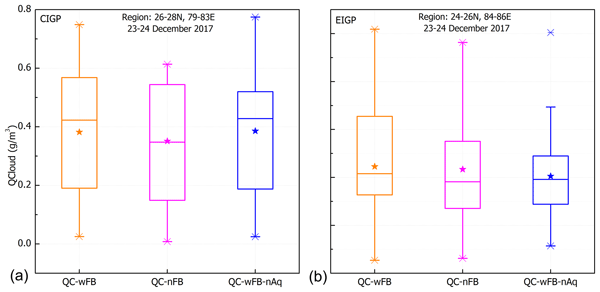
This study examines the role of atmospheric aerosols in winter fog over the Indo-Gangetic Plains of India using WRF-Chem. The increase in RH with aerosol–radiation feedback (ARF) is found to be important for fog formation as it promotes the growth of aerosols in the polluted environment. Aqueous-phase chemistry in the fog increases PM2.5 concentration, further affecting ARF. ARF and aqueous-phase chemistry affect the fog intensity and the timing of fog formation by ~1–2 h.
Gaurav Govardhan, Sachin D. Ghude, Rajesh Kumar, Sumit Sharma, Preeti Gunwani, Chinmay Jena, Prafull Yadav, Shubhangi Ingle, Sreyashi Debnath, Pooja Pawar, Prodip Acharja, Rajmal Jat, Gayatry Kalita, Rupal Ambulkar, Santosh Kulkarni, Akshara Kaginalkar, Vijay K. Soni, Ravi S. Nanjundiah, and Madhavan Rajeevan
Geosci. Model Dev., 17, 2617–2640, https://doi.org/10.5194/gmd-17-2617-2024, https://doi.org/10.5194/gmd-17-2617-2024, 2024
Short summary
Short summary
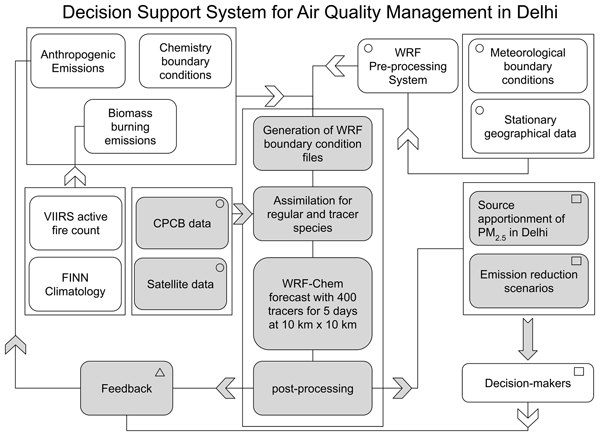
A newly developed air quality forecasting framework, Decision Support System (DSS), for air quality management in Delhi, India, provides source attribution with numerous emission reduction scenarios besides forecasts. DSS shows that during post-monsoon and winter seasons, Delhi and its neighboring districts contribute to 30 %–40 % each to pollution in Delhi. On average, a 40 % reduction in the emissions in Delhi and the surrounding districts would result in a 24 % reduction in Delhi's pollution.

Pooja V. Pawar, Sachin D. Ghude, Gaurav Govardhan, Prodip Acharja, Rachana Kulkarni, Rajesh Kumar, Baerbel Sinha, Vinayak Sinha, Chinmay Jena, Preeti Gunwani, Tapan Kumar Adhya, Eiko Nemitz, and Mark A. Sutton
Atmos. Chem. Phys., 23, 41–59, https://doi.org/10.5194/acp-23-41-2023, https://doi.org/10.5194/acp-23-41-2023, 2023
Short summary
Short summary
In this study, for the first time in South Asia we compare simulated ammonia, ammonium, and total ammonia using the WRF-Chem model and MARGA measurements during winter in the Indo-Gangetic Plain region. Since observations show HCl promotes the fraction of high chlorides in Delhi, we added HCl / Cl emissions to the model. We conducted three sensitivity experiments with changes in HCl emissions, and improvements are reported in accurately simulating ammonia, ammonium, and total ammonia.
Cited articles
Adler, G., Riziq, A. A., Erlick, C., and Rudich, Y.: Effect of intrinsic organic carbon on the optical properties of fresh diesel soot, P. Natl. Acad. Sci. USA, 107, 6699–6704, https://doi.org/10.1073/pnas.0903311106, 2010.
Agnihotri, R., Mishra, S. K., Yadav, P., Singh, S., Rashmi, R., Prasad, M. V. S. N., Sharma, C., and Arya, B. C.: Bulk Level to Individual Particle Level Chemical Composition of Atmospheric Dust Aerosols (PM5) over a Semi-Arid Urban Zone of Western India (Rajasthan), Aerosol Air Qual. Res., 15, 58–71, https://doi.org/10.4209/aaqr.2013.08.0270, 2015.
Ambulkar, R., Govardhan, G., Gavhale, S., Kalita, G., Pande, C., Jat, R., Kulkarni, S., Khare, M., Attri, S. D., and Ghude, S. D.: Crop Residue Burning in North-Western India: Emission Estimation and Uncertainty Quantification, J. Geophys. Res.-Atmos., 130, e2024JD042198, https://doi.org/10.1029/2024JD042198, 2025.
Armour, K., Forster, P., Storelvmo, T., Collins, W., Dufresne, J.-L., Frame, D., Lunt, D., Mauritsen, T., Palmer, M., Watanabe, M., Wild, M., Zhang, H., Alterskjaer, K., and Smith, C.: The Earths energy budget, climate feedbacks, and climate sensitivity, in: AGU Fall Meeting Abstracts, U13B-07, 2021.
Baklanov, A., Schlünzen, K., Suppan, P., Baldasano, J., Brunner, D., Aksoyoglu, S., Carmichael, G., Douros, J., Flemming, J., Forkel, R., Galmarini, S., Gauss, M., Grell, G., Hirtl, M., Joffre, S., Jorba, O., Kaas, E., Kaasik, M., Kallos, G., Kong, X., Korsholm, U., Kurganskiy, A., Kushta, J., Lohmann, U., Mahura, A., Manders-Groot, A., Maurizi, A., Moussiopoulos, N., Rao, S. T., Savage, N., Seigneur, C., Sokhi, R. S., Solazzo, E., Solomos, S., Sørensen, B., Tsegas, G., Vignati, E., Vogel, B., and Zhang, Y.: Online coupled regional meteorology chemistry models in Europe: current status and prospects, Atmos. Chem. Phys., 14, 317–398, https://doi.org/10.5194/acp-14-317-2014, 2014.
Barnard, J. C., Fast, J. D., Paredes-Miranda, G., Arnott, W. P., and Laskin, A.: Technical Note: Evaluation of the WRF-Chem “Aerosol Chemical to Aerosol Optical Properties” Module using data from the MILAGRO campaign, Atmos. Chem. Phys., 10, 7325–7340, https://doi.org/10.5194/acp-10-7325-2010, 2010.
Bellouin, N., Quaas, J., Gryspeerdt, E., Kinne, S., Stier, P., Watson-Parris, D., Boucher, O., Carslaw, K. S., Christensen, M., Daniau, A.-L., Dufresne, J.-L., Feingold, G., Fiedler, S., Forster, P., Gettelman, A., Haywood, J. M., Lohmann, U., Malavelle, F., Mauritsen, T., McCoy, D. T., Myhre, G., Mülmenstädt, J., Neubauer, D., Possner, A., Rugenstein, M., Sato, Y., Schulz, M., Schwartz, S. E., Sourdeval, O., Storelvmo, T., Toll, V., Winker, D., and Stevens, B.: Bounding Global Aerosol Radiative Forcing of Climate Change, Rev. Geophys., 58, e2019RG000660, https://doi.org/10.1029/2019RG000660, 2020.
Bender, F. A.-M.: Aerosol Forcing: Still Uncertain, Still Relevant, AGU Adv., 1, e2019AV000128, https://doi.org/10.1029/2019AV000128, 2020.
Bond, T. C. and Bergstrom, R. W.: Light Absorption by Carbonaceous Particles: An Investigative Review, Aerosol Sci. Tech., 40, 27–67, https://doi.org/10.1080/02786820500421521, 2006.
Businger, J. A., Wyngaard, J. C., Izumi, Y., and Bradley, E. F.: Flux-Profile Relationships in the Atmospheric Surface Layer, J. Atmos. Sci., 28, 181–189, https://doi.org/10.1175/1520-0469(1971)028<0181:FPRITA>2.0.CO;2, 1971.
Chang, H. and Charalampopoulos, T. T.: Determination of the wavelength dependence of refractive indices of flame soot, P. Roy. Soc. Lond. A Mat., 430, 577–591, https://doi.org/10.1098/rspa.1990.0107, 1990.
Chen, F. and Dudhia, J.: Coupling an Advanced Land Surface–Hydrology Model with the Penn State–NCAR MM5 Modeling System. Part I: Model Implementation and Sensitivity, Mon. Weather Rev., 129, 569–585, https://doi.org/10.1175/1520-0493(2001)129<0569:CAALSH>2.0.CO;2, 2001.
Chen, Y. and Bond, T. C.: Light absorption by organic carbon from wood combustion, Atmos. Chem. Phys., 10, 1773–1787, https://doi.org/10.5194/acp-10-1773-2010, 2010.
Chin, M., Rood, R. B., Lin, S., Müller, J., and Thompson, A. M.: Atmospheric sulfur cycle simulated in the global model GOCART: Model description and global properties, J. Geophys. Res.-Atmos., 105, 24671–24687, https://doi.org/10.1029/2000JD900384, 2000.
Chou, M.-D. and Suarez, M. J.: A solar radiation parameterization for atmospheric studies, NASA/TM-1999-104606/VOL15, NASA Goddard Space Flight Center, Greenbelt, MD, USA, https://ntrs.nasa.gov/api/citations/19990060930/downloads/19990060930.pdf (last access: 10 September 2026), 1999.
Collins, W. D., Rasch, P. J., Boville, B. A., Hack, J. J., McCaa, J. R., Williamson, D. L., Kiehl, J. T., and Briegleb, B.: Description of the NCAR Community Atmosphere Model (CAM 3.0), NCAR Tech. Note NCAR/TN-464+STR, National Center for Atmospheric Research, Boulder, CO, USA, https://www2.mmm.ucar.edu/wrf/users/physics/phys_refs/SW_LW/CAM.pdf (last access: 10 September 2026), 2004.
Ding, A. J., Huang, X., Nie, W., Sun, J. N., Kerminen, V.-M., Petäjä, T., Su, H., Cheng, Y. F., Yang, X.-Q., Wang, M. H., Chi, X. G., Wang, J. P., Virkkula, A., Guo, W. D., Yuan, J., Wang, S. Y., Zhang, R. J., Wu, Y. F., Song, Y., Zhu, T., Zilitinkevich, S., Kulmala, M., and Fu, C. B.: Enhanced haze pollution by black carbon in megacities in China, Geophys. Res. Lett., 43, 2873–2879, https://doi.org/10.1002/2016GL067745, 2016.
Emmons, L. K., Walters, S., Hess, P. G., Lamarque, J.-F., Pfister, G. G., Fillmore, D., Granier, C., Guenther, A., Kinnison, D., Laepple, T., Orlando, J., Tie, X., Tyndall, G., Wiedinmyer, C., Baughcum, S. L., and Kloster, S.: Description and evaluation of the Model for Ozone and Related chemical Tracers, version 4 (MOZART-4), Geosci. Model Dev., 3, 43–67, https://doi.org/10.5194/gmd-3-43-2010, 2010.
Fast, J. D., Gustafson, W. I., Easter, R. C., Zaveri, R. A., Barnard, J. C., Chapman, E. G., Grell, G. A., and Peckham, S. E.: Evolution of ozone, particulates, and aerosol direct radiative forcing in the vicinity of Houston using a fully coupled meteorology-chemistry-aerosol model, J. Geophys. Res.-Atmos., 111, 2005JD006721, https://doi.org/10.1029/2005JD006721, 2006.
Friedl, M. A., McIver, D. K., Hodges, J. C. F., Zhang, X. Y., Muchoney, D., Strahler, A. H., Woodcock, C. E., Gopal, S., Schneider, A., Cooper, A., Baccini, A., Gao, F., and Schaaf, C.: Global land cover mapping from MODIS: algorithms and early results, Remote Sens. Environ., 83, 287–302, https://doi.org/10.1016/S0034-4257(02)00078-0, 2002.
Ghan, S., Laulainen, N., Easter, R., Wagener, R., Nemesure, S., Chapman, E., Zhang, Y., and Leung, R.: Evaluation of aerosol direct radiative forcing in MIRAGE, J. Geophys. Res.-Atmos., 106, 5295–5316, https://doi.org/10.1029/2000JD900502, 2001.
Ghude, S. D., Bhat, G. S., Prabhakaran, T., Jenamani, R. K., Chate, D. M., Safai, P. D., Karipot, A. K., Konwar, M., Pithani, P., Sinha, V., Rao, P. S. P., Dixit, S. A., Tiwari, S., Todekar, K., Varpe, S., Srivastava, A. K., Bisht, D. S., Murugavel, P., Ali, K., Mina, U., Dharua, M., Jaya Rao, Y., Padmakumari, B., Hazra, A., Nigam, N., Shende, U., Lal, D. M., Chandra, B. P., Mishra, A. K., Kumar, A., Hakkim, H., Pawar, H., Acharja, P., Kulkarni, R., Subharthi, C., Balaji, B., Varghese, M., Bera, S., and Rajeevan, M.: Winter fog experiment over the Indo-Gangetic plains of India, Curr. Sci.-India, 112, 767–784, https://doi.org/10.18520/cs/v112/i04/767-784, 2017.
Ghude, S. D., Kumar, R., Jena, C., Debnath, S., Kulkarni, R. G., Alessandrini, S., Biswas, M., Kulkrani, S., Pithani, P., Kelkar, S., Sajjan, V., Chate, D. M., Soni, V. K., Singh, S., Nanjundiah, R. S., and Rajeevan, M.: Evaluation of PM2.5 forecast using chemical data assimilation in the WRF-Chem model, Curr. Sci.-India, 118, 1803–1815, 2020.
Ghude, S. D., Jenamani, R. K., Kulkarni, R., Wagh, S., Dhangar, N. G., Parde, A. N., Acharja, P., Lonkar, P., Govardhan, G., Yadav, P., Vispute, A., Debnath, S., Lal, D. M., Bisht, D. S., Jena, C., Pawar, P. V., Dhankhar, S. S., Sinha, V., Chate, D. M., Safai, P. D., Nigam, N., Konwar, M., Hazra, A., Dharmaraj, T., Gopalkrishnan, V., Padmakumari, B., Gultepe, I., Biswas, M., Karipot, A. K., Prabhakaran, T., Nanjundiah, R. S., and Rajeevan, M.: WiFEX: Walk into the Warm Fog over Indo-Gangetic Plain Region, B. Am. Meteorol. Soc., 104, E980–E1005, https://doi.org/10.1175/BAMS-D-21-0197.1, 2023.
Ghude, S. D., Govardhan, G., Kumar, R., Yadav, P. P., Jat, R., Debnath, S., Kalita, G., Jena, C., Ingle, S., Gunwani, P., Pawar, P. V., Ambulkar, R., Kumar, S., Kulkarni, S., Kulkarni, A., Khare, M., Kaginalkar, A., Soni, V. K., Nigam, N., Ray, K., Atri, S. D., Nanjundiah, R., and Rajeevan, M.: Air Quality Warning and Integrated Decision Support System for Emissions (AIRWISE): Enhancing Air Quality Management in Megacities, B. Am. Meteorol. Soc., 105, E2525–E2550, https://doi.org/10.1175/BAMS-D-23-0181.1, 2024.
Glotfelty, T., Alapaty, K., He, J., Hawbecker, P., Song, X., and Zhang, G.: The Weather Research and Forecasting Model with Aerosol–Cloud Interactions (WRF-ACI): Development, Evaluation, and Initial Application, Mon. Weather Rev., 147, 1491–1511, https://doi.org/10.1175/MWR-D-18-0267.1, 2019.
Goudie, A. S.: Dust storms and their geomorphological implications, J. Arid Environ., 1, 291–311, https://doi.org/10.1016/S0140-1963(18)31712-9, 1978.
Govardhan, G., Nanjundiah, R. S., Satheesh, S. K., Krishnamoorthy, K., and Kotamarthi, V. R.: Performance of WRF-Chem over Indian region: Comparison with measurements, J. Earth Syst. Sci., 124, 875–896, https://doi.org/10.1007/s12040-015-0576-7, 2015.
Govardhan, G., Ambulkar, R., Kulkarni, S., Vishnoi, A., Yadav, P., Choudhury, B. A., Khare, M., and Ghude, S. D.: Stubble-burning activities in north-western India in 2021: Contribution to air pollution in Delhi, Heliyon, 9, e16939, https://doi.org/10.1016/j.heliyon.2023.e16939, 2023.
Govardhan, G., Ghude, S. D., Kumar, R., Sharma, S., Gunwani, P., Jena, C., Yadav, P., Ingle, S., Debnath, S., Pawar, P., Acharja, P., Jat, R., Kalita, G., Ambulkar, R., Kulkarni, S., Kaginalkar, A., Soni, V. K., Nanjundiah, R. S., and Rajeevan, M.: Decision Support System version 1.0 (DSS v1.0) for air quality management in Delhi, India, Geosci. Model Dev., 17, 2617–2640, https://doi.org/10.5194/gmd-17-2617-2024, 2024.
Graber, E. R. and Rudich, Y.: Atmospheric HULIS: How humic-like are they? A comprehensive and critical review, Atmos. Chem. Phys., 6, 729–753, https://doi.org/10.5194/acp-6-729-2006, 2006.
Grell, G. A. and Freitas, S. R.: A scale and aerosol aware stochastic convective parameterization for weather and air quality modeling, Atmos. Chem. Phys., 14, 5233–5250, https://doi.org/10.5194/acp-14-5233-2014, 2014.
Grell, G. A., Peckham, S. E., Schmitz, R., McKeen, S. A., Frost, G., Skamarock, W. C., and Eder, B.: Fully coupled “online” chemistry within the WRF model, Atmos. Environ., 39, 6957–6975, https://doi.org/10.1016/j.atmosenv.2005.04.027, 2005.
Guenther, A., Karl, T., Harley, P., Wiedinmyer, C., Palmer, P. I., and Geron, C.: Estimates of global terrestrial isoprene emissions using MEGAN (Model of Emissions of Gases and Aerosols from Nature), Atmos. Chem. Phys., 6, 3181–3210, https://doi.org/10.5194/acp-6-3181-2006, 2006.
Han, Y.: JCSDA community radiative transfer model (CRTM): Version 1, NOAA Technical Report NESDIS 122, National Oceanic and Atmospheric Administration (NOAA), https://repository.library.noaa.gov/view/noaa/1157 (last access: 10 September 2026), 2006.
Haugvaldstad, O. W., Olivié, D., Storelvmo, T., and Schulz, M.: Dust radiative forcing in CMIP6 Earth System models: insights from the AerChemMIP piClim-2xdust experiment, Atmos. Chem. Phys., 25, 13199–13219, https://doi.org/10.5194/acp-25-13199-2025, 2025.
Haywood, J. and Boucher, O.: Estimates of the direct and indirect radiative forcing due to tropospheric aerosols: A review, Rev. Geophys., 38, 513–543, https://doi.org/10.1029/1999RG000078, 2000.
Haywood, J. M. and Shine, K. P.: The effect of anthropogenic sulfate and soot aerosol on the clear sky planetary radiation budget, Geophys. Res. Lett., 22, 603–606, https://doi.org/10.1029/95GL00075, 1995.
Hersbach, H., Bell, B., Berrisford, P., Hirahara, S., Horányi, A., Muñoz-Sabater, J., Nicolas, J., Peubey, C., Radu, R., Schepers, D., Simmons, A., Soci, C., Abdalla, S., Abellan, X., Balsamo, G., Bechtold, P., Biavati, G., Bidlot, J., Bonavita, M., De Chiara, G., Dahlgren, P., Dee, D., Diamantakis, M., Dragani, R., Flemming, J., Forbes, R., Fuentes, M., Geer, A., Haimberger, L., Healy, S., Hogan, R. J., Hólm, E., Janisková, M., Keeley, S., Laloyaux, P., Lopez, P., Lupu, C., Radnoti, G., De Rosnay, P., Rozum, I., Vamborg, F., Villaume, S., and Thépaut, J.: The ERA5 global reanalysis, Q. J. Roy. Meteor. Soc., 146, 1999–2049, https://doi.org/10.1002/qj.3803, 2020.
Hess, M., Koepke, P., and Schult, I.: Optical Properties of Aerosols and Clouds: The Software Package OPAC, B. Am. Meteorol. Soc., 79, 831–844, https://doi.org/10.1175/1520-0477(1998)079<0831:OPOAAC>2.0.CO;2, 1998.
Hodnebrog, Ø., Aunan, K., Chowdhury, S., Marelle, L., Myhre, G., Stjern, C. W., and Wang, S.: Strong reduction in near-surface turbulence due to aerosols in South and East Asia, Npj Clean Air, 1, 9, https://doi.org/10.1038/s44407-025-00009-6, 2025.
Hong, S.-Y. and Lim, J.-O. J.: The WRF single-moment 6-class microphysics scheme (WSM6), Asia-Pac. J. Atmos. Sci., 42, 129–151, 2006.
Iacono, M. J., Delamere, J. S., Mlawer, E. J., Shephard, M. W., Clough, S. A., and Collins, W. D.: Radiative forcing by long-lived greenhouse gases: Calculations with the AER radiative transfer models, J. Geophys. Res.-Atmos., 113, 2008JD009944, https://doi.org/10.1029/2008JD009944, 2008.
Janssens-Maenhout, G., Crippa, M., Guizzardi, D., Dentener, F., Muntean, M., Pouliot, G., Keating, T., Zhang, Q., Kurokawa, J., Wankmüller, R., Denier van der Gon, H., Kuenen, J. J. P., Klimont, Z., Frost, G., Darras, S., Koffi, B., and Li, M.: HTAP_v2.2: a mosaic of regional and global emission grid maps for 2008 and 2010 to study hemispheric transport of air pollution, Atmos. Chem. Phys., 15, 11411–11432, https://doi.org/10.5194/acp-15-11411-2015, 2015.
Jena, C., Ghude, S. D., Kumar, R., Debnath, S., Govardhan, G., Soni, V. K., Kulkarni, S. H., Beig, G., Nanjundiah, R. S., and Rajeevan, M.: Performance of high resolution (400 m) PM2.5 forecast over Delhi, Sci. Rep.-UK, 11, 4104, https://doi.org/10.1038/s41598-021-83467-8, 2021.
Kanakidou, M., Seinfeld, J. H., Pandis, S. N., Barnes, I., Dentener, F. J., Facchini, M. C., Van Dingenen, R., Ervens, B., Nenes, A., Nielsen, C. J., Swietlicki, E., Putaud, J. P., Balkanski, Y., Fuzzi, S., Horth, J., Moortgat, G. K., Winterhalter, R., Myhre, C. E. L., Tsigaridis, K., Vignati, E., Stephanou, E. G., and Wilson, J.: Organic aerosol and global climate modelling: a review, Atmos. Chem. Phys., 5, 1053–1123, https://doi.org/10.5194/acp-5-1053-2005, 2005.
Kant, S., Kumar, N., and Jenamani, R. K.: Assessment of fog conditions over capital city Delhi (India) during December 2023–January 2024, Nat. Hazards, 121, 12077–12093, https://doi.org/10.1007/s11069-025-07273-5, 2025.
Kim, D. and Ramanathan, V.: Solar radiation budget and radiative forcing due to aerosols and clouds, J. Geophys. Res.-Atmos., 113, 2007JD008434, https://doi.org/10.1029/2007JD008434, 2008.
Kim, J., Petzold, A., Lottin, D., Hitzenberger, R., Ferry, D., Bauer, H., and Dobovicnik, T.: Constraining optical properties and refractive index of soot through combined experimental and modelling studies, European Aerosol Conference 2012, Contribution No. 335, A-WG01S1P04, Granada, Spain, https://juser.fz-juelich.de/record/23021 (last access: 10 September 2026), 2 September 2012.
Kirchstetter, T. W., Novakov, T., and Hobbs, P. V.: Evidence that the spectral dependence of light absorption by aerosols is affected by organic carbon, J. Geophys. Res.-Atmos., 109, 2004JD004999, https://doi.org/10.1029/2004JD004999, 2004.
Koven, C. D. and Fung, I.: Inferring dust composition from wavelength-dependent absorption in Aerosol Robotic Network (AERONET) data, J. Geophys. Res.-Atmos., 111, 2005JD006678, https://doi.org/10.1029/2005JD006678, 2006.
Kumar, R., Ghude, S. D., Biswas, M., Jena, C., Alessandrini, S., Debnath, S., Kulkarni, S., Sperati, S., Soni, V. K., Nanjundiah, R. S., and Rajeevan, M.: Enhancing Accuracy of Air Quality and Temperature Forecasts During Paddy Crop Residue Burning Season in Delhi Via Chemical Data Assimilation, J. Geophys. Res.-Atmos., 125, e2020JD033019, https://doi.org/10.1029/2020JD033019, 2020.
Kwon, Y. C. and Hong, S.-Y.: A Mass-Flux Cumulus Parameterization Scheme across Gray-Zone Resolutions, Mon. Weather Rev., 145, 583–598, https://doi.org/10.1175/MWR-D-16-0034.1, 2017.
Lafon, S., Sokolik, I. N., Rajot, J. L., Caquineau, S., and Gaudichet, A.: Characterization of iron oxides in mineral dust aerosols: Implications for light absorption, J. Geophys. Res.-Atmos., 111, 2005JD007016, https://doi.org/10.1029/2005JD007016, 2006.
Lettau, H. and Lettau, K.: Shortwave radiation climatonomy, Tellus A, 21, 208, https://doi.org/10.3402/tellusa.v21i2.10075, 1969.
Li, Z., Guo, J., Ding, A., Liao, H., Liu, J., Sun, Y., Wang, T., Xue, H., Zhang, H., and Zhu, B.: Aerosol and boundary-layer interactions and impact on air quality, Natl. Sci. Rev., 4, 810–833, https://doi.org/10.1093/nsr/nwx117, 2017.
Liu, F., Yon, J., Fuentes, A., Lobo, P., Smallwood, G. J., and Corbin, J. C.: Review of recent literature on the light absorption properties of black carbon: Refractive index, mass absorption cross section, and absorption function, Aerosol Sci. Tech., 54, 33–51, https://doi.org/10.1080/02786826.2019.1676878, 2020.
Mishra, S. K. and Tripathi, S. N.: Modeling optical properties of mineral dust over the Indian Desert, J. Geophys. Res.-Atmos., 113, 2008JD010048, https://doi.org/10.1029/2008JD010048, 2008.
Mishra, S. K., Ahlawat, A., Khosla, D., Sharma, C., Prasad, M. V. S. N., Singh, S., Gupta, B., Tulsi, Sethi, D., Sinha, P. R., Ojha, D. K., Wiedensohler, A., and Kotnala, R. K.: Experimental investigation of variations in morphology, composition and mixing-state of boundary layer aerosol: A balloon based study over urban environment (New Delhi), Atmos. Environ., 185, 243–252, https://doi.org/10.1016/j.atmosenv.2018.04.053, 2018.
Mlawer, E. J., Taubman, S. J., Brown, P. D., Iacono, M. J., and Clough, S. A.: Radiative transfer for inhomogeneous atmospheres: RRTM, a validated correlated-k model for the longwave, J. Geophys. Res.-Atmos., 102, 16663–16682, https://doi.org/10.1029/97JD00237, 1997.
Moteki, N.: Climate-relevant properties of black carbon aerosols revealed by in situ measurements: a review, Prog. Earth Planet. Sci., 10, 12, https://doi.org/10.1186/s40645-023-00544-4, 2023.
Nakanishi, M. and Niino, H.: An Improved Mellor–Yamada Level-3 Model with Condensation Physics: Its Design and Verification, Bound.-Lay. Meteorol., 112, 1–31, https://doi.org/10.1023/B:BOUN.0000020164.04146.98, 2004.
Negi, B. S., Sadasivan, S., Nambi, K. S. V., and Pande, B. M.: Characterization of atmospheric dust at Gurushikar, Mt. Abu, Rajasthan, Environ. Monit. Assess., 40, 253–259, https://doi.org/10.1007/BF00398870, 1996.
Negi, B. S., Jha, S. K., Chavan, S. B., Sadasivan, S., Goyal, A., Sapru, M. L., and Bhat, C. L.: Atmospheric Dust Loads and Their Elemental Composition at a Background Site in India, Environ. Monit. Assess., 73, 1–6, https://doi.org/10.1023/A:1012619711336, 2002.
Parde, A. N., Ghude, S. D., Sharma, A., Dhangar, N. G., Govardhan, G., Wagh, S., Jenamani, R. K., Pithani, P., Chen, F., Rajeevan, M., and Niyogi, D.: Improving simulation of the fog life cycle with high-resolution land data assimilation: A case study from WiFEX, Atmos. Res., 278, 106331, https://doi.org/10.1016/j.atmosres.2022.106331, 2022.
Powers, J. G., Klemp, J. B., Skamarock, W. C., Davis, C. A., Dudhia, J., Gill, D. O., Coen, J. L., Gochis, D. J., Ahmadov, R., Peckham, S. E., Grell, G. A., Michalakes, J., Trahan, S., Benjamin, S. G., Alexander, C. R., Dimego, G. J., Wang, W., Schwartz, C. S., Romine, G. S., Liu, Z., Snyder, C., Chen, F., Barlage, M. J., Yu, W., and Duda, M. G.: The Weather Research and Forecasting Model: Overview, System Efforts, and Future Directions, B. Am. Meteorol. Soc., 98, 1717–1737, https://doi.org/10.1175/BAMS-D-15-00308.1, 2017.
Ramanathan, V., Crutzen, P. J., Kiehl, J. T., and Rosenfeld, D.: Aerosols, Climate, and the Hydrological Cycle, Science, 294, 2119–2124, https://doi.org/10.1126/science.1064034, 2001.
Ruiz-Arias, J. A., Arbizu-Barrena, C., Santos-Alamillos, F. J., Tovar-Pescador, J., and Pozo-Vázquez, D.: Assessing the Surface Solar Radiation Budget in the WRF Model: A Spatiotemporal Analysis of the Bias and Its Causes, Mon. Weather Rev., 144, 703–711, https://doi.org/10.1175/MWR-D-15-0262.1, 2016.
Saide, P. E., Spak, S. N., Carmichael, G. R., Mena-Carrasco, M. A., Yang, Q., Howell, S., Leon, D. C., Snider, J. R., Bandy, A. R., Collett, J. L., Benedict, K. B., de Szoeke, S. P., Hawkins, L. N., Allen, G., Crawford, I., Crosier, J., and Springston, S. R.: Evaluating WRF-Chem aerosol indirect effects in Southeast Pacific marine stratocumulus during VOCALS-REx, Atmos. Chem. Phys., 12, 3045–3064, https://doi.org/10.5194/acp-12-3045-2012, 2012.
Seinfeld, J. H. and Pandis, S. N.: Atmospheric Chemistry and Physics: From Air Pollution to Climate Change, 3rd Edn., John Wiley & Sons, Inc., Hoboken, New Jersey, USA, ISBN 978-1-118-94740-1, 1152 pp., 2016.
Sengupta, A., Govardhan, G., Debnath, S., Yadav, P., Kulkarni, S. H., Parde, A. N., Lonkar, P., Dhangar, N., Gunwani, P., Wagh, S., Nivdange, S., Jena, C., Kumar, R., and Ghude, S. D.: Probing into the wintertime meteorology and particulate matter (PM2.5 and PM10) forecast over Delhi, Atmos. Pollut. Res., 13, 101426, https://doi.org/10.1016/j.apr.2022.101426, 2022.
Sharma, A., Venkataraman, C., Muduchuru, K., Singh, V., Kesarkar, A., Ghosh, S., and Dey, S.: Aerosol radiative feedback enhances particulate pollution over India: A process understanding, Atmos. Environ., 298, 119609, https://doi.org/10.1016/j.atmosenv.2023.119609, 2023.
Shettle, E. P. and Fenn, R. W.: Models for the aerosols of the lower atmosphere and the effects of humidity variations on their optical properties, Optical Physics Division, Air Force Geophysics Laboratory, Hanscom AFB, Massachusetts, USA, https://www.researchgate.net/publication/235074087_Models_for_the_Aerosols_of_the_Lower_Atmosphere_and_the_Effects_of_Humidity_Variations_on_their_Optical_Properties (last access: 10 September 2026), 1979.
Skamarock, W. C., Klemp, J. B., Dudhia, J., Gill, D. O., Barker, D. M., Duda, M. G., Huang, X.-Y., Wang, W., and Powers, J. G.: A description of the Advanced Research WRF version 3, NCAR Tech. Note NCAR/TN-475+STR, National Center for Atmospheric Research, Boulder, CO, USA, https://www2.mmm.ucar.edu/wrf/users/docs/technote/v3_technote.pdf (last access: 10 September 2026), 2008.
Skamarock, W. C., Klemp, J. B., Dudhia, J., Gill, D. O., Liu, Z., Berner, J., Wang, W., Powers, J. G., Duda, M. G., Barker, D. M., and others: A description of the Advanced Research WRF version 4, NCAR Tech. Note NCAR/TN-556+STR, National Center for Atmospheric Research, Boulder, CO, USA, 145 pp., https://www2.mmm.ucar.edu/wrf/users/docs/technote/v2_technote.pdf (last access: 10 September 2026), 2019.
Sokolik, I. N. and Toon, O. B.: Incorporation of mineralogical composition into models of the radiative properties of mineral aerosol from UV to IR wavelengths, J. Geophys. Res.-Atmos., 104, 9423–9444, https://doi.org/10.1029/1998JD200048, 1999.
Srivastava, P., Dey, S., Srivastava, A. K., Singh, S., and Tiwari, S.: Most probable mixing state of aerosols in Delhi NCR, northern India, Atmos. Res., 200, 88–96, https://doi.org/10.1016/j.atmosres.2017.09.018, 2018.
Stier, P., Schutgens, N. A. J., Bellouin, N., Bian, H., Boucher, O., Chin, M., Ghan, S., Huneeus, N., Kinne, S., Lin, G., Ma, X., Myhre, G., Penner, J. E., Randles, C. A., Samset, B., Schulz, M., Takemura, T., Yu, F., Yu, H., and Zhou, C.: Host model uncertainties in aerosol radiative forcing estimates: results from the AeroCom Prescribed intercomparison study, Atmos. Chem. Phys., 13, 3245–3270, https://doi.org/10.5194/acp-13-3245-2013, 2013.
Stjern, C. W., Hodnebrog, Ø., Myhre, G., and Pisso, I.: The turbulent future brings a breath of fresh air, Nat. Commun., 14, 3735, https://doi.org/10.1038/s41467-023-39298-4, 2023.
Tomasi, C., Fuzzi, S., and Kokhanovsky, A.: Atmospheric Aerosols: Life Cycles and Effects on Air Quality and Climate, John Wiley & Sons, 704 pp., ISBN 978-3-527-33645-6, 2017.
Toon, O. B., Pollack, J. B., and Khare, B. N.: The optical constants of several atmospheric aerosol species: Ammonium sulfate, aluminum oxide, and sodium chloride, J. Geophys. Res., 81, 5733–5748, https://doi.org/10.1029/JC081i033p05733, 1976.
Tuccella, P., Curci, G., Grell, G. A., Visconti, G., Crumeyrolle, S., Schwarzenboeck, A., and Mensah, A. A.: A new chemistry option in WRF-Chem v. 3.4 for the simulation of direct and indirect aerosol effects using VBS: evaluation against IMPACT-EUCAARI data, Geosci. Model Dev., 8, 2749–2776, https://doi.org/10.5194/gmd-8-2749-2015, 2015.
Twomey, S.: The Influence of Pollution on the Shortwave Albedo of Clouds, J. Atmos. Sci., 34, 1149–1152, https://doi.org/10.1175/1520-0469(1977)034<1149:TIOPOT>2.0.CO;2, 1977.
Wiedinmyer, C., Akagi, S. K., Yokelson, R. J., Emmons, L. K., Al-Saadi, J. A., Orlando, J. J., and Soja, A. J.: The Fire INventory from NCAR (FINN): a high resolution global model to estimate the emissions from open burning, Geosci. Model Dev., 4, 625–641, https://doi.org/10.5194/gmd-4-625-2011, 2011.
Wild, M.: Short-wave and long-wave surface radiation budgets in GCMs: a review based on the IPCC-AR4/CMIP3 models, Tellus A, 60, 932, https://doi.org/10.1111/j.1600-0870.2008.00342.x, 2008.
Wu, C., Lin, Z., and Liu, X.: The global dust cycle and uncertainty in CMIP5 (Coupled Model Intercomparison Project phase 5) models, Atmos. Chem. Phys., 20, 10401–10425, https://doi.org/10.5194/acp-20-10401-2020, 2020.
Yu, H., Liu, S. C., and Dickinson, R. E.: Radiative effects of aerosols on the evolution of the atmospheric boundary layer, J. Geophys. Res.-Atmos., 107, https://doi.org/10.1029/2001JD000754, 2002.
Zaveri, R. A., Easter, R. C., Fast, J. D., and Peters, L. K.: Model for Simulating Aerosol Interactions and Chemistry (MOSAIC), J. Geophys. Res.-Atmos., 113, 2007JD008782, https://doi.org/10.1029/2007JD008782, 2008.
Zhang, Y.: Online-coupled meteorology and chemistry models: history, current status, and outlook, Atmos. Chem. Phys., 8, 2895–2932, https://doi.org/10.5194/acp-8-2895-2008, 2008.
Zhao, C., Ruby Leung, L., Easter, R., Hand, J., and Avise, J.: Characterization of speciated aerosol direct radiative forcing over California, J. Geophys. Res.-Atmos., 118, 2372–2388, https://doi.org/10.1029/2012JD018364, 2013.
Short summary
Air pollution poses a major challenge in densely populated megacities, where forecasting severe events is difficult because weather models often poorly represent aerosol interactions with solar radiation. We improved a forecast system by modifying aerosol properties to better reflect real conditions. This reduced radiation errors and improved predictions of temperature, humidity, and pollution levels, resulting in more reliable air quality forecasts.
Air pollution poses a major challenge in densely populated megacities, where forecasting severe...


Altmetrics
Final-revised paper
Preprint