
the Creative Commons Attribution 4.0 License.
the Creative Commons Attribution 4.0 License.
 | 24 Aug 2026
Buffering of atmospheric nanoparticle growth by temperature-dependent shifts in molecular composition, volatility and diffusivity
Zhiqiang Zhang
Hyun Gu Kang
Ulrich Pöschl

Aerosols have a profound influence on climate and human health, but new particle formation in the atmosphere has remained a scientific conundrum. In particular, the growth rates of atmospheric nanoparticles are often smaller and less dependent on condensable vapor concentration than expected. Here, we take a new integrative approach to analyze observational data from field measurements and chamber experiments, which were previously unexplained and appeared inconsistent with theory and model predictions. We show that the observed growth rates can be predicted when the temperature dependence and multiphase kinetics of gas-particle partitioning are resolved. Slow surface-to-bulk transport limits the rates of vapor uptake by semi-solid particles with low diffusivity, whereas shifts in the volatility distribution following the Clausius-Clapeyron equation enhance growth rates at low temperature and concentration levels. These antagonistic effects lead to an effective buffering of the organic vapor concentration dependence of nanoparticle growth in secondary organic aerosols. Our study reveals how counteracting temperature dependencies of organic vapor oxidation, volatility and diffusivity can explain the convergence of growth rates around a few nanometers per hour under widely varying atmospheric conditions.
- Article
(2471 KB) - Full-text XML
-
Supplement
(2172 KB) - BibTeX
- EndNote


Atmospheric aerosols consisting of airborne particles in the nanometer to micrometer size range have a strong influence on air quality, public health, and climate (IPCC, 2023; WHO, 2023). Large fractions of airborne fine particulate matter consist of secondary organic aerosols (SOA) formed by gas-to-particle conversion of organic precursor molecules in the atmosphere (Jimenez et al., 2009; Hallquist et al., 2009; Riipinen et al., 2011; Shrivastava et al., 2017). Over the past decades, numerous studies have investigated atmospheric new particle formation and growth (Kulmala et al., 2004, 2014; Stolzenburg et al., 2023). The rates of nanoparticle growth, however, have remained enigmatic and constitute a gap in the scientific understanding and assessment of atmospheric aerosols and their effects on health and climate (Bianchi et al., 2016; Gordon et al., 2017; Kulmala et al., 2022). In particular, the growth rates of atmospheric SOA particles observed in field measurements are fairly uniform around 1–10 nm h−1 and exhibit a relatively weak dependence on measured organic vapor concentrations that vary by multiple orders of magnitude (Stolzenburg et al., 2018; Yli-Juuti et al., 2020; Stolzenburg et al., 2025). Computational models utilizing volatility basis sets (VBS; Donahue et al., 2006, 2011; Bhattacharyya et al., 2025) were found to reproduce observations under a variety of conditions, while under- or over-predicting nanoparticle growth rates measured in other instances (Stolzenburg et al., 2018; Mohr et al., 2019; Qiao et al., 2021; Stolzenburg et al., 2022; Dada et al., 2023; Cai et al., 2026).
Under atmospheric conditions, organic aerosol particles are expected to exist in highly viscous or semi-solid phase states and may even exhibit an amorphous solid (glassy) state depending on chemical composition, temperature, and humidity (Zobrist et al., 2008; Mikhailov et al., 2009; Virtanen et al., 2010; Koop et al., 2011; Renbaum-Wolff et al., 2013; Shiraiwa et al., 2017; Reid et al., 2018). Accordingly, the molecular diffusivity in SOA particles can vary over a wide range from more than 10−10 cm2 s−1 (liquid) to less than 10−21 cm2 s−1 (glassy), which influences the kinetics of mass transport, gas uptake, and partitioning (Shiraiwa et al., 2011; Berkemeier et al., 2013; Shiraiwa et al., 2014; Zaveri et al., 2018; Li et al., 2026). Earlier studies have shown that diffusivity-limitations can affect the water uptake, heterogeneous chemical transformation, evaporation, and size distribution of organic aerosol particles (Pfrang et al., 2011; Zhou et al., 2013; Arangio et al., 2015; Berkemeier et al., 2014, 2016; Mu et al., 2018; Zaveri et al., 2020; Berkemeier et al., 2020; Schervish et al., 2026; Kang et al., 2026).
Here, we re-analyze observational data of nanoparticle growth from field measurements in the boreal forest (Hyytiälä, Finland) and from sophisticated laboratory experiments (CERN CLOUD), utilizing a new kinetic multilayer model of multiphase chemistry (KM3C) that resolves the reactivity, diffusivity, and concentration gradients of different chemical species across the gas phase, condensed phase, and the interface between them. We demonstrate that SOA nanoparticle growth can be accurately predicted when the relevant thermodynamic and kinetic aspects of aerosol properties, processes, and temperature dependencies are taken into account in an integrative approach of data analysis and numerical modeling.
Figure 1 illustrates how the elucidation of condensed-phase diffusivity and concentration profiles inside SOA particles resolves previously unexplained discrepancies between field measurements and model predictions of condensable organic vapor concentrations and nanoparticle growth rates. As shown in Fig. 1a and reported by Stolzenburg et al. (2025), nanoparticle growth rates observed in the boreal forest summer (blue markers) were substantially lower than those predicted with a two-film model (Zaveri et al., 2014) assuming quasi-liquid particles with high diffusivity (>10−15 cm2 s−1, solid brown line and shading). In their modeling approach, Stolzenburg et al. (2025) considered uncertainties and variations related to condensable vapor concentration measurements, activity coefficients, decomposition reactions, and reduced diffusivity (10−18 cm2 s−1, dashed brown line), but they did not reach agreement with the measurement results and highlighted incomplete mass closure.
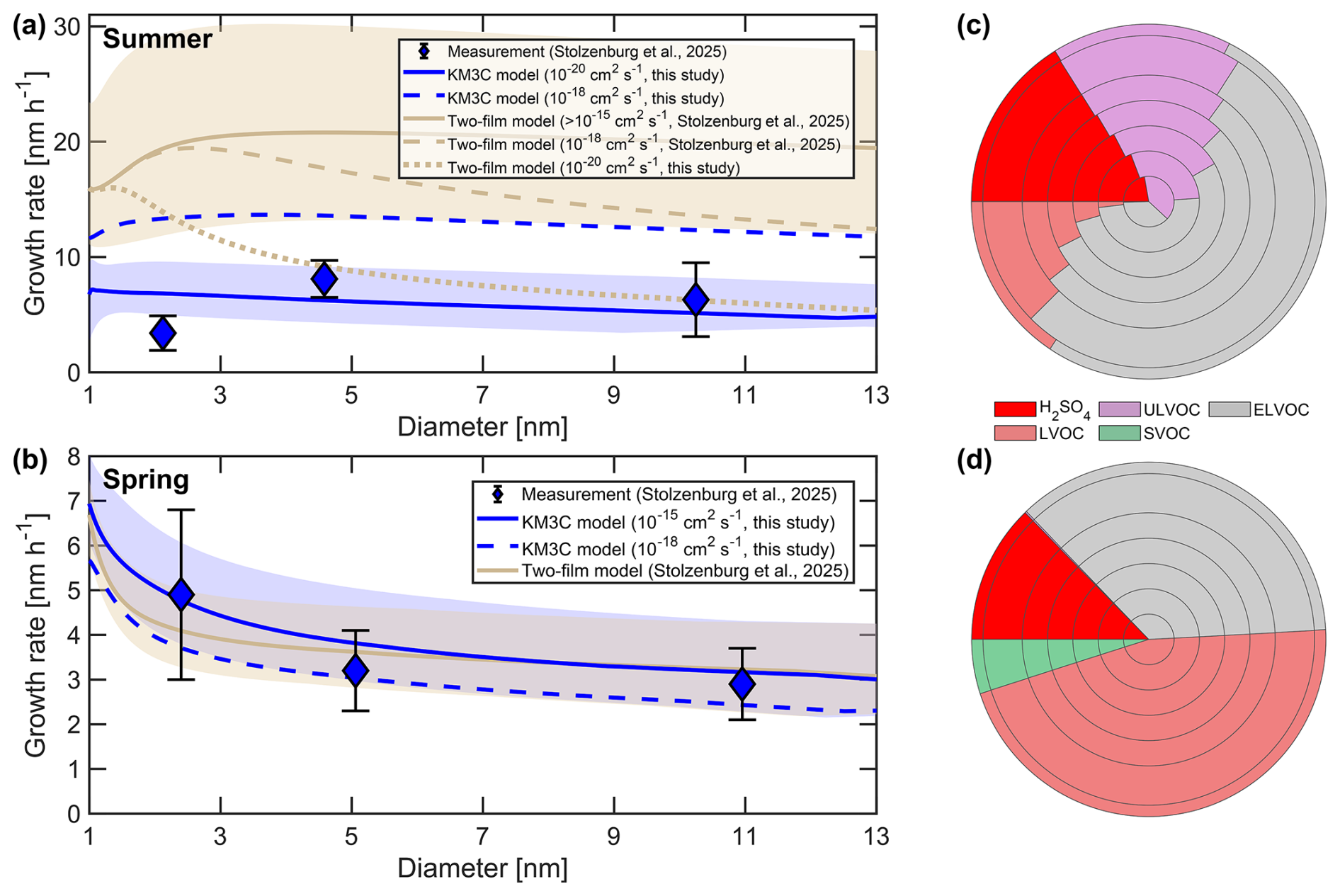
Figure 1Atmospheric nanoparticle growth observed in field measurements. Blue diamond markers and error bars represent arithmetic mean values and standard deviations of growth rates measured in (a) summer and (b) spring at a boreal forest site (Hyytiälä, Finland; Gonzalez Carracedo et al., 2022). Lines and shadings represent model predictions and uncertainty ranges obtained with a traditional two-film model in brown color (Stolzenburg et al., 2025) and with the new multilayer model KM3C in blue color (Sect. S4). KM3C captures the observations assuming low diffusivity (10−20 cm2 s−1) in summer (a) and high diffusivity (10−15 cm2 s−1) in spring (b). With the high and intermediate diffusivities assumed by Stolzenburg et al. (2025), the two-film model matches the observations in spring but not in summer (>10−15 cm2 s−1, solid brown line; 10−18 cm2 s−1, dashed brown line). Inserting the same low diffusivity as in KM3C (10−20 cm2 s−1), the two-film model can also match the summertime observations data for particles larger than 4 nm (dotted line). Note that all diffusivities listed for KM3C represent values at 298 K that are adjusted for temperature with Ea,dif=40 kJ mol−1 in the model, while diffusivities in the two-film model are kept at their nominal values. Radial concentration profiles of sulfuric acid (H2SO4) and organic compounds with different volatilities (ULVOC, ELVOC, LVOC, SVOC) calculated by KM3C show that the growing particles (7 nm) are well-mixed and contain larger proportions of more volatile compounds (LVOC/SVOC) in spring (d). In summer (c), however, the growing particles contain larger proportions of less volatile compounds (ULVOC/ELVOC) and exhibit differential concentration gradients, which reflect kinetic limitations of mass transport.
In contrast, our kinetic multilayer model KM3C is able to reproduce the observed growth rates assuming a diffusivity characteristic for highly viscous, nearly glassy semi-solid substances (10−20 cm2 s−1) and otherwise identical model parameters such as the time-dependent concentrations of condensable organic vapors, their enthalpies of vaporization, and the treatment of the Kelvin effect (Supplement, Sects. S1, S2). Using the same diffusivity in the two-film model published by Stolzenburg et al. (2025), we obtain closure for larger particles sizes, but not below 3 nm (brown dotted line), which indicates that details of interfacial mass transport, molecular diffusion, and differential concentration gradients as resolved in KM3C are relevant for the kinetics of atmospheric nanoparticle growth.
Figure 1c illustrates how low diffusivity leads to the development of differential concentration gradients inside the nanoparticle as described in KM3C, where the outer layers contain higher fractions of relatively more volatile compounds (low-volatile organic compounds, LVOC) compared to the inner layers, which in turn show higher fractions of relatively less volatile compounds (ultra low-volatile organic compounds, ULVOC). This is consistent with the role of ULVOC in new particle formation and nucleation, respectively (Dada et al., 2023; Donahue et al., 2026). The low diffusivity leads to an enrichment of relatively more volatile compounds at the surface, decelerates their uptake into the particle bulk (surface-to-bulk transport), and delays the equilibration of gas-particle partitioning. These effects keep the particle growth rate lower than expected under the assumption of a well-mixed and thus rapidly equilibrating particle phase (Figs. S1, S2 in the Supplement).
As illustrated in Fig. 1b, nanoparticle growth observed in the boreal forest spring was well captured by both the two-film model of Stolzenburg et al. (2025) as well as our multilayer model with higher diffusivity (10−15 cm2 s−1, solid blue line and shading). Under these conditions, the multilayer model shows a well-mixed particle bulk without differential concentration gradients (Fig. 1d), indicating that the growth rates observed and simulated under these conditions are not limited by molecular diffusivity. We find that the sensitivity to particle phase state and diffusivity is less pronounced in the springtime scenario (Fig. S3), and KM3C captures the spring data within experimental errors also at a diffusivity of 10−18 cm2 s−1 (dashed blue line).
The diffusion properties of complex SOA mixtures have not yet been constrained with high precision, but the occurrence of different phase states and diffusivities of SOA nanoparticles in the investigated growth events is consistent with earlier studies (Virtanen et al., 2010; Saukko et al., 2012; Renbaum-Wolff et al., 2013; Bateman et al., 2016; Shiraiwa et al., 2017; Slade et al., 2019; Kiland et al., 2019; Artaxo et al., 2022; Zhang et al., 2024; Antossian et al., 2026; Golay et al., 2026). To obtain quantitative estimates, we performed model calculations with semi-empirical parameterizations that relate glass transition temperatures, viscosities and self-diffusion coefficients to the volatilities of organic compounds, including particle-size and plasticizer effects (Mikhailov et al., 2013; Cheng et al., 2015; Dette and Koop, 2015; Li et al., 2020; Mahant et al., 2024; Kang et al., 2026). As detailed in the online supplement (Sects. S8, S9), these model calculations support that nanoparticle formation and growth by condensation of low-volatile organic vapors yield particles with very high viscosity and low diffusivity in the range of 10−20 to 10−18 cm2 s−1. Due to higher fractions of ULVOC, the diffusivity of newly formed particles in boreal forest air can indeed be lower in summer than in spring (Fig. S5). Despite remaining uncertainties in predicting these properties, our model results demonstrate that kinetic limitations related to particle-phase diffusivity of condensable organic vapors offer a plausible, coherent, and quantitative explanation for previously unexplained observations.
Figure 2 shows nanoparticle growth rates measured under very well defined conditions in the CERN CLOUD chamber (Stolzenburg et al., 2018). For particles in the diameter range of 1.5 to 3 nm (Fig. 2a), the growth rates observed at 5 °C are near the kinetic limit derived by Stolzenburg et al. (2025) from the concentration of oxidized organic molecules (OOMs) measured by nitrate chemical ionization mass spectrometry (NO3-CIMS). The rates observed at −25 and 25 °C, however, are well above and below the kinetic limit (OOMs) line, respectively, and were not captured by this modeling approach (Stolzenburg et al., 2025). In the particle size range of 3 to 7 nm (Fig. 2b), the observed growth rates are close to the reported kinetic limit at 5 and 25 °C, but again much higher at −25 °C.
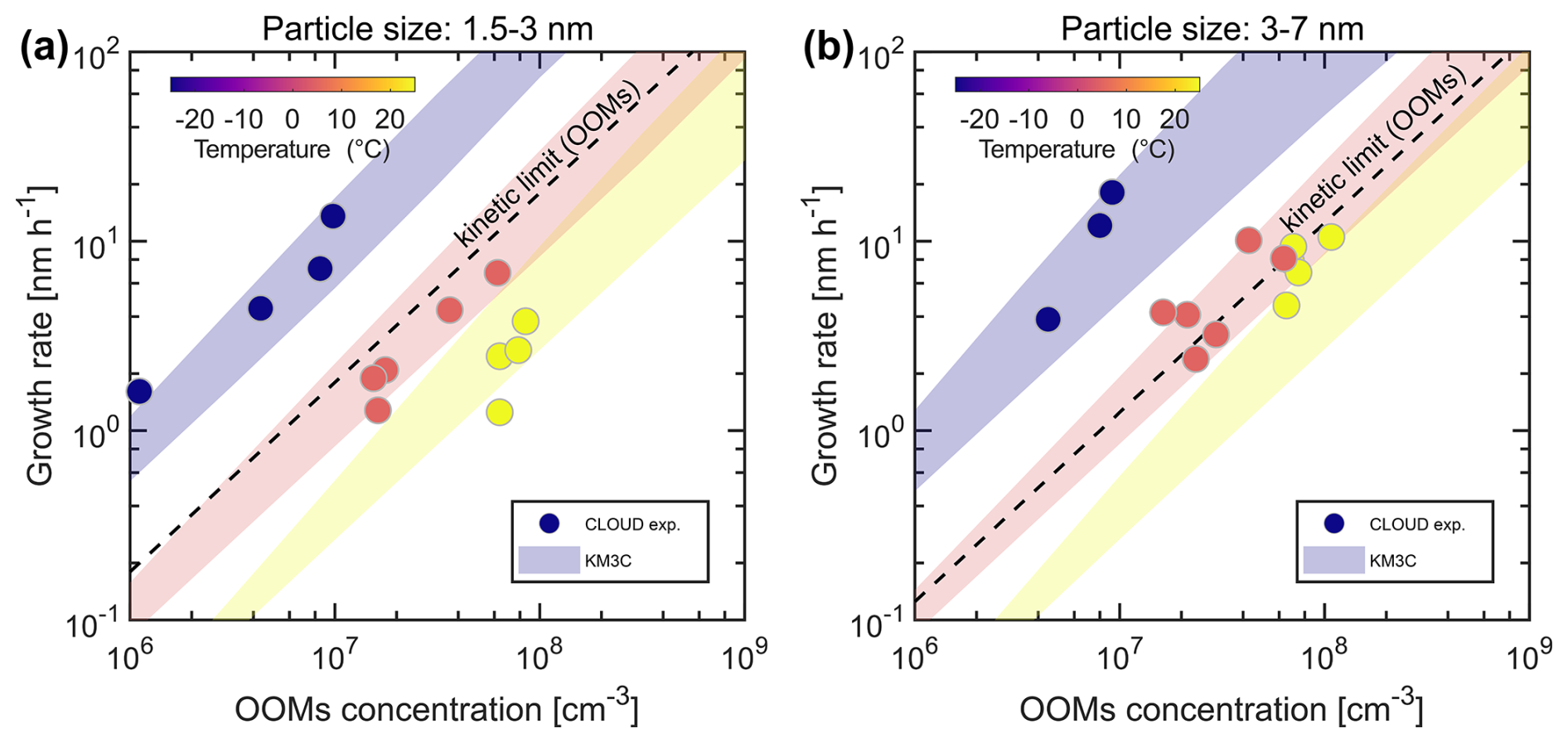
Figure 2Secondary organic aerosol nanoparticle growth observed in laboratory experiments. Circular markers represent growth rates measured at different temperatures in the CERN CLOUD chamber (Stolzenburg et al., 2018, 2025) for particle size ranges of 1.5–3 nm (a) and 3–7 nm (b). The dependence on temperature and concentration of oxygenated organic molecules (OOMs) determined by nitrate chemical ionization mass spectrometry (NO3-CIMS) was not captured by the modeling approach of Stolzenburg et al. (2025) (dashed line, “kinetic limit (OOMs)”). Considering also more volatile organic compounds detected by proton-transfer reaction time-of-flight mass spectrometry (PTR3, Stolzenburg et al., 2018), volatility shifts according to the Clausius-Clapeyron equation, as well as variable particle-phase diffusivity, KM3C can reproduce both the temperature and concentration dependence (colored bands). The width of the colored bands corresponds to the same range of diffusivities as assumed in Fig. 1 (10−20–10−15 cm2 s−1, Sect. S5).
When considering only the OOMs measured by NO3-CIMS (Fig. S7), our kinetic multilayer model was not able to reproduce the observed growth rates. Thus, we included organic vapors measured by proton-transfer reaction time-of-flight mass spectrometry (PTR3; Stolzenburg et al., 2018) and integrated the Clausius-Clapeyron equation in KM3C to describe the temperature-dependent volatility distribution of organic vapors (Supplement, Sect. S1). This approach captures both the concentration dependence and the temperature dependence of the measured nanoparticle growth rates as illustrated in Fig. 2a, b. In accordance with the VBS modeling approach of Stolzenburg et al. (2022), our kinetic model calculations confirm that comprehensive measurement techniques and data are needed to cover the full range and variability of condensable organic vapors. This includes semi-volatile organic compounds (SVOC) that can substantially contribute to nanoparticle growth at −25 °C even if their contribution is negligible at +25 °C (Fig. S8). As shown by Riva et al. (2019), Mohr et al. (2019), and Dada et al. (2023), full coverage of condensable organic vapors by mass spectrometry requires suitable instrumentation and ionization techniques as the sensitivity towards compounds with different degrees of oxygenation can vary strongly. The molecular composition of SOA particles formed by dark ozonolysis of α-pinene (CERN CLOUD) is likely not the same as for particles formed in summertime boreal forest air (Hyytiälä), which may be influenced by other volatile precursors (monoterpenes, sesquiterpenes; Hellén et al., 2018) and photo-oxidants including OH radicals (Baboomian et al., 2022). These differences in aerosol composition and chemical aging can plausibly lead to differences in particle-phase diffusivity (Sect. S5).
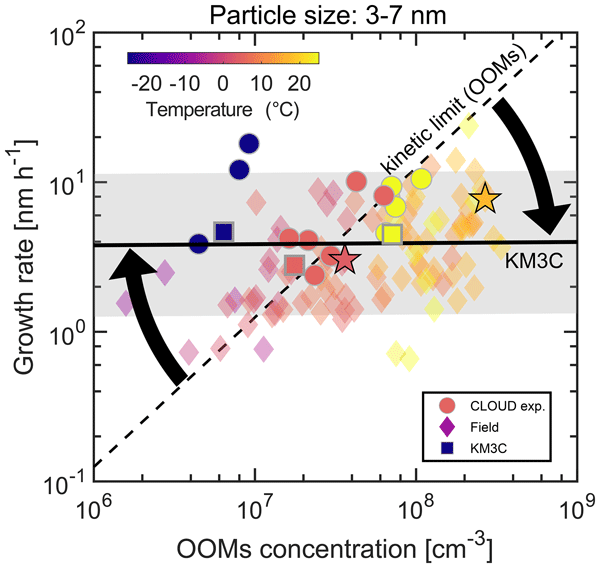
Figure 3 shows a wide range of atmospheric nanoparticle growth rates plotted against organic vapor concentrations as observed in the Asian megacity of Beijing (China, Qiao et al., 2021), at the Europe rural background site San Pietro di Capofiume (Italy, Cai et al., 2024), and at the boreal forest site Hyytiälä (Finland, Gonzalez Carracedo et al., 2022) alongside the CERN CLOUD chamber data as presented by Stolzenburg et al. (2025). Similar to the chamber experiments (circular markers), the field measurement data (diamond markers) exhibit a pronounced increase of OOMs concentrations with increasing temperature (color coding), which can be attributed to general trends of temperature-related enhancements in emissions of volatile organic compounds (VOC) as SOA precursors and photochemical reactivity leading to higher OOMs production rates in the atmosphere (Seinfeld and Pandis, 2016; Paasonen et al., 2018; Bianchi et al., 2019). While the OOMs concentrations vary by three orders of magnitude, the nanoparticle growth rates observed in the atmosphere remain rather uniformly confined to a narrow range around 1 to 10 nm h−1.
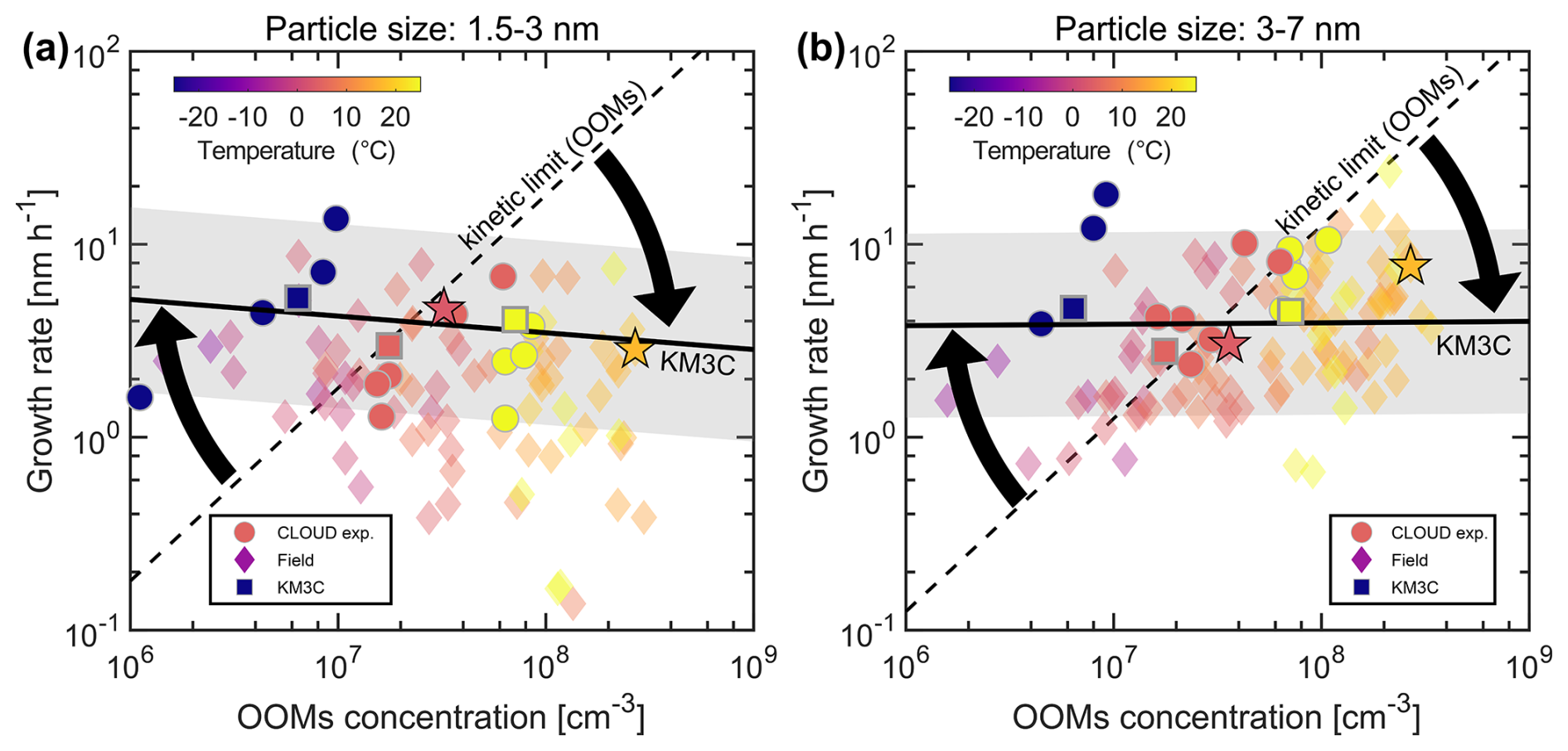
Figure 3Range and buffering of observed and predicted atmospheric nanoparticle growth rates. Measurement data points color-coded by temperature represent growth rates as presented and discussed by Stolzenburg et al. (2025) for particles with diameters in the ranges of (a) 1.5–3 nm and (b) 3–7 nm, respectively. The data are plotted against the concentration of oxygenated organic molecules (OOMs) measured by NO3-CIMS during laboratory experiments in the CERN CLOUD chamber (circles, Stolzenburg et al., 2018) and during field measurements (diamonds) in Hyytiälä, Finland (Gonzalez Carracedo et al., 2022), Beijing, China (Qiao et al., 2021), and San Pietro di Capofiume, Italy (Cai et al., 2024). The two cases studied in Fig. 1 are highlighted with star-shaped markers. Square markers represent growth rates predicted by KM3C at the temperatures, median organic vapor concentrations and volatility distributions reported for the CERN CLOUD chamber experiments, and the solid black lines are linear fits to the model results. As indicated by the grey shaded areas, most of the growth rates observed in the field measurements and laboratory experiments fall within a factor of three relative to this line. The dashed black line is the kinetic limit reported by Stolzenburg et al. (2025), and the black arrows indicate the effective buffering of the organic vapor (OOMs) concentration dependence by temperature-related shifts in volatility and diffusivity.
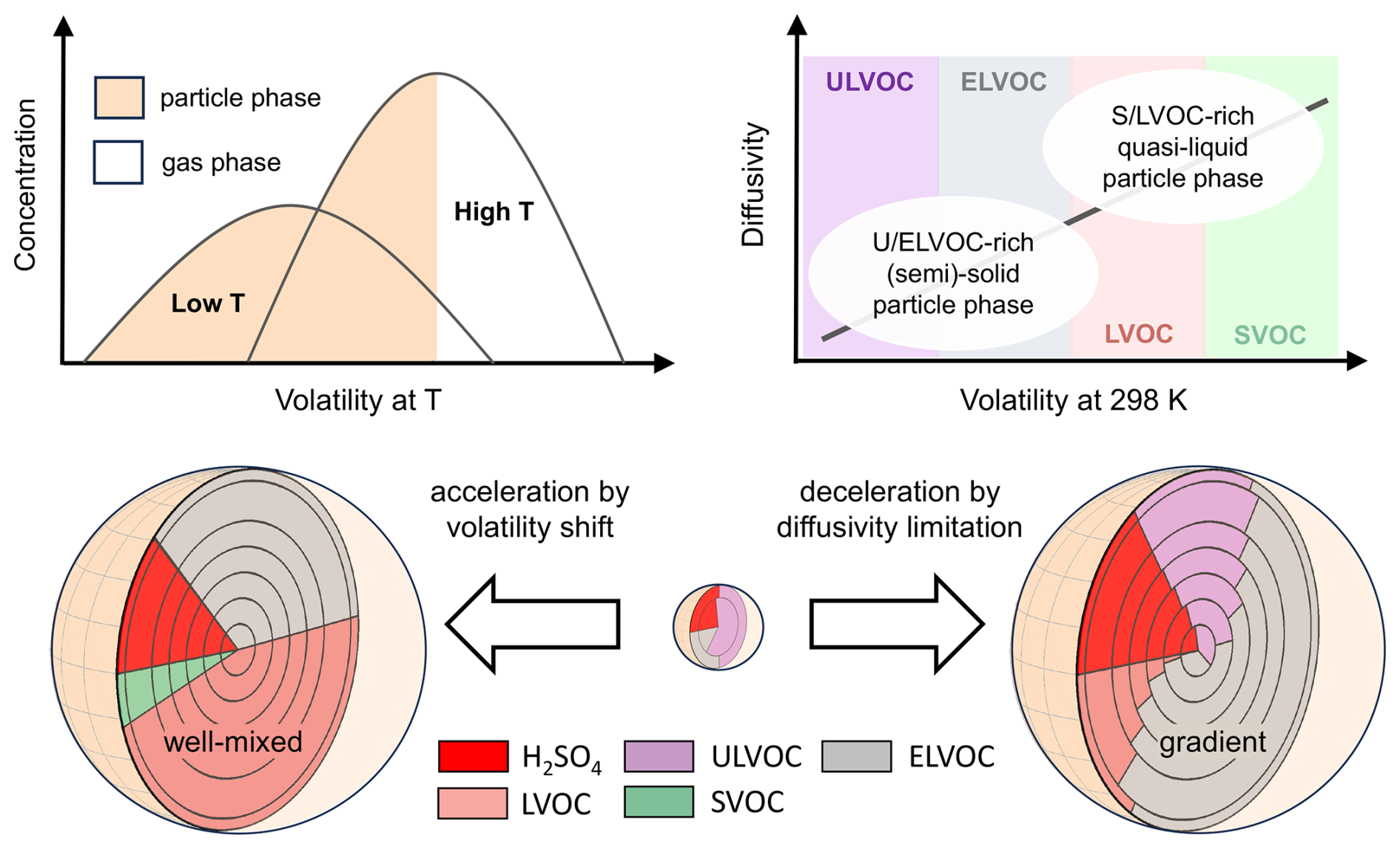
Figure 4Key factors in the buffering of atmospheric nanoparticle growth rates. Ambient temperature influences the production and volatility distribution of condensable vapors in the atmosphere. An increase in temperature tends to enhance the production and concentration of organic vapors, but it also enhances their volatility (equilibrium vapor pressure) following the Clausius-Clapeyron equation and shifts the gas-particle partitioning towards the gas phase. These competing effects buffer the amount of vapors that are available to condense and drive particle growth. In addition, particle composition and phase state are influencing the molecular diffusivity, which tends to increase with increasing intrinsic volatility of the condensed organic compounds. At elevated temperatures, primarily very low volatile compounds (ULVOC, ELVOC) tend to condense and form (semi-)solid phases with kinetic limitations of diffusivity and surface-to-bulk transport, leading to differential concentration gradients and surface enrichment of more volatile compounds. At low temperatures, also more volatile compounds (SVOC, LVOC) tend to condense and favor the formation of quasi-liquid phases and well-mixed particles that are not subject to kinetic limitations by slow diffusion.
The field measurement data points and their weak dependence on ambient temperature and measured OOMs concentration do not follow the kinetic-limit line (black dashed) to which they had been related in the recent study of Stolzenburg et al. (2025) highlighting incomplete mass closure of atmospheric nanoparticle growth. In contrast, the solid black fit line to our model results illustrates the weak apparent dependence on OOMs concentration which we obtain using KM3C to predict SOA nanoparticle growth rates as a function of temperature and organic vapor concentration assuming the same volatility distributions as observed in the CERN CLOUD experiments (square markers). The grey shaded areas in Fig. 3 illustrate that most of the growth rates observed in the field measurements and laboratory experiments reported by Stolzenburg et al. (2025) fall within a factor of three relative to this line.
The tilt and flattening of the high OOMs concentration dependence by kinetic-limit lines introduced in earlier studies (Stolzenburg et al., 2018, 2025) towards the weak OOMs concentration dependence indicated by KM3C can be attributed to the following key factors: (I) at low temperature and concentration levels, organic vapors that would have relatively high volatility at room temperature can also contribute to nanoparticle growth (upward shift indicated by the arrow on the left side of Fig. 3a, b); and (II) at high temperature and concentration levels, enhanced volatility, low diffusivity, slow surface-to-bulk transport, and differential concentration gradients decelerate the uptake of organic vapors and delay the equilibration of gas-particle partitioning (downward shift indicated by the arrow on the right side of Fig. 3a, b).
Overall, the variability and temperature dependencies of condensable organic vapor (OOMs) production by VOC oxidation, volatility, and diffusivity are partly offsetting and balancing each other. This balancing leads to an effective buffering of the vapor concentration dependence of atmospheric nanoparticle growth rates around 1 to 10 nm h−1 as observed and reported in earlier studies (Kulmala et al., 2004; Kulmala and Kerminen, 2008; Stolzenburg et al., 2023, 2025).
This study provides an answer to the long-standing and enigmatic scientific question why atmospheric nanoparticle growth rates are fairly uniform under widely different ambient conditions and exhibit a low dependence on organic vapor concentration (OOMs). We have developed and applied a new kinetic multilayer model of multiphase chemistry (KM3C) to explain and reconcile discrepancies between field observations, laboratory experiments, theoretical considerations, and earlier model predictions by resolving the interplay and counteracting effects of temperature-dependent multiphase chemical reactivity, volatility, and diffusivity.
As illustrated in Fig. 4, we identified key factors that lead to an effective buffering and convergence of atmospheric nanoparticle growth rates around 1–10 nm h−1 in spite of highly variable ambient conditions, including temperature and organic vapor concentrations. The emission and oxidation of organic compounds that serve as SOA precursors, and the production and concentration of potentially condensable organic vapors in the atmosphere generally tend to increase with increasing temperature. At the same time, however, increasing temperature enhances the volatility and equilibrium vapor pressure of organic compounds, thus reducing the proportions of organic compounds that are actually available to condense under equilibrium conditions in accordance with the Clausius-Clapeyron equation (left side of Fig. 4). On the other hand, increasing proportions of molecules with lower intrinsic volatility can increase the viscosity and reduce the diffusivity of organic aerosols. Low diffusivity in highly viscous, semi-solid or solid particles can decelerate and kinetically limit the uptake and surface-to-bulk transport of organic vapor molecules, generate differential concentration gradients of compounds with different volatilities in the particle, and delay the equilibration of gas-particle partitioning (right side of Fig. 4).
The combination and interplay of these effects can buffer the kinetics of gas-particle partitioning and explain the observation of similar nanoparticle growth rates at vastly differing organic vapor concentrations as observed in well-defined laboratory experiments and ambient air around the world. To reproduce the measurement results, we did not have to invoke chemical reactions in the condensed phase or at the surface of the particles as suggested in related earlier studies (Heitto et al., 2022; Stolzenburg et al., 2025). Nevertheless, such multiphase chemical reactions – in particular the formation of dimers and oligomers – may also influence the volatility distribution and particle diffusivity, and can be flexibly included in KM3C (Mehra et al., 2020; Berkemeier et al., 2020; Maben and Ziemann, 2023; Kenseth et al., 2023; Schervish et al., 2026; Kang et al., 2026). This also applies for the effects of coagulation and air mass history (Sect. S1; Hussein et al., 2009; Cai et al., 2021; Hakala et al., 2022; Nguyen et al., 2026; Cai et al., 2026).
To further constrain key parameters and enhance the mechanistic understanding and predictability of nanoparticle growth under varying atmospheric conditions, we suggest performing further laboratory experiments and field observations in which nanoparticle composition and phase state are determined alongside condensable vapor concentrations. Future work should quantify the distribution and gradients of organic compounds between and within aerosol particles across the relevant size range. For example, it may be possible to detect or infer radial concentration gradients in highly viscous particles (Huisman et al., 2025; Kang et al., 2026; Schervish et al., 2026) or detect deviations from the composition expected for the uninhibited growth of well-mixed, quasi-liquid particles (Lopez et al., 2025; Bhattacharyya et al., 2025). Kinetic process models, machine learning tools, and targeted uncertainty analysis can help identify the experimental conditions that promise the largest gain of mechanistic understanding (Krüger et al., 2024).
The measurement data were adopted from Stolzenburg et al. (2018) and Stolzenburg et al. (2025). The KM3C model used in this study is available as online tool under https://multiphasekinetics.org/km3c/nano (last access: 19 August 2026).
The supplement related to this article is available online at https://doi.org/10.5194/acp-26-12037-2026-supplement.
TB and UP conceived the study. TB designed and supervised research. ZZ, HGK and TB built the kinetic model. ZZ performed kinetic model simulations and processed results. All authors analyzed and discussed the results, and co-wrote the paper led by TB and UP.
At least one of the (co-)authors is a member of the editorial board of Atmospheric Chemistry and Physics. The peer-review process was guided by an independent editor, and the authors also have no other competing interests to declare.
Publisher's note: Copernicus Publications remains neutral with regard to jurisdictional claims made in the text, published maps, institutional affiliations, or any other geographical representation in this paper. The authors bear the ultimate responsibility for providing appropriate place names. Views expressed in the text are those of the authors and do not necessarily reflect the views of the publisher.
This work was funded by the Max Planck Society (MPG). HGK is supported by the Max Planck Graduate Center with the Johannes Gutenberg University Mainz (MPGC). The authors thank the Max Planck Computing and Data Facility (MPCDF) for computing time on the supercomputer RAVEN. We thank A. Mishra, M. Radecka, and colleagues across the scientific community for helpful discussions.
The article processing charges for this open-access publication were covered by the Max Planck Society.
This paper was edited by Mingyi Wang and James Allan and reviewed by two anonymous referees.
Antossian, C., Müller, M., and Krieger, U. K.: Photochemical and ozone-induced aging significantly alter the viscosity of aqueous trans-aconitic acid aerosol particles, Atmos. Chem. Phys., 26, 2443–2463, https://doi.org/10.5194/acp-26-2443-2026, 2026. a
Arangio, A. M., Slade, J. H., Berkemeier, T., Pöschl, U., Knopf, D. A., and Shiraiwa, M.: Multiphase Chemical Kinetics of OH Radical Uptake by Molecular Organic Markers of Biomass Burning Aerosols: Humidity and Temperature Dependence, Surface Reaction, and Bulk Diffusion, J. Phys. Chem. A, 119, 4533–4544, https://doi.org/10.1021/jp510489z, 2015. a
Artaxo, P., Hansson, H.-C., Andreae, M. O., Bäck, J., Alves, E. G., Barbosa, H. M. J., Bender, F., Bourtsoukidis, E., Carbone, S., Chi, J., Decesari, S., Després, V. R., Ditas, F., Ezhova, E., Fuzzi, S., Hasselquist, N. J., Heintzenberg, J., Holanda, B. A., Guenther, A., Hakola, H., Heikkinen, L., Kerminen, V.-M., Kontkanen, J., Krejci, R., Kulmala, M., Lavric, J. V., de Leeuw, G., Lehtipalo, K., Machado, L. A. T., McFiggans, G., Franco, M. A. M., Meller, B. B., Morais, F. G., Mohr, C., Morgan, W., Nilsson, M. B., Peichl, M., Petäjä, T., Praß, M., Pöhlker, C., Pöhlker, M. L., Pöschl, U., Von Randow, C., Riipinen, I., Rinne, J., Rizzo, L. V., Rosenfeld, D., Silva Dias, M. A. F., Sogacheva, L., Stier, P., Swietlicki, E., Sörgel, M., Tunved, P., Virkkula, A., Wang, J., Weber, B., Yáñez-Serrano, A. M., Zieger, P., Mikhailov, E., Smith, J. N., and Kesselmeier, J.: Tropical and Boreal Forest – Atmosphere Interactions: A Review, Tellus B: Chem. Phys. Meteorol., https://doi.org/10.16993/tellusb.34, 2022. a
Baboomian, V. J., Crescenzo, G. V., Huang, Y., Mahrt, F., Shiraiwa, M., Bertram, A. K., and Nizkorodov, S. A.: Sunlight can convert atmospheric aerosols into a glassy solid state and modify their environmental impacts, P. Natl. Acad. Sci. USA, 119, e2208121119, https://doi.org/10.1073/pnas.2208121119, 2022. a
Bateman, A. P., Gong, Z., Liu, P., Sato, B., Cirino, G., Zhang, Y., Artaxo, P., Bertram, A. K., Manzi, A. O., Rizzo, L. V., Souza, R. A. F., Zaveri, R. A., and Martin, S. T.: Sub-micrometre particulate matter is primarily in liquid form over Amazon rainforest, Nat. Geosci., 9, 34–37, https://doi.org/10.1038/ngeo2599, 2016. a
Berkemeier, T., Huisman, A. J., Ammann, M., Shiraiwa, M., Koop, T., and Pöschl, U.: Kinetic regimes and limiting cases of gas uptake and heterogeneous reactions in atmospheric aerosols and clouds: a general classification scheme, Atmos. Chem. Phys., 13, 6663–6686, https://doi.org/10.5194/acp-13-6663-2013, 2013. a
Berkemeier, T., Shiraiwa, M., Pöschl, U., and Koop, T.: Competition between water uptake and ice nucleation by glassy organic aerosol particles, Atmos. Chem. Phys., 14, 12513–12531, https://doi.org/10.5194/acp-14-12513-2014, 2014. a
Berkemeier, T., Steimer, S. S., Krieger, U. K., Peter, T., Pöschl, U., Ammann, M., and Shiraiwa, M.: Ozone uptake on glassy, semi-solid and liquid organic matter and the role of reactive oxygen intermediates in atmospheric aerosol chemistry, Phys. Chem. Chem. Phys., 18, 12662–12674, https://doi.org/10.1039/C6CP00634E, 2016. a
Berkemeier, T., Takeuchi, M., Eris, G., and Ng, N. L.: Kinetic modeling of formation and evaporation of secondary organic aerosol from NO3 oxidation of pure and mixed monoterpenes, Atmos. Chem. Phys., 20, 15513–15535, https://doi.org/10.5194/acp-20-15513-2020, 2020. a, b
Bhattacharyya, N., Lopez, B., DeVivo, J., Russell, D. M., Shen, J., Sommer, E., Almeida, J., Amorim, A., Beckmann, H. M., Busato, M., Canagaratna, M. R., Caudillo, L., Chassaing, A., Christoudias, T., Dada, L., El-Haddad, I., Flagan, R. C., Harder, H., Judmaier, B., Kaniyodical Sebastian, M., Kirkby, J., Klebach, H., Kulmala, M., Kunkler, F., Lehtipalo, K., Liu, L., Mentler, B., Möhler, O., Morawiec, A., Petäjä, T., Rato, P., Rörup, B., Ruhl, S., Scholz, W., Simon, M., Tóme, A., Tong, Y., Top, J., Umo, N. S., Volkamer, R., Weissbacher, J., Worsnop, D. R., Xenofontos, C., Yang, B., Yu, W., Zauner-Wieczorek, M., Zgheib, I., Zhang, J., Zheng, Z., He, X.-C., Stolzenburg, D., Schobesberger, S., Curtius, J., and Donahue, N. M.: Isoprene Aerosol Growth in the Upper Troposphere: Application of the Diagonal Volatility Basis Set to CLOUD Chamber Measurements, ACS ES&T Air, 2, 2092–2104, https://doi.org/10.1021/acsestair.5c00106, 2025. a, b
Bianchi, F., Tröstl, J., Junninen, H., Frege, C., Henne, S., Hoyle, C. R., Molteni, U., Herrmann, E., Adamov, A., Bukowiecki, N., Chen, X., Duplissy, J., Gysel, M., Hutterli, M., Kangasluoma, J., Kontkanen, J., Kürten, A., Manninen, H. E., Münch, S., Peräkylä, O., Petäjä, T., Rondo, L., Williamson, C., Weingartner, E., Curtius, J., Worsnop, D. R., Kulmala, M., Dommen, J., and Baltensperger, U.: New particle formation in the free troposphere: A question of chemistry and timing, Science, 352, 1109–1112, https://doi.org/10.1126/science.aad5456, 2016. a
Bianchi, F., Kurtén, T., Riva, M., Mohr, C., Rissanen, M. P., Roldin, P., Berndt, T., Crounse, J. D., Wennberg, P. O., Mentel, T. F., Wildt, J., Junninen, H., Jokinen, T., Kulmala, M., Worsnop, D. R., Thornton, J. A., Donahue, N., Kjaergaard, H. G., and Ehn, M.: Highly Oxygenated Organic Molecules (HOM) from Gas-Phase Autoxidation Involving Peroxy Radicals: A Key Contributor to Atmospheric Aerosol, Chem. Rev., 119, 3472–3509, https://doi.org/10.1021/acs.chemrev.8b00395, 2019. a
Cai, J., Sulo, J., Gu, Y., Holm, S., Cai, R., Thomas, S., Neuberger, A., Mattsson, F., Paglione, M., Decesari, S., Rinaldi, M., Yin, R., Aliaga, D., Huang, W., Li, Y., Gramlich, Y., Ciarelli, G., Quéléver, L., Sarnela, N., Lehtipalo, K., Zannoni, N., Wu, C., Nie, W., Kangasluoma, J., Mohr, C., Kulmala, M., Zha, Q., Stolzenburg, D., and Bianchi, F.: Elucidating the mechanisms of atmospheric new particle formation in the highly polluted Po Valley, Italy, Atmos. Chem. Phys., 24, 2423–2441, https://doi.org/10.5194/acp-24-2423-2024, 2024. a, b
Cai, R., Li, C., He, X.-C., Deng, C., Lu, Y., Yin, R., Yan, C., Wang, L., Jiang, J., Kulmala, M., and Kangasluoma, J.: Impacts of coagulation on the appearance time method for new particle growth rate evaluation and their corrections, Atmos. Chem. Phys., 21, 2287–2304, https://doi.org/10.5194/acp-21-2287-2021, 2021. a
Cai, R., Li, X., Li, Y., Blichner, S., Stolzenburg, D., Zha, Q., Cai, J., Nie, W., Yan, C., Huang, D. D., Wang, Z., Wu, J., Yin, R., Sarnela, N., Huang, W., Tuovinen, S., Holm, S., Ahonen, L., Yao, L., Ding, A., Bianchi, F., Liu, Y., Winkler, P. M., Petäjä, T., Chen, J., Kerminen, V.-M., Wang, L., Worsnop, D., Jiang, J., Kulmala, M., and Kangasluoma, J.: The key role of nanoparticle concentration gradient in aerosol initial growth, Nat. Commun., https://doi.org/10.1038/s41467-026-70082-2, 2026. a, b
Cheng, Y., Su, H., Koop, T., Mikhailov, E., and Pöschl, U.: Size dependence of phase transitions in aerosol nanoparticles, Nat. Commun., 6, 5923, https://doi.org/10.1038/ncomms6923, 2015. a
Dada, L., Stolzenburg, D., Simon, M., Fischer, L., Heinritzi, M., Wang, M., Xiao, M., Vogel, A. L., Ahonen, L., Amorim, A., Baalbaki, R., Baccarini, A., Baltensperger, U., Bianchi, F., Daellenbach, K. R., DeVivo, J., Dias, A., Dommen, J., Duplissy, J., Finkenzeller, H., Hansel, A., He, X.-C., Hofbauer, V., Hoyle, C. R., Kangasluoma, J., Kim, C., Kürten, A., Kvashnin, A., Mauldin, R., Makhmutov, V., Marten, R., Mentler, B., Nie, W., Petäjä, T., Quéléver, L. L. J., Saathoff, H., Tauber, C., Tome, A., Molteni, U., Volkamer, R., Wagner, R., Wagner, A. C., Wimmer, D., Winkler, P. M., Yan, C., Zha, Q., Rissanen, M., Gordon, H., Curtius, J., Worsnop, D. R., Lehtipalo, K., Donahue, N. M., Kirkby, J., El Haddad, I., and Kulmala, M.: Role of sesquiterpenes in biogenic new particle formation, Sci. Adv., 9, https://doi.org/10.1126/sciadv.adi5297, 2023. a, b, c
Dette, H. P. and Koop, T.: Glass Formation Processes in Mixed Inorganic/Organic Aerosol Particles, J. Phys. Chem. A, 119, 4552–4561, https://doi.org/10.1021/jp5106967, 2015. a
Donahue, N. M., Robinson, A. L., Stanier, C. O., and Pandis, S. N.: Coupled Partitioning, Dilution, and Chemical Aging of Semivolatile Organics, Environ. Sci. Technol., 40, 2635–2643, https://doi.org/10.1021/es052297c, 2006. a
Donahue, N. M., Epstein, S. A., Pandis, S. N., and Robinson, A. L.: A two-dimensional volatility basis set: 1. organic-aerosol mixing thermodynamics, Atmos. Chem. Phys., 11, 3303–3318, https://doi.org/10.5194/acp-11-3303-2011, 2011. a
Donahue, N. M., Dada, L., Stolzenburg, D., Sommer, E., Simon, M., Schervish, M., DeVivo, J., Stinchfield, A., Burton, N., Bhattacharyya, N., Lopez, B., Wang, M., Scholz, W., Almeida, J., Zhao, B., Heinritzi, M., Gordon, H., Hansel, A., Curtius, J., Lehtipalo, K., El Haddad, I., Kirkby, J., Flagan, R., Kulmala, M., and Worsnop, D.: On describing particle nucleation within the Volatility Basis Set, Atmos. Chem. Phys., 26, 8311–8339, https://doi.org/10.5194/acp-26-8311-2026, 2026. a
Golay, Z. M., Vandergrift, G. W., Kamal, S., China, S., Nizkorodov, S. A., and Bertram, A. K.: Sunlight can turn smoldering pine wood smoke into a glass, npj Clean Air, 2, 29, https://doi.org/10.1038/s44407-026-00070-9, 2026. a
Gonzalez Carracedo, L., Lehtipalo, K., Ahonen, L. R., Sarnela, N., Holm, S., Kangasluoma, J., Kulmala, M., Winkler, P. M., and Stolzenburg, D.: On the relation between apparent ion and total particle growth rates in the boreal forest and related chamber experiments, Atmos. Chem. Phys., 22, 13153–13166, https://doi.org/10.5194/acp-22-13153-2022, 2022. a, b, c
Gordon, H., Kirkby, J., Baltensperger, U., Bianchi, F., Breitenlechner, M., Curtius, J., Dias, A., Dommen, J., Donahue, N. M., Dunne, E. M., Duplissy, J., Ehrhart, S., Flagan, R. C., Frege, C., Fuchs, C., Hansel, A., Hoyle, C. R., Kulmala, M., Kürten, A., Lehtipalo, K., Makhmutov, V., Molteni, U., Rissanen, M. P., Stozkhov, Y., Tröstl, J., Tsagkogeorgas, G., Wagner, R., Williamson, C., Wimmer, D., Winkler, P. M., Yan, C., and Carslaw, K. S.: Causes and importance of new particle formation in the present‐day and preindustrial atmospheres, J. Geophys. Res.-Atmos., 122, 8739–8760, https://doi.org/10.1002/2017jd026844, 2017. a
Hakala, S., Vakkari, V., Bianchi, F., Dada, L., Deng, C., Dällenbach, K. R., Fu, Y., Jiang, J., Kangasluoma, J., Kujansuu, J., Liu, Y., Petäjä, T., Wang, L., Yan, C., Kulmala, M., and Paasonen, P.: Observed coupling between air mass history, secondary growth of nucleation mode particles and aerosol pollution levels in Beijing, Environ. Sci.: Atmos., 2, 146–164, https://doi.org/10.1039/d1ea00089f, 2022. a
Hallquist, M., Wenger, J. C., Baltensperger, U., Rudich, Y., Simpson, D., Claeys, M., Dommen, J., Donahue, N. M., George, C., Goldstein, A. H., Hamilton, J. F., Herrmann, H., Hoffmann, T., Iinuma, Y., Jang, M., Jenkin, M. E., Jimenez, J. L., Kiendler-Scharr, A., Maenhaut, W., McFiggans, G., Mentel, Th. F., Monod, A., Prévôt, A. S. H., Seinfeld, J. H., Surratt, J. D., Szmigielski, R., and Wildt, J.: The formation, properties and impact of secondary organic aerosol: current and emerging issues, Atmos. Chem. Phys., 9, 5155–5236, https://doi.org/10.5194/acp-9-5155-2009, 2009. a
Heitto, A., Lehtinen, K., Petäjä, T., Lopez-Hilfiker, F., Thornton, J. A., Kulmala, M., and Yli-Juuti, T.: Effects of oligomerization and decomposition on the nanoparticle growth: a model study, Atmos. Chem. Phys., 22, 155–171, https://doi.org/10.5194/acp-22-155-2022, 2022. a
Hellén, H., Praplan, A. P., Tykkä, T., Ylivinkka, I., Vakkari, V., Bäck, J., Petäjä, T., Kulmala, M., and Hakola, H.: Long-term measurements of volatile organic compounds highlight the importance of sesquiterpenes for the atmospheric chemistry of a boreal forest, Atmos. Chem. Phys., 18, 13839–13863, https://doi.org/10.5194/acp-18-13839-2018, 2018. a
Huisman, M., Poon, W. C. K., Warren, P. B., Titmuss, S., and Marenduzzo, D.: Diffusive evaporation dynamics in polymer solutions is ubiquitous, Soft Matter, 21, 1508–1515, https://doi.org/10.1039/D4SM01215A, 2025. a
Hussein, T., Junninen, H., Tunved, P., Kristensson, A., Dal Maso, M., Riipinen, I., Aalto, P. P., Hansson, H.-C., Swietlicki, E., and Kulmala, M.: Time span and spatial scale of regional new particle formation events over Finland and Southern Sweden, Atmos. Chem. Phys., 9, 4699–4716, https://doi.org/10.5194/acp-9-4699-2009, 2009. a
IPCC: Climate Change 2023: Synthesis Report, Contribution of Working Groups I, II and III to the Sixth Assessment Report of the Intergovernmental Panel on Climate Change, https://doi.org/10.59327/IPCC/AR6-9789291691647, 2023. a
Jimenez, J. L., Canagaratna, M. R., Donahue, N. M., Prevot, A. S. H., Zhang, Q., Kroll, J. H., DeCarlo, P. F., Allan, J. D., Coe, H., Ng, N. L., Aiken, A. C., Docherty, K. S., Ulbrich, I. M., Grieshop, A. P., Robinson, A. L., Duplissy, J., Smith, J. D., Wilson, K. R., Lanz, V. A., Hueglin, C., Sun, Y. L., Tian, J., Laaksonen, A., Raatikainen, T., Rautiainen, J., Vaattovaara, P., Ehn, M., Kulmala, M., Tomlinson, J. M., Collins, D. R., Cubison, M. J., Dunlea, J., Huffman, J. A., Onasch, T. B., Alfarra, M. R., Williams, P. I., Bower, K., Kondo, Y., Schneider, J., Drewnick, F., Borrmann, S., Weimer, S., Demerjian, K., Salcedo, D., Cottrell, L., Griffin, R., Takami, A., Miyoshi, T., Hatakeyama, S., Shimono, A., Sun, J. Y., Zhang, Y. M., Dzepina, K., Kimmel, J. R., Sueper, D., Jayne, J. T., Herndon, S. C., Trimborn, A. M., Williams, L. R., Wood, E. C., Middlebrook, A. M., Kolb, C. E., Baltensperger, U., and Worsnop, D. R.: Evolution of Organic Aerosols in the Atmosphere, Science, 326, 1525–1529, https://doi.org/10.1126/science.1180353, 2009. a
Kang, H. G., Takeuchi, M., Ng, N. L., Pöschl, U., and Berkemeier, T.: Multiphase Chemistry and Phase State Explain Nonlinear Effects in the Formation and Evaporation of SOA from Mixed Monoterpene Precursors, ACS ES&T Air, https://doi.org/10.1021/acsestair.5c00438, 2026. a, b, c, d
Kenseth, C. M., Hafeman, N. J., Rezgui, S. P., Chen, J., Huang, Y., Dalleska, N. F., Kjaergaard, H. G., Stoltz, B. M., Seinfeld, J. H., and Wennberg, P. O.: Particle-phase accretion forms dimer esters in pinene secondary organic aerosol, Science, 382, 787–792, https://doi.org/10.1126/science.adi0857, 2023. a
Kiland, K. J., Maclean, A. M., Kamal, S., and Bertram, A. K.: Diffusion of Organic Molecules as a Function of Temperature in a Sucrose Matrix (a Proxy for Secondary Organic Aerosol), J. Phys. Chem. Lett., 10, 5902–5908, https://doi.org/10.1021/acs.jpclett.9b02182, 2019. a
Koop, T., Bookhold, J., Shiraiwa, M., and Pöschl, U.: Glass transition and phase state of organic compounds: dependency on molecular properties and implications for secondary organic aerosols in the atmosphere, Phys. Chem. Chem. Phys., 13, 19238, https://doi.org/10.1039/c1cp22617g, 2011. a
Krüger, M., Mishra, A., Spichtinger, P., Pöschl, U., and Berkemeier, T.: A numerical compass for experiment design in chemical kinetics and molecular property estimation, J. Cheminf., 16, 34, https://doi.org/10.1186/s13321-024-00825-0, 2024. a
Kulmala, M. and Kerminen, V.-M.: On the formation and growth of atmospheric nanoparticles, Atmos. Res., 90, 132–150, https://doi.org/10.1016/j.atmosres.2008.01.005, 2008. a
Kulmala, M., Vehkamäki, H., Petäjä, T., Dal Maso, M., Lauri, A., Kerminen, V.-M., Birmili, W., and McMurry, P.: Formation and growth rates of ultrafine atmospheric particles: a review of observations, J. Aerosol Sci., 35, 143–176, https://doi.org/10.1016/j.jaerosci.2003.10.003, 2004. a, b
Kulmala, M., Petäjä, T., Ehn, M., Thornton, J., Sipilä, M., Worsnop, D., and Kerminen, V.-M.: Chemistry of Atmospheric Nucleation: On the Recent Advances on Precursor Characterization and Atmospheric Cluster Composition in Connection with Atmospheric New Particle Formation, Annu. Rev. Phys. Chem., 65, 21–37, https://doi.org/10.1146/annurev-physchem-040412-110014, 2014. a
Kulmala, M., Cai, R., Stolzenburg, D., Zhou, Y., Dada, L., Guo, Y., Yan, C., Petäjä, T., Jiang, J., and Kerminen, V.-M.: The contribution of new particle formation and subsequent growth to haze formation, Environ. Sci.: Atmos., 2, 352–361, https://doi.org/10.1039/D1EA00096A, 2022. a
Li, Y., Day, D. A., Stark, H., Jimenez, J. L., and Shiraiwa, M.: Predictions of the glass transition temperature and viscosity of organic aerosols from volatility distributions, Atmos. Chem. Phys., 20, 8103–8122, https://doi.org/10.5194/acp-20-8103-2020, 2020. a
Li, Y., Heald, C. L., Miao, R., Campuzano-Jost, P., and Jimenez, J. L.: Global Impacts of Simulating Organic Aerosol Phase State, Environ. Sci. Technol., https://doi.org/10.1021/acs.est.5c13238, 2026. a
Lopez, B., Bhattacharyya, N., DeVivo, J., Wang, M., Caudillo-Plath, L., Surdu, M., Bianchi, F., Brasseur, Z., Buchholz, A., Chen, D., Duplissy, J., He, X.-C., Hofbauer, V., Mahfouz, N., Makhmutov, V., Marten, R., Mentler, B., Philippov, M., Schervish, M., Wang, D. S., Weber, S. K., Welti, A., El Haddad, I., Lehtipalo, K., Kulmala, M., Worsnop, D., Kirkby, J., Mauldin, R. L., Stolzenburg, D., Schobesberger, S., Flagan, R., and Donahue, N. M.: A diagonal volatility basis set to assess the condensation of organic vapors onto particles, Environ. Sci.: Atmos., 5, 1035–1061, https://doi.org/10.1039/d5ea00062a, 2025. a
Maben, H. K. and Ziemann, P. J.: Kinetics of oligomer-forming reactions involving the major functional groups present in atmospheric secondary organic aerosol particles, Environ. Sci.: Processes Impacts, 25, 214–228, https://doi.org/10.1039/D2EM00124A, 2023. a
Mahant, S., Snider, J. R., Petters, S. S., and Petters, M. D.: Effect of Aerosol Size on Glass Transition Temperature, J. Phys. Chem. Lett., 15, 7509–7515, https://doi.org/10.1021/acs.jpclett.4c01415, 2024. a
Mehra, A., Krechmer, J. E., Lambe, A., Sarkar, C., Williams, L., Khalaj, F., Guenther, A., Jayne, J., Coe, H., Worsnop, D., Faiola, C., and Canagaratna, M.: Oligomer and highly oxygenated organic molecule formation from oxidation of oxygenated monoterpenes emitted by California sage plants, Atmos. Chem. Phys., 20, 10953–10965, https://doi.org/10.5194/acp-20-10953-2020, 2020. a
Mikhailov, E., Vlasenko, S., Martin, S. T., Koop, T., and Pöschl, U.: Amorphous and crystalline aerosol particles interacting with water vapor: conceptual framework and experimental evidence for restructuring, phase transitions and kinetic limitations, Atmos. Chem. Phys., 9, 9491–9522, https://doi.org/10.5194/acp-9-9491-2009, 2009. a
Mikhailov, E., Vlasenko, S., Rose, D., and Pöschl, U.: Mass-based hygroscopicity parameter interaction model and measurement of atmospheric aerosol water uptake, Atmos. Chem. Phys., 13, 717–740, https://doi.org/10.5194/acp-13-717-2013, 2013. a
Mohr, C., Thornton, J. A., Heitto, A., Lopez-Hilfiker, F. D., Lutz, A., Riipinen, I., Hong, J., Donahue, N. M., Hallquist, M., Petäjä, T., Kulmala, M., and Yli-Juuti, T.: Molecular identification of organic vapors driving atmospheric nanoparticle growth, Nat. Commun., 10, https://doi.org/10.1038/s41467-019-12473-2, 2019. a, b
Mu, Q., Shiraiwa, M., Octaviani, M., Ma, N., Ding, A., Su, H., Lammel, G., Pöschl, U., and Cheng, Y.: Temperature effect on phase state and reactivity controls atmospheric multiphase chemistry and transport of PAHs, Sci. Adv., 4, eaap7314, https://doi.org/10.1126/sciadv.aap7314, 2018. a
Nguyen, K., Schervish, M., Lakey, P. S. J., Smith, J. N., and Shiraiwa, M.: Impact of particle phase state on the competition between condensation and coagulation, Environ. Sci.: Atmos., 6, 152–165, https://doi.org/10.1039/d5ea00069f, 2026. a
Paasonen, P., Peltola, M., Kontkanen, J., Junninen, H., Kerminen, V.-M., and Kulmala, M.: Comprehensive analysis of particle growth rates from nucleation mode to cloud condensation nuclei in boreal forest, Atmos. Chem. Phys., 18, 12085–12103, https://doi.org/10.5194/acp-18-12085-2018, 2018. a
Pfrang, C., Shiraiwa, M., and Pöschl, U.: Chemical ageing and transformation of diffusivity in semi-solid multi-component organic aerosol particles, Atmos. Chem. Phys., 11, 7343–7354, https://doi.org/10.5194/acp-11-7343-2011, 2011. a
Qiao, X., Yan, C., Li, X., Guo, Y., Yin, R., Deng, C., Li, C., Nie, W., Wang, M., Cai, R., Huang, D., Wang, Z., Yao, L., Worsnop, D. R., Bianchi, F., Liu, Y., Donahue, N. M., Kulmala, M., and Jiang, J.: Contribution of Atmospheric Oxygenated Organic Compounds to Particle Growth in an Urban Environment, Environ. Sci. Technol., 55, 13646–13656, https://doi.org/10.1021/acs.est.1c02095, 2021. a, b, c
Reid, J. P., Bertram, A. K., Topping, D. O., Laskin, A., Martin, S. T., Petters, M. D., Pope, F. D., and Rovelli, G.: The viscosity of atmospherically relevant organic particles, Nat. Commun., 9, 956, https://doi.org/10.1038/s41467-018-03027-z, 2018. a
Renbaum-Wolff, L., Grayson, J. W., Bateman, A. P., Kuwata, M., Sellier, M., Murray, B. J., Shilling, J. E., Martin, S. T., and Bertram, A. K.: Viscosity of α-pinene secondary organic material and implications for particle growth and reactivity, P. Natl. Acad. Sci. USA, 110, 8014–8019, https://doi.org/10.1073/pnas.1219548110, 2013. a, b
Riipinen, I., Pierce, J. R., Yli-Juuti, T., Nieminen, T., Häkkinen, S., Ehn, M., Junninen, H., Lehtipalo, K., Petäjä, T., Slowik, J., Chang, R., Shantz, N. C., Abbatt, J., Leaitch, W. R., Kerminen, V.-M., Worsnop, D. R., Pandis, S. N., Donahue, N. M., and Kulmala, M.: Organic condensation: a vital link connecting aerosol formation to cloud condensation nuclei (CCN) concentrations, Atmos. Chem. Phys., 11, 3865–3878, https://doi.org/10.5194/acp-11-3865-2011, 2011. a
Riva, M., Rantala, P., Krechmer, J. E., Peräkylä, O., Zhang, Y., Heikkinen, L., Garmash, O., Yan, C., Kulmala, M., Worsnop, D., and Ehn, M.: Evaluating the performance of five different chemical ionization techniques for detecting gaseous oxygenated organic species, Atmos. Meas. Tech., 12, 2403–2421, https://doi.org/10.5194/amt-12-2403-2019, 2019. a
Saukko, E., Lambe, A. T., Massoli, P., Koop, T., Wright, J. P., Croasdale, D. R., Pedernera, D. A., Onasch, T. B., Laaksonen, A., Davidovits, P., Worsnop, D. R., and Virtanen, A.: Humidity-dependent phase state of SOA particles from biogenic and anthropogenic precursors, Atmos. Chem. Phys., 12, 7517–7529, https://doi.org/10.5194/acp-12-7517-2012, 2012. a
Schervish, M., Kang, H. G., Wingen, L. M., Nguyen, K., Begay, C., Wilson, J., Shrivastava, M., Chen, Y., Shilling, J. E., Ng, N. L., Pöschl, U., Berkemeier, T., Zelenyuk, A., and Shiraiwa, M.: Surface Crust Formation Controls Evaporation Kinetics of Secondary Organic Aerosols, Environ. Sci. Technol., 60, 7995–8006, https://doi.org/10.1021/acs.est.5c11018, 2026. a, b, c
Seinfeld, J. H. and Pandis, S. N.: Atmospheric chemistry and physics: from air pollution to climate change, John Wiley & Sons, ISBN: 978-1-118-94740-1, 2016. a
Shiraiwa, M., Ammann, M., Koop, T., and Pöschl, U.: Gas uptake and chemical aging of semisolid organic aerosol particles, P. Natl. Acad. Sci. USA, 108, 11003–11008, https://doi.org/10.1073/pnas.1103045108, 2011. a
Shiraiwa, M., Berkemeier, T., Schilling-Fahnestock, K. A., Seinfeld, J. H., and Pöschl, U.: Molecular corridors and kinetic regimes in the multiphase chemical evolution of secondary organic aerosol, Atmos. Chem. Phys., 14, 8323–8341, https://doi.org/10.5194/acp-14-8323-2014, 2014. a
Shiraiwa, M., Li, Y., Tsimpidi, A. P., Karydis, V. A., Berkemeier, T., Pandis, S. N., Lelieveld, J., Koop, T., and Pöschl, U.: Global distribution of particle phase state in atmospheric secondary organic aerosols, Nat. Commun., 8, 15002, https://doi.org/10.1038/ncomms15002, 2017. a, b
Shrivastava, M., Cappa, C. D., Fan, J., Goldstein, A. H., Guenther, A. B., Jimenez, J. L., Kuang, C., Laskin, A., Martin, S. T., Ng, N. L., Petaja, T., Pierce, J. R., Rasch, P. J., Roldin, P., Seinfeld, J. H., Shilling, J., Smith, J. N., Thornton, J. A., Volkamer, R., Wang, J., Worsnop, D. R., Zaveri, R. A., Zelenyuk, A., and Zhang, Q.: Recent advances in understanding secondary organic aerosol: Implications for global climate forcing, Rev. Geophys., 55, 509–559, https://doi.org/10.1002/2016RG000540, 2017. a
Slade, J. H., Ault, A. P., Bui, A. T., Ditto, J. C., Lei, Z., Bondy, A. L., Olson, N. E., Cook, R. D., Desrochers, S. J., Harvey, R. M., Erickson, M. H., Wallace, H. W., Alvarez, S. L., Flynn, J. H., Boor, B. E., Petrucci, G. A., Gentner, D. R., Griffin, R. J., and Shepson, P. B.: Bouncier Particles at Night: Biogenic Secondary Organic Aerosol Chemistry and Sulfate Drive Diel Variations in the Aerosol Phase in a Mixed Forest, Environ. Sci. Technol., 53, 4977–4987, https://doi.org/10.1021/acs.est.8b07319, pMID: 31002496, 2019. a
Stolzenburg, D., Fischer, L., Vogel, A. L., Heinritzi, M., Schervish, M., Simon, M., Wagner, A. C., Dada, L., Ahonen, L. R., Amorim, A., Baccarini, A., Bauer, P. S., Baumgartner, B., Bergen, A., Bianchi, F., Breitenlechner, M., Brilke, S., Buenrostro Mazon, S., Chen, D., Dias, A., Draper, D. C., Duplissy, J., El Haddad, I., Finkenzeller, H., Frege, C., Fuchs, C., Garmash, O., Gordon, H., He, X., Helm, J., Hofbauer, V., Hoyle, C. R., Kim, C., Kirkby, J., Kontkanen, J., Kürten, A., Lampilahti, J., Lawler, M., Lehtipalo, K., Leiminger, M., Mai, H., Mathot, S., Mentler, B., Molteni, U., Nie, W., Nieminen, T., Nowak, J. B., Ojdanic, A., Onnela, A., Passananti, M., Petäjä, T., Quéléver, L. L. J., Rissanen, M. P., Sarnela, N., Schallhart, S., Tauber, C., Tomé, A., Wagner, R., Wang, M., Weitz, L., Wimmer, D., Xiao, M., Yan, C., Ye, P., Zha, Q., Baltensperger, U., Curtius, J., Dommen, J., Flagan, R. C., Kulmala, M., Smith, J. N., Worsnop, D. R., Hansel, A., Donahue, N. M., and Winkler, P. M.: Rapid growth of organic aerosol nanoparticles over a wide tropospheric temperature range, P. Natl. Acad. Sci. USA, 115, 9122–9127, https://doi.org/10.1073/pnas.1807604115, 2018. a, b, c, d, e, f, g, h, i
Stolzenburg, D., Wang, M., Schervish, M., and Donahue, N. M.: Tutorial: Dynamic organic growth modeling with a volatility basis set, J. Aerosol Sci., 166, 106063, https://doi.org/10.1016/j.jaerosci.2022.106063, 2022. a, b
Stolzenburg, D., Cai, R., Blichner, S. M., Kontkanen, J., Zhou, P., Makkonen, R., Kerminen, V.-M., Kulmala, M., Riipinen, I., and Kangasluoma, J.: Atmospheric nanoparticle growth, Rev. Mod. Phys., 95, 045002, https://doi.org/10.1103/RevModPhys.95.045002, 2023. a, b
Stolzenburg, D., Sarnela, N., Bianchi, F., Cai, J., Cai, R., Cheng, Y., Dada, L., Donahue, N. M., Grothe, H., Holm, S., Kerminen, V.-M., Lehtipalo, K., Petäjä, T., Sulo, J., Winkler, P. M., Yan, C., Kangasluoma, J., and Kulmala, M.: Incomplete mass closure in atmospheric nanoparticle growth, npj Clim. Atmos. Sci., 8, https://doi.org/10.1038/s41612-025-00893-5, 2025. a, b, c, d, e, f, g, h, i, j, k, l, m, n, o, p, q, r, s, t
Virtanen, A., Joutsensaari, J., Koop, T., Kannosto, J., Yli-Pirilä, P., Leskinen, J., Mäkelä, J. M., Holopainen, J. K., Pöschl, U., Kulmala, M., Worsnop, D. R., and Laaksonen, A.: An amorphous solid state of biogenic secondary organic aerosol particles, Nature, 467, 824–827, https://doi.org/10.1038/nature09455, 2010. a, b
WHO: Health workforce support and safeguards list 2023, Tech. rep., World Health Organization, Geneva, Switzerland, https://www.who.int/publications/i/item/9789240069787 (last access: 1 April 2026), 2023. a
Yli-Juuti, T., Mohr, C., and Riipinen, I.: Open questions on atmospheric nanoparticle growth, Commun. Chem., 3, 106, https://doi.org/10.1038/s42004-020-00339-4, 2020. a
Zaveri, R. A., Easter, R. C., Shilling, J. E., and Seinfeld, J. H.: Modeling kinetic partitioning of secondary organic aerosol and size distribution dynamics: representing effects of volatility, phase state, and particle-phase reaction, Atmos. Chem. Phys., 14, 5153–5181, https://doi.org/10.5194/acp-14-5153-2014, 2014. a
Zaveri, R. A., Shilling, J. E., Zelenyuk, A., Liu, J., Bell, D. M., D’Ambro, E. L., Gaston, C. J., Thornton, J. A., Laskin, A., Lin, P., Wilson, J., Easter, R. C., Wang, J., Bertram, A. K., Martin, S. T., Seinfeld, J. H., and Worsnop, D. R.: Growth Kinetics and Size Distribution Dynamics of Viscous Secondary Organic Aerosol, Environ. Sci. Technol., 52, 1191–1199, https://doi.org/10.1021/acs.est.7b04623, 2018. a
Zaveri, R. A., Shilling, J. E., Zelenyuk, A., Zawadowicz, M. A., Suski, K., China, S., Bell, D. M., Veghte, D., and Laskin, A.: Particle-Phase Diffusion Modulates Partitioning of Semivolatile Organic Compounds to Aged Secondary Organic Aerosol, Environ. Sci. Technol., 54, 2595–2605, https://doi.org/10.1021/acs.est.9b05514, 2020. a
Zhang, Z., Li, Y., Ran, H., An, J., Qu, Y., Zhou, W., Xu, W., Hu, W., Xie, H., Wang, Z., Sun, Y., and Shiraiwa, M.: Simulated phase state and viscosity of secondary organic aerosols over China, Atmos. Chem. Phys., 24, 4809–4826, https://doi.org/10.5194/acp-24-4809-2024, 2024. a
Zhou, S., Shiraiwa, M., McWhinney, R. D., Pöschl, U., and Abbatt, J. P. D.: Kinetic limitations in gas-particle reactions arising from slow diffusion in secondary organic aerosol, Faraday Discuss., 165, 391–406, https://doi.org/10.1039/C3FD00030C, 2013. a
Zobrist, B., Marcolli, C., Pedernera, D. A., and Koop, T.: Do atmospheric aerosols form glasses?, Atmos. Chem. Phys., 8, 5221–5244, https://doi.org/10.5194/acp-8-5221-2008, 2008. a