
the Creative Commons Attribution 4.0 License.
the Creative Commons Attribution 4.0 License.
 | 21 Aug 2026
Characterizing the global tropospheric budget of oxidized nitrogen (NOy)
Colette L. Heald
Ilann Bourgeois
John D. Crounse
Eric J. Hintsa
Fred L. Moore
Jeff Peischl
Nitrogen oxides (NOx = NO + NO2) in the troposphere form an array of secondary pollutants that are detrimental to air quality, ecosystems, and climate. The family of reactive oxidized nitrogen (NOy) in the atmosphere consists of NOx and its reservoir species (e.g. HNO3, PAN). Our understanding of the processes underlying the transformation of NOy has advanced considerably over recent decades, however, the relative importance of NOy partitioning and loss pathways remain uncertain. In this study, we use the GEOS-Chem global chemical transport model and observations from the ATom flight campaign to assess the simulated global budget of tropospheric NOy, and the production and loss fluxes between key NOy species. Our simulation indicates that the mean global chemical lifetime of NOx is ∼ 23 h and the mean global deposition lifetime of NOy is 5.5 d. The global mean NOx:NOy ratio is 0.23 at the surface (over continents it is 0.34) and is 0.10 at 500 hPa. In addition to the four most prevalent gas-phase species (NO, NO2, HNO3, PAN) that have been central to previous descriptions of tropospheric NOy chemistry, we find that other species play key roles in driving overall chemical cycling. The model representation of organic nitrate chemistry is highly simplified and likely overestimates the importance of hydrolysis as a sink while underestimating deposition. Finally, the photolytic loss of particulate nitrate () to form NO2 and HONO, as represented in our simulations, is comparable to its depositional loss, indicating the importance of further constraining this photolysis sink.
- Article
(4878 KB) - Full-text XML
-
Supplement
(3411 KB) - BibTeX
- EndNote


Nitrogen oxides (NOx = NO + NO2) are a key driver of tropospheric chemistry and form a range of secondary pollutants, including ozone (O3) and particulate matter (PM), that affect air quality, ecosystems, and climate. Ozone is also a precursor to the hydroxyl (OH) radical, which is a crucial oxidant that determines the rate at which many reactive compounds are removed from the atmosphere. Direct removal of reactive nitrogen species by wet or dry deposition may also have profound effects on ecosystems. Excess nitrogen deposition causes acid rain and eutrophication, which may be responsible for the loss of biodiversity in pH- or nutrient-sensitive terrestrial and aquatic ecosystems (Likens and Bormann, 1974; Paerl and Whitall, 1999; Schindler, 1974).
Emitted NOx can be transformed, through oxidative processes, into a broader class of oxidized nitrogen compounds (NOy). These include short-lived species such as the nitrate radical (NO3), nitrous acid (HONO), peroxynitric acid (HNO4) and species with moderate to longer lifetimes such as nitric acid (HNO3) and peroxyacyl nitrates (PANs) (Seinfeld and Pandis, 2016). The short-lived species drive chemical processing near source regions, while longer-lived species can function as reservoirs of NOx, advecting NOy away from source regions and releasing NOx into remote environments.
NOx is emitted into the atmosphere from a mixture of anthropogenic and natural sources (for recent global estimates see: Crippa et al., 2018; Hoesly et al., 2018; McDuffie et al., 2020). The dominant source of tropospheric NOx is the burning of fossil fuels. High combustion temperatures convert atmospheric nitrogen (N2) to nitric oxide (NO) via the Zel'dovich mechanism (thermal NOx) (Lavoie et al., 1970; Zel'dovich, 1946) and oxidize nitrogen within the fuels (fuel NOx) (Merryman and Levy, 1977). Additional sources of NOy emissions include microbial activity in soil, biomass burning, lightning, and small quantities of alkyl nitrates from the ocean. NOx is emitted primarily as NO, which is oxidized by O3, the hydroperoxy radical (HO2), or organic peroxy radicals (RO2) to form nitrogen dioxide (NO2). During the day, NO2 is photolyzed back into NO, thereby forming the NOx chemical family. HONO and HNO4 also rapidly cycle with NOx during the day. HONO is primarily formed by the oxidation of NO by OH and photolyzes back to NO, while HNO4 is a weakly-bound molecule formed from the association reaction of NO2 and HO2 and decomposes back to precursors at warm temperatures. The main reservoir species for NOx is peroxyacetyl nitrate (PAN), which is an example of a peroxyacyl nitrate, compounds that are formed when peroxyacyl radicals react with NO2. These PANs are thermally unstable and dissociate to release NOx into the remote atmosphere, making them a reservoir for NOy. A key loss pathway for NOx is the oxidation of NO2 during the daytime by OH to form nitric acid (HNO3). At night, when photolysis shuts down, NO2 instead reacts with O3 to form the nitrate radical (NO3). NO3 may react with more NO2 to form dinitrogen pentoxide (N2O5), which can hydrolyze to form nitric acid (HNO3). Another major loss pathway for NOx is the formation of organic nitrates, either via the reaction of NO with peroxy radicals or by the oxidation of volatile organic compounds (VOCs) by NO3. The fate of these gas-phase organic nitrates is uncertain, but generally they may be removed by deposition or undergo further photo-oxidation, which can either recycle NOx or form larger, more functionalized nitrates that may partition into the aerosol phase. Several organic nitrates are thought to hydrolyze rapidly in the condensed phase to form HNO3. Nitric acid is highly soluble and may be neutralized to form nitrate aerosol (), often by ammonia (NH3), the primary base in the troposphere. This total nitrate system (TNO3 = HNO3 + ) is generally considered to be the major terminal sink of NOy. Therefore, the formation and subsequent removal (by wet or dry deposition) of TNO3 from the atmosphere is key in determining the lifetime of NOy. These species are the more prevalent forms of NOy, though there are many additional, typically shorter-lived, compounds. See Seinfeld and Pandis (2016) for further details on the canonical chemistry described above.
Given the central role of NOx in tropospheric chemistry, NOy species have been represented since the advent of tropospheric models (e.g. Crutzen and Zimmermann, 1991; Levy II, 1972, 1973; Logan et al., 1981), with a particular focus on the NOy budget in Logan (1983). The importance of PAN as an organic reservoir for NOx was highlighted by Singh and Hanst (1981). Subsequent modeling studies pointed to PAN as an important source of NOx in the low-altitude remote troposphere (Kasibhatla et al., 1993; Moxim et al., 1996) and to uncertain PAN photochemistry and deposition which resulted in high-biased model representations of this species (Horowitz et al., 2003; Jacob et al., 1993). Other simultaneous studies of NOy compiled observations and model representations of the spatial distribution of tropospheric NOy (Bradshaw et al., 2000; Emmons et al., 1997), and highlighted the challenge of modeling HNO3 and indicated possible unknown HNO3 loss processes (Wang et al., 1998b). Subsequent work established the importance of lightning and the lofting of surface pollution to NOx concentrations in the upper troposphere (Jaeglé et al., 1998; Singh et al., 2007), as well as the relative importance of PAN and HNO3 as reservoir species in the upper and lower troposphere, respectively (Singh et al., 2007; Staudt et al., 2003), although the abundance and distribution of PAN precursors remains uncertain (Lee et al., 2025; Travis et al., 2024; Wang et al., 2019).
More recent global modeling studies emphasize the same key species, but large differences in the representation of NOy remain. Murray et al. (2021) show that the tropospheric burden of NOy varies by almost a factor of 4 across the ACCMIP models, with similarly large differences in speciation. Many model schemes now treat evermore complex cycling of organic compounds in the troposphere, including the representation of organic nitrogen (e.g. Bates et al., 2022; Bates and Jacob, 2019; Bian et al., 2017; Fisher et al., 2016; Huijnen et al., 2010; Sander et al., 2019). However, there still exist many gaps in our understanding of the chemical cycling of NOy and the loss pathways that may contribute to model spread.
Nitrous acid (HONO) is a major source of uncertainty in chemical transport models. It has long been known as an important source of OH radicals in the morning (Perner and Platt, 1979), with uncertainties in heterogeneous chemistry limiting our understanding of the impacts on NOy and oxidant burdens (Akimoto et al., 1987; Jacob, 2000; Pitts et al., 1984). Recent work has sought to explain elevated observations of HONO made in the remote troposphere which could influence global oxidant chemistry (Kasibhatla et al., 2018; Rowlinson et al., 2025).
The status of aerosol nitrate as a permanent sink for NOy has come into question in recent years, with several studies noting the production of NO2 and HONO by photolysis of (renoxification) (Andersen et al., 2023; Reed et al., 2017; Ye et al., 2016a, b, 2017). This recycling would enable freshly-produced NOx to drive the formation of secondary pollutants in pristine environments (Honrath et al., 1999). However, the rate of this photolysis is poorly constrained and has been shown to be dependent on the composition of the particles. Initial studies suggested that the photolysis rate constant ranged from one to three orders of magnitude higher than that of HNO3 and depended on the substrate on which particles were photolyzed (Baergen and Donaldson, 2013; Ye et al., 2016a). However, some recent lab and field studies have suggested a much more moderate photolysis rate constant between 1–30 times faster than that of HNO3 (Romer et al., 2018; Shi et al., 2021). Recent modeling studies have set a rate for that is 100 times faster than (Kasibhatla et al., 2018; Shah et al., 2023).
Due to the importance of NOx as a pollutant itself and as a precursor to secondary pollutants like ozone and PM2.5, NOx emissions have been subject to national emission control policies around the world. For example, in the United States, such emissions controls have been responsible for a 73 % decrease in anthropogenic NOx emissions between 1990 and 2023 (US EPA, 2024). Many studies have used satellite observations of NO2 to constrain NOx emissions and trends worldwide, particularly in response to such regulatory measures (Martin et al., 2003; Miyazaki et al., 2017). While such reductions are largely beneficial to air quality in the near-field, there can be consequences for NOy cycling further away from sources. For example, it has been shown that reductions in anthropogenic emissions increase the importance of organic nitrate formation (Zare et al., 2018). Such changes can lead to greater export of NOx from source regions to more remote ones, thereby making the formation of secondary pollutants derived from NOy chemistry a regional-scale problem rather than a local one (Romer Present et al., 2020). Both the natural sources of NOx and the formation and fate of organic nitrates are highly uncertain; however, they are essential when attempting to constrain NOx lifetimes (Browne and Cohen, 2012).
In this work, we characterize the global tropospheric budget for NOy as represented in a state-of-the-science global model. We go beyond previous work that has focused on a handful of key NOy species, to provide a more comprehensive accounting of tropospheric NOy. In addition to emissions, burdens, removal rates, and lifetimes of NOy species, we also characterize the relative importance of the various processes and species that drive NOy chemistry. The goal of this study is to assess rather than improve the global NOy budget as currently simulated. The systematic framework developed here allows us to explore how uncertainties within a single process impact the NOy system as a whole and thus provides future opportunities to improve our understanding of NOy cycling.
2.1 Model Description
We use v14.3.0 of the GEOS-Chem global chemical transport model (International GEOS-Chem User Community, 2024), driven by Modern-Era Retrospective analysis for Research and Applications, Version 2 (MERRA-2) assimilated meteorology. Simulations are spun up for 6 months and are conducted at a horizontal resolution of 2° × 2.5°, 47 vertical hybrid sigma-pressure levels, a chemistry timestep of 20 min, and a transport timestep of 10 min (Philip et al., 2016).
The model includes a simulation of HOx-NOx-VOC-O3-halogen chemistry (Bates and Jacob, 2019; Wang et al., 2021) coupled to aerosol thermodynamics (Park et al., 2004; Pye et al., 2009). Alkyl (methyl, ethyl, and propyl) nitrate chemistry (Fisher et al., 2018) and aromatic oxidation products (Bates et al., 2021) contribute to the organic nitrate burden. Aerosol nitrate () photolysis is based on Kasibhatla et al. (2018), with modifications made by Shah et al. (2023) to account for the internal mixing of fine mode in sea salt aerosol. In this model representation, the photolysis of forms HONO and NO2 in a molar ratio of 2:1, with a rate set by scaling the photolysis rate constant of HNO3 by an “enhancement factor” (EF) of 100. Partitioning of nitric acid between the gas phases and fine mode nitrate aerosol (NIT) is calculated using the ISORROPIA II model (Fountoukis and Nenes, 2007). Coarse mode nitrate aerosol (NITs) is formed by the titration of sea salt alkalinity by nitric acid to form NaNO3. A full list of nitrogen-containing species and their properties, as included in this version of GEOS-Chem, is given in Table S1 in the Supplement.
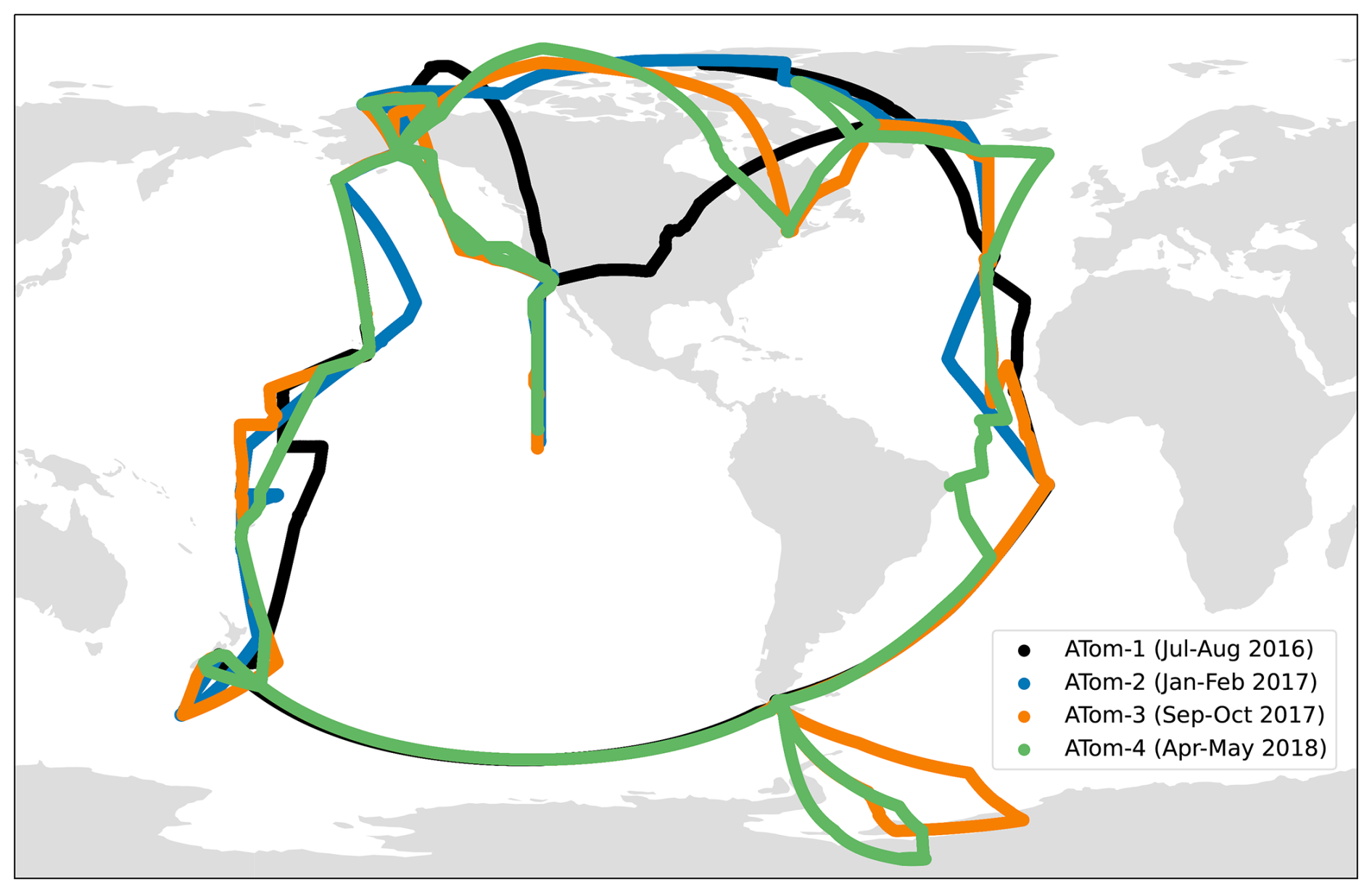
Figure 1Flight tracks of the four deployments (see dates in legend) comprising the ATom field campaign.
Anthropogenic emissions (including ship emissions) follow the year-specific global Community Emissions Data System inventory (CEDSv2) (Hoesly et al., 2018; McDuffie et al., 2020). Aircraft emissions of NOx are from the Aviation Emissions Inventory Code (AEIC) 2019 inventory, based on Simone et al. (2013). Ship NOx emissions are subject to a parameterization of NOx chemistry within plumes (PARANOX) (Holmes et al., 2014) in order to better represent the production of HNO3 and O3, and therefore contribute to a “direct” source of HNO3. We use the Global Fire Emissions Database (GFED4.1s) for biomass burning emissions. Dust (Fairlie et al., 2007; Ridley et al., 2012), biogenic VOCs (Guenther et al., 2012; Hu et al., 2015), sea salt, soil NOx (Hudman et al., 2012) and lightning NOx (Murray et al., 2012) are specified from offline year-specific archived emissions (Weng et al., 2020).
Wet deposition in GEOS-Chem includes two mechanisms – the scavenging of gases and aerosol by wet convective updrafts, and their removal by large-scale precipitation, as described by Liu et al. (2001) for water-soluble aerosols, and Amos et al. (2012) for gases. Removal by precipitation may occur in-cloud (“rainout”) or below-cloud (“washout”). We do not use the optional modified wet deposition scheme from Luo et al. (2019, 2020). Dry deposition is represented by a resistances-in-series model (Wesely, 1989), implemented by Wang et al. (1998a), with size dependent aerosol dry deposition from Emerson et al. (2020) which is based on Zhang et al. (2001). Dry deposition depends on land cover type, local meteorology, and the reactivity, solubility, and hygroscopicity (which affects particle radius) of the compounds being deposited.
We perform a set of simulations from July 2016 to May 2018 and sample the model along the observed flight tracks (see Sect. 2.2). For the annual budget, we perform a year-long simulation for 2016, adding chemical production and loss tracer variables in the Kinetic PreProcessor (KPP v3.0.2) (Lin et al., 2023; Sandu et al., 2023) to every reaction relevant to NOy chemistry in order to characterize the annual chemical flux between NOy species in the model (see Table S2). We add three new species to better account for reactive nitrogen mass in organic aerosol: ALKONITA (alkyl nitrate aerosol), IDNITA (aerosol formed by isoprene dinitrate uptake), INDIOLN (hydrolysis product of IDNITA, formed alongside HNO3). ALKONITA and IDNITA are modeled after the existing IONITA (isoprene nitrate aerosol), and INDIOLN is given the same properties as INDIOL (the generic aerosol-phase organonitrate hydrolysis product). See Sect. S1 in the Supplement for details. Beyond this, we make no changes to the chemical mechanism in GEOS-Chem given that the goal of this work is to assess the existing budget of NOy.
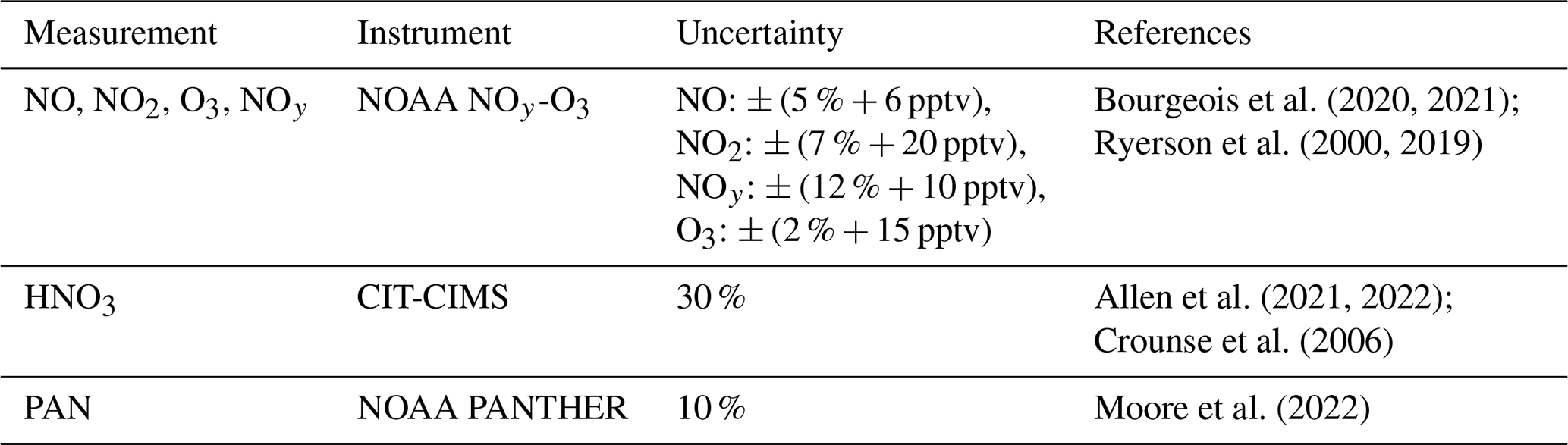
Table 1Description of ATom measurements used to evaluate the model simulation. For uncertainties given as ± (x %+y pptv), x represents the accuracy and y represents the 2σ precision in 1 s.
2.2 ATom Observations
The Atmospheric Tomography Mission (ATom) (Thompson et al., 2022; Wofsy et al., 2018, 2021) surveyed the composition of the remote atmosphere above the Atlantic and Pacific basins during four sets of flights (ATom-1 through ATom-4) between July 2016 and May 2018, sampling each season for approximately a month at a time (Fig. 1). The NASA DC-8 aircraft, which cyclically profiled the troposphere from ∼ 0.2 to 12 km altitude, included instrumentation aboard to measure both gas and aerosol species. We use this multi-season campaign with its consistent vertical profiling to evaluate the global simulation of NOy. Table 1 describes the measurements of NO, NO2, HNO3, and PAN used in this work. We sample the model for the time and location of all flights.
The NO2 measurements can suffer at higher altitude from interferences from thermal decomposition of HNO4 and methyl peroxy nitrate (MPN) (Bourgeois et al., 2022; Shah et al., 2023; Silvern et al., 2018; Travis et al., 2016) or fixed nitrogen compounds like HCN (Bradshaw et al., 1998). Following Shah et al. (2023) we therefore estimate NO2 from the NO-NO2 photostationary state (PSS), using rate constants from Burkholder et al. (2019):
Burkholder et al. (2019) note that Reaction (1) exhibits some non-Arrhenius behavior, described between 204 and 440 K. However, for simplicity, we elect to use the Arrhenius parameterization for k1 (recommended for 195 K < T < 443 K), as a small number of points (< 1 %) above 9 km are sampled at temperatures below 204 K. The two parameterizations differ by on average 5 % (at most 15 %) above 204 K. As in Shah et al. (2023), we use GEOS-Chem-simulated concentrations of species that were not measured or had insufficient coverage (HO2, RO2, and BrO) in our analysis, and treat the CH3O2 + NO reaction as a model for Reaction (3). Species included within the GEOS-Chem definition of RO2 are listed in Sect. S2. We find that the PSS correction factor (Eq. 1) is dominated by NO + O3 (Reaction 1), as it accounts for 36 %–81 % of the denominator. The NO + RO2 and NO + HO2 reactions (Reactions 2 and 3) are of comparable importance and account for 11 %–40 % and 2 %–27 %, respectively. The NO + BrO reaction (Reaction 4) has a minor but non-negligible contribution (1 %–12 %), peaking in the winter. Our model evaluation in Sect. 3.1 uses the PSS NO2 vertical profiles (Eq. 2).
We remove ATom data that sampled fresh NOx emissions ( < 3 mol mol−1), early mornings and late evenings (solar zenith angle > 70°) (Shah et al., 2023; Wei et al., 2025), points that may have been influenced by stratospheric air masses ( > 1 ppbv ppmv−1) (Bourgeois et al., 2021), and flights over continents. Additionally, we filtered out plumes, as they cannot be represented by the GEOS-Chem model (Rastigejev et al., 2010), by excluding the 97th percentile of data and above for each species evaluated. Between 14 %–19 % of the NO data remaining after filtering is below the lower end of the detection limit (5 ppt). We retain this fraction in order not to high bias the observations; however, we note that observational constraints on NO are less reliable at low concentrations. We compare the sum of NO, NO2 (PSS-corrected), HNO3, and PAN (ΣNOy), the key contributors to NOy, as in Murray et al. (2021), to our model. Sampling times with missing data for any one of these four constituents are not included in the model-observation comparison of NOy. We exclude aerosol from our model evaluation as it accounts for on average 1 %–3 % of NOy and is often reported as below detection limit in the remote troposphere during ATom. A model-observation comparison of total NOy from the NOAA-NOyO3 chemiluminescence instrument is available in Fig. S1 in the Supplement. Species included in the model definition of NOy for this comparison are in Sect. S2. Additional NOy species that were not measured consistently across ATom (e.g., peroxypropionyl nitrate (PPN), HNO4, and N2O5) are also excluded from the main text, but we include a model-observation comparison for these species in Fig. S2.
3.1 Model Evaluation using the ATom Campaign
Prior to describing the GEOS-Chem NOy budget in detail, we present a simple global-scale model evaluation compared to the ATom measurements. These comparisons provide some context for uncertainties discussed in Sect. 3.2 and 3.3.
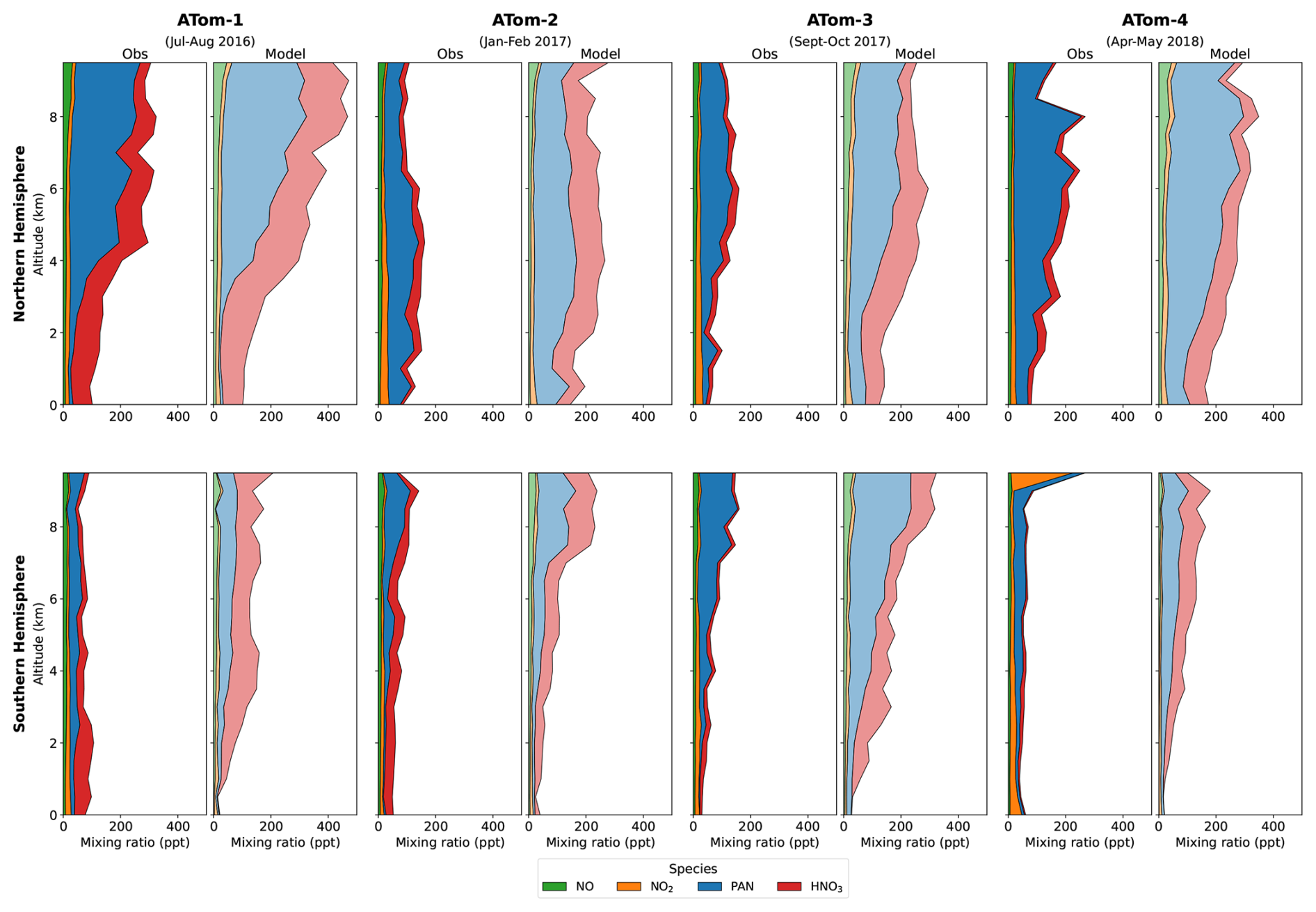
Figure 2Observed (saturated) and modeled (desaturated colors) stacked median vertical profiles of ΣNOy during ATom flights, separated by Northern Hemisphere (top row) and Southern Hemisphere (bottom row). For a detailed comparison of all species, see Fig. S1.
Figure 2 compares vertical profiles measured by the ATom campaign and those simulated by the model. The model captures the general shape of the ΣNOy (= NO + NO2 + HNO3 + PAN) vertical profile throughout the troposphere, as well as the magnitude in the Southern Hemisphere. The model exhibits a high bias in the Northern Hemisphere throughout the year, except in the summer.
As discussed in Sect. 2.2, there is likely a high bias in the measurement of NO2 aboard ATom. Figure S1 shows the effect of applying the PSS correction factor to NO2. We see that the native chemiluminescence measurements would indicate that the model consistently underestimates NO2, as measured by normalized mean bias (NMB, −67 % < NMB < −19 %, except Southern Hemisphere winter when NMB = 8 %). However, application of the PSS correction leads to much better agreement between the model and observations across seasons, particularly in the Southern Hemisphere. Some positive and negative biases remain in the Northern Hemisphere (see Fig. S1 for details). Recent studies (Horner et al., 2024; Wei et al., 2025) note a high bias in the model's representation of PPN, especially in the upper troposphere, and recommend addressing this model bias with the inclusion of PPN photolysis, thereby decreasing PPN and increasing NO2. Figure S2 confirms this high model bias is present in this GEOS-Chem version prior to the implementation of PPN photolysis (131 % < NMB < 451 % in the Northern Hemisphere and 44 % < NMB < 266 % in the Southern Hemisphere).
The model systematically overestimates HNO3, a long-standing bias in GEOS-Chem (62 % < NMB < 505 %) (Norman et al., 2025; Travis et al., 2016; Zhang et al., 2012). It is also unable to capture the general shape of the HNO3 vertical profile across seasons in both hemispheres. An alternative wet deposition scheme (Luo et al., 2019, 2020) is able to largely correct this high bias over the remote ocean (Travis et al., 2020). However, these updates are inconsistent with continental measurements of deposition made over the United States (Dutta and Heald, 2023). Thus, further investigation is needed to improve the HNO3 simulation.
Although the model representation of PAN does have a moderate high bias (8 % < NMB < 93 %), the shape of the vertical profile is reasonably well-captured across seasons. This is consistent with a previous model evaluation of PAN, which explored the sensitivity of PAN chemistry to spatially heterogeneous factors (the variety of VOC precursors, biomass burning in the remote high latitudes, and lightning as a source of NOx at high altitudes) (Fischer et al., 2014). A comparison against additional measurements of PAN taken during ATom is included in Fig. S1.
Overall, the model captures the amount and speciation of total NOy measured during ATom best year-round in the Southern Hemisphere (0 % < NMB < 15 %, except spring when NMB = 50 %) and in the Northern Hemisphere in the summer (when NMB = 11 %, during the rest of the year NMB = 45 %–65 %) (Fig. S1). Figure 2 shows that the model exhibits excess HNO3 year-round throughout the column in the Northern Hemisphere, and in the free troposphere in the Southern Hemisphere. There is also excess model NO and PAN, to a lesser degree than HNO3, in the Northern Hemisphere spring-fall. We present these comparisons as a benchmark for interpreting the global budgets that follow.
3.2 Global Budget of NOx and NOy
The global burdens of various NOy species are set by an equilibrium between sources (emissions, chemical production) and sinks (wet and dry deposition, chemical loss). We characterize these sources and sinks based on a 2016 simulation; interannual variability in the total abundance of NOy is expected due to variations in natural sources (including fires) and removal via precipitation, but we expect the overall partitioning of NOy species presented here to be robust. Table 2 summarizes the major NOy emissions. These are dominated by NOx (∼ 94 %), with small quantities of HNO3 (as a consequence of the parameterization of NOx chemistry from ship emissions plumes, discussed in Sect. 2.1) and alkyl nitrates making up the remainder. NOx is primarily emitted as NO (51 Tg N yr−1), with a minor contribution from NO2 (2.5 Tg N yr−1). Anthropogenic sources (including here aircraft and ship emissions reported by the model's emissions diagnostics) contribute 63 % of NOx emissions (33.9 Tg N yr−1), with fires, lightning, and soil contributing a little more than 10 % each. Approximately 76 % of total NOx emissions are in the Northern Hemisphere.
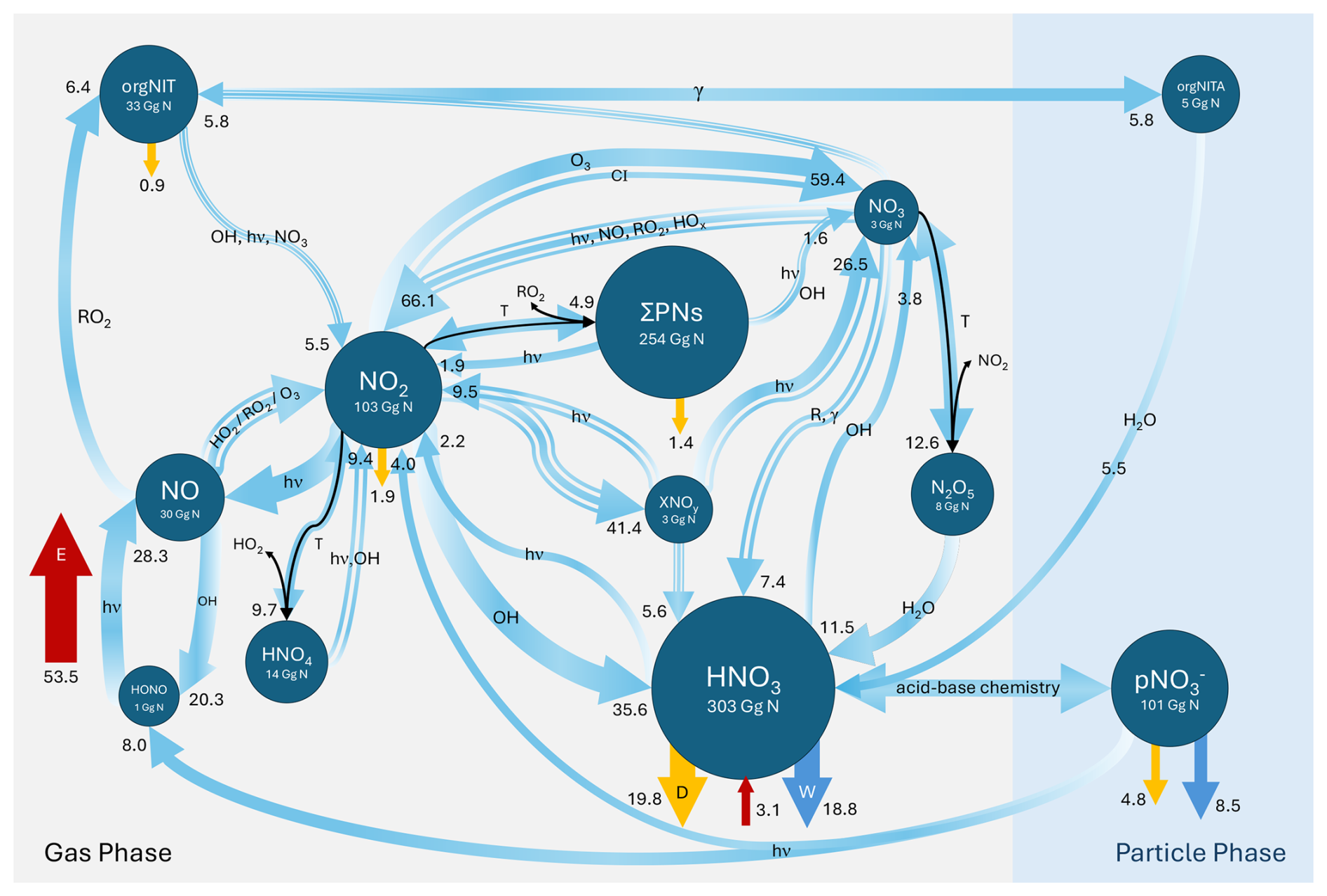
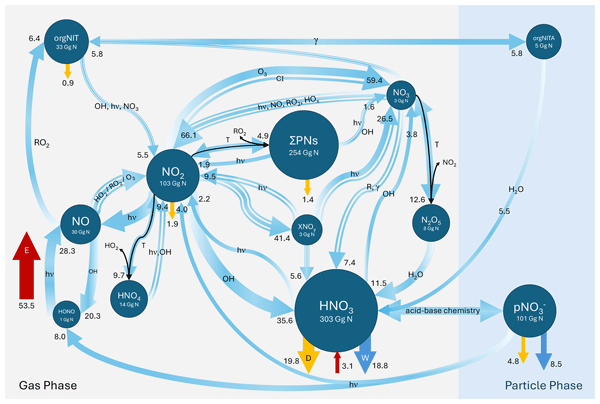
Figure 3Modeled NOy budget for 2016 showing key species and families (dark blue circles) in Gg N and chemical and physical fluxes (arrows) in Tg N yr−1. Chemical fluxes exceeding 1 Tg N yr−1 are represented by curved light blue arrows. Compound arrows indicate where multiple flux pathways between species have been lumped. Net fluxes between species that undergo rapid cycling are shown with inset curved black arrows. Physical fluxes exceeding 0.5 Tg N yr−1 are represented by vertical arrows and include emissions (red arrows), wet deposition (blue arrows), and dry deposition (yellow arrows).
Figure 3 summarizes the modeled annual global tropospheric budget of NOy simulated for 2016. ΣPNs refers to peroxy nitrates, XNOy is a catchall for halogen nitrates and nitrites, orgNIT includes both gas-phase organic nitrates and related nitrogen-containing peroxy and alkoxy radicals, orgNITA is aerosol organic nitrates, and is comprised of both fine (NIT) and coarse (NITs) mode particulate nitrates. See Sect. S3 for the complete lists of model species that define each of these families. Emissions are shown as vertical red arrows, with deposition shown as vertical blue and yellow arrows. All chemical fluxes that exceed 1 Tg N yr−1 are shown as light blue arrows, except for those that represent radical cycling between NO, NO2 and NO3 (discussed in greater detail in Sect. 3.3). The total burden of NOy is 858 Gg N, with major contributions from NOx (134 Gg N), HNO3 (303 Gg N), (90 Gg N fine and 11 Gg N coarse), and ΣPNs (254 Gg N) (of which PAN is the major component, corresponding to 205 Gg N, followed by PPN = 38 Gg N, and MPN = 10 Gg N). The deposition of HNO3 and (51.9 Tg N yr−1) is responsible for 90 % of NOy deposition (57.4 Tg N yr−1) and therefore governs the lifetime of NOy (τdep ∼ 5.5 d). The total NOy deposition is slightly higher than the total emissions (56.8 Tg N yr−1). This is due to a small net input of nitrogen in the form of nitric acid from the stratosphere ∼ 0.6 Tg N yr−1, as seen in ACCMIP (Lamarque et al., 2013). The tropospheric lifetime of HNO3 to deposition is ∼ 2.9 d, with approximately equal contributions from wet and dry deposition. A more detailed version of this budget is available in Table S3.
Table 2Annual global tropospheric emissions of NOy for 2016 in GEOS-Chem.
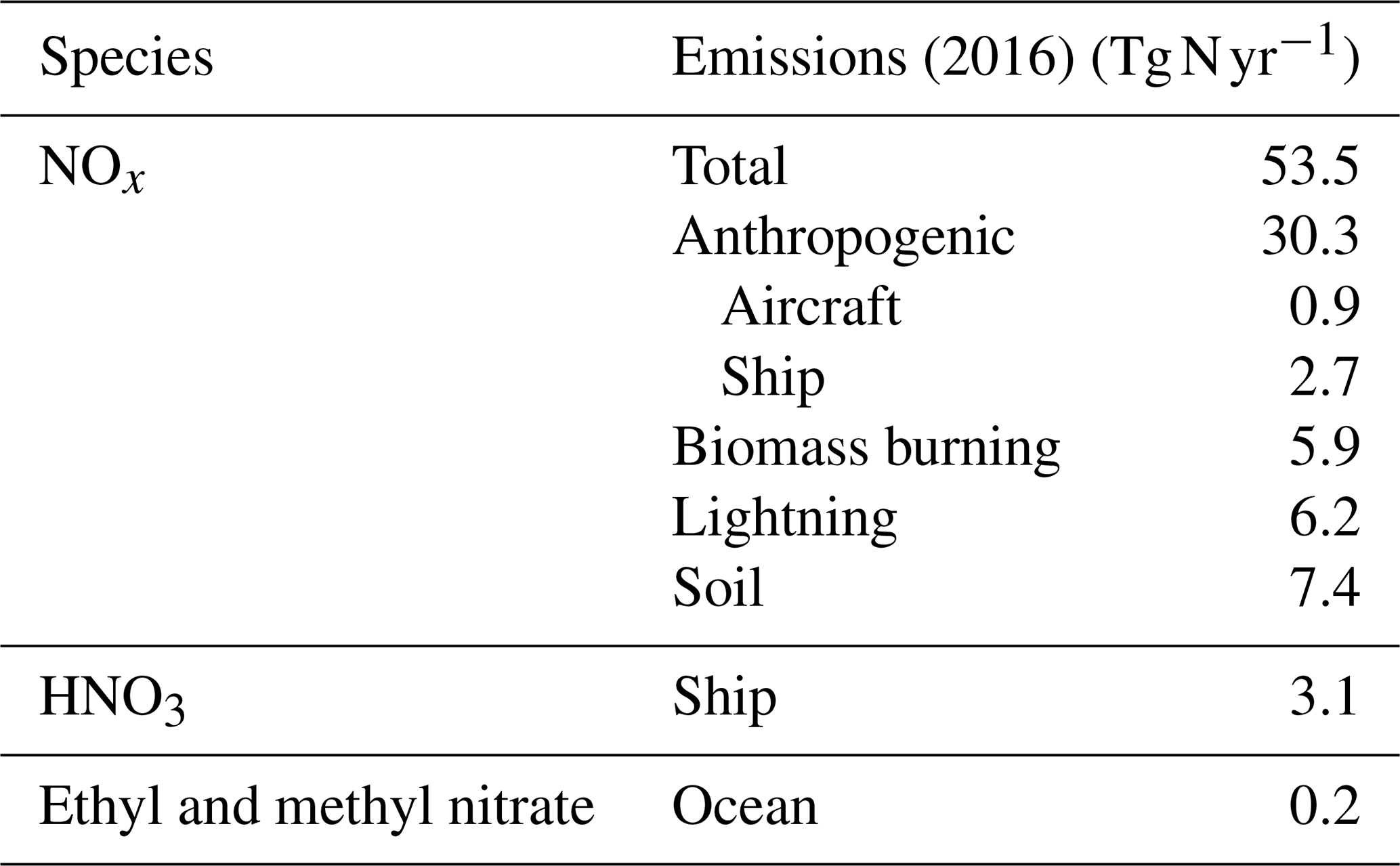
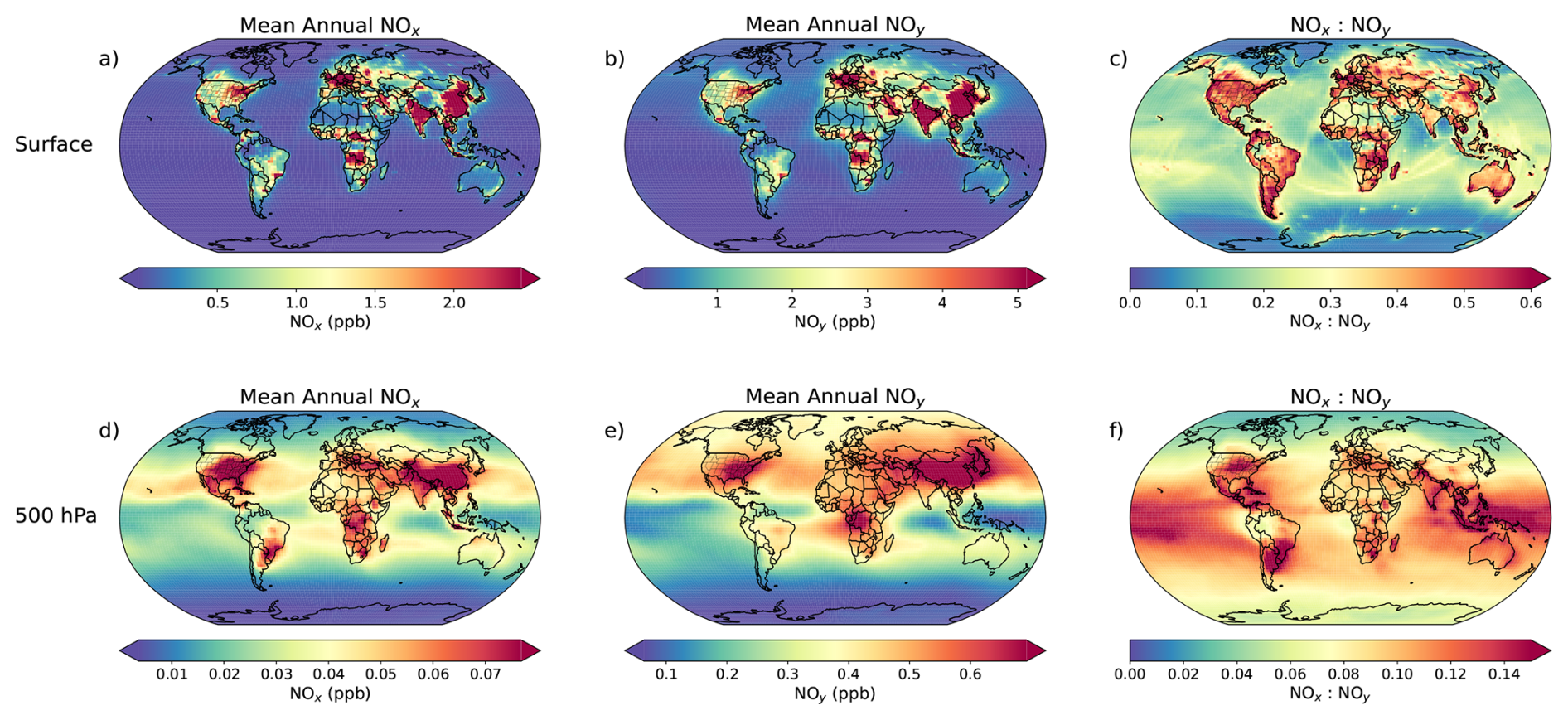
Figure 4GEOS-Chem simulation of annual mean (2016) concentrations of NOx (ppb), NOy (ppb) and NOx:NOy at (a–c) the surface and (d–f) 500 hPa. See Sect. S4 for species included in the model definition of NOy.
Figure 4 shows the concentrations of NOx and NOy, as well as their ratio at the surface and at 500 hPa. High NOx:NOy regions near the surface are indicative of fresh NOx emissions, with the peaks near urban centers, major shipping lanes, and biomass burning regions. At the surface, the global average ratio of NOx:NOy is 0.23, and over continents it is 0.34. In the free troposphere, much of the NOx is consumed to form longer-lived NOz (= NOy – NOx), with a low, diffuse NOx:NOy ratio reflecting long-range transport and mixing. At 500 hPa, both NOx and NOy concentrations are lower, and the ratio is more spatially homogenous, with the continental average being within 5 % of the global average of 0.10. Regions with high NOx:NOy ratio aloft, such as those seen in the tropics, are due to lightning as well as lofted anthropogenic and biomass burning NOx emissions.
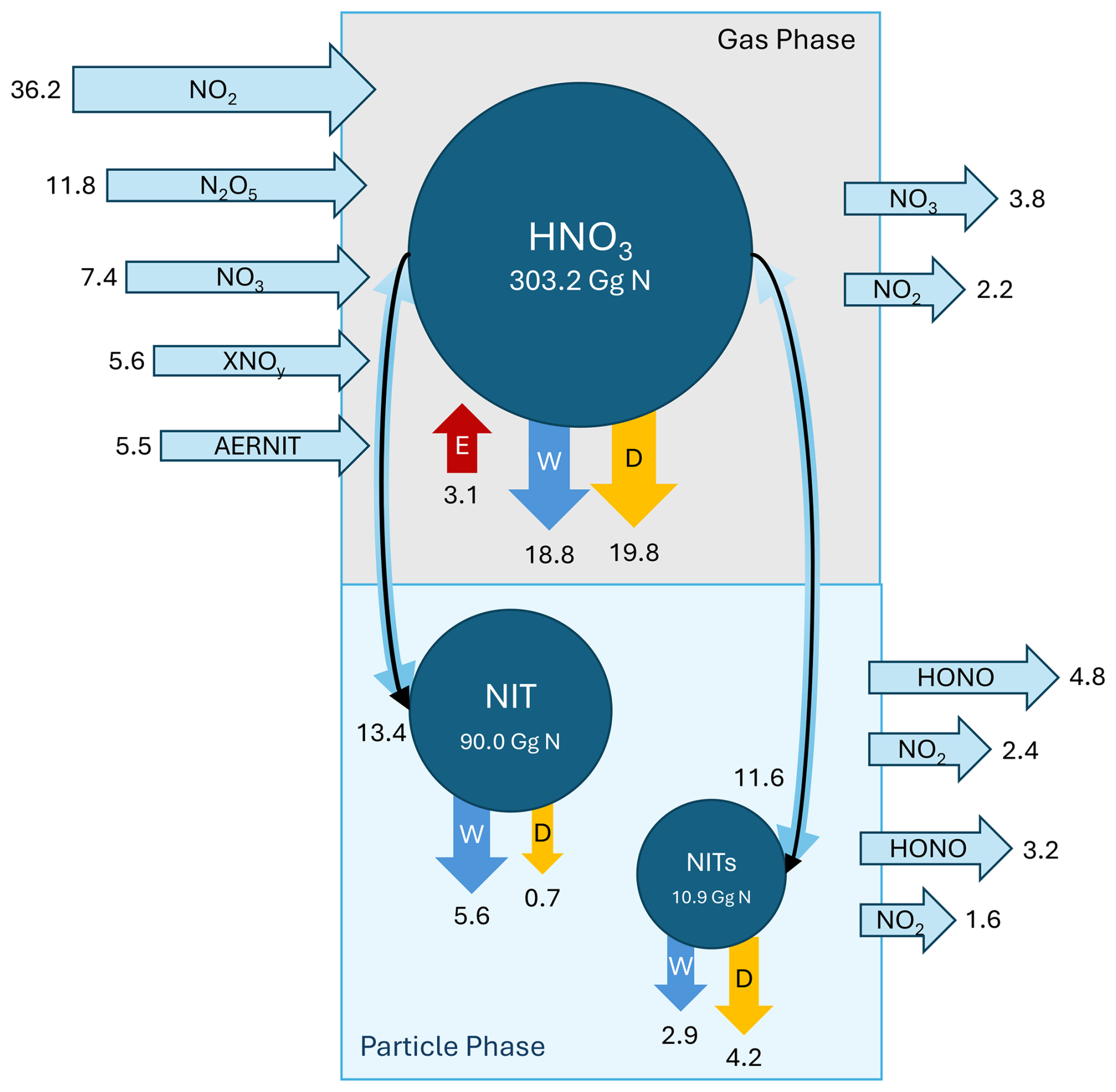
Figure 5Summary of annual TNO3 budget in GEOS-Chem for 2016, showing sources (red), chemical fluxes (light blue), and wet (blue) and dry (yellow) deposition. Here NIT are fine mode nitrate aerosol and NITs are coarse mode nitrate aerosol.
As described in Sect. 1, NOx undergoes rapid chemical cycling with a number of other NOy species (NO3, HONO, HNO4, N2O5, ΣPNs). However, the primary sink of NOx is the formation of nitric acid (HNO3), with approximately 36.2 Tg N yr−1 formed from NO2. Given rapid cycling of NOx, the resulting mean global chemical lifetime for NOx is ∼ 44 min. However, if we exclude rapid cycling (for example with ΣPNs and HONO) and only consider net loss of NOx, the mean global chemical lifetime of NOx is ∼ 23 h.
3.3 NOy Chemical Cycling
Figure 3 summarizes the main chemical and physical flows within the NOy family. Here we discuss in further detail the budgets of key reservoir species within that family. Table S2 provides all annual mean simulated fluxes for each reaction, based on definitions of families described in Sect. S3.
Figure 5 summarizes the budget of total nitrate (TNO3 = HNO3 + ). As described above, the main source of HNO3 is production via NO2 (36.2 Tg N yr−1), most (98 %) of which is formed by the oxidation of NO2 by OH (35.6 Tg N yr−1) with a minor (2 %) contribution from aerosol uptake of NO2 (0.5 Tg N yr−1). Heterogeneous chemistry that includes N2O5 hydrolysis (11.5 Tg N yr−1, of which 2.2 Tg N yr−1 is from cloud uptake) and uptake by sea salt (0.4 Tg N yr−1) is the second most important source of HNO3. Aerosol uptake of NO3 (3.0 Tg N yr−1) and the production of HNO3 as a byproduct of RO2 formation by NO3 (4.4 Tg N yr−1) are minor sources of HNO3. Other sources include halogen nitrate uptake on sea salt, hydrolysis, or breakdown by acids (e.g. HCl, HBr) (5.6 Tg N yr−1), and aerosol organic nitrate hydrolysis (5.5 Tg N yr−1).
As discussed previously, almost all NOy removal from the troposphere is via deposition of HNO3 (38.6 Tg N yr−1). In GEOS-Chem, the equilibrium partitioning of HNO3 between gas and particle phase is calculated by ISORROPIA II, and therefore we can estimate the net formation of from HNO3 to be 25 Tg N yr−1 (13.4 Tg N yr−1 as fine mode nitrate aerosol, and 11.6 Tg N yr−1 as coarse mode aerosol). Other losses of HNO3 include oxidation by OH to form NO3 (3.8 Tg N yr−1), photolysis to form NO2 (2.2 Tg N yr−1), and uptake of HNO3 on sea salt to form coarse mode aerosol inorganic nitrate (0.3 Tg N yr−1, not shown in Fig. 5). While was classically treated to be a terminal sink for NOx, the recent implementation of NOx recycling via photolysis of to form HONO and NO2 implies that serves as a reservoir species. In our model representation, this photolysis is non-negligible (12.0 Tg N yr−1), with approximately 8.0 Tg N yr−1 forming HONO (which rapidly cycles with NO during the daytime), and 4.0 Tg N yr−1 being recycled directly back to NO2. This is comparable to the total deposition of (13.3 Tg N yr−1).
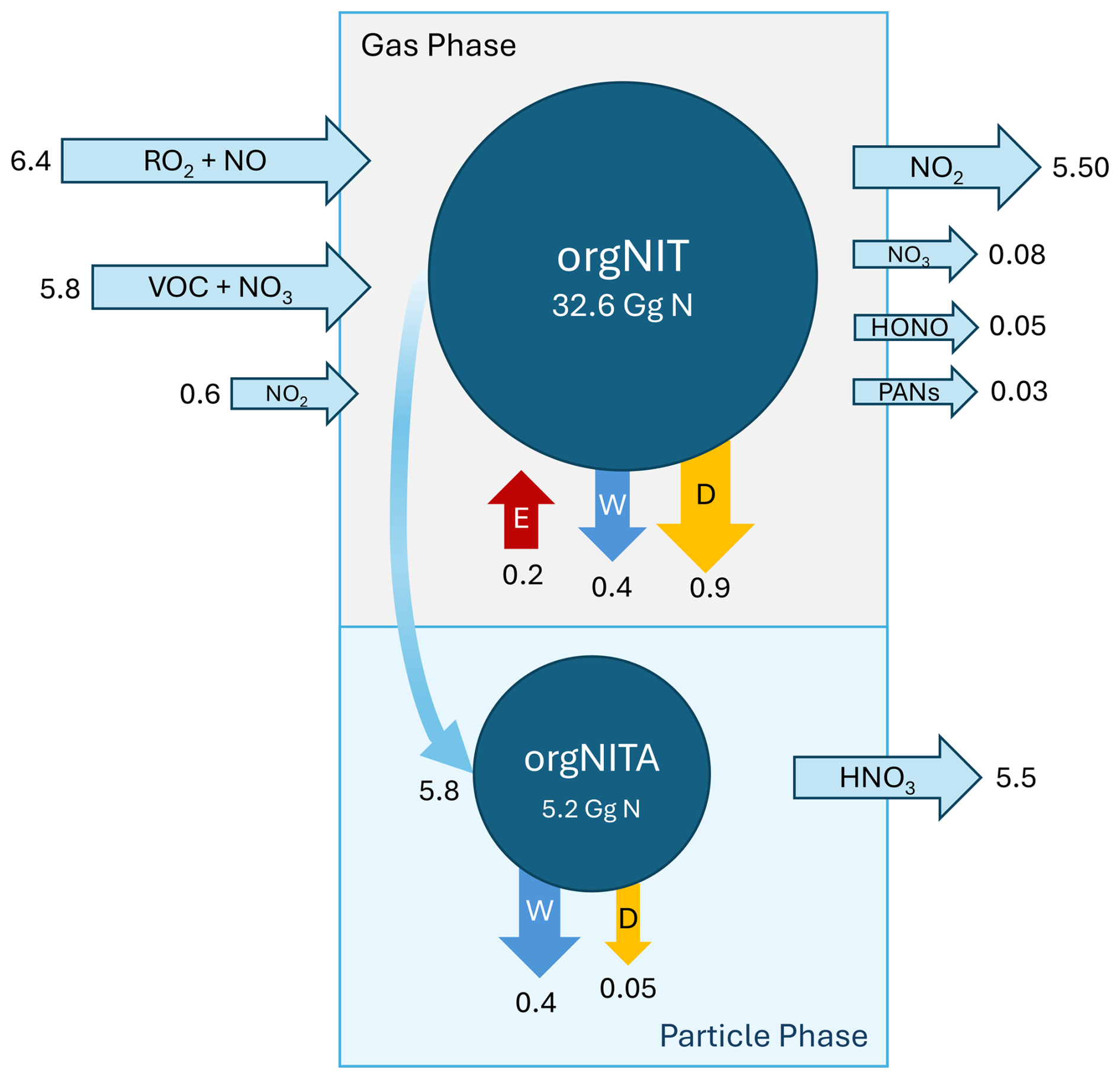
Figure 6Summary of annual organic nitrate budget in GEOS-Chem for 2016, showing sources (red), chemical fluxes (light blue), and wet (blue) and dry (yellow) deposition.
Peroxy nitrates (ΣPNs) are the other major reservoir species. They are formed near the surface where NOx is abundant and RO2 readily forms from the oxidation of volatile organic compounds (VOCs) by OH. ΣPNs are stable at lower temperatures in the free troposphere and therefore able to transport NOy away from NOx source regions. As air masses descend, warmer temperatures lead to ΣPN decomposition, releasing NOx downwind of sources. In the model, there is rapid formation and decomposition of ΣPNs (formation = 811.3 Tg N yr−1, loss = 810.0 Tg N yr−1). Of these, the rate of production and loss of MPN is the fastest (production = 654.8 Tg N yr−1, loss = 654.9 Tg N yr−1, of which 0.8 Tg N yr−1 is by photolysis), followed by PAN (production = 132.4 Tg N yr−1, loss = 130.7 Tg N yr−1, of which 1.2 Tg N yr−1 is by photolysis). There is a net production (2.9 Tg N yr−1) of ΣPNs from NO2, and there is a net loss of ΣPNs to form NO3 via oxidation by OH (1.1 Tg N yr−1) and photolysis (0.5 Tg N yr−1). Approximately 1.5 Tg N yr−1 of ΣPNs are lost by deposition, primarily via dry deposition.
Figure 6 summarizes the budget of organic nitrates, the representation of which is highly simplified in GEOS-Chem. Organic nitrates are formed primarily by the oxidation of NO by peroxy radicals (6.4 Tg N yr−1) and oxidation of BVOCs by the nitrate radical (5.8 Tg yr−1). Alkyl nitrates (ALKNIT) represent a majority of the gas-phase organic nitrate burden (27.5 Gg N), followed by isoprene nitrates (ISOPNIT) (2.9 Gg N), monoterpene nitrates (MTNIT) (1.0 Gg N), and other short-chain nitrates (C3NIT) (1.0 Gg N). Only a small fraction of the total gas phase organic nitrate loss is accounted for by deposition (1.2 Tg N yr−1). Instead, once formed, these lumped gas-phase nitrates (including those formed from the oxidation of isoprene, monoterpenes, and alkyl nitrates) either recycle NOx as NO2 (5.5 Tg N yr−1), or are subject to aerosol uptake that represents the formation of particulate matter (5.8 Tg N yr−1), neglecting more complex processes. The formation of particle-phase organic nitrates (orgNITA) (mean annual burden of 5 Gg N) is dominated by ISOPNIT (56 %), followed by MTNIT (20 %), ALKNIT (19 %), and aromatics (5 %). Once formed, orgNITAs rapidly hydrolyse to form HNO3 (5.5 Tg N yr−1) (Fisher et al., 2016), which vastly outcompetes their deposition (0.4 Tg N yr−1).
Almost all alkyl nitrate formation (93 %) occurs via the RO2 + NO pathway. Once formed, the losses are via aerosol uptake (48 %), NOx recycling (38 %), and deposition (14 %). In contrast, only 56 % of isoprene nitrates are formed by this pathway, with 41 % accounted for by the oxidation of isoprene initiated by NO3. Despite the differences in formation, the fate of isoprene nitrates is similar to that of alkyl nitrates, with 45 % forming aerosol nitrate, 38 % recycling NO2, 8 % removed by deposition, and the remaining 7 % forming shorter-chain organic nitrates (C3NIT) (primarily via reaction with HO2 or NO, and with small contributions from photolysis or reaction with OH). These C3NIT are formed either from isoprene-derived precursors (44 %) or by the oxidation of short-chain VOCs (methacrolein or lumped > C3 alkenes) by NO3 (40 %) and are removed primarily by photolysis (54 %) or NO- or RO2-mediated reactions, both of which form NO2 (25 %). Deposition contributes 14 % of the loss of C3NIT.
Monoterpene chemistry is simplified to a greater degree than isoprene chemistry in GEOS-Chem. 85 % of monoterpene nitrates are formed from the oxidation of monoterpenes by NO3, while only 15 % are formed via RO2 + NO. However, the fate of monoterpene nitrates closely mirrors that of isoprene nitrates, with 48 % forming organic aerosol, 44 % recycling to NO2, and 8 % removed by deposition.
HONO can function as an important source of OH radicals in the morning (Sect. 1). The major sources of HONO are the oxidation of NO by OH (20.3 Tg N yr−1) and the photolysis of particulate inorganic nitrate () (8.0 Tg N yr−1), with a minor contribution from NO2 uptake on aerosol surfaces (0.5 Tg N yr−1). Almost all HONO (98 %) is photolyzed during the day to form NO and OH (28.3 Tg N yr−1), while the remainder is further oxidized by OH to form NO2 and water.
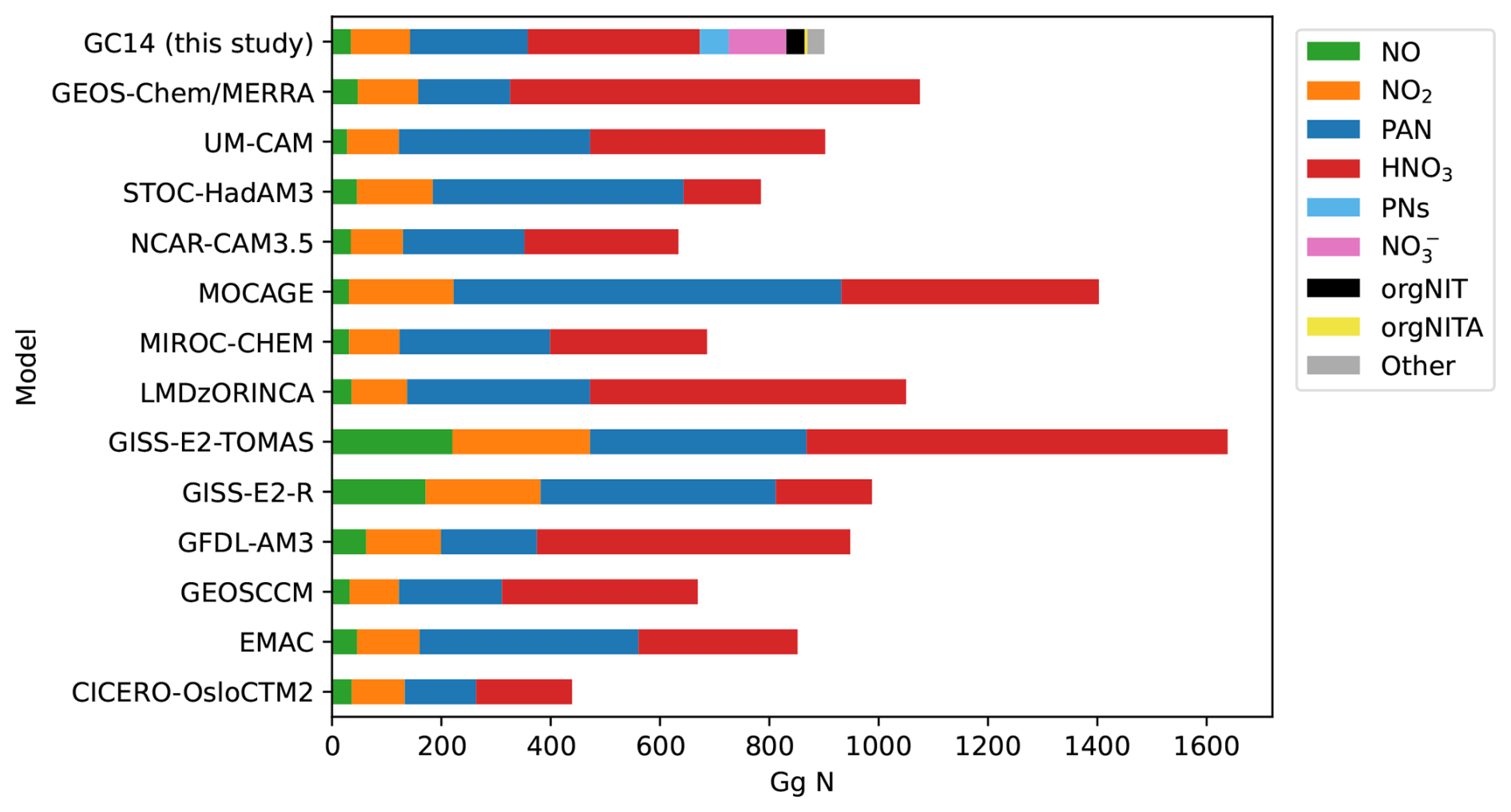
Figure 7Decadal-average (2000s) global tropospheric burdens of the four major NOy species across ACCMIP models (data from Murray et al., 2021) compared with NOy burdens (including additional species quantified) from this study (GC14) for 2016. We note that the ACCMIP models represent NOy chemistry with varying complexity but all models simulated additional NOy species beyond the four major species shown here; however, these additional species are not represented here as their burdens were not characterized in Murray et al. (2021).
The nitrate radical (NO3) is the key driver of nighttime tropospheric NOy chemistry. It is formed primarily by the oxidation of NO2 by O3 (52.2 Tg N yr−1), and the decomposition of halogen nitrates (25.1 Tg N yr−1 by photolysis, and 1.4 Tg N yr−1 by miscellaneous oxidants). Smaller sources of NO3 include the oxidation of HNO3 and peroxymethacroyl nitrate (MPAN) by OH (3.8 Tg N yr−1 and 1.1 Tg N yr−1, respectively), and the photolysis of PAN (0.5 Tg N yr−1) and N2O5 (forming 0.6 Tg N yr−1 each of NO2 and NO3). NO3 forms NO2 by photolysis (46.2 Tg N yr−1), reaction with NO (14.5 Tg N yr−1), reaction with RO2 (3.7 Tg N yr−1), or HOx cycling (1.6 Tg N yr−1); and forms NO by photolysis (6.0 Tg N yr−1). It may form HNO3 via oxidation of unsaturated VOCs (4.4 Tg N yr−1) or via uptake on aerosol surfaces (3.0 Tg N yr−1) and is responsible for 45 % of the formation of organic nitrates (5.8 Tg N yr−1).
N2O5 is formed entirely via the termolecular reaction between NO2 and NO3 (1037.5 Tg N yr−1 of N2O5, returning 511.9 Tg N yr−1 each to NO2 and NO3 upon decomposition. Some of this formation is balanced by a photolytic loss (0.6 Tg N yr−1 each to NO2 and NO3), giving a net formation of N2O5 of 12.6 Tg N yr−1. There are additional losses to HNO3 via hydrolysis (11.5 Tg N yr−1) and uptake on sea salt (0.7 Tg N yr−1), the latter of which also produces ClNO2 in equal quantities. Deposition is a minor sink of N2O5 (0.4 Tg N yr−1 of dry deposition).
As seen in Fig. 3, halogens play a central role in mediating the flow of reactive nitrogen between different NOy species. XNOy species are largely formed by the reaction of NO2 with halogen atoms or halogen monoxides (41.4 Tg N yr−1). These species are relatively short-lived and may decompose to form NO3 (26.5 Tg N yr−1, 95 % of which is by photolysis) or NO2 (9.5 Tg N yr−1, 56 % of which is by photolysis) or undergo uptake onto sea salt to form HNO3 (5.6 Tg N yr−1). Deposition of XNOy is negligible (0.1 Tg N yr−1, 86 % of which is dry deposition).
Nitrogen oxides have long been studied due to their central role in driving tropospheric chemistry. In this study, we characterize the global tropospheric budget for NOy as represented in the GEOS-Chem chemical transport model. We also provide model estimates of the relative importance of the different chemical processes that control the production and loss of NOy species in the global troposphere. As discussed in Sect. 2.1, the earliest models of NOy considered only a handful of reservoir species for NOx (HONO, HNO3, N2O5, and later PAN) (Levy II, 1972; Logan, 1983). Now, especially with advances in our understanding of organic nitrates and heterogeneous chemistry, we represent a more diverse array of reservoirs that transport NOx further away from source regions into the remote troposphere. However, modern chemical transport models disagree on the abundance and speciation of this more complicated (and variable) representation of NOy.
Figure 7 shows the decadal-average burdens of four key NOy species (NO, NO2, HNO3, and PAN) across ACCMIP models for the 2000s from Murray et al. (2021), compared to our simulation of 2016 where we comprehensively characterize all the forms of NOy in GEOS-Chem (GC14). The tropospheric burdens of the sum of these four NOy species varies between models by a factor of 3.7. There is similarly large variation in speciation, with no clear trend between models. Murray et al. (2021) note numerous reasons for this variation that lead either directly to changes in NOy lifetime by physical removal, or indirectly by reactive loss due to differences in oxidant abundance, as well as differences in the spatial distribution of lightning NOx. Different implementations of heterogeneous chemistry across models are another source of uncertainty (e.g., some models consider variations in reactive uptake based on aerosol composition while others do not), thereby altering local sinks of NOy. Finally, models vary in their representation of the competition between reactive loss and physical loss (which is also the case for reactive carbon) and the degree to which they permit NOx recycling from reservoirs.
Despite advances in our understanding of NOy chemistry over the last 70 years, there remain numerous uncertainties in our ability to accurately represent the global abundances of many NOy species in models. In Sect. 1, we noted the GEOS-Chem model's long-standing overestimate of HNO3. However, Fig. 7 shows that some ACCMIP models exhibit even higher HNO3 than GEOS-Chem, suggestive of wide-spread issues in the simulation of HNO3 and potentially the need for additional chemical loss pathways. In Sect. 3.1, we noted the development of alternative wet deposition schemes that seek to address the model's high-biased representation of HNO3. However, these changes are not an unambiguous improvement over the existing scheme, with regional biases in concentration and deposition fluxes persisting (Dutta and Heald, 2023). Thus, investigation of additional loss processes is needed to improve the HNO3 simulation. These may include heterogeneous processes such as the uptake of nitric acid on coarse mode aerosol (e.g. dust), although current optional representations of this process in GEOS-Chem produce only local modest reductions in HNO3. Additionally, our understanding of as a terminal sink for NOy has been challenged in recent years – renoxification by photolysis allows to act as a reservoir for NOy instead. However, the efficiency of this renoxification is still uncertain and will require coordinated model, lab, and field studies to constrain.
In Sect. 3.3 we characterize the impact of organic chemistry on NOy cycling. This is an area of study that is rapidly evolving, and updates to the model's representation of organic chemistry, especially monoterpene chemistry, will likely lead to changes to the NOy budget. We also find that deposition is presently a relatively small sink for organic nitrates in the model, given the large (and perhaps excessive) hydrolysis loss. Constraints on organic nitrogen deposition are limited; one study suggests that wet deposition of organic nitrogen in Rocky Mountain National Park is comparable to that of nitrate (Beem et al., 2010). Thus, the balance between chemical and physical losses requires more attention. In service of this, we advocate for additional collocated measurements of both concentrations and deposition, with a characterization of organic and inorganic NOy. However, we note that modifications to the current balance between reactive and physical loss of aerosol organic nitrate will likely have minimal impacts on the high model HNO3 bias, as this hydrolysis represents only ∼ 8 % of HNO3 sources.
There have also been recent changes to the model's representation of halogen chemistry, which is another active area of research in the troposphere. A recent review by Saiz-Lopez et al. (2025) notes the need to increase the spatial and temporal density of observations of short-lived halogens, due to their high reactivity, as well as the need to include measurements of a greater variety of short-lived halogen species. The current implementation of halogen chemistry varies widely across models, largely due to limitations in our current understanding of the underlying processes.
The systematic approach to characterizing not just burdens and physical sinks but also chemical cycling used in this study may enable efforts to probe the sensitivity of the NOy system to changes in chemistry or future emissions. Here, we have provided a summary of the global tropospheric NOy budget for a single year and at monthly mean timescales. Future exploration of the NOy budget on diurnal and seasonal timescales is needed. Additionally, while the focus of this study was to examine NOy on a global scale, we acknowledge that the relative importance of different NOy interconversion pathways could vary considerably at the regional scale. Finally, our results represent only a single model's characterization of global NOy chemistry. There is a range of complexity represented across different global chemistry models, and a comparison of NOy fluxes across models would help us further understand the processes that give rise to differences in burdens and speciation.
The data that support the findings of this study are available on Zenodo (https://doi.org/10.5281/zenodo.18632688) (Dutta et al., 2026). Observational data for the ATom campaign (Wofsy et al., 2021) are publicly available at https://doi.org/10.3334/ORNLDAAC/1925. The GEOS-Chem model is publicly available at https://doi.org/10.5281/zenodo.10640536 (GEOS-Chem v14.3.0, 2024).
The supplement related to this article is available online at https://doi.org/10.5194/acp-26-11875-2026-supplement.
ID and CLH designed the study. ID performed the simulations and led the analysis. EJH and FLM provided measurements of PAN used in the analysis. JDC provided measurements of HNO3 used in the analysis. IB and JP provided measurements of NOy, NO, and NO2, and O3 used in the analysis. ID and CLH wrote and edited the paper with input from all co-authors.
The contact author has declared that none of the authors has any competing interests.
Publisher's note: Copernicus Publications remains neutral with regard to jurisdictional claims made in the text, published maps, institutional affiliations, or any other geographical representation in this paper. The authors bear the ultimate responsibility for providing appropriate place names. Views expressed in the text are those of the authors and do not necessarily reflect the views of the publisher.
We acknowledge the following investigators for providing measurements of NO, NO2, NOy, O3, HNO3, HNO4, PPN, PAN, , N2O5, ClNO2, and water vapor: Hannah M. Allen, Pedro Campuzano-Jost, Douglas A. Day, Joshua P. DiGangi, Glenn S. Diskin, Geoffrey S. Dutton, James W. Elkins, Bradley D. Hall, L. Gregory Huey, Jose L. Jimenez, Michelle J. Kim, Saewung Kim, J. David Nance, Benjamin A. Nault, J. Andrew Neuman, John B. Nowak, Derek J. Price, Thomas B. Ryerson, Jason C. Schroder, David J. Tanner, Alexander P. Teng, Chelsea R. Thompson, Patrick R. Veres, and Paul O. Wennberg.
The model simulations and analyses presented here were conducted using the “Svante” cluster, a facility located at MIT's Massachusetts Green High Performance Computing Center and supported by the Center for Sustainability Science and Strategy.
This study was supported by a National Science Foundation Division of Atmospheric and Geospace Sciences grant (AGS-2223070) to CLH at MIT. The Caltech group was supported by the National Aeronautics and Space Administration (NNX15AG61A, 80NSSC21K1704). EJH and FLM were partially supported by NASA award NNH17AE26I. IB and JP were partially supported by the NOAA cooperative agreements with CIRES, NA17OAR4320101 and NA22OAR4320151.
This paper was edited by Leiming Zhang and reviewed by two anonymous referees.
Akimoto, H., Takagi, H., and Sakamaki, F.: Photoenhancement of the nitrous acid formation in the surface reaction of nitrogen dioxide and water vapor: Extra radical source in smog chamber experiments, Int. J. Chem. Kinet., 19, 539–551, https://doi.org/10.1002/kin.550190606, 1987.
Allen, H. M., Crounse, J. D., Kim, M. J., Teng, A. P., Xu, L., and Wennberg, P. O.: ATom: In Situ Data from Caltech Chemical Ionization Mass Spectrometer (CIT-CIMS), V2, ORNL DAAC, Oak Ridge, Tennessee, USA [data set], https://doi.org/10.3334/ORNLDAAC/1927, 2021.
Allen, H. M., Crounse, J. D., Kim, M. J., Teng, A. P., Ray, E. A., McKain, K., Sweeney, C., and Wennberg, P. O.: H2O2 and CH3OOH (MHP) in the Remote Atmosphere: 1. Global Distribution and Regional Influences, J. Geophys. Res.-Atmos., 127, e2021JD035701, https://doi.org/10.1029/2021JD035701, 2022.
Amos, H. M., Jacob, D. J., Holmes, C. D., Fisher, J. A., Wang, Q., Yantosca, R. M., Corbitt, E. S., Galarneau, E., Rutter, A. P., Gustin, M. S., Steffen, A., Schauer, J. J., Graydon, J. A., Louis, V. L. St., Talbot, R. W., Edgerton, E. S., Zhang, Y., and Sunderland, E. M.: Gas-particle partitioning of atmospheric Hg(II) and its effect on global mercury deposition, Atmos. Chem. Phys., 12, 591–603, https://doi.org/10.5194/acp-12-591-2012, 2012.
Andersen, S. T., Carpenter, L. J., Reed, C., Lee, J. D., Chance, R., Sherwen, T., Vaughan, A. R., Stewart, J., Edwards, P. M., Bloss, W. J., Sommariva, R., Crilley, L. R., Nott, G. J., Neves, L., Read, K., Heard, D. E., Seakins, P. W., Whalley, L. K., Boustead, G. A., Fleming, L. T., Stone, D., and Fomba, K. W.: Extensive field evidence for the release of HONO from the photolysis of nitrate aerosols, Science Advances, 9, eadd6266, https://doi.org/10.1126/sciadv.add6266, 2023.
Baergen, A. M. and Donaldson, D. J.: Photochemical Renoxification of Nitric Acid on Real Urban Grime, Environ. Sci. Technol., 47, 815–820, https://doi.org/10.1021/es3037862, 2013.
Bates, K. H. and Jacob, D. J.: A new model mechanism for atmospheric oxidation of isoprene: global effects on oxidants, nitrogen oxides, organic products, and secondary organic aerosol, Atmos. Chem. Phys., 19, 9613–9640, https://doi.org/10.5194/acp-19-9613-2019, 2019.
Bates, K. H., Jacob, D. J., Li, K., Ivatt, P. D., Evans, M. J., Yan, Y., and Lin, J.: Development and evaluation of a new compact mechanism for aromatic oxidation in atmospheric models, Atmos. Chem. Phys., 21, 18351–18374, https://doi.org/10.5194/acp-21-18351-2021, 2021.
Bates, K. H., Burke, G. J. P., Cope, J. D., and Nguyen, T. B.: Secondary organic aerosol and organic nitrogen yields from the nitrate radical (NO3) oxidation of alpha-pinene from various RO2 fates, Atmos. Chem. Phys., 22, 1467–1482, https://doi.org/10.5194/acp-22-1467-2022, 2022.
Beem, K. B., Raja, S., Schwandner, F. M., Taylor, C., Lee, T., Sullivan, A. P., Carrico, C. M., McMeeking, G. R., Day, D., Levin, E., Hand, J., Kreidenweis, S. M., Schichtel, B., Malm, W. C., and Collett, J. L.: Deposition of reactive nitrogen during the Rocky Mountain Airborne Nitrogen and Sulfur (RoMANS) study, Environ. Pollut., 158, 862–872, https://doi.org/10.1016/j.envpol.2009.09.023, 2010.
Bian, H., Chin, M., Hauglustaine, D. A., Schulz, M., Myhre, G., Bauer, S. E., Lund, M. T., Karydis, V. A., Kucsera, T. L., Pan, X., Pozzer, A., Skeie, R. B., Steenrod, S. D., Sudo, K., Tsigaridis, K., Tsimpidi, A. P., and Tsyro, S. G.: Investigation of global particulate nitrate from the AeroCom phase III experiment, Atmos. Chem. Phys., 17, 12911–12940, https://doi.org/10.5194/acp-17-12911-2017, 2017.
Bourgeois, I., Peischl, J., Thompson, C. R., Aikin, K. C., Campos, T., Clark, H., Commane, R., Daube, B., Diskin, G. W., Elkins, J. W., Gao, R.-S., Gaudel, A., Hintsa, E. J., Johnson, B. J., Kivi, R., McKain, K., Moore, F. L., Parrish, D. D., Querel, R., Ray, E., Sánchez, R., Sweeney, C., Tarasick, D. W., Thompson, A. M., Thouret, V., Witte, J. C., Wofsy, S. C., and Ryerson, T. B.: Global-scale distribution of ozone in the remote troposphere from the ATom and HIPPO airborne field missions, Atmos. Chem. Phys., 20, 10611–10635, https://doi.org/10.5194/acp-20-10611-2020, 2020.
Bourgeois, I., Peischl, J., Neuman, J. A., Brown, S. S., Thompson, C. R., Aikin, K. C., Allen, H. M., Angot, H., Apel, E. C., Baublitz, C. B., Brewer, J. F., Campuzano-Jost, P., Commane, R., Crounse, J. D., Daube, B. C., DiGangi, J. P., Diskin, G. S., Emmons, L. K., Fiore, A. M., Gkatzelis, G. I., Hills, A., Hornbrook, R. S., Huey, L. G., Jimenez, J. L., Kim, M., Lacey, F., McKain, K., Murray, L. T., Nault, B. A., Parrish, D. D., Ray, E., Sweeney, C., Tanner, D., Wofsy, S. C., and Ryerson, T. B.: Large contribution of biomass burning emissions to ozone throughout the global remote troposphere, P. Natl. Acad. Sci. USA, 118, e2109628118, https://doi.org/10.1073/pnas.2109628118, 2021.
Bourgeois, I., Peischl, J., Neuman, J. A., Brown, S. S., Allen, H. M., Campuzano-Jost, P., Coggon, M. M., DiGangi, J. P., Diskin, G. S., Gilman, J. B., Gkatzelis, G. I., Guo, H., Halliday, H. A., Hanisco, T. F., Holmes, C. D., Huey, L. G., Jimenez, J. L., Lamplugh, A. D., Lee, Y. R., Lindaas, J., Moore, R. H., Nault, B. A., Nowak, J. B., Pagonis, D., Rickly, P. S., Robinson, M. A., Rollins, A. W., Selimovic, V., St. Clair, J. M., Tanner, D., Vasquez, K. T., Veres, P. R., Warneke, C., Wennberg, P. O., Washenfelder, R. A., Wiggins, E. B., Womack, C. C., Xu, L., Zarzana, K. J., and Ryerson, T. B.: Comparison of airborne measurements of NO, NO2, HONO, NOy, and CO during FIREX-AQ, Atmos. Meas. Tech., 15, 4901–4930, https://doi.org/10.5194/amt-15-4901-2022, 2022.
Bradshaw, J., Sandholm, S., and Talbot, R.: An update on reactive odd-nitrogen measurements made during recent NASA Global Tropospheric Experiment programs, J. Geophys. Res.-Atmos., 103, 19129–19148, https://doi.org/10.1029/98JD00621, 1998.
Bradshaw, J., Davis, D., Grodzinsky, G., Smyth, S., Newell, R., Sandholm, S., and Liu, S.: Observed distributions of nitrogen oxides in the remote free troposphere from the Nasa Global Tropospheric Experiment Programs, Rev. Geophys., 38, 61–116, https://doi.org/10.1029/1999RG900015, 2000.
Browne, E. C. and Cohen, R. C.: Effects of biogenic nitrate chemistry on the NOx lifetime in remote continental regions, Atmos. Chem. Phys., 12, 11917–11932, https://doi.org/10.5194/acp-12-11917-2012, 2012.
Burkholder, J. B., Sander, S. P., Abbatt, J., Barker, J. R., Cappa, C., Crounse, J. D., Dibble, T. S., Huie, R. E., Kolb, C. E., Kurylo, M. J., Orkin, V. L., Percival, C. J., Wilmouth, D. M., and Wine, P. H.: Chemical Kinetics and Photochemical Data for Use in Atmospheric Studies, Evaluation No. 19, Jet Propulsion Laboratory, Pasadena, CA, 2019.
Crippa, M., Guizzardi, D., Muntean, M., Schaaf, E., Dentener, F., van Aardenne, J. A., Monni, S., Doering, U., Olivier, J. G. J., Pagliari, V., and Janssens-Maenhout, G.: Gridded emissions of air pollutants for the period 1970–2012 within EDGAR v4.3.2, Earth Syst. Sci. Data, 10, 1987–2013, https://doi.org/10.5194/essd-10-1987-2018, 2018.
Crounse, J. D., McKinney, K. A., Kwan, A. J., and Wennberg, P. O.: Measurement of Gas-Phase Hydroperoxides by Chemical Ionization Mass Spectrometry, Anal. Chem., 78, 6726–6732, https://doi.org/10.1021/ac0604235, 2006.
Crutzen, P. J. and Zimmermann, P. H.: The changing photochemistry of the troposphere, Tellus B, 43, 136–151, https://doi.org/10.1034/j.1600-0889.1991.t01-1-00012.x, 1991.
Dutta, I. and Heald, C. L.: Exploring Deposition Observations of Oxidized Sulfur and Nitrogen as a Constraint on Emissions in the United States, J. Geophys. Res.-Atmos., 128, e2023JD039610, https://doi.org/10.1029/2023JD039610, 2023.
Dutta, I., Heald, C. L., Bourgeois, I., Crounse, J. D., Hintsa, E. J., Moore, F. L., and Peischl, J.: Characterizing the Global Tropospheric Budget of Oxidized Nitrogen (NOy), Zenodo [data set], https://doi.org/10.5281/zenodo.18632688, 2026.
Emerson, E. W., Hodshire, A. L., DeBolt, H. M., Bilsback, K. R., Pierce, J. R., McMeeking, G. R., and Farmer, D. K.: Revisiting particle dry deposition and its role in radiative effect estimates, P. Natl. Acad. Sci. USA, 117, 26076–26082, https://doi.org/10.1073/pnas.2014761117, 2020.
Emmons, L. K., Carroll, M. A., Hauglustaine, D. A., Brasseur, G. P., Atherton, C., Penner, J., Sillman, S., Levy, H., Rohrer, F., Wauben, W. M. F., Van Velthoven, P. F. J., Wang, Y., Jacob, D., Bakwin, P., Dickerson, R., Doddridge, B., Gerbig, C., Honrath, R., Hübler, G., Jaffe, D., Kondo, Y., Munger, J. W., Torres, A., and Volz-Thomas, A.: Climatologies of NOxx and NOy: A comparison of data and models, Atmos. Environ., 31, 1851–1904, https://doi.org/10.1016/S1352-2310(96)00334-2, 1997.
Fairlie, T. D., Jacob, D. J., and Park, R. J.: The impact of transpacific transport of mineral dust in the United States, Atmos. Environ., 41, 1251–1266, https://doi.org/10.1016/j.atmosenv.2006.09.048, 2007.
Fischer, E. V., Jacob, D. J., Yantosca, R. M., Sulprizio, M. P., Millet, D. B., Mao, J., Paulot, F., Singh, H. B., Roiger, A., Ries, L., Talbot, R. W., Dzepina, K., and Pandey Deolal, S.: Atmospheric peroxyacetyl nitrate (PAN): a global budget and source attribution, Atmos. Chem. Phys., 14, 2679–2698, https://doi.org/10.5194/acp-14-2679-2014, 2014.
Fisher, J. A., Jacob, D. J., Travis, K. R., Kim, P. S., Marais, E. A., Chan Miller, C., Yu, K., Zhu, L., Yantosca, R. M., Sulprizio, M. P., Mao, J., Wennberg, P. O., Crounse, J. D., Teng, A. P., Nguyen, T. B., St. Clair, J. M., Cohen, R. C., Romer, P., Nault, B. A., Wooldridge, P. J., Jimenez, J. L., Campuzano-Jost, P., Day, D. A., Hu, W., Shepson, P. B., Xiong, F., Blake, D. R., Goldstein, A. H., Misztal, P. K., Hanisco, T. F., Wolfe, G. M., Ryerson, T. B., Wisthaler, A., and Mikoviny, T.: Organic nitrate chemistry and its implications for nitrogen budgets in an isoprene- and monoterpene-rich atmosphere: constraints from aircraft (SEAC4RS) and ground-based (SOAS) observations in the Southeast US, Atmos. Chem. Phys., 16, 5969–5991, https://doi.org/10.5194/acp-16-5969-2016, 2016.
Fisher, J. A., Atlas, E. L., Barletta, B., Meinardi, S., Blake, D. R., Thompson, C. R., Ryerson, T. B., Peischl, J., Tzompa-Sosa, Z. A., and Murray, L. T.: Methyl, Ethyl, and Propyl Nitrates: Global Distribution and Impacts on Reactive Nitrogen in Remote Marine Environments, J. Geophys. Res.-Atmos., 123, 12,429-12,451, https://doi.org/10.1029/2018JD029046, 2018.
Fountoukis, C. and Nenes, A.: ISORROPIA II: a computationally efficient thermodynamic equilibrium model for K+–Ca2+–Mg2+––Na+–––Cl−–H2O aerosols, Atmos. Chem. Phys., 7, 4639–4659, https://doi.org/10.5194/acp-7-4639-2007, 2007.
Guenther, A. B., Jiang, X., Heald, C. L., Sakulyanontvittaya, T., Duhl, T., Emmons, L. K., and Wang, X.: The Model of Emissions of Gases and Aerosols from Nature version 2.1 (MEGAN2.1): an extended and updated framework for modeling biogenic emissions, Geosci. Model Dev., 5, 1471–1492, https://doi.org/10.5194/gmd-5-1471-2012, 2012.
Hoesly, R. M., Smith, S. J., Feng, L., Klimont, Z., Janssens-Maenhout, G., Pitkanen, T., Seibert, J. J., Vu, L., Andres, R. J., Bolt, R. M., Bond, T. C., Dawidowski, L., Kholod, N., Kurokawa, J.-I., Li, M., Liu, L., Lu, Z., Moura, M. C. P., O'Rourke, P. R., and Zhang, Q.: Historical (1750–2014) anthropogenic emissions of reactive gases and aerosols from the Community Emissions Data System (CEDS), Geosci. Model Dev., 11, 369–408, https://doi.org/10.5194/gmd-11-369-2018, 2018.
Holmes, C. D., Prather, M. J., and Vinken, G. C. M.: The climate impact of ship NOx emissions: an improved estimate accounting for plume chemistry, Atmos. Chem. Phys., 14, 6801–6812, https://doi.org/10.5194/acp-14-6801-2014, 2014.
Honrath, R. E., Peterson, M. C., Guo, S., Dibb, J. E., Shepson, P. B., and Campbell, B.: Evidence of NOx production within or upon ice particles in the Greenland snowpack, Geophys. Res. Lett., 26, 695–698, https://doi.org/10.1029/1999GL900077, 1999.
Horner, R. P., Marais, E. A., Wei, N., Ryan, R. G., and Shah, V.: Vertical profiles of global tropospheric nitrogen dioxide (NO2) obtained by cloud slicing the TROPOspheric Monitoring Instrument (TROPOMI), Atmos. Chem. Phys., 24, 13047–13064, https://doi.org/10.5194/acp-24-13047-2024, 2024.
Horowitz, L. W., Walters, S., Mauzerall, D. L., Emmons, L. K., Rasch, P. J., Granier, C., Tie, X., Lamarque, J.-F., Schultz, M. G., Tyndall, G. S., Orlando, J. J., and Brasseur, G. P.: A global simulation of tropospheric ozone and related tracers: Description and evaluation of MOZART, version 2, J. Geophys. Res.-Atmos., 108, https://doi.org/10.1029/2002JD002853, 2003.
Hu, L., Millet, D. B., Baasandorj, M., Griffis, T. J., Turner, P., Helmig, D., Curtis, A. J., and Hueber, J.: Isoprene emissions and impacts over an ecological transition region in the U. S. Upper Midwest inferred from tall tower measurements, J. Geophys. Res.-Atmos., 120, 3553–3571, https://doi.org/10.1002/2014JD022732, 2015.
Hudman, R. C., Moore, N. E., Mebust, A. K., Martin, R. V., Russell, A. R., Valin, L. C., and Cohen, R. C.: Steps towards a mechanistic model of global soil nitric oxide emissions: implementation and space based-constraints, Atmos. Chem. Phys., 12, 7779–7795, https://doi.org/10.5194/acp-12-7779-2012, 2012.
Huijnen, V., Williams, J., van Weele, M., van Noije, T., Krol, M., Dentener, F., Segers, A., Houweling, S., Peters, W., de Laat, J., Boersma, F., Bergamaschi, P., van Velthoven, P., Le Sager, P., Eskes, H., Alkemade, F., Scheele, R., Nédélec, P., and Pätz, H.-W.: The global chemistry transport model TM5: description and evaluation of the tropospheric chemistry version 3.0, Geosci. Model Dev., 3, 445–473, https://doi.org/10.5194/gmd-3-445-2010, 2010.
International GEOS-Chem User Community: GEOS-Chem v14.3.0, Zenodo [code], https://doi.org/10.5281/zenodo.10640536, 2024.
Jacob, D. J.: Heterogeneous chemistry and tropospheric ozone, Atmos. Environ., 34, 2131–2159, https://doi.org/10.1016/S1352-2310(99)00462-8, 2000.
Jacob, D. J., Logan, J. A., Yevich, R. M., Gardner, G. M., Spivakovsky, C. M., Wofsy, S. C., Munger, J. W., Sillman, S., Prather, M. J., Rodgers, M. O., Westberg, H., and Zimmerman, P. R.: Simulation of summertime ozone over North America, J. Geophys. Res.-Atmos., 98, 14797–14816, https://doi.org/10.1029/93JD01223, 1993.
Jaeglé, L., Jacob, D. J., Wang, Y., Weinheimer, A. J., Ridley, B. A., Campos, T. L., Sachse, G. W., and Hagen, D. E.: Sources and chemistry of NOx in the upper troposphere over the United States, Geophys. Res. Lett., 25, 1705–1708, https://doi.org/10.1029/97GL03591, 1998.
Kasibhatla, P., Sherwen, T., Evans, M. J., Carpenter, L. J., Reed, C., Alexander, B., Chen, Q., Sulprizio, M. P., Lee, J. D., Read, K. A., Bloss, W., Crilley, L. R., Keene, W. C., Pszenny, A. A. P., and Hodzic, A.: Global impact of nitrate photolysis in sea-salt aerosol on NOx, OH, and O3 in the marine boundary layer, Atmos. Chem. Phys., 18, 11185–11203, https://doi.org/10.5194/acp-18-11185-2018, 2018.
Kasibhatla, P. S., Levy II, H., and Moxim, W. J.: Global NO , HNO3, PAN, and NO distributions from fossil fuel combustion emissions: A model study, J. Geophys. Res.-Atmos., 98, 7165–7180, https://doi.org/10.1029/92JD02845, 1993.
Lamarque, J.-F., Dentener, F., McConnell, J., Ro, C.-U., Shaw, M., Vet, R., Bergmann, D., Cameron-Smith, P., Dalsoren, S., Doherty, R., Faluvegi, G., Ghan, S. J., Josse, B., Lee, Y. H., MacKenzie, I. A., Plummer, D., Shindell, D. T., Skeie, R. B., Stevenson, D. S., Strode, S., Zeng, G., Curran, M., Dahl-Jensen, D., Das, S., Fritzsche, D., and Nolan, M.: Multi-model mean nitrogen and sulfur deposition from the Atmospheric Chemistry and Climate Model Intercomparison Project (ACCMIP): evaluation of historical and projected future changes, Atmos. Chem. Phys., 13, 7997–8018, https://doi.org/10.5194/acp-13-7997-2013, 2013.
Lavoie, G. A., Heywood, J. B., and Keck, J. C.: Experimental and Theoretical Study of Nitric Oxide Formation in Internal Combustion Engines, Combust. Sci. Technol., 1, 313–326, https://doi.org/10.1080/00102206908952211, 1970.
Lee, Y. R., Huey, L. G., Tanner, D. J., Roberts, J. M., Wang, Y., Wennberg, P. O., Crounse, J. D., Allen, H., Apel, E. C., Hills, A. J., Hornbrook, R. S., Elkins, J. W., Hintsa, E., Moore, F., Hall, S. R., Ullmann, K., McKain, K., Sweeney, C., Ryerson, T. B., Peischl, J., Tompson, C. R., Bourgeois, I., Ray, E., Newman, P. A., and Strode, S.: Global Observations of Acetyl Peroxynitrate (PAN) in the Remote Troposphere, Geophys. Res. Lett., 52, e2025GL115001, https://doi.org/10.1029/2025GL115001, 2025.
Levy II, H.: Photochemistry of the lower troposphere, Planet. Space Sci., 20, 919–935, https://doi.org/10.1016/0032-0633(72)90177-8, 1972.
Levy II, H.: Photochemistry of minor constituents in the troposphere, Planet. Space Sci., 21, 575–591, https://doi.org/10.1016/0032-0633(73)90071-8, 1973.
Likens, G. E. and Bormann, F. H.: Acid Rain: A Serious Regional Environmental Problem, Science, 184, 1176–1179, https://doi.org/10.1126/science.184.4142.1176, 1974.
Lin, H., Long, M. S., Sander, R., Sandu, A., Yantosca, R. M., Estrada, L. A., Shen, L., and Jacob, D. J.: An Adaptive Auto-Reduction Solver for Speeding Up Integration of Chemical Kinetics in Atmospheric Chemistry Models: Implementation and Evaluation in the Kinetic Pre-Processor (KPP) Version 3.0.0, J. Adv. Model. Earth Sy., 15, e2022MS003293, https://doi.org/10.1029/2022MS003293, 2023.
Liu, H., Jacob, D. J., Bey, I., and Yantosca, R. M.: Constraints from 210Pb and 7Be on wet deposition and transport in a global three-dimensional chemical tracer model driven by assimilated meteorological fields, J. Geophys. Res.-Atmos., 106, 12109–12128, https://doi.org/10.1029/2000JD900839, 2001.
Logan, J. A.: Nitrogen oxides in the troposphere: Global and regional budgets, J. Geophys. Res.-Oceans, 88, 10785–10807, https://doi.org/10.1029/JC088iC15p10785, 1983.
Logan, J. A., Prather, M. J., Wofsy, S. C., and McElroy, M. B.: Tropospheric chemistry: A global perspective, J. Geophys. Res.-Oceans, 86, 7210–7254, https://doi.org/10.1029/JC086iC08p07210, 1981.
Luo, G., Yu, F., and Schwab, J.: Revised treatment of wet scavenging processes dramatically improves GEOS-Chem 12.0.0 simulations of surface nitric acid, nitrate, and ammonium over the United States, Geosci. Model Dev., 12, 3439–3447, https://doi.org/10.5194/gmd-12-3439-2019, 2019.
Luo, G., Yu, F., and Moch, J. M.: Further improvement of wet process treatments in GEOS-Chem v12.6.0: impact on global distributions of aerosols and aerosol precursors, Geosci. Model Dev., 13, 2879–2903, https://doi.org/10.5194/gmd-13-2879-2020, 2020.
Martin, R. V., Jacob, D. J., Chance, K., Kurosu, T. P., Palmer, P. I., and Evans, M. J.: Global inventory of nitrogen oxide emissions constrained by space-based observations of NO2 columns, J. Geophys. Res.-Atmos., 108, https://doi.org/10.1029/2003JD003453, 2003.
McDuffie, E. E., Smith, S. J., O'Rourke, P., Tibrewal, K., Venkataraman, C., Marais, E. A., Zheng, B., Crippa, M., Brauer, M., and Martin, R. V.: A global anthropogenic emission inventory of atmospheric pollutants from sector- and fuel-specific sources (1970–2017): an application of the Community Emissions Data System (CEDS), Earth Syst. Sci. Data, 12, 3413–3442, https://doi.org/10.5194/essd-12-3413-2020, 2020.
Merryman, E. L. and Levy, A.: NOx Formation in CO Flames, United States Environmental Protection Agency, Research Triangle Park, NC, 1977.
Miyazaki, K., Eskes, H., Sudo, K., Boersma, K. F., Bowman, K., and Kanaya, Y.: Decadal changes in global surface NOx emissions from multi-constituent satellite data assimilation, Atmos. Chem. Phys., 17, 807–837, https://doi.org/10.5194/acp-17-807-2017, 2017.
Moore, F. L., Hintsa, E. J., Nance, D., Dutton, G., Hall, B., and Elkins, J. W.: ATom: Trace Gas Measurements from PANTHER Gas Chromatograph, ORNL DAAC, Oak Ridge, Tennessee, USA [data set], https://doi.org/10.3334/ORNLDAAC/1914, 2022.
Moxim, W. J., Levy II, H., and Kasibhatla, P. S.: Simulated global tropospheric PAN: Its transport and impact on NO x, J. Geophys. Res.-Atmos., 101, 12621–12638, https://doi.org/10.1029/96JD00338, 1996.
Murray, L. T., Jacob, D. J., Logan, J. A., Hudman, R. C., and Koshak, W. J.: Optimized regional and interannual variability of lightning in a global chemical transport model constrained by LIS/OTD satellite data, J. Geophys. Res.-Atmos., 117, https://doi.org/10.1029/2012JD017934, 2012.
Murray, L. T., Fiore, A. M., Shindell, D. T., Naik, V., and Horowitz, L. W.: Large uncertainties in global hydroxyl projections tied to fate of reactive nitrogen and carbon, P. Natl. Acad. Sci. USA, 118, e2115204118, https://doi.org/10.1073/pnas.2115204118, 2021.
Norman, O. G., Heald, C. L., Bililign, S., Campuzano-Jost, P., Coe, H., Fiddler, M. N., Green, J. R., Jimenez, J. L., Kaiser, K., Liao, J., Middlebrook, A. M., Nault, B. A., Nowak, J. B., Schneider, J., and Welti, A.: Exploring the processes controlling secondary inorganic aerosol: evaluating the global GEOS-Chem simulation using a suite of aircraft campaigns, Atmos. Chem. Phys., 25, 771–795, https://doi.org/10.5194/acp-25-771-2025, 2025.
Paerl, H. W. and Whitall, D. R.: Anthropogenically-Derived Atmospheric Nitrogen Deposition, Marine Eutrophication and Harmful Algal Bloom Expansion: Is There a Link?, Ambio, 28, 307–311, 1999.
Park, R. J., Jacob, D. J., Field, B. D., Yantosca, R. M., and Chin, M.: Natural and transboundary pollution influences on sulfate-nitrate-ammonium aerosols in the United States: Implications for policy, J. Geophys. Res.-Atmos., 109, https://doi.org/10.1029/2003JD004473, 2004.
Perner, D. and Platt, U.: Detection of nitrous acid in the atmosphere by differential optical absorption, Geophys. Res. Lett., 6, 917–920, https://doi.org/10.1029/GL006i012p00917, 1979.
Philip, S., Martin, R. V., and Keller, C. A.: Sensitivity of chemistry-transport model simulations to the duration of chemical and transport operators: a case study with GEOS-Chem v10-01, Geosci. Model Dev., 9, 1683–1695, https://doi.org/10.5194/gmd-9-1683-2016, 2016.
Pitts Jr., J. N., Sanhueza, E., Atkinson, R., Carter, W. P. L., Winer, A. M., Harris, G. W., and Plum, C. N.: An investigation of the dark formation of nitrous acid in environmental chambers, Int. J. Chem. Kinet., 16, 919–939, https://doi.org/10.1002/kin.550160712, 1984.
Pye, H. O. T., Liao, H., Wu, S., Mickley, L. J., Jacob, D. J., Henze, D. K., and Seinfeld, J. H.: Effect of changes in climate and emissions on future sulfate-nitrate-ammonium aerosol levels in the United States, J. Geophys. Res.-Atmos., 114, https://doi.org/10.1029/2008JD010701, 2009.
Rastigejev, Y., Park, R., Brenner, M. P., and Jacob, D. J.: Resolving intercontinental pollution plumes in global models of atmospheric transport, J. Geophys. Res.-Atmos., 115, https://doi.org/10.1029/2009JD012568, 2010.
Reed, C., Evans, M. J., Crilley, L. R., Bloss, W. J., Sherwen, T., Read, K. A., Lee, J. D., and Carpenter, L. J.: Evidence for renoxification in the tropical marine boundary layer, Atmos. Chem. Phys., 17, 4081–4092, https://doi.org/10.5194/acp-17-4081-2017, 2017.
Ridley, D. A., Heald, C. L., and Ford, B.: North African dust export and deposition: A satellite and model perspective, J. Geophys. Res.-Atmos., 117, https://doi.org/10.1029/2011JD016794, 2012.
Romer, P. S., Wooldridge, P. J., Crounse, J. D., Kim, M. J., Wennberg, P. O., Dibb, J. E., Scheuer, E., Blake, D. R., Meinardi, S., Brosius, A. L., Thames, A. B., Miller, D. O., Brune, W. H., Hall, S. R., Ryerson, T. B., and Cohen, R. C.: Constraints on Aerosol Nitrate Photolysis as a Potential Source of HONO and NOx, Environ. Sci. Technol., 52, 13738–13746, https://doi.org/10.1021/acs.est.8b03861, 2018.
Romer Present, P. S., Zare, A., and Cohen, R. C.: The changing role of organic nitrates in the removal and transport of NOx, Atmos. Chem. Phys., 20, 267–279, https://doi.org/10.5194/acp-20-267-2020, 2020.
Rowlinson, M. J., Carpenter, L. J., Evans, M. J., Lee, J. D., Andersen, S. T., Sherwen, T., Callaghan, A. B., Sommariva, R., Bloss, W., Hou, S., Crilley, L. R., Pfeilsticker, K., Weyland, B., Ryerson, T. B., Veres, P. R., Campuzano-Jost, P., Guo, H., Nault, B. A., Jimenez, J. L., and Fomba, K. W.: A nitrate photolysis source of tropospheric HONO is incompatible with current understanding of atmospheric chemistry, Atmos. Chem. Phys., 25, 16945–16968, https://doi.org/10.5194/acp-25-16945-2025, 2025.
Ryerson, T. B., Thompson, C. R., Peischl, J., and Bourgeois, I.: ATom: L2 In Situ Measurements from NOAA Nitrogen Oxides and Ozone (NOyO3) Instrument, ORNL DAAC, Oak Ridge, Tennessee, USA [data set], https://doi.org/10.3334/ORNLDAAC/1734, 2019.
Ryerson, T. B., Williams, E. J., and Fehsenfeld, F. C.: An efficient photolysis system for fast-response NO2 measurements, J. Geophys. Res.-Atmos., 105, 26447–26461, https://doi.org/10.1029/2000JD900389, 2000.
Saiz-Lopez, A., Mahajan, A. S., Abbatt, J., Bobrowski, N., Brown, S. S., Burrows, J. P., Carpenter, L. J., Chipperfield, M. P., Cuevas, C. A., Fernandez, R. P., Hossaini, R., Kinnison, D. E., Lamarque, J.-F., Finlayson-Pitts, B. J., Plane, J. M. C., Platt, U., Pratt, K. A., Ravishankara, A. R., Salawitch, R. J., Saltzman, E. S., Simpson, W. R., Solomon, S., Thornton, J. A., and Wang, T.: The influence of short-lived halogens on atmospheric chemistry and climate, Nature, 648, 289–299, https://doi.org/10.1038/s41586-025-09753-x, 2025.
Sander, R., Baumgaertner, A., Cabrera-Perez, D., Frank, F., Gromov, S., Grooß, J.-U., Harder, H., Huijnen, V., Jöckel, P., Karydis, V. A., Niemeyer, K. E., Pozzer, A., Riede, H., Schultz, M. G., Taraborrelli, D., and Tauer, S.: The community atmospheric chemistry box model CAABA/MECCA-4.0, Geosci. Model Dev., 12, 1365–1385, https://doi.org/10.5194/gmd-12-1365-2019, 2019.
Sandu, A., Sander, R., Long, M. S., Yantosca, R. M., Lin, H., Shen, L., and Jacob, D. J.: KineticPreProcessor/KPP: The Kinetic PreProcessor (KPP) 3.0.2, Zenodo, https://doi.org/10.5281/zenodo.8030063, 2023.
Schindler, D. W.: Eutrophication and Recovery in Experimental Lakes: Implications for Lake Management, Science, 184, 897–899, 1974.
Seinfeld, J. H. and Pandis, S. N.: Atmospheric chemistry and physics: from air pollution to climate change, John Wiley & Sons, ISBN 978-1-118-94740-1, 2016.
Shah, V., Jacob, D. J., Dang, R., Lamsal, L. N., Strode, S. A., Steenrod, S. D., Boersma, K. F., Eastham, S. D., Fritz, T. M., Thompson, C., Peischl, J., Bourgeois, I., Pollack, I. B., Nault, B. A., Cohen, R. C., Campuzano-Jost, P., Jimenez, J. L., Andersen, S. T., Carpenter, L. J., Sherwen, T., and Evans, M. J.: Nitrogen oxides in the free troposphere: implications for tropospheric oxidants and the interpretation of satellite NO2 measurements, Atmos. Chem. Phys., 23, 1227–1257, https://doi.org/10.5194/acp-23-1227-2023, 2023.
Shi, Q., Tao, Y., Krechmer, J. E., Heald, C. L., Murphy, J. G., Kroll, J. H., and Ye, Q.: Laboratory Investigation of Renoxification from the Photolysis of Inorganic Particulate Nitrate, Environ. Sci. Technol., 55, 854–861, https://doi.org/10.1021/acs.est.0c06049, 2021.
Silvern, R. F., Jacob, D. J., Travis, K. R., Sherwen, T., Evans, M. J., Cohen, R. C., Laughner, J. L., Hall, S. R., Ullmann, K., Crounse, J. D., Wennberg, P. O., Peischl, J., and Pollack, I. B.: Observed Ratios in the Upper Troposphere Imply Errors in NO-NO2-O3 Cycling Kinetics or an Unaccounted NOx Reservoir, Geophys. Res. Lett., 45, 4466–4474, https://doi.org/10.1029/2018GL077728, 2018.
Simone, N. W., Stettler, M. E. J., and Barrett, S. R. H.: Rapid estimation of global civil aviation emissions with uncertainty quantification, Transport. Res. D-Tr. E,, 25, 33–41, https://doi.org/10.1016/j.trd.2013.07.001, 2013.
Singh, H. B. and Hanst, P. L.: Peroxyacetyl nitrate (PAN) in the unpolluted atmosphere: An important reservoir for nitrogen oxides, Geophys. Res. Lett., 8, 941–944, https://doi.org/10.1029/GL008i008p00941, 1981.
Singh, H. B., Salas, L., Herlth, D., Kolyer, R., Czech, E., Avery, M., Crawford, J. H., Pierce, R. B., Sachse, G. W., Blake, D. R., Cohen, R. C., Bertram, T. H., Perring, A., Wooldridge, P. J., Dibb, J., Huey, G., Hudman, R. C., Turquety, S., Emmons, L. K., Flocke, F., Tang, Y., Carmichael, G. R., and Horowitz, L. W.: Reactive nitrogen distribution and partitioning in the North American troposphere and lowermost stratosphere, J. Geophys. Res.-Atmos., 112, https://doi.org/10.1029/2006JD007664, 2007.
Staudt, A. C., Jacob, D. J., Ravetta, F., Logan, J. A., Bachiochi, D., Krishnamurti, T. N., Sandholm, S., Ridley, B., Singh, H. B., and Talbot, B.: Sources and chemistry of nitrogen oxides over the tropical Pacific, J. Geophys. Res.-Atmos., 108, https://doi.org/10.1029/2002JD002139, 2003.
Thompson, C. R., Wofsy, S. C., Prather, M. J., Newman, P. A., Hanisco, T. F., Ryerson, T. B., Fahey, D. W., Apel, E. C., Brock, C. A., Brune, W. H., Froyd, K., Katich, J. M., Nicely, J. M., Peischl, J., Ray, E., Veres, P. R., Wang, S., Allen, H. M., Asher, E., Bian, H., Blake, D., Bourgeois, I., Budney, J., Bui, T. P., Butler, A., Campuzano-Jost, P., Chang, C., Chin, M., Commane, R., Correa, G., Crounse, J. D., Daube, B., Dibb, J. E., DiGangi, J. P., Diskin, G. S., Dollner, M., Elkins, J. W., Fiore, A. M., Flynn, C. M., Guo, H., Hall, S. R., Hannun, R. A., Hills, A., Hintsa, E. J., Hodzic, A., Hornbrook, R. S., Huey, L. G., Jimenez, J. L., Keeling, R. F., Kim, M. J., Kupc, A., Lacey, F., Lait, L. R., Lamarque, J.-F., Liu, J., McKain, K., Meinardi, S., Miller, D. O., Montzka, S. A., Moore, F. L., Morgan, E. J., Murphy, D. M., Murray, L. T., Nault, B. A., Neuman, J. A., Nguyen, L., Gonzalez, Y., Rollins, A., Rosenlof, K., Sargent, M., Schill, G., Schwarz, J. P., Clair, J. M. S., Steenrod, S. D., Stephens, B. B., Strahan, S. E., Strode, S. A., Sweeney, C., Thames, A. B., Ullmann, K., Wagner, N., Weber, R., Weinzierl, B., Wennberg, P. O., Williamson, C. J., Wolfe, G. M., and Zeng, L.: The NASA Atmospheric Tomography (ATom) Mission: Imaging the Chemistry of the Global Atmosphere, B. Am. Meteorol. Soc., 103, E761–E790, https://doi.org/10.1175/BAMS-D-20-0315.1, 2022.
Travis, K. R., Jacob, D. J., Fisher, J. A., Kim, P. S., Marais, E. A., Zhu, L., Yu, K., Miller, C. C., Yantosca, R. M., Sulprizio, M. P., Thompson, A. M., Wennberg, P. O., Crounse, J. D., St. Clair, J. M., Cohen, R. C., Laughner, J. L., Dibb, J. E., Hall, S. R., Ullmann, K., Wolfe, G. M., Pollack, I. B., Peischl, J., Neuman, J. A., and Zhou, X.: Why do models overestimate surface ozone in the Southeast United States?, Atmos. Chem. Phys., 16, 13561–13577, https://doi.org/10.5194/acp-16-13561-2016, 2016.
Travis, K. R., Heald, C. L., Allen, H. M., Apel, E. C., Arnold, S. R., Blake, D. R., Brune, W. H., Chen, X., Commane, R., Crounse, J. D., Daube, B. C., Diskin, G. S., Elkins, J. W., Evans, M. J., Hall, S. R., Hintsa, E. J., Hornbrook, R. S., Kasibhatla, P. S., Kim, M. J., Luo, G., McKain, K., Millet, D. B., Moore, F. L., Peischl, J., Ryerson, T. B., Sherwen, T., Thames, A. B., Ullmann, K., Wang, X., Wennberg, P. O., Wolfe, G. M., and Yu, F.: Constraining remote oxidation capacity with ATom observations, Atmos. Chem. Phys., 20, 7753–7781, https://doi.org/10.5194/acp-20-7753-2020, 2020.
Travis, K. R., Nault, B. A., Crawford, J. H., Bates, K. H., Blake, D. R., Cohen, R. C., Fried, A., Hall, S. R., Huey, L. G., Lee, Y. R., Meinardi, S., Min, K.-E., Simpson, I. J., and Ullman, K.: Impact of improved representation of volatile organic compound emissions and production of NOx reservoirs on modeled urban ozone production, Atmos. Chem. Phys., 24, 9555–9572, https://doi.org/10.5194/acp-24-9555-2024, 2024.
US EPA: Our Nation's Air: Trends Through 2023, United States Environmental Protection Agency, 2024.
Wang, S., Hornbrook, R. S., Hills, A., Emmons, L. K., Tilmes, S., Lamarque, J.-F., Jimenez, J. L., Campuzano-Jost, P., Nault, B. A., Crounse, J. D., Wennberg, P. O., Kim, M., Allen, H., Ryerson, T. B., Thompson, C. R., Peischl, J., Moore, F., Nance, D., Hall, B., Elkins, J., Tanner, D., Huey, L. G., Hall, S. R., Ullmann, K., Orlando, J. J., Tyndall, G. S., Flocke, F. M., Ray, E., Hanisco, T. F., Wolfe, G. M., St. Clair, J., Commane, R., Daube, B., Barletta, B., Blake, D. R., Weinzierl, B., Dollner, M., Conley, A., Vitt, F., Wofsy, S. C., Riemer, D. D., and Apel, E. C.: Atmospheric Acetaldehyde: Importance of Air-Sea Exchange and a Missing Source in the Remote Troposphere, Geophys. Res. Lett., 46, 5601–5613, https://doi.org/10.1029/2019GL082034, 2019.
Wang, X., Jacob, D. J., Downs, W., Zhai, S., Zhu, L., Shah, V., Holmes, C. D., Sherwen, T., Alexander, B., Evans, M. J., Eastham, S. D., Neuman, J. A., Veres, P. R., Koenig, T. K., Volkamer, R., Huey, L. G., Bannan, T. J., Percival, C. J., Lee, B. H., and Thornton, J. A.: Global tropospheric halogen (Cl, Br, I) chemistry and its impact on oxidants, Atmos. Chem. Phys., 21, 13973–13996, https://doi.org/10.5194/acp-21-13973-2021, 2021.
Wang, Y., Jacob, D. J., and Logan, J. A.: Global simulation of tropospheric O3-NOx-hydrocarbon chemistry: 1. Model formulation, J. Geophys. Res.-Atmos., 103, 10713–10725, https://doi.org/10.1029/98JD00158, 1998a.
Wang, Y., Logan, J. A., and Jacob, D. J.: Global simulation of tropospheric O3-NOx-hydrocarbon chemistry: 2. Model evaluation and global ozone budget, J. Geophys. Res.-Atmos., 103, 10727–10755, https://doi.org/10.1029/98JD00157, 1998b.
Wei, N., Marais, E. A., Lu, G., Ryan, R. G., and Sauvage, B.: Characterization of reactive oxidized nitrogen in the global upper troposphere using recent and historic commercial and research aircraft campaigns and GEOS-Chem, Atmos. Chem. Phys., 25, 7925–7940, https://doi.org/10.5194/acp-25-7925-2025, 2025.
Weng, H., Lin, J., Martin, R., Millet, D. B., Jaeglé, L., Ridley, D., Keller, C., Li, C., Du, M., and Meng, J.: Global high-resolution emissions of soil NOx, sea salt aerosols, and biogenic volatile organic compounds, Sci. Data, 7, 148, https://doi.org/10.1038/s41597-020-0488-5, 2020.
Wesely, M. L.: Parameterization of surface resistances to gaseous dry deposition in regional-scale numerical models, Atmos. Environ. (1967), 23, 1293–1304, https://doi.org/10.1016/0004-6981(89)90153-4, 1989.
Wofsy, S. C., Afshar, S., Allen, H. M., et al.: ATom: Merged Atmospheric Chemistry, Trace Gases, and Aerosols, ORNL DAAC, Oak Ridge, Tennessee, USA [data set], https://doi.org/10.3334/ORNLDAAC/1581, 2018.
Wofsy, S. C., Afshar, S., Allen, H. M., et al.: ATom: Merged Atmospheric Chemistry, Trace Gases, and Aerosols, Version 2, ORNL DAAC, Oak Ridge, Tennessee, USA [data set], https://doi.org/10.3334/ORNLDAAC/1925, 2021.
Ye, C., Gao, H., Zhang, N., and Zhou, X.: Photolysis of Nitric Acid and Nitrate on Natural and Artificial Surfaces, Environ. Sci. Technol., 50, 3530–3536, https://doi.org/10.1021/acs.est.5b05032, 2016a.
Ye, C., Zhou, X., Pu, D., Stutz, J., Festa, J., Spolaor, M., Tsai, C., Cantrell, C., Mauldin, R. L., Campos, T., Weinheimer, A., Hornbrook, R. S., Apel, E. C., Guenther, A., Kaser, L., Yuan, B., Karl, T., Haggerty, J., Hall, S., Ullmann, K., Smith, J. N., Ortega, J., and Knote, C.: Rapid cycling of reactive nitrogen in the marine boundary layer, Nature, 532, 489–491, https://doi.org/10.1038/nature17195, 2016b.
Ye, C., Zhang, N., Gao, H., and Zhou, X.: Photolysis of Particulate Nitrate as a Source of HONO and NOx, Environ. Sci. Technol., 51, 6849–6856, https://doi.org/10.1021/acs.est.7b00387, 2017.
Zare, A., Romer, P. S., Nguyen, T., Keutsch, F. N., Skog, K., and Cohen, R. C.: A comprehensive organic nitrate chemistry: insights into the lifetime of atmospheric organic nitrates, Atmos. Chem. Phys., 18, 15419–15436, https://doi.org/10.5194/acp-18-15419-2018, 2018.
Zel'dovich, Y. B.: The Oxidation of Nitrogen in Combustion and Explosions, Acta Physicochimica, 21, 577–628, 1946.
Zhang, L., Gong, S., Padro, J., and Barrie, L.: A size-segregated particle dry deposition scheme for an atmospheric aerosol module, Atmos. Environ., 35, 549–560, https://doi.org/10.1016/S1352-2310(00)00326-5, 2001.
Zhang, L., Jacob, D. J., Knipping, E. M., Kumar, N., Munger, J. W., Carouge, C. C., van Donkelaar, A., Wang, Y. X., and Chen, D.: Nitrogen deposition to the United States: distribution, sources, and processes, Atmos. Chem. Phys., 12, 4539–4554, https://doi.org/10.5194/acp-12-4539-2012, 2012.