Articles | Volume 26, issue 14
https://doi.org/10.5194/acp-26-10287-2026
© Author(s) 2026. This work is distributed under
the Creative Commons Attribution 4.0 License.
https://doi.org/10.5194/acp-26-10287-2026
© Author(s) 2026. This work is distributed under
the Creative Commons Attribution 4.0 License.
Hydrocarbon and carbonyl contributions to wintertime ozone formation in the Uinta Basin, Utah
Loknath Dhar
Department of Chemistry and Biochemistry, Utah State University, Logan, UT 84322, USA
Bingham Research Center, Utah State University, Vernal, UT 84078, USA
Department of Chemistry and Biochemistry, Utah State University, Logan, UT 84322, USA
Bingham Research Center, Utah State University, Vernal, UT 84078, USA
Related authors
Tyler R. Elgiar, Loknath Dhar, Lynne Gratz, A. Gannet Hallar, Rainer Volkamer, and Seth N. Lyman
Atmos. Chem. Phys., 25, 16387–16399, https://doi.org/10.5194/acp-25-16387-2025, https://doi.org/10.5194/acp-25-16387-2025, 2025
Short summary
Short summary
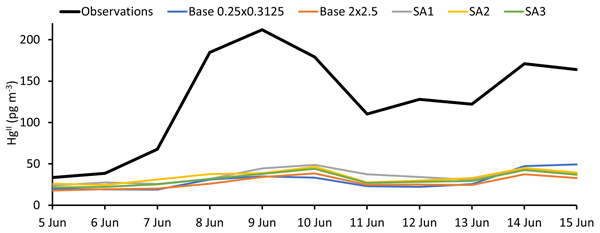
We compare verified atmospheric mercury measurements against output from the GEOS-Chem photochemical transport model. We show the model is unable to reproduce measured atmospheric oxidized mercury concentrations, even in several cases where oxidation rates in the model are enhanced.
Tyler R. Elgiar, Loknath Dhar, Lynne Gratz, A. Gannet Hallar, Rainer Volkamer, and Seth N. Lyman
Atmos. Chem. Phys., 25, 16387–16399, https://doi.org/10.5194/acp-25-16387-2025, https://doi.org/10.5194/acp-25-16387-2025, 2025
Short summary
Short summary
We compare verified atmospheric mercury measurements against output from the GEOS-Chem photochemical transport model. We show the model is unable to reproduce measured atmospheric oxidized mercury concentrations, even in several cases where oxidation rates in the model are enhanced.
Marc L. Mansfield and Seth N. Lyman
Atmos. Chem. Phys., 25, 11261–11274, https://doi.org/10.5194/acp-25-11261-2025, https://doi.org/10.5194/acp-25-11261-2025, 2025
Short summary
Short summary
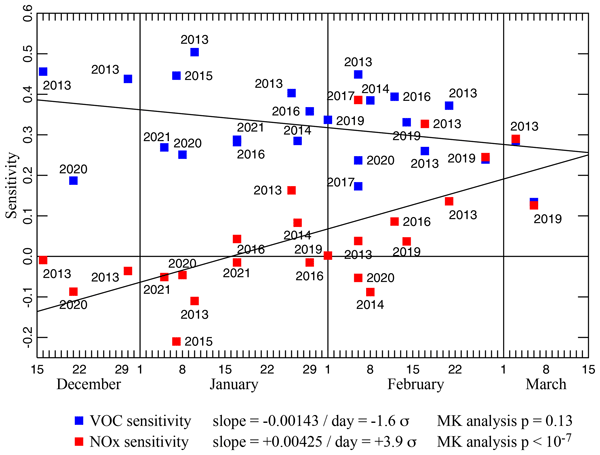
Precursor compounds must be present in the lower atmosphere for ozone to form. Ozone abatement strategies focus on reducing such precursors, but measuring and modeling are necessary to determine the most efficient way to do this. We show that the sensitivity of ozone to various precursors changes over the course of the winter. We also argue that similar seasonal changes probably occur in many regions of the Northern Hemisphere.
Livia Lown, Sarrah M. Dunham-Cheatham, Seth N. Lyman, and Mae S. Gustin
Atmos. Meas. Tech., 17, 6397–6413, https://doi.org/10.5194/amt-17-6397-2024, https://doi.org/10.5194/amt-17-6397-2024, 2024
Short summary
Short summary
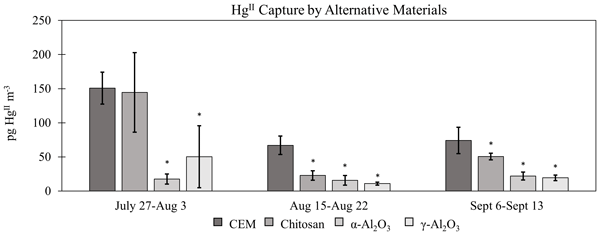
New sorbent materials are needed to preconcentrate atmospheric oxidized mercury for analysis by developing mass spectrometry methods. Chitosan, α-Al2O3, and γ-Al2O3 were tested for quantitative gaseous oxidized mercury sorption in ambient air under laboratory and field conditions. Although these materials sorbed gaseous oxidized mercury without sorbing elemental mercury in the laboratory, less oxidized mercury was recovered from these materials compared to cation exchange membranes in the field.
Eleanor J. Derry, Tyler R. Elgiar, Taylor Y. Wilmot, Nicholas W. Hoch, Noah S. Hirshorn, Peter Weiss-Penzias, Christopher F. Lee, John C. Lin, A. Gannet Hallar, Rainer Volkamer, Seth N. Lyman, and Lynne E. Gratz
Atmos. Chem. Phys., 24, 9615–9643, https://doi.org/10.5194/acp-24-9615-2024, https://doi.org/10.5194/acp-24-9615-2024, 2024
Short summary
Short summary
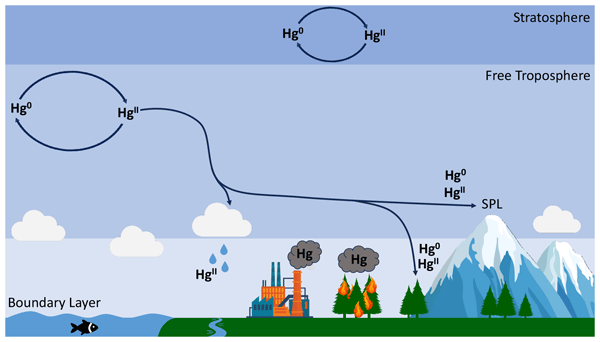
Mercury (Hg) is a globally distributed neurotoxic pollutant. Atmospheric deposition is the main source of Hg in ecosystems. However, measurement biases hinder understanding of the origins and abundance of the more bioavailable oxidized form. We used an improved, calibrated measurement system to study air mass composition and transport of atmospheric Hg at a remote mountaintop site in the central US. Oxidized Hg originated upwind in the low to middle free troposphere under clean, dry conditions.
Cited articles
Ashmore, M. R.: Assessing the future global impacts of ozone on vegetation, Plant Cell Environ., 28, 949–964, https://doi.org/10.1111/j.1365-3040.2005.01341.x, 2005.
Barnes, P. W., Williamson, C. E., Lucas, R. M., Robinson, S. A., Madronich, S., Paul, N. D., and Zepp, R. G.: Ozone depletion, ultraviolet radiation, climate change, and prospects for a sustainable future, Nat. Sustain., 2, 569–579, https://doi.org/10.1038/s41893-019-0314-2, 2019.
Bloss, C., Wagner, V., Jenkin, M. E., Volkamer, R., Bloss, W. J., Lee, J. D., Heard, D. E., Wirtz, K., Martin-Reviejo, M., Rea, G., Wenger, J. C., and Pilling, M. J.: Development of a detailed chemical mechanism (MCMv3.1) for the atmospheric oxidation of aromatic hydrocarbons, Atmos. Chem. Phys., 5, 641–664, https://doi.org/10.5194/acp-5-641-2005, 2005.
Cao, L., Li, S., and Sun, L.: Study of different Carbon Bond 6 (CB6) mechanisms by using a concentration sensitivity analysis, Atmos. Chem. Phys., 21, 12687–12714, https://doi.org/10.5194/acp-21-12687-2021, 2021.
Carbajo, P. G., Smith, S. C., Holloway, A. L., Smith, C. A., Pope, F. D., Shallcross, D. E., and Orr-Ewing, A. J.: Ultraviolet photolysis of HCHO: absolute HCO quantum yields by direct detection of the HCO radical photoproduct, J. Phys. Chem. A, 112, 12437–12448, https://doi.org/10.1021/jp8070508, 2008.
Carter, W. P. and Seinfeld, J. H.: Winter ozone formation and VOC incremental reactivities in the Upper Green River Basin of Wyoming, Atmos. Environ., 50, 255–266, https://doi.org/10.1016/j.atmosenv.2011.12.025, 2012.
Chen, T., Xue, L., Zheng, P., Zhang, Y., Liu, Y., Sun, J., Han, G., Li, H., Zhang, X., Li, Y., Li, H., Dong, C., Xu, F., Zhang, Q., and Wang, W.: Volatile organic compounds and ozone air pollution in an oil production region in northern China, Atmos. Chem. Phys., 20, 7069–7086, https://doi.org/10.5194/acp-20-7069-2020, 2020.
Edwards, P. M., Young, C. J., Aikin, K., deGouw, J., Dubé, W. P., Geiger, F., Gilman, J., Helmig, D., Holloway, J. S., Kercher, J., Lerner, B., Martin, R., McLaren, R., Parrish, D. D., Peischl, J., Roberts, J. M., Ryerson, T. B., Thornton, J., Warneke, C., Williams, E. J., and Brown, S. S.: Ozone photochemistry in an oil and natural gas extraction region during winter: simulations of a snow-free season in the Uintah Basin, Utah, Atmos. Chem. Phys., 13, 8955–8971, https://doi.org/10.5194/acp-13-8955-2013, 2013.
Edwards, P. M., Brown, S. S., Roberts, J. M., Ahmadov, R., Banta, R. M., de Gouw, J. A., and Zamora, R.: High winter ozone pollution from carbonyl photolysis in an oil and gas basin, Nature, 514, 351–354, https://doi.org/10.1038/nature13767, 2014.
Field, R. A., Soltis, J., McCarthy, M. C., Murphy, S., and Montague, D. C.: Influence of oil and gas field operations on spatial and temporal distributions of atmospheric non-methane hydrocarbons and their effect on ozone formation in winter, Atmos. Chem. Phys., 15, 3527–3542, https://doi.org/10.5194/acp-15-3527-2015, 2015.
Filippidou, E. C. and Koukouliata, A.: Ozone affects the respiratory system, Prog. Health Sci., 1, 144–155, 2011.
Fischer, E. V., Jacob, D. J., Yantosca, R. M., Sulprizio, M. P., Millet, D. B., Mao, J., Paulot, F., Singh, H. B., Roiger, A., Ries, L., Talbot, R. W., Dzepina, K., and Pandey Deolal, S.: Atmospheric peroxyacetyl nitrate (PAN): a global budget and source attribution, Atmos. Chem. Phys., 14, 2679–2698, https://doi.org/10.5194/acp-14-2679-2014, 2014.
Gilman, J. B., Lerner, B. M., Kuster, W. C., and de Gouw, J. A.: Source signature of volatile organic compounds from oil and natural gas operations in northeastern Colorado, Environ. Sci. Technol., 47, 1297–1305, https://doi.org/10.1021/es304119a, 2013.
Goliff, W. S., Stockwell, W. R., and Lawson, C. V.: The regional atmospheric chemistry mechanism, version 2, Atmos. Environ., 68, 174–185, https://doi.org/10.1016/j.atmosenv.2012.11.038, 2013.
Heard, D. E., Carpenter, L. J., Creasey, D. J., Hopkins, J. R., Lee, J. D., Lewis, A. C., and Emmerson, K. M.: High levels of the hydroxyl radical in the winter urban troposphere, Geophys. Res. Lett., 31, L18112, https://doi.org/10.1029/2004GL020544, 2004.
Koss, A. R., de Gouw, J., Warneke, C., Gilman, J. B., Lerner, B. M., Graus, M., Yuan, B., Edwards, P., Brown, S. S., Wild, R., Roberts, J. M., Bates, T. S., and Quinn, P. K.: Photochemical aging of volatile organic compounds associated with oil and natural gas extraction in the Uintah Basin, UT, during a wintertime ozone formation event, Atmos. Chem. Phys., 15, 5727–5741, https://doi.org/10.5194/acp-15-5727-2015, 2015.
Lapworth, A.: The morning transition of the nocturnal boundary layer, Bound.-Lay. Meteorol., 119, 501–526, https://doi.org/10.1007/s10546-005-9046-0, 2006.
Levy, H.: Normal atmosphere: Large radical and formaldehyde concentrations predicted, Science, 173, 141–143, https://doi.org/10.1126/science.173.3992.141, 1971.
Lew, M. M., Rickly, P. S., Bottorff, B. P., Reidy, E., Sklaveniti, S., Léonardis, T., Locoge, N., Dusanter, S., Kundu, S., Wood, E., and Stevens, P. S.: OH and HO2 radical chemistry in a midlatitude forest: measurements and model comparisons, Atmos. Chem. Phys., 20, 9209–9230, https://doi.org/10.5194/acp-20-9209-2020, 2020.
Li, C.: Nitrous Acid (HONO) Chemistry over Snow in the Uintah Basin, Utah, M. S. thesis, University of California, Los Angeles, USA, https://www.proquest.com/docview/3066745289, 2024.
Lin, J. C., Bares, R., Fasoli, B., Garcia, M., Crosman, E., and Lyman, S.: Declining methane emissions and steady, high leakage rates observed over multiple years in a western US oil/gas production basin, Sci. Rep., 11, 22291, https://doi.org/10.1038/s41598-021-01721-5, 2021.
Liu, Y., Li, J., Ma, Y., Zhou, M., Tan, Z., Zeng, L., and Zhang, Y.: A review of gas-phase chemical mechanisms commonly used in atmospheric chemistry modeling, J. Environ. Sci., 123, 522–534, https://doi.org/10.1016/j.jes.2022.10.031, 2023.
Lyman, S. and Tran, T.: Inversion structure and winter ozone distribution in the Uintah Basin, Utah, USA, Atmos. Environ., 123, 156–165, https://doi.org/10.1016/j.atmosenv.2015.10.067, 2015.
Lyman, S., Mansfield, M., Tran, H., and Tran, T.: Uintah Basin Air Quality Research 2018 Annual Report, BRC-181031A, Bingham Research Center, Utah State University, Vernal, UT, USA, https://www.usu.edu/binghamresearch/files/reports/UBAQR-2018-AnnualReport.pdf (last access: 12 July 2026), 2018.
Lyman, S. N., Holmes, M. L., Tran, H. N., Tran, T., and O'Neil, T.: High ethylene and propylene in an area dominated by oil production, Atmosphere, 12, 1, https://doi.org/10.3390/atmos12010001, 2020.
Lyman, S. N., Elgiar, T., Gustin, M. S., Dunham-Cheatham, S. M., David, L. M., and Zhang, L.: Evidence against rapid mercury oxidation in photochemical smog, Environ. Sci. Technol., 56, 11225–11235, https://doi.org/10.1021/acs.est.2c02224, 2022.
Maasakkers, J. D., Jacob, D. J., Sulprizio, M. P., Scarpelli, T. R., Nesser, H., Sheng, J.-X., Zhang, Y., Hersher, M., Bloom, A. A., Bowman, K. W., Worden, J. R., Janssens-Maenhout, G., and Parker, R. J.: Global distribution of methane emissions, emission trends, and OH concentrations and trends inferred from an inversion of GOSAT satellite data for 2010–2015, Atmos. Chem. Phys., 19, 7859–7881, https://doi.org/10.5194/acp-19-7859-2019, 2019.
Mahrt, L.: The early evening boundary layer transition, Q. J. Roy. Meteor. Soc., 107, 329–343, https://doi.org/10.1002/qj.49710745205, 1981.
Mansfield, M. L. and Hall, C. F.: Statistical analysis of winter ozone events, Air Qual. Atmos. Hlth., 6, 687–699, https://doi.org/10.1007/s11869-013-0204-0, 2013.
Mansfield, M. L. and Hall, C. F.: A survey of valleys and basins of the western United States for the capacity to produce winter ozone, J. Air Waste Manage., 68, 909–919, https://doi.org/10.1080/10962247.2018.1454356, 2018.
Mansfield, M. L. and Lyman, S. N.: Winter ozone pollution in Utah's Uinta Basin is attenuating, Atmosphere, 12, 4, https://doi.org/10.3390/atmos12010004, 2020.
Mansfield, M. L. and Lyman, S. N.: Seasonal trends in the wintertime photochemical regime of the Uinta Basin, Utah, USA, Atmos. Chem. Phys., 25, 11261–11274, https://doi.org/10.5194/acp-25-11261-2025, 2025.
NASA Giovanni: The Bridge between Data and Science, https://giovanni.gsfc.nasa.gov/giovanni/, last accessed: 2 May 2024.
Neemann, E. M., Crosman, E. T., Horel, J. D., and Avey, L.: Simulations of a cold-air pool associated with elevated wintertime ozone in the Uintah Basin, Utah, Atmos. Chem. Phys., 15, 135–151, https://doi.org/10.5194/acp-15-135-2015, 2015.
Ninneman, M., Lyman, S., Hu, L., Cope, E., Ketcherside, D., and Jaffe, D.: Investigation of ozone formation chemistry during the Salt Lake Regional Smoke, Ozone, and Aerosol Study (SAMOZA), ACS Earth Space Chem., 7, 2521–2534, https://doi.org/10.1021/acsearthspacechem.3c00235, 2023.
Nogueira, T., Dominutti, P. A., Fornaro, A., and Andrade, M. D. F.: Seasonal trends of formaldehyde and acetaldehyde in the megacity of São Paulo, Atmosphere, 8, 144, https://doi.org/10.3390/atmos8080144, 2017.
Oltmans, S., Schnell, R., Johnson, B., Pétron, G., Mefford, T., and Neely III, R.: Anatomy of wintertime ozone associated with oil and natural gas extraction activity in Wyoming and Utah, Elem. Sci. Anth., 2, 000024, https://doi.org/10.12952/journal.elementa.000024, 2014.
Pang, X. and Mu, Y.: Seasonal and diurnal variations of carbonyl compounds in Beijing ambient air, Atmos. Environ., 40, 6313–6320, https://doi.org/10.1016/j.atmosenv.2006.05.044, 2006.
Saunders, S. M., Jenkin, M. E., Derwent, R. G., and Pilling, M. J.: Protocol for the development of the Master Chemical Mechanism, MCM v3 (Part A): tropospheric degradation of non-aromatic volatile organic compounds, Atmos. Chem. Phys., 3, 161–180, https://doi.org/10.5194/acp-3-161-2003, 2003.
Seinfeld, J. H.: Urban air pollution: state of the science, Science, 243, 745–752, https://doi.org/10.1126/science.243.4892.745, 1989.
Shareef, M., Cho, S., Lyder, D., Zelensky, M., and Heckbert, S.: Evaluation of different chemical mechanisms on O3 and PM2.5 predictions in Alberta, Canada, Appl. Sci., 12, 8576, https://doi.org/10.3390/app12178576, 2022.
Simpson, D., Arneth, A., Mills, G., Solberg, S., and Uddling, J.: Ozone – the persistent menace: interactions with the N cycle and climate change, Curr. Opin. Env. Sust., 9, 9–19, https://doi.org/10.1016/j.cosust.2014.07.008, 2014.
Soares, A. R. and Silva, C.: Review of ground-level ozone impact in respiratory health deterioration for the past two decades, Atmosphere, 13, 434, https://doi.org/10.3390/atmos13030434, 2022.
Stockwell, W. R., Lawson, C. V., Saunders, E., and Goliff, W. S.: A review of tropospheric atmospheric chemistry and gas-phase chemical mechanisms for air quality modeling, Atmosphere, 3, 1–32, https://doi.org/10.3390/atmos3010001, 2011.
United States Environmental Protection Agency (EPA): SPECIATE database browser 5.2 for air emission modeling, https://www.epa.gov/air-emissions-modeling/speciate-0, last accessed: 2 May 2024.
Warneke, C., Geiger, F., Edwards, P. M., Dube, W., Pétron, G., Kofler, J., Zahn, A., Brown, S. S., Graus, M., Gilman, J. B., Lerner, B. M., Peischl, J., Ryerson, T. B., de Gouw, J. A., and Roberts, J. M.: Volatile organic compound emissions from the oil and natural gas industry in the Uintah Basin, Utah: oil and gas well pad emissions compared to ambient air composition, Atmos. Chem. Phys., 14, 10977–10988, https://doi.org/10.5194/acp-14-10977-2014, 2014.
Wilkes, H. (Ed.): Hydrocarbons, oils and lipids: diversity, origin, chemistry and fate, Handbook of Hydrocarbon and Lipid Microbiology, Springer, https://doi.org/10.1007/978-3-319-90569-3, 2020.
Wolfe, G. M., Marvin, M. R., Roberts, S. J., Travis, K. R., and Liao, J.: The Framework for 0-D Atmospheric Modeling (F0AM) v3.1, Geosci. Model Dev., 9, 3309–3319, https://doi.org/10.5194/gmd-9-3309-2016, 2016.
Xiong, Y., Chai, J., Mao, H., Mariscal, N., Yacovitch, T., Lerner, B., and Huang, Y.: Examining the summertime ozone formation regime in Southeast Michigan using MOOSE ground-based HCHO/NO2 measurements and F0AM box model, J. Geophys. Res.-Atmos., 128, e2023JD038943, https://doi.org/10.1029/2023JD038943, 2023.
Yang, J., Zeren, Y., Guo, H., Wang, Y., Lyu, X., Zhou, B., and Zhang, G.: Wintertime ozone surges: the critical role of alkene ozonolysis, Environ. Sci. Ecotechnol., 22, 100477, https://doi.org/10.1016/j.ese.2024.100477, 2024.
Yarwood, G., Jung, J., Whitten, G. Z., Heo, G., Mellberg, J., and Estes, M.: Updates to the Carbon Bond mechanism for version 6 (CB6), in: Proceedings of the 9th Annual CMAS Conference, Chapel Hill, NC, USA, 11–13 October 2010, https://www.cmascenter.org/conference/2010/abstracts/emery_updates_carbon_2010.pdf (last access: 12 July 2026), 2010.
Zaveri, R. A. and Peters, L. K.: A new lumped structure photochemical mechanism for large-scale applications, J. Geophys. Res.-Atmos., 104, 30387–30415, https://doi.org/10.1029/1999JD900876, 1999.
Short summary
We studied unusual winter air pollution in Utah's Uinta Basin, where ozone levels exceed safety standards despite cold temperatures. Using an air quality model, we found hydrocarbon compounds from oil and gas operations transform into formaldehyde and other chemicals during winter photochemical events. Light alkanes were the biggest contributors to pollution formation. Understanding these mechanisms helps identify compounds to target for emission reductions in oil and gas regions.
We studied unusual winter air pollution in Utah's Uinta Basin, where ozone levels exceed safety...
Altmetrics
Final-revised paper
Preprint