
the Creative Commons Attribution 4.0 License.
the Creative Commons Attribution 4.0 License.
 | 17 Dec 2025
Challenges and benefits of using NOx as a quantitative proxy for fossil fuel CO2 in an urban area based on radiocarbon measurements
Hannes Juchem
Fabian Maier
Ingeborg Levin
Armin Jordan
Denis Pöhler
Claudius Rosendahl
Julian Della Coletta
Susanne Preunkert
Samuel Hammer
Radiocarbon (14CO2) observations are the benchmark for quantifying fossil fuel CO2 (ffCO2) in the atmosphere, but continuous 14CO2 measurements are not yet available. Continuous estimates of ffCO2 can be made by observing continuously measurable proxies that are co-emitted during fossil fuel combustion. This paper investigates the potential and challenges of using in situ NOx observations in urban areas to quantitatively estimate hourly ffCO2 enhancements, in the example of the ICOS pilot station in Heidelberg, Germany. The short atmospheric lifetime of NOx limits the use of the observed signal to a local area. Thus, a local NOx and ffCO2 background was approximated using the Stochastic Time-Inverted Lagrangian Transport (STILT) model and bottom-up emission estimates from the Netherlands Organisation for Applied Scientific Research (TNO). Using 14CO2 data from 185 hourly integrated flask samples between 2020–2021, mean ratios of local excess NOx (ΔNOx) to local excess ffCO2 (ΔffCO2) of 1.40 ppb ppm−1 for winter and 2.12 ppb ppm−1 for summer were calculated. These ratios were applied to the ΔNOx time series to construct continuous ΔffCO2 estimates. The uncertainty of the ΔNOx-based ΔffCO2 record was estimated at 3.94 ppm. Comparisons with 14CO2-based and ΔCO-based ΔffCO2 estimates showed good agreement, while still demonstrating distinct behaviour for individual events. ΔNOx shows considerable potential as ΔffCO2 proxy and as useful addition to ΔCO-based estimates, as both proxies have different footprints due to their lifetimes. A key challenge remains in reliably determining the seasonal and diurnal cycle of average ΔNOx to ΔffCO2 ratios.
- Article
(4834 KB) - Full-text XML
- BibTeX
- EndNote


To derive top-down estimates of anthropogenic CO2 emissions due to fossil fuel combustion from atmospheric measurements, it is necessary to separate the recently added biospheric and fossil fuel CO2 (ffCO2) signal (Ciais et al., 2015). The most direct method to derive these excess fossil fuel CO2 contributions (ΔffCO2, the term “excess” is used to describe an enhancement of the measured signal above a given background level) is by utilising 14CO2 measurements compared to a background site (Levin et al., 2003; Turnbull et al., 2006). However, at present, optical methods for continuous 14C measurements are just developing (Ling et al., 2025), and existing methods like accelerator mass spectrometry (AMS) and low level counting (LLC) work only on discrete samples and are labour intensive. Continuously measured species that are co-emitted in combustion processes, such as CO or NOx, are a possible alternative for deriving high temporal resolution ffCO2 estimates (Turnbull et al., 2006; Levin and Karstens, 2007; Van Der Laan et al., 2010; Maier et al., 2024a). These have the advantage of lower-cost continuous measurements, are in part (CO and NO2) observable by satellite (Konovalov et al., 2016), and in urban areas can even outperform sparsely collected 14C-based estimates in inversion modelling (Maier et al., 2024b). However, they require adequate knowledge about the ratio of excess proxy concentrations to ΔffCO2. For readability purposes, the manuscript used the simplification “concentration” for the mole fraction of the respective molecule, even though, strictly speaking, this is incorrect when using ppm units.
CO has already been widely studied as a proxy for ΔffCO2 (Gamnitzer et al., 2006; Levin and Karstens, 2007; Turnbull et al., 2015; Maier et al., 2024a). Using NOx as a proxy has been the subject of considerably less study, with the majority of research conducted using satellite data and ratios derived from inventories (Lopez et al., 2013; Goldberg et al., 2019; Liu et al., 2020; Feng et al., 2024). A fundamental challenge of both proxies is that CO and NOx emissions depend on fuel type and combustion parameters like e.g. combustion temperature, oxygen supply, and applied emission reduction systems. Accordingly, different emission sectors, like traffic, industry, and residential heating, have different average proxy to ffCO2 emission ratios, which also vary within the emission sectors. The use of NOx is accompanied by additional challenges due to its atmospheric chemistry and its relatively short atmospheric lifetime, which is on the order of hours (Beirle, 2004). This implies that atmospheric ratios vary by station and reflect the composition of fossil fuel sources present in each station's footprint. These features can also be an advantage, as it gives the NOx signal a more localised nature and generally a low background (Goldberg et al., 2019), which also means that it quickly adapts to changes in emissions. Therefore, NOx is a promising proxy for urban applications and constraining city-wide emissions. Furthermore, the combination of multiple proxies can provide better constraints on fossil fuel emissions and enable attribution of emissions to source sectors (Super et al., 2020; Hilland et al., 2025).
This study characterises the potential and challenges of using NOx concentration excesses (ΔNOx) from in situ observations as a proxy for ΔffCO2 in an urban setting by deriving ratios from radiocarbon measurements, using Heidelberg as an example. While the absolute ratios are likely to differ for other urban areas and need to be determined on a per-site basis, the general approach for considering the local nature of the measured NOx signal is applicable to other cities and the associated uncertainties serve as an indicator of the uncertainties likely to be encountered in other urban environments. As NOx shows a much more localised signal than CO and 14C, the choice of a suitable and common background for both species is highly important. In the absence of a suitable NOx and 14CO2 measurement station to define a local background, we describe its construction based on forward simulations of European NOx and ffCO2 emissions in the Stochastic Time-Inverted Lagrangian Transport model (STILT, Lin et al., 2003) and discuss the associated additional uncertainties. Following the methodology of Maier et al. (2024a), the ratios of ΔNOx to ΔffCO2 concentrations obtained from in situ NOx and flask-based 14C measurements are then analysed for diurnal and seasonal variation, to determine average atmospheric ratios. With these, ΔNOx-based ΔffCO2 estimates are calculated and benchmarked against 14C-based ΔffCO2 estimates to assess the accuracy of the proxy. We investigate what share of the ΔNOx-based ΔffCO2 uncertainty is due to the observation and background uncertainty and what is due to the inherent oversimplification of applying observation-based seasonally averaged ratios. The ΔNOx-based continuous ΔffCO2 record is compared to a ΔCO-based record in order to analyse if and how the two proxies differ. Finally, both proxy-based ΔffCO2 records are compared to an independent 14CO2-based ΔffCO2 record with fortnightly resolution for Heidelberg.
2.1 Site and data description
Heidelberg is a city with a population of approximately 160 000, situated in the densely populated Upper Rhine Valley in south-western Germany. The measurement site is located in the northern part of the city, within the university campus. The sampling intake for the measurements is located 30 m above ground on the roof of the Institute for Environmental Physics, approximately 100 m from a residential area and a high traffic road, with little traffic directly around the building. Thus, local emissions of CO2 and NOx are predominantly attributable to traffic and residential heating. A combined heat and power station, with a chimney height of 120 m, is situated 500 m to the north of the site, while a cement plant is located approximately 7 km to the south. Moreover, the cities of Mannheim and Ludwigshafen, which are characterised by a high degree of industrialisation, are situated approximately 15–20 km to the north-west. These include a large coal-fired power plant and the BASF industrial complex. Furthermore, air masses originating from the southern part of the Rhine Valley frequently affect the station due to the predominant south-westerly winds in Western Europe, which are further pronounced by the channelling effect of the Rhine Valley.
Continuous measurements of atmospheric CO2 concentrations are performed with a Cavity Ring-Down Spectroscopy (CRDS) gas analyser (Picarro G2401). The measurement protocol as well as the calibration are in accordance with the ICOS Atmosphere Station specifications Version 2.0 (ICOS RI, 2020). The data processing is performed via the ICOS Atmosphere Thematic Center (ATC) following Hazan et al. (2016). NOx concentrations are measured with an iterative cavity-enhanced DOAS (ICAD) instrument. The ICAD measures absorption spectra and determines the in situ NO2 concentration by fitting its characteristic absorption structures. NOx is measured by converting NO to NO2 through the addition of ozone (Horbanski et al., 2019). An ICOS flask sampler is used to collect flask samples integrated over one hour (see Levin et al., 2020 for a description of the sampler). The flow of air into the flasks is controlled by mass flow controllers so that the final sample in the flask approximates a one hour average of the concentrations in the ambient air. The flask samples are measured for CO2 concentrations at the ICOS Flask and Calibration Laboratory (FCL; https://www.icos-cal.eu/fcl, last access: 20 May 2025) with a gas chromatographic analysis system (GC) (Jordan and Damak, 2025). Subsequently, the CO2 in the flasks is extracted and graphitized at the Central Radiocarbon Laboratory (CRL; https://www.icos-cal.eu/crl, last access: 20 May 2025; Lux, 2018) for subsequent 14C analysis with an accelerator mass spectrometer (AMS, Kromer et al., 2013). Additionally, integrated CO2 sampling using NaOH solution has been implemented at HEI station since the late 1970s. Fortnightly samples are collected between 19:00 and 07:00 CET and analysed for 14C at the CRL (Levin et al., 1980; Kromer and Münnich, 1992). In 2013 a second integrated sampling device for afternoon hours between 11:00 and 16:00 CET was added.
More than 600 flask samples were collected and analysed for 14C in the years 2019–2021, covering a variety of atmospheric situations (Maier, 2023). The samples cover most of the day, especially the morning and evening rush hours, as well as the afternoon and night. The flasks were analysed following the same procedure as in Maier et al. (2024a). Accordingly, flasks with a modelled nuclear contamination from 14CO2 emissions of nuclear facilities above 2 ‰ were excluded to avoid high nuclear corrections with uncertainties exceeding typical 14C uncertainties. NOx measurements are available from 18 December 2019 on. Multiple periods of one to four weeks in March, June, July, and October 2020, as well as March and July in 2021, were excluded due to instrument outages or maintenance. NOx data is available for 246 of the flask sampling periods. In the following, all times are given in local time, as we expect this to be better suited than UTC to capture and explain the patterns of human behaviour and diurnal cycles, that affect the emission ratios.
2.2 Construction of a suitable background
To calculate the excess concentration of a species, the background concentration must be subtracted from the measured concentration. For estimating 14C- or CO-based ffCO2 excess concentrations, the marine sector of the ICOS station at Mace Head (MHD), located on the west coast of Ireland, is a suitable choice for assessing European background conditions, due to the prevailing westerlies (Maier et al., 2023, 2024a). Maier et al. (2023) investigated the additional ffCO2 uncertainties that arise from the approximation of the European background concentrations based on the clean air sector in MHD and quantified these at 0.28 ppm. However, due to atmospheric chemistry, the lifetime of NOx is on the order of hours (Beirle, 2004), and thus removal of NOx from the atmosphere becomes important on scales larger than the immediate vicinity of the measurement site. This prevents the use of MHD as a NOx background station. Exploiting the co-emission link between ffCO2 and NOx requires that the excess concentrations contain information about the same emissions. In order to derive coherent excess concentrations for NOx and ffCO2, allowing to determine local atmospheric concentration ratios, it is necessary to choose the same background boundary for both species. Otherwise, if the determined ffCO2 excess concentrations are influenced by emissions from a larger area than the NOx excess concentrations, the correlation between them would be generally weaker because of the heterogeneous spatial distribution of emissions, which would lead to a higher variability of ratios. The background boundary should therefore be close enough to the measurement station that, to a first approximation, NOx removal from the atmosphere can be neglected (i.e. NOx can be approximated to be transported as a conservative tracer). At the same time, to ensure a good signal-to-noise ratio, the background boundary should be far enough that the derived excess concentrations still contain most of the measured concentration signal. Thus, balancing these requirements, the location of the background boundary will depend on the NOx lifetime and mean travel time to the station.
To differentiate between the excess concentrations in relation to MHD and in relation to the local background, the following nomenclature will be used: local excess concentrations are indicated by the symbol “Δ” preceding the species name, whereas excess concentrations relative to MHD are indicated by the abbreviation “ex.” in the index. Equation (1) postulates that the measured concentration of a species (e.g. NOx, CO2 or 14CO2) at the station (meas.) is composed of a concentration contribution from the European background BGEU/MHD, a concentration contribution from the European domain EUcontr., and a local concentration contribution Δspecies. Figure 1 illustrates the spatial division of the different domains for the case of Heidelberg.

Figure 1Division of the station catchment area into different domains, for the case of HEI, according to Eq. (1): European background BGMHD/EU (blue shaded area), contribution from the European domain EUcontr. (green shaded area) and local domain Δspecies (red shaded area). (b) The contour lines illustrate the mean simulated travel time of air masses to HEI for DJF 2019/20. The location of HEI and MHD is indicated. © OpenStreetMap contributors 2025. Distributed under the Open Data Commons Open Database License (ODbL) v1.0.
For NOx we can expect the contribution from outside Europe to be 0 due to fast removal by atmospheric chemistry, and need only subtract the concentration contributions of the European domain from the measured NOx concentrations to obtain ΔNOx for the local domain, as shown in Eq. (2). For 14C-based ffCO2, as excess concentrations are derived relative to MHD () (Maier et al., 2023), the local excess concentration can also be calculated by subtracting the concentration contributions from the European domain, as shown in Eq. (3).
Thus, in the context of this method only the contribution of the European domain needs to be determined to calculate local excess concentrations. Therefore, in the following, when we refer to the local background, this concerns the contribution from the European domain.
2.2.1 Setting the local background boundaries
The atmospheric chemistry of NOx involves multiple different processes, with several reactions being dependent on solar radiation, temperature, and concentrations of ozone and radicals (see Kenagy et al., 2018 for an overview). These in turn depend on NOx concentrations themselves, thus introducing feedback loops (Valin et al., 2013). Consequently, the lifetime of NOx varies considerably with the atmospheric conditions, resulting in significant spatial and temporal variations. Daytime lifetime estimates range from 2 to 11 h in summer and 18 h to 2 d in winter (Martin et al., 2003; Liu et al., 2016; Romer et al., 2016; Kenagy et al., 2018). Lifetime estimates for Germany have been derived by Beirle et al. (2003) and Beirle (2004). From these, we assume typical NOx lifetimes of 6 h for summer, 20 h for winter, and 16 h for the intermediate seasons, with an uncertainty of ±2 h for the typical NOx lifetimes, based on the range of estimates.
Figure 1b illustrates the spatial distribution of simulated mean travel times to Heidelberg in the Rhine Valley for the winter months (DJF) of 2019/20. These were simulated with the Stochastic Time-Inverted Lagrangian Transport (STILT) model, driven by meteorological fields from the Weather Research and Forecast (WRF) model (Nehrkorn et al., 2010) with a horizontal resolution of 2 km. The WRF simulations are based on hourly, 0.25° resolution meteorological fields from the European Centre for Medium-Range Weather Forecast (ECMWF) Reanalysis v5 (ERA5; Hersbach et al., 2020). The mean winter travel times already exceed 15 h or 20 h at distances of 100–200 km. On this timescale, the majority of the emitted NOx contribution from the European domain will not contribute significantly to the observations at the station due to its short atmospheric lifetime of a few hours to a day. Therefore, in most meteorological situations, the observed NOx concentration only provides information on a close vicinity around the station.
For the determination of the location of the local background boundaries, the WRF-STILT model was used to calculate time-resolved (hourly) and gridded footprints (with a horizontal resolution of ca. 1 km) for the HEI observation site within the Rhine Valley domain (47.75–50.25° N and 6–10.25° E indicated as grey rectangle in Fig. 1a). These footprints describe the sensitivity of the HEI observation site on upwind surface fluxes within the Rhine Valley. They have been simulated by releasing 100 particles per hour from the Heidelberg site and calculating the particle trajectories backward in time. The footprints are mapped with high-resolution NOx and ffCO2 fluxes from the TNO inventory (Dellaert et al., 2019; Denier van der Gon et al., 2019) to get the NOx (and ffCO2) contribution from each grid cell. The simulations incorporate the most basic atmospheric NOx chemistry through an exponential lifetime approach. The time-resolved and gridded footprints were multiplied by a factor , where T is the travel time of the air mass and λ is the assumed atmospheric lifetime of NOx, to describe the atmospheric decay of NOx along the footprint.
Each grid cell contributes a specific share of the total simulated NOx concentration for HEI, which depends on the emission of that grid cell, the sensitivity of the footprint to the grid cell, and the travel time from the grid cell to the station. This is referred to as the NOx contribution of that grid cell, with the sum of all contributions being equal to the total simulated NOx concentration. We analysed the spatial distribution of the NOx contributions for HEI to identify a suitable location of the local background. For the mean simulated NOx contributions shown in Fig. 2a and b, the NOx contribution maps of the high-resolution domain were aggregated to a coarser resolution of 0.25°, which is used for simulating the European contributions (see Sect. 2.2.2).

Figure 2(a) Mean simulated NOx contributions for winter and (b) summer months in 2020 on a 0.25° grid. The blue dot indicates the location of Heidelberg. The green rectangle shows the chosen boundary for the local background. (c) Simulated mean NOx contributions from the local domain as a function of their travel time for winter and (d) summer months in 2020. The vertical dotted lines indicate 50 % and 100 % of the lifetime of NOx, respectively. The results as for a conservative transport without decay are displayed in blue. The results obtained with the exponential decay applied are shown in orange.
The Heidelberg grid cell and the ones directly surrounding it have by far the highest NOx contributions. Therefore, the boundary for the background was chosen as indicated by the green border in Fig. 2a and b (49, 49.75° N, 8.25 and 8.75° E), encompassing six grid cells next to Heidelberg to cover most NOx contributions while still considering modest travel times. In summer (JJA) 86.1 % of the simulated NOx contributions from the Rhine Valley originate from within these boundaries and in winter (DJF) 77.8 %. Thus, the NOx excess concentrations relative to this background still contain most of the measured signal. The domain defined by these boundaries will subsequently be referred to as the “local” domain and extends about 30 km to the West of HEI and about 40 km to the North and the South. The domain between these boundaries and the European background is referred to as the “European” domain.
To further investigate NOx contributions with respect to the air mass travelling times within the local domain, Fig. 2c and d show the winter and summer distributions of the mean NOx contributions, with and without the exponential decay, based on simulations of the high-resolution model. For the winter months, 99.8 % of the NOx contributions have a travel time less than the typical NOx winter lifetime and 98 % have a travel time less than half of it. In the summer months, this is still true for 97.1 % and 86.7 % respectively. The difference between the NOx concentrations simulated with and without the exponential decay shows that assuming conservative transport within the local domain introduces a bias on the order of 1 ppb (0.77 ppb for winter, 1.06 ppb for summer). The assumption of conservative transport leads to an underestimation of ∼10 % on the average winter NOx signal of 8.76 ppb and a more significant underestimation of ∼25 % on the average summer signal of 4.55 ppb. For winter, the overall underestimation and travel times are small enough that the assumption of conservative transport is deemed acceptable. For summer however, travel times are of the same order as the atmospheric lifetime, resulting in a significant underestimation. The effects of this are discussed in Sect. 2.3.
2.2.2 Determination of the local background concentrations
To calculate the local background concentrations, the STILT model was driven with coarser, 0.25° resolution meteorological fields from the ECMWF Integrated Forecasting System (IFS). Again, 100 particles were released each hour from the HEI site and their back-trajectories were calculated for 10 d or until they left the European model domain (32–74° N, 16° W–36° E). The resulting footprints are mapped with European NOx and ffCO2 emissions from TNO, but with the emissions inside the local domain set to 0, so that only emissions from the European domain were propagated to the HEI station. Due to the seasonal change in NOx lifetime, the model was run three times with NOx lifetimes of 6, 16, and 20 h to produce hourly resolved background concentrations for summer, spring/autumn, and winter respectively. Season changes were assigned based on the temperatures observed at the station: months with mean temperatures below 10°C were assigned as winter, months with over 19°C as summer, and the remaining months as spring/autumn.
Previous studies revealed that the STILT and TNO modelling framework shows a remarkable capability to model synoptic concentration changes for HEI station (Maier et al., 2022). However, the STILT model and the TNO emission inventory are imperfect and subject to uncertainties, thus the timing and the absolute value of the modelled local background concentrations should not be considered accurate on the hourly timescale. Thus, a rolling Gaussian smooth was applied on the modelled local background concentrations with a window size of 24 h and standard deviation of 3 h.
Figure 3 displays an example week, showing the modelled local background concentration time series, i.e. the contribution from the European domain and the measured concentrations for ffCO2 and NOx. The modelled local background concentrations are predominantly lower than the measured concentrations. Comparing the two shows different situations with varying influence from the local domain (excess between measured data and local background). In a few cases the simulated background concentrations do exceed the real measurements, resulting in negative local excess concentrations, but only for 1.7 %, with only 0.1 % outside a 1σ range from 0 ppb. The average simulated contributions from the European domain for 2020 and 2021 were 1.49 ppb for NOx and 2.93 ppm for ffCO2, with standard deviations of 1.5 ppb and 2.8 ppm respectively. This corresponds on average to approximately 10 % of the total measured NOx concentration and 25 % of the concentration calculated from 14CO2 measurements.

Figure 3Measured concentrations (in black) and simulated background (in dashed green) from 13 April until 19 April 2020 for Heidelberg station. The solid green curve shows the background concentrations after the Gaussian smooth, with its 1σ confidence interval according to the combined uncertainties from emission-, model transport- and lifetime-uncertainties. Please refer to main text for a detailed explanation.
2.2.3 Assessing the uncertainty of the local background concentrations
The additional uncertainty related to the modelled local background concentration can be separated into three main contributions: the uncertainties of the emissions from the TNO inventory, the errors of the transport model, and the uncertainty of the lifetimes used in the exponential decay.
The uncertainties of the emissions from the TNO inventory were approximated as 40 % for ffCO2 and 45 % for NOx, based on the uncertainties of the national emissions and their spatial distribution (Ingrid Super, personal communication 2024, based on Super et al., 2024). Since a relative change of the emissions propagates linearly through the transport model, these relative uncertainties were directly applied to the simulated background to calculate the corresponding emission-related uncertainty. The actual impact on the uncertainty of the simulated concentrations is probably smaller due to the random errors from the grid cells compensating each other. As we want to make a conservative estimation of the uncertainty, we choose to use the greater value as an upper boundary.
As an approximation for the errors of the transport model and their impact on the simulated background, the main factor was assumed to be temporal misalignment of the simulated and “true” background. The standard deviation of the unsmoothed data over a 6 h window was used to assess the possible impact of such a shift and to estimate the corresponding uncertainty. The median of this background uncertainty is about 30 % for the modelled NOx and ffCO2 concentrations. This time-dependent estimate of transport uncertainty has the advantage of yielding higher uncertainties for periods with strong fluctuations in the simulated concentrations, mirroring the limited reliability of the simulated background concentrations. When averaging over longer periods, the temporal misalignment should average out. This contribution to the background uncertainty is therefore mainly important when looking at individual hours.
To assess the impact of the NOx lifetime uncertainties on the NOx background, the modelled background concentration B at a certain hour can be regarded as a “mean” air mass with some initial concentration E and a travel time T. The dependency of the background concentration B on the lifetime λ can then directly be described by Eq. (4), where c is the contribution with a travel time of 0 h.
As the background was simulated for 6, 16, and 20 h lifetimes (and additionally for 18 and 24 h), the unknown parameters E, T, and c can be determined analytically. The lifetime-dependent change in the modelled NOx concentration can thus be calculated analytically, without running the model. For the assumed uncertainty of 2 h of the seasonally dependent lifetime this yields a lifetime-related background uncertainty of 40 % for 6 h, 11 % for 16 h, and 7 % for 20 h lifetime.
Assuming the three uncertainty components are independent, the resulting uncertainties for the simulated background concentrations are on average about 60 % for NOx and 50 % for ffCO2. They are shown as shaded uncertainty range of the modelled local background concentrations in Fig. 3. The uncertainty analysis of the modelled background concentrations conducted here is incomplete. It could be enhanced through an ensemble approach, utilising alternative transport models, meteorological driver data, and emission inventories. However, this is beyond the scope and intention of this exploratory work. We acknowledge the inherent limitation of using modelled local background concentrations, while recalling that these account for only 10 % of the measured NOx and 25 % of the ffCO2 signals.
2.3 Construction of a ΔNOx-based ΔffCO2 record
To construct continuos hourly ΔNOx-based ΔffCO2 estimates, the hourly ΔNOx record is divided by an average atmospheric ratio. The local excess concentrations ΔNOx and ΔffCO2 are determined with respect to the simulated local background concentration according to Eqs. (2) and (3). For each 14CO2 flask analysis we calculated a concentration relative to a marine 14CO2 background record from MHD using Eq. (3) from Maier et al. (2023), which includes corrections for 14C contamination from nuclear facilities and biospheric respiration. Please refer to Maier et al. (2023) for more details and for the construction of the marine 14CO2 background. Following Maier et al. (2024a), a weighted total least-squares regression was applied to determine mean atmospheric ratios.
By design, this method is insensitive to systematic shifts and scaling in the determination of ΔNOx, as long as the sampled flasks are representative of the conditions at the station. This is because such systematic biases affect the determination of the ratio and the continuous ΔNOx record on which the ratio is applied in the same way, and therefore cancel each other out in the calculation of the ΔNOx-based ΔffCO2 estimates. However, the statistical variability around a mean bias still has an effect. A mean bias is corrected for by the method, as described above, but the variability of that bias results in an effectively higher variability in the observed ratios and therefore a higher uncertainty in the ΔNOx-based ΔffCO2 estimates. This would be, for example, a mean bias caused by NOx removal from the atmosphere in the local domain, with variability due to the variability of atmospheric conditions leading to different levels of removal.
Returning to the underestimation of ΔNOx in the summer months due to significant removal of NOx from the atmosphere within the local domain (see Sect. 2.2.1), the mean bias caused by this underestimation has no effect on the estimation of ΔffCO2 as just stated. However, the variability of the underestimation increases the uncertainty of the derived ratio and ΔffCO2 concentrations. From the concentration contributions simulated with the high resolution model, we estimated this additional uncertainty for the ΔffCO2 estimates at approximately 0.4 ppm using a Monte Carlo approach. Given that this is much lower than the typical 1.5 ppm uncertainty of 14C-based ΔffCO2 estimates, the choice of background is still deemed appropriate for the summer months, although a higher uncertainty for the ΔNOx-based estimates is to be expected. For winter, we recall that the underestimation was much smaller, and therefore the impact is smaller still than for summer.
3.1 ratios from flask samples
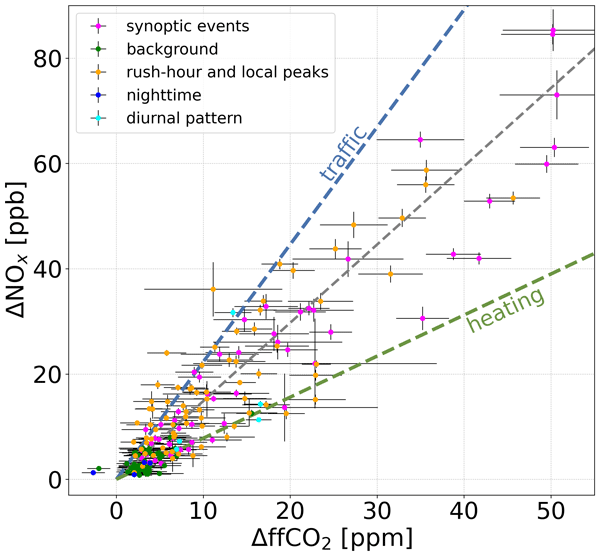
Figure 4a shows the local ΔNOx enhancements against the 14C-based local ΔffCO2 enhancements. The flask samples were collected under a range of different atmospheric conditions and at different times of the day to be representative of the mix of conditions encountered at the station. While there are some very small or negative and some very high ratios, most ratios fall within the expected range for a mix of traffic and heating emissions for Heidelberg (shown by the blue and green lines in the figure). Scatter plots for winter and summer separately can be found in Fig. A1. For winter the flasks fall within the expected range for a mix of traffic and heating. For summer the flasks mostly fall in the expected range for traffic emissions and show lower excess concentrations than in winter. Flasks with a ratio uncertainty of over 100 % were excluded from the determination of the mean ratio (but included in the determination of the uncertainty of the resulting ΔNOx-based ΔffCO2 estimates). As outlined in Maier et al. (2024a), an error-weighted regression through the data was used to obtain unbiased estimates of the mean atmospheric ratios.

Figure 4(a) Scatter plot of the local ΔNOx and ΔffCO2 concentrations for all valid flask measurements. The colour of each data point indicates the sampling situation. The dashed grey line represents the weighted total least-squares regression line. The blue and green lines show the average TNO inventory emission ratios for the traffic and heating sector in the vicinity of Heidelberg. (b) Comparison between ΔNOx- and 14C-based local ΔffCO2 concentrations for the summer (grey circles) and winter (black circles) flasks. Synthetic data (red circles for winter data and orange circles for summer data) was generated by assuming a constant summer and winter ratio respectively.
The regression over all the flasks collected in 2020 and 2021 yields an average ratio of , with an R2 value of 0.84. Due to the temporal changes in atmospheric chemistry and the mix of emissions, a seasonal and diurnal cycle of the atmospheric ratio is expected. In Fig. 5 monthly and hourly derived atmospheric ratios are shown. The seasonal and diurnal cycle are qualitatively similar to what would be expected from the inventory, with a higher ratio in summer than in winter, following the heating cycle and two peaks in the morning and evening because of rush hour traffic. The monthly atmospheric ratios clearly indicate two different ratios for winter (October–April) and summer (May–September). For all winter samples, the regression yields an average atmospheric ratio of with an R2 value of 0.86, while for all summer samples a higher ratio of with an R2 value of 0.55 is found. The weaker correlation for the summer flasks is related to the overall smaller signal strength; if for the winter period only flasks in the same concentration range as the summer period (ΔffCO2<19 ppm) would be used, the R2 value would drop to 0.63.

Figure 5(a) Seasonal cycle with ratios calculated by separate regression for each month. The number next to each data point indicates the number of measurements in that month. Values denoted by a cross instead of a circle have an associated R2 value of less than 0.5. The blue line illustrates the ratios calculated by two regressions over a summer period from May to September, and a winter period from October to April. (b) Diurnal cycle with ratios calculated by separate regression for each hour of the day. The number indicates the number of measurements in that hour. Values denoted by a cross instead of a circle have an associated R2 value of less than 0.5. For three hours there is only one flask available, these were therefore excluded from this analysis. For hours 3 and 20 there is a second value shown with a teal coloured circle representing an alternative ratio under exclusion of three flasks from a single synoptic event for hour 3 and one traffic-signal flask for hour 20.
Dividing the samples into summer and winter retains a sufficient number of samples per season, ensuring the regression remains resilient against non-representative ratios obtained from single flasks. However, if only a small number of flasks are available, for example in June where only background conditions were sampled or for specific hours of the day, the regression can be heavily biased by a single observation with a non-representative ratio (see Fig. 5). Therefore, we refrained from deducing a diurnal cycle even though a certain structure is visible.
The data was also analysed for any dependency on wind direction and speed, but no relevant correlation was found.
3.2 Uncertainty of the ΔNOx-based ΔffCO2 record
Following Maier et al. (2024a), the uncertainty of the ΔNOx-based ΔffCO2 estimates was estimated by comparison to the 14C-based ΔffCO2 estimates (see Fig. 4b). A regression through this data unsurprisingly results in a slope of 1, as the flask were used to derive the average summer and winter ratios. The distribution of the ΔNOx-based ΔffCO2 estimates around the 1:1 line is caused by the uncertainties of the measurements and the background estimation, as well as the neglected spatio-temporal variability of the atmospheric ratios on sub-seasonal time scales. The root-mean-square-deviation (RMSD) between the ΔNOx- and 14C-based ΔffCO2 can be used to estimate the uncertainty of the ΔNOx-based ΔffCO2 record. As the RMSD is dependent on the range of ΔffCO2 concentrations, the normalised RMSD (NRMSD) was calculated by dividing the RMSD by the mean 14C-based ΔffCO2 concentrations. The (N)RMSD over all flasks is 3.94 ppm (46 %), while it is 4.45 ppm (41 %) for the winter period and 2.46 ppm (73 %) for the summer period.
In order to assess which share of this uncertainty can be attributed to the measurement and background uncertainties and how much is due to the neglected variability of the ratios, a synthetic data experiment was performed analogue to the procedure in Maier et al. (2024a). With this, an uncertainty of 2.65 ppm (31 %) over all flasks and 3.00 ppm (28 %) or 1.93 ppm (57 %) for the winter or summer periods, respectively, can be attributed to the measurement and background uncertainties. Assuming these to be independent of the ratio variability, the uncertainty of the ΔffCO2 concentrations due to the ratio variability can be estimated through Gaussian error propagation. An uncertainty of 2.91 ppm (34 %) over all flasks can therefore be attributed to the ratio variability. This results in an uncertainty of 3.29 ppm (30 %) in winter and 1.52 ppm (45 %) in summer.
3.3 Comparison with COex.- and 14C-based records
We compared the constructed ΔNOx-based ΔffCO2 record with a 14C-based record from fortnightly integrated radiocarbon samples and a COex.-based record to investigate the similarities and differences between the records. Note that the ratio for CO was determined by Maier et al. (2024a) for the years 2019 and 2020 and applied here for the years 2020 and 2021. The integrated radiocarbon samples are completely independent of the flask measurements used to derive the ratio and therefore allow for a meaningful evaluation of the ΔNOx-based estimates.
Maier et al. (2024a) estimated an uncertainty of 3.95 ppm (39 %) for the COex.-based estimates and attributed 2.07 ppm (20 %) to the background and measurement uncertainty. Consequently, an uncertainty of 3.36 ppm (33 %) can be attributed to the ratio variability. While the background and measurement uncertainty for the COex.-based record is smaller than for the ΔNOx-based record (even without considering the additional uncertainty of the European domain ffCO2 contribution), the relative uncertainty due to the ratio variability is almost identical for both proxies, although for CO no seasonally varying ratio was applied.
Figure 6 shows a comparison of monthly means for the years 2020 and 2021. The local ΔNOx-based ΔffCO2 estimates and the ffCO2 contribution from the European domain are shown as blue and grey columns, which when stacked together give the composite ΔNOx-based estimates relative to MHD. The COex.- and 14C-based estimates are shown as red and black lines, respectively. The monthly mean ΔNOx-based concentrations are on average about 0.6 ppm higher than the COex.-based estimates and 1.1 ppm lower than the 14C-based. The ΔNOx- and COex.-based monthly mean concentrations generally show a good agreement with each other and with the concentrations from the integrated samples. A majority of the higher differences between the records are in months with low data coverage of one proxy and are overall well within the uncertainties of the records. A more notable discrepancy is observed between the integrated samples and the proxy based records for the months of July through September 2021, which should warrant further investigation into the reasons for this, but is beyond the scope of this study.

Figure 6Mean monthly concentration estimates for Heidelberg estimated through independent proxies. The grey bars give the ffCO2 contribution from the European domain (see Sect. 2.2). Stacked upon this, the ΔNOx-based ΔffCO2 concentrations are shown in blue. The total height of this column represents the ΔNOx-based estimate relative to MHD. The blue error bars for ΔNOx-based report the uncertainty of the excess concentration relative to MHD, including the uncertainty of the ffCO2 background. Mean monthly 14C-based concentrations based on fortnightly integrated 14C samples are shown in black with their uncertainties. These were calculated by averaging the from the day and night time integrated 14C samples (calculated according to the methods described in Maier et al., 2023), assuming that they represent the day and night halves of the day respectively. COex.-based relative to MHD is shown in red with the uncertainty of 3.95 ppm estimated by Maier et al. (2024a). Periods with low data coverage are indicated in transparent. In January 2020, the CO data coverage is only 15 %. For NOx, the data coverage is low in March (63 %), June (42 %), and October (16 %) 2020, as well as March (46 %) and July (18 %) 2021.
Two example weeks of proxy-based estimates are shown in Fig. 7 to further compare the ΔNOx- and COex.-based records. The 14C-based flask estimates generally agree well with the proxy-based estimates. On average, the COex.-based estimates are 0.3 ppm lower than the ΔNOx-based. The ΔNOx-based estimates for the rush hour peaks are mostly higher than for the COex.-based which is often corroborated by the 14C-based estimates. On multiple occasions the COex. and 14C-based records reach lower than the ΔNOx-based record, partly below the modelled contribution from the local background. Figure 7b shows a contrasting situation at the end of the week with prevailing winds from the east where the COex.-based estimates are substantially higher compared to the ΔNOx- and 14C-based. As the COex.-based record uses smoothed MHD measurements as background for CO, in the minority of cases where air masses are not originating from the Atlantic, this can lead to an over- or understated background, as illustrated here. At the same time, the constructed local background uses a smoothed version of the modelled data, averaging out minima and high peaks. The determination of the ratio accounts for this on some scale, as it uses the same background. Still, in situations that are not well represented by the available flasks, this can have a relevant impact. For example, on the 13 April 2020 (Fig. 7a, Monday), a background problem is obvious, whereby the composite ΔNOx-based estimate is substantially higher than the COex.- and 14C-based estimates. While the problems of both backgrounds are reflected in their uncertainties, this needs to be considered when analysing individual events.

Figure 7Example weeks of proxy based records. COex.-based excess ffCO2 relative to MHD is shown in red. The grey bars give the ffCO2 contribution from the European domain. Stacked upon this, the ΔNOx-based ΔffCO2 concentrations are shown in blue. The total height of this column represents the ΔNOx-based estimate relative to MHD. Additionally, the black data points show 14C-based estimates from flasks. (a) 13 April–19 April 2020, (b) 1 February–7 February 2021. Note that (a) and (b) have different y scales.
The co-emission of NOx and ffCO2 makes ΔNOx a potential proxy for continuous ΔffCO2 estimates. The feasibility of such an approach in an urban environment, acknowledging the challenges involved, is demonstrated in our study. The comparison to two independent records shows in general a good agreement with the ΔNOx-based estimates and validates this approach for the example of Heidelberg. In the following, we critically discuss the benefits and challenges of ΔNOx-based ΔffCO2 estimation.
4.1 Challenges of a ΔNOx-based proxy approach
The key challenges of the method lie in determination of coherent NOx and ffCO2 excess concentration, i.e. in the determination of an appropriate background, and the robust determination of atmospheric ratios with their seasonal and diurnal cycles.
The relatively short atmospheric lifetime of NOx means that the observed NOx concentrations provide information only about the immediate vicinity of the observation station. To utilise the correlation of NOx and ffCO2, it is crucial to ensure that the observed NOx and ffCO2 signals pertain to the same catchment area. Therefore, determining an appropriate common local NOx and ffCO2 background is important for the quantitative use of ΔNOx-based ΔffCO2 estimates. In an urban context, this would ideally be accomplished by a measurement network with up- and downwind measurements of 14CO2 and NOx, allowing direct, measurement-based calculation of excess concentrations. As such a network was not available in the case of Heidelberg, the STILT model and TNO emission inventory were used to simulate background concentrations for a region of about 40 km×80 km around Heidelberg. This required the consideration of the short atmospheric lifetime of NOx, which was taken into account through a very simplistic exponential decay approach, with different lifetimes for each season. Consequently, this model approach introduced additional uncertainties through the uncertainties of the emission inventory, the transport model, and the lifetimes used for the exponential decay of NOx. This is reflected in the higher background uncertainties of 40 % for NOx and 30 % for ffCO2. As described in Sect. 2.3, the choice of the background per se is not as crucial with regard to its absolute value, because the method used intrinsically accounts for shifts and scaling of the background. However, it is crucial for limiting the analysis to a region where the atmospheric chemistry of NOx still allows for an adequate observation of the correlation between ΔNOx and ΔffCO2, which is necessary to obtain low uncertainties. The employment of the most simplified approach of directly using the European estimates and the measured NOx signal without background correction would result in the uncertainty of the ΔNOx-based ΔffCO2 estimates increasing by about 1 ppm. Given that the estimated uncertainties of the ΔNOx-based ΔffCO2 estimates are comparable to those of the COex.-based estimates, we conclude that our described approach to the choice of background was adequate.
The atmospheric ratios are influenced by the atmospheric chemistry of NOx and the changing shares of emission sectors due to their different emission ratios. This leads to distinct seasonal and diurnal cycles in the atmospheric ratios (see Fig. 5). The observed cycles generally agree qualitatively with the emission ratios from the inventory. However, we found that for lower numbers of available flasks, average ratios for individual months or hours can be highly influenced by individual flasks and are not necessarily representative, especially in summer. Therefore, only two different ratios for summer at 2.12±0.13 and winter at were applied for the estimation of ΔNOx-based ΔffCO2. The seasonal means are primarily influenced from samples collected during the afternoon and rush-hour times, as more flasks were sampled during these times and these flasks generally measured the highest excess concentrations, making them representative of periods most accurately captured by atmospheric transport models.
In particular, the neglected diurnal ratio variability should be further investigated, as this is one of the major sources for the overall uncertainty of the ΔNOx-based ΔffCO2 record. One possible approach which we tested, would be to take the basic shape of the diurnal cycle from the inventory and fit this to the observed ratios for the individual hours. However, applying this method actually increased the uncertainty of the ΔNOx-based ΔffCO2 estimates by 50 % to 6 ppm. This is not entirely surprising, considering that the inventory describes emission ratios, whereas our method requires mean atmospheric ratios. The difference between these is non trivial, especially at night and in the morning, as this depends on atmospheric conditions and the dynamics of the planetary boundary layer. By restricting this approach to afternoon hours only (11:00–16:00 LT), a 2 % improvement in the uncertainty can be achieved. Just restricting the original analysis to the afternoon and deriving a mean afternoon ratio already leads to a 3 % improvement in the uncertainty. Consequently, a better quantitative determination of the diurnal cycle requires either more radiocarbon measurements for ratio determination, or an advanced atmospheric model to translate the inventory emission ratios into atmospheric concentration ratios, provided that the shape of the diurnal cycle from the inventory is correct.
The summer samples show a lower correlation between ΔNOx and ΔffCO2, as well as considerably higher relative uncertainties than the winter. This reflects the lower signal strength in summer and the higher variability due to the shorter atmospheric NOx lifetime compared to winter. Overall, the method is therefore in general strongest on a winter afternoon and much more limited in its significance in summer.
Determining robust ratios also requires a representative data set on which the ratios are determined. The typical range of the continuous ΔNOx-based ΔffCO2 estimates (0–20 ppm) is lower than that of the 14C-based flask estimates (2–35 ppm), suggesting that the flasks used to derive the ratio are not necessarily representative of the complete record. This originates from a sampling bias of the flask samples, which were disproportionately sampled during situations with high ffCO2 concentrations and during daytime. In light of the uncertainties of the 14C-based ΔffCO2 estimates and the analysis costs, this is still a reasonable sampling approach. However, this should be kept in mind when using and interpreting the ΔNOx-based ΔffCO2 record.
4.2 Benefits of a ΔNOx-based proxy approach
Despite all these challenges, the ΔNOx and 14C-based ΔffCO2 concentrations show a strong correlation, with R2 values of 0.86 in winter and still 0.55 in summer. This allows the determination of robust seasonal ratios with relatively small uncertainties. When combined with a more advanced transport and chemistry model, they can provide valuable information for validating emission inventories.
A main cause of the challenges, the short atmospheric lifetime of NOx, is also a reason for a benefit of using ΔNOx as a ΔffCO2 proxy due to the local nature of the NOx signal. The ΔNOx-based ΔffCO2 record relative to the local background combined with the COex.-based record relative to MHD allow the calculation of the local share of ffCO2. As a result of the way in which the ratio is determined, the distribution of ffCO2 into the local signal and background is calibrated by the flasks used for determining the ratio. Consequently, it is largely influenced by the local ffCO2 background. In a scenario where a more complex and precise background with sparse temporal resolution is used, e.g. a measured 14C-based ffCO2 background or a highly complex model that is only evaluated for the sample times of the flasks, the above introduced simpler method can be used to effectively upscale the background and determine the local share of ffCO2 on a high temporal resolution.
Furthermore, the comparison of the ΔNOx- and COex.-based records showed that while they generally produce similar records, there are also distinctly different structures for individual events. Where the two proxies show differing , no single proxy systematically agrees better with the 14C-based flask data, highlighting that the two records offer distinct and complementary information. This calls for further studies on inverse modelling of ffCO2 emissions with multiple proxies, leveraging the different sensitivities of the proxies to the near and far field and to different emission sectors. This in turn opens up opportunities for spatial and sectoral attribution of emissions.
ΔNOx shows considerable potential as a proxy for ΔffCO2 in an urban context, as shown here for the case of Heidelberg. Even with a simple approach to account for its atmospheric chemistry and ratio variability, a strong correlation between ΔNOx and ΔffCO2 is observed, allowing the construction of a high temporal resolution ΔNOx-based ΔffCO2 record with uncertainties comparable to the use of CO as a proxy.
For this, a local background was modelled with the STILT model and TNO emission inventory to derive coherent ΔNOx and ΔffCO2 excess concentrations. Two different ratios for summer at 2.12±0.13 and winter at were obtained through an error-weighted regression and applied to a continuous ΔNOx record for the estimation of ΔNOx-based ΔffCO2. A comparison with the 14C-based ΔffCO2 from the flasks was used to estimate the uncertainty of the ΔNOx-based estimates at about 4 ppm. Approximately 2.6 ppm could be attributed to the measurement and background uncertainties, while about 3 ppm were attributed to the ratio variability. This is comparable with the uncertainties for COex.-based estimates in Heidelberg (Maier et al., 2024a). Moreover, the ΔNOx-based estimates are overall in good agreement with independent COex.- and fortnightly 14C-based estimates. Concurrently, they display distinctive structures that indicate a potential information gain from incorporating a ΔNOx-based record into model simulations. The extent to which the method can be applied to other (also potentially non urban) stations represents an exciting avenue for further research, though the results from this study indicate a high potential for the application in urban measurement networks.
One of the key challenges of the method is the short atmospheric lifetime of NOx. This mandates the careful identification of an appropriate common background to determine the excess concentrations of NOx and ffCO2. The pronounced seasonal and diurnal cycle of atmospheric ratios necessitates a representative and comprehensive set of flask measurements to ensure its accurate and robust determination. As a consequence, the summer months present a particularly challenging period, given that the lifetime is shortest at this time and the predominantly low signals result in a less favourable signal-to-noise ratio. Urban measurement networks with up- and downwind sampling of 14CO2 and NOx provide the ideal setup to accommodate these challenges through direct background measurements and short travel times over the city.
In turn, when these challenges are adequately addressed, the short lifetime of NOx can also provide benefits, such as insights into the local share of ffCO2. In conclusion, while this work highlights the potential of constructing proxy based ΔffCO2 records, it also reiterates the importance of systematic 14C measurements to provide the necessary constraints on the changing ratios between the proxies and ffCO2.

Figure A1Scatter plot of the local ΔNOx and ΔffCO2 concentrations for all valid flask measurements in (a) winter (October–April) and (b) summer (May–September). The colour of each data point indicates the sampling situation. The dashed grey line represents the weighted total least-squares regression line. The blue and green lines show the average TNO inventory emission ratios for the traffic and heating sector in the vicinity of Heidelberg.
The flask results and NOx data from Heidelberg, as well as the modelled local backgrounds can be found in Juchem et al. (2025) (https://doi.org/10.11588/DATA/KI8DTQ).
HJ designed the study with contributions from SH, IL, and FM. FM and CR performed the flask sampling. SH and AJ provided the flask measurements. DP provided the NOx measurements. FM conducted the modelling. HJ evaluated the data. HJ and SH wrote the manuscript with contributions from all co-authors.
The contact author has declared that none of the authors has any competing interests.
Publisher's note: Copernicus Publications remains neutral with regard to jurisdictional claims made in the text, published maps, institutional affiliations, or any other geographical representation in this paper. While Copernicus Publications makes every effort to include appropriate place names, the final responsibility lies with the authors. Views expressed in the text are those of the authors and do not necessarily reflect the views of the publisher.
We thank the staff of the ICOS Central Radiocarbon Laboratory (CRL) for conducting the continuous measurements in Heidelberg and preparing the 14CO2 analyses. Moreover, we would like to thank Ronny Friedrich from the Curt-Engelhorn Center for Archaeometry (CECA), who performed the AMS measurements. We thank the staff at the ICOS Flask and Calibration Laboratory (FCL) for measuring all flask concentrations. Furthermore, We thank Hugo Denier van der Gon, Ingrid Super, and the staff of the Department of Climate, Air and Sustainability at TNO in Utrecht for providing the emission inventory as well as Julia Marshall, who computed and processed the high-resolution WRF meteorology in the Rhine Valley. We further would like to thank Ida Storm and the members of the ICOS Carbon Portal for their cooperation in developing tools for estimating nuclear 14CO2 contamination at European ICOS stations. We thank Ann-Kristin Kunz for her valuable comments on the manuscript.
This research has been supported by the German Weather Service (DWD) and the ICOS Research Infrastructure. The ICOS Central Radiocarbon Laboratory is funded by the German Federal Ministry for Transport.
This paper was edited by Thomas Karl and reviewed by Maarten Krol and two anonymous referees.
Beirle, S.: Estimating source strengths and lifetime of Nitrogen Oxides from satellite data, PhD, University of Heidelberg, Heidelberg, https://doi.org/10.11588/heidok.00005225, 2004. a, b, c
Beirle, S., Platt, U., Wenig, M., and Wagner, T.: Weekly cycle of NO2 by GOME measurements: a signature of anthropogenic sources, Atmos. Chem. Phys., 3, 2225–2232, https://doi.org/10.5194/acp-3-2225-2003, 2003. a
Ciais, P., Crisp, D., Denier Van Der Gon, H., Engelen, R., Heimann, M., Janssens-Maenhout, G., Rayner, P., and Scholze, M.: Towards a European Operational Observing System to Monitor Fossil CO2 Emissions. Final Report from the Expert Group, European Commission: Joint Research Centre, https://doi.org/10.2788/350433, 2015. a
Dellaert, S., Super, I., Visschedijk, A., and Denier van der Gon, H.: High resolution scenarios of CO2 and CO emissions, Tech. rep., CHE deliverable D4.2, https://www.che-project.eu/sites/default/files/2019-05/CHE-D4-2-V1-0.pdf (last access: 20 May 2025), 2019. a
Denier van der Gon, H., Kuenen, J., Boleti, E., Muntean, M., Maenhout, G., Marshall, J., and Haussaire, J.-M.: Emissions and natural fluxes Dataset, Tech. rep., CHE deliverable D2.3, https://www.che-project.eu/sites/default/files/2019-01/CHE-D2-3-V1-0.pdf (last access: 20 May 2025), 2019. a
Feng, S., Jiang, F., Wang, H., Liu, Y., He, W., Wang, H., Shen, Y., Zhang, L., Jia, M., Ju, W., and Chen, J. M.: China's fossil fuel CO2 emissions estimated using surface observations of coemitted NO2, Environ. Sci. Technol., https://doi.org/10.1021/acs.est.3c07756, 2024. a
Gamnitzer, U., Karstens, U., Kromer, B., Neubert, R. E. M., Meijer, H. A. J., Schroeder, H., and Levin, I.: Carbon monoxide: a quantitative tracer for fossil fuel CO2?, J. Geophys. Res.-Atmos., 111, https://doi.org/10.1029/2005JD006966, 2006. a
Goldberg, D. L., Lu, Z., Oda, T., Lamsal, L. N., Liu, F., Griffin, D., McLinden, C. A., Krotkov, N. A., Duncan, B. N., and Streets, D. G.: Exploiting OMI NO2 satellite observations to infer fossil-fuel CO2 emissions from U.S. megacities, Sci. Total Environ., 695, 133805, https://doi.org/10.1016/j.scitotenv.2019.133805, 2019. a, b
Hazan, L., Tarniewicz, J., Ramonet, M., Laurent, O., and Abbaris, A.: Automatic processing of atmospheric CO2 and CH4 mole fractions at the ICOS Atmosphere Thematic Centre, Atmos. Meas. Tech., 9, 4719–4736, https://doi.org/10.5194/amt-9-4719-2016, 2016. a
Hersbach, H., Bell, B., Berrisford, P., Hirahara, S., Horányi, A., Muñoz Sabater, J., Nicolas, J., Peubey, C., Radu, R., Schepers, D., Simmons, A., Soci, C., Abdalla, S., Abellan, X., Balsamo, G., Bechtold, P., Biavati, G., Bidlot, J., Bonavita, M., De Chiara, G., Dahlgren, P., Dee, D., Diamantakis, M., Dragani, R., Flemming, J., Forbes, R., Fuentes, M., Geer, A., Haimberger, L., Healy, S., Hogan, R. J., Hólm, E., Janisková, M., Keeley, S., Laloyaux, P., Lopez, P., Lupu, C., Radnoti, G., De Rosnay, P., Rozum, I., Vamborg, F., Villaume, S., and Thépaut, J.: The ERA5 global reanalysis, Q. J. Roy. Meteor. Soc., 146, 1999–2049, https://doi.org/10.1002/qj.3803, 2020. a
Hilland, R., Hashemi, J., Stagakis, S., Brunner, D., Constantin, L., Kljun, N., Kunz, A.-K., Molinier, B., Hammer, S., Emmenegger, L., and Christen, A.: Sectoral attribution of greenhouse gas and pollutant emissions using multi-species eddy covariance on a tall tower in Zurich, Switzerland, Atmos. Chem. Phys., 25, 14279–14299, https://doi.org/10.5194/acp-25-14279-2025, 2025. a
Horbanski, M., Pöhler, D., Lampel, J., and Platt, U.: The ICAD (iterative cavity-enhanced DOAS) method, Atmos. Meas. Tech., 12, 3365–3381, https://doi.org/10.5194/amt-12-3365-2019, 2019. a
ICOS RI: ICOS Atmosphere Station Specifications V2.0, edited by: Laurent, O., ICOS ERIC, https://doi.org/10.18160/GK28-2188, 2020. a
Jordan, A. and Damak, F.: ICOS CAL – Quality Control Report 2024, ICOS CAL, https://doi.org/10.18160/V2NS-9WXH, 2025. a
Juchem, H., Maier, F., Hammer, S., Della Coletta, J., Pöhler, D., Preunkert, S.: 14C-based ΔffCO2 estimates and NOx measurements for Heidelberg (2020-2021), V1, heiDATA [data set], https://doi.org/10.11588/DATA/KI8DTQ, 2025. a
Kenagy, H. S., Sparks, T. L., Ebben, C. J., Wooldrige, P. J., Lopez-Hilfiker, F. D., Lee, B. H., Thornton, J. A., McDuffie, E. E., Fibiger, D. L., Brown, S. S., Montzka, D. D., Weinheimer, A. J., Schroder, J. C., Campuzano-Jost, P., Day, D. A., Jimenez, J. L., Dibb, J. E., Campos, T., Shah, V., Jaeglé, L., and Cohen, R. C.: NOx lifetime and NOy partitioning during WINTER, J. Geophys. Res.-Atmos., 123, 9813–9827, https://doi.org/10.1029/2018JD028736, 2018. a, b
Konovalov, I. B., Berezin, E. V., Ciais, P., Broquet, G., Zhuravlev, R. V., and Janssens-Maenhout, G.: Estimation of fossil-fuel CO2 emissions using satellite measurements of “proxy” species, Atmos. Chem. Phys., 16, 13509–13540, https://doi.org/10.5194/acp-16-13509-2016, 2016. a
Kromer, B. and Münnich, K. O.: CO2 gas proportional counting in radiocarbon dating – review and perspective, in: Radiocarbon After Four Decades, edited by: Taylor, R. E., Long, A., and Kra, R. S., Springer, New York, NY, https://doi.org/10.1007/978-1-4757-4249-7_13, 184–197, 1992. a
Kromer, B., Lindauer, S., Synal, H.-A., and Wacker, L.: MAMS – a new AMS facility at the Curt-Engelhorn-Centre for Achaeometry, Mannheim, Germany, Nuclear Instruments and Methods in Physics Research Section B: Beam Interactions with Materials and Atoms, 294, 11–13, https://doi.org/10.1016/j.nimb.2012.01.015, 2013. a
Levin, I. and Karstens, U.: Inferring high-resolution fossil fuel CO2 records at continental sites from combined 14CO2 and CO observations, Tellus B, 59, 245, https://doi.org/10.1111/j.1600-0889.2006.00244.x, 2007. a, b
Levin, I., Münnich, K. O., and Weiss, W.: The effect of anthropogenic CO2 and 14CO sources on the distribution of 14CO in the atmosphere, Radiocarbon, 22, 379–391, https://doi.org/10.1017/S003382220000967X, 1980. a
Levin, I., Kromer, B., Schmidt, M., and Sartorius, H.: A novel approach for independent budgeting of fossil fuel CO2 over Europe by 14CO2 observations, Geophys. Res. Lett., 30, https://doi.org/10.1029/2003GL018477, 2003. a
Levin, I., Karstens, U., Eritt, M., Maier, F., Arnold, S., Rzesanke, D., Hammer, S., Ramonet, M., Vítková, G., Conil, S., Heliasz, M., Kubistin, D., and Lindauer, M.: A dedicated flask sampling strategy developed for Integrated Carbon Observation System (ICOS) stations based on CO2 and CO measurements and Stochastic Time-Inverted Lagrangian Transport (STILT) footprint modelling, Atmos. Chem. Phys., 20, 11161–11180, https://doi.org/10.5194/acp-20-11161-2020, 2020. a
Lin, J. C., Gerbig, C., Wofsy, S. C., Andrews, A. E., Daube, B. C., Davis, K. J., and Grainger, C. A.: A near-field tool for simulating the upstream influence of atmospheric observations: the Stochastic Time-Inverted Lagrangian Transport (STILT) model, J. Geophys. Res.-Atmos., 108, https://doi.org/10.1029/2002JD003161, 2003. a
Ling, Q., Zhou, Y., Chen, D., Varricchio, L., Detti, A., Bartalini, S., and Guan, Z.: Laser spectroscopy applied in radiocarbon dating with the bomb peak, Optics Express, 33, 7830, https://doi.org/10.1364/OE.554129, 2025. a
Liu, F., Beirle, S., Zhang, Q., Dörner, S., He, K., and Wagner, T.: NOx lifetimes and emissions of cities and power plants in polluted background estimated by satellite observations, Atmos. Chem. Phys., 16, 5283–5298, https://doi.org/10.5194/acp-16-5283-2016, 2016. a
Liu, F., Duncan, B. N., Krotkov, N. A., Lamsal, L. N., Beirle, S., Griffin, D., McLinden, C. A., Goldberg, D. L., and Lu, Z.: A methodology to constrain carbon dioxide emissions from coal-fired power plants using satellite observations of co-emitted nitrogen dioxide, Atmos. Chem. Phys., 20, 99–116, https://doi.org/10.5194/acp-20-99-2020, 2020. a
Lopez, M., Schmidt, M., Delmotte, M., Colomb, A., Gros, V., Janssen, C., Lehman, S. J., Mondelain, D., Perrussel, O., Ramonet, M., Xueref-Remy, I., and Bousquet, P.: CO, NOx and 13CO2 as tracers for fossil fuel CO2: results from a pilot study in Paris during winter 2010, Atmos. Chem. Phys., 13, 7343–7358, https://doi.org/10.5194/acp-13-7343-2013, 2013. a
Lux, J. T.: A new target preparation facility for high precision AMS measurements and strategies for efficient 14CO2 sampling, PhD, University of Heidelberg, Heidelberg, https://doi.org/10.11588/heidok.00024767, 2018. a
Maier, F.: Estimating fossil fuel carbon dioxide (ffCO2) emissions in the Rhine Valley metropolitan region from local atmospheric observations in Heidelberg, PhD, University of Heidelberg, Heidelberg, https://doi.org/10.11588/heidok.00033558, 2023. a
Maier, F., Gerbig, C., Levin, I., Super, I., Marshall, J., and Hammer, S.: Effects of point source emission heights in WRF–STILT: a step towards exploiting nocturnal observations in models, Geosci. Model Dev., 15, 5391–5406, https://doi.org/10.5194/gmd-15-5391-2022, 2022. a
Maier, F., Levin, I., Gachkivskyi, M., Rödenbeck, C., and Hammer, S.: Estimating regional fossil fuel CO2 concentrations from 14CO2 observations: challenges and uncertainties, Philos. T. Roy. Soc. A, 381, 20220203, https://doi.org/10.1098/rsta.2022.0203, 2023. a, b, c, d, e, f
Maier, F., Levin, I., Conil, S., Gachkivskyi, M., Denier van der Gon, H., and Hammer, S.: Uncertainty in continuous ΔCO-based ΔffCO2 estimates derived from 14C flask and bottom-up ratios, Atmos. Chem. Phys., 24, 8205–8223, https://doi.org/10.5194/acp-24-8205-2024, 2024a. a, b, c, d, e, f, g, h, i, j, k, l, m
Maier, F., Rödenbeck, C., Levin, I., Gerbig, C., Gachkivskyi, M., and Hammer, S.: Potential of 14C-based vs. ΔCO-based ΔffCO2 observations to estimate urban fossil fuel CO2 (ffCO2) emissions, Atmos. Chem. Phys., 24, 8183–8203, https://doi.org/10.5194/acp-24-8183-2024, 2024b. a
Martin, R. V., Jacob, D. J., Chance, K., Kurosu, T. P., Palmer, P. I., and Evans, M. J.: Global inventory of nitrogen oxide emissions constrained by space-based observations of NO2 columns, J. Geophys. Res.-Atmos., 108, https://doi.org/10.1029/2003JD003453, 2003. a
Nehrkorn, T., Eluszkiewicz, J., Wofsy, S. C., Lin, J. C., Gerbig, C., Longo, M., and Freitas, S.: Coupled weather research and forecasting–stochastic time-inverted lagrangian transport (WRF–STILT) model, Meteorology and Atmospheric Physics, 107, 51–64, https://doi.org/10.1007/s00703-010-0068-x, 2010. a
Romer, P. S., Duffey, K. C., Wooldridge, P. J., Allen, H. M., Ayres, B. R., Brown, S. S., Brune, W. H., Crounse, J. D., de Gouw, J., Draper, D. C., Feiner, P. A., Fry, J. L., Goldstein, A. H., Koss, A., Misztal, P. K., Nguyen, T. B., Olson, K., Teng, A. P., Wennberg, P. O., Wild, R. J., Zhang, L., and Cohen, R. C.: The lifetime of nitrogen oxides in an isoprene-dominated forest, Atmos. Chem. Phys., 16, 7623–7637, https://doi.org/10.5194/acp-16-7623-2016, 2016. a
Super, I., Denier van der Gon, H. A. C., van der Molen, M. K., Dellaert, S. N. C., and Peters, W.: Optimizing a dynamic fossil fuel CO2 emission model with CTDAS (CarbonTracker Data Assimilation Shell, v1.0) for an urban area using atmospheric observations of CO2, CO, NOx, and SO2, Geosci. Model Dev., 13, 2695–2721, https://doi.org/10.5194/gmd-13-2695-2020, 2020. a
Super, I., Scarpelli, T., Droste, A., and Palmer, P. I.: Improved definition of prior uncertainties in CO2 and CO fossil fuel fluxes and its impact on multi-species inversion with GEOS-Chem (v12.5), Geosci. Model Dev., 17, 7263–7284, https://doi.org/10.5194/gmd-17-7263-2024, 2024. a
Turnbull, J. C., Miller, J. B., Lehman, S. J., Tans, P. P., Sparks, R. J., and Southon, J.: Comparison of 14CO2, CO, and SF6 as tracers for recently added fossil fuel CO2 in the atmosphere and implications for biological CO2 exchange, Geophys. Res. Lett., 33, https://doi.org/10.1029/2005GL024213, 2006. a, b
Turnbull, J. C., Sweeney, C., Karion, A., Newberger, T., Lehman, S. J., Tans, P. P., Davis, K. J., Lauvaux, T., Miles, N. L., Richardson, S. J., Cambaliza, M. O., Shepson, P. B., Gurney, K., Patarasuk, R., and Razlivanov, I.: Toward quantification and source sector identification of fossil fuel CO2 emissions from an urban area: results from the INFLUX experiment, J. Geophys. Res.-Atmos., 120, 292–312, https://doi.org/10.1002/2014JD022555, 2015. a
Van Der Laan, S., Karstens, U., Neubert, R., Van Der Laan-Luijkx, I., and Meijer, H.: Observation-based estimates of fossil fuel-derived CO2 emissions in the Netherlands using and Δ14C, CO and 222Radon, Tellus B, 62, 389, https://doi.org/10.1111/j.1600-0889.2010.00493.x, 2010. a